Artificial Intelligence
AI for Metals Manufacturing
AI isn’t one thing. It’s a shorthand for a dozen different technologies: machine learning, computer vision, natural language processing, and optimisation algorithms. Each solves a different class of problem.
For metals manufacturers, the most valuable applications are narrow and practical. AI that reads mill certificates in seconds and extracts every heat number, grade, and mechanical property without anyone typing a thing. AI that calculates optimal cut sequences for bar, rebar, and structural sections, cutting scrap by up to 50%. AI that monitors stock levels in real time and flags reorder points before you run short.
None of this requires a data science team or a rip-and-replace ERP project. The best metals AI sits on top of what you already have: your spreadsheets, your email inbox, your existing ERP. It adds intelligence where it counts. You pilot on one product family. You go live in a day. You scale when it works.
Posts here cover practical implementations for metals manufacturers: certificate automation, cutting optimisation, inventory intelligence, and what to expect when you bring AI into a shop that’s been running on Excel and tribal knowledge.
Start with the problem you want to solve. Let the maths do the rest.

Cambridge Network
- Steph Organ
- News
- Aug 21, 2020
- Updated
Executive Chair of Innovate UK, which has backed the initiative, Dr Ian Campbell said: “In these challenging times many businesses, organisations and individuals are facing the stark reality that they must try to do more with less. However, it’s equally true that our UK pioneers and entrepreneurs are demonstrating their resilience and proving time and again how they can adapt through enterprise and innovation.

Four tips for introducing an FAQ chatbot
- Laura Dernie
- Archive
- Aug 5, 2020
- Updated
Getting your own chatbot up and running is not as tricky as you may think. In fact there are many no-code options available and you can be setup in minutes. We have put together a list of tips to consider before you jump in on augmenting your customer service.

Featured in Forbes
- Ruth Kearney
- News
- Jul 29, 2020
- Updated
Forbes featured us in a story, as one of five startups helping companies to survive and thrive beyond Covid-19.

Bigger, better sales with AI
Automation and Artificial Intelligence can support the sales team to make bigger, better sales. AI in sales and marketing can be particularly valuable. In this #GoSmarter webinar Steph Locke, CEO of Nightingale HQ takes a look at automation tools in a B2B context and how easy they are to adopt.

COVID triggers a wave of automation
- Steph Organ
- Archive
- Jul 23, 2020
- Updated
For companies that have survived thus far through the global pandemic, the next huge challenge they face is getting back to normal. Numerous factors, from uncertain cashflow to making the workplace safe enough to return to, prove that the old ways just won’t work.

Social listening for small businesses
- Steph Locke
- Archive
- Jul 21, 2020
- Updated
Our latest webinar was on social listening. Social listening is monitoring social media for feedback, mentions, or relevant chatter to gain insight or act. The price tag on this capability is at least $150 per month putting it outside the budget of a small business. With #GoSmarter, we're introducing a practically free and highly extendable option for small businesses.


Automation: The fundamentals
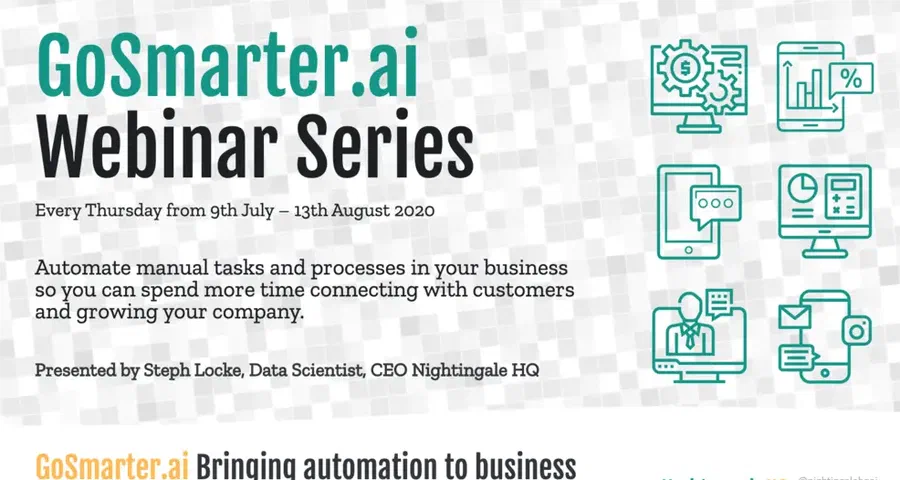
GoSmarter is an AI-powered tools and training support toolkit to help businesses optimise digital operations, saving precious time and helping increase productivity.
7 reasons why SMEs need to automate and how
- Ruth Kearney
- Learning , Archive
- Jul 3, 2020
- Updated
Going digital and using automation has never been more important to small businesses than it has been since COVID-19. Here's some stats you may not know...
5.6million UK SMEs - listen up and automate!
- Ruth Kearney
- Archive
- Jun 26, 2020
- Updated
This week on AIFightsBack, Steph Locke, CEO of Nightingale HQ, talked about the new GoSmarter automation toolbox, funded by Innovate UK and free for SMEs to use.
Categories
Tags
- Artificial Intelligence
- Automation
- Cloud Technology
- Compliance
- Continuous Improvement
- Cutting Optimisation
- Data Strategy
- Digital Transformation
- Energy Management
- Glossary
- Inventory Management
- Inventory Management for Metals
- Ireland
- Manufacturing
- Metals
- Nightingale HQ and GoSmarter
- Procurement
- Production Planning
- Quality
- Research & Innovation
- Shape Code Technology
- Small & Medium Enterprises
- Steel Industry
- Supply Chain
- Sustainability
- Steel Tariffs
- Traceability
- Trade & International Steel
- Wales