🏆 Test your reinforced steel (rebar) knowledge! Take our ShapeCode Quiz and enter to win a Shape Code Champ t-shirt

Artificial Intelligence

Artificial Intelligence Insights

Dive into our comprehensive collection of AI and machine learning content designed for business leaders and technical practitioners. We cover everything from foundational AI concepts to advanced implementation strategies, helping you understand how artificial intelligence can drive value in your organisation.

Our AI resources explore practical use cases across industries, ethical considerations, AI strategy development, and MLOps best practices. We demystify complex AI concepts and provide actionable guidance for businesses looking to adopt AI technologies effectively.

Whether you’re exploring AI for the first time or scaling existing AI initiatives, our content covers essential topics including quick wins with AI, responsible AI implementation, understanding AI capabilities and limitations, and building an AI-ready culture in your organisation. Learn from real-world examples and expert insights to navigate your AI journey successfully.

Low ROI from AI is a people problem, not a tech problem

The top blockers to effective AI use in businesses aren't technical issues. They're people problems.

Read More: Low ROI from AI is a people problem, not a tech problem
How to use Azure Cognitive Services to make voiceovers for your videos

How to use Azure Cognitive Services to make voiceovers for your videos

In this post, we take you through how to use Microsoft's Cognitive Services to generate voiceovers for your videos. In practice, this technique for generating speech from text can be used in a wide range tasks but one of the ways we're using it at Nightingale HQ is to support our marketing team.

Read More: How to use Azure Cognitive Services to make voiceovers for your videos
AI Winters and hype

AI Winters and hype

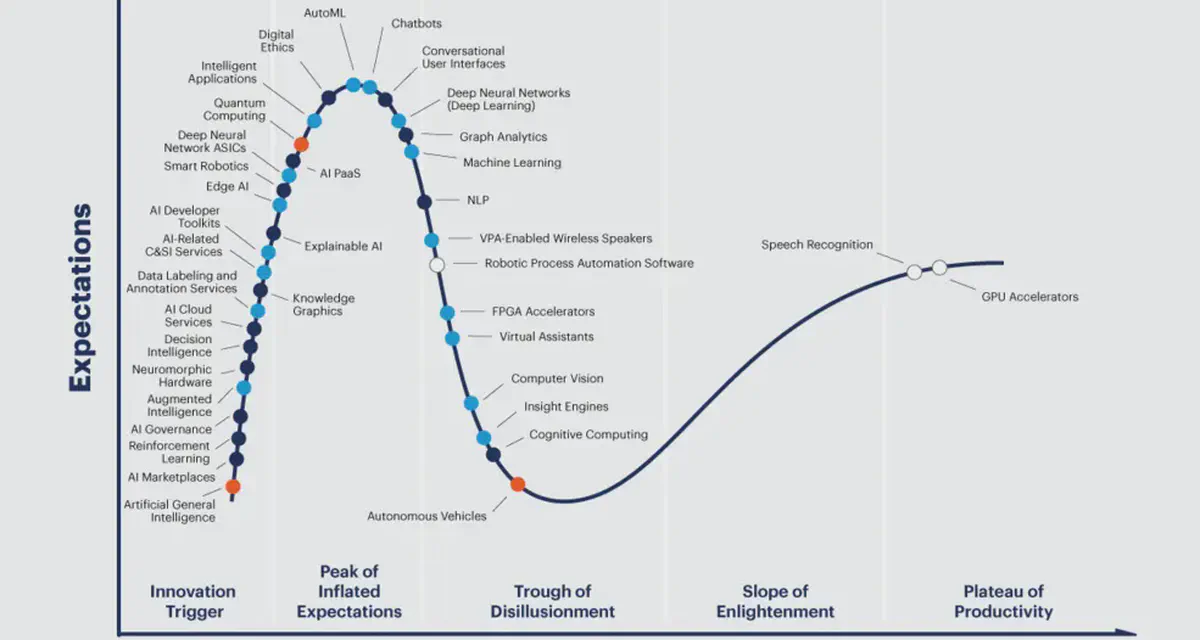
This is not the first time AI has been all the rage in the business world. In particular, AI was big in the eighties with solutions called expert systems. Will AI be a passing fad now?

Read More: AI Winters and hype
How IoT technology can be used to improve UK public transport

How IoT technology can be used to improve UK public transport

There is no shortage of possible applications when it comes to Artificial Intelligence (AI) in the public sector, but while the UK government is investing heavily in AI in the private sector, what are they actually doing to implement it themselves? Some fear that governments using AI will result in a dystopian future of constant surveillance, but in reality, public sector applications of AI are far more pragmatic.

Read More: How IoT technology can be used to improve UK public transport
DataOps for everyone at #DataOpticon

DataOps for everyone at #DataOpticon

If there’s one thing that our CEO Steph Locke is passionate about, it’s data. Getting businesses’ data AI-ready, sharing knowledge around data skills and processes, and generally empowering people through data. Back in September 2019, Steph hosted the first ever DataOpticon in London, with a simple goal: to help people who work with data do it better.

Read More: DataOps for everyone at #DataOpticon
Sealing the gap in education poverty with AI & EdTech

Sealing the gap in education poverty with AI & EdTech

Could education be the industry that has seen the least change over the years? While we’ve seen big changes in the accessibility of education, there is still a long way to go, and as pointed out by The World Bank, being in school is not the same as learning. Often pupils are unengaged, teachers are failing to hold everyone’s attention in class, and drop out rates and grades are proving that the one-size-fits-all approach to learning is outdated.

Read More: Sealing the gap in education poverty with AI & EdTech
The AI Hierarchy of Needs meets the Minimum Viable Product

The AI Hierarchy of Needs meets the Minimum Viable Product

Two of my favourite pyramids are the Data Science Hierarchy of Needs and the Minimum Viable Product. Combining them helps us build effective artificial intelligence (AI) proof of concepts in businesses. It also supports building AI competency at the same time as demonstrating Return on Investment (ROI).

Read More: The AI Hierarchy of Needs meets the Minimum Viable Product
How to score your first AI quick wins: Intelligent Insights

How to score your first AI quick wins: Intelligent Insights

There’s no doubt that going ahead with Artificial Intelligence (AI) can be risky. We’ve seen numerous AI fails from major companies including IBM, Amazon and Microsoft which landed them in hot water, something big companies can often bounce back from, but could be more of a problem for the smaller players. The trick to getting started with AI is to start small, which is where our quick win AI projects come into play.

Read More: How to score your first AI quick wins: Intelligent Insights
Mastering AI in manufacturing: the three levels of competency

Mastering AI in manufacturing: the three levels of competency

Manufacturers have been facing continual pressure to improve their technology base, reduce costs, and improve quality since the Industrial Revolution. Manufacturers are used to change but not every manufacturer can or will embrace it at the same rate. Also, no manufacturer jumps straight to being an expert at the new thing they're needing to adopt. The same goes for Artificial Intelligence (AI) as an emerging change in manufacturing.

Read More: Mastering AI in manufacturing: the three levels of competency
Industry IoT, smart factories and AI in manufacturing

Industry IoT, smart factories and AI in manufacturing

The world of manufacturing is on the brink of another revolution due to the Internet of Things (IoT) and Artificial Intelligence (AI) applications. Aside from clear use cases like robotics and automation, big data applications are coming into play, thanks to industrial time series data collected by data historians. Thriving on all this data, AI systems can be built to send early warnings, optimise processes, predict maintenance and enforce quality control. By collecting the right data, manufacturers can get really creative with their AI solutions, and it can set them apart from the competition.

Read More: Industry IoT, smart factories and AI in manufacturing