What is business intelligence?
Table of Contents Show Hide
Definition of business intelligence
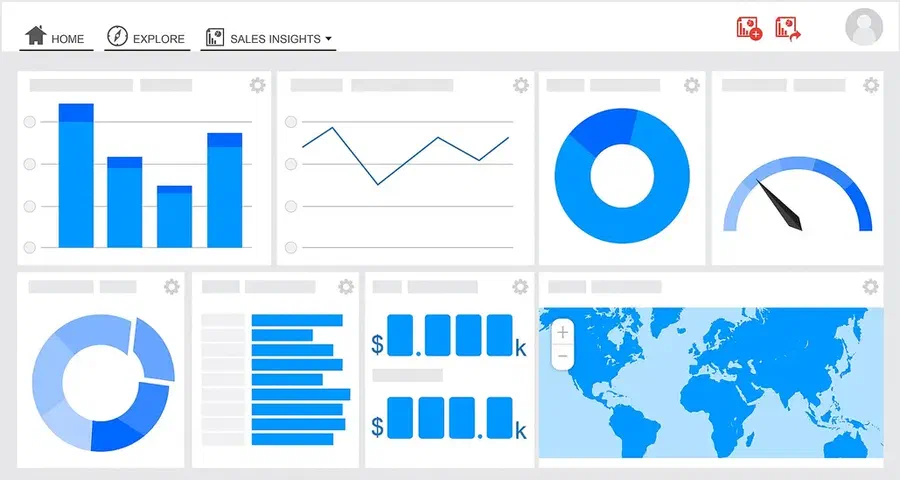
Business intelligence refers to the systematic collection, integration, analysis and reporting of data from all areas of your business — from finance and sales to worker productivity — to drive better decision making. It typically combines a data warehouse or data platform (where information from disparate source systems is consolidated), a reporting or dashboarding layer (where that data is turned into charts, tables and KPIs), and a set of processes for keeping both up to date as the business changes.
The term covers a spectrum, from a single well-built spreadsheet report through to enterprise platforms like Power BI, Tableau, or Looker that refresh automatically from live operational systems. What separates business intelligence from ad hoc reporting is consistency: the same metric, calculated the same way, available to everyone who needs it, without someone manually re-pulling numbers from five different systems every time a question comes up.
Executive view
Business intelligence gives you a clear view of your company’s performance and progress towards your strategic goals. This insight comes from applying analysis and modeling to data from all areas of your business so that you are fully informed at all times, and makes actionable insights available to all teams so that improvements to processes are made efficiently.
Business intelligence helps businesses:
streamline processes by making actionable insights available to people at all levels of the organisation.
gain a clearer view of the whole organisation’s performance.
develop a clear strategy for growth based on insights.
Business function leader view
Business intelligence helps teams to gain valuable insight into their performance and act on that insight efficiently.
Business intelligence brings value to different departments throughout an organisation:
Sales teams use business intelligence to gain a clearer view of conversion rates and insights into the quality of leads passed to them, helping them to focus their attention, keep track of their targets and improve their performance.
For companies offering physical products, having insight into seasonal trends helps purchasing departments to ensure that inventory is adequate for periods of high demand.
Getting an overview of churn rates, reviews and ticketing supports training, and improves the quality and personalisation of customer service, leading to improved customer retention and advocacy.
Finance departments can stay ahead of potential problems such as overspending and revenue downturns thanks to the predictive properties of business intelligence.
KPIs you should consider measuring for this are:
Improved conversion rate at all levels of your funnel.
Reduced stock waste.
Improved retention rates.
Reduced overspend.
Technical view
Business intelligence solutions make actionable insights available to all relevant stakeholders, reducing their dependency on IT teams to make insights available. Business intelligence solutions can be built into products to deliver insights both internally and directly to clients. For business intelligence to be successfully implemented, the structure of available data must be understood and it should be stored efficiently to allow secure and efficient access from different stakeholders.
Business intelligence helps deliver:
actionable insights and feedback.
tiered availability of data and results of analyses to different stakeholders.
insights that are tailored to the user.
Get this service if you encounter:
high demand from different departments to understand the data your company holds.
a lack of understanding of data analysis throughout your organisation.
difficulties aggregating data from disparate sources.
a need to offer tiered security access to data and insights.
Key criteria to consider are:
Which tech stack should you use to implement business intelligence?
How will you maintain the security of your data?
Is your data structured and stored in a way that allows access by your business intelligence solution?
Business intelligence in metals manufacturing
Steel and metals manufacturers generate a lot of operational data that rarely ends up in one place: order and despatch records in an ERP, cutting yield and scrap figures at the saw, mill certificate and heat traceability data attached to individual deliveries, and inventory positions that change every time a bar is cut or a delivery arrives. Without business intelligence tooling on top of that, answering a simple question — “what was our average scrap rate on 16mm B500B rebar last quarter?” — means someone manually cross-referencing several spreadsheets.
Applied to manufacturing, business intelligence typically covers:
- Yield and scrap reporting: Tracking material yield rate over time, by product, by customer, or by machine — turning cutting optimisation results into a trend line rather than a one-off report.
- Order and production throughput: Dashboards showing order backlog, on-time delivery performance, and production capacity utilisation, drawn directly from ERP and production data rather than a manually maintained spreadsheet.
- Traceability and compliance reporting: Aggregate views of certificate coverage, heat number traceability, and non-conformance trends — useful both for internal quality management and for demonstrating compliance to customers and auditors.
- Inventory visibility: A live picture of available stock by grade, diameter, and location, rather than a snapshot that’s already out of date by the time someone reads it.
The value compounds because manufacturing decisions are usually operational and time-sensitive — a purchasing decision or a cutting plan made on stale data costs real money. Business intelligence built on top of the same data your ERP and production systems already hold, rather than a separate manually maintained reporting spreadsheet, is what makes that data trustworthy enough to act on quickly.