From Zapier to GoSmarter: when spreadsheets aren’t enough for metals
- Ruth Kearney
- Blog
- August 28, 2026
- Updated:
Table of Contents Show Hide
If you are asking when spreadsheets stop being enough for metals, my short answer is this: they stop being enough when quotes, stock, certs and shop-floor status no longer match the job in front of you. That usually shows up once volume climbs, traceability gets tighter, and your team spends more time retyping data than making parts.
GoSmarter, built by Nightingale HQ, sits over the systems you already use and sorts the admin grind that spreadsheets and Zapier cannot hold together. It reads mill cert PDFs, links heat numbers to stock, keeps scrap and offcuts tied to jobs, and gives planners a live view of what is on the floor. It is for metals manufacturers who are sick of chasing files, fixing bad stock figures, and rebuilding records for audits.
What you get is simple:
- less cert entry by hand
- fewer stock arguments
- live job status instead of end-of-shift guesswork
- traceability that does not depend on one person’s inbox
- a small pilot you can test in 14 days
The point is not to bin every spreadsheet tomorrow. The point is to stop letting old admin hacks wreck good shop work. Here’s how to fix it.
Practical approaches to using artificial intelligence (AI) in manufacturing and fabrication
Where the cracks show first: quotes, stock, schedules and certs
The cracks start small: a stale quote, a missing cert, a schedule that no longer matches the floor.
Why quoting goes wrong when numbers live in five places
A sales engineer builds a quote from a pricing spreadsheet. It shows 10 tonnes of S355 plate at a known cost, plus a standard cutting charge. The margin looks fine: 15% on a GBP25,000 job.
Then reality turns up.
The spreadsheet does not show that only 6 tonnes of usable stock remain. The rest sits in live jobs or lurks in a pile of unlabelled offcuts. It misses last week’s mill price move. It ignores machine load that is already booked.
You win the order. Then the shop finds out it needs to rush-buy material at a higher rate, re-plan around offcuts nobody logged, and push back a date that sales already promised. The gap shows up only after the job goes live.
Over 80% of complex spreadsheets contain at least one serious error [8][9]. When those sheets drive your costings, this is not some abstract risk. It hits margin fast.
How traceability breaks down when certs and heat numbers are scattered
Mill certs land as PDFs. Heat numbers get typed into a separate sheet. Carbon Border Adjustment Mechanism (CBAM) data sits in customs or purchasing paperwork instead of the job record.
So when a customer or auditor asks for full traceability on a structural job, an engineer loses most of a day digging through email threads, PDF filenames and loose notes. That is not traceability. That is a paperwork scavenger hunt.
Heat numbers link the physical item to the mill test certificate and back to a specific melt, its chemistry and mechanical test results [2][4]. Break that link with manual re-keying or a badly filed PDF, and the record stops being reliable. If the chain breaks, the batch can sit there until someone rebuilds it.
EU CBAM rules make the mess worse. Where verified emissions data is unavailable, default values set at the highest observed emissions intensity apply automatically [3][5][6][7]. No benefit of the doubt. No polite second chance for a folder full of half-sorted PDFs.
Once that link breaks, audit requests stop being a record lookup. They turn into a search job.
Why your production status is always half a day behind
Operators mark jobs complete on paper travellers or a whiteboard. Then someone copies that into a spreadsheet at the end of the shift. Or after lunch, if the day has gone sideways. By the time the update hits the main plan, the shop has already made more decisions on old information.
Scrap from the morning’s cuts gets guessed, not measured. Offcuts get stacked in a corner and never entered into stock. A rush job jumps the queue on the whiteboard but not in the master schedule.
That is how you end up with:
- over-ordering
- late changes
- missed delivery dates
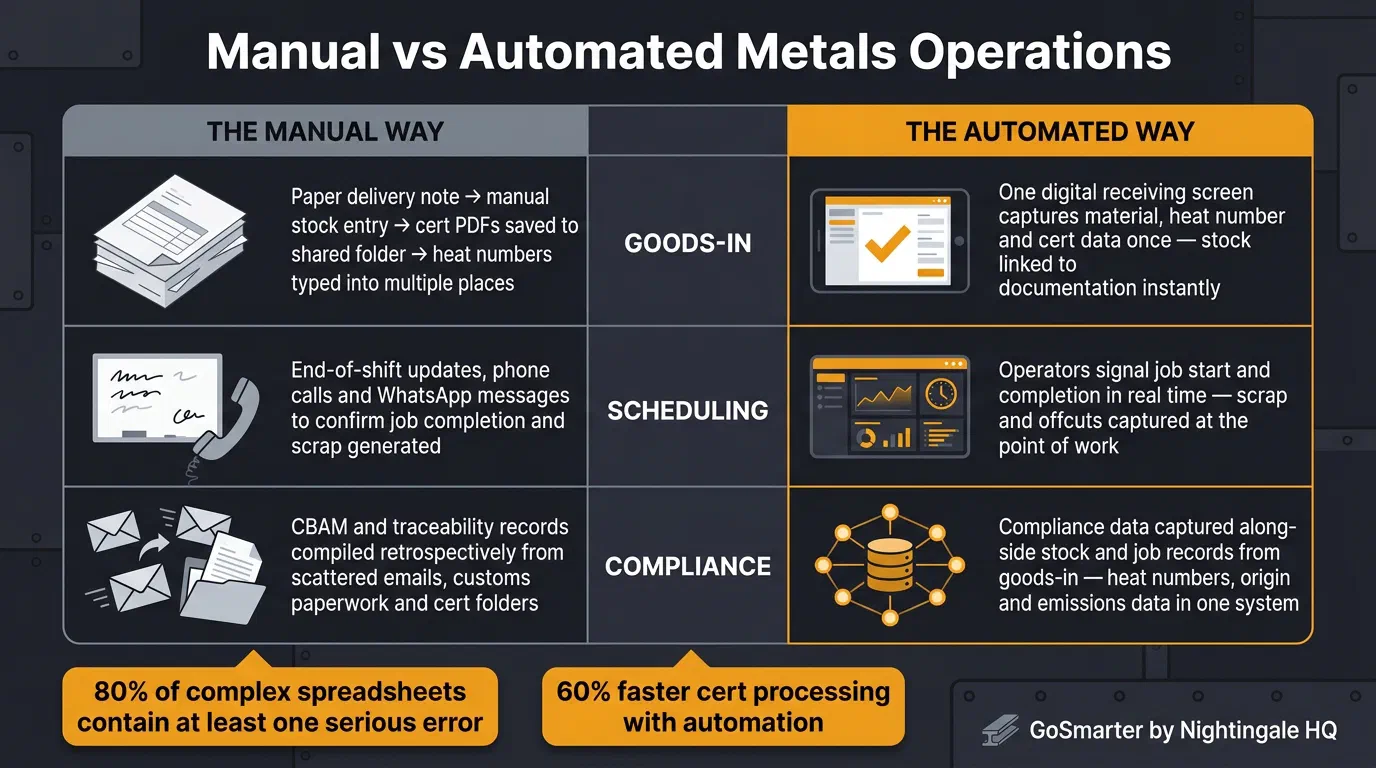
The same split shows up at goods-in, on the floor and in compliance.
| The Manual Way | The Automated Way | |
|---|---|---|
| Goods-in | A paper delivery note, a manual stock entry and cert PDFs saved to a shared folder, with heat numbers typed into multiple places. | A single digital receiving screen captures material, heat number and cert data once, linking stock to its documentation straight away. |
| Scheduling | End-of-shift updates, phone calls and messages to confirm what is complete and what scrap was generated. | Live updates from the shop floor: operators signal job start and completion in real time, with scrap and offcuts captured at the point of work. |
| Compliance | CBAM and traceability records compiled retrospectively from scattered emails, customs paperwork and cert folders. | Compliance data captured alongside stock and job records from goods-in, with heat numbers, origin and emissions data stored in the same system that drives production. |
That is the hand-off GoSmarter, built by Nightingale HQ, removes.
What changes when GoSmarter becomes the operating layer
The problem was never effort. Your team already put the work in. The problem was the mess. Data lived in too many places, so every handoff gave errors and delays another chance to creep in.
GoSmarter, built by Nightingale HQ, fixes that by linking certs, stock, jobs and scrap in one live operations layer on top of your current ERP or accounts system.
So instead of certs, stock, jobs and scrap sitting in separate files, they update in one place. No more digging through folders, inboxes and spreadsheet tabs just to work out what happened.
The first wins usually show up in cert entry, traceability and live planning.
How MillCert Reader stops cert entry eating engineering time
Mill certificates arrive in all sorts of layouts. Every mill, service centre and inspection body seems to have its own idea of a sensible format. That means manual extraction is slow from the start.
Across the metals industry, manual cert keying carries a 2-5% error rate [1]. One mis-keyed heat number can send the wrong material into a critical production order. That’s not admin fuss. That’s a shop-floor problem.
MillCert Reader deals with this by reading the PDF as it arrives. It pulls the fields you need, including:
- heat number
- grade
- dimensions
- chemical composition
- mechanical properties
- inspector reference
It then checks those fields against expected formats before it creates a linked cert record in GoSmarter.
That changes the engineer’s job. Instead of burning an hour typing cert data, they review auto-filled records and deal with exceptions. That’s a much better use of engineering time.
When someone needs a heat number, whether it’s a customer, an auditor or someone sorting out a non-conformance, staff can search GoSmarter by that reference and see the cert straight away. They can also see the jobs that used material from that heat, plus any offcuts or scrap tied to it. That beats rummaging through shared drives, email attachments and half-forgotten spreadsheets.
How Product Lineage and Business Manager keep stock, scrap and traceability together
Once you’ve captured certs, the next headache starts: keeping that material history tied to every cut and offcut.
Product Lineage keeps that chain of custody from the minute material lands on site. When steel is booked in, the system records its heat code and cert. As it moves through cutting and production, Product Lineage records which lengths went to which orders and what offcuts came out of the job. The link between the physical item and its paperwork stays in place without someone babying it by hand.
Business Manager works alongside that. It gives planners and managers one connected view of inventory, open orders, scrap and offcuts.
A planner can search a heat code and see:
- booked-in quantity
- cuts
- offcuts
- scrap
That makes it much easier to answer, “Can we satisfy this new order from existing offcuts?” before you buy more material you may not need.
How Production Planner gives the floor a plan that matches reality
Once stock and scrap are live, planning can finally use what’s there. Not what was there yesterday. Not what someone thinks might still be on the rack.
Production Planner pulls live inventory, offcuts and order demand from Business Manager to build first-draft plans. Instead of making a schedule from a static stock list and a separate order sheet, it looks at the lot together. That includes available lengths, known offcuts, required quantities, promised delivery dates and machine limits.
Using suitable offcuts before cutting new stock, and sorting cut patterns across multiple orders instead of planning each job on its own, can cut scrap by several percentage points on often-cut products such as flat bar or tube [11].
GoSmarter sits on top of current ERP systems through CSV export or REST API. So you don’t rip out the systems you already use. You add a layer that handles the metalwork mess properly. The shop floor gets a plan based on live, cert-backed material, not yesterday’s guesswork.
What day-to-day work looks like when the data joins up
Once certs, stock and jobs sit in one system, you stop guessing and start seeing what’s happening on the shop floor. That’s the bit that matters. Not the software demo. Not the dashboard fluff. The actual Tuesday morning mess: a wagon turns up, jobs are half-cut, and someone’s already asking for a cert.
Booking in steel without losing the cert before lunch
A delivery arrives. The stores operator checks the order, records the grade, dimensions, supplier, heat number and quantity, and uploads the mill certificate. In GoSmarter, built by Nightingale HQ, the certificate attaches to the stock record straight away. You can find it later by heat number, supplier or certificate date.
That matters when the customer wants the cert now. A quality manager who needs to prove the origin and properties of a batch before noon can pull the right certificate in seconds. No inbox search. No rummaging through a shared drive. No calling the person who booked the delivery to ask where they dumped the file.
If the heat number lives in one file and the cert lives in another, steel traceability turns into a paper chase. That’s not quality control. That’s admin with steel in the background. The same link keeps the material record intact when the job moves into production.
Updating work orders without the WhatsApp chase
In a manual setup, cutting completion might go on a whiteboard, then into a spreadsheet later, then over to the next operation on WhatsApp. Every handoff gives you another chance to miss something or work from old info.
With GoSmarter, the operator marks the operation complete in the system. Offcuts go back into stock with a quantity and reason code attached. The next operation sees the updated status straight away. No message. No supervisor doing laps of the shop floor to check what’s actually done.
That changes how planners and supervisors work:
- They can see what’s running
- They can see what’s queued
- They can see what’s ready to move
So instead of chasing, “Is that cut done yet?”, they get a live view of the work. When several jobs are moving at once, that saves a lot of faff. It lets you plan the next move instead of spending the day putting out fires. The same live record also kills the month-end scramble for scrap and CBAM data.
Keeping scrap, carbon and compliance records straight
Scrap handling often ends up as a month-end grind. Someone rebuilds usage figures from notes, shift logs and spreadsheet entries, and the numbers still don’t quite match. For CBAM reporting, the records need to show material usage, scrap ratios and pre-consumer scrap percentages, and they have to be retained for six years [13][12]. A manual setup leaves plenty of room for missing data and awkward questions later.
When you capture scrap weight and reason codes at the point of work, and tie them to the job, the material and the heat number, the record already exists. You don’t need to rebuild it after the fact. The same data that supports stock control and job costing also supports compliance submissions, without a second manual process bolted on afterwards.
Once the data stays with the material and the job, the next question is how that changes planning on the floor.
Start with your next batch of certs and prove it fast
You do not need some bloated transformation project. Pick one painful process. Test it for two weeks. Measure the before and after.
If certs or heat numbers are the headache, start there. Mill certificates and heat-code traceability make sense as a first pilot because the failures already mentioned, missing certs, slow lookup, audit pressure, usually hit here first. Pick one supplier or one customer compliance workflow. Trial it there.
Upload your next batch of mill certificates to MillCert Reader from GoSmarter, built by Nightingale HQ. It reads the PDFs directly. It pulls out the key fields without retyping. It links heat numbers to stock records. It makes each certificate searchable as soon as you upload it.
GoSmarter runs alongside your current spreadsheets from day one, so you can test it without a cutover. Run both in parallel for the first 14 days. Cross-check the data. Automated certificate processing is 60% faster than manual entry [10]. That is not some fluffy KPI. You will see it in the first week if the trial stays tight.
If cert entry is not the main mess, use material movement as the pilot instead. Product Lineage suits shops where the bigger pain is linking receipts, offcuts, and later jobs rather than typing speed. Measure how long a heat-number or traceability query takes before and after the trial.
If this article landed because a customer chased a cert, a heat number went missing, or a compliance record took ages to piece back together, that is your pilot. Start there. Prove the gain is real. Check that you can repeat it. Then expand from that point.
FAQs
When do spreadsheets become a risk in metals?
Spreadsheets turn into a problem in metals manufacturing when they stop being a reference and become the live system for inventory, quoting, scheduling and traceability.
That is where the mess starts.
Once several people keep their own versions, errors creep in through manual entry, and teams start using spreadsheets to track live stock allocation and compliance records like EN 10204 mill certs, you lose control fast. You can’t reliably check grade against application. You can’t rebuild a clean audit trail either.
This is the bit old software never admits. A spreadsheet looks harmless right up until it runs work that affects stock, quality, and compliance. Then one wrong cell can cost you time, scrap, or a nasty argument with a customer.
Can GoSmarter work with our current ERP and spreadsheets?
Yes. GoSmarter, built by Nightingale HQ, works with your current ERP and spreadsheets. It does not rip them out.
You can keep your ERP for finance, purchasing, and sales. GoSmarter handles the shop-floor admin your ERP usually makes a mess of, like inventory tracking and mill certificate management.
You have a couple of ways to connect it:
- CSV imports if you want a simple setup
- REST API connections if you want data to sync on its own
That means you can keep the systems you already rely on, while GoSmarter sorts the operational grind.
What should we test first in a 14-day pilot?
Start where manual errors hit most or where your team wastes the most time on repeat admin. A good first test is mill certificate tracking. It gives you a high-value win without dragging the whole site into a software circus.
Then upload your current stock list. Move your first cutting plan into GoSmarter, built by Nightingale HQ, by day four. Run it next to your existing spreadsheets and check the numbers line by line.
Tags:
About the Author

Co-Founder & CEO
Ruth Kearney is Co-Founder and CEO of GoSmarter AI — driving commercial growth and strategic partnerships to help metals manufacturers adopt AI and digital tools that actually deliver on the shop floor.