Your Mill Certs Are Your Superpower
- Ruth Kearney
- Blog
- June 16, 2026
- Updated:
Table of Contents Show Hide
In the metals industry, every piece of steel tells a story. Where it was produced. Which mill made it. What heat it came from. Whether it meets the required standard. Whether it is safe to use in a bridge, a pressure vessel, an offshore platform, or critical infrastructure.
One document holds that story: the Mill Test Certificate (MTC), often called a Material Test Report (MTR).
Most procurement teams treat Mill Certs as paperwork. The certificate arrives with the delivery, someone files it for compliance, and everyone moves on. The best manufacturers, fabricators, and stockholders see it differently. Your Mill Certs are your superpower. They are the foundation for traceability, quality assurance, risk management, customer confidence, and operational excellence.
What is traceability?
Traceability is the ability to track material across its entire lifecycle. It follows the metal from the producing mill to the finished product you deliver to the customer.
A strong traceability system answers critical questions instantly:
- Where did this material originate?
- Which heat or batch did it come from?
- What chemical and mechanical properties does it have?
- Which supplier provided it?
- Which customer received it?
- Which standards and specifications does it meet?
In regulated industries, these questions are not optional. They are fundamental. Traceability protects safety, quality, and compliance. It applies whether you make structural steel, pressure vessels, offshore components, rail infrastructure, aerospace parts, or medical devices.
Why traceability matters more than ever
Modern supply chains are more complex than ever. Material often passes through several suppliers, processors, distributors, fabricators, and subcontractors before it reaches its final home. Every handoff creates risk.
Without proper traceability, you expose your business to material mix-ups, compliance failures, and quality disputes. Product recalls, customer claims, regulatory penalties, and reputational damage follow.
When something goes wrong, you need to identify the affected material quickly and confidently. The companies that do this well protect both their customers and their bottom line.
Mill Certs: the backbone of traceability
A Mill Cert is documented proof that material meets the required specification. It carries the critical detail:
- Heat numbers
- Material grades
- Dimensions
- Chemical composition
- Mechanical properties
- Applicable standards
- Manufacturer information
- Testing results
Each certificate creates a permanent link between the physical material and its manufacturing origin. Break that link and true traceability becomes impossible.
Every bar, plate, beam, coil, pipe, or fitting traces back to a specific heat and production batch via the certificate. That is why Mill Certs are often the most important documents in a metals business.
The hidden value of heat numbers
A heat number is far more than a reference code. It acts as the DNA of a material batch.
Say a quality issue surfaces months, even years, later. The heat number lets you:
- identify affected material immediately
- locate stock still in inventory
- work out which customers received material from the same batch
- isolate the risk
- prevent wider disruption
Instead of investigating thousands of tonnes, you focus on the specific batches affected. What could have become a major crisis becomes a controlled quality process.
Traceability creates competitive advantage
Many companies treat traceability as a compliance requirement. Leading organisations treat it as a competitive advantage.
Customers increasingly demand proof of quality, sustainability, compliance, and origin. When a customer requests certification documentation, a business with strong traceability responds in minutes, not hours or days.
The payoff shows up across the operation:
- Faster project approvals
- Greater customer confidence
- Less administration
- Better audit readiness
- Stronger supplier relationships
- Higher quality standards
In competitive markets, these advantages matter.
The problem with manual traceability
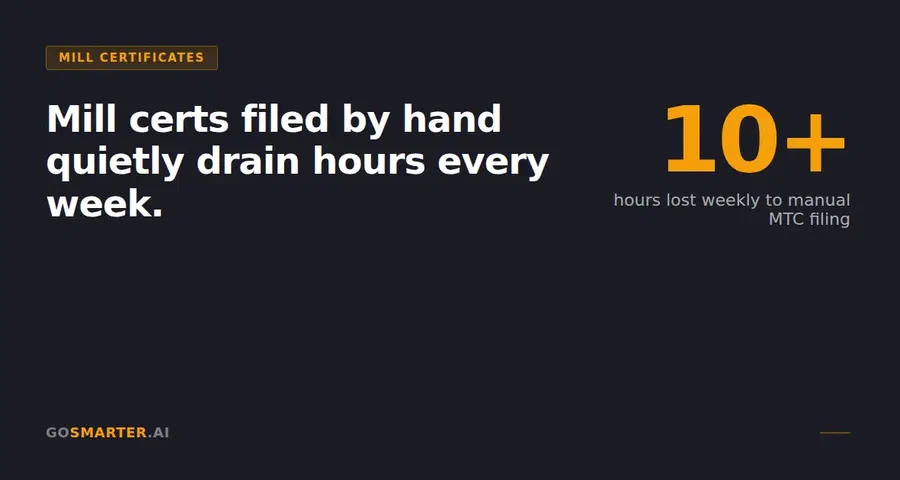
Despite all this, many businesses still manage Mill Certs by hand. Certificates sit in email folders, on shared drives, renamed manually, linked to spreadsheets, or filed in physical folders.
This approach creates real problems. Finding a certificate takes hours. Building a customer quality pack becomes a manual chore. Heat-code searches turn painful. Audit preparation gets stressful.
Worst of all, the traceability information stays trapped inside portable document format (PDF) files. It never becomes searchable business data.
Turn Mill Certs into a strategic asset
The most forward-thinking manufacturers turn their Mill Certs from static documents into digital assets. When you digitise and extract certificate information, you build a searchable traceability system. It connects procurement, inventory, production, quality, compliance, and customer deliveries.
Instead of searching through folders, your team locates any material record, heat number, grade, supplier, or certification history in seconds. That changes the role of the Mill Cert entirely. It becomes operational intelligence, not administrative paperwork.
How Mill Cert Manager strengthens traceability
Mill Cert Manager (built by Nightingale HQ) was made to solve exactly this challenge for metals manufacturers, fabricators, stockholders, and distributors.
Using Artificial Intelligence (AI), the platform automatically extracts and structures the key information from a Mill Cert:
- Heat numbers
- Material grades
- Dimensions
- Chemical properties
- Mechanical properties
- Standards and certifications
The result is a digital traceability system. You search certificates instantly, track material across the supply chain, and build compliance packs quickly. Audit readiness improves, manual admin drops, and customer confidence grows. Most importantly, your critical material information stays accessible when it matters most.
When Mill Cert Manager feeds clean data into Metals Manager, the link between cert, stock, and order never breaks. You get integrated cert traceability from goods-in through to despatch.
Your Mill Certs are more than compliance documents
Every delivery of steel, aluminium, stainless steel, titanium, or speciality alloy arrives with valuable data attached. The only question is whether that data stays buried in PDFs or becomes a strategic asset.
The companies that embrace traceability do more than meet a compliance requirement. They build stronger supply chains, improve quality, reduce risk, and create competitive advantage.
In modern metals procurement, traceability is not just about knowing where material came from. It is about knowing exactly where your business is going.
Less paper. More metal. With Mill Cert Manager, your Mill Certs become more than documents. They become your superpower.
Frequently Asked Questions
What is a Mill Test Certificate (MTC)?
Why is traceability important in metals procurement?
What is a heat number and why does it matter?
How does Mill Cert Manager improve traceability?
What goes wrong when Mill Certs are managed manually?
Further Reading
- Mill Cert Manager: Automate Mill Certificate Processing — extract and link your incoming Mill Certs automatically
- AI for Mill Test Report Traceability
- Audit Trails: Because ‘I Think It Was Dave’ Isn’t a Defence
- Metals Manufacturing Glossary — heat numbers, MTCs, and traceability in plain English
About the Author

Co-Founder & CEO
Ruth Kearney is Co-Founder and CEO of GoSmarter AI — driving commercial growth and strategic partnerships to help metals manufacturers adopt AI and digital tools that actually deliver on the shop floor.