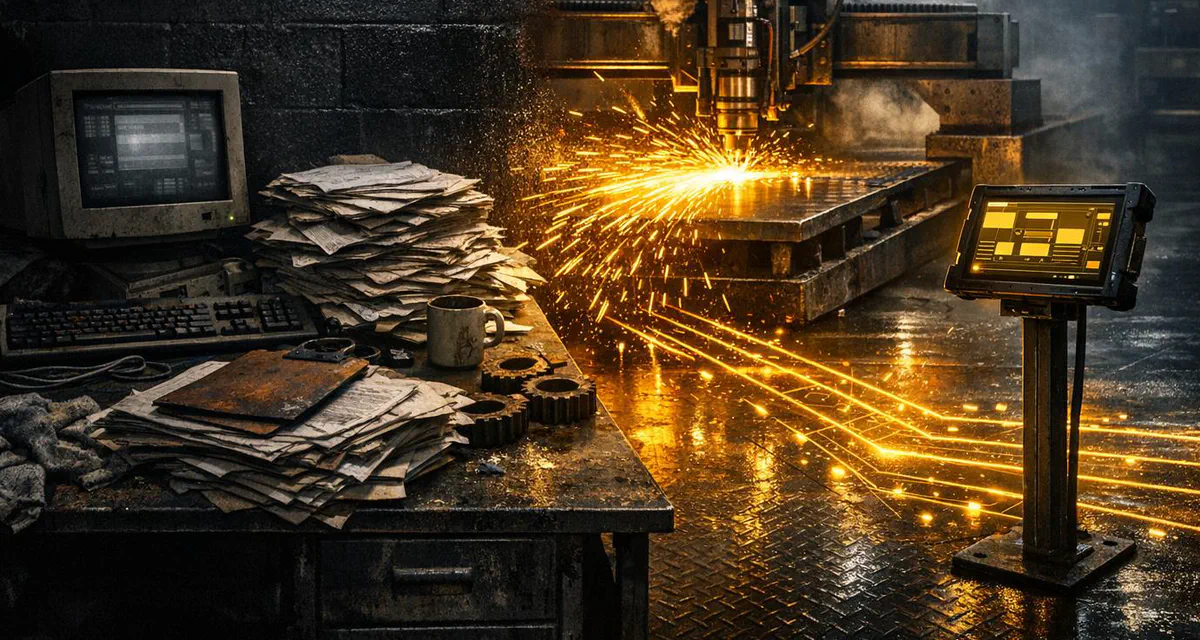
Why Does Your Work Software Look Like Windows 95? (And Why It’s Costing You Money).
- BlogSmarter AI
- Blog
- February 27, 2026
Table of Contents
Stop me if this sounds familiar: your shop floor is running on multi-million-pound machines, but the software looks like it was pulled straight from 1995. Clunky interfaces, cryptic workflows, and manual data entry everywhere. It’s not just ugly - it’s eating into your profits every single day.
Here’s the hard truth: sticking with outdated systems isn’t saving you money. It’s quietly burning through your IT budget, wasting operator time, and creating a mountain of inefficiencies that slow down production. Every second wasted navigating clunky screens or fixing manual errors is another pound lost.
The good news? There’s a way out. Modern tools like GoSmarter are built to fix the mess without tearing apart your existing systems. From automating mill cert processing to slashing scrap rates by up to 50%, these tools cut through the drudgery so your team can focus on what matters: hitting targets and protecting margins.
The Old Way vs. The Smart Way
| The Old Way | The Smart Way |
|---|---|
| Typing data from PDFs into spreadsheets | AI reads and organises it in seconds |
| Guessing at cutting plans | AI optimises to cut scrap by 50% |
| Hours of manual scheduling | Automated schedules in minutes |
You don’t need a years-long IT overhaul to get started. Just upload your data, let the AI run in the background, and see the results for yourself. It’s time to stop running your business on 1995 tech. Let’s fix this.
Upgrade Your Manufacturing Systems From Legacy to Smart Tech
How Old Software Drains Your Budget and Productivity
Outdated software isn’t just a minor inconvenience - it’s a hidden drain on your resources. From wasted labour hours to missed opportunities for optimisation, the costs add up fast.
Errors and Waste: The Hidden Price Tag
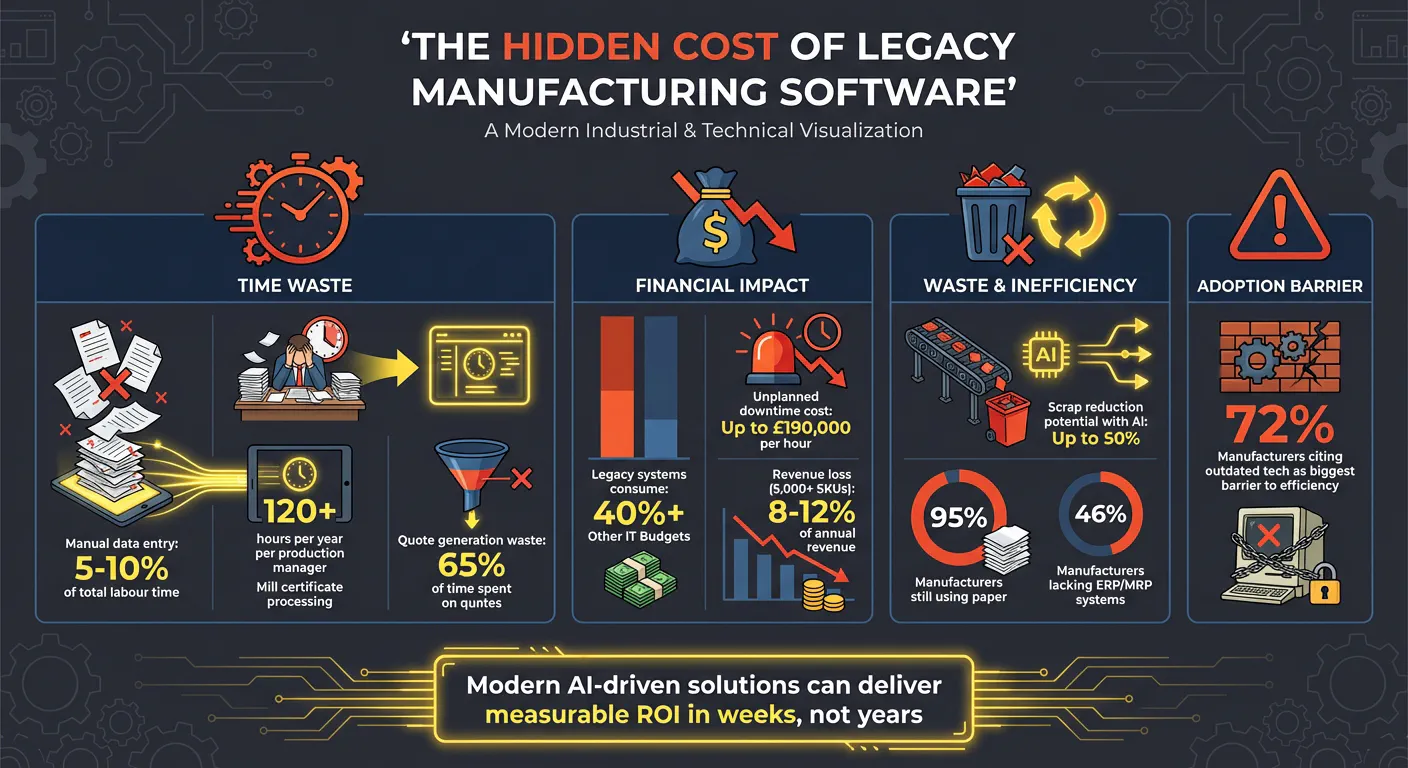
Transferring data manually - whether from paper to Excel or into an ERP system - eats up 5–10% of total labour time [4]. And it’s not just a time sink; every manual entry increases the chance of errors. A single incorrect formula or outdated material price can wipe out your margins in an instant [1].
Take mill certificates as an example. Searching through PDFs, renaming files, and manually entering heat numbers into spreadsheets can cost a production manager over 120 hours every year [5]. Worse, by the time these manual reports are ready, the information is often outdated, forcing you to rely on gut instinct instead of real-time data [4]. These inefficiencies don’t just slow you down - they make automation nearly impossible.
What Automation Could Be Saving You
Clinging to outdated systems doesn’t just lead to errors - it also locks away insights that could transform your operations. Old software often operates like a black box, with undocumented processes and siloed data that prevent advanced analytics from being used effectively [7]. Without proper data connectivity, implementing tools for predictive maintenance or real-time optimisation becomes a pipe dream.
For instance, manual production planning for long products results in far more scrap than AI-driven cutting plans. Automation can slash scrap rates by as much as 50% [5]. And this isn’t a niche issue - 72% of manufacturers identify outdated technology as the biggest barrier to improving efficiency and growth [6]. Every day without automation is another day of wasted potential.
The Escalating Cost of Legacy Systems
Running old systems doesn’t just cost you in efficiency; it’s a direct hit to your bottom line. Legacy software consumes over 40% of IT budgets [7], and ageing hardware paired with fragile integrations leads to unplanned downtime. This downtime can cost up to £190,000 per hour [7]. That’s not all - outdated quoting processes waste 65% of the time it takes to generate quotes [8], and operations with 5,000+ SKUs lose 8–12% of annual revenue due to inefficiencies [8].
As Robert Kramer, VP & Principal Analyst at Moor Insights & Strategy, explains:
“The real risk isn’t that the old systems ‘still work,’ but that they quietly undermine capacity, flexibility and competitiveness in ways that become harder to unwind over time” [2].
The longer you stick with outdated systems, the more these hidden costs pile up, holding back your business in ways you might not even realise.
Modern Software Built for Metals Manufacturing
Modern solutions are stepping in to handle the inefficiencies that have long plagued metals manufacturing. Tools like GoSmarter seamlessly integrate with your existing systems - whether you’re using a legacy ERP or just Excel spreadsheets - to automate repetitive tasks and reduce costs.
AI Tools That Solve Real Problems
GoSmarter offers tools designed to tackle specific challenges. Take the MillCert Reader, for instance. This AI-powered feature extracts chemical compositions and mechanical properties from mill certificates in seconds. It then renames and organises PDFs by heat code automatically. In June 2025, Midland Steel’s Production Manager adopted this tool and saw immediate results, slashing admin time spent on typing product codes and digging through bulky PDF files. They shared:
“I logged in for the first time and was up and running in minutes. MillCert Reader now pulls all the key info - chemical composition, mechanical properties - automatically. What used to take hours every week is done in seconds” [9].
Another standout tool, the Long Product Optimiser, uses genetic algorithms to evaluate thousands of cutting combinations. It matches inventory with open orders to create efficient cut lists, cutting scrap rates by up to 50% [5]. Building on this, the Smart Production Scheduler helps plan daily production runs, reducing waste and improving delivery times - all without the need to overhaul your existing systems.
These tools work together effortlessly, delivering immediate benefits without disrupting operations.
Quick Setup, No Hassle
Forget about long-winded consultancy projects. GoSmarter’s zero-configuration setup lets you get started right away. Whether it’s processing mill certificates or planning production, the platform is ready to go as soon as you log in [3][5]. Want to try the production planner? Just upload your inventory and orders in Excel or CSV format, and you’ll instantly see projections for scrap and offcuts. No IT expertise is needed, and there are no hidden fees - just straightforward, usage-based pricing [3].
This straightforward approach ensures you see results quickly and easily.
Measurable Results: Time, Waste, and ROI
The numbers tell the story. Midland Steel, a rebar manufacturer operating in the UK, Ireland, and Norway, achieved a 50% reduction in scrap rates - hitting an industry benchmark - after implementing the Rebar Optimiser [9][11]. Tony Woods, CEO of Midland Steel, highlighted the broader impact:
“Smart technology choices can have a direct, measurable impact on reducing carbon emissions in steel manufacturing. The integration of AI and digital tracking has significantly improved our operational efficiency and sustainability performance” [3].
In another example, MAAS Precision Engineering leveraged GoSmarter’s tools in 2025 to streamline operations and train their teams in advanced workflows [11]. Tadhg Hurley, Managing Director, reflected:
“Choosing the right digital tools is no different [than precision tools]. We’re constantly seeking ways to improve our systems and processes with technology, and this has been a great opportunity to accelerate our adoption of smarter tools” [3].
These examples showcase how modern software can deliver real-world results, from cutting waste to boosting efficiency and sustainability.
How to Move Away from Legacy Systems
Leave behind outdated systems like Windows 95 without committing to a years-long IT overhaul. The key? Start small, demonstrate results quickly, and avoid dismantling systems that still manage to function.
Step 1: Pinpoint Weaknesses in Your Current Software
Before making any changes, take a hard look at where your current setup is falling short. Operational inefficiencies can quietly drive up costs, so it’s crucial to identify the trouble spots. Focus on the “Golden Signals” - the top 20% of data points like motor current, temperature, and cycle time that account for 80% of your operational value [12]. If your processes depend on manual data entry or unreliable spreadsheets, that’s a major warning sign [1][3]. Another issue is isolated systems - if your PLC and SCADA systems operate independently with inconsistent naming conventions, you’re left unable to compare data across production lines or locations [12]. High material waste due to rough cutting estimates is another glaring problem [5]. Shockingly, nearly half of manufacturers (46%) aren’t even using ERP or MRP systems for supply chain management [1]. If that’s your situation, you’re essentially navigating blind.
Once you’ve identified these gaps, look for a solution that integrates seamlessly with what you already have.
Step 2: Introduce GoSmarter Without Disrupting Operations
You don’t need to tear out your existing systems to modernise. GoSmarter follows a “wrap-and-extend” approach, using integration layers like edge gateways or middleware. These listen to your existing PLC and SCADA signals without altering the control logic [12][13]. To get started, simply upload your inventory and order data in Excel or CSV format - no IT expertise required [3][5]. Run GoSmarter in “shadow mode” for 4–6 weeks, allowing the AI to process data and make predictions in the background. This lets you verify its accuracy before incorporating it into your live operations [12].
As Arun Mehta, Head Digital at Coca-Cola, puts it:
“Don’t start with AI tools; start by fixing data ownership and definitions around one real problem, like unplanned downtime or energy loss” [12].
Pick a single high-impact issue - whether it’s processing mill certificates or cutting down scrap rates - and tackle that first. Once the integration process begins, make sure to measure the results immediately.
Step 3: Monitor Your Progress
After implementation, track the improvements in time savings and waste reduction. Tools like the GoSmarter Business Case Calculator can help you create detailed cost–benefit reports for stakeholders [5][10]. Getting maintenance and operations teams involved early ensures they trust the data and use it effectively [12]. For example, a Plant Energy Manager at an integrated steel manufacturer discovered their #2 reheating furnace was burning 15% more fuel than #1 under identical conditions - all within the first month of real-time monitoring:
“That single finding paid for three months of the system cost” [10].
This kind of clear, measurable result highlights the value of moving past outdated systems.
Stop Running Your Business on 1995 Technology
Why You Need to Change Now
Clinging to spreadsheets and manual workflows isn’t just inconvenient - it’s a losing strategy. Shockingly, 95% of manufacturers still rely on paper for at least part of their operations [14]. These outdated systems drag down efficiency, open the door to cybersecurity threats, and make compliance with regulations a headache [13][1]. The longer you delay modernisation, the more you’re stuck with a tangled web of tools that stifles progress and hikes up the cost and complexity of future upgrades [14]. Worse, older systems can’t easily integrate cutting-edge technologies like AI and IoT, leaving you flat-footed when the market shifts [13]. This rigidity compounds the operational and financial challenges you’re already facing, making it even harder to stay competitive.
Gartner analyst Stefan Van Der Zijden sums it up perfectly:
“When a tipping point is reached, application leaders must look to application modernization to help remove the obstacles” [13].
That tipping point isn’t on the horizon - it’s already here.
Get Started with GoSmarter
The solution? Start small with GoSmarter’s tools. Thanks to their “Start for free” model, you can experiment with features like the MillCert Reader or Scrap Optimiser without locking into a long-term contract [3]. Use your existing inventory data, run the AI in shadow mode for a few weeks, and let it demonstrate its value before you change a single workflow. Tony Woods, CEO of Midland Steel, shares his experience:
“The integration of AI and digital tracking has significantly improved our operational efficiency and sustainability performance” [3].
His company even slashed scrap rates by 50% using GoSmarter’s AI-driven production planning tools [5].
It’s time to ditch the costly manual tasks and constant firefighting. Shift to a unified digital system that automates repetitive jobs like reading mill certificates, renaming PDFs, and calculating offcuts. This frees up your skilled staff to focus on work that genuinely matters [3][5]. The tools are ready, the results are proven, and the only question left is this: will you still be stuck in 1995 while your competitors surge ahead?
FAQs
How do I know which legacy workflow is costing us the most money?
To uncover where your operations are bleeding time and money, start by looking at areas plagued by delays, manual data entry, or missing data insights. These are often the usual suspects behind inefficiencies.
Common problems include:
- Bottlenecks that slow production
- Unplanned downtime eating into schedules
- Quality control issues leading to rework or waste
- Inventory mistakes that disrupt supply chains
Systems that don’t provide real-time data or demand repetitive data entry are often responsible for sneaky, hidden costs. By carrying out a thorough audit of these trouble spots, you can identify the processes that are quietly draining your profits.

