Why Metals Manufacturers Need a Phased Approach to Digital Transformation
- Ruth Kearney
- Blog
- April 21, 2026
- Updated:
Table of Contents Show Hide
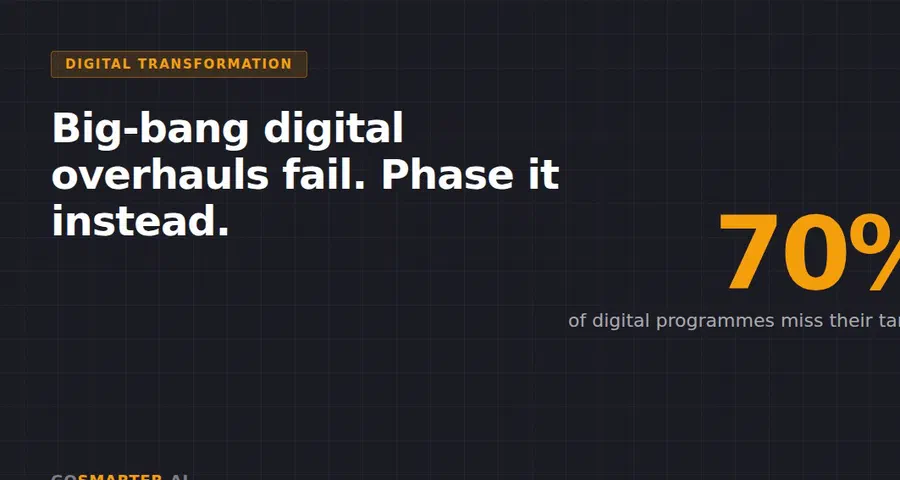
Seven in ten digital transformation programmes fail to hit their objectives. Not because the technology fails. Because manufacturers try to do everything at once.
For metals manufacturers (steel stockholders, service centres, fabricators), the problem is worse than most industries. You are dealing with complex material traceability requirements, ageing legacy systems, and a workforce that has spent twenty years making imperfect paper processes work. Dropping a dozen new platforms on them simultaneously does not accelerate transformation. It creates chaos, burns budget, and ends with half the project quietly shelved while everyone goes back to spreadsheets.
A phased approach fixes this. Start with the processes where the data is cleanest and the risk is lowest. Prove ROI quickly. Build the internal capability and confidence to go further. Then tackle the factory floor.
McKinsey research on successful transformations consistently finds that the programmes that succeed share one characteristic: they break the work into stages with clear milestones and visible wins at each one.
Here is what that looks like for metals manufacturing, and the three-stage maturity framework you can map your own business against today.
What this post covers:
- Why big-bang transformation fails metals manufacturers at a higher rate than most industries
- What a phased approach means in practice: back-office first, systems integration second, factory floor third
- The specific risks of connecting too early: ransomware exposure, staff resistance, data that is not ready
- A practical 3-stage maturity framework to assess where your business sits right now
The Big-Bang Problem: Why “Do Everything Now” Always Costs More Than It Saves
A big-bang transformation programme promises to modernise everything in one go. New ERP. New MES. IoT sensors across every production line. Real-time dashboards. Cloud migration. The system integrator gets paid. The project runs six months late. The budget doubles. And eighteen months in, half the promised features are switched off because nobody had the bandwidth to train people to use them.
This pattern is not an edge case in metals. It is the default.
The reason is structural. A steel stockholder processing 500 tonnes of mixed-grade material a week cannot pause production to wait for a software rollout to stabilise. Your sales team cannot stop quoting while the ERP is being reconfigured. Your quality manager cannot stop reviewing certs while the document management system is being migrated. Every failed phase of the project lands on staff who are already stretched.
The result is that people route around the new system, return to spreadsheets, and your “digital transformation” becomes a very expensive filing cabinet.
What a Phased Approach Actually Means
A phased approach is not moving slowly. It is moving in the right order.
Each phase builds the data foundations, internal skills, and commercial justification that the next phase depends on. Skip a phase and you absorb the risk of the one that follows without the preparation it needs.
For metals manufacturers, three phases map cleanly onto how the business actually operates.
Phase 1: Back-Office and Operational Processes
The first phase targets the processes that are already mostly digital, mostly documented, and mostly painful to run by hand: mill certificate management, inventory tracking, quoting, and order processing.
These processes are expensive to do manually. Automating them carries low risk. You are not connecting to production machinery. You are not touching live process control. You are reading PDFs, matching data, and updating records — and eliminating the hours of drudgery that sit between steel arriving at goods-in and that information being usable.
This is exactly the territory that GoSmarter’s tools are built for:
- MillCert Reader reads mill certificates and extracts heat numbers, material grades, and chemical compositions in under 15 seconds per page. The data links directly to your stock records, with no manual re-keying and no cert disappearing before an audit.
- The cutting optimiser tackles the 1D and 2D cutting stock problem automatically, generating cut plans that reduce offcuts and protect your material margins without asking your best estimator to spend three hours on a spreadsheet.
- Inventory tracking gives you a live, structured view of what is on the floor — by grade, by heat, by location — rather than a spreadsheet that nobody has updated since last Tuesday.
Both tools are pay-as-you-go and non-invasive. They work alongside what you already have. There is no six-month implementation project and no requirement to replace your ERP.
Phase 1 delivers measurable ROI inside three months. Midland Steel recovered 10 hours a month just from automating their mill certificate renaming and data extraction. That is not a transformation. It is a quick win. And quick wins are what fund Phase 2 and prove to leadership that digital tools actually work.
Phase 2: Asset Configuration and Systems Integration
Once your data processes are working cleanly and consistently, Phase 2 connects them to the wider business. This means integrating your ERP with your quoting and inventory tools, linking your purchasing process to live stock data, and activating the software layer that already sits on top of your production equipment but has never been properly wired in.
Many metals businesses are running machinery with manufacturer-supplied configuration software that has been ignored for years. It is installed. It is capable. It just has not been connected to anything useful. Phase 2 is about changing that: using machine output data to improve scheduling, surfacing maintenance needs before they cause unplanned downtime, and building a clear picture of what is actually happening across the floor without walking out and physically looking.
This phase requires more IT involvement than Phase 1. It does not require replacing existing systems. The goal at Phase 2 is connection, not replacement.
Phase 3: Factory Floor — IoT, Sensors, and Automation
Phase 3 is the factory floor proper: real-time sensor networks, Industrial Internet of Things (IIoT), predictive maintenance, robotics, and AI-driven process control.
This is where most digital transformation war stories originate. Every piece of production equipment is different. Configurations vary. The data is high-volume and inconsistent. Connecting machines to external networks introduces cybersecurity exposure that simply does not exist in a paper-based process.
The key point: if Phases 1 and 2 have been done properly, you arrive at Phase 3 with clean data, trained staff, a working integration layer, and a leadership team that has already seen digital tools deliver real commercial results. The factory floor phase is still expensive and complex. It is just no longer a gamble.
Why Phasing Works: Five Concrete Reasons
Lower financial risk. Each phase costs a fraction of a full-platform overhaul. If Phase 1 disappoints, you have lost weeks, not millions. The decision to proceed to Phase 2 is made with evidence, not optimism.
Faster ROI. Automating mill cert handling or improving cut plans can pay back inside a quarter. That cash reduces the net cost of Phase 2 and gives finance a reason to keep approving the programme.
It builds internal capability. Your team learns to implement, test, and use new tools on low-stakes problems before they tackle high-stakes ones. The engineer who automated cert processing in Phase 1 is your IIoT champion in Phase 3.
It builds buy-in. Staff resistance to digital change is real. People who have seen a tool make their own job easier become advocates rather than blockers. That matters more than any project plan.
Your data gets ready. Phase 3 only works if your data is structured, consistent, and trustworthy. Phases 1 and 2 are how you get there. Without data discipline in Phase 1, you have no reliable foundation for analytics in Phase 3.
The Risks You Take When You Try to Do It All at Once
Ransomware: Connecting Before You Are Ready
Connecting factory-floor machinery to a network before a cybersecurity layer is in place is one of the fastest ways to hand a ransomware group access to your production line. IIoT devices are frequently targeted precisely because manufacturers connect them without applying the same security controls used for office networks. The National Cyber Security Centre (NCSC) publishes specific guidance on operational technology security for this reason. A phased approach means your cybersecurity controls are established and tested during back-office and integration phases, before machines are given external network exposure in Phase 3.
Staff Resistance
Change imposed all at once, without time to adjust, produces resentment. Production staff who have run a process the same way for fifteen years do not become digital enthusiasts overnight. A big-bang rollout makes this worse by overwhelming people with multiple unfamiliar systems simultaneously, before any of them are stable. A phased rollout gives people time to adapt, builds champions organically, and avoids the morale crash that quietly kills large transformation programmes somewhere around month four.
Your Data Is Not Ready
Real-time analytics and AI-driven process control on the factory floor depend on clean, structured, consistent data. If your inventory records have three different conventions for recording steel grades, if your ERP has fields nobody has maintained in four years, if your cert filing is a mixture of scanned PDFs and a folder labelled “MISC2023”: Phase 3 will not deliver what it promises. Phases 1 and 2 are how you fix that before it becomes a very expensive problem at the worst possible time.
The 3-Stage Digital Maturity Framework for Metals Manufacturers
Map your business against this framework honestly. Most metals businesses sit somewhere between Stage 1 and Stage 2.
Stage 1: Foundational
Your operational data is being captured, but mostly by hand. Mill certs are filed in binders or generic folder structures on a shared drive. Inventory is managed in spreadsheets or a basic ERP with limited structure. Quoting involves significant manual calculation and margin estimation. Cut lists are worked out by your most experienced estimator, with no optimisation tool behind them.
Where to focus: Automate the highest-pain paper processes first. Mill cert management and cut plan generation both deliver fast, measurable results without requiring a system overhaul. Get those wins documented before committing to anything more complex.
| The Manual Way | The Automated Way |
|---|---|
| Re-keying heat numbers from PDFs into the ERP | MillCert Reader extracts and links data in under 15 seconds per page |
| Estimators calculating cut plans by hand | Cutting optimiser generates plans automatically, reducing offcuts |
| Certs filed in binders or generic shared-drive folders | Certs indexed by heat number, searchable in seconds |
| Inventory updated manually after goods receipt | Live stock records updated at point of processing |
Stage 2: Integrated
Core processes are digital and consistent. Your ERP holds structured data. Certs are indexed and searchable. Quoting pulls from live inventory. You have started connecting systems so that a new order automatically checks stock availability rather than requiring someone to walk to the yard and count by eye.
Where to focus: The integration layer. Find every handoff in your operation that still requires someone to re-key data from one system into another. Each one is a delay, an error risk, and a salary cost. Remove them systematically, starting with the handoffs that touch production scheduling and purchasing.
Stage 3: Intelligent
Your data is clean, integrated, and available in near real time. The factory floor is visible from the office dashboard. Machine output feeds into scheduling decisions. Predictive maintenance flags issues before they cause unplanned downtime. AI is optimising production planning against live material availability and forward demand.
Where to focus: Expand IIoT coverage and use the data you have built over Phases 1 and 2 to drive autonomous decisions. At Stage 3, the competitive advantage is real and difficult to replicate quickly. The barrier for competitors is not the technology — it is the years of data discipline that have to come first.
Start This Week, Not This Quarter
Digital transformation in metals manufacturing does not require a board-level programme, a six-month implementation project, or a system integrator on a day rate.
It requires picking one painful process, fixing it with a focused tool, and using the result to justify the next step.
If mill certificates are your biggest time sink, start there. GoSmarter’s MillCert Reader runs alongside your existing ERP, requires no custom coding, and processes a cert in under 15 seconds. If material waste is the problem, the cutting optimiser handles the cut planning your estimators are currently doing by hand — faster, and with less scrap.
Both are Phase 1 tools. Both deliver Phase 1 results: fast, measurable, and low-risk enough to survive contact with a real production environment.
See what GoSmarter can fix in Phase 1 at gosmarter.ai/features/.
What is a phased approach to digital transformation in manufacturing?
Why do big-bang digital transformation projects fail in manufacturing?
What should a metals manufacturer automate first?
How does connecting factory equipment to the internet create ransomware risk?
How long does Phase 1 digital transformation take for a metals manufacturer?
Go deeper
- What is digital transformation in manufacturing? — the fundamentals before you start planning your phases
- AI for Metals Manufacturing — how AI fits into each stage of your digital maturity
- Midland Steel case study — a real example of Phase 1 quick wins in a steel service centre
- GoSmarter for Metals Operations — the toolkit built for metals manufacturers at every stage
About the Author

Co-Founder & CEO
Ruth Kearney is Co-Founder and CEO of GoSmarter AI — driving commercial growth and strategic partnerships to help metals manufacturers adopt AI and digital tools that actually deliver on the shop floor.