The "USB-C for AI": Using MCP to Plug Your Factory Directly into the Future (and Out of 1985)
- BlogSmarter AI
- Edited by Steph Locke
- Blog
- June 3, 2026
- Updated:
Table of Contents Show Hide
How many hours did your team waste this week chasing mill certificates, re-entering data, or fixing cutting plans? Be honest. For most metals manufacturers, the answer is too many. That’s the price of outdated systems and manual workflows. Hours lost, margins squeezed, and compliance risks piling up.
Here’s the fix: GoSmarter’s artificial intelligence (AI) tools. They cut through the chaos of scattered spreadsheets, missing certs, and disconnected software. Whether it’s automating mill certificate processing, optimising cutting plans, or linking everything into one connected system, GoSmarter makes your factory work smarter, not harder.
What’s in it for you?
- Save time: Automate cert processing and cut hours of admin down to minutes.
- Reduce waste: Slash scrap rates by up to 50% with smarter cutting plans.
- Stay audit-ready: Link certs, inventory, and jobs for instant traceability.
- Quick setup: Live in under a week - no IT headaches.
Here’s how it works.
RMFG Factory Tour: Automating Sheet Metal Operations with Vision AI
Before we dive in, take a look at this video:
What Makes MCP the USB-C of AI for Factories?
Remember the chaos of mismatched cables and ports before USB-C came along? Every device seemed to demand a different connector, making life unnecessarily complicated. Then USB-C arrived, simplifying everything with one universal standard. The Model Context Protocol (MCP) does the same for AI in manufacturing. It standardises how AI interacts with Enterprise Resource Planning (ERP) systems, Manufacturing Execution System (MES) software, supervisory control and data acquisition systems, and sensor feeds, cutting out the need for custom adapters.
The headache MCP solves is called “N×M integration complexity.” Here’s what that means: every time you add a new tool or data source, you’d traditionally need to create a bespoke adapter. Let’s say you’ve got five tools and five systems. That’s 25 separate connections to maintain. It’s a fragile, messy setup. MCP eliminates this by creating a single, standard interface. Nikhil Makhija from MESA sums it up well:
“MCP abstracts away low-level plumbing so that AI agents can request ’tools’ or ‘resources’ in a uniform way.” [1]
This is a turning point for factory AI. Just like USB-C made life easier by replacing a tangle of adapters, MCP simplifies how your factory systems connect and communicate.
One Platform for All Your Workflows
MCP doesn’t just unify your systems. It transforms how they work together. In metals manufacturing, it’s common to have planning data, quality records, inventory stats, and compliance documents scattered across different platforms. This forces your team to manually pull data from multiple systems, wasting time and increasing the risk of errors. MCP acts as a bridge, connecting these systems into a single layer that’s ready for AI. It doesn’t replace what you already use. It links it all together.
Here’s where AI shines in manufacturing: it’s not about one tool doing all the work. It’s about asking complex questions that pull data from multiple systems. Imagine asking, “What’s our current Overall Equipment Effectiveness (OEE), and which open orders are at risk?” With MCP, you get an answer in seconds. Not hours.
GoSmarter is built with this in mind. Unlike solutions that demand a full ERP overhaul or months of setup, GoSmarter overlays your existing systems. Steph Locke, Head of Product at GoSmarter AI, explains:
“GoSmarter is an overlay - it sits on top of whatever systems you already use. You can start with just one product, prove the value on one workflow, and expand at your own pace.” [2]
GoSmarter’s simplicity doesn’t stop there. It’s live in under a week, using a flat per-site fee with unlimited users. That means no extra charges for involving your entire team. It’s all made possible by a connected platform for smart manufacturing.
How MCP Works Under the Hood
So, how does MCP pull this off? Its architecture is built around three main components:
| Component | Role |
|---|---|
| MCP Client (Agent Host) | The AI application that sends requests using the MCP protocol |
| MCP Server | Translates AI requests into operations your systems understand |
| Resources / Tools | Your existing factory systems: ERP, MES, SCADA, databases, and machine controllers |
The MCP Server is the linchpin. It acts as a translator, bridging the gap between AI and your legacy systems. Instead of rewriting ERP software or building new MES APIs, the MCP Server wraps around your existing interfaces. For example, if you add a sensor array to a rolling mill, you just deploy an additional MCP Server. No need to rewire the entire system. The MCP Server handles it.
This modular setup makes MCP ready for whatever’s next. Industrial software vendors are already rolling out MCP-based solutions for conversational analytics and AI-driven workflows [3]. Major AI players like OpenAI and Anthropic are backing MCP as the go-to standard for industrial AI [1]. Adopting MCP today means your factory stays ready for tomorrow, no matter how the industry evolves.
How MCP Fixes Your Biggest Manufacturing Pain Points
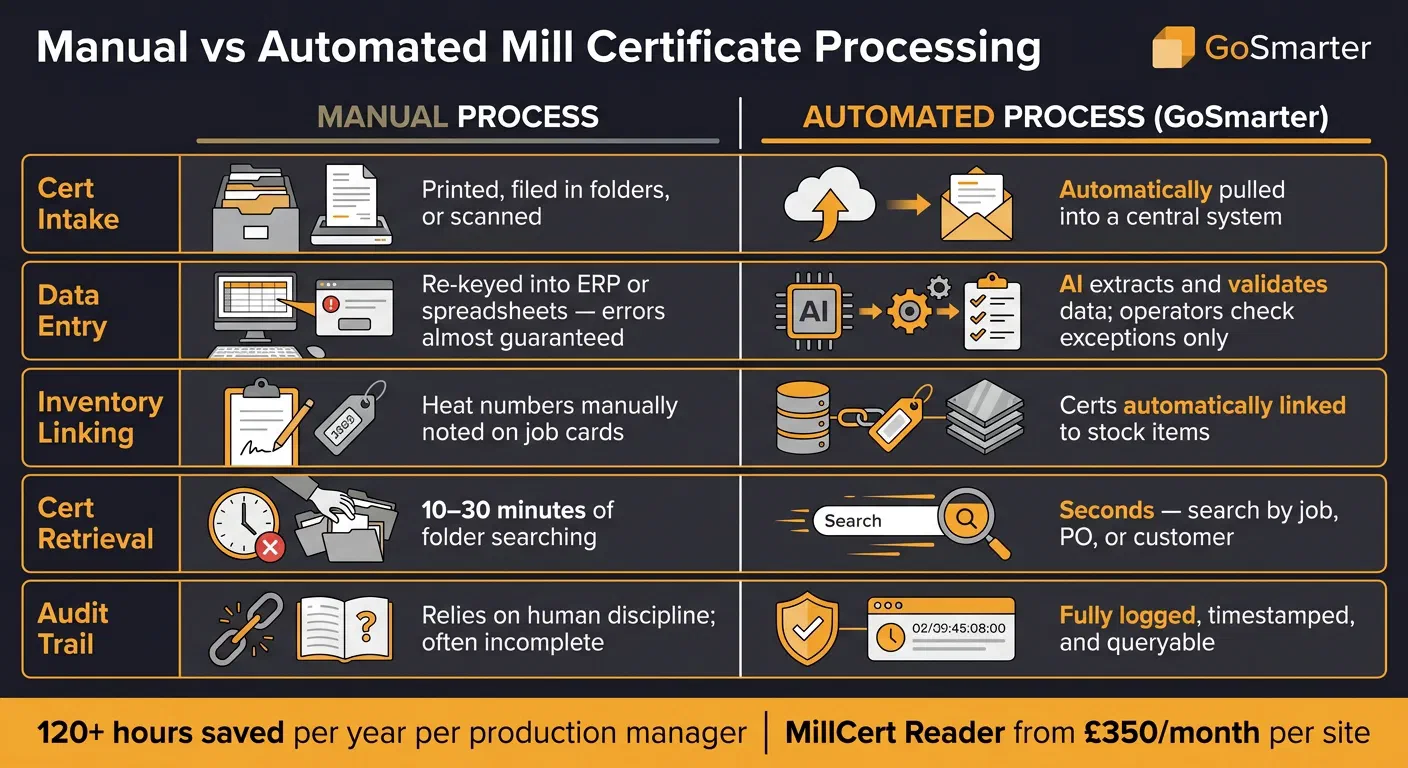
MCP tackles the core headaches on the shop floor: cutting operations, material intake, and staying compliant.
Turning Mill Certs Into a Digital Asset
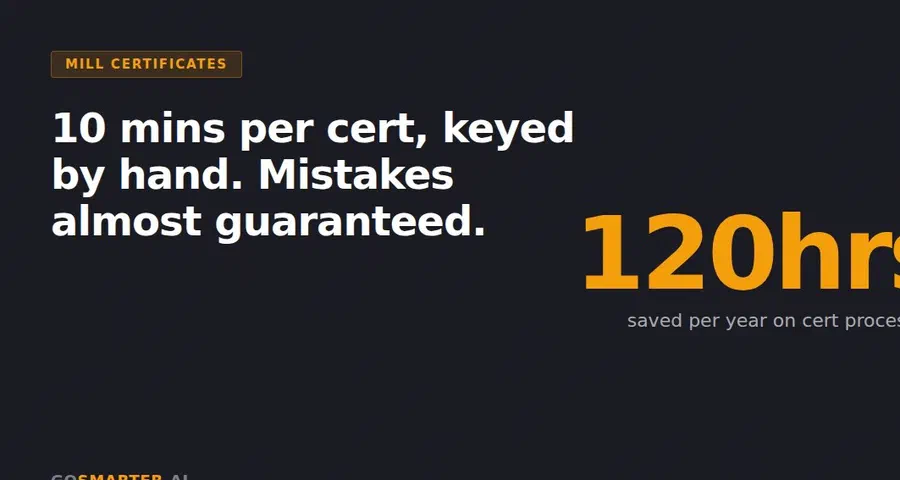
Mill certificates are a nightmare for metals manufacturers. They show up as PDFs, email attachments, or even scanned faxes. Operators then spend 10–15 minutes keying in data manually. Mistakes? Almost guaranteed. And they show up at the worst time: during audits or after despatch.
Enter GoSmarter’s MillCert Reader. It takes PDFs straight from your email or scanner and uses Optical Character Recognition (OCR) and AI trained for the metals industry. It extracts every critical field: grade (e.g., S355J2, B500B), heat number, chemistry, yield strength, and the relevant standard (BS EN 10025, BS 4449, EN 10204). Instead of slogging through every cert, operators only check exceptions. The system automatically links certificates to inventory, creating a timestamped, searchable audit trail from raw material intake to finished goods.
“GoSmarter links every mill cert to the relevant inventory record, order, and job. The audit trail is automatic. No manual cross-referencing. No frantic searching before a site visit.” [2]
This could save a production manager over 120 hours a year on cert processing alone. At £350/month for the MillCert Reader, it’s a no-brainer. And for those working under EN 1090 or UKCA marking rules, this isn’t just helpful. It’s mandatory.
| Aspect | Manual Process | Automated Process |
|---|---|---|
| Cert Intake | Printed, filed in folders, or scanned | Automatically pulled into a central system |
| Data Entry | Re-keyed into ERP or spreadsheets | AI extracts and validates data; operators check exceptions |
| Inventory Linking | Heat numbers manually noted on job cards | Certs automatically linked to stock items |
| Cert Retrieval | 10–30 minutes of folder searching | Seconds, via search by job, PO, or customer |
| Audit Trail | Relies on human discipline; often incomplete | Fully logged, timestamped, and queryable |
This digital process doesn’t just fix traceability. It sets the stage for better cutting and scheduling.
Slashing Scrap and Tightening Schedules
Manual cut planning is where money leaks. Scrap rates on rebar and long products usually sit at 5–8%. Offcuts? They pile up, untracked, filling skips faster than they should. The financial hit is obvious, and the environmental cost is becoming harder to ignore.
GoSmarter’s Cutting Plans fixes this directly. It analyses your stock (bar lengths, plate sizes, offcuts, grades, heats), matches it against open orders and deadlines, then generates cutting plans that minimise waste. It accounts for machine limits and shift schedules too. At Midland Steel, this approach cut scrap rates by 50%, bringing losses from 5–8% down to under 2.5% [2][4].
Better cutting plans mean better scheduling too. When sales, production, and despatch work off the same live data, those endless “chasing” calls disappear. GoSmarter users report measurable On-Time In-Full (OTIF) improvements within 90 days [4]. Delivery promises? They’re based on real-time shop-floor progress, not a spreadsheet last touched three days ago.
Beyond saving material and time, MCP takes compliance to a whole new level.
Making Compliance Practically Effortless
Audits in metals manufacturing are usually a slog: digging through paper folders, cross-referencing heat numbers, hunting for calibration records, and manually pulling together cert packs. According to an IDC survey, plants using integrated Manufacturing Execution System/Manufacturing Operations Management (MES/MOM) platforms spend 40–50% less time on audits compared to those stuck with spreadsheets.
With MCP, compliance isn’t something you prepare for. It’s already done. Every action (cutting, bending, inspecting, despatching) is logged against a specific heat and certificate. Need a production record? The system generates a complete, timestamped report on demand. For UK plants working under ISO 9001, EN 1090, or similar standards, this means walking into audits with confidence, not a box of folders.
Real-time alerts add an extra layer of control. If material arrives without a valid cert or a process parameter drifts off-spec, the system flags it immediately. That’s the difference between scrambling to fix problems and stopping them before they happen. This shift to proactive control is why MCP earns its spot on the shop floor.
How to Modernise Your Factory Without Replacing Legacy Systems
You don’t need to tear down your existing setup to bring your factory into the 21st century. With GoSmarter’s MCP, you can build on what you already have. Layer intelligent tools over your ERP, your spreadsheets, and even your old job cards. No need for a rip-and-replace headache.
Start by Mapping Your Current Systems
First, figure out where your data is hiding. It’s probably not in one neat place. Heat numbers might be scribbled on job cards, mill certificates buried in email inboxes, or cut lists scattered across spreadsheets. These are “data traps”: places where information gets stuck, duplicated, or outright lost.
Take stock of the inefficiencies: unstructured data needing manual re-entry, cut plans relying on guesswork, or inventory records that don’t match what’s on the shop floor. Once you know where the bottlenecks are, you’ll see where MCP can step in and start sorting the mess.
Target Quick Wins with AI Tools
Don’t try to fix everything at once. Start with the one process that wastes the most time or money. For many UK metals manufacturers, that’s mill certificate processing or cutting plan optimisation. GoSmarter’s tools are built for exactly this.
- MillCert Reader: Cuts hours of manual data entry down to minutes by automating certificate processing.
- Cutting Plans tool: Slashes scrap rates in half. One rebar manufacturer reduced scrap from the typical 5–8% to under 2.5%, saving thousands [2].
Both tools integrate directly with your existing inventory and order data, so they don’t just solve one problem. They make your other systems work better too. They’re also dead simple to use: point, click, and you’re up and running in under a week. At £350/month for the MillCert Reader (Workshop tier) and £180/month for Metals Manager (Starter tier, per site, not per user), the payback is obvious from the first month.
Scale Up Your AI-Powered Operations
Once you’ve nailed one workflow, it’s time to connect the dots. Imagine your mill certificates automatically linking to inventory records, which then feed into cutting plans and even production schedules. That’s where the real value is: everything working together.
GoSmarter’s tier-based platform makes scaling straightforward. It uses the Model Context Protocol (MCP) as its backbone. This standard integration layer lets AI tools talk to your factory data, whether it’s checking inventory levels, calculating scrap, or pulling a full audit trail by heat number [6]. Every new capability plugs into this shared system as you move up a tier, keeping things simple as you grow.
By layering these tools step by step, you’re not just making your factory smarter. You’re setting it up for the future.
| Step | Action | GoSmarter Tool |
|---|---|---|
| 1. Map | Locate your data traps in PDFs, emails, and spreadsheets | GoSmarter API / MCP Resources |
| 2. Quick win | Automate your biggest manual pain point | MillCert Reader or Cutting Plans tool |
| 3. Connect | Link certificates to inventory and orders for traceability | Metals Manager |
| 4. Scale | Add more workflows and data sources | Full GoSmarter platform |
Instead of replacing your current systems, you’re giving them a serious upgrade. It’s about working smarter, not harder, and making sure your factory is ready for whatever comes next.
How to Keep Your Factory Ready for What Comes Next
The biggest hurdles for factories aren’t always about outdated machinery. They’re about systems that can’t bend when the landscape shifts. Whether it’s a new regulation, a customer demanding carbon data, or the arrival of advanced AI tools, rigid setups can bring everything to a grinding halt. An MCP-style platform removes that brittleness entirely. It keeps your factory flexible as it grows. New AI tools and tighter regulations slot in without a crisis.
Adding AI Tools Without Tearing Everything Apart
One of MCP’s standout features is its role as a universal integration layer. When a new AI function (like autonomous scheduling or energy tracking) hits the market, it connects straight in using the standardised protocol already in place.
GoSmarter delivers these capabilities as ready-to-use tools (e.g. CalculateScrap or UpdateInventory) that connected AI agents can automatically discover. This eliminates the need for custom coding. This extensible design means new tools (energy data feeds, advanced scheduling) slot in without touching your existing workflows. Most GoSmarter users notice measurable improvements in On-Time In-Full (OTIF) performance within just 90 days of implementation [4].
Staying Ahead on Sustainability and Compliance
MCP’s integration layer also positions your factory to handle increasing sustainability and compliance pressures. The regulatory environment for metals manufacturers is tightening fast. The European Union’s Carbon Border Adjustment Mechanism (CBAM) and environmental, social and governance reporting are now mainstream expectations. Providing carbon data and material traceability is no longer a “nice-to-have.” It’s mandatory. The factories that adapt quickly are those already capturing the right data from day one.
Operational data you’re already gathering (like scrap reduction stats or digitised mill certificates) can double as audit-ready sustainability evidence [5]. GoSmarter links this data directly to CBAM and ESG reporting requirements, turning everyday metrics into compliance-ready documentation.
| Compliance Requirement | Data Captured by GoSmarter |
|---|---|
| EN 10204 | Chemical and mechanical properties from 3.1 and 3.2 certificates |
| ISO 9001 | Automated document control and retrieval for Quality Management System (QMS) audits |
| CBAM / ESG | Scrap rates and material origin data tied to carbon evidence |
| IATF 16949 | Quality data and inspection records captured at the source |
Steph Locke, Co-founder and Head of Product at GoSmarter, sums it up well:
“AI in metals manufacturing is not magic - it is a set of specific, practical capabilities: reading unstructured documents, optimising constrained problems, spotting patterns in production data, and surfacing the right information at the right moment.” [2]
The factories that breeze through compliance are those that stop treating operational and regulatory data as separate silos. With an MCP-style platform, everything becomes part of one interconnected system.
Take the First Step: Try GoSmarter Today
The factories that thrive don’t wait. They pick a problem, fix it, and grow from there with GoSmarter.
Pinpoint where it hurts most and let GoSmarter show you instant results. Start with your biggest headache: if your team spends hours chasing mill certificates or manually keying data into spreadsheets, MillCert Reader can handle certificates from day one. No IT project needed. It saves over 120 hours a year for just £350/month [2][4]. If scrap waste is your main issue, Cutting Plans applies advanced calculations to your actual stock, cutting scrap rates by up to 50%. Midland Steel, a rebar supplier, saw this kind of improvement after ditching spreadsheets during production trials [2][4].
“GoSmarter is an overlay as it sits on top of whatever systems you already use. You can start with just one AI production assistant, prove the value on one workflow, and expand at your own pace.” Steph Locke, Co-founder & Head of Product, GoSmarter [2]
Installation is quick. Think days, not months. GoSmarter connects to your current ERP, MES, or even your folder structure via a secure API or file drop. There’s no need to replace or rework your existing setup. Your data is hosted on Microsoft Azure in UK-based ISO 27001-certified centres. GoSmarter never uses your commercial data to train its AI models [2]. IT involvement? Barely any, by design.
Need hard numbers? The GoSmarter Business Case Calculator creates a detailed savings report, breaking down scrap reductions, recaptured staff hours, and avoided rework costs in pounds. Perfect for your finance team [4]. Prefer to see it in action first? Try it risk-free with a 7-day free trial [4]. Run one workflow alongside your current process and let the results do the talking.
Take the first step today to streamline your factory without overhauling your systems.
FAQs
Do I need to replace my ERP or MES to use MCP?
What factory data can MCP connect to first?
How do I prove ROI from MillCert Reader or Cutting Plans?
Tags:
About the Author

Editor· Co-founder & Head of Product
Steph Locke is Co-founder and Head of Product at GoSmarter AI — former Microsoft Data & AI MVP building practical tools to cut paperwork and automate compliance for metals manufacturers.