Ultimate Guide to AI in Sustainable Metals Sourcing
- BlogSmarter AI
- Edited by Steph Locke
- Blog
- April 30, 2026
- Updated:
Table of Contents Show Hide
Retyping data from mill certificates burns hours your team cannot get back. If you still rely on spreadsheets and paper trails, you are spending time and money on tasks AI can handle in seconds.
Mill certs, Scope 3 emissions, and compliance audits: they’re the bane of every metals manufacturer. Miss a certificate, and you’re scrambling before an audit. Lose track of emissions data, and you’re risking fines under the Carbon Border Adjustment Mechanism (CBAM). The manual grind isn’t just frustrating; it’s expensive.
GoSmarter (built by Nightingale HQ) sits on top of your existing ERP, Excel, and email. No rip-and-replace required. Its AI tools fix this mess. From extracting heat numbers to tracking supplier risks, they automate the boring, error-prone bits so you can focus on production.
What you’ll get:
- Automated mill cert processing: Save hours every week.
- Scrap tracking: Use offcuts without second-guessing quality.
- Carbon reporting: Meet CBAM requirements without the admin burden.
- Supplier insights: Spot risks before they become problems.
What is a mill certificate? A mill certificate (also called a Mill Test Report, or MTR) is a quality assurance document issued by the steel or metals producer. It records the chemical composition and mechanical properties of each batch: heat number, grade, yield strength, tensile strength, and Carbon Equivalence (CEQ). It confirms the material meets the ordered specification. Without one, you cannot prove traceability.
Here’s how to get started.
How AI Changes Metals Sourcing
Automating Mill Certificate Processing
Mill certificates are a headache for production managers. Each one is packed with heat numbers, chemical compositions (like carbon, manganese, and silicon), and mechanical properties (yield strength, tensile strength). The problem? Your team has to key all that data into an ERP (Enterprise Resource Planning) system or spreadsheet, manually.
AI tools, like GoSmarter’s MillCert Reader, take over this tedious job. Using machine learning, it pulls the critical details straight from scanned or digital certificates, even renaming files based on heat codes and material grades. Suddenly, your folder of random filenames becomes a neatly organised, searchable archive by material spec 12. Unlike generic OCR (Optical Character Recognition) tools that often mix up data from multi-heat certificates, this system keeps everything in order. It also flags out-of-spec materials right at goods-in, saving you from costly surprises later on. The best part? It’s ready to go in minutes and supports certificates in multiple languages (German, French, Spanish, and Turkish) by converting them into standard English field names 12.
You can even upload thousands of old certificates to create a searchable database by heat number, grade, or mill. This mammoth task? Done in a day. MillCert Reader sits on the Workshop tier, at £350/month rolling, or £280/month billed annually, and often pays for itself within weeks. Plus, you get a 7-day free trial 12.
Tracking and Using Scrap More Efficiently
AI doesn’t stop at certificates; it tackles scrap management too. Offcuts are a goldmine - if you can trace their quality. AI creates a digital thread linking certificate data to inventory records. That means every offcut retains its material history, making it usable for future jobs without compromising quality 1.
With this setup, production teams can instantly check offcut properties, cutting down waste, costs, and the carbon footprint of buying new stock. The trick is ensuring your AI tool connects certificates to inventory as soon as materials arrive, so accurate data flows seamlessly through every stage of production 1.
Using Data to Choose Better Suppliers
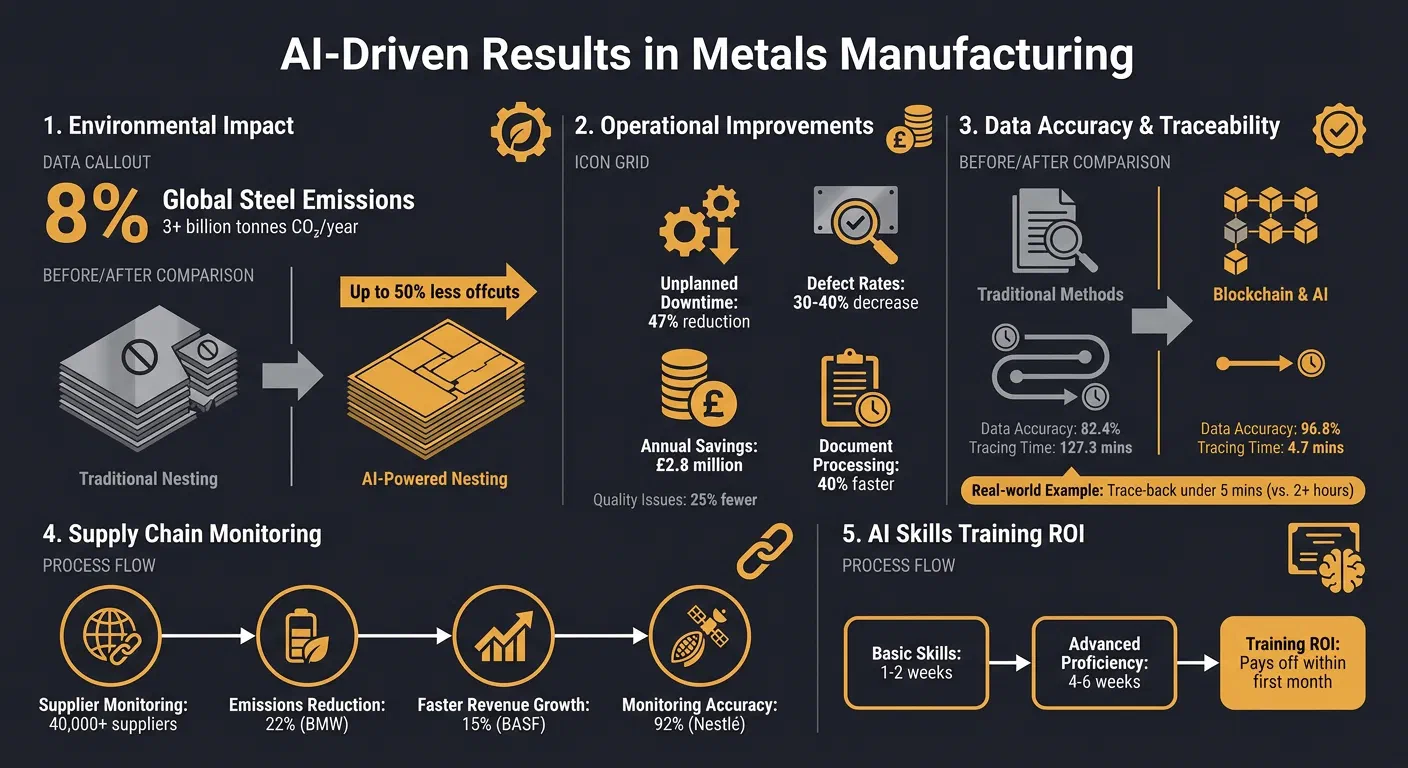
AI also helps you pick smarter suppliers. By scanning public data - news, social media, regulatory filings - it flags risks like pollution or unethical labour practices. For example, Volkswagen Group (think Porsche and Audi) uses an AI system to monitor over 40,000 suppliers for sustainability issues, providing early warnings of potential violations 3.
This kind of insight helps manufacturers stay ahead, ensuring their supply chains align with both quality and ethical standards.
How AI Reduces Environmental Impact in Metals Sourcing
Choosing Lower-Carbon Materials
AI takes the guesswork out of sourcing by tracking the carbon footprint of materials from start to finish. It monitors energy use and CO₂ emissions at the component level, giving you a detailed breakdown of your carbon output 4.
Why does this matter? Steel production alone accounts for about 8% of global man-made greenhouse gas emissions - over 3 billion tonnes of CO₂ every year. With AI, you can identify the carbon intensity of each batch and make smarter choices, like opting for Electric Arc Furnace steel instead of Blast Furnace steel or prioritising suppliers using cleaner energy. This data-driven approach ensures you’re not just talking about net-zero goals but actively tracking progress.
Cutting Waste Through Better Production Planning
AI doesn’t stop at sourcing - it also tackles waste in production. For example, AI-powered cutting optimisation, often called “nesting”, calculates the most efficient way to cut raw materials, slashing offcuts by up to 50%. Tools like GoSmarter’s Cutting Optimiser create cutting plans that align open orders with available inventory, predicting material usage before a single cut is made. The same heat-number record that feeds the MillCert Reader flows directly into the Cutting Optimiser – one entry, every tool.
The benefits don’t end there. AI systems assess scrap properties and metallic yield in real time, while predictive maintenance has transformed operations. Industry data suggests moving from reactive to predictive strategies can cut unplanned downtime by up to 47% and reduce defect rates by 30-40%, with annual savings that often run into seven figures. Avoiding major failures - like a furnace shutdown that could waste 30 tonnes of steel - not only saves money but also reduces emissions and waste.
Meeting Environmental Compliance Requirements
AI also takes the headache out of environmental compliance. Regulations like the Carbon Border Adjustment Mechanism (CBAM) demand detailed reporting on the carbon content of imported metals. This means pulling CEQ and chemical composition data from every mill certificate - a process that’s tedious and error-prone when done manually.
GoSmarter’s MillCert Reader automates this entirely. It captures CBAM data at the point of entry, links certificates to inventory records, and generates tamper-proof audit logs. No more scrambling to piece together paper trails during inspections. This not only keeps you compliant but also cuts the admin burden significantly.
How to Start Using AI for Metals Sourcing
Setting Up Your Data Systems
First, map out every manual step in your sourcing workflow. Think about all the repetitive tasks your team handles, like re-entering heat numbers, filing PDF certificates, or manually inputting chemical composition data into spreadsheets. This not only exposes the time sink but also builds a solid case for automation. Key data to focus on include heat numbers, material grades, chemical compositions (C, Mn, P, S, Si), mechanical properties (yield strength, tensile strength, elongation), and CEQ values for sustainability reporting.
To make your system truly efficient, ensure every stock item in your database is linked to its certificate data. This creates an automatic audit trail as materials move through production and despatch. A good starting point is a pilot: upload a batch of existing certificates into an AI reader to check how accurately it extracts the data. Once that’s validated, you’ll be ready to scale up 1. With a solid data setup, the next step is picking the right AI platform for your specific needs.
Choosing an AI Platform
Generic OCR tools often fall short when dealing with metals-specific terms like “Rp0.2” or CEQ. That’s where specialised tools like GoSmarter’s MillCert Reader come in. This platform is designed specifically for metals manufacturing, so it doesn’t require custom training for each mill. It validates extracted data against grade specifications and automatically creates compliant audit trails. Beyond simplifying operations, it also makes it easier to track material carbon footprints accurately.
Pilot tests have shown that this kind of tool can save a significant amount of time 1. GoSmarter offers flexible pricing across four tiers, starting at £120/month billed annually, with credit packs available for high-volume use. You get a 7-day free trial, letting you test the accuracy of data extraction before committing. Another perk? The platform links certificates directly to inventory items, so you can quickly search by mechanical properties when needed 1. For IT teams: GoSmarter connects via REST API with OAuth 2.0 authentication, supports Microsoft Entra single sign-on, and hosts all data on UK Azure infrastructure. No customer data trains shared models.
Training Your Team and Managing the Transition
The success of AI implementation depends heavily on your team - people, culture, and how well the change is managed make up about 70% of the equation 5. With structured training, most manufacturing workers can pick up basic AI skills in one to two weeks, while advanced proficiency takes about four to six weeks. These skills allow them to handle tasks like processing mill certificates and automating cutting plans 6.
Start small with pilot projects, such as automating invoice matching or supplier risk scoring. These early wins help validate the impact and build internal buy-in before a full-scale rollout 7. Workers trained in AI report processing documents 40% faster and see 25% fewer quality issues, with training often paying off within the first month 6.
What’s Next for AI in Metals Sourcing
AI has already shaken up metals sourcing, cutting through inefficiencies and manual labour. Now, technologies like blockchain and real-time carbon tracking are pushing things even further, setting new standards for the industry.
Blockchain for Supply Chain Visibility
Blockchain creates a tamper-proof record of every transaction and custody transfer, giving all parties access to the same reliable data. For metals manufacturers, this tackles age-old headaches like verifying material origins across borders, preventing dodgy data tweaks, and tracing exactly where every batch came from 89.
The numbers speak for themselves: blockchain systems achieve 96.8% data accuracy, compared to 82.4% with traditional manual methods. And when it comes to tracing materials, blockchain slashes the time from 127.3 minutes to just 4.7 minutes 8. A real-world example? In early 2026, Huaxin Mining Group rolled out a blockchain traceability system that cut trace-back times from over two hours to under five minutes, hitting a traceability score of 81.2 8. On top of that, smart contracts can automatically check if materials meet your chemical or carbon standards and flag any issues instantly 8. This level of transparency is laying the groundwork for even smarter AI tools to handle carbon tracking and regulatory compliance.
Instant Carbon Impact Tracking
AI is now helping manufacturers get a grip on Scope 3 emissions by digging into procurement data to pinpoint carbon hotspots hiding deep in supply chains 10. With stricter EU regulations around the corner, better ESG (Environmental, Social and Governance) data is no longer optional. European companies are already seeing improved emissions tracking, thanks to mandatory directives 10.
Take BMW, for instance. In 2024, they used the Catena-X automotive data ecosystem to map out carbon footprints across a five-tier battery supply chain. This detailed traceability helped them cut battery supply chain emissions by 22% by tweaking their sourcing strategy 11. BASF also jumped on board, calculating carbon footprints for all 45,000+ of its products. Products with lower documented footprints saw revenue grow 15% faster than the rest of the portfolio 11. These real-time insights aren’t just good for compliance - they’re good for business, too.
Getting Ready for New Regulations
Regulations are tightening fast. The Carbon Border Adjustment Mechanism (CBAM) Phase 2 kicked off on 1st January 2026, requiring importers to report embedded emissions for materials like iron, steel, and aluminium at the installation level 12. Then there’s the Corporate Sustainability Due Diligence Directive (CSDDD), which will enforce legal duties to identify and mitigate environmental risks starting in July 2028. Ignoring these rules could cost up to 5% of global turnover in penalties 11.
To keep up, companies are turning to AI-powered mapping platforms, which are replacing clunky manual audits with continuous supply chain monitoring. These platforms are growing at a compound annual growth rate of 28% 11. Nestlé, for example, adopted the Starling satellite monitoring system by 2024 to oversee 100% of its direct cocoa sourcing areas. Using machine learning, they achieved 92% accuracy in detecting land cover changes across over 800,000 tonnes of cocoa annually 11. Metals manufacturers can take a similar approach, using AI to map beyond Tier 1 suppliers and uncover hidden risks before regulations force full supply chain visibility 11.
Next Steps: Try AI in Your Sourcing Process
Manually processing mill certificates is the most fixable bottleneck in metals sourcing. With AI-powered OCR, you can digitise them at over 87% accuracy 1. Automation handles the heavy lifting. You focus on production.
Start small. Look at the task that eats up the most hours - likely mill certificate processing. Test it out with a small batch first to check how well the AI extracts data and handles tasks like automated renaming. GoSmarter’s MillCert Reader does the boring stuff for you, and you’ll notice the difference straight away.
Once you’ve nailed certificate processing, take it a step further by automating environmental data tracking. Link a shared inbox so the system processes incoming supplier documents automatically. Then, use the Emissions Calculator to estimate carbon footprints based on material weight and production methods, whether it’s a Blast Furnace or an Electric Arc Furnace, and whether the material is steel, aluminium, copper, copper-nickel (Cu-Ni), or a brass/bronze alloy. This isn’t just about speeding things up; it gives you the insights to choose materials with a lower carbon footprint. From here, you’re on track to build a real-time sustainability dashboard.
You can start with a 7-day free trial, and paid plans start at £120/month billed annually (Starter). At £350/month (Workshop tier) on a rolling plan, recovering even 10 hours of admin per week pays that back inside the first quarter. Setup takes a few hours and works with Excel or CSV imports into your current ERP system. Many users see results in the first week. Explore the full GoSmarter platform for metals manufacturers to see what else you can automate.
Regulations are tightening, and your competitors aren’t standing still. Test these tools now and make sure your operations are ready for what’s next.
FAQs
How do I connect mill cert data to my ERP and inventory?
What CBAM data should be captured from each mill certificate?
How can AI prove scrap quality so offcuts can be reused safely?
AI makes scrap reuse safer and more dependable by evaluating the quality of offcuts with advanced computer vision and machine learning. These technologies examine surface features, textures, and structures to accurately determine the quality of the metal.
By automating quality checks and delivering consistent, real-time assessments, AI cuts down on human mistakes. This ensures only top-quality offcuts are reused, reducing the risk of contamination and helping manufacturers stick to eco-friendly practices.
Further Reading
1: Mill Certificate Automation for Metals | GoSmarter
2: Mill Certificate Reader | Automated Extraction | GoSmarter
3: Top 15 Companies Using AI for Sustainable Supply Chains : Earth5R
4: AI for Sustainability in Metal Production - TVARIT
5: Gen AI: Get the 70 Percent Right | AS/COA
6: Best AI Training for Manufacturing Teams (2026)
7: The Role of AI in Sourcing and Procurement [2026]
8: Blockchain-enabled traceability evaluation framework for mineral resource development and utilization: a fuzzy comprehensive assessment approach | Scientific Reports
9: Smart Traceability in the Supply Chain: Blockchain, AI and Analytics
10: Greener supply chains need smarter AI systems
11: Deep dive: Supply chain traceability & product data — the fastest-moving subsegments to watch | Sustainability Atlas
12: CSDDD and the Future of Supply Chain Traceability | Metalshub
About the Author

Editor· Co-founder & Head of Product
Steph Locke is Co-founder and Head of Product at GoSmarter AI — former Microsoft Data & AI MVP building practical tools to cut paperwork and automate compliance for metals manufacturers.