Stop Running Metal Machining Like It's 1985
- BlogSmarter AI
- Edited by Steph Locke
- Blog
- March 31, 2026
- Updated:
Table of Contents Show Hide
Metal machining is bleeding time and margin through manual admin and outdated software. When your best computer numerical control (CNC) programmer retires, decades of expertise walk out the door.
Here’s the truth: manual processes are draining your team. From outdated enterprise resource planning (ERP) systems to endless spreadsheets, you’re wasting hours on tasks that add zero value. Worse, with 1.9 million manufacturing jobs projected to go unfilled by 2033, hiring your way out isn’t an option.
But there’s good news. Artificial intelligence (AI) robotics can fix this mess. It automates tedious tasks like reading mill certificates, optimising cutting plans, and spotting defects in real-time. You reclaim your time, reduce waste, and protect your bottom line.
For most stockholders, the win is compound: less scrap, fewer admin hours, and better On-Time In Full (OTIF). You also tie up less cash in over-ordering.
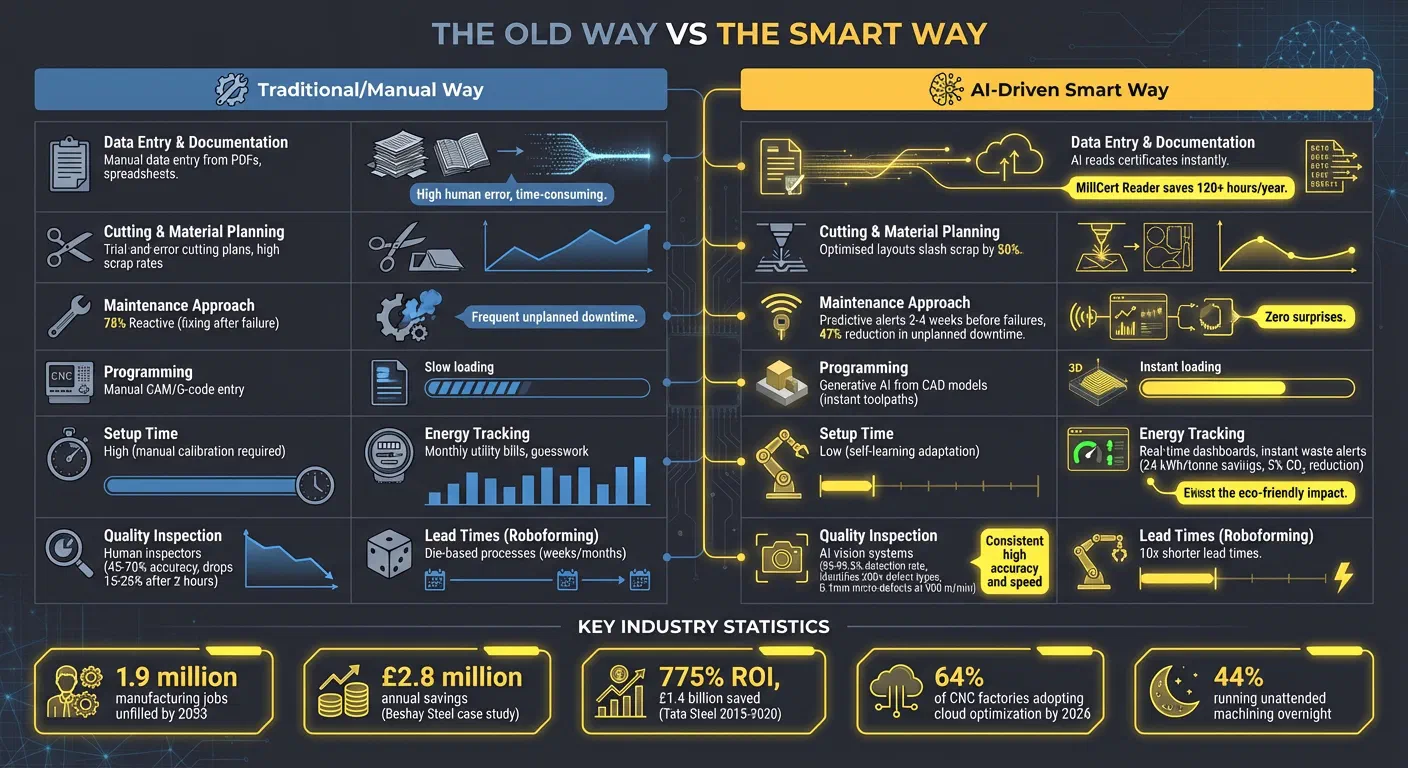
The Old Way vs. The Smart Way
| The Old Way | The Smart Way |
|---|---|
| Manual data entry from PDFs | AI reads certificates instantly |
| Trial-and-error cutting plans | Optimised layouts slash scrap by 50% |
| Reactive maintenance | Predictive alerts prevent downtime |
Stop relying on spreadsheets and legacy systems. Let AI handle the boring stuff so your team can focus on building, not typing. Ready to see how it works? Let’s dive in.
Machina Labs: The Future of Metal Shaping with AI & Robotics
Core Technologies Behind AI Robotics
AI robotics is transforming metal machining by integrating three key technologies that replace outdated, expensive methods. Roboforming uses robotic arms guided by CAD data to shape metal without the need for dies. Vision-guided systems enable robots to visually assess their work, spotting defects before they lead to waste and inventory loss. High-stiffness robots provide the strength required to bend hardened metals while maintaining precision. Here’s a closer look at how each of these technologies contributes to modern manufacturing.
Roboforming: Shaping Metal Without Dies
Roboforming employs two synchronised 7-axis robotic arms to shape sheet metal layer by layer. One arm supports the material while the other applies pressure and twists to form it, all based on toolpaths directly derived from CAD models. This approach eliminates the lengthy waits and high costs associated with traditional tooling methods 12.
In early 2023, Machina Labs demonstrated the potential of Roboforming by manufacturing aircraft components for the United States Air Force, NASA, and Hermeus. They worked with titanium and steel sheets as large as 1.2 metres by 3.7 metres, achieving lead times 10 times shorter than those of die-based processes 312.
Dr. Babak Raeisinia, Co-founder of Machina Labs, highlights their RoboCraftsman system, which integrates “multiple manufacturing operations within a single, containerised robotic cell, including sheet metal forming, trimming, scanning, and heat treating” 2.
This compact system fits into an ISO-standard shipping container, making it possible to deploy a mobile factory wherever there’s a power supply 2.
Vision-Guided Robotics: Real-Time Precision
Vision-guided systems allow robots to monitor their work in real-time, comparing scans of the material to the CAD model. This ensures defects are spotted early and adjustments to speed or force are made instantly 12. Reflective and flexible sheet metal presents unique challenges, but TRUMPF has tackled this by manually labelling 100,000 images to train its Sorting Guide AI. Their TruLaser Center 7030 system, equipped with 12 cameras (expandable to 24), collects the data needed for continuous improvement 4.
The result? AI flags defective parts immediately and creates a “digital twin” for every part. You keep valuable process data even as experienced workers retire. You also improve production compliance 12.
Korbinian Weiß, Head of AI image-recognition at TRUMPF, emphasises the importance of data, stating, “Ninety-five per cent of the solution is data, and just five per cent is AI” 4.
High-Stiffness Robots: Handling Hard Metals
Working with materials like hardened steel or titanium demands high-stiffness robots mounted on linear rails with rigid fixtures to handle the extreme forces required. This setup ensures the precision necessary for aerospace-grade components 2.
In March 2025, researchers used an “intelligent metal forming robot” in a two-stage cold forging process for 28B2 steel screw-like parts. The system featured a servo mechanical knuckle joint press with a 5,000 kN capacity. Self-learning algorithms stabilised operations against vibrations and temperature changes, reducing waste during the ramp-up phase 5. Acting as a “virtual process operator”, the system adapts to new conditions by learning from past and current data 5.
While a basic two-arm robotic setup for AI-driven metal fabrication costs around £2 million, the savings in tooling - over £1 million per unique part design - make the investment worthwhile 32.
Applications of AI Robotics in Metal Machining
AI robotics are transforming metal machining by streamlining processes such as cutting, welding, trimming, and quality control. These technologies not only speed up operations but also minimise defects, optimise material usage, and contribute to reduced waste and lower carbon emissions.
Automated Cutting, Welding, and Trimming
AI-powered robots excel in precision tasks by predicting and adapting to material changes. Neural networks, for instance, can forecast metal deformation and adjust robotic arm movements accordingly, compensating for factors like spring-back and material inconsistencies 3. This capability allows for the trimming and finishing of intricate structures directly from CAD files, eliminating the need for costly dies or moulds 6.
In welding, AI systems analyse both material properties and environmental conditions in real time, fine-tuning parameters mid-process to ensure stronger welds and reduce the need for rework 7. Robotic arms equipped with laser scanners continuously compare production progress against digital blueprints, ensuring precise cutting and shaping [6, 15].
Toyota explains the benefits: “RoboCraftsman thrives in low-volume, high-variation environments, where every change is digital and flexible. It means faster changeovers, less capital, and personalised parts produced right alongside mass production” 6.
AI-guided fibre lasers further enhance efficiency by delivering higher power while consuming up to 77% less nitrogen gas 8. These advancements pair with cutting-edge inspection technologies to boost production quality and reduce rework.
Quality Inspection and Defect Detection
AI vision systems are redefining quality control by detecting flaws that human inspectors might overlook, even at high speeds. Using high-speed line-scan cameras paired with precision LED lighting, these systems can identify micro-defects as small as 0.1 mm at speeds of up to 900 m/min [17, 18]. Deep learning models, trained on millions of images, can classify over 200 types of defects, such as scratches, inclusions, roll marks, and edge cracks [17, 18].
Edge computing processes massive image data - 2–8 GB per second - with latencies under 50 ms, allowing for real-time grading and sorting before products leave the production line [17, 18]. These systems achieve detection rates between 95% and 99.5%, a significant improvement over the 45% to 70% accuracy of human inspectors at similar speeds [17, 18]. Fatigue further impacts human inspectors, with accuracy dropping by 15% to 25% after just two hours of continuous work 9.
A stark example comes from early 2026, when a flat-rolled steel producer in the Ohio Valley reported losses of approximately £3.0 million due to surface inclusions missed by human inspectors operating at line speeds of 900 m/min 9.
As AI vision specialist Lebron puts it: “The camera doesn’t replace the inspector - it replaces the limitation” 10.
These AI systems also integrate with Computerised Maintenance Management Systems (CMMS), automatically generating work orders when defect patterns signal equipment wear, such as roll surface degradation [17, 18].
Scrap Reduction and Lower Carbon Emissions
AI is also making strides in cutting efficiency, which directly reduces scrap and supports greener production practices. By generating optimised cutting layouts for long products and sheets, AI-powered tools significantly cut down on waste 11.
For example, GoSmarter’s Cutting Plans, a Production tier feature from £950/month rolling, or £760/month billed annually, automatically calculate the most efficient cutting patterns and track leftover material, reducing scrap by up to 50% 11. For those hesitant to invest heavily upfront, GoSmarter offers free tools like the Scrap Rate Calculator and Emissions Calculator, requiring no account to use 11.
How to Integrate AI Robotics into Your Shop Floor
Assessing Your Current Systems
Start by pinpointing your biggest bottleneck. It could be programming delays, machine downtime, or manual data entry. Target that bottleneck first – AI delivers the fastest return where manual work costs you the most time.
Next, review your current systems. Check what your machines already track, such as spindle loads, tool wear, and cycle times. Then confirm connectivity standards like MTConnect or OPC UA. Appoint a digital champion to bridge shop-floor and IT decisions.
Nearly 70% of software in Fortune 500 companies is over 20 years old 12. Map your current state first, then test one AI use case with immediate impact.
Steps for Implementation
A phased rollout works best. Start with one use case, prove savings fast, then scale 13. Feed your tool library into the system to improve AI-generated strategies. After validation, add sensor kits for vibration and temperature. You can also add vision AI for quality checks. Test each workflow in a controlled environment first. This avoids disrupting live ERP data 12. This approach also helps you retrain teams for robot operation and system oversight instead of replacing them 1415.
Working with Legacy Systems
Once new processes are in place, tackle the challenges posed by legacy systems. The biggest hurdle is often the lack of integration between older setups and modern AI 12. Industrial IoT (IIoT) platforms can bridge this gap by connecting outdated machines through hardware connectors and software agents, enabling real-time data collection 14. For systems without modern APIs, Robotic Process Automation (RPA) can step in, interacting with existing user interfaces to move data 12.
GoSmarter plugs into old ERPs without a rebuild. MillCert Reader (Workshop tier, from £280/month billed annually) pulls data from PDF certificates, and Metals Manager (Starter tier, from £120/month billed annually) links stock to those certificates in real time 11. Most teams can go live in 1–2 days using CSV or REST API connections 1116. Start with routine tasks, avoid long implementation projects, and scale as your system evolves.
Future Trends in AI Robotics for Metal Machining
AI-Driven Customisation for Small Batches
The game is changing for custom machining. Generative AI-powered CAM systems now generate optimised machining strategies directly from CAD models. By analysing geometry and material, these systems create toolpaths instantly, cutting out hours of manual programming for one-off jobs [24, 25]. Self-learning CNC machines add another layer of efficiency by using deep neural networks and sensor data to adapt to material behaviour during small-batch production. This eliminates trial runs and drastically reduces setup times 17. Take the AMADA EGB 1303 ARse, for example - it’s built for high-mix, low-volume production, using automatic tool changers to bypass the need for manual fixture setups.
Looking ahead, 64% of CNC factories are projected to adopt cloud-based optimisation by 2026, with 44% running unattended machining overnight. These advancements mean AI will soon handle planning and quoting for small orders independently, taking repetitive admin tasks off your team’s plate. Using an AI production assistant to automate these workflows allows engineers to focus on high-value machining tasks. This kind of customisation doesn’t just streamline operations - it also sets the stage for smarter energy usage and predictive maintenance.
Energy-Efficient Robotics
AI is also driving a shift towards greener operations. With carbon reduction now tied to cost savings, AI synchronises energy-intensive processes - like melting or reheating - with off-peak electricity rates and renewable energy availability. For instance, Spartan UK implemented the “Deep.Optimiser” platform at its Gateshead plate mill in November 2024. This system alerts operators when steel reaches its ideal temperature, resulting in a 24 kWh per tonne energy reduction and a 5% cut in CO₂ emissions 18.
AI-guided fibre lasers are another example, cutting nitrogen gas consumption by up to 77% 8. Similarly, ArcelorMittal Asturias deployed an AI-driven image-based system in April 2024 to optimise a 1.2 MW industrial burner. By using neural networks to estimate flue gas oxygen with 97% accuracy, they achieved savings of 52.8 kWh per tonne and reduced CO₂ emissions by 13.2 kg per tonne of steel. Considering steel production accounts for around 8% of global greenhouse gases, these improvements are far from trivial.
Tarun Mathur, Global Digital Lead for Metals at ABB, sums it up well: “AI is making sustainability and decarbonisation more profitable by linking carbon reduction with operations excellence” 11.
Predictive Maintenance with AI
When it comes to keeping machines running, AI is a game-changer. Predictive maintenance systems now alert operators 2–4 weeks before failures occur, boosting equipment availability by 30% and slashing unplanned downtime by 22–47%. Beshay Steel in Egypt is a great example: in 2025, they moved from a 78% reactive maintenance model to an AI-driven system. The results? A 47% drop in unplanned downtime, a 62% increase in Mean Time Between Failures (MTBF), and annual savings of £2.8 million, with the investment paying for itself in just 4.2 months.
AI doesn’t stop there. Self-learning spindles now adapt to metal behaviour in real time, preventing chatter and reducing cycle times 17. Meanwhile, cloud-connected CNC ecosystems share wear patterns, predicting spindle failures before they disrupt production. Between 2015 and 2020, Tata Steel’s use of the iROC system delivered a staggering 775% ROI, saving £1.4 billion through AI-powered efficiency.
For businesses looking to get started, a four-week audit of energy usage and metering systems can establish a baseline. From there, focus on quick wins like benchmarking machine performance within the first 90 days to build momentum and internal support.
| Metric | Traditional/Manual Way | AI-Driven Smart Way |
|---|---|---|
| Maintenance | 78% Reactive (Fixing after failure) | Predictive (Alerts 2–4 weeks early) |
| Programming | Manual CAM/G-code entry | Generative AI from CAD models 17 |
| Setup Time | High (manual calibration) | Low (self-learning adaptation) 17 |
| Energy Tracking | Monthly utility bills/Guesswork | Real-time dashboards/Instant waste alerts |
Conclusion
AI robotics has become a game-changer for metal machining. Sticking to spreadsheets, reactive maintenance, and manual data entry doesn’t just slow you down - it eats away at your margins. The numbers speak for themselves: AI-driven cutting can slash scrap waste by up to 50% 11, while predictive maintenance reduces unplanned downtime and improves efficiency across the board.
The best part? You don’t need to rip out your entire ERP system or endure lengthy implementation delays. Modern solutions like GoSmarter connect to legacy systems through CSV and API feeds. They also pull data directly from sensors and PLCs. Take the MillCert Reader, for example - it eliminates the hassle of manual PDF entry, saving over 120 hours a year for only £280/month billed annually (Workshop tier). That’s a tool that pays for itself before your next quarterly review 11.
As Tony Woods, CEO of Midland Steel, explains: “Smart technology choices can have a direct, measurable impact on reducing carbon emissions in steel manufacturing. The integration of AI and digital tracking has significantly improved our operational efficiency and sustainability performance.” 11
The evidence is clear: embracing AI doesn’t just improve operations - it delivers measurable environmental benefits too.
Now’s the time to evolve. Small, high-impact changes can transform your operations, leaving outdated manual processes behind. Let AI robotics take care of the repetitive tasks, so your team can focus on what really matters - driving strategy and innovation. This is the future of metal machining: efficient, forward-thinking, and ready for what’s next.
FAQs
Which AI robotics project gives the fastest ROI in a machining shop?
What shop-floor data is needed for AI to work reliably?
AI needs clean, structured data. Start with machine status, cycle times, tool wear, scrap rates, maintenance history, and certificate-linked stock records. Add production schedules and order priorities so models can plan against real constraints.
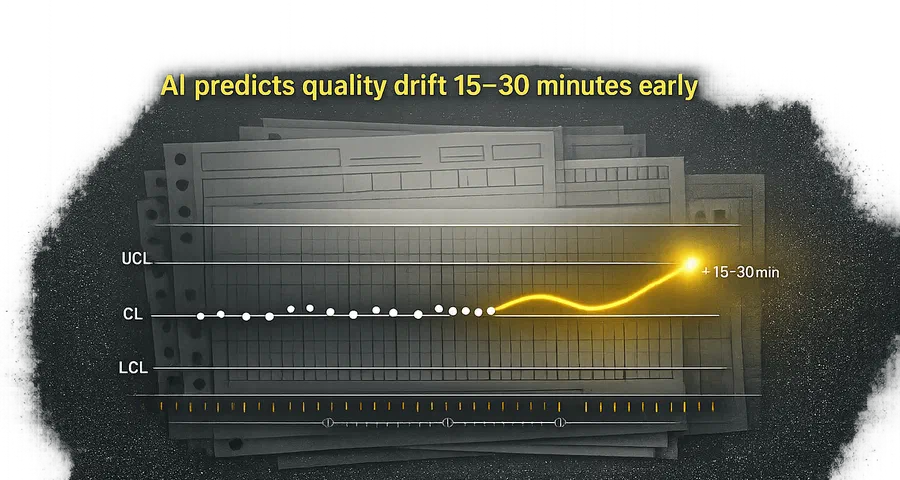
Historical records matter too. They help models predict failures, flag quality drift, and keep planning stable. Poor data gives poor decisions, so standardise data capture before scaling automation.
Can AI robotics integrate with my legacy ERP and older CNC machines?
Yes. Most teams start with CSV imports and simple API connections, then add deeper links over time. You can automate key workflows without replacing your current ERP or CNC setup on day one.
Platforms like GoSmarter support this phased approach for metals teams. Operations can launch no-code workflows quickly, while IT can extend integrations with API and data mapping as needed.
Further Reading
1: Robotics and AI in sheet metal forming
2: Advanced Manufacturing: Incremental Sheet Metal Forming with Robotics and AI
3: How Machina Labs Uses AI to Automate Metal Fabrication
4: How AI is Transforming Computer Vision in Sheet Metal Machinery – TRUMPF’s Journey
5: Development of an intelligent metal forming robot and application to multi-stage cold forging | Production Engineering | Springer Nature Link
7: How AI in Industrial Automation Is Transforming Metal Fabrication
8: The Future of Metalworking: How Automation, Robotics, and Machine Learning Are Revolutionizing the Fabrication Industry / FABTECH
9: AI Vision Inspection for Steel Surface Defect Detection: Complete Technology Guide
10: AI Vision Surface Defect Detection for Steel Strip Mills
11: GoSmarter AI | AI Tools for Metals Manufacturing
12: 5 Manufacturing AI Tools That Integrate With Legacy Systems | Jinba Blog
13: How to use AI in machining — a practical guide for CNC machine shops
14: https://gmbindustries.com/steel-mill-automation-how-ai-and-robotics-are-transforming-the-industry
15: https://medium.com/@zenea3211/the-rise-of-automated-machining-are-ai-automated-robotics-the-solution-to-a-shortage-of-skilled-0c18a303190a
16: Operations Management for Metals Manufacturers | GoSmarter
17: https://www.campro-usa.com/post/the-future-of-cnc-machining-trends-to-watch
18: Next-Gen CNC Automation in 2026: AI-Driven Machining, Self-Learning Robots and Fully Autonomous Smart Factories - cnccode.com – Ultimate CNC Knowledge Hub | G-Code, CAD/CAM, DIY CNC
Tags:
About the Author

Editor· Co-founder & Head of Product
Steph Locke is Co-founder and Head of Product at GoSmarter AI — former Microsoft Data & AI MVP building practical tools to cut paperwork and automate compliance for metals manufacturers.