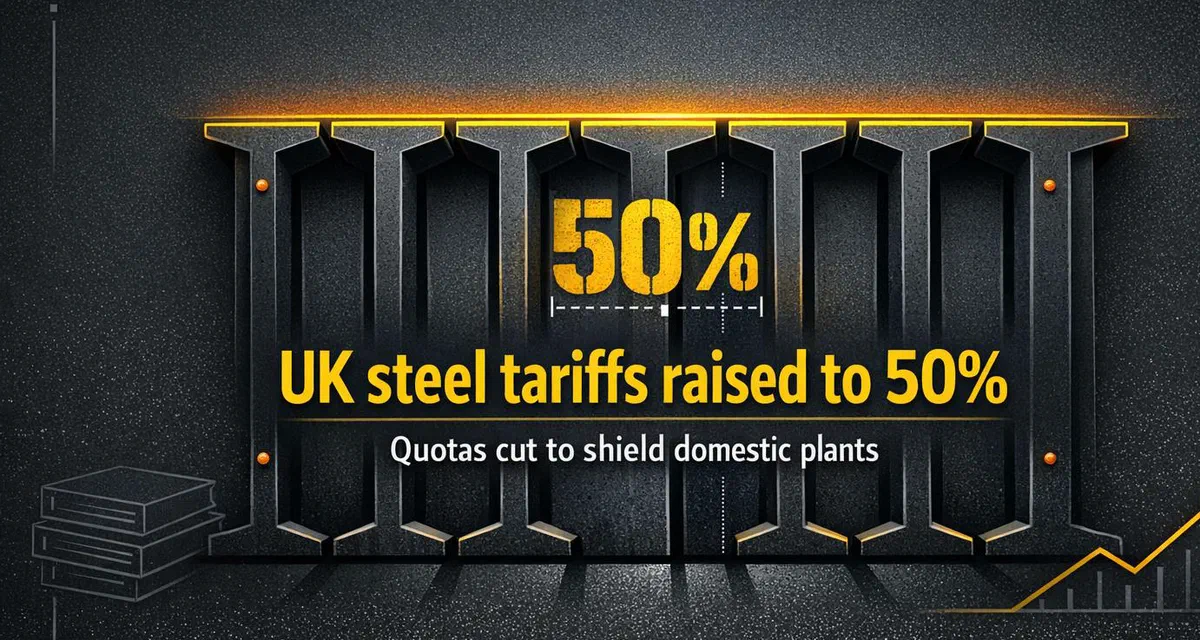
UK doubles steel tariffs to 50% — what manufacturers must do before July
- BlogSmarter AI
- Blog , News
- March 19, 2026
- Updated:
Table of Contents
The UK just doubled tariffs on imported steel to 50%, including Chinese steel. It is part of a £2.5bn plan to rebuild domestic production and protect what’s left of the UK’s steel industry.
The announcement follows urgent warnings from Tata Steel in South Wales about the risk of plant closures without government intervention. During a visit to Tata Steel’s Port Talbot site, Business Secretary Peter Kyle set an ambitious target: 50% of steel used in the UK will be produced domestically, with half of that output coming from Wales.
“This is a very strident set of protections for British steel production to equal out the unfair competitive behaviour elsewhere that doesn’t create a level playing field for British steel”, said Kyle. The strategy also lines up with investments in a shift to green steel and a push to bring domestic production up to global standards.
The new rules: what’s changing in July
From July, the UK will introduce stricter import measures. Quotas on several overseas steel products will be cut by 60%. Tariffs on imports outside those quotas will rise to 50%. These measures mirror recent actions taken by the United States, European Union, and Canada — all responding to an oversupply of Chinese steel. China, the world’s largest steel producer, hit record-high exports in December, adding pressure to an already saturated global market.
These measures also land just as the old steel safeguards expire — the ones put in place before the UK left the EU. The EU has proposed the same move: doubling its tariffs to 50% and cutting quotas for imports from third countries, including the UK. Both sides are expected to negotiate carve-outs to unlock lower tariffs between them — a joint effort to tackle cheaper Chinese steel.
Reviving a shrinking industry
The new strategy protects what’s left of the UK’s steel industry after decades of decline. Port Talbot, once a hub of steel production, shut its last blast furnace in 2024. That closure happened despite a £500m government package to fund the switch to electric arc furnaces — a change that cost 2,800 jobs. Construction on the new furnaces is already underway, with operations expected to start in 2028.
The Scunthorpe plant in north-east England remains the UK’s last producer of virgin steel. The government took it into public ownership in April last year after its Chinese owner, Jingye, threatened to close the gates. Since then, taxpayers have been propping it up — and the bill is rising. Recent figures from the National Audit Office put the total cost to the public purse at over £1.5bn by 2028.
Kyle said the blast furnaces at Scunthorpe “would continue until the companies themselves decide to transition” — and said nothing about the NAO’s report.
The industry is cautiously backing the plan — for now
Despite the obstacles, industry reps are cautiously backing the plan. Alasdair McDiarmid, assistant general secretary of the trade union Community, described recent talks with ministers and Tata Steel executives in Port Talbot as “positive and productive.” He noted: “We have sat across from business secretaries for years who promise things and don’t deliver, but this government is following through … At Port Talbot we can see progress.”
Welsh First Minister Eluned Morgan also welcomed the strategy, calling it “good news for our steel communities and the thousands of people across Wales who work in or around the industry, now and in the future.”
The government has made its move. Whether it’s enough depends on execution — and on how fast domestic mills can ramp up. Energy costs remain brutal, and Chinese export volumes aren’t going away. For manufacturers, the question isn’t whether this affects you. It’s whether you’re ready.
Which steel products take the hardest hit
The tariffs don’t land evenly. Certain product families feel it first and feel it hardest.
Flat products — hot-rolled coil, cold-rolled strip, galvanised sheet — face the sharpest quota cuts. These grades feed automotive, white goods, and general fabrication lines. If you stamp, press, or roll for a living, your input costs are heading north.
Long products — rebar, wire rod, and sections — also fall within the new quota restrictions. Construction contractors and structural steel fabricators will feel the squeeze quickest. Cheap rebar from Turkey and Eastern Europe has undercut domestic supply for years. That era ends in July.
Structural steel — I-beams, hollow sections, and angles — sits right at the intersection of high demand and thin domestic supply. With Port Talbot’s blast furnaces already gone, the UK cannot replace all structural grades from home production. That gap is real and it is open right now.
Stainless and speciality grades face less direct tariff exposure — for now. But watch this space. If China redirects export volumes away from carbon flat products, speciality mills will feel the knock-on pressure on alloy inputs soon enough.
What this means for UK manufacturers right now
Your raw material costs are going up — plan for it
The 50% tariff on out-of-quota imports is not a distant threat. It starts in July. If you buy steel on the spot market, your next purchase order will look different to the last one. Buyers who locked in forward contracts before the announcement are better placed. Everyone else is playing catch-up.
If you don’t know which of your stock was bought at what cost and from where, you can’t quantify your exposure. That calculation starts with accurate, up-to-date inventory data — not last Friday’s spreadsheet.
Supply chains built on cheap imports need rethinking
Many UK fabricators spent the last decade sourcing hot-rolled coil and structural sections from Asia and Eastern Europe. That model worked when tariffs were low and freight was predictable. Neither condition holds today.
Go through your approved supplier list now. If more than half your steel volume comes from outside the quota bands, you carry serious cost exposure after July.
Lead times will stretch before they improve
New domestic capacity — including Scunthorpe’s stabilised output and Port Talbot’s future electric arc furnace — will not fill the supply gap overnight. Expect supply tightness to persist well into 2027. Scunthorpe remains under pressure, and Port Talbot’s new electric arc furnaces won’t be operational until 2028. Start ordering further ahead than you normally would.
What should manufacturers do right now
Don’t wait for an invoice shock to force your hand. Here is where to start:
- Work out which of your steel buys fall outside the quota. Break down last year’s purchases by product family and country of origin. Know your exposure before July, not after.
- Call your steel service centre this week — not in June. Ask directly about forward-priced contracts and stock availability on your core grades. The buyers who move first get the better terms.
- Build a 90-day buffer on your highest-volume grades. Domestic mill lead times are already tightening. A buffer gives you room to be selective when the market gets worse.
- Reprice any live quotes with post-July delivery dates. If you based those quotes on today’s steel costs, you may have already locked in a loss. Check every open quotation now.
Your service centre can tell you what’s available. You still need to know what you actually have — and what it cost to land it.
One more thing. If your steel stock lives in a spreadsheet right now, this market volatility will hurt you more than your competitors. GoSmarter’s Inventory Management was built for metals — not adapted from generic warehouse software. It tracks stock the way a steel business actually works: by length, grade, and heat number, not units on a shelf.
If your cost-per-tonne data is out of date, you cannot accurately reprice live quotes — and you risk locking in margin losses before the tariff even hits. See it in action →