The Hidden Cost of Manual Mill Certificate Management
- Ruth Kearney
- Edited by Ruth Kearney
- Blog
- May 20, 2026
- Updated:
Table of Contents Show Hide
For many manufacturers, steel stockholders, fabricators and distributors, Mill Test Certificates (MTCs) and Material Test Reports (MTRs) are a necessary part of doing business. They prove compliance, provide traceability, and confirm the material delivered matches the material ordered. Without them, projects stall, audits get painful, and quality risks climb.
Yet despite their importance, many companies still manage mill certificates by hand.
Certificates arrive by email. Staff store them across multiple folders, rename them by hand, check them against purchase orders, and hunt for them when customers request documentation. What should be a simple process becomes a time-consuming administrative burden.
What Is a Mill Certificate?
A Mill Test Certificate (MTC), sometimes called a Mill Test Report (MTR), is a quality assurance document issued by the producing mill. It carries the critical information your team relies on:
- Heat numbers and batch identification
- Material grade and specification
- Chemical composition
- Mechanical properties
- Dimensions and product details
- Applicable standards such as ASTM (American Society for Testing and Materials), ASME (American Society of Mechanical Engineers) or EN 10204
- Traceability information linking material back to production batches
For regulated industries such as construction, infrastructure, energy, pressure vessels, oil and gas, and manufacturing, these certificates are not optional. They form the foundation of material traceability and compliance.
The Real Cost of Manual Mill Certificate Management
The challenge isn’t the certificates themselves. It’s the effort required to manage them.
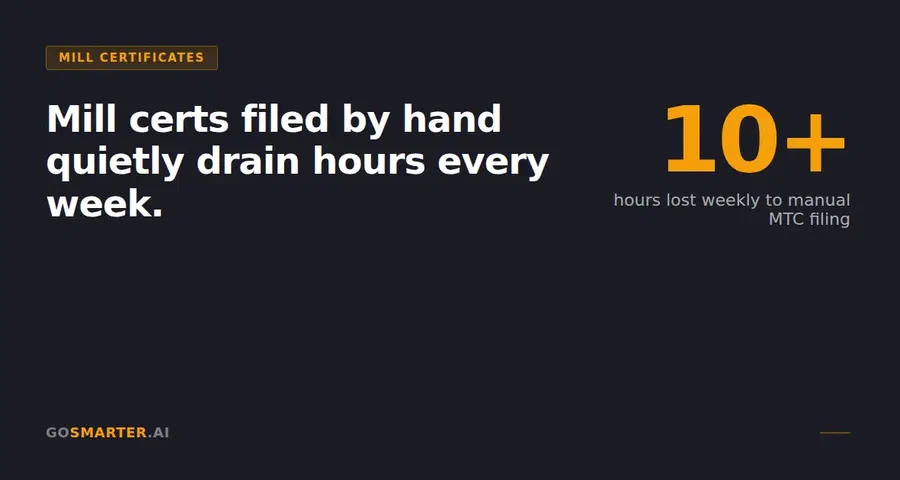
Many businesses spend hours every week on the same repetitive tasks:
- Searching for missing certificates
- Renaming and filing documents
- Extracting data into spreadsheets by hand
- Matching certificates to deliveries
- Verifying heat numbers and grades
- Responding to customer documentation requests
- Building quality and compliance packs
These manual tasks create hidden costs across the business.
Labour Costs
Every minute spent processing certificates is a minute taken from production, procurement, customer service or quality improvement. As certificate volumes rise, the administration grows faster still.
Errors and Rework
Manual data entry introduces risk. Incorrect heat numbers, missing certificates, duplicate records or misplaced documents lead to delays, customer complaints and costly rework.
Compliance Risk
Auditors, inspectors and customers all request traceability documentation. Missing or incomplete records turn a routine request into a serious compliance problem.
Delayed Decision Making
Critical material information stays trapped inside PDF documents. Teams can’t easily search, analyse or report on material data when it’s locked away in unstructured files.
Why Manufacturers Are Automating Mill Certificates
Manufacturing leaders are turning to automation to remove repetitive document handling and improve day-to-day efficiency. Automation cuts manual effort, sharpens accuracy, and creates structured digital records you can search, analyse and connect to other systems.
The result is clear:
- Faster certificate processing
- Improved traceability
- Reduced administration
- Better compliance
- More accurate records
- Improved customer response times
Most importantly, teams spend less time managing paperwork and more time adding value.
Introducing GoSmarter Mill Cert Manager
GoSmarter Mill Cert Manager is built by Nightingale HQ and is specifically for metals manufacturers, fabricators, stockholders and distributors. It automates certificate handling from inbox to digital library giving customers end to end traceability.
GoSmarter sits on top of your existing Enterprise Resource Planning (ERP) system, email and shared drives with no need to rip-and-replace. It connects via an Application Programming Interface (API) with Microsoft Entra single sign-on (SSO) support. All data is stored in UK Azure. GoSmarter never uses your certificate data to train Artificial Intelligence (AI) models.
Extract Key Data
GoSmarter captures heat numbers, grades, dimensions, chemical composition, mechanical properties and certification details directly from your mill certificates. There is literally no retyping.
Split and Organise Documents
GoSmarter separates, classifies and stores multi-page certificate packs in a structured digital library.
Enable Instant Search
Find certificates in seconds by heat number, grade, supplier, project, customer or material type.
Improve Traceability
Link material, inventory and certificates together to create complete end-to-end traceability, from mill to customer.
Generate Compliance Packs
Build customer documentation packs quickly, without hours of manual searching and assembly.
Support EN 10204 Compliance
Manage 2.1, 2.2, 3.1 and 3.2 certificates with confidence, while keeping a complete audit trail. The same heat number data feeds GoSmarter’s Inventory and Oders modules giving you one record and end to end traceability.
From Paperwork to Competitive Advantage
Mill certificates are one of the most important documents in the metals supply chain but they should not be one of the most time-consuming. Automate certificate management and you reduce administrative effort, improve compliance, strengthen traceability, and unlock the operational data hidden inside thousands of PDF documents.
The future of mill certificate management is not filing cabinets, shared drives and spreadsheets. It’s intelligent automation.
Less paper. More metal. Most teams see first-quarter payback — the subscription typically costs less than one hour of rework per month.
GoSmarter Mill Cert Manager helps manufacturers automate certificate processing, improve traceability and reduce compliance administration. Teams get more time to focus on production, customers and growth.
Frequently Asked Questions
What is a Mill Test Certificate (MTC)? A Mill Test Certificate (MTC), also called a Mill Test Report (MTR), is a quality assurance document issued by a steel or metals mill. It records the chemical composition, mechanical properties, heat number, and applicable standard for a batch of material. Without it, you cannot prove the material meets your specification.
Can GoSmarter read mill certificates from different mills and suppliers? Yes. GoSmarter’s Mill Cert Manager is trained on hundreds of mill certificate templates from suppliers across the UK, Europe, and globally. It handles varying layouts, languages, and formats without manual template setup.
How long does it take to get value from mill cert automation? Most teams process their first certificates on day one of the trial. The setup is configuration, not development — connect your email inbox or shared drive, and GoSmarter starts extracting data immediately.
Does GoSmarter store my certificate data securely? All data is stored in UK Azure data centres. GoSmarter connects via REST API with Microsoft Entra (SSO) support and never uses your certificate data to train AI models. Your data stays yours.
What happens when a mill certificate has missing or incorrect data? GoSmarter flags incomplete or anomalous certificates automatically — before they reach production. Your team reviews exceptions rather than checking every document by hand.
Go Deeper
- AI for Mill Test Report Traceability — how AI cuts MTR handling from minutes to seconds
- Mill Cert Automation hub — the full guide to automating certificate processing end to end
- Metals Manufacturing Glossary — plain-English definitions of mill certs, EN 10204, heat numbers and more
About the Authors

Co-Founder & CEO
Ruth Kearney is Co-Founder and CEO of GoSmarter AI — driving commercial growth and strategic partnerships to help metals manufacturers adopt AI and digital tools that actually deliver on the shop floor.
Editor· Co-Founder & CEO
Ruth Kearney is Co-Founder and CEO of GoSmarter AI — driving commercial growth and strategic partnerships to help metals manufacturers adopt AI and digital tools that actually deliver on the shop floor.