Stop Drowning in Paperwork: Why Your Inbox is Killing Your Production Speed.
- Steph Locke
- Blog
- February 25, 2026
- Updated:
Table of contents Show Hide
Think your machines are the problem? Think again. The real bottleneck is your inbox. Every day, production managers and estimators lose hours chasing RFQs, digging through PDF mill certificates, and juggling outdated spreadsheets. It’s not just frustrating - it’s costing you time, money, and deals.
Here’s the hard truth: processing just 40 RFQs a week can eat up 80–120 hours of manual work. That’s three full-time employees doing nothing but email admin. Meanwhile, your competitors are quoting faster and winning business while your team is stuck in the weeds.
The Cost of Doing It the Old Way
- Manual RFQ processing: 10–20 minutes per email
- Extracting data from PDFs: Up to 2 hours per drawing
- Email overload: 120 emails/day per office worker
- Quote turnaround: 5.6 days on average - your competitor already won the job
Every minute wasted on admin is time stolen from production. And it’s not just time - it’s expertise. Skilled engineers are stuck doing data entry instead of solving real problems, and your factory is paying the price.
The Fix: Smarter Tools, Less Admin
AI tools like GoSmarter cut through the chaos, automating the boring stuff so your team can get back to work. Here’s how:
- MillCert Reader: Pulls data from mill certificates in seconds, not days.
- Smart Production Scheduler: Creates cutting plans in minutes, reducing waste by up to 50%.
- Smart inventory: Better selection and management of stock to reduce over- or under- ordering.
Stop running your factory like it’s 1985. The tools to fix this mess are here - and they don’t require months of setup or IT headaches. Let’s dive into how you can make admin delays a thing of the past.
Why Your Inbox Keeps You Behind Schedule
Your inbox isn’t just a tool for communication - it’s often the hidden bottleneck that slows everything down. While much attention is given to machine uptime and shop floor efficiency, the real drag on operations often starts in the front office. Every RFQ buried in an endless email chain, every mill certificate stuck in a PDF, and every approval request lost in a sea of messages eats away at valuable time. Let’s dive into how mill certificates, messy communication, and misused engineering resources are holding you back.
Mill Certificates: The Time Sink You Can’t Ignore
Mill certificates are supposed to confirm material compliance, not hijack your workday. Yet, manually processing them can take up to three days. Compare that to automated systems, which trim this down to just 15 minutes - a staggering 99% reduction in time spent [7].
Take Midland Steel, for example. In June 2025, this UK-based rebar manufacturer adopted the MillCert Reader tool. By automating the renaming and data extraction from mill certificates, they freed up 10 hours every month while cutting down on tracking errors for chemical and mechanical properties [6]. Similarly, a North American metal parts service centre slashed its MTR processing time from three days to 15 minutes between 2024 and 2025, resulting in an extra £30,000 in annual revenue [7].
Every moment spent manually inputting heat numbers and tensile strengths is time stolen from production. These delays don’t just slow you down - they cost you in output and efficiency.
How Fragmented Communication Wrecks Your Schedule
Poor communication isn’t just annoying - it’s a production killer. When RFQs, schedule updates, and approvals get buried in email threads, it’s no wonder 57% of employees report not receiving clear instructions [9]. Sharing spreadsheets over email only adds to the chaos, creating version conflicts that teams waste time resolving instead of executing plans [5].
Even something as simple as processing an RFQ email can take 10 to 20 minutes just to figure out quantities and deadlines [4]. On the flip side, having real-time visibility into machine and job performance can boost efficiency by 20% [8]. If your production managers are chasing yesterday’s updates instead of planning for tomorrow, your entire schedule starts to crumble. And when engineers are pulled into this mess, the inefficiency only deepens.
Engineers Bogged Down in Admin Work
Engineers are trained to solve complex problems, yet they often find themselves stuck doing repetitive, mind-numbing tasks. Hours are wasted hunting through PDFs instead of focusing on actual engineering challenges [3][4]. This isn’t just a waste of skills - it’s demoralising. In fact, 22% of workers say they’d quit their jobs because of an overwhelming flood of emails [9].
Here’s a stark example: skilled estimators often spend their time manually extracting data from technical drawings. As Atishay Jain, Founder of Mavlon, explains:
“The shift is critical: your estimator reviews pre-extracted data instead of reading from scratch. Reviewing 180 data points and correcting 25 errors takes 10 minutes. Extracting 180 data points manually takes 90 minutes” [3].
That’s a 9× productivity boost on just one drawing. Now imagine the difference automation could make when your team handles dozens of these every week. By automating routine tasks, you free up your engineers to focus on what they’re actually good at - optimising production and solving real problems.
How GoSmarter Fixes Production Operations with AI
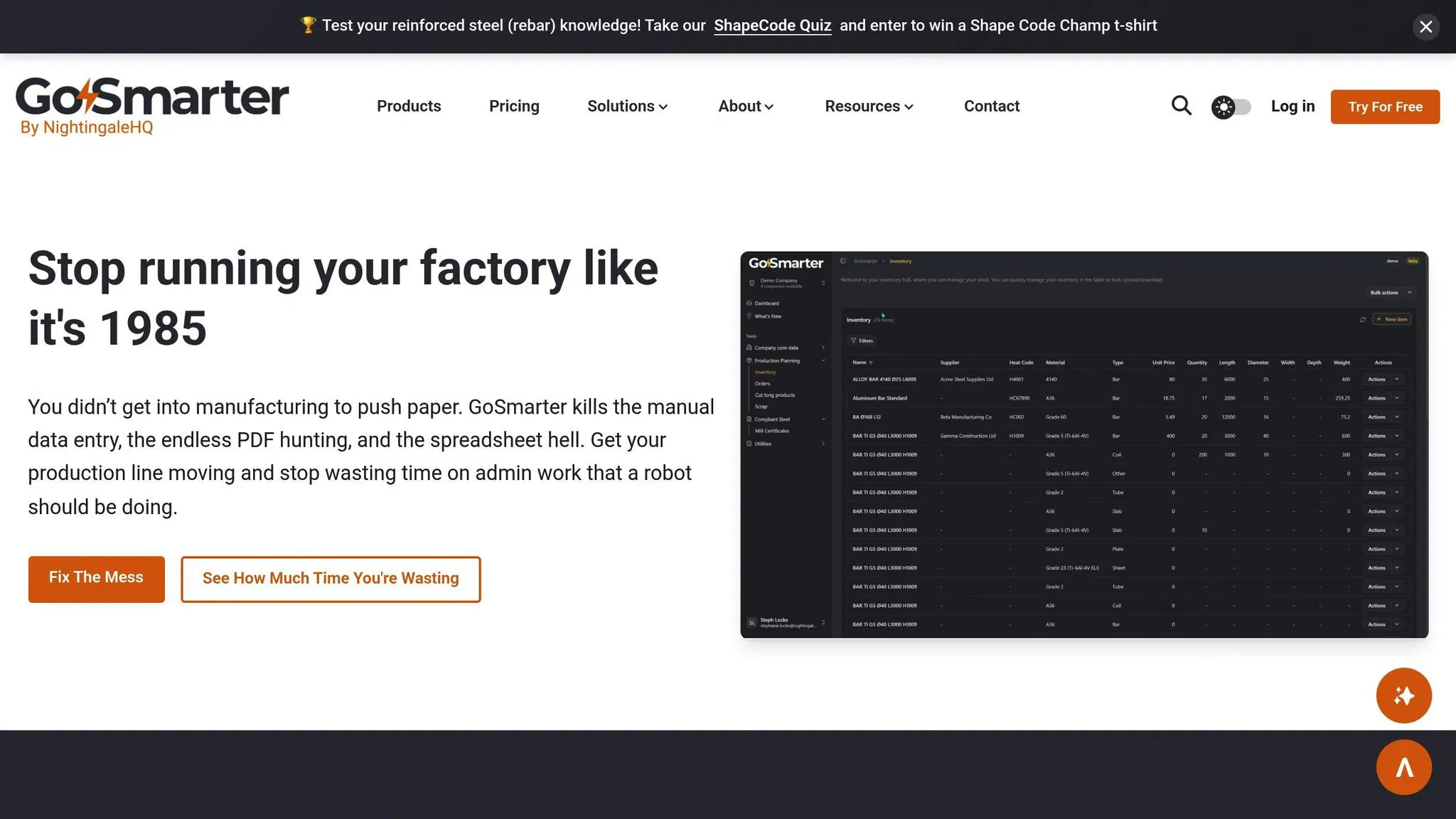
GoSmarter is designed to free metals manufacturers from the burden of endless paperwork, giving them more time to focus on actual production. By automating tedious admin tasks, it restores hours of productive time. Unlike clunky, traditional ERP systems that take ages to implement, GoSmarter works with what you already have. Just log in, upload your data, and start seeing results instantly.
GoSmarter tackles production bottlenecks head-on with targeted automation tools.
MillCert Reader: Let AI Handle the Paperwork
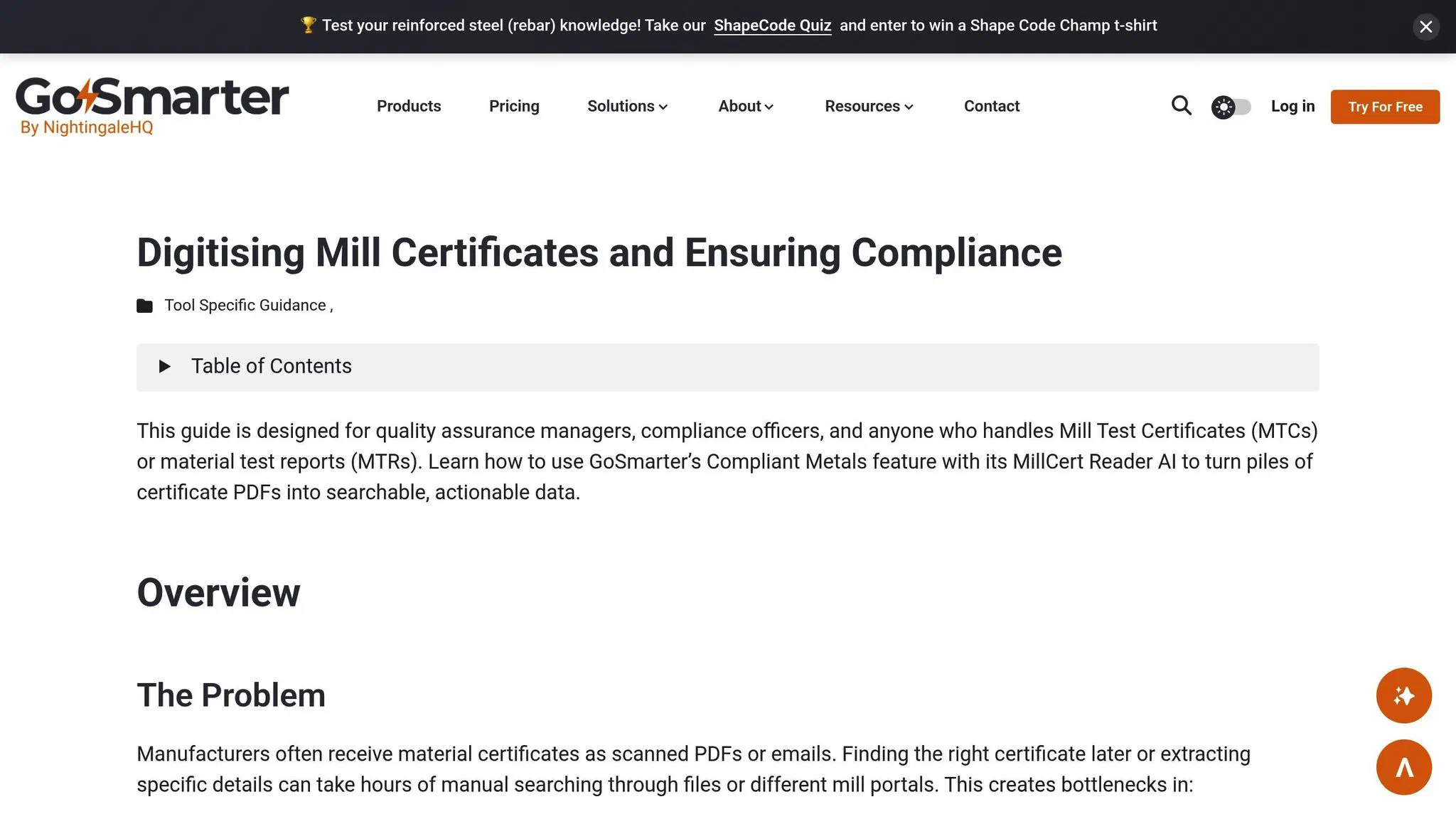
Processing mill certificates manually is a time sink. These compliance documents contain critical details like chemical composition, mechanical properties, and heat numbers, but extracting this data by hand is slow and error-prone. Enter the MillCert Reader: it scans PDFs and pulls out the key information in seconds.
One production manager at Midland Steel shared their experience:
“I logged in for the first time and was up and running in minutes. MillCert Reader now pulls all the key info automatically. What used to take hours every week is done in seconds” [6].
It even renames files instantly, shaving off up to 10 hours of work every month.
Our AI tool saves hours every month by automatically pulling key data from mill certificates. Making traceability packs a breeze through renaming based on data in the PDFs and automatically connecting this data to support smarter inventory management is just a no-brainer.
This isn’t just about saving time - it’s about making production smoother and faster.
Smart Production Scheduler: Smarter Plans, Less Scrap
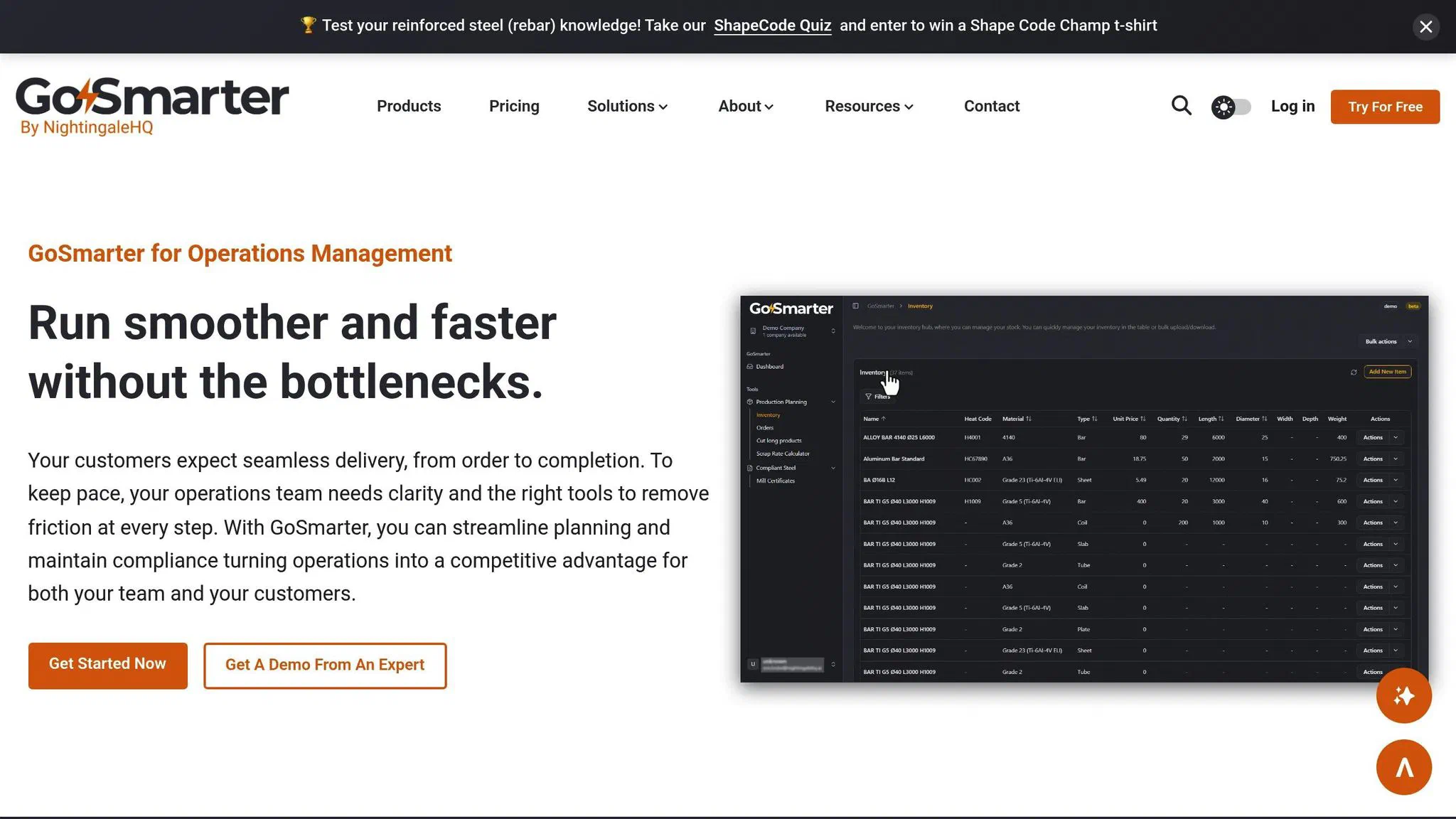
Planning production doesn’t have to be a guessing game. The Smart Production Scheduler simplifies the process by taking your orders and inventory data, crunching the numbers, and generating an optimal cut list that reduces waste. It factors in data like the carbon equivalency of stock so you can pick the right metal for the order specifications so you know exectly how it will change your stock levels at a the line item level. [2].
Just upload your inventory and order spreadsheets, hit “Plan”, and get a production schedule that works.
Tony Woods, CEO of Midland Steel, sums up its impact:
“Smart technology choices can have a direct, measurable impact on reducing carbon emissions in steel manufacturing. The integration of AI and digital tracking has significantly improved our operational efficiency” [1].
The tool also includes a free Scrap Rate Calculator to help standardise reporting and drive continuous improvements - all without requiring a complete system overhaul.
Manual Methods vs. AI Tools: What Changes
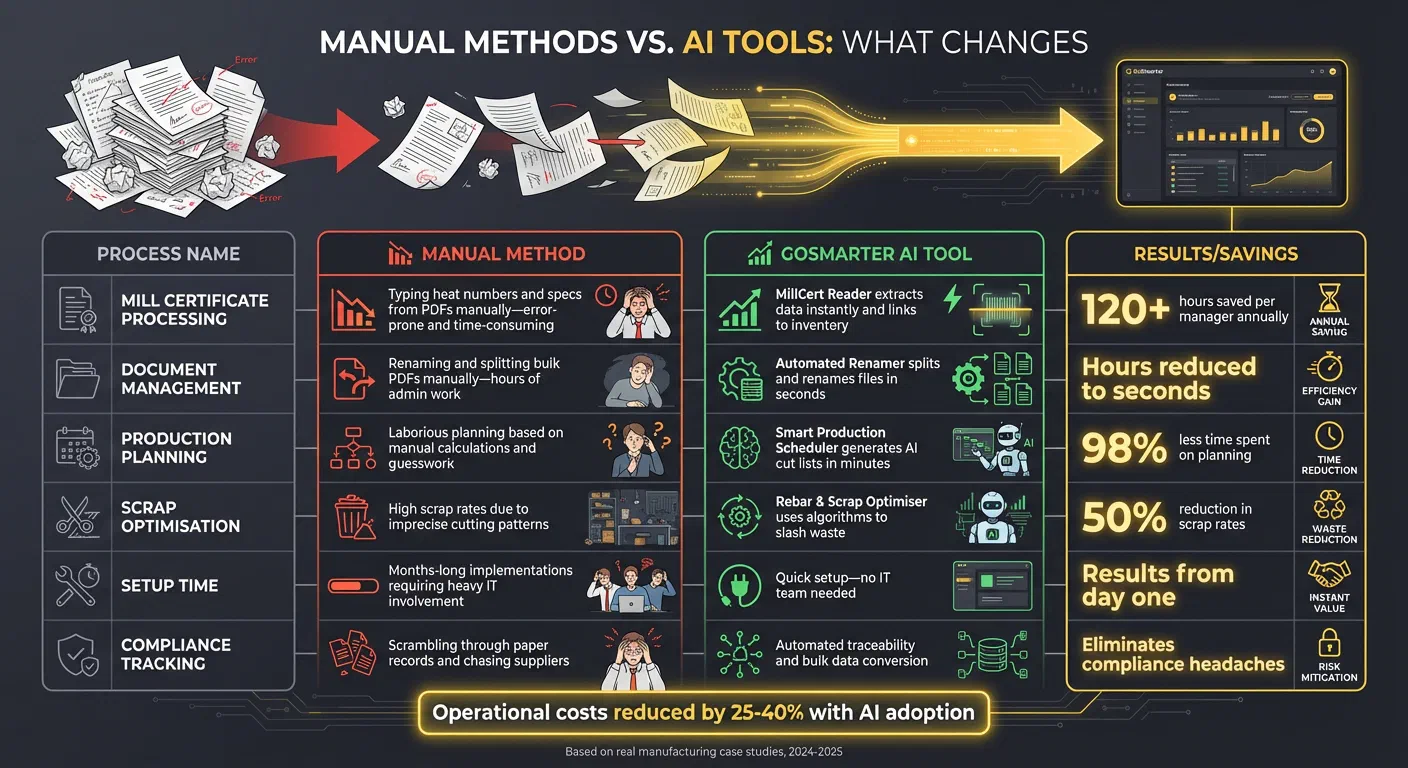
Let’s be honest - manual processes in manufacturing are slow, error-prone, and downright frustrating. Using spreadsheets to manage production is like trying to navigate with a blurry map; you’re guessing more than you’re acting. Hours are wasted chasing PDFs, fixing data entry mistakes, and making calculations that are little more than educated guesses. Enter AI tools, and suddenly, the chaos turns into clarity. In seconds, messy data becomes actionable insights.
Here’s a look at how manual methods stack up against GoSmarter’s AI-driven system:
Comparison Table: Manual Work vs. Automated Systems
| Process | Manual Method | GoSmarter AI Tool | What You Gain |
|---|---|---|---|
| Mill Certificate Processing | Typing heat numbers and specs from PDFs manually - error-prone and time-consuming [2] | MillCert Reader: Extracts data instantly and links to inventory [2] | Saves 120+ hours per manager annually [2] |
| Document Management | Renaming and splitting bulk PDFs manually - hours of admin work [2] | Automated Renamer: Splits and renames files in seconds [2] | Cuts hours of admin to mere seconds |
| Production Planning | Laborious planning based on manual calculations and guesswork [2] | Smart Production Scheduler: AI-generated cut lists in minutes [2] | 98% less time spent on planning [2] |
| Setup Time | Months-long implementations requiring heavy IT involvement [2] | Quick setup - no IT team needed [2] | Results from day one |
| Compliance Tracking | Scrambling through paper records and chasing suppliers [2] | Automated traceability and bulk data conversion [2] | Eliminates compliance headaches |
Factories using GoSmarter’s AI tools have seen scrap rates cut in half and reclaimed hundreds of hours previously lost to tedious admin work [2]. Tadhg Hurley, Managing Director at MAAS Precision Engineering, summed it up perfectly:
“Choosing the right digital tools… has been a great opportunity to accelerate our adoption of smarter tools that open up new opportunities” [1].
This isn’t just a nice-to-have upgrade - it’s a game-changer. When you stop tolerating the inefficiency of outdated methods, your factory doesn’t just keep up; it speeds ahead.
Speed Up Your Factory Without Overspending
What You Actually Save: Time and Money
GoSmarter’s MillCert Reader frees up 120 hours a year for production managers by eliminating the need to manually type data or search through PDFs [2]. Meanwhile, the Rebar & Scrap Optimiser slashes scrap rates by 50% [2], reducing material waste and improving profit margins. No vague promises here - these are tangible results that directly impact your bottom line.
Factories that adopt AI-driven production scheduling report 30% lower labour costs [11][12], and overall AI adoption in manufacturing can cut operational expenses by 25% to 40% [11]. These aren’t just numbers - they represent money saved and reinvested into growing your business, instead of being lost to inefficiencies. All those staff you free up can be working on boosting your business, tackling the upcoming retirement crisis and help build the next wave of talent.
Pricing Plans for Different Factory Sizes
GoSmarter offers pricing plans designed to match your factory’s scale, so you can take advantage of these savings without overcommitting. Here’s how it works:
- GoSmarter Insights: Start for free and explore the basics.
- MillCert Reader: £275/month for automated mill certificate processing and heat code integration.
- Metals Manager: £400/month for complete inventory and order management.
- Cutting Plans: £1,000/month paid annually, £1,250/month rolling.
This flexible approach ensures you’re only paying for what you need. Try the free calculators, see the results, and upgrade when you’re ready.
Stop Running Your Factory Like It’s 1985
Still relying on outdated filing systems in 2026? That’s like running your factory with 1985 efficiency. The tools to streamline your operations are available now - no need for drawn-out implementation projects. By adopting smarter technologies, you’ll see measurable improvements in efficiency while also cutting costs and reducing your carbon footprint.
Your competitors are already making these changes. They’re automating repetitive tasks, halving scrap rates, and reclaiming valuable time. Modernise your factory today to stay ahead of the curve. The real question isn’t whether you can afford to upgrade - it’s whether you can afford not to.
Frequently Asked Questions
What should I automate first to speed up quotes?
How does AI extract data from mill certificates safely?
Will this work with my existing spreadsheets and emails?
How much time does manual data entry waste in a metal shop?
How do I speed up quoting without hiring more staff?
Go deeper
- No-Code Workflows for Metals SMEs — three core workflows that cut the paperwork without writing a line of code
- Mill Certificate Automation: The Complete Guide — automating cert extraction end to end
Tags:
About the Author

Co-founder & Head of Product
Steph Locke is Co-founder and Head of Product at GoSmarter AI — former Microsoft Data & AI MVP building practical tools to cut paperwork and automate compliance for metals manufacturers.