Stop Burning Cash: Why Your Cutting Plans Are Wrong.
- BlogSmarter AI
- Blog
- February 28, 2026
- Updated:
Table of Contents
You’re throwing away money - literally. Every sheet of stainless steel or aluminium that ends up as scrap is profit lost. And no, selling scrap doesn’t make up for it - you’re only recovering about 40% of its value. The real problem? Your cutting plans are stuck in the past. Static nesting patterns, manual calculations, and outdated tools are draining your margins. Here’s the hard truth: the old way is broken.
The Problem at a Glance
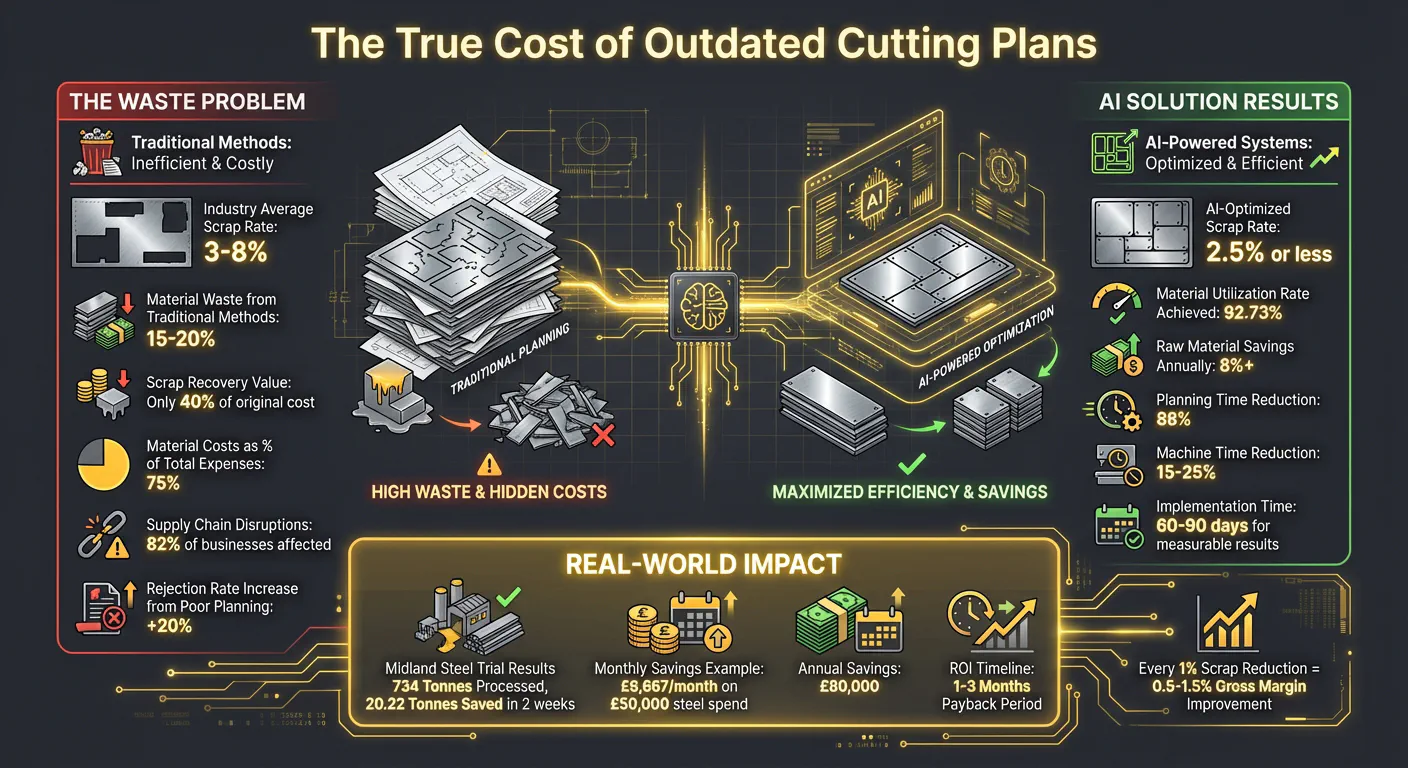
- Material Waste: Industry averages 3–8% scrap rates, but leaders aim for just 2.5%.
- Hidden Costs: Scrap doesn’t just hit your wallet - it inflates material orders and labour costs.
- Outdated Systems: Legacy tools can’t handle real-time changes, leaving you to react instead of plan.
The Smart Fix
AI-driven cutting systems are rewriting the rules. They slash scrap to under 2.5%, track offcuts automatically, and adjust to live job specs. For example, Midland Steel trialled AI in 2025 and reduced scrap by 2.5% in just two weeks. The result? More efficient use of materials and fewer headaches.
If you’re still relying on spreadsheets or clunky legacy systems, you’re leaving money on the table. Let’s dig into how smarter cutting plans can protect your margins - and your sanity.
Why Traditional Cutting Plans Fail
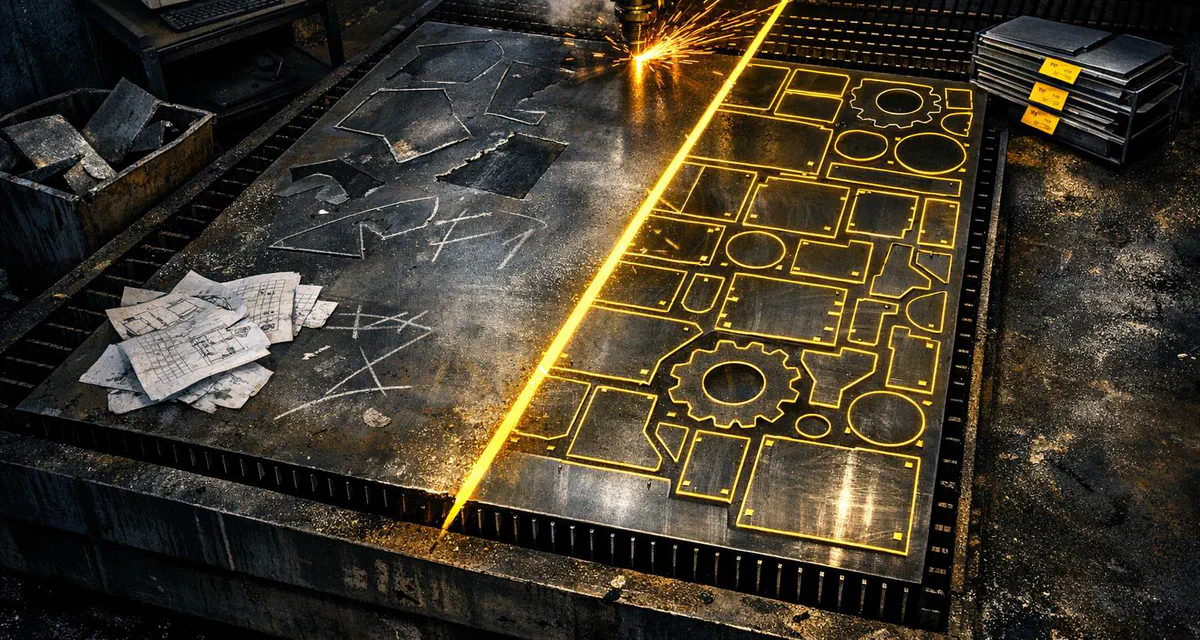
Traditional cutting plans often fall short when faced with the complexities of modern manufacturing. These systems rely on static nesting algorithms that struggle to handle irregular offcuts, last-minute changes, or dynamic shop-floor conditions. As a result, companies end up wasting between 15–20% of their raw materials[5]. This waste stems from two main shortcomings: rigid nesting algorithms and a lack of real-time production data.
Static Nesting Algorithms Create Waste
Older systems rely on fixed patterns that fail to adapt to unique challenges like irregular offcuts, varying machine constraints, or specific material grain requirements. Muhiuddin Alam highlights this issue: “Material waste is the silent killer of profit margins. When I first introduced cut list optimisation to a cabinet maker in Ohio, he couldn’t believe the results. ‘We were throwing away $500 worth of plywood every week,’ he told me. ‘Now it’s maybe $50’”[5].
Without integration with modern Manufacturing Execution Systems (MES), these systems overlook valuable offcuts, treating them as scrap. This oversight not only increases waste but also drives up costs by requiring more frequent material orders.
No Real-Time Visibility
The problem doesn’t stop at static algorithms. The lack of live production data compounds inefficiencies, particularly when unexpected changes occur. With no real-time visibility, production teams are left to respond to issues like machine downtime or design updates only after the fact. This reactive approach leads to higher rejection rates, often increasing by 20%[1].
To put this into perspective, 82% of businesses report supply chain disruptions[2], and without IoT sensors or live data feeds, these disruptions hit harder. AI-driven systems, on the other hand, can adapt to shifting conditions in real time, slashing material waste to just 3–8%[5]. This ability to pivot mid-production is what sets modern solutions apart from their outdated counterparts.
How AI Improves Cutting Plans
AI is transforming cutting processes by addressing the limitations of traditional planning. Machine learning algorithms evaluate thousands of layout possibilities instantly, taking into account material dimensions and machine capabilities. This approach has achieved utilisation rates as high as 92.73%[7].
One of the standout features is remnant management. AI systems track leftover materials (offcuts) and match them with new orders for smaller parts, ensuring nothing goes to waste. As Luis Galo, Data Scientist at Lantek, explains:
“The key to optimising the use of raw materials is nesting. That is, fitting pieces into the original sheet to try to take up as little space as possible… and making the most of what’s left after cutting”[4].
Selling scrap only recovers 40% of its cost[3], making leftover offcuts a direct loss. AI-driven systems minimise this by improving nesting methods, enabling real-time adjustments, and promoting proactive maintenance.
AI-Driven Nesting: Smarter Material Use
Modern nesting algorithms use techniques like Genetic Algorithms and No-Fit Polygon methods to create optimal layouts. They also identify opportunities for common-line cutting, where adjacent parts share a cutting edge. This reduces material wasted on the kerf and can lower scrap rates by up to 10% in high-volume runs[7].
Given that material costs can make up 75% of total expenses[7], even small reductions in scrap translate into significant savings. For instance, AI-driven nesting programmes have achieved raw material savings exceeding 8% annually[4], with scrap rates dropping to the industry target of 2.5% or less[3]. These improvements ensure materials are used to their fullest potential.
Real-Time Data for Smarter Adjustments
Static cutting plans often fail when unexpected changes occur, such as machine breakdowns, urgent orders, or design updates. AI systems overcome this by pulling live data from cutting machines, enabling on-the-fly adjustments. This agility has been validated in industry trials, where advanced AI tools reduced the time needed to generate high-quality production plans by 88%[8]. The result? Faster, smarter cutting with significantly reduced scrap.
Preventing Downtime with Predictive Maintenance
AI also tackles the challenges of reactive maintenance by continuously monitoring machine performance. By analysing real-time data, AI systems can detect potential issues - like worn blades, misaligned feeds, or material defects - before they escalate into costly downtime. Early detection not only prevents rejected parts but also ensures smoother operations, turning reliability into a measurable advantage.
How to Adopt AI Without Disruption
AI has proven its worth in reducing waste and scrap, but how do you integrate it without turning your operations upside down? The good news is you don’t need to overhaul your entire tech setup. Modern AI tools are designed to work alongside your existing systems, whether it’s your trusty CAD/CAM software, an ageing ERP, or even those spreadsheets you’ve relied on for years. AI takes on the grunt work in the background, letting your current tools do what they do best.
Integration with Legacy Systems
Did you know that around 70% of the software still in use by Fortune 500 companies was built over two decades ago[10]? If your factory depends on older systems, you’re in good company. AI platforms are built to connect with these legacy systems using APIs, middleware, and edge gateways. These tools translate older protocols like Modbus, OPC-UA, and Fanuc into modern standards, making AI integration possible without replacing your existing machines[13]. And for systems that don’t support APIs, Robotic Process Automation (RPA) can step in to automate tasks[11].
Here’s another staggering fact: between 70% and 80% of IT budgets are typically spent just maintaining outdated systems, leaving precious little for innovation[12]. AI-powered upgrades can speed up modernisation projects by 40% to 50% compared to traditional methods[10]. That means more time and money for what truly matters - creating better products with less waste. This streamlined integration ensures you see results quickly, without the headaches of drawn-out implementation.
Fast Results Without Long Implementation
Cloud-based AI tools are a game-changer, rolling out in weeks rather than months. Take GoSmarter, for example. It’s built to deliver results from day one, skipping the drawn-out six-month implementation phases you might expect[6]. All it takes is logging in through a browser, linking your data sources, and letting the optimisation begin.
Start small - say, with a single cutting line - and aim to achieve measurable results within 60 to 90 days[12]. This lets you demonstrate AI’s value without risking your production flow. With GoSmarter’s “Start for free” model[6], you only pay as you expand - no hidden fees, no massive upfront commitments. Test it, prove it works, and scale it up when you’re ready. AI adoption doesn’t have to be a gamble; it can be a calculated step forward.
The Financial Case for AI-Powered Cutting
Measuring the Impact
The numbers tell a clear story. During a two-week trial in late 2024, Nightingale HQ partnered with Midland Steel to test GoSmarter AI. The results? The platform optimised 734 tonnes of steel across 193 jobs, saving an impressive 20.22 tonnes of steel through better cutting plans[9]. Why does this matter? Every tonne of scrap comes at a double cost: the lost gross margin and the added carbon liability, especially under regulations like CBAM[3].
Let’s break it down. If you boost material utilisation from 75% to 85% on a £50,000 monthly steel spend, you save £6,667 a month, adding up to £80,000 annually[14]. AI-driven nesting can cut scrap rates to as low as 2.5%, compared to the industry average of 3%–8%[3]. For perspective, every 1% reduction in scrap could improve your gross margins by 0.5 to 1.5 percentage points[3]. On top of that, AI path optimisation trims machine time by 15%–25%, which means lower energy costs and reduced wear on consumables[14].
Key metrics to track include scrap reduction percentages, material utilisation rates (targeting 88%–95%[14]), labour hours saved on planning (often cut by more than 50%), and improvements in carbon footprint. There’s also a hidden benefit: selling scrap usually recovers only 40% of its original cost. Avoiding scrap entirely means dodging a 60% loss on your raw material investment[3]. These figures make a strong case for upgrading your cutting processes.
Time to Modernise Your Cutting Plans
Still relying on spreadsheets and outdated nesting methods? That’s money slipping through your fingers. Tony Woods, CEO of Midland Steel, summed it up perfectly:
“Smart technology choices can have a direct, measurable impact on reducing carbon emissions in steel manufacturing. The integration of AI and digital tracking has significantly improved our operational efficiency and sustainability performance.”[6]
AI-powered cutting tools typically pay for themselves within 1–3 months for general fabrication shops[14]. This isn’t just an upgrade - it’s an investment in protecting your margins and boosting efficiency.
GoSmarter makes it easy to take the first step with their “Start for free” model[6]. Test the platform on a single cutting line, track the results, and expand from there. The old methods aren’t just outdated - they’re costly. Modernising your cutting plans is a smart move to safeguard your profits and streamline operations.
FAQs
What data do I need to start optimising cutting with AI?
How can AI reuse offcuts instead of turning them into scrap?
How do I prove the ROI of AI cutting in my own shop?
To measure the return on investment (ROI) for AI cutting, focus on metrics that matter: scrap reduction, material savings, and efficiency improvements. By comparing these figures before and after implementing AI, you’ll have a clear picture of its impact.
For instance, AI tools can cut scrap waste by up to 50% and save between £17 and £44 per tonne of steel. Factor in these savings, along with increased production efficiency, and stack them against the cost of the AI system. The result? Financial benefits that often pay for themselves in just a few months, thanks to optimised nesting and smarter production planning.