Improving the Process for Fabricators Who Buy Stock Per Job
- Steph Locke
- Blog
- May 1, 2026
- Updated:
Table of Contents Show Hide
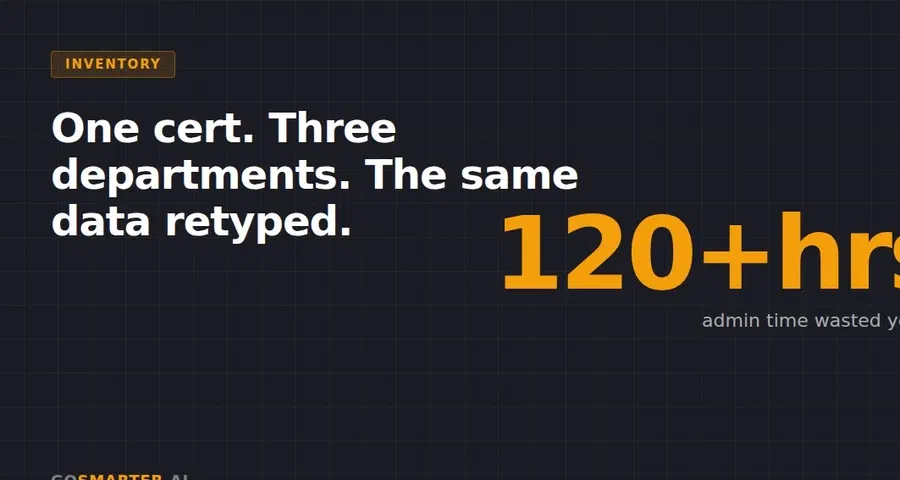
Fabricators waste time reprocessing mill certificate information across key steps, often pushing the same data through three departments instead of one. GoSmarter, built by Nightingale HQ, lets you scan certificates at goods receivable and use that data instantly across your workflow, without anyone touching the paper again. You cut duplicate admin work, run compliance checks earlier, speed up goods receivable, and avoid costly rework when materials miss spec.
The business case in one view
When you digitise mill certs at goods receivable, you can track four outcomes that matter:
- Lower admin time from removing repeat data entry and re-checking
- Fewer wrong-material jobs and less rework from early quality flags
- Better On-Time In Full (OTIF) performance from faster release decisions
- Less cash tied up in over-ordering because stock and cert data stay aligned
Measure this in phases. Track admin hours and rework incidents for four weeks before go-live, then compare after launch. Most teams see admin gains first, then better quality and stock decisions as cert-linked records become reliable.
In many to-order shops, the same cert data gets touched by 2-4 people across goods receivable, planning, and quality. If each person spends even 2-3 minutes re-checking or re-keying the same values, total hidden effort climbs fast.
How we calculated savings
The “120+ hours” claim is a planning benchmark, not a guarantee. Use this method:
- Count weekly cert volume
- Time how long manual cert handling takes end to end (open PDF, extract values, rename, file, re-check)
- Multiply by weeks per year
- Apply loaded hourly labour cost
Formula:
- Annual admin hours = weekly cert volume x manual minutes per cert / 60 x 52
If multiple people re-process the same cert, use this instead:
- Annual admin hours = weekly cert volume x manual minutes per cert x average number of people touching the cert / 60 x 52
Example:
- 30 certs/week x 5 minutes each = 150 minutes/week
- 150 minutes/week x 52 = 7,800 minutes/year
- 7,800 minutes/year / 60 = 130 hours/year
People-touch example:
- 30 certs/week x 3 minutes x 3 people = 270 minutes/week
- 270 minutes/week x 52 = 14,040 minutes/year
- 14,040 minutes/year / 60 = 234 hours/year
See the Midland Steel case study for a real deployment reference. Midland Steel is a UK rebar fabricator. The reported time saving came from one production manager at one site, so treat it as directional evidence, not a universal baseline.
Who this post is for
If you buy stock against a specific job (not to a warehouse) this is for you.
You source from one or more suppliers per purchase order (PO) for a specific job. You need the right grade, the right heat, and the right paperwork before cutting starts. That makes goods receivable the control point. Not procurement, not planning. Get it wrong and every downstream step gets slower and riskier.
Mill certificate data is not just admin. It drives production decisions. It tells your team whether welding and testing should proceed on that batch.
It also underpins British Standard EN 1090-1 (BS EN 1090-1) compliance for CE marking of structural components. Traceability from incoming steel to finished output is not optional — it is your evidence chain. You need a clear Factory Production Control (FPC) trail. If that trail still lives in disconnected spreadsheets, this is where audits get painful.
GoSmarter supports multiple metals business models. This post covers the to-order pattern: buy stock per job, process it, deliver it, prove it.
The broad process
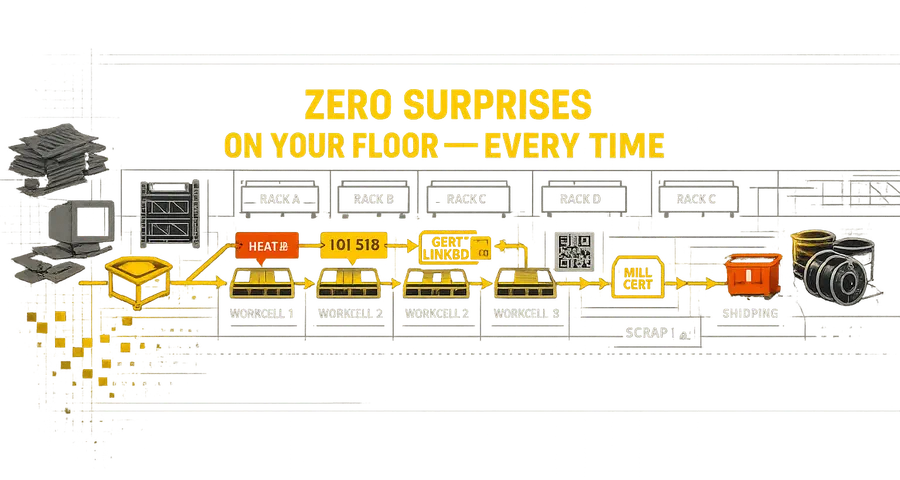
We mapped the core to-order fabrication process to show where GoSmarter fits. You can use it to replace disconnected tools or to remove specific bottlenecks in your existing stack. Here is the broad process from order intake to delivery.
flowchart TD;
co[Customer order received] --> est[Estimate and draft purchase orders for stock]
est --> po[Raise Purchase Order with suppliers] --> gi[Goods In]
gi --> yha[Yard ingestion]
yha --> cr[Mill certs received]
cr -- yes --> bmm[Log goods]
cr -- no --> yha
bmm --> cmc[Mill cert review]
cmc --> afu[Quality criteria met?]
afu -- no --> yha
afu -- yes --> rfm[Release for manufacture]
afu -- yes --> cpo[Complete Purchase Order]
rfm --> ms[Manufacture to spec]
ms --> off[Attach mill cert to offcuts]
ms --> del[Deliver with PoD]
del -->ret[Scan mill certs and store]
With GoSmarter, this process moves faster because cert data is captured once, validated once, and reused everywhere.
Choose your setup
Use this to pick your starting point. The “time to first value” column assumes your trial starts when you are ready — not when you sign up.
| Setup | Effort | Time to first value | Best fit |
|---|---|---|---|
| GoSmarter as core system | Medium to high | 2-6 weeks | You want one system for stock, orders, and cert traceability |
| Semi-manual bridge (comma-separated values sync) | Low to medium | 1-2 weeks | Your current system cannot integrate cleanly yet |
| GoSmarter as cert AI layer | Low | 3-10 days | Your current execution system works, but cert admin is the bottleneck |
Get ready before your trial starts
Most people waste the first week of a trial on setup they could have done beforehand. Do this before you go live:
- Gather a sample batch of recent mill certificates (10-20 is enough)
- Agree which person owns goods receivable sign-off
- Write down your current cert handling time per delivery — one honest number
That prep takes an hour. It means your trial clock starts on day one of real use, not day one of configuration.
Concrete go-live timeline
- Week 1 (pre-trial): baseline metrics, sample certs collected, pilot scope agreed
- Week 2 (trial day 1): goods receivable digitisation live on real deliveries
- Weeks 3-4: stock-to-order linking and release rules in place
- Weeks 5-8: expand to more product lines or sites
Trade-off to be honest about: fastest start usually means more manual sync. Lowest long-term admin usually means more upfront process change. Pick the setup that matches your appetite for change right now — you can always move up a tier later.
If you have no IT team, start here
Owner-operators can still roll this out without a heavy project.
- Start with cert capture at goods receivable only.
- Use comma-separated values (CSV) import/export once per day.
- Track two numbers for 30 days: admin minutes per cert and cert-related rework incidents.
- Add automation only after you have a clear baseline and a visible win.
No integration team required for phase one.
Canonical flow to implement once
Do not duplicate this flow across systems. Build it once, then choose where each step runs.
- Receive stock and related documents.
- Scan and extract certificate data.
- Validate against required standards.
- Link certificate data to stock records.
- Release compliant material to production.
- Track offcuts and carry certificate links forward.
- Deliver with proof of delivery (PoD).
- Produce traceability evidence pack on demand.
GoSmarter as the single system
You can run GoSmarter as the primary operating layer for stock, orders, and cert traceability. This is strongest when you are moving off legacy tools. If that transition is on your roadmap, start with modernising without ripping out your enterprise resource planning (ERP) system.
How this setup differs from the canonical flow:
- Most steps run in one platform
- Fewer handoffs between teams
- Faster audit evidence generation
Trade-off:
- Higher change effort in month one
GoSmarter with semi-manual integration to another system
Use this when your current system cannot integrate cleanly yet. Keep your core system. Run cert intelligence and traceability steps in GoSmarter. Sync only what matters.
How this setup differs from the canonical flow:
- You keep existing order and finance records where they are
- You add daily or event-based CSV sync points
- You can phase out manual sync later
Trade-off:
- Fast to start, but manual sync can become overhead if you never move to integrations
This is a bridge, not the final destination. Longer term, use application programming interfaces (APIs) to automate the handoffs.
GoSmarter as the mill certificate AI for another system
If your current execution system already works, use GoSmarter as a focused cert intelligence layer. This removes manual entry without forcing a platform migration.
How this setup differs from the canonical flow:
- GoSmarter handles extraction, validation, and file normalisation
- Your existing system remains system of record
- You pull structured cert output back using APIs
Trade-off:
- Lowest disruption, but less process standardisation across teams
Finance mini-box: payback range
For most small to mid-size fabrication teams, an initial cert-focused rollout often lands with a payback window of a few months.
Included in this estimate:
- Saved admin hours on cert handling
- Fewer cert-related rework incidents
- Faster release decisions that reduce delay costs
Not included in this estimate:
- Full ERP replacement costs
- Broader change-management effort outside cert and traceability flow
- Upstream commercial gains from improved OTIF
Risk and data in plain English
You should not need a legal deep dive to trust new software. Ask four blunt questions before rollout: where data is stored, who owns it, how export works, and what support covers in month one. If those answers are vague, fix that before scale-up.
Wrapping up
If you buy stock per job, pick one setup and run a 30-day pilot around goods receivable. Measure admin time, rework incidents, and release speed before and after.
Then decide based on evidence. Keep what works. Drop what does not.
Book a 20-minute workflow teardown to find your quickest route to fewer cert errors and faster material release: Book a Demo.
FAQs
Where should a to-order fabricator start with GoSmarter?
Do we need to replace our ERP to get value quickly?
Can we start with mill cert automation first and add planning later?
How quickly can we see results?
What happens when a mill certificate is missing data or fails the spec check?
How does this help with BS EN 1090-1 and audit readiness?
How should we treat the 120+ hours savings claim?
About the Author

Co-founder & Head of Product
Steph Locke is Co-founder and Head of Product at GoSmarter AI — former Microsoft Data & AI MVP building practical tools to cut paperwork and automate compliance for metals manufacturers.