Your ERP Calls It Traceability. It Isn't.
- BlogSmarter AI
- Edited by Steph Locke
- Blog
- September 15, 2026
Table of Contents Show Hide
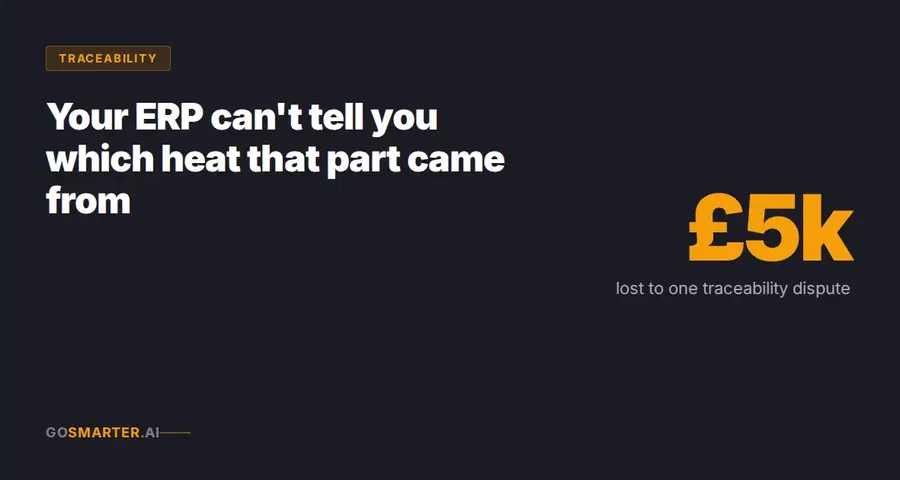
Enterprise Resource Planning (ERP) systems track lot numbers. They do not track traceability. A single traceability dispute already costs a mid-size metals operation around £5,000 in staff time, and that’s before anyone has to reconstruct a chain the ERP never captured in the first place. Most teams never notice the gap until an audit, a recall, or a customer certification request forces the question.
Your ERP can tell you that lot A4521 moved from goods-in to a work order on Tuesday. It cannot tell you which heat of raw material was inside that lot. It cannot name the mill certificate that proves the composition. It cannot show you which off-cuts came from it, which order they were later allocated to, or who last edited that record and why. Ask it to go backward from a shipped part to that full history, and someone opens a spreadsheet. Ask it to go forward from a single heat to every part it ended up in, and that same someone opens three more.
What real traceability actually requires:
- Naming the exact heat or cast behind any piece of material, not just a lot number
- Producing the matching EN 10204 mill certificate on demand
- Keeping the heat number and certificate linked through every cut, allocation, and off-cut return
- A tamper-resistant record of who changed what, and when, on every certificate, stock, and order record
- Tracing forward (heat to every part) and backward (part to full genealogy) without manual cross-referencing
Here’s why ERPs were never built to do this, and what actually closes the gap.
What Your ERP Actually Gives You
An Enterprise Resource Planning (ERP) system was built to answer financial and inventory questions. How much stock do we have? What did it cost? Where did the transaction post? Lot or batch tracking bolts onto that model. It records that a quantity of material with a given lot number moved from one location or status to another.
That is a real capability. It is also not what “traceability” means to a quality engineer, an auditor, or a customer asking where their steel came from.
“The ERP tells you a lot number moved. It doesn’t tell you which mill cert backs that material, which off-cuts it produced, or who last touched the record.”
Lot tracking in a generic ERP typically means:
- A lot or batch number entered manually at goods-in, or captured off a barcode
- That number carried through inventory transactions as stock moves between locations
- A rough link between the lot and the sales order it eventually shipped against
None of that is false. It just isn’t genealogy. It’s a stock ledger with an extra column.
Lot Numbers Are Not Genealogy
The Manual Way (ERP lot tracking) treats a lot number as a label on a quantity of stock. Real traceability treats every part as the sum of everything that happened to it, on the way to becoming a part.
| ERP Lot Tracking | Real Traceability |
|---|---|
| Records that lot A4521 moved from goods-in to WIP | Links the finished part back to the exact heat number inside lot A4521 |
| Stores a scanned mill cert as a PDF attachment, if anyone remembered to upload it | Matches the cert data field-by-field to the material specification and flags mismatches automatically |
| Shows which work order a lot was allocated to | Keeps the heat number and cert linked through every cut, partial allocation, and off-cut return |
| Logs a transaction against whichever login posted it, with no record of what changed | Logs the original value, the new value, who changed it, and when, on every cert, stock, and order record |
| Answers “where did this lot go” with a query someone has to build | Answers “what is the full genealogy of this part” in one lookup, forward or backward |
That last row is the one that matters most. An auditor doesn’t ask “where did lot A4521 go.” They ask “prove this specific part meets spec, and show me everything that touched it.” A lot number answers the first question. It cannot answer the second.
Why ERPs Were Never Built for Physical Process Genealogy
This isn’t a failure of Systems, Applications and Products in Data Processing (SAP), Oracle, or Epicor as companies. It’s a design decision made decades ago, and it was the right one for what ERPs were solving.
ERPs model the business: purchase orders, invoices, general ledger postings, stock valuation. A lot number exists inside that model as a financial and inventory identifier: something to value, count, and reconcile. It was never designed to ingest a mill certificate, keep that certificate linked as material gets cut and reallocated, or log who edited a spec value and why.
That linkage work still has to happen somewhere. In most metals operations, it happens on paper, in a shared drive full of PDFs, or in the memory of whoever handled the job that day. Someone writes the heat number on a traveller. Someone else files the cert. Nobody records what happened to the off-cut, or who amended the spec after the fact, unless they think to write it down.
Ask a quality engineer to prove which heat a part shipped eight months ago actually came from, and who last touched that certificate. Watch how many systems they have to open before they can answer.
That cross-referencing works right up until it doesn’t: an auditor visit, a customer certification request, or a recall. Then the gaps show up all at once, and someone spends a day reconstructing a history that should have taken thirty seconds to pull up.
What Happens When the Chain Breaks
The cost of this gap isn’t hypothetical. It shows up in three recurring situations.
The Recall
Without genealogy, you cannot isolate which parts are actually affected by a bad heat. You quarantine everything that shares a rough date range or a lot number, because that’s all you can prove. A recall that should touch fifty parts touches five hundred, because the ERP can’t narrow it any further.
The Audit
An EN 10204 3.1 certificate has to match the material in front of the auditor. It can’t just exist somewhere in a filing cabinet. If your quality engineer has to cross-reference a cert PDF, a spreadsheet of heat numbers, and an ERP log by hand, that’s hours per query. Multiply that by every line item the auditor picks.
The Customer Certification Request
Aerospace and automotive customers increasingly want more than “here’s a lot number.” They want the full chain: heat, cert, and a record of anything that changed along the way. If assembling that chain takes your team two days, you’ve just told a demanding customer that your traceability is a manual reconstruction exercise, not a system.
None of this is a reflection on the people doing the reconstruction. Quality engineers and production staff are good at their jobs. The problem is that the linkage work was never built into the tools they use. They’re proving genealogy by hand because nothing else is doing it for them.
How GoSmarter Captures Genealogy as a Byproduct, Not a Bolt-On
GoSmarter does not add a separate “traceability module” on top of an ERP. It captures the genealogy automatically, because the platform already handles the things that genealogy is made of.
- Mill certs: MillCert Reader reads EN 10204 certificates at goods-in and links each one to the exact heat number it belongs to, not just to a batch of stock.
- Stock movements: Metals Manager keeps that heat number and certificate link alive through every cut, partial allocation, off-cut return, and location move.
- Work orders: every order and line item records what material was reserved and allocated against it, and a full history is available for the record.
- Changes: GoSmarter requires individual logins and logs the original value, the new value, who changed it, and when, on every cert, stock, and order record, without any configuration.
Because those data points already live inside the same platform, the link between them is a natural consequence of how the work gets recorded. It’s not an extra step someone has to remember to complete. Pull up any stock item and get the full chain: heat, cert, every movement it’s made, and a record of anyone who amended it, forward or backward, without opening a second system.
“Traceability shows you where material went. GoSmarter’s audit trail proves what happened to it, and who was involved at every step.”
This is the same underlying architecture behind GoSmarter’s audit trail coverage: if the platform already logs who changed what on every record, extending that discipline to heat numbers and certificates needs no new system, only the same rigour applied from goods-in onward.
What to Do Next
Pick one part you shipped in the last month. Try to answer, from your current systems, which heat it came from, which cert backs it, and who last amended that certificate or stock record. Time how long it takes.
If that took more than a few minutes, or needed more than one system open at once, that’s the gap a lot number can’t close. Run a trial batch of your mill certs and work orders through GoSmarter’s MillCert Reader and see the same lookup take seconds instead of an afternoon.
Frequently Asked Questions
What's the difference between lot tracking and traceability in metals manufacturing?
Why can't my ERP do full material genealogy?
What does EN 10204 3.1 have to do with traceability?
How does GoSmarter capture genealogy without a separate traceability module?
What happens during a recall if you only have lot-level traceability?
Further Reading
- Audit Trails: Because ‘I Think It Was Dave’ Isn’t a Defence — how GoSmarter’s audit trail proves what happened to your data, not just your material
- From Mill to Customer: End-to-End Mill Cert Traceability — the full cert workflow from arrival to customer documentation
- AI for Mill Test Report Traceability — how AI extraction links certs to inventory in seconds
- Midland Steel Case Study — real production results from linking material data to work orders
- BS EN 10204 explained — the official standard governing mill certificate types
About the Author

Editor· Co-founder & Head of Product
Steph Locke is Co-founder and Head of Product at GoSmarter AI — former Microsoft Data & AI MVP building practical tools to cut paperwork and automate compliance for metals manufacturers.