Real-Time Data vs. Manual Tracking in Manufacturing
- BlogSmarter AI
- Edited by Ruth Kearney
- Blog
- April 18, 2026
- Updated:
Table of Contents Show Hide
Manual tracking costs UK manufacturers around £200,000 a year in production labour tracking alone. Add unplanned downtime, and the sector loses an estimated £700 million a week. If your team re-enters data that already exists somewhere else, you are paying for a problem that real-time data systems can fix today.
Real-time systems pull live information straight from machines. They cut errors, reduce downtime, and make compliance effortless. Tools like GoSmarter (built by Nightingale HQ), including the Mill Certificate Reader and Cutting Plans, automate the grunt work so your team can focus on keeping production moving.
What’s in it for you
- Cut downtime by up to 50% with instant alerts.
- Eliminate manual errors - no more 40% transcription mistakes.
- Save hours on compliance and scrap tracking.
- Spot inefficiencies in seconds with live dashboards.
Manual tracking slows you down. Here’s how to fix it.
Real-Time Data in Action: A Smart Manufacturing Case Study
The principle holds across industries. Danone’s experience shows what becomes possible when you replace paper-and-clipboard workflows with live data. The same transformation is happening right now in metals manufacturing.

Manual Tracking: Problems and Limitations
Manual tracking might seem straightforward - clipboards, shift logs, and end-of-day spreadsheets - but it’s a fragile system, especially in metals manufacturing, where precision is everything. Shockingly, about 70% of manufacturers still rely on manual data entry for their shop floor operations 12. And with that reliance comes a host of issues: transposed digits, missing entries, and handwriting that even the most seasoned operator can’t decipher 13. Add to that the lack of real-time reporting, and you’ve got a recipe for inefficiency that compounds daily.
The problem isn’t operator effort - it’s the delays and fragmentation baked into these systems. Operators usually record data in batches, often at the end of a shift. By then, the details surrounding a machine stoppage or quality issue are long gone. Minor problems - like brief material shortages or micro-stops - often slip through the cracks entirely 34.
Common Failures in Manual Tracking
Even at its best, manual data entry has a built-in error rate of about 1% 13. That might not sound like much until you multiply it across hundreds of entries every day. Mistakes like transposing numbers (e.g., writing 123 instead of 132), skipping data points, mixing up units, or dealing with illegible handwriting are all too common. When the data starts on paper and is later entered digitally, error rates can skyrocket to 40% 5.
Scrap tracking is one of the worst-hit areas. Operators often log scrap reasons hours after the fact, relying on memory. This delay leads to vague entries - like “material issue” instead of pinpointing that a specific heat number failed a tensile test at a given time. Without precise details, root-cause analysis becomes nearly impossible. And when different shifts interpret scrap codes inconsistently, the data becomes a fragmented mess 3.
Compliance records are another headache. Whether it’s for ISO 9001, the Corporate Sustainability Reporting Directive (CSRD), or customer audits, manual records are prone to missing signatures, physical wear, and illegibility. Preparing for audits often means weeks of painstaking manual compilation 6. Production scheduling doesn’t fare much better. With reporting delays of 24 to 48 hours, schedules are based on what machines should be doing, not what they’re actually doing. By the time unexpected downtime is noticed, it’s already disrupted the entire production week 14. These flaws show how manual tracking stifles timely, informed decision-making.
The True Cost of Manual Methods
The financial toll of manual systems is staggering. Human errors in these processes cost manufacturers between $3–$5 million annually in rework and waste 1. Paper-based systems alone slow production by roughly 15% 1. One company reported spending £243,000 every year just on manual production data entry 7.
Operators spend 15 to 30 minutes per shift filling out reports, and over 40% of workers waste at least a quarter of their week on repetitive data entry instead of focusing on tasks that actually add value 12. Compliance risks also skyrocket with manual records. Auditors frequently flag them as unreliable due to potential alterations, missing signatures, or unreadable documentation. Without proper traceability, linking a defect to a specific material lot or production run becomes nearly impossible 2.
“Manual data entry is the silent enemy of your productivity. It distorts your key performance indicators (KPIs), wastes your operators’ talent, clouds your financial visibility, and paralyses your growth.”
- Artemis Intelligence 2
And let’s not forget the data that never gets recorded at all. Manual methods make it nearly impossible to capture, verify, and act on information quickly. By the time records are updated, production delays have already snowballed, scrap has piled up, and the chance to fix issues in real time has slipped away. Transitioning to smart data in manufacturing is the only way to eliminate these systemic errors. Up next, we’ll see how real-time data systems tackle these shortcomings head-on.
How Real-Time Data Improves Manufacturing
Real-time production monitoring takes the guesswork out of manufacturing by providing instant, accurate data. Instead of discovering hours later that a machine has stopped, supervisors can see the issue as it happens - complete with fault codes, spindle loads, or material problems. Data from Computer Numerical Control (CNC) machines, Programmable Logic Controllers (PLCs), and Internet of Things (IoT) sensors feeds directly into live dashboards, so everyone is looking at the same numbers 83. This means no more manual errors or missed details - every data point is captured as it happens.
Manual tracking, by contrast, is always playing catch-up. Reports compiled hours after the fact don’t help you stop a small issue from becoming a major bottleneck. Real-time systems, however, give you a live view of the entire production line, allowing you to intervene immediately. The result? Many manufacturers report efficiency gains of up to 20% after adopting automated systems 3.
Real-Time Tracking Technology Explained
Unlike manual methods, real-time systems deliver immediate, precise data. They connect directly to production equipment using protocols like MTConnect, OPC UA, and FANUC FOCAS - essentially speaking the “native language” of different CNC brands 5. For older machines without built-in connectivity, edge devices and IoT bridges can be retrofitted to capture live data, so you don’t have to replace perfectly good equipment 95. Once collected, this data flows into cloud-based dashboards, where metrics like cycle times, throughput, and overall equipment effectiveness (OEE) update continuously.
AI tools take this even further. For instance, GoSmarter’s MillCert Reader uses AI-powered Optical Character Recognition (OCR) to extract key details - like heat numbers and tensile strengths - from PDF mill certificates in seconds. This eliminates the tedious task of manually transcribing certificate data, which is often riddled with errors from typos or illegible handwriting 3. The result? Clean, structured data that integrates directly into production records, compliance systems, and traceability logs.
Consider a New Jersey food packing plant: workers used to record package weights on clipboards and later enter the data into Excel, leading to gaps and unpredictable trends. After switching to an automated system, scales detected whether a package had already been weighed and sent the data straight to an online platform. This allowed managers to spot and fix filling issues in real time 10. Similarly, Avalign Technologies implemented the MachineMetrics platform to automate shop floor data collection. This cut downtime, boosted OEE, and unlocked millions of pounds in extra production capacity - without the need for new machinery 3.
Direct Benefits of Real-Time Systems
The advantages of real-time systems are clear. First and foremost, they improve accuracy. Automated data capture eliminates the 1% error rate of manual entry - and the staggering 40% error rate that often occurs during transcription 583. By catching issues early, these systems can reduce unplanned downtime by 30–50% and scrap rates by up to 50% 5.
Reliable digital records also make compliance easier. For example, one automotive parts manufacturer cut downtime events from 12 to just 2 per month - an 83% drop - thanks to real-time alerts that flagged problems immediately. This saved the company £280,000 annually 5. Meanwhile, a European precision engineering small and medium-sized enterprise (SME) increased productivity by 24% and generated £21,000 in additional revenue by using Industrial Internet of Things (IIoT) data analytics to uncover inefficiencies that manual logs had missed 5.
Real-time data also transforms production scheduling. Instead of relying on outdated estimates, planners use actual cycle times and throughput data to make informed decisions. If a bottleneck arises mid-shift, they can reassign work or adjust job sequencing within minutes. Your Enterprise Resource Planning (ERP) system stops being a spreadsheet graveyard and starts helping again. Rory Miller of McMellon Bros summed it up perfectly:
ERP has become a more powerful tool. I can pull it up at any time and find out what’s happening with a customer’s parts. If we’re not on pace, we can fix it 5.
That’s the difference between running a factory efficiently and simply reacting to problems as they arise.
Manual vs. Real-Time: Direct Comparison
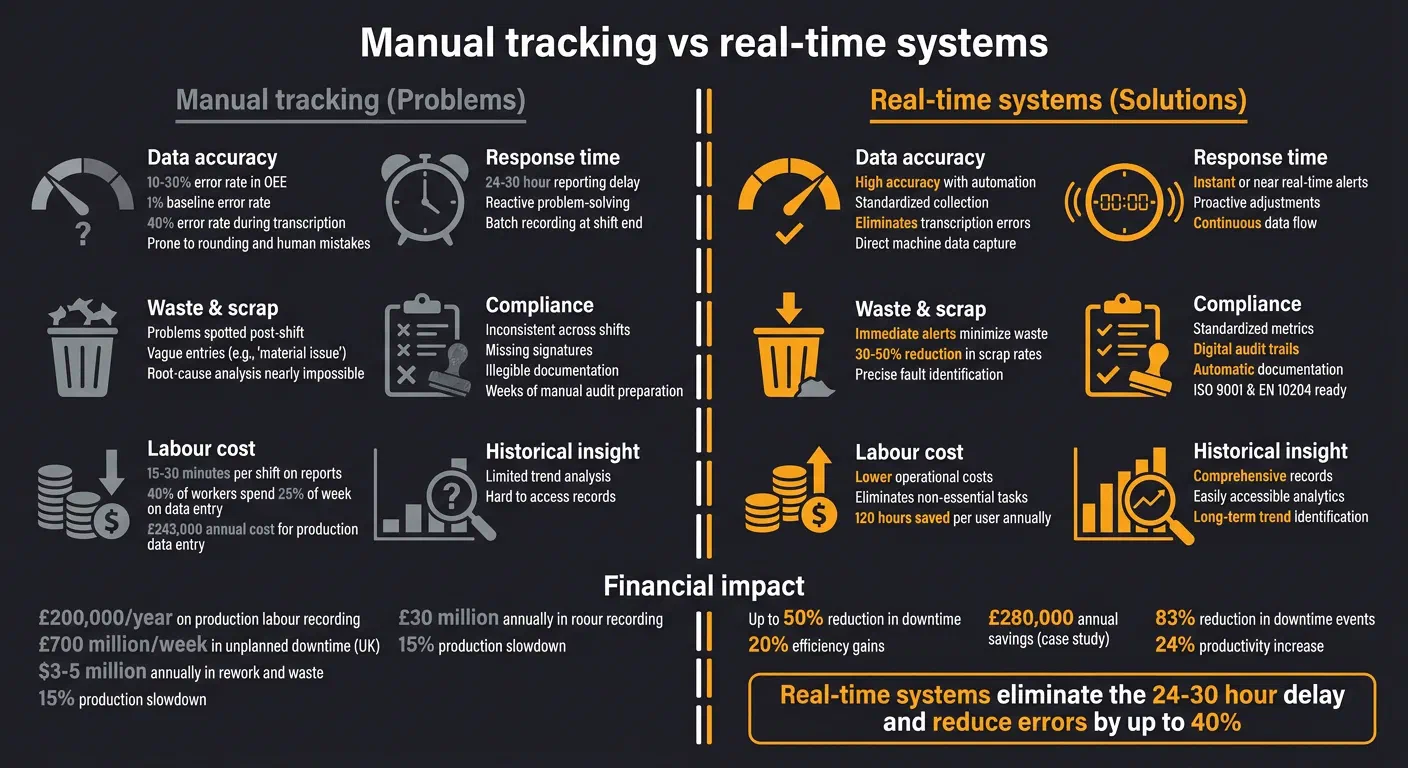
Manual tracking depends on delayed, human-recorded data, while real-time systems capture and share information as it happens. As mentioned earlier, manual tracking introduces delays and errors - issues that real-time systems are built to eliminate.
For example, manual OEE calculations can inflate performance figures by 10–30% compared to automated systems. Adding to the problem, batch recording at the end of shifts further reduces data reliability 43. Reporting delays of 24–30 hours are common with manual methods, leaving supervisors scrambling to address problems long after they’ve occurred 4.
“The moment leaders spend more time validating numbers than discussing performance, manual tracking has become a bottleneck rather than a control tool.” – LTS Data Point 8
Real-time systems fix these issues by pulling data directly from machines as events unfold. Automated, standardised data collection reduces reporting delays to mere seconds. This instant visibility allows teams to act quickly - whether it’s addressing a quality issue, fixing a machine fault, or dealing with material shortages - before small problems snowball into costly setbacks.
Comparison Table: Manual vs. Real-Time
| Metric | Manual Tracking | Real-Time Systems |
|---|---|---|
| Data Accuracy | 10–30% error rate in OEE; prone to rounding 4 | High accuracy with automated, standardised collection 4 |
| Response Time | 24–30 hour delay; reactive fixes 4 | Instant or near real-time; proactive adjustments 4 |
| Waste/Scrap Reduction | Problems often spotted post-shift 7 | Immediate alerts minimise scrap and waste 4 |
| Compliance Readiness | Inconsistent across shifts 8 | Standardised metrics with digital audit trails 8 |
| Labour Cost | High, due to time-consuming data entry 7 | Lower, by cutting out non-essential tasks 7 |
| Historical Insight | Limited; hard to spot long-term trends 8 | Comprehensive, easily accessible records 8 |
This comparison shows why manufacturers are moving towards real-time systems and leaving manual processes behind. Manual tracking was designed for a time when production lines were slower, product ranges were simpler, and compliance wasn’t as demanding. As Muhammed Abdulla NC of Harns Technologies put it, “Manual processes weren’t designed to become analytics later” 11. Every minute of downtime and every kilogramme of wasted material hurts your margins. Real-time data is not a luxury. It is a necessity for staying competitive.
How GoSmarter Automates Metals Manufacturing
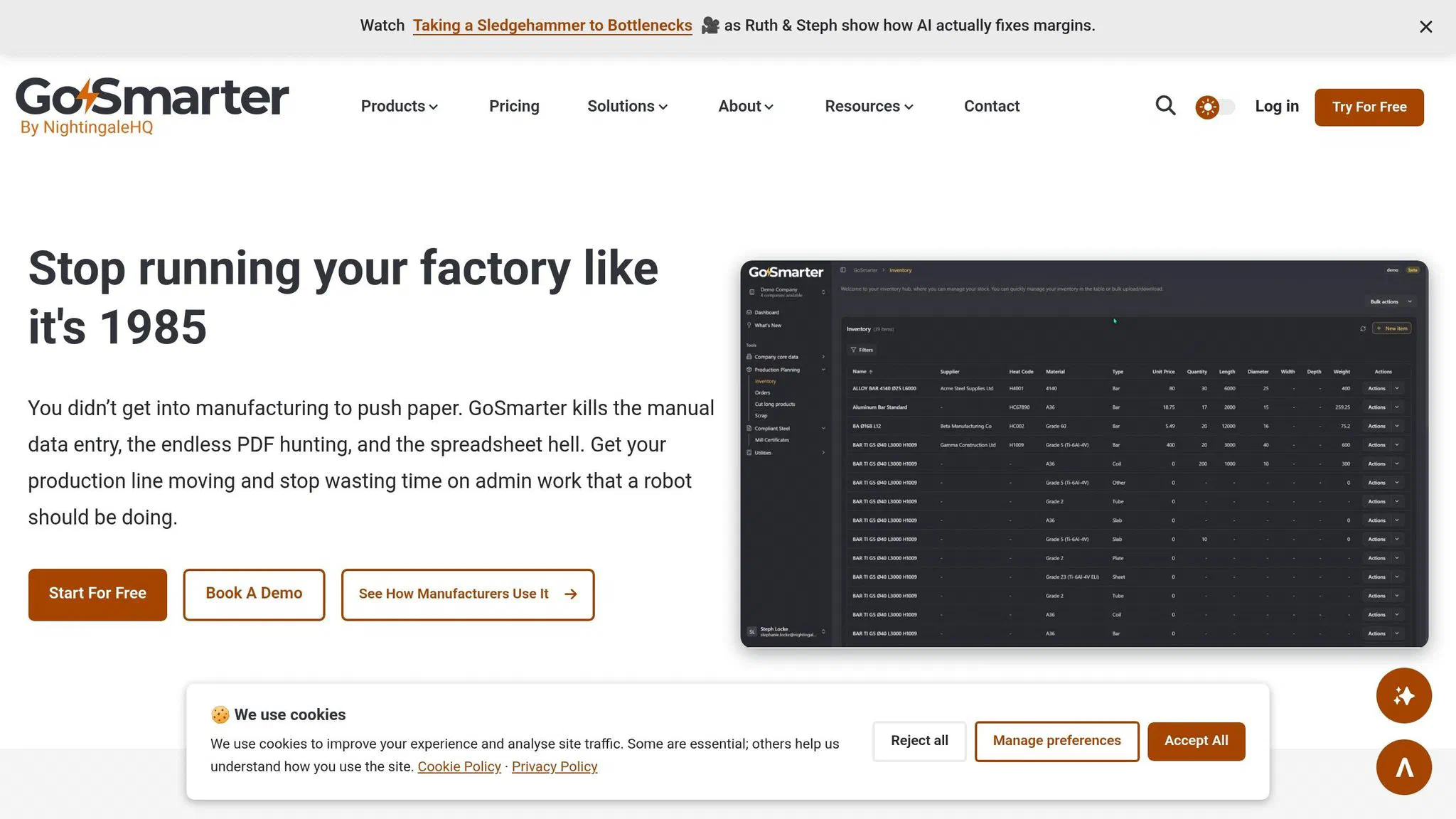
Real-time data is only useful if it fits the gritty, unpredictable world of metals production. GoSmarter takes the hassle out of manual tasks for steel fabricators and stockholders, turning messy paper certificates, clunky spreadsheets, and guesswork-driven scheduling into reliable, actionable data.
Tools Built for Metals Manufacturing
The MillCert Reader uses AI to pull critical data from scanned or digital mill certificates in seconds. It captures heat numbers, material grades, chemical compositions (like C, Mn, P, S, Si), mechanical properties (yield, tensile strength, elongation), and dimensions - no matter how inconsistent the format. Unlike generic OCR tools that need endless tweaking for each mill’s quirks, GoSmarter handles variations automatically. It even deals with tricky multi-heat certificates and tracks bundle-level or bar-level traceability. GoSmarter validates extracted data against grade specs and flags any mismatches before production starts.
Cutting Plans ditches clunky spreadsheet planning for a live system that connects directly to your operations. It fine-tunes daily production runs and cutting schedules, calculates cutting patterns that squeeze the most value out of materials, and tracks offcuts to cut costs and lower carbon emissions. All these tools sit on top of your existing ERP, Excel, or email workflows via CSV/PDF exports or Application Programming Interface (API) connections. No rip-and-replace required. One heat-number record links the MillCert Reader and Cutting Plans together — the same data drives every tool.
By combining real-time data capture with automated analysis, GoSmarter bridges the divide between production and management, solving the specific headaches of metals manufacturing.
Measured Results with GoSmarter
The numbers speak for themselves. A production manager at a UK-based steel stockholder saved 120 hours per user annually by automating mill certificate data entry and bulk PDF renaming. The AI’s error rate? Practically zero, thanks to built-in checks against grade specifications 12.
Take Midland Steel Manufacturing, a leading supplier of reinforcing steel in Ireland and the UK. They worked with GoSmarter to digitise their operations, creating a plan to automate mill certificate processing, cut out manual grunt work, and reduce waste 13. The platform handles certificates in multiple languages, mapping the data to standard English fields automatically. It also generates an unchangeable audit trail for every certificate, meeting ISO 9001 and EN 10204 (Types 2.1, 2.2, 3.1, 3.2) standards. Plus, it extracts Carbon Equivalence (CEQ) data for EU Carbon Border Adjustment Mechanism reporting. The Workshop tier starts at £350/month rolling, or £280/month billed annually. At £350/month against 120 hours recovered per user each year, most teams see payback inside the first quarter. See the pricing page for current rates and volume discounts.
These results show how real-time data and automation can transform metals manufacturing, leaving manual tracking in the dust.
Start Automating Your Manufacturing Processes
You don’t need to tear down your entire operation to start automating. With GoSmarter Insights, a free tool, you can get instant visibility into key metrics like scrap weight, cost calculations, and carbon emissions - all without changing your current systems. It’s a quick way to see where manual processes are bogging you down and burning through time and money.
Once you’ve spotted the reporting gaps, step it up with the Workshop tier. Its MillCert Reader automates tedious tasks like mill certificate scanning, links inventory to heat codes, and lets you retrieve certificates in seconds. It’s the bridge between identifying inefficiencies and actually fixing them. See the pricing page for full rates and volume discounts.
Experts agree that smart automation tailored to your specific production headaches speeds up decision-making. Whether your main issue is downtime, scrap waste, or compliance headaches, focus your automation strategy on solving that problem first. Michael Bosson, Senior Content Manager at Factbird, puts it this way:
If there’s one key takeaway from having helped hundreds of companies in implementing smart manufacturing solutions, it’s the importance of properly onboarding key personnel in using the new solution.
GoSmarter works with what you already have. It integrates with your current ERP via CSV/PDF exports or API connections, so you don’t have to ditch systems that are doing their job. The platform connects via REST API with OAuth 2.0 authentication, keeps data on UK-based Azure infrastructure, and never trains AI models on your production data. Most teams are up and running within a day. No lengthy onboarding project. No dedicated IT resource required.
Start small - automate one production line, track the results, and scale up from there. The result? Real-time data that finally puts an end to the chaos of manual tracking.
Ready to ditch the grunt work? Run a free GoSmarter Insights check today. It’s time to take the first step towards smarter, faster manufacturing.
FAQs
What's the fastest way to start using real-time data without replacing machines?
The fastest way to start using real-time data without swapping out your machinery is to hook up digital production tracking systems to what you already have. This often means adding sensors or software interfaces to gather live data around the clock.
You can also connect a digital dashboard or monitoring software to your existing setup. This gives you instant access to live metrics, improves accuracy, and skips the need for costly hardware upgrades.
How do real-time systems integrate with our existing ERP and spreadsheets?
Real-time systems plug directly into your existing ERP setup or spreadsheets using plant/ERP gateways or data integration platforms. This means live production data flows straight into the ERP, keeping tabs on production, inventory, and other key metrics without delay.
When it comes to spreadsheets, APIs or specialised syncing tools handle the heavy lifting. They automatically update manufacturing data, ensuring your metrics are always accurate and current. The result? Less manual input, fewer errors, and quicker, more informed decisions.
What should we automate first to get the quickest payback?
How does GoSmarter compare to MachineMetrics or Oden for metals manufacturers?
What results are GoSmarter customers actually seeing?
Further Reading
1: Challenges with Manual Data Entry on Shop Floor: Why 70% of Manufacturers Still Struggle - shoplogix
2: Article : 5 Signs Your Manual Data Entry Is Sabotaging Your Growth
3: Manual Data Collection: Manufacturing’s Biggest Problem
4: Ultimate Guide to Tracking Manufacturing Performance
5: 8 Key Benefits of Real-Time Production Monitoring in Manufacturing
6: Eliminating the scourge of manual data collection in manufacturing | 5Y Technology
7: Manual vs Automated Data Collection in Manufacturing
8: Why Manual Boards Can’t Keep Up with Real-Time Production Metrics
9: Why Manual Production Updates Fail in 2026 Manufacturing
10: How real-time data reduces error in manufacturing operations
11: Why Tracking Manual Processes in Manufacturing Is So Difficult
12: Mill Certificate Automation for Metals | GoSmarter
13: Case studies | GoSmarter AI | AI Tools for Metals Manufacturing
About the Author

Editor· Co-Founder & CEO
Ruth Kearney is Co-Founder and CEO of GoSmarter AI — driving commercial growth and strategic partnerships to help metals manufacturers adopt AI and digital tools that actually deliver on the shop floor.