How to Prove Melt-and-Pour Country for EU Steel Imports
- BlogSmarter AI
- Edited by Steph Locke
- Blog
- November 18, 2026
- Updated:
Table of Contents Show Hide
To prove the country of melt and pour, link each imported heat to its mill test certificate. That certificate must name the country and the heat number. A shipping address or a “made in” statement won’t do.
Since 1 October 2026, EU importers of covered steel must provide this evidence at the moment of import (Regulation (EU) 2026/1384, Article 4(1) and Article 14). The Commission set the accepted documents in Implementing Regulation (EU) 2026/1963.
For metals manufacturers, the headache starts when mill certs, warehouse labels and customs records don’t match. This guide explains how to:
- Check which documents the rules accept, and until when.
- Match certificates, heat numbers and shipment quantities.
- Sort missing records and mixed heats before the declaration.
Start with the heat, not another spreadsheet.
What is the country of melt and pour?
The country of melt and pour is where raw steel or iron was first made liquid in a furnace and then cast into its first solid state. The Steel Regulation gives that definition in Article 4(1). Recital 22 adds that the first solid state can be a slab, billet or ingot, or a finished mill product. The implementing regulation adds that it includes remelting of scrap (Recital 3).
Melt and pour is not the same as customs origin. The Commission calls it a transparency requirement. It helps the Commission understand the EU steel supply chain (2026/1963, Recital 4). From 1 October 2027, the Commission takes melt and pour data into account when it shares out tariff quotas (2026/1384, Article 5(1)(j)). By 30 June 2028, it must assess whether to make melt and pour the basis for quotas (Article 12(5)).
What the rules ask for
| Rule | What it says | Source |
|---|---|---|
| Who | Importers of product categories in Annex I of the Steel Regulation | 2026/1384, Article 4(1) |
| When | At the moment of import, from 1 October 2026 | 2026/1384, Articles 4(1) and 14 |
| Main evidence | A Mill Test Certificate (MTC) with the country of melt and pour and the heat number | 2026/1963, Article 1(1) |
| Gaps in the MTC | Other documents can complement it if they carry the missing country or heat number | 2026/1963, Article 1(2) |
| No MTC at all | Other documents can stand alone if they carry both. This applies only from 1 October 2026 to 30 September 2027 | 2026/1963, Articles 1(3) and 3 |
| How you declare | Through TARIC document codes on the customs declaration | 2026/1963, Article 2(2) |
| Checks | Customs carry out documentary checks when you rely on other documents | 2026/1963, Article 2(1) |
| Failure | No country of melt and pour with verifiable evidence means customs reject the import | 2026/1963, Article 2(3) |
TARIC is the Integrated Tariff of the European Union. Ask your customs declarant which document codes apply to your goods.
Video: EU melt and pour reporting
This short explainer comes from Nexus Customs & Legal, a third-party customs firm. Check any detail in it against the regulations linked above.
Check the mill certificate, country and heat number
Start with the Mill Test Certificate (MTC), also called a works certificate. Get it before the goods reach the border. Check that it names the country of melt and pour and the heat number of the imported steel (2026/1963, Article 1(1)). If either field is missing, go straight to heat-linked records.
The regulation itself notes that the MTC is not a harmonised document. Nor was it designed to show melt and pour (Recital 9). So expect the wording to vary by mill.
Find the country and heat number on the certificate
Look for labels such as:
“country of melt and pour”, “melt country”, “melted and poured in” or “steelmaking country”
Check the header, production section, declaration block or a separate origin field. For traceability, look in the identification fields for:
“heat number” or “cast number”
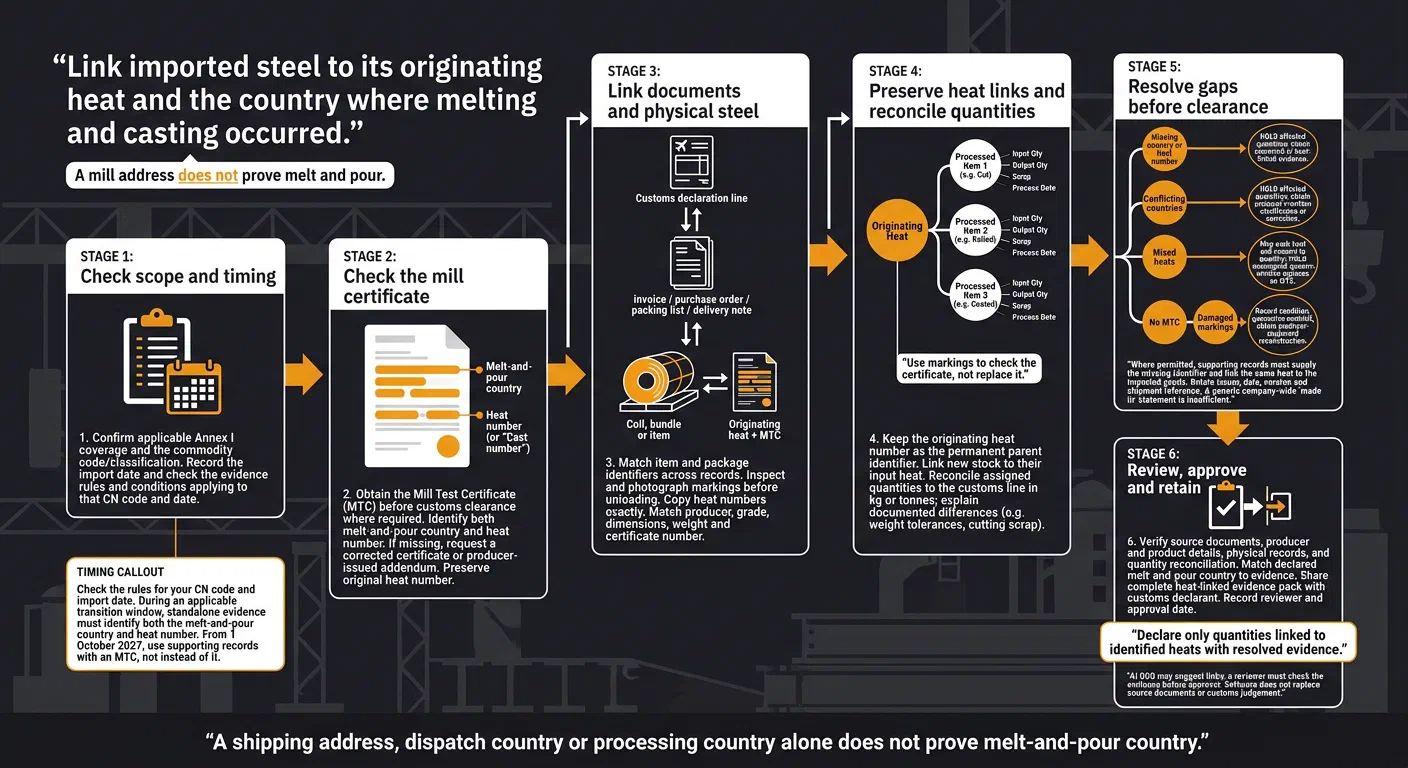
These usually sit beside the cast, batch or ladle reference. Record the exact wording. A mill address does not prove melt and pour. A rolling mill can roll slabs that another country melted and poured. Grade, dimensions and test results describe the product. Lot, batch and coil references still need a link to the originating heat.
Fill missing fields with heat-linked records
If the MTC lacks a field, ask the producer for a corrected certificate or an addendum. It should keep the original heat number and name the country of melt and pour.
Customs can also accept these documents as complementary evidence, if they carry the missing field (2026/1963, Article 1(2)):
- Invoices and delivery notes.
- Quality certificates, and clauses in purchase orders or contracts you have carried out.
- Long-term declarations from suppliers.
- Cost accounting and production documents.
- Customs documents from the exporting country.
- Commercial correspondence or production descriptions.
Keep the issuer, date, version and shipment reference with each record. If the country is missing, the record must name that heat’s country of melt and pour. If the heat number is missing, the record must link the heat to the goods. That means the coils, bundles, plates or shipment quantities.
A generic company-wide “made in” statement proves neither. Once the documents match the heat, move on to shipment-level traceability.
Check whether standalone evidence still applies
Check the import date before you rely on documents without an MTC. Standalone evidence applies only from 1 October 2026 to 30 September 2027. It must carry both the country of melt and pour and the heat number (2026/1963, Articles 1(3) and 3).
From 1 October 2027, other documents only complement an MTC. They no longer replace it. The Commission’s announcement says the same.
When you rely on other documents, customs check them first. Irish Revenue warns this can delay access to the quota while checks run (eCustoms notification 17/2026).
Trace each shipment quantity to its heat
Trace each customs line back to its heat. Keep the evidence linked at every step.
- Record the declaration line, Combined Nomenclature (CN) code, description, quantity, supplier, producer, invoice number and import date. Record each country field separately.
- Link the customs line to the invoice, purchase order, packing list and delivery note. Use their item and package numbers.
- Assign each coil, bundle or item to its heat and certificate using physical markings or processing records.
- Total each heat’s quantity and reconcile it to the customs line. Allow only documented differences, such as weight tolerances or packaging weight.
Match documents to physical steel markings
Inspect and photograph accessible markings before unloading, cutting or relabelling. Copy the heat number exactly, including prefixes, suffixes, spaces and leading zeroes.
Compare the grade, dimensions, coil or bundle weight, producer name and certificate number. Confirm that the country statement covers that same heat. Use markings to check the certificate, not replace it.
Use the same identifiers across customs, commercial and mill records.
| Document or record | Identifier to record | Matching check | Escalate when |
|---|---|---|---|
| Customs declaration line | Declaration and line numbers, CN code, quantity, supplier, declared country of melt and pour | Check that the declared line covers the products and quantities in the evidence pack | You cannot reconcile the product, quantity or country |
| Invoice | Invoice number, item code, quantity, grade, dimensions and supplier | Match the invoice to the customs line, purchase order and packing list | The invoice omits heat, batch or producer information |
| Purchase order or contract | Order number, product specification, supplier and agreed evidence requirements | Check that the ordered grade, dimensions and producer match the shipment | The contract permits substitution without an auditable approval |
| Packing list | Package, coil or bundle numbers, net and gross mass, heat numbers | Match each package to physical labels and the delivery note | Package numbers or quantities contain gaps or duplicates |
| Delivery note | Delivery-note number, date, package references and heat or batch codes | Check that the delivered goods match the invoiced and imported goods | The delivery note refers to another batch or shipment |
| Mill test certificate (MTC) or quality certificate | Certificate number, heat number, grade, dimensions, test results, producer and country of melt and pour | Match the heat number and technical details to the physical steel and commercial documents | The heat number or country is absent, inconsistent or illegible |
| Supplier declaration | Declaration number, supplier, heat or batch scope and country of melt and pour | Check the signature, date and link to the same goods and heats | The statement is generic, unsigned or retrospective, or production records do not support it |
| Production or processing records | Work order, slit, cut, coating or fabrication references and input heats | Follow the input heat through every transformation to the imported item | The record links to a different batch or leaves an unexplained quantity gap |
If you find damaged markings, record their condition and quarantine the material. Ask the producer to confirm the marking, with dispatch and production records to support it.
Keep heat links through processing
Keep the originating heat number as the permanent parent identifier. Your rolling, cutting, coating and fabrication records should link each new stock or job reference to its input heat.
Those records should include the process date, input quantity, output quantity, scrap and new internal batch number. Include the operator or system reference too.
Keep separate allocations for each heat and quantity within each customs line. Don’t combine several heats under one reference.
Where GoSmarter fits
GoSmarter is the material traceability platform built by Nightingale HQ. It sits on top of your existing ERP and spreadsheets, with no rip-and-replace.
MillCert Reader, on the Workshop plan, reads supplier certificates with AI. It extracts the heat number and, where the mill prints it, the country of melt and pour. Your team checks each field before approval. Product Lineage, from the Starter plan, links stock to heat numbers and certificates from goods in to goods out. So you can pull the certificate for a heat when customs ask. On Starter you add certificate data by hand.
The software stores the links. It does not replace supplier confirmation, your customs declarant’s judgement or your own approval of the declaration.
A reviewer must check the evidence before approval. Compare the extracted heat number character by character against the source document. Check that the country field refers to melt and pour, not dispatch. Verify the producer and product description, then inspect the physical marking. Reconcile the quantity to the customs line.
Resolve document gaps and mixed heats before the declaration
Once you have the heat links, sort incomplete or conflicting documents before you declare.
- Missing fields: request a corrected MTC, or gather complementary records that carry the missing field.
- No MTC: check the import date. Standalone evidence ends on 30 September 2027.
- Unresolved evidence: leave quantities without resolved evidence out of the declaration. Customs reject imports without verifiable evidence.
Use this table to decide whether to declare, hold or correct.
| Document status | Action | Risk |
|---|---|---|
| Complete MTC | Proceed once you have checked the MTC and traced the shipment to it | Lower if all checks pass |
| Missing country | Hold until the producer supplies a corrected MTC or a heat-specific record naming the country of melt and pour | High until corrected |
| Missing heat number | Hold until you can link the certificate to the heat and shipment | High until linked |
| No MTC, import up to 30 September 2027 | Standalone documents must carry both the country and the heat number. Expect documentary checks | Subject to customs checks |
| No MTC, import from 1 October 2027 | Other documents only complement an MTC. Get the MTC | Rejection likely |
| Conflicting countries | Hold affected quantities until the producer clarifies or corrects in writing | High until resolved |
| Mixed heats | Match each heat and country to its quantity. Hold unassigned quantities | High for unsupported allocations |
Request replacement certificates and supporting records
Request a replacement MTC or certified duplicate naming the product, quantity, heat number and country of melt and pour. Hold the affected declaration line until the producer links the correction to the shipment.
Resolve conflicting countries with the producer
Compare the MTC, supplier declaration, production records and export documents field by field. Don’t rely on the country name alone. Record the conflict, then get written clarification or a correction from the producer.
Create a heat-by-heat schedule for mixed consignments
Give each heat its own entry in the schedule, with its country and quantity. Link each entry to the customs line, package identifiers and MTC or supporting-record references.
Hold unidentified quantities. Declare only quantities you can link to identified heats.
Check your next shipment before declaring it
Pick one incoming consignment and check it before filing. Use its shipment or purchase-order reference to build a heat-linked evidence pack. Link the MTC, commercial documents and production or traceability records to each heat and quantity.
Share the full pack with your customs declarant. Clear every item below before you file.
Pre-clearance evidence checklist
- [ ] Scope: Confirm the product falls in an Annex I category of the Steel Regulation. Keep the CN code and your classification rationale.
- [ ] Timing: Record the import date. Check whether standalone evidence still applies on that date.
- [ ] Evidence: Have the MTC ready, or document why none exists and which documents replace it.
- [ ] Country and heat: Check that the evidence names both the country of melt and pour and the heat number. The dispatch or processing country alone won’t do.
- [ ] Consistent details: Check that producer, product, grade and dimensions match across documents.
- [ ] Physical match: Match bundle tags, coil labels or other steel markings to the documented heats.
- [ ] Quantities: Reconcile totals in kg or tonnes and explain any differences. Map each mixed heat separately to its country, quantity and physical identifiers.
- [ ] Gaps and corrections: Check that corrections, replacement certificates and supplier declarations carry dates, signatures and links to the shipment.
- [ ] Conflicts: Get and keep the producer’s resolution of any contradictory country information.
- [ ] Declaration and retention: Match the declared country of melt and pour to the evidence. Keep the full file under customs record-keeping rules.
- [ ] Approval: Get the responsible reviewer to approve the heat-to-shipment mapping. Leave no unresolved quantities or gaps.
FAQs
How do I check that a mill certificate is genuine?
Check that the certificate names the producing mill, its certificate type (for example EN 10204 3.1 or 3.2) and the heat number. If a stockist passes it on, ask for the producer’s original or an unaltered copy.
At goods-in, check the certificate against the material:
- Match heat numbers to material markings and check the grade.
- Check chemical and mechanical results against the standard’s limits.
- Check the certification statement and reconcile quantities.
Reject certificates with missing, mismatched or questionable data until the supplier clarifies.
What if the steel was melted in one country and rolled in another?
Declare the country where the steel was first made liquid in a furnace and cast into its first solid state. Later rolling, cutting or coating elsewhere does not change the country of melt and pour.
This is not the same as customs origin. Melt and pour is a separate transparency requirement under the EU Steel Regulation. Check origin rules for duty and quotas with your customs adviser.
Does melt and pour decide my steel quota?
How long must I keep melt and pour evidence?
Drill deeper
- Your EU Steel Quota Isn't 18 Million Tonnes. It's One Line in Annex I
Covers which Annex I quota your steel falls under. This post covers the evidence you file with it.
12 min read
- AI for Mill Test Report Traceability
Explains how to read and store mill certificates in general, not the EU customs rule.
16 min read
About the Author

Editor· Co-founder & Head of Product
Steph Locke is Co-founder and Head of Product at GoSmarter AI — former Microsoft Data & AI MVP building practical tools to cut paperwork and automate compliance for metals manufacturers.