You Wouldn't Worry About the Price of a Pint if Your Margins Were Better.
- BlogSmarter AI
- Blog
- March 18, 2026
- Updated:
Table of Contents
You wouldn’t stress over a £6.50 pint if your margins weren’t bleeding cash. The real issue isn’t the cost of a pint - it’s the inefficiencies eating into your profits. Every tonne of scrap, every outdated process, and every hour wasted on manual tasks is draining your bottom line.
Here’s the truth: Outdated systems are costing you far more than you realise. Whether it’s chasing data across clunky spreadsheets or losing 60% of raw material costs to scrap, the old ways are holding you back. AI tools like GoSmarter can fix this mess - cutting scrap rates, slashing energy costs, and preventing downtime.
The Old Way vs. The Smart Way
| The Old Way | The Smart Way |
|---|---|
| Manual scrap tracking | AI-driven optimisation |
| Wasted offcuts | Offcuts tracked and reused |
| Spreadsheet chaos | Real-time data integration |
| Overheated furnaces | AI-controlled energy efficiency |
| Reactive fixes | Predictive maintenance |
The result? Better margins, fewer headaches, and a business that runs like it should. Let’s break down how AI can transform your operations.
Reduce Scrap and Material Costs with AI
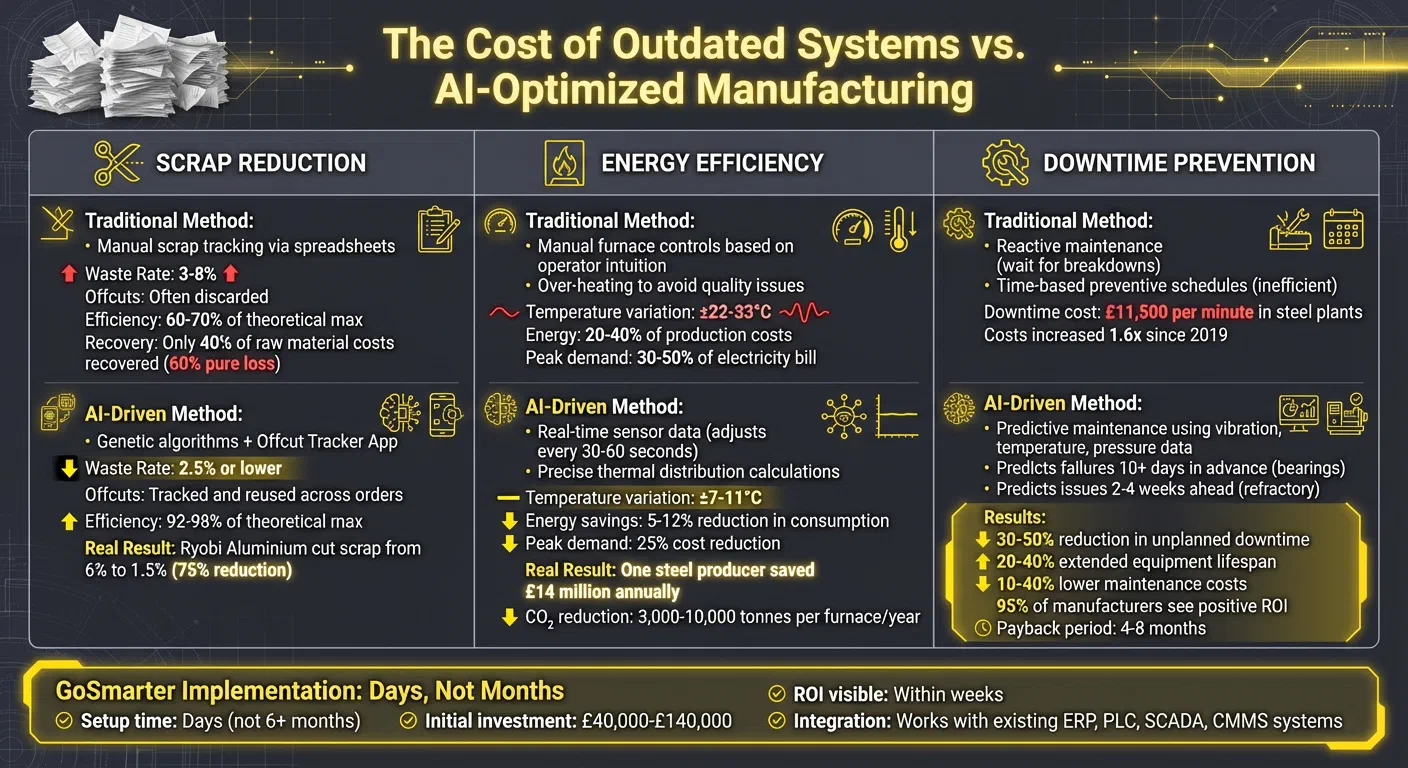
Scrap isn’t just wasted material; it’s a direct hit to your bottom line. Did you know you only recover about 40% of raw material costs from scrap? That means 60% is pure loss. While the industry aims for a scrap rate of 2.5%, many UK manufacturers find themselves stuck between 3% and 8%. Every percentage point above the target eats into profits, turning production into a costly exercise [3]. This is where AI steps in, transforming waste management into a profit-saving strategy.
GoSmarter’s Rebar Optimiser uses genetic algorithms to tackle the 1D Cutting Stock Problem. It evaluates thousands of cutting combinations across multiple orders to find the most efficient sequences [4][5]. Unlike manual methods that focus on one order at a time, AI looks at the bigger picture, matching offcuts from one job to another to reduce waste [5]. The Offcut Tracker App takes this a step further, monitoring leftover pieces and reassigning them to future jobs, ensuring nothing usable goes to waste [4].
Manual Scrap Tracking vs. AI Optimisation
Traditional scrap tracking methods rely on spreadsheets and static rules, which struggle to keep up with the fast-paced demands of modern manufacturing. AI, on the other hand, integrates real-time data from inventory, job schedules, and even sustainability metrics like carbon equivalence. This allows manufacturers to achieve efficiency rates of 92–98% of the theoretical maximum, compared to the 60–70% ceiling of manual methods [2].
| Feature | Manual Scrap Management | AI-Driven Optimisation |
|---|---|---|
| Planning Method | Spreadsheet/manual guesswork | Genetic algorithms/natural selection models |
| Typical Waste Rate | 3% to 8% | Targets 2.5% or lower |
| Offcut Handling | Often discarded | Tracked and reused for future orders |
| Carbon Visibility | None | Integrated carbon equivalence (CEQ) tracking |
| Efficiency Ceiling | 60–70% of theoretical max | 92–98% of theoretical max |
How UK Manufacturers Cut Scrap by 50%
Elsewhere in the industry, Ryobi Aluminium Casting in Carrickfergus, Northern Ireland, shows what’s possible. By implementing AI-driven predictive modelling, they slashed their scrap rate from 6% to just 1.5% by February 2026 - a 75% reduction. Beyond cutting scrap, they improved defect detection accuracy to 96% and reduced inspection times from 10 seconds to just 2 seconds. For every tonne of scrap avoided, they prevented 1.9 tonnes of CO₂ emissions [5].
These results show how AI doesn’t just reduce waste - it strengthens margins and boosts production efficiency.
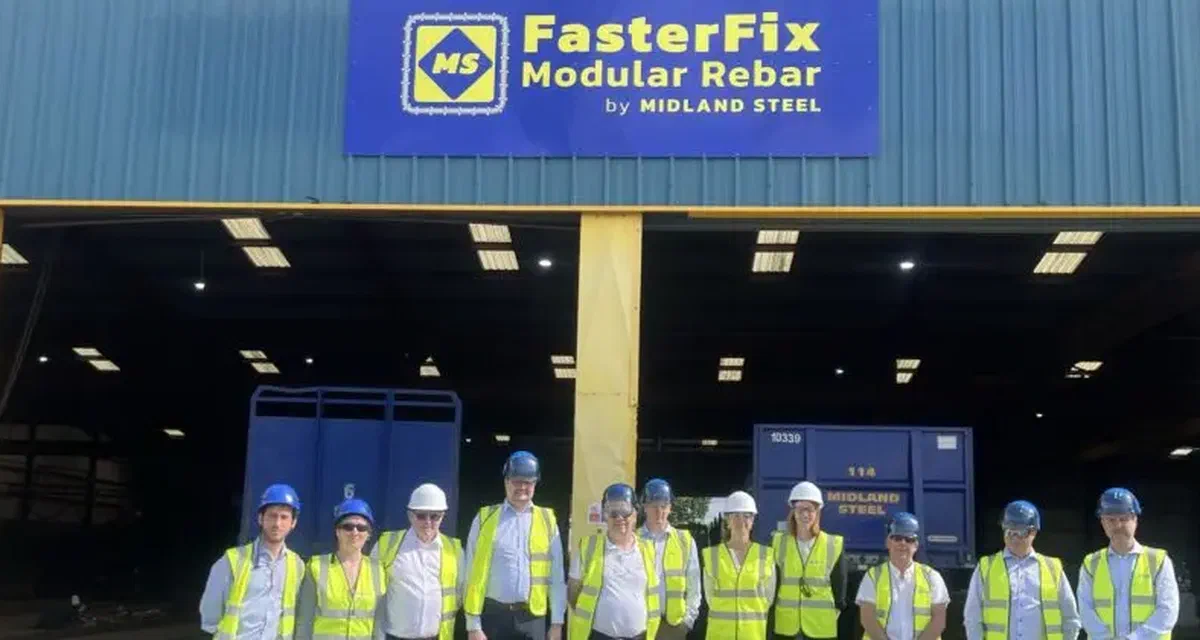
“Smart technology can directly contribute to reducing carbon emissions in steel manufacturing. By integrating AI and digital tracking tools, we have significantly improved efficiency whilst aligning with our sustainability goals.” [4]
- Tony Woods, Managing Director, Midland Steel
Lower Energy Costs with AI Controls
AI doesn’t just kill scrap waste. Your energy bill is next. With energy making up 20–40% of production costs, every wasted kilowatt eats into your margins [8][9]. Traditional manual furnace controls depend on operator intuition and often err on the side of over-heating to avoid quality issues. This approach burns through energy unnecessarily. AI, on the other hand, uses real-time data from hundreds of sensors to calculate the exact thermal distribution inside each slab. It adjusts setpoints every 30 to 60 seconds, taking the guesswork out of the equation [6][8].
AI-driven furnace optimisation delivers:
- 5–12% reduction in specific energy consumption
- 50–70% improvement in temperature uniformity
- 3,000–10,000 fewer tonnes of CO₂ per furnace, per year [6]
One major steel producer saved £14 million a year in energy costs and slashed utility demand charges by 40 MW per month after implementing AI in its hot roll mill [11]. These aren’t just small wins — they’re the kind of change that shows up in your accounts within months.
AI-Controlled Furnace Temperatures
Traditional furnace controls often overheat zones to avoid rejects, and manual adjustments during mill stops waste even more energy [6]. AI flips this approach on its head. Using advanced modelling, it calculates the lowest possible temperature needed to meet metallurgical requirements. It then adjusts fuel and oxygen inputs in real time, guided by data like exhaust gas composition, slab tracking, and zone temperatures [6][8].
In Electric Arc Furnaces, AI optimises the balance between electrical and chemical energy inputs - like oxygen, carbon, and burners - based on real-time scrap composition. This reduces specific energy use by around 37 kWh per tonne [7]. When the mill stops, AI cuts fuel within 30 to 60 seconds, avoiding unnecessary energy loss [6]. It also tightens temperature uniformity, reducing variation from ±22–33°C to just ±7–11°C. Every 28°C drop in peak zone temperature cuts oxide scale formation by about 15%, reducing material loss [6]. These improvements don’t just save energy - they also reduce peak demand costs significantly.
“The AI isn’t replacing operators - it’s giving them a tool that handles the optimisation maths they were never equipped to do manually.” [6]
- John Mark, Author/Expert, OxMaint
Calculate Your Energy Savings
Start by monitoring power usage at 15-minute intervals over three months and ensure sensors are properly calibrated. This will help identify inefficiencies and reduce peak demand charges by up to 25% [7][9]. Measure energy use in GJ per tonne or kWh per tonne by grade - aggregate figures often hide where the real losses occur [6]. AI systems can highlight energy variances of up to 340 kWh per tonne between shifts, exposing inefficiencies you might not even realise exist [10].
Peak demand charges can make up 30% to 50% of your electricity bill, and AI can shave off 25% of these costs by intelligently shifting loads [7][9]. Most AI systems pay for themselves within 4 to 8 months [6]. To ease the transition, run the system in advisory mode for 6 to 8 weeks to build operator confidence before moving to full automation [6]. The maths is simple: every 1% drop in specific fuel consumption cuts CO₂ emissions by 1% [6]. The result? Lower bills, better margins, and cleaner operations.
Prevent Downtime with Predictive Maintenance
Unplanned downtime doesn’t just disrupt production - it eats into profits. For steel plants, the cost of equipment failures can skyrocket to £11,500 per minute [13]. While traditional reactive maintenance waits for things to break, and time-based preventive schedules can either replace parts too soon or miss impending failures, AI predictive maintenance offers a smarter solution. It predicts failures days or even weeks in advance, allowing repairs to be planned during scheduled downtime.
Downtime costs 1.6× more than it did in 2019. The meter is running [13]. AI predictive maintenance puts a stop to it:
- Unplanned downtime: down 30–50%
- Equipment lifespan: up 20–40%
- Maintenance costs: down 10–40% [23–27]
95% of manufacturers using AI see a positive return on investment, with the system often paying for itself within a year [13].
How AI Detects Equipment Problems Early
AI watches the metrics your team doesn’t have time to watch: vibration, temperature, pressure, acoustic signatures. It flags subtle issues long before your next scheduled check [24,26,27]. It also calculates the Remaining Useful Life (RUL) of parts — so you know exactly when to act [18,23,27].
Elsewhere in the industry, Sasol shows the same principle in action. Their engineers used MATLAB to analyse six years of turbine data, focusing on wheel chamber pressure and speed. They built a predictive model to forecast salt deposit fouling, optimise wash schedules, and gauge the turbines’ remaining lifespan. This approach helped them avoid unexpected shutdowns [12]. Similarly, AI can spot bearing failures over 10 days in advance and refractory issues 2–4 weeks ahead [13], giving teams plenty of time to order parts and schedule repairs.
Catch the problem early. Fix it on your schedule. That’s how you drag a legacy plant into 2026 without tearing the floor apart.
Add AI to Your Existing Systems
You don’t need to tear down your current setup to adopt predictive maintenance. Non-invasive IoT sensors - designed to monitor vibration, heat, and sound - can be added to existing equipment without disrupting operations [20,22]. These sensors feed data into AI platforms that talk directly to your ERP, PLC, SCADA, or CMMS via standard protocols [13]. GoSmarter’s Legacy Integration feature, for instance, works with what you already have, so there’s no need for a complete overhaul.
Start small with a pilot project targeting your “Critical 10–15” assets - the machines where failures would cause the most chaos. Allow the AI to observe and learn normal operating patterns over 4–6 weeks before rolling it out fully [20,21]. At BMW’s Regensburg plant, for example, an AI system monitored conveyor power consumption, identifying movement irregularities that helped prevent roughly 500 minutes of production downtime annually [15].
And the cost? Surprisingly manageable. For a steel plant, initial investment typically ranges from £65,000 to £140,000, with yearly maintenance costing less than £15,000 [13]. Smaller operations, like mini-mills or specialty producers, could get started for under £40,000 [13]. This upgrade turns your equipment into self-diagnosing assets, keeping production on track and profits growing [14].
Deploy GoSmarter and Improve Margins Immediately
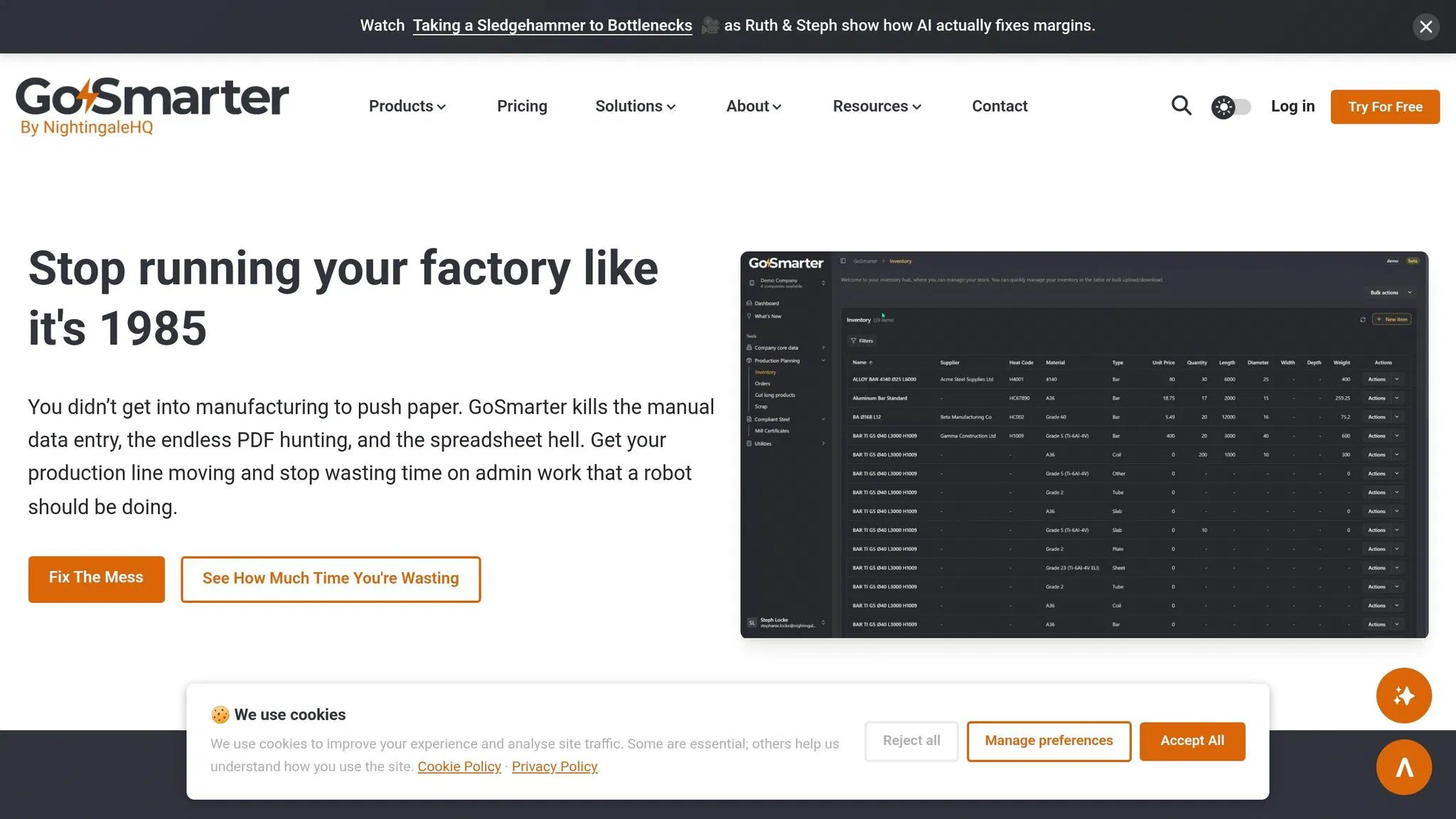
AI cuts scrap by half, slashes energy bills, and stops expensive downtime. GoSmarter puts that to work in your operation. You’re up and running in days, not months — no IT department needed, no drawn-out six-month implementation process [1].
Get Started in Days, Not Months
Forget lengthy ERP overhauls and consultancy delays. GoSmarter bolts onto your existing systems — AI, OCR, and automation, all wired in without a six-month IT project. You’ll be operational within days [1][2][16].
The MillCert Reader AI eliminates manual data entry from mill certificates immediately, while Business Manager swaps out clunky spreadsheets for streamlined inventory and production tools tailored to the shop floor [1]. You can run the Business Case Calculator for free before you spend a penny. Paid plans include a trial period so you see the impact before you commit [1].
Once you’re live, the benefits start rolling in, with measurable ROI to prove it.
Track Your ROI in Weeks
GoSmarter’s Business Case Calculator shows you exactly where your savings are coming from [16][17]:
- Scrap rates — down, thanks to smarter cutting plans
- Energy bills — lower, from AI-controlled furnace settings
- Breakdown costs — gone, because problems get caught before they happen
These results aren’t hypothetical. You’ll see measurable gains in just weeks.
Build Stronger Margins for the Long Term
Fast setup. Clear ROI. Your margins stop bleeding and start growing. As Tadhg Hurley, Managing Director at MAAS Precision Engineering, puts it:
“We’re constantly seeking ways to improve our systems and processes with technology, and this has been a great opportunity to accelerate our adoption of smarter tools that open up new opportunities” [1].
Stop firefighting. Start winning back the margin you’ve been handing to the scrap merchant for years.
FAQs
What should I pilot first to improve margins fastest?
To boost margins quickly, begin with material yield optimisation. By using tools like a Material Yield Planner, you can reduce scrap and waste, ensuring raw materials are used more effectively. The result? Immediate cost savings.
Follow this up with AI-driven production scheduling. This approach not only lowers scrap rates but also streamlines operations, improving overall efficiency. Together, these strategies tackle waste and inefficiencies head-on, providing a straightforward path to increased profitability.