Predictive Maintenance: Edge Computing in Action
- BlogSmarter AI
- Edited by Ruth Kearney
- Blog
- April 3, 2026
- Updated:
Table of Contents Show Hide
Predictive maintenance with edge computing helps metals manufacturers detect machine faults in under 10 milliseconds and prevent costly downtime before it spreads. By analysing sensor data on-site instead of in the cloud, teams can cut unplanned downtime by up to 40%, reduce scrap, and keep production running during network outages.
Edge computing processes data at the machine, so maintenance teams get instant, actionable alerts and can intervene before bearing wear, overheating, or hydraulic faults stop a line.
What are the benefits of edge computing for predictive maintenance?
- Faster response times: Detect failures in under 10 milliseconds, not 5 seconds.
- Lower costs: Cut unplanned downtime by up to 40% and slash waste.
- No network worries: Systems keep running even during outages.
- Smarter decisions: Real-time adjustments prevent scrap and protect margins.
Here’s how it works on a real production line.
Edge Artificial Intelligence (AI) and Internet of Things (IoT) keep maintenance fast and local
Why Predictive Maintenance Needs Edge Computing
Problems with Cloud-Based Predictive Maintenance
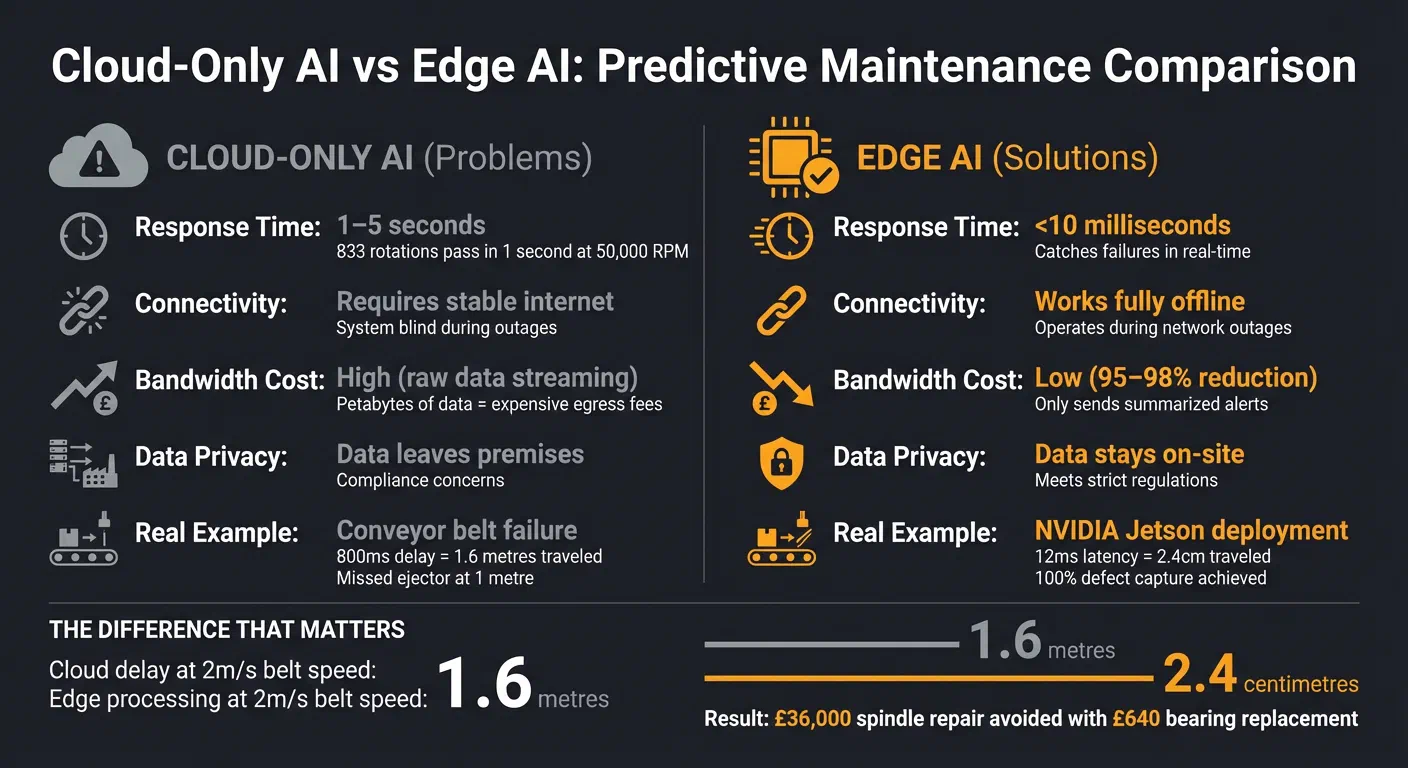
Cloud-based predictive maintenance sounds great on paper - until you try it on a shop floor where a bearing spins at 50,000 rotations per minute. A single second of delay means 833 rotations have already passed. That’s not exactly “predictive,” is it?
The main issue here is latency. Cloud systems introduce delays of 1 to 5 seconds as sensor data makes the round trip to a distant data centre and back 1. Take the example from March 2026, when Ashutosh Singhal, Founder of Veriprajna, documented a conveyor belt failure. The belt moved at 2 metres per second, but the cloud Application Programming Interface (API) delay of 800 milliseconds meant the faulty part had already travelled 1.6 metres - missing the ejector meant to catch it, which was only 1 metre away 2. Singhal summed it up perfectly:
The speed of light is not a feature you can upgrade. The internet is probabilistic. The conveyor belt is not 2.
Then there’s connectivity dependency. Cloud systems rely on a stable internet connection. But what happens during outages, bandwidth slowdowns, or Internet Service Provider (ISP) issues? Your monitoring system is effectively blind when you need it most 13. For metals manufacturers, it gets even trickier. Steel beams, high-voltage motors, and arc welders create electromagnetic interference that can disrupt wireless signals critical for cloud-based systems 2.
And let’s not forget the bandwidth issue. Steel plants churn out petabytes of data every year 4. Sending all that to the cloud 24/7 isn’t just slow - it’s financially painful. Between egress fees and the need for massive fibre backhauls, the costs stack up fast 52.
These delays, interruptions, and costs make it clear: the traditional cloud approach just doesn’t cut it for the factory floor.
How Edge Computing Solves These Problems
This is where edge computing steps in. Instead of shipping data off to some distant server, edge systems process it locally. Devices like an NVIDIA Jetson or an industrial gateway handle the analysis right on-site, cutting response times to under 10 milliseconds 67.
When speed is the difference between a minor hiccup and a full-blown production disaster, local processing is a game-changer. In Singhal’s case, swapping the cloud system for an NVIDIA Jetson edge device reduced latency to just 12 milliseconds. Now, the faulty part only travelled 2.4 centimetres during processing - making 100% defect capture possible 2. Another example from March 2026 involved an automotive parts manufacturer using an acoustic edge sensor to monitor Computer Numerical Control (CNC) spindles. When coolant contamination led to bearing degradation, the system detected a frequency shift and triggered an emergency stop in just 5 milliseconds. The result? A £640 bearing replacement instead of a £36,000 spindle repair 2.
Edge systems also operate independently of internet connections. That means they keep monitoring even if the network goes down 68. Plus, they slash bandwidth usage by up to 98%, sending only summarised alerts or insights to the cloud 8. For industries with strict data regulations or air-gapped facilities, this means sensitive production data stays on-site 19.
| Capability | Cloud-Only AI | Edge AI |
|---|---|---|
| Response Time | 1–5 seconds 1 | <10 milliseconds 67 |
| Connectivity | Requires stable internet 1 | Works fully offline 68 |
| Bandwidth Cost | High (raw data streaming) 1 | Low (95–98% reduction) 89 |
| Data Privacy | Data leaves premises 1 | Data stays on-site 1 |
This isn’t just a small improvement. It’s the difference between noticing a failure and stopping it in its tracks.
Case Studies: Edge Computing in Manufacturing
These results are reported by solution providers and plant teams, so treat them as benchmarks and validate against your own line data.
Preventing Motor Failures with Edge Analytics
In October 2024, Precision Manufacturing Inc., an automotive parts producer, took a major step forward by installing vibration, thermal, and acoustic sensors across its production lines. Led by Michael Torres, Manufacturing Solutions Lead, the results were striking. Over the next year, unplanned downtime dropped by 40%, falling from 12% to 7.2%. Maintenance costs plummeted from £960,000 to £560,000, saving the company £400,000 annually. On top of that, quality defects shrank by 60%, from 2.3% to 0.9%, and spare parts inventory was cut by 35%. The kicker? They recouped their investment in just six months 10.
The system didn’t just monitor - it acted. When a bearing overheated, the edge device automatically slowed the motor or balanced the load, reacting in under 5 seconds 11.
Siemens also took a similar route in August 2025, integrating an Armv9-based edge AI solution into its SIMATIC S7-1500 Programmable Logic Controllers (PLCs) and IoT2040 devices. Herbert Taucher, VP Research and Predevelopment for IC and Electronics at Siemens AG, highlighted the company’s vision:
Siemens is committed to unlocking the power of AI in edge applications. The Armv9-based edge AI platform will help to extend our portfolio of highly secure, performant, and energy-efficient AI innovation to all our customers 12.
The system proved its worth by detecting bearings operating outside their optimal range. It would trigger a cooling cycle or tweak machine settings, ensuring production continued without a hitch. These examples show how edge computing can turn potential downtime into a thing of the past.
Reducing Scrap with Real-Time Production Monitoring
Edge analytics doesn’t just keep machines running - it also slashes waste. Dana, a global drivetrain manufacturer, showcased this at one of its axle production plants. By using the LinePulse edge platform, they analysed over 200 signals per unit across 20+ operations. This pinpointed the causes of noise, vibration, and harshness (NVH) issues. Real-time alerts flagged abnormal trends, allowing engineers to step in before failures escalated. The result? A 65% drop in axle failure and rework rates, with rework falling below 4%. The financial payoff was enormous, with savings estimated between £2 million and £2.4 million 13.
Joel Scott, VP of Global Continuous Improvement at Dana, summed it up:
LinePulse is an important solution in smart data strategy and helps our manufacturing teams automate overhead, monitor and manage product quality, and optimise productivity 13.
By processing data locally, edge systems sidestep the delays of cloud computing. When deviations occur, they adjust machine parameters - whether slowing a motor or triggering a cooling cycle - before any scrap is produced. In high-speed environments, where even a split-second can lead to material losses, this is a game-changer 12.
Monitoring Heavy Machinery to Prevent Downtime
Heavy machinery downtime is a nightmare for manufacturers, but edge computing is making it easier to avoid. In March 2026, a hot rolling mill operation implemented IoT sensors and AI analytics across a 7-stand finishing mill. Monitoring over 400 parameters, the system detected a 58% slowdown in an F5 Automatic Gauge Control (AGC) hydraulic servo valve over 60 days. Acting on this, the team replaced the valve for £4,960 during a planned 45-minute roll change, dodging a potential “cobble” event that could have cost £152,800 14.
Similarly, in February 2024, a critical alloys facility used Razor Labs’ DataMind AI to monitor a ball mill. The system flagged a failing drive end bearing outer race, deteriorating at an alarming rate of 40 times per week. Early detection saved the plant 36 hours of unplanned downtime and avoided maintenance costs of roughly £518,400 15.
ArcelorMittal, another metals giant, demonstrated the power of predictive maintenance by preventing 31 hours of unplanned downtime. Their system identified 27 equipment failures in advance 16. Considering that downtime in a hot rolling mill can cost between £4,800 and £9,600 per hour, the savings were substantial 14.
Edge systems also reduce the time from anomaly detection to alert from 15 minutes to under 5 seconds. This allows for immediate automated actions, like slowing motors or balancing loads, stopping failures before they escalate 11. These examples highlight how edge analytics keeps production running smoothly while saving serious money.
Benefits of Edge Computing for Metals Manufacturers
Recent case studies show that processing data locally on the shop floor can boost uptime, cut waste, and improve decision-making. Here’s what metals manufacturers are getting out of it.
Improved Uptime and Equipment Reliability
Edge computing has been a game-changer for reducing unplanned downtime. Some operations have seen up to a 40% drop in downtime, with mill stops slashed by as much as 91% 71014.
The secret? Speed. Edge AI processes data in under 10 milliseconds, compared to the sluggish 50–500 milliseconds of cloud-based systems 7. As Oxmaint puts it:
“A bearing at 50,000 RPM doesn’t wait for your cloud server to respond. By the time sensor data travels to a remote data centre and a prediction returns… the bearing has completed 166 additional rotations” 7.
In high-speed environments like rolling mills, that kind of delay can mean the difference between a minor adjustment and a catastrophic failure.
What’s more, edge devices don’t rely on internet connectivity. They keep monitoring equipment even during network outages 46. These systems integrate directly with PLCs, triggering immediate protective actions - like slowing motors or initiating emergency stops - before damage spreads. After a year of deployment, prediction accuracy for specific machines typically exceeds 92% 7. The results? Maintenance costs drop by 30%, and Overall Equipment Effectiveness (OEE) gets a 15% boost 76. These reliability improvements pave the way for cutting waste and making smarter decisions.
Cutting Scrap and Energy Waste
Edge computing doesn’t just keep machines running - it also reduces waste and energy use. Steel fabrication plants have seen an 84% drop in part scrap caused by mid-process failures 17. A 2023 deployment at a Texas steel plant using Oxmaint’s predictive maintenance slashed part scrap from 138 parts to just 22 annually, saving roughly £2.5 million a year 17. That’s real money back in the budget.
Energy savings are just as impressive. POSCO’s smart blast furnace in South Korea uses edge AI to analyse video feeds and sensor data every 30 seconds. The system adjusts fuel supply with sub-100ms response times, cutting coke use by 5%, increasing daily productivity by 240 tonnes, and saving about £2.5 million annually 4. Across the steel industry, edge solutions typically deliver 15% energy savings 4.
These examples highlight how local data processing can tackle waste - both in materials and energy - while improving efficiency.
Real-Time Data for Faster Decisions
Edge computing doesn’t just save money; it speeds up decision-making. When a cobble event happens in milliseconds on a rolling mill, cloud latency is too slow. Edge AI cuts detection-to-action time to under 10 milliseconds, compared to the 1–5 seconds cloud systems need 67. This allows engineers to respond faster - or lets the system act autonomously before human intervention is even required.
Take Tata Steel’s Kalinganagar plant as an example. Their edge platform, running over 260 AI algorithms across the production chain, achieved a 68% reduction in quality deviations and 92% accuracy in silicon control for furnace operations 4. By processing data locally, the system adjusts furnace temperatures and motor speeds in real time, preventing energy-wasting thermal excursions and material jams 4.
Edge systems also keep running autonomously during network outages, ensuring production data stays on-site - critical for regulated industries 6. For metals manufacturers, this means no reliance on cloud connectivity during crucial moments and no risk of sensitive data leaving the premises.
How to Implement Edge Computing for Predictive Maintenance
Start small, prove value fast, then scale. Here’s how metals manufacturers are turning this idea into a workable, scalable system using smart manufacturing toolkits.
Installing Sensors and Connecting Data Sources
The first step is matching sensors to specific failure modes. Use a Failure Modes and Effects Analysis (FMEA) to rank asset criticality and pinpoint issues like bearing wear, insulation breakdown, or filter blockages 918. This analysis will guide you in selecting the right sensors - whether it’s vibration, thermal, or current sensors 18.
Before installing wireless sensors, conduct a Radio Frequency (RF) site survey. This ensures you identify dead zones caused by metal structures or electromagnetic interference 18. The survey also helps you pick the right communication protocol. For example:
- LoRaWAN: Ideal for long-range, low-data needs.
- Wi-Fi 6 or 5G: Best for high-bandwidth data like vibration waveforms.
- WirelessHART: Suited for process-heavy environments 18.
In practice, most setups use a hybrid network - about 70% of sensors run on LoRaWAN for simpler data, while 30% rely on Wi-Fi or 5G for handling high-bandwidth tasks 18.
This tailored approach boosts prediction accuracy to 91%, compared to less than 35% with generic sensor setups 18. Once installed, collect 2–4 weeks of baseline data during normal operations. This gives AI models a clear understanding of what “healthy” equipment looks like 9.
Configuring Edge Devices for Local Processing
With sensors in place, the next step is setting up edge devices. Ruggedised industrial PCs or edge gateways are key here - they handle tasks like AI inference, noise filtering, and data normalisation 918. These devices process data in under 10 milliseconds, quick enough to catch issues as they happen 9.
To avoid bottlenecks, size your edge gateways for double the peak data throughput. This ensures smooth operation even during production spikes when multiple sensors are active 18. The gateway should also unify data from various protocols into a single model and link to your Computerised Maintenance Management System (CMMS) via API 181. Without this integration, 72% of IoT predictive maintenance pilots fail, often because they rely on standalone dashboards instead of fully integrated systems 18.
Another critical feature is store-and-forward capability. This allows edge devices to buffer data locally during outages, preventing data loss and maintaining trend accuracy 18. Even with connectivity issues, your system stays operational.
With local processing sorted, you’re ready to scale beyond a single facility.
Expanding Edge Computing Across Multiple Facilities
Start small - launch a pilot with 5–10 high-risk assets to prove the return on investment before going all-in on a facility-wide deployment 918. This gradual approach works well, as shown by IMA Active, a pharmaceutical machinery manufacturer. In 2020, they used two sensors on tablet presses to extract 36 features and applied machine learning to identify the five most effective ones. The result? A classification model with 89% accuracy in assessing the health of critical moving parts 19. Alessandro Ferri from IMA Active noted:
Using MATLAB tools, we managed to extract and select the best features to build a classification model. The most promising algorithm uses five features and has an accuracy of 89% 19.
Once the pilot proves its worth, roll out the solution across all sites using a consistent four-layer architecture:
- Sensing: Hardware like sensors.
- Transport: Wireless protocols.
- Processing: Edge computing for real-time analysis.
- Action: CMMS integration for triggering maintenance tasks 18.
Edge computing handles real-time decisions and safety-critical responses, while the cloud supports centralised model training, historical analysis, and cross-site comparisons 91. To keep everything up to date, implement secure over-the-air (OTA) updates for firmware and analytics models across all facilities 20.
When done right, this approach can cut unplanned downtime by 80% within a year 18. The key? Make sure every sensor anomaly automatically triggers a work order, complete with evidence like spectral analysis or thermal images. This avoids the trap of “dashboard fatigue” and ensures actionable insights drive real improvements 18.
Getting Started with GoSmarter
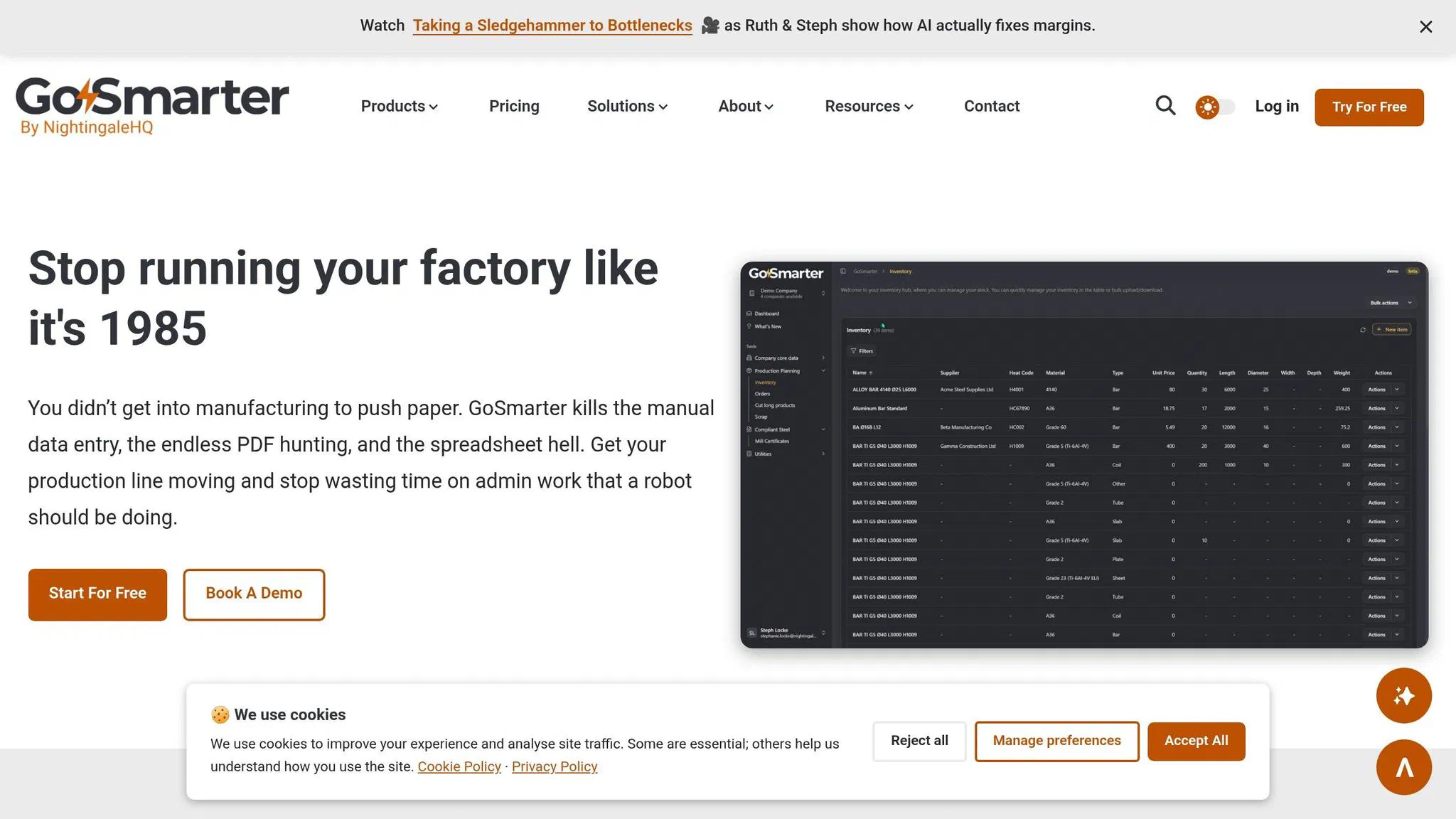
GoSmarter uses edge computing to spot issues fast and tell your team what to do next. Normally, setting up edge computing for predictive maintenance is a logistical headache. You’ve got to figure out the right sensors, run network surveys, configure edge gateways, and integrate with your CMMS. It’s the kind of project that drags on for months and eats up IT resources.
GoSmarter is a metals AI toolkit that sits on top of the systems you already use - spreadsheets, email, and Enterprise Resource Planning (ERP) - so you can modernise without a rip-and-replace project.
GoSmarter skips all that. Instead of a six-month slog, you can be up and running in 1–2 days 21. No need to hire a consultant army, rip out your infrastructure, or even hand over your payment details to get started. All it takes is a quick sign-up, importing your data via spreadsheet or API, and you’re good to go. You can start with a limited pilot and expand once the results are clear. This no-fuss setup means you can start seeing results on the shop floor almost immediately.
Start Small: One Line, One Module
Start light: begin with one line and one module, prove value in weeks, then scale in phases - MillCert Reader first, then scheduling, then inventory and cutting optimisation. For example, start with the MillCert Reader to extract cert data, link it to live stock records, auto-check material against order spec, and flag non-conformances before material reaches the saw or laser 21.
Take inspiration from companies like Midland Steel and MAAS Precision Engineering. Tony Woods, CEO of Midland Steel, used GoSmarter to cut carbon emissions and streamline steel manufacturing. Meanwhile, Tadhg Hurley at MAAS Precision Engineering brought in GoSmarter’s tools to modernise systems without disrupting day-to-day operations 21.
The results speak for themselves:
- The MillCert Reader saves 120 hours a year.
- The Cutting Plans module slashes scrap by 20–50% 21.
See your numbers now with GoSmarter’s free Business Case Calculator. Plug in your scrap rates and admin hours, and it’ll generate a PDF ROI report you can share with your team before committing. The calculator shows its assumptions: current scrap rate, planner/admin hours, rework risk, and On-Time In Full (OTIF) baseline, so you can compare before vs after on a like-for-like basis.
Scaling Up: From One Line to Full Operations
Once you’ve proven the ROI on one production line, it’s time to think bigger. GoSmarter scales from one line to your full operation. It syncs real-time data with existing ERP systems - for example Infor, Epicor, Dynamics, or Sage - through REST APIs, using a four-layer process - sensing, transport, processing, and action - to turn raw numbers into insights you can act on 22 21.
This isn’t just about another dashboard to ignore. It’s about creating clarity and driving results. Rajesh Nair, CEO of Tata Steel UK, summed it up perfectly:
This project helped create clarity, shared understanding, and momentum around how AI can support our people, operations, and long‑term strategy 21.
That’s the real win: a system that slots into your daily workflow and delivers measurable improvements across your facilities.
FAQs
Which machines should we start with for edge-based predictive maintenance?
What sensors are needed to catch failures early?
How do we connect edge alerts to our CMMS for automatic work orders?
Run a 30-Day Pilot on One Critical Asset
Pick one high-impact asset, wire up the minimum sensor set, and run edge alerts into your CMMS for 30 days. Use GoSmarter to measure three numbers only: alert-to-action time, avoided downtime hours, and scrap avoided. If those move in the right direction, scale to the next line.
Further Reading
1: Real-Time Predictive Maintenance with Edge AI (Zero Cloud Latency in Factories)
2: Why We Replaced Cloud AI With Edge AI on the Factory Floor | Medium
3: Edge vs. Cloud Processing: Reducing Latency in Manufacturing
4: Edge Computing for Steel Plants: Real-Time Analytics at the Source
5: The Shift from Cloud to Edge AI in 2026: Why Industrial Companies Are Moving to On-Prem AI
6: Real-Time Predictive Maintenance with Edge AI (Zero Cloud Latency in Factories)
7: Edge AI for Industrial Maintenance: Predict Equipment Failures in Real Time
8: Edge Computing for Real-Time Maintenance Analytics: On-Premise AI Processing
9: Edge AI for Manufacturing: On-Premise Predictive Analytics Guide
10: Reducing Unplanned Downtime by 40%: A Manufacturing AI Case Study | Tesan AI
11: Transforming Predictive Maintenance with Edge AI and Real-Time Sensor Analytics - RDS Data
12: https://newsroom.arm.com/blog/siemens-arm-edge-ai-driven-predictive-maintenance
13: Reducing Axle Rework by 65% - Acerta
14: Rolling Mill Predictive Maintenance: Preventing Costly Breakdowns with IoT & AI
15: Breakthrough in Critical Ball Mill Failure Prediction with DataMind AI - Razor Labs
16: How ArcelorMittal prevented 31 hours of downtime by detecting 27 failures ahead of time | Samotics
17: Steel Fabrication Plant Saves $3.2M with Predictive Maintenance Across Critical Equipment
18: IoT Sensor Deployment for Predictive Maintenance: Hardware & Network Setup Guide
19: https://it.mathworks.com/company/technical-articles/deploying-predictive-maintenance-algorithms-to-the-cloud-and-edge.html
20: The Role of Edge Computing in Real-Time Preventive Maintenance - TeroTAM
21: GoSmarter AI | AI Tools for Metals Manufacturing
22: Operations Management for Metals Manufacturers | GoSmarter
About the Author

Editor· Co-Founder & CEO
Ruth Kearney is Co-Founder and CEO of GoSmarter AI — driving commercial growth and strategic partnerships to help metals manufacturers adopt AI and digital tools that actually deliver on the shop floor.