Predicting Metallurgical Defects with Machine Learning
- BlogSmarter AI
- Edited by Zoe Locke
- Blog
- July 22, 2026
- Updated:
Table of Contents Show Hide
Why do defect prediction projects fail in metals? Because your model usually is not the problem. Your data is. It lands late, split across PDFs, scans, spreadsheets, and paper that everyone swears they filed somewhere sensible.
That mess burns cash through scrap, rework, and bad calls made on half the story.
I see the fix like this: start with clean, heat-linked batch data, then use machine learning where it fits. GoSmarter, built by Nightingale HQ, reads mill cert PDFs with AI OCR, splits multi-heat records, and gives metals manufacturers data they can train on without feeding rubbish into the model.
What you get from this:
- Why steel traceability matters more than fancy modelling
- Which fields matter first, like heat number, chemistry, CEQ, and Rp0.2
- Where image models fit, and where tabular models make more sense
- How to start with one defect use case and avoid alert spam
- What turns a risk score into something an engineer can act on
If you want earlier defect warnings, you need to sort the paperwork first. Here’s how to fix it.
Can Machine Learning Predict Casting Defects Before They Happen?
Why metallurgical defects are hard to catch early
Most defects show up at final inspection. By then, the scrap and rework bill is already baked in. Scrap steel usually gives you back only 40p in the pound. That means a 60% loss on every kilogram of bad material [6].
The hard part is this: defects rarely come from one bad reading. They come from process conditions stacking up in the wrong way. Weldability is a good example. It depends on Carbon Equivalence (CEQ), which you calculate from several chemical elements [3]. Miss one value, or tie it to the wrong heat, and your quality call starts from bad data. Then the mess spreads.
Your data is scattered, messy and sometimes wrong
Quality data turns up in clashing formats. Batch history ends up split across systems. Labels don’t match. Then multi-heat certificates make it worse. One document can cover several production heats, each with different chemical and mechanical properties. Generic tools often squash that into one record, or skip later heats altogether [2]. Feed that into a defect model and you train it on a warped average that matches no real batch.
Terms like Rp0.2 and +N (normalised) have exact technical meanings. Generic optical character recognition (OCR) tools often read them like plain text. That leads to mislabelled fields in quality databases [2].
The same defect rarely looks the same twice
One defect does not always wear the same face. It shifts across alloys, batches and process settings. Fixed rules struggle with that. Bad labels make it worse. The model ends up learning noise, not signal.
The defects that matter most are usually the rarest
The defects that hit hardest are usually the ones you catch too late. Manual planning often leaves scrap rates at 5-8%. Better-run systems can cut that to under 2.5% [6]. But early prediction only works when you give the model batch-level records it can trust.
Once you sort that out, you can start picking models that spot real risk instead of chasing process noise.
How machine learning turns noisy process data into defect warnings
Once you have clean batch-level records, pick the model that fits the signal. Don’t force one tool onto every problem. Structured process data needs one approach. Image-based defects need another.
Models that work well on production data
For structured process data, start with a tabular model. It’s the sensible place to begin when your data sits in rows and columns, not buried in photos or scans.
Use deep learning when the defect shows up in images
When the defect signal shows up in images, deep learning fits better. That’s the right tool for visual patterns that standard tabular models will miss. The catch is simple: these models are harder to explain. So if the model looks unsure, send those low-confidence cases for manual review [2].
Combine plant knowledge with AI to cut false alarms
AI on its own isn’t enough. Plant knowledge still does the heavy lifting. You need it to read terms like Rp0.2 and CEQ the right way [2][3]. Then you route low-confidence cases for review before they hit the quality system [2]. That keeps engineers in the loop and cuts false alarms.
What you need in place before the model is worth trusting
Defect prediction usually falls over because your batch data is a mess, not because the model is poor. Fixing that is dull work. It is also the bit that matters. Start with the heat link. If that link is wrong, the rest is guesswork.
Capture only signals you can tie to a heat
Your minimum dataset should start with signals you can tie to one heat with confidence: heat number, material grade, and chemical composition.
Heat number is the key link in your dataset [5]. If you lose that link, you can easily match records to the wrong defect outcome from the wrong batch. That is how people end up trusting a tidy chart built on bad joins.
Skip EN 10204 Type 2.1 and 2.2 as your starting point. They do not link results cleanly to a single batch. Type 3.1 or 3.2 certificate data is the safer option because it links one heat number to measured chemical and mechanical properties [3][5].
Clean the labels and select the features that actually matter
Once the batch link is clean, sort out your defect labels. Give each defect type one name. If a record looks vague or messy, pull it out for review. Do not shove rubbish into training data and hope the model sorts it out for you.
Start with fields that have clear metallurgical meaning:
GoSmarter, built by Nightingale HQ, includes MillCert Reader. It pulls structured data from PDF mill certificates, reads terms like Rp0.2 and CEQ properly, and splits multi-heat certificates into separate batch records [2][3]. That matters because old certificate files often look like they were designed to annoy everyone on purpose.
Test it as if production depends on it, because it does
Then test it against real production history. A model can look good in testing and still fall apart on the shop floor. Track precision and recall. Keep your validation tied to the heat number [3][5].
If the model is not sure, send that prediction to a person before you write it into the production record [2]. That step stops bad calls from slipping straight into live work.
How to get value on the line without overloading the team with alerts
A model sitting in a notebook does nothing for the line. You get value when it flags a heat, coil or batch before you create scrap, rework or a customer escape. Put that signal in front of the engineer who can act on it. Once you have clean, heat-linked data, the next job is simple: get the alert to the right person at the right time. Then you decide how live it needs to be.
Pick the setup that matches how your plant actually runs
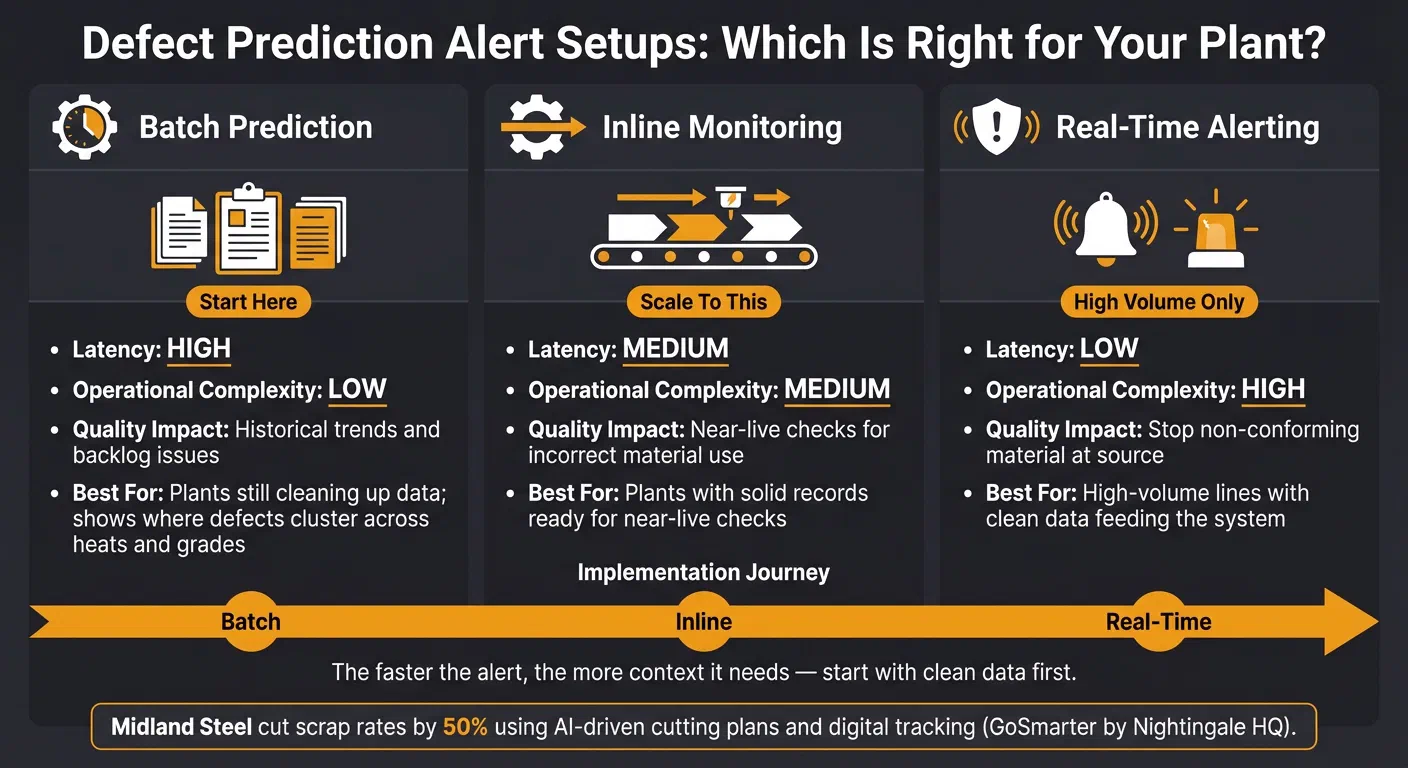
Not every plant needs real-time alerting tied into every sensor on the line. That’s how you end up with fancy software and a team that ignores it. The right setup depends on where quality losses happen and how much extra moving parts your operation can handle without turning daily work into a slog.
| Setup Type | Latency | Operational Complexity | Quality Impact |
|---|---|---|---|
| Batch Prediction | High | Low | Historical trends and backlog issues |
| Inline Monitoring | Medium | Medium | Near-live checks for incorrect material use |
| Real-Time Alerting | Low | High | Stop non-conforming material at source |
Start with batch prediction if you’re still cleaning up the data. It carries less risk and shows where defects cluster across heats and grades before you wire anything into live production. Move to inline monitoring when your records are solid enough for near-live checks. Real-time alerting makes sense on high-volume lines, but only when clean data feeds it. The faster the alert, the more context it needs.
Make the output useful to engineers, not just data teams
A bare risk score is useless on the shop floor. Engineers need the reason. Chemistry out of range. Rp0.2 near the limit. A certificate that does not match the order.
The output needs to point at a lever the operator can pull - temperature, feed rate, material mix, or a hold for re-inspection - not just signal that something might be wrong.
Explainability is not a nice extra. It decides whether the model changes behaviour or gets switched off after three weeks. You need root-cause cues tied to specific metallurgical fields. That’s what makes the output believable to a metallurgist or quality engineer who has spent twenty years dealing with bad data and bad software.
Start with one record flow and prove the result fast
Start with one product family, not the whole plant. Pick something like structural hollow sections or rebar in one diameter range. Link certificates, inspection results and scrap records. That gives you enough to build a labelled dataset, train a simple model and test it against production history. Use the pilot to set thresholds, ownership and escalation rules.
Midland Steel, a major UK and Ireland rebar supplier, cut production scrap rates by 50% during real-world trials after implementing GoSmarter, built by Nightingale HQ, with AI-driven cutting plans and digital tracking; the project was led by CEO Tony Woods [4][1]. That sort of result does not come from a model running on its own. It comes from clean data, a tight starting point and a team that can see what the model is saying and why.
Conclusion: Build one clean dataset, prove one defect use case, then scale
Start small. Pick one defect, one product family, and one clean data flow.
Build the minimum heat-linked dataset first: heat number, chemistry, key mechanical properties, and heat-treatment history. Link every mill test certificate to its heat number and goods-in record, so traceability sits inside the day-to-day workflow, not buried in a PDF graveyard [1][5].
Once you clean that data, prove one defect use case. Keep it tight. You are not trying to boil the ocean. You are trying to show that clean, linked data can help you spot a problem before it burns time, scrap, and margin.
When the pilot works, roll the same setup into nearby long products. Same logic. Same data discipline. Less reinvention.
The next step is to digitise certificates into a clean, heat-linked dataset.
Next step: run GoSmarter MillCert Reader on your next batch of certificates and build one clean defect dataset
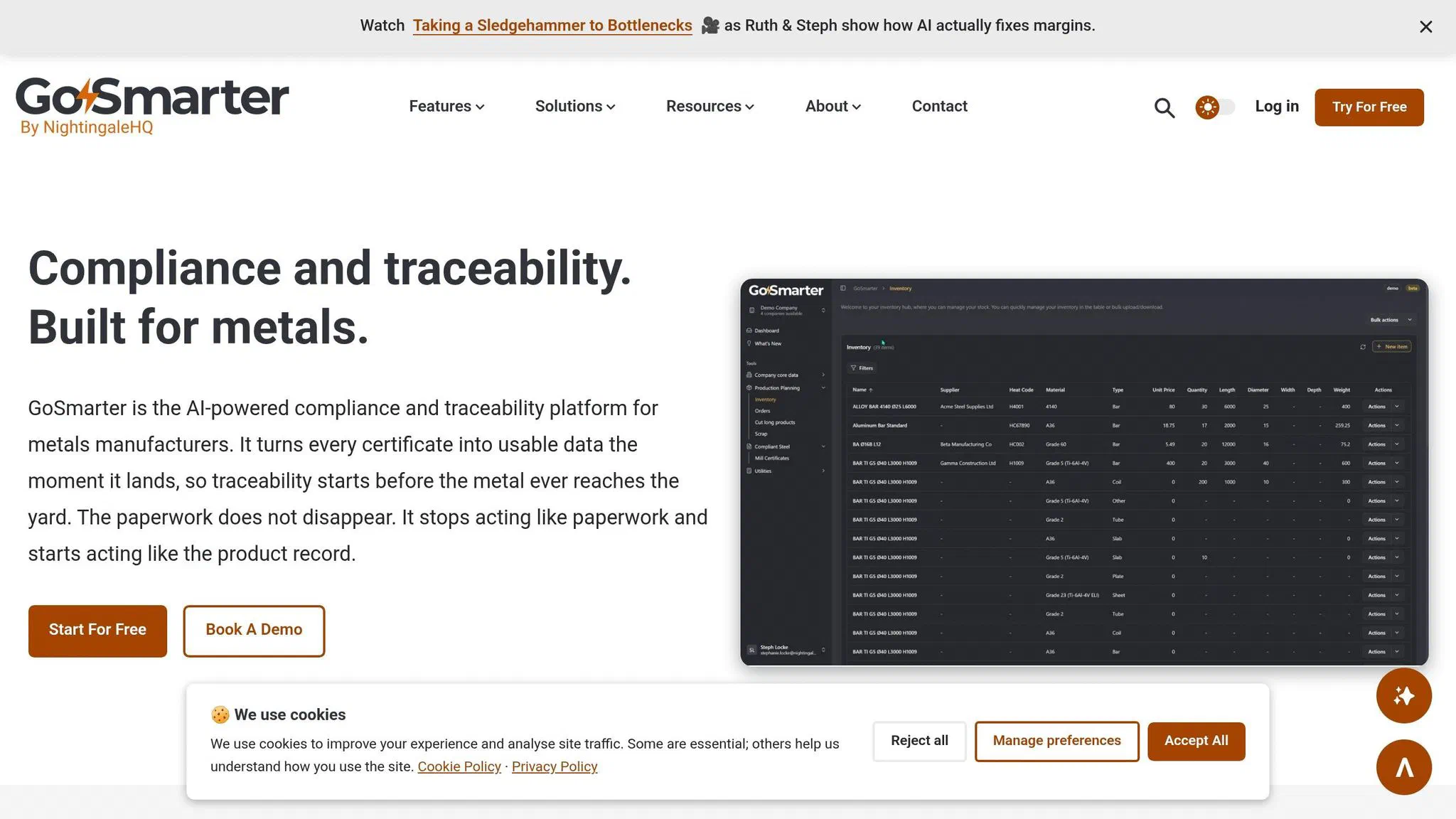
Run GoSmarter MillCert Reader, built by Nightingale HQ, on your next batch of certificates. Pull the data straight out of the PDFs instead of making someone type it all in by hand. The tool extracts heat number, chemistry, CEQ, Rp0.2, tensile strength, elongation, and heat-treatment state from each certificate. It then links each certificate back to the batch record, so you can track where the data came from [2][3][4].
Once you digitise the certificates, turn them into a clean training set. That’s the bit that matters. If your source data is a mess, your defect model will be a mess too.
These fields matter first:
| Data Category | Key Fields | Why It Matters |
|---|---|---|
| Material Identity | Heat Number, Material Grade | Links certificate to batch outcome |
| Chemistry | C, Mn, Si, P, S, CEQ | Affects weldability and forming |
| Mechanicals | Rp0.2, Tensile Strength, Elongation | Shows mechanical performance |
| Process State | Heat Treatment (+N, +QT, +A) | Sets the starting condition |
| Traceability | Supplier, EN 10204 Type (3.1/3.2) | Supports traceability and compliance |
GoSmarter includes automated mill cert reading, data validation checks, and a review step for low-confidence extractions before they enter the production record [1][4]. That review step matters. It stops dodgy reads from slipping into your dataset and poisoning the model.
Start small:
- Extract one batch
- Check the fields
- Fix any bad reads
- Train your first model on clean records
That’s a far better starting point than feeding junk in and hoping the software sorts itself out.
FAQs
What data do I need first?
Start with your mill test certificates (MTCs). They hold the data that matters: heat numbers, material grades, chemical composition, and mechanical properties like tensile and yield strength.
GoSmarter, built by Nightingale HQ, pulls that data from PDFs and scanned files into structured, searchable records. That means less manual typing, fewer messy data gaps, and cleaner inputs for machine learning models that spot defect patterns.
Can I start without real-time alerts?
Yes. You can start without real-time alerts.
GoSmarter, built by Nightingale HQ, still cuts out a lot of manual grind. It can read mill certificates, pull out the data, and help you manage inventory without a messy, long set-up.
That means you get:
- automated data extraction from mill certs
- traceability you can actually follow
- stock management without spreadsheet chaos
- better visibility across production and quality assurance
You do not need a big, drawn-out project to get use from it. You can start with the boring admin work first, then sort the rest when you’re ready.
How do I stop false alarms?
To stop false alarms in metallurgical defect prediction, fix bad data at the source. GoSmarter, built by Nightingale HQ, checks incoming mill certificate data against the expected ranges for your declared grade and standard before you book it into stock.
It uses purpose-built AI to pull out the data and cross-check it. That cuts transcription mistakes and PDF misreads that spark false quality or compliance alerts. Your team can then focus on the problems that are actually real.
About the Author

Editor· Web Dev, Graphic Designer, Technical Writer
Tech generalist specializing in web development, graphic design, and multimedia content creation for GoSmarter AI