Microsoft Emissions Impact Dashboard - what you need to know
- Will Harris
- Archive
- October 25, 2021
- Updated:
Table of Contents
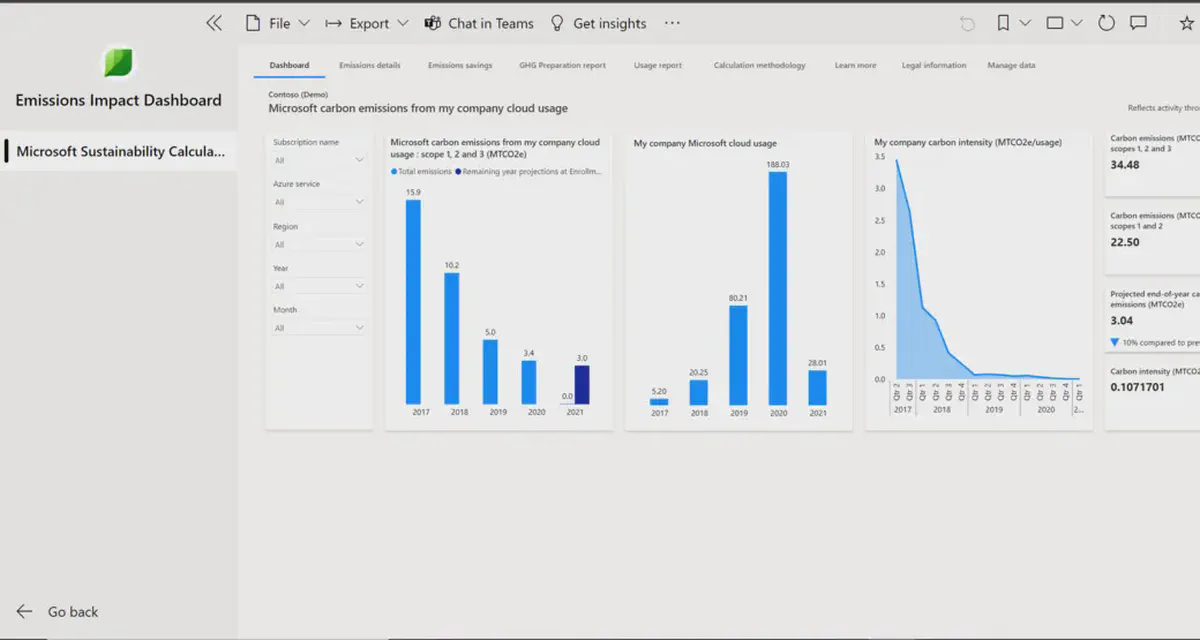
Microsoft first introduced their Emissions Impact Dashboard in January 2020, under the name of ‘Microsoft Sustainability Calculator’. The tool is designed to help cloud services users to track and reduce their cloud carbon emissions. It has an excellent visual interface and provides users with critical insights and information on emissions associated with cloud usage. Users can measure the impact of cloud usage on their carbon footprint by month, service, and datacenter region.
Functionality
The tool also enables customers to enter un-migrated workloads and get an estimate of emissions savings from migrating to Microsoft cloud services. Newly added data protection also allows Emissions Impact Dashboard administrators within an organisation to control who can see their company data in the tool.
Microsoft highlights three key ways the dashboard can help cloud users:
- Use consistent and accurate carbon accounting to track greenhouse gas emissions associated with using Azure and other Microsoft cloud services.
- Optimise decision-making by comparing actual cloud usage with emissions avoided over time through Microsoft datacenter efficiency.
- Estimate further emissions reductions through moving additional apps and services to the cloud.
Another great thing about the app is how easy it is to share findings and information. The data is represented visually in accessible formats while emissions information can easily be shared using a comprehensive cloud data export.
Improving Scope 3 emissions
Over the last year, Microsoft has been improving the capabilities of the app including increased capabilities of measuring and estimating scope 3 emissions - these are basically emissions that indirectly result from all other business activities, such as those associated with the upstream raw materials extraction, manufacturing, and delivery of cloud-based IT asset infrastructure (such as servers) from suppliers to be used in cloud data centers. This also includes emissions that occur from our circularity partners during the recycling process and disposal for IT hardware reuse.
Microsoft is attempting to set a new standard of transparency regarding Scope 3 emissions, labelling them as ‘The next frontier in greenhouse gas management’. Their website provides great examples of organisations benefiting from the tools, including the Swiss multinational plant equipment manufacturer The Bühler Group.
To reach their net zero goal, Bühler needed to track their emissions. They used the dashboard to determine their cloud-related emissions in an accessible format, providing a more accurate overview of their carbon footprint. The tool gave them a wealth of data and insights to better understand and reduce their carbon footprint.
The tool is a brilliant way to get a better understanding of your carbon footprint and can help bring you closer to your net zero goals.
If you’re not a cloud user, as we’ve said before moving to the cloud can be one of the best things you can do if you want to be more sustainable. If your organisation has net-zero goals it’s something you must consider.