AI-Powered Risk Mitigation for Metals Supply Chains
- BlogSmarter AI
- Edited by Steph Locke
- Blog
- July 8, 2026
- Updated:
Table of Contents Show Hide
Most metals supply-chain risk starts long before the late lorry or line stoppage. It starts with bad data, missing certs, and heat codes trapped in the wrong file. If you want to cut risk with AI, you start by fixing traceability, supplier warning signs, and scrap decisions before they hit the shop floor.
The pain is dull but expensive. People re-key PDFs, chase paperwork, hold the wrong stock, and spot trouble too late.
I see the fix as pretty plain. GoSmarter, built by Nightingale HQ, sits on top of your current systems and sorts the admin mess that slows production. It reads mill certs with AI OCR, links heats with Metals Manager, and helps planners cut waste with Cutting Plans. For metals manufacturers, that means fewer surprises and less time spent feeding clunky software.
What you get from this article:
- Earlier warning on supplier delays, price swings, and route trouble
- Cleaner traceability across mill certs, heat numbers, and audit records
- Lower scrap through better cutting plans and offcut use
- Less cash stuck in stock with live buffer decisions instead of fixed guesses
- A low-drama starting point that does not mean replacing your Enterprise Resource Planning (ERP) system
If your team is sick of typing the same data twice and finding problems after the damage lands, here’s how to fix it.
How AI is exposing hidden supply chain risks before they become crises
Why Your Risk Plan Fails the Moment the Market Shifts
Once you’ve got the data sorted, the next weak spot is the market itself. Most metals risk plans quietly assume stable lead times, steady sterling, and input costs that behave themselves. That’s fine until the market does what it always does and moves. Then the plan falls apart.
Those assumptions usually crack first in lead times, supplier reliability, and landed cost. When those inputs shift, small planning mistakes turn into late receipts, line stoppages, and margin loss.
The Risks That Hit Metals Plants First
When markets move, UK metals plants feel it fast. A swing in sterling can change landed costs before you can renegotiate prices. Meanwhile, customer prices often stay fixed for weeks or months.
Risk tends to pile up around a small number of firms, routes, and chokepoints. That means targeted action beats broad, generic planning.[2] One weak supplier link can stop a heat from moving. You’re not just late on admin. You’re stuck waiting for metal.
That lack of visibility gets worse when markets shift. You don’t have spare time to make up for what you can’t see upstream.
Border delays add another problem. Material arrives late. Traceability gaps then turn a routine goods-in issue into a compliance headache.
Why Spreadsheets and Safety Stock Stop Working
The old response to volatility is simple. Hold more stock. Check more spreadsheets. Both hit a limit.
Static safety stock traps cash when energy and input costs are already climbing. It also leaves you exposed if sterling moves again before you use the material.
Spreadsheet-based supplier tracking trails events by design. A weekly risk register won’t help much when a disruption unfolds in 48 hours. You end up firefighting after the damage lands.
You can see the gap in day-to-day control:
| Area | Manual | AI |
|---|---|---|
| Safety stock levels | Quarterly fixed buffers based on historical averages | Dynamic buffers adjusted to live lead-time and demand signals |
| Supplier risk tracking | Weekly spreadsheet updates; late disruption detection | Continuous monitoring of logistics and geopolitical signals; alerts before stock is affected [2] |
| Heat-code traceability | Paper certs; slow audit retrieval | Digital audit trail linked to specific heats; searchable in seconds [1] |
| Goods-in validation | Manual checks against orders and certificates | AI checks certs against specs at goods-in [3] |
This is where GoSmarter, built by Nightingale HQ, earns its keep. It spots disruption earlier. It watches the signals your spreadsheet misses. The next section gets into how that works.
What AI Does Better Than Your Current Setup
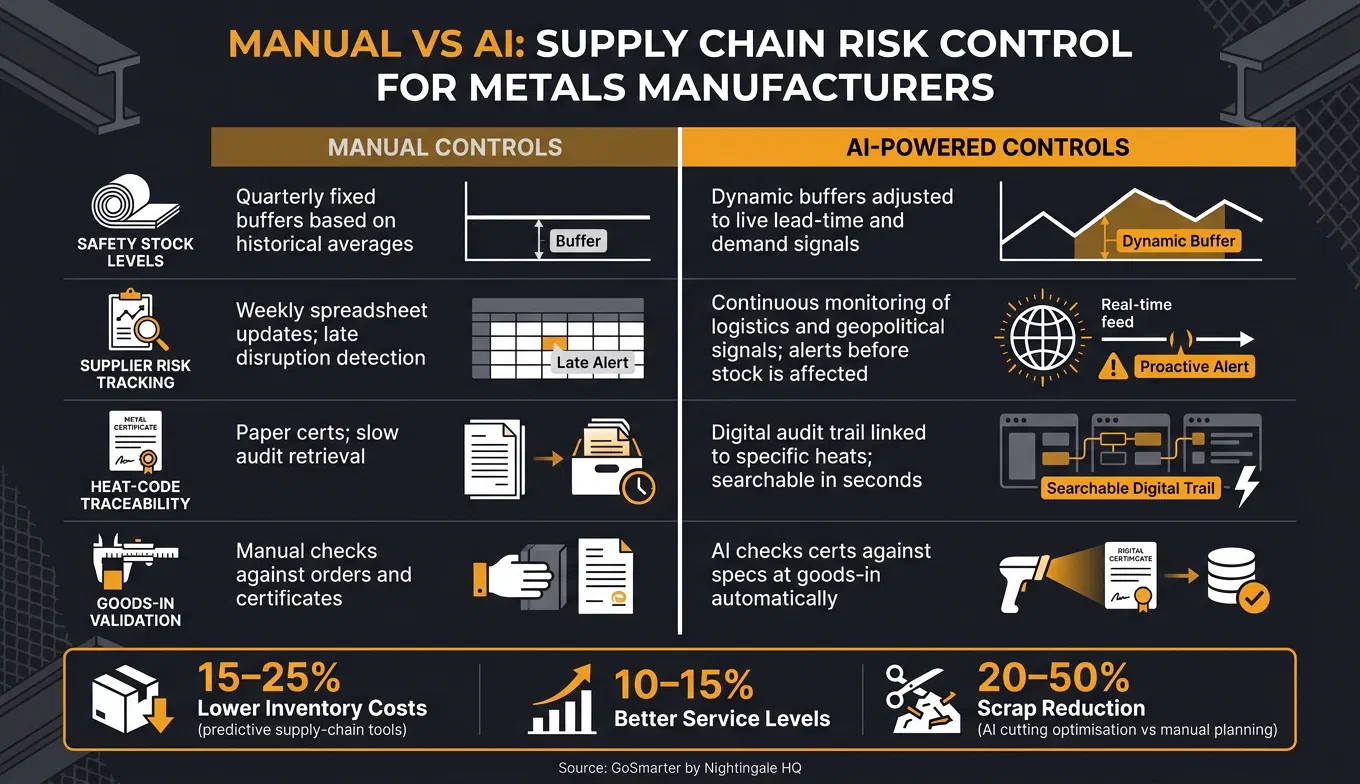
Manual controls leave a timing gap. AI closes it. It spots disruption, quality issues, and supply risk before they punch a hole in production. That gives planners time to act while they still have choices.
How AI Spots Trouble Before It Reaches the Shop Floor
AI learns from your enterprise resource planning (ERP) system, goods-in records, stock data, shipment updates, and quality logs. Then it scores live risk against past disruption patterns. It can spot port delays, slipping supplier performance, and price spikes early enough for you to change sourcing or move the production plan.
These systems run all the time. They refresh risk dashboards every few minutes and show risk scores at material, supplier, and route level. Buyers get early alerts so they can place backup orders. Production managers can re-sequence jobs based on predicted arrivals, not the usual fantasy built on “optimistic” estimated arrival times.
How Digital Twins Let You Test Worst-Case Scenarios
Once AI spots a risk, the next question is simple: can your plant take the hit?
A supply-chain digital twin is a live model of your plant, inventory, suppliers, and routes. It tests what happens when demand shifts, lead times stretch, or supply falls over.
For a UK metals plant, that means you can run scenarios like these:
- a two-week outage at a primary mill
- new customs checks adding three days to a shipping lane
- a 25% spike in orders from a key automotive customer
The AI shows what each case does to buffer stock, line loading, overtime needs, and On-Time In Full (OTIF) risk. It uses UK-specific calendars, shift patterns, and local transport limits. That matters. A model that ignores bank holidays, shift handovers, or a clogged port is just expensive guesswork.
Planners can then decide whether to hold an extra 200 tonnes of a vulnerable grade, adjust cut plans to get better yield, or split production across lines to protect OTIF commitments.
Organisations using predictive supply-chain tools, including digital twins, report 15-25% lower inventory costs and 10-15% better service levels [4]. That means less cash tied up in stock and better service. But the model only works if the data stays current and consistent.
What Data You Need to Make AI Work
These gains depend on clean, connected data. If your inputs are patchy, messy, or missing timestamps, AI cannot track heats, spot non-conformance, or trust its own risk scores.
| Data Input | Source | AI Signal Generated |
|---|---|---|
| Mill certificates | Supplier PDFs | Non-conformance alerts (wrong grade or spec) |
| ERP records | Purchase and sales orders | Supplier risk scoring (OTIF and parts per million) |
| Manufacturing execution system (MES) data | Shop-floor sensors | Real-time production deviation alerts |
| Logistics feeds | Carrier and port updates | Disruption alerts for strikes, weather, and delays |
| Market feeds | Commodity exchanges | Price spike and material shortage warnings |
The minimum standard is not fancy. It is just disciplined.
- Use one standard format for heat numbers and material codes
- Keep accurate timestamps in 24-hour format
- Standardise metric units such as tonnes, millimetres, and degrees Celsius
- Fix large gaps in delivery dates and quality logs
A sensible first step is a data profiling exercise. Check error rates. Look at the share of orders missing promised dates or certificate references. Then fix the gaps that hit risk models before you train anything. No point feeding clever software bad records and hoping for magic.
Use tamper-evident audit trails, encrypted data, and role-based access so outputs stay traceable and defensible. Many customers now expect exportable logs and risk scores they can actually understand.
Where AI Cuts Risk Fastest in a Metals Supply Chain
Once your data stops fighting you, AI cuts supply-chain risk fastest in three places: traceability, scrap, and supplier and demand visibility. It fixes traceability gaps first. Then it cuts waste. Then it spots supplier and demand shocks earlier.
How to Stop Losing Certs, Heat Codes, and Audit Trails
AI improves visibility by stopping bad material before it hits the shop floor. It catches problems before a manual check would.
Mill certificates still turn up as PDFs. Heat numbers still get typed into enterprise resource planning (ERP) systems by hand. That is where the audit trail starts to fall apart. You only find the gap when an auditor asks for proof.
AI can read PDF mill certificates on arrival. It pulls the key fields:
- heat number
- chemical composition
- mechanical properties
- applicable standard
It then checks them against the order and flags mismatches at goods-in. GoSmarter, built by Nightingale HQ, uses its MillCert Reader to handle common European steel and aluminium certificate layouts, including multi-language fields and EN standard references. Its Metals Manager tool builds a full traceability chain. It links each bar, coil, or section to the source heat and each process step. If chemistry is out of spec, or mechanical properties are missing, you see it before material reaches production.
During an audit, that means you search for evidence. You do not start a paper hunt.
A single non-conformance report in a regulated supply chain can cost several times the annual cost of automation software. [6] Catching the wrong grade at goods-in is not a quality win - it is a financial one.
Once traceability works, the next gain is less scrap.
How AI Finds Margin Leaks in Scrap, Yield, and Cutting Plans
For long products like rebar, beams, and sections, the main leak is scrap. Planners often use standard cut tables because they save planning time. They do not always save material. Offcuts then pile up and rarely get reused in any disciplined way.
AI-based cutting optimisers look at historical jobs, actual cutting results, and current offcut stock. Then they build plans that cut total scrap at both job and plant level. GoSmarter’s Cutting Plans applies metals-specific rules such as bend radii, splice rules, and bar diameters. It proposes cutting sequences that stay compliant while cutting waste and protecting yield and delivery performance. In production trials at Midland Steel, the tool achieved a 50% reduction in scrap rates on long products [5][7][8].
“Turned a morning of planning into a five-minute review. We cut scrap rates in half during trials.” [6]
Across structural sections, tube, and bar, GoSmarter’s cutting optimisation reports scrap reductions of 20–50% against manual planning [7][8]. Cutting Plans pushes this further by sequencing orders and cutting runs so demand lines up with available offcuts and semi-finished stock. That means the gains stack up across the week, not just on one job.
The next risk sits outside the plant: supplier and demand volatility.
How to See Supplier and Demand Problems Earlier
AI can flag external risk earlier by scoring supplier reliability and forecasting demand shifts. Supplier risk scoring pulls together delivery history, quality performance, financial signals, and geographical exposure into a live score for each supplier. As new data comes in, the score updates. Purchasing teams can spot a slide in performance weeks before it turns into a missed delivery. That gives you time to shift sourcing, negotiate consignment stock, or move a critical grade to a supplier that is less likely to let you down. Automated weekly risk reports for 600+ suppliers can include early warning signals and recommended mitigation actions [9].
On the demand side, AI forecasting models use order patterns, macroeconomic indicators, commodity market data, and sector-specific signals to build demand visibility months ahead and flag pricing shifts as little as two to four weeks out [10]. For a UK plant, that is enough time to act. You can bring a purchase forward before a price spike, change reorder points when lead times look set to stretch, or resequence production to protect the jobs that cannot slip.
How to Add AI Without Replacing Your Existing Systems
A lot of UK metals manufacturers put AI on hold because they expect a long, messy rollout. Fair enough. Most software projects promise the earth, then dump more work on your team.
The least disruptive AI projects do not rip out your Enterprise Resource Planning (ERP) or Manufacturing Execution System (MES). They sit on top. They fix one bottleneck at a time. Once you can see the risk, you can put AI where the friction bites hardest. So the question is not whether you should use AI. It is where you should test it first.
Start With One Painful Problem and Measure the Result
Pick one repetitive workflow that you can measure. Keep the pilot tight. One plant. One product family. One document flow. Not the whole operation.
Set your baseline before you start. Record:
- how long you take to process each mill certificate
- the current scrap rate per tonne
- how often a late or missing cert holds up material release
Then run AI alongside your current process. Compare the same workload before and after.
Judge the result in the terms your production team already uses. GBP per tonne saved. On-Time In-Full (OTIF) improvement. Fewer non-conformance reports. Less rekeying. That is what matters on the shop floor.
For example, one AI-driven scrap-risk optimisation tool reported a 14% cut in scrap, a 1.5% cut in cost of goods sold, and a 22% lift in planner productivity in manufacturing settings.[11]
How to Make Legacy ERP Data More Useful
Start with the data you already have. You do not need to gut the core system just to make use of it.
Older ERP systems often hold years of usable shop-floor data. Heat records. Purchase orders. Batch histories. Yield figures. The data is there. The problem is that it sits in clumsy formats and scattered files. AI can read it, clean it, and link it without touching the core transactional system.
The AI layer handles extraction, normalisation, and anomaly checks. Your ERP still runs orders, stock, and production. That split matters. You keep control of the system you rely on, while AI sorts out the admin mess around it.
In practice, that usually means connecting to CSV exports, shared drives, scanned PDFs, and flat-file outputs from on-premises systems. AI can pull fields from PDFs and flat files, cross-check them, and leave the ERP alone.
That layered approach gives you faster deployment, less disruption, and visible return on investment (ROI) without replacing core systems.
Pilot GoSmarter on Your Next Batch of Mill Certs
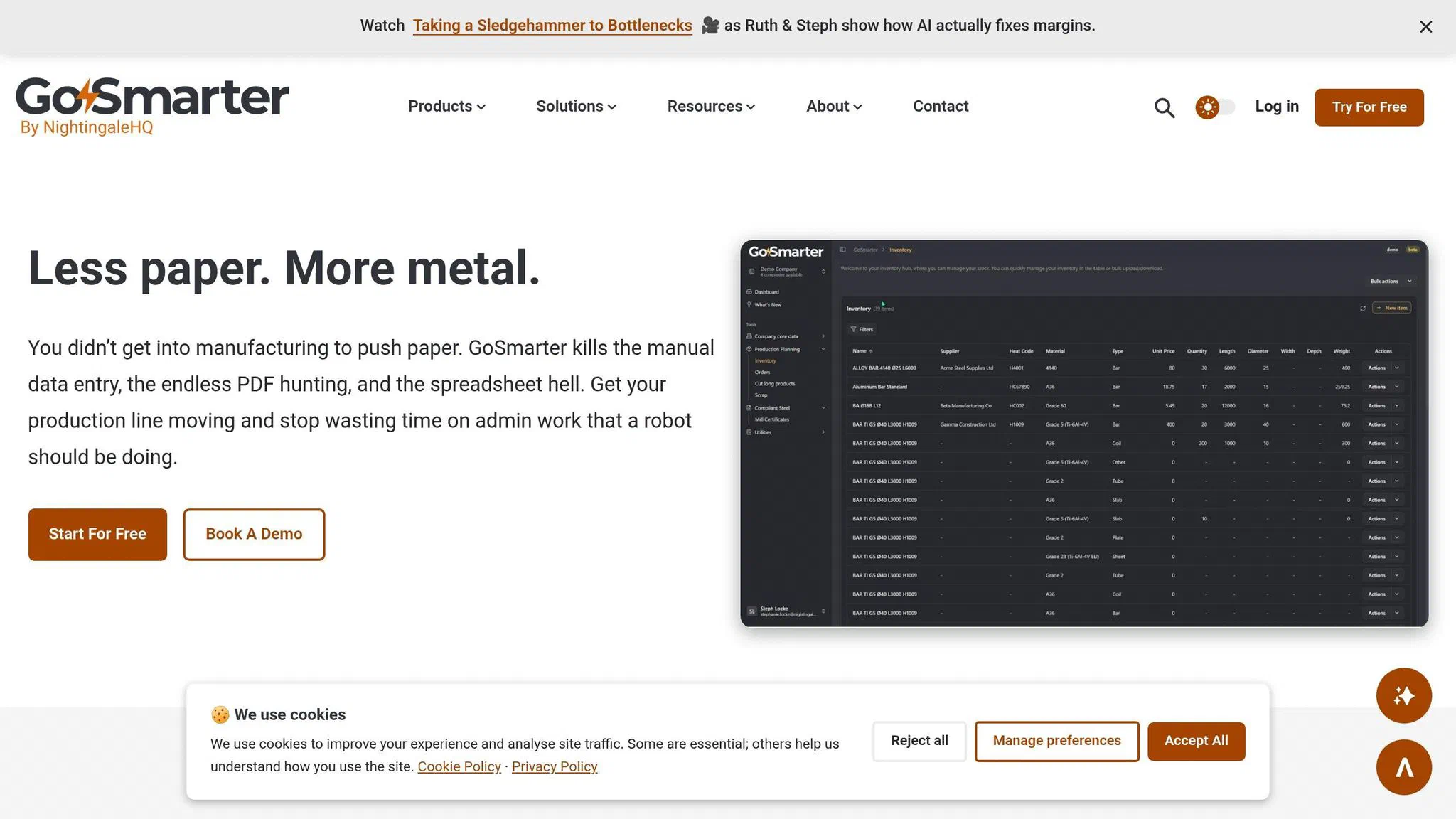
The cleanest first test is incoming mill certificates. The workflow is repetitive. The output is easy to measure. And nobody enjoys typing data out of clunky PDFs by hand.
Take a batch of PDF certs and run them through GoSmarter, built by Nightingale HQ, using MillCert Reader. Measure three things:
- time saved against manual processing
- drop in keying errors
- how fast the extracted data links back to the right heat codes and purchase orders through Metals Manager
AI-driven OCR applied to material test reports in a steel manufacturing context delivered a 40% increase in processing speed and a significant reduction in manual data entry errors, enabling faster compliance sign-off and better traceability. [12]
A live mill cert pilot is not some grand transformation programme. It is one shop-floor test with a clear before-and-after result. If the numbers stack up, you can extend the same approach to scrap optimisation or supplier risk scoring. If they do not, you have still learned something useful without blowing up the rest of the system.
Conclusion: What Good Risk Control Looks Like in a Metals Supply Chain
Across traceability, scrap, and supplier risk, the pattern stays the same. Good risk control in a metals supply chain is continuous, data-led, and built on early warning.
For UK metals manufacturers, the main risks are plain enough:
- Supply disruption
- Traceability gaps
- Demand swings
- Scrap loss
- Compliance exposure
- Working-capital strain
AI does not change those risks. It changes how fast you spot them. You can flag non-conforming material at goods-in. You can prep audits faster. You can spot demand shifts weeks earlier. Most big losses do not come from impossible surprises. They come from problems you saw too late.
Traceability helps you stay resilient because it improves visibility and speed.
The gains are not vague. They show up on the shop floor and in the numbers: fewer non-conformance reports, faster audit sign-off, lower scrap per tonne, and less cash tied up in stock.
That is why the best first step is usually a small one. Pick the process that causes the most friction. Measure the result. GoSmarter, built by Nightingale HQ, fits that first step by automating mill cert extraction and traceability links.
The aim is simple: fewer surprises, stronger compliance, lower waste, and less cash tied up in stock. AI will not remove uncertainty. It does give your team more time to act.
FAQs
What data do we need first?
Start by pulling your own shop-floor data into one place. Focus on:
- historical purchase orders
- supplier delivery records, such as on-time in-full (OTIF) rates
- current live inventory levels
That gives you a base you can trust. Without it, you’re still chasing numbers across inboxes, spreadsheets, and whatever your enterprise resource planning (ERP) system forgot to tell you.
Once that base is in place, GoSmarter, built by Nightingale HQ, can take the ugly stuff off your plate. It reads unstructured files like mill certificates and turns them into structured records you can actually use.
How quickly can AI reduce supply-chain risk?
AI cuts supply-chain risk far faster than manual work. Old-school processes can take up to 14 days to spot a disruption and react. AI-driven systems can flag the issue and kick off a response in as little as 4 hours.
If you use GoSmarter, built by Nightingale HQ, your team can be fully operational in 1–2 days. You do not need a long, painful rollout while everyone drowns in setup calls and spreadsheets. You can also deploy targeted AI risk models within 8 weeks, and those models often start showing useful risk signals in 30–60 days.
Can we add AI without replacing our ERP?
Yes. You can add AI to your supply chain without ripping out your current Enterprise Resource Planning (ERP) system.
GoSmarter, built by Nightingale HQ, sits on top of your current ERP, Excel, and email setup. No rip-and-replace. No long IT circus. You keep the systems you already use. GoSmarter handles the manual admin work those systems leave behind.
It connects through a simple web integration or spreadsheet imports. That means you can start automating jobs like mill certificate digitisation and inventory tracking without turning your whole operation upside down.
Most teams go live within one to two days.
Drill deeper
- Top AI Tools for Supply Chain Visibility in Metals Manufacturing
Go here to compare supply chain visibility tools by name.
25 min read
About the Author

Editor· Co-founder & Head of Product
Steph Locke is Co-founder and Head of Product at GoSmarter AI — former Microsoft Data & AI MVP building practical tools to cut paperwork and automate compliance for metals manufacturers.