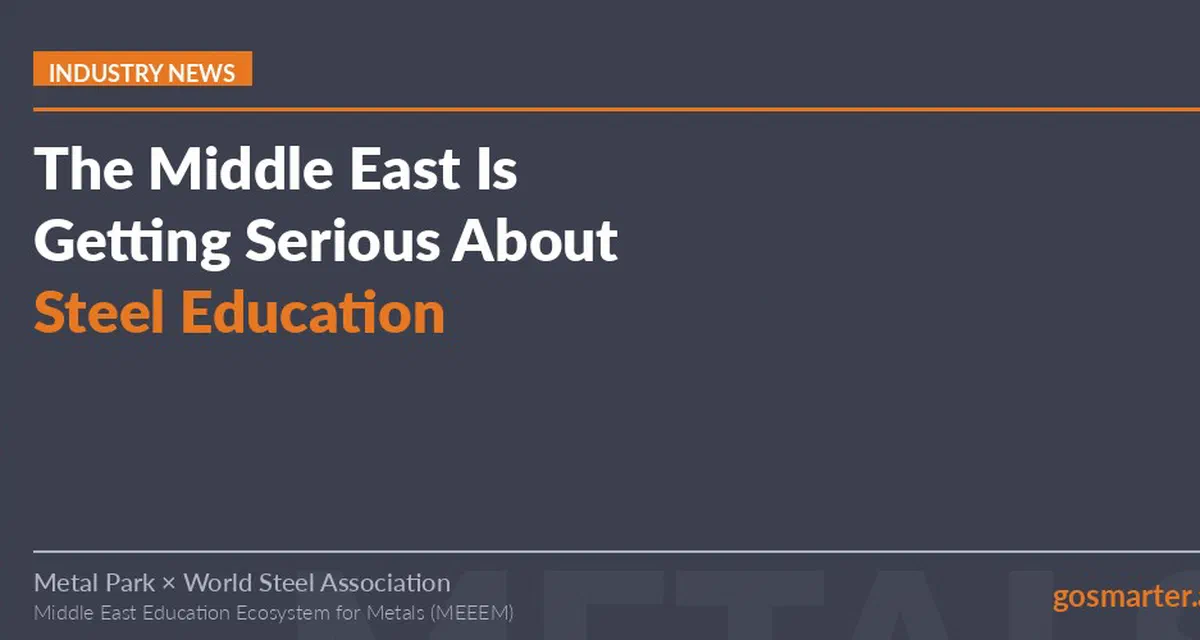
The Middle East is getting serious about steel education
- BlogSmarter AI
- Edited by Steph Locke
- Blog
- February 20, 2026
- Updated:
Table of contents Show Hide
The metals industry has a skills problem. Everyone knows it. But Metal Park and the World Steel Association have actually decided to do something about it.
The two organisations have launched the Middle East Education Ecosystem for Metals (MEEEM) — a proper, joined-up effort to build foundational skills, advanced metallurgy, and engineering capability across the region. No half-measures. No vanity press releases. An actual programme.
Vahid Fouladkar, CEO of Metal Park, put it plainly: “Metal Park was conceived as more than physical infrastructure—it is an operating ecosystem where standards, talent, capability, and production are developed together.”
The initiative plugs in Steel University, the World Steel Association’s educational arm, and aligns squarely with the UAE’s “Make it in the Emirates” and “Operation 300bn” strategies. In short: the UAE wants a serious industrial base, and you can’t build one without people who actually know what they’re doing.
Fixing the talent pipeline — globally
This isn’t just a Middle East story. Jorge Muract, Director of Steel University, made clear the ambition goes further: “The alliance seeks to secure the industry talent pipeline through strong collaboration and alignment among academia, industry, its value chain, and government.”
He also flagged the plan to link up with similar initiatives in Europe, Saudi Arabia, India, and Latin America — so talent can move across borders and the industry stops reinventing the wheel in every region.
That’s worth paying attention to. Cross-border talent mobility in metals manufacturing has been talked about for years. This is one of the first credible attempts to actually build the infrastructure for it.
Why this matters
The metals industry is not short of experience. It is short of a structured way to pass that experience on — especially as experienced workers retire and younger engineers come in without the hands-on background.
MEEEM is a bet that the solution is an ecosystem, not a training course. Bring together governments, regulators, industry partners, and universities, and you get something that actually sticks.
As Fouladkar put it: “By partnering with the World Steel Association and Steel University, we are embedding global best practices directly into the industrial environment, ensuring that education translates into measurable performance, competitiveness, and long-term national value for the UAE.”
That’s the right framing. Training that doesn’t connect to production outcomes is just expensive box-ticking. If MEEEM delivers on this, it could be the template the rest of the industry needs.
FAQs
Why does metals education matter globally?
Steel and metals manufacturing employ millions of people worldwide and is critical infrastructure for construction, energy, transportation, and manufacturing. Yet awareness of the sector — how steel is made, where it comes from, what properties it has, and how it is used — is low among the general public and even among many engineering students.
The Metal Park initiative at the World Steel Association addresses this education gap at a global level. By creating interactive, accessible content about the metals industry, the initiative builds understanding of a sector that is central to the modern economy but often invisible to the people who depend on it.
Why GoSmarter is interested in metals education?
GoSmarter’s mission is to help metals manufacturers operate more efficiently and more sustainably. That mission depends on manufacturers, customers, and policymakers understanding the industry well enough to make good decisions about technology adoption, sustainability investments, and supply chain practices.
An educated metals sector — one where production managers understand materials science deeply, where buyers understand what mill certificates mean, and where policymakers understand what decarbonisation requires in a steel mill — is a sector that can make better decisions. GoSmarter’s tools are more valuable in that context because the people using them understand what the data means and why it matters.
What is the global context of metals education?
Steel production is global and its challenges are global. The carbon footprint of a steel building in London depends partly on where the steel was made and how it was processed. The quality of a medical device depends on the steel from which it was machined. Educating people at every level of the supply chain about materials, processes, and quality creates a foundation for the industry improvements that sustainability and digitalisation require.
The World Steel Association’s role in this education mission reflects the industry’s understanding that collective action on knowledge and standards benefits all participants in the global steel market.
About the Author

Editor · Co-founder & Head of Product
Steph Locke is Co-founder and Head of Product at GoSmarter AI — former Microsoft Data & AI MVP building practical tools to cut paperwork and automate compliance for metals manufacturers.