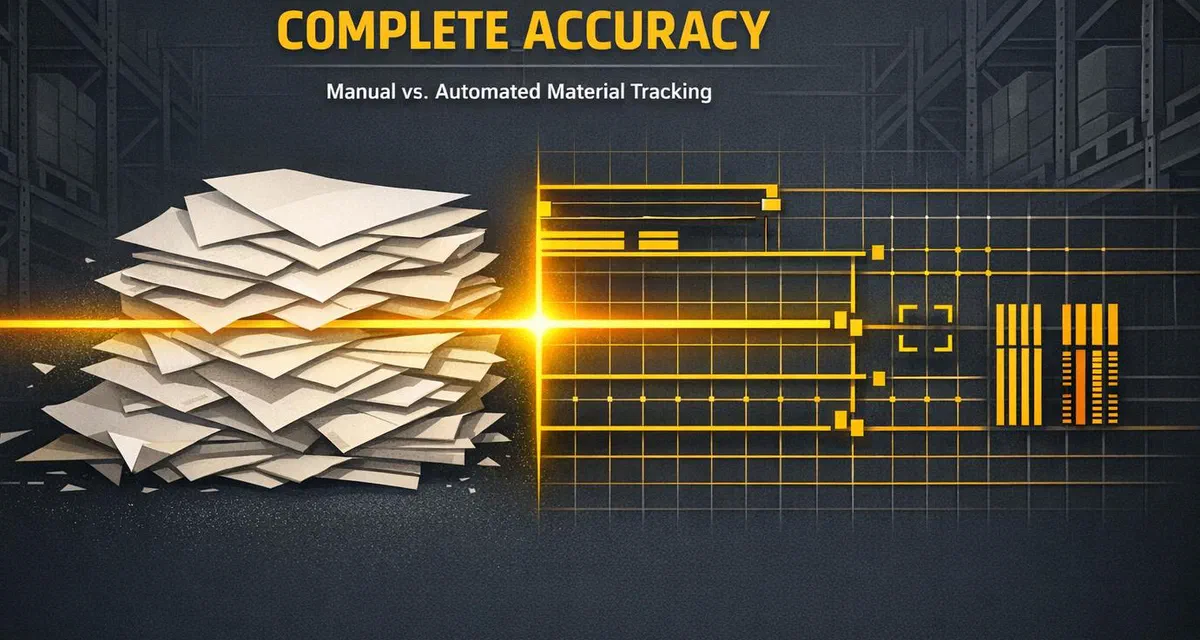
Manual vs. Automated Material Tracking
- BlogSmarter AI
- Blog
- March 23, 2026
- Updated:
Table of contents Show Hide
Stop running your factory like it’s 1985.
Manually typing data from mill certs, hunting through filing cabinets, and fixing spreadsheet errors isn’t just tedious — it’s draining your profits. One UK steel stockholder spent over 120 hours a year just typing certificate data. That’s before you add stock counts, stockout delays, and error corrections. Together, manual tracking costs small manufacturers an estimated £14,100 every year [4].
The solution? Automated material tracking. AI tools now handle certificate data in seconds, link materials to their full history, and provide real-time stock updates. No more guessing, no more wasted hours, and no more compliance nightmares.
The Old Way vs. The Smart Way
| Manual Tracking | Automated Tracking |
|---|---|
| Data entry takes hours | Data processed in seconds |
| High error rates (1–2%) | Near-perfect accuracy |
| Stock checks disrupt operations | Continuous, real-time updates |
| £14,100+ annual hidden costs | High return on a small investment |
Ready to stop losing time and money on outdated methods? Modern tools like GoSmarter’s MillCert Reader can digitise your certificates and transform your tracking process in minutes. Let’s fix this mess.
Manual Tracking: Hours Wasted, Money Burned
How Manual Tracking Works in Practice
In metals factories, manual tracking often revolves around clipboards, logbooks, and spreadsheets. Inventory movements - SKU, quantity, date - are logged in physical books or on bin cards attached to storage bins as materials come and go [5]. When audits or financial reports are due, operations grind to a halt while staff manually count every SKU in storage to create a “snapshot” [5]. It’s a time-consuming and disruptive process, offering only occasional glimpses into stock levels.
Managing mill certificates adds another layer of complexity. Staff must extract details like heat numbers, material grades, and chemical compositions from paper or PDF certificates and input them into ERP systems or shared drives [1]. At Midland Steel Manufacturing, for instance, employees had to manually match incoming deliveries with certificates and ensure the correct sections of multi-heat documents followed materials through cutting and dispatch [1]. This tedious process increases the risk of compliance errors. On average, small manufacturers spend 2–4 hours each week updating stock records [4], with some shop owners still relying on whiteboards or even memory to decide when to reorder parts [4].
As AirShop aptly put it:
The system ‘works’ in the sense that jobs get done and parts get ordered. But ‘works’ and ‘costs you money’ aren’t mutually exclusive. [4]
These inefficiencies not only slow operations but also lead to avoidable financial losses.
The True Cost of Manual Tracking
The financial impact of manual tracking is staggering. Small shops lose an estimated £14,100 annually just from manual tracking: £5,200 in labour for stock counts, £4,800 due to stockout delays, £2,600 correcting errors, and £1,500 in overstock carrying costs [4].
Errors are another major issue. Manual systems typically have error rates of 1% to 2% [5][7], which might seem minor but can snowball across thousands of transactions. Mistakes like transcription errors, illegible handwriting, and unit mix-ups only worsen the situation [7][8]. Because of this lack of trust in the data, many small shops carry 10% to 20% extra inventory as a safety buffer [4]. When a quality issue arises, tracing the problem back through manual records can take days, as inspection sheets, rework notes, and batch records are scattered across disconnected folders [3].
In short, manual tracking creates a data “black box” - you can see the final outcomes, but the process behind them is murky [3]. These hidden inefficiencies highlight the urgent need for a better, automated solution. Let’s examine how automation addresses these challenges next.
Watch: Automated Traceability in Minutes
What Automated Tracking Actually Fixes
The days of juggling clipboards and spreadsheets are over. Automated tracking systems now offer a faster, more precise way to manage materials, cutting costs and saving time.
How Automation Tackles Key Tracking Challenges
Gone are the hours spent manually entering heat numbers and chemical compositions from mill certificates. Tools like GoSmarter’s MillCert Reader use AI-driven OCR technology to extract this data in seconds. One production manager at Midland Steel Manufacturing, a rebar supplier operating across the UK, Ireland, and Norway, shared:
I logged in for the first time and was up and running in minutes. MillCert Reader now pulls all the key info - chemical composition, mechanical properties - automatically. This change cuts weeks of manual work to seconds. [10]
This efficiency adds up to roughly 10 hours saved every month on certificate-related tasks.
Unlike generic OCR systems, GoSmarter’s AI is built specifically for the metals industry. It understands complex terms like “Rp0.2”, separates data from multi-heat certificates, and even calculates Carbon Equivalence (CEQ) for CBAM reporting. All of this is done with precision, eliminating the painstaking manual effort these tasks would normally require [1]. The system also validates extracted data against expected ranges for specific grades and standards, flagging any discrepancies before they cause production issues [1].
At Midland Steel, this has led to real-time inventory visibility tied directly to mill certificates. Every piece of material now carries its full history - grade, heat number, mechanical properties - ensuring complete traceability [1][9]. When a cert arrives with a Carbon Equivalence outside the ordered range, or a heat number that doesn’t match the delivery note, GoSmarter flags it before the material reaches the shop floor. Non-conformances get caught at goods-in — not during a customer audit three months later.
Many metals businesses also use barcodes and RFID tags on individual bars, bundles, or pallets to replace handwritten bin cards, giving live visibility into stock levels and order commitments [9]. Most companies are up and running in a single day, with a clean fit into most ERP systems [1]. This creates an immutable audit trail and eliminates the need to sift through paper records. The result? Faster processes, fewer errors, and better oversight.
Tangible Benefits: Time, Accuracy, and Transparency
The shift to automation delivers clear, measurable improvements.
By automating mill certificate reading, users save over 120 hours annually — roughly three full workweeks [1]. That figure is based on a UK steel stockholder processing around 400 certs a month at 2–3 minutes of manual data entry per cert. A smaller site processing 100 certs a month typically saves 30–40 hours a year; a high-volume operation can save 200 or more. Accuracy gets a major boost too: while manual systems typically have error rates of 1% to 2%, automated systems achieve near-perfect accuracy by cross-checking data against industry standards [1]. Beyond the admin saving, the downstream effect matters equally. When stock records update from the cert in real time rather than from a spreadsheet refreshed once a day, planners make better commitments — fewer short-shipments, fewer last-minute material re-purchases, and measurably better on-time-in-full delivery.
Real-time updates reduce the need for excess safety stock, streamlining inventory and cutting waste [4]. If a quality issue arises, tracing the problem takes minutes instead of days, as every material is directly linked to its certificate and heat number [3].
This shift from periodic updates to continuous, real-time data transforms decision-making. Managers can instantly see what’s in stock, what’s allocated, and what needs reordering. This not only simplifies operations but also slashes administrative headaches.
GoSmarter offers a free trial, with plans starting at £275 per month [1]. Stop losing time and money on outdated methods - invest in a system that works for you and your team.
Manual vs. Automated: Direct Comparison
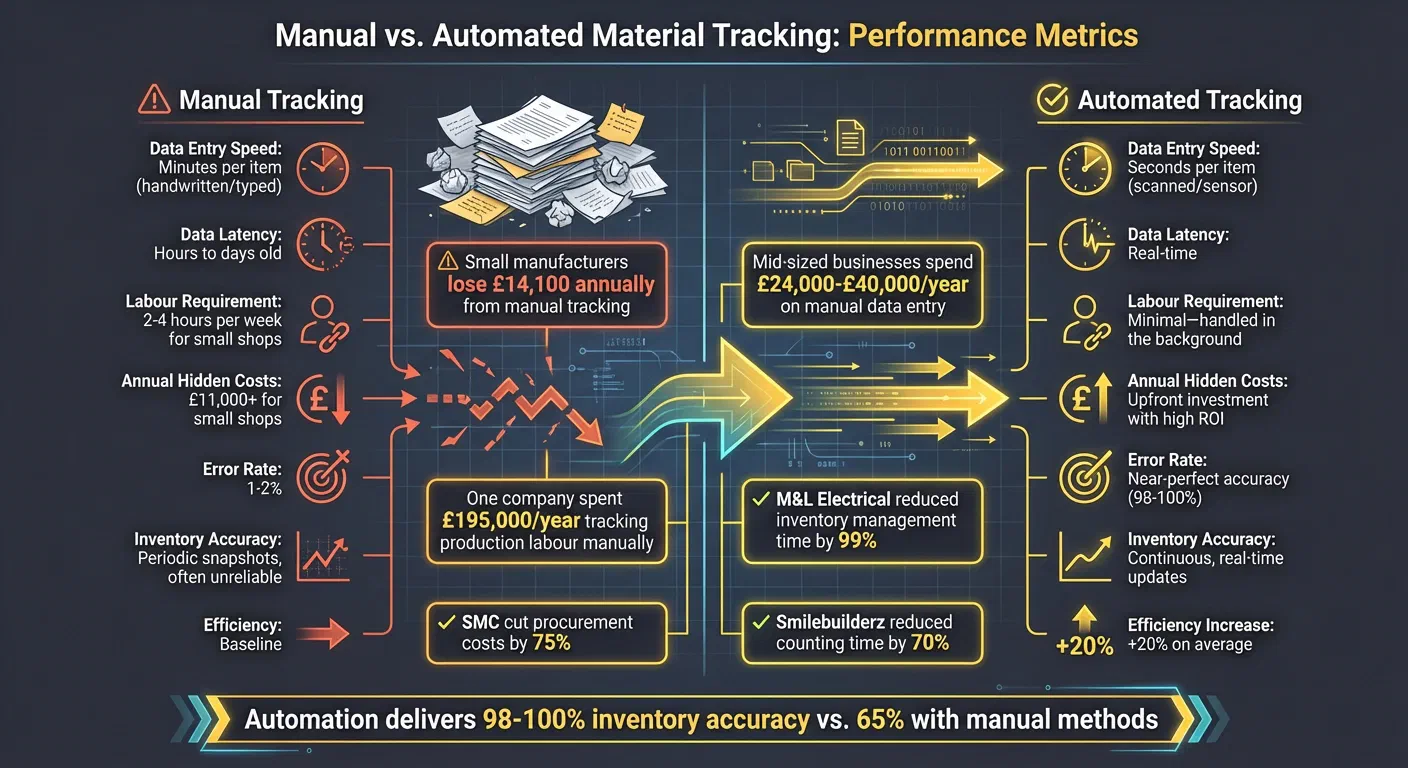
Manual tracking leaves gaps in data and bleeds cash. Here is exactly how big the difference is.
The shift from manual to automated tracking is like moving from guesswork to certainty. Manual systems rely on humans to jot down data - often at the end of a shift or after delays - while automated systems capture events in real time, removing the need to rely on memory or delayed inputs [8].
The financial impact of sticking with manual methods can be staggering. For small manufacturers, hidden costs can run into thousands of pounds annually [4]. For mid-sized businesses, manual data entry alone can cost between £24,000 and £40,000 per year [12]. One striking example is a company spending £195,000 every year just to manually track production labour [2].
The efficiency gains with automation are undeniable. Take M&L Electrical, for instance - they slashed inventory management time by 99% after ditching manual methods. Smilebuilderz cut counting and replenishment time by 70%, and SMC, an electrical distributor, reduced procurement costs by 75% thanks to automation [6]. These aren’t just small wins - they’re transformative changes.
Performance Metrics: Manual vs. Automated
Let’s break this down further with a side-by-side comparison of key metrics:
| Metric | Manual Tracking | Automated Tracking |
|---|---|---|
| Data Entry Speed | Minutes per item (handwritten/typed) | Seconds per item (scanned/sensor) |
| Data Latency | Hours to days old [2] | Real-time [8] |
| Labour Requirement | 2–4 hours per week for small shops [4] | Minimal - handled in the background |
| Annual Hidden Costs | £14,100+ for small shops [4] | Upfront investment with high ROI [4] |
| Efficiency Increase | Baseline | +20% on average [8] |
| Inventory Accuracy | Periodic snapshots, often unreliable | Continuous, real-time updates [11] |
Manual tracking is slow, error-prone, and costly. Automation is faster, more accurate, and pays for itself.
How to Transition from Manual to Automated Tracking
Switching to automation doesn’t have to upend your operations. Start by tackling your biggest headache - mill certificates. Many factories are buried under unorganised PDFs in shared drives, making them a nightmare to search or audit. Digitising these documents offers immediate relief while laying the groundwork for broader automation. This approach moves you from manual chaos to real-time data without tearing everything apart.
Start with High-Impact Tools, Then Expand
In December 2025, Midland Steel, a rebar manufacturer operating across the UK, Ireland, and Norway, adopted GoSmarter’s MillCert Reader. The result: 10 hours saved every month on certificate-related tasks [10].
Tools like GoSmarter’s MillCert Reader (starting at £275 per month) are built specifically for metals manufacturing. Unlike generic OCR, which often stumbles over industry-specific terms like “Rp0.2” or multi-heat certificates, this system handles them effortlessly. It processes certificate pages in just 5 to 15 seconds and automatically renames files by heat number, making them easy to find even during the transition [1][13].
Once you’ve digitised your certificates, it’s easy to scale up. You could move to full inventory tracking with tools like Metals Manager (starting at £400 per month), or use AI-powered cutting plans to slash scrap waste [14]. Cutting optimisation works by fitting jobs to the actual stock available — accounting for remnants, partial lengths, and material already committed — so fewer bars get scrapped as offcuts. Customers on long products typically recover 20–50% of the scrap they were generating, depending on their product mix.
Preparing for Long-Term Requirements
After addressing immediate challenges, it’s time to think about future needs, especially compliance and integration. Manual tracking simply can’t keep up with modern regulatory demands. For example, the EU’s Carbon Border Adjustment Mechanism (CBAM) already requires manufacturers to track Carbon Equivalence (CEQ) data - something that’s nearly impossible with manual systems [1]. Tools like GoSmarter automatically pull this data from certificates, ensuring you’re audit-ready without extra hassle.
The good news? You don’t need to replace your existing ERP or endure long integration timelines. GoSmarter sits alongside whatever you already run — Infor, Epicor, Microsoft Dynamics, Sage, or a bespoke system — reading in your data via CSV or REST API, and writing cert records, live stock updates, and cut plans back out the same way. Your ERP stays the system of record. GoSmarter adds the operational intelligence layer on top, without a rip-and-replace project [1][13]. To keep things running smoothly, set up clear naming conventions and assign responsibilities for uploading, verifying, and editing data. This approach ensures a clean, ISO 9001-compliant digital audit trail [13].
Stop Burning Cash on Manual Processes
Manual tracking drains over £14,100 a year from small manufacturers — and that’s just the measurable cost [4]. Automated systems achieve near-perfect inventory accuracy, reducing error rates from the 1–2% that manual methods routinely produce to near-zero [1]. They slash order processing times from two days to four hours. At £275 a month for MillCert Reader, if your team currently spends 10 hours a month on cert data entry at a fully-loaded cost of £35/hour, you’re spending £350 a month to do what GoSmarter does automatically. Month one, you’re already ahead. In today’s fast-moving industry, having accurate, real-time data isn’t just a nice-to-have; it’s a necessity for staying compliant and competitive.
This isn’t about jumping on the latest tech trend - it’s about survival. Your competitors are already ahead, digitising their processes to quote faster, meet compliance standards like CBAM with ease, and respond to market demands more effectively. Relying on spreadsheets and filing cabinets? That’s a recipe for slower operations and inflated costs.
Start with the biggest headache: mill certificates. Tools like GoSmarter’s MillCert Reader (starting at £275 per month) eliminate the time-sucking data entry that eats up hours every week [1]. Once your certificates are digitised, expanding to full inventory tracking or even AI-driven production scheduling becomes a natural next step.
The Longer You Wait, The More It Costs
The efficiency gains and cost savings from automation make it an obvious choice. Manual processes are not just outdated - they’re a drain on resources and a barrier to growth. Automated material tracking is no longer optional for metals manufacturers that want to run leaner, faster, and more sustainably. The real question isn’t whether you should automate - it’s how much longer you can afford to lose money on manual methods [4].
Try GoSmarter for free at gosmarter.ai and see how quickly you can turn paperwork chaos into actionable insights. Upgrade today to cut waste, boost efficiency, and stay ahead. Your team - and your profits - will thank you.
FAQs
What’s the quickest first step to automate material tracking?
Start with the biggest time-sink: mill certificate data entry. GoSmarter’s MillCert Reader extracts key data from certificate PDFs or scans in seconds — heat number, grade, chemical composition, mechanical properties — without anyone typing a thing.
Fewer errors. More time saved. A clear path to fully automated material tracking.
How does automated tracking improve traceability for audits and quality issues?
When something goes wrong with manual records, you’re digging through folders, squinting at handwriting, and matching batch numbers across disconnected spreadsheets.
With GoSmarter, every goods-in event, every cut, and every despatch is logged and linked to the certificate automatically. You find the root cause in seconds, not days. Auditors get a clean digital trail. No scrambling. No gaps.
Will automated certificate and stock tracking integrate with my existing ERP?
Yes. GoSmarter is built to sit alongside your existing setup — Sage, Epicor, Microsoft Dynamics, Infor, or a bespoke system. It reads in your data via CSV or REST API and writes cert records, stock updates, and cut plans back out the same way.
Your ERP stays the system of record. GoSmarter handles the metals-specific work your ERP can’t: reading mill certificates, linking stock to heat numbers, and keeping the traceability chain intact from goods-in to despatch. No middleware required.