Material Test Report (MTR) vs Mill Test Certificate (MTC): What's the Difference?
- Ruth Kearney
- Blog
- June 21, 2026
- Updated:
Table of Contents Show Hide
A Material Test Report (MTR) and a Mill Test Certificate (MTC) usually describe the same document. If you work in steel fabrication, construction, energy, or any trade where traceability matters, you have heard people swap the terms freely. Mill Test Report, Mill Sheet, Mill Certificate. Same paperwork, different name. The real question is not what to call it. It is whether you can find the right one in three seconds when a customer or an auditor asks.
Both documents prove one thing: this batch of metal was tested, and the results meet a recognised standard. Get that wrong and you carry a compliance risk into every job. Below, we sort out what each document is, where it comes from, and why the difference matters less than most people think.
Why these documents matter at all
Every week, your goods-in bay takes deliveries from mills, stockholders, and suppliers. Before any of that metal touches a production run, you need proof it meets the spec on the order. That proof is the certificate.
An MTR or MTC does five jobs at once:
- Confirms the material matches the grade and standard you bought
- Gives you full traceability back to a specific batch of steel
- Provides evidence when an auditor or customer asks
- Cuts the risk of a material failure on a finished job
- Keeps you compliant with customer and regulatory requirements
Skip the certificate and you are taking the supplier’s word for it. That is fine until something cracks, fails, or gets queried. Then you need the paper, and you need it fast.
What a Material Test Report (MTR) actually is
A Material Test Report records the chemical and mechanical properties of a batch of material. It confirms the metal supplied meets a particular grade, specification, or standard. Think of it as the metal’s exam results.
A typical MTR lists:
- Material grade and specification
- Heat number or batch number
- Chemical composition
- Mechanical properties
- Testing methods used
- Heat treatment details
- Manufacturing information
- Inspection and approval sign-off
The report ties the physical bar, plate, or coil on your shop floor back to the production records at the mill. That link is the whole point.
What a Mill Test Certificate (MTC) is, and how it differs
A Mill Test Certificate carries much of the same information as an MTR. The difference sits in who issued it. An MTC comes from the original manufacturer or steel mill, and it includes the actual test results from that production batch.
In practice, most teams treat MTR, MTC, Mill Certificate, Mill Sheet, and Mill Test Report as the same thing. The distinction that genuinely matters is the source and the level of traceability behind the paper. A certificate issued by the mill that made the steel gives you stronger traceability than one re-typed by a stockholder three links down the chain.
If two people in your business call the same PDF by two different names, the document is not the problem. The filing system is.
For formal definitions of MTC, heat number, and the EN 10204 standard, see the metals manufacturing glossary.
The heat number is the part that matters
The heat number is the single most important field on any certificate. It is the metal’s unique identifier. It lets you trace a finished product back to the exact batch of steel it was made from.
Lose the heat number and full traceability falls apart. You cannot prove which batch fed which job. During an audit or a customer inspection, that gap turns into a problem you have to explain on the spot. A certificate without a valid heat number is barely a certificate at all.
What to check on every certificate
When a delivery lands, run through the same checks every time. They confirm the metal you received matches the purchase order and the project spec.
Material identification: grade, dimensions, quantity, and the standards it claims to meet.
Traceability: heat number, batch number, and manufacturer details.
Chemical properties: carbon, manganese, silicon, sulphur, phosphorus, and any other alloying elements.
Mechanical properties: yield strength, tensile strength, elongation, impact test results, and hardness where it applies.
Certification details: inspection type, authorised signatures, the issue date, and the standard references.
Miss one of these and you might accept material that never matched the order in the first place.
Where manual certificate management falls down
Managing certificates is rarely the clean process it looks like on paper. Most teams still run it by hand:
| The Manual Way | The Automated Way |
|---|---|
| Certs arrive as email attachments and land in an inbox | Certs upload once and data is extracted on the spot |
| Heat numbers re-typed into a spreadsheet | Heat numbers read and validated automatically |
| Audit prep means hunting through shared drives | Audit trail is built and searchable in seconds |
| Lost or duplicate records pile up | One searchable library, no duplicates |
The manual route leaks time everywhere. Lost certificates. Missing heat numbers. Duplicate records. Slow audit prep. Hours of admin that nobody enjoys. When you grow from dozens of certificates a week to thousands a month, that workload stops being an annoyance and becomes an operational drag.
How Artificial Intelligence (AI) handles certificates at scale
Forward-thinking manufacturers now hand the grunt work to Artificial Intelligence (AI). A trained model reads a certificate the way your best engineer would, only faster and without getting bored at 4pm.
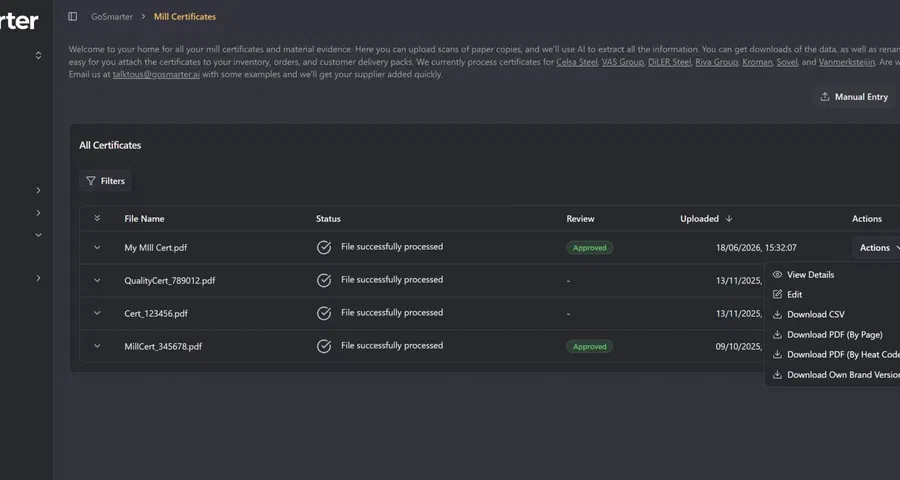
GoSmarter’s MillCert Reader does the heavy lifting:
- Extracts certificate data automatically
- Identifies heat numbers and material grades
- Validates required fields and flags anything missing
- Builds a searchable digital library
- Creates an instant audit trail
- Links each certificate to inventory and production records
That cuts the admin and lifts accuracy at the same time. Midland Steel, a rebar manufacturer running operations across Ireland, the UK, and Norway, saved roughly ten hours a month doing exactly this. The full story sits in our MillCert Reader case study. For a deeper walk-through of the workflow, see our mill certificate automation guide.
Less paper, more metal
MTRs and MTCs are not just paperwork. They are the backbone of quality assurance, traceability, and compliance across the metals supply chain. The hard part was never understanding what the documents are. The hard part is managing them at scale without burning a day a week on it.
If your team still files certificates by hand, start with one batch. Run your next set of mill certs through MillCert Reader and see how much of the admin disappears. Time spent searching for a certificate is time not spent making metal.
FAQs
Is an MTR the same as an MTC?
In most workplaces, yes. A Material Test Report (MTR) and a Mill Test Certificate (MTC) both record the chemical composition and mechanical properties of a batch of metal, and both prove it meets a recognised standard. Teams also call the same document a Mill Test Report, a Mill Sheet, or a Mill Certificate.
The one distinction worth holding onto is the source. An MTC is issued by the original manufacturer or steel mill and carries the actual test results from that production run. That gives you stronger traceability than a certificate re-typed by a stockholder further down the supply chain. So treat the names as interchangeable, but always check who issued the paper and how close they sit to the mill that made the metal.
What is the difference between EN 10204 3.1 and 3.2?
EN 10204 is the European standard that defines the types of inspection document a metal producer can issue. A 3.1 certificate is validated by the manufacturer’s own authorised inspection representative, someone independent of the production department. It confirms the material meets the order and reports the actual test results from that batch. A 3.1 covers the large majority of structural and fabrication work.
A 3.2 certificate goes a step further. It is validated by both the manufacturer’s inspector and either an independent third party or the buyer’s nominated representative. You tend to see 3.2 on safety-critical and high-pressure work, such as oil and gas, nuclear, and pressure equipment, where an extra layer of verification is required. If your project specification calls for 3.2 and the supplier sends a 3.1, the material does not meet the order, full stop.
Why does the heat number matter so much?
The heat number is the unique identifier for a specific batch of molten steel poured at the mill. Every certificate ties its test results to a heat number, and every piece of finished material should trace back to one. It is the thread that connects the bar on your rack to the production records at the mill.
When a customer queries a job or an auditor asks for proof, the heat number is how you find the right certificate in seconds rather than hours. Lose it, and full traceability breaks. You cannot prove which batch went into which order, and that gap becomes a compliance problem you have to explain under pressure. Treat the heat number as the most important field on the page, because in a dispute it is the field everyone asks for first.
How does AI help manage certificates at scale?
AI reads a certificate, pulls out the fields that matter, and files the result without anyone re-typing a thing. A trained model identifies the heat number, the grade, the chemical composition, and the mechanical properties, then validates that the required fields are present and flags anything missing. The certificate goes straight into a searchable library and links to the relevant inventory and production records.
The payoff shows up most when volumes climb. Reading and filing a few certificates by hand is tedious but manageable. Reading thousands a month by hand is a job in itself. GoSmarter’s MillCert Reader automates that work, which is how Midland Steel clawed back around ten hours a month. You get faster audit prep, fewer lost certificates, and an instant audit trail, with the admin handed to software instead of a person.
About the Author

Co-Founder & CEO
Ruth Kearney is Co-Founder and CEO of GoSmarter AI — driving commercial growth and strategic partnerships to help metals manufacturers adopt AI and digital tools that actually deliver on the shop floor.