Marcegaglia Finalises €450 Million Deal for French Steel Plant
- BlogSmarter AI
- Edited by Steph Locke
- Blog , News
- April 28, 2026
- Updated:
Table of Contents Show Hide
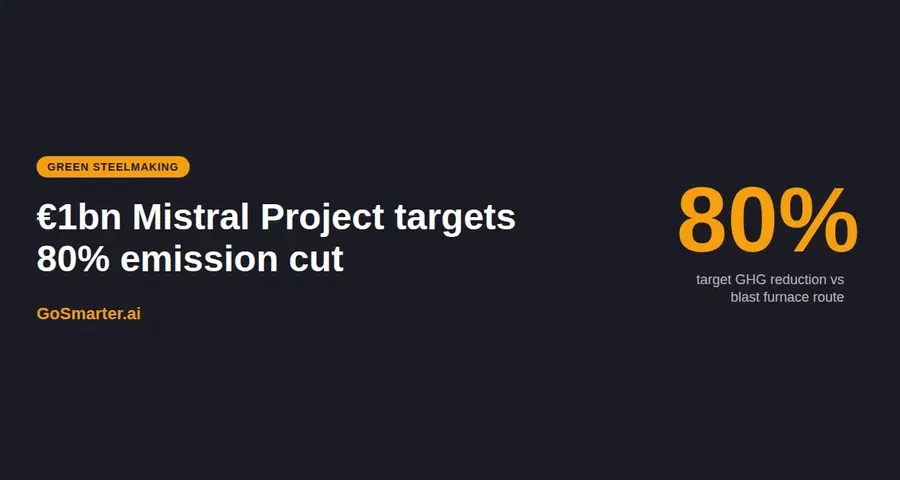
Marcegaglia has committed €450 million to a new steelmaking contract. It will reshape how France produces flat steel for a generation. Signed with Italian engineering group Danieli, the deal is the centrepiece of the Mistral Project: a €1 billion total investment. The plan is to build a new Hot Briquetted Iron (HBI) and scrap-fed Electric Arc Furnace (EAF) mill at Fos-sur-Mer in southern France. At full capacity, the plant will produce over 2 million tonnes of liquid steel per year. Hot-rolled carbon and stainless steel coil output will reach up to 3 million tonnes annually.
This is the largest investment in Marcegaglia’s history. It is also one of the most significant private bets on new low-carbon steelmaking capacity in Western Europe.
Here is what matters for the industry:
- What the Mistral Project actually involves and how the plant will run
- Why the 80% greenhouse gas reduction claim stacks up
- What the HBI and scrap feedstock model means in practice
- The supply chain and pricing implications for buyers downstream
Here’s how it all fits together.
What the Mistral Project Actually Involves
Marcegaglia is one of Europe’s largest steel processors and distributors, not a primary steelmaker. The Mistral Project changes that. By building upstream steelmaking capacity at Fos-sur-Mer, the group takes direct control of its flat steel supply chain for the first time.
The plant will run on two inputs:
- Scrap metal — the primary feedstock for EAF steelmaking, charged by grade and chemistry
- Low-carbon Hot Briquetted Iron (HBI) — a processed form of Direct Reduced Iron (DRI) that supplements scrap, improves chemistry control, and reduces residual element contamination in the finished product
Energy will come exclusively from nuclear and renewable electricity. France generates around 70% of its electricity from nuclear power. That gives EAF steelmaking at Fos-sur-Mer a structural carbon advantage over operations running on fossil-fuel-heavy grids elsewhere in Europe.
Why Danieli?
Danieli is the Italian engineering group behind many of the EAFs running across Europe today. Their track record delivering HBI and scrap-fed EAF plants at scale makes them the logical choice for a project this size.
The €450 million contract covers the design, supply, and installation of the core steelmaking plant. That includes the EAF furnaces, casting lines, and hot rolling equipment. The remaining balance of the €1 billion total covers civil works, port infrastructure, and the broader supply chain setup.
The 80% Emissions Reduction Claim
Marcegaglia says the Mistral Project will cut greenhouse gas (GHG) emissions by up to 80% compared to conventional steelmaking. That figure deserves unpacking.
The Blast Furnace Baseline
Conventional steelmaking uses a blast furnace to reduce iron ore using coking coal. The liquid iron then goes into a basic oxygen furnace. It is carbon-intensive by design. Integrated mills operating via this route emit roughly 1.8 to 2.1 tonnes of CO₂ per tonne of crude steel produced.
The EAF route using scrap metal produces a fraction of that. Typical emissions run from 0.4 to 0.8 tonnes of CO₂ per tonne, depending on the electricity grid. On France’s largely nuclear grid, the carbon intensity of EAF steelmaking drops further still.
What HBI Adds to the Equation
Replacing part of the scrap charge with HBI reduces reliance on lower-grade scrap. It allows tighter chemistry targeting and lowers residual copper and tin in the final product. HBI does add some upstream emissions from the Direct Reduced Iron (DRI) reduction process. Net lifecycle emissions still stay well below the blast furnace route.
The 80% reduction figure compares against a coal-powered blast furnace on an average European grid. At Fos-sur-Mer, running on French nuclear electricity, the real-world outcome could improve on that headline number.
Why Fos-sur-Mer?
Fos-sur-Mer sits on the Gulf of Lion, west of Marseille. It is at the edge of one of France’s main deepwater industrial ports. This plant will import HBI by sea from the Middle East, the Caribbean, and North America. Port access is not optional.
It also positions finished product for distribution across southern France, northern Italy, and the broader Mediterranean flat steel market. The area has the skilled workforce and infrastructure for heavy steelmaking. Marcegaglia is not building on a blank slate.
What It Means for European Steel Buyers
Marcegaglia’s move upstream is a response to supply chain risk. As a major processor, Marcegaglia has bought slab and coil from third parties for decades. It has absorbed their price swings and supply shortages. The Mistral Project brings that control in-house.
For service centres, fabricators, and construction firms buying further downstream, three things are worth tracking.
New flat product capacity. The plant will produce hot-rolled carbon and stainless steel coils. That adds up to 3 million tonnes per year of new European supply. That volume will compete with existing flat product sources. Other producers are managing their own transition away from blast furnace routes at the same time.
Low-carbon credentials. Under the EU’s Carbon Border Adjustment Mechanism (CBAM), the carbon content of steel is no longer just an ESG talking point. It is a hard procurement calculation. Steel from the HBI-EAF route on France’s nuclear grid carries substantially lower CBAM exposure than blast furnace material. Buyers who need to show their supply chain emissions will have a better-specified option in the Mistral Project’s output.
Price dynamics. EAF steel using HBI costs more to produce than scrap-only EAF steel. Whether that output commands a premium depends on CBAM timing and how fast buyers demand low-carbon steel. That shift is underway but not yet uniform across all customer segments.
What to Watch Before 2030
The Mistral Project is a multi-year construction programme. Marcegaglia has not announced a commissioning date. A greenfield EAF plant at a port site typically takes five to seven years from contract signature to first heat. DRI and HBI infrastructure adds to that timeline. Commercial production sits somewhere in the early 2030s.
Three things worth monitoring:
- HBI supply agreements. The plant’s economics depend on securing cost-competitive HBI at scale. Watch for offtake announcements with Middle Eastern or North American DRI producers.
- CBAM phase-in timeline. The faster CBAM implements, the sooner low-carbon EAF steel commands a market premium. That is what justifies the project’s higher capital cost. Delays to the phase-in schedule weaken the financial case.
- French energy policy. France’s commitment to extending its nuclear fleet underpins the carbon advantage of the Fos site. The current policy direction makes reversal unlikely. It is a variable worth tracking.
Go Deeper
- Italy’s Electric Arc Furnaces: 23.9Mt Capacity and Three Bets on the Future — how Europe’s EAF leaders are positioning for the green steel transition
- Germany Allocates €322m for Salzgitter’s Hydrogen Steel Project — another flagship green steel bet reshaping European capacity
- Business Finland Funds €20M for SSAB Sustainable Steel Programme — public investment accelerating low-carbon steel across the Nordic region
- CBAM and the Financial Case for Cutting Scrap — why carbon now hits your margins twice
- Go Green Without Going Broke: Cutting Carbon While Protecting Margins — the business case for decarbonisation in metals manufacturing
- Metals Manufacturing Glossary — definitions for EAF, HBI, DRI, CBAM, and more
Frequently Asked Questions
What is Hot Briquetted Iron (HBI) and why does it matter for low-carbon steelmaking?
What is CBAM and how does it affect steel buyers in practice?
What does Marcegaglia's move into primary steelmaking mean for the European flat steel market?
What does the €450 million Danieli contract actually cover?
About the Author

Editor· Co-founder & Head of Product
Steph Locke is Co-founder and Head of Product at GoSmarter AI — former Microsoft Data & AI MVP building practical tools to cut paperwork and automate compliance for metals manufacturers.