Zero Surprises: How to Know Exactly What's on Your Floor, Every Single Time.
- BlogSmarter AI
- Blog
- March 20, 2026
Table of Contents
Manual data entry, misplaced mill certificates, and outdated ERP systems are killing your margins. Sound familiar? Most manufacturers are stuck in a vicious cycle of wasted time, lost materials, and constant guesswork. It’s not your fault - your tools are the problem.
Here’s the truth: your shop floor doesn’t need more spreadsheets or yesterday’s data. What you need is real-time visibility. AI tools now make it possible to track every raw material, order, and machine status as it happens. The result? No more hunting for heat numbers or scrambling to fix production delays.
The Old Way vs. The Smart Way
| The Old Way | The Smart Way |
|---|---|
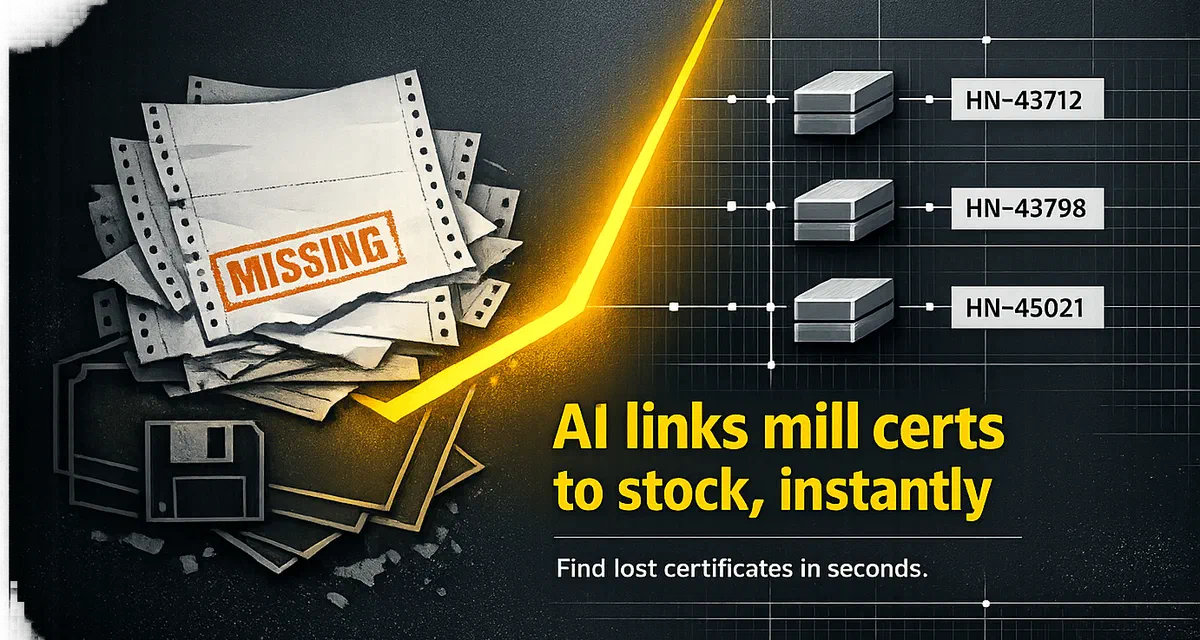
| Searching for missing mill certs | AI scans and links them in seconds |
| Manual inventory checks | Automated sensors track stock live |
| Guessing at cutting plans | AI calculates patterns to reduce scrap |
| Reacting to delays | Predictive analytics prevents them |
Stop running your factory like it’s 1985. Let’s break down how AI tools can eliminate the chaos and give you full control over your floor.
See It in Action: Real-Time Shop Floor Control
Step 1: Track Raw Materials in Real Time with Automated Sensors
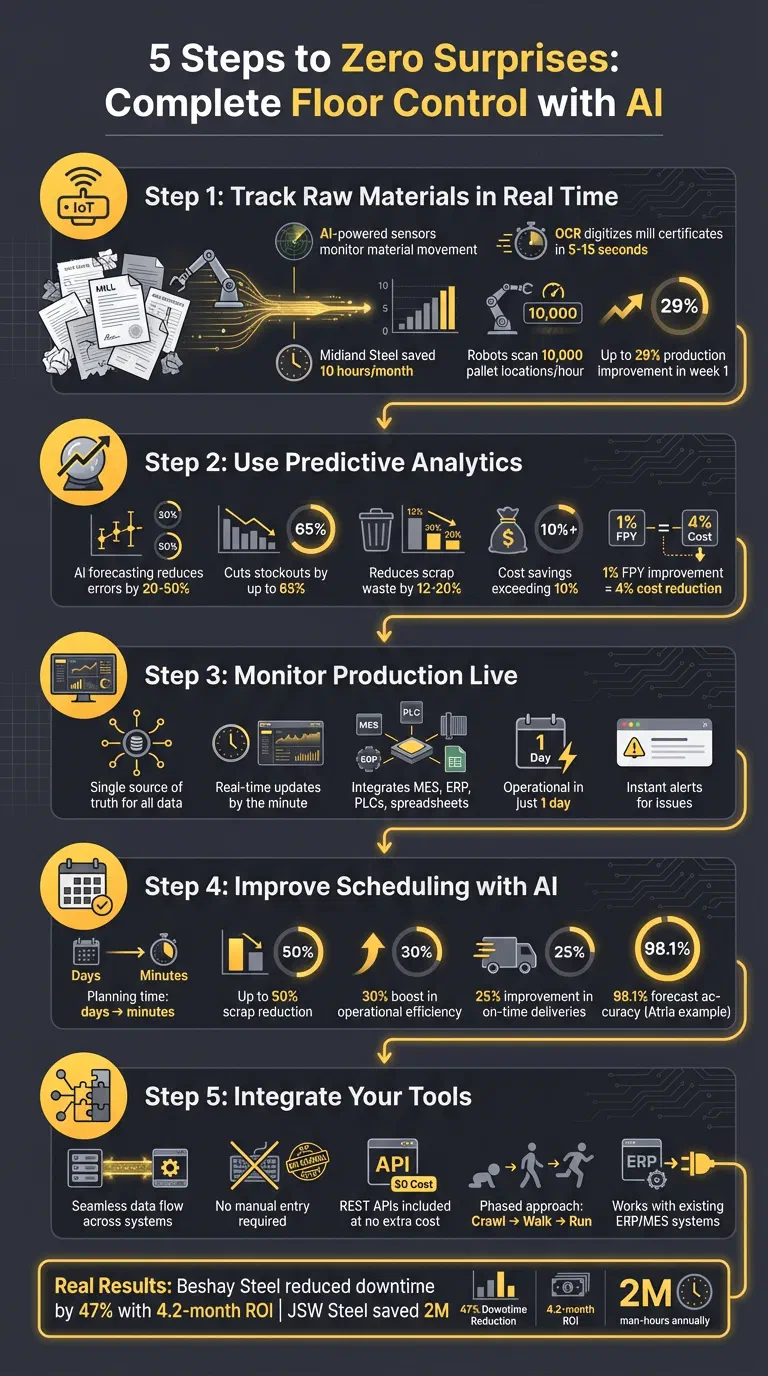
Start with AI-powered sensors to track raw materials in real time. They monitor movement through receiving, storage, and picking — feeding live data straight into your system [5]. Retrofit IoT sensors — vibration, current, proximity, photoelectric — and even your oldest kit gets connected [4]. Pair them with AI-powered Optical Character Recognition (OCR) to digitise essential documents instantly.
Digitise Mill Certificates with AI OCR
Mill certificates are often the bane of production managers. They arrive as messy, inconsistently formatted PDFs, requiring someone to manually extract key details like heat numbers, chemical compositions, and mechanical properties. GoSmarter’s MillCert Reader eliminates this tedious task in just 5–15 seconds per page [6]. Simply upload the PDF, and the AI extracts and links critical data - like heat codes, grades, and yield strength - directly to your inventory records [1][6].
Take Midland Steel, for example. In December 2024, this UK-based rebar manufacturer implemented the MillCert Reader. Previously, the team spent hours manually entering product codes and chemical compositions. With the AI tool, they saved 10 hours per month and eliminated manual errors in renaming and data entry [8]. As their Production Manager explained:
“I logged in for the first time and was up and running in minutes. MillCert Reader now pulls all the key info - chemical composition, mechanical properties - automatically. What used to take hours every week is done in seconds.” [8]
The tool even renames certificate PDFs with heat numbers and grades automatically, so you’re never stuck searching through files labelled “cert1.pdf” when you need compliance data [1]. Plans start at £275 per month, with a free trial available [1].
Cut Manual Errors with Real-Time Monitoring
Digitising documents is just the beginning. Real-time monitoring also removes manual errors across your operations. Mistakes often happen during manual checks - like misreading a heat number at goods-in, which can lead to the wrong material entering production. Automated sensors prevent this by continuously validating your physical stock against system records. Autonomous robots can scan up to 10,000 pallet locations per hour, achieving near-perfect accuracy compared to the 91% typical of manual checks [7]. Rory Fidler, Vice President Cargo Technology at Menzies Aviation, highlighted the impact:
“Mimi [the robot] is delivering this, as on a daily basis we are scanning over 500 locations and achieving high accuracy levels in a fraction of the time it has historically taken to do it manually.” [7]
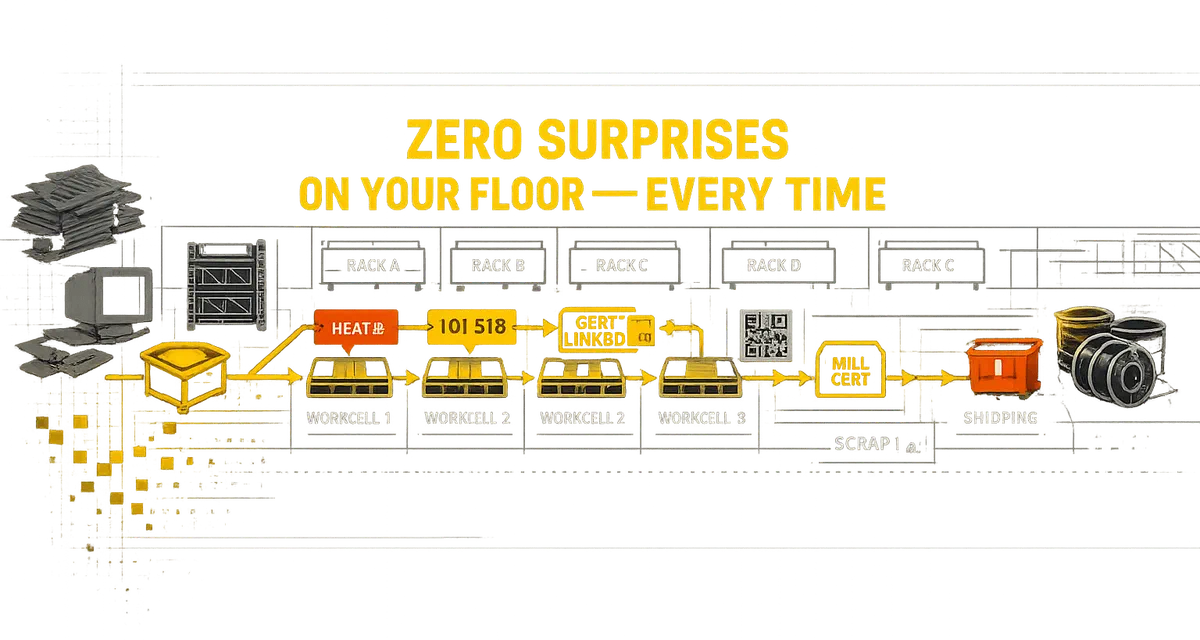
For metals manufacturers, heat codes entered during the “Goods In” process automatically link to digitised certificates, creating an instant and reliable audit trail [6]. Need material with specific yield strength for a job? Your dashboard verifies compliance in seconds, sparing you the hassle of digging through physical files. Real-time monitoring can improve production efficiency by up to 29% within the first week [4].
Step 2: Use Predictive Analytics to Prevent Shortages and Waste
With real-time tracking in place, predictive analytics sharpens your inventory management. It moves you away from the risks of overstocking, which ties up cash, or shortages, which lead to missed deadlines and costly emergency orders. Instead, machine learning forecasts what you’ll need and when, while ensuring materials are used efficiently.
Forecast Inventory Accurately
Predictive analytics dives deeper into your inventory needs by combining historical data with real-time insights.
AI-powered forecasting replaces guesswork with precise, data-driven predictions. By analysing past sales and inventory trends alongside external factors - like raw material prices, weather changes, economic conditions, and even social media trends - it creates highly accurate demand forecasts [9][13]. Advanced machine learning algorithms uncover patterns and relationships in massive datasets, providing detailed forecasts down to the SKU or store level [9][11][13]. Unlike traditional methods, these AI systems update predictions almost instantly as new data flows in, allowing you to adjust production schedules on the fly [10][13].
The data backs this up: AI forecasting can reduce errors by 20% to 50% and cut stockouts by up to 65% [9][13]. Businesses using generative AI for inventory management in late 2024 reported cost savings exceeding 10% [13], while 43% of companies still lose sales due to poor forecasting [10]. To maximise these benefits, ensure you have at least 12–18 months of clean, structured historical data before training your AI models [10]. Also, integrate forecasting tools with your ERP, POS, and warehouse systems to avoid data silos and enable real-time updates [10][12].
Cut Scrap with Smart Calculations
Optimising your supply chain is just one side of the coin - smart calculations help tackle material waste.
Scrap can eat into profits quickly. Even a small 2–3% reduction in scrap waste can save high-volume plants hundreds of thousands of pounds annually [14]. Predictive analytics powered by AI can reduce scrap by 12–20% by identifying and addressing process inefficiencies before they escalate [15][16]. For example, GoSmarter’s Rebar & Scrap Optimiser calculates cutting patterns to minimise waste and tracks offcuts, reducing both material costs and carbon emissions. Instead of relying on manual cutting plans, the tool generates optimised plans that sync with your inventory and orders.
An improvement of just 1% in First Pass Yield (FPY) can reduce overall manufacturing costs by as much as 4% [17]. In the metals industry, using AI to cut scrap waste not only boosts profits but also aligns with sustainability goals.
Tony Woods, CEO of Midland Steel, highlighted the impact of these technologies:
“Smart technology choices can have a direct, measurable impact on reducing carbon emissions in steel manufacturing. The integration of AI and digital tracking has significantly improved our operational efficiency and sustainability performance.” [3]
Step 3: Monitor Production Live with Smart Dashboards
Once automated tracking and forecasting are in place, move to live monitoring. Smart dashboards pull from MES, ERP, PLCs, and even spreadsheets — giving you live insights refreshed by the minute [18]. Every critical metric, visible, in one place.
Bring All Your Data Together
Factories often rely on a jumble of systems - production data here, inventory there, and quality certificates either buried in filing cabinets or scattered across email threads. This lack of organisation can make it tough to get a clear picture and increases the risk of poor decisions. GoSmarter’s dashboard acts as your single source of truth. It connects directly to your existing systems. It even consolidates certificate details, so you can see not just your total stock but also what’s already allocated to active orders [2]. Plus, built-in search tools make finding specific items quick and painless [19].
Use Live Data to Make Smarter Decisions
With everything centralised, your dashboard becomes the nerve centre for decision-making. Real-time updates mean you can spot and address issues as they happen. For example, instead of waiting days to notice a rise in scrap rates, your dashboard alerts you immediately. Using natural language processing, you can ask straightforward questions - like why scrap rates are spiking on Line 2 - and get instant, data-backed answers [18]. By focusing on a few key metrics like Overall Equipment Effectiveness (OEE), Cycle Time, Scrap Rate, and First Pass Yield, the dashboard stays clean and easy to navigate [18]. Features like automated reorder alerts also help you avoid stockouts. Most teams can get real-time inventory tracking operational in just one day [2]. Plus, with GoSmarter’s “start for free” model, you can scale up as your needs grow [3].
Tony Woods, CEO of Midland Steel, shared how integrating AI and digital tracking gave his team real-time inventory visibility tied directly to mill certificates. This shift not only improved operational efficiency but also boosted sustainability efforts [2][3].
Step 4: Improve Scheduling and Production with AI Tools
Once you’ve got live dashboards feeding you real-time floor data, the next move is to ensure production flows smoothly into the next phase. This is where AI-driven scheduling steps in, turning raw data into actionable plans. Forget the chaos of whiteboards or sluggish ERP systems - AI slashes planning time from days to minutes and adapts instantly when disruptions hit [20].
With scheduling sorted, the focus shifts to making better use of materials and maintaining production consistency.
Create Better Cutting Plans
GoSmarter’s Smart Production Scheduler takes the guesswork out of cutting plans. Instead of manually crunching numbers or gambling on which offcuts to use, the AI evaluates stock levels and current orders to calculate the best 1D cutting patterns. Take 2023, for instance - Blount Fine Foods, managing a hefty 1,500 SKUs under Sr. Director Jonathan Wells, used AI scheduling to cut finished goods waste by 35% and improve production efficiency by 2% simply by reducing changeovers [22]. For metals manufacturers, this translates to less scrap, lower material costs, and fewer carbon emissions. In fact, the system can trim scrap waste by up to 50%, saving money while aligning with sustainability goals.
Meet Deadlines Consistently
AI-powered scheduling does more than optimise cutting plans — it keeps your entire operation running on time. When machine breakdowns or rush orders hit, the system recalibrates instantly [20][21]. No costly delays. Companies using AI for production scheduling report up to a 30% boost in operational efficiency and a 25% improvement in on-time deliveries [21]. Take Atria, a major meat supplier in Finland. Under SVP Tapani Potka, they hit 98.1% weekly forecast accuracy. They also cut manual adjustments by 13% — freeing planners to handle exceptions instead of babysitting spreadsheets [22]. For metals manufacturers with tight tolerances and demanding deadlines, that precision matters. Combined with real-time floor monitoring, AI scheduling gives you complete control over your operations.
Step 5: Integrate Your Tools for Complete Floor Control
Real-time dashboards and smart scheduling are powerful on their own — but they get even better when they talk to each other. Most factory software lives in silos. Your inventory system doesn’t speak to your cutting planner. Your ERP has no idea what’s happening on the shop floor. Integration fixes that. Data flows without manual copying, data entry, or lost records. Connected tools mean no blind spots.
Combine Tools for Better Efficiency
GoSmarter’s tools are built to work together. For example, the MillCert Reader attaches certificate data directly to inventory records, which then feed into the Optimisation tool to create cutting plans based on actual stock levels - no need for manual data entry or guesswork [2][24]. No manual entry. No copying. No wasted time.
Tony Woods, CEO of Midland Steel, shared how integration transformed their operations in February 2026:
“The integration of AI and digital tracking has significantly improved our operational efficiency and sustainability performance.” [3]
By linking mill certificates to real-time inventory, Midland Steel reduced administrative burdens and made smarter material choices, which in turn helped lower carbon emissions. Similarly, Tadhg Hurley, Managing Director of MAAS Precision Engineering, highlighted the benefits of embracing advanced tools:
“We’re constantly seeking ways to improve our systems and processes with technology, and this has been a great opportunity to accelerate our adoption of smarter tools that open up new opportunities.” [3]
GoSmarter connects to your existing ERP and MES systems without disrupting how you work [23][2]. You can ease into integration with a phased approach:
- Crawl phase: Start with the independent web interface to familiarise your team with the core features.
- Walk phase: Progress to semi-manual CSV imports and exports for periodic data sharing.
- Run phase: Achieve full automation with REST APIs for real-time, bidirectional data sync - orders move from your ERP to the AI planner, while optimised cutting plans flow back to production tablets.
REST APIs are included at no extra cost, offering real-time synchronisation without hidden fees [23].
Compare Plans to Find Your Best Option
GoSmarter offers flexible plans to suit different needs, whether you’re starting small or managing large-scale operations. Here’s a breakdown of the options:
| Product | Best For | Key Capabilities | Annual Pricing | Monthly Pricing |
|---|---|---|---|---|
| GoSmarter Insights | Quick insights | Scrap weight and cost calculation, carbon emissions estimation, free insight tools | Free | Free |
| Product Lineage | Compliance & traceability | AI scanning of mill & material certificates, automatic linking of inventory to heat codes, retrieve mill certificate PDFs by heat code | £275/month | £350/month |
| Business Manager | Inventory & order control | Customer & supplier management, inventory tracking, order management, scrap tracking | £400/month | £500/month |
| Production Planner | Complex production planning | Long product cutting planning, integrates with inventory and orders, first-draft cutting plans | POA | POA |
Just getting started? GoSmarter Insights is free and gives you instant calculations for scrap and carbon emissions. If compliance is a priority, Product Lineage automates mill certificate scanning and links data to heat codes. Manufacturers needing comprehensive inventory and order control will find Business Manager invaluable. And for high-volume operations with complex cutting schedules, Production Planner delivers AI-driven plans that slot straight into your systems.
Conclusion: Gain Real-Time Control Over Your Factory Floor
The difference between a factory that runs like clockwork and one constantly battling chaos often boils down to one thing: visibility. When you can see everything on your floor — every stock location, every order status — you stop firefighting and start running things properly. GoSmarter’s AI toolkits make this level of real-time insight part of your everyday workflow.
Start by introducing real-time inventory tracking to cut down on wasted time searching for materials and prevent over-ordering scattered stock [2]. Use AI-powered OCR to digitise mill certificates in seconds, and take advantage of predictive analytics to spot material shortages before they disrupt production. Smart dashboards pull all your data into one place, giving you a clear, up-to-date picture far beyond what traditional ERP reports can offer [2][26]. With these tools in place, you’re not just seeing more — you’re cutting waste and saving real time.
Here’s proof it works. Manufacturers using AI and digital tracking report significant gains in efficiency and performance. For example, Beshay Steel reduced unplanned downtime by 47% and saw a return on investment in just 4.2 months. JSW Steel saved an incredible 2 million man-hours annually by digitising their supply chain processes. These examples show how adding AI tools to your existing systems delivers results faster than overhauling your entire ERP setup [25].
GoSmarter’s AI tools bolt onto your current systems. No long rollouts. No hidden enterprise costs. You can even get started for free with GoSmarter Insights [3]. By layering AI over your legacy systems - beginning with real-time inventory tracking - you move from reactive guesswork to proactive, data-driven control. Say goodbye to manual processes and unwanted surprises, and let live data guide your factory to peak performance.
FAQs
How can I start real-time material tracking without replacing my current ERP?
AI tools plug straight into your current ERP — no rip-and-replace needed. Use sensors or RFID to track material movements automatically and update digital records in real time. No more manual counts. Fewer errors. Same setup, better results.
Add spatial awareness or live digital twins on top for even sharper visibility. Layer AI over what you’ve got — don’t bin it.
What data do I need for AI forecasting to work well in my factory?
How do I link mill certificates to specific stock and jobs automatically?
To simplify the process of connecting mill certificates to stock and jobs, AI-driven tools like GoSmarter’s MillCert Reader do the heavy lifting. This tool pulls key details - such as heat numbers, material grades, and properties - directly from certificates and integrates them with your inventory and production systems.
By converting certificates into a digital, searchable database, your system can automatically match heat numbers or batch details. This not only ensures full traceability but also cuts down on manual errors, saving time and improving accuracy.