Kaizen Meets AI: Modernising Continuous Improvement
- BlogSmarter AI
- Edited by Ruth Kearney
- Blog
- March 27, 2026
- Updated:
Table of contents Show Hide
Stop running your factory like it’s stuck in 1995.
Manual Gemba walks and sticky notes had their moment. They’re slowing you down now. The old way of Kaizen is reactive: spotting problems only after they’ve cost you time and money. In metals manufacturing, where downtime eats margins for breakfast, that’s a luxury no one can afford.
Here’s the good news: AI-powered Kaizen takes the same improvement mindset and puts it on steroids. Forget waiting weeks to find inefficiencies - AI spots them in real time. Predictive maintenance slashes downtime by up to 70%, and tools like GoSmarter automate tedious tasks like scrap calculations and mill certificate processing. That’s more time for engineers to focus on what matters.
The Old Way vs. The Smart Way
| The Old Way | The Smart Way |
|---|---|
| Manual Gemba walks | Real-time sensor monitoring |
| Paper-based suggestions | Automated data insights |
| Reactive problem-solving | Predictive alerts |
| Slow PDCA cycles | Instant adjustments |
The bottom line? Stop wasting time on paperwork and start solving real problems. Let’s dive into how AI is changing the game.
Build AI Systems To Optimise Any Process (with Kaizen)
1. Traditional Kaizen Methods
Traditional Kaizen is built on five core principles [3]:
- Customer focus — every improvement decision starts with the end user
- Waste elimination — cut anything that doesn’t add value
- Direct observation — go to the the actual place that value is created (Gemba), don’t guess from a spreadsheet
- Team empowerment — the people doing the work find the fixes
- Transparency — problems are visible, not hidden
At its core lies the PDCA cycle (Plan, Do, Check, Act) [1]. On the shop floor, managers perform Gemba walks to benefit from direct observations of workflows and to pinpoint areas for improvement [3]. The ultimate aim is to tackle the 3 Ms [1]:
- Muda — waste: defects, overproduction, waiting
- Mura — uneven workflows that create peaks and troughs
- Muri — overburdening people or kit until something breaks
Efficiency Gains
When done right, traditional Kaizen can yield impressive results. Take Lockheed Martin, for instance: over five years, they slashed manufacturing costs by more than 33% and halved delivery times [3]. Similarly, Toyota’s transformation in the late 1950s under Taiichi Ohno’s guidance is legendary where they reduced die-change times from 24 hours to just 3 minutes. This shift enabled small-batch production, which exposed quality issues almost immediately [4]. The philosophy driving these successes is simple: small, continuous improvements create momentum and show value to employees [3]. These achievements highlight the potential of Kaizen while also setting the stage for understanding its limitations in scaling and sustaining these methods.
Implementation Complexity
The real challenge with Kaizen lies not in its techniques but in the mindset shift it requires. It demands full commitment from everyone including executives, managers, and workers alike. Without this, resistance can emerge, sometimes even leading to staff turnover [3]. Smaller organisations often find it easier to secure this buy-in due to closer manager-employee relationships. In contrast, larger corporations with rigid systems can struggle [3]. Tools like Nemawashi which is a practice of informal discussions to build consensus before decisions are formalised are invaluable for fostering alignment, though they can be time-consuming [3]. This preparatory work is crucial for adapting traditional Kaizen to meet the dynamic needs of modern manufacturing.
Scalability
One major limitation is the heavy reliance on manual tools and isolated data systems, which makes it harder to quickly identify root causes [1]. The PDCA process, when done manually, can slow down responses in fast-moving environments [1]. Traditional Kaizen often takes a reactive approach - you only fix the oil leak after it’s already made a mess [1]. Another issue is the loss of “tribal knowledge” when experienced workers retire, especially if this expertise hasn’t been documented or digitised [1]. In today’s manufacturing world, these manual and reactive methods can turn into obstacles rather than solutions.
2. AI-Powered Kaizen (e.g., GoSmarter)
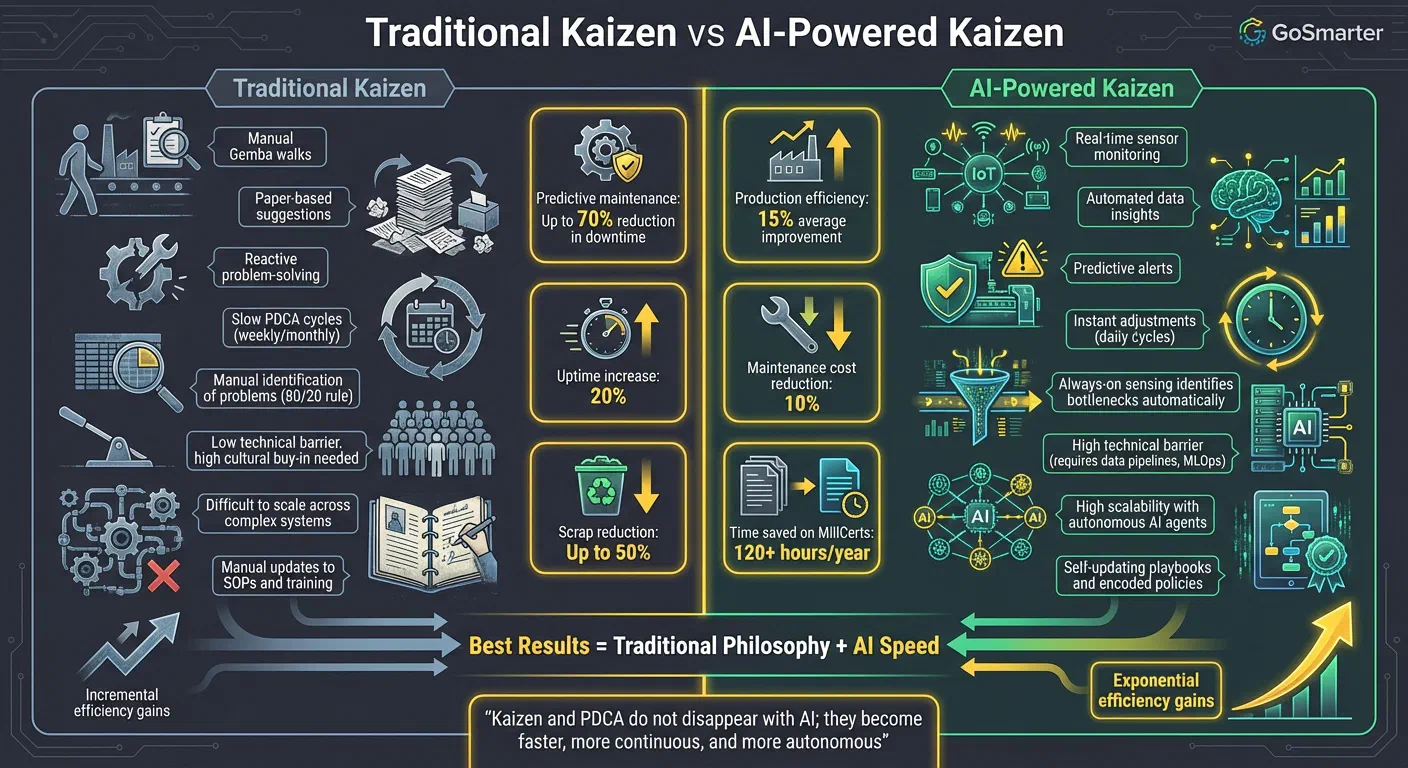
AI doesn’t replace Kaizen - it amplifies it. Instead of relying on occasional Gemba walks to uncover issues, machine learning keeps an eye on every parameter in real time[6]. The PDCA cycle, which traditionally moved at the pace of manual data gathering, now operates fast enough to identify and address problems within hours rather than weeks[11]. This evolution shifts management from being reactive to proactive, blending time-tested methods with cutting-edge data-driven strategies.
Efficiency Gains
AI-driven tools offer impressive boosts in efficiency. For instance, dynamic parameter adjustments can lead to an average 15% improvement in production efficiency[9]. Predictive maintenance not only increases uptime by 20% but also reduces maintenance expenses by 10%[11].
Waste Reduction
AI goes beyond improving efficiency and it tackles waste head-on. Take Muda, for example: optimised cutting plans and precise tracking of offcuts through GoSmarter can reduce scrap by as much as 50%[2]. Mura, or uneven workflows, is smoothed out when AI schedules production runs to eliminate bottlenecks. As for Muri, or overburdening, predictive analytics help balance workloads before they become overwhelming[6][11].
What makes this metals-specific is how the AI thinks about offcuts. A generic planning tool marks a short remnant as scrap. GoSmarter tracks it by grade, length, and heat number and offers it up for the next job that needs a short bar. That’s the difference between an AI that understands your yard and one that just runs a cut-length algorithm.
As Tarun Mathur, Global Digital Lead for Metals at ABB, puts it, “AI is making sustainability and decarbonisation more profitable by linking carbon reduction with operations excellence.”
Implementation Complexity
Integrating AI into manufacturing isn’t without its challenges, echoing some of the hurdles faced in traditional Kaizen. One significant technical obstacle is working with outdated ERP systems, many of which date back to the 1990s. AI integration often requires custom solutions to bridge these gaps[6]. GoSmarter plugs directly into existing infrastructure including sensors, PLCs, and spreadsheets without a rip-and-replace project or a six-month IT queue.
On the cultural side, gaining frontline workers’ trust in AI can be tricky. Mercedes-Benz’s MO360 platform tackled this by empowering employees to directly interact with AI for bottleneck solutions, staying true to Kaizen’s focus on team involvement[8].
As Jan Bosch explains, “kaizen AI generators” are systems that evolve continuously, requiring deep integration rather than functioning as simple add-ons[10].
Starting small with tools like scrap rate calculators that can help prove the benefits of AI before committing to a larger rollout[2].
Scalability
Platforms like GoSmarter’s Production Planner are designed to scale effortlessly, connecting shop-floor automation with enterprise systems without delay[7]. Tesla, for example, uses AI to fine-tune production efficiency and streamline supply chains across multiple locations[9][10]. Unlike traditional Kaizen, which can lose momentum when key personnel retire, AI preserves expert knowledge in machine learning models that continue to evolve and improve. This scalability captures the essence of continuous improvement in today’s digital landscape.
Advantages and Disadvantages
Traditional Kaizen and its AI-powered counterpart each have their own strengths and challenges. The traditional method is straightforward: it doesn’t require advanced tech like data pipelines or machine learning. Instead, it relies on team commitment and the willingness to hold workshops. But there’s a catch - it’s slow. Traditional PDCA (Plan-Do-Check-Act) cycles often run on a monthly or quarterly basis, relying on manual observation. On the other hand, AI-powered Kaizen operates at a completely different speed, running multiple cycles daily through real-time telemetry[5]. This means AI can pinpoint bottlenecks as they happen. However, the trade-off is the complexity of implementation. It does need solid data pipelines, MLOps know-how, and guardrails to stop automated changes going sideways.
Scalability is another area where these approaches differ significantly. Traditional Kaizen struggles to handle large, complex systems due to its manual nature. In contrast, AI-powered Kaizen embeds process knowledge into machine learning models that can evolve on their own. GoSmarter’s Production Planner links shop-floor automation to enterprise systems without middleware headaches, letting improvements roll out across every site.
As Hemant Panda explains, “Kaizen and PDCA do not disappear with AI; they become faster, more continuous, and more autonomous”[5].
The table below highlights the major differences between these two approaches, underlining the importance of combining their strengths.
| Feature | Traditional Kaizen | AI-Powered Kaizen |
|---|---|---|
| Efficiency Gains | Incremental; limited by manual review cycles (weekly/monthly) | Exponential; real-time monitoring and automated execution |
| Waste Reduction | Manual identification of the “vital few” problems (80/20 rule) | Always-on sensing identifies bottlenecks and queues automatically |
| Implementation Complexity | Low technical barrier; relies on cultural buy-in and workshops | High; requires data pipelines, MLOps, and ethical governance |
| Scalability | Difficult to scale improvements across large, complex systems manually | High; AI agents can tune parameters and re-route workloads autonomously |
| Standardisation | Manual updates to SOPs, training, and templates | Self-updating playbooks; “standard work” is encoded in policy |
The best approach lies in integrating these methods. Combining the steady, incremental improvement philosophy of traditional Kaizen with the speed and adaptability of AI creates a balanced strategy.
Manu Mulaveesala cautions, “In the rush to capitalize on AI’s potential, many organizations are focused on rapid, radical transformation rather than sustainable progress. The Kaizen philosophy offers a valuable counterbalance”[12].
The key is to start small. Prove the benefits on a smaller scale before expanding. And remember: AI isn’t a magic wand. Automating flawed processes only amplifies their inefficiencies. Focus on refining your workflows first, then let AI take them to the next level. Using free toolkits for smart manufacturing will show you exactly where the waste is hiding.
Conclusion
AI doesn’t replace Kaizen - it supercharges it. The philosophy of continuous improvement hasn’t changed. The speed and scale of it have. What used to take weeks in traditional PDCA cycles now takes hours. Real-time telemetry replaces the manual walkabout and it never misses a shift. The goal isn’t to abandon the principles that built modern manufacturing. It’s to kill the spreadsheets slowing them down.
For metals manufacturers, the next steps are straightforward: start small, prove the results, and then scale up. Free tools like scrap rate or emissions calculators can help you pinpoint areas of high waste before making any major investments. Focus on specific pain points such as the 120+ hours a year spent manually processing MillCerts by deploying targeted AI solutions, rather than diving into a massive six-month ERP overhaul.
As Tony Woods, CEO of Midland Steel, explains: “Smart technology choices can have a direct, measurable impact on reducing carbon emissions in steel manufacturing. The integration of AI and digital tracking has significantly improved our operational efficiency and sustainability performance” [2].
The most effective strategies layer AI onto existing systems instead of tearing everything down. For instance, GoSmarter’s approach connects directly to legacy ERPs via APIs, digitises mill certificates using OCR, and optimises cutting plans to slash scrap by 50%. This lets you modernise outdated processes without waiting years for IT to complete a full system overhaul. It’s a practical way to blend Kaizen’s traditional principles with the speed and precision of digital tools.
The metals industry doesn’t need flashy buzzwords; it needs tools that eliminate muda (waste) without adding complexity. AI-powered Kaizen does just that: it removes tedious manual work, captures critical know-how before experienced planners retire, and transforms chaotic PDF stacks into actionable insights. By combining AI with Kaizen, manufacturers can stick to the philosophy of continuous improvement while achieving execution speeds that were previously unimaginable.
Refine your processes first, then let AI take them to the next level. Start small and focus on one production line, measure the results, and then expand. That’s how you’ll run faster, greener, and without any surprises.
FAQs
Where should we start with AI-powered Kaizen?
To truly embrace continuous improvement, start with real-time data and AI-driven analysis. By integrating systems like CMMS with Predictive Maintenance, you can transform your approach from merely reacting to issues to anticipating and preventing them. This shift not only slashes downtime but also trims costs significantly.
AI tools go beyond maintenance, simplifying tasks like time studies and ergonomic evaluations. These tools embed continuous improvement into your daily workflow, enabling quicker, smarter decisions. That’s Kaizen in practice as the system improves continuously so you don’t have to remember to.
What data is needed for AI Kaizen to work?
How do we keep AI improvements safe and under control?
To keep AI advancements safe and under control, it’s crucial to set clear guidelines for responsible use and prioritise trust. This involves focusing on breaking tasks into manageable parts, understanding the purpose behind actions, and ensuring transparency. These principles help establish boundaries and make AI outputs clear and understandable.
Ongoing checks, audits, and adherence to industry standards are equally important. In areas like manufacturing such as predictive maintenance this approach helps avoid mistakes and ensures safety as AI becomes a more integral part of daily operations.