ISO 9001 and ASTM Won't Save a Lost Mill Certificate
- BlogSmarter AI
- Edited by Ruth Kearney
- Blog , Learning
- July 15, 2026
- Updated:
Table of Contents Show Hide
International Organization for Standardization (ISO) 9001 certification proves you have a documented quality system. It doesn’t prove you can find last Tuesday’s mill certificate before an auditor asks for it.
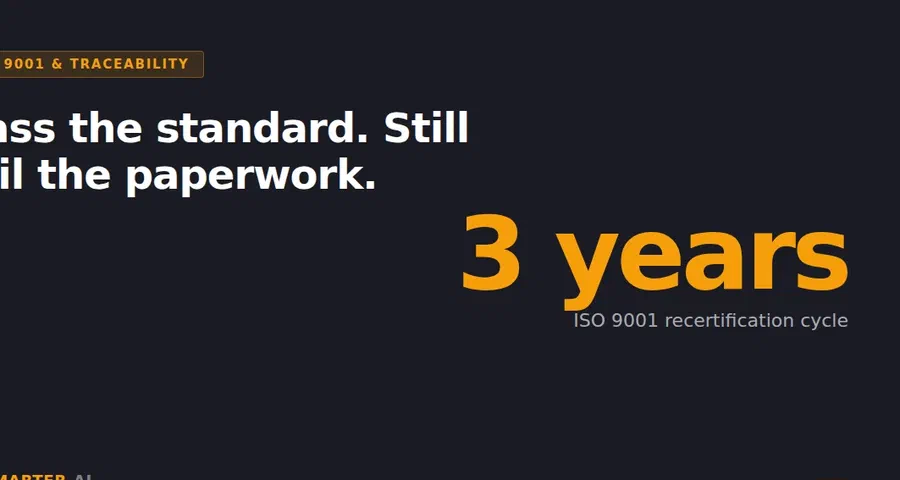
That’s the gap. Steel businesses pass the standard and still fail the paperwork. Certification bodies reassess ISO 9001 certificates on a three-year cycle, with a lighter surveillance audit in between. That leaves plenty of time for a gap to open between what the quality manual says and what actually happens at goods-in.
Customers now expect more than a certificate on the wall. They want complete traceability. That means knowing which mill made the steel and what heat number it carries. It means proof the steel meets the grade on the order. Whether you’re a stockholder, fabricator, processor, or manufacturer, that expectation is now the baseline, not the bonus.
GoSmarter, built by Nightingale HQ, works with metals businesses across the UK, Europe, and beyond. It sits on top of your existing ERP, spreadsheets, and email, so there’s no rip-and-replace project. It automates the certificate handling that quality standards assume you’re already doing properly. Here’s what the standards actually cover, where paper-based systems break, and what closes the gap:
- What ISO 9001 actually checks in a steel business
- What ASTM standards specify, and what they don’t
- Why full material traceability has stopped being optional
- Where manual quality systems fall apart
- How digital certificate management fixes it
Start with the standard everyone quotes and almost nobody reads in full.
ISO 9001 Runs Your Business, Not Your Steel
ISO 9001 doesn’t specify what your steel has to contain, or how strong it has to be. It specifies how you run the business that produces, processes, or supplies it.
An auditor working through ISO 9001 isn’t checking your metal. They’re checking whether you have a documented, repeatable process for controlling quality from goods-in to despatch. They’re also checking whether you actually follow it.
A Quality Management System (QMS) built on paper is only as strong as the person filling in today’s form.
What an ISO 9001 Auditor Actually Checks
For a steel service centre, fabricator, or manufacturer, ISO 9001 typically covers:
- Supplier management
- Material receiving procedures
- Production controls
- Inspection processes
- Corrective actions and Non-Conformance Reports (NCRs)
- Customer feedback
- Internal audits
- Document control and traceability, covered specifically by ISO 9001 Clause 8.5.2
Get this right and you build quality into every stage of the job. Get it wrong and you’re inspecting for problems after they’ve already happened. That’s usually at goods-out, when it’s too late to do anything cheap about it.
ASTM Standards Define What the Steel Has to Be
Where ISO 9001 governs your business, ASTM (American Society for Testing and Materials) standards define your material. ASTM International publishes more than 12,000 standards. They cover chemical composition, mechanical properties, testing methods, manufacturing requirements, dimensions, and performance criteria.
ASTM A36: One Standard, One Job
ASTM A36 specifies the requirements for structural carbon steel used in construction and general fabrication. Order A36 and you know exactly what tensile strength, yield strength, and chemical limits it must hit. The mill has to meet those limits before it puts its name on the certificate.
Buyers rely on standards like this to confirm the material suits the job it’s going into. Neither ISO 9001 nor ASTM proves where a specific batch came from, though. That’s a different problem, and it’s getting harder to ignore.
Why Buyers Now Expect Full Traceability
Supply chains have got more regulated, not less. Customers increasingly want you to identify, for any piece of steel you supply:
- Which mill produced it
- The heat and cast numbers
- The material grade
- The Mill Test Certificate (MTC) that covers it
- Chemical and mechanical properties
- Country of melt and pour
- Where it’s been processed and supplied since
What “Full Traceability” Actually Means
Traceability means being able to answer every one of those questions in minutes, not days. Skip it, and a quality issue stops being a quality problem. It becomes a legal one, and a slow one. Nobody can prove what went where until someone spends a week digging through filing cabinets.
Where Paper-Based Quality Systems Fall Apart
Most quality systems still run on manual paperwork. Think spreadsheets, filing cabinets, and someone’s memory of which folder the cert went in.
The Documentation Problems Nobody Budgets For
That setup creates predictable problems:
- Lost mill certificates
- Manual data entry, typed once and never checked again
- Heat codes allocated to the wrong batch
- Duplicate records nobody notices until an audit
- Audits that take days instead of hours
- Customer queries that sit unanswered for a week
As the business grows, none of this gets easier. It gets worse, at exactly the volume where you can least afford it.
The Manual Way vs the Automated Way
| The Manual Way | The Automated Way |
|---|---|
| Certificates filed in folders by job number | Certificates read and indexed automatically by heat number |
| Heat codes copied by hand onto goods-in sheets | Heat codes linked straight from certificate to stock record |
| Audit prep means searching email and filing cabinets | Audit prep means running a search and exporting the report |
| Compliance reports built manually in a spreadsheet | Compliance reports generated on demand, already formatted |
How GoSmarter Strengthens the QMS You Already Have
GoSmarter doesn’t replace your ISO 9001 quality system or your ASTM specifications. It removes the manual admin sitting underneath both. The quality information you already need is available the second someone asks for it.
What GoSmarter Actually Automates
Nightingale HQ built GoSmarter specifically for the metals industry. It uses Artificial Intelligence (AI) to handle:
- AI extraction of Mill Test Certificate data
- Digital, searchable storage of every certificate
- Heat code traceability from goods-in to despatch
- Material inventory linked directly to certificate data
- Compliance reporting for audits and customer requests
- End-to-end material traceability across the supply chain
Instead of a quality manager spending an afternoon hunting for a certificate, they retrieve it in seconds. The audit trail already exists. Nobody has to build it from scratch under pressure the week before an assessment.
For IT teams, every paid plan includes a REST API at no extra cost, so you can connect GoSmarter to your ERP or quality management system without a dedicated integration project.
The same heat-number spine that powers certificate traceability also feeds Metals Manager and Cutting Plans, so it’s one record shared across every tool, not a separate database for each.
Frequently Asked Questions
Do I need ISO 9001 certification to sell steel in the UK?
What's the difference between ISO 9001 and ASTM standards?
Does digital traceability replace an ISO 9001 quality system?
What counts as full material traceability?
How often does an ISO 9001 certificate get reassessed?
Stop Auditing Your Filing Cabinet
Standards like ISO 9001 and ASTM remain the backbone of consistent, compliant steel. They just don’t fix a broken filing system on their own.
Upload your next batch of mill certificates to GoSmarter’s MillCert Reader and watch the traceability chain build itself. No manual entry, no missing heat numbers, no last-minute scramble before the next audit. Most teams extract data from their first certificate within minutes of signing up.
Start Your Free Trial →Go Deeper
- Mill Certificate Automation for Metals Manufacturers — the complete guide to what GoSmarter does with mill certs
- GoSmarter MillCert Reader product page — features, pricing, and first-month offer
- International ASTM Standards: The Foundation of Quality, Compliance, and Traceability — a full breakdown of ASTM’s role in metals
- Why MTRs Are the Foundation of Quality, Traceability, and Compliance — the document behind every traceability claim
- Midland Steel case study — how a digital review reshaped quality processes for a reinforcing steel supplier
GoSmarter is made by Nightingale HQ, a UK-based AI company building practical tools for metals manufacturers since 2018.
Drill deeper
- Audit Trails: Because 'I Think It Was Dave' Isn't a Defence
Go here for the audit-trail clauses in ISO 9001, IATF 16949 and AS9100.
9 min read
About the Author

Editor· Co-Founder & CEO
Ruth Kearney is Co-Founder and CEO of GoSmarter AI — driving commercial growth and strategic partnerships to help metals manufacturers adopt AI and digital tools that actually deliver on the shop floor.