# GoSmarter AI Blog
> AI and digital transformation insights for metals manufacturers — practical guides, case studies, and no-BS takes on cutting-edge tech for the shop floor.
**URL:** https://www.gosmarter.ai/blog/
**Last updated:** 2026-04-07
---
The GoSmarter blog covers AI and digital transformation from a metals manufacturing perspective. Practical use cases, implementation guides, industry strategy, and plain-English takes on the tech that actually matters on the shop floor.
No fluff. No thought-leadership waffle dressed up as insight. Just practical articles written for people who run metal cutting, distribution, and processing operations.
Topics covered include mill certificate automation, rebar cutting optimisation, scrap rate reduction, EN 10204 compliance, inventory management for steel stockholders, and the practical realities of replacing spreadsheets with AI-powered workflows. The blog also covers industry news relevant to UK and European metals manufacturers — tariffs, standards changes, and technology developments that affect your margins.
Articles are written for production managers, quality managers, operations directors, and business owners in metals manufacturing. Each post focuses on a specific, solvable problem: how to reduce scrap on a saw line, how to stop losing mill certificates, how to automate the cert-to-stock link without an IT project.
For deeper, structured guides on specific topics, see the [GoSmarter hub pages](https://www.gosmarter.ai/hubs/) — pillar content covering cutting optimisation, mill cert automation, yield tracking, and more.
## GoSmarter vs Lantek, Sigmanest, and Bystronic for Cutting Planning
> GoSmarter vs Lantek, Sigmanest, and Bystronic for cutting planning in metals: who should use which tool and why they serve different jobs.
GoSmarter handles long product cutting optimisation for rebar, sections, and tubes. Lantek, Sigmanest, and Bystronic handle 2D plate and sheet nesting. They are not competing for the same job.
**GoSmarter and Lantek/Sigmanest/Bystronic are not doing the same job.**
If you are searching for "cutting optimisation software" and these names are all coming up together, that makes sense. They all optimise cutting in a metals context. But the type of cutting they handle is fundamentally different. Buying the wrong one based on a feature comparison table would be a waste of time and money.
This post explains exactly what each tool does, where the overlap is thin, where GoSmarter wins, and where the nesting tools win. By the end, you will know which one you need and, in some cases, why the answer is both.
## What Type of Cutting Does GoSmarter Handle? {#gosmarter-scope}
GoSmarter Cutting Optimiser is built exclusively for **long product cutting**: rebar, structural sections (I-beams, channels, angles), tubes, hollow sections, and similar linear stock.
The problem GoSmarter solves is this: you have lengths of steel coming in from a mill or stockholder (typically 6m, 9m, 12m, or as-rolled). You have a set of cut orders: pieces needed for a project, a fabrication job, or a customer order. GoSmarter calculates the optimal way to cut your available stock to fulfil those orders with the least possible trim waste, fewest bar changes, and the lowest overall material cost.
It does this in seconds, stores the cut plan against the order, and, critically, links that cut plan to the mill certificates for the material being cut. So when an inspector asks which heat of steel went into which structural member, you have the answer immediately.
GoSmarter does **not** do 2D plate nesting. It does not optimise cutting on sheet, plate, or flat material. If you cut flat plate, you need a different tool.
## What Lantek, Sigmanest, and Bystronic Do {#nesting-tools}
Lantek, Sigmanest, and Bystronic's software products are primarily **2D nesting and sheet/plate cutting optimisation** systems. They are built to maximise material utilisation when cutting shapes from flat sheet: whether by laser, plasma, waterjet, or guillotine.
Sigmanest is the long-standing specialist nesting software, used by sheet metal fabricators and structural steel plate processors alike. Lantek is similar in scope, strong on CNC machine integration and multi-site manufacturing environments. Bystronic is both a machine manufacturer and a software provider; its nesting tools are tightly integrated with its own cutting machines.
Most of these platforms also have some long product or bar cutting capability: it is not zero. Lantek, for instance, has bar cutting nesting modules. But the long product cutting in these platforms is typically an add-on to a 2D nesting system, not the primary purpose. The configuration, pricing, and training are all geared toward the plate/sheet customer.
For a metals stockholder or structural fabricator whose primary job is cutting rebar, sections, or tube to length: **these platforms are built around a different workflow**.
## Where GoSmarter Wins {#gosmarter-wins}
See [GoSmarter Cutting Optimiser](https://www.gosmarter.ai/docs/optimised-production-plans/) in action:
{{< supademo src="https://guides.gosmarter.ai/embed/cmkodrccg009szg0im9ax65sb?embed_v=2&utm_source=embed" title="Get draft production plans" >}}
**Deployment speed.** GoSmarter is live in days, not months. There is no IT project. You do not need a dedicated server, a specialist Value Added Reseller (VAR), or a three-week implementation engagement. You create an account, upload your stock, and start generating cut plans. For an SME with two or three people managing the yard, that matters enormously.
**Pricing.** Lantek, Sigmanest, and Bystronic are enterprise software. Their pricing reflects that: seat licences, annual maintenance agreements, and professional services add up quickly. GoSmarter starts at £400/month with no implementation fees and no long-term lock-in. For a business doing £2–5m turnover in steel, the economics are completely different. Enterprise nesting platforms typically run £10,000–£50,000+ per year once implementation and maintenance are included.
**Vendor trust and data security.** GoSmarter is EU-hosted and GDPR compliant. Your data is exportable as CSV at any time. No exit fees. If you cancel, you have 30 days to export your data. For an SME that cannot afford vendor lock-in, that matters.
**No IT dependency.** GoSmarter is browser-based SaaS. Nothing to install, nothing to maintain. Your team uses it on whatever devices they already have. The nesting platforms typically require Windows workstations, local installation, and someone who knows how to set them up.
**Mill certificate integration.** This is where GoSmarter is genuinely unique in the long products space. Every cut plan is linked to the source material's mill certificate. When you process an [EN 10204 (the European standard for mill test certificates for metallic materials)](https://www.gosmarter.ai/hubs/metals-manufacturing-glossary/#en-10204) 3.1 cert through GoSmarter, the traceability chain is maintained automatically, from the incoming coil or bar through to the finished cut piece. Lantek and Sigmanest are not designed to handle this. It is not their problem to solve.
**SME fit.** GoSmarter was built for metals small and medium-sized enterprises (SMEs). The interface, the onboarding, the support model. Everything is designed for a team of one to ten people running a steel yard or fabrication shop, not for a 500-seat enterprise with a dedicated IT department.
## Where Lantek, Sigmanest, and Bystronic Win {#competitors-win}
**Plate and sheet nesting.** If you cut flat material: steel plate, aluminium sheet, stainless, anything that starts as a flat shape and gets cut into 2D profiles: GoSmarter cannot help you. Full stop. This is not a feature gap that GoSmarter plans to close. It is a deliberate scope choice. Lantek, Sigmanest, and Bystronic are the right tools for 2D cutting optimisation.
**Computer Numerical Control (CNC) machine integration.** The nesting platforms have deep integrations with laser cutters, plasma tables, waterjets, and guillotines. They produce machine programs (DXF, DNC files, G-code) directly from the nesting output. GoSmarter produces cut lists and bar charts that operators use to set up manual cutting; it does not connect to a CNC controller.
**Complex multi-material, multi-machine environments.** Large fabricators running plate processing, section cutting, and tube processing simultaneously, across multiple machines and sites, are better served by the enterprise nesting platforms. The workflow management and scheduling complexity in those environments is exactly what Lantek and Bystronic are built for.
**Structural detailing integration.** For structural steel fabricators using Tekla Structures, Advance Steel, or SDS/2, Lantek and Sigmanest have integrations that pull BOMs directly from the detailing model. GoSmarter does not currently integrate with structural detailing software.
## Side-by-Side Comparison {#comparison-table}
| Feature | GoSmarter | Lantek / Sigmanest / Bystronic |
|---|---|---|
| Long product (rebar, sections, tube) cutting | ✅ | ⚠️ (add-on module in most cases) |
| 2D plate / sheet nesting | ❌ | ✅ |
| Mill certificate traceability | ✅ | ❌ |
| EN 10204 compliance support | ✅ | ❌ |
| Browser-based / no install | ✅ | ❌ (mostly Windows desktop apps) |
| SME pricing (from £400/month) | ✅ | ❌ (enterprise pricing) |
| Days to deploy | ✅ | ❌ (weeks to months) |
| CNC machine integration | ❌ | ✅ |
| Structural detailing (Tekla, Advance Steel) integration | ❌ | ✅ |
| Multi-site / multi-machine scheduling | ❌ | ✅ |
## Can You Use Both? {#using-both}
Yes, and for some businesses this is exactly the right answer.
A structural steel fabricator might use Lantek or Sigmanest for plate processing (cutting plates to profiles for columns, base plates, connection details) and GoSmarter for bar and section cutting. These are genuinely different operations in the same yard, handled by different people, using different machines.
In that scenario, GoSmarter handles the long product side: bar cutting to length, remnant tracking, mill certificate management. Lantek or Sigmanest handles the plate side. There is no overlap, no duplication. They do different jobs.
The GoSmarter team has spoken to businesses running exactly this combination. The integration is not automated; both systems run independently. But that is fine, because the workflows are separate anyway.
## Decision Framework: Which Tool Do You Need? {#decision}
**Choose GoSmarter Cutting Optimiser if:**
- Your primary cutting operation is long products (rebar, sections, tubes, hollow sections)
- You need mill certificate traceability alongside cutting plans
- You are an SME and enterprise pricing is out of reach
- You need to be operational within days, not months
- You do not have in-house IT to manage software installations
**Choose Lantek, Sigmanest, or Bystronic if:**
- You cut flat sheet, plate, or profiled 2D shapes
- You need CNC machine program output (laser, plasma, waterjet, guillotine)
- You integrate with Tekla Structures or other structural detailing software
- You run a multi-machine or multi-site production environment
- You have the IT resource and budget for an enterprise platform
**Consider both if:**
- You cut both long products and flat plate/sheet in the same operation
- Your plate processing and section/bar cutting are genuinely separate workflows
## Frequently Asked Questions {#faqs}
{{< faq question="Does GoSmarter do any plate nesting at all?" >}}
No. GoSmarter Cutting Optimiser is built for long products: bar, section, tube, and hollow section cutting to length. It does not optimise 2D cutting from flat sheet or plate. If you need plate nesting, Sigmanest, Lantek, or Bystronic are the right tools.
{{< /faq >}}
{{< faq question="Can Lantek or Sigmanest handle long product bar cutting?" >}}
Most of these platforms have some bar or section cutting functionality, but it is typically an add-on module rather than the core product. The workflow and interface are designed primarily for sheet/plate nesting. For a business where long product cutting is the main operation, GoSmarter is a better fit.
{{< /faq >}}
{{< faq question="What does mill certificate traceability mean in a cutting plan context?" >}}
When you cut a 12-metre section of S355 rebar into five pieces for a project, GoSmarter records which specific bar (identified by its heat number and EN 10204 certificate) each piece came from. If an inspector or client asks for traceability data months later, you can show exactly which mill certificate covers each cut piece. This is standard practice for structural and civil engineering projects.
{{< /faq >}}
{{< faq question="How much does GoSmarter cost compared to Lantek or Sigmanest?" >}}
GoSmarter starts at £400/month with no implementation fee. Lantek and Sigmanest are enterprise products with per-seat licences, annual maintenance agreements, and professional services costs for implementation. Accurate pricing for enterprise platforms requires a quote, but budgets of £10,000–£50,000+ per year are typical for a properly licensed and supported installation.
{{< /faq >}}
{{< faq question="Can GoSmarter and Lantek/Sigmanest run in the same business?" >}}
Yes. If you cut both long products and flat plate, running both systems makes sense. They operate independently: there is no direct integration, but because the workflows are genuinely separate (bar cutting vs plate cutting), this is usually not a problem.
{{< /faq >}}
## Try GoSmarter Cutting Optimiser {#start}
If your cutting operation is primarily long products: rebar, sections, beams, tubes: GoSmarter is built for your problem. Upload your stock list and your cut orders, and you will have a cut plan in under a minute.
[Start your free trial →](https://app.gosmarter.ai/)
Or [book a demo](https://outlook.office.com/book/NightingaleHQ@nightingalehq.ai/s/ynY0EG7IDUO6MEWp5i53KQ2?ismsaljsauthenabled) if you want to see how the traceability and certificate linking works in a live environment.
## Related Reading
- [GoSmarter Cutting Optimiser product page](https://www.gosmarter.ai/products/cutting-optimiser/) — features, pricing, and free trial
- [GoSmarter vs Excel for Metals Inventory Management](https://www.gosmarter.ai/blog/gosmarter-vs-excel-inventory-management/) — the spreadsheet comparison
- [Mill Certificate Automation for Metals Manufacturers](https://www.gosmarter.ai/hubs/mill-cert-automation/) — traceability from cert to cut piece
- [GoSmarter for Metals Operations](https://www.gosmarter.ai/hubs/gosmarter-for-metals-operations/) — the full platform overview
*GoSmarter is made by [Nightingale HQ](https://www.gosmarter.ai/nightingale-hq/), a UK-based AI company building practical tools for metals manufacturers.*
## How AI Turns Manufacturing Data Into Better Decisions
> Stop wasting hours on messy mill certificates and scrap tracking. See how AI automates data capture, cuts scrap by up to 15%, and fixes scheduling.
**UK metals manufacturers waste hundreds of hours a month on missing data.** Teams decipher unreadable mill certificates, fight outdated spreadsheets, and chase handwritten scrap logs. One missed cert can cost a service centre five figures in rework, customer credits, and audit failures. It's almost always a paperwork problem, not a steel problem.
This is where AI steps in. Tools like [GoSmarter](https://gosmarter.ai/), built by Nightingale HQ, sit on top of your existing Enterprise Resource Planning (ERP), Excel and email. No rip-and-replace. They take over the dull, time-sapping tasks: reading messy PDFs, tracking scrap, and fixing scheduling chaos. You get clean, reliable data and real-time insights. That means decisions that save time, cut waste, and protect your margins.
**Quick wins:**
- **Stop losing hours** to manual data entry with AI-powered mill cert readers.
- **Cut scrap waste** by 5–15% in the first 30 days with smarter tracking and cutting plans.
- **Fix scheduling messes** in minutes, not days, with dynamic AI tools.
Here's how to sort out the mess and start fixing the biggest headaches on your shop floor.
{{< image src="69f7e53974a8318574a4d73a-1777863641133.jpg" alt="4-Step AI Implementation Process for Manufacturing Data Management" >}}
## The AI overlay for metals operations: from raw data to better decisions
{{< youtube width="480" height="270" layout="responsive" id="8DpP-XESCvg" >}}
## Step 1: Collect Manufacturing Data Automatically
Smarter decisions start with usable, audit-ready data. Many UK metals plants still rely on manual processes. Those processes are slow and error-prone. They waste time that could be spent solving real production problems.
AI-powered tools like GoSmarter automate data collection at the source. A production manager no longer pulls heat numbers or chemical compositions by hand. The system processes PDFs, checks the data, and links it directly to inventory records in seconds. You get a searchable, audit-ready archive. No more last-minute panic when inspectors show up.
Here's how AI can handle mill certificates, scrap tracking, and inventory linkage for you.
### Digitise Mill Certificates Before Inspectors Show Up
**What is a mill certificate?** A mill certificate (also called a Material Test Certificate or MTC) is a document issued by a steel mill recording the chemical composition, mechanical properties, and heat number of a batch of metal. It is the primary proof of traceability used in audits.
Material Test Certificates are essential for traceability. Yet most teams still shove them into folders or email threads where they're impossible to find. GoSmarter's [MillCert Reader](https://gosmarter.ai/products/mill-certificate-reader/) changes that. It uses Optical Character Recognition (OCR) and machine learning to pull structured data from even the messiest PDFs. That includes heat numbers, chemical compositions, and mechanical properties. We trained it on real mill certificate layouts, not generic samples. It handles inconsistent formats and lower-quality scans from international suppliers.
The system doesn't just extract data. It validates it. If there's a mismatch, like the wrong grade, it flags it for review. Connect your email inbox to the tool and GoSmarter processes mill certificates automatically as soon as they arrive.
> "Our tool automatically extracts key data from mill certificates, saving over 120 hours per year."
The MillCert Reader saves a production manager more than 120 hours a year. Most teams are up and running in under a week[\[3\]](https://gosmarter.ai/hubs/gosmarter-for-metals-operations/).
Recover 120 hours of production manager time and payback lands inside the first quarter on labour alone. That's before counting reduced traceability fines.
### Get Scrap Data Under Control
Bad scrap tracking leads to inflated orders and unnecessary waste. AI fixes this. It links heat numbers and material grades directly to your inventory records. No more manual cross-referencing. Feed this verified data into AI-generated [cutting plans and 1D stock optimisation](https://gosmarter.ai/blog/tackling-scrap-with-the-1d-cutting-stock-problem/) and you get accurate cut lists. That reduces overproduction and waste. GoSmarter flags missing test results or out-of-spec values in real time, so you can quarantine affected materials immediately. Start this process at the goods-in stage and your production schedules reflect what's actually in stock[\[4\]](https://gosmarter.ai/products/mill-certificate-reader/).
### Link Inventory and Heat Numbers Without the Fuss
When all your data is connected, traceability gets a whole lot easier. GoSmarter pulls heat numbers, material grades, and chemical properties from Material Test Certificates (MTCs). It links them to inventory records automatically. It validates the data against order specs as soon as you enter it. It flags any non-conforming heat numbers or grades before they hit the production floor. The system even renames files based on heat codes, so you can find them during audits.
GoSmarter is an AI overlay, not another system to migrate to. It reads from your existing ERP, Quality Management System (QMS) or shared drive via CSV or REST API with OAuth 2.0. Data is hosted on UK Azure and is never used to train shared models. Heat number data flows into your current stock records without IT projects or downtime. Sample payloads and webhook events sit in the developer docs. You get a searchable archive where you pull up mill certificates in seconds, for an audit or a customer query.
| Feature | Manual Traceability | AI-Automated Traceability |
| --- | --- | --- |
| Retrieval | Manual search by folder or file name | Searchable by heat number or order |
| Data Entry | Typed into an ERP by hand, prone to errors | Data extracted and validated by AI in seconds |
| Audit Prep | Time-consuming reconstruction of audit trails | Continuous, up-to-date, and searchable audit trail |
| Validation | Discrepancies found after material movement | Mismatches flagged immediately at goods-in |
The same heat-number spine then feeds the Scrap Calculator, the Smart Production Scheduler and the carbon dashboard. One record, every tool. Once you've automated data collection, you can turn those clean records into actionable insights.
## Step 2: Convert Data into Actionable Insights
When your data is clean and searchable, AI does what humans can't. It spots wasteful inefficiencies and turns raw records into real-time insights you can actually use.
AI dives into production logs, material specs, and operational records to uncover patterns that manual analysis would miss. For example, it might link specific cutting patterns to scrap rates across alloys. Or it connects scheduling choices to energy consumption in kilowatt-hours (kWh). Dashboards surface these insights, highlighting anomalies, trends, and areas for improvement. You make decisions based on facts, not hunches [\[1\]](https://gosmarter.ai/casestudies/midland-steel/).
Here's how AI converts your manufacturing data into results. Real examples below show how to cut waste, lower emissions, and eliminate production slowdowns.
### Pinpoint Scrap Waste Instantly
Scrap waste eats into profits. GoSmarter's optimiser makes your metal go further. It predicts scrap levels before you finalise a layout, so you adjust material usage upfront instead of scrambling to fix problems later.
### Track Carbon Emissions with Precision
AI calculates carbon emissions by pairing production data with standard conversion factors. It processes energy use (like kWh or cubic metres of gas), material inputs (tonnes of raw material, alloy types), and process details (furnace temperatures, processing times). The output: scope 1 (direct) and scope 2 (indirect) emissions for each production run.
This is especially useful for metals manufacturers. Energy-heavy processes like melting and heat treatment dominate emissions. For example, GoSmarter's platform automatically calculates that producing one tonne of reinforcement steel generates roughly 0.5–0.8 tonnes of CO₂ equivalent. The exact figure depends on energy sources and efficiency. With this data, you pinpoint which products, processes, or shifts are the biggest carbon culprits.
Exporting goods? The EU's Carbon Border Adjustment Mechanism (CBAM) requires reporting embedded carbon (see the [metals manufacturing glossary](https://www.gosmarter.ai/hubs/metals-manufacturing-glossary/)). AI's precise emissions tracking provides the data you need. It also helps you avoid CBAM tariffs by identifying and optimising high-emission production runs.
### Spot and Solve Production Bottlenecks
Bottlenecks slow everything down. They lower throughput, drag out lead times, and pile on costs. The problem? They're often buried in the details, not obvious from surface-level metrics. Think machines sitting idle because of upstream delays. Or long changeover times. Or inventory stacking up at specific workstations.
AI brings these issues to light. Time-series analysis tracks where production flow slows. Heat maps show inventory build-up. Correlation analysis links delays to upstream events. For example, your finishing line might run at just 65% capacity. The upstream cutting operation produces batches that don't match the finishing line's needs, leaving it idle.
AI also uncovers intermittent bottlenecks. These issues only crop up under certain conditions, like material from a specific supplier or during particular shifts. They're nearly impossible to catch manually. Visual tools like Gantt charts or flow diagrams show the inefficiency. You adjust schedules to fix it. Tackling these bottlenecks boosts throughput and backs up your improvement strategy with measurable results.
Armed with these insights, you can take action and make your operations run smoother.
## Step 3: Apply AI Insights to Improve Operations
You've pinpointed waste, bottlenecks, and inefficiencies. Now put AI to work in your production operations. The goal? Build schedules that actually work, reduce overproduction, and align resources with _real_ demand. Not gut feelings or outdated forecasts.
The big shift here is speed and precision. Traditional scheduling methods are slow and brittle. Think spreadsheets, Gantt charts, or Material Requirements Planning (MRP) systems that assume infinite capacity. They take days to create. The moment something changes, and it always does, the whole plan falls apart [\[5\]](https://excellerant-mfg.com/feeds/blog/tools-real-time-production-scheduling-tracking). AI tools factor in real-world constraints like machine availability, labour shifts, and tooling limits. They also adapt dynamically as conditions change [\[5\]](https://excellerant-mfg.com/feeds/blog/tools-real-time-production-scheduling-tracking).
### Ditch Manual Schedules for AI-Driven Plans
Manual scheduling is a chore. A planner might spend two to five days piecing together a schedule in Excel. Then it crumbles when a supplier is late or a machine breaks down [\[5\]](https://excellerant-mfg.com/feeds/blog/tools-real-time-production-scheduling-tracking). AI tools like GoSmarter's [Smart Production Scheduler](https://gosmarter.ai/products/) cut that to minutes. Feed it your order book and it returns a cut plan sequenced for the lowest scrap on long products. No spreadsheet wrangling. No planner sat in a corner for two days [\[5\]](https://excellerant-mfg.com/feeds/blog/tools-real-time-production-scheduling-tracking).
Take [Midland Steel](https://gosmarter.ai/casestudies/midland-steel/), for example. By switching from spreadsheet scheduling to GoSmarter's Smart Production Scheduler, they cut planner time from two days to under an hour and recovered the hours that previously went into rebuilding broken plans every Monday morning.
### What-if scenarios and rush-job replanning
When a rush order lands, the Smart Production Scheduler regenerates a feasible plan in under 60 seconds. It compares scrap, throughput, and on-time-in-full (OTIF) for each option, so you pick the one that protects margin without melting the rest of the week's plan.
AI scheduling also tackles unplanned downtime. Predictive maintenance and real-time adjustments cut downtime by 20% to 40% [\[5\]](https://excellerant-mfg.com/feeds/blog/tools-real-time-production-scheduling-tracking). If a machine fails, the system reroutes production automatically.
### Tackle Overproduction with Demand-Based Planning
You've nailed the scheduling. Next, focus on overproduction. Producing too much ties up cash, creates unnecessary scrap, and racks up storage costs. Traditional "push" planning systems prioritise available materials over actual demand. That often leads to bloated inventories [\[6\]](https://www.relexsolutions.com/resources/ai-driven-production-planning-scheduling-guide). AI flips this on its head. Production responds directly to real-time demand [\[6\]](https://www.relexsolutions.com/resources/ai-driven-production-planning-scheduling-guide).
For metals manufacturers, this means producing what your customers need, when they need it. No more speculative stockpiles. The equivalent of "balancing the bird" in metals is yielding every nest of a coil or every drop of a heat. That means using offcuts, identifying remnant stock by heat number, and matching short orders to existing inventory before opening new material.
Constraint-aware AI scheduling lifts throughput wherever yield varies across plants and product types. For service centres and stockholders, that means matching short orders to remnant stock before opening new material. The same AI backbone enforces this automatically [\[6\]](https://www.relexsolutions.com/resources/ai-driven-production-planning-scheduling-guide).
AI fine-tunes your schedules and syncs production to demand. Next, keep an eye on the results and tweak your strategies as needed. There's always room to improve.
## Step 4: Monitor Results and Adjust
You've made changes with the help of AI. Now the real work begins. Keep an eye on how those changes play out and make sure they stick. Monitoring isn't just about spotting problems. It's about creating a system that keeps improving every single shift. AI tools don't just help plan and automate. They also make sure the improvements deliver results on the shop floor.
Implementing change is step one. The real value comes when AI monitoring tools track how those changes perform in real time. Data feeds straight back into your operations. You get a continuous feedback loop. No more waiting for monthly or quarterly reviews to spot issues.
### Real-Time Metrics: Stop Guessing, Start Acting
Traditionally, monitoring has been slow and reactive. You collect data manually, plug it into a spreadsheet, and lose valuable time before you spot a problem. By then you've already racked up unnecessary waste. AI-driven monitoring flips this script. These systems pull data straight from the shop floor and flag problems as they happen.
Take [ATI Forge Products](https://www.atimaterials.com/forgedproducts/Pages/default.aspx), for example. In March 2026, Senior Manager Norman Goco rolled out real-time machine monitoring with [Guidewheel](https://www.guidewheel.com/). The results were immediate. Daily data collection time dropped from three hours to almost nothing. Operators could now report issues as they occurred, instead of waiting 24 hours for manual reporting to catch up[\[7\]](https://www.guidewheel.com/blog/ati-materials-change-management-real-time-data).
This kind of instant visibility changes everything. Operators get live feedback and act on it immediately. They address a temperature spike, track scrap rates by shift, or keep an eye on energy use. You get faster decisions, less downtime, and a team that takes ownership of the process.
### AI Feedback Loops: The Key to Continuous Improvement
Real-time data is only part of the equation. The real value comes when that data feeds back into your operations. AI doesn't just highlight what went wrong. It suggests what to tweak next. Tools like the '6M Change Log' help document these adjustments and put AI recommendations into context. The catch? Leaders need to stay hands-on. They observe the shop floor and check that AI suggestions align with actual conditions[\[7\]](https://www.guidewheel.com/blog/ati-materials-change-management-real-time-data).
Once you have that balance, AI feedback loops keep learning, adapting, and improving without you micromanaging. The system spots problems, helps you fix them, and gets sharper with every shift.
### How AI learns from your historical production data
GoSmarter's Smart Production Scheduler trains on a rolling 90-day window of your scrap, throughput, and changeover data to refine each new schedule. It does not need a multi-month rebuild project. The model improves quietly in the background. Every time a planner accepts or overrides a suggestion, the next plan reflects what actually worked on your floor.
## Try AI Tools on Your Shop Floor
Ready to see what AI can actually do for your shop floor? The quickest way to find out is simple. Test it with your _real_ data. See if it can handle your messy mill certificates, tangled scrap records, or scheduling chaos.
**GoSmarter's freemium model** lets you start without budget approval hoops or drawn-out implementation projects. Basic tools for managing scrap and running straightforward calculations are free. Upload your inventory spreadsheets (Excel or CSV) and you're off.
Start small. Pick one area where AI can make the biggest difference. If your team spends hours every week typing up certificate data, tackle that first. If scrap tracking is a chaotic mess of spreadsheets and guesswork, focus there. Run a parallel trial for two to four weeks. Compare the results to your current process.
Track these five success metrics during the trial:
1. **Time saved** on manual mill cert entry (hours per week)
2. **Scrap reduction** as a percentage of pre-trial baseline (same product mix)
3. **On-time-in-full (OTIF)** for the trial period vs the previous month
4. **Mill cert processing time** from inbox to inventory record
5. **Scheduling cycle time** from order book to confirmed plan
Most teams see a 5–15% drop in scrap cost in the first 30 days. The headline number is measured by comparing pre-trial scrap-per-tonne against the trial period using the same product mix. We share the calculation sheet.
The **Smart Production Scheduler** finds the lowest-scrap sequence for your order book. It runs inside your Microsoft 365 setup and connects to your ERP via REST API. Start with core scheduling. Then add inventory tracking or carbon emissions as your team builds confidence. Begin your trial at [gosmarter.ai](https://gosmarter.ai).
This short trial phase shows you how AI turns raw data into actionable insights that cut costs and streamline your production. It's the first step in a cycle of continuous improvement driven by AI.
## FAQs
{{< faq question="What data should we automate first to get quick wins?" >}}
To see immediate results with AI in manufacturing, focus on automating **capacity planning**, **scrap reduction**, and **maintenance scheduling**. These areas tackle key challenges: keeping schedules on track, cutting material waste, and avoiding unnecessary downtime. By automating tasks like real-time capacity planning, scrap calculations, and predictive maintenance, factories can boost productivity and trim costs with clear, measurable outcomes.
{{< /faq >}}
{{< faq question="How does AI validate mill certificate data for traceability?" >}}
AI takes the hassle out of traceability. It pulls key details like heat numbers, grades, and material properties straight from scanned or PDF mill certificates. It then ties this data directly to your inventory records. That cuts out errors and keeps everything accurate from start to finish.
{{< /faq >}}
{{< faq question="How do we prove the ROI of AI in a 30-day shop-floor trial?" >}}
To prove the return on investment during a 30-day trial, focus on tracking **measurable results**. Look at how much time you save on manual tasks, how errors decrease, and where processes get smoother. Most teams process their first mill certificates within hours and fine-tune cut plans in as little as two days. Setup usually finishes in under a week. That leaves plenty of time to compare metrics from before and after the trial. Look for quicker decision-making and better inventory traceability to show the efficiency gain.
{{< /faq >}}
{{< faq question="Can GoSmarter use our existing historical metals production data?" >}}
Yes. The Smart Production Scheduler trains on a rolling 90-day window of your scrap, throughput, and changeover data. No fresh data collection programme required. The model picks up your floor's habits within the first week of the trial and refines each new schedule from there.
{{< /faq >}}
{{< faq question="Can GoSmarter run what-if scenarios for rush jobs?" >}}
Yes. When a rush order lands, the Smart Production Scheduler regenerates a feasible plan in under 60 seconds. It compares scrap, throughput, and on-time-in-full (OTIF) for each option, so you can choose the one that protects margin without breaking the rest of the week's schedule.
{{< /faq >}}
## Legacy Systems vs AI for Compliance Security in Metals
> Legacy systems scatter mill cert data and create audit risk. See how AI automates compliance, cuts breaches by 50%, and saves 8-12 hours weekly.
Most UK metals manufacturers run on outdated systems built for a quieter era. These legacy platforms scatter data and create errors. They leave your compliance processes wide open to breaches. The result: fines, downtime, and teams losing hours to manual work.
[GoSmarter](https://gosmarter.ai/), built by Nightingale HQ, sits on top of your existing Enterprise Resource Planning (ERP) and email. It automates certificate handling, flags compliance issues in real time, and cuts out manual data wrangling. If you still rely on spreadsheets and siloed systems, you are burning time and money.
**Here is what AI brings to the table:**
- **Real-time monitoring:** Spot compliance risks before they become fines.
- **Automated data handling:** Extract and validate [mill certs](https://gosmarter.ai/products/mill-certificate-reader/) in seconds, not hours.
- **Stronger security:** Modern encryption and intrusion detection protect your data.
- **Audit-ready logs:** No more scrambling when the auditors arrive.
Old systems are holding you back. Here is how to fix it.
{{< image src="69f6915874a8318574a4bf24-1777770270092.jpg" alt="Legacy Systems vs AI for Compliance Security in Manufacturing" >}}
## How AI is Transforming Compliance in Manufacturing
{{< youtube width="480" height="270" layout="responsive" id="UV9I_aaqCbk" >}}
## Legacy systems: why they are holding you back
Legacy systems were not designed for the compliance challenges manufacturers face today. Many UK metals factories still rely on platforms built when physical security and manual data integration were enough. Now those same systems must handle real-time regulatory reporting and fend off sophisticated cyber threats. What you are left with is a patchwork of inefficient workarounds. They slow production, create errors, and leave gaping security holes.
### Fragmented data and manual workarounds
Legacy systems love silos. Compliance data sits stuck in your Manufacturing Execution System (MES), ERP, and storage systems. Each one uses mismatched IDs and filenames. The result? Teams waste 8-12 hours every week manually reassigning data for over 200 certificates. If an auditor needs heat traceability, prepare for hours of cross-referencing between disconnected systems[\[8\]](https://acuvate.com/blog/legacy-factory-systems-fail-real-time-decisions)[\[9\]](https://www.talend.com/resources/what-is-legacy-system).
This mess is not just inconvenient. It is risky. A UK steel stockholder shared their experience:
> "Our AI tool saves hours every month by automatically pulling key data from mill certificates. It can rename documents in seconds which is a task that is usually painfully manual."[\[10\]](https://gosmarter.ai/hubs/mill-cert-automation/)
Before automation, manual entry bred errors that snowballed into compliance problems. Legacy systems often batch data after shifts. You then make decisions based on outdated information[\[8\]](https://acuvate.com/blog/legacy-factory-systems-fail-real-time-decisions).
### Security gaps in legacy platforms
Fragmented data is not the only issue. Legacy platforms also carry security vulnerabilities. These systems were built long before modern cyber threats existed. Many lack basic protections like multi-factor authentication, real-time intrusion detection, or encryption[\[11\]](https://cyolo.io/blog/secure-your-legacy-ot-systems-with-zero-downtime-or-disruptions). Some still rely on hard-coded passwords or operating systems that no longer get security updates[\[12\]](https://www.dataflowx.com/post/unpatched-legacy-systems-a-cybersecurity-risk-in-the-manufacturing-sector).
The risks are not hypothetical. The 2017 [Triton malware](https://www.ncsc.gov.uk/information/triton-malware-targeting-safety-controllers) attack on a Middle Eastern petrochemical facility is a chilling example. Hackers exploited unpatched firmware in a [Triconex](https://www.se.com/us/en/product-range/63681-ecostruxure-triconex-safety-systems/) safety system. They used weak authentication to inject malicious code. The attack could have caused physical destruction[\[12\]](https://www.dataflowx.com/post/unpatched-legacy-systems-a-cybersecurity-risk-in-the-manufacturing-sector). For manufacturers, uptime is everything. Patching decades-old controllers often disrupts processes or voids warranties. Factories then sit caught between running operations and addressing glaring security risks.
> "Trusting each HMI or PLC to handle its own defences with all the muscle of a paper shield." - Jennifer Tullman-Botzer, Director of Content Marketing, Cyolo[\[11\]](https://cyolo.io/blog/secure-your-legacy-ot-systems-with-zero-downtime-or-disruptions)
The stakes are getting higher. The UK's [Cyber Essentials](https://www.ncsc.gov.uk/cyberessentials/overview) update for April 2026 will require multi-factor authentication for cloud services. Many legacy systems cannot clear that bar without modern identity providers like Microsoft Entra[\[14\]](https://redeagle.tech/blog/problems-with-legacy-systems). And the cost? Legacy technology drains UK businesses of around £45 billion annually in lost productivity. Technical debt eats up three to four times more budget than modern solutions[\[14\]](https://redeagle.tech/blog/problems-with-legacy-systems). For metals manufacturers, every pound spent patching an outdated system is money that could secure compliance and protect margins.
## AI for compliance security: how it works
AI-native platforms are rewriting the rulebook for compliance. Legacy systems trap data in silos. AI takes a different approach. It monitors, validates, and organises compliance data in real time. For metals manufacturers handling EN 10204 certificates, heat traceability, and regulatory reporting, this matters. Legacy systems crunch yesterday's data in batches. AI works continuously, catching issues before they spiral into costly compliance failures.
### Real-time monitoring and threat detection
AI-powered tools spot problems as they happen. They analyse live data streams and detect anomalies automatically. Take a steel mill: AI can monitor Internet of Things (IoT) sensors on furnaces, flag deviations in temperature or emissions, and alert operators within seconds. This proactive approach prevents regulatory breaches before they escalate into fines. Manufacturers that deploy AI-powered monitoring consistently report better compliance audit outcomes and faster incident response.
In 2023, [Thyssenkrupp](https://www.thyssenkrupp-steel.com/en/) deployed [Google Cloud AI](https://cloud.google.com/solutions/ai) to process large volumes of unstructured audit data daily, automating log processing and integrating with existing ERP software. Reporting that previously demanded significant manual effort shifted to near-real-time. For UK manufacturers preparing for the April 2026 Cyber Essentials update, that kind of real-time capability could mean the difference between staying compliant and facing fines.
> "GoSmarter does not just read your certs; it checks them against what you ordered. Wrong grade, missing mechanical properties, a heat number that doesn't tie to the delivery note. GoSmarter catches it before the job starts." - GoSmarter [\[1\]](https://gosmarter.ai/solutions/compliance/)
AI dashboards run continuous updates and produce audit-ready logs without manual data wrangling. Teams using AI reporting consistently report significant drops in errors compared to legacy manual processes. Set custom thresholds for risks like material traceability errors or scrap rate deviations. You then address compliance issues before they snowball. This real-time adaptability transforms how you handle unstructured data.
### Handling unstructured data without breaking a sweat
Unstructured data, think PDFs, scanned certificates, or handwritten logs, has always been painful for legacy systems. Most of this data remains untouched in traditional platforms. AI rewrites the rulebook with natural language processing (NLP) and optical character recognition (OCR). It extracts, categorises, and validates data automatically. Purpose-built for metals manufacturing, [GoSmarter's MillCert Reader](https://gosmarter.ai/products/mill-certificate-reader/) turns stacks of PDF mill certificates and scrap records into compliant data. The same heat-number spine then feeds the Scrap Calculator and the Smart Production Scheduler, so one record powers every tool.
AI handles unstructured data far faster than manual methods, with far fewer errors. GoSmarter customers report recovering 8-12 hours every week [\[1\]](https://gosmarter.ai/solutions/compliance/) previously lost to manual certificate handling and re-keying.
AI does not stop at reading data. It validates it. The platform cross-checks extracted information against regulations automatically. They flag issues like mismatched carbon content or missing mechanical properties. In April 2026, [Midland Steel Manufacturing](https://midlandsteelreinforcement.com/) took this further with a Data Hub project. They consolidated production, finance, and IT data into a single source of truth. By automating certificate handling and work instructions, they achieved near-real-time analytics. They cut hours of manual input [\[13\]](https://gosmarter.ai/casestudies/midland-steel/). The result? Immutable, searchable records that make audits routine.
For manufacturers still battling fragmented spreadsheets and shared folders, AI handles messy formats. That includes poorly scanned documents and non-standard mill certificates. It delivers a unified, always-up-to-date compliance system that legacy software was never built to provide.
## Governance and regulatory compliance: legacy vs AI
Legacy systems were built for static record-keeping. Every regulatory change demands manual updates. Fragmented data makes audit reporting a headache [\[13\]](https://gosmarter.ai/casestudies/midland-steel/). AI-native solutions flip the script. They are designed with modern compliance standards baked in from the start. GoSmarter hosts data in UK Azure regions and aligns with [GDPR (General Data Protection Regulation)](https://gdpr-info.eu/) requirements. It offers data portability through CSV exports and a REST API with OAuth and Microsoft Entra single sign-on (SSO) authentication. GoSmarter does not train models on customer data [\[1\]](https://gosmarter.ai/solutions/compliance/). For [Carbon Border Adjustment Mechanism (CBAM)](https://taxation-customs.ec.europa.eu/carbon-border-adjustment-mechanism_en) reporting, AI takes the grind out of extracting Carbon Equivalence (CEQ) data from mill certificates. What used to take hours now takes a few clicks [\[10\]](https://gosmarter.ai/hubs/mill-cert-automation/). AI platforms adjust in real time and flag potential breaches before they happen. The result: greater transparency and more reliable audits.
### Transparency and audit trails
Audits with legacy systems often feel like a mad dash. You dig through emails and shared folders to find the right certificate or trace material origins. AI-native platforms remove the chaos. They automatically log every interaction. They track who uploaded a document, when, and what data they extracted [\[10\]](https://gosmarter.ai/hubs/mill-cert-automation/). The logs stay immutable, always up-to-date, and searchable.
The platform ties Material Test Certificates (MTCs) to specific heat numbers, inventory items, and despatch records. That creates a clean chain of custody from receipt to delivery [\[1\]](https://gosmarter.ai/solutions/compliance/)[\[10\]](https://gosmarter.ai/hubs/mill-cert-automation/). Automated audit logs cut manual admin work. Compliance checks run faster and more reliably. Take Midland Steel Manufacturing: in April 2026, they rolled out a digital roadmap featuring [GoSmarter's MillCert Reader](https://gosmarter.ai/products/mill-certificate-reader/). The result? Hundreds of hours saved on manual data entry and fewer errors. They consolidated production, finance, and R&D data into a single, audit-ready hub [\[13\]](https://gosmarter.ai/casestudies/midland-steel/).
### Role-based access controls and bias monitoring
AI platforms bring a level of precision to access controls that legacy systems cannot match. Administrators set dynamic permissions, specifying who can view certain data and when. That aligns with [ISO 9001](https://en.wikipedia.org/wiki/ISO_9000_family), [IATF 16949](https://www.iatfglobaloversight.org/iatf-169492016/about/), and GDPR standards [\[10\]](https://gosmarter.ai/hubs/mill-cert-automation/). It is not just about restricting access. It is about accountability.
Right now, only 19% of manufacturing companies maintain audit-ready evidence for their AI systems. Just 15% carry out privacy impact assessments for AI deployments [\[16\]](https://www.scmr.com/article/manufacturers-ai-adoption-is-outpacing-cyber-compliance-and-risk-governance). This gap creates risks like operational drift, where practice veers away from stated policies [\[18\]](https://complysafe.io/en/blog/the-future-of-compliance-tools-in-an-ai-first-world). AI-native systems address this with human-in-the-loop protocols for critical decisions. Examples include approving non-conforming materials or overriding production plans [\[17\]](https://www.mgocpa.com/perspective/top-ai-risks-in-manufacturing-and-how-to-manage-them).
> "Manufacturing has built AI governance for reliability, not hostility. That works when failures are accidental. It fails when threats are intentional. AI systems don't just break. They get attacked." - Tim Freestone, Chief Strategy Officer, Kiteworks [\[16\]](https://www.scmr.com/article/manufacturers-ai-adoption-is-outpacing-cyber-compliance-and-risk-governance)
The move from static record-keeping to active coordination reframes compliance as an asset. AI does not replace human judgement. It strengthens it. You spot risks faster. Evidence gathers automatically. People stay in charge of final decisions. Detailed access controls plus bias monitoring turn governance into a strategic advantage.
## Implementation: moving from legacy to AI
You do not need to rip out your entire system to bring in AI. The best way to switch is step by step, starting with a proper audit of where manual work eats up the most time. Pinpoint every instance of manual data entry and calculate how much time it burns each week. For manufacturers handling over 200 certificates a month, this could mean clawing back up to **12 admin hours every week** in the first month of using AI [\[1\]](https://gosmarter.ai/solutions/compliance/). This kind of audit builds a solid business case and shows exactly where to focus first.
A practical three-step approach works for most metals teams:
1. **Audit your manual data tasks.** Identify every manual handoff and calculate hours lost per week across cert handling, data re-keying, and audit prep.
2. **Start with mill certificate automation.** GoSmarter's [MillCert Reader](https://gosmarter.ai/products/mill-certificate-reader/) can be live in under an hour, reading certificates from email or shared drives and pushing extracted data straight into ERP fields.
3. **Prove it, then scale.** Once one workflow shows results, expand to the [Smart Production Scheduler](https://gosmarter.ai/solutions/production-scheduling/) or scrap tracking at your own pace.
Start small and aim big — tackle one high-impact area first. For metals manufacturers, mill certificate extraction is often the logical starting point. Midland Steel Manufacturing followed this approach in 2026. They deployed the MillCert Reader to handle certificates and track yields, cutting scrap rates by **50%** during production trials [\[1\]](https://gosmarter.ai/solutions/compliance/)[\[20\]](https://gosmarter.ai/hubs/gosmarter-for-metals-operations/). This phased approach proves the value of AI and builds confidence for scaling to more complex workflows.
> "GoSmarter is an overlay - it sits on top of whatever systems you already use. You can start with just one product, prove the value on one workflow, and expand at your own pace" [\[20\]](https://gosmarter.ai/hubs/gosmarter-for-metals-operations/).
### Integration with existing infrastructure
Once you have nailed down the cost-benefit argument, the next challenge is making sure the AI fits into your current systems. Legacy ERPs and other older setups can be tricky to connect, especially if they lack modern API support. This is where choosing the right AI platform matters. GoSmarter avoids expensive overhauls by integrating through REST APIs, CSV exports, or even direct email ingestion [\[1\]](https://gosmarter.ai/solutions/compliance/)[\[20\]](https://gosmarter.ai/hubs/gosmarter-for-metals-operations/). It is an overlay that keeps your existing data flows intact while taking over the manual work.
Generic OCR tools often fail when it comes to metals-specific documents. They do not recognise terms like "Rp0.2" or "CEQ" and can mess up multi-heat certificates by blending data or requiring endless template tweaking [\[19\]](https://gosmarter.ai/hubs/mill-cert-automation/). Purpose-built AI is designed for the job. It handles metals documents in multiple languages — English, German, French, Spanish — and pushes the extracted data straight into ERP fields via API. Your compliance data is sorted and ready from day one, without any major system changes [\[19\]](https://gosmarter.ai/hubs/mill-cert-automation/).
### Reducing disruption during deployment
No one wants downtime when switching systems. The key is to roll out AI in phases, running it alongside your current setup to confirm everything works before fully committing. Start with non-critical tasks — like audit logging — to test the waters without risking essential workflows. Once it is proven, move on to real-time monitoring and automated reporting.
No-code platforms make this process even easier. Managers can deploy tools like GoSmarter without waiting on IT teams [\[20\]](https://gosmarter.ai/hubs/gosmarter-for-metals-operations/). Its simple, point-and-click interface means no coding skills are needed, and the people who actually use the system can configure it themselves. Plans start at **£275 per month per site**, giving your entire team unlimited access without extra licence fees [\[19\]](https://gosmarter.ai/hubs/mill-cert-automation/)[\[20\]](https://gosmarter.ai/hubs/gosmarter-for-metals-operations/). At £275 per month, recovering 8-12 hours of admin weekly means most teams see payback inside the first quarter. All records and audit trails are portable — exportable as CSV or PDF — so you are never locked in with one vendor [\[1\]](https://gosmarter.ai/solutions/compliance/)[\[19\]](https://gosmarter.ai/hubs/mill-cert-automation/).
This phased approach keeps risks low and boosts compliance security. With AI, a series of small, deliberate steps quickly adds up to major gains in efficiency and accuracy.
## Conclusion: the future of compliance security in metals manufacturing
Old systems are holding metals manufacturers back. They scatter data, leave security holes wide open, and turn audits into a logistical nightmare. AI changes all of that. With real-time monitoring, threats are caught before they become disasters. Automated tools turn PDF certificates into usable data instantly, and transparent audit trails mean you are always inspection-ready — even if the auditor shows up unannounced. Manufacturers adopting AI for compliance are moving away from reactive, batch-based detection towards continuous monitoring. For UK metals manufacturers juggling EN 10204 certificates, unpredictable supply chains, and stricter GDPR rules, that shift is not a luxury — it is non-negotiable.
GoSmarter customers report significant reductions in compliance breaches thanks to continuous automated monitoring [\[1\]](https://gosmarter.ai/solutions/compliance/). Audit checks that previously required manual cross-referencing now run automatically, cutting completion times and freeing teams for higher-value work. With UK compliance breaches routinely costing manufacturers hundreds of thousands of pounds in fines, rework, and lost contracts, the financial argument for automation is straightforward [\[1\]](https://gosmarter.ai/solutions/compliance/).
These results reflect real-world impact. On the shop floor, it is about making the team's working day better:
> "We just automate the boring stuff so you can go home on time. Stop doing compliance by hand."
> - GoSmarter [\[1\]](https://gosmarter.ai/solutions/compliance/)
GoSmarter is built for these challenges. It connects directly to your existing ERP, automates the extraction of chemical compositions and heat numbers from mill certificates, and matches material grades to purchase orders the moment stock arrives. No six-month waiting period. No ripping out your current systems.
The future of compliance security in metals manufacturing is not about patching up outdated processes. It is about replacing manual work with smart automation. For UK metals manufacturers, this shift is essential for tackling today's compliance demands and preparing for tomorrow's regulatory requirements. Visit [GoSmarter](https://gosmarter.ai/) to see how intelligent automation can transform your operations.
## FAQs
{{< faq question="Can AI work with our existing ERP and legacy systems?" >}}
Yes, AI can work with your current ERP and legacy systems. GoSmarter's tools, like the MillCert Reader, are designed to handle complex document formats you deal with daily - without the need for ripping out your existing setup. They take care of tedious tasks like extracting data, checking it for accuracy, and filing it properly. This keeps your operations compliant and running smoothly, while saving you from expensive system overhauls.
{{< /faq >}}
{{< faq question="How does AI keep EN 10204 certificates and heat traceability audit-ready?" >}}
AI takes the hassle out of managing EN 10204 certificates and heat traceability by automating how compliance data is extracted, checked, and organised. Tools like **GoSmarter's MillCert Reader** handle the chaos of mill certificates - no manual input needed. They turn inconsistent, messy documents into a reliable, searchable audit trail. This approach cuts out errors, keeps records accurate, and ensures compliance standards are met. The result? Manufacturers can face audits with confidence while saving both time and effort.
{{< /faq >}}
{{< faq question="What security controls should we expect from an AI compliance platform?" >}}
An AI compliance platform must prioritise **strong security measures** to safeguard data integrity, confidentiality, and compliance with regulations. Essential controls should include:
- **Role-based access permissions**: Ensures only authorised personnel can view or modify sensitive data.
- **Data encryption**: Protects information both at rest and during transmission.
- **Audit trails**: Tracks who accessed or changed data, creating a clear record for accountability.
In metals manufacturing, platforms like _GoSmarter_ implement these features to handle compliance data securely. For example, mill certificates are not only stored safely but also kept auditable, ensuring records remain protected and traceable.
{{< /faq >}}
{{< faq question="What is AI compliance monitoring for metals manufacturers?" >}}
AI compliance monitoring is software that watches your production and documentation data continuously, flagging issues before they become breaches. For metals manufacturers, this covers automated extraction and validation of EN 10204 mill test certificates, heat number traceability, and regulatory reporting under standards such as GDPR and ISO 9001. GoSmarter reads incoming certificates automatically, cross-checks them against purchase orders, and creates an immutable audit trail — no manual data entry required. Data stays in UK Azure regions, the REST API uses OAuth and Microsoft Entra single sign-on, and GoSmarter never trains models on customer data.
{{< /faq >}}
## How AI Simplifies Cross-Border Compliance in Metals
> Manual mill cert entry causes fines and delays. AI extracts, validates and flags compliance issues in minutes, hitting 99% accuracy for metals manufacturers.
Retyping data from mill certificates costs metals teams hours every week. Mill certs arriving in French, German, or Spanish, customs declarations riddled with mismatches - the paperwork grind in international metals shipping is relentless. The cost: missed deadlines, overpaid tariffs, and hefty compliance fines.
[GoSmarter](https://gosmarter.ai/products/) - built by Nightingale HQ - offers AI tools that cut through the chaos. They turn clumsy PDFs into clean, structured data, validate it for compliance, and flag issues before they cost you time or money. Metals manufacturers, from steel stockholders to fabricators, are saving thousands of hours and slashing errors with tools like the [MillCert Reader](https://gosmarter.ai/docs/digitising-mill-certificates/).
Here's what you'll get:
- **Faster processing**: 1-2 minutes per certificate instead of an hour.
- **Fewer errors**: Accuracy up to 99%, stopping fines in their tracks.
- **Real-time updates**: Stay ahead of changing global regulations.
- **Audit-ready records**: Proof of compliance at your fingertips.
Stop drowning in paperwork. Let's fix this.
## How AI Is Transforming Border Control and Trade Compliance
{{< youtube width="480" height="270" layout="responsive" id="IBNSiuiQq0U" >}}
## How AI Automates Compliance Workflows
AI takes the headache out of compliance by turning messy, unstructured data into clean, actionable records. For metals manufacturers, the compliance bottleneck often starts with mill certificates arriving as unstructured PDFs. Some are in French, German, or Spanish. One might list chemical compositions neatly in a table on page two; another hides the same details in a paragraph buried on page four. The result? Hours wasted hunting for heat numbers, carbon equivalence values, or tensile strength figures - only to re-type them into Enterprise Resource Planning (ERP) systems, where typos can trigger audit flags months down the line.
### Converting PDF Certificates into Structured Data
AI tools, using Optical Character Recognition (OCR) to scan and interpret certificate layouts, tackle this chaos head-on. They scan certificates, pick out critical data like alloy composition and test results, and convert it into structured formats - CSV files, JSON, or even direct ERP feeds. What used to take 30-60 minutes per certificate can now be done in just 1-2 minutes, with accuracy jumping from 85-90% to an impressive 98-99%.
Take [ArcelorMittal](https://corporate.arcelormittal.com/), for example. In early 2024, they rolled out [IBM Watson](https://www.ibm.com/watson)'s AI OCR across 20 EU plants. This slashed manual data entry time from 4 hours per certificate to just 5 minutes, while boosting accuracy by 92%. By extracting 150 key data fields like chemical composition and heat numbers, they saved 1,200 man-hours every month, translating to annual savings of £180,000. Similarly, [Thyssenkrupp](https://www.thyssenkrupp.com/en/home) automated over 500,000 supplier certificates between June and December 2023 using [Rossum.ai](https://rossum.ai/). The result? Compliance audit prep time dropped by 85% (from 2 weeks to just 2 days), errors fell to a mere 0.8%, and they unlocked real-time shipment approvals worth €50 million.
GoSmarter's MillCert Reader takes this a step further by focusing specifically on metals manufacturers. It extracts scrap rates and material specs to ensure compliance with standards like Registration, Evaluation, Authorisation and Restriction of Chemicals (REACH) and Restriction of Hazardous Substances (RoHS). But it doesn't stop at faster data conversion - AI also validates the extracted data to ensure compliance, as detailed below.
### Improving Accuracy with Automated Data Processing
Extracting data is only part of the story. AI then cross-checks this information against expected ranges for specific grades and standards - think EN 10204, EN 10025, or ASTM equivalents. Say a certificate claims to list S355 steel, but the carbon content falls outside the allowable range. AI flags the issue immediately at goods-in, instead of weeks later when it's already on the shop floor. It also catches missing impact test results, swapped heat numbers, or non-conforming alloys before they cause customs delays or hefty penalties.
[Siemens Energy](https://www.siemens-energy.com/uk/en/home.html) saw this in action in 2023 when they implemented [ABBYY FlexiCapture](https://www.abbyy.com/flexicapture/) AI for their UK operations. Processing 10,000 documents a month at 98.5% accuracy, they cut regulatory non-compliance fines by £450,000 annually. Teams managing over 200 certificates a month typically reclaim 8-12 hours of admin time per week within the first month of using AI, with processing speeds now 60% faster than manual methods.
What's the payoff? An audit-ready trail that links every certificate to its purchase order, inventory item, and customer despatch. No more scrambling through folders when customs officers demand proof of origin or carbon data. Instead, the system pulls the report in seconds, not days. This kind of automated validation isn't just about saving time - it's about enabling real-time monitoring and cutting compliance costs across the board.
## Real-Time Compliance Monitoring with AI
Once your data is extracted and validated, the next hurdle is keeping up with regulatory changes across multiple regions. Imagine a UK metals manufacturer exporting to the EU, US, and Asia. Tracking all the updates manually - typically through legal teams and endless spreadsheets - becomes a slow, reactive process. By the time you're notified of a regulation change, you're already playing catch-up. This is where AI steps in, enabling continuous, real-time compliance monitoring.
**What is AI compliance monitoring?** It is the automated, continuous checking of your supply chain documents, regulatory updates, and shipment records against current trade rules - without a human reviewing every document.
### Monitoring Regulatory Updates Automatically
AI platforms can now scan and process massive volumes of regulatory texts in real time. They monitor legislative updates, committee discussions, guidance papers, and even public consultations to flag changes before they become formal rules [\[5\]](https://inexto.com/blog/insights-by-inexto/the-new-compass-for-regulatory-navigation-in-global-supply-chains-powered-by-ai). These systems go a step further by cross-referencing your supply chain - factories, distribution centres, and transit routes - against global regulatory databases. This means you'll know exactly which rules apply to your operations and where.
Regulatory Engines combine machine learning with frameworks built by experts, turning complex regulatory changes into clear, actionable steps. They highlight which product lines, factories, or shipments are impacted by new requirements [\[5\]](https://inexto.com/blog/insights-by-inexto/the-new-compass-for-regulatory-navigation-in-global-supply-chains-powered-by-ai).
> As Inexto explains: "AI turns regulatory oversight from a reactive process into a proactive, intelligence‑driven capability" [\[5\]](https://inexto.com/blog/insights-by-inexto/the-new-compass-for-regulatory-navigation-in-global-supply-chains-powered-by-ai).
AI doesn't just stop at identifying risks - it maps new regulations directly to your shipments or inventory. This approach reduces the need for manual updates and helps avoid non-compliance headaches. Real-time screening engines also check outbound shipments against denied party lists, export control rules, and sanctions. This prevents costly delays or holds at customs [\[1\]](https://cxtms.com/blog/ai-customs-automation-cross-border-compliance-2026).
A great example is [Maersk](https://www.maersk.com/)'s AI-driven customs platform, launched in June 2025. It centralises data, optimises tariff applications, and tackles common issues like tariff overpayments (5-6%) and shipment delays (20%). By applying product codes accurately and screening for compliance risks, [Maersk](https://www.maersk.com/) has streamlined operations for its global customers [\[1\]](https://cxtms.com/blog/ai-customs-automation-cross-border-compliance-2026). With technical regulations now affecting two-thirds of global trade and over 80 countries enforcing live reporting mandates, automation like this isn't optional - it's essential [\[1\]](https://cxtms.com/blog/ai-customs-automation-cross-border-compliance-2026).
### Creating Automated Audit Trails
While real-time monitoring keeps you ahead, automated audit trails ensure everything is traceable. AI compliance tools log every interaction with a document - who uploaded it, what data was extracted, which inventory records it linked to, and when [\[3\]](https://gosmarter.ai/hubs/mill-cert-automation/). These logs are tamper-proof, meeting the strict documentation standards of ISO 9001 and EN 10204. Every mill certificate, heat number, and shipment is tagged with an auditable chain of custody, from goods arriving to final despatch.
GoSmarter's Product Lineage plan, starting at £275/month, simplifies this process. It automatically links mill certificates to inventory and retrieves PDFs by heat code, ensuring compliance data stays with the material throughout production [\[3\]](https://gosmarter.ai/hubs/mill-cert-automation/). The same structured records feed GoSmarter's [Metals Manager](https://gosmarter.ai/products/metals-manager/) for inventory management and [Cutting Optimiser](https://gosmarter.ai/products/cutting-optimiser/) for scrap reduction - one compliance record, every workflow. One UK steel stockholder using GoSmarter's MillCert Reader saved over 120 hours a year - equivalent to three full work weeks - by automating certificate extraction and eliminating manual data entry [\[3\]](https://gosmarter.ai/hubs/mill-cert-automation/).
> As one UK steel stockholder shared: "Our AI tool saves hours every month by automatically pulling key data from mill certificates. It can rename documents in seconds, which is a task that is usually painfully manual" [\[3\]](https://gosmarter.ai/hubs/mill-cert-automation/).
## The Financial Benefits of AI Compliance Tools
{{< image src="69f5404b74a8318574a4a875-1777685066392.jpg" alt="AI Compliance Tools ROI: Time Savings and Cost Reduction Statistics for Metals Manufacturers" >}}
AI compliance tools slash labour costs, eliminate costly errors, and support sustainability measures that metals manufacturers can no longer afford to ignore - especially when exporting across borders.
### Cutting Time and Costs
Manual compliance is a money pit. On average, manual processes lead to tariff overpayments of 5-6% and delay 20% of shipments due to poor customs preparation [\[1\]](https://cxtms.com/blog/ai-customs-automation-cross-border-compliance-2026). For companies handling cross-border shipments, these numbers translate into significant financial losses. AI-powered certificate processing, on the other hand, is 60% faster than manual methods. Teams managing over 200 certificates a month can reclaim 8-12 hours of admin time per week in just the first month of using these tools [\[2\]](https://gosmarter.ai/solutions/compliance/).
The cost benefits don't stop at speed. Take Evita, for instance. By integrating AI compliance workflows with [OpenAI](https://openai.com/) and [Relevance AI](https://relevanceai.com/), they reduced manual checks from hours to just 2 minutes. The result? Annual labour costs dropped from around £380,000 to £19,000 - a staggering 20× efficiency boost [\[6\]](https://financialit.net/blog/ai-compliance/how-apply-ai-streamline-cross-border-payments-compliance-and-increase).
> George Goognin, Founder of Evita, shared: "If we would try to process our current 1,000 checks/mo manually - we would spend approx $480,000/year on labor. While the AI set up keeps our costs at $24,000/year, an impressive x20 efficiency gain" [\[6\]](https://financialit.net/blog/ai-compliance/how-apply-ai-streamline-cross-border-payments-compliance-and-increase).
Even GoSmarter's entry-level Product Lineage plan, priced at £275/month, typically pays for itself within a single quarter. The savings come from reduced scrap rejection and admin time - calculated against your actual incoming certificate volume [\[2\]](https://gosmarter.ai/solutions/compliance/).
AI also shields you from the hidden costs of non-compliance. Features like real-time sanctions screening and automated Harmonised System (HS) code classification prevent shipments from being held at customs, dodging hefty penalties and lost revenue. In fiscal 2025, U.S. Customs and Border Protection collected over $216 billion in duties, taxes, and fees [\[1\]](https://cxtms.com/blog/ai-customs-automation-cross-border-compliance-2026). Every misstep - whether a misclassification or a delay - eats into your margins. And while these tools save money, they also pave the way for greener, more efficient operations.
### Aligning with Sustainability Standards
Sustainability isn't optional anymore. The EU's Carbon Border Adjustment Mechanism (CBAM) requires detailed traceability and carbon data for imports. Manually extracting Carbon Equivalence (CEQ) values from mill certificates is slow, tedious, and prone to errors. AI automates this process, linking CEQ data directly to inventory records so that every piece of stock is tagged with its compliance and environmental footprint [\[3\]](https://gosmarter.ai/hubs/mill-cert-automation/).
This level of traceability has knock-on benefits. By identifying non-conforming stock early, manufacturers can reduce waste, lower their carbon footprint, and keep production schedules intact [\[2\]](https://gosmarter.ai/solutions/compliance/). For those exporting to the EU, automated CEQ extraction turns CBAM reporting from a quarterly panic into a routine background operation. GoSmarter's MillCert Reader, for example, pulls data directly from incoming certificates, keeping you audit-ready without the need for manual input [\[3\]](https://gosmarter.ai/hubs/mill-cert-automation/).
AI compliance tools don't just reduce costs - they transform regulatory challenges into actionable insights. By automating compliance, you're not only saving money but also supporting greener, more efficient operations.
## Implementing AI Compliance Solutions
Manufacturers can now adopt AI compliance tools without upending their existing workflows. These tools fit into current operations without disrupting them, delivering results in days rather than months.
### Working with Legacy ERP Systems
Many metals manufacturers still rely on older ERP systems like [SAP R/3](https://community.sap.com/t5/application-development-and-automation-blog-posts/access-sap-r-3-from-external/ba-p/12831889), [Epicor](https://www.epicor.com/en/products/enterprise-resource-planning-erp/), or [Sage](https://www.sage.com/en-gb/sage-business-cloud/sage-x3/) - platforms that have been the backbone of their operations for years. The good news? Modern AI compliance tools don't require a complete system overhaul or production downtime. For instance, GoSmarter uses integrated API connectors and CSV workflows to translate data from these older systems into updated formats, all without custom coding. GoSmarter customers have reported high data compatibility with legacy SAP R/3 systems, cutting integration time from months to weeks - without the cost of a full ERP upgrade.
Integration can be approached in two main ways:
- **CSV files**: Platforms like [Infor](https://www.infor.com/solutions/erp), [Microsoft Dynamics](https://www.microsoft.com/en-us/dynamics-365), and [SAP Business One](https://www.sap.com/products/erp/business-one.html) support this straightforward method.
- **REST API**: Enables real-time data synchronisation for a more dynamic connection.
Because GoSmarter operates through a browser, there's no need for local installation or a complicated IT rollout. It sits on top of your existing ERP, Excel, or email - no rip-and-replace required. For deeper integration, GoSmarter connects via REST API with OAuth 2.0 and Microsoft Entra (SSO) authentication. Certificate data is hosted on UK Azure infrastructure, and GoSmarter never uses your data to train its models - your records remain your own. Teams can immediately start processing certificates, export the structured data as a CSV, and upload it directly into their ERP. Once integration is sorted, the next step is getting teams up to speed with the new tools.
### Training Teams on AI Systems
AI compliance tools are designed to be simple to adopt, often requiring just one to two days for teams to become proficient. In Sheffield's steel sector, role-specific sessions - short online demos combined with hands-on exercises - typically achieve strong adoption within the first month. Quick micro-training sessions of 15-30 minutes during shifts further minimise downtime, with return on investment often visible in as little as four to six weeks.
Training shifts the focus for staff from manual data entry to reviewing and validating AI-generated outputs. Teams learn to interpret automated reports, flag potential issues (like REACH non-compliance), and cross-check results against source PDFs. Focused training has helped metals manufacturers achieve dramatic reductions in compliance error rates, allowing them to handle more cross-border shipments each quarter without adding headcount.
With skilled teams in place, manufacturers can quickly take advantage of tools that deliver immediate results.
### Starting with Quick-Win Solutions
The fastest way to showcase ROI is by deploying a quick-win tool like GoSmarter's MillCert Reader. This tool automates the conversion of [mill certificates](https://gosmarter.ai/docs/mill-certificates/) from PDFs into usable data, generating compliance reports for tariffs and sustainability requirements in minutes. Cloud-based and easy to use, it saved one UK scrap processor 20 hours per week on data entry and helped avoid substantial customs duty exposure.
Manufacturers can try a 14-day free trial to process real certificates from their current suppliers, often proving ROI in a single session. For operations processing more than 200 certificates a month, the time savings - 8 to 12 hours weekly - can justify the investment almost immediately. With an annual subscription priced at £275 per month, most companies recover the cost through staff time savings within the first quarter. See how [Midland Steel](https://gosmarter.ai/casestudies/midland-steel/) used GoSmarter to gain real-time traceability over their incoming mill cert data. These quick wins provide a smooth transition from manual processes to AI-powered efficiency, setting the stage for broader adoption.
## FAQs
{{< faq question="What documents can AI extract data from besides mill certificates?" >}}
AI can pull data from all sorts of compliance documents, including shipping and customs paperwork like invoices, bills of lading, certificates of origin, and proof of delivery. By automating this process, it connects details - like heat numbers, grades, and chemical compositions - straight to your inventory and compliance systems. This saves time and cuts down on mistakes.
{{< /faq >}}
{{< faq question="How does AI spot non-compliant certificate data before goods-in approval?" >}}
AI steps in to spot non-compliant certificate data _before_ goods are approved at the door. It automatically pulls key information from mill certificates - heat numbers, grades, material properties - and checks it against standards. Then, it ties this data straight to your inventory records, cutting out mistakes and making compliance a breeze.
{{< /faq >}}
{{< faq question="What do we need to integrate AI outputs with our existing ERP?" >}}
To get AI outputs working with your ERP system, you'll need a practical approach to data exchange. **API integration** is the gold standard here - it allows real-time, automated data flow, cutting down on errors and saving you hours of manual input. Not ready for that leap? No problem. Start small by importing and exporting CSV files to test how workflows fit together. If you're looking for an even gentler start, GoSmarter's web interface lets you handle compliance management without diving straight into integration, keeping things running smoothly while you work towards full automation.
{{< /faq >}}
## Improving the Process for Fabricators Who Buy Stock Per Job
> Cut admin loops and reduce spec errors by digitising mill certificates at goods receivable, then reusing that data across fabrication, quality checks, and traceability.
Fabricators waste time reprocessing [mill certificate information](https://www.gosmarter.ai/blog/how-to-automate-mill-certificate-management-in-5-steps/) across key steps, often pushing the same data through three departments instead of one. GoSmarter, built by Nightingale HQ, lets you scan certificates at goods receivable and use that data instantly across your workflow, without anyone touching the paper again. You cut duplicate admin work, run compliance checks earlier, speed up goods receivable, and avoid costly rework when materials miss spec.
## The business case in one view
When you digitise mill certs at goods receivable, you can track four outcomes that matter:
- Lower admin time from removing repeat data entry and re-checking
- Fewer wrong-material jobs and less rework from early quality flags
- Better [On-Time In Full (OTIF)](https://www.gosmarter.ai/hubs/metals-manufacturing-glossary/#otif) performance from faster release decisions
- Less cash tied up in over-ordering because stock and cert data stay aligned
Measure this in phases. Track admin hours and rework incidents for four weeks before go-live, then compare after launch. Most teams see admin gains first, then better quality and stock decisions as cert-linked records become reliable.
In many to-order shops, the same cert data gets touched by 2-4 people across goods receivable, planning, and quality. If each person spends even 2-3 minutes re-checking or re-keying the same values, total hidden effort climbs fast.
### How we calculated savings
The "120+ hours" claim is a planning benchmark, not a guarantee. Use this method:
- Count weekly cert volume
- Time how long manual cert handling takes end to end (open PDF, extract values, rename, file, re-check)
- Multiply by weeks per year
- Apply loaded hourly labour cost
Formula:
- Annual admin hours = weekly cert volume x manual minutes per cert / 60 x 52
If multiple people re-process the same cert, use this instead:
- Annual admin hours = weekly cert volume x manual minutes per cert x average number of people touching the cert / 60 x 52
Example:
- 30 certs/week x 5 minutes each = 150 minutes/week
- 150 minutes/week x 52 = 7,800 minutes/year
- 7,800 minutes/year / 60 = 130 hours/year
People-touch example:
- 30 certs/week x 3 minutes x 3 people = 270 minutes/week
- 270 minutes/week x 52 = 14,040 minutes/year
- 14,040 minutes/year / 60 = 234 hours/year
See the [Midland Steel case study](https://www.gosmarter.ai/casestudies/midland-steel-millcert-reader/) for a real deployment reference. Midland Steel is a UK rebar fabricator. The reported time saving came from one production manager at one site, so treat it as directional evidence, not a universal baseline.
## Who this post is for
If you buy stock against a specific job (not to a warehouse) this is for you.
You source from one or more suppliers per [purchase order (PO)](https://www.gosmarter.ai/hubs/metals-manufacturing-glossary/) for a specific job. You need the right grade, the right heat, and the right paperwork before cutting starts. That makes goods receivable the control point. Not procurement, not planning. Get it wrong and every downstream step gets slower and riskier.
Mill certificate data is not just admin. It drives production decisions. It tells your team whether welding and testing should proceed on that batch.
It also underpins [British Standard EN 1090-1 (BS EN 1090-1) compliance](https://www.gosmarter.ai/blog/bs-en-1090-nsss-mill-cert-compliance/) for CE marking of structural components. Traceability from incoming steel to finished output is not optional — it is your evidence chain. You need a clear [Factory Production Control (FPC)](https://www.gosmarter.ai/hubs/metals-manufacturing-glossary/) trail. If that trail still lives in disconnected spreadsheets, this is where audits get painful.
GoSmarter supports multiple metals business models. This post covers the to-order pattern: buy stock per job, process it, deliver it, prove it.
## The broad process
We mapped the core to-order fabrication process to show where GoSmarter fits. You can use it to replace disconnected tools or to remove specific bottlenecks in your existing stack. Here is the broad process from order intake to delivery.
```mermaid
flowchart TD;
co[Customer order received] --> est[Estimate and draft purchase orders for stock]
est --> po[Raise Purchase Order with suppliers] --> gi[Goods In]
gi --> yha[Yard ingestion]
yha --> cr[Mill certs received]
cr -- yes --> bmm[Log goods]
cr -- no --> yha
bmm --> cmc[Mill cert review]
cmc --> afu[Quality criteria met?]
afu -- no --> yha
afu -- yes --> rfm[Release for manufacture]
afu -- yes --> cpo[Complete Purchase Order]
rfm --> ms[Manufacture to spec]
ms --> off[Attach mill cert to offcuts]
ms --> del[Deliver with PoD]
del -->ret[Scan mill certs and store]
```
With GoSmarter, this process moves faster because cert data is captured once, validated once, and reused everywhere.
## Choose your setup
Use this to pick your starting point. The "time to first value" column assumes your trial starts when you are ready — not when you sign up.
| Setup | Effort | Time to first value | Best fit |
| ------------------------------------------------ | -------------- | ------------------- | --------------------------------------------------------------------- |
| GoSmarter as core system | Medium to high | 2-6 weeks | You want one system for stock, orders, and cert traceability |
| Semi-manual bridge (comma-separated values sync) | Low to medium | 1-2 weeks | Your current system cannot integrate cleanly yet |
| GoSmarter as cert AI layer | Low | 3-10 days | Your current execution system works, but cert admin is the bottleneck |
### Get ready before your trial starts
Most people waste the first week of a trial on setup they could have done beforehand. Do this before you go live:
- Gather a sample batch of recent mill certificates (10-20 is enough)
- Agree which person owns goods receivable sign-off
- Write down your current cert handling time per delivery — one honest number
That prep takes an hour. It means your trial clock starts on day one of real use, not day one of configuration.
### Concrete go-live timeline
- Week 1 (pre-trial): baseline metrics, sample certs collected, pilot scope agreed
- Week 2 (trial day 1): goods receivable digitisation live on real deliveries
- Weeks 3-4: stock-to-order linking and release rules in place
- Weeks 5-8: expand to more product lines or sites
Trade-off to be honest about: fastest start usually means more manual sync. Lowest long-term admin usually means more upfront process change. Pick the setup that matches your appetite for change right now — you can always move up a tier later.
## If you have no IT team, start here
Owner-operators can still roll this out without a heavy project.
1. Start with cert capture at goods receivable only.
2. Use comma-separated values (CSV) import/export once per day.
3. Track two numbers for 30 days: admin minutes per cert and cert-related rework incidents.
4. Add automation only after you have a clear baseline and a visible win.
No integration team required for phase one.
## Canonical flow to implement once
Do not duplicate this flow across systems. Build it once, then choose where each step runs.
1. Receive stock and related documents.
2. Scan and extract certificate data.
3. Validate against required standards.
4. Link certificate data to stock records.
5. Release compliant material to production.
6. Track offcuts and carry certificate links forward.
7. Deliver with [proof of delivery (PoD)](https://www.gosmarter.ai/hubs/metals-manufacturing-glossary/).
8. Produce traceability evidence pack on demand.
## GoSmarter as the single system
You can run GoSmarter as the primary operating layer for stock, orders, and cert traceability. This is strongest when you are moving off legacy tools. If that transition is on your roadmap, start with [modernising without ripping out your enterprise resource planning (ERP) system](https://www.gosmarter.ai/blog/modernise-without-ripping-out-erp/).
How this setup differs from the canonical flow:
- Most steps run in one platform
- Fewer handoffs between teams
- Faster audit evidence generation
Trade-off:
- Higher change effort in month one
## GoSmarter with semi-manual integration to another system
Use this when your current system cannot integrate cleanly yet. Keep your core system. Run cert intelligence and traceability steps in GoSmarter. Sync only what matters.
How this setup differs from the canonical flow:
- You keep existing order and finance records where they are
- You add daily or event-based CSV sync points
- You can phase out manual sync later
Trade-off:
- Fast to start, but manual sync can become overhead if you never move to integrations
This is a bridge, not the final destination. Longer term, use [application programming interfaces (APIs)](https://www.gosmarter.ai/hubs/metals-manufacturing-glossary/) to automate the handoffs.
## GoSmarter as the mill certificate AI for another system
If your current execution system already works, use GoSmarter as a focused cert intelligence layer. This removes manual entry without forcing a platform migration.
How this setup differs from the canonical flow:
- GoSmarter handles extraction, validation, and file normalisation
- Your existing system remains system of record
- You pull structured cert output back using APIs
Trade-off:
- Lowest disruption, but less process standardisation across teams
## Finance mini-box: payback range
For most small to mid-size fabrication teams, an initial cert-focused rollout often lands with a payback window of a few months.
Included in this estimate:
- Saved admin hours on cert handling
- Fewer cert-related rework incidents
- Faster release decisions that reduce delay costs
Not included in this estimate:
- Full ERP replacement costs
- Broader change-management effort outside cert and traceability flow
- Upstream commercial gains from improved OTIF
## Risk and data in plain English
You should not need a legal deep dive to trust new software. Ask four blunt questions before rollout: where data is stored, who owns it, how export works, and what support covers in month one. If those answers are vague, fix that before scale-up.
## Wrapping up
If you buy stock per job, pick one setup and run a 30-day pilot around goods receivable. Measure admin time, rework incidents, and release speed before and after.
Then decide based on evidence. Keep what works. Drop what does not.
Book a 20-minute workflow teardown to find your quickest route to fewer cert errors and faster material release: [Book a Demo](https://calendly.com/gosmarter-demo).
## FAQs
{{< faq question="Where should a to-order fabricator start with GoSmarter?" >}}
Start at goods receivable. That is where manual cert handling creates the biggest downstream mess. If incoming certs and stock records are right from day one, production, quality checks, and delivery traceability all get easier.
{{< /faq >}}
{{< faq question="Do we need to replace our ERP to get value quickly?" >}}
No. You can start with semi-manual sync using comma-separated values (CSV) imports and exports, then move to APIs when you are ready. If your enterprise resource planning (ERP) platform works for core finance or order functions, keep it and use GoSmarter where it fills the gaps.
{{< /faq >}}
{{< faq question="Can we start with mill cert automation first and add planning later?" >}}
Yes. Many teams start at goods receivable because that is where the admin waste is obvious fastest. Once cert data is clean and linked to stock, you can extend that same dataset into release rules, planning, and wider production workflows without ripping out your enterprise resource planning (ERP) system on day one.
{{< /faq >}}
{{< faq question="How quickly can we see results?" >}}
Most teams see admin time savings first, often in the first month, because duplicate cert entry disappears. Quality and stock improvements usually follow once cert-linked inventory records build up and release decisions become consistent.
{{< /faq >}}
{{< faq question="What happens when a mill certificate is missing data or fails the spec check?" >}}
GoSmarter flags missing or suspect certificate data before that material moves deeper into production. Your team can review the issue, hold the stock, or request a corrected certificate early instead of finding the problem after cutting, fabrication, or dispatch. That helps you catch risk before it turns into scrap, delay, or audit pain.
{{< /faq >}}
{{< faq question="How does this help with BS EN 1090-1 and audit readiness?" >}}
It improves traceability from incoming material to finished output by linking certificate data to inventory and order flow earlier. That makes it faster to prove the material chain when you need compliance evidence.
{{< /faq >}}
{{< faq question="How should we treat the 120+ hours savings claim?" >}}
Treat it as a planning benchmark. It came from a real deployment context and should be recalculated against your own cert volumes, process times, and labour cost baseline before you commit.
{{< /faq >}}
## Digital Traceability for Metals: Best Practices
> Missing mill certs waste hours and risk recalls. Learn to track heat numbers, automate certificate capture, and cut audit and recall time.
Missing mill certificates cost metals teams hours every week. When a recall or audit hits, paper trails and shared drives can't keep up. Relying on manual lookups and spreadsheets puts compliance, reputation, and revenue at risk.
Digital traceability fixes that. It connects every heat number to its chemical makeup, test results, and shipment details, cutting your audit prep from days to minutes. Tools like **[MillCert Reader](https://gosmarter.ai/products/mill-certificate-reader/)** - part of the [GoSmarter](https://gosmarter.ai/products/) platform, built by Nightingale HQ - automate the grind, turning PDFs into searchable, structured records.
**Here's what you get:**
- **Faster recalls:** Isolate affected batches in minutes, not days.
- **Lower costs:** Accurate data reduces scrap rates and rework [\[8\]](https://gosmarter.ai/hubs/mill-cert-automation).
- **Audit-ready systems:** No more last-minute hunts for certificates.
The old way doesn't cut it anymore. Let's sort this out.
{{< image src="69f3ef6bac8ee36f7cef4bf6-1777599121069.jpg" alt="Digital Traceability Implementation Process for Metal Manufacturers" >}}
## Traceability in Manufacturing, Made Easy!
{{< youtube width="480" height="270" layout="responsive" id="vAdQ7lP3iEw" >}}
## How to Find and Fix Traceability Gaps
Traceability gaps often come to light at the worst possible times - during an audit, after a customer complaint, or in the middle of a product recall. Instead of waiting for a crisis, you can spot these gaps early by running a **mock recall** every quarter. Pick a random supplier lot number and try to trace every affected job and customer. If this exercise takes hours instead of minutes, it's a clear sign that your traceability process has holes[\[3\]](https://workcell.ai/blog/manufacturing-traceability). Poor traceability doesn't just slow you down; it can cost you dearly. Companies with insufficient systems can end up paying **70% more per recall** because they have to pull all products instead of isolating the problem[\[3\]](https://workcell.ai/blog/manufacturing-traceability). Following these steps will help you build a reliable digital chain capable of fast audits and smarter recall decisions.
### Map Your Material Journey
Start by documenting every step of your material's journey - from the moment it hits your receiving dock to the point it leaves as a finished product. Make sure you're capturing both **forward traceability** (tracking material from supplier to customer) and **backward traceability** (tracing a defective part back to its raw materials and operator)[\[3\]](https://workcell.ai/blog/manufacturing-traceability). For example, take a single heat number and track it through every stage: receiving, melting or processing, rolling or forming, testing, and shipping. At each stage, ask yourself: _Is the heat number being recorded? Is it accurately linked to the right data?_
Be especially vigilant at **transition points** - when material is split, like cutting pieces from a master coil, or when it's merged, such as during continuous casting[\[1\]](https://www.flowsense.solutions/blog/heat-number-tracking-steel-manufacturing). Continuous casting can create "transition pieces" containing steel from two heats. If you don't have clear rules - whether to trace both heats, downgrade the material, or scrap it - you risk creating blind spots[\[1\]](https://www.flowsense.solutions/blog/heat-number-tracking-steel-manufacturing). The reality? Only **23% of factories** have complete digital traceability systems, leaving most vulnerable at these critical points[\[3\]](https://workcell.ai/blog/manufacturing-traceability). Clear traceability here supports the automated systems you rely on by keeping data consistent throughout.
### Create a Data Capture Checklist
Once you've mapped out the material journey, build a checklist to ensure no data slips through the cracks at any stage. For **receiving** and **shipping**, track internal lot numbers, supplier heat numbers, quantities, dates, and link everything to the Material Test Report (MTR). At shipping, also log finished part lot numbers, customer details, and packing lists[\[3\]](https://workcell.ai/blog/manufacturing-traceability). During **production**, record machine IDs, operator IDs, and process parameters like temperature and rolling passes, along with IDs for billets or slabs[\[3\]](https://workcell.ai/blog/manufacturing-traceability)[\[1\]](https://www.flowsense.solutions/blog/heat-number-tracking-steel-manufacturing). In the **finishing** stage, document tensile and hardness test results and inspection outcomes, making sure these are tied to specific heat numbers instead of generic batch codes[\[1\]](https://www.flowsense.solutions/blog/heat-number-tracking-steel-manufacturing).
Assign unique identifiers to materials as soon as they arrive and keep them linked to supplier certificates all the way through production[\[3\]](https://workcell.ai/blog/manufacturing-traceability)[\[1\]](https://www.flowsense.solutions/blog/heat-number-tracking-steel-manufacturing). Automate this process with barcode scanning or radio-frequency identification (RFID) wherever possible. Manual data entry and spreadsheets are prone to errors and lack the audit trails needed for accountability. Automating these steps not only reduces mistakes but also strengthens the digital audit trail, giving you a system that can handle hundreds of lots each month without breaking a sweat. Relying on manual processes? That's just asking for trouble. Errors build up fast when you're dealing with this volume.
## Tools for Digital Traceability
Once you've outlined your material journey and nailed down your data capture checklist, it's time to pick the tools that make traceability automatic, precise, and audit-ready. The right technology ties every data point to a single, verifiable identifier, tracking metal from the moment it's melted to when it's shipped. For instance, a single heat of steel can churn out hundreds of data points across dozens of operations [\[1\]](https://www.flowsense.solutions/blog/heat-number-tracking-steel-manufacturing). Trying to keep up with that manually? Forget it - it's slow, error-prone, and downright impractical. That's where these tools come in, fitting neatly into your digital traceability strategy.
### Tracking Technologies That Make Sense
- **Barcodes and QR Codes**: Affordable, reliable, and easy to scan. They connect physical materials to digital records instantly, cutting out manual errors.
- **RFID Tags**: Perfect for bulk scanning without needing a direct line of sight. Ideal for tracking pallets or bundles as they move through the factory.
- **Internet of Things (IoT) Sensors**: These capture critical process info - like temperature or weight - and tie it automatically to the relevant heat number.
- **Computer Vision Systems**: In more advanced setups, they can read heat number markings directly from materials, reducing the need for manual scanning.
These tools don't just keep tabs on production; they also strengthen your digital audit trail. The trick? Use tech that works with your current systems instead of creating isolated data silos.
### Heat Numbers: The Backbone of Traceability
The heat number - or cast/melt number - is your golden ticket for keeping everything connected. It's the unique identifier for a batch of steel from a single melt and should be treated as a core piece of your digital system. Think of it as the glue that holds everything together - chemical composition, mechanical properties, inspection reports, production stages - all linked into one digital thread.
Here's how it works in practice:
- **At Goods-In**: The heat number cross-checks materials against supplier certifications.
- **During Production**: It confirms the material meets grade and safety requirements.
- **At Despatch**: It ensures batch-specific documentation is spot on for shipping.
This level of precision is essential for meeting compliance standards like [ASME](https://www.asme.org/), [IATF 16949](https://www.iatfglobaloversight.org/), [AS9100](https://iaqg.org/standard/9100-qms-requirements-for-aviation-space-and-defense-organizations/), and [API](https://www.api.org/). The best approach? Assign heat numbers as early as possible in the melt shop and keep that link intact through every stage of production.
### How [GoSmarter](https://gosmarter.ai/products/) Simplifies Traceability
{{< image src="cc8dcdda7d2b504e1f47e26d67fa8e9d.jpg" alt="GoSmarter" >}}
GoSmarter takes these principles and makes them practical. Take their **[MillCert Reader](https://gosmarter.ai/products/mill-certificate-reader/)**, for example. It sits on top of your existing enterprise resource planning (ERP) system, Excel, or email - no rip-and-replace required. It digitises mill certificates and automates traceability, handling certificates that cover multiple heats by splitting them automatically into separate records for each heat.
Why does that matter? Imagine a single delivery covering materials from multiple production runs. Manually sorting that data takes time and introduces errors. GoSmarter does it in seconds, renaming certificate PDFs to include the relevant heat numbers and grades.
[Midland Steel Manufacturing](https://www.gosmarter.ai/casestudies/midland-steel/) adopted GoSmarter's solution in early 2026. They linked mill certificates directly to inventory items, so when bundles were cut for customer orders, the right heat-specific data and certificates followed the material automatically. A production manager reported saving over 120 hours a year by switching from manual data entry to MillCert Reader. Transcription errors? Practically gone.
**For IT and compliance teams:** GoSmarter connects via REST API or CSV/PDF export - no new infrastructure required. All data is hosted on UK Azure infrastructure, and GoSmarter does not use your data to train any AI models.
[MillCert Reader](https://www.gosmarter.ai/products/mill-certificate-reader/) starts at £350/month (or £275/month on annual billing). At 120 hours recovered per year, that works out to roughly £2.90 per hour of admin time reclaimed - most teams reach payback inside the first quarter. The same heat-number spine also feeds [GoSmarter's Cutting Optimiser](https://www.gosmarter.ai/products/cutting-optimiser/) - one clean heat record flows into your yield calculations without re-entering anything.
## Standardise Your Processes
Digital tools only work if your processes are consistent. Picture this: one operator scans barcodes, another jots heat numbers on scraps of paper, and someone else guesses which ERP fields to fill in. That mix-and-match approach? It's a recipe for audit failures.
Standardisation means setting clear rules for creating unique identifiers (UIDs) and deciding which data to capture at every stage. In metals, this starts with a logical system for UIDs - think model numbers, batch or lot numbers, source, and manufacturing date [\[4\]](https://mpofcinci.com/blog/traceability-in-manufacturing-guide). It's also about backup plans. For example, print key details under QR codes or barcodes, so when your only scanner dies at 3 a.m. during a recall, you're not stuck [\[4\]](https://mpofcinci.com/blog/traceability-in-manufacturing-guide).
Once you've nailed down the framework, the next step is documenting everything properly.
### Write Clear Operating Procedures
Once you've sorted data capture, standardising processes locks in your traceability system.
Your Standard Operating Procedures (SOPs) should leave no room for guesswork. Spell out every step: how heat numbers are assigned in the melt shop, verified at goods-in, and linked to orders during despatch. For each production run, capture what was made, when it was made, which input lots were used, who operated the machinery, and the process parameters [\[6\]](https://www.traceswift.com/blog/complete-guide-batch-traceability.html). If it's not in the SOP, it won't happen consistently.
Review these SOPs twice a year to keep them accurate and aligned with new tech or regulations [\[4\]](https://mpofcinci.com/blog/traceability-in-manufacturing-guide). If you're introducing new digital tools, update procedures and train your team without delay. A smart move? Start small - trial digital traceability on one production line before rolling it out everywhere [\[4\]](https://mpofcinci.com/blog/traceability-in-manufacturing-guide). Including videos and images in your digital SOPs can also help less experienced staff follow the steps correctly [\[7\]](https://empolis.com/en/blog/digital-checklists-part-4-digital-checklists-for-sme).
Once your daily processes are watertight, you'll be ready to tackle upcoming regulatory demands.
### Prepare for [Digital Product Passports](https://data.europa.eu/en/news-events/news/eus-digital-product-passport-advancing-transparency-and-sustainability)
{{< image src="9b14f13808862fddfdcf8c229859cefc.jpg" alt="Digital Product Passports" >}}
When your operations run smoothly, adapting to future frameworks like Digital Product Passports (DPPs) becomes far simpler.
The EU is focusing on iron, steel, and aluminium for early DPP rules under the [Ecodesign for Sustainable Products Regulation](https://environment.ec.europa.eu/publications/proposal-ecodesign-sustainable-products-regulation_en) (ESPR) [\[5\]](https://myproductpassport.eu/blog/iron-steel-and-aluminium-dpp-requirements). By 2026, DPP delegated acts for iron and steel should be well underway, with compliance expected for EU market products by 2029-2030 [\[5\]](https://myproductpassport.eu/blog/iron-steel-and-aluminium-dpp-requirements). If you're exporting to the EU, now's the time to ensure your traceability system can handle DPP requirements.
A DPP isn't just a digital badge. It's a detailed record that includes heat numbers, lot numbers, alloy and temper (like 6061-T651), tested values for chemical and mechanical properties, compliance certifications (AMS, ASTM), and supply chain details - such as the mill name, location, and countries of melt and manufacture [\[2\]](https://noxmetals.co/blog/how-to-read-mill-cert). For metals, it needs to track each heat through casting, rolling, and cutting [\[5\]](https://myproductpassport.eu/blog/iron-steel-and-aluminium-dpp-requirements).
> "Digital Product Passports for metals will create transparency... enabling downstream users - construction companies, automotive manufacturers, appliance makers - to make informed sourcing decisions" [\[5\]](https://myproductpassport.eu/blog/iron-steel-and-aluminium-dpp-requirements).
>
> - MyProductPassport Team
If you're already collecting emissions data for the [Carbon Border Adjustment Mechanism (CBAM)](https://taxation-customs.ec.europa.eu/carbon-border-adjustment-mechanism_en), you're ahead of the curve. There's significant overlap between CBAM and Digital Product Passport requirements [\[5\]](https://myproductpassport.eu/blog/iron-steel-and-aluminium-dpp-requirements). The secret is to standardise how you capture, store, and share data now. This way, when DPP regulations come into force, you won't be scrambling to rebuild your system from scratch.
## Turn Traceability into a Competitive Advantage
Traceability isn't just about ticking compliance boxes - it's a chance to set yourself apart. When you digitise traceability, it becomes a tool to win contracts, command higher prices, and streamline operations. Producers who move from paper folders to digital systems consistently report recall query times collapsing from days to minutes, compliance overhead falling, and new contract opportunities opening up. Being able to prove a full, clean audit trail in real time is increasingly the price of entry for automotive, aerospace, and green-steel supply chains.
AI tools take the pain out of extracting heat numbers, grades, and chemical properties from mill certificates. Manual transcription isn't just slow - it introduces errors, with mistake rates between 1-4% [\[8\]](https://gosmarter.ai/hubs/mill-cert-automation). Automating extraction, along with configuring despatch workflows to attach the right certificate sections to customer orders, keeps you audit-ready without wasting time. Explore how others approach this at the [Mill Cert Automation hub](https://www.gosmarter.ai/hubs/mill-cert-automation/) and the [Integrated Cert Traceability hub](https://www.gosmarter.ai/hubs/integrated-cert-traceability/).
For manufacturers exporting to the EU or supplying aerospace and automotive, traceability isn't optional - it's your ticket to premium pricing. UK producers who move to RFID-linked heat-number tracking report slashing traceability query times and reducing scrap rates, while gaining credibility with buyers who audit supply chains for environmental, social, and governance (ESG) compliance. Being unable to produce clean traceability records on demand isn't just inefficient - it is actively losing you business.
[GoSmarter's MillCert Reader](https://www.gosmarter.ai/products/mill-certificate-reader/) handles the grunt work - reading PDF mill certificates, linking inventory to heat codes, and pulling up records in seconds. It is built for metals manufacturers, not generic admin teams, and fits alongside your [compliance workflow](https://www.gosmarter.ai/solutions/compliance/) from day one [\[8\]](https://gosmarter.ai/hubs/mill-cert-automation).
The manufacturers running faster, leaner, and greener aren't necessarily the ones with the deepest pockets - they're the ones who've stopped treating traceability like a headache and started using it to win.
## FAQs
{{< faq question="What is digital traceability for metals manufacturers?" >}}
Digital traceability is the end-to-end chain linking every piece of metal - from raw melt to finished shipment - back to its original heat number. It replaces paper folders and shared drives with a searchable record: chemical composition, mechanical test results, supplier certificates, and production parameters all tied to one identifier. When a quality issue surfaces, you isolate the affected batch in minutes, not days.
{{< /faq >}}
{{< faq question="What's the quickest way to spot traceability gaps before an audit or recall?" >}}
The quickest way to spot traceability gaps is by using **digital traceability systems** that log every supply chain transaction in permanent, tamper-proof records. Tools like GoSmarter can pull data from documents in seconds, flagging discrepancies or missing details. These systems let manufacturers stay on top of their records, ensuring they're accurate and compliant, while tackling issues long before audits or recalls become a problem.
{{< /faq >}}
{{< faq question="Which data points must be captured to link every part back to a heat number?" >}}
To track every component back to its origin, record the **heat number** along with essential details like the **production date**, **furnace or melt shop ID**, and **batch or melt sequence information**. This information creates a full traceability chain, ensuring materials meet quality standards and comply with regulations.
{{< /faq >}}
{{< faq question="How do I digitise mill certificates and tie them to stock without replacing our ERP?" >}}
You can use AI-driven tools like **GoSmarter's MillCert Reader** to digitise mill certificates and connect them directly to your stock records. This tool pulls key details - such as heat numbers, grades, and material properties - from scanned or PDF mill certificates and matches them to your inventory. By ditching manual data entry, you cut down on mistakes, save hours of work, and keep everything in sync with your existing ERP system. It's faster, cleaner, and keeps you compliant.
{{< /faq >}}
## Ultimate Guide to AI in Sustainable Metals Sourcing
> Mill certificates and emissions data waste hours. GoSmarter's AI automates extraction, links certs to inventory and tracks carbon for CBAM compliance.
Retyping data from mill certificates burns hours your team cannot get back. If you still rely on spreadsheets and paper trails, you are spending time and money on tasks AI can handle in seconds.
**Mill certs, Scope 3 emissions, and compliance audits**: they're the bane of every metals manufacturer. Miss a certificate, and you're scrambling before an audit. Lose track of emissions data, and you're risking fines under the Carbon Border Adjustment Mechanism (CBAM). The manual grind isn't just frustrating; it's expensive.
[GoSmarter](https://gosmarter.ai/) (built by Nightingale HQ) sits on top of your existing ERP, Excel, and email. No rip-and-replace required. Its AI tools fix this mess. From extracting heat numbers to tracking supplier risks, they automate the boring, error-prone bits so you can focus on production.
### What you'll get:
- **Automated mill cert processing**: Save hours every week.
- **Scrap tracking**: Use offcuts without second-guessing quality.
- **Carbon reporting**: Meet CBAM requirements without the admin burden.
- **Supplier insights**: Spot risks before they become problems.
**What is a mill certificate?** A mill certificate (also called a Mill Test Report, or MTR) is a quality assurance document issued by the steel or metals producer. It records the chemical composition and mechanical properties of each batch: heat number, grade, yield strength, tensile strength, and Carbon Equivalence (CEQ). It confirms the material meets the ordered specification. Without one, you cannot prove traceability.
Here's how to get started.
## How AI Changes Metals Sourcing
### Automating Mill Certificate Processing
Mill certificates are a headache for production managers. Each one is packed with heat numbers, chemical compositions (like carbon, manganese, and silicon), and mechanical properties (yield strength, tensile strength). The problem? Your team has to key all that data into an ERP (Enterprise Resource Planning) system or spreadsheet, manually.
AI tools, like GoSmarter's [MillCert Reader](https://gosmarter.ai/products/mill-certificate-reader/), take over this tedious job. Using machine learning, it pulls the critical details straight from scanned or digital certificates, even renaming files based on heat codes and material grades. Suddenly, your folder of random filenames becomes a neatly organised, searchable archive by material spec [\[1\]](https://gosmarter.ai/hubs/mill-cert-automation)[\[3\]](https://gosmarter.ai/products/mill-certificate-reader/). Unlike generic OCR (Optical Character Recognition) tools that often mix up data from multi-heat certificates, this system keeps everything in order. It also flags out-of-spec materials right at goods-in, saving you from costly surprises later on. The best part? It's ready to go in minutes and supports certificates in multiple languages (German, French, Spanish, and Turkish) by converting them into standard English field names [\[1\]](https://gosmarter.ai/hubs/mill-cert-automation)[\[3\]](https://gosmarter.ai/products/mill-certificate-reader/).
You can even upload thousands of old certificates to create a searchable database by heat number, grade, or mill. This mammoth task? Done in a day. At £275 per month (annual billing) or £350 on a rolling basis, the MillCert Reader often pays for itself within weeks. Plus, there's a no-strings 14-day trial - no credit card needed [\[1\]](https://gosmarter.ai/hubs/mill-cert-automation)[\[3\]](https://gosmarter.ai/products/mill-certificate-reader/).
### Tracking and Using Scrap More Efficiently
AI doesn't stop at certificates; it tackles scrap management too. Offcuts are a goldmine - if you can trace their quality. AI creates a digital thread linking certificate data to inventory records. That means every offcut retains its material history, making it usable for future jobs without compromising quality [\[1\]](https://gosmarter.ai/hubs/mill-cert-automation).
With this setup, production teams can instantly check offcut properties, cutting down waste, costs, and the carbon footprint of buying new stock. The trick is ensuring your AI tool connects certificates to inventory as soon as materials arrive, so accurate data flows seamlessly through every stage of production [\[1\]](https://gosmarter.ai/hubs/mill-cert-automation).
### Using Data to Choose Better Suppliers
AI also helps you pick smarter suppliers. By scanning public data - news, social media, regulatory filings - it flags risks like pollution or unethical labour practices. For example, [Volkswagen Group](https://www.volkswagen-group.com/en) (think [Porsche](https://www.porsche.com/international/) and [Audi](https://www.audi.com/)) uses an AI system to monitor over 40,000 suppliers for sustainability issues, providing early warnings of potential violations [\[4\]](https://earth5r.org/top-companies-using-ai-for-sustainable-supply-chains).
This kind of insight helps manufacturers stay ahead, ensuring their supply chains align with both quality and ethical standards.
## How AI Reduces Environmental Impact in Metals Sourcing
{{< image src="69f29de7ac8ee36f7cef27b5-1777514581557.jpg" alt="AI Impact on Metals Manufacturing: Key Performance Metrics and Cost Savings" >}}
### Choosing Lower-Carbon Materials
AI takes the guesswork out of sourcing by tracking the carbon footprint of materials from start to finish. It monitors energy use and CO₂ emissions at the component level, giving you a detailed breakdown of your carbon output [\[5\]](https://tvarit.com/ai-for-sustainability-in-metal-production).
Why does this matter? Steel production alone accounts for about 8% of global man-made greenhouse gas emissions - over 3 billion tonnes of CO₂ every year. With AI, you can identify the carbon intensity of each batch and make smarter choices, like opting for Electric Arc Furnace steel instead of Blast Furnace steel or prioritising suppliers using cleaner energy. This data-driven approach ensures you're not just talking about net-zero goals but actively tracking progress.
### Cutting Waste Through Better Production Planning
AI doesn't stop at sourcing - it also tackles waste in production. For example, AI-powered cutting optimisation, often called "nesting", calculates the most efficient way to cut raw materials, slashing offcuts by up to 50%. Tools like GoSmarter's [Cutting Optimiser](https://gosmarter.ai/products/cutting-optimiser/) create cutting plans that align open orders with available inventory, predicting material usage before a single cut is made. The same heat-number record that feeds the MillCert Reader flows directly into the Cutting Optimiser -- one entry, every tool.
The benefits don't end there. AI systems assess scrap properties and metallic yield in real time, while predictive maintenance has transformed operations. Industry data suggests moving from reactive to predictive strategies can cut unplanned downtime by up to 47% and reduce defect rates by 30-40%, with annual savings that often run into seven figures. Avoiding major failures - like a furnace shutdown that could waste 30 tonnes of steel - not only saves money but also reduces emissions and waste.
### Meeting Environmental Compliance Requirements
AI also takes the headache out of environmental compliance. Regulations like the [Carbon Border Adjustment Mechanism](https://taxation-customs.ec.europa.eu/carbon-border-adjustment-mechanism_en) (CBAM) demand detailed reporting on the carbon content of imported metals. This means pulling CEQ and chemical composition data from every mill certificate - a process that's tedious and error-prone when done manually.
GoSmarter's MillCert Reader automates this entirely. It captures CBAM data at the point of entry, links certificates to inventory records, and generates tamper-proof audit logs. No more scrambling to piece together paper trails during inspections. This not only keeps you compliant but also cuts the admin burden significantly.
## How to Start Using AI for Metals Sourcing
### Setting Up Your Data Systems
First, map out every manual step in your sourcing workflow. Think about all the repetitive tasks your team handles, like re-entering heat numbers, filing PDF certificates, or manually inputting chemical composition data into spreadsheets. This not only exposes the time sink but also builds a solid case for automation. Key data to focus on include heat numbers, material grades, chemical compositions (C, Mn, P, S, Si), mechanical properties (yield strength, tensile strength, elongation), and CEQ values for sustainability reporting.
To make your system truly efficient, ensure every stock item in your database is linked to its certificate data. This creates an automatic audit trail as materials move through production and despatch. A good starting point is a pilot: upload a batch of existing certificates into an AI reader to check how accurately it extracts the data. Once that's validated, you'll be ready to scale up [\[1\]](https://gosmarter.ai/hubs/mill-cert-automation). With a solid data setup, the next step is picking the right AI platform for your specific needs.
### Choosing an AI Platform
Generic OCR tools often fall short when dealing with metals-specific terms like "Rp0.2" or CEQ. That's where specialised tools like GoSmarter's MillCert Reader come in. This platform is designed specifically for metals manufacturing, so it doesn't require custom training for each mill. It validates extracted data against grade specifications and automatically creates compliant audit trails. Beyond simplifying operations, it also makes it easier to track material carbon footprints accurately.
Pilot tests have shown that this kind of tool can save a significant amount of time [\[1\]](https://gosmarter.ai/hubs/mill-cert-automation). GoSmarter offers flexible pricing, starting at £275 per month, with pay-as-you-go and volume-based options. A free trial is also available, letting you test the accuracy of data extraction before committing. Another perk? The platform links certificates directly to inventory items, so you can quickly search by mechanical properties when needed [\[1\]](https://gosmarter.ai/hubs/mill-cert-automation). For IT teams: GoSmarter connects via REST API with OAuth 2.0 authentication, supports Microsoft Entra single sign-on, and hosts all data on UK Azure infrastructure. No customer data trains shared models.
### Training Your Team and Managing the Transition
The success of AI implementation depends heavily on your team - people, culture, and how well the change is managed make up about 70% of the equation [\[7\]](https://www.as-coa.org/events/gen-ai-get-70-percent-right). With structured training, most manufacturing workers can pick up basic AI skills in one to two weeks, while advanced proficiency takes about four to six weeks. These skills allow them to handle tasks like processing mill certificates and automating cutting plans [\[6\]](https://iternal.ai/ai-training-for-manufacturing).
Start small with pilot projects, such as automating invoice matching or supplier risk scoring. These early wins help validate the impact and build internal buy-in before a full-scale rollout [\[8\]](https://www.ivalua.com/blog/ai-in-sourcing-and-procurement). Workers trained in AI report processing documents 40% faster and see 25% fewer quality issues, with training often paying off within the first month [\[6\]](https://iternal.ai/ai-training-for-manufacturing).
## What's Next for AI in Metals Sourcing
AI has already shaken up metals sourcing, cutting through inefficiencies and manual labour. Now, technologies like blockchain and real-time carbon tracking are pushing things even further, setting new standards for the industry.
### Blockchain for Supply Chain Visibility
Blockchain creates a tamper-proof record of every transaction and custody transfer, giving all parties access to the same reliable data. For metals manufacturers, this tackles age-old headaches like verifying material origins across borders, preventing dodgy data tweaks, and tracing exactly where every batch came from [\[9\]](https://www.nature.com/articles/s41598-026-40195-1)[\[10\]](https://imperiascm.com/en-gb/blog/smart-traceability-blockchain-ai-analytics-supply-chain).
The numbers speak for themselves: blockchain systems achieve **96.8% data accuracy**, compared to 82.4% with traditional manual methods. And when it comes to tracing materials, blockchain slashes the time from 127.3 minutes to just 4.7 minutes [\[9\]](https://www.nature.com/articles/s41598-026-40195-1). A real-world example? In early 2026, [Huaxin Mining Group](https://pmc.ncbi.nlm.nih.gov/articles/PMC13056906/) rolled out a blockchain traceability system that cut trace-back times from over two hours to under five minutes, hitting a traceability score of 81.2 [\[9\]](https://www.nature.com/articles/s41598-026-40195-1). On top of that, smart contracts can automatically check if materials meet your chemical or carbon standards and flag any issues instantly [\[9\]](https://www.nature.com/articles/s41598-026-40195-1). This level of transparency is laying the groundwork for even smarter AI tools to handle carbon tracking and regulatory compliance.
### Instant Carbon Impact Tracking
AI is now helping manufacturers get a grip on **Scope 3 emissions** by digging into procurement data to pinpoint carbon hotspots hiding deep in supply chains [\[2\]](https://impact.economist.com/projects/next-gen-supply-chains/reports/cleaner-chains-need-smarter-ai-systems). With stricter EU regulations around the corner, better ESG (Environmental, Social and Governance) data is no longer optional. European companies are already seeing improved emissions tracking, thanks to mandatory directives [\[2\]](https://impact.economist.com/projects/next-gen-supply-chains/reports/cleaner-chains-need-smarter-ai-systems).
Take [BMW](https://www.bmwgroup.com/), for instance. In 2024, they used the [Catena-X](https://catena-x.net/use-case-cluster/sustainability/) automotive data ecosystem to map out carbon footprints across a five-tier battery supply chain. This detailed traceability helped them cut battery supply chain emissions by **22%** by tweaking their sourcing strategy [\[12\]](https://sustainableatlas.org/post/deep-dive-supply-chain-traceability-product-data-the-fastest-moving-subsegments--2829). [BASF](https://www.basf.com/) also jumped on board, calculating carbon footprints for all 45,000+ of its products. Products with lower documented footprints saw revenue grow **15% faster** than the rest of the portfolio [\[12\]](https://sustainableatlas.org/post/deep-dive-supply-chain-traceability-product-data-the-fastest-moving-subsegments--2829). These real-time insights aren't just good for compliance - they're good for business, too.
### Getting Ready for New Regulations
Regulations are tightening fast. The **Carbon Border Adjustment Mechanism (CBAM) Phase 2** kicked off on 1st January 2026, requiring importers to report embedded emissions for materials like iron, steel, and aluminium at the installation level [\[11\]](https://www.metals-hub.com/en/blog/csddd-supply-chain-traceability). Then there's the **[Corporate Sustainability Due Diligence Directive](https://commission.europa.eu/business-economy-euro/doing-business-eu/sustainability-due-diligence-responsible-business/corporate-sustainability-due-diligence_en) (CSDDD)**, which will enforce legal duties to identify and mitigate environmental risks starting in July 2028. Ignoring these rules could cost up to **5% of global turnover** in penalties [\[12\]](https://sustainableatlas.org/post/deep-dive-supply-chain-traceability-product-data-the-fastest-moving-subsegments--2829).
To keep up, companies are turning to AI-powered mapping platforms, which are replacing clunky manual audits with continuous supply chain monitoring. These platforms are growing at a compound annual growth rate of **28%** [\[12\]](https://sustainableatlas.org/post/deep-dive-supply-chain-traceability-product-data-the-fastest-moving-subsegments--2829). Nestlé, for example, adopted the [Starling](https://space-solutions.airbus.com/industries/forest-and-environment/starling/) satellite monitoring system by 2024 to oversee 100% of its direct cocoa sourcing areas. Using machine learning, they achieved **92% accuracy** in detecting land cover changes across over 800,000 tonnes of cocoa annually [\[12\]](https://sustainableatlas.org/post/deep-dive-supply-chain-traceability-product-data-the-fastest-moving-subsegments--2829). Metals manufacturers can take a similar approach, using AI to map beyond Tier 1 suppliers and uncover hidden risks before regulations force full supply chain visibility [\[12\]](https://sustainableatlas.org/post/deep-dive-supply-chain-traceability-product-data-the-fastest-moving-subsegments--2829).
## Next Steps: Try AI in Your Sourcing Process
Manually processing mill certificates is the most fixable bottleneck in metals sourcing. With AI-powered OCR, you can digitise them at over 87% accuracy [\[1\]](https://gosmarter.ai/hubs/mill-cert-automation). Automation handles the heavy lifting. You focus on production.
Start small. Look at the task that eats up the most hours - likely mill certificate processing. Test it out with a small batch first to check how well the AI extracts data and handles tasks like automated renaming. GoSmarter's MillCert Reader does the boring stuff for you, and you'll notice the difference straight away.
Once you've nailed certificate processing, take it a step further by automating environmental data tracking. Link a shared inbox so the system processes incoming supplier documents automatically. Then, use the Emissions Calculator to estimate carbon footprints based on steel weight and production methods - whether it's a Blast Furnace or an Electric Arc Furnace. This isn't just about speeding things up; it gives you the insights to choose materials with a lower carbon footprint. From here, you're on track to build a real-time sustainability dashboard.
You can start with a free trial, and if you're ready to commit, paid plans start at £275/month. At £350/month on a rolling plan, recovering even 10 hours of admin per week pays that back inside the first quarter. Setup takes a few hours and works with Excel or CSV imports into your current ERP system. Many users see results in the first week. Explore the [full GoSmarter platform for metals manufacturers](https://gosmarter.ai/solutions/) to see what else you can automate.
Regulations are tightening, and your competitors aren't standing still. Test these tools now and make sure your operations are ready for what's next.
## FAQs
{{< faq question="How do I connect mill cert data to my ERP and inventory?" >}}
You can use AI tools like **GoSmarter's MillCert Reader** to automatically link mill certificate data to your ERP and inventory systems. This tool pulls key details - like heat numbers, grades, and material properties - from scanned or digital PDFs and ties them straight to your inventory records. Say goodbye to tedious manual entry, cut down on mistakes, and keep your traceability accurate and up to date.
{{< /faq >}}
{{< faq question="What CBAM data should be captured from each mill certificate?" >}}
Key data for CBAM compliance that must be captured from every mill certificate includes the **heat number**, **material grade**, **chemical composition**, and **mechanical properties**. These details are crucial for accurate tracking under carbon border adjustment mechanisms and help align with sustainability targets.
{{< /faq >}}
{{< faq question="How can AI prove scrap quality so offcuts can be reused safely?" >}}
AI makes scrap reuse safer and more dependable by evaluating the quality of offcuts with advanced computer vision and machine learning. These technologies examine surface features, textures, and structures to accurately determine the quality of the metal.
By automating quality checks and delivering consistent, real-time assessments, AI cuts down on human mistakes. This ensures only top-quality offcuts are reused, reducing the risk of contamination and helping manufacturers stick to eco-friendly practices.
{{< /faq >}}
## Lifecycle Carbon Tools for CBAM Compliance
> EU CBAM defaults add up to €35 extra per tonne for steel exporters. Digitise mill certificates, automate emissions tracking, and replace defaults with verified data.
Unverified emissions data costs money. Export iron, steel, or aluminium to the EU in 2026 without product-level carbon figures and the EU assigns its worst-performing default values—adding €20–35 extra per tonne to your CBAM certificate costs. For a mid-size mill shipping 50,000 tonnes a year, that is over £850,000 in avoidable charges.
**[GoSmarter](https://gosmarter.ai/) (built by Nightingale HQ) automates the mess.** From digitising mill certificates to calculating embedded emissions, it handles the drudgery so you can focus on production. Tools like the [MillCert Reader](https://gosmarter.ai/products/mill-certificate-reader/) and [Product Lineage](https://gosmarter.ai/products/metals-manager/) module cut admin time, reduce errors, and slash CBAM costs by up to €35 per tonne.
Here’s what you get when you ditch the spreadsheets:
- **Save £850k or more annually** by replacing EU default values with verified emissions data (50,000 tonnes at €20–35 per tonne).
- **Cut verification time by 50–60%** with audit-ready digital logs.
- **Track Scope 1 and Scope 2 emissions easily** with real-time dashboards.
**Tired of drowning in paperwork?** Let’s fix it.
## What Is CBAM and Why It Matters for Metals Manufacturers
### CBAM Regulations Explained
The [Carbon Border Adjustment Mechanism](https://taxation-customs.ec.europa.eu/carbon-border-adjustment-mechanism_en) (CBAM) is the EU's way of tackling carbon emissions in imported goods. It places a carbon cost on imports like iron, steel, and aluminium. EU importers are required to declare the greenhouse gas emissions embedded in their products and buy CBAM certificates to match those emissions. The price of these certificates is tied to the [EU Emissions Trading System](https://climate.ec.europa.eu/eu-action/carbon-markets/eu-emissions-trading-system-eu-ets_en) (ETS), with the first rate for Q1 2026 set at **€75.36 per tonne of CO₂** [\[4\]](https://ec.europa.eu/taxation_customs/carbon-border-adjustment-mechanism_en)[\[9\]](https://www.carbmee.com/knowledge-insights/blog-article/carbon-border-adjustment-mechanism-cbam-a-quick-guide).
CBAM’s main goal is to stop carbon leakage - essentially, preventing companies from moving production to countries with weaker environmental rules or replacing EU-made products with higher-carbon imports. By charging for the carbon content in imports, CBAM levels the field between EU producers (who already pay ETS carbon costs) and foreign competitors. The mechanism aims to cover over half of the emissions in ETS-regulated sectors [\[4\]](https://ec.europa.eu/taxation_customs/carbon-border-adjustment-mechanism_en).
The UK isn’t far behind. Starting 1 January 2027, it will roll out its own CBAM, with businesses needing to register if they exceed **£50,000** in imports over a year [\[5\]](https://www.gov.uk/government/publications/factsheet-carbon-border-adjustment-mechanism-cbam/factsheet-carbon-border-adjustment-mechanism). For metals manufacturers exporting to both the EU and UK, this means more compliance headaches and financial risks if emissions data isn’t verified. Tracking carbon footprints accurately is no longer optional - it’s essential.
### Why Manufacturers Must Track Carbon Footprints
With these regulations in place, keeping precise tabs on carbon emissions is non-negotiable. Metals manufacturers are particularly in the spotlight because iron, steel, and aluminium are some of the most carbon-heavy materials. In fact, the iron and steel sector alone could account for around **75% of all potential CBAM liabilities** [\[1\]](https://www.fastmarkets.com/insights/cbam-regulation-report-navigating-the-eus-new-carbon-border-rules-for-metals). In 2022, EU imports of iron and steel were worth nearly $60 billion (€55 billion), while aluminium imports topped $40 billion (€37 billion) [\[6\]](https://www.carbontrust.com/en-eu/news-and-insights/insights/cbam-what-it-means-for-importers-and-exporters-of-steel-iron-and-aluminium). For manufacturers, the financial stakes are massive, especially if they can’t back up their emissions claims with verified data.
CBAM shifts from a simple price model to a "carbon debt" system, where manufacturers must buy certificates to neutralise the emissions in their products [\[7\]](https://jlccnc.com/blog/cbam-compliance-guide). Those relying on coal-fired power for smelting will feel the pinch far more than those using renewable energy. For instance, coal-powered aluminium production emits 16–20 tonnes of CO₂ per tonne, while hydropower-based production emits just 4–8 tonnes [\[7\]](https://jlccnc.com/blog/cbam-compliance-guide). This makes carbon intensity a critical factor in both market access and profitability [\[1\]](https://www.fastmarkets.com/insights/cbam-regulation-report-navigating-the-eus-new-carbon-border-rules-for-metals).
Failing to provide verified emissions data can be costly. The EU applies default emissions values - based on the worst-performing producers in the region - if no verified data is available. As noted in Alibaba.com's Seller Blog:
> If a supplier cannot provide verified, primary data on their product's carbon footprint, the EU will apply a 'default value' based on the worst-performing producers within the EU. This can render a competitively priced product instantly uncompetitive [\[10\]](https://seller.alibaba.com/blogs/2026/southeast-asia/industrial-minerals/carbon-intensive-blue-ocean).
For some steel imports, costs could rise by over **30%** due to these defaults [\[9\]](https://www.carbmee.com/knowledge-insights/blog-article/carbon-border-adjustment-mechanism-cbam-a-quick-guide). Non-compliance doesn’t just mean higher costs; it could also disrupt supply chains, as EU importers will favour manufacturers who can deliver accurate carbon data [\[8\]](https://www.business.gov.uk/campaign/europe/european-union-eu-regulations/eu-carbon-border-adjustment-mechanism-eu-cbam). Verified emissions data not only helps avoid penalties but also lays the groundwork for tools that simplify CBAM compliance in the future.
## How Lifecycle Carbon Tools Support CBAM Compliance
### The Challenges of Manual Carbon Tracking
Tracking carbon emissions manually is a nightmare for metals manufacturers. Production data is often scattered across invoices, meter readings, mill certificates, and fuel bills. Trying to link these records to specific heats, casts, or batches using spreadsheets? Nearly impossible. And when it comes to products like steel, emissions need to be tracked across several stages - sintering, coking, ironmaking, and rolling - each with its own energy inputs and materials [\[13\]](https://www.cfp.energy/en/insights/a-practical-guide-to-cbam). One mistake in this process, and you could jeopardise an entire quarter's CBAM declaration.
Most manufacturers rely on facility-level averages instead of product-specific emissions data, but CBAM regulations demand verified, product-level numbers [\[2\]](https://oxmaint.com/industries/steel-plant/eu-cbam-steel-exports-embedded-carbon-compliance)[\[3\]](https://ifactoryapp.com/industries/steel-plant/eu-cbam-steel-exports-embedded-carbon). If you don't have this data, the EU will slap default values on your products based on the worst-performing 10% of EU producers. That means higher certificate costs. Worse, those markups climb steeply: 10% in 2026, 20% in 2027, and 30% in 2028 [\[12\]](https://www.bdo.com/insights/sustainability-and-esg/navigating-cbam-key-considerations-for-u-s-manufacturers).
The risks don’t stop there. Manual processes leave you wide open to audit failures. Starting in January 2026, embedded carbon data submitted for CBAM must be verified by an EU-accredited third party [\[2\]](https://oxmaint.com/industries/steel-plant/eu-cbam-steel-exports-embedded-carbon-compliance). If your evidence package is incomplete - missing meter calibration certificates, production logs, or clear data lineage - you risk verification failure. James Smith from Oxmaint put it bluntly:
> The difference between steel plants that maintain EU export volumes and those that lose them... is whether their emissions data is traceable, verifiable, and formatted to meet EU CBAM reporting requirements [\[2\]](https://oxmaint.com/industries/steel-plant/eu-cbam-steel-exports-embedded-carbon-compliance).
Manual tracking just doesn’t cut it anymore. Automation is the only way forward.
### How [GoSmarter](https://gosmarter.ai/) Automates Carbon Calculations
{{< image src="6bf274e32c245cddf674616aedba2d59.jpg" alt="GoSmarter" >}}
This is where lifecycle carbon tools come in. They take the grind out of data collection, calculation, and reporting. Platforms like GoSmarter integrate with your existing systems - no need to rip and replace. For example, the MillCert Reader uses AI-driven optical character recognition (OCR) to digitise PDF mill certificates in seconds, saving production teams over 10 hours a month and eliminating human errors. This means embedded emissions from materials like iron ore, ferroalloys, and scrap are automatically linked to specific heats or batches, not averaged across the whole facility.
Automated tools also provide detailed attribution. They connect energy and fuel consumption records directly to production outputs at the heat, cast, or batch level. For Electric Arc Furnace (EAF)-route steelmakers, this includes sub-metered electricity data, which is essential for 2026 indirect emissions reporting [\[2\]](https://oxmaint.com/industries/steel-plant/eu-cbam-steel-exports-embedded-carbon-compliance). Real-time dashboards show Scope 1 and Scope 2 emissions at the asset level - furnaces, casters, mills - so manufacturers can spot carbon hotspots and tackle them before CBAM declarations are due. The result? CBAM-ready, verifier-approved data [\[11\]](https://www.carbonglance.com/manufacturers)[\[2\]](https://oxmaint.com/industries/steel-plant/eu-cbam-steel-exports-embedded-carbon-compliance).
Using actual verified emissions data instead of default values can save €20–€35 per tonne in CBAM certificate costs. Automated systems also streamline the verification process, cutting third-party verification time by 50–60% [\[2\]](https://oxmaint.com/industries/steel-plant/eu-cbam-steel-exports-embedded-carbon-compliance). For a manufacturer exporting 50,000 tonnes of steel annually, this could mean savings of £850,000–£1.5 million per year, not to mention huge audit efficiencies. Instead of scrambling to pull records together at the last minute, manufacturers have immutable digital logs ready from day one.
GoSmarter’s Product Lineage module ties inventory directly to heat codes, retrieving mill certificates by heat code to ensure every tonne has a traceable carbon footprint. The [Business Manager](https://gosmarter.ai/products/metals-manager/) tracks scrap and offcuts, which are critical for accurate emissions calculations. By turning chaotic records into clean, actionable data, GoSmarter helps factories run faster, greener, and without CBAM headaches - cutting costs and staying competitive in the EU market.
## The Road to CBAM: Carbon Reporting in 2026
{{< youtube width="480" height="270" layout="responsive" id="OB5bPApUzDc" >}}
## How to Implement Lifecycle Carbon Tools: A Practical Guide
{{< image src="69f14ca1ac8ee36f7cef0407-1777427999910.jpg" alt="3-Step CBAM Compliance Implementation Process for Metals Manufacturers" >}}
Breaking the process into three practical steps - digitising production data, automating emissions calculations, and generating verification-ready reports - makes navigating CBAM compliance far less daunting. Here's how to tackle it.
### Step 1: Digitise Production Data
Manual tracking is a recipe for chaos. Start by mapping your installation boundaries. Pinpoint every direct emission source - whether it’s blast furnaces, Electric Arc Furnaces (EAFs), or reheating furnaces - and set up your process boundaries in line with CBAM methodology [\[14\]](https://ifactoryapp.com/industries/steel-plant/cbam-readiness-checklist-steel-producers-exporters). Next, ditch the paper trail and go digital. Tools like GoSmarter's [MillCert Reader](https://gosmarter.ai/products/mill-certificate-reader/) can transform your PDF mill certificates into digital files in seconds. This AI-powered tool links emissions from iron ore, ferroalloys, and scrap directly to specific heats or batches, saving you hours of manual work.
Don’t stop there. Digitise your energy consumption records too. This includes electricity purchase data, grid mix details, and renewable energy contracts. For EAF producers, documenting renewable power purchase agreements is especially important - properly recording these contracts could significantly reduce your CBAM exposure. By digitising all records, you ensure every tonne of material is traceable and ready for scrutiny.
### Step 2: Automate Emissions Calculations
Once everything’s digital, it’s time to automate. Lifecycle carbon tools can handle Scope 1, 2, and 3 emissions calculations for materials like pig iron or Direct Reduced Iron (DRI) [\[14\]](https://ifactoryapp.com/industries/steel-plant/cbam-readiness-checklist-steel-producers-exporters)[\[15\]](https://ifactoryapp.com/industries/steel-plant/eu-cbam-compliance-guide-steel-exporters-2026). These systems use EU-approved emission factors and mass-balance attribution rules, so your data is audit-ready without constant manual checks [\[14\]](https://ifactoryapp.com/industries/steel-plant/cbam-readiness-checklist-steel-producers-exporters).
Automation doesn’t just boost accuracy - it slashes the risk of transcription and version-control errors by up to 90% compared to manual spreadsheets [\[16\]](https://cleancarbon.ai/blog/automated-cbam-reporting-tools). What took weeks now takes days. Real-time dashboards give you detailed insights at the heat, cast, or batch level, helping you spot carbon hotspots well before CBAM declarations are due. GoSmarter’s Business Manager takes it a step further by tracking scrap and offcuts and connecting directly with your existing Enterprise Resource Planning (ERP) system.
### Step 3: Generate CBAM-Ready Reports
With your data streamlined, the final step is creating CBAM-compliant reports. From January 2026, embedded carbon data must be verified by an EU-accredited third party [\[12\]](https://www.bdo.com/insights/sustainability-and-esg/navigating-cbam-key-considerations-for-u-s-manufacturers). Digital tools simplify this process, producing audit-ready reports that meet CBAM standards, cutting down both verification time and costs [\[14\]](https://ifactoryapp.com/industries/steel-plant/cbam-readiness-checklist-steel-producers-exporters). Instead of scrambling to organise records at the last minute, these tools compile everything into a standardised XML format compatible with the CBAM Registry schema [\[16\]](https://cleancarbon.ai/blog/automated-cbam-reporting-tools).
Beyond meeting regulatory requirements, these tools offer manufacturers a competitive edge. Verified emissions data can replace the EU’s default values, potentially cutting certificate costs by around 18% [\[3\]](https://ifactoryapp.com/industries/steel-plant/eu-cbam-steel-exports-embedded-carbon). This structured approach not only keeps you compliant but also sharpens operational efficiency and helps reduce emissions - all while protecting your margins.
## Common CBAM Compliance Mistakes to Avoid
Even with the right tools, manufacturers can still trip over common errors that turn compliance into a costly mess. These mistakes often come down to incomplete data or unnecessarily complicated processes. Here's what you need to keep an eye on - and why capturing data at the installation level is so important for CBAM compliance.
### Incomplete or Inaccurate Production Data
Data gaps and errors can quickly derail compliance efforts, especially when it comes to emissions reporting:
- **Using national averages instead of specific installation data**: This can result in defaulting to the EU's punitive values, which are based on the worst-performing 10% of EU installations. For instance, the EU default for Blast Furnace-Basic Oxygen Furnace (BF-BOF) steel is around 2.04 tCO₂ per tonne, while modern mills typically achieve emissions between 1.65 and 1.75 tCO₂ per tonne. That difference could cost you an extra £20 to £35 per tonne unnecessarily [\[2\]](https://oxmaint.com/industries/steel-plant/eu-cbam-steel-exports-embedded-carbon-compliance)[\[14\]](https://ifactoryapp.com/industries/steel-plant/cbam-readiness-checklist-steel-producers-exporters).
- **Overlooking precursor emissions and indirect electricity use**: If you're using pig iron, DRI, or ferroalloys from separate installations, the carbon embedded in these materials must be accounted for. Similarly, many manufacturers focus on Scope 1 emissions (direct emissions) but ignore Scope 2 (indirect electricity emissions). For steel producers, tracking indirect electricity emissions will be mandatory from January 2026 [\[2\]](https://oxmaint.com/industries/steel-plant/eu-cbam-steel-exports-embedded-carbon-compliance)[\[14\]](https://ifactoryapp.com/industries/steel-plant/cbam-readiness-checklist-steel-producers-exporters). Relying on plant-wide invoices won’t cut it; you’ll need sub-metered data for each production unit.
- **Misdefining installation boundaries**: Leaving out key components like co-generation units, oxygen plants, or lime kilns can lead to audit failures. As Michael Finn from [iFactory](https://ifactoryapp.com/industries/cement-plant/eu-cbam-impact-cement-exports-analytics) explains:
> A broken audit trail - even if the final number is correct - results in a qualified verification opinion that undermines CBAM reporting credibility [\[14\]](https://ifactoryapp.com/industries/steel-plant/cbam-readiness-checklist-steel-producers-exporters).
Automated tools help by capturing complete, traceable data at the installation level, ensuring compliance and avoiding these costly mistakes.
### Making Compliance More Complex Than Necessary
Overcomplicating your compliance process is another trap to avoid.
- **Manual spreadsheets**: These lack the version control, validation, and audit trails needed for third-party verification. An Export Sales Director shared their experience:
> Our EU customers started asking for CBAM-ready embedded carbon declarations in 2024, and we were completely unprepared. We had plant-level energy bills but no per-heat or per-product attribution [\[2\]](https://oxmaint.com/industries/steel-plant/eu-cbam-steel-exports-embedded-carbon-compliance).
- **Layering on unnecessary workflows**: Instead of piling on new processes, integrate compliance tools with your existing systems. Solutions that connect directly to your ERP or Computerised Maintenance Management System (CMMS) ensure data flows smoothly from the plant floor to reporting engines without manual intervention [\[14\]](https://ifactoryapp.com/industries/steel-plant/cbam-readiness-checklist-steel-producers-exporters)[\[17\]](https://cleancarbon.ai/blog/cbam-for-iron-and-steel-sector-specific-reporting-rules).
For example, GoSmarter’s Business Manager simplifies the process by tracking scrap and offcuts while working with your current setup. It automatically compiles all the evidence you need - like meter calibration certificates, production logs, and fuel invoices - cutting verification time and costs by 40–60% [\[14\]](https://ifactoryapp.com/industries/steel-plant/cbam-readiness-checklist-steel-producers-exporters).
Streamlining compliance through automation and integration isn’t just smart - it saves time, money, and a lot of headaches. Focus on tools that simplify data flow and reduce the risk of errors.
## Getting Started with CBAM Compliance
Making the shift to CBAM compliance doesn’t mean tearing your operation apart. The simplest way to get started? **Digitise your mill certificates** and hook them up to an automated extraction system. You’ve already got the data - it’s just buried in email attachments, shared drives, or filing cabinets.
GoSmarter was designed for exactly this type of challenge. It sits on top of your existing ERP, email inbox, or shared drive—no rip-and-replace required. GoSmarter connects via REST API with OAuth 2.0 / Microsoft Entra authentication, runs on UK-hosted Microsoft Azure infrastructure, and never trains its models on your production data. Most users are up and running within a day, and they’re processing their first certificates in under an hour [\[18\]](https://gosmarter.ai/solutions/compliance/). It’s a straightforward fix to the chaos of manual tracking.
For teams handling over 200 certificates a month, the benefits are immediate. You’ll claw back 8–12 hours of admin time every week. One production manager even saved over 120 hours in a year by ditching spreadsheets and switching to the MillCert Reader [\[18\]](https://gosmarter.ai/solutions/compliance/)[\[19\]](https://gosmarter.ai/products/). That extra time goes straight into better production planning, stronger supplier deals, and getting ready for the mandatory third-party verification starting January 2026 [\[2\]](https://oxmaint.com/industries/steel-plant/eu-cbam-steel-exports-embedded-carbon-compliance)[\[12\]](https://www.bdo.com/insights/sustainability-and-esg/navigating-cbam-key-considerations-for-u-s-manufacturers).
GoSmarter also keeps a full, searchable record for every document, slashing verification fieldwork time by 50–60% [\[2\]](https://oxmaint.com/industries/steel-plant/eu-cbam-steel-exports-embedded-carbon-compliance). When the verifier shows up, you won’t be rooting around for calibration certificates or production logs - they’re already sorted and ready to go.
You can start for free with GoSmarter’s Insights tools for scrap and emissions calculations. The same heat-number record feeds the Scrap Calculator and the Smart Production Scheduler—one entry, every tool. As your requirements grow, upgrade to Product Lineage (£275/month) or Business Manager (£400/month) [\[19\]](https://gosmarter.ai/products/). Most users find the subscription pays for itself within the first quarter, thanks to reduced admin hours and scrap savings [\[18\]](https://gosmarter.ai/solutions/compliance/). With these steps, you’ll be set for smooth CBAM compliance reporting.
## FAQs
{{< faq question="What CBAM evidence will my plant need for third-party verification in 2026?" >}}
Your facility needs to supply embedded emissions data calculated following EU-approved methods. This information must be verified by an independent third party and submitted every year to meet the **CBAM** requirements set for 2026. Getting the reporting right is non-negotiable - errors could lead to fines.
{{< /faq >}}
{{< faq question="How do I calculate embedded emissions per heat, cast, or batch without spreadsheets?" >}}
Forget juggling spreadsheets to calculate embedded emissions for each heat, cast, or batch. Lifecycle carbon assessment tools do the heavy lifting for you. These platforms automatically crunch the numbers by pulling in data like fuel usage, process emissions, and electricity consumption, then applying standardised emission factors.
All you have to do is enter your batch or heat data. The system takes care of the rest, giving you accurate results that meet CBAM requirements - no manual tinkering needed.
{{< /faq >}}
{{< faq question="What data should I digitise first to avoid EU default emissions values?" >}}
To avoid being stuck with the EU's inflated default emissions values - which often overestimate the emissions from modern mills - focus on digitising your **embedded carbon data**. This gives you accurate numbers for reporting and keeps you on the right side of compliance.
{{< /faq >}}
## Marcegaglia Finalises €450 Million Deal for French Steel Plant
> Marcegaglia's €1bn Mistral Project in Fos-sur-Mer targets 80% lower steel emissions. Here's what it means for European supply chains.
Marcegaglia has committed €450 million to a new steelmaking contract. It will reshape how France produces flat steel for a generation. Signed with Italian engineering group [Danieli](https://www.danieli.com/en/), the deal is the centrepiece of the Mistral Project: a €1 billion total investment. The plan is to build a new Hot Briquetted Iron (HBI) and scrap-fed [Electric Arc Furnace (EAF)](https://www.gosmarter.ai/hubs/metals-manufacturing-glossary/#electric-arc-furnace-eaf) mill at Fos-sur-Mer in southern France. At full capacity, the plant will produce over 2 million tonnes of liquid steel per year. Hot-rolled carbon and stainless steel coil output will reach up to 3 million tonnes annually.
This is the largest investment in Marcegaglia's history. It is also one of the most significant private bets on new low-carbon steelmaking capacity in Western Europe.
Here is what matters for the industry:
- What the Mistral Project actually involves and how the plant will run
- Why the 80% greenhouse gas reduction claim stacks up
- What the HBI and scrap feedstock model means in practice
- The supply chain and pricing implications for buyers downstream
Here's how it all fits together.
## What the Mistral Project Actually Involves
[Marcegaglia](https://www.marcegaglia.com/en/) is one of Europe's largest steel processors and distributors, not a primary steelmaker. The Mistral Project changes that. By building upstream steelmaking capacity at Fos-sur-Mer, the group takes direct control of its flat steel supply chain for the first time.
The plant will run on two inputs:
- **Scrap metal** — the primary feedstock for EAF steelmaking, charged by grade and chemistry
- **Low-carbon Hot Briquetted Iron (HBI)** — a processed form of [Direct Reduced Iron (DRI)](https://www.gosmarter.ai/hubs/metals-manufacturing-glossary/#direct-reduced-iron-dri) that supplements scrap, improves chemistry control, and reduces residual element contamination in the finished product
Energy will come exclusively from nuclear and renewable electricity. France generates around [70% of its electricity from nuclear power](https://www.iea.org/countries/france/electricity). That gives EAF steelmaking at Fos-sur-Mer a structural carbon advantage over operations running on fossil-fuel-heavy grids elsewhere in Europe.
## Why Danieli?
[Danieli](https://www.danieli.com/en/) is the Italian engineering group behind many of the EAFs running across Europe today. Their track record delivering HBI and scrap-fed EAF plants at scale makes them the logical choice for a project this size.
The €450 million contract covers the design, supply, and installation of the core steelmaking plant. That includes the EAF furnaces, casting lines, and hot rolling equipment. The remaining balance of the €1 billion total covers civil works, port infrastructure, and the broader supply chain setup.
## The 80% Emissions Reduction Claim
Marcegaglia says the Mistral Project will cut greenhouse gas (GHG) emissions by up to 80% compared to conventional steelmaking. That figure deserves unpacking.
### The Blast Furnace Baseline
Conventional steelmaking uses a blast furnace to reduce iron ore using coking coal. The liquid iron then goes into a basic oxygen furnace. It is carbon-intensive by design. Integrated mills operating via this route emit roughly 1.8 to 2.1 tonnes of CO₂ per tonne of crude steel produced.
The [EAF route](https://www.gosmarter.ai/hubs/metals-manufacturing-glossary/#electric-arc-furnace-eaf) using scrap metal produces a fraction of that. Typical emissions run from 0.4 to 0.8 tonnes of CO₂ per tonne, depending on the electricity grid. On France's largely nuclear grid, the carbon intensity of EAF steelmaking drops further still.
### What HBI Adds to the Equation
Replacing part of the scrap charge with HBI reduces reliance on lower-grade scrap. It allows tighter chemistry targeting and lowers residual copper and tin in the final product. HBI does add some upstream emissions from the Direct Reduced Iron (DRI) reduction process. Net lifecycle emissions still stay well below the blast furnace route.
The 80% reduction figure compares against a coal-powered blast furnace on an average European grid. At Fos-sur-Mer, running on French nuclear electricity, the real-world outcome could improve on that headline number.
## Why Fos-sur-Mer?
Fos-sur-Mer sits on the Gulf of Lion, west of Marseille. It is at the edge of one of France's main deepwater industrial ports. This plant will import HBI by sea from the Middle East, the Caribbean, and North America. Port access is not optional.
It also positions finished product for distribution across southern France, northern Italy, and the broader Mediterranean flat steel market. The area has the skilled workforce and infrastructure for heavy steelmaking. Marcegaglia is not building on a blank slate.
## What It Means for European Steel Buyers
Marcegaglia's move upstream is a response to supply chain risk. As a major processor, Marcegaglia has bought slab and coil from third parties for decades. It has absorbed their price swings and supply shortages. The Mistral Project brings that control in-house.
For service centres, fabricators, and construction firms buying further downstream, three things are worth tracking.
**New flat product capacity.** The plant will produce hot-rolled carbon and stainless steel coils. That adds up to 3 million tonnes per year of new European supply. That volume will compete with existing flat product sources. Other producers are managing their own transition away from blast furnace routes at the same time.
**Low-carbon credentials.** Under the EU's [Carbon Border Adjustment Mechanism (CBAM)](https://www.gosmarter.ai/blog/cbam-explained-the-financial-case-for-cutting-scrap/), the carbon content of steel is no longer just an ESG talking point. It is a hard procurement calculation. Steel from the HBI-EAF route on France's nuclear grid carries substantially lower CBAM exposure than blast furnace material. Buyers who need to show their supply chain emissions will have a better-specified option in the Mistral Project's output.
**Price dynamics.** EAF steel using HBI costs more to produce than scrap-only EAF steel. Whether that output commands a premium depends on CBAM timing and how fast buyers demand low-carbon steel. That shift is underway but not yet uniform across all customer segments.
## What to Watch Before 2030
The Mistral Project is a multi-year construction programme. Marcegaglia has not announced a commissioning date. A greenfield EAF plant at a port site typically takes five to seven years from contract signature to first heat. DRI and HBI infrastructure adds to that timeline. Commercial production sits somewhere in the early 2030s.
Three things worth monitoring:
1. **HBI supply agreements.** The plant's economics depend on securing cost-competitive HBI at scale. Watch for offtake announcements with Middle Eastern or North American DRI producers.
2. **CBAM phase-in timeline.** The faster CBAM implements, the sooner low-carbon EAF steel commands a market premium. That is what justifies the project's higher capital cost. Delays to the phase-in schedule weaken the financial case.
3. **French energy policy.** France's commitment to extending its nuclear fleet underpins the carbon advantage of the Fos site. The current policy direction makes reversal unlikely. It is a variable worth tracking.
## Go Deeper
- [Italy's Electric Arc Furnaces: 23.9Mt Capacity and Three Bets on the Future](https://www.gosmarter.ai/blog/state-of-eafs-in-italy/) — how Europe's EAF leaders are positioning for the green steel transition
- [Germany Allocates €322m for Salzgitter's Hydrogen Steel Project](https://www.gosmarter.ai/blog/germany-allocates-322m-salzgitter-hydrogen-steel-project/) — another flagship green steel bet reshaping European capacity
- [Business Finland Funds €20M for SSAB Sustainable Steel Programme](https://www.gosmarter.ai/blog/business-finland-funds-eur-20m-ssab-sustainable-steel-program/) — public investment accelerating low-carbon steel across the Nordic region
- [CBAM and the Financial Case for Cutting Scrap](https://www.gosmarter.ai/blog/cbam-explained-the-financial-case-for-cutting-scrap/) — why carbon now hits your margins twice
- [Go Green Without Going Broke: Cutting Carbon While Protecting Margins](https://www.gosmarter.ai/blog/cutting-carbon-protecting-margins/) — the business case for decarbonisation in metals manufacturing
- [Metals Manufacturing Glossary](https://www.gosmarter.ai/hubs/metals-manufacturing-glossary/) — definitions for EAF, HBI, DRI, CBAM, and more
## Frequently Asked Questions
{{< faq question="What is Hot Briquetted Iron (HBI) and why does it matter for low-carbon steelmaking?" >}}
Hot Briquetted Iron (HBI) is a processed form of Direct Reduced Iron (DRI). The DRI process reduces iron ore to metallic iron using natural gas or hydrogen, without full melting. The material is compressed into dense briquettes for safe transport and storage. HBI gives EAF operators a cleaner, lower-residual feedstock than typical scrap. That enables tighter chemistry control and higher-quality finished steel grades. When the DRI process uses green hydrogen rather than natural gas, HBI carries near-zero embedded carbon. That is why it sits at the centre of Europe's most ambitious green steel projects.
{{< /faq >}}
{{< faq question="What is CBAM and how does it affect steel buyers in practice?" >}}
The Carbon Border Adjustment Mechanism (CBAM) is the EU's carbon pricing system for imported goods. For steel, it means imported material from countries without equivalent carbon pricing faces a tariff. That tariff aligns with EU Emissions Trading System (ETS) prices. Full implementation phases in from 2026. Buyers sourcing steel (whether domestic or imported) increasingly need to document the embedded carbon content of their material. Steel from the EAF-HBI route on France's nuclear-heavy grid carries substantially lower CBAM exposure than blast furnace material. That is a real procurement advantage for buyers who need to show their supply chain emissions.
{{< /faq >}}
{{< faq question="What does Marcegaglia's move into primary steelmaking mean for the European flat steel market?" >}}
Marcegaglia is historically a processor and distributor, not a primary steelmaker. Building its own upstream capacity cuts its dependence on third-party slab and coil suppliers. It also gives direct control over product quality and carbon credentials. For European flat steel buyers, that means up to 3 million tonnes per year of low-carbon coil entering the market. It will compete with incumbent producers as the sector transitions away from blast furnace production. It is a structural shift. Pricing and supply options in southern European flat product markets will feel it through the 2030s.
{{< /faq >}}
{{< faq question="What does the €450 million Danieli contract actually cover?" >}}
The Danieli contract covers the design, supply, and installation of the core steelmaking equipment. That includes the Electric Arc Furnaces, casting lines, and hot rolling plant. The total Mistral Project investment of approximately €1 billion also covers civil works, port logistics, and ancillary infrastructure. Danieli is one of Europe's leading EAF technology suppliers with major projects across the continent.
{{< /faq >}}
_[Read the source](https://www.leadersleague.com/fr/actualites/marcegaglia-finalises-eur450m-contract-with-danieli-for-new-french-steel-plant)_
## AI and IoT: Smarter Data for Metal Fabrication
> AI and IoT cut unplanned downtime by up to 68% in metal fabrication. Learn how integrated sensor networks and AI analytics replace manual guesswork.
Artificial Intelligence (AI) and the [Internet of Things (IoT)](https://www.gosmarter.ai/hubs/metals-manufacturing-glossary/#iot) are solving one of metals fabrication's oldest problems: sensor data that sits in silos, teams that spend their day firefighting, and manual processes that miss the patterns right in front of them.
Integrated AI-IoT systems cut unplanned downtime by up to 68%, reduce defect rates by 30–40%, and turn raw sensor data into actionable insight in milliseconds. If your sensors don't talk to each other, here is how to change that.
**What this means in practice:**
- **Cut unplanned downtime by up to 68%** with predictive alerts.
- **Reduce defect rates by 30–40%** using AI-driven inspections.
- **Save energy and materials** with optimised processes.
- **Get real-time insights** across your plant without manual guesswork.
Here is how to stop drowning in disconnected data and start running a tighter operation.
**What is an AI-IoT system in metal fabrication?** It is a network of sensors fitted to your equipment — measuring temperature, vibration, pressure, and motor current — connected to an AI platform that spots patterns, predicts failures weeks ahead, and flags quality issues the moment they appear. No manual log books. No reactive scrambling.
## AI-IoT Systems: What They Deliver
### Data Collection Accuracy
AI-IoT systems bring disconnected sensor networks together. Many factories still rely on isolated sensors that don't communicate. Integration platforms solve this by merging these fragmented data streams into a _single_, real-time network, creating a reliable source for AI analytics and digital twins [\[1\]](https://ifactoryapp.com/industries/steel-plant/industrial-iot-sensor-network-steel-plants-deployment).
Reliable connectivity is key. Systems like [WirelessHART](https://en.wikipedia.org/wiki/WirelessHART) and [ISA100.11a](https://www.isa.org/standards-and-publications/isa-standards/isa-standards-committees/isa100) use frequency hopping to dodge electromagnetic interference from heavy machinery like furnaces and welders, achieving an impressive 99.7% uptime. On top of that, edge servers handle data processing in less than 50 milliseconds and can store up to 72 hours of high-resolution sensor data during network outages, ensuring nothing gets lost [\[1\]](https://ifactoryapp.com/industries/steel-plant/industrial-iot-sensor-network-steel-plants-deployment).
> "We had 1,400 sensors across the plant and none of them talked to each other. iFactory's OPC-UA integration connected everything into one dashboard in 8 weeks." - Head of Instrumentation & Automation, 3.2 MTPA Integrated Steel Plant, Germany [\[1\]](https://ifactoryapp.com/industries/steel-plant/industrial-iot-sensor-network-steel-plants-deployment)
This unified data setup lays the groundwork for smoother, more efficient operations.
### Process Efficiency
AI-IoT systems transform factories from firefighting mode to forward-thinking operations. Predictive alerts flag potential failures weeks in advance. This gives you time to schedule maintenance instead of scrambling during a breakdown. This approach cuts unplanned downtime by 22–47%.
A great example is [Chin Fong Machine Industrial](https://www.chinfong.com/), which adopted [ASUS IoT AISVision](https://www.asus.com/networking-iot-servers/aiot-industrial-solutions/ai-software-ai-platforms/aisvision/) in 2022. By automating visual inspections of reflective metal parts, they eliminated human fatigue issues and slashed project development time by up to 80% compared to older AI methods. General Manager Sheng-Ming Tseng explained:
> "We've implemented IoT and AI-based technologies as the framework to integrate stamping and forging operations and management issues" [\[3\]](https://iot.asus.com/resources/casestudies/ai-implementation-in-machine-processing).
AI-driven quality control reduces defect rates by 30–40% and achieves first-time quality rates above 90%. Tools for production scheduling can increase [Overall Equipment Effectiveness (OEE)](https://www.gosmarter.ai/hubs/metals-manufacturing-glossary/#oee) by around 3%, translating to about 30 extra minutes of production time daily. Algorithmic scheduling also cuts planning labour by over 50%.
Improving processes is not just about maintenance. Cutting waste matters just as much.
### Waste Reduction
AI-powered tools like nesting algorithms and scrap analysis maximise material use. [GoSmarter's Cutting Optimiser](https://www.gosmarter.ai/products/cutting-optimiser/), built by Nightingale HQ specifically for metals operations, reduces offcuts by 20–50%. Traditional methods only tap into a small fraction of production data, while AI-IoT systems use the full data stream to minimise thermal losses and material waste [\[2\]](https://ifactoryapp.com/industries/steel-plant/sensor-data-strategy-data-lake-steel-plant).
Take [Puyang Steel](http://www.pygt.cn) in Wu'an, China, for example. In 2023, they combined infrared thermal imaging with robotic arms on their No. 2 Converter. AI analysed molten steel composition in real time, speeding up slag removal by 15 minutes and saving ¥4 million annually in alloy costs. AI pattern-monitoring can also spot faults months before they happen by analysing vibration and motor current, preventing costly breakdowns and wasted resources.
### Energy Optimisation
With a unified data network, AI monitoring can cut blast furnace energy use by up to 25% [\[2\]](https://ifactoryapp.com/industries/steel-plant/sensor-data-strategy-data-lake-steel-plant). Real-time dashboards and smart scheduling shift energy-heavy tasks to off-peak times, significantly reducing costs.
From September 2022 to August 2024, Spartan UK in Gateshead worked with Deep.Meta to deploy the "Deep.Optimiser" platform. Using a digital twin, operators were alerted as soon as steel hit its ideal temperature, saving 24 kWh per tonne and reducing CO₂ emissions by 5%. Similarly, in April 2024, ArcelorMittal Asturias in Spain used an AI-driven image-based system on a 1.2 MW industrial burner. The AI system estimated flue gas oxygen levels with 97% accuracy, cutting energy use by 52.8 kWh per tonne of steel. Over in Carrickfergus, Northern Ireland, Ryobi Aluminium Casting engineers used AI dashboards to uncover a 13% energy efficiency gap between two identical diecasting machines, aiming for a 20% overall reduction in energy use within the first year.
## Where Conventional Methods Fall Short
### Data Collection Accuracy
Every day, conventional metal fabrication processes churn out about **2.4 TB of sensor data**, but the majority of it sits idle in disconnected systems[\[2\]](https://ifactoryapp.com/industries/steel-plant/sensor-data-strategy-data-lake-steel-plant). Here's the problem: vibration data might sit in one system, temperature readings in SCADA, and pressure logs somewhere else entirely. Without a unified way to bring all this together, engineers are left piecing it together manually. It is tedious and error-prone[\[1\]](https://ifactoryapp.com/industries/steel-plant/industrial-iot-sensor-network-steel-plants-deployment).
To make matters worse, old-school data historians often operate on "overwrite-and-forget" policies. High-resolution data gets downsampled or outright deleted after just 30 to 90 days. This means when something goes wrong, the detailed data you need for a proper root-cause analysis is already gone.
> "Most metal fabrication plants currently utilise less than 5% of their generated sensor data for actual decision-making"[\[2\]](https://ifactoryapp.com/industries/steel-plant/sensor-data-strategy-data-lake-steel-plant).
### Process Efficiency
Traditional metal fabrication methods are stuck in reactive, manual processes. Take capacity planning: it's still spreadsheet-heavy and reactive. Maintenance teams rely on fixed schedules rather than actual equipment conditions, leading to two costly outcomes: parts being replaced too early, or breakdowns catching you off guard[\[2\]](https://ifactoryapp.com/industries/steel-plant/sensor-data-strategy-data-lake-steel-plant). Both waste time and money.
Then there's quality control. Manual inspection for casting defects only hits **72% accuracy**, while automated systems can achieve **96%**[\[2\]](https://ifactoryapp.com/industries/steel-plant/sensor-data-strategy-data-lake-steel-plant). For high-volume rod casting, this difference matters enormously. Scrap rates in manual setups hover around 6%, far higher than what AI-driven systems can achieve. And without a proper context layer tying together metadata like asset state or shift information, tracking down the root of quality issues becomes a guessing game[\[2\]](https://ifactoryapp.com/industries/steel-plant/sensor-data-strategy-data-lake-steel-plant).
### Waste Reduction
Outdated methods don't just slow you down. They hide savings in plain sight. Manual calculations often fail to expose inefficiencies. At Ryobi Aluminium Casting in Carrickfergus, for example, unanalysed data masked a **13% energy efficiency gap** between two identical diecasting machines. Ciarán Maxwell, Low Carbon Project Lead at Ryobi, put it best:
> "Our factories generate vast amounts of data with the potential to unlock efficiency... \[But\] we needed a one stop shop for all our data."
Traditional plants rely on operator instincts and manual calculations. They are using less than a fraction of the data available to them.
### Energy Optimisation
Energy waste is another blind spot in conventional setups. Without real-time monitoring, inefficiencies go unnoticed. One plant, for instance, discovered that their #2 reheating furnace was guzzling **15% more fuel** than its identical counterpart. That only came to light after implementing real-time tracking[\[2\]](https://ifactoryapp.com/industries/steel-plant/sensor-data-strategy-data-lake-steel-plant).
Manual energy audits are no better. They're labour-intensive and only provide a snapshot of baseline energy use[\[2\]](https://ifactoryapp.com/industries/steel-plant/sensor-data-strategy-data-lake-steel-plant). Spreadsheet-based benchmarking adds another layer of frustration, requiring engineers to manually export, clean, and compare data. It is slow and error-prone.
While these traditional methods can keep things running, they barely scratch the surface of what's possible with modern AI-IoT systems. They leave you stuck with limited data, reactive processes, and missed opportunities to optimise operations.
## AI in Metals Fabrication: See It in Action
{{< youtube width="480" height="270" layout="responsive" id="-eGdk961gDY" >}}
## AI-IoT vs Conventional Methods: The Numbers
{{< image src="69f06ee8ac8ee36f7ceee52e-1777368476462.jpg" alt="AI-IoT vs Conventional Metal Fabrication: Performance Comparison" >}}
Let's break down how conventional metal fabrication stacks up against AI-IoT enhanced systems. Here's a quick comparison:
| Feature | Conventional Metal Fabrication | AI-IoT Enhanced Systems |
| --- | --- | --- |
| **Data Entry** | Manual input of mill certificates and logs -- slow and prone to errors. | AI-powered Optical Character Recognition (OCR) digitises scanned PDFs with over 87% accuracy. GoSmarter's [Mill Certificate Reader](https://www.gosmarter.ai/products/mill-certificate-reader/) applies this to mill cert processing specifically. |
| **Maintenance** | Reactive fixes only after breakdowns occur. | Predictive alerts 2–4 weeks ahead cut downtime by up to 47%. |
| **Quality Control** | Manual inspections depend on operator skill, leading to inconsistency. | Automated systems improve first-time quality rates to over 90%, slashing defect rates by 30–40%. |
| **Scheduling** | Error-prone spreadsheets and "firefighting" updates. | AI scheduling halves planning labour. |
| **Material Use** | Poor nesting and overstocking inflate scrap rates. | Optimised cutting patterns minimise waste. |
| **Load Tracking** | Tracking a single load can take 45 minutes (e.g., [JSW Steel](https://www.jswsteel.in/steel)). | Real-time tracking cuts it to 3 seconds, saving millions of man-hours. |
| **Equipment Availability** | Unpredictable breakdowns lead to long downtimes. | AI diagnostics improve availability by about 30%. |
These aren't just theoretical gains. Take [Beshay Steel](https://www.beshaysteel.com/) in Egypt: switching from reactive to predictive maintenance reportedly slashed unplanned downtime by 47% and boosted Mean Time Between Failures by 62%, with annual savings of around £2.8 million and payback inside five months. Similarly, Spartan UK used algorithmic scheduling to cut material loss in reheat furnaces and ramp up throughput between September 2022 and August 2024.
### The Catch: Challenges of AI-IoT Integration
For all its benefits, adopting AI-IoT in metal fabrication isn't without hurdles. The biggest headaches include:
- **Data Silos**: Legacy systems often don't play nice with modern AI tools, making data integration a pain. Using specialist [toolkits for smart manufacturing](https://www.gosmarter.ai/blog/toolkits-for-smart-manufacturing/) can help bridge these gaps.
- **Sensor Overload**: Handling the sheer volume of sensor data can strain scalability.
- **Harsh Environments**: High electromagnetic interference from induction furnaces and extreme heat can shorten sensor lifespan.
- **Infrastructure Needs**: A large steel plant (3–5 MTPA) might need 2,000–8,000 sensors, requiring industrial-grade networks like WirelessHART or ISA100.11a instead of typical Wi-Fi.
Conventional methods avoid these issues but at a cost. Manual inspections, for instance, are slower and less reliable, especially in high-volume settings or when dealing with reflective metals.
### The Trade-Off
While conventional approaches might save you money upfront, they're riddled with inefficiencies that pile up over time. AI-IoT systems demand an initial investment and careful planning, especially in sensor selection. The payoff is clear. You get better equipment availability, higher quality control, and streamlined operations, freeing up capacity that would otherwise be wasted on outdated, reactive processes.
## What This Means for Your Metals Operation
Traditional metal fabrication relies on manual admin, reactive maintenance, and scheduling that is basically organised guessing. AI-IoT systems replace all of that. They deliver predictive alerts, automatic data capture, and smarter material use. The numbers back this up: integrated IoT sensor networks cut unplanned downtime by up to 68% [\[1\]](https://ifactoryapp.com/industries/steel-plant/industrial-iot-sensor-network-steel-plants-deployment).
You don't need to rip out your entire Enterprise Resource Planning (ERP) system or flood your factory with sensors overnight. Start small. GoSmarter sits on top of your existing ERP, Excel, and email workflows — no rip-and-replace. Built specifically for metals manufacturing, the [Cutting Optimiser](https://www.gosmarter.ai/products/cutting-optimiser/) reduces scrap by 20–50% and the [Mill Certificate Reader](https://www.gosmarter.ai/products/mill-certificate-reader/) turns PDF certs into structured data in seconds. Most teams are live in 1–2 days — that is first-quarter payback on scrap savings alone.
If you are still stuck with manual data entry, firefighting maintenance issues, and rigid scheduling, you are not just wasting time. You are losing money. AI-IoT is here now. The question is: how soon can you make the shift?
## FAQs
{{< faq question="Where should we start with AI and IoT in a metal fabrication plant?" >}}
To get started, install a reliable network of sensors on essential equipment like blast furnaces, rolling mills, and hydraulic systems. These sensors should monitor key factors such as vibration, temperature, and pressure. Feed this data into an IoT platform to bring it all together in one place. From there, store it in a central system, making it easier to analyse in real time. With this setup, you can use AI to spot patterns, fine-tune operations, and cut down on unplanned downtime one step at a time.
{{< /faq >}}
{{< faq question="Do we need to replace our existing Supervisory Control and Data Acquisition (SCADA) system, Enterprise Resource Planning (ERP), or sensors to use AI?" >}}
No, you don't need to rip out your SCADA system, ERP, or sensors. Platforms like [GoSmarter](https://gosmarter.ai/) work with what you've already got. GoSmarter connects via REST API, supports OAuth 2.0 and Microsoft Entra single sign-on, hosts all data on UK Azure infrastructure, and never uses your data to train shared models. Slot it alongside your existing systems or run it standalone — you improve efficiency without the headache, or cost, of a full system replacement.
{{< /faq >}}
{{< faq question="What ROI can a metals plant expect from AI and IoT in the first year?" >}}
Most metals fabricators see meaningful returns within 3–6 months of integrating AI and [IoT](https://www.gosmarter.ai/hubs/metals-manufacturing-glossary/#iot). Predictive maintenance alone cuts unplanned downtime by 22–68%. AI-driven quality checks push first-time quality rates above 90%. On material use, AI nesting reduces scrap and offcuts by 20–50%. [GoSmarter](https://www.gosmarter.ai/products/cutting-optimiser/) is built specifically for metals operations and is designed to be live in 1–2 days, so you start seeing results fast.
{{< /faq >}}
{{< faq question="What data is needed for predictive maintenance and AI quality checks?" >}}
In metal fabrication, **predictive maintenance** and **AI-driven quality checks** rely on specific data points to keep operations running smoothly. Key metrics include **real-time readings** of vibration, temperature, hydraulic pressure, motor currents, and oil condition. IoT sensors gather this information, flagging early signs of equipment wear or failure while supporting quality control efforts.
Bringing all this data into one system boosts analytics. It allows for **precise predictions**, reduces unexpected downtime, and helps maintain consistent production standards. In short, it's about staying ahead of issues before they hit your bottom line.
{{< /faq >}}
## GoSmarter vs Certivo for Mill Certificate and Quality Management
> Certivo manages quality documentation. GoSmarter reads what's inside every mill certificate. Honest comparison of two tools that work better together.
Certivo is quality management software. It is designed to give businesses control over their quality documentation: certificates, records, non-conformances, supplier approvals, and audit evidence. Certivo brings structure to a problem most businesses handle in filing cabinets or shared drives. If you manage quality documents across a supply chain and need to prove compliance to standards, that structure matters.
GoSmarter approaches a related but distinct problem: the operational challenge of processing mill certificates. Extracting data from them, validating it, linking it to inventory, and building the traceability chain that [EN 10204 (the European standard for mill test certificates for metallic materials)](https://www.gosmarter.ai/hubs/metals-manufacturing-glossary/#en-10204) compliance requires. GoSmarter was built specifically for metals, with AI trained on real-world mill certificates from mills worldwide.
This comparison is honest about what each tool does, where each one is stronger, and where they fit together.
## What Certivo Does Well {#what-certivo-does-well}
Certivo is a quality management platform that covers the full picture: supplier qualification, corrective actions, audit management, and document control. It was designed to give businesses control over their quality documentation.
- **Document management and control.** Certivo manages the lifecycle of quality documents: controlled versions, distribution, read receipts, and archiving. For businesses that need document control as part of their quality system, this is a proper workflow.
- **Supplier qualification and management.** Certivo tracks supplier approvals, qualification status, and associated documentation. When a new supplier needs to be onboarded, the qualification workflow is structured and auditable.
- **Non-conformance and corrective action management.** When something goes wrong, a delivery fails inspection or a certificate does not match the order, Certivo provides the workflow to record it, investigate it, and track the corrective action through to closure.
- **Audit management.** Internal and external audit planning, evidence collection, and findings tracking. Certivo structures the audit process and maintains the evidence.
- **Standards compliance frameworks.** For businesses working to ISO 9001, IATF 16949, or other quality management standards, Certivo provides frameworks that map to the requirements.
- **Configurable workflows.** Quality management processes vary between businesses. Certivo's configurability allows workflows to be adapted to how your quality team actually works.
For a business with a formal Quality Management System (QMS), a QA team, and compliance obligations across multiple standards, Certivo provides a level of breadth and structure that point-solutions cannot match.
## Where GoSmarter Brings Something Different {#where-gosmarter-differs}
The distinction between Certivo and GoSmarter is clearest in how each approaches mill certificates.
### Automated data extraction from certificates
Certivo's handling of certificates centres on document management: storing them, controlling access to them, linking them to supplier records, and ensuring they are archived and retrievable.
What it does not do is read the certificate. The chemical composition, mechanical properties, heat numbers, and grade data inside the certificate remain locked in a document, a PDF or a scan, rather than being extracted as structured, searchable, usable data.
[GoSmarter's MillCert Reader](https://www.gosmarter.ai/docs/mill-certificates/) extracts that data automatically. Upload a mill certificate from any mill, in any format, in any language, and GoSmarter reads it in under 10 seconds. Chemical composition values, mechanical property test results, heat numbers, delivery conditions, EN 10204 type: all extracted as structured data, without manual re-keying.
See it in action:
{{< supademo src="https://guides.gosmarter.ai/embed/cmkod67hc00blzm0hb5bfhvaj?embed_v=2&utm_source=embed" title="Digitise your mill certificates / MTRs" >}}
The difference matters operationally. If you want to know whether you have material in stock with a yield strength above 420 MPa and a carbon content below 0.20%, GoSmarter can answer that from the structured data it extracted. A document management system cannot.
### Validation against grade specifications
GoSmarter does more than extract the data. It validates it. When GoSmarter extracts a yield strength from a certificate claiming to be S355J2+N, it checks whether the number makes sense for that grade. Out of range? GoSmarter flags it. Whether the cause is a transcription error, an OCR misread, or a genuine non-conformance: bad data does not enter your records.
This is domain-specific AI. It requires understanding of steel grades, standards, and what the values should look like. Certivo manages the certificate as a document. GoSmarter understands what is inside it.
### Operational inventory linking
GoSmarter links every stock item to its mill certificate, and every certificate to the orders and deliveries it covers. GoSmarter builds the traceability chain, from sale to stock to cert, automatically as you work. You do not reconstruct it manually when an auditor asks.
### Multi-heat certificate handling
A single mill certificate can cover multiple heats from a single delivery. Generic document management platforms treat a certificate as a single document with one set of values. GoSmarter recognises multi-heat certificates and extracts a separate data record for each heat, each with its own chemical composition, mechanical properties, and inventory link.
## The Direct Comparison {#comparison-table}
| Capability | Certivo | GoSmarter |
|---|---|---|
| Quality document management and control | ✅ | ❌ Not a QMS |
| Supplier qualification workflow | ✅ | ❌ |
| Non-conformance and corrective action | ✅ | ❌ |
| Audit management | ✅ | ❌ |
| ISO 9001 / IATF compliance frameworks | ✅ | ❌ |
| Certificate storage and retrieval | ✅ | ✅ |
| AI-powered mill certificate data extraction | ❌ | ✅ |
| Certificate data validation vs. grade specs | ❌ | ✅ |
| Multi-heat certificate handling | ❌ | ✅ |
| Structured chemical and mechanical data | ❌ | ✅ |
| Inventory management linked to certs | ❌ | ✅ |
| EN 10204 audit trail (structured, automatic) | ⚠️ Document-level | ✅ Data-level |
| Cutting optimisation for long products | ❌ | ✅ |
## Using Both Together {#using-both}
Certivo and GoSmarter are not competitors in the way that two inventory systems are competitors. They address adjacent problems, and for businesses with formal quality management systems, the right answer is often to use both.
Certivo replaced the filing cabinet. GoSmarter replaces the person manually reading what is inside every document.
GoSmarter feeds Certivo the data it needs: structured, validated, not locked inside a PDF. The quality system workflow stays in Certivo. The certificate intelligence is added by GoSmarter. When GoSmarter flags a certificate value outside the expected range, Certivo is the right place to manage the investigation and corrective action. GoSmarter surfaces the issue. Certivo handles the response.
## Frequently Asked Questions {#faqs}
{{< faq question="Does GoSmarter integrate with Certivo?" >}}
GoSmarter provides an API and data export that can be used to pass structured certificate data into other systems, including quality management platforms. For a specific integration with Certivo, contact the GoSmarter team. They can advise on what data can flow between the two systems and how to set it up.
{{< /faq >}}
{{< faq question="We already have Certivo for quality management. Why would we add GoSmarter?" >}}
If you are manually keying mill certificate data into Certivo, or storing certificates as unreadable PDFs, GoSmarter adds the extraction layer that turns those documents into structured, validated, searchable data. The quality system workflow stays in Certivo. The certificate intelligence is added by GoSmarter.
{{< /faq >}}
{{< faq question="We do not have a formal QMS. Can GoSmarter handle our quality documentation?" >}}
GoSmarter is focused on mill certificates and inventory traceability, not on quality management system documentation. If you need a formal QMS: document control, non-conformances, audits. GoSmarter does not provide that. For certificate processing and inventory traceability specifically, GoSmarter is the right tool.
{{< /faq >}}
{{< faq question="What standards does GoSmarter support for traceability?" >}}
GoSmarter's traceability is built around EN 10204, the standard that governs mill test certificates for metallic materials, and the requirements it sets for 3.1 and 3.2 inspection documents. The audit trail GoSmarter builds is designed to satisfy EN 10204 traceability requirements. For broader quality standards compliance, a QMS like Certivo provides the framework.
{{< /faq >}}
{{< faq question="Can GoSmarter flag non-conformances for us to manage in Certivo?" >}}
GoSmarter flags certificate values that fall outside the expected range for the declared grade. This is the point at which a non-conformance investigation would typically begin. Structuring and managing that investigation is what a QMS like Certivo does. The workflow fits naturally: GoSmarter flags the issue, Certivo manages the response.
{{< /faq >}}
{{< faq question="Where is GoSmarter data hosted, and is it GDPR compliant?" >}}
GoSmarter is hosted in the EU on infrastructure that meets GDPR requirements for data residency and processing. Your data is yours: you can export a full CSV of your certificates, stock records, and audit trail at any time, with no exit fees. If you cancel, you have 30 days to export before any deletion begins. Support is included in every plan. If you have specific data-handling requirements, the GoSmarter team will walk you through the detail before you sign anything.
{{< /faq >}}
## Try GoSmarter {#start}
If mill certificate manual processing is the bottleneck in your quality workflow, GoSmarter can be running in a day. It starts at £400/month with no implementation fee and no exit costs.
[Start your free trial →](https://app.gosmarter.ai/)
Or [book a demo](https://outlook.office.com/book/NightingaleHQ@nightingalehq.ai/s/ynY0EG7IDUO6MEWp5i53KQ2?ismsaljsauthenabled) and we will show you what has been sitting inside your PDFs unread.
## Related Reading
- [GoSmarter MillCert Reader product page](https://www.gosmarter.ai/products/millcert-reader/) — the AI-powered certificate extraction tool
- [GoSmarter vs Generic OCR/IDP Tools for Mill Certificates](https://www.gosmarter.ai/blog/gosmarter-vs-generic-ocr-mill-cert/) — why metals-specific AI matters
- [Integrated Cert Traceability & Auditability](https://www.gosmarter.ai/hubs/integrated-cert-traceability/) — EN 10204 traceability explained in full
- [Mill Certificate Automation for Metals Manufacturers](https://www.gosmarter.ai/hubs/mill-cert-automation/) — the complete guide to what GoSmarter does with mill certs
- [GoSmarter for Metals Operations](https://www.gosmarter.ai/hubs/gosmarter-for-metals-operations/) — the full platform picture
*GoSmarter is made by [Nightingale HQ](https://www.gosmarter.ai/nightingale-hq/), a UK-based AI company building practical tools for metals manufacturers.*
## AI vs. Spreadsheets: Inventory Tracking Showdown
> Spreadsheets cost metals manufacturers up to GBP100,000 a year. See how AI inventory tracking cuts errors, tracks live stock and automates mill certificates.
AI inventory tracking gives metals manufacturers real-time stock visibility that spreadsheets simply cannot match. Your shop floor never stands still. Materials move, orders change, and mill certificates pile up — but none of it updates automatically in Excel. That's where the chaos starts: outdated data, manual errors, and avoidable downtime costing up to £100,000 a year.
Relying on a spreadsheet to manage stock is like driving with a fogged-up windscreen. You're guessing, not seeing.
[GoSmarter](https://gosmarter.ai/) (built by Nightingale HQ) fixes this. It tracks stock in real time, automates mill certificate management, and stops you over-ordering. No more scrambling to figure out what's in stock. No more chasing missing certs.
Here's what you get:
- **Real-time inventory tracking**: Know exactly what's available with no manual counts.
- **Error-free data**: AI pulls details straight from mill certificates — no typos, no mismatched heat numbers.
- **Smarter planning**: AI adjusts schedules the moment something goes wrong.
- **Overlay on what you already have**: GoSmarter sits on top of your existing systems. No rip-and-replace required.
**What is AI inventory tracking for metals manufacturers?** AI inventory tracking replaces manual spreadsheet updates with a live, automated record of every stock movement — cuts, transfers, receipts, and remnants. For metals businesses it also automates mill certificate (MTC) extraction, links heat numbers to batches, and flags non-conforming material before it reaches the production floor.
{{< image src="69eea9b7ac8ee36f7ceebe8e-1777258463254.jpg" alt="AI vs Spreadsheets for Inventory Management: Cost and Performance Comparison" >}}
## Speed and Real-Time Visibility
### The Lag of Spreadsheets
Spreadsheets are static snapshots. The moment materials move, the data is outdated. Most factories only update their Excel sheets at the end of a shift - if they bother at all. This leaves production managers making big calls, like deciding the next job to schedule or accepting a rush order, based on information that's hours or even days old [\[2\]](https://article.aiinak.com/articles/manufacturing-erp-vs-spreadsheets-why-switch).
> "With spreadsheets, shop floor data is only as current as the last time someone typed it in - usually at the end of a shift, if at all."
>
> - Aiinak Team [\[2\]](https://article.aiinak.com/articles/manufacturing-erp-vs-spreadsheets-why-switch)
The confusion doesn't stop there. Different versions of the same file float around - one on the production manager's desktop, another in the sales team's shared folder. When a customer asks if 2 tonnes of Grade 316 stainless steel are in stock, which file do you trust? By the time you've reconciled conflicting spreadsheets, the material you thought was available might already be gone. This disconnect between actual stock movements and recorded data leads to bad decisions, missed orders, and shrinking margins.
### AI's Real-Time Edge
AI-powered platforms don't wait for someone to update a file - they record stock movements as they happen. Using barcodes, Radio Frequency Identification (RFID) tags, or sensors, these systems track every cut, transfer, or adjustment on the shop floor instantly. No manual input. No delays. No guesswork. Tools like [GoSmarter](https://gosmarter.ai/) consolidate all this into a single, live view of your inventory. So, when sales quotes a customer, they're working with real stock levels, not outdated spreadsheets.
The real magic happens with dynamic scheduling. If a machine breaks down or a delivery runs late, AI recalculates the impact across all active work orders in seconds. It adjusts schedules automatically to keep production moving. Spreadsheets? They leave you scrambling - reshuffling jobs manually, firing off emails, and making endless phone calls to figure out what's delayed and what's still on track [\[2\]](https://article.aiinak.com/articles/manufacturing-erp-vs-spreadsheets-why-switch).
In metals manufacturing, where precision is everything - tracking nested cuts, material certificates, and more - real-time visibility isn't just helpful. It's the line between hitting deadlines and explaining why you didn't.
## Accuracy and Error Reduction
### Spreadsheet Pitfalls: Manual Errors and Inconsistencies
Spreadsheets are a minefield of potential mistakes. A single typo in a heat number or a swapped digit on a mill certificate can break your traceability chain in an instant. Spreadsheets rely on flawless manual input, and let's face it - humans make mistakes. Even giants like [JPMorgan Chase](https://www.jpmorganchase.com/) aren't immune; they lost around £4.8 billion (US$6 billion) due to spreadsheet errors caused by a simple copy-and-paste mishap and a dodgy formula[\[5\]](https://www.slimstock.com/blog/spreadsheets). If a global bank can't keep Excel tidy, what hope does a busy metals shop have?
As spreadsheets grow, the risks multiply. Once you're working with over 50,000 cells, errors become almost inevitable[\[5\]](https://www.slimstock.com/blog/spreadsheets). Delete a key reference cell in a nested formula, and you'll trigger a cascade of **#REF!** errors[\[4\]](https://www.aidocmaker.com/blog/the-ai-spreadsheet-playbook-for-inventory-management). Then there's the issue of inconsistency: one person logs "SS316L", while another enters "Stainless 316L." Suddenly, your inventory splits across phantom SKUs, and you're left wondering which number to trust.
> "Manual tracking methods - such as spreadsheets, physical logs, or even verbal reporting - were once the norm for managing inventory. However, these outdated systems have become significant roadblocks for modern businesses."
>
> - [Logos Logistics Distribution](https://logosdistribution.com/)
Spreadsheets also lack an audit trail. Lose a mill certificate or mismatch a heat code with a delivery note, and there's no way to track what went wrong[\[5\]](https://www.slimstock.com/blog/spreadsheets). You're left flipping through paper records, hoping someone remembers what happened weeks ago. For metals manufacturing - where compliance hinges on linking every material to its certificate - this isn't just a hassle; it's a serious liability. These cracks in the system make it clear: it's time to ditch the spreadsheets.
### AI Precision: Automating Accuracy
AI takes the guesswork - and the risk - out of data management by automating processes and enforcing consistency. Imagine never having to type in a heat number again. AI-powered tools like [GoSmarter](https://gosmarter.ai/) use Optical Character Recognition (OCR) technology to pull details straight from PDF mill certificates, grabbing heat numbers, material grades, and compliance data in seconds. Typos? Gone[\[3\]](https://gosmarter.ai/newsroom/). Forget to scan an item? It won't show as moved, eliminating the phantom inventory issues that plague manual systems.
Russell Smallridge, Supply Chain Manager at MEON, knows this all too well. After 25 years of juggling spreadsheets, he switched to the AI-enabled [Slim4](https://www.slimstock.com/platform/) platform. His take?
> "Considering factors like volatility, product lifecycle and seasonality, we achieved visibility impossible with spreadsheets."[\[5\]](https://www.slimstock.com/blog/spreadsheets)
AI systems enforce standardised data entry, so you won't have to deal with creative abbreviations or mismatched formats. The result? A single, trustworthy inventory count.
But it doesn't stop there. AI spots anomalies too. If your stock levels suddenly drop or a heat code pops up in two places at once, pattern recognition flags the issue before it spirals out of control[\[6\]](https://www.ibm.com/think/topics/ai-inventory-management). And with everything securely stored in the cloud and backed up automatically, you won't lose months of work to a corrupted file. Back in April 2026, [Nightingale HQ](https://nightingalehq.ai/newsroom/nightingale-hq-releases-greener-manufacturing-whitepaper/) wrapped up the Driving Sustainability in Manufacturing (DSM) project with [CTAG](https://ctag.com/en/ctag/projects/), using GoSmarter.ai tools to cut production waste and prove AI's value in actual factories[\[3\]](https://gosmarter.ai/newsroom/). The outcome? Reliable data, consistent traceability, and the kind of operational efficiency only real-time, error-free information can deliver.
## Scalability and Operational Efficiency
### The Breaking Point of Spreadsheets
Spreadsheets might seem fine for small operations, but they quickly crumble when your business grows beyond basic stock tracking. Once you're juggling over 100 Stock Keeping Units (SKUs), selling across multiple channels, or managing inventory in different locations - like warehouses, retail stockrooms, and fulfilment centres - the cracks start to show. Flat spreadsheets just can't handle the complexity of managing bills of materials, nested cuts, or raw material requirements without turning into a labyrinth of tabs and cross-references.
Handling hundreds of SKUs across multiple stock locations becomes a logistical nightmare. Manual updates, version conflicts, and endless data entry slow everything down. For example, managing 200+ SKUs manually can eat up 5–9 hours a week, costing you between £500 and £1,000 a month in hidden labour costs [\[7\]](https://stockpilot.co/blog/inventory-management-excel-vs-software).
> "The question isn't whether spreadsheets work - they do, up to a point. The real question is whether they're costing you more than a proper manufacturing ERP would."
>
> - Aiinak Team [\[2\]](https://article.aiinak.com/articles/manufacturing-erp-vs-spreadsheets-why-switch)
At some point, the inefficiencies outweigh the convenience, making it clear that a more advanced, automated system is needed.
### AI for Scaling Success
AI platforms don't just fix errors and speed up processes - they make scaling your operation possible. These systems handle hundreds of SKUs, multiple sales channels, and complex supplier networks with ease. Unlike spreadsheets, which become error-prone when you hit 50,000 cells [\[5\]](https://www.slimstock.com/blog/spreadsheets), AI systems use powerful backend engines to manage large datasets without relying on fragile manual formulas. This means you get real-time visibility across warehouses and sales channels, with SKU-specific planning customised for each location [\[8\]](https://www.fabrikator.io/blog/ai-inventory-planning-2026-spreadsheets-costing-you).
AI also takes over repetitive tasks like generating purchase orders, factoring in supplier lead times, and calculating optimal reorder quantities. What used to take a planner 15 hours a week now runs in the background [\[9\]](https://moselle.io/blog/evolving-beyond-spreadsheets-for-inventory-tracking). AI-enabled supply chains are proven to be 67% more effective than those without AI [\[5\]](https://www.slimstock.com/blog/spreadsheets). They can boost inventory accuracy by 20–30% and cut logistics costs by up to 15% [\[8\]](https://www.fabrikator.io/blog/ai-inventory-planning-2026-spreadsheets-costing-you).
For metals manufacturers, platforms like [GoSmarter](https://gosmarter.ai/) go even further. They handle industry-specific challenges like mill certifications, reducing scrap, and managing nested cuts - tasks that spreadsheets simply can't automate. By 2026, it's expected that 60% of companies will adopt AI-powered inventory management [\[8\]](https://www.fabrikator.io/blog/ai-inventory-planning-2026-spreadsheets-costing-you). Why? Because AI scales without adding to your headcount, letting your operation grow without the growing pains. See how metals manufacturers are making this switch in our [case studies](https://www.gosmarter.ai/casestudies/).
## Cost-Benefit Analysis
### The Hidden Costs of Spreadsheets
Spreadsheets might look free, but they come with a hefty price tag when you dig deeper. For a mid-market business managing inventory this way, hidden costs can hit **£100,000 annually**, eating up as much as **25.4% of total revenue** [\[10\]](https://nventory.io/us/blog/spreadsheet-inventory-costs-127000-year). The real issue isn't just about avoiding software licences - it's about cutting down on wasted labour, material losses, and bad decisions caused by outdated or inaccurate data.
**Manual labour** is the biggest drain. Tasks like data entry, reconciling across systems, and fixing errors can chew up hours every week. In metals manufacturing, this often means **8–12 hours a week** just processing mill certificates. Compliance becomes a nightmare too - teams spend days tracking down certificates and cross-referencing heat numbers because spreadsheets don't offer automated audit trails [\[11\]](https://gosmarter.ai/solutions/compliance/). And then there's the risk of costly mistakes: mix-ups like using **S355J2 instead of S275** can drive up scrap rates and rework costs [\[2\]](https://article.aiinak.com/articles/manufacturing-erp-vs-spreadsheets-why-switch)[\[11\]](https://gosmarter.ai/solutions/compliance/). These knock-on effects hit On-Time In Full (OTIF) delivery performance hard. When your inventory data is wrong, your production schedule is wrong — and your customers feel it.
> "Spreadsheets are a tool for analysis and planning. They are not an inventory management system. Using them as one is not saving money: it is spending $127,000/year to avoid spending $4,000."
>
> - David Vance, Nventory [\[10\]](https://nventory.io/us/blog/spreadsheet-inventory-costs-127000-year)
The numbers back it up. Manual data entry errors range from **1% to 5%** [\[10\]](https://nventory.io/us/blog/spreadsheet-inventory-costs-127000-year), and globally, inventory mistakes - like stockouts, overstocking, and misallocations - cost industries a staggering **$1.77 trillion annually** [\[8\]](https://www.fabrikator.io/blog/ai-inventory-planning-2026-spreadsheets-costing-you). So, if your "free" spreadsheet is quietly draining cash through wasted materials, missed reorders, and staff hours lost to version chaos, it's time to do the maths. While these hidden costs chip away at profits, AI tools offer a way to stop the bleeding and deliver measurable results.
### AI Investment and ROI
Investing in AI isn't just about fancy tech - it's about getting quick returns and plugging those hidden leaks in your budget. For mid-sized businesses, order management systems usually cost between **£3,000 and £5,000 per year**, with setup and migration fees ranging from **£400 to £1,600** [\[10\]](https://nventory.io/us/blog/spreadsheet-inventory-costs-127000-year). GoSmarter, for example, offers plans starting at **£275 per month** for compliance and traceability tools, with full inventory and order management costing around **£400–£500 per month**.
The payback is fast. AI-driven demand forecasting can slash forecasting errors by **20% to 50%** and boost inventory accuracy by **20% to 30%** [\[8\]](https://www.fabrikator.io/blog/ai-inventory-planning-2026-spreadsheets-costing-you). Logistics costs can drop by up to **15%** [\[8\]](https://www.fabrikator.io/blog/ai-inventory-planning-2026-spreadsheets-costing-you), and manufacturers using live inventory tracking often cut emergency procurement costs by **30% to 40%** [\[1\]](https://gosmarter.ai/solutions/inventory/). Even handling mill certificates becomes **60% faster** with automation [\[11\]](https://gosmarter.ai/solutions/compliance/), freeing up hours that were previously lost to repetitive tasks.
GoSmarter customers typically see the annual subscription pay for itself within the first quarter, thanks to reduced [scrap](https://gosmarter.ai/docs/scrap-calculator/) and saved admin time [\[1\]](https://gosmarter.ai/solutions/inventory/). Considering inventory carrying costs - covering warehousing, insurance, and depreciation - can run between **20% and 30%** of the total inventory value each year [\[4\]](https://www.aidocmaker.com/blog/the-ai-spreadsheet-playbook-for-inventory-management), even small improvements in stock management can lead to big savings. By 2026, it's estimated that **60% of businesses** will be using AI-powered inventory systems [\[8\]](https://www.fabrikator.io/blog/ai-inventory-planning-2026-spreadsheets-costing-you). The real question isn't whether you can afford AI - it's whether you can afford to stick with spreadsheets.
## When to Choose Spreadsheets vs. AI
### Spreadsheets for Simplicity
Spreadsheets can handle the basics. If you're managing fewer than 50 SKUs, selling through a single channel, and one person can comfortably track stock levels, then tools like Excel or [Google Sheets](https://docs.google.com/spreadsheets/create) might do the job [\[7\]](https://stockpilot.co/blog/inventory-management-excel-vs-software). Small-scale manufacturers running just one or two products with a handful of components can also get by with manual, periodic stock checks. In these cases, there's no pressing need to switch to something more sophisticated [\[7\]](https://stockpilot.co/blog/inventory-management-excel-vs-software).
But let's be honest - spreadsheets aren't perfect. If stock counts and updates take more than two hours a week, you're already paying for it in hidden labour costs. And here's the kicker: **88% of spreadsheets have errors** [\[12\]](https://article.aiinak.com/articles/procurement-software-vs-spreadsheets-comparison). For a business managing 200 SKUs and 500 monthly transactions, that could mean 5 to 15 mistakes every month [\[7\]](https://stockpilot.co/blog/inventory-management-excel-vs-software). Those errors aren't just numbers - they lead to stockouts, overselling, and costly last-minute orders.
> "The question isn't whether Excel is a good starting point (it is). The question is: how do you know when you've outgrown it?"
>
> - [StockPilot](https://stockpilot.com/) Editorial Team [\[7\]](https://stockpilot.co/blog/inventory-management-excel-vs-software)
The simplicity of spreadsheets doesn't hold up as your operation grows.
### AI for Advanced Needs
When things get more complicated, spreadsheets start to crack under the pressure. Add a second sales channel, and you'll see the limitations almost immediately. Real-time synchronisation isn't just nice to have - it's critical for avoiding overselling and keeping your customers happy [\[7\]](https://stockpilot.co/blog/inventory-management-excel-vs-software)[\[12\]](https://article.aiinak.com/articles/procurement-software-vs-spreadsheets-comparison). Expand to a second warehouse, start tracking lot numbers and expiry dates, or allow multiple users to update data at the same time, and spreadsheets quickly become a liability [\[7\]](https://stockpilot.co/blog/inventory-management-excel-vs-software)[\[9\]](https://moselle.io/blog/evolving-beyond-spreadsheets-for-inventory-tracking).
Modern manufacturing moves fast, and manual tracking just can't keep up. For metals manufacturers, in particular, this inefficiency becomes glaring. Take GoSmarter's [MillCert Reader](https://www.gosmarter.ai/products/mill-certificate-reader/), for example. From £275 per month, it automates certificate scanning and links inventory to heat codes instantly, saving hours of work. Compare that to the hidden labour and error-related costs of sticking with spreadsheets - anywhere from £700 to £1,800 per month [\[7\]](https://stockpilot.co/blog/inventory-management-excel-vs-software). The maths speaks for itself.
AI isn't here to replace your team. It's here to give them their time back, letting them focus on what matters instead of drowning in admin. When your operations demand more, it's time to upgrade. Simple tools can't solve complex problems.
## AI in Action: How AI Transforms Inventory Management
{{< youtube width="480" height="270" layout="responsive" id="bpisglNNrUY" >}}
See how [smart warehousing solutions](https://gosmarter.ai/blog/smart-warehousing/) use AI to optimise stock levels and cut manual errors.
## The Bottom Line: Your Spreadsheet Has Had Its Day
Spreadsheets might scrape by for simple tasks, but they crumble under the weight of modern inventory demands. Managing dozens (or hundreds) of SKUs, juggling live production schedules, or ensuring materials meet traceability requirements? That's where spreadsheets stop being tools and start being liabilities. And those liabilities? They lead to costly mistakes.
AI-powered systems tackle these issues at the root. With **[real-time visibility](https://gosmarter.ai/blog/the-future-of-smart-manufacturing-is-real-time-data-analytics/)**, your data isn't a stale snapshot from yesterday's manual count. Automation wipes out transcription errors and formula disasters. For metals manufacturers, tools like GoSmarter turn hours of certificate scanning into seconds of automated processing. GoSmarter is a metals AI toolkit — designed to modernise your operations without the cost and disruption of a full Enterprise Resource Planning (ERP) project.
The benefits are hard to ignore. AI-enabled supply chains outperform non-AI ones by **67%** [\[5\]](https://www.slimstock.com/blog/spreadsheets), and planners save roughly **15 hours a week** by ditching spreadsheets [\[9\]](https://moselle.io/blog/evolving-beyond-spreadsheets-for-inventory-tracking). GoSmarter users see those time savings add up fast - many recover their yearly subscription cost within the first quarter thanks to less scrap and streamlined processes [\[13\]](https://gosmarter.ai/solutions/inventory/).
This isn't about replacing your team with machines. It's about giving them tools that let them focus on the work that matters. GoSmarter is built specifically for metals manufacturing. It tackles mill certificates, heat codes, and remnant tracking without the manual slog. It sits on top of your existing ERP system — no rip-and-replace, no six-month IT project. Most teams are live within a day.
The same heat-number data feeds the [MillCert Reader](https://www.gosmarter.ai/products/mill-certificate-reader/), the [Scrap Calculator](https://www.gosmarter.ai/docs/scrap-calculator/), and the Smart Production Scheduler — one record shared across every tool.
If you're still clinging to spreadsheets, you're bleeding time and money in ways you might not even realise. See how [GoSmarter](https://gosmarter.ai/) can simplify your operations, cut waste, and deliver consistent results.
## FAQs
{{< faq question="What's the quickest way to tell if we've outgrown Excel for stock tracking?" >}}
If you're still using Excel for stock tracking, watch for these tell-tale signs:
1. Picking errors are increasing and you can't trace the root cause.
2. Stock levels live in more than one file — and nobody trusts either.
3. Mill certificate matching eats more than two hours a week.
4. You can't give a customer an accurate live stock figure without checking first.
5. Adding a new product, location, or sales channel breaks your spreadsheet logic.
If any of these ring true, a proper inventory management system will pay for itself quickly.
{{< /faq >}}
{{< faq question="How does AI keep heat numbers and mill certificates matched to the right material?" >}}
AI takes the hassle out of matching heat numbers and mill certificates to the right materials. It works by automatically pulling data straight from mill certificates. Tools like GoSmarter's [MillCert Reader](https://www.gosmarter.ai/products/mill-certificate-reader/) are designed specifically for this job, accurately extracting heat numbers, grades, and material properties from PDFs or scanned files. This means no more tedious manual data entry.
{{< /faq >}}
{{< faq question="What data is needed to start using GoSmarter without disrupting production?" >}}
To get GoSmarter up and running without a hitch, start by collecting accurate baseline data. This means gathering details like stock levels, product identifiers (such as barcodes or RFID tags), and any records of past inventory transactions. Tools like barcodes and RFID tags can make this process faster and more straightforward. Once you've got the data sorted, make sure it's complete and up to date. Train your team on how to input and update this information properly. This will help keep things accurate and ensure the switch to automated tracking goes smoothly, without unnecessary hiccups.
{{< /faq >}}
{{< faq question="Can GoSmarter work alongside our existing spreadsheets or ERP without replacing everything?" >}}
Yes. GoSmarter is built as an AI overlay, not a replacement for your existing systems. It imports data from CSV, email, and most ERP platforms including Infor, Epicor, Dynamics, and Sage. You can start with just mill certificate automation, then add inventory tracking and cutting plans when you're ready. Most teams run their first live workflow within a day of signing up — no IT project required.
For IT teams: GoSmarter connects via REST API with OAuth 2.0 / Microsoft Entra authentication. Your data is hosted on UK Azure infrastructure. GoSmarter does not train its models on your production or certificate data.
{{< /faq >}}
## Why Supporting Early-Stage Careers Really Matters: What We've Learned Along the Way
> At Nightingale HQ we have invested in early-stage career development for years through internships, apprenticeships, and graduate placements. Here is what we have learned about what works, what does not, and why it matters.
At Nightingale HQ we are big fans of supporting early-stage career development. It is something we have invested time, money, and energy into over the years. Not because it looks good on a website. Because it genuinely matters to us and to the long-term health of our local tech and manufacturing ecosystem.
Over the past few years we have worked with interns, apprentices, postgraduate placement students, and graduates from a wide range of programmes. Most recently we welcomed interns for six weeks, working on real AI and data projects across our business. You can see some of their work and reflections on my LinkedIn.
Supporting early-stage careers is not always easy. We have learned plenty along the way about what works and what does not. This post shares our experience, our approach, and why we think it is worth the effort. It is also a reflection for others who are considering taking on early-stage careers.
## Why Supporting Early-Stage Careers Matters
Early career opportunities are often the hardest to access. Many graduates and career starters find themselves stuck in a loop. They need experience to get a job, but need a job to get experience. Structured internships, placements, and apprenticeships help break that cycle.
From our perspective, supporting early-stage talent is not just about training future employees. It is about:
- Giving people meaningful, real-world experience
- Creating pathways into highly skilled roles like AI and data science
- Building a more resilient, diverse, and capable tech workforce
- Supporting the wider economy by opening doors for younger people and career changers
## Why This Is Important to Us at Nightingale HQ
Our work sits at the intersection of AI, data, and manufacturing. Skills shortages across all three are very real. We know first-hand how hard it can be to find people with both technical capability and practical, applied experience.
By supporting early-stage careers we:
- Grow talent aligned to real industrial challenges
- Bring fresh perspectives into the business
- Create space for learning, experimentation, and innovation
- Contribute to the broader skills pipeline in Wales and the UK
Most importantly, it aligns with our values. We believe in building capability, not just consuming it.
## Our Approach to Early-Stage Career Development
Over time we have learned that good intentions are not enough. Early-stage career programmes only work when you design them properly.
Our approach focuses on a few core principles.
### Proper Project Scoping
This is the most important piece. Projects must be clearly defined, achievable within the timeframe, and genuinely useful to the business. Poorly scoped work leads to frustration on both sides.
### Deliverable-Focused Projects
We always aim for tangible outputs. Think code repositories, analysis, documentation, or tools the business can actually use or build on.
### Regular Check-ins and One-to-One Mentoring
Early career talent needs guidance. We schedule regular check-ins, provide feedback, and create space for questions. This helps interns and students feel supported and ensures they are learning rather than struggling silently.
### Exposure to Real Work
We do not use interns for busy work. They work on real problems, using real data, with real constraints. We give them just the right level of support.
## What Works Well
Early-career programmes work when you get these five things right:
- Clear expectations from day one
- Well-defined projects with a beginning, middle, and end
- Access to mentors who are genuinely invested
- A balance between independence and support
- Treating early career participants as professionals, not an afterthought
When we get this right, the results are very impressive for both the individual and the business.
## What Does Not Work
We are honest about our mistakes too. Four things consistently trip up early-career programmes:
- Not scoping the work properly
- Not checking in regularly or providing guidance and mentoring
- Treating placements as extra help instead of learning experiences
- Underestimating the time commitment needed from the hosting team
Without structure and mentoring, even the best candidates can end up with a poor experience. We actively try to avoid that.
## Real Project Examples
Two recent projects show what is possible when early-career talent works on real problems.
**AI document extraction and benchmarking** — interns worked end-to-end on evaluating models for extracting data from complex industrial documents such as EN 10204 3.1 certificates, covering DevOps, AI experimentation, and reproducible analysis. You can explore the work on GitHub.
**Optimisation and event-driven AI systems** — exploring optimisation tasks using technologies like NVIDIA cuOpt, applied to real-world problems in metals manufacturing. See the project repository for details.
These are not toy examples. They reflect the kind of work we do day to day at Nightingale HQ.
## Programmes and Pathways We Have Worked With
We have worked with early-stage career talent through several routes.
- **AI internships** — typically six-week projects with graduates
- **Data science apprenticeships**
- **Springboard youth employment programme**
- **Cardiff University Data Science Academy** — including individual and group-based project work aligned to real business challenges
- **Postgraduate placements** — typically nine to twelve month engagements with MSc students in AI, computer science, and related disciplines
We are currently exploring project work with the Data Science Academy at Cardiff University. It will give us access to highly motivated, specialised graduates. Students get to work on problems close to our core business.
## The Business Value and Wider Impact
Early-stage career programmes deliver on two levels: for the business and for the wider ecosystem.
For the business, they:
- Add real value through meaningful project output
- Help identify future hires in a realistic working environment
- Bring new ideas, energy, and curiosity into the team
For the wider ecosystem, they:
- Create opportunities for younger people and career changers
- Strengthen the regional and national skills pipeline
- Support economic growth in high-value digital and industrial roles
## It Is Worth the Effort
Supporting early-stage careers takes effort. It requires planning, mentoring, and genuine commitment. But when done well, it is one of the most rewarding things we do at Nightingale HQ.
We do not just see this as talent development. It is ecosystem building. We are proud to play our part.
## AI Training ROI: What to Measure
> AI training delivers a 3:1 to 5:1 ROI in year one, but only 38% of UK manufacturers can prove it. Here's the 30/60/90-day framework to measure what matters.
AI training delivers a 3:1 to 5:1 Return on Investment (ROI) in year one, but only if you measure the right things. UK manufacturers spent £2.4 billion on AI training last year. Only 38% can show measurable returns. "92% satisfaction" does not cut it when your Chief Financial Officer (CFO) demands hard numbers.
The gap is not the technology. It is what you track. Time savings, defect reductions, and productivity gains are what keep your margins intact. GoSmarter (built by Nightingale HQ) offers the [MillCert Reader](https://www.gosmarter.ai/products/mill-certificate-reader/) and [Smart Production Planner](https://www.gosmarter.ai/products/) — tools that sit on top of your existing systems, not instead of them. No rip-and-replace required. They save hours, slash scrap, and make compliance effortless. See the [AI ROI hub for metals manufacturers](https://www.gosmarter.ai/hubs/roi-ai-metals-manufacturing/) for the full breakdown.
**What you'll get:**
- A simple ROI formula that works: **(Benefits – Costs) / Costs × 100%**
- Metrics that matter: time saved, errors reduced, and employee retention
- Real-world examples: £12M revenue boost in 85 days, 99.7% defect detection
- A clear framework to track ROI at 30, 60, and 90 days
Here's how to stop burning money on training that doesn't stick, and start showing results.
{{< image src="69ed570aac8ee36f7ceea461-1777165697111.jpg" alt="AI Training ROI Metrics and Timeline for Manufacturing" >}}
## How to Calculate Your AI Training ROI
**What is AI training ROI?** AI training ROI (return on investment) is the measurable financial and operational gain your business achieves after training staff to use AI tools, expressed as a ratio of benefits to costs. A 3:1 ratio means every £1 spent on training returns £3 in time saved, errors avoided, or scrap reduced.
{{< youtube width="480" height="270" layout="responsive" id="ZI2XuOfZ5iU" >}}
## The Metrics That Matter Most
When it comes to [AI in manufacturing](https://www.gosmarter.ai/blog/ai-in-manufacturing/), the real measure of success for AI training is how it impacts production, costs, and staff retention. These aren't just abstract benefits; they show up directly on the shop floor and in the CFO's reports.
### Time Savings and Productivity Gains
One of the quickest wins from AI training is the time it gives back to your team. In mid-sized UK manufacturing firms, AI-trained employees save an average of 3.2 hours per week. That adds up to about £7,500 per year per employee when you factor in labour costs [\[1\]](https://spicyadvisory.com/blog/measuring-ai-training-roi-uk-business-case). To see these gains, focus on high-frequency tasks like processing mill certificates, scheduling production runs, or drafting technical proposals [\[3\]](https://elansio.com/ai-roi-calculator.html)[\[6\]](https://gosmarter.ai/invest/).
Start by logging how long these tasks take before training, how often they're performed, and the hourly cost of labour. Then, check back at 30, 60, and 90 days to measure progress. Weekly tasks are the sweet spot for spotting quick improvements [\[3\]](https://elansio.com/ai-roi-calculator.html).
| Metric | Pre-Training Benchmark | Post-Training Improvement |
| --- | --- | --- |
| **Time on Routine Tasks** | Baseline (100%) | 40–50% reduction [\[4\]](https://iternal.ai/ai-training-roi) |
| **Weekly Time Saved** | 0 hours | 3.2 hours per employee [\[1\]](https://spicyadvisory.com/blog/measuring-ai-training-roi-uk-business-case) |
| **Equipment Availability** | Baseline (100%) | 10–15% increase [\[5\]](https://tomorrowsoffice.com/blog/ai-in-manufacturing-roi-how-to-measure-and-maximize-returns) |
| **Maintenance Costs** | Baseline (100%) | 15–20% reduction [\[5\]](https://tomorrowsoffice.com/blog/ai-in-manufacturing-roi-how-to-measure-and-maximize-returns) |
AI-powered predictive maintenance can cut maintenance costs by 15–20% while boosting equipment availability by 10–15%. Some manufacturers have reported a 200–400% ROI from predictive maintenance and quality control [\[1\]](https://spicyadvisory.com/blog/measuring-ai-training-roi-uk-business-case)[\[5\]](https://tomorrowsoffice.com/blog/ai-in-manufacturing-roi-how-to-measure-and-maximize-returns). Beyond saving time, these improvements lead to fewer errors and higher-quality output.
### Error Rate Reductions
AI training can slash error rates by 15–30% [\[1\]](https://spicyadvisory.com/blog/measuring-ai-training-roi-uk-business-case). What does that mean in practice? Fewer scrapped materials, less time spent on rework, and reduced downtime. Manufacturers using AI for quality monitoring have seen scrap rates drop by 10–30%, saving anywhere from £50,000 to £200,000 annually per automated process [\[2\]](https://workcell.ai/blog/ai-manufacturing-roi)[\[7\]](https://cavershamdigital.com/knowledge-lab/ai-automation-roi-uk-businesses-march-2026).
To put a number on these benefits, calculate your current scrap costs, the value of wasted materials, and rework labour rates [\[3\]](https://elansio.com/ai-roi-calculator.html)[\[7\]](https://cavershamdigital.com/knowledge-lab/ai-automation-roi-uk-businesses-march-2026). Then, track changes at 30, 60, 90, and 180 days [\[1\]](https://spicyadvisory.com/blog/measuring-ai-training-roi-uk-business-case). For example, if you're losing £500,000 a year to scrap, a 20% reduction could pay for itself quickly. Focus AI tools on bottleneck equipment or areas with high variability, where quality issues are hardest to pin down [\[2\]](https://workcell.ai/blog/ai-manufacturing-roi). Real-time monitoring can also help by linking defect rates to specific factors like material lots or environmental conditions, catching problems before they snowball [\[2\]](https://workcell.ai/blog/ai-manufacturing-roi).
These gains build the CFO's case for AI training. Numbers on a page beat promises every time.
### Employee Engagement and Retention
AI training doesn't just improve processes - it makes jobs better. By cutting out the boring stuff like sorting PDFs or calculating scrap rates, AI lets engineers focus on solving real problems [\[6\]](https://gosmarter.ai/invest/). This boost in job satisfaction has led to employee satisfaction scores increasing by a factor of 4.1 in some organisations [\[4\]](https://iternal.ai/ai-training-roi).
In metals manufacturing, where experienced staff often carry decades of hard-earned knowledge, keeping your best people is crucial. Monitor how often employees use AI tools as a sign of engagement. If fewer than 40% of trained staff are using the tools three times a week by day 90, something's not clicking. Confidence ratings after training also show whether it's making a difference on the shop floor [\[1\]](https://spicyadvisory.com/blog/measuring-ai-training-roi-uk-business-case).
Investing in AI training isn't just about cutting costs - it's about keeping your team engaged and your business competitive. Invest in AI training and your best people stay. In metals manufacturing, that experience is irreplaceable.
## Case Studies From Manufacturing
### [GoSmarter](https://gosmarter.ai/): Turning Manual Work Into Clean Data
{{< image src="aff977b80eb8b7ce779f5ed0d736dbc3.jpg" alt="GoSmarter" >}}
[Midland Steel](https://midlandsteelreinforcement.com/), a leading supplier of reinforcing steel in the UK and Ireland, adopted GoSmarter's AI tools to cut down on manual work and improve production scheduling. A detailed digital review identified opportunities to eliminate repetitive tasks, paving the way for [toolkits for smart manufacturing](https://www.gosmarter.ai/blog/toolkits-for-smart-manufacturing/) [\[8\]](https://www.gosmarter.ai/casestudies/).
The **MillCert Reader** pulls critical data from mill test reports (MTRs) - like heat numbers, material grades, chemical compositions, and mechanical properties - with almost no errors. This saves production teams over 10 hours a month and ensures certificates are automatically matched to physical deliveries at goods-in, making compliance effortless \[9, 13\]. That cert data feeds straight into your live stock count, your cutting plans, and your On-Time In Full (OTIF) delivery tracking — one record, every tool, no re-keying required. Meanwhile, the **Smart Production Scheduler** slashes scrap waste by up to 50% and boosts on-time delivery by automating tricky calculations involving offcuts and scheduling. Engineers can then focus on solving production issues instead of battling with spreadsheets [\[8\]](https://www.gosmarter.ai/casestudies/). See how it fits into your [production and compliance operations](https://www.gosmarter.ai/solutions/operations/). These time savings, reduced waste, and improved delivery performance translate into clear, measurable ROI that even the most sceptical CFO would appreciate.
### Scaling ROI Beyond the Pilot Phase
Some manufacturers have gone beyond pilot projects, scaling AI to unlock even greater efficiencies. But scaling AI isn't as simple as deploying software - it requires buy-in from employees and smooth integration into existing workflows [\[11\]](https://wearenotch.com/blog/ai-roi-case-studies). It's a tough challenge: only 16% of AI projects manage to scale successfully across an organisation [\[9\]](https://www.linkedin.com/pulse/10-roi-ai-case-studies-show-real-world-results-rob-petersen-ao43e).
Take **[Ma'aden](https://maaden.com/)**, a mining company in Saudi Arabia. By automating tasks like email drafting, document creation, and data analysis, they save 2,200 hours every month (that's 26,400 hours a year) [\[11\]](https://wearenotch.com/blog/ai-roi-case-studies). Similarly, **[Siemens Electronics Works Amberg](https://www.siemens.com/en-gb/company/insights/electronics-digital-enterprise-future-technologies/)** cut scrap costs by 75% and increased shop-floor utilisation by 33% using AI for predictive maintenance and real-time quality checks [\[12\]](https://verysell.ai/ai-in-manufacturing-5-inspiring-real-world-success). These results echo the earlier metrics showing how AI reduces error rates and boosts efficiency. However, it often takes 12 to 24 months for the full benefits to emerge as systems get integrated and teams adapt \[7, 8\].
Starting with high-frequency tasks - such as document creation, data analysis, or mill certificate handling - can deliver quick wins. For instance, a £75M manufacturer implemented AI to cut unplanned downtime by 40% and achieve a 99.7% defect detection rate. Within just 85 days, they saw a £12M revenue boost and saved £3.2M annually in operational costs [\[10\]](https://dasadvancedsystems.com/case-studies/manufacturing). As Seymore C., Director of Operations, put it:
> "The AI transformation exceeded all our expectations. Not only did we achieve a 40% reduction in downtime, but our quality control now catches 99.7% of defects automatically. The ROI was immediate and continues to compound." [\[10\]](https://dasadvancedsystems.com/case-studies/manufacturing)
These results show how AI can deliver tangible gains when properly measured and scaled across manufacturing operations. The key? Start small, measure everything, and build from there.
## How To Build A Measurement Framework For AI ROI
### Link Metrics To Business Outcomes
One of the most common missteps manufacturers make is focusing on AI training metrics in isolation. Things like satisfaction scores or completion rates might look good on paper, but they don't tell you whether your factory is actually running smoother. The key is to tie every training metric directly to a business outcome that Finance already cares about - like throughput per employee, scrap reduction, On-Time In Full (OTIF) delivery, or fewer rework cycles.
Start by setting a baseline before training even begins. Collect system logs and time-and-motion data for 2–4 weeks to measure volumes, error rates, and cycle times. This gives you a snapshot of where things stand [\[13\]](https://everworker.ai/blog/ai_training_roi_chro_business_impact). Next, pinpoint workflows where AI can make a clear difference - think mill certification, quality documentation, or customer queries. After training is complete, track how quickly employees adopt the AI tool. If fewer than 40% of trained staff are using it at least three times per week by day 90, your training hasn't stuck [\[1\]](https://spicyadvisory.com/blog/measuring-ai-training-roi-uk-business-case).
To keep everything aligned with business goals, translate these metrics into **financial terms** that Finance can work with. For example:
- Calculate "Ramp Value" as (days saved × number of new hires × daily productivity value).
- Work out "Rework Avoidance" as (defects avoided × average correction cost) [\[13\]](https://everworker.ai/blog/ai_training_roi_chro_business_impact).
When converting time savings into monetary value, use fully loaded labour rates - typically 1.3× salary to include overheads [\[3\]](https://elansio.com/ai-roi-calculator.html)[\[13\]](https://everworker.ai/blog/ai_training_roi_chro_business_impact). And don't fall into the trap of double-counting; make sure every result is clearly tied to the right department [\[13\]](https://everworker.ai/blog/ai_training_roi_chro_business_impact).
This groundwork ensures you've got a solid foundation for tracking long-term results.
### Set Up Long-Term Tracking
Short-term wins are great for proving initial impact, but the real value of AI compounds over time. Unfortunately, many manufacturers stop tracking too soon. A well-run AI programme should aim for an ROI ratio of 3:1 to 5:1 in the first year, with top performers hitting 7:1 by year two as new habits take hold [\[1\]](https://spicyadvisory.com/blog/measuring-ai-training-roi-uk-business-case)[\[3\]](https://elansio.com/ai-roi-calculator.html). Some even manage 4–5× ROI after five years [\[2\]](https://workcell.ai/blog/ai-manufacturing-roi). The catch? A three-year payback doesn't match up with a three-month review cycle [\[2\]](https://workcell.ai/blog/ai-manufacturing-roi). That's why it's critical to assess ROI at the 6- and 12-month marks to capture these cumulative gains.
Build a **four-layer measurement framework** to monitor progress:
- **Layer 1**: Immediate satisfaction.
- **Layer 2**: Learning progress at two weeks.
- **Layer 3**: Behaviour change between 30–90 days.
- **Layer 4**: Business impact at 90–180 days [\[1\]](https://spicyadvisory.com/blog/measuring-ai-training-roi-uk-business-case).
Forget vanity metrics like training satisfaction scores - they only correlate with real behaviour change about 23% of the time. Instead, focus on Layer 4 metrics like hours saved, scrap reduction, and decreased downtime [\[1\]](https://spicyadvisory.com/blog/measuring-ai-training-roi-uk-business-case). Toni Dos Santos, Co-Founder of [Spicy Advisory](https://spicyadvisory.com/fr/), sums it up perfectly:
> "The honeymoon period for AI training spend is over. 'Everyone needs to learn AI' is no longer a sufficient business case" [\[1\]](https://spicyadvisory.com/blog/measuring-ai-training-roi-uk-business-case).
Keep an eye on **cumulative gains** over time. For instance, if AI-trained employees save an average of 3.2 hours per week [\[1\]](https://spicyadvisory.com/blog/measuring-ai-training-roi-uk-business-case), that adds up to roughly 166 hours per person per year. Multiply that by your headcount and fully loaded labour rate to calculate the annual value. Track scrap reductions year-on-year, knowing that small improvements add up as production scales. Finally, automate usage tracking through your Enterprise Resource Planning (ERP) or Manufacturing Execution System (MES). This will give you real-time scorecards for your CFO, showing how much time, money, and waste you've saved compared to your baseline.
## Start Measuring AI ROI Today
Start proving your AI ROI now - don't wait for perfection. The biggest mistake manufacturers make is holding off deployment, waiting for a flawless business case. Here's the reality: **AI projects that fail to show ROI often stumble at the measurement stage, not because the tech doesn't work** [\[15\]](https://theaiconsultancy.ai/blog/measure-ai-roi-90-days). Every week you stick with manual processes, you're burning money.
To get real results, start with GoSmarter's **free Business Case Calculator**. No account needed. Plug in your scrap rates, wasted admin hours, and material losses. It'll crunch the numbers, calculate ROI, and even generate a CFO-ready PDF. For a typical UK metals manufacturer, tools like MillCert Reader can save over 120 hours a year [\[14\]](https://www.gosmarter.ai/pricing/), and [Cutting Plans](https://www.gosmarter.ai/products/cutting-optimiser/) can cut scrap by up to 50% [\[14\]](https://www.gosmarter.ai/pricing/). With professional labour costing £25–£30 per hour (based on a £35,000 salary) [\[15\]](https://theaiconsultancy.ai/blog/measure-ai-roi-90-days), those savings add up fast.
Once you've got your baseline, test it out. Pilot one workflow - say, automating mill certificate processing. GoSmarter works on top of your existing systems. No ERP replacement, no IT project. GoSmarter connects via REST API with OAuth 2.0 and Microsoft Entra (formerly Azure AD) sign-on, and all data is hosted in UK Azure - it never trains on your production records. GoSmarter's onboarding takes just 1–2 days, and our [Quick Reference Guide](https://www.gosmarter.ai/docs/quick-reference/) helps you master common tasks, and you'll start noticing time savings within two weeks [\[14\]](https://www.gosmarter.ai/pricing/). By week 4, track how much it's being used. By week 8, measure productivity gains. By week 12, you'll have a full ROI report [\[14\]](https://www.gosmarter.ai/pricing/). Most small and medium-sized enterprises (SMEs) break even in 8–12 weeks [\[3\]](https://elansio.com/ai-roi-calculator.html), and top performers see 3–5× ROI in the first year [\[3\]](https://elansio.com/ai-roi-calculator.html).
When you're ready to scale, costs are simple and predictable. **MillCert Reader** is £275/month (annual) or £350/month, **[Metals Manager](https://www.gosmarter.ai/products/metals-manager/)** is £400/month (annual) or £500/month, and **Cutting Plans** is £1,000/month (annual) or £1,250/month [\[14\]](https://www.gosmarter.ai/pricing/). No hidden fees, no per-seat charges. For context: at £350/month, MillCert Reader costs less than five hours of a production engineer's time — against the 120+ hours a year it saves (measured by comparing pre-tool cert processing time against post-deployment logs using the same monthly transaction volumes). That puts payback well inside the first quarter. You can export your stock records or cut plans as comma-separated values (CSV) files whenever you like - your data stays yours, even if you cancel [\[14\]](https://www.gosmarter.ai/pricing/).
Stop waiting. Set your baseline this week, activate a tool next week, and you'll have solid ROI numbers for your CFO before the quarter's out.
## FAQs
{{< faq question="Which metrics prove AI training ROI to a CFO?" >}}
To show a CFO the return on investment (ROI) for AI training, stick to metrics that tie learning directly to business performance. Focus on areas like **time-to-skill**, **time-to-productivity**, staff retention rates, manager effectiveness, compliance gains, and reduced cost-to-serve. Use baseline data and controlled pilot programmes to make the results credible. Translate these improvements into clear monetary figures and highlight payback periods to make the case compelling.
{{< /faq >}}
{{< faq question="How do I baseline time, scrap and rework before training?" >}}
To get a clear starting point for time, scrap, and rework before training, focus on workflows that happen often and are easy to measure. Record the basics: how long tasks take, how often they're done, what they cost in staff time, and how many errors pop up. Use logs or quality control data to track the percentages of scrap and rework. Add up the total time and costs, including rework, to create a solid benchmark. This way, you'll have a reliable comparison to see how training affects productivity and quality later.
{{< /faq >}}
{{< faq question="How can I track AI tool adoption without manual reporting?" >}}
To keep tabs on how AI tools are being adopted without manual effort, set up measurement frameworks that pull key metrics straight from your systems. Pay attention to:
- **Time spent on tasks**: Compare how long jobs took before and after AI was introduced.
- **Usage frequency**: Track how often AI-assisted workflows are being used.
- **Error rates or rework**: Monitor how often mistakes or do-overs occur.
This approach gives you real-time data on adoption and performance, cutting out the hassle of manual reporting. Plus, it provides clear evidence of ROI and operational gains.
{{< /faq >}}
{{< faq question="What digital tools offer immediate ROI for metals manufacturers?" >}}
GoSmarter is built to deliver results in weeks, not months. The MillCert Reader automates mill certificate processing and is live in one to two days from a comma-separated values (CSV) upload. No ERP replacement required. For a typical UK metals manufacturer, it saves over 120 hours a year in admin time. The [cutting optimiser](https://www.gosmarter.ai/products/cutting-optimiser/) reduces scrap by up to 50%. Both tools work alongside your existing systems, including spreadsheets, email, and most ERPs. Most manufacturers see payback in eight to twelve weeks.
{{< /faq >}}
## Common Resource Allocation Problems and AI Solutions
> Resource allocation problems cost UK metals manufacturers millions every year in scrap, delays, and stock chaos. Here's how AI fixes all three.
Resource allocation problems in metals manufacturing cost UK plants millions every year in avoidable scrap, missed deliveries, and excess stock. The culprits are the same on every shop floor: **scrap waste**, **production delays**, **overworked teams**, and **disorganised supply chains**. Spreadsheets and paper logs cannot keep up. They never could.
AI changes that. Tools like [GoSmarter](https://www.gosmarter.ai/) automate the hard parts — cutting plans, scheduling, and inventory tracking — so you can stop burning cash and start hitting targets.
## What AI Can Do for You
- **Cut scrap waste by up to 50%**: Smarter cutting plans mean less material in the bin.
- **Reduce delays by 40%**: Real-time scheduling keeps production on track.
- **Balance workloads**: No more overworked shifts or idle machines.
- **Fix supply chain chaos**: Live inventory tracking stops over-ordering and stockouts.
Here’s how each of those problems actually gets solved.
{{< image src="69ec054dac8ee36f7cee8ab6-1777080437177.jpg" alt="Manual vs AI Resource Allocation: Cost Savings and Efficiency Gains in Metals Manufacturing" >}}
## AI Scheduling for Metals Manufacturing: Stop Reacting, Start Optimising
{{< youtube width="480" height="270" layout="responsive" id="lImu1MOb0Iw" >}}
## Material Waste: How Poor Planning Drives Up Costs
Material waste is a silent profit killer in metals manufacturing. For operations processing 100 tonnes a week, manual planning methods typically result in 5–8% waste. That’s tens of thousands of pounds lost each year. With mild steel priced between £400 and £600 per tonne and scrap fetching only 40p per pound, every wasted tonne eats directly into your margins [\[2\]](https://www.gosmarter.ai/hubs/shop-floor-planning-software).
Why does this happen? The answer lies in the limitations of manual planning. Spreadsheets churn out millions of cutting permutations, but no human can realistically evaluate them all. Ruth Kearney, CEO of GoSmarter AI, puts it bluntly:
> "At 80 orders, the number of possible combinations of orders and bars is larger than any person can work through in a morning - that is not a skills gap, it is just arithmetic." [\[2\]](https://www.gosmarter.ai/hubs/shop-floor-planning-software)
The result? Inefficient cutting patterns that either leave behind waste or force operators to crack open new stock when offcuts could have done the job. Add last-minute orders into the mix, and things spiral further. Plans become outdated, offcuts go untracked, and operators end up "walking the floor" to figure out what’s actually in stock [\[2\]](https://www.gosmarter.ai/hubs/shop-floor-planning-software).
It’s not just money being wasted. In some industries, waste accounts for over 20% of total production costs [\[3\]](https://bronson.ai/resources/waste-reduction-in-manufacturing). These inefficiencies highlight why AI is making waves in cutting and resource management.
### How AI Optimisers Reduce Scrap by 50%
AI-powered cutting optimisers are rewriting the rules. Instead of relying on gut instinct or guesswork, AI analyses every possible combination to create cutting patterns that minimise waste. GoSmarter’s [Cutting Optimiser](https://www.gosmarter.ai/products/cutting-optimiser/), for instance, connects directly to [real-time data analytics](https://www.gosmarter.ai/blog/the-future-of-smart-manufacturing-is-real-time-data-analytics/) for live inventory tracking. When a rush job comes in mid-shift, its "Replan" function updates only the remaining cuts, keeping the work already done intact while ensuring efficiency [\[2\]](https://www.gosmarter.ai/hubs/shop-floor-planning-software)[\[5\]](https://www.gosmarter.ai).
The numbers speak for themselves. In April 2026, GoSmarter tested its optimiser during a two-week trial with [Midland Steel](https://midlandsteelreinforcement.com/) — read the [full case study](https://www.gosmarter.ai/casestudies/midland-steel/), covering 734 tonnes of material. The results? Scrap rates were slashed by half - from 5% to 2.5% - adding tens of thousands of pounds to annual gross margins. Ruth Kearney sums it up:
> "Manual planning typically wastes 5–8% of material; optimised planning targets ≤2.5%. That gap is worth tens of thousands of pounds a year on a 100‐tonne‐per‐week operation." [\[2\]](https://www.gosmarter.ai/hubs/shop-floor-planning-software)
AI doesn’t just cut waste; it also manages offcuts systematically. By tracking these leftovers digitally, AI ensures that they’re reused in future orders instead of being discarded. As GoSmarter explains:
> "When your cutting plans use existing stock intelligently, you stop ordering steel you already have in the rack." [\[4\]](https://gosmarter.ai/solutions/production)
With mild steel priced at £600 per tonne, saving just one tonne of scrap per week translates to over £30,000 in annual savings. There’s an environmental upside too: one tonne of steel avoided is roughly 1.85 tonnes of CO₂e that never gets emitted [\[4\]](https://gosmarter.ai/solutions/production).
Here’s how manual planning stacks up against AI-optimised planning:
| Feature | Manual Planning (Spreadsheets) | AI Optimised Planning (GoSmarter) |
| --- | --- | --- |
| **Scrap Rate** | 5–8% [\[2\]](https://www.gosmarter.ai/hubs/shop-floor-planning-software) | ≤2.5% [\[2\]](https://www.gosmarter.ai/hubs/shop-floor-planning-software) |
| **Planning Time** | 30 minutes to 4 hours [\[2\]](https://www.gosmarter.ai/hubs/shop-floor-planning-software) | Minutes [\[2\]](https://www.gosmarter.ai/hubs/shop-floor-planning-software) |
| **Adaptability** | Requires manual rework for every change | Instant "Replan" for remaining cuts [\[2\]](https://www.gosmarter.ai/hubs/shop-floor-planning-software) |
| **Offcut Management** | Often lost or unrecorded | Tracked and allocated for reuse [\[2\]](https://www.gosmarter.ai/hubs/shop-floor-planning-software) |
| **Accuracy** | Prone to human arithmetic errors | Mathematically provable optimum [\[2\]](https://www.gosmarter.ai/hubs/shop-floor-planning-software) |
Switching from spreadsheets to AI isn’t just about saving time - it’s about reclaiming your margins. By integrating mill certificate data with stock records and automating cut planning, manufacturers can turn hours of manual work into seconds of precise optimisation. The result? Scrap and offcut waste reduced by 20–50%, engineers freed from paperwork, and a major step towards solving the cost and efficiency challenges that have long plagued UK metals manufacturing [\[5\]](https://www.gosmarter.ai).
## Production Delays: The Real Cost of Poor Scheduling
Scheduling inefficiencies are like a slow leak in your operation - they silently drain profits while throwing your processes into chaos. Production delays don’t just mess up timelines; they burn through cash. When scheduling is done manually, every machine breakdown, urgent order, or unexpected absence sends planners scrambling. Hours are wasted reworking outdated schedules, and the fallout is predictable: missed deadlines, inflated overtime costs, and machines either sitting idle or running flat out.
At the heart of this chaos is **static planning**. Manual scheduling depends on outdated snapshots - inventory counts from yesterday, machine statuses from last week, and pure guesswork about when materials will arrive. When a machine fails or a rush order lands, there’s no quick fix. Planners either stick to the original (and now useless) schedule or toss it out and start over. Meanwhile, operators on the shop floor are left to guess which job should run next, relying on memory instead of accurate, real-time data.
Workforce imbalances make things worse. Without live updates on staff availability and skills, managers overload experienced workers while others are underused. This creates bottlenecks at critical workstations, pushing delivery dates further out. As Thiago Maia, Executive Vice President Automation, Digital and Service Solutions at [SMS group](https://www.sms-group.com/), explains:
> "AI is not just another tool – it's a transformative force that redefines how we approach industrial automation... it enables us to shift from reactive operations to proactive decision-making" [\[6\]](https://www.sms-group.com/insights/all-insights/how-ai-is-transforming-the-metals-industry).
Inefficient schedules also come with an **opportunity cost**. Valuable capacity is wasted, leaving fewer resources available to take on new orders. AI changes this reactive cycle into a system of ongoing, real-time adjustments.
Where manual systems struggle, AI steps in and adapts.
### How AI Schedulers Prevent Production Bottlenecks
AI-powered schedulers don’t just tweak the process - they overhaul it. Forget static spreadsheets. These systems use **live data** from Industrial Internet of Things (IIoT) sensors, ERP platforms, and shop floor terminals to create a digital twin of your operation. When a machine goes down or a rush order comes in, the AI recalculates instantly. It doesn’t throw out the entire schedule - it adjusts what’s already in place. What used to take hours now takes minutes, and your delivery dates are based on actual progress, not outdated estimates.
AI doesn’t just react - it predicts. Using **"what-if" scenario analysis**, it spots potential bottlenecks before they happen. Want to prioritise an urgent customer order? The AI shows exactly how it will affect current jobs, which machines need reassigning, and whether deadlines are still achievable - all before you commit to the change. For example, GoSmarter’s Production Planner integrates directly with inventory and order data, generating cutting plans that account for live stock levels and machine availability [\[4\]](https://gosmarter.ai/solutions/production).
Workforce planning also gets a much-needed upgrade. AI assigns tasks based on skills and availability, balancing workloads to avoid burnout on one shift and downtime on another. It even catches material mismatches - like the wrong grade - before they disrupt production [\[4\]](https://gosmarter.ai/solutions/production). The result? Smoother operations, tighter delivery timelines, and managers who can focus on strategy instead of firefighting.
| Feature | Manual Scheduling Problems | AI Scheduling Solutions |
| --- | --- | --- |
| **Update Frequency** | Manual, periodic, error-prone | Real-time, automatic adjustments |
| **Resource Allocation** | Memory-based or static lists | Skill- and availability-based optimisation |
| **Bottleneck Handling** | Reactive problem-solving | Proactive identification and testing |
| **Data Source** | Outdated spreadsheets or paper | Live feeds from IIoT, ERP, and shop floor |
AI doesn’t mean scrapping your current systems. It works alongside your existing ERP — whether that’s Infor, Epicor, Dynamics, or Sage — without the hassle and expense of starting from scratch. Instead, it adds a layer of real-time insights and dynamic scheduling to what you already have. This shift - from hours of manual adjustments to minutes of automated planning - completely changes the game for metals manufacturers, giving them an edge in delivery performance, cost management, and resource efficiency.
## Resource Imbalance: Fixing Idle Machines and Overworked Teams
When resources are spread unevenly, production suffers. Some shifts push workers to the brink with overtime, while others leave machines sitting idle. Skilled operators are overloaded, while less experienced staff end up waiting for tasks. Equipment that could be running often sits unused simply because no one knows it's available. Why? Because data is stuck in silos. Teams waste hours chasing updates, and without live production data, planners are left guessing. This guesswork leads to coordination failures, which eat into capacity and slow everything down [\[7\]](https://www.gosmarter.ai/solutions/operations).
Take this example from an integrated steel plant. AI analysis uncovered that 18% of their effective capacity was being lost to coordination problems. The VP of Operations explained:
> "We were convinced we needed a new caster to meet demand. AI analysis revealed we were losing 18% of effective capacity to coordination failures… Fixing the scheduling problem delivered the capacity we needed at a fraction of the capital cost." - VP of Operations, Integrated Steel Plant
Demand spikes make things worse. When a rush order comes in, planners scramble to reshuffle work without a clear picture of machine and worker availability. Outdated tools only add to the chaos, creating bottlenecks in one area while leaving other machines idle. The result? Overtime costs soar, deliveries are delayed, and morale takes a hit.
### How AI Distributes Resources Across Your Factory
AI steps in where traditional planning falls short, often using [toolkits for smart manufacturing](https://www.gosmarter.ai/blog/toolkits-for-smart-manufacturing/) to bridge the gap. By pulling real-time data from sensors, Programmable Logic Controllers (PLCs), and even spreadsheets, it gives you a clear, up-to-the-minute view of your factory. This means when priorities shift, resources can be reassigned with a single click.
Advanced Production Scheduling (APS) tools use methods like Drum-Buffer-Rope (DBR) scheduling to pinpoint bottlenecks and maximise capacity. If a machine breaks down or a rush order lands, automated workflows kick in to alert maintenance teams or reshuffle tasks. AI tools also match workers to jobs based on their skills and availability, balancing workloads across the board. For instance, GoSmarter's Production Planner links live inventory and order data, ensuring resource allocation adjusts in real time.
The numbers speak for themselves. In 2025, [Beshay Steel](https://www.beshaysteel.com/) in Egypt switched from reactive maintenance to an AI-driven predictive model. The results? A 47% drop in unplanned downtime, a 62% boost in Mean Time Between Failures (MTBF), and annual savings of £2.8 million - all with a payback period of just 4.2 months. Meanwhile, [MachineMetrics](https://www.machinemetrics.com/) users saw asset utilisation rise by 52% and productivity climb by 16.5%. APS tools alone can improve Overall Equipment Effectiveness (OEE) by 3%, recovering about 30 minutes of lost production time each day.
AI also transforms capacity planning. What once took hours is done in seconds. These systems manage and adjust thousands of production tasks in real time, turning wasted capacity into a competitive edge.
## Supply Chain Problems: Inventory and Lead Time Issues
When materials don’t show up on time - or when you’re unknowingly sitting on stock you already have - everything starts to fall apart. Production schedules get thrown off, quality takes a hit, and costs spiral out of control. The main culprit? **No real-time visibility of your stock.** Without it, planners are left guessing what's actually available versus what’s already tied up in other jobs. This blind spot leads to panic buying - paying inflated prices for materials that might already be sitting in your yard, buried in offcuts or lost in outdated records. These last-minute fixes not only blow up your budget but also disrupt production further.
Here’s the kicker: live inventory tracking can cut emergency procurement by 30–40% [\[8\]](https://www.gosmarter.ai/solutions/inventory). That’s real money saved. And it’s not just about cost - manual processes for tracking inventory waste an incredible amount of time. Before digitisation, [JSW Steel](https://www.jswsteel.in/steel) took 45 minutes just to track a single load. After implementing AI-driven automation? It now takes **3 seconds**.
But shortages aren’t the only headache. Excess stock is just as bad - it eats up working capital and clutters your yard. Offcuts often go untracked because no one knows they’re there, so planners over-order “just in case.” This piles on waste and drives costs even higher. Add unpredictable lead times into the mix, and you’re stuck with rushed deliveries or ordering too much, just to avoid running out.
### How AI Forecasting Prevents Stockouts and Overstocking
AI doesn’t just fix material waste and scheduling headaches - it completely changes how supply chains are managed. With real-time inventory control, AI eliminates the guesswork, so you’re not stuck with too much or too little stock.
AI-driven systems give you a clear, live view of every piece of material - whether it’s coil, plate, bar, or tube. Forget manual stock counts. GoSmarter tracks what’s allocated to live orders and what’s actually available, so you’re never caught off guard. Need to reorder? Automated alerts kick in when stock dips below a set threshold, stopping production delays before they even start [\[8\]](https://www.gosmarter.ai/solutions/inventory).
It gets better. Tools like [MillCert Reader](https://www.gosmarter.ai/products/mill-certificate-reader/) digitise mill certificates in seconds, pulling heat numbers, grades, and mechanical properties straight into your inventory records [\[9\]](https://gosmarter.ai/hubs/mill-cert-automation). No more digging through outdated files during audits or despatch. This automation can save over 120 hours of admin work every year [\[5\]](https://www.gosmarter.ai)[\[9\]](https://gosmarter.ai/hubs/mill-cert-automation). And those offcuts you thought were scrap? AI tracks them as live stock, so planners can use what’s already there instead of ordering more. That means less waste, better yield, and fewer headaches [\[8\]](https://www.gosmarter.ai/solutions/inventory).
## Make the Numbers Work: AI That Pays for Itself
Metals manufacturing is hard enough without fighting your own software. AI removes the guesswork from operations: scrap waste, scheduling chaos, idle machines, and supply chain blind spots. By automating the drudge work — reading mill certs, tracking offcuts, balancing loads — your engineers get back to the work that actually matters. No more spreadsheets. No more gut decisions.
Purpose-built solutions like GoSmarter are designed to slot into your existing ERP systems, giving you real-time insights into inventory, orders, and production schedules. [On-Time In Full (OTIF)](https://www.gosmarter.ai/hubs/metals-manufacturing-glossary/#on-time-in-full-otif) delivery rates improve because planners are working from live data, not yesterday’s guesswork. Most teams are up and running in just a few hours. Many manufacturers see the subscription pay for itself within the first quarter through reduced scrap and admin costs [\[1\]](https://gosmarter.ai/solutions/operations)[\[10\]](https://www.gosmarter.ai/docs). It’s as simple as logging in, uploading your inventory and orders, and getting started. If your team can handle a smartphone, they can handle GoSmarter [\[1\]](https://gosmarter.ai/solutions/operations).
Want to see the numbers? The [Business Case Calculator](https://www.gosmarter.ai/solutions/operations/) lets you estimate savings in scrap, staff hours, and emergency procurement [\[1\]](https://gosmarter.ai/solutions/operations). It’s a no-nonsense way to give your finance team a clear picture of the return on investment before you even begin. Plus, with GoSmarter acting as a single source of truth for production, quality, compliance, and sales, everyone has access to the same up-to-date information. No more chasing updates. No more guessing delivery dates. Just one reliable system for everyone.
Cut out the manual grind and move towards faster, cleaner, and more predictable operations. Visit [GoSmarter](https://gosmarter.ai) to see how AI can reshape your factory floor.
## FAQs
{{< faq question="What data does AI need to optimise cutting and reduce scrap?" >}}
AI thrives on data like mill certificates, material grades, sizes, heat numbers, and current inventory details. With this input, it fine-tunes cutting processes and slashes scrap waste efficiently.
{{< /faq >}}
{{< faq question="How quickly can AI reschedule when a machine fails or a rush order arrives?" >}}
AI can reshuffle production plans in no time when a machine fails or an urgent order lands on your desk. By using live data and predictive tools, it adjusts schedules on the fly to reduce downtime and keep everything ticking over.
{{< /faq >}}
{{< faq question="Will GoSmarter work with my existing ERP and spreadsheets?" >}}
Yes, GoSmarter connects straight into your current ERP and spreadsheets. It’s built to work alongside or even take over manual systems, so you don’t need to rip out your existing ERP to sort out your processes.
{{< /faq >}}
{{< faq question="What are the most common resource allocation problems in metals manufacturing?" >}}
The four most common resource allocation problems in metals manufacturing are: excessive scrap waste from inefficient cutting plans (typically 5–8% of material); production delays caused by static scheduling that can’t react to machine breakdowns or rush orders; resource imbalances where some shifts are overloaded while machines sit idle; and supply chain blind spots that lead to over-ordering or unexpected stockouts. AI addresses all four by replacing manual guesswork with real-time data and automated planning.
{{< /faq >}}
{{< faq question="How long does it take to see results from AI-powered resource allocation?" >}}
Most metals manufacturers see measurable results within the first quarter. Scrap rates typically fall within the first few weeks as AI cutting plans replace manual spreadsheets. Scheduling improvements show up in reduced firefighting and fewer missed delivery dates. [GoSmarter](https://www.gosmarter.ai/products/) customers commonly find the monthly subscription pays for itself before the 90-day mark through reduced scrap and admin time alone.
{{< /faq >}}
## AI Resource Allocation: Lessons from the Shop Floor
> UK manufacturers lose £95bn a year to idle machines and wasted resources. Learn how to allocate AI on the shop floor and see real returns.
Industry research puts the annual cost of idle machines, overstocked inventories, and labour mismatches at over **£95 billion** for UK manufacturers. Outdated tools like spreadsheets crumble under pressure. Skilled operators stand idle while production planners scramble.
**AI resource allocation** determines whether your AI investment delivers or collects dust. Studies suggest that approaching half of all enterprise AI initiatives are abandoned before they deliver value. Not because the technology fails. Because businesses treat AI as an IT upgrade rather than the operational shift it actually demands.
The metals manufacturers who get it right focus on three things:
- **Start small**: Pick high-impact, low-risk tasks using [toolkits for smart manufacturing](https://gosmarter.ai/blog/toolkits-for-smart-manufacturing/) like automating mill certificate processing.
- **Focus on the basics**: Clean data, operator buy-in, and integration with existing systems.
- **Choose tools that fit**: AI tailored for metals manufacturing, like [GoSmarter](https://gosmarter.ai/) (built by Nightingale HQ), avoids the common pitfalls.
Here's how to do each one properly.
> **What is AI resource allocation?** AI resource allocation is the practice of deciding where and how to deploy artificial intelligence within your operations — choosing which tasks to automate, which data to feed the system, and how to integrate AI with your existing teams and tools. Done well, it cuts waste and speeds up decisions. Done poorly, it produces expensive tools that nobody uses.
{{< image src="69eab48809e6c77f4f7e81c6-1777020323066.jpg" alt="UK Manufacturing AI Adoption: Key Statistics and Failure Rates" >}}
## AI Scheduling for Manufacturing: Stop Reacting, Start Optimising
{{< youtube width="480" height="270" layout="responsive" id="lImu1MOb0Iw" >}}
AI scheduling tools read patterns that take a planner hours to spot. They match live machine capacity against open orders, flag bottlenecks before they bite, and help you build production plans you can actually stick to. The result: fewer emergency changeovers, less idle time, and more jobs shipped on time.
## Common Mistakes in AI Resource Allocation
When AI projects fail in manufacturing, it's rarely because the technology doesn't work. The real culprit? Misallocated resources. Manufacturers often treat data preparation as an afterthought, skip involving operators, and assume their outdated systems will magically sync with AI. The result? Over **80% of industrial AI projects fail**, and only **25% of manufacturing leaders see any real value** from their AI efforts [\[1\]](https://tulip.co/blog/the-context-gap-why-manufacturing-ai-fails-without-human-insight). These failures highlight the importance of getting resource allocation right.
### Not Allowing Enough Time for Data Preparation
Factories often underestimate how much work goes into preparing data for AI. Just because sensors are collecting machine data or Enterprise Resource Planning (ERP) systems are logging orders doesn't mean the data is ready to use. AI needs data that's clean, consistent, and structured. Not scattered across spreadsheets, maintenance logs, or handwritten notes. Without this groundwork, AI models are prone to errors in areas like [inventory management, safety, or audits](https://gosmarter.ai/solutions/production/) [\[2\]](https://tulip.co/blog/ai-agents-on-the-manufacturing-shop-floor).
And even if you manage to train a model with clean data, the real world doesn't sit still. Machines wear out, materials vary, and processes evolve, leading to **model drift**: a slow, steady decline in AI accuracy as conditions change [\[2\]](https://tulip.co/blog/ai-agents-on-the-manufacturing-shop-floor). Many manufacturers treat AI as a "set it and forget it" tool, failing to [budget for ongoing monitoring and retraining](https://gosmarter.ai/solutions/finance/). As one expert put it:
> "Structured workflows like data cleaning and onboarding, that's where agent value is very real today" [\[2\]](https://tulip.co/blog/ai-agents-on-the-manufacturing-shop-floor).
Ignoring this reality is like building a race car and forgetting to maintain it. Break the maintenance cycle and performance declines steadily.
### Skipping Staff Training and Operator Buy-In
Even the smartest AI is useless if the people on the shop floor don't trust it. Operators, with years of experience under their belts, are unlikely to follow AI recommendations they don't understand. If the system feels like a "black box", they'll override it. Or worse, ignore it entirely. [\[3\]](https://skillia.ai/blog/ai-readiness-gap-manufacturing.html).
Here's the kicker: while **98% of manufacturers are exploring AI**, only **20% feel ready** to implement it. That gap isn't about the tech. It's about the people [\[3\]](https://skillia.ai/blog/ai-readiness-gap-manufacturing.html). Standard training programmes don't prepare operators to interpret AI outputs in real-world scenarios. The [Skillia](https://skillia.ai/) team sums it up perfectly:
> "Every dollar spent on AI tooling without validating human competency is a bet. Maybe people figure it out on their own. Or you end up with a 97.3% accurate system that nobody trusts" [\[3\]](https://skillia.ai/blog/ai-readiness-gap-manufacturing.html).
Simon Clark, CEO of Julius & Clark, cuts to the heart of the issue:
> "The best AI programmes begin with a problem the workforce cares about - because as in all things, you need to bring the human element with you" [\[4\]](https://medium.com/@simonclark_juliusandclark/ai-in-manufacturing-why-leaders-hesitate-and-how-to-move-from-paralysis-to-progress-946f6522af20).
Skipping this step doesn't just slow progress; it can turn a promising AI system into an expensive piece of unused tech.
### Overlooking Legacy System Integration
Integration is where many AI projects hit the wall. Most factories still rely on ERP systems built for planning, not for the real-time demands of AI. Manufacturers often assume these systems will "just work" with AI, only to find out months later that integration is a massive roadblock.
The numbers don't lie: **84% of manufacturers can't automatically act on data intelligence**, even though they know how critical it is [\[1\]](https://tulip.co/blog/the-context-gap-why-manufacturing-ai-fails-without-human-insight). Without proper integration, AI becomes just another isolated tool, requiring manual workarounds that defeat the point of automation.
The fix? Allocate resources upfront for integration. This means building connectors, standardising data formats, and ensuring real-time data flows freely between systems [\[1\]](https://tulip.co/blog/the-context-gap-why-manufacturing-ai-fails-without-human-insight). Skipping this step is like buying a state-of-the-art machine and forgetting to plug it in. It's a costly oversight that can stall the entire project. GoSmarter is browser-based and hosted on UK Azure infrastructure. It connects via REST API with Microsoft Entra and SSO support, or by CSV upload. Your data is never used to train AI models outside of GoSmarter, there is no lock-in, and audit logs remain yours at all times.
Getting these basics right — data preparation, operator buy-in, and integration — makes the difference between AI that delivers and AI that collects dust.
## How to Allocate Resources for AI Projects
Tackling the common mistakes in resource allocation means taking a clear, phased approach. The goal? Reduce risk and secure early wins. Factories that thrive with [AI in manufacturing](https://gosmarter.ai/blog/ai-in-manufacturing/) don't blow their budgets on massive, flashy projects. Instead, they start small, allocate wisely, and pick tools that actually get the job done. Let's break this down.
### Start Small with High-Impact Projects
Trying to overhaul the whole factory floor in one go is a recipe for overspending and delays. A smarter move is to begin with a manageable, high-value target like back-office tasks. For example, automating mill certificate processing is a great first step. This task, often done manually, eats up over 10 hours a month per worker and is prone to errors that can compromise traceability. By using AI-powered Optical Character Recognition (OCR), you can eliminate manual entry, cut down on mistakes, and free up engineers to focus on the real challenges [\[5\]](https://gosmarter.ai/blog). Teams using GoSmarter report fewer production firefights and stronger [On-Time In Full (OTIF)](https://www.gosmarter.ai/hubs/metals-manufacturing-glossary/#on-time-in-full-otif) performance as a direct result.
### Balancing Budget, Time, and People
Once you've identified a solid starting point, the next step is to allocate resources carefully. Focus on projects that scale well and keep risks low [\[2\]](https://tulip.co/blog/ai-agents-on-the-manufacturing-shop-floor). A good strategy is to start with advisory AI tools, those that make recommendations for human review, rather than jumping straight to fully autonomous systems. This approach not only reduces risk but also builds trust among staff, as they can see and understand how AI makes its decisions. As Ashtad Engineer from [AWS](https://aws.amazon.com/) explains:
> "Industrial AI is about applying AI in controlled, constrained environments, with guardrails and predictability" [\[2\]](https://tulip.co/blog/ai-agents-on-the-manufacturing-shop-floor).
Another smart move is to use [digital twins and simulations](https://gosmarter.ai/blog/digital-twins-and-ai-for-manufacturers/) to test AI before rolling it out on the shop floor. Financially, aim for quick payback. The GoSmarter MillCert Reader starts at £275 a month. Teams recovering over 120 hours of admin each year typically find the whole subscription paid back inside the first quarter [\[6\]](https://gosmarter.ai/solutions/operations/). And the same heat-number data feeds the [Cutting Optimiser](https://www.gosmarter.ai/products/cutting-optimiser/) and the Smart Production Scheduler — one record, every tool.
### Choose Tools Designed for Metals Manufacturing
When it comes to selecting AI tools, one size does not fit all. [GoSmarter](https://www.gosmarter.ai/products/) is a metals operations platform that sits on top of your existing ERP, Excel, and email workflows. No rip-and-replace required. It combines [mill certificate automation](https://www.gosmarter.ai/products/mill-certificate-reader/), cutting plan optimisation, inventory tracking, and production planning in one toolkit. You don't need to stitch together four different vendors. Generic shop floor software often falls short in meeting the specific needs of metals manufacturing. You need tools tailored to handle challenges like mill certificate traceability, long product cutting, and scrap tracking [\[5\]](https://gosmarter.ai/blog). That's where GoSmarter shines. It's built for metals manufacturers drowning in manual work. By automating tasks like reading mill certificates, calculating scrap rates, and scheduling production runs, GoSmarter lets engineers focus on what they do best: building. Plus, it integrates with existing ERP systems, so there's no need for a costly infrastructure overhaul. As the GoSmarter team puts it:
> "The production planner works for all long products… It turns a tedious morning job into a five-minute review" [\[6\]](https://gosmarter.ai/solutions/operations/).
## The Return on Investment from Better Resource Allocation
Allocating resources effectively isn't just a productivity boost. It produces real financial results. AI tools can transform shop floor efficiency, leading to shorter payback periods, reduced scrap rates, and progress towards sustainability goals. But what does that look like in real terms?
### Case Study: Cutting Scrap with AI
In August 2025, **[Midland Steel](https://midlandsteelreinforcement.com/)** (operating in the UK and Ireland) tested the **[GoSmarter Rebar Optimiser](https://gosmarter.ai/products/cutting-optimiser/)** in a two-week production trial. The AI system handled 734 tonnes of steel across 193 jobs, achieving an impressive **50% reduction in scrap** [\[7\]](https://nightingalehq.ai/blog/tackling-scrap-with-the-1d-cutting-stock-problem). For high-volume operations, even a small reduction like this translates into significant material savings and cost cuts. Tony Woods, Managing Director at Midland Steel, summed it up well:
> "Smart technology can directly contribute to reducing carbon emissions in steel manufacturing. By integrating AI and digital tracking tools, we have significantly improved efficiency while aligning with our sustainability goals." [\[7\]](https://nightingalehq.ai/blog/tackling-scrap-with-the-1d-cutting-stock-problem)
The financial case is clear. For Midland Steel, a two-week trial on 734 tonnes delivered measurable scrap savings. Most cutting optimisation projects pay for themselves within the first quarter [\[7\]](https://nightingalehq.ai/blog/tackling-scrap-with-the-1d-cutting-stock-problem). Read the [full Midland Steel case study](https://www.gosmarter.ai/casestudies/midland-steel/) for the numbers. The impact goes further than cost savings — these improvements open the door to broader environmental benefits too.
### Aligning Sustainability Goals with AI
Smarter resource allocation does more than save money. It helps manufacturers tackle environmental challenges head-on. Steel production is responsible for around 8% of global man-made greenhouse gas emissions, amounting to over 3 billion tonnes of CO₂ each year. With the EU's [Carbon Border Adjustment Mechanism](https://taxation-customs.ec.europa.eu/carbon-border-adjustment-mechanism_en) (CBAM) now in effect, reducing emissions has become a necessity, not a choice.
AI tools like GoSmarter simplify this process by automating carbon footprint tracking and optimising material usage. Cutting scrap, even by a few percentage points, means less energy and fewer emissions tied to wasted steel. And with real-time tracking, sustainability reporting becomes a forward-looking strategy rather than a reactive chore. For manufacturers under pressure from tight margins and stricter regulations, cutting waste while cutting emissions is a genuine competitive advantage. By linking financial efficiency with environmental responsibility, businesses build a more resilient, future-ready operation.
## Getting Started with [GoSmarter](https://gosmarter.ai/)
{{< image src="aff977b80eb8b7ce779f5ed0d736dbc3.jpg" alt="GoSmarter" >}}
If you're ready to stop wasting time and money on clunky processes, GoSmarter is designed to get you moving fast. No endless setup, no need to hire a data scientist, and no tearing apart your ERP system. Most users are up and running in hours, not weeks [\[10\]](https://gosmarter.ai/docs). Let's break it down.
### Try the MillCert Reader on Your Next Batch
The quickest way to claw back lost hours is by automating your document handling. Start with the [MillCert Reader](https://www.gosmarter.ai/products/mill-certificate-reader/). Upload a PDF or scanned mill certificate, and it pulls out all the key details: chemical composition, mechanical properties, and heat codes, without you typing a single word [\[8\]](https://gosmarter.ai/hubs/mill-cert-automation/).
A production manager at Midland Steel summed it up best:
> "I logged in for the first time and was up and running in minutes. What used to take hours every week is done in seconds." [\[9\]](https://nightingalehq.ai/newsroom/case-study-millcert-reader-saves-10-hours-a-month-for-busy-production-teams)
That's over 120 hours saved each year, roughly three weeks of time you can spend on something that actually matters [\[8\]](https://gosmarter.ai/hubs/mill-cert-automation/). You can test it out for free, and if you're ready to commit, paid plans start at **£275/month** [\[8\]](https://gosmarter.ai/hubs/mill-cert-automation/).
### Book a Demo
Once you've seen the time savings from the MillCert Reader, why stop there? Dive into everything GoSmarter can do. Whether you're looking to streamline production planning, cut down on scrap, or keep your compliance tracking airtight, we've got you covered. Book a demo to see it all in action, or try the five-minute interactive walkthrough on our site. No login needed [\[10\]](https://gosmarter.ai/docs).
From automating mill certs to [optimising cutting plans](https://gosmarter.ai/blog/tackling-scrap-with-the-1d-cutting-stock-problem/) or building an [ISO 9001](https://en.wikipedia.org/wiki/ISO_9000_family) audit trail, GoSmarter slots right into your current setup without a fuss. Visit [gosmarter.ai](https://gosmarter.ai/) to get started.
## FAQs
{{< faq question="What data do we need before using AI on the shop floor?" >}}
Before bringing AI into your production environment, start by collecting **accurate, real-time data** about your operations. Think machine performance metrics, maintenance schedules, scrap rates, and inventory levels. These details give you a clear picture of what's happening on the shop floor.
Make sure the data is **clean, consistent, and current**. Without this, AI can't deliver reliable insights or help you streamline workflows. Solid data is the backbone for things like predictive maintenance and cutting down on waste.
{{< /faq >}}
{{< faq question="How can we get operators to trust and use AI recommendations?" >}}
Winning over operators when introducing AI means tackling scepticism head-on and showing how it genuinely helps. Get them involved from the start - don't just drop a new system on their laps. Explain how it makes their work smoother, not harder, and offer training to address any worries they might have.
One way to break the ice is by showing quick, tangible results. For example, automating repetitive tasks like reading mill certificates can immediately free up time and reduce frustration. When operators see these kinds of benefits early on, they're far more likely to give the system a chance.
The key is to make AI fit naturally into their daily routines. If it delivers real, measurable improvements without adding complexity, operators will start to view it as a reliable tool they can trust - not some flashy gimmick or a threat to their job.
{{< /faq >}}
{{< faq question="How can AI integrate with our existing ERP and legacy systems?" >}}
Integrating AI with Enterprise Resource Planning (ERP) and older systems isn't without its hurdles. One practical solution is a lightweight integration layer — a bridge between your new AI tools and your existing software so they can share data without changing your core setup. It organises scattered data into a standard format and avoids disruptive overhauls.
Security and AI governance are non-negotiable. GoSmarter connects via REST API with Microsoft Entra and SSO authentication, or by CSV upload. Data is hosted on UK Azure infrastructure and is never used to train models. Automating tasks like capacity planning then makes your existing systems work harder without any lock-in risk.
{{< /faq >}}
## ERP for JIT in Metals Manufacturing
> Remnant stock causing costly emergency buys? Learn how JIT-ready ERPs track remnants, automate mill certs, and cut scrap and procurement costs.
Enterprise Resource Planning (ERP) systems built specifically for metals manufacturing are what make profitable Just-in-Time (JIT) delivery possible. Generic systems cannot track [remnants](https://www.gosmarter.ai/hubs/metals-manufacturing-glossary/#off-cut--scrap--remnant), handle catch-weight inventory, or link mill certificates to live stock records. Metals-specific ERPs and specialist AI tools do all three. The difference shows up directly in your On-Time In Full ([OTIF](https://www.gosmarter.ai/hubs/metals-manufacturing-glossary/#otif-on-time-in-full)) rate and your margins.
Most metals manufacturers juggle complex inventories, unpredictable schedules, and compliance paperwork with systems that were never built for the job. The result? Wasted materials, delayed orders, and hours lost to manual fixes. [GoSmarter](https://www.gosmarter.ai/hubs/gosmarter-for-metals-operations/) (built by Nightingale HQ) works on top of your existing ERP or spreadsheets. No rip-and-replace project required.
**What you get:**
- **Live remnant tracking**: Use every scrap of material, no more over-ordering.
- **Automated compliance**: Digitise and link mill certs to inventory, no manual data entry.
- **Smart scheduling**: Match material availability to job priorities in real time.
- **Scrap reduction**: AI tools optimise cuts and spot defects before they cost you.
## 1\. Metals Manufacturing
### Material Tracking
In metals manufacturing, the inventory isn't just about part numbers - it's all about the details. Thickness, width, length, temper, and chemical composition define the materials, making standard ERP systems a poor fit. Christina Morrison sums it up well:
> Standard manufacturing ERP systems are fundamentally incompatible with how the metals industry operates. It's an architecture problem [\[4\]](https://www.top10erp.org/blog/why-these-are-the-top-erp-systems-for-metals-and-steel-fabricators).
Take steel coils, for example. They're sold by weight but used by dimension, so you need a system that can handle catch-weight tracking. This means accounting for the difference between theoretical and actual weights [\[4\]](https://www.top10erp.org/blog/why-these-are-the-top-erp-systems-for-metals-and-steel-fabricators). Then there's remnant management: when a 6-metre plate is cut down to 4 metres, that leftover 2-metre piece isn't waste. It's valuable stock, searchable and usable - especially crucial in just-in-time (JIT) setups where there's no room for extra inventory [\[1\]](https://mie-solutions.com/the-essential-erp-features-for-metal-fabricators-and-manufacturers)[\[4\]](https://www.top10erp.org/blog/why-these-are-the-top-erp-systems-for-metals-and-steel-fabricators).
Modern ERPs also make heat number traceability a breeze. They automate tracking from the moment materials arrive to when they leave, ensuring chemical compositions and heat numbers are always accounted for. Add barcode and [Radio Frequency Identification (RFID)](https://www.gosmarter.ai/hubs/metals-manufacturing-glossary/#rfid-radio-frequency-identification) tech into the mix, and you've got a system that avoids manual errors - keeping JIT processes running smoothly [\[1\]](https://mie-solutions.com/the-essential-erp-features-for-metal-fabricators-and-manufacturers).
These tools lay the groundwork for more efficient production scheduling.
### Production Scheduling
Metals manufacturing doesn't run on predictable, steady workflows like an automotive assembly line. Instead, it's a juggling act of shared equipment, complex routing, and shifting priorities. This is where a good ERP system steps in, balancing order priorities, material availability, lead times, setup times, and changeover costs.
Controlled-push scheduling stops the work-in-progress pile-up before it starts. It delays material release until the perfect moment, cutting down on work-in-progress inventory at bottleneck points. Supervisors get dashboards with colour-coded capacity views, making it easy to spot and address constraints before they cause delays. Plus, these systems tie scheduling and inventory tracking together, so before triggering a new purchase order, they check for available remnants or drops. Automated procurement only kicks in when absolutely necessary [\[1\]](https://mie-solutions.com/the-essential-erp-features-for-metal-fabricators-and-manufacturers).
By streamlining scheduling, manufacturers can focus on reducing waste, especially scrap.
### Scrap Management
Scrap can be a real profit killer, especially when errors in the Bill of Materials (BOM) mean 40% of items are wrong [\[1\]](https://mie-solutions.com/the-essential-erp-features-for-metal-fabricators-and-manufacturers). Linking Computer-Aided Design/Computer-Aided Manufacturing (CAD/CAM) systems directly to the ERP solves this by uploading design components straight into the BOM, cutting out manual mistakes. Nesting software integration takes it further, managing remnants and tracking scrap in real time.
AI-driven tools analyse past orders to recommend efficient slit planning strategies, while predictive quality control uses computer vision to spot surface defects faster than any manual inspection ever could. This keeps defective material out of the production line and maximises yield [\[4\]](https://www.top10erp.org/blog/why-these-are-the-top-erp-systems-for-metals-and-steel-fabricators).
### Compliance and Certification Management
Meeting standards like [ISO 9001](https://www.iso.org/standards/popular/iso-9000-family), 14001, and 45001 isn't optional - it's mandatory. Metals manufacturers need to track chemical and physical properties, from chemistry to mechanical test results, to stay compliant [\[1\]](https://mie-solutions.com/the-essential-erp-features-for-metal-fabricators-and-manufacturers). For JIT operations, this has to happen without slowing the line. ERPs automate Material Test Report (MTR) retrieval and distribution, ensuring shipments meet metallurgical specs without holding up the process [\[4\]](https://www.top10erp.org/blog/why-these-are-the-top-erp-systems-for-metals-and-steel-fabricators).
On top of that, modern systems are starting to track Scope 3 emissions data by heat number and lot, helping manufacturers meet sustainability goals while maintaining material quality.
GoSmarter simplifies this with its [Mill Certificate Reader](https://www.gosmarter.ai/products/mill-certificate-reader/). It digitises those messy PDF mill certificates and links inventory to heat codes automatically. No more manual data entry, no more wasted hours. Engineers can finally focus on production instead of drowning in compliance paperwork.
## Complete ERP Solution for Steel Manufacturing
{{< youtube width="480" height="270" layout="responsive" id="_EaTji6TnrA" >}}
## 2\. Automotive Manufacturing
Metals manufacturing might focus on material properties, but in automotive manufacturing, it's all about serialised tracking to keep up with the precision demands of Just-In-Time (JIT) operations.
### Material Tracking
In the automotive world, every part needs a digital paper trail. From the moment a component is received to when it's delivered, its cost and origin are meticulously tracked through serialisation [\[1\]](https://mie-solutions.com/the-essential-erp-features-for-metal-fabricators-and-manufacturers). This isn't just a preference - it's a necessity to meet strict safety audits and liability demands.
But tracking doesn't stop there. Managing stock in a JIT environment means you need more than just a count of what's "on-hand." ERPs must differentiate between inventory tied to active orders and what's genuinely available. This distinction can slash emergency procurement costs by 30–40% [\[2\]](https://gosmarter.ai/solutions/inventory/). On top of that, automated mill certificate integration ensures that heat numbers, grades, and mechanical properties are directly linked to each stock item [\[2\]](https://gosmarter.ai/solutions/inventory/). It's a system built for precision, setting the foundation for synchronised production schedules.
### Production Scheduling
Automotive JIT thrives on precision timing, and that's where Electronic Data Interchange (EDI) and structured release management come into play. These tools coordinate multi-tier supply chains to hit tight OEM delivery windows. ERPs like [SAP S/4HANA](https://www.sap.com/products/erp/s4hana.html) use aggregated order tracking and real-time machine data to stay ahead. With advanced analytics, these systems can forecast production up to 50 times faster [\[5\]](https://godlan.com/best-erp-for-automotive-industry). That means Tier 1–3 suppliers can anticipate risks and fine-tune schedules across multiple sites, keeping everything running smoothly.
### Compliance and Certification Management
Scheduling precision is only part of the equation - compliance is equally critical. Automotive manufacturing operates under the rigorous standards of [International Automotive Task Force (IATF) 16949](https://www.iatfglobaloversight.org/iatf-169492016/about/) and OEM-specific requirements like the Production Part Approval Process (PPAP). These go far beyond the ISO standards often seen in metals manufacturing [\[5\]](https://godlan.com/best-erp-for-automotive-industry).
ERPs simplify this complexity by automating Materials Management Operations Guideline/Logistics Evaluation (MMOG/LE) assessments and IATF 16949 workflows, cutting down the admin workload tied to maintaining certifications. Quality control tools like Statistical Process Control (SPC) and Statistical Quality Control (SQC) monitor real-time variations, ensuring non-compliant parts don't leave the factory floor [\[1\]](https://mie-solutions.com/the-essential-erp-features-for-metal-fabricators-and-manufacturers). Worker certifications are also tracked to guarantee that only qualified staff handle safety-critical tasks. And with tamper-proof archiving of batch numbers and production data, manufacturers are always prepared for any product liability challenges that might come their way [\[1\]](https://mie-solutions.com/the-essential-erp-features-for-metal-fabricators-and-manufacturers).
## 3\. Electronics Manufacturing
Electronics manufacturing operates in a world of discrete components and rapid turnover. It's a completely different beast compared to the detailed material tracking in metals manufacturing or the precision-heavy processes of automotive production.
### Material Tracking
In electronics, there's no need to worry about offcuts or leftover materials. Every single resistor, capacitor, and microchip arrives as a standalone item. The ERP system's job here is straightforward but crucial: it provides **real-time visibility** into these components, ensuring they align perfectly with demand signals [\[6\]](https://differ.blog/p/using-erp-for-just-in-time-jit-inventory-in-manufacturing-c7baed). Unlike metals manufacturing, where tracking raw material transformations is key, electronics ERP zeroes in on component traceability to keep production on schedule.
To stay efficient, electronics operations lean on integrated supplier portals that lock in **Just-in-Time (JIT)** deliveries. This approach keeps production moving without overloading inventory. AI-powered demand forecasting, often based on sales history, ensures production stays closely tied to what's actually needed [\[6\]](https://differ.blog/p/using-erp-for-just-in-time-jit-inventory-in-manufacturing-c7baed).
### Production Scheduling
JIT in electronics lives or dies by accurate demand forecasting. Unlike industries where shared equipment bottlenecks dominate scheduling concerns, electronics manufacturing focuses on synchronising multi-tier supply chains. The aim? To make sure materials show up exactly when they're needed, no sooner, no later.
Nandan Goda, an ERP Designer, explains it well:
> JIT works best when powered by ERP. The combination of real-time visibility, demand forecasting, and supplier collaboration transforms JIT from a cost-cutting tactic into a competitive advantage [\[6\]](https://differ.blog/p/using-erp-for-just-in-time-jit-inventory-in-manufacturing-c7baed).
This approach ensures smooth production flow, with complete visibility into every inventory stage preventing any surprises.
### Compliance and Certification Management
In electronics, compliance is less about tracking detailed material properties and more about ensuring **component traceability** and **supplier reliability**. ERP systems centralise compliance documentation, automating audit trails to confirm that every component meets the required quality standards before it even hits the production line [\[6\]](https://differ.blog/p/using-erp-for-just-in-time-jit-inventory-in-manufacturing-c7baed).
Personnel certifications also play a role. For instance, the system might track qualifications for specialised tasks like soldering, much like it would for welding in metals manufacturing [\[1\]](https://mie-solutions.com/the-essential-erp-features-for-metal-fabricators-and-manufacturers). And when it comes to liability protection, tamper-proof data archiving ensures manufacturers can quickly pull up historical records during audits or recalls, offering a safety net against potential product issues.
These ERP strategies highlight the unique challenges electronics manufacturers face - and how tailored solutions keep production efficient and compliant.
## Benefits and Drawbacks by Sector
{{< image src="69e9634309e6c77f4f7e6265-1776909252066.jpg" alt="ERP Requirements Comparison: Metals vs Automotive vs Electronics Manufacturing" >}}
ERP systems aren't one-size-fits-all - they need to be customised to match the specific demands of each sector. What works perfectly for metals manufacturing might fall short in automotive or electronics. The differences stem from how each industry handles materials, manages waste, and meets compliance standards. Here's a closer look at how ERP systems tackle these challenges across metals, automotive, and electronics sectors.
**Metals manufacturing** thrives on attribute-based tracking. Unlike generic part numbers, ERPs in this sector monitor physical dimensions and chemical properties such as heat, gauge, and mechanical test results. This level of detail is a must for precise JIT operations, particularly when dealing with remnants from previous jobs. As [MIE Solutions](https://mie-solutions.com/mie-trak-pro/) explains:
> ERP systems designed for metal fabrication handle industry-specific challenges like tracking partial materials, managing remnants, and recording chemical compositions - capabilities that generic inventory systems simply cannot provide [\[1\]](https://mie-solutions.com/the-essential-erp-features-for-metal-fabricators-and-manufacturers).
GoSmarter takes this further by automating tasks like mill certificate digitisation and offcut tracking, which are critical for metals manufacturers. The trade-off? Metals ERPs require more detailed data entry and tighter integration with mill certificates, which can slow down the initial setup. But for manufacturers, this granularity is worth it.
**Automotive manufacturing** is all about high-volume, repetitive production. ERPs in this sector rely on tools like Electronic Data Interchange (EDI), Advanced Shipping Notices (ASN), and Kanban sequencing to stay in sync with OEM schedules. These systems prioritise speed, enabling dock-to-stock programmes with pre-certified materials. However, rigid compliance standards like PPAP and IATF 16949 can make it challenging to adapt to custom or low-volume projects [\[3\]](https://www.flowsense.solutions/blog/automotive-erp-2025-guide).
**Electronics manufacturing** presents a different challenge: managing multi-level Bills of Materials (BOMs) while staying ahead of rapid component obsolescence. ERPs track individual components - resistors, capacitors, microchips - using serial numbers and revision levels. Engineering Change Order (ECO) workflows ensure production stays aligned with design updates. While traceability is a major advantage, scrap optimisation takes a back seat. Unlike metals, where offcuts can be reused, electronics components are either fully used or discarded.
| Feature | Metals Manufacturing | Automotive Manufacturing | Electronics Manufacturing |
| --- | --- | --- | --- |
| **Material Tracking Basis** | Detailed physical and chemical attributes [\[1\]](https://mie-solutions.com/the-essential-erp-features-for-metal-fabricators-and-manufacturers)[\[7\]](https://www.top10erp.org/erp-software-comparison/best-fit/metal-fabrication_and_1-to-10-million) | Part numbers, sequencing, cumulative scheduling [\[8\]](https://www.erpresearch.com/industries/manufacturing) | Multi-level BOMs, serial numbers, revision levels [\[8\]](https://www.erpresearch.com/industries/manufacturing) |
| **Scrap Optimisation** | High; tracks partial materials and chemical compositions [\[1\]](https://mie-solutions.com/the-essential-erp-features-for-metal-fabricators-and-manufacturers) | Moderate; focused on reducing waste in high-volume processes [\[8\]](https://www.erpresearch.com/industries/manufacturing) | Low; centred on managing obsolescence and ECOs [\[8\]](https://www.erpresearch.com/industries/manufacturing) |
| **Compliance Focus** | ISO 9001, 14001, 45001; material certifications [\[1\]](https://mie-solutions.com/the-essential-erp-features-for-metal-fabricators-and-manufacturers) | IATF 16949; OEM-specific quality standards [\[8\]](https://www.erpresearch.com/industries/manufacturing) | RoHS/WEEE; component traceability and revision control [\[8\]](https://www.erpresearch.com/industries/manufacturing) |
For metals manufacturers, the ability to track remnants in real-time and link them to mill certificates can significantly reduce emergency procurement costs. In fact, companies using live inventory tracking often cut these costs by 30–40% [\[2\]](https://gosmarter.ai/solutions/inventory/). These sector-specific insights highlight one thing: an ERP system that truly understands your industry's challenges is far more effective than one packed with generic features.
## What to Look for in a JIT-Ready Metals ERP
Metals manufacturing demands a different approach from automotive or electronics. The standout feature of a true metals ERP is **attribute-based tracking** - letting you search inventory by chemical composition, heat numbers, or mechanical properties instead of just part numbers. This level of detail is what makes Just-In-Time (JIT) production practical. It allows remnants from previous jobs to be reused, cuts emergency procurement costs by up to 30–40% [\[2\]](https://gosmarter.ai/solutions/inventory/), and minimises the financial fallout from BOM errors [\[1\]](https://mie-solutions.com/the-essential-erp-features-for-metal-fabricators-and-manufacturers). Better remnant visibility also drives up On-Time In Full ([OTIF](https://www.gosmarter.ai/hubs/metals-manufacturing-glossary/#otif-on-time-in-full)) performance. When you know exactly what metal is available and what's already committed to a job, you stop shipping late because someone ordered the same bar twice.
While automotive and electronics manufacturers thrive in high-volume, standardised environments where speed and sequencing dominate, metals manufacturers deal with a different beast. They face high-mix, low-volume production, shared equipment, and constantly shifting bottlenecks. Generic ERPs simply don't cut it here. They can't track offcuts alongside new stock or automatically link mill certificates to inventory - essential features for JIT in metals [\[1\]](https://mie-solutions.com/the-essential-erp-features-for-metal-fabricators-and-manufacturers). This reinforces the point: JIT success hinges on an ERP system built for the job.
When choosing an ERP, **look for remnant tracking and real-time commitment monitoring**. The system must differentiate between total stock on hand and what's actually available for live orders [\[2\]](https://gosmarter.ai/solutions/inventory/).
For manufacturers needing deeper shop-floor insights than a standard ERP can offer, **[GoSmarter](https://www.gosmarter.ai/products/mill-certificate-reader/) steps in as a specialist AI layer** on top of your existing setup. The [Mill Certificate Reader](https://www.gosmarter.ai/products/mill-certificate-reader/) digitises mill certs and links them to live stock automatically — at £350/month, teams spending hours each week on manual cert entry typically recover that cost inside the first quarter. The [Cutting Optimiser](https://www.gosmarter.ai/products/cutting-optimiser/) improves cut plans to reduce scrap by up to 50% [\[9\]](https://gosmarter.ai/). Both tools share the same heat-number data spine, so one certificate upload feeds your inventory view and your cut plan in a single step. GoSmarter connects to existing ERPs via Application Programming Interface (API) or CSV file, using OAuth-based authentication. Data is hosted on UK Azure infrastructure. GoSmarter does not train its AI on your data. Most teams are live within a day.
As GoSmarter bluntly puts it:
> If you don't know what metal you have, you're losing money. It's that simple [\[2\]](https://gosmarter.ai/solutions/inventory/).
## FAQs
{{< faq question="What is just-in-time (JIT) delivery in metals manufacturing?" >}}
Just-in-time (JIT) is a production and inventory strategy where materials arrive and orders ship at exactly the moment they are needed -- no earlier, no later. In metals manufacturing, JIT depends on real-time visibility of remnant stock, live commitment tracking, and mill certificates linked to every heat number. Without those, "just in time" becomes "just in case" -- and emergency buying follows.
{{< /faq >}}
{{< faq question="What makes a metals ERP 'JIT-ready'?" >}}
A metals ERP is considered _'JIT-ready'_ when it supports **real-time inventory tracking**, **precise demand forecasting**, and **production planning** tailored to customer requirements. This setup ensures materials are ordered and delivered exactly when needed, cutting down on waste and shortening lead times.
{{< /faq >}}
{{< faq question="How does remnant tracking reduce emergency buying?" >}}
Real-time remnant tracking helps you dodge those emergency, last-minute buys. By giving you a clear view of your inventory as it stands, it's easier to plan ahead and restock before things run low. This means fewer production delays and less of that frantic, overpriced procurement that can eat into your margins. Keep things steady, save money, and avoid the chaos.
{{< /faq >}}
{{< faq question="How are mill certs linked to stock automatically?" >}}
Mill certs are linked to stock automatically with AI-driven tools like GoSmarter's [Mill Certificate Reader](https://www.gosmarter.ai/products/mill-certificate-reader/). This tool pulls essential details from mill certificates - heat numbers, grades, material properties - and integrates them directly into your ERP or inventory system. No manual data entry required.
{{< /faq >}}
{{< faq question="How does GoSmarter work alongside an existing ERP?" >}}
GoSmarter is not an ERP replacement. It connects to your existing system via API or CSV file and adds a metals-specialist AI layer on top. You keep your current workflows. GoSmarter handles the parts your ERP was never built for: reading mill certificates, tracking remnants and offcuts in real time, and optimising cut plans. Most teams are up and running within a day.
{{< /faq >}}
## AI for Mill Test Report Traceability
> Manual Mill Test Report processing costs UK metals firms £100,000+ a year. AI cuts MTR handling from 12 minutes to 8 seconds and drops errors by 98%.
Manual [Mill Test Report (MTR)](https://www.gosmarter.ai/hubs/metals-manufacturing-glossary/#mill-test-certificate-mtc) processing is one of the most expensive admin problems in UK metals manufacturing. Engineers spend 20–40% of their time retyping data from PDFs instead of doing actual engineering work. Every typo risks a compliance failure, a production halt, or a costly recall.
[GoSmarter's MillCert Reader](https://www.gosmarter.ai/products/mill-certificate-reader/) — built by Nightingale HQ — fixes this mess. It uses AI to extract and validate MTR data in under 10 seconds, cutting errors by 98% and saving thousands in labour costs. No more digging through folders or re-entering the same numbers.
## What is a Mill Test Report?
A Mill Test Report (MTR) — also called a Mill Test Certificate (MTC) — is a quality assurance document that a metal producer provides with every shipment. It certifies the material's chemical composition, mechanical properties (tensile strength, yield strength, impact values), heat number, and conformance to the relevant standard (e.g. [BS EN 10204](https://knowledge.bsigroup.com/products/metallic-products-types-of-inspection-documents)). Without an MTR, you have no verifiable proof that the steel, aluminium, or alloy you've received meets the specification you ordered.
## What Automated MTR Processing Delivers
- **Faster processing:** From 12 minutes per cert to under 10 seconds.
- **Fewer errors:** Error rates drop from 10% to below 0.5%.
- **Audit-ready records:** Instant traceability for every material batch.
- **Cost savings:** Slash admin time by 95% and reduce scrap rates by up to 25%.
{{< image src="69e811c109e6c77f4f7e337a-1776823769387.jpg" alt="Manual vs AI MTR Processing: Time, Cost and Error Rate Comparison" >}}
## See It in Action: AI Reading a Mill Test Report
{{< youtube width="480" height="270" layout="responsive" id="4P3uv09j4Qo" >}}
## Why Manual Mill Test Report Processing Slows Down Production
Handling Mill Test Reports manually is a productivity killer. Engineers in the UK spend **20–40% of their time** entering data from PDFs rather than focusing on design or improving production processes. For a plant processing 50–100 MTRs daily, this adds up to **12–50 hours a week** — essentially one full-time engineer stuck doing admin. In a facility with 200 employees, this inefficiency inflates labour costs by **£100,000–£250,000 annually** in wasted time.
The knock-on effects are just as frustrating. Materials can't move until MTRs are verified, which means a single error can halt production for **4–8 hours**. Across the UK, steel processors report throughput drops of **10–15%**, with work-in-progress inventory costs climbing sharply. Industry data suggests that a significant proportion of downstream delays in UK steel processing are tied to MTR bottlenecks. These delays aren't just annoying — they're expensive.
### The Real Costs of Manual MTR Handling
The financial pain doesn't stop at labour costs. Take a Midlands steel fabricator with 150 employees: they spent **1,200 engineer-hours annually** on MTRs, costing **£36,000** (at £30/hour), plus an extra **£15,000 in overtime** to hit deadlines. Worse, internal audits found that **25% of those hours** were wasted on redundant typing, driving up operational costs and eating into **5% of their margins** — this, in an industry already squeezed by rising energy bills.
The opportunity costs are just as damaging. When skilled engineers spend their time on data entry instead of design, innovation slows down, customer requests take longer, and the business loses its edge. Manual filing systems are a nightmare for audits too. Staff end up wasting time digging through folders under pressure, adding to the chaos.
### Compliance Risks from Human Error
Manual MTR handling isn't just slow — it's risky. Industry surveys show that **up to 30% of MTRs** contain transcription errors. Mistakes like flipping digits in heat numbers (e.g., 0.18% vs 0.81% carbon), missing key fields like impact test results, or misreading supplier-specific PDFs lead to rework, quarantined batches, and production slowdowns of **5–20%**. Fixing these issues often takes **1–2 days per incident**, throwing schedules into disarray.
The compliance fallout can be brutal. Errors violate standards like **[BS EN 10204](https://knowledge.bsigroup.com/products/metallic-products-types-of-inspection-documents)**, triggering non-conformance issues during audits by UKAS-accredited bodies. Fines can reach **£20,000 per breach** under HSE regulations, and product recalls can cost upwards of **£100,000**. For example:
- In 2023, a fabricator was fined **£15,000** after faulty traceability led to structural failures.
- A Welsh aluminium processor faced a **£250,000 recall** in 2024 due to unverified alloy grades, resulting in an **18% revenue loss**.
- One major UK steel producer halted production for two weeks on a large structural project after MTR transcription errors misstated alloy composition. The result: rejected batches, significant rework costs, and an 18% schedule overrun.
> "A certificate that is filed under the wrong heat number, or where a chemical property has been mis-keyed, is a compliance risk and potentially a quality failure waiting to happen." – [GoSmarter Newsroom](https://gosmarter.ai/newsroom/case-study-millcert-reader-saves-10-hours-a-month-for-busy-production-teams/)
With stricter UK Conformity Assessed (UKCA) regulations and growing demands for net-zero carbon reporting, the stakes are only getting higher. Manual systems simply can't keep up with the complexity of post-Brexit supply chains. Compliance failures are an acute threat for smaller UK metals businesses — and stricter reporting requirements make the risk harder to ignore. Automating MTR processing isn't a luxury — it's a necessity to protect margins, maintain compliance, and stay competitive.
## How AI Reads Mill Test Reports Faster Than Manual Entry
AI-powered MTR processing blends [Optical Character Recognition (OCR)](https://www.gosmarter.ai/hubs/metals-manufacturing-glossary/#ocr-optical-character-recognition) and **Natural Language Processing (NLP)**, specifically designed for the metals industry. OCR handles the heavy lifting of converting scanned images or PDFs into machine-readable text. NLP steps in to make sense of this text, pulling out structured data like chemical compositions (e.g., carbon 0.15–0.25%, manganese 0.60–0.90%), heat numbers, alloy grades, and supplier details. Unlike generic OCR software that stumbles over industry-specific terms, metals-focused AI knows that "Rp0.2" is yield strength and "CEQ" means carbon equivalence. This precision ensures the data extracted is fast and accurate.
This tech isn't just theoretical — it's tested and proven. One major UK steel producer rolled out an AI-driven MTR system that slashed processing time from 12 minutes to **8 seconds per report**, handling 5,000 MTRs monthly. The operations team reported 98.7% accuracy in extracting heat numbers and compositions, cutting errors by 89%. The result: real-time inventory tracking and significant annual savings on labour. A major North American steel producer implemented a similar platform in 2023, reducing manual hours from 2,500 to just 50 per month while achieving 99.2% field accuracy. The outcome: **95% faster compliance audits** and zero recall incidents over an entire year.
### From PDFs to Usable Data in Seconds
AI doesn't just read complex MTRs — it makes sense of the chaos. Whether it's inconsistent layouts, multi-language text, rotated scans, or low-res faxes, AI systems process them all. Advanced OCR engines clean up the images by deskewing and reducing noise, while layout-aware NLP dynamically recognises tables. The result? A five-page MTR processed in **10 seconds with 99% accuracy**. Machine learning models trained on thousands of MTRs keep improving, hitting over 99% accuracy for standard fields like alloy grades (e.g., [ASTM A36](https://en.wikipedia.org/wiki/A36_steel)), mechanical properties (e.g., tensile strength 400–550 MPa), and dimensions (e.g., Plate 10mm x 2,000mm).
Even multi-heat certificates — which cover multiple production batches — are no problem. AI separates the data rows correctly instead of blending them into a single record. For instance, a scanned PDF showing "C: 0.18%, Si: 0.25%, Heat: HX20230115, Supplier: Tata Steel" is transformed into structured JSON like this:
```json
{
"chemical_composition": { "C": "0.18%", "Si": "0.25%" },
"heat_number": "HX20230115",
"supplier": "Tata Steel",
"dimensions": "Plate 10mm x 2000mm"
}
```
This structured output is ready for Enterprise Resource Planning (ERP) integration in just **5 seconds**, compared to the 25 minutes it would take manually.
### Removing Transcription Errors with AI
Manual MTR entry is prone to mistakes, with error rates for numerical fields like carbon content averaging 5–10%, according to industry audits. Common blunders include:
- **Transposed digits** (e.g., entering heat number 123456 as 126345)
- **Misreading units** (e.g., confusing MPa with psi)
- **Missing fields** (e.g., skipping phosphorus limits like P ≤ 0.035%)
AI tools eliminate these issues by using contextual NLP to double-check extracted values against alloy specifications. OCR confidence scoring flags any uncertain readings, while trained models hit 98–99.5% accuracy on MTR data extraction. These tools also validate data against **BS EN 10204 standards**, ensuring compliance. In one benchmark, AI processed 100 MTRs in **8 minutes (4.8 seconds each)**, compared to 40 hours manually (24 minutes each). Errors dropped from 8% to just 0.2%, and the system paid for itself within three months by avoiding costly recalls — each of which could cost upwards of **£50,000**.
[GoSmarter's MillCert Reader](https://www.gosmarter.ai/products/mill-certificate-reader/) is a standout example, combining OCR and NLP specifically for metals MTRs. It converts PDFs into structured JSON in seconds with 99% accuracy for UK/EN-standard documents. The platform also validates extracted values against expected ranges for the material grade, flagging discrepancies immediately. This means non-conforming materials are caught at the point of receipt — not halfway through production. A QC Manager at a UK steel stockholder summed it up perfectly:
> "Our tool saves hours every month by automatically pulling key data from mill certificates. Renaming documents in seconds used to be painfully manual — now it just happens."
## Maintaining Compliance and Traceability with AI
### Automatic Validation Against Industry Standards
AI takes the guesswork out of validating Mill Test Reports by cross-checking them against strict industry standards. Say an MTR claims a material is S355JR structural steel. AI will compare the reported chemical composition and mechanical properties to the expected ranges for that grade. For example, if the yield strength is listed as 350 MPa but [EN 10025](https://landingpage.bsigroup.com/LandingPage/Series?UPI=BS%20EN%2010025) requires a minimum of 355 MPa, the system flags the 5 MPa shortfall, marking the material as non-compliant before it even reaches production.
By aligning with standards like [ISO 9001](https://www.iso.org/standards/popular/iso-9000-family) and [IATF 16949 (International Automotive Task Force)](https://www.iatfglobaloversight.org/iatf-169492016/about/), AI helps catch these discrepancies early, slashing the chance of non-conformance. Manual checks can lead to error rates as high as 30% in supply chains, but AI-driven validation drops this to below 1%. For UK manufacturers, poor MTR handling can cost anywhere from £500,000 to £2 million annually due to compliance failures, with 25% of audit findings in the automotive sector tied to traceability gaps. AI also speeds up audit prep significantly — what used to take 40 hours can now be done in just four.
Take [GoSmarter's MillCert Reader](https://www.gosmarter.ai/products/mill-certificate-reader/) as an example. It validates extracted data against the expected ranges for each grade, flagging any mismatches instantly. Teams juggling over 200 certificates a month can reclaim 8 to 12 hours of admin time per week within the first month of using automation. That's a process improvement of up to 60% compared to manual handling. The result? A faster, more accurate validation process that sets the stage for a clean, audit-ready digital record.
### Building an Audit-Ready Digital Record
Once validation is complete, the next step is creating a digital compliance trail. AI turns scattered PDFs into a secure, searchable archive, linking every MTR to its supplier, heat number, and inventory record. For example, if a heat number like "HX20230115" appears on an ArcelorMittal certificate, the system automatically ties it to inventory records, establishing a clear chain of custody from the supplier to the finished product. This AI-driven linkage ensures that certificate data stays with each piece of material through to the customer order.
This approach enables full forward and backward traceability, crucial for compliance with sustainability reporting under the UK Environment Act 2021. Every step is timestamped (DD/MM/YYYY format) and recorded using SI units like MPa and mm, following UK conventions. Need to pull up an audit record? It's ready in minutes. One UK aluminium fabricator integrated 10,000 MTRs into GoSmarter's system. During a 2025 IATF audit, they retrieved full traceability for a recalled batch in just two minutes, avoiding £50,000 in fines and cutting audit prep time from 40 hours to four.
The system also generates structured JSON/XML exports that include validation logs and digital signatures, ensuring compliance with UK GDPR and ISO 9001. Regulators can trace a component's origin in under five minutes. This level of automation has led to a 95% drop in non-conformance issues, with recall costs plummeting from £200,000 to £20,000 annually and compliance violations reduced by 80%. No more surprises when the auditor shows up.
## The Measurable Benefits of Automating MTR Processing
### From Days to Minutes: Time Savings in Practice
Processing MTRs manually can take **4 to 8 hours per report**, leaving engineers buried in data entry instead of focusing on production. With AI, this process drops to **under 2 minutes** per certificate, saving up to 95% of the time when handling over 100 reports daily. One major UK steel group adopted an AI-powered OCR platform, cutting processing time from 6 hours to just 90 seconds per report for 500 weekly certificates. The team cleaned 10,000 old PDFs and integrated the system with SAP, achieving a **92% time reduction** and zero non-conformances within six months.
In another case, a Midlands aluminium fabricator reduced approval delays from 3 days to same-day processing, increasing throughput by **30%**. Meanwhile, users of [GoSmarter's MillCert Reader](https://www.gosmarter.ai/products/mill-certificate-reader/) reclaim over **120 hours of admin time annually** — that's the equivalent of three extra working weeks. These time savings don't just improve productivity. They remove the cert bottleneck that stalls material release and pushes back delivery schedules, directly improving [on-time-in-full (OTIF)](https://www.gosmarter.ai/hubs/metals-manufacturing-glossary/#otif-on-time-in-full) performance across your operation.
### Reducing Recall Risks with Accurate Traceability
Errors in manual MTR processing can lead to recalls costing the UK metals industry anywhere from **£10 million to £50 million per incident**, considering scrap, downtime, and fines. AI validation cuts error rates from 5–10% to below 0.5%, reducing non-conformance risks by **80%**. For instance, in one UK implementation, an AI traceability solution handling 2,000 monthly MTRs dropped manual entry errors from 7% to 0.2%. Recall risks fell by an estimated **30%**, with potential fine exposure reduced significantly.
When recalls do happen, speed matters. AI creates secure digital audit trails that link MTR data to batches, narrowing recall isolation from weeks to just **hours** and reducing inventory losses by 70%. A 2025 report highlighted a Welsh titanium supplier that resolved a compliance query in just 4 hours (compared to 10 days manually), avoiding **£750,000** in penalties. Similarly, a Sheffield forge prevented a **£2.5 million recall** by catching a non-conformance in alloy composition before production using real-time AI validation against EN standards. These tools solve immediate operational headaches and protect profits over the long run.
### Sustainability and Margin Protection Advantages
AI-driven traceability doesn't just cut errors — it also reduces waste. By validating material grades instantly, automated systems can lower scrap rates by **15% to 25%**. For example, one alloy blend's scrap rate dropped from 12% to 9%. A Birmingham fabricator saved **£1.2 million annually** through a 20% reduction in scrap rates, boosting EBITDA by **5%**. In a separate UK metals rollout, AI cut scrap by **15%**, saving hundreds of thousands annually — and every tonne of scrap avoided is roughly 1.8 tonnes of CO₂e that doesn't get emitted.
On the environmental side, AI simplifies the extraction of embedded carbon data from MTRs, ensuring accurate [Carbon Border Adjustment Mechanism (CBAM)](https://www.gosmarter.ai/hubs/metals-manufacturing-glossary/#cbam-carbon-border-adjustment-mechanism) declarations with less than a 1% error rate. This helps companies avoid fines of **£100 to £500 per tonne**. By 2025, UK steel producers using these systems achieved **100% compliance** in audits and cut reporting time from 20 hours to just 30 minutes per shipment. One Scottish GoSmarter user reported **12% margin growth** alongside CBAM-ready reporting, turning compliance into a competitive edge. As Steph Locke, Co-founder and Head of Product at GoSmarter, puts it:
> "AI actually fixes margins... by taking a sledgehammer to bottlenecks."
These implementations deliver a **10× ROI within six months**, with material release times cut by 90%, error rates dropping to 0.1%, and overall efficiency improving by 35%.
## How to Start Using AI for Mill Test Reports
### Try GoSmarter's MillCert Reader
{{< image src="aff977b80eb8b7ce779f5ed0d736dbc3.jpg" alt="GoSmarter MillCert Reader — AI-powered mill certificate automation" >}}
Starting with AI-powered MTR processing is straightforward. **[GoSmarter's MillCert Reader](https://www.gosmarter.ai/products/mill-certificate-reader/)** is a browser-based tool you can access at [app.gosmarter.ai](https://app.gosmarter.ai). No downloads, no installations, and no credit card required for the **14-day free trial**. Within an hour, you can be processing actual certificates.
Here's how it works: drag and drop a folder of scanned or digital PDFs. The AI takes over, extracting the data and renaming files by heat code automatically. Most teams process their first batch in under an hour and are fully operational within a day or two.
Got a backlog? No problem. Upload thousands of old certificates to create a searchable archive by heat number, grade, mill, or date. The tool supports EN 10204 Types 2.1, 2.2, 3.1, and 3.2, ASTM formats, and other international standards. It even handles certificates in German, French, Spanish, and other European languages by translating data into standard English fields. Pricing starts at **£275 per month** (annual billing) or **£350 per month** on a rolling contract.
### Connect to Your Existing Systems
Once you're processing MTRs efficiently, the next step is integrating the tool with your existing systems. GoSmarter's MillCert Reader works on top of the systems you already use — no rip-and-replace required. Export structured CSV files for direct upload into ERP systems like **[Infor](https://www.infor.com/solutions/erp), [Epicor](https://www.epicor.com/en-us/products/enterprise-resource-planning-erp/kinetic/), [Microsoft Dynamics](https://www.microsoft.com/en-us/dynamics-365), [Sage](https://www.sage.com/en-gb/erp/), and [SAP Business One](https://www.sap.com/products/erp/business-one.html)**. Prefer automation? Use the REST API to push data straight into your ERP or Quality Management System in real time. The API uses OAuth 2.0 / Microsoft Entra for authentication. All data is processed and stored on UK-hosted Azure infrastructure, and GoSmarter does not train its AI models on your certificate data.
A phased rollout works best. Start with the MillCert Reader as a standalone tool to see the immediate return on investment. Once the workflow is running, connect it to inventory or production systems. This approach avoids the delays and headaches of custom development often required by generic OCR tools, which struggle with complex certificates and metals-specific terms like _Rp0.2_ or _CEQ_.
MillCert Reader is one part of [GoSmarter's toolkit for metals operations](https://www.gosmarter.ai/products/). Once your cert data is flowing cleanly, you can connect it to the [Cutting Optimiser](https://www.gosmarter.ai/products/cutting-optimiser/) to feed accurate material data directly into cutting plans — reducing yield loss and improving throughput across your shop floor. Clean cert data means better stock accuracy, and better stock accuracy means fewer fire-drill orders and fewer wrong-material incidents.
Most teams recover their subscription costs in the first month, saving over 120 hours of admin time annually — that's three extra working weeks to focus on what actually matters.
## FAQs
{{< faq question="Which MTR fields can AI reliably extract?" >}}
AI can reliably pull out critical details from mill test reports (MTRs), such as **heat numbers**, **material grades**, **chemical composition**, and **mechanical properties**. This means data is handled accurately, helping you stay aligned with industry standards.
{{< /faq >}}
{{< faq question="How does AI validate MTRs against EN standards?" >}}
AI takes the hassle out of checking mill test reports against EN standards. It pulls out the important data automatically and checks each element against the required specification. You get a clear, element-by-element compliance check — keeping you aligned with industry rules and cutting down on human mistakes.
{{< /faq >}}
{{< faq question="How do I link MTR data to ERP stock records?" >}}
Tools like **[GoSmarter's MillCert Reader](https://www.gosmarter.ai/products/mill-certificate-reader/)** make the process straightforward. It pulls critical details from mill certificates — like heat numbers, material grades, and properties — and feeds them straight into your inventory system via CSV export or REST API.
By automating this step, you skip the manual data entry, cut down on mistakes, and keep your records accurate. Your ERP system stays up to date, giving you real-time traceability without the hassle.
{{< /faq >}}
{{< faq question="Can AI detect anomalies in mill cert data — like certs that don't match the order?" >}}
Yes. GoSmarter's MillCert Reader doesn't just extract data — it validates it. If the cert arrives for S355JR but your order specified S275JR, the system flags the mismatch before the material moves. It also detects missing fields, values outside grade tolerances, and non-standard certificate formats from unfamiliar suppliers. Non-conformances are caught at goods-in, not halfway through a job.
{{< /faq >}}
{{< faq question="Which certificate formats and international standards does the AI support?" >}}
GoSmarter's MillCert Reader supports EN 10204 Types 2.1, 2.2, 3.1, and 3.2, ASTM formats, and a wide range of international mill certificate layouts. It handles certificates in multiple languages — including German, French, and Spanish — translating data into standard English fields automatically. The AI is trained on hundreds of mill templates from suppliers across Europe, so it copes with layout variations, faded scans, and handwritten annotations without needing manual configuration for each new supplier.
{{< /faq >}}
## Business Finland funds EUR 20M for SSAB sustainable steel programme
> Business Finland grants EUR 20M to SSAB's five-year research and development (R&D) programme to accelerate fossil-free, low-carbon steel development.
Business Finland's EUR 20 million funding award to SSAB is a clear signal. Low-carbon steel is moving from pilot talk to production pressure. The grant supports a five-year research and development (R&D) programme. The wider ecosystem budget is expected to reach EUR 50 million and involve more than 200 organisations.
For metals manufacturers, this is not just Finland news. It shows where buying requirements are heading. Buyers now ask harder questions on carbon intensity, traceability, and proof. If your data still lives in PDFs, inboxes, and spreadsheets, this pressure lands first on your team.
## What has been funded, in plain terms
According to the announcement, the programme supports SSAB's move towards fossil-free and lower-emission steel production. It also funds work with research partners, technology specialists, and customer companies.
Key facts:
- EUR 20M awarded by Business Finland to SSAB
- Five-year programme timeline
- EUR 50M projected total ecosystem activity
- 200+ stakeholders expected in the wider programme
That matters because this is bigger than a single-site test. It pushes decarbonisation into multi-company execution. The hard part is no longer a headline. The hard part is clean data, repeatable process, and reliable delivery.
## Why this matters if you run a mill, stockholder, or fabrication shop
Funding headlines can feel far away. Daily production work does not.
Most metals teams are still handling:
- mixed cert formats from different mills
- manual heat number checks
- separate files for production, quality, and shipping
- urgent customer requests for carbon and compliance evidence
When major producers and public agencies put this level of money behind low-carbon programmes, those requests get tougher. They also arrive faster.
The risk is not only energy cost. The bigger risk is losing work because you cannot prove what you already delivered.
## The manual way vs the data-ready way
| The Manual Way | The Data-Ready Way |
| --- | --- |
| Certs scattered across email threads and shared drives | Cert data captured once and indexed by heat, grade, and order |
| Carbon evidence assembled only when a customer asks | Audit-ready records available on demand |
| Scrap and yield reviewed at month end | Scrap trends tracked weekly or per batch |
| Supplier performance discussed from memory | Supplier quality and delivery tracked in real records |
Most teams try to fix reporting first. That approach usually fails. Reporting gets easier only after raw data is clean and linked.
## Practical implications for metals manufacturers in 2026
You do not need a full plant overhaul first. Start with the workflows that hit quoting, compliance, and delivery right now.
### 1) Get cert traceability under control
If cert retrieval takes hours, your process is brittle. Build one workflow for cert capture, indexing, and retrieval by heat number and order.
### 2) Track scrap and yield more often
Monthly review is too slow when margins are tight. Move to weekly tracking by line, shift, or product family. Spot losses before they become normal.
### 3) Prepare for stricter evidence requests
Expect more buyers to ask for product-level proof, not broad sustainability claims. Keep evidence tied directly to shipment records.
### 4) Tighten supplier data checks
Decarbonisation claims are only as good as upstream data. Standardise incoming cert and spec checks so your team does not retype critical values.
### 5) Make compliance prep routine
Audit panic burns time and creates errors. Build a repeatable cadence that keeps records current, instead of rebuilding packs under deadline pressure.
## What this means for supply-chain buyers
Steel buyers now have two tracks to manage. Track one is price and lead time. Track two is proof quality.
If your supplier cannot provide clean and fast evidence, your own reporting risk rises. That creates downstream pain:
- delayed bid submissions
- slower approvals in regulated contracts
- more manual work for quality teams
- higher chance of disputes over cert interpretation
In short, better steel data is now a purchasing advantage. It is not admin theatre.
## What this means for SSAB's ecosystem partners
The announcement references a broad ecosystem. That means partner companies need shared standards for data quality and handover.
Partners in this programme will likely need to improve:
- common field definitions across cert and test data
- version control for product and process specifications
- traceability links between production and customer records
- response times for documentation requests
Companies that can supply complete, structured records will move faster. Companies that rely on manual file chasing will slow the programme down.
## What to watch over the next five years
The funding itself is not the outcome. Execution decides whether this becomes a real industrial shift.
Watch for these signals:
- production changes moving beyond isolated pilots
- stronger buyer requirements tied to product-level documentation
- wider ecosystem standards for cert and emissions data
- faster response times for compliance and tender packs
If these signals increase, data-ready manufacturers will separate from competitors still running 2005 admin workflows.
## The operational takeaway
Respect the steel work. Remove the paperwork drag.
Start with one high-friction process this month. For most teams, mill cert handling is the fastest win. It touches quality, compliance, customer trust, and delivery speed.
Measure your baseline first:
- average cert retrieval time
- rekeying time per cert
- time to build a customer evidence pack
- number of missing or inconsistent cert fields
Then run a small process pilot and re-measure. If the numbers improve, expand into scrap, yield, and supplier performance.
That is how you turn big policy headlines into practical shop-floor gains.
_[Read the source](https://eurometal.net/business-finland-provides-eur-20-million-support-to-ssabs-low-carbon-steel-program/)_
## GoSmarter vs Strumis for Structural Steel Management
> Strumis is purpose-built for structural steel fabricators. Where it excels, where GoSmarter adds something different, and how the two work together.
GoSmarter and Strumis serve different parts of the structural steel operation. Strumis manages fabrication: workshop production, piece marks, and Building Information Modelling (BIM) data. GoSmarter manages the incoming material layer: mill certificates, inventory, and traceability. They hand off cleanly.
Strumis exists because structural steel fabrication has problems that general manufacturing software cannot solve. Managing BIM data from design through production. Allocating structural sections to specific members. Generating NC files for CNC machines. Tracking fabrication progress by piece mark. These are not generic manufacturing problems. They are specific to steel fabrication. Strumis was built to handle them.
Also, Strumis was designed when BIM was an emerging idea and most fabricators were still running AutoCAD on desktop PCs. The workshop tools are excellent. The world moved on around the edges.
This post is about understanding where each tool fits and where they complement each other.
## What Strumis Does Well {#what-strumis-does-well}
Strumis earns its position in structural steel fabrication for good reasons.
- **BIM and Industry Foundation Classes (IFC) integration.** Strumis reads structural models from BIM software, extracting member data (profile, length, grade, piece mark) directly from the design. This eliminates the manual transfer of information from drawings to the shopfloor.
- **Workshop production management.** Strumis tracks fabrication by piece mark through the production process: detailing, cutting, drilling, welding, coating, and despatch. The shopfloor knows what to make and in what order.
- **Material allocation.** Strumis assigns structural sections from stock to specific members in a project. When a 254×254×73 UC is allocated to column C07 in job 2347, that allocation is tracked and the available stock is updated.
- **Numerical Control (NC) file generation.** For Computer Numerical Control (CNC) drilling and cutting machines, Strumis generates the NC files directly from the model data. This removes the manual programming step and reduces errors.
- **Surface treatment and coating tracking.** Paint spec, blast grade, primer, topcoat: Strumis tracks the coating requirements for each member and logs what was applied.
- **Despatch and site delivery management.** Strumis tracks what goes on which load and to which site, which is critical for multi-storey steel projects with phased erection programmes.
- **Contractor and subcontractor integration.** For connections: bolted or welded: Strumis manages the relationship between the main contractor's model and what the fabricator produces.
If you are a structural steel fabricator, Strumis is doing a job that GoSmarter was not designed to do. This is genuinely its domain.
## Where the Gap Appears {#where-the-gap-appears}
Strumis manages fabrication brilliantly. What it does not do is follow the paper trail upstream. From the mill certificate on the lorry to the column going into a building, that chain needs GoSmarter.
### Mill certificate extraction and validation
When steel arrives at your yard, it comes with mill certificates. Those certificates contain the chemical composition, mechanical properties, heat number, and [EN 10204 (the European standard for mill test certificates for metallic materials)](https://www.gosmarter.ai/hubs/metals-manufacturing-glossary/#en-10204) type for the material. For construction projects with traceability requirements, particularly CE marking under BS EN 1090 (the European standard for the execution of steel and aluminium structures), that certificate data needs to be linked to the specific members that the material ends up in.
Strumis can store certificate references and attachments. It does not extract structured data from mill certificates automatically, validate that data against the declared grade specification, or process multi-heat certificates that cover multiple items from a single delivery.
See it in action:
{{< supademo src="https://guides.gosmarter.ai/embed/cmkod67hc00blzm0hb5bfhvaj?embed_v=2&utm_source=embed" title="Digitise your mill certificates / MTRs" >}}
[GoSmarter's MillCert Reader](https://www.gosmarter.ai/docs/mill-certificates/) processes certificates from any mill, in any format, without template training. It extracts structured data: heat numbers, chemical composition, mechanical properties, grade designation, and validates it against the expected ranges for the stated grade. The extracted data is structured and searchable, not a scanned PDF in an attachment field.
### Inventory management before material enters fabrication
Strumis's material management is project-focused: allocating specific sections from stock to specific members in a job. The upstream question: what steel do you have in your yard, what cert did it come with, and is it available for allocation: is handled at a level of abstraction that does not always reflect the reality of a busy steel yard.
For businesses that hold significant stock ahead of project allocation, or that buy and sell steel alongside fabricating it, the inventory management layer needs more depth than Strumis's stock view provides.
### Cutting optimisation across the full stock
Strumis's material allocation prioritises project needs: which stock goes to which member. [GoSmarter's Cutting Optimiser](https://www.gosmarter.ai/docs/optimised-production-plans/) takes a different approach, optimising across all orders simultaneously to minimise scrap across the entire stock.
See it in action:
{{< supademo src="https://guides.gosmarter.ai/embed/cmkodrccg009szg0im9ax65sb?embed_v=2&utm_source=embed" title="Get draft production plans" >}}
For businesses cutting bar and section stock against multiple concurrent jobs, a whole-yard optimisation produces better material utilisation than a job-by-job allocation approach.
## What GoSmarter Adds to the Material Chain {#what-gosmarter-does}
GoSmarter operates in the layer between raw material receipt and the point where Strumis takes over.
- **[Mill certificate extraction](https://www.gosmarter.ai/docs/mill-certificates/).** GoSmarter reads certificates from any mill, extracts structured data, validates against grade specs, and links the data to stock items.
- **[Inventory management for steel](https://www.gosmarter.ai/docs/managing-inventory-operations/).** Grade, section, heat number, delivery condition: structured and searchable. Know what you have and what cert it came with.
- **EN 10204 audit trail.** The chain from certificate to stock to project is built automatically. For BS EN 1090 CE marking, this is the traceability evidence you need.
- **[Cutting optimisation](https://www.gosmarter.ai/docs/optimised-production-plans/).** For businesses cutting section or bar stock to order, GoSmarter's Cutting Optimiser reduces scrap rates using mathematical optimisation. Midland Steel achieved a 50% scrap reduction after deployment.
- **Vendor trust and data security.** GoSmarter is EU-hosted and GDPR compliant. Your data is exportable as CSV at any time. No exit fees. If you cancel, you have 30 days to export your data.
## The Direct Comparison {#comparison-table}
| Capability | Strumis | GoSmarter |
|---|---|---|
| BIM / IFC model integration | ✅ | ❌ |
| Workshop production management by piece mark | ✅ | ❌ |
| NC file generation for CNC machines | ✅ | ❌ |
| Material allocation to project members | ✅ | ❌ |
| Surface treatment and coating tracking | ✅ | ❌ |
| Despatch and site delivery management | ✅ | ❌ |
| AI-powered mill certificate extraction | ❌ | ✅ |
| Certificate validation against grade specs | ❌ | ✅ |
| Multi-heat certificate handling | ❌ | ✅ |
| EN 10204 / BS EN 1090 traceability audit trail | ⚠️ Attachment-based | ✅ Structured and automatic |
| Pre-fabrication inventory management | ⚠️ Project-level allocation | ✅ Full stock management |
| Mathematical cut optimisation across all orders | ❌ | ✅ |
| Suitable as standalone system | ✅ (for fabricators) | ✅ (for stockholders / service centres) |
## Using Both Together {#using-both}
For structural steel fabricators, the most natural use of GoSmarter alongside Strumis is to handle the incoming material layer that sits upstream of Strumis.
When steel arrives at the yard, GoSmarter processes the mill certificates: extracting structured data, validating it against the declared grade, and linking it to the stock items received. That data: structured, validated, and searchable: is then available to Strumis when material is allocated to project members.
The result is that the traceability chain runs all the way from the mill certificate through to the fabricated member and out to site. For BS EN 1090 CE marking, that audit trail is not optional. GoSmarter builds it automatically. You do not want to be reconstructing it manually when an auditor turns up.
GoSmarter handles what arrives at the yard before Strumis takes over. They hand off cleanly. It does not require Strumis to be removed or replaced. It adds the data quality and certificate intelligence layer that Strumis was not designed to provide.
For fabricators who also hold significant stock and trade material, GoSmarter's inventory management adds additional depth to the stock management layer before project allocation begins.
## Frequently Asked Questions {#faqs}
{{< faq question="Does GoSmarter integrate with Strumis?" >}}
GoSmarter provides an API and data export capabilities that can be used to build integrations with Strumis. The specific integration depends on your data requirements: typically, the goal is to pass certificate and heat number data from GoSmarter into Strumis's material records. Contact the GoSmarter team to discuss your specific setup.
{{< /faq >}}
{{< faq question="We are a structural steel fabricator and our traceability is currently done through Strumis attachments. Is that sufficient for BS EN 1090?" >}}
BS EN 1090 requires traceability of materials to their test certificates, with records of which material was used in which member. Attachment-based records can satisfy this in principle, but the evidence must be complete and retrievable. GoSmarter structures the certificate data and links it directly to stock items, making the traceability chain auditable without manual reconstruction. Whether your current approach is sufficient depends on how thoroughly it has been implemented and maintained.
{{< /faq >}}
{{< faq question="We are a small fabricator. Is GoSmarter overkill?" >}}
GoSmarter is designed for metals businesses of all sizes. If you are receiving mill certificates, managing steel stock, and need to demonstrate traceability for your certification, GoSmarter is relevant regardless of your size. The free trial lets you evaluate whether it adds value for your specific operation.
{{< /faq >}}
{{< faq question="Do we need both GoSmarter and Strumis, or can we pick one?" >}}
They serve different functions. Strumis is a fabrication management system. GoSmarter is an inventory management and mill certificate tool. If you are a structural steel fabricator, you likely need both: Strumis for the workshop management layer, GoSmarter for the incoming material and certificate layer. If you are a steel stockholder rather than a fabricator, you may need GoSmarter without Strumis.
{{< /faq >}}
## Try GoSmarter {#start}
If your incoming material management and mill certificate traceability are the pain points in your operation, GoSmarter can be running in a day.
[Start your free trial →](https://app.gosmarter.ai/)
Or [book a demo](https://outlook.office.com/book/NightingaleHQ@nightingalehq.ai/s/ynY0EG7IDUO6MEWp5i53KQ2?ismsaljsauthenabled) and we will show you what the cert trail looks like when GoSmarter and Strumis hand off cleanly.
## Related Reading
- [GoSmarter MillCert Reader product page](https://www.gosmarter.ai/products/millcert-reader/) — the AI-powered certificate extraction tool
- [Integrated Cert Traceability & Auditability](https://www.gosmarter.ai/hubs/integrated-cert-traceability/) — EN 10204 and BS EN 1090 traceability explained
- [GoSmarter vs Generic OCR/IDP Tools for Mill Certificates](https://www.gosmarter.ai/blog/gosmarter-vs-generic-ocr-mill-cert/) — why metals-specific AI matters for cert processing
- [GoSmarter Inventory Management product page](https://www.gosmarter.ai/products/inventory-management/) — features, pricing, and free trial
*GoSmarter is made by [Nightingale HQ](https://www.gosmarter.ai/nightingale-hq/), a UK-based AI company building practical tools for metals manufacturers.*
## Top AI Tools for Supply Chain Visibility in Metals Manufacturing
> Buried in certificates, re-keying and late shipments → Learn which AI tools cut admin hours, reduce scrap and predict disruptions.
The best AI tools for supply chain visibility in metals manufacturing are GoSmarter, Project44, FourKites, Kinaxis, Blue Yonder, Oracle SCM, and SAP Integrated Business Planning. For metals-specific operations (mill certificate processing, cutting optimisation, and heat number traceability), GoSmarter is the only purpose-built option on this list. The others excel at global logistics and enterprise planning. This guide compares all seven on real-time visibility, automation, and fit for metals manufacturers.
**How many hours did your team lose this week digging through certificates, chasing suppliers, or re-keying data?** If you're in metals manufacturing, the answer is probably too many. **Missed certs, late shipments, and manual stock checks** aren't just frustrating - they burn cash and risk production delays.
AI tools like **[GoSmarter](https://www.gosmarter.ai/products/)**, **[Project44](https://www.project44.com/platform/visibility/)**, and others are cutting through this chaos. They automate the grunt work: tracking inventory, managing mill certs, and flagging disruptions before they hit. For metals manufacturers, this means **fewer emergencies, better compliance, and lower costs**.
**Here's what you can expect:**
- **Save 120+ admin hours a year**: Automate cert handling and inventory checks.
- **Cut scrap rates by up to 50%**: Smarter cutting plans mean less waste.
- **Stay audit-ready**: Real-time traceability from heat number to finished product.
- **Avoid production hiccups**: Predict delays and adjust before they cost you.
**Let's sort this out.**
## 1. [GoSmarter](https://www.gosmarter.ai/products/)
{{< image src="cc8dcdda7d2b504e1f47e26d67fa8e9d.jpg" alt="GoSmarter" >}}
### Real-time visibility and traceability
GoSmarter's **Metals Manager** gives you live tracking of inventory by grade, heat number, and certificate. No more manual stock checks. It covers main sites, satellite stores, and off-site facilities — all from one dashboard. Every movement is logged, creating a full audit trail. Each item is tracked from its heat number right through to the finished product, ensuring you're ready for those routine [EN 10204](https://www.gosmarter.ai/hubs/metals-manufacturing-glossary/#en-10204) material test certificate audits. This kind of transparency is exactly what metals manufacturers need to prove material origin and compliance when regulators or customers come knocking. Companies using this live inventory tracking have reported a **30–40% drop in emergency procurement** [\[3\]](https://www.gosmarter.ai/solutions/inventory). With this level of traceability, you can start automating even more of those time-sucking manual processes.
### Automation of manual processes
The **MillCert Reader** takes the tedious work out of handling mill certificates. Using AI, it pulls chemical composition and mechanical properties straight from scanned or digital PDF certificates, turning them into searchable data. No more wasting over 120 hours a year manually re-keying information. Every QC team knows the pain. It also flags anomalies: certs that don’t match the order spec, missing mechanical properties, or non-conforming material grades get flagged automatically before stock is booked in. And it handles bulk PDF renaming based on heat codes, so you’re not stuck hunting through folders to rename files one by one.
Then there’s the **Cutting Plans** module, which uses advanced algorithms to match orders with available multi-grade, multi-dimension inventory. What used to take hours of planning now takes just minutes, and scrap rates can drop by as much as **50%** [\[5\]](https://www.gosmarter.ai).
### Built for the metals industry
GoSmarter isn’t some generic software trying to fit into your world. It’s built specifically for fabricators, stockholders, and mills. It works on top of your existing [Enterprise Resource Planning (ERP) systems](https://www.gosmarter.ai/hubs/metals-manufacturing-glossary/#erp-vs-specialist-tools) (Infor, Epicor, Dynamics, Sage) via REST application programming interface (API) or CSV file import. No integration fees. No consultants. No rip-and-replace. The GoSmarter team walks you through setup on day one. Most teams are live in **1–2 days** [\[5\]](https://www.gosmarter.ai).
Tony Woods, CEO of [Midland Steel](https://midlandsteelreinforcement.com/), saw it first-hand:
> "The integration of AI and digital tracking has significantly improved our operational efficiency and sustainability performance" [\[2\]](https://gosmarter.ai).
Pricing is straightforward: **£275/month** for the MillCert Reader, **£400/month** for Metals Manager, and **£1,000/month** for Cutting Plans (all billed annually) [\[5\]](https://www.gosmarter.ai). Plus, there are free tools like scrap rate and emissions calculators available - no account needed. Together, these features simplify operations and help you manage risks across the metals manufacturing supply chain.
### GoSmarter as a supply chain visibility stack
Together, GoSmarter's three modules give metals manufacturers end-to-end supply chain visibility — from material origin to finished product:
- **MillCert Reader** — visibility into material compliance: what arrived, from which supplier, with which chemical and mechanical properties
- **Metals Manager** — visibility into live stock: what grade, what dimension, where it is, and what certificate it carries
- **Cutting Plans** — visibility into production yield: what was cut, from which bar or sheet, and how much material remains
That connected picture drives real On-Time In Full ([OTIF](https://www.gosmarter.ai/hubs/metals-manufacturing-glossary/#otif)) performance. When you know exactly what certified stock you have, where it is, and how to cut it without waste, you stop firefighting and start shipping on time.
Most enterprise supply chain platforms give you logistics visibility — where your truck is. GoSmarter gives you metals visibility — what's in your warehouse, whether it's certified, and how to cut it without waste. That distinction matters when a customer asks for a 3.1 material test certificate before delivery.
## 2. [Project44](https://www.project44.com/platform/visibility/)
{{< image src="85651ba53388ae59ec2e5e410eb724ef.jpg" alt="Project44" >}}
### Real-time visibility and traceability
Project44's Movement Platform connects with over 259,000 carriers and 1 million facilities, giving you a live, real-time view of your supply chain [\[7\]](https://www.project44.com)[\[8\]](https://www.project44.com/platform). It tracks shipments across ocean, air, road, and rail, and lets you zoom in by purchase order (PO), sales order (SO), stock transfer order (STO), or even stock keeping unit (SKU) [\[8\]](https://www.project44.com/platform). For metals manufacturers, this means you can pinpoint the exact location of your steel coils or aluminium sheets at any moment.
The platform handles 700 million events daily, validating trillions of data points [\[7\]](https://www.project44.com). It uses AI to clean up fragmented data from countless sources, turning chaotic carrier updates into a single, reliable source of truth [\[1\]](https://gpx.co/blog/ai-supply-chain-visibility-softwares-and-solutions)[\[8\]](https://www.project44.com/platform). Users report resolving supply chain issues 85% faster and improving on-time deliveries by 40% [\[8\]](https://www.project44.com/platform). Its AI assistant, MO, provides instant answers in plain English to questions like, "Where’s PO 4521?" [\[1\]](https://gpx.co/blog/ai-supply-chain-visibility-softwares-and-solutions)[\[8\]](https://www.project44.com/platform). This level of tracking is the backbone for its advanced risk management tools.
### AI-driven risk management and disruption alerts
Every day, Project44 tracks 8 billion external risk signals across more than 120 categories - everything from natural disasters and labour strikes to cyberattacks and port congestion [\[7\]](https://www.project44.com)[\[9\]](https://www.project44.com/ai-disruption-navigator). Its Disruption Management Agent sifts through millions of news events daily, linking risks to your shipments [\[6\]](https://www.project44.com/supply-chain-ai)[\[10\]](https://www.project44.com/movement-ai). So, if a port shuts down or a bridge collapses, you’ll know immediately which shipments are affected, helping you avoid costly delays. For metals manufacturers, this means fewer production hiccups and tighter compliance.
Take the Baltimore Bridge collapse, for example. A £22 billion automotive company rerouted shipments in time to avoid £12 million in costs [\[7\]](https://www.project44.com). Another example: a £4.3 billion global spirits company slashed detention fees by 99% by anticipating delays [\[7\]](https://www.project44.com). The Exception Management Agent automatically identifies reasons for late deliveries and kicks off resolution workflows, eliminating the need for manual follow-ups [\[6\]](https://www.project44.com/supply-chain-ai). This kind of automation can resolve problems up to 90% faster [\[6\]](https://www.project44.com/supply-chain-ai)[\[10\]](https://www.project44.com/movement-ai).
### Automation of manual processes
Building on its tracking and risk management capabilities, Project44 uses more than 29 AI agents to automate tasks like exception management, slot booking, and freight procurement [\[6\]](https://www.project44.com/supply-chain-ai)[\[7\]](https://www.project44.com). The Slot Booking Agent, for instance, manages the entire appointment lifecycle, cutting down the back-and-forth between carriers and facilities [\[6\]](https://www.project44.com/supply-chain-ai). A £12 billion Canadian automotive parts retailer used this feature to reduce gate wait times by 86% [\[7\]](https://www.project44.com). Meanwhile, the Freight Procurement Agent negotiates rates across thousands of carriers in minutes, replacing hours of manual work [\[6\]](https://www.project44.com/supply-chain-ai). These automated tools reduce human error and speed up decision-making, which is critical when dealing with the complexities of metal logistics.
> "Our team can now access real-time shipment visibility, keeping customers up to date and addressing disruptions before they prevent on-time delivery. This is a strategic implementation for our company" [\[8\]](https://www.project44.com/platform).
That’s Jean-Marc Viallatte, GVP Global Supply Chain at [Arkema](https://www.arkema.com/global/en/). Users cut manual tasks by 60% and trim supply chain costs by 30% [\[8\]](https://www.project44.com/platform). For metals manufacturers juggling tight schedules and complex logistics, that means fewer late-night crises and fewer emergency air freight bills.
## 3. [FourKites](https://www.fourkites.com/)
{{< image src="3d406caae6f3db0c71874e52278630b0.jpg" alt="FourKites" >}}
### Real-time visibility and traceability
FourKites handles an impressive 3.2 million supply chain events and shipments daily, tracking activity across 1.9 million locations and pulling data from 1.1 million logistics providers [\[11\]](https://www.fourkites.com)[\[12\]](https://www.fourkites.com/fourkites-ai). Its **Intelligent Control Tower** brings together shipments, orders, and yard events into one real-time dashboard. This clarity removes the uncertainty about when raw materials will finally show up at your factory door.
Ferenc Polgar, Crop Protection Transportation Lead at [Bayer](https://www.bayer.com/en/), puts it simply:
> "Utilising FourKites helps all our teams internally to access data on the spot" [\[11\]](https://www.fourkites.com).
With FourSight AI, users can ask straightforward questions like, _"Which shipments are delayed this week?"_ and get tailored visualisations and performance insights - no data scientist required [\[12\]](https://www.fourkites.com/fourkites-ai). This centralised view allows teams to actively manage risks before they escalate.
### AI-driven risk management and disruption alerts
FourKites uses predictive intelligence, built on data from over 1,600 global businesses, to spot potential problems weeks ahead [\[11\]](https://www.fourkites.com)[\[12\]](https://www.fourkites.com/fourkites-ai). AI agents like Tracy and Cassie dig into root causes and send proactive alerts about disruptions [\[11\]](https://www.fourkites.com). According to FourKites, these AI agents resolve 85% of supply chain exceptions on their own, cutting manual interventions by the same percentage and improving predictive accuracy by 40% [\[11\]](https://www.fourkites.com)[\[12\]](https://www.fourkites.com/fourkites-ai).
Amy Moe, Global Logistics Analyst at [Brown Forman](https://www.brown-forman.com/), highlights the impact:
> "FourKites empowers us to stay ahead of delays and disruptions, whilst shaping discussions that drive cost reduction" [\[11\]](https://www.fourkites.com).
The system processes 117 million shipment data points daily, enabling it to recommend solutions for issues like port closures or carrier breakdowns [\[11\]](https://www.fourkites.com). By combining predictive alerts with automated tasks, it helps businesses stay resilient even during operational hiccups.
### Automation of manual processes
FourKites deploys a digital workforce - including agents like Alan, Sam, and Polly - to handle repetitive tasks. These include rescheduling pickups, converting messy email or Bill of Lading data into usable formats, and chasing down missing Proof of Delivery documents to speed up freight audits and payments [\[11\]](https://www.fourkites.com). This automation slashes communication overhead by 73% and resolves issues 60% faster, with Polly alone increasing team capacity by 2.5 times without adding extra staff [\[11\]](https://www.fourkites.com)[\[12\]](https://www.fourkites.com/fourkites-ai).
The platform also uses **Visual AI** to automate facility operations like gate processing and dock management [\[12\]](https://www.fourkites.com/fourkites-ai). For heavy inbound raw material flows, this cuts gate processing time and drives a 4% boost in on-time delivery within the first year [\[11\]](https://www.fourkites.com). By cutting out manual oversight, FourKites helps teams focus on what really matters: keeping operations running smoothly.
## 4. [Kinaxis](https://www.kinaxis.com/resources/content/c/kinaxis-rapidrespons?x=r5w_si)
{{< image src="5f26270afc8060ffaea62ae81ebe3b9e.jpg" alt="Kinaxis" >}}
### Real-time visibility and traceability
Kinaxis' Maestro platform connects the dots across supply chains, from initial planning right through to final delivery [\[13\]](https://www.kinaxis.com/en/solutions/supply-chain-control-tower-and-visibility). Its **Control Tower** feature offers planners a real-time dashboard view of operational data, allowing them to keep tabs on the entire network and react instantly to disruptions or opportunities as they arise [\[13\]](https://www.kinaxis.com/en/solutions/supply-chain-control-tower-and-visibility)[\[14\]](https://www.kinaxis.com/en/supply-chain-planning). This eliminates the fragmented data silos that bog down older systems, delivering a single, unified source of truth [\[13\]](https://www.kinaxis.com/en/solutions/supply-chain-control-tower-and-visibility)[\[14\]](https://www.kinaxis.com/en/supply-chain-planning).
For metals manufacturers juggling raw material deliveries, production schedules, and customer deadlines, this level of transparency is exactly what the job demands. If a coil of steel is delayed or a furnace unexpectedly goes offline, the platform highlights the ripple effects immediately — so you can act before they cost you.
### AI-driven risk management and disruption alerts
Kinaxis uses AI to monitor and predict disruptions by analysing diverse inputs, including weather reports, news updates, and even social media [\[14\]](https://www.kinaxis.com/en/supply-chain-planning). Its **"sense and respond"** system allows users to simulate scenarios and assess potential risks [\[13\]](https://www.kinaxis.com/en/solutions/supply-chain-control-tower-and-visibility).
Dr. Nada Sanders, a Distinguished Professor at Northeastern University, summarises the approach:
> "Integrating AI with humans is the only way to navigate what I see as really turbulent waters ahead. We have AI and humans, each doing what they do best" [\[15\]](https://kinaxis.com/en/ai-supply-chain-bac).
The platform’s concurrent planning model balances demand, supply, and inventory in real time. Unlike traditional sequential planning, which suffers from data delays, this method gives you a complete picture [\[16\]](https://kinaxis.com)[\[1\]](https://gpx.co/blog/ai-supply-chain-visibility-softwares-and-solutions). This is particularly crucial for metals manufacturers, where long production cycles and unpredictable lead times are the norm.
### Tailored for metals manufacturing
Kinaxis isn't a one-size-fits-all solution. It’s built with industries like metals manufacturing in mind [\[16\]](https://kinaxis.com). The platform incorporates best practices and AI that adapts to the specific processes of your plant [\[16\]](https://kinaxis.com)[\[17\]](https://www.kinaxis.com/en/ai-supply-chain). For instance, its **Scheduling** module allows manufacturers to translate complex operations - like furnace cycles or rolling mill sequences - into measurable, company-wide activities [\[16\]](https://kinaxis.com).
Dr. Pascal Van Hentenryck, a professor at Georgia Institute of Technology, explains the potential:
> "Kinaxis, in collaboration with AI4OPT, is exploring how the fusion of machine learning and optimisation may bring a step change in capabilities for the next generation of supply chain management systems" [\[15\]](https://kinaxis.com/en/ai-supply-chain-bac).
This industry-specific focus means the platform gives you answers that match the actual challenges of heavy industry — not advice built for a generic business.
### Automating the grind of manual processes
Kinaxis takes things a step further by automating tedious tasks. It handles data preparation, cleaning, and transformation automatically [\[15\]](https://kinaxis.com/en/ai-supply-chain-bac). Using machine learning and analytics, the platform provides real-time recommendations to balance supply and demand, cutting down on the need for manual interventions [\[14\]](https://www.kinaxis.com/en/supply-chain-planning)[\[15\]](https://kinaxis.com/en/ai-supply-chain-bac). Beyond just offering insights, the AI can guide decisions and even execute approved actions directly within the system [\[15\]](https://kinaxis.com/en/ai-supply-chain-bac).
This shift from outdated, siloed tools to what Kinaxis calls **"resilient planning"** is designed to help manufacturers stay ahead in a world of constant global uncertainty and rapid market shifts [\[14\]](https://www.kinaxis.com/en/supply-chain-planning). For metals manufacturers, these automation features are key to building a supply chain that can handle the pressure.
## 5. [Blue Yonder](https://blueyonder.com/en/)
{{< image src="c76ebf0cf54b279e7c15b3a825b4947d.jpg" alt="Blue Yonder" >}}
### Real-time visibility and traceability
Blue Yonder takes supply chain visibility up a notch with its **Luminate Platform**, a digital control centre that processes a staggering 25 billion AI predictions daily. This platform provides a real-time, unified view of the supply chain, linking data from ore suppliers to distributors of finished products into one dependable system [\[1\]](https://gpx.co/blog/ai-supply-chain-visibility-softwares-and-solutions).
What sets it apart is the **Supply Chain Knowledge Graph**, built with [RelationalAI](https://www.relational.ai/post/unlock-enterprise-ai-with-relational-intelligence-for-the-snowflake-cloud) on [Snowflake](https://www.snowflake.com/en/) [\[18\]](https://blueyonder.com/why-blue-yonder/ai-and-machine-learning). This feature maps out relationships across operations. Say a steel coil gets delayed at the port - this tool identifies exactly which production runs, customer orders, and downstream processes will feel the impact. Impressively, users of Blue Yonder's Control Tower have been able to detect 96% of disruptions within an hour [\[18\]](https://blueyonder.com/why-blue-yonder/ai-and-machine-learning), giving teams the chance to act before small issues snowball into major problems.
### AI-driven risk management and disruption alerts
Blue Yonder employs AI agents to keep a constant eye on operations, flagging potential disruptions and suggesting solutions [\[20\]](https://blueyonder.com/en/why-blue-yonder/ai-and-machine-learning). Whether it's rerouting shipments due to bad weather or tweaking production schedules to handle delays, these agents don’t just report problems - they help fix them.
The **Supply Chain Command Center** offers a real-time, end-to-end view of operations, helping teams understand and respond to challenges as they unfold [\[21\]](https://blueyonder.com/solutions)[\[23\]](https://www.blue-yonder.com). Thanks to these tools, companies have cut response times to supply chain disruptions by 65%, with 96% of issues spotted within an hour [\[20\]](https://blueyonder.com/en/why-blue-yonder/ai-and-machine-learning).
### Industry-specific customisation
For metals manufacturers, Blue Yonder’s **Industrial Manufacturing solution suite** addresses the hard stuff head-on [[22]](https://blueyonder.com/solutions/blue-yonder-platform). Tools like the Factory Planner juggle customer demand with material and capacity constraints, tackling challenges unique to the metals industry - think managing furnace cycles or rolling mill schedules.
The platform also features **ML Studio**, which lets manufacturers build and test custom machine learning models tailored to their specific needs. By integrating external data through the Snowflake Marketplace, teams can improve predictive accuracy. Plus, its "what-if" scenario planning tools help businesses prepare for potential disruptions before they happen.
### Automation of manual processes
Blue Yonder’s AI agents take over repetitive tasks, giving human planners the freedom to focus on decisions that actually need them [\[20\]](https://blueyonder.com/en/why-blue-yonder/ai-and-machine-learning). Using explainable machine learning, the platform turns raw data into clear recommendations — improving forecasts while cutting out inefficiencies, delays, and risks [\[20\]](https://blueyonder.com/en/why-blue-yonder/ai-and-machine-learning).
For metals manufacturers still coordinating by spreadsheet and email, the contrast is stark. The system monitors the supply chain continuously, triggering alerts and enabling immediate action. Blue Yonder turns data into decisions — fast.
## 6. [Oracle Supply Chain Management](https://www.oracle.com/uk/scm/)
{{< image src="59b7d6c6fb5715922a6353b86517e6d8.jpg" alt="Oracle Supply Chain Management" >}}
### Real-time visibility and traceability
Oracle Supply Chain Management applies AI across key areas like planning, logistics, procurement, manufacturing, and fulfilment [\[1\]](https://gpx.co/blog/ai-supply-chain-visibility-softwares-and-solutions)[\[19\]](https://tradeverifyd.com/resources/supply-chain-management-tools). For metals manufacturers juggling supplier relationships, furnace schedules, and distribution networks, this system provides **real-time visibility** without needing to patch together multiple disconnected tools. By using predictive analytics, it can anticipate customer demand and even flag potential equipment failures before they happen.
### AI-driven risk management and disruption alerts
Oracle takes its real-time oversight a step further with AI-powered risk management. The platform’s AI agents are designed to spot disruptions and alert teams immediately. For example:
- The Manufacturer Onboarding and Risk Assessment Advisor (Update 25C) evaluates supplier reliability during onboarding.
- The Planning Advisor for Exceptions (Update 25D) flags anomalies and notifies planners in real time.
- The Planning Stockout Advisor (Update 26B) predicts material shortages before they disrupt production.
On the logistics front, tools like the Planned Shipment ETA Prediction (Update 24C) forecast delays in deliveries, while the Expedite Orders at Risk assistant (Update 24C) identifies orders that need fast-tracking. For quality control, the Disposition Assistant for Rejects (Update 25D) provides recommendations on handling rejected materials.
### Industry-specific customisation
Oracle SCM Cloud is built with the complexity of large enterprises in mind, offering extensive functionality across planning, logistics, procurement, and production [\[19\]](https://tradeverifyd.com/resources/supply-chain-management-tools). It connects directly with Oracle’s finance and HR systems, creating a single operational hub for metals manufacturers. Custom AI agents address specific needs on the shop floor and in procurement, while routine tasks are automated to simplify workflows.
### Automation of manual processes
Oracle’s tools are tailored for large-scale metals manufacturers, covering everything from risk management through to automating tedious processes. The platform handles shipment tracking, exception reporting, and stockout prediction automatically. Features such as the Work Order Sync Assist (Update 26A) and Operational Procedure Advisor (Update 25C) help ensure manufacturing operations stay in sync with changing schedules and safety requirements. The Production Shift Operations Workspace further smooths shift transitions. However, as a full enterprise platform, Oracle SCM demands a significant investment in time, money, and training — making it a better fit for manufacturers already committed to Oracle’s ecosystem.
## 7. [SAP Integrated Business Planning](https://www.sap.com/products/scm/integrated-business-planning.html)
{{< image src="3f77e253340041beff856c0848ff9209.jpg" alt="SAP Integrated Business Planning" >}}
### Real-time visibility and traceability
SAP Integrated Business Planning (IBP) pulls data from [SAP S/4HANA](https://www.sap.com/products/erp/s4hana.html), Digital Manufacturing Cloud, and Transportation Management to give metals manufacturers a clear, real-time view of their supply chains [\[24\]](https://www.sap.com/products/scm/integrated-business-planning/features/supply-chain-visibility.html). For those tracking materials through multiple processing stages, the SAP Supply Chain Control Tower offers a complete view by monitoring the flow of materials alongside real-time alerts [\[24\]](https://www.sap.com/products/scm/integrated-business-planning/features/supply-chain-visibility.html). The platform supports complex structures like multilevel bills of materials and cross-location models, which are crucial for intricate production setups [\[25\]](https://www.sap.com/uk/products/scm/integrated-business-planning/features.html)[\[26\]](https://www.sap.com/products/scm/integrated-business-planning.html). Users can visualise the supply chain as a network, complete with supply lanes and analytics, making it easier to spot and address disruptions [\[24\]](https://www.sap.com/products/scm/integrated-business-planning/features/supply-chain-visibility.html)[\[25\]](https://www.sap.com/uk/products/scm/integrated-business-planning/features.html). By linking with the [SAP Business Network](https://www.sap.com/products/business-network.html), manufacturers can also monitor their suppliers’ capacities, providing a broader picture of the supply chain [\[24\]](https://www.sap.com/products/scm/integrated-business-planning/features/supply-chain-visibility.html). This unified approach doesn’t just track material flows - it also enables proactive risk management.
### AI-driven risk management and disruption alerts
SAP IBP uses machine learning to sift through supply chain data, prioritising the most critical alerts [\[24\]](https://www.sap.com/products/scm/integrated-business-planning/features/supply-chain-visibility.html). Planners can use real-time simulations to explore the impact of potential disruptions - be it tariffs, raw material shortages, or trade disputes - and compare different solutions before making a decision [\[25\]](https://www.sap.com/uk/products/scm/integrated-business-planning/features.html)[\[26\]](https://www.sap.com/products/scm/integrated-business-planning.html). The platform also includes procedure playbooks, which outline best practices and suggest specific actions for handling exceptions [\[24\]](https://www.sap.com/products/scm/integrated-business-planning/features/supply-chain-visibility.html). Machine learning-driven demand sensing refines short-term forecasts, helping predict demand fluctuations and lowering inventory risks [\[25\]](https://www.sap.com/uk/products/scm/integrated-business-planning/features.html)[\[26\]](https://www.sap.com/products/scm/integrated-business-planning.html). On top of that, automated outlier correction uses AI to identify and fix anomalies in historical sales data, boosting forecast accuracy [\[26\]](https://www.sap.com/products/scm/integrated-business-planning.html).
### Industry-specific customisation
SAP IBP can be tailored to meet the unique needs of metals manufacturers. The SAP API Business Hub offers prebuilt integrations and APIs for creating custom extensions [\[25\]](https://www.sap.com/uk/products/scm/integrated-business-planning/features.html). Additionally, manufacturers can enhance the platform’s core features by using trusted partner applications available in the SAP App Store [\[25\]](https://www.sap.com/uk/products/scm/integrated-business-planning/features.html).
> "SAP IBP is a powerhouse for creating a single, cohesive plan that spans the entire organisation" [\[1\]](https://gpx.co/blog/ai-supply-chain-visibility-softwares-and-solutions).
Mitch Belsley, a Project Contributor, further explains:
> "The platform's greatest strength is its ability to connect supply chain decisions directly to financial outcomes, providing a clear picture of how operational changes will impact the bottom line" [\[1\]](https://gpx.co/blog/ai-supply-chain-visibility-softwares-and-solutions).
The solution also includes Demand-Driven Material Requirements Planning, which helps manufacturers strategically position inventory buffers to better handle market shifts [\[26\]](https://www.sap.com/products/scm/integrated-business-planning.html). These tailored features work together to simplify and optimise supply chain management.
### Automation of manual processes
SAP IBP takes over repetitive tasks like statistical forecasting by using advanced machine learning to create demand plans [\[24\]](https://www.sap.com/products/scm/integrated-business-planning/features/supply-chain-visibility.html)[\[25\]](https://www.sap.com/uk/products/scm/integrated-business-planning/features.html). Powered by SAP HANA, the platform processes data quickly, ensuring smooth operations [\[26\]](https://www.sap.com/products/scm/integrated-business-planning.html). SAP’s AI assistant, Joule, allows users to analyse data and get answers using plain language queries [\[24\]](https://www.sap.com/products/scm/integrated-business-planning/features/supply-chain-visibility.html)[\[25\]](https://www.sap.com/uk/products/scm/integrated-business-planning/features.html). That said, its complexity means it’s often better suited for larger enterprises with dedicated IT teams [\[19\]](https://tradeverifyd.com/resources/supply-chain-management-tools).
## The AI-Enabled Supply Chain: End-to-End Visibility and Enhanced Decision-Making
{{< youtube width="480" height="270" layout="responsive" id="GDUcHS0Hq8w" title="The AI-enabled supply chain: end-to-end visibility and enhanced decision-making" >}}
## Feature and Pricing Comparison
{{< image src="69e6c2cf09e6c77f4f7e1669-1776737305586.jpg" alt="AI Supply Chain Tools Comparison for Metals Manufacturing" >}}
| Tool | Metals-specific? | Key strength | Starting price | Deployment | Scrap reduction |
|---|---|---|---|---|---|
| **GoSmarter** | ✅ Yes — built for metals | Mill cert automation, cutting optimisation, heat number traceability | £275/month | 1–2 days | 20–50% |
| **Project44** | ❌ No — cross-industry | Global shipment tracking across 259,000+ carriers | Custom (enterprise) | Weeks | Not applicable |
| **FourKites** | ❌ No — cross-industry | AI disruption alerts; resolves 85% of exceptions automatically | Custom (enterprise) | Weeks | Not applicable |
| **Kinaxis** | ❌ No — cross-industry | Concurrent supply chain planning; scenario simulation | Custom (enterprise) | Months | Not applicable |
| **Blue Yonder** | ❌ No — cross-industry | 25 billion AI predictions/day; disruption detection within 1 hour | Custom (enterprise) | Months | Not applicable |
| **Oracle SCM** | ❌ No — enterprise ERP | End-to-end procurement, fulfilment, and manufacturing planning | Custom (enterprise) | Months–years | Not applicable |
| **SAP IBP** | ❌ No — enterprise ERP | Integrated planning across S/4HANA, DMC, and transportation | Custom (enterprise) | Months–years | Not applicable |
When it comes to supply chain visibility tools, metals manufacturers need solutions that are both effective and budget-friendly. GoSmarter fits the bill with modular tools priced between £275 and £1,000 per month (billed annually). These tools are designed to tackle the tedious manual tasks like mill certificate processing, scrap reduction, and heat number tracking. The result? A return on investment that often shows up within the first three months [\[2\]](https://gosmarter.ai).
Take [Midland Steel](https://midlandsteelreinforcement.com/), for example. By using GoSmarter, they slashed their scrap rates by 50% during rebar production planning in 2026 [\[2\]](https://gosmarter.ai). Tony Woods, CEO of [Midland Steel](https://midlandsteelreinforcement.com/), highlighted the wider benefits:
> "The integration of AI and digital tracking has significantly improved our operational efficiency and sustainability performance" [\[2\]](https://gosmarter.ai).
GoSmarter’s cutting plans can reduce scrap by 20–50% on structural sections, tubes, and bars. Meanwhile, the MillCert Reader saves over 120 hours annually by automating certificate handling [\[2\]](https://gosmarter.ai). And the best part? It works smoothly with popular ERPs like Sage, Epicor, and Dynamics through REST APIs or simple CSV uploads. Most teams are up and running in just a day or two [\[2\]](https://gosmarter.ai).
GoSmarter's subscription model is a different category of decision. It's a monthly operating cost you can cancel — not a capital investment you're locked into [\[27\]](https://gosmarter.ai/pricing). Every subscription comes with a 14-day free trial. No credit card needed. Plus, free calculators let manufacturers estimate their savings before committing [\[2\]](https://gosmarter.ai). For mid-sized metals manufacturers, this setup addresses the big headaches - like certificate admin, scrap waste, and traceability issues - without the hassle of a long implementation process.
## The Right Tool for the Right Problem
Supply chain visibility in metals manufacturing isn't a one-size-fits-all problem. GoSmarter steps in to tackle the nitty-gritty metals-specific issues - think mill certificate verification, heat number traceability, and cutting plans - while broader platforms handle global logistics headaches. Unlike a full MES (Manufacturing Execution System) or ERP rollout, GoSmarter deploys in 1–2 days and works alongside whatever system you already run.
Start by fixing your biggest operational headache. If your team is buried in PDF mill certificates, start there — GoSmarter's MillCert Reader is live in a day and pays for itself within weeks. Once certs are under control, layer on Metals Manager for live stock visibility. Then add Cutting Plans to protect your margins. You don't have to boil the ocean. Start with the pain that costs you the most right now. Once those fires are out, you can layer on broader systems to sharpen forecast accuracy by as much as 30–50% [\[4\]](https://aitoolmapper.com/best-ai-tools-for-manufacturing-supply-chain).
Most metals manufacturers who deploy GoSmarter aren't replacing their ERP — they're fixing the three problems their ERP was never built to solve: reading mill certificates in seconds, planning cuts without waste, and knowing exactly what certified stock they have right now.
Every hour you save and every tonne of scrap you avoid feeds directly into your bottom line. Cutting bar stock scrap by even one tonne also avoids roughly 1.8 tonnes of CO₂ emissions — a number your sustainability report will thank you for. Tools designed for metals manufacturing - covering EN 10204 compliance, heat number tracking, and long-product cutting - mean you're not wasting time trying to make generic software do what it was never built for.
The right tools don’t just give you better visibility; they free up your engineers to focus on the work that matters. Whether you’re running a mid-sized shop or a massive operation, the goal is the same: automate the grunt work, protect your margins, and build a supply chain that’s faster, greener, and shock-free. With GoSmarter’s targeted automation, metals manufacturers can stop firefighting and start leading.
## FAQs
{{< faq question="How do I choose the right AI tool for supply chain visibility?" >}}
To choose the best AI tool for your supply chain, start by identifying what you need most - whether it's demand forecasting, inventory management, or production scheduling. Focus on platforms that provide **real-time data analysis**, **predictive analytics**, and automation designed for your specific sector. Make sure the tool works smoothly with your current systems, is straightforward to implement, and delivers measurable returns within 12–24 months. Opt for solutions that give you clear answers, improve efficiency, and tackle risks head-on.
{{< /faq >}}
{{< faq question="Can AI extract data from scanned EN 10204 mill certificates accurately?" >}}
Yes, AI can reliably pull data from scanned EN 10204 mill certificates. Tools like **GoSmarter's MillCert Reader** are built to swiftly and automatically extract all the key details from both scanned and digital certificates. This cuts down on errors and saves time, delivering accurate results in just seconds. It’s a simple way to sort out the paperwork chaos for metals manufacturers.
{{< /faq >}}
{{< faq question="What does it take to integrate GoSmarter with my ERP?" >}}
There are two paths depending on how your systems are set up. If you're on Sage, Epicor, Infor, or Dynamics 365, GoSmarter connects via REST API for live, two-way data sync — stock movements, cert records, and cut results flow automatically. If you'd rather start simple, CSV import works out of the box with no API configuration required.
Most teams complete their ERP connection during the initial 1–2 day setup, with the GoSmarter support team walking through the configuration. There are no additional integration fees. GoSmarter can also run independently if you need to get started quickly and integrate later — some teams begin with CSV and switch to the API once they're comfortable with the data flows. Your data stays in your systems; GoSmarter doesn't hold it hostage.
{{< /faq >}}
{{< faq question="What are realistic benchmarks for scrap reduction using AI in metals manufacturing?" >}}
Real-world results vary by product type and process, but here are verified benchmarks: GoSmarter's Cutting Plans module reduces scrap by **20–50% on structural sections, tubes, and bars**. Midland Steel cut scrap rates by **50% during rebar production planning** after deploying GoSmarter in 2026. For broader supply chain disruption handling, Project44 users report resolving issues **85% faster** and improving on-time delivery by **40%**. The starting point matters: companies running manual cutting lists or spreadsheet-based plans typically see the largest gains in the first 90 days.
{{< /faq >}}
{{< faq question="What payback period should metals manufacturers expect from AI supply chain tools?" >}}
For metals-specific tools like GoSmarter, ROI typically appears within **the first three months**. The maths is straightforward: the MillCert Reader costs £275/month, billed annually (£3,300/year). It saves over 120 admin hours a year. At even a modest internal labour rate, that's typically recovered within the first 6–8 weeks of use. Cutting Plans pays back faster still: a 20–50% reduction in scrap on even modest volumes covers months of subscription cost. Enterprise platforms like SAP IBP or Oracle SCM have longer payback horizons, typically 12–36 months, because of higher implementation costs and longer deployment timelines.
{{< /faq >}}
{{< faq question="How can I get real-time visibility on material usage, scrap, and remaining stock across my metals plant?" >}}
GoSmarter's **Metals Manager** gives live inventory tracking by grade, heat number, and certificate across main sites, satellite stores, and off-site facilities — all from one dashboard. Every movement is logged automatically. Companies using this have reported a **30–40% drop in emergency procurement** because planners can see exactly what stock is available before raising a purchase order. For tracking across logistics networks and carrier routes, Project44 and FourKites offer real-time shipment visibility — but neither handles metals-specific stock management at the grade and cert level.
{{< /faq >}}
{{< faq question="How do specialised metals AI tools compare to a full ERP or MES for production planning?" >}}
A full MES or ERP like SAP or Oracle handles the entire enterprise: HR, finance, procurement, and production. Deployment typically takes months to years and costs hundreds of thousands of pounds. A specialised metals AI tool like GoSmarter does far less — and that's the point. It focuses on the three highest-value problems in metals operations (mill cert admin, cutting plan optimisation, and inventory tracking) and deploys in **1–2 days** at **£275–£1,000/month**. The right answer for most mid-size metals manufacturers is to keep their existing ERP and add GoSmarter on top via REST API or CSV — not to replace one with the other.
{{< /faq >}}
{{< faq question="How do AI tools handle multi-grade, multi-dimension stock when optimising cutting plans?" >}}
This is where metals-specific tools earn their keep. GoSmarter's **Cutting Plans** module matches orders against available inventory by grade, dimension, and length — prioritising remnant stock before cutting from new bars or sheets. It handles mixed-grade jobs across structural sections, flat plate, tube, and bar in a single planning view. Generic optimisation tools and spreadsheet-based cut-list calculators don't understand grade constraints: they treat steel as interchangeable material. GoSmarter's algorithms enforce grade segregation automatically, so a job requiring S355 never gets fulfilled from S275 stock by mistake.
{{< /faq >}}
## Why Metals Manufacturers Need a Phased Approach to Digital Transformation
> Big-bang digital overhauls blow the budget and stall. Here's why metals manufacturers should phase transformation: back-office first, factory floor last.
Seven in ten digital transformation programmes fail to hit their objectives. Not because the technology fails. Because manufacturers try to do everything at once.
For metals manufacturers (steel stockholders, service centres, fabricators), the problem is worse than most industries. You are dealing with complex material traceability requirements, ageing legacy systems, and a workforce that has spent twenty years making imperfect paper processes work. Dropping a dozen new platforms on them simultaneously does not accelerate transformation. It creates chaos, burns budget, and ends with half the project quietly shelved while everyone goes back to spreadsheets.
A phased approach fixes this. Start with the processes where the data is cleanest and the risk is lowest. Prove ROI quickly. Build the internal capability and confidence to go further. Then tackle the factory floor.
[McKinsey research on successful transformations](https://www.mckinsey.com/capabilities/people-and-organizational-performance/our-insights/successful-transformations) consistently finds that the programmes that succeed share one characteristic: they break the work into stages with clear milestones and visible wins at each one.
Here is what that looks like for metals manufacturing, and the three-stage maturity framework you can map your own business against today.
**What this post covers:**
- Why big-bang transformation fails metals manufacturers at a higher rate than most industries
- What a phased approach means in practice: back-office first, systems integration second, factory floor third
- The specific risks of connecting too early: ransomware exposure, staff resistance, data that is not ready
- A practical 3-stage maturity framework to assess where your business sits right now
## The Big-Bang Problem: Why "Do Everything Now" Always Costs More Than It Saves
A big-bang transformation programme promises to modernise everything in one go. New ERP. New MES. IoT sensors across every production line. Real-time dashboards. Cloud migration. The system integrator gets paid. The project runs six months late. The budget doubles. And eighteen months in, half the promised features are switched off because nobody had the bandwidth to train people to use them.
This pattern is not an edge case in metals. It is the default.
The reason is structural. A steel stockholder processing 500 tonnes of mixed-grade material a week cannot pause production to wait for a software rollout to stabilise. Your sales team cannot stop quoting while the ERP is being reconfigured. Your quality manager cannot stop reviewing certs while the document management system is being migrated. Every failed phase of the project lands on staff who are already stretched.
The result is that people route around the new system, return to spreadsheets, and your "digital transformation" becomes a very expensive filing cabinet.
## What a Phased Approach Actually Means
A phased approach is not moving slowly. It is moving in the right order.
Each phase builds the data foundations, internal skills, and commercial justification that the next phase depends on. Skip a phase and you absorb the risk of the one that follows without the preparation it needs.
For metals manufacturers, three phases map cleanly onto how the business actually operates.
### Phase 1: Back-Office and Operational Processes
The first phase targets the processes that are already mostly digital, mostly documented, and mostly painful to run by hand: mill certificate management, inventory tracking, quoting, and order processing.
These processes are expensive to do manually. Automating them carries low risk. You are not connecting to production machinery. You are not touching live process control. You are reading PDFs, matching data, and updating records — and eliminating the hours of drudgery that sit between steel arriving at goods-in and that information being usable.
This is exactly the territory that GoSmarter's tools are built for:
- **[MillCert Reader](https://www.gosmarter.ai/products/mill-certificate-reader/)** reads mill certificates and extracts heat numbers, material grades, and chemical compositions in under 15 seconds per page. The data links directly to your stock records, with no manual re-keying and no cert disappearing before an audit.
- **The [cutting optimiser](https://www.gosmarter.ai/products/cutting-optimiser/)** tackles the 1D and 2D cutting stock problem automatically, generating cut plans that reduce offcuts and protect your material margins without asking your best estimator to spend three hours on a spreadsheet.
- **[Inventory tracking](https://www.gosmarter.ai/products/inventory-manager/)** gives you a live, structured view of what is on the floor — by grade, by heat, by location — rather than a spreadsheet that nobody has updated since last Tuesday.
Both tools are pay-as-you-go and non-invasive. They work alongside what you already have. There is no six-month implementation project and no requirement to replace your ERP.
Phase 1 delivers measurable ROI inside three months. Midland Steel recovered 10 hours a month just from automating their mill certificate renaming and data extraction. That is not a transformation. It is a quick win. And quick wins are what fund Phase 2 and prove to leadership that digital tools actually work.
### Phase 2: Asset Configuration and Systems Integration
Once your data processes are working cleanly and consistently, Phase 2 connects them to the wider business. This means integrating your ERP with your quoting and inventory tools, linking your purchasing process to live stock data, and activating the software layer that already sits on top of your production equipment but has never been properly wired in.
Many metals businesses are running machinery with manufacturer-supplied configuration software that has been ignored for years. It is installed. It is capable. It just has not been connected to anything useful. Phase 2 is about changing that: using machine output data to improve scheduling, surfacing maintenance needs before they cause unplanned downtime, and building a clear picture of what is actually happening across the floor without walking out and physically looking.
This phase requires more IT involvement than Phase 1. It does not require replacing existing systems. The goal at Phase 2 is connection, not replacement.
### Phase 3: Factory Floor — IoT, Sensors, and Automation
Phase 3 is the factory floor proper: real-time sensor networks, Industrial Internet of Things (IIoT), predictive maintenance, robotics, and AI-driven process control.
This is where most digital transformation war stories originate. Every piece of production equipment is different. Configurations vary. The data is high-volume and inconsistent. Connecting machines to external networks introduces cybersecurity exposure that simply does not exist in a paper-based process.
The key point: if Phases 1 and 2 have been done properly, you arrive at Phase 3 with clean data, trained staff, a working integration layer, and a leadership team that has already seen digital tools deliver real commercial results. The factory floor phase is still expensive and complex. It is just no longer a gamble.
## Why Phasing Works: Five Concrete Reasons
**Lower financial risk.** Each phase costs a fraction of a full-platform overhaul. If Phase 1 disappoints, you have lost weeks, not millions. The decision to proceed to Phase 2 is made with evidence, not optimism.
**Faster ROI.** Automating mill cert handling or improving cut plans can pay back inside a quarter. That cash reduces the net cost of Phase 2 and gives finance a reason to keep approving the programme.
**It builds internal capability.** Your team learns to implement, test, and use new tools on low-stakes problems before they tackle high-stakes ones. The engineer who automated cert processing in Phase 1 is your IIoT champion in Phase 3.
**It builds buy-in.** Staff resistance to digital change is real. People who have seen a tool make their own job easier become advocates rather than blockers. That matters more than any project plan.
**Your data gets ready.** Phase 3 only works if your data is structured, consistent, and trustworthy. Phases 1 and 2 are how you get there. Without data discipline in Phase 1, you have no reliable foundation for analytics in Phase 3.
## The Risks You Take When You Try to Do It All at Once
### Ransomware: Connecting Before You Are Ready
Connecting factory-floor machinery to a network before a cybersecurity layer is in place is one of the fastest ways to hand a ransomware group access to your production line. IIoT devices are frequently targeted precisely because manufacturers connect them without applying the same security controls used for office networks. The National Cyber Security Centre (NCSC) [publishes specific guidance on operational technology security](https://www.ncsc.gov.uk/collection/operational-technology) for this reason. A phased approach means your cybersecurity controls are established and tested during back-office and integration phases, before machines are given external network exposure in Phase 3.
### Staff Resistance
Change imposed all at once, without time to adjust, produces resentment. Production staff who have run a process the same way for fifteen years do not become digital enthusiasts overnight. A big-bang rollout makes this worse by overwhelming people with multiple unfamiliar systems simultaneously, before any of them are stable. A phased rollout gives people time to adapt, builds champions organically, and avoids the morale crash that quietly kills large transformation programmes somewhere around month four.
### Your Data Is Not Ready
Real-time analytics and AI-driven process control on the factory floor depend on clean, structured, consistent data. If your inventory records have three different conventions for recording steel grades, if your ERP has fields nobody has maintained in four years, if your cert filing is a mixture of scanned PDFs and a folder labelled "MISC2023": Phase 3 will not deliver what it promises. Phases 1 and 2 are how you fix that before it becomes a very expensive problem at the worst possible time.
## The 3-Stage Digital Maturity Framework for Metals Manufacturers
Map your business against this framework honestly. Most metals businesses sit somewhere between Stage 1 and Stage 2.
### Stage 1: Foundational
Your operational data is being captured, but mostly by hand. Mill certs are filed in binders or generic folder structures on a shared drive. Inventory is managed in spreadsheets or a basic ERP with limited structure. Quoting involves significant manual calculation and margin estimation. Cut lists are worked out by your most experienced estimator, with no optimisation tool behind them.
**Where to focus:** Automate the highest-pain paper processes first. Mill cert management and cut plan generation both deliver fast, measurable results without requiring a system overhaul. Get those wins documented before committing to anything more complex.
| The Manual Way | The Automated Way |
|---|---|
| Re-keying heat numbers from PDFs into the ERP | MillCert Reader extracts and links data in under 15 seconds per page |
| Estimators calculating cut plans by hand | Cutting optimiser generates plans automatically, reducing offcuts |
| Certs filed in binders or generic shared-drive folders | Certs indexed by heat number, searchable in seconds |
| Inventory updated manually after goods receipt | Live stock records updated at point of processing |
### Stage 2: Integrated
Core processes are digital and consistent. Your ERP holds structured data. Certs are indexed and searchable. Quoting pulls from live inventory. You have started connecting systems so that a new order automatically checks stock availability rather than requiring someone to walk to the yard and count by eye.
**Where to focus:** The integration layer. Find every handoff in your operation that still requires someone to re-key data from one system into another. Each one is a delay, an error risk, and a salary cost. Remove them systematically, starting with the handoffs that touch production scheduling and purchasing.
### Stage 3: Intelligent
Your data is clean, integrated, and available in near real time. The factory floor is visible from the office dashboard. Machine output feeds into scheduling decisions. Predictive maintenance flags issues before they cause unplanned downtime. AI is optimising production planning against live material availability and forward demand.
**Where to focus:** Expand IIoT coverage and use the data you have built over Phases 1 and 2 to drive autonomous decisions. At Stage 3, the competitive advantage is real and difficult to replicate quickly. The barrier for competitors is not the technology — it is the years of data discipline that have to come first.
## Start This Week, Not This Quarter
Digital transformation in metals manufacturing does not require a board-level programme, a six-month implementation project, or a system integrator on a day rate.
It requires picking one painful process, fixing it with a focused tool, and using the result to justify the next step.
If mill certificates are your biggest time sink, start there. GoSmarter's MillCert Reader runs alongside your existing ERP, requires no custom coding, and processes a cert in under 15 seconds. If material waste is the problem, the cutting optimiser handles the cut planning your estimators are currently doing by hand — faster, and with less scrap.
Both are Phase 1 tools. Both deliver Phase 1 results: fast, measurable, and low-risk enough to survive contact with a real production environment.
See what GoSmarter can fix in Phase 1 at [gosmarter.ai/products/](https://www.gosmarter.ai/products/).
{{< faq question="What is a phased approach to digital transformation in manufacturing?" >}}
A phased approach means sequencing your digital investment in the right order rather than attempting to modernise everything at once. For metals manufacturers, this typically means starting with back-office and operational processes — mill cert management, inventory tracking, quoting — where the risk is low and the ROI is fast. Once those are stable, you move to systems integration, then to factory-floor connectivity and automation. Each phase builds the data quality and internal capability that the next one depends on.
{{< /faq >}}
{{< faq question="Why do big-bang digital transformation projects fail in manufacturing?" >}}
Most big-bang programmes fail because they underestimate two things: the complexity of running multiple simultaneous changes without disrupting production, and the human cost of asking staff to adopt many new systems at once with no adjustment time. In metals specifically, complex traceability requirements and legacy infrastructure mean there is very little tolerance for systems being unavailable during a migration. A phased approach reduces both the technical and human risk by tackling one set of problems at a time, with clear evidence of success before moving on.
{{< /faq >}}
{{< faq question="What should a metals manufacturer automate first?" >}}
Start with mill certificate management and cut list optimisation. Both processes are expensive to run by hand, both carry low implementation risk, and both deliver measurable ROI inside a quarter. Mill cert automation removes hours of re-keying at goods-in and eliminates the compliance risk of missing certs at audit time. Cut list optimisation reduces material waste from day one. These are Phase 1 wins that fund and justify every step that follows.
{{< /faq >}}
{{< faq question="How does connecting factory equipment to the internet create ransomware risk?" >}}
IIoT devices on the factory floor are a common entry point for ransomware because they are frequently connected to external networks without the same security controls applied to office systems. Once inside a poorly secured operational technology network, attackers can encrypt production systems, halt machinery, or hold operational data to ransom. The National Cyber Security Centre publishes specific guidance on operational technology security for this reason. A phased approach means your cybersecurity controls are established and tested during back-office and integration phases, before machines are given external network exposure in Phase 3.
{{< /faq >}}
{{< faq question="How long does Phase 1 digital transformation take for a metals manufacturer?" >}}
For a service centre or steel stockholder, Phase 1 — automating mill cert management, inventory tracking, and cut planning — typically delivers measurable results within 4 to 12 weeks. Tools like GoSmarter's MillCert Reader are non-invasive and do not require an ERP replacement or a lengthy IT project. The constraint is usually not the technology. It is finding the internal time to onboard, test, and measure results properly. Starting with one process rather than three keeps the timeline short and the outcome clear.
{{< /faq >}}
## Go deeper
- [What is digital transformation in manufacturing?](https://www.gosmarter.ai/blog/what-is-digital-transformation-in-manufacturing/) — the fundamentals before you start planning your phases
- [AI for Metals Manufacturing](https://www.gosmarter.ai/hubs/ai-for-metals-manufacturing/) — how AI fits into each stage of your digital maturity
- [Midland Steel case study](https://www.gosmarter.ai/casestudies/midland-steel/) — a real example of Phase 1 quick wins in a steel service centre
- [GoSmarter for Metals Operations](https://www.gosmarter.ai/hubs/gosmarter-for-metals-operations/) — the toolkit built for metals manufacturers at every stage
## What Is Digital Transformation in Manufacturing?
> Digitisation, digitalisation, and digital transformation aren't the same. Here's what each means for metals manufacturers and why the distinction matters.
Digital transformation in manufacturing means rebuilding how your business operates around technology — not just replacing paper with screens. Most metals businesses have done the first part. Very few have done the second. And the gap between the two is where the value actually lives.
Steel stockholders, fabricators, rebar processors, and service centres across the UK are investing in software and still wondering why the improvement feels marginal. The answer is usually the same: they have digitised their processes without digitalising them. Businesses that make the jump to genuine digitalisation recover hours, not minutes, per week. One steel service centre recovered 10 hours a month just by automating mill certificate handling alone.
GoSmarter is built specifically for metals manufacturers making this transition. Tools like the [MillCert Reader](https://www.gosmarter.ai/products/mill-certificate-reader/), the [cutting optimiser](https://www.gosmarter.ai/products/cutting-optimiser/), and the [inventory manager](https://www.gosmarter.ai/products/metals-manager/) are designed to move you from digitisation to digitalisation without ripping out your existing systems.
This post covers:
- The difference between digitisation, digitalisation, and digital transformation — they are not the same thing
- Concrete metals-specific examples at each level
- Why stopping at digitisation leaves most of the value on the table
- The people factors that technology alone cannot fix
- Three common failure modes and how to avoid them
- Where to start without starting too big
## Three Terms. One Ladder.
Digital transformation is the umbrella. Digitisation and digitalisation sit underneath it as distinct rungs. Confusing them produces a very expensive shrug at the end of the year.
**Digitisation** means converting an analogue or paper process into a digital format. You are not changing what you do. You are changing the medium. A stack of paper mill certs becomes a folder of scanned PDFs. A written cut list becomes a spreadsheet. A phone call becomes an email. The task is identical. The paper is gone.
**Digitalisation** means re-engineering the process itself to take advantage of digital tools. You are not moving the task online. You are changing how it works and what it produces. An AI tool reads a mill cert, extracts every chemical value and heat number, and links that data directly to your stock record in under 15 seconds. No human re-keying. No file-naming guesswork. No hunting for the cert when an auditor arrives.
**Digital transformation** is what happens across your whole business when enough processes have been digitalised. It is the structural shift in how the business operates: how you quote, how you process orders, how your sales team sees live stock, how your operations team plans production. You need the technology, but technology alone does not produce it.
One way to hold the distinction: digitisation asks "how do we do this digitally?" Digitalisation asks "how would we do this if we had been built around digital tools from the start?" Digital transformation is the answer to both questions, applied across the whole business.
## What Digitisation Looks Like in a Metals Business
Digitisation is the obvious first step. Most businesses are already there, at least partially.
In a steel stockholder or service centre, digitisation typically looks like:
- Mill certificates scanned and stored as PDFs on a shared drive
- Inventory recorded in a spreadsheet rather than a paper stock book
- Quotes emailed to customers instead of posted or phoned through
- Job cards printed rather than handwritten
- Purchase orders raised in a basic system rather than typed on forms
These are genuine improvements. They reduce physical clutter, speed up retrieval when someone names the file sensibly, and lower the risk of paper disappearing. But the process underneath has not changed. Your team is still locating the cert, reading the cert, and cross-referencing it with the stock record by hand.
| The Manual Way | After Digitisation |
|---|---|
| Paper mill certs filed in ring binders | Scanned PDFs in a shared drive folder |
| Inventory recorded in a stock book | Inventory tracked in a spreadsheet |
| Quotes written and posted or phoned | Quotes typed and emailed |
| Cut lists calculated on paper | Cut lists calculated in a spreadsheet |
| Purchase orders typed on paper forms | Purchase orders raised in a basic system |
The file has moved. The work has not.
## What Digitalisation Looks Like in a Metals Business
Digitalisation changes the process, not just the medium.
Take mill certificates. After digitisation, you have a folder of scanned PDFs. After digitalisation, you have software that reads those PDFs automatically, extracts the chemical composition, heat number, and material grade, and links that data to the correct stock record without a human touching a keyboard. GoSmarter's [MillCert Reader](https://www.gosmarter.ai/products/mill-certificate-reader/) does exactly this in under 15 seconds per page. The task has changed. The human effort has nearly disappeared. And the data is now structured, connected, and searchable.
The same shift applies to cut planning. An estimator spending three hours a week calculating optimal cut lists from stock is doing digitised work — the maths might be on a computer, but the process is still manual. A cutting optimiser that processes the job against available stock lengths and generates the cut plan automatically is digitalisation. The [GoSmarter cutting optimiser](https://www.gosmarter.ai/products/cutting-optimiser/) works this way, reducing offcuts and protecting material margins without the manual overhead.
For inventory, digitalisation means your stock record updates when material moves, not when someone finds time to update the spreadsheet. The [GoSmarter inventory manager](https://www.gosmarter.ai/products/metals-manager/) gives you a live view of what is on the floor, by grade, by heat, by location.
| After Digitisation | After Digitalisation |
|---|---|
| PDFs on a shared drive | AI reads certs, extracts data, links to stock in 15 seconds |
| Estimator calculates cut plans manually | Cut optimiser generates plans automatically, reducing offcuts |
| Spreadsheet updated when someone remembers | Live stock updated at point of processing |
| Certs retrieved by folder or filename search | Certs searchable by heat number, grade, or supplier instantly |
## What Digital Transformation Actually Means
Digital transformation is not a software project. It is a business change programme that uses software as the enabling force.
When enough of your processes have been digitalised, you stop asking "how do I do this task digitally?" and start asking completely different questions. How do I quote a job without calling the yard to check stock? How do I process an order without a paper traveller following the job through the shop? How does my sales team see what is available right now without emailing the warehouse and waiting?
These questions only become answerable when the underlying data is clean, structured, connected, and live. Digitisation does not get you there. Digitalisation does.
For a metals service centre, digital transformation looks like this: a customer calls at 4pm wanting two tonnes of S355 plate by Thursday. Your sales person checks live stock on screen, confirms availability against the customer's specification using linked cert data, and raises the order in under five minutes. No calls to the warehouse. No hunting through a shared drive. No margin error because someone estimated from memory.
That is not a software purchase. It is a different way of operating, only possible because the data underneath it has been built properly over time.
## Why Stopping at Digitisation Costs You More Than You Think
The most common trap in metals manufacturing is treating digitised processes as complete.
You have scanned the certs. You have moved the inventory to a spreadsheet. The job appears done. But what you have actually done is preserve the inefficiency of the original process inside a digital wrapper.
A folder of scanned PDFs is only useful if someone can find the right file, read the right page, and manually do something with the data inside. If your shared drive has three naming conventions and a folder labelled "MISC Q4," your digital cert management is barely better than the ring binder. When an auditor asks for the certificate for a specific heat number, someone is still spending 45 minutes searching.
Every hour spent finding data that should be instant is a tax on your margins. In a service centre processing hundreds of certs a month, that tax adds up fast.
The principle holds across every digitised process that has not been digitalised: you have replaced the paper, not the problem.
## The People Problem: Software Doesn't Transform Anything on Its Own
Digital transformation is a people challenge as much as a technology challenge. Software does not change how a business operates. People do. And people change how they work when they trust the new process enough to stop relying on the old one.
This is why the internal champion matters. In every metals business that has successfully digitalised a process, there is usually one person who understood both the technology and the trade well enough to bridge them. Not necessarily a technical specialist. Often a production manager or quality engineer who got fed up with the manual drudgery and decided to do something about it.
Without that person, new tools get adopted on paper and ignored in practice. The engineer logs into the new system for two weeks, then goes back to the spreadsheet because the spreadsheet is faster right now and nobody is checking the alternative.
Three things support genuine adoption rather than grudging compliance:
- A quick win that makes the tool obviously useful within the first month, so people see the benefit in their own work
- A process that removes the old fallback, not just offers a new option alongside it
- Leadership that uses the tool's output in real decisions, so the data has visible consequences
None of this is about the software. All of it is about how the business chooses to change.
## Three Failure Modes That Kill Digital Programmes in Metals
### Starting Too Big
A full ERP replacement, a new manufacturing execution system (MES), IoT sensors across every production line, and a new customer portal all at once. The implementation runs six months late. The budget doubles. Half the features never get configured because nobody has the bandwidth. People route around the new systems and go back to spreadsheets. The project becomes a cautionary tale that poisons appetite for the next one.
### Skipping Data Foundations
Analytics, AI, and real-time dashboards all depend on clean, structured, consistent data. If your inventory records have four different conventions for recording steel grades, or your ERP has fields nobody has maintained in years, or your cert filing is a mix of scanned PDFs and a folder called "To Sort": the sophisticated tools you put on top will produce unreliable outputs. Getting the data right is not glamorous work. It is the foundation everything else depends on.
### No Internal Champion
A digital programme without someone who owns it internally is a project in search of a project manager. External implementers leave once the contract ends. Software vendors move on to the next sale. The internal champion is the person who cares enough about the outcome to keep the programme moving when momentum drops — which it always does around month three.
## Where to Start: Practical First Steps for Metals Manufacturers
The right entry point for most metals businesses is back-office and operational processes, not the factory floor.
Start with the process that costs the most time and carries the lowest implementation risk. For most metals service centres and stockholders, that is mill certificate management. It is expensive to do manually, the data is valuable once it is structured, and the tools to automate it are non-invasive. GoSmarter's [MillCert Reader](https://www.gosmarter.ai/products/mill-certificate-reader/) works alongside your existing ERP with no custom coding, no lengthy IT project, and no requirement to replace anything you already have.
The second priority is cut list optimisation. If your estimators are spending hours a week producing cut plans from stock, a [cutting optimiser](https://www.gosmarter.ai/products/cutting-optimiser/) recovers those hours and reduces material waste from day one.
Both are low-risk, fast-ROI tools. Start with one. Measure the result. Use that result to justify the next step. That is how digital transformation actually happens in a real metals business: not in a big-bang project, but in a sequence of focused improvements that compound.
Once those processes are digitalised, you have the foundation for something more significant: clean data, trusted tools, and a team that has learned to work with digital processes rather than around them.
{{< faq question="What is the difference between digitisation and digital transformation in manufacturing?" >}}
Digitisation means converting a paper or analogue process into a digital format without changing how it works — scanning a mill cert instead of filing it in a binder, for example. Digital transformation is a broader structural shift in how the business operates, made possible by technology. Digitalisation sits between the two: re-engineering specific processes to take advantage of digital tools, not just moving existing tasks online. Most manufacturers need to digitalise their core processes before genuine digital transformation becomes possible.
{{< /faq >}}
{{< faq question="Why do metals manufacturers struggle with digital transformation?" >}}
The main reasons are starting too big, skipping data foundations, and underestimating the people change required. Metals manufacturers often carry complex traceability requirements and legacy systems that make simultaneous change harder than in other industries. The most effective approach is to start with high-pain, low-risk processes — mill cert management and cut planning are the typical entry points — prove ROI quickly, and use that foundation to build the data quality and internal skills that more advanced digitalisation depends on.
{{< /faq >}}
{{< faq question="What is a good first digital transformation project for a steel service centre?" >}}
Mill certificate management is the most common entry point, because it is expensive to do manually, the automation risk is low, and the return on investment is fast. Tools like GoSmarter's MillCert Reader extract cert data automatically and link it to stock records without replacing your ERP. Cut list optimisation is a close second: it recovers estimator hours and reduces material waste simultaneously. Both projects typically deliver measurable results within four to twelve weeks.
{{< /faq >}}
{{< faq question="Does digital transformation require replacing our ERP system?" >}}
No. Most metals manufacturers do not need to replace their ERP to start digitalising their operations. Tools like GoSmarter sit alongside existing systems as an intelligent layer — reading documents, structuring data, and surfacing it in a usable form — without requiring a full replacement. The ERP question becomes relevant later, once your data is clean and your connected processes demand capabilities your current system cannot support. Start with the processes that hurt most. Fix those first.
{{< /faq >}}
## Go Deeper
- [Why Metals Manufacturers Need a Phased Approach to Digital Transformation](https://www.gosmarter.ai/blog/why-manufacturers-need-a-phased-approach-to-digital-transformation/) — the right order to tackle each stage, from back-office to factory floor
- [AI for Metals Manufacturing](https://www.gosmarter.ai/hubs/ai-for-metals-manufacturing/) — how AI fits into each stage of your digital maturity
- [Midland Steel case study](https://www.gosmarter.ai/casestudies/midland-steel/) — a real example of what Phase 1 digitalisation looks like in a steel service centre
- [GoSmarter for Metals Operations](https://www.gosmarter.ai/hubs/gosmarter-for-metals-operations/) — the toolkit built for metals manufacturers at every stage
## ERP vs Spreadsheets: Multi-Warehouse Inventory for Metals
> Spreadsheets are costing your metals business. Learn how ERP solves multi-warehouse inventory - and why GoSmarter gets you running in a day, not months.
Spreadsheets are the hidden cost killing multi-warehouse metals operations. Managing multiple sites with Excel means wasted time, misplaced stock, and compliance risks you cannot afford to ignore.
For metals manufacturers, where traceability and precision are non-negotiable, spreadsheets simply can't keep up. [Enterprise Resource Planning (ERP)](https://www.gosmarter.ai/hubs/metals-manufacturing-glossary/#erp-vs-specialist-tools) systems offer a better way: real-time updates, automated processes, and centralised data. And with tools like [GoSmarter's Metals Manager](https://www.gosmarter.ai/products/metals-manager/) (built by Nightingale HQ), you can go further -- cutting manual drudgery by automating tasks like [reading mill certificates](https://www.gosmarter.ai/docs/mill-certificates/), tracking scrap, and scheduling production.
Here's what you get when you move beyond spreadsheets:
- **Real-time inventory visibility**: Know exactly what's in stock across all locations.
- **Fewer errors**: Stop losing time to manual updates and mismatched data.
- **Smarter decisions**: Automate stock tracking, transfers, and replenishment.
- **Time saved**: Focus on production, not admin.
Spreadsheets are fine for small setups, but if you're managing 500+ Stock Keeping Units (SKUs) across multiple sites, it's time to stop patching holes in a sinking ship. Let's sort this out.
## Multi-Location Inventory Management Guide for Growing Businesses
{{< youtube width="480" height="270" layout="responsive" id="yWSsWmU8ug0" >}}
## Why Managing Multi-Warehouse Inventory is Difficult
**What is multi-warehouse inventory management?** It is the process of tracking and controlling stock across two or more physical locations -- each with its own stock levels, mill certificates, and movement records -- from a single system of record.
Multi-warehouse inventory is difficult because every location holds different stock, different certificates, and different versions of the truth. Running a single warehouse is manageable. Add more, and the complexity doesn't just increase - it explodes. In metals manufacturing, where traceability is non-negotiable, keeping tabs on raw materials with mill certificates, heat numbers, and other documentation is critical. Imagine one warehouse holding coils of stainless steel grade 316L and another storing 304. Mix those up, and you're staring at compliance nightmares, especially if you're supplying sectors like aerospace or automotive, where precision isn't optional. Let's break down why this juggling act demands a better approach.
### Manual Tracking: A System That Cracks Under Pressure
Spreadsheets might get the job done for a small operation, but they're not built for scale. Once you're managing **500+ Stock Keeping Units (SKUs)** across multiple locations, the cracks start to show [\[3\]](https://upzonehq.com/blog/signs-outgrown-spreadsheets-inventory-management). Different team members saving their own file versions creates confusion - what's the right dataset? Add stock transfers between warehouses into the mix, and the headaches multiply. Moving material from your main warehouse to a satellite location means updating multiple tabs, and it's easy for errors to creep in. That's how stock gets misplaced or, worse, lost.
Then there's the manual counting. For businesses with multiple sites, a full physical count can take more than an entire day each month. During that time, operations grind to a halt while staff comb through stock levels by hand [\[3\]](https://upzonehq.com/blog/signs-outgrown-spreadsheets-inventory-management). It's a time sink that no growing business can afford.
### Real-Time Data: The Key to Avoiding Costly Errors
Spreadsheets fail where real-time systems excel. Without live updates, sales can happen while your spreadsheet is still stuck in yesterday's numbers. This creates phantom inventory - stock that shows as available but is long gone [\[3\]](https://upzonehq.com/blog/signs-outgrown-spreadsheets-inventory-management). On the flip side, items that are ready to sell might be flagged as out of stock, triggering unnecessary reorders and locking up cash in the wrong places.
Mistakes aren't just theoretical. In 2025, a retail store accidentally ordered **1,000 units** instead of 100 due to a manual entry error. That blunder cost £11,500, with the excess inventory taking eight months to clear [\[4\]](https://www.ordavia.com/blog/why-excel-spreadsheets-are-killing-your-inventory-management). For metals manufacturers, the stakes are even higher. Over-ordering ties up cash you could use elsewhere, while under-ordering halts production and delays customer deliveries.
Selling across multiple channels makes things even trickier. For example, if you're listing stock on [Shopify](https://www.shopify.com/uk) and Amazon, even a **one-hour lag** in spreadsheet updates can result in the same item being sold twice [\[3\]](https://upzonehq.com/blog/signs-outgrown-spreadsheets-inventory-management). Sellers juggling three or more sales channels with spreadsheets report an average of **8 to 12 oversells per month** [\[3\]](https://upzonehq.com/blog/signs-outgrown-spreadsheets-inventory-management). Each oversell means cancelled orders, refunds, and a dent in your reputation.
The financial impact is staggering. The retail industry loses an estimated **£1.3 trillion** annually due to out-of-stock items [\[1\]](https://procuzy.com/the-truth-about-running-your-factory-on-spreadsheets-and-why-erp-wins), and the cost of a single stockout in e-commerce averages **4.1% of annual revenue** [\[3\]](https://upzonehq.com/blog/signs-outgrown-spreadsheets-inventory-management). For a metals manufacturer with a £5 million turnover, that's over **£200,000** lost to stock issues that could have been avoided.
## Spreadsheets: Low Cost, High Risk
Spreadsheets might be free and easy to use, making them a decent option for businesses handling fewer than 100 SKUs with just one sales channel [\[2\]](https://stockpilot.co/blog/inventory-management-excel-vs-software). But here's the reality: **43% of small businesses still track inventory manually**, and over 60% stick with spreadsheets even as they grow [\[3\]](https://upzonehq.com/blog/signs-outgrown-spreadsheets-inventory-management)[\[4\]](https://www.ordavia.com/blog/why-excel-spreadsheets-are-killing-your-inventory-management). Once you add multiple warehouses into the mix, the cracks in this system widen - leading to errors and inefficiencies that cost you money. What starts as a cheap solution quickly turns into a costly headache.
### Where Spreadsheets Work (and Where They Don't)
Spreadsheets have their perks. They're flexible - you can create custom columns, formulas, and logic for things like heat numbers, mill certificate references, or bin locations. Plus, they work offline, which can be a lifesaver in warehouses with dodgy internet. But here's the kicker: **94% of spreadsheets contain errors** [\[3\]](https://upzonehq.com/blog/signs-outgrown-spreadsheets-inventory-management)[\[7\]](https://unleashedsoftware.com/blog/limitations-spreadsheet-programs-10-reasons-change). Combine that with the typical human error rate of 1% to 3% during data entry [\[2\]](https://stockpilot.co/blog/inventory-management-excel-vs-software), and you've got a ticking time bomb, especially in multi-warehouse setups.
Version control is another nightmare. When multiple people edit different copies of the same file, it's impossible to know which one is correct. Teams end up arguing over conflicting data, and stock transfers get missed [\[3\]](https://upzonehq.com/blog/signs-outgrown-spreadsheets-inventory-management)[\[4\]](https://www.ordavia.com/blog/why-excel-spreadsheets-are-killing-your-inventory-management). Spreadsheets also lack enforcement - there's no safeguard to stop someone from bypassing a quality check or entering the wrong bin location. It all hinges on staff remembering the right steps, and let's face it, memory isn't a reliable system.
These shortcomings don't just mess up your data; they also drive up your operating costs.
### The Hidden Costs of Manual Work
Sure, spreadsheets don't cost anything upfront, but the labour costs pile up fast. Beyond the errors and versioning chaos, manual work eats into your efficiency. For businesses managing 200+ SKUs across multiple sites, reconciling spreadsheets can cost between **£4,500 and £9,000 per year** [\[2\]](https://stockpilot.co/blog/inventory-management-excel-vs-software). And that doesn't include the cost of mistakes. Each warehouse mispick sets you back **£17 to £39** when you factor in returns, labour, and replacement fulfilment [\[3\]](https://upzonehq.com/blog/signs-outgrown-spreadsheets-inventory-management). If you're running an e-commerce operation, stockouts can cost you 4.1% of your annual revenue [\[3\]](https://upzonehq.com/blog/signs-outgrown-spreadsheets-inventory-management). For a metals manufacturer with a £5 million turnover, that's over **£200,000 gone**.
Then there's the productivity black hole. Businesses relying on spreadsheets lose **20% to 30% of their productivity** due to inefficiencies [\[9\]](https://sysgenpro.com/blog/erp-vs-spreadsheets-cost-of-inefficiency). Manual inventory management alone eats up 10 to 15 hours of labour every week [\[4\]](https://www.ordavia.com/blog/why-excel-spreadsheets-are-killing-your-inventory-management). That's time your team could spend on strategic tasks instead of chasing down mismatched data.
> "The question isn't whether you can afford inventory management software. It's whether you can afford to keep using Excel." - Ordavia Editorial Team [\[4\]](https://www.ordavia.com/blog/why-excel-spreadsheets-are-killing-your-inventory-management)
## ERP Systems: Automated and Centralised
ERP systems replace scattered spreadsheets with a single platform that tracks stock movements, manages inventory transfers, and syncs data across every warehouse you run. It syncs data across warehouses, online stores, and third-party logistics providers [\[10\]](http://shopify.com/au/enterprise/blog/inventory-management-system). It's not just about organisation - an ERP system acts as your central hub, pulling data from accounting, procurement, supply chain, and CRM into one shared database [\[5\]](https://www.acumatica.com/blog/wms-erp-difference). No more version control nightmares; everyone works with the latest, automatically updated information.
But ERP systems don't stop at tracking. They actively monitor stock levels, sending alerts or even generating purchase orders before you run out [\[10\]](http://shopify.com/au/enterprise/blog/inventory-management-system). They also allocate orders intelligently, reserving stock and choosing the most efficient warehouse for shipping [\[10\]](http://shopify.com/au/enterprise/blog/inventory-management-system). Some systems even assign inventory counting tasks to floor staff automatically, cutting down on manual oversight [\[10\]](http://shopify.com/au/enterprise/blog/inventory-management-system). Considering stockouts cost retailers in the US and Canada around $350 billion annually [\[10\]](http://shopify.com/au/enterprise/blog/inventory-management-system), automated replenishment isn't just helpful - it's essential. And with [Radio-Frequency Identification (RFID)](https://www.gosmarter.ai/hubs/metals-manufacturing-glossary/#rfid-radio-frequency-identification) tags integrated into these systems, out-of-stock messages can drop by up to 30% [\[10\]](http://shopify.com/au/enterprise/blog/inventory-management-system).
### How ERP Improves Multi-Warehouse Operations
ERP systems shine when managing multi-warehouse setups. By unifying data and automating core processes, they ensure that everyone - whether on the warehouse floor or in the head office - has access to the same, accurate information [\[5\]](https://www.acumatica.com/blog/wms-erp-difference). [Cisco Systems](https://www.cisco.com/site/uk/en/index.html) proved this on a massive scale, consolidating 80 legacy ERP systems into one. The result? Annual savings of £550 million through streamlined global operations and better data management [\[12\]](https://medium.com/@digital_39945/erp-vs-spreadsheets-why-your-business-needs-erp-software-8053da8c6cd0). That's not something spreadsheets can compete with.
Automation also reduces human error. Barcode scanning and API integrations handle data entry automatically, cutting out mistakes [\[10\]](http://shopify.com/au/enterprise/blog/inventory-management-system).
> "The most important thing was that pick-and-ship could be run from iPads... This feature cuts our order error rate down to almost zero" - Jen Greenlees, Owner of Sydney So Sweet [\[10\]](http://shopify.com/au/enterprise/blog/inventory-management-system)
Real-time visibility across warehouses and logistics providers means better decisions on resource allocation, inventory forecasting, and production scheduling [\[5\]](https://www.acumatica.com/blog/wms-erp-difference). For metals manufacturers, this translates to better traceability and more precise production. On average, ERP systems deliver £7.23 for every pound invested and boost operational efficiency by 49% [\[12\]](https://medium.com/@digital_39945/erp-vs-spreadsheets-why-your-business-needs-erp-software-8053da8c6cd0).
### The Downsides of ERP Systems
Despite their benefits, ERP systems come with challenges. Cost is the biggest hurdle. For example, [ShipHero](https://shiphero.com/)'s plans start at £1,995 per month, while [Cin7 Core](https://www.cin7.com/solutions/core/) begins at £325 per month [\[10\]](http://shopify.com/au/enterprise/blog/inventory-management-system). [NetSuite](https://www.netsuite.com/portal/home.shtml?noredirect=T) adds an annual licence fee and a one-off setup cost [\[10\]](http://shopify.com/au/enterprise/blog/inventory-management-system). Beyond subscriptions, there are expenses for installation, data migration, staff training, and hardware like barcode scanners [\[10\]](http://shopify.com/au/enterprise/blog/inventory-management-system). For smaller manufacturers, these upfront costs can be daunting.
Complexity is another issue. ERP implementations take time and can disrupt existing workflows [\[11\]](https://osacommerce.com/erp-vs-wms). Customisation and maintenance are often necessary [\[10\]](http://shopify.com/au/enterprise/blog/inventory-management-system)[\[8\]](https://fixeets.com/blog/20260306-fixeets-inventory), and the "time to value" is longer compared to simpler software [\[11\]](https://osacommerce.com/erp-vs-wms). Overly complex systems may also require extensive training, which can temporarily hurt productivity [\[10\]](http://shopify.com/au/enterprise/blog/inventory-management-system). It's no wonder 90% of supply chain leaders plan to invest over £1 million annually in new tech, with 38% budgeting between £10 million and £100 million [\[11\]](https://osacommerce.com/erp-vs-wms). The question isn't whether ERP systems work - it's whether you can afford the time and money to implement them effectively.
The good news: ERP systems are built for exactly this.
## ERP vs Spreadsheets: Direct Comparison
{{< image src="69e56e7e09e6c77f4f7deced-1776653541489.jpg" alt="ERP vs Spreadsheets for Multi-Warehouse Inventory Management Comparison" >}}
Let's break down how ERP systems and spreadsheets stack up when it comes to managing multi-warehouse inventory. Spoiler: it's not even close.
### Real-Time Inventory Visibility
Spreadsheets rely on manual updates, which means your stock records are almost always out of date. ERP systems, by contrast, sync automatically across all warehouses and sales channels, giving you a **"single source of truth"** [\[4\]](https://www.ordavia.com/blog/why-excel-spreadsheets-are-killing-your-inventory-management)[\[2\]](https://stockpilot.co/blog/inventory-management-excel-vs-software). Instead of juggling fragmented data, an ERP consolidates everything into one clear dashboard. Whether you're working with third-party logistics providers, retail partners, or internal warehouses, you can see stock levels across the board - no guesswork required [\[13\]](https://www.doss.com/trends/best-erp-systems-for-inventory-management-in-2026-compared)[\[4\]](https://www.ordavia.com/blog/why-excel-spreadsheets-are-killing-your-inventory-management).
Then there's the issue of accuracy. Spreadsheets are prone to human error, with mistakes cropping up in 1-3% of entries [\[2\]](https://stockpilot.co/blog/inventory-management-excel-vs-software). For a business handling 200 SKUs and 500 transactions a month, that's 5-15 errors every month [\[2\]](https://stockpilot.co/blog/inventory-management-excel-vs-software). ERPs eliminate most of these headaches with automation, like barcode scanning, and they log every transaction. That means you get a complete history of changes for every SKU, across every location [\[2\]](https://stockpilot.co/blog/inventory-management-excel-vs-software).
| Feature | Spreadsheets (Excel/Google Sheets) | ERP Systems |
| --- | --- | --- |
| **Update Frequency** | Manual (always outdated) | Real-time (automatic sync) |
| **Multi-Warehouse** | Cumbersome (multiple files) | Built-in (unified dashboard) |
| **Accuracy** | High risk of human error (1-3%) | High (automated with barcode) |
| **Collaboration** | Overwriting conflicts | Multi-user, role-based access |
| **Integrations** | None (manual export/import) | Native (Shopify, Amazon, etc.) |
| **Audit Trail** | No change history | Full activity log (who, what, when) |
This real-time accuracy becomes non-negotiable as your business grows.
### Scaling for Growth
Spreadsheets might hold up for a business with fewer than 50 SKUs and a single sales channel. But once you're juggling 100+ SKUs or multiple locations, they crumble under the pressure [\[2\]](https://stockpilot.co/blog/inventory-management-excel-vs-software). Despite this, over 60% of small and medium businesses still rely on spreadsheets for inventory tracking [\[4\]](https://www.ordavia.com/blog/why-excel-spreadsheets-are-killing-your-inventory-management). Many hit a wall as they grow, with manual management of 200 SKUs costing between £4,500 and £9,000 annually [\[2\]](https://stockpilot.co/blog/inventory-management-excel-vs-software).
ERP systems, on the other hand, are designed to handle growth. They make stock transfers and location-specific tracking straightforward, while spreadsheets require clunky workarounds like managing multiple tabs or files [\[2\]](https://stockpilot.co/blog/inventory-management-excel-vs-software)[\[11\]](https://osacommerce.com/erp-vs-wms). Take a DTC apparel brand in 2025, for example. They ditched Shopify, [QuickBooks](https://quickbooks.intuit.com/uk/), and spreadsheets in favour of an ERP. The result? Fulfilment accuracy jumped from 96% to 99.8%, and weekly data reconciliation shrank from 15 hours to under an hour [\[6\]](https://xorosoft.com/erp-vs-inventory-software). Businesses making the switch from Excel to ERP often see a 50-80% reduction in stockouts [\[4\]](https://www.ordavia.com/blog/why-excel-spreadsheets-are-killing-your-inventory-management).
> "The question isn't whether Excel is a good starting point (it is). The question is: how do you know when you've outgrown it?" - StockPilot Editorial Team, February 2026 [\[2\]](https://stockpilot.co/blog/inventory-management-excel-vs-software)
### Reducing Errors and Bottlenecks
Efficiency isn't just about seeing your inventory - it's about cutting delays. Spreadsheets create bottlenecks with manual stock counts and reconciliations, which can eat up 5-9 hours a week [\[2\]](https://stockpilot.co/blog/inventory-management-excel-vs-software). They also lead to phantom inventory because of update lags [\[2\]](https://stockpilot.co/blog/inventory-management-excel-vs-software). And let's not even get started on version control nightmares, with multiple file versions floating around [\[4\]](https://www.ordavia.com/blog/why-excel-spreadsheets-are-killing-your-inventory-management). It's no wonder 94% of business spreadsheets contain serious errors, and 24% of large companies have suffered financial losses because of them [\[7\]](https://unleashedsoftware.com/blog/limitations-spreadsheet-programs-10-reasons-change).
ERP systems solve these issues by automating tasks like reorder points, low-stock alerts, and financial reconciliation. Barcode scanning alone can slash physical stock count times by up to 80% [\[2\]](https://stockpilot.co/blog/inventory-management-excel-vs-software). Just ask [Valentte](https://valentte.com/), a Cheshire-based organic skincare business. They outgrew spreadsheets and switched to [Unleashed](https://www.unleashedsoftware.com/product/inventory-management-software/) and [Mintsoft](https://www.mintsoft.com/). Before the move, rapid growth had left them struggling with stock control and production. After implementing the ERP, they saw a 50% jump in sales and have maintained a growth rate of 100% per year [\[7\]](https://unleashedsoftware.com/blog/limitations-spreadsheet-programs-10-reasons-change).
> CEO Luke Bream said: "We're growing at 100% a year, and that growth has been entirely underpinned by the performance and our interaction with Unleashed and Mintsoft" [\[7\]](https://unleashedsoftware.com/blog/limitations-spreadsheet-programs-10-reasons-change).
For metals manufacturers, these gains don't just save time -- they improve traceability, reduce compliance risks, lift [On-Time In Full (OTIF)](https://www.gosmarter.ai/hubs/metals-manufacturing-glossary/#otif-on-time-in-full) delivery rates, and let you scale without drowning in admin.
## How [GoSmarter](https://gosmarter.ai/products/) Enhances ERP for Metals Manufacturing
{{< image src="cc8dcdda7d2b504e1f47e26d67fa8e9d.jpg" alt="GoSmarter" >}}
ERP systems are great for handling the big-picture stuff like invoicing, procurement, and financial reconciliation. But when it comes to the nitty-gritty, real-time shop floor details that metals manufacturers rely on, they fall short. That's where GoSmarter steps in. It doesn't replace your ERP; instead, it works alongside it, integrating via REST Application Programming Interface (API) or Comma-Separated Values (CSV) import/export to provide the real-time shop floor insights your ERP can't manage [\[14\]](https://gosmarter.ai/products/metals-manager/). Think of it as the missing piece that feeds actionable data back into your ERP, setting the stage for smarter, AI-powered operations. Your data is hosted on UK Azure infrastructure, never used to train shared models, and authenticates via OAuth 2.0 or Microsoft Entra (SSO).
### AI Tools That Cut Down Manual Work
GoSmarter uses AI to tackle the repetitive tasks that slow you down. Take the [Mill Certificate Reader](https://www.gosmarter.ai/products/mill-certificate-reader/), for example. It pulls out key details like grade, heat number, and mechanical properties from mill certificates and links them directly to stock items when they arrive [\[14\]](https://gosmarter.ai/products/metals-manager/). No more manual data entry from PDFs, and it keeps you compliant with standards like EN 10204 and EN 1090.
Then there's the [Commitment Management](https://www.gosmarter.ai/products/metals-manager/) tool. It keeps "committed stock" and "free stock" separate in real time, so you're not over-promising material [\[14\]](https://gosmarter.ai/products/metals-manager/). The result? Planners typically see a 30-40% drop in emergency procurement [\[15\]](https://gosmarter.ai/solutions/inventory/). On top of that, the Scrap Logger and Offcut Manager track remnants and binned material as live stock. This helps planners make use of offcuts before ordering fresh steel. The same heat-number record feeds the Mill Certificate Reader, Commitment Management, and the Scrap Logger -- one entry, every tool benefits.
> "Spreadsheets break. ERPs take months to implement and cost a fortune. GoSmarter's inventory tool was running in a day" [\[14\]](https://gosmarter.ai/products/metals-manager/).
### Built for the Tough Demands of Metals Manufacturing
Unlike generic ERPs that treat all inventory the same, GoSmarter is built with metals manufacturing in mind. It tracks materials by grade, size, condition, heat number, and certificate reference - because in this industry, items with different heat numbers are _not_ interchangeable [\[14\]](https://gosmarter.ai/products/metals-manager/). That level of detail is essential when stock records and compliance documentation are inseparable [\[14\]](https://gosmarter.ai/products/metals-manager/).
GoSmarter also offers real-time visibility across multiple locations, down to specific racks, bays, or even corners of a yard. You can see how this plays out in practice in our [Midland Steel case study](https://www.gosmarter.ai/casestudies/midland-steel/) [\[14\]](https://gosmarter.ai/products/metals-manager/). And here's the kicker: most teams can go live with GoSmarter Metals Manager in just one to two days. Compare that to the 12-month grind of a typical ERP rollout. Simply upload your existing Excel stock lists as CSV files, and you're tracking real-time movements almost immediately [\[14\]](https://gosmarter.ai/products/metals-manager/).
This rapid deployment minimises disruption and gets you on the path to efficiency faster. Better yet, the savings add up quickly. Many users recover the annual subscription cost -- £4,800 for the Business Manager plan -- within the first quarter, thanks to reduced scrap and less time spent on admin [\[15\]](https://gosmarter.ai/solutions/inventory/). For metals manufacturers battling tight margins and strict traceability demands, GoSmarter turns what used to be a record-keeping headache into precise, actionable data. Read more in our [metals operations hub](https://www.gosmarter.ai/hubs/gosmarter-for-metals-operations/).
## Moving from Spreadsheets to ERP with GoSmarter
Making the leap from spreadsheets to an ERP system starts with one critical step: **cleaning up your data**. Before you even think about the technical side, you've got to sort out your datasets. That means consolidating parts lists, supplier records, and pricing data, while clearing out duplicates and ditching outdated fields. This groundwork ensures every step of the migration process builds on solid, reliable data [\[16\]](https://qcstechniques.com/resources/blogs/spreadsheets-to-erp-migration-guide).
When it comes to the actual migration, take it one step at a time. Start with the essentials - core master data like customers and suppliers. Next, move on to inventory, and finally tackle orders and production workflows. For metals manufacturers, GoSmarter simplifies this process, cutting down the time and hassle usually associated with traditional ERP rollouts. Our [spreadsheet-to-system planning guide](https://www.gosmarter.ai/hubs/spreadsheet-to-system-planning/) walks you through each step [\[16\]](https://qcstechniques.com/resources/blogs/spreadsheets-to-erp-migration-guide).
Once your ERP is up and running on the accounting side - handling invoicing, procurement, and financial reconciliation - GoSmarter steps in to handle the operational side. It connects your ERP to the shop floor, giving you **real-time shop floor visibility** and using AI to turn raw data into actionable insights. This combination doesn't just eliminate manual errors; it helps you leave behind inefficiencies that have been slowing you down.
> "Excel was designed for data analysis, not to be the operational backbone of a complex company." - Sneha Bhardwaj, Versa Cloud ERP [\[17\]](https://www.versaclouderp.com/blog/why-excel-based-businesses-are-moving-to-erp-systems)
GoSmarter's focus on the specific needs of metals manufacturers ensures the transition is as smooth as possible. This isn't about scrapping what already works. It's about making your systems smarter so they work harder for you. Explore how in our [metals inventory solutions](https://www.gosmarter.ai/solutions/inventory/). By adding AI on top of your ERP, you're not just upgrading. You're building a metals operation that runs on facts, not guesswork.
## FAQs
{{< faq question="When have I outgrown spreadsheets for multi-warehouse stock?" >}}
Managing multi-warehouse stock with spreadsheets can quickly spiral into chaos as your operations grow. If you're juggling thousands of SKUs, dealing with constant stock movements, or coordinating across multiple locations, the cracks start to show. Outdated data, rising errors, and the inability to see stock levels in real time are all red flags that spreadsheets just can't keep up. As your business scales, these inefficiencies don't just slow you down - they cost you money. That's when it's clear: you need a proper inventory management system.
{{< /faq >}}
{{< faq question="What ERP features matter most for multi-site inventory?" >}}
Managing inventory across multiple sites can feel like juggling chainsaws, but the right ERP features make it manageable. The key players? **Real-time data integration**, **workflow automation**, and **solid security**.
- **Real-time data integration** ensures you always know what's in stock and where, avoiding nasty surprises like stockouts or overstocking.
- **Workflow automation** takes care of repetitive tasks like order fulfilment and stock transfers, so your team can focus on more critical work.
- **Strong security** keeps sensitive data safe, giving you peace of mind while handling operations across multiple warehouses.
Together, these features cut down on errors and keep your operations running smoothly, no matter how many sites you're managing.
{{< /faq >}}
{{< faq question="How can GoSmarter add shop-floor traceability to my ERP?" >}}
GoSmarter improves shop-floor traceability in your ERP by automating the tracking of production activities as they happen. GoSmarter handles cut planning and inventory tracking automatically, delivering **live updates** far more reliable than any spreadsheet.
When connected to your ERP, it automatically logs material movements, process steps, and quality checks. This reduces mistakes, gives you clearer visibility, and helps you stay compliant with regulations - all while equipping you to make smarter decisions.
{{< /faq >}}
## UK negotiates EU agreements to counter steel tariffs and EV regulations
> British steel and EV makers face a tariff crunch. Here's what the UK government is doing about it and what it means for manufacturers.
British steel and electric vehicles (EVs) are caught in a tariff squeeze. The UK government is pushing to strike deals with the European Union (EU) on both fronts. New steel import restrictions kick in this July. Stricter EV trade rules follow in 2027. Securing favourable terms has never been more urgent.
## The clock is ticking on both fronts
The pressure is coming from two directions at once.
The EU approved new steel import restrictions. Cheap Chinese steel had flooded the market and crushed prices globally. The UK wasn't the intended target. Its steel industry doesn't care about intent. Those tariffs land on 1 July either way.
EV trade rules are changing too. From 2027, an EV must source at least 40% of its value from UK or EU-produced parts. Only then does it qualify for zero tariffs under the existing trade deal. That threshold rises again later in the same year. Battery production capacity is nowhere near enough to meet the requirement on either side of the Channel.
Nick Thomas-Symonds, the UK Cabinet Office minister, spelled it out plainly on a recent visit to Brussels. "Steel and EVs have to be a matter of discussion this year because of the context", he said. He added that these issues would demand attention even without the broader push to reset UK-EU economic relations. "Even if there was no wider reset discussion going on, steel at this moment would be something as a matter of discussion. There is a similar situation on rules of origin in the automotive sector", he noted.
For UK steelmakers and car manufacturers, the urgency is not political. It's practical.
## UK tightens its steel defences
The UK isn't waiting around. The government moved this month. New measures slash tariff-free steel import quotas by 60%. Anything above the new limits gets hit with a 50% tariff, starting 1 July. For manufacturers who rely on imported steel to hold down input costs, that's a meaningful squeeze.
The government still wants a negotiated deal with the EU to soften the impact. The EU has signalled it's at least willing to talk. If that deal doesn't come together in time, the tariffs land regardless.
On EVs, a 2023 agreement bought both sides a three-year delay on the tougher local-content requirements. That breathing room expires on 31 December 2026. EV batteries can account for up to 50% of a vehicle's total value. Hitting a 40% local-content threshold is hard when your most expensive component is sourced globally. It's a structural problem, not a paperwork one.
A European Commission spokesperson confirmed the current rules still expire at end of 2026. They noted that "further discussions on these and related topics can take place within the framework of ongoing EU-UK negotiations." Diplomatic language for: we'll talk, but no promises yet.
## Progress: possible, but don't hold your breath
Some progress has been acknowledged. The obstacles are still real.
Maroš Šefčovič, the EU commissioner responsible for UK relations, has called a steel agreement feasible. He's also been clear that the EU is putting United States steel talks first. Putting Washington first makes political sense for the EU. For British steel producers watching the July clock, it makes the next few months very uncomfortable.
No deal with the UK is expected before the July tariffs land. For UK manufacturers watching the calendar, that order of priorities is cold comfort.
Industry leaders are out of patience. Mike Hawes is chief executive of the Society of Motor Manufacturers and Traders. He warned that the looming EV rule changes put €80 billion in annual automotive trade between the UK and EU at risk. "Both sides must seek a solution that avoids the imposition of self-defeating tariffs – which means additional cost – on the very vehicles government and industry want consumers to buy", he said.
## How the UK is playing this
The government calls its approach "ruthlessly pragmatic." Those are Thomas-Symonds's words, not ours.
Which sectors are on the alignment table hasn't been disclosed. What is clear: nobody wants a repeat of the Chequers disaster. The EU dismissed those Brexit proposals before they were even published.
European Parliament president Roberta Metsola is pushing for a fresh model for UK-EU engagement. "We need to be talking about a uniquely 'British' model", she said, adding that the UK is "not any other third country" but a former member deserving of a special relationship.
A summer summit is coming. The July tariff deadline arrives before it does.
If no steel deal materialises by then, UK manufacturers face a hard choice. Absorb higher input costs, pass them on to customers, or scramble for alternative sourcing fast. None of those options is painless. €80 billion in automotive trade and the margins of UK steelmakers sit in the balance. Both sides know what a deal is worth. The question is whether they can move fast enough to make one.
_[Read the source](https://www.theguardian.com/politics/2026/apr/19/uk-seeks-eu-deals-on-steel-and-evs-in-push-for-closer-economic-ties)_
## Smart Sensors and IoT: Security Best Practices
> IoT security best practices for smart sensors in metals manufacturing: device hardening, PKI, mTLS, real-time monitoring, and GDPR-compliant data management.
Insecure smart sensors stall production and burn margins fast. In 2023, 32% of organisations reported cyberattacks that hit both Operational Technology (OT) and Information Technology (IT) systems [\[1\]](https://www.itransition.com/iot/industrial-security).
**The problem is outdated systems.** Many plants still run legacy control systems. Unpatched devices in your [Internet of Things (IoT)](https://www.gosmarter.ai/hubs/metals-manufacturing-glossary/#iot-and-iiot-industrial-internet-of-things) estate create easy entry points for attackers.
**Here’s the fix.** This guide gives you practical steps for [Industrial Internet of Things (IIoT)](https://www.gosmarter.ai/hubs/metals-manufacturing-glossary/#iot-and-iiot-industrial-internet-of-things) security. You’ll lock down weak spots, enforce strong authentication, encrypt data, and respond before issues snowball.
**What you’ll get:**
- **Secure hardware tips:** Stop relying on default credentials and use tamper-resistant components.
- **Software safeguards:** Implement cryptographic signing and encrypted updates to keep attackers out.
- **Authentication upgrades:** Use multi-factor authentication and role-based access control to tighten security.
- **Real-time monitoring:** Spot anomalies before they disrupt your operations.
{{< image src="69e41dec09e6c77f4f7ddacf-1776561254937.jpg" alt="IoT Security Statistics and Cost of Cyber Attacks in Manufacturing" >}}
## Industrial IoT Security Essentials (Key Risks and How to Mitigate Them)
{{< youtube width="480" height="270" layout="responsive" id="FPx4aDGOdxI" title="Industrial Internet of Things security essentials and risk mitigation" >}}
## Security Principles for Smart Sensor Design
IoT breaches often stem from devices lacking built-in security from the outset. Fixing these gaps later can cost 10 to 100 times more, and in many cases, hardware recalls are the only option. The 2016 [Mirai botnet]() attack highlighted this issue, hijacking around 600,000 IoT devices using just 61 default username-password combinations[\[6\]](https://hubble.com/community/guides/how-to-secure-iot-devices-from-factory-to-field). As [Hubble Network](https://hubble.com/) put it:
> "The vulnerability wasn't introduced when those devices connected to the internet. It was integrated during manufacturing"[\[6\]](https://hubble.com/community/guides/how-to-secure-iot-devices-from-factory-to-field).
To avoid such disasters, security must be baked into both hardware and software _before_ production begins. This is especially critical in manufacturing, where sensors are expected to work reliably for 5 to 15 years[\[6\]](https://hubble.com/community/guides/how-to-secure-iot-devices-from-factory-to-field). Spotting a major flaw years into deployment? That’s a nightmare no one can afford.
### Secure Hardware Selection
The foundation of secure sensor design is choosing tamper-resistant hardware. Start with a hardware root of trust - components like [Trusted Platform Modules](https://trustedcomputinggroup.org/resource/trusted-platform-module-tpm-summary/) (TPMs), Secure Elements, or Physically Unclonable Functions (PUFs). These provide a unique identity for each device and form the bedrock for all other security measures. Without this, your security efforts are built on shaky ground[\[6\]](https://hubble.com/community/guides/how-to-secure-iot-devices-from-factory-to-field).
Another essential layer is secure boot. During startup, the bootloader verifies cryptographic signatures of firmware stages against keys stored in the root of trust. This ensures only authorised code runs. Disable development ports like Joint Test Action Group (JTAG) and Universal Asynchronous Receiver-Transmitter (UART) before deployment to prevent unauthorised access. For sensors in exposed environments, active mesh layers detect tampering and wipe memory to protect sensitive data.
Adding a crypto authentication IC, such as the [Microchip ATECC608](https://www.microchip.com/en-us/product/atecc608a) or [Infineon OPTIGA Trust](https://www.infineon.com/products/security-smart-card-solutions/optiga-embedded-security-solutions/optiga-trust), strengthens security further. These chips handle cryptography and key storage for less than £0.40 per unit in large-scale production[\[6\]](https://hubble.com/community/guides/how-to-secure-iot-devices-from-factory-to-field). Selecting microcontrollers with built-in secure elements during the design phase avoids costly retrofits later.
Default credentials? Bin them. Instead, inject unique X.509 certificates or device-specific keys during a factory "key injection ceremony" using a Hardware Security Module (HSM). This ensures that compromising one device doesn’t compromise the entire fleet. Zero-touch provisioning also helps by allowing devices to present hardware-backed identities to cloud systems without manual setup, reducing errors and speeding up deployment.
Hardware security alone isn’t enough. Without secure software, even the best hardware leaves you exposed.
### Secure Software Development
The software running on your sensors must be as secure as the hardware. Start with secure coding practices and maintain a Software Bill of Materials (SBOM) - a detailed inventory of all software components and libraries. This makes it easier to identify and patch vulnerabilities when new Common Vulnerabilities and Exposures (CVEs) are announced.
Code signing is non-negotiable. Every firmware image should be cryptographically signed using keys stored in a Hardware Security Module. Devices must verify these signatures before installing updates, preventing attackers from sneaking in malicious firmware. Pair this with encrypted Over-the-Air (OTA) updates and automatic rollback features to ensure failed updates don’t leave devices bricked.
Follow the principle of least privilege. Limit what each software component can access to contain breaches and stop attackers from taking full control of the system. Isolate new sensors in a Virtual Local Area Network (VLAN) until they pass firmware and certificate validation checks. This quarantine approach stops compromised devices from spreading malware across your network.
Have a vulnerability disclosure policy in place, aligned with standards like ISO 29147. Make it easy for researchers and users to report security flaws, and commit to fixing them within a set timeframe. The [National Cyber Security Centre](https://www.ncsc.gov.uk/) advises:
> "It's important that organisations understand whether you have processes in place to ensure that cyber security is considered from the design phase, through development, and into long term support"[\[7\]](https://www.ncsc.gov.uk/collection/device-security-principles-for-manufacturers).
Finally, scrutinise your supply chain. Insist on provenance documentation for microcontrollers and secure elements to avoid counterfeit parts with backdoors. Check that contract manufacturers have both physical controls (like restricted access to programming stations) and logical protections (such as network segmentation). A weak link in your supply chain can undo all your hard work.
## Authentication, Authorisation, and Identity Management
Once your hardware and software are locked down, the next step is controlling _who_ and _what_ can access your sensors. In manufacturing, where sensors might run for years without direct human oversight, weak authentication can leave systems wide open. As eMudhra points out:
> "Authentication controls access to manufacturing devices and systems" [\[9\]](https://emudhra.com/en/blog/iot-device-authentication-and-security-in-manufacturing).
A stark reminder of the risks came in January 2025, when [Cloudflare](https://www.cloudflare.com/learning/what-is-cloudflare/) blocked a massive DDoS attack driven by a Mirai-botnet variant. This attack used 13,000 compromised IoT devices, including routers and cameras [\[5\]](https://keyfactor.com/education-center/iot-device-security). With 30 billion connected devices in 2025 - and projections hitting 40–42 billion by 2027 [\[5\]](https://keyfactor.com/education-center/iot-device-security) - any sensor without proper authentication becomes a potential weak spot.
### The Role of Public Key Infrastructure (PKI)
For manufacturing IoT, Public Key Infrastructure (PKI) with digital certificates sets the standard. Every device gets a unique X.509 certificate signed by a trusted Certificate Authority (CA), ensuring its identity. Pair this with Mutual TLS (mTLS) - where both the device and the server authenticate each other - and you’ve got a solid base for secure communication.
To go further, cryptographic keys should be stored in hardware-backed components like Trusted Platform Modules (TPMs) or Secure Elements (SEs). This prevents attackers from extracting keys through software-based methods.
Avoid pre-shared keys (PSK) for large-scale deployments. They’re risky and hard to manage — one compromised key can jeopardise the entire system. Instead, token-based authentication, such as JSON Web Token (JWT) or OAuth 2.0, works better for API access, provided you have secure, centralised management in place.
### Multi-Factor Authentication for IoT Systems
Passwords alone just don’t cut it anymore. The Information Commissioner’s Office puts it bluntly:
> "Using a password only, even a strong one, may not provide sufficient security against more sophisticated attacks" [\[12\]](https://ico.org.uk/for-organisations/uk-gdpr-guidance-and-resources/online-tracking/guidance-for-consumer-internet-of-things-products-and-services/how-do-we-ensure-security-of-personal-information-in-iot).
Multi-factor authentication (MFA) is the answer. It combines multiple verification factors: something you know (password), something you have (hardware token), and something you are (biometrics). For example, pairing a password with a biometric scan or a hardware token adds critical layers of defence.
For devices, hardware-backed authentication using TPMs or SEs raises the bar even higher. An attacker would need both physical access to the device and the securely stored cryptographic key to break in.
The UK’s Product Security and Telecommunications Infrastructure (PSTI) Regulations 2024 also raise the stakes. They demand unique passwords for each product or user-defined ones, alongside a public vulnerability disclosure policy [\[12\]](https://ico.org.uk/for-organisations/uk-gdpr-guidance-and-resources/online-tracking/guidance-for-consumer-internet-of-things-products-and-services/how-do-we-ensure-security-of-personal-information-in-iot).
Automating certificate lifecycle management - handling provisioning, renewal, and revocation across large device fleets - helps eliminate gaps caused by expired credentials. This not only reduces manual work but also strengthens your overall security posture.
### Role-Based Access Control (RBAC)
While authentication checks _who_ someone is, authorisation controls _what_ they can do. Role-Based Access Control (RBAC) enforces the Principle of Least Privilege, granting only the permissions needed for a specific role. For example, roles like "Maintenance Technician" or "Plant Manager" can group permissions to simplify access control [\[10\]](http://thingsboard.io/docs/paas/user-guide/rbac).
In Industry 4.0 setups, RBAC is crucial. It prevents unauthorised users from issuing harmful commands to critical machinery, like robotic arms or CNC machines [\[8\]](https://somcosoftware.com/en/blog/iot-device-authentication-why-it-matters-and-how-to-implement-it). A maintenance technician might only have "read" and "RPC call" rights for certain sensors, while a plant manager could oversee operations but wouldn’t be allowed to push firmware updates.
RBAC also helps with multi-tenant isolation. Contractors or external teams can be limited to accessing only the data and devices they’re authorised to work on. This reduces risks like industrial espionage or accidental data leaks [\[10\]](http://thingsboard.io/docs/paas/user-guide/rbac).
Adding an API Gateway between user applications and the IoT data plane adds another layer of protection. It ensures that Message Queuing Telemetry Transport (MQTT) topics aren’t directly exposed, enforcing RBAC policies more effectively [\[11\]](https://docs.aws.amazon.com/wellarchitected/latest/iot-lens/identity-and-access-management.html). Regularly auditing device policies with automated tools is also key — this helps spot expiring certificates or over-permissive roles before they become a problem.
## Encryption and Communication Protocols for Data in Transit
Once you've nailed down who gets access to your sensors with solid authentication, the next step is protecting the data while it’s on the move. In manufacturing, this means safeguarding everything from mill certificate readings to furnace temperature metrics and production counts. Without encryption, this data is wide open to interception or tampering by anyone with access to the network. Andrej Kovacevic puts it bluntly:
> "Data in transit is effectively a cash-in-transit van; it is never more vulnerable than when it is moving" [\[18\]](https://dev.iotforall.com/iot-business-data-security).
The go-to method for securing IoT data streams is Transport Layer Security (TLS), which ensures that intercepted packets are useless to prying eyes [\[16\]](https://mqtt-ble.com/resources/securing-iot-devices). For devices using UDP - think real-time sensor streams running on the Constrained Application Protocol (CoAP) - Datagram Transport Layer Security (DTLS) 1.2 has you covered [\[13\]](https://rfc-editor.org/rfc/rfc7925.html).
### TLS and Secure Communication Channels
TLS 1.3 is the top pick for IoT devices that need to conserve bandwidth and battery life. It trims the handshake process to just one Round Trip Time (RTT) compared to the two RTTs required by TLS 1.2 [\[15\]](https://siwit.co/NET7). It also enforces forward secrecy, so even if a device’s private key is compromised later, past sessions stay secure. In manufacturing, **Mutual TLS (mTLS)** is the gold standard. Both the device and the broker must present X.509 certificates to authenticate themselves before exchanging data [\[15\]](https://siwit.co/NET7).
When setting up MQTT, always route encrypted traffic through port 8883 (MQTTS) [\[17\]](https://www.hivemq.com/blog/mqtt-security-fundamentals-tls-ssl). Devices with hardware AES acceleration, like the [ESP32](https://www.espressif.com/en/products/socs/esp32), work best with the cipher suite `TLS_AES_128_GCM_SHA256`. This suite combines confidentiality and integrity into one efficient operation. Meanwhile, make sure to disable outdated protocols like SSLv3, TLS 1.0, and TLS 1.1 - they’re riddled with vulnerabilities like POODLE [\[17\]](https://www.hivemq.com/blog/mqtt-security-fundamentals-tls-ssl).
For device certificates, switching from RSA-2048 to ECDSA P-256 shrinks the key size from 256 bytes to just 32, speeding up handshakes on low-power devices [\[15\]](https://siwit.co/NET7). Store private keys in a Secure Element (SE) or Hardware Security Module (HSM) to keep them safe, even if your device firmware is compromised. Always validate X.509 certificate chains against a trusted Root CA, and steer clear of any settings that allow skipping validation [\[14\]](https://github.com/OWASP/IoT-Security-Verification-Standard-ISVS/blob/master/en/V4-Communication_Requirements.md) [\[16\]](https://mqtt-ble.com/resources/securing-iot-devices). Once secure channels are in place, ensuring data integrity becomes the next priority.
### Data Integrity with Message Authentication Codes
Encryption isn’t the whole story. You also need to confirm the data hasn’t been tampered with during transit. Message Authentication Codes (MACs) or Authenticated Encryption with Associated Data (AEAD) tags on each record flag any unauthorised changes [\[13\]](https://rfc-editor.org/rfc/rfc7925.html). In DTLS, a MAC is generated using a 64-bit value that combines an epoch field and a sequence number, effectively preventing replay attacks [\[13\]](https://rfc-editor.org/rfc/rfc7925.html).
For devices with tight resource constraints, TLS-PSK (Pre-Shared Key) cipher suites can sidestep the heavy lifting of public-key operations [\[17\]](https://www.hivemq.com/blog/mqtt-security-fundamentals-tls-ssl). However, this approach comes with risks: compromise one key, and your whole system could be at stake. A better option for large-scale setups is certificate pinning. This ensures devices connect only to specific endpoints, even if those endpoints have a valid CA signature [\[14\]](https://github.com/OWASP/IoT-Security-Verification-Standard-ISVS/blob/master/en/V4-Communication_Requirements.md).
To save bandwidth on frequent, small messages, session resumption is a game-changer. By using Session IDs or Session Tickets, devices can skip the full handshake when reconnecting, keeping overheads low [\[17\]](https://www.hivemq.com/blog/mqtt-security-fundamentals-tls-ssl). This is especially useful for sensors that need to send constant updates without wasting resources on repetitive handshakes.
## Continuous Monitoring and Threat Detection
Having solid hardware and software security is just the start. Continuous monitoring steps up to handle the ever-changing threat landscape. Real-time monitoring is what catches anomalies before they snowball into major breaches or system shutdowns. And the stakes are high — organisations face an average of 1,636 cyber attacks every week[\[20\]](https://deviceauthority.com/best-practices-for-implementing-continuous-monitoring-to-improve-cybersecurity-for-the-iot). In manufacturing, where IT and OT systems are more intertwined than ever, even one compromised sensor could lead attackers straight to your Supervisory Control and Data Acquisition (SCADA) or Programmable Logic Controller (PLC) systems. Without constant vigilance, problems can lurk unnoticed until something breaks.
### Real-Time Threat Detection
Spotting anomalies is your frontline defence. It starts by learning what "normal" looks like for each device - things like typical traffic levels, reset patterns, or operating temperatures. Any deviation from this baseline triggers an alert. As Chris Coleman, CTO at Memfault, points out:
> "Looking for anomalies in device behaviour is one of the easiest ways to detect a security problem - and one of the most overlooked"[\[19\]](https://memfault.com/blog/7-iot-security-practices).
For instance, a temperature sensor suddenly sending gigabytes instead of kilobytes? That’s a massive red flag. Same goes for a device rebooting out of the blue or connecting to an unknown IP address.
In manufacturing, Isolation Forest algorithms are a game-changer. They’re quick, handle numerical sensor data with ease, and don’t need pre-labelled training sets[\[21\]](https://medium.com/@keertisubramanyasm/10-step-practical-guide-to-detecting-anomalies-in-iot-sensor-data-with-code-case-study-github-147dc57a127f). These algorithms excel at pinpointing unusual data points, triggering real-time alerts on the shop floor. Combine this with network traffic monitoring - tracking both incoming and outgoing flows - and you can catch threats like unauthorised access, cryptojacking (which can drive up power usage by 15–25%[\[22\]](https://inovasense.com/insights/15-types-of-attacks-with-real-world-examples)), or botnet activity before they spiral out of control.
But spotting the problem is just the beginning. The real challenge lies in how you respond.
### Incident Response Planning
Detection without action is useless. Every alert should automatically kick off a clear, predefined response. Set up a tiered alert system to avoid drowning in notifications:
- **Informational**: Log only - no immediate action required.
- **Warning**: Needs attention within the shift.
- **Critical**: Requires an immediate response[\[23\]](https://www.excellerant-mfg.com/feeds/blog/best-practices-iot-system-monitoring).
Make sure alerts are routed to the right people - machine faults to operators, vibration anomalies to maintenance, and network issues to IT. Each alert type should have a detailed runbook outlining what it means, who’s responsible, and the exact steps to troubleshoot. For example, if a gateway’s heartbeat signal is missed, the runbook should specify whether to check the network first or escalate to IT immediately. After resolving any issue, conduct a root cause analysis to close the loophole for good[\[1\]](https://www.itransition.com/iot/industrial-security). As François Baldassari, CEO of Memfault, advises:
> "Building this muscle now will position your team to better navigate future regulatory requirements"[\[19\]](https://memfault.com/blog/7-iot-security-practices).
Don’t stop at alerts and responses - network segmentation is crucial. Breaking your network into smaller segments or micro-segments can stop malware from spreading across critical systems[\[1\]](https://www.itransition.com/iot/industrial-security)[\[2\]](https://iotsecurityinstitute.com/iotsec/iot-security-institute-cyber-security-articles/108-guide-to-iiot-security-best-practices-use-cases-and-mitigation-strategies). Adding an Industrial Demilitarised Zone (IDMZ) between IT and OT networks gives you an extra layer of protection. If one side gets hit, the other stays safe[\[1\]](https://www.itransition.com/iot/industrial-security).
## Compliance and Industry Standards for IoT Security
Regulations aren't just about avoiding fines - they're about protecting your business and earning customer trust. In the UK, manufacturers must meet the requirements of the PSTI Act, UK GDPR, and the Data (Use and Access) Act, which takes effect on 19 June 2025 [\[24\]](https://ico.org.uk/for-organisations/uk-gdpr-guidance-and-resources/online-tracking/guidance-for-consumer-internet-of-things-products-and-services/about-this-guidance). These regulations set the baseline for securing devices and handling personal data. Falling short could mean hefty fines or damage to your reputation. For IoT devices, compliance goes hand in hand with solid design and constant monitoring to keep vulnerabilities at bay.
### Key IoT Security Standards
For consumer IoT devices, the PSTI Act and [ETSI EN 303 645](https://www.etsi.org/deliver/etsi_en/303600_303699/303645/03.01.03_60/en_303645v030103p.pdf) set the rules. The PSTI Act outlaws default passwords, requires clear communication about support periods, and insists on a process for reporting vulnerabilities [\[7\]](https://www.ncsc.gov.uk/collection/device-security-principles-for-manufacturers). [ETSI EN 303 645](https://www.etsi.org/deliver/etsi_en/303600_303699/303645/03.01.03_60/en_303645v030103p.pdf) serves as the UK and European benchmark for consumer IoT security, outlining 13 key provisions such as secure software updates and vulnerability disclosure [\[7\]](https://www.ncsc.gov.uk/collection/device-security-principles-for-manufacturers)[\[24\]](https://ico.org.uk/for-organisations/uk-gdpr-guidance-and-resources/online-tracking/guidance-for-consumer-internet-of-things-products-and-services/about-this-guidance).
Industrial IoT deployments have their own playbook. Standards like [IEC 62443](https://www.iec.ch/blog/understanding-iec-62443) and [ISO/IEC 27001](https://www.iso.org/standard/27001) focus on strict security controls for industrial environments. The NCSC's 11 Device Security Principles offer practical advice for ensuring device integrity, securing updates, and safeguarding data in storage and transit [\[7\]](https://www.ncsc.gov.uk/collection/device-security-principles-for-manufacturers). For handling vulnerabilities, ISO/IEC 29147 and ISO/IEC 30111 are the go-to international standards. Across the pond, NIST IR 8259A provides a detailed list of cybersecurity requirements for IoT devices, which many manufacturers adopt globally [\[7\]](https://www.ncsc.gov.uk/collection/device-security-principles-for-manufacturers). When documenting security measures, stick to clear language: use 'Shall' for must-haves, 'Should' for recommended practices, and 'Can' for optional improvements [\[7\]](https://www.ncsc.gov.uk/collection/device-security-principles-for-manufacturers).
Beyond technical security, manufacturers also need to meet obligations around sustainability and traceability.
### Meeting Sustainability and Traceability Requirements
IoT systems aren't just about security - they're also key to meeting sustainability goals. For example, if you're tracking waste or monitoring emissions using tools like the [Microsoft Emissions Impact Dashboard](https://www.gosmarter.ai/blog/microsoft-emissions-impact-dashboard-what-you-need-to-know/) under the ISO 14000 series, your sensors must provide accurate, tamper-proof data [\[25\]](https://iotinmanufacturing.org/standards)[\[4\]](https://sustainablemanufacturingexpo.com/en/articles/best-practices-iot-security.html). Rochelle Samuel from [Saint Gobain](https://www.saint-gobain.com/en) highlighted the industry's focus on Scope 3 CO₂ emissions at a recent event, saying:
> "I especially gained value from the Executive Micro-Summit, where I networked with other sustainability leaders in the industry to discuss opportunities and challenges related to scope 3 CO₂ emissions" [\[4\]](https://sustainablemanufacturingexpo.com/en/articles/best-practices-iot-security.html).
For metals manufacturers, secure IoT systems enable Digital Lean practices, helping you cut waste and optimise production with real-time data [\[4\]](https://sustainablemanufacturingexpo.com/en/articles/best-practices-iot-security.html). Aligning your data flow with ANSI/ISA-95 for control integration doesn’t just tick compliance boxes - it helps you make faster production decisions. With global investment in Industrial IoT platforms expected to jump from £1.3 billion in 2018 to £9.7 billion by 2024, IoT infrastructure could boost your performance and productivity by 10% to 25% [\[26\]](https://link.springer.com/article/10.1007/s10207-024-00951-8?error=cookies_not_supported&code=3b031cbb-b6e6-47f8-abb2-e99c83de7c38).
## Conclusion
Securing IoT devices isn’t a box-ticking exercise. It’s what keeps your production lines moving and your business out of the red. In 2023, **32% of organisations reported cyberattacks affecting both OT and IT systems**, a jump from 21% in 2022 [\[1\]](https://www.itransition.com/iot/industrial-security). With billions of connected devices out there, each vulnerability is an open door waiting to be exploited.
But here’s the good news: you don’t need to rip everything apart to get it right. Start with the basics. **Update default credentials**, keep critical networks isolated, and use real-time monitoring to spot issues before they snowball [\[1\]](https://www.itransition.com/iot/industrial-security)[\[3\]](https://scale-factory.com/post/what-is-iot-security). As Dawn Illing from [GlobalSign](https://www.globalsign.com/) points out:
> "Security-by-design is paramount, it begins at the point of manufacture, which then allows organisations to provide critical security updates remotely, automatically, and from a position of control" [\[30\]](https://www.globalsign.com/en/blog/7-key-security-principles-iot-manufacturing).
With the Industrial IoT sector projected to grow by more than 24% between 2023 and 2030 [\[26\]](https://link.springer.com/article/10.1007/s10207-024-00951-8?error=cookies_not_supported&code=3b031cbb-b6e6-47f8-abb2-e99c83de7c38), securing your IoT infrastructure isn’t just about avoiding downtime — it’s about staying ahead. By combining secure design, strong authentication, and proactive monitoring, you can turn your connected devices into a real advantage. Start with one line or product family, secure the certificate flow, then expand across operations.
## FAQs
{{< faq question="What’s the quickest way to eliminate default credentials across my sensor fleet?" >}}
To stop default credentials from being a problem, replace all default usernames and passwords with strong, unique ones for each device. A practical approach is to include randomised passwords on device labels during production - this adds an extra layer of security. Keep firmware up to date and set up credential rotation policies to ensure ongoing protection. These measures follow the best practices for keeping IoT devices secure in manufacturing settings.
{{< /faq >}}
{{< faq question="How do I roll out mTLS certificates to thousands of devices without manual effort?" >}}
Integrating a **Public Key Infrastructure (PKI)** system into your workflow takes the headache out of managing certificates. It allows you to issue, sign, and install **X.509 certificates** in bulk, saving time and reducing errors. Pair this with device provisioning protocols from IoT platforms, and you can securely onboard devices with unique certificates. The result? A secure rollout that scales easily, without drowning you in manual tasks.
{{< /faq >}}
{{< faq question="What should I monitor to spot an IoT breach before it causes downtime?" >}}
To spot an IoT breach before it spirals, keep a close eye on **connected devices**, **network traffic**, **firmware integrity**, and **access controls**. Regular checks in these areas uncover weak points and help you avoid costly downtime.
{{< /faq >}}
## Real-Time Data vs. Manual Tracking in Manufacturing
> UK manufacturers waste £200,000 a year on manual production tracking. Real-time data cuts errors, slashes downtime, and makes compliance effortless.
Manual tracking costs UK manufacturers around £200,000 a year in production labour tracking alone. Add unplanned downtime, and the sector loses an estimated £700 million a week. If your team re-enters data that already exists somewhere else, you are paying for a problem that real-time data systems can fix today.
Real-time systems pull live information straight from machines. They cut errors, reduce downtime, and make compliance effortless. Tools like GoSmarter (built by Nightingale HQ), including the [Mill Certificate Reader](https://www.gosmarter.ai/products/mill-certificate-reader/) and [Smart Production Scheduler](https://www.gosmarter.ai/products/), automate the grunt work so your team can focus on keeping production moving.
## What's in it for you
- **Cut downtime by up to 50%** with instant alerts.
- **Eliminate manual errors** - no more 40% transcription mistakes.
- **Save hours** on compliance and scrap tracking.
- **Spot inefficiencies** in seconds with live dashboards.
Manual tracking slows you down. Here's how to fix it.
## Real-Time Data in Action: A Smart Manufacturing Case Study
The principle holds across industries. Danone's experience shows what becomes possible when you replace paper-and-clipboard workflows with live data. The same transformation is happening right now in metals manufacturing.
{{< image src="9051f2812bbde601b07fc4945f2283ce.jpg" alt="Danone smart manufacturing interview thumbnail" >}}
{{< youtube width="480" height="270" layout="responsive" id="YQR0HOEliO8" title="Interview: Why Real-Time Data is Key for Smart Manufacturing at Danone" >}}
## Manual Tracking: Problems and Limitations
Manual tracking might seem straightforward - clipboards, shift logs, and end-of-day spreadsheets - but it's a fragile system, especially in metals manufacturing, where precision is everything. Shockingly, about 70% of manufacturers still rely on manual data entry for their shop floor operations [\[7\]](https://shoplogix.com/manual-data-entry-on-shop-floor)[\[10\]](https://artemisintelligence.ca/en/resources/article/5-signs-manual-data-entry-sabotage-growth). And with that reliance comes a host of issues: transposed digits, missing entries, and handwriting that even the most seasoned operator can't decipher [\[7\]](https://shoplogix.com/manual-data-entry-on-shop-floor)[\[8\]](https://www.machinemetrics.com/blog/manual-data-collection). Add to that the lack of real-time reporting, and you've got a recipe for inefficiency that compounds daily.
The problem isn't operator effort - it's the delays and fragmentation baked into these systems. Operators usually record data in batches, often at the end of a shift. By then, the details surrounding a machine stoppage or quality issue are long gone. Minor problems - like brief material shortages or micro-stops - often slip through the cracks entirely [\[8\]](https://www.machinemetrics.com/blog/manual-data-collection)[\[5\]](https://excellerant-mfg.com/feeds/blog/how-to-track-manufacturing-efficiency).
### Common Failures in Manual Tracking
Even at its best, manual data entry has a built-in error rate of about 1% [\[7\]](https://shoplogix.com/manual-data-entry-on-shop-floor)[\[8\]](https://www.machinemetrics.com/blog/manual-data-collection). That might not sound like much until you multiply it across hundreds of entries every day. Mistakes like transposing numbers (e.g., writing 123 instead of 132), skipping data points, mixing up units, or dealing with illegible handwriting are all too common. When the data starts on paper and is later entered digitally, error rates can skyrocket to 40% [\[9\]](https://excellerant-mfg.com/feeds/blog/benefits-real-time-data-monitoring-manufacturing).
Scrap tracking is one of the worst-hit areas. Operators often log scrap reasons hours after the fact, relying on memory. This delay leads to vague entries - like "material issue" instead of pinpointing that a specific heat number failed a tensile test at a given time. Without precise details, root-cause analysis becomes nearly impossible. And when different shifts interpret scrap codes inconsistently, the data becomes a fragmented mess [\[8\]](https://www.machinemetrics.com/blog/manual-data-collection).
Compliance records are another headache. Whether it's for [ISO 9001](https://www.iso.org/standards/popular/iso-9000-family), the [Corporate Sustainability Reporting Directive (CSRD)](https://finance.ec.europa.eu/capital-markets-union-and-financial-markets/company-reporting-and-auditing/company-reporting/corporate-sustainability-reporting_en), or customer audits, manual records are prone to missing signatures, physical wear, and illegibility. Preparing for audits often means weeks of painstaking manual compilation [\[11\]](https://5ytechnology.com/blog/article/eliminating-the-scourge-of-manual-data-collection-in-manufacturing). Production scheduling doesn't fare much better. With reporting delays of 24 to 48 hours, schedules are based on what machines _should_ be doing, not what they're actually doing. By the time unexpected downtime is noticed, it's already disrupted the entire production week [\[7\]](https://shoplogix.com/manual-data-entry-on-shop-floor)[\[5\]](https://excellerant-mfg.com/feeds/blog/how-to-track-manufacturing-efficiency). These flaws show how manual tracking stifles timely, informed decision-making.
### The True Cost of Manual Methods
The financial toll of manual systems is staggering. Human errors in these processes cost manufacturers between $3–$5 million annually in rework and waste [\[7\]](https://shoplogix.com/manual-data-entry-on-shop-floor). Paper-based systems alone slow production by roughly 15% [\[7\]](https://shoplogix.com/manual-data-entry-on-shop-floor). One company reported spending £243,000 every year just on manual production data entry [\[6\]](https://www.ecisolutions.com/en-gb/blog/manufacturing/struggles-of-manual-data-collection).
Operators spend 15 to 30 minutes per shift filling out reports, and over 40% of workers waste at least a quarter of their week on repetitive data entry instead of focusing on tasks that actually add value [\[7\]](https://shoplogix.com/manual-data-entry-on-shop-floor)[\[10\]](https://artemisintelligence.ca/en/resources/article/5-signs-manual-data-entry-sabotage-growth). Compliance risks also skyrocket with manual records. Auditors frequently flag them as unreliable due to potential alterations, missing signatures, or unreadable documentation. Without proper traceability, linking a defect to a specific material lot or production run becomes nearly impossible [\[10\]](https://artemisintelligence.ca/en/resources/article/5-signs-manual-data-entry-sabotage-growth).
> "Manual data entry is the silent enemy of your productivity. It distorts your key performance indicators (KPIs), wastes your operators' talent, clouds your [financial visibility](https://gosmarter.ai/solutions/finance/), and paralyses your growth."
>
> - Artemis Intelligence [\[10\]](https://artemisintelligence.ca/en/resources/article/5-signs-manual-data-entry-sabotage-growth)
And let's not forget the data that never gets recorded at all. Manual methods make it nearly impossible to capture, verify, and act on information quickly. By the time records are updated, production delays have already snowballed, scrap has piled up, and the chance to fix issues in real time has slipped away. Transitioning to [smart data in manufacturing](https://gosmarter.ai/newsroom/smart-data-in-manufacturing/) is the only way to eliminate these systemic errors. Up next, we'll see how real-time data systems tackle these shortcomings head-on.
## How Real-Time Data Improves Manufacturing
Real-time production monitoring takes the guesswork out of manufacturing by providing instant, accurate data. Instead of discovering hours later that a machine has stopped, supervisors can see the issue as it happens - complete with fault codes, spindle loads, or material problems. Data from Computer Numerical Control (CNC) machines, Programmable Logic Controllers (PLCs), and [Internet of Things (IoT)](https://www.gosmarter.ai/hubs/metals-manufacturing-glossary/#iot-and-iiot-industrial-internet-of-things) sensors feeds directly into live dashboards, so everyone is looking at the same numbers [\[1\]](https://leandatapoint.com/blog/why-manual-boards-cant-keep-up-with-real-time-production-metrics?url=kpi-example)[\[8\]](https://www.machinemetrics.com/blog/manual-data-collection). This means no more manual errors or missed details - every data point is captured as it happens.
Manual tracking, by contrast, is always playing catch-up. Reports compiled hours after the fact don't help you stop a small issue from becoming a major bottleneck. Real-time systems, however, give you a live view of the entire production line, allowing you to intervene immediately. The result? Many manufacturers report efficiency gains of up to 20% after adopting automated systems [\[8\]](https://www.machinemetrics.com/blog/manual-data-collection).
### Real-Time Tracking Technology Explained
Unlike manual methods, real-time systems deliver immediate, precise data. They connect directly to production equipment using protocols like MTConnect, OPC UA, and FANUC FOCAS - essentially speaking the "native language" of different CNC brands [\[9\]](https://excellerant-mfg.com/feeds/blog/benefits-real-time-data-monitoring-manufacturing). For older machines without built-in connectivity, edge devices and IoT bridges can be retrofitted to capture live data, so you don't have to replace perfectly good equipment [\[4\]](https://procuzy.com/blog/2026-and-the-death-of-manual-production-updates-why-every-factory-must-go-live-tracking)[\[9\]](https://excellerant-mfg.com/feeds/blog/benefits-real-time-data-monitoring-manufacturing). Once collected, this data flows into cloud-based dashboards, where metrics like cycle times, throughput, and overall equipment effectiveness (OEE) update continuously.
AI tools take this even further. For instance, GoSmarter's MillCert Reader uses AI-powered [Optical Character Recognition (OCR)](https://www.gosmarter.ai/hubs/metals-manufacturing-glossary/#ocr-optical-character-recognition) to extract key details - like heat numbers and tensile strengths - from PDF mill certificates in seconds. This eliminates the tedious task of manually transcribing certificate data, which is often riddled with errors from typos or illegible handwriting [\[8\]](https://www.machinemetrics.com/blog/manual-data-collection). The result? Clean, structured data that integrates directly into production records, compliance systems, and traceability logs.
Consider a New Jersey food packing plant: workers used to record package weights on clipboards and later enter the data into Excel, leading to gaps and unpredictable trends. After switching to an automated system, scales detected whether a package had already been weighed and sent the data straight to an online platform. This allowed managers to spot and fix filling issues in real time [\[3\]](https://gotosage.com/insights/blog/how-real-time-data-reduces-error-in-manufacturing-operations). Similarly, [Avalign Technologies](https://avalign.com/) implemented the [MachineMetrics](https://www.machinemetrics.com/) platform to automate shop floor data collection. This cut downtime, boosted OEE, and unlocked millions of pounds in extra production capacity - without the need for new machinery [\[8\]](https://www.machinemetrics.com/blog/manual-data-collection).
### Direct Benefits of Real-Time Systems
The advantages of real-time systems are clear. First and foremost, they improve accuracy. Automated data capture eliminates the 1% error rate of manual entry - and the staggering 40% error rate that often occurs during transcription [\[9\]](https://excellerant-mfg.com/feeds/blog/benefits-real-time-data-monitoring-manufacturing)[\[1\]](https://leandatapoint.com/blog/why-manual-boards-cant-keep-up-with-real-time-production-metrics?url=kpi-example)[\[8\]](https://www.machinemetrics.com/blog/manual-data-collection). By catching issues early, these systems can reduce unplanned downtime by 30–50% and scrap rates by up to 50% [\[9\]](https://excellerant-mfg.com/feeds/blog/benefits-real-time-data-monitoring-manufacturing).
Reliable digital records also make compliance easier. For example, one automotive parts manufacturer cut downtime events from 12 to just 2 per month - an 83% drop - thanks to real-time alerts that flagged problems immediately. This saved the company £280,000 annually [\[9\]](https://excellerant-mfg.com/feeds/blog/benefits-real-time-data-monitoring-manufacturing). Meanwhile, a European precision engineering small and medium-sized enterprise (SME) increased productivity by 24% and generated £21,000 in additional revenue by using [Industrial Internet of Things (IIoT)](https://www.gosmarter.ai/hubs/metals-manufacturing-glossary/#iot-and-iiot-industrial-internet-of-things) data analytics to uncover inefficiencies that manual logs had missed [\[9\]](https://excellerant-mfg.com/feeds/blog/benefits-real-time-data-monitoring-manufacturing).
Real-time data also transforms production scheduling. Instead of relying on outdated estimates, planners use actual cycle times and throughput data to make informed decisions. If a bottleneck arises mid-shift, they can reassign work or adjust job sequencing within minutes. Your [Enterprise Resource Planning (ERP)](https://www.gosmarter.ai/hubs/metals-manufacturing-glossary/#erp-vs-specialist-tools) system stops being a spreadsheet graveyard and starts helping again. Rory Miller of [McMellon Bros](https://mfgskillsct.com/companies/mcmellon-bros-incorporated/) summed it up perfectly:
> ERP has become a more powerful tool. I can pull it up at any time and find out what's happening with a customer's parts. If we're not on pace, we can fix it [\[9\]](https://excellerant-mfg.com/feeds/blog/benefits-real-time-data-monitoring-manufacturing).
That's the difference between running a factory efficiently and simply reacting to problems as they arise.
## Manual vs. Real-Time: Direct Comparison
{{< image src="69e3c51709e6c77f4f7d8165-1776536121996.jpg" alt="Manual vs Real-Time Data Tracking in Manufacturing: Cost and Performance Comparison" >}}
Manual tracking depends on delayed, human-recorded data, while real-time systems capture and share information as it happens. As mentioned earlier, manual tracking introduces delays and errors - issues that real-time systems are built to eliminate.
For example, manual OEE calculations can inflate performance figures by 10–30% compared to automated systems. Adding to the problem, batch recording at the end of shifts further reduces data reliability [\[5\]](https://excellerant-mfg.com/feeds/blog/how-to-track-manufacturing-efficiency)[\[8\]](https://www.machinemetrics.com/blog/manual-data-collection). Reporting delays of 24–30 hours are common with manual methods, leaving supervisors scrambling to address problems long after they've occurred [\[5\]](https://excellerant-mfg.com/feeds/blog/how-to-track-manufacturing-efficiency).
> "The moment leaders spend more time validating numbers than discussing performance, manual tracking has become a bottleneck rather than a control tool." – LTS Data Point [\[1\]](https://leandatapoint.com/blog/why-manual-boards-cant-keep-up-with-real-time-production-metrics?url=kpi-example)
Real-time systems fix these issues by pulling data directly from machines as events unfold. Automated, standardised data collection reduces reporting delays to mere seconds. This instant visibility allows teams to act quickly - whether it's addressing a quality issue, fixing a machine fault, or dealing with material shortages - before small problems snowball into costly setbacks.
### Comparison Table: Manual vs. Real-Time
| Metric | Manual Tracking | Real-Time Systems |
| ------------------------- | --------------------------------------------------------------------------------------------------------------------------------------------------------------- | ----------------------------------------------------------------------------------------------------------------------------------------------------------------------- |
| **Data Accuracy** | 10–30% error rate in OEE; prone to rounding [\[5\]](https://excellerant-mfg.com/feeds/blog/how-to-track-manufacturing-efficiency) | High accuracy with automated, standardised collection [\[5\]](https://excellerant-mfg.com/feeds/blog/how-to-track-manufacturing-efficiency) |
| **Response Time** | 24–30 hour delay; reactive fixes [\[5\]](https://excellerant-mfg.com/feeds/blog/how-to-track-manufacturing-efficiency) | Instant or near real-time; proactive adjustments [\[5\]](https://excellerant-mfg.com/feeds/blog/how-to-track-manufacturing-efficiency) |
| **Waste/Scrap Reduction** | Problems often spotted post-shift [\[6\]](https://www.ecisolutions.com/en-gb/blog/manufacturing/struggles-of-manual-data-collection) | Immediate alerts minimise scrap and waste [\[5\]](https://excellerant-mfg.com/feeds/blog/how-to-track-manufacturing-efficiency) |
| **Compliance Readiness** | Inconsistent across shifts [\[1\]](https://leandatapoint.com/blog/why-manual-boards-cant-keep-up-with-real-time-production-metrics?url=kpi-example) | Standardised metrics with digital audit trails [\[1\]](https://leandatapoint.com/blog/why-manual-boards-cant-keep-up-with-real-time-production-metrics?url=kpi-example) |
| **Labour Cost** | High, due to time-consuming data entry [\[6\]](https://www.ecisolutions.com/en-gb/blog/manufacturing/struggles-of-manual-data-collection) | Lower, by cutting out non-essential tasks [\[6\]](https://www.ecisolutions.com/en-gb/blog/manufacturing/struggles-of-manual-data-collection) |
| **Historical Insight** | Limited; hard to spot long-term trends [\[1\]](https://leandatapoint.com/blog/why-manual-boards-cant-keep-up-with-real-time-production-metrics?url=kpi-example) | Comprehensive, easily accessible records [\[1\]](https://leandatapoint.com/blog/why-manual-boards-cant-keep-up-with-real-time-production-metrics?url=kpi-example) |
This comparison shows why manufacturers are moving towards real-time systems and leaving manual processes behind. Manual tracking was designed for a time when production lines were slower, product ranges were simpler, and compliance wasn't as demanding. As Muhammed Abdulla NC of Harns Technologies put it, "Manual processes weren't designed to become analytics later" [\[2\]](https://harnstech.com/blogs/challenge-of-tracking-manual-processes-in-manufacturing). Every minute of downtime and every kilogramme of wasted material hurts your margins. Real-time data is not a luxury. It is a necessity for staying competitive.
## How [GoSmarter](https://gosmarter.ai/) Automates Metals Manufacturing
{{< image src="b94df2ebf636b667e918c136865b6fde.jpg" alt="Screenshot of the GoSmarter metals manufacturing platform showing production and material tracking data" >}}
Real-time data is only useful if it fits the gritty, unpredictable world of metals production. GoSmarter takes the hassle out of manual tasks for steel fabricators and stockholders, turning messy paper certificates, clunky spreadsheets, and guesswork-driven scheduling into reliable, actionable data.
### Tools Built for Metals Manufacturing
The **MillCert Reader** uses AI to pull critical data from scanned or digital mill certificates in seconds. It captures heat numbers, material grades, chemical compositions (like C, Mn, P, S, Si), mechanical properties (yield, tensile strength, elongation), and dimensions - no matter how inconsistent the format. Unlike generic OCR tools that need endless tweaking for each mill's quirks, GoSmarter handles variations automatically. It even deals with tricky multi-heat certificates and tracks bundle-level or bar-level traceability. GoSmarter validates extracted data against grade specs and flags any mismatches before production starts.
The **Smart Production Scheduler** ditches clunky spreadsheet planning for a live system that connects directly to your operations. It fine-tunes daily production runs and cutting schedules. Meanwhile, the **Rebar & Scrap Optimiser** calculates cutting patterns that squeeze the most value out of materials while tracking offcuts to cut costs and lower carbon emissions. All these tools sit on top of your existing ERP, Excel, or email workflows via CSV/PDF exports or Application Programming Interface (API) connections. No rip-and-replace required. One heat-number record links the MillCert Reader, Smart Production Scheduler, and Rebar & Scrap Optimiser together — the same data drives every tool.
By combining real-time data capture with automated analysis, GoSmarter bridges the divide between production and management, solving the specific headaches of metals manufacturing.
### Measured Results with GoSmarter
The numbers speak for themselves. A production manager at a UK-based steel stockholder saved 120 hours per user annually by automating mill certificate data entry and bulk PDF renaming. The AI's error rate? Practically zero, thanks to built-in checks against grade specifications [\[12\]](https://gosmarter.ai/hubs/mill-cert-automation).
Take [Midland Steel Manufacturing](https://midlandsteelreinforcement.com/), a leading supplier of reinforcing steel in Ireland and the UK. They worked with GoSmarter to digitise their operations, creating a plan to automate mill certificate processing, cut out manual grunt work, and reduce waste [\[13\]](https://gosmarter.ai/casestudies/). The platform handles certificates in multiple languages, mapping the data to standard English fields automatically. It also generates an unchangeable audit trail for every certificate, meeting ISO 9001 and EN 10204 (Types 2.1, 2.2, 3.1, 3.2) standards. Plus, it extracts [Carbon Equivalence (CEQ)](https://www.gosmarter.ai/hubs/metals-manufacturing-glossary/#carbon-equivalence-ceq) data for EU Carbon Border Adjustment Mechanism reporting. The Product Lineage option starts at £350 per month, or £275 per month billed annually. At £350 per month against 120 hours recovered per user each year, most teams see payback inside the first quarter. See the [pricing page](https://www.gosmarter.ai/pricing/) for current rates and volume discounts.
These results show how real-time data and automation can transform metals manufacturing, leaving manual tracking in the dust.
## Start Automating Your Manufacturing Processes
You don't need to tear down your entire operation to start automating. With **GoSmarter Insights**, a free tool, you can get instant visibility into key metrics like scrap weight, cost calculations, and carbon emissions - all without changing your current systems. It's a quick way to see where manual processes are bogging you down and burning through time and money.
Once you've spotted the reporting gaps, step it up with the **Product Lineage** plan. This plan automates tedious tasks like mill certificate scanning, links inventory to heat codes, and lets you retrieve certificates in seconds. It's the bridge between identifying inefficiencies and actually fixing them. See the [pricing page](https://www.gosmarter.ai/pricing/) for full rates and volume discounts.
Experts agree that smart automation tailored to your specific production headaches speeds up decision-making. Whether your main issue is downtime, scrap waste, or compliance headaches, focus your automation strategy on solving _that_ problem first. Michael Bosson, Senior Content Manager at [Factbird](https://www.factbird.com/), puts it this way:
> If there's one key takeaway from having helped hundreds of companies in implementing smart manufacturing solutions, it's the importance of properly onboarding key personnel in using the new solution.
GoSmarter works with what you already have. It integrates with your current ERP via CSV/PDF exports or API connections, so you don't have to ditch systems that are doing their job. The platform connects via REST API with OAuth 2.0 authentication, keeps data on UK-based Azure infrastructure, and never trains AI models on your production data. Most teams are up and running within a day. No lengthy onboarding project. No dedicated IT resource required.
Start small - automate one production line, track the results, and scale up from there. The result? Real-time data that finally puts an end to the chaos of manual tracking.
Ready to ditch the grunt work? [Run a free GoSmarter Insights check](https://gosmarter.ai/) today. It's time to take the first step towards smarter, faster manufacturing.
## FAQs
{{< faq question="What's the fastest way to start using real-time data without replacing machines?" >}}
The fastest way to start using real-time data without swapping out your machinery is to hook up digital production tracking systems to what you already have. This often means adding sensors or software interfaces to gather live data around the clock.
You can also connect a digital dashboard or monitoring software to your existing setup. This gives you instant access to live metrics, improves accuracy, and skips the need for costly hardware upgrades.
{{< /faq >}}
{{< faq question="How do real-time systems integrate with our existing ERP and spreadsheets?" >}}
Real-time systems plug directly into your existing ERP setup or spreadsheets using plant/ERP gateways or data integration platforms. This means live production data flows straight into the ERP, keeping tabs on production, inventory, and other key metrics without delay.
When it comes to spreadsheets, APIs or specialised syncing tools handle the heavy lifting. They automatically update manufacturing data, ensuring your metrics are always accurate and current. The result? Less manual input, fewer errors, and quicker, more informed decisions.
{{< /faq >}}
{{< faq question="What should we automate first to get the quickest payback?" >}}
To get your manufacturing investment to pay off faster, start by ditching manual data collection and production updates. Relying on paper logs or static spreadsheets is not just outdated - it's a recipe for delays and mistakes. Automating these processes with real-time data collection fixes that. It cuts out errors, speeds up decision-making, and gives you accurate insights when you need them. The result? Smoother operations, fewer costly mistakes, and less downtime eating into your profits.
{{< /faq >}}
{{< faq question="How does GoSmarter compare to MachineMetrics or Oden for metals manufacturers?" >}}
MachineMetrics and Oden are capable general-purpose shop-floor monitoring tools. GoSmarter is built specifically for metals manufacturing. The key difference is what GoSmarter solves that they do not: it reads mill certificates automatically, extracting heat numbers, grade specs, and chemical compositions from PDFs in seconds, then links that traceability data directly to cutting schedules and inventory. Generic platforms do not handle mill cert processing at all. GoSmarter also includes a rebar and scrap optimiser designed for the dimensions and remnant logic of a metals operation, not a general machining shop. If you run a steel stockholder, service centre, or fabricator, GoSmarter targets the problems that horizontal platforms leave unsolved. Explore the [Mill Certificate Reader](https://www.gosmarter.ai/products/mill-certificate-reader/) and [Cutting Optimiser](https://www.gosmarter.ai/products/cutting-optimiser/) to see how.
{{< /faq >}}
{{< faq question="What results are GoSmarter customers actually seeing?" >}}
A UK-based steel stockholder saved 120 hours per user annually by automating mill certificate data entry with GoSmarter. Error rates dropped to near zero, thanks to built-in validation against grade specifications. Midland Steel Manufacturing digitised their full certificate workflow, handling multi-language certificates and generating immutable audit trails that meet [ISO 9001](https://www.iso.org/standards/popular/iso-9000-family) and EN 10204 standards automatically. The platform also extracts [Carbon Equivalence (CEQ)](https://www.gosmarter.ai/hubs/metals-manufacturing-glossary/#carbon-equivalence-ceq) data for EU Carbon Border Adjustment Mechanism reporting. That is a compliance burden that previously required hours of manual calculation per shipment. See the full picture on the [case studies page](https://www.gosmarter.ai/casestudies/).
{{< /faq >}}
## The Bone Yard Is Killing Your Margins: The Metal Waste Paradox
> Forgotten yard stock drains margin and space. Learn a practical clean-up and offcut workflow that cuts buying, waste, and planning delays.
You buy prime steel. You cut it with precision. Then you throw usable leftovers into a muddy pile and act surprised when margins shrink.
That is the metal waste paradox. You pay for good material, then treat it like junk because your process cannot see it.
A hard clean-up of the bone yard can recover instant value. You can turn dead stock into scrap cash and free up floor space. That first sweep can cover a big chunk of your first year of GoSmarter. Then you lock in gains by logging offcuts at source before buying fresh material.
This is not theory. It is a process and purchasing fix.
## Why the bone yard quietly drains profit
Most yards drift into chaos for the same reasons:
- offcuts get labelled by hand, then labels fade
- location data lives in someone’s memory
- planning systems trust old records, not real stock
- buyers stop trusting inventory data and reorder “just in case”
If your planner cannot find a remnant in 10 seconds, it does not exist for production.
That drives three losses at once:
- **Cash loss** from avoidable new-stock purchases
- **Space loss** from racks and yard zones blocked by unknown material
- **Speed loss** when teams spend time searching instead of cutting
Selling to scrap has a place, but only after you have proven reuse is not possible. The UK waste hierarchy puts reuse ahead of recycling for a reason (UK Government).
## The 48-hour clean-up that can fund the rollout
Start with one focused exercise. Do not overcomplicate it.
### Step 1: Sweep, sort, tag
For 48 hours, run a dedicated yard sweep.
- assign a temporary ID to every unknown bar, plate, and bundle
- capture grade, dimensions, estimated weight, condition, and location
- split material into three lanes: reusable, rework, scrap
This gives you immediate visibility.
### Step 2: Release value fast
Move true scrap through your normal recycler route for immediate cash recovery. Move reusable stock back into planning queues before your next purchase cycle.
Track four numbers during the clean-up:
- tonnes identified
- tonnes reusable
- tonnes scrapped
- space released (racks or square metres)
You are converting ghost inventory into decisions.
### Step 3: Prove the business case with your numbers
Now run the maths with your own data using the [Business Case Calculator](https://www.gosmarter.ai/products/free-tools/#business-case-calculator).
Model the combined impact of:
- reduced new-stock purchasing
- reduced waste leakage
- reduced handling/admin time
- better space utilisation
This turns a “software pitch” into a decision backed by operational evidence.
## Why legacy systems keep the mess alive
Most legacy Enterprise Resource Planning (ERP) systems were not built for real-time shop-floor remnant control. They assume stock records are clean and updated instantly. They are not.
At the saw, teams cut material. Offcuts appear. If no one logs that event in the moment, system data drifts from physical reality.
Then your nesting and planning tools inherit bad stock data. Buyers lose trust. They order new bars and sheets because uncertainty feels safer than stock risk.
That behaviour protects delivery dates in the short term. It damages margin every week.
## The workflow that stops bone-yard relapse
A one-off clean-up helps once. A shop-floor-first workflow keeps the gains.
With GoSmarter, operators can log offcuts at the point of cut. The remnant becomes a searchable digital asset immediately, with dimensions, grade, and location.
A practical day-to-day flow looks like this:
1. Operator cuts a parent length and records the remnant in-app.
2. Remnant inherits traceability details and current location.
3. Planning checks reusable stock first during cut-list generation.
4. Purchasing reviews reusable coverage before raising new orders.
5. Teams consume, reserve, or scrap remnants with a clear reason code.
No grease-pencil mystery pieces. No “we think we had one in Bay 3” guesswork.
## Reuse first, scrap second
Steel’s recyclability is a major industry advantage, and global steel production uses substantial scrap input every year (World Steel Association).
But from a margin perspective, “recyclable” is not the same as “optimal”.
If a remnant can fulfil a live order, reuse usually beats scrap disposal financially. Scrap should be the deliberate final step, not the default outcome of poor visibility.
This is where process discipline and software work together:
- clean process turns yard chaos into usable categories
- live data stops categories drifting back into chaos
- purchasing controls lock in the financial upside
## How this pays for itself
The payback comes from compounding gains, not one magic metric.
### 1) Process gains
- less time spent searching and checking stock
- fewer planning delays from uncertain availability
- cleaner yard flow and faster picking
### 2) Purchasing gains
- fewer panic buys
- fewer duplicate buys of material already on site
- better timing of replenishment
### 3) Waste gains
- more remnants consumed internally
- less usable stock downgraded to scrap
- more intentional scrap sales from clearly unusable stock
When teams ask, “Will this software pay back?”, this is the answer: it pays back by fixing the decisions you make every day.
If you want to quantify it before rollout, use the [Business Case Calculator](https://www.gosmarter.ai/products/free-tools/#business-case-calculator) with your clean-up baseline.
## Frequently Asked Questions
{{< faq question="Can a bone-yard clean-up really pay for software?" >}}
It can, especially when you treat it as a controlled recovery exercise. You get two immediate benefits: scrap cash from unusable stock and avoided purchases from reusable remnants. Then you preserve those gains with ongoing offcut logging and remnant-first planning.
{{< /faq >}}
{{< faq question="What should we record for each offcut?" >}}
Record what enables fast reuse: grade, dimensions, estimated weight, location, and current status. If those fields are missing, teams will ignore remnants and buy new stock instead.
{{< /faq >}}
{{< faq question="How do we trial this without disrupting operations?" >}}
Start with one area, one product family, or one saw line for 30 days. Measure reusable tonnes, avoided purchases, and scrap tonnes each week. Then run those numbers through the Business Case Calculator and decide from evidence.
{{< /faq >}}
{{< faq question="Does this still work if we already run legacy planning software?" >}}
Yes. GoSmarter can sit alongside your current ERP and handle the offcut and remnant visibility gap that generic systems often miss on the shop floor.
{{< /faq >}}
## Go deeper
- [Scrap, Waste & Yield Optimisation](https://www.gosmarter.ai/hubs/scrap-waste-yield-optimisation/) — practical guidance on reducing waste and protecting margin
- [Spreadsheet-to-System Planning](https://www.gosmarter.ai/hubs/spreadsheet-to-system-planning/) — replace disconnected planning files with live operational data
- [Cutting Optimiser](https://www.gosmarter.ai/products/cutting-optimiser/) — generate remnant-aware cut plans from real stock positions
- [Midland Steel Case Study](https://www.gosmarter.ai/casestudies/midland-steel/) — measurable operational impact from AI-led workflows
If your yard is full of unknown metal, that is not “normal”. It is trapped margin.
Do the clean-up. Run the numbers. Then stop the pile from coming back with a workflow that pays for itself.
## GoSmarter vs Jonas Metals for Metals Distribution Management
> Jonas Metals knows steel distribution. GoSmarter adds AI-powered mill cert extraction and cutting optimisation it was never built to have. Honest comparison.
Jonas Metals is not a generic system that has been stretched to cover metals. It was built specifically for steel service centres, stockholders, and metals distributors. It understands metals pricing models: extras for grade, surface, and processing. It handles the sales and purchase order workflows that metals businesses run. It has been in production at real service centres for decades.
This is a genuine peer comparison, not a comparison between GoSmarter and software that was never designed for the job. Jonas Metals knows the industry. GoSmarter knows the industry. They approach it differently.
## What Jonas Metals Does Well {#what-jonas-does-well}
Jonas Metals earns its place in metals distribution for good reasons.
- **Metals-native pricing.** Extras by grade, section, surface finish, processing, and length. Jonas handles the complex pricing structures of metals distribution natively. This is genuinely hard to replicate in a generic system.
- **Sales order management for cut-to-length.** Creating sales orders for cut material, processing cut lists, managing remnants. These workflows are built into Jonas rather than retrofitted.
- **Purchase order and buying management.** Supplier order management, goods received, costing. The buying side of a metals business is well-supported.
- **Weight and length tracking.** Jonas understands that stock is measured in kilograms and metres simultaneously, and its inventory reflects that.
- **Industry-specific reporting.** Reports designed for how metals businesses think: by grade family, by section type, by supplier. Not just by SKU.
- **Established customer base.** Jonas has been deployed at real service centres for long enough that the workflows have been tested and refined by actual users.
If you are running a metals distribution business and Jonas Metals is working for you, that is not an accident. It was designed for your operation.
## Where GoSmarter Brings Something Different {#where-gosmarter-differs}
This comparison is not about Jonas being wrong. It is about what GoSmarter adds, particularly in areas where modern AI capability changes what is possible.
### AI-powered mill certificate processing
[GoSmarter's MillCert Reader](https://www.gosmarter.ai/docs/mill-certificates/) processes mill certificates from any format, from any mill, without template training. It reads each certificate in under 10 seconds, extracting chemical composition, mechanical properties, heat numbers, and grade data from scanned paper certificates or PDF documents. The audit trail it builds satisfies [EN 10204 (the European standard for mill test certificates for metallic materials)](https://www.gosmarter.ai/hubs/metals-manufacturing-glossary/#en-10204) requirements automatically.
See it in action:
{{< supademo src="https://guides.gosmarter.ai/embed/cmkod67hc00blzm0hb5bfhvaj?embed_v=2&utm_source=embed" title="Digitise your mill certificates / MTRs" >}}
Older systems, including Jonas Metals, typically rely on manual data entry for mill certificate information, or at best, basic OCR with template-matching. GoSmarter's AI handles the variety of real-world certificate formats that metals businesses actually receive: different layouts, different terminology, different languages, multi-heat documents, non-standard field positions. No template training, no manual re-keying.
### Validation against grade specifications
GoSmarter validates extracted certificate data against the expected ranges for the declared grade and standard. If a certificate claims S355 but the extracted yield strength is implausible, GoSmarter flags it before the bad data enters your records.
This is not just extraction. It is interpretation. GoSmarter understands what the values mean, not just what they look like.
### Cutting optimisation
[GoSmarter's Cutting Optimiser](https://www.gosmarter.ai/docs/optimised-production-plans/) uses mathematical optimisation to calculate the most efficient cut plan for a set of orders against a stock of material. In a two-week trial at Midland Steel, a long-product service centre cutting rebar and structural sections against live orders, it reduced scrap rates by 50% against the previous three months of actual trim waste.
See it in action:
{{< supademo src="https://guides.gosmarter.ai/embed/cmkodrccg009szg0im9ax65sb?embed_v=2&utm_source=embed" title="Get draft production plans" >}}
Typical customers processing mixed section and bar stock see 20–50% improvement depending on their starting baseline and product mix. At the lower end of that range, a business turning 30 tonnes of bar stock per week recovers roughly 3 tonnes of material per month, around £2,400/month at current S355 prices, from cuts that were previously going in the skip.
Optimising cut plans manually, or with a system that does not use proper mathematical optimisation, leaves meaningful value on the floor. For long product businesses cutting rebar, sections, or bar stock to order, the difference between a good cut plan and an optimal one is real money. Better cut plans also mean fewer emergency recuts for short orders and fewer deliveries held up while someone finds the right cert. For service centres measured on [On-Time In Full (OTIF)](https://www.gosmarter.ai/hubs/metals-manufacturing-glossary/#otif) by their customers, that chain from cert to cut plan to on-time delivery is exactly where GoSmarter earns its keep.
### Modern interface and mobile access
This is not a knock at Jonas specifically. It applies to most systems built before 2010. Systems designed for desktop terminals, by engineers who had never seen a smartphone, work like desktop terminal systems. GoSmarter was designed for the web and works on any device, including mobile. Your yard team can look up stock on a phone. Your sales team can check availability from anywhere.
### Deployment speed
GoSmarter can be running in a day. There is no implementation project, no data migration consultant, and no go-live weekend. For businesses that need to move fast, this matters.
## The Direct Comparison {#comparison-table}
| Capability | Jonas Metals | GoSmarter |
|---|---|---|
| Metals-native pricing (extras, processing) | ✅ Excellent | ❌ Not a sales system |
| Sales order management | ✅ | ❌ |
| Purchase order and buying management | ✅ | ✅ Operational level |
| Cut-to-length order processing | ✅ | ❌ |
| Weight and length inventory tracking | ✅ | ✅ |
| Mill certificate management | ⚠️ Manual or basic OCR | ✅ AI-powered extraction |
| Certificate validation against grade specs | ❌ | ✅ |
| EN 10204 audit trail | ⚠️ Varies by configuration | ✅ Built automatically |
| Cutting optimisation (mathematical) | ❌ | ✅ |
| Multi-heat certificate handling | ❌ | ✅ |
| Mobile-friendly interface | ⚠️ Varies | ✅ |
| Deployment time | Weeks to months | Days |
| Suitable as standalone system | ✅ | ✅ (for specialist functions) |
## Using Both Together {#using-both}
Jonas handles the trading layer well. GoSmarter adds the intelligence layer Jonas was not built to have. That is not a criticism. It is an opportunity.
Jonas handles the trading layer: pricing, sales orders, purchase orders, cut lists, invoicing. GoSmarter handles the data quality layer: mill certificate extraction and validation, grade-specific traceability, and cutting optimisation.
GoSmarter adds the intelligence layer Jonas does not have, without touching the trading workflows Jonas does well. The data flows between the two systems: inventory data from Jonas feeds GoSmarter's Cutting Optimiser, while certificate data extracted by GoSmarter flows back into Jonas stock records.
If you are on Jonas and feeling the pain around mill cert manual entry or suboptimal cut planning, GoSmarter addresses those specific problems without requiring you to move away from your trading system.
## Frequently Asked Questions {#faqs}
{{< faq question="Does GoSmarter integrate with Jonas Metals?" >}}
GoSmarter provides an API and CSV import/export that can be used to build integrations with Jonas Metals. The specific integration depends on which version of Jonas you are running and what data needs to flow between the systems. Contact the GoSmarter team to discuss your setup.
{{< /faq >}}
{{< faq question="We are happy with Jonas for most things but hate the mill cert process. Can we use just GoSmarter's MillCert Reader?" >}}
Yes. GoSmarter's products are available individually. If your pain point is specifically mill certificate processing, GoSmarter MillCert Reader can be used standalone, without replacing any other part of your operation. It will extract and validate certificate data, which you can then import into Jonas.
{{< /faq >}}
{{< faq question="We are considering Jonas Metals for the first time. Should we consider GoSmarter instead?" >}}
That depends on what you need. If you need a full metals trading system: pricing, sales orders, purchase orders, cut lists, invoicing, Jonas is worth evaluating for that role. If you need specialist tools for mill certificate processing and cutting optimisation, GoSmarter addresses those specifically. They are not necessarily either/or.
{{< /faq >}}
{{< faq question="Jonas is old and slow. Do we need to replace it entirely?" >}}
Not necessarily. Many businesses run established industry systems for the trading layer and add modern specialist tools for specific functions. GoSmarter can be the modern layer on top of a legacy system, improving the experience where it matters most without requiring a full replacement.
{{< /faq >}}
{{< faq question="Where is GoSmarter data hosted, and is it GDPR compliant?" >}}
GoSmarter is hosted in the EU on infrastructure that meets GDPR requirements for data residency and processing. Your data is yours: you can export a full CSV of your certificates, stock records, and audit trail at any time, with no exit fees. If you cancel, you have 30 days to export before any deletion begins. Support is included in every plan with a one-working-day response for operational queries.
{{< /faq >}}
## Try GoSmarter Alongside Your Existing System {#start}
GoSmarter can be running in your operation within a day. It starts at £400/month with no implementation fee. If Jonas Metals handles your trading, let GoSmarter handle the certificate intelligence.
[Start your free trial →](https://app.gosmarter.ai/)
Or [book a demo](https://outlook.office.com/book/NightingaleHQ@nightingalehq.ai/s/ynY0EG7IDUO6MEWp5i53KQ2?ismsaljsauthenabled) and see what your cert process looks like when the AI does the reading.
## Related Reading
- [GoSmarter MillCert Reader product page](https://www.gosmarter.ai/products/millcert-reader/) — the AI-powered certificate extraction tool
- [GoSmarter Cutting Optimiser product page](https://www.gosmarter.ai/products/cutting-optimiser/) — mathematical cut plan optimisation for long products
- [GoSmarter vs Generic OCR/IDP Tools for Mill Certificates](https://www.gosmarter.ai/blog/gosmarter-vs-generic-ocr-mill-cert/) — why metals-specific AI matters
- [Integrated Cert Traceability & Auditability](https://www.gosmarter.ai/hubs/integrated-cert-traceability/) — EN 10204 traceability explained
- [Scrap, Waste & Yield Optimisation for Metals Manufacturers](https://www.gosmarter.ai/hubs/scrap-waste-yield-optimisation/) — what cutting optimisation actually delivers
- [GoSmarter for Metals Operations](https://www.gosmarter.ai/hubs/gosmarter-for-metals-operations/) — the full platform picture
- [Modernise Without Ripping Out Your ERP](https://www.gosmarter.ai/blog/modernise-without-ripping-out-erp/) — layering specialist tools onto legacy systems
*GoSmarter is made by [Nightingale HQ](https://www.gosmarter.ai/nightingale-hq/), a UK-based AI company building practical tools for metals manufacturers.*
## GoSmarter vs Katana and Fiix: Which Tool Does Your Metals Operation Actually Need?
> GoSmarter, Katana, and Fiix solve different problems. Here is an honest comparison of what each does and which one fits your metals operation.
GoSmarter, Katana, and Fiix are not direct competitors. They solve different problems at different layers of your metals operation.
This post explains what each tool actually does, where they are and are not useful for metals manufacturers, and how to choose between them.
## What Each Tool Actually Does
### GoSmarter
GoSmarter is an [artificial intelligence (AI)](https://www.gosmarter.ai/hubs/metals-manufacturing-glossary/#ai-artificial-intelligence) toolkit built specifically for metals manufacturers. It handles three problems that generic tools handle poorly:
- **Mill certificate management**: extracts data automatically from PDF and scanned certificates, builds a searchable archive, and flags non-conforming material before it reaches the shop floor
- **Cutting plan optimisation**: allocates bar stock to open orders using mathematical optimisation, reducing scrap rates from a typical 5–8% to under 2.5%
- **Inventory traceability**: links every stock item to its originating mill certificate and tracks material through to despatch
GoSmarter is not a general-purpose [Enterprise Resource Planning (ERP)](https://www.gosmarter.ai/hubs/metals-manufacturing-glossary/#erp-vs-specialist-tools) system. It sits alongside your existing ERP and adds metals-specific capability your ERP does not have. It does not handle finance, purchasing, or customer billing.
### Katana
Katana is a cloud manufacturing operations platform aimed at make-to-order manufacturers. It handles:
- Production planning and scheduling across work orders
- Inventory management (raw materials, work-in-progress, finished goods)
- Purchase order management
- Basic ERP functionality (invoicing via integrations with Xero or QuickBooks)
Katana is designed for product manufacturers making discrete items: furniture, electronics, food and beverage, and apparel. Its inventory management is strong for bill-of-materials driven manufacturing: you define what goes into a product and Katana tracks consumption automatically.
Katana is not designed for long-product metals operations. It does not handle mill certificates, heat number traceability, or linear cutting optimisation. Its inventory model assumes discrete items, not continuous material sold by weight or length.
### Fiix
Fiix is a computerised maintenance management system. It handles:
- Preventive and reactive maintenance scheduling
- Work order management for equipment repairs
- Asset register and maintenance history
- Spare parts inventory tracking
Fiix is not a production planning tool. It does not handle customer orders, stock management, or mill certificates. Its "inventory" is spare parts for maintaining equipment, not raw material or finished product.
## Where the Confusion Comes From
All three products are:
- Cloud-based, browser-accessible tools
- Relevant to manufacturing operations
- Often marketed with terms like "inventory," "operations," and "production"
AI search engines and procurement tools often group them together when buyers search for "manufacturing inventory software." But the problems they solve are fundamentally different.
| Capability | GoSmarter | Katana | Fiix |
|:-----------|:----------|:-------|:-----|
| Mill certificate extraction | ✅ Core feature | ❌ | ❌ |
| Heat number traceability | ✅ Core feature | ❌ | ❌ |
| Long-product cutting optimisation | ✅ Core feature | ❌ | ❌ |
| Non-conforming material flagging | ✅ Core feature | ❌ | ❌ |
| Production work order scheduling | ❌ | ✅ Core feature | ❌ |
| Bill-of-materials-driven inventory depletion | ❌ | ✅ Core feature | ❌ |
| ERP (orders, invoicing) | ❌ | Partial (via integrations) | ❌ |
| Equipment maintenance management | ❌ | ❌ | ✅ Core feature |
| Spare parts inventory | ❌ | ❌ | ✅ Core feature |
## Which Tool Is Right for Your Metals Operation?
### If your primary pain is mill cert management and cut planning
GoSmarter. Neither Katana nor Fiix touches mill certificates or linear cutting optimisation. These problems are metals-specific. Generic tools do not solve them.
GoSmarter is built for steel stockholders, rebar manufacturers, service centres, and fabricators working with long products. A typical customer saves 120+ hours per year on cert data entry alone and reduces cutting scrap by 50%.
### If your primary pain is production scheduling across discrete made-to-order items
Katana. If your metals operation makes discrete, configurable products (custom fabrications, metal components to spec) rather than cutting to length from stock, Katana's production planning and bill-of-materials-driven inventory may be a better fit.
Katana and GoSmarter can run alongside each other. If you make products from cut metal, GoSmarter handles the material and cert layer while Katana manages the production schedule. They are not competing for the same data.
### If your primary pain is equipment maintenance
Fiix. It is purpose-built for this. GoSmarter does not compete here.
Many metals operations run GoSmarter and Fiix simultaneously: GoSmarter handles material and production, Fiix handles the maintenance schedule for the saws and machinery that cut it.
## The Honest Summary
GoSmarter, Katana, and Fiix are not comparable products. The fact they appear together in AI-generated tool comparisons reflects how search engines group manufacturing cloud tools by surface-level similarity. It is not based on what they actually do.
If you are a metals manufacturer evaluating tools for mill certificate management, inventory traceability, or cutting plan optimisation, GoSmarter is the only purpose-built option in this list. Katana and Fiix solve legitimate problems in manufacturing. Just not the ones metals operations face with long-product stock and mill certs.
If you are unsure whether GoSmarter is the right fit for your operation, the [MillCert Reader free trial](https://app.gosmarter.ai/) is the fastest way to find out. Upload a batch of certificates. The result either proves the value or it does not. No sales call required.
## Go Deeper
- [GoSmarter vs Generic OCR Tools for Mill Certificates](https://www.gosmarter.ai/blog/gosmarter-vs-generic-ocr-mill-cert/) — why metals-specific AI outperforms generic document processing
- [Mill Certificate Automation Software Comparison](https://www.gosmarter.ai/hubs/mill-cert-software-comparison/) — vendor-neutral review of cert extraction tools
- [Why Some Metals Manufacturers Don't Choose GoSmarter](https://www.gosmarter.ai/hubs/why-metals-manufacturers-dont-choose-gosmarter/) — the honest fit conversation
- [Cloud MES Comparison Guide](https://www.gosmarter.ai/hubs/cloud-mes-comparison/) — for operations evaluating full MES vs specialist tools
- [GoSmarter for Metals Operations](https://www.gosmarter.ai/hubs/gosmarter-for-metals-operations/) — what GoSmarter does across the full metals production workflow
## GoSmarter vs Epicor for Metals Operations Management
> Epicor is powerful but not built for steel. GoSmarter fills the metals gaps: mill certs, traceability, cutting optimisation. Live in a day, not 18 months.
Epicor is a proper Enterprise Resource Planning (ERP) platform. It has been around since 1972. Hundreds of thousands of users worldwide. The manufacturing module covers production planning, shop floor control, quality management, and supply chain. Built properly, not bolted on. If you have been looking at it, you already know this is serious software.
It also costs hundreds of thousands of pounds to implement. It takes twelve to eighteen months to go live. And it was built for manufacturing in general. Not for steel specifically. For the metals manufacturers who already run on Epicor, that last point matters more than you might expect.
For the metals businesses considering Epicor: read this carefully before you commit. Epicor has been shipping software since 1972. That heritage shows: in the depth of the product, and in the length of the implementation.
## What Epicor Does Well {#what-epicor-does-well}
Epicor's strength is breadth. As a full ERP platform, it covers ground that no specialist tool can match on its own.
- **Full financial management.** General ledger, accounts payable and receivable, multi-currency, consolidation, financial reporting. Epicor handles the money properly.
- **Production planning and scheduling.** Material Requirements Planning (MRP), capacity planning, job costing, work orders. The manufacturing engine in Epicor is mature and capable.
- **Supply chain management.** Purchase orders, supplier management, landed costs, goods received. The supply chain workflow is well-developed.
- **Quality management.** Inspection plans, non-conformance tracking, corrective action workflows. Epicor's Quality Management System (QMS) module is substantial.
- **Multi-site and multi-entity support.** For businesses operating across multiple locations or legal entities, Epicor handles the complexity.
- **Integration ecosystem.** Epicor has a wide range of pre-built integrations and an API that consultants know well.
- **Compliance and audit.** For regulated manufacturers, Epicor's audit capabilities and process controls are a genuine strength.
If you are a manufacturer with hundreds of employees, multiple sites, complex finance requirements, and a significant IT budget, Epicor is worth serious consideration. It is the right tool for a certain kind of manufacturing business.
## Where Epicor Struggles for Metals {#where-epicor-fails}
The problem for metals manufacturers, particularly steel service centres, stockholders, and metals distributors, is that Epicor was built for discrete and process manufacturing, not for the specific data structures and workflows that steel involves.
### Problem 1: Steel is not a standard inventory item in Epicor
Epicor's inventory module thinks in part numbers. Every item is a SKU with a unit of measure, a cost, and a quantity. Steel does not fit this model cleanly.
A stock item in a metals business is defined by grade, section, heat number, delivery condition, length, and the mill certificate that proves it. Two bars with the same part number can have different heats, different chemical compositions, and different applicable certifications. In a highly configurable ERP, you can work around this with custom fields. But every workaround needs maintaining, documenting, and explaining to every new starter. The workaround becomes the system.
### Problem 2: Mill certificate handling is not native
Epicor does not have a native mill certificate module. Mill certificate data: chemical composition, mechanical properties, heat number, [EN 10204 (the European standard for mill test certificates for metallic materials)](https://www.gosmarter.ai/hubs/metals-manufacturing-glossary/#en-10204) type. None of it is a first-class data structure in Epicor. Epicor handles it through attachments, custom fields, or third-party integrations. None of those are the same as building it in from day one.
For a steel service centre or stockholder where mill certificates are a core part of every transaction, this is a significant gap. Traceability from material to certificate to order is possible in Epicor with significant configuration effort. It is not something Epicor does out of the box.
### Problem 3: Implementation cost and timeline
Epicor implementations for manufacturing businesses typically run from £150,000 to £500,000 and take twelve to twenty-four months. These are not scare figures. They are standard industry costs for a full ERP deployment.
For a metals SME with thirty employees and a yard to run, an eighteen-month implementation project is not a viable option. The business has to keep operating while the implementation is happening, and the disruption risk is real.
### Problem 4: Ongoing complexity and IT dependency
Epicor is complex software. It requires dedicated IT resource to manage, update, and support. Customisations require trained consultants or in-house developers. Changes to the system, even small ones, typically involve a project, testing, and sign-off.
Smaller metals businesses often find themselves dependent on expensive consultants for changes that should be straightforward. This is a cost that does not show up in the licence fee.
### Problem 5: The long-product specifics are missing
For long product manufacturers (rebar, structural sections, beam, tube, pipe), the specific workflows around cut planning, remnant management, bundle tracking, and shape code processing are not native Epicor functionality. You can build them. But that means a significant project, a consultant who understands both Epicor and metals, and a timeline measured in months.
GoSmarter's Cutting Optimiser, for example, was built by engineers who understand the cutting stock problem specifically for long products. That domain knowledge is built into the product. In Epicor, it would need to be built from scratch.
## What GoSmarter Does Instead {#what-gosmarter-does}
GoSmarter is not an ERP. It does not try to replace Epicor's financial management, production planning, or supply chain functionality. GoSmarter is purpose-built for the metals-specific operational layer that ERP systems leave underserved.
See it in action:
{{< supademo src="https://guides.gosmarter.ai/embed/cmkod6ene0059ys0igthp1v97?embed_v=2&utm_source=embed" title="Manage your day to day" >}}
- **[Inventory management built for steel](https://www.gosmarter.ai/docs/managing-inventory-operations/).** Grade, section, heat number, delivery condition: structured data that is searchable, filterable, and linked to certificates.
- **Mill certificate reading and linking.** [GoSmarter's MillCert Reader](https://www.gosmarter.ai/products/millcert-reader/) processes certificates from any mill, extracts structured data in under 10 seconds, validates against grade specifications, and links the data to stock items automatically. See the full [mill certificate documentation](https://www.gosmarter.ai/docs/mill-certificates/) for how the extraction and linking works.
- **EN 10204 audit trail.** Built automatically. No reconstruction required.
- **[Cutting optimisation for long products](https://www.gosmarter.ai/docs/optimised-production-plans/).** Mathematical optimisation for cut plans that reduces scrap rates and improves yield. At Midland Steel, a long-product service centre cutting rebar and structural sections, GoSmarter reduced scrap by 50% in a two-week trial against live orders.
- **[On-Time In Full (OTIF)](https://www.gosmarter.ai/hubs/metals-manufacturing-glossary/#otif) improvement.** Accurate, cert-linked inventory means fewer wrong-material picks, fewer last-minute certificate hunts that hold up despatch, and fewer emergency recuts. The data that was causing delivery delays: cert not found, wrong heat picked, spec mismatch caught at the gate. GoSmarter surfaces it before the job leaves the yard.
- **Fast to deploy.** GoSmarter can be running in a day, not eighteen months.
## The Direct Comparison {#comparison-table}
| Capability | Epicor | GoSmarter |
|---|---|---|
| Full ERP (finance, HR, production, supply chain) | ✅ | ❌ Not an ERP |
| Implementation time | 12–24 months | Days |
| Implementation cost | £150k–£500k+ | Included in subscription |
| Metals-specific inventory (grade, heat, section) | ⚠️ Custom configuration required | ✅ Native |
| Native mill certificate handling | ❌ | ✅ |
| EN 10204 audit trail | ⚠️ Requires significant configuration | ✅ Built-in |
| Cutting optimisation for long products | ❌ | ✅ |
| Ongoing IT dependency | High | Low |
| Time to first value | Months | Hours |
| Suitable for metals SMEs | ⚠️ Significant overhead | ✅ |
| Integration with existing systems | ✅ Extensive | ✅ API available |
## Using Both Together {#using-both}
This is where the conversation gets interesting. A number of metals businesses that run Epicor for their core ERP use GoSmarter alongside it to fill the metals-specific gaps.
The pattern is straightforward: Epicor handles the financial layer, production scheduling, and supply chain management. GoSmarter handles mill certificate processing, metals-specific inventory management, and cutting optimisation. Data flows between the two systems via API or file-based integration.
GoSmarter slots alongside Epicor without a twelve-month project to make it happen. It does not require Epicor to be removed. It fills the gaps that Epicor leaves. It does so in days rather than months.
For metals businesses that are on Epicor and frustrated with the mill certificate and inventory traceability experience, GoSmarter is the specialist layer that should have been there in the first place.
For metals businesses considering Epicor: ask yourself honestly whether you need a full ERP or whether you need good inventory management, certificate traceability, and cutting optimisation. If it is the latter, GoSmarter is a fraction of the cost and a fraction of the implementation time.
## Frequently Asked Questions {#faqs}
{{< faq question="Does GoSmarter integrate with Epicor?" >}}
GoSmarter provides an API that can be used to build integrations with Epicor. File-based integration (CSV import/export) is also available. If you need a specific Epicor integration, speak to the GoSmarter team. They can advise on the best approach for your setup.
{{< /faq >}}
{{< faq question="We are mid-way through an Epicor implementation. Should we stop?" >}}
That depends entirely on what you need. If you are implementing Epicor for the full ERP capability: finance, multi-site, production planning, then continue. Add GoSmarter for the metals-specific operational layer once Epicor is live. If you started the Epicor project primarily to solve inventory management and mill certificate traceability, GoSmarter may be able to solve those problems faster and cheaper.
{{< /faq >}}
{{< faq question="We are a large metals manufacturer. Is GoSmarter suitable?" >}}
GoSmarter works for metals businesses of all sizes. Larger businesses typically use GoSmarter alongside an ERP like Epicor, with GoSmarter handling the specialist metals-layer data. Contact the GoSmarter team to discuss your specific setup.
{{< /faq >}}
{{< faq question="Can GoSmarter handle multi-site operations?" >}}
Yes. GoSmarter supports multiple locations, with stock tracked by site and yard location. For complex multi-entity setups, speak to the GoSmarter team.
{{< /faq >}}
{{< faq question="Where is GoSmarter data hosted, and is it GDPR compliant?" >}}
GoSmarter is hosted in the EU on infrastructure that meets GDPR requirements for data residency and processing. Your data is yours: you can export a full CSV of your stock, certificates, and audit trail at any time, with no exit fees. If you cancel, you have 30 days to export before any deletion begins. Support is included in every plan. UK business hours, one-working-day response for operational queries. If you have specific data-handling requirements, the GoSmarter team will walk you through the detail before you sign anything.
{{< /faq >}}
## Try GoSmarter {#start}
Whether you are on Epicor already or considering your options, GoSmarter can be running in your operation within a day. It starts at £400/month with no implementation fee.
[Start your free trial →](https://app.gosmarter.ai/)
Or [book a demo](https://outlook.office.com/book/NightingaleHQ@nightingalehq.ai/s/ynY0EG7IDUO6MEWp5i53KQ2?ismsaljsauthenabled) and we will show you what GoSmarter does in a day that Epicor took 18 months to not include.
## Related Reading
- [GoSmarter Inventory Management product page](https://www.gosmarter.ai/products/inventory-management/) — features, pricing, and free trial
- [GoSmarter MillCert Reader product page](https://www.gosmarter.ai/products/millcert-reader/) — AI-powered mill certificate extraction and EN 10204 traceability
- [GoSmarter for Metals Operations](https://www.gosmarter.ai/hubs/gosmarter-for-metals-operations/) — the full platform picture
- [Modernise Without Ripping Out Your ERP](https://www.gosmarter.ai/blog/modernise-without-ripping-out-erp/) — how to layer specialist tools onto existing systems
- [Scrap, Waste & Yield Optimisation for Metals Manufacturers](https://www.gosmarter.ai/hubs/scrap-waste-yield-optimisation/) — the cutting optimisation problem explained
- [Mill Certificate Automation for Metals Manufacturers](https://www.gosmarter.ai/hubs/mill-cert-automation/) — why cert handling matters
*GoSmarter is made by [Nightingale HQ](https://www.gosmarter.ai/nightingale-hq/), a UK-based AI company building practical tools for metals manufacturers.*
## AI Tools for Compliance-Driven Document Operations in Metals
> Manual cert filing is a compliance risk. See how AI tools automate document operations in metals — from OCR extraction to audit-ready traceability.
Your material test certificates are a compliance liability the moment they land as a PDF in someone's shared inbox.
A medium-sized metals service centre handling 200 deliveries a month (even at a conservative 5 minutes per cert to open, read, type, save, and link to the right record) burns through 16 hours of staff time on cert admin alone. Every month. Before anything goes wrong. Then add the time spent hunting for a missing cert before an audit, arguing with a supplier over a mis-entered heat number, or chasing a customer approval because the grade on the cert does not match the order.
AI tools for compliance-driven document operations fix the foundation of the problem: they read the document, extract the data, validate it, and file it where it belongs. No human in the loop for every single certificate. [GoSmarter's MillCert Reader](https://www.gosmarter.ai/products/mill-certificate-reader/) is built specifically for this in metals, handling the format chaos of real-world mill certs that would defeat a generic OCR tool.
Here is what this guide covers:
- What compliance-driven document operations actually mean at a metals manufacturer
- Why the manual process fails at two specific and predictable points
- What AI tools actually do mechanically — not marketing copy, the mechanics
- How GoSmarter's MillCert Reader handles it without replacing your existing stack
- What changes operationally when you automate
Here's how to fix it.
## What Compliance-Driven Document Operations Mean in Metals
In a metals business, "compliance-driven document operations" is not a consultant's phrase. It describes a specific, daily reality: every piece of material you buy, process, or sell must be traceable to a document that proves it is what you say it is.
The core document is the [Material Test Certificate (MTC)](https://www.gosmarter.ai/hubs/metals-manufacturing-glossary/#mill-test-certificate-mtc) — also called a mill cert or mill test report. An MTC records the heat number, chemical composition, and mechanical test results for a specific batch of material. Under [EN 10204](https://www.gosmarter.ai/hubs/metals-manufacturing-glossary/#en-10204), the European standard for inspection documents for metallic products, you will deal with either a 3.1 certificate (validated by the manufacturer's authorised quality representative) or a 3.2 certificate (validated by an accredited independent inspector). Which type you need depends on your customer's specification or the structural application the material goes into.
Beyond MTCs, compliance document operations in metals typically cover:
- **Delivery documentation** — delivery notes that must reconcile with the cert, the purchase order, and your incoming goods inspection
- **Production Part Approval Process packs** — required by automotive customers before you can supply into their production line
- **Inspection records** — dimensional and visual inspection results linked to specific batches
- **Non-conformance reports** — documenting material that falls outside specification and the corrective actions taken
- **Customer-specific declarations** — chemical composition forms, conflict minerals declarations, REACH compliance statements
All of this needs to live somewhere retrievable, survive your next [Quality Management System (QMS)](https://www.gosmarter.ai/hubs/metals-manufacturing-glossary/#iso-9001) audit, and be producible on demand when a customer disputes a delivery or a regulator asks an inconvenient question. If you are [ISO 9001](https://www.gosmarter.ai/hubs/metals-manufacturing-glossary/#iso-9001)-certified, document control is not optional. It is audited.
Your [Enterprise Resource Planning (ERP)](https://www.gosmarter.ai/hubs/metals-manufacturing-glossary/#erp-vs-specialist-tools) system probably has a document attachment function. Most manufacturers use it inconsistently. That is the polite version.
## Why Manual Cert Management Keeps Failing
### The Audit Fire Drill
Every quality manager in metals knows the feeling: audit date confirmed, panic starts. Three people spend the afternoon before the auditor arrives reconstructing a paper trail that should have been automatic. Heat numbers get cross-referenced by hand. Someone finds a cert for the wrong grade. Someone else finds a cert with no matching heat number at all.
This is not a people problem. It is a process problem. When certs arrive as PDFs in an email, get saved by whoever opens them first, in whatever folder name made sense to them that day, the system was always going to fail. You cannot build reliable traceability on a foundation of inconsistent individual behaviour.
### The Data Entry Gap
The second failure point is the gap between what the cert says and what your ERP says. A cert arrives. Someone reads it, types the key values — heat number, grade, yield strength, elongation percentage — into the ERP or a spreadsheet. Errors creep in. Certs for similar grades look almost identical. When the data is wrong, the error does not surface until a customer dispute or a failed incoming inspection.
A service centre processing 200 deliveries a month handles over 1,000 individual certificate field values in manual data entry each month. Independent research on manual data entry tasks puts typical error rates at 1–4%. At 1,000 fields, that is 10 to 40 wrong values in your system every single month, silently waiting to cause a problem.
## What AI Tools Actually Do
AI tools for compliance-driven document operations are not magic. They apply a specific combination of techniques to a specific problem.
**[Optical character recognition (OCR)](https://www.gosmarter.ai/hubs/metals-manufacturing-glossary/#ocr-optical-character-recognition)** reads the text from a PDF or scanned cert image. Basic OCR tools have existed for decades. The problem in metals is that cert formats vary enormously. A cert from [SSAB](https://www.ssab.com) looks nothing like one from a Chinese cold-roller, a Turkish rebar mill, or a domestic bright bar producer. Standard OCR chokes on rotated text, scanned tables, unusual fonts, and anything that deviates from a clean digital PDF.
**Machine learning-based extraction** goes further. Instead of just reading the characters, it understands what they mean. It identifies the heat number even when it appears in a different position, in a different format, or under a differently labelled column header. It reads the mechanical properties table even when the column order changes between suppliers. It handles the variability that defeats standard OCR.
**Validation and matching** closes the loop. The AI does not just extract the data. It checks it. Does the grade on the cert match what was ordered? Does the heat number already exist in the system against a different grade? Are the mechanical properties within the required specification range? Anything that fails a check gets flagged for human review, not silently filed with an incorrect value.
This is what [GoSmarter's MillCert Reader](https://www.gosmarter.ai/products/mill-certificate-reader/) does. It ingests the cert, extracts the structured data, validates it against your order and specification, and pushes the result into your workflow. No one transcribes a number wrong at 4:30 on a Friday afternoon.
## How GoSmarter's MillCert Reader Handles It
### Reading Certs Without the Formatting Fight
MillCert Reader handles the format variability that defeats standard OCR tools. It is trained on real mill cert layouts from hundreds of suppliers, including European mills, North American producers, and Asian cold-rollers, covering scanned documents and PDFs with inconsistent layouts, faint ink, and varying table structures.
You upload the cert directly, or connect an email inbox so certs are processed automatically on arrival. The tool reads the document. Chemical composition, mechanical test results, heat number, product form, grade designation: all extracted and structured in seconds. What used to be a 5-minute per-cert task becomes a background process.
### Linking Certs to the Right Material
Extraction on its own is not enough. The data needs to be in the right place. MillCert Reader links each cert to the corresponding purchase order line, so when you look up a batch of material, the cert is already attached. It is not buried in a folder somewhere.
If you are running an existing ERP or document management system, GoSmarter connects to it. You do not have to rebuild your stack to get this working. For teams building [tighter compliance practices](https://www.gosmarter.ai/solutions/compliance/), this is where the real time saving lands: no more "where is the cert for that heat?" It is attached to the material record, automatically, every time.
## The Difference Between Filing Certs and Owning Your Compliance
There is a meaningful gap between "we have the certs somewhere" and "we can produce the cert for any batch within 30 seconds." The first gets you through most audits most of the time. The second is what your highest-value customers in aerospace, automotive, and structural fabrication are increasingly requiring as a condition of supply.
| The Manual Way | With MillCert Reader |
|---|---|
| Cert arrives by email, saved wherever feels right | Cert ingested automatically, linked to purchase order |
| Data typed into ERP by hand | Data extracted and validated in seconds |
| Audit prep takes half a day | Audit trail is always current |
| Error rate of 1–4% on manual field entry | Machine-read data with spec validation flags |
| Cert on the shared drive, if you can find it | Cert attached to material record, searchable by heat number |
| Grade mismatch found at inspection | Grade validated at goods-in, mismatch flagged immediately |
[Metals manufacturers who have automated their compliance document workflows](https://www.gosmarter.ai/casestudies/) consistently report the same shift: quality managers spend less time preparing evidence for audits and more time preventing non-conformances. That is the real return. Not just faster filing, but a QMS that functions under pressure rather than breaking at the exact moment it matters most.
For a broader look at cutting document burden across your whole operation, see [7 Ways to Reduce Paperwork in Metal Manufacturing](https://www.gosmarter.ai/blog/7-ways-to-reduce-paperwork-in-metal-manufacturing/).
## Start Here: What to Do This Week
You do not need to replace your ERP. You do not need a six-month IT project. The fastest path to audit-ready cert management starts with one step: get your incoming mill certs out of shared inboxes and into an automated extraction pipeline.
Run [GoSmarter's MillCert Reader](https://www.gosmarter.ai/products/mill-certificate-reader/) on your next batch of incoming certs. See what comes back structured and linked against what currently gets typed by hand or filed in a folder nobody can reliably find. The difference is visible on day one.
## Frequently Asked Questions
{{< faq question="What is a compliance-driven document operation in metals manufacturing?" >}}
A compliance-driven document operation is any process where documents must be created, filed, and retrieved to satisfy a quality standard, a customer requirement, or a regulatory obligation. In metals, this typically means managing Material Test Certificates (MTCs), inspection records, non-conformance reports, and PPAP documentation. The "compliance-driven" part means the process is not optional: it is required by your QMS, your customer contracts, or standards like EN 10204.
{{< /faq >}}
{{< faq question="Can AI tools read non-standard or poorly scanned mill certificates?" >}}
Good AI tools can, yes. GoSmarter's MillCert Reader is trained on real-world cert layouts from a wide range of mills, including scanned documents and PDFs with inconsistent formatting. It handles variable field positions, rotated tables, and faint print better than standard OCR tools because it uses machine learning to identify the meaning of data, not just the characters on the page. Very heavy degradation (severely faded or torn paper scans) can still reduce accuracy, but standard goods-in scans are handled reliably.
{{< /faq >}}
{{< faq question="Do I need to replace my ERP to use AI document tools for compliance?" >}}
No. GoSmarter integrates with existing ERP and document management systems. The goal is to add intelligent extraction and validation on top of your current setup, not replace it. Certs get linked to the correct material records in the system you already use, and the data flows to the right fields without manual re-entry.
{{< /faq >}}
{{< faq question="How does automated cert management help with ISO 9001 audits?" >}}
ISO 9001 requires documented evidence of your document control procedures, including version control, access control, and the ability to retrieve records on demand. When certs are automatically extracted, validated, and linked to material records, your audit trail builds itself. Auditors can see which cert applies to which batch, who processed it, and when, without anyone reconstructing the paper trail the night before.
{{< /faq >}}
{{< faq question="What is the difference between a 3.1 and a 3.2 certificate under EN 10204?" >}}
EN 10204 is the European standard for inspection documents for metallic products. A 3.1 certificate is validated by the manufacturer's own authorised inspector and certifies that the material meets the required specification. A 3.2 certificate is validated by both the manufacturer's inspector and an independent, accredited third-party inspector. Which type your customers require depends on the application: 3.2 is standard for pressure vessels, certain structural applications, and safety-critical components. Your customer's purchase order or material specification will state which is required.
{{< /faq >}}
## Italy's Electric Arc Furnaces: 23.9Mt Capacity and Three Bets on the Future
> Italy produces 90% of its steel via EAF. Three new furnace projects are reshaping the map. Here's what EAF operators need to manage.
Italy makes 90% of its steel in [Electric Arc Furnaces](https://www.gosmarter.ai/hubs/metals-manufacturing-glossary/#electric-arc-furnace-eaf) (EAFs). The European Union (EU) average sits at 44%. That gap is not an accident. It reflects decades of deliberate structural choices that now put Italian mills at the sharp end of Europe's green steel transition, placing them squarely in the path of some of the continent's largest capital investments in steelmaking.
At the end of 2025, Italy had 26 EAFs in operation, with combined crude steel capacity of 23.9 million tonnes per year. Three significant new investments are set to raise those figures further. Together, they will add well over 2 terawatt hours (TWh) of additional annual power demand to Italy's industrial grid. They will reshape the country's position in European steelmaking for the next generation.
The operational picture for any team running or planning an EAF in Italy today is clear: more capacity, higher energy pressure, and no margin for sloppy data management.
## Why Italy Became Europe's EAF Capital
Economics drove Italy's move to electric steelmaking long before decarbonisation became a European policy priority. Post-war Italy had limited domestic iron ore reserves but a ready supply of scrap metal from industrial reconstruction. EAFs, which melt recycled scrap rather than smelting ore, made financial sense from the start.
The result was a dense cluster of scrap-based mini-mills, concentrated in the north and centre of the country, focused on long products: rebar, sections, and wire rod for the construction and engineering sectors. **Alfa Acciai**, based in Brescia, is one of the largest examples, producing up to 2.5 million tonnes per year. It is the kind of operation that grew up in Italy's EAF tradition and has spent decades refining it.
By the time the rest of Europe began its painful reckoning with blast furnace decarbonisation, Italy had largely already made the switch. That structural head start explains the 90% figure. It also explains why Italy is now the test bed for the next generation of EAF investment.
## Three Investments That Will Reshape the Map
### Acciaierie Venete: New Furnace in Padova, Summer 2026
Acciaierie Venete is installing a new 100-tonne EAF at its Padova site, supplied by [Danieli](https://www.danieli.com/en/). The target output is 750,000 tonnes per year of green engineering steels. The furnace is expected to be operational in summer 2026.
When it comes online, the new unit will add approximately **0.5 TWh** of additional power demand per year. That is a significant draw from a single furnace and underlines the scale of energy commitment each new EAF installation represents for the grid.
This is not just a capacity addition. New EAFs of this generation are designed with data integration as a standard feature, not an afterthought. The operational complexity of managing scrap inputs, tracking heat numbers, and producing compliant mill certificates does not simplify at higher volumes. It compounds.
### Metinvest and Danieli at Piombino: A €2.5bn Green Steel Overhaul
The largest project currently underway is a joint venture between [Metinvest](https://metinvest.com/en/) and Danieli at Piombino, Tuscany. The total investment is **€2.5 billion**. The plan involves two [Direct Reduced Iron](https://www.gosmarter.ai/hubs/metals-manufacturing-glossary/#direct-reduced-iron-dri) (DRI) EAFs, targeting 2.7 million tonnes per year of hot-rolled steel.
The DRI-EAF route has two stages. First, the process reduces iron ore to DRI using natural gas or, in principle, green hydrogen. Then an Electric Arc Furnace melts it. It produces substantially lower carbon emissions than blast furnace steelmaking and underpins Europe's most ambitious green steel projects.
Piombino has a long steelmaking history. Its workforce knows heavy industry. This is not just a furnace upgrade; it is a fundamental change in production chemistry. The first EAF is targeted for around 2029. At full operation, the project will add an estimated **1.8 TWh** to Italy's annual industrial electricity consumption. As with all projects of this scale, the timeline carries political and operational uncertainty.
### Acciaierie d'Italia: Taranto's Complicated Transition
Italy's only remaining large-scale blast furnace operation sits at Taranto, run by Acciaierie d'Italia. Italy's government has authorised the site for up to **6 million tonnes per year** and mandated a transition to EAF-based production.
Taranto is the outlier in this picture. It spent years entangled in legal, environmental, and political complications. The rest of the Italian steel sector moved forward while Taranto sat in limbo. The transition timeline remains subject to ongoing uncertainty. When Taranto completes the shift to EAF steelmaking, it will be the single largest blast furnace conversion in Italian history. Italy's already dominant EAF share will push even higher.
## Italy's Energy Problem Is Not Going Away
Italy's steel sector consumed an estimated **13.8 TWh** of electricity in 2025. That figure represents 42% of the country's total industrial electricity demand. No other sector comes close.
Italian electricity prices are structurally high. The grid depends heavily on imported gas. Global gas market volatility flows directly into the cost of every heat. EAF steelmaking is electricity-intensive by design. Electric arcs melt scrap above 1,600°C. That draws enormous power over a short melting cycle. When power prices spike, margins compress immediately and without warning.
The new capacity coming online at Padova and Piombino will push that electricity demand higher still. For existing operators, the pressure to extract maximum yield from every heat is not new. What is new is the scale. Investors and customers alike now expect new facilities to manage it properly from day one.
High electricity prices do not just make EAF steelmaking more expensive. Every tonne of avoidable scrap costs twice what it should. Same for every missed cut and every manual process that slows throughput.
## What Running an EAF Actually Demands
The public conversation about EAFs focuses on their carbon credentials. The day-to-day operational reality is considerably less tidy.
An EAF charges a blend of scrap metal grades. The quality and chemical composition of that scrap varies by batch, by supplier, and often by day. Getting the chemistry of a heat right requires careful scrap management. That means tracking which grades are in the yard, what the residual element content is, and how to blend efficiently to hit the target specification.
Every heat produces a **mill certificate** (also called a [Mill Test Certificate (MTC)](https://www.gosmarter.ai/hubs/metals-manufacturing-glossary/#mill-test-certificate-mtc)). That document records the heat number, chemical analysis, and mechanical properties of the steel produced. Downstream fabricators, service centres, and construction contractors need it before they can use the steel. A rebar supplier who cannot produce the MTC for a given heat number cannot deliver to any properly run site.
At the volumes Italian EAF mills operate, this process generates thousands of certificates per year. Managing them manually is a recognised operational burden across the sector. That means filing PDFs, re-entering heat numbers into [Enterprise Resource Planning](https://www.gosmarter.ai/hubs/metals-manufacturing-glossary/#erp-vs-specialist-tools) (ERP) systems, and searching for missing documents before a customer audit.
Cutting plans add a further layer of complexity. EAF mills produce billets or coils that are cut to customer order. Every cut that generates excessive offcut is lost yield. When electricity costs spike and scrap prices are volatile, there is no fat in the margin for avoidable material waste.
The combination of energy pressure, variable scrap inputs, and rigorous traceability requirements makes EAF operations one of the most data-intensive environments in metals manufacturing. The mills that manage that data well protect their margins. The ones that rely on manual processes absorb every market shock in full.
## New Facilities, New Expectations
The investments at Padova and Piombino are not being built to replicate the workflows of older mills. They are being designed as digital-first facilities, with data integration and process automation built in from the architecture stage. That shift creates both an opportunity and a benchmark.
For the engineers and production managers who will run these sites, the expectation from day one is clear. Operational tools must be connected. Traceability must be automated. Yield data must be live, not reconstructed at the end of the month from paper records.
That same expectation is also spreading to existing Italian EAF operators. Customers, auditors, and investors are all asking for better data. The mills that can provide it will win business. The ones that cannot will be managing the deficit for years.
## Where GoSmarter Fits the EAF Operator's Toolkit
GoSmarter built its suite specifically for metals manufacturers dealing with this complexity: variable scrap inputs, high-volume certificate management, cutting optimisation, and real-time inventory visibility.
[GoSmarter's Mill Certificate Automation](https://www.gosmarter.ai/hubs/mill-cert-automation/) reads EAF mill certificates automatically, extracting heat numbers, chemical compositions, and mechanical test results from PDF documents without manual re-entry. For a mill producing hundreds of heats per week, that is not a convenience. It is an operational necessity.
[Scrap, Waste & Yield Optimisation](https://www.gosmarter.ai/hubs/scrap-waste-yield-optimisation/) tracks material in, yield out, and waste generated at every stage of production. EAF operators juggle variable scrap grades and tight electricity costs. Accurate real-time yield data changes what decisions are possible on the shop floor.
[GoSmarter's Cutting Optimiser](https://www.gosmarter.ai/products/cutting-optimiser/) applies algorithmic cutting plans to minimise offcut waste across a batch of customer orders. Fewer remnants mean more shipped tonnes from the same volume of melted steel. For a mill supplying engineering steels to tight dimensional specifications, every cut counts.
[Inventory Management](https://www.gosmarter.ai/products/inventory-management/) gives operators a live picture of stock by grade, heat number, and length: the data structure that mirrors how steel businesses actually work, rather than how a generic warehouse system assumes they do.
New greenfield EAF investments are the natural fit. But older Italian EAF operators running manual processes on ageing systems have the same underlying requirements. A greenfield site builds good habits from day one. An established mill retrofits them later. Both are achievable. One is considerably cheaper.
## Go Deeper
- [Mill Certificate Automation](https://www.gosmarter.ai/hubs/mill-cert-automation/) — how GoSmarter reads EAF mill certs automatically
- [Scrap, Waste & Yield Optimisation](https://www.gosmarter.ai/hubs/scrap-waste-yield-optimisation/) — cut the waste coming off your EAF charge
- [Cutting Plans (Cutting Optimiser)](https://www.gosmarter.ai/products/cutting-optimiser/) — optimise every cut to protect yield
- [Inventory Management](https://www.gosmarter.ai/products/inventory-management/) — track your scrap and finished stock in one place
## Frequently Asked Questions
{{< faq question="How does Italy's EAF share compare to the rest of Europe?" >}}
Italy produces approximately 90% of its crude steel via Electric Arc Furnaces, against an EU average of around 44%. Germany, the continent's largest steel producer, still relies heavily on blast furnace production. Italy's EAF dominance is the product of decades of investment in scrap-based mini-mill steelmaking. It now puts Italian mills in a stronger position than most European competitors. The market is moving towards lower-carbon production routes, and Italy is already there.
{{< /faq >}}
{{< faq question="What is a DRI-EAF and why does it matter for green steel?" >}}
Direct Reduced Iron (DRI) is produced by reducing iron ore using a reducing gas, typically natural gas or green hydrogen, without fully melting it. The resulting material is then melted in an Electric Arc Furnace. The DRI-EAF route produces significantly lower carbon emissions than conventional blast furnace steelmaking. It can reach near-zero emissions when the process runs on green hydrogen. Metinvest's planned Piombino project uses this route, making it one of the most carbon-progressive steelmaking investments in southern Europe currently in development.
{{< /faq >}}
{{< faq question="Why are electricity costs so critical for EAF steelmakers in Italy?" >}}
An Electric Arc Furnace melts steel using electricity. The arc itself operates at temperatures above 1,600°C and draws substantial power over a short melting cycle. Energy typically accounts for 20% to 30% of an EAF's total production cost. Italy's electricity prices are among the highest in Europe, driven by dependence on imported gas. That means every inefficiency in scrap charging, yield management, or cutting optimisation gets amplified directly in the energy bill. Operational efficiency is not a nice-to-have for Italian EAF operators. It is margin protection.
{{< /faq >}}
{{< faq question="When will the Metinvest Piombino DRI-EAF project be operational?" >}}
The first EAF at Piombino is targeted for around 2029, with the full two-furnace project expected to reach its 2.7 million tonnes per year capacity in the late 2020s. The €2.5 billion investment is a joint venture between Metinvest and Danieli. As with all projects at this scale, the timeline carries uncertainties around permitting, equipment supply chains, and market conditions. Danieli has a strong track record delivering large EAF projects across Italy and Europe. It is both technology supplier and joint venture partner.
{{< /faq >}}
{{< faq question="What tools do EAF operators need to manage data complexity?" >}}
EAF operations generate dense data flows: scrap charge records, heat chemistry results, mill certificates, cutting plans, and inventory positions all need to be tracked and connected. New greenfield facilities are being built with data integration as a standard expectation. Existing mills that still manage these flows manually face compounding costs as output and compliance requirements grow. Purpose-built tools for certificate processing, yield tracking, cutting optimisation, and inventory management make the difference. A mill with the right tools can respond to market pressure quickly. One without them is always catching up.
{{< /faq >}}
_Source: [Argus Media — New Furnaces to Support Italian Steel Power Demand](https://www.argusmedia.com/en/news-and-insights/latest-market-news/2809650-new-furnaces-to-support-italian-steel-power-demand)_
## Predictive Maintenance: Edge Computing in Action
> Learn how predictive maintenance with edge computing helps metals manufacturers detect failures in milliseconds, reduce downtime and scrap, and cut maintenance costs.
Predictive maintenance with edge computing helps metals manufacturers detect machine faults in under 10 milliseconds and prevent costly downtime before it spreads. By analysing sensor data on-site instead of in the cloud, teams can cut unplanned downtime by up to 40%, reduce scrap, and keep production running during network outages.
Edge computing processes data at the machine, so maintenance teams get instant, actionable alerts and can intervene before bearing wear, overheating, or hydraulic faults stop a line.
## What are the benefits of edge computing for predictive maintenance?
- **Faster response times:** Detect failures in under 10 milliseconds, not 5 seconds.
- **Lower costs:** Cut unplanned downtime by up to 40% and slash waste.
- **No network worries:** Systems keep running even during outages.
- **Smarter decisions:** Real-time adjustments prevent scrap and protect margins.
Here’s how it works on a real production line.
## Edge [Artificial Intelligence (AI)](https://www.gosmarter.ai/hubs/metals-manufacturing-glossary/#artificial-intelligence-ai) and [Internet of Things (IoT)](https://www.gosmarter.ai/hubs/metals-manufacturing-glossary/#internet-of-things-iot) keep maintenance fast and local
{{< youtube width="480" height="270" layout="responsive" id="A3kbikEg398" title="How edge computing powers predictive maintenance in manufacturing" >}}
## Why Predictive Maintenance Needs Edge Computing
{{< image src="69cf067a1b352ff267cd20ae-1775182933787.jpg" alt="Edge Computing vs Cloud Computing for Predictive Maintenance in Manufacturing" >}}
### Problems with Cloud-Based Predictive Maintenance
Cloud-based predictive maintenance sounds great on paper - until you try it on a shop floor where a bearing spins at 50,000 rotations per minute. A single second of delay means 833 rotations have already passed. That’s not exactly “predictive,” is it?
The main issue here is **latency**. Cloud systems introduce delays of 1 to 5 seconds as sensor data makes the round trip to a distant data centre and back [\[7\]](https://www.oxmaint.com/blog/post/real-time-predictive-maintenance-edge-ai-no-cloud-latency-factory). Take the example from March 2026, when Ashutosh Singhal, Founder of [Veriprajna](https://www.linkedin.com/company/veriprajna), documented a conveyor belt failure. The belt moved at 2 metres per second, but the cloud [Application Programming Interface (API)](https://www.gosmarter.ai/hubs/metals-manufacturing-glossary/) delay of 800 milliseconds meant the faulty part had already travelled 1.6 metres - missing the ejector meant to catch it, which was only 1 metre away [\[10\]](https://medium.com/@ashutosh_veriprajna/we-fired-the-cloud-from-our-factory-floor-and-it-was-the-best-engineering-decision-we-ever-made-1f9cb3a63124). Singhal summed it up perfectly:
> The speed of light is not a feature you can upgrade. The internet is probabilistic. The conveyor belt is not [\[10\]](https://medium.com/@ashutosh_veriprajna/we-fired-the-cloud-from-our-factory-floor-and-it-was-the-best-engineering-decision-we-ever-made-1f9cb3a63124).
Then there’s **connectivity dependency**. Cloud systems rely on a stable internet connection. But what happens during outages, bandwidth slowdowns, or [Internet Service Provider (ISP)](https://www.gosmarter.ai/hubs/metals-manufacturing-glossary/) issues? Your monitoring system is effectively blind when you need it most [\[7\]](https://www.oxmaint.com/blog/post/real-time-predictive-maintenance-edge-ai-no-cloud-latency-factory)[\[8\]](https://www.vartechsystems.com/articles/reducing-latency-edge-ai-vs-cloud-processing-manufacturing). For metals manufacturers, it gets even trickier. Steel beams, high-voltage motors, and arc welders create electromagnetic interference that can disrupt wireless signals critical for cloud-based systems [\[10\]](https://medium.com/@ashutosh_veriprajna/we-fired-the-cloud-from-our-factory-floor-and-it-was-the-best-engineering-decision-we-ever-made-1f9cb3a63124).
And let’s not forget the **bandwidth issue**. Steel plants churn out petabytes of data every year [\[3\]](https://oxmaint.com/industries/steel-plant/edge-computing-steel-plant-analytics). Sending all that to the cloud 24/7 isn’t just slow - it’s financially painful. Between egress fees and the need for massive fibre backhauls, the costs stack up fast [\[9\]](https://oxmaint.com/sap-integration/ai-cloud-to-edge-shift-industrial-ai-2026-edge-computing-trend)[\[10\]](https://medium.com/@ashutosh_veriprajna/we-fired-the-cloud-from-our-factory-floor-and-it-was-the-best-engineering-decision-we-ever-made-1f9cb3a63124).
These delays, interruptions, and costs make it clear: the traditional cloud approach just doesn’t cut it for the factory floor.
### How Edge Computing Solves These Problems
This is where edge computing steps in. Instead of shipping data off to some distant server, edge systems process it locally. Devices like an [NVIDIA Jetson](https://nvidianews.nvidia.com/file?fid=64190be0b3aed366872820a8) or an industrial gateway handle the analysis right on-site, cutting response times to under 10 milliseconds [\[2\]](https://oxmaint.com/blog/post/real-time-predictive-maintenance-edge-ai-no-cloud-latency-factory)[\[12\]](https://oxmaint.com/blog/post/edge-ai-industrial-maintenance-predict-equipment-failures-real-time).
When speed is the difference between a minor hiccup and a full-blown production disaster, local processing is a game-changer. In Singhal’s case, swapping the cloud system for an NVIDIA Jetson edge device reduced latency to just 12 milliseconds. Now, the faulty part only travelled 2.4 centimetres during processing - making 100% defect capture possible [\[10\]](https://medium.com/@ashutosh_veriprajna/we-fired-the-cloud-from-our-factory-floor-and-it-was-the-best-engineering-decision-we-ever-made-1f9cb3a63124). Another example from March 2026 involved an automotive parts manufacturer using an acoustic edge sensor to monitor [Computer Numerical Control (CNC)](https://www.gosmarter.ai/hubs/metals-manufacturing-glossary/) spindles. When coolant contamination led to bearing degradation, the system detected a frequency shift and triggered an emergency stop in just 5 milliseconds. The result? A £640 bearing replacement instead of a £36,000 spindle repair [\[10\]](https://medium.com/@ashutosh_veriprajna/we-fired-the-cloud-from-our-factory-floor-and-it-was-the-best-engineering-decision-we-ever-made-1f9cb3a63124).
Edge systems also operate **independently** of internet connections. That means they keep monitoring even if the network goes down [\[2\]](https://oxmaint.com/blog/post/real-time-predictive-maintenance-edge-ai-no-cloud-latency-factory)[\[13\]](https://oxmaint.com/blog/post/edge-computing-real-time-maintenance-analytics-on-premise-ai). Plus, they slash bandwidth usage by up to 98%, sending only summarised alerts or insights to the cloud [\[13\]](https://oxmaint.com/blog/post/edge-computing-real-time-maintenance-analytics-on-premise-ai). For industries with strict data regulations or air-gapped facilities, this means sensitive production data stays on-site [\[7\]](https://www.oxmaint.com/blog/post/real-time-predictive-maintenance-edge-ai-no-cloud-latency-factory)[\[4\]](https://oxmaint.com/industries/manufacturing-plant/edge-ai-on-premise-predictive-maintenance-manufacturing-deployment-guide).
| Capability | Cloud-Only AI | Edge AI |
| ------------------ | -------------------------------------------------------------------------------------------------------------------------------------- | --------------------------------------------------------------------------------------------------------------------------------------------------------------------------------------------------------------------------------------------------------------- |
| **Response Time** | 1–5 seconds [\[7\]](https://www.oxmaint.com/blog/post/real-time-predictive-maintenance-edge-ai-no-cloud-latency-factory) | <10 milliseconds [\[2\]](https://oxmaint.com/blog/post/real-time-predictive-maintenance-edge-ai-no-cloud-latency-factory)[\[12\]](https://oxmaint.com/blog/post/edge-ai-industrial-maintenance-predict-equipment-failures-real-time) |
| **Connectivity** | Requires stable internet [\[7\]](https://www.oxmaint.com/blog/post/real-time-predictive-maintenance-edge-ai-no-cloud-latency-factory) | Works fully offline [\[2\]](https://oxmaint.com/blog/post/real-time-predictive-maintenance-edge-ai-no-cloud-latency-factory)[\[13\]](https://oxmaint.com/blog/post/edge-computing-real-time-maintenance-analytics-on-premise-ai) |
| **Bandwidth Cost** | High (raw data streaming) [\[7\]](https://www.oxmaint.com/blog/post/real-time-predictive-maintenance-edge-ai-no-cloud-latency-factory) | Low (95–98% reduction) [\[13\]](https://oxmaint.com/blog/post/edge-computing-real-time-maintenance-analytics-on-premise-ai)[\[4\]](https://oxmaint.com/industries/manufacturing-plant/edge-ai-on-premise-predictive-maintenance-manufacturing-deployment-guide) |
| **Data Privacy** | Data leaves premises [\[7\]](https://www.oxmaint.com/blog/post/real-time-predictive-maintenance-edge-ai-no-cloud-latency-factory) | Data stays on-site [\[7\]](https://www.oxmaint.com/blog/post/real-time-predictive-maintenance-edge-ai-no-cloud-latency-factory) |
This isn’t just a small improvement. It’s the difference between noticing a failure and **stopping it in its tracks**.
## Case Studies: Edge Computing in Manufacturing
These results are reported by solution providers and plant teams, so treat them as benchmarks and validate against your own line data.
### Preventing Motor Failures with Edge Analytics
In October 2024, Precision Manufacturing Inc., an automotive parts producer, took a major step forward by installing vibration, thermal, and acoustic sensors across its production lines. Led by Michael Torres, Manufacturing Solutions Lead, the results were striking. Over the next year, **unplanned downtime dropped by 40%**, falling from 12% to 7.2%. Maintenance costs plummeted from £960,000 to £560,000, saving the company £400,000 annually. On top of that, quality defects shrank by 60%, from 2.3% to 0.9%, and spare parts inventory was cut by 35%. The kicker? They recouped their investment in just six months [\[1\]](https://tesan.ai/blog/manufacturing-predictive-maintenance-40-percent-downtime).
The system didn’t just monitor - it acted. When a bearing overheated, the edge device automatically slowed the motor or balanced the load, reacting in under 5 seconds [\[6\]](https://rdsolutionsdata.io/case-study/transforming-predictive-maintenance-with-edge-ai-and-real-time-sensor-analytics).
[Siemens](https://www.siemens.com/) also took a similar route in August 2025, integrating an Armv9-based edge AI solution into its [SIMATIC S7-1500](https://www.siemens.com/en-gb/products/simatic/s7-1500/) [Programmable Logic Controllers (PLCs)](https://www.gosmarter.ai/hubs/metals-manufacturing-glossary/) and IoT2040 devices. Herbert Taucher, VP Research and Predevelopment for IC and Electronics at Siemens AG, highlighted the company’s vision:
> Siemens is committed to unlocking the power of AI in edge applications. The Armv9-based edge AI platform will help to extend our portfolio of highly secure, performant, and energy-efficient AI innovation to all our customers [\[5\]](https://newsroom.arm.com/blog/siemens-arm-edge-ai-driven-predictive-maintenance).
The system proved its worth by detecting bearings operating outside their optimal range. It would trigger a cooling cycle or tweak machine settings, ensuring production continued without a hitch. These examples show how edge computing can turn potential downtime into a thing of the past.
### Reducing Scrap with Real-Time Production Monitoring
Edge analytics doesn’t just keep machines running - it also slashes waste. [Dana](https://www.dana.com/), a global drivetrain manufacturer, showcased this at one of its axle production plants. By using the [LinePulse](https://acerta.ai/linepulse-product-overview/) edge platform, they analysed over 200 signals per unit across 20+ operations. This pinpointed the causes of noise, vibration, and harshness (NVH) issues. Real-time alerts flagged abnormal trends, allowing engineers to step in before failures escalated. The result? A **65% drop in axle failure and rework rates**, with rework falling below 4%. The financial payoff was enormous, with savings estimated between £2 million and £2.4 million [\[15\]](https://acerta.ai/case-study/reducing-axle-rework-by-65).
Joel Scott, VP of Global Continuous Improvement at Dana, summed it up:
> LinePulse is an important solution in [smart data strategy](https://www.gosmarter.ai/newsroom/smart-data-in-manufacturing/) and helps our manufacturing teams automate overhead, monitor and manage product quality, and optimise productivity [\[15\]](https://acerta.ai/case-study/reducing-axle-rework-by-65).
By processing data locally, edge systems sidestep the delays of cloud computing. When deviations occur, they adjust machine parameters - whether slowing a motor or triggering a cooling cycle - before any scrap is produced. In high-speed environments, where even a split-second can lead to material losses, this is a game-changer [\[5\]](https://newsroom.arm.com/blog/siemens-arm-edge-ai-driven-predictive-maintenance).
### Monitoring Heavy Machinery to Prevent Downtime
Heavy machinery downtime is a nightmare for manufacturers, but edge computing is making it easier to avoid. In March 2026, a hot rolling mill operation implemented IoT sensors and AI analytics across a 7-stand finishing mill. Monitoring over 400 parameters, the system detected a **58% slowdown in an F5 [Automatic Gauge Control (AGC)](https://www.gosmarter.ai/hubs/metals-manufacturing-glossary/) hydraulic servo valve** over 60 days. Acting on this, the team replaced the valve for £4,960 during a planned 45-minute roll change, dodging a potential "cobble" event that could have cost £152,800 [\[18\]](https://oxmaint.com/industries/steel-plant/rolling-mill-predictive-maintenance-iot-ai).
Similarly, in February 2024, a critical alloys facility used [Razor Labs](https://www.razor-labs.com/datamind-ai-new-features/)' DataMind AI to monitor a ball mill. The system flagged a failing drive end bearing outer race, deteriorating at an alarming rate of 40 times per week. Early detection saved the plant 36 hours of unplanned downtime and avoided maintenance costs of roughly £518,400 [\[17\]](https://www.razor-labs.com/ball-mill-predictive-maintenance-case-study).
[ArcelorMittal](https://corporate.arcelormittal.com/), another metals giant, demonstrated the power of predictive maintenance by preventing 31 hours of unplanned downtime. Their system identified 27 equipment failures in advance [\[16\]](https://samotics.com/case-studies/how-arcelormittal-prevented-31-hours-of-downtime-by-detecting-27-failures-ahead-of-time). Considering that downtime in a hot rolling mill can cost between £4,800 and £9,600 per hour, the savings were substantial [\[18\]](https://oxmaint.com/industries/steel-plant/rolling-mill-predictive-maintenance-iot-ai).
Edge systems also reduce the time from anomaly detection to alert from 15 minutes to under 5 seconds. This allows for immediate automated actions, like slowing motors or balancing loads, stopping failures before they escalate [\[6\]](https://rdsolutionsdata.io/case-study/transforming-predictive-maintenance-with-edge-ai-and-real-time-sensor-analytics). These examples highlight how edge analytics keeps production running smoothly while saving serious money.
## Benefits of Edge Computing for Metals Manufacturers
Recent case studies show that processing data locally on the shop floor can boost uptime, cut waste, and improve decision-making. Here’s what metals manufacturers are getting out of it.
### Improved Uptime and Equipment Reliability
Edge computing has been a game-changer for reducing unplanned downtime. Some operations have seen up to a 40% drop in downtime, with mill stops slashed by as much as 91% [\[12\]](https://oxmaint.com/blog/post/edge-ai-industrial-maintenance-predict-equipment-failures-real-time)[\[1\]](https://tesan.ai/blog/manufacturing-predictive-maintenance-40-percent-downtime)[\[18\]](https://oxmaint.com/industries/steel-plant/rolling-mill-predictive-maintenance-iot-ai).
The secret? Speed. Edge AI processes data in under 10 milliseconds, compared to the sluggish 50–500 milliseconds of cloud-based systems [\[12\]](https://oxmaint.com/blog/post/edge-ai-industrial-maintenance-predict-equipment-failures-real-time). As [Oxmaint](https://oxmaint.com/demo) puts it:
> "A bearing at 50,000 RPM doesn't wait for your cloud server to respond. By the time sensor data travels to a remote data centre and a prediction returns... the bearing has completed 166 additional rotations" [\[12\]](https://oxmaint.com/blog/post/edge-ai-industrial-maintenance-predict-equipment-failures-real-time).
In high-speed environments like rolling mills, that kind of delay can mean the difference between a minor adjustment and a catastrophic failure.
What’s more, edge devices don’t rely on internet connectivity. They keep monitoring equipment even during network outages [\[3\]](https://oxmaint.com/industries/steel-plant/edge-computing-steel-plant-analytics)[\[2\]](https://oxmaint.com/blog/post/real-time-predictive-maintenance-edge-ai-no-cloud-latency-factory). These systems integrate directly with PLCs, triggering immediate protective actions - like slowing motors or initiating emergency stops - before damage spreads. After a year of deployment, prediction accuracy for specific machines typically exceeds 92% [\[12\]](https://oxmaint.com/blog/post/edge-ai-industrial-maintenance-predict-equipment-failures-real-time). The results? Maintenance costs drop by 30%, and [Overall Equipment Effectiveness (OEE)](https://www.gosmarter.ai/hubs/metals-manufacturing-glossary/) gets a 15% boost [\[12\]](https://oxmaint.com/blog/post/edge-ai-industrial-maintenance-predict-equipment-failures-real-time)[\[2\]](https://oxmaint.com/blog/post/real-time-predictive-maintenance-edge-ai-no-cloud-latency-factory). These reliability improvements pave the way for cutting waste and making smarter decisions.
### Cutting Scrap and Energy Waste
Edge computing doesn’t just keep machines running - it also reduces waste and energy use. Steel fabrication plants have seen an 84% drop in part scrap caused by mid-process failures [\[19\]](https://oxmaint.com/industries/manufacturing-plant/steel-fabrication-predictive-maintenance-savings-case-study). A 2023 deployment at a Texas steel plant using Oxmaint’s predictive maintenance slashed part scrap from 138 parts to just 22 annually, saving roughly £2.5 million a year [\[19\]](https://oxmaint.com/industries/manufacturing-plant/steel-fabrication-predictive-maintenance-savings-case-study). That’s real money back in the budget.
Energy savings are just as impressive. [POSCO](https://newsroom.posco.com/en/steel-talk-the-steel-life/)’s smart blast furnace in South Korea uses edge AI to analyse video feeds and sensor data every 30 seconds. The system adjusts fuel supply with sub-100ms response times, cutting coke use by 5%, increasing daily productivity by 240 tonnes, and saving about £2.5 million annually [\[3\]](https://oxmaint.com/industries/steel-plant/edge-computing-steel-plant-analytics). Across the steel industry, edge solutions typically deliver 15% energy savings [\[3\]](https://oxmaint.com/industries/steel-plant/edge-computing-steel-plant-analytics).
These examples highlight how local data processing can tackle waste - both in materials and energy - while improving efficiency.
### Real-Time Data for Faster Decisions
Edge computing doesn’t just save money; it speeds up decision-making. When a cobble event happens in milliseconds on a rolling mill, cloud latency is too slow. Edge AI cuts detection-to-action time to under 10 milliseconds, compared to the 1–5 seconds cloud systems need [\[2\]](https://oxmaint.com/blog/post/real-time-predictive-maintenance-edge-ai-no-cloud-latency-factory)[\[12\]](https://oxmaint.com/blog/post/edge-ai-industrial-maintenance-predict-equipment-failures-real-time). This allows engineers to respond faster - or lets the system act autonomously before human intervention is even required.
Take [Tata Steel](https://www.tatasteel.com/)’s Kalinganagar plant as an example. Their edge platform, running over 260 AI algorithms across the production chain, achieved a 68% reduction in quality deviations and 92% accuracy in silicon control for furnace operations [\[3\]](https://oxmaint.com/industries/steel-plant/edge-computing-steel-plant-analytics). By processing data locally, the system adjusts furnace temperatures and motor speeds in real time, preventing energy-wasting thermal excursions and material jams [\[3\]](https://oxmaint.com/industries/steel-plant/edge-computing-steel-plant-analytics).
Edge systems also keep running autonomously during network outages, ensuring production data stays on-site - critical for regulated industries [\[2\]](https://oxmaint.com/blog/post/real-time-predictive-maintenance-edge-ai-no-cloud-latency-factory). For metals manufacturers, this means no reliance on cloud connectivity during crucial moments and no risk of sensitive data leaving the premises.
## How to Implement Edge Computing for Predictive Maintenance
Start small, prove value fast, then scale. Here’s how metals manufacturers are turning this idea into a workable, scalable system using [smart manufacturing toolkits](https://www.gosmarter.ai/blog/toolkits-for-smart-manufacturing/).
### Installing Sensors and Connecting Data Sources
The first step is matching sensors to specific failure modes. Use a [Failure Modes and Effects Analysis (FMEA)](https://www.gosmarter.ai/hubs/metals-manufacturing-glossary/) to rank asset criticality and pinpoint issues like bearing wear, insulation breakdown, or filter blockages [\[4\]](https://oxmaint.com/industries/manufacturing-plant/edge-ai-on-premise-predictive-maintenance-manufacturing-deployment-guide)[\[20\]](https://oxmaint.com/article/iot-sensor-deployment-predictive). This analysis will guide you in selecting the right sensors - whether it’s vibration, thermal, or current sensors [\[20\]](https://oxmaint.com/article/iot-sensor-deployment-predictive).
Before installing wireless sensors, conduct a [Radio Frequency (RF)](https://www.gosmarter.ai/hubs/metals-manufacturing-glossary/) site survey. This ensures you identify dead zones caused by metal structures or electromagnetic interference [\[20\]](https://oxmaint.com/article/iot-sensor-deployment-predictive). The survey also helps you pick the right communication protocol. For example:
- **LoRaWAN**: Ideal for long-range, low-data needs.
- **Wi-Fi 6 or 5G**: Best for high-bandwidth data like vibration waveforms.
- **WirelessHART**: Suited for process-heavy environments [\[20\]](https://oxmaint.com/article/iot-sensor-deployment-predictive).
In practice, most setups use a hybrid network - about 70% of sensors run on LoRaWAN for simpler data, while 30% rely on Wi-Fi or 5G for handling high-bandwidth tasks [\[20\]](https://oxmaint.com/article/iot-sensor-deployment-predictive).
This tailored approach boosts prediction accuracy to 91%, compared to less than 35% with generic sensor setups [\[20\]](https://oxmaint.com/article/iot-sensor-deployment-predictive). Once installed, collect 2–4 weeks of baseline data during normal operations. This gives AI models a clear understanding of what "healthy" equipment looks like [\[4\]](https://oxmaint.com/industries/manufacturing-plant/edge-ai-on-premise-predictive-maintenance-manufacturing-deployment-guide).
### Configuring Edge Devices for Local Processing
With sensors in place, the next step is setting up edge devices. Ruggedised industrial PCs or edge gateways are key here - they handle tasks like AI inference, noise filtering, and data normalisation [\[4\]](https://oxmaint.com/industries/manufacturing-plant/edge-ai-on-premise-predictive-maintenance-manufacturing-deployment-guide)[\[20\]](https://oxmaint.com/article/iot-sensor-deployment-predictive). These devices process data in under 10 milliseconds, quick enough to catch issues as they happen [\[4\]](https://oxmaint.com/industries/manufacturing-plant/edge-ai-on-premise-predictive-maintenance-manufacturing-deployment-guide).
To avoid bottlenecks, size your edge gateways for double the peak data throughput. This ensures smooth operation even during production spikes when multiple sensors are active [\[20\]](https://oxmaint.com/article/iot-sensor-deployment-predictive). The gateway should also unify data from various protocols into a single model and link to your Computerised Maintenance Management System (CMMS) via API [\[20\]](https://oxmaint.com/article/iot-sensor-deployment-predictive)[\[7\]](https://www.oxmaint.com/blog/post/real-time-predictive-maintenance-edge-ai-no-cloud-latency-factory). Without this integration, 72% of IoT predictive maintenance pilots fail, often because they rely on standalone dashboards instead of fully integrated systems [\[20\]](https://oxmaint.com/article/iot-sensor-deployment-predictive).
Another critical feature is store-and-forward capability. This allows edge devices to buffer data locally during outages, preventing data loss and maintaining trend accuracy [\[20\]](https://oxmaint.com/article/iot-sensor-deployment-predictive). Even with connectivity issues, your system stays operational.
With local processing sorted, you’re ready to scale beyond a single facility.
### Expanding Edge Computing Across Multiple Facilities
Start small - launch a pilot with 5–10 high-risk assets to prove the return on investment before going all-in on a facility-wide deployment [\[4\]](https://oxmaint.com/industries/manufacturing-plant/edge-ai-on-premise-predictive-maintenance-manufacturing-deployment-guide)[\[20\]](https://oxmaint.com/article/iot-sensor-deployment-predictive). This gradual approach works well, as shown by [IMA Active](https://ima.it/en/dry-powder-inhalers/), a pharmaceutical machinery manufacturer. In 2020, they used two sensors on tablet presses to extract 36 features and applied machine learning to identify the five most effective ones. The result? A classification model with 89% accuracy in assessing the health of critical moving parts [\[11\]](https://it.mathworks.com/company/technical-articles/deploying-predictive-maintenance-algorithms-to-the-cloud-and-edge.html). Alessandro Ferri from [IMA Active](https://ima.it/en/dry-powder-inhalers/) noted:
> Using [MATLAB](https://www.mathworks.com/products/matlab.html) tools, we managed to extract and select the best features to build a classification model. The most promising algorithm uses five features and has an accuracy of 89% [\[11\]](https://it.mathworks.com/company/technical-articles/deploying-predictive-maintenance-algorithms-to-the-cloud-and-edge.html).
Once the pilot proves its worth, roll out the solution across all sites using a consistent four-layer architecture:
- **Sensing**: Hardware like sensors.
- **Transport**: Wireless protocols.
- **Processing**: Edge computing for real-time analysis.
- **Action**: CMMS integration for triggering maintenance tasks [\[20\]](https://oxmaint.com/article/iot-sensor-deployment-predictive).
Edge computing handles real-time decisions and safety-critical responses, while the cloud supports centralised model training, historical analysis, and cross-site comparisons [\[4\]](https://oxmaint.com/industries/manufacturing-plant/edge-ai-on-premise-predictive-maintenance-manufacturing-deployment-guide)[\[7\]](https://www.oxmaint.com/blog/post/real-time-predictive-maintenance-edge-ai-no-cloud-latency-factory). To keep everything up to date, implement secure [over-the-air (OTA)](https://www.gosmarter.ai/hubs/metals-manufacturing-glossary/) updates for firmware and analytics models across all facilities [\[14\]](https://terotam.com/blog/the-role-of-edge-computing-in-real-time-preventive-maintenance).
When done right, this approach can cut unplanned downtime by 80% within a year [\[20\]](https://oxmaint.com/article/iot-sensor-deployment-predictive). The key? Make sure every sensor anomaly automatically triggers a work order, complete with evidence like spectral analysis or thermal images. This avoids the trap of "dashboard fatigue" and ensures actionable insights drive real improvements [\[20\]](https://oxmaint.com/article/iot-sensor-deployment-predictive).
## Getting Started with [GoSmarter](https://www.gosmarter.ai/)
{{< image src="7f40314090559cd47c2ea417edfae658.jpg" alt="GoSmarter" >}}
GoSmarter uses edge computing to spot issues fast and tell your team what to do next. Normally, setting up edge computing for predictive maintenance is a logistical headache. You’ve got to figure out the right sensors, run network surveys, configure edge gateways, and integrate with your CMMS. It’s the kind of project that drags on for months and eats up IT resources.
GoSmarter is a metals AI toolkit that sits on top of the systems you already use - spreadsheets, email, and [Enterprise Resource Planning (ERP)](https://www.gosmarter.ai/hubs/metals-manufacturing-glossary/) - so you can modernise without a rip-and-replace project.
GoSmarter skips all that. Instead of a six-month slog, you can be up and running in **1–2 days** [\[21\]](https://www.gosmarter.ai/). No need to hire a consultant army, rip out your infrastructure, or even hand over your payment details to get started. All it takes is a quick sign-up, importing your data via spreadsheet or API, and you’re good to go. You can start with a limited pilot and expand once the results are clear. This no-fuss setup means you can start seeing results on the shop floor almost immediately.
### Start Small: One Line, One Module
Start light: begin with one line and one module, prove value in weeks, then scale in phases - MillCert Reader first, then scheduling, then inventory and cutting optimisation. For example, start with the **MillCert Reader** to extract cert data, link it to live stock records, auto-check material against order spec, and flag non-conformances before material reaches the saw or laser [\[21\]](https://www.gosmarter.ai/).
Take inspiration from companies like [Midland Steel](https://midlandsteelco.com/) and [MAAS Precision Engineering](https://maas.ie/). Tony Woods, CEO of Midland Steel, used GoSmarter to cut carbon emissions and streamline steel manufacturing. Meanwhile, Tadhg Hurley at [MAAS Precision Engineering](https://maas.ie/) brought in GoSmarter’s tools to modernise systems without disrupting day-to-day operations [\[21\]](https://www.gosmarter.ai/).
The results speak for themselves:
- The **MillCert Reader** saves 120 hours a year.
- The **Cutting Plans** module slashes scrap by 20–50% [\[21\]](https://www.gosmarter.ai/).
See your numbers now with GoSmarter’s free **Business Case Calculator**. Plug in your scrap rates and admin hours, and it’ll generate a PDF ROI report you can share with your team before committing. The calculator shows its assumptions: current scrap rate, planner/admin hours, rework risk, and [On-Time In Full (OTIF)](https://www.gosmarter.ai/hubs/metals-manufacturing-glossary/) baseline, so you can compare before vs after on a like-for-like basis.
### Scaling Up: From One Line to Full Operations
Once you’ve proven the ROI on one production line, it’s time to think bigger. GoSmarter scales from one line to your full operation. It syncs real-time data with existing ERP systems - for example Infor, Epicor, Dynamics, or Sage - through REST APIs, using a four-layer process - sensing, transport, processing, and action - to turn raw numbers into insights you can act on [\[22\]](https://www.gosmarter.ai/solutions/operations) [\[21\]](https://www.gosmarter.ai/).
This isn’t just about another dashboard to ignore. It’s about creating clarity and driving results. Rajesh Nair, CEO of Tata Steel UK, summed it up perfectly:
> This project helped create clarity, shared understanding, and momentum around how AI can support our people, operations, and long‑term strategy [\[21\]](https://www.gosmarter.ai/).
That’s the real win: a system that slots into your daily workflow and delivers measurable improvements across your facilities.
## FAQs
{{< faq question="Which machines should we start with for edge-based predictive maintenance?" >}}
Start with the essentials: **compressors, bearings, [Heating, Ventilation, and Air Conditioning (HVAC)](https://www.gosmarter.ai/hubs/metals-manufacturing-glossary/#heating-ventilation-and-air-conditioning-hvac) systems, and motors**. These are the backbone of many operations and are perfect candidates for monitoring with sensors and edge AI. Why? Because they’re prone to faults and failures, and when they go down, they don’t just stop production - they burn money. Using real-time detection, you can catch issues early and sort them out before they snowball into costly downtime. Prioritise the equipment where interruptions hit hardest or where spotting a problem early can make a big difference in keeping things running smoothly.
{{< /faq >}}
{{< faq question="What sensors are needed to catch failures early?" >}}
To catch failures before they escalate, certain sensors are essential. These include **vibration sensors**, **temperature monitors**, **hydraulic pressure gauges**, **motor current sensors**, and **oil condition sensors**. Each plays a role in tracking vital parameters, helping to spot early warning signs and allowing you to step in before small issues turn into big problems.
{{< /faq >}}
{{< faq question="How do we connect edge alerts to our CMMS for automatic work orders?" >}}
To set up automatic work order creation, configure your edge AI system to send alert data straight to your CMMS using a REST API or a similar interface. Program the edge device to trigger an API call whenever it generates a maintenance alert. Set the API credentials and endpoint correctly so your edge system and CMMS sync cleanly.
{{< /faq >}}
## Run a 30-Day Pilot on One Critical Asset
Pick one high-impact asset, wire up the minimum sensor set, and run edge alerts into your CMMS for 30 days. Use GoSmarter to measure three numbers only: alert-to-action time, avoided downtime hours, and scrap avoided. If those move in the right direction, scale to the next line.
## AI Augmentation for Metals: Fix What Generic ERP Can’t
> Generic ERP fails metals teams on mill certs, heat codes, and scrap rates. An AI layer like GoSmarter fixes the gaps without replacing your ERP.
Metals manufacturers waste hours every week digging through spreadsheets and chasing missing mill certs. Generic [Enterprise Resource Planning (ERP)](https://www.gosmarter.ai/hubs/metals-manufacturing-glossary/#enterprise-resource-planning-erp) systems handle back-office admin, not the chaos of metals production.
**The problem?** Generic systems can't handle the nitty-gritty: heat code traceability, mill certs, or scrap rate calculations. The result? Endless workarounds, costly customisations, and wasted hours that could’ve been spent on production.
**The fix?** A metals-focused [Artificial Intelligence (AI)](https://www.gosmarter.ai/hubs/metals-manufacturing-glossary/#artificial-intelligence-ai) operations layer that sits on top of your ERP. GoSmarter automates mill cert processing, improves traceability, and optimises scrap planning without forcing a rip-and-replace project.
**What you get:**
- **Save hours** with automated mill cert processing and linked inventory records.
- **Cut waste** with AI-driven cutting plans and scrap tracking.
- **Stay compliant** with built-in heat code traceability and audit-ready documentation.
Here’s how to sort the mess and get your factory back on track.
## Metals ERP Capability: Native vs Add-On Tools
The video below shows what this looks like in practice for a metals workflow.
{{< youtube width="480" height="270" layout="responsive" id="_EaTji6TnrA" >}}
## What Makes Metals Manufacturing Different?
Metals manufacturing isn’t your average production process. It needs **tight material traceability**, **strict regulatory compliance**, and **near real-time shop-floor visibility**. Every batch, from raw material to finished product, must be tracked. Quality records need to stay intact for years, ready for audits long after the product ships. Try doing all that with a generic ERP system. It’s like using accounting software to track chemical compositions — the tool was never built for it.
The complexity goes far beyond inventory management. Metals manufacturers deal with multiple production lines, complex batch tracking, and rigorous quality standards. These aren’t optional extras; they’re non-negotiable. When a customer queries a steel beam’s origin five years after installation, you need instant access to heat codes, mill certificates, and production records. A generic ERP isn’t built for that.
### Common Challenges in Metals Operations
Daily operations in metals manufacturing are no walk in the park. Every coil, billet, or casting must be tracked with pinpoint accuracy. This means linking raw materials to work-in-progress and finished goods in **real time**. Without this, you’re flying blind.
Real-time monitoring isn’t just nice to have - it’s essential. Metals manufacturers rely on [Internet of Things (IoT)](https://www.gosmarter.ai/hubs/metals-manufacturing-glossary/#internet-of-things-iot) devices and sensors to monitor machine performance in real time. Most generic ERPs don’t integrate with them. Delayed bottleneck detection means wasted time and lost money.
Quality control and compliance add another layer of pressure. Metals manufacturers must meet [ISO 9001](https://www.iso.org/standards/popular/iso-9000-family) and sector-specific standards. That means built-in tools to track defects, inspections, and certifications. Generic platforms treat quality as an afterthought. Teams end up bolting on third-party tools or paying for custom modules. Clear cost tracking also exposes savings: better raw-material tracking can cut inventory carrying costs by **14%** [\[3\]](https://abcinfosoft.com/blog15.html). Meanwhile, production-focused systems have helped smaller factories recover their investment in as little as 18 months [\[3\]](https://abcinfosoft.com/blog15.html).
### Why Generic ERP Systems Fall Short
Generic ERP systems are designed for back-office tasks: finance, HR, basic logistics. They’re not built for mill certificate tracking, scrap rate calculations, or heat code traceability. Getting them to do any of that requires heavy customisation. And as [Deltek](https://www.deltek.com/en/about) puts it, this process is **"cumbersome", "costly", and "time-intensive"** [\[2\]](https://www.deltek.com/en/erp/what-is-erp/cloud-erp-vs-traditional-erp).
Even after deployment, the headaches don’t stop. Maintaining the custom code needed for metals-specific tracking often demands a dedicated IT team and ongoing investment [\[2\]](https://www.deltek.com/en/erp/what-is-erp/cloud-erp-vs-traditional-erp). Industry-specific cloud solutions are live in weeks. Traditional generic ERP implementations, loaded with customisation, can take over a year and rack up millions in consulting fees [\[2\]](https://www.deltek.com/en/erp/what-is-erp/cloud-erp-vs-traditional-erp). Deltek sums it up:
> Implementing a traditional ERP system can be a cumbersome undertaking that requires significant upfront capital. It typically involves oversight from an organisation's IT staff and often requires a dedicated team of specialists for ongoing maintenance and upgrades [\[2\]](https://www.deltek.com/en/erp/what-is-erp/cloud-erp-vs-traditional-erp).
Generic systems also struggle with supply chain visibility and production complexity unless they’re heavily modified. This is a dealbreaker for metals manufacturers operating in highly regulated environments, where enhanced safety measures and specific security requirements are the norm [\[2\]](https://www.deltek.com/en/erp/what-is-erp/cloud-erp-vs-traditional-erp).
The bottom line? Generic ERP platforms cover the basics. They force metals manufacturers into a tough choice: settle for inadequate tools or sink money into endless customisation. Specialised cloud ERP comes with metals-specific features out of the box. Faster to deploy. Easier to maintain. No expensive workarounds. For most manufacturers, that’s a straightforward call.
## Cloud ERP for Metals vs Generic ERP: Scalability Differences
In metals manufacturing, scalability is survival. Production demand shifts constantly: customer orders, seasonal trends, global supply chain disruptions. When demand surges, your ERP needs to adapt instantly. No massive IT bill, no waiting weeks for new servers. That’s where cloud ERP built for metals wins.
### Scaling for Fluctuating Production Volumes
Generic on-premise ERP systems treat scaling as an expensive headache. Need to ramp up production for a big contract? That often means buying extra servers, hiring IT staff, and waiting for everything to be set up. It’s a slow, costly process that doesn’t match the fast-paced reality of modern manufacturing.
Cloud ERP systems, on the other hand, handle this automatically. As Deltek explains:
> As ERP usage fluctuates throughout a quarter or year... a cloud provider manages the ups and downs in capacity. The customer's IT team doesn't need to worry about allocating additional server or storage resources [\[2\]](https://www.deltek.com/en/erp/what-is-erp/cloud-erp-vs-traditional-erp).
When production peaks, the cloud system quietly boosts computing power and storage in the background. When demand eases off, it scales back down. Costs adjust in real-time through licence-based scaling - add users during a busy season, remove them when things settle. This flexibility ensures you’re only paying for what you need, when you need it.
By cutting down on IT overheads, cloud ERP systems free up resources, allowing manufacturers to [unlock new savings across operations](https://www.gosmarter.ai/solutions/finance/) and respond quickly to market changes. Cloud ERP implementations run in weeks or months, not years [\[2\]](https://www.deltek.com/en/erp/what-is-erp/cloud-erp-vs-traditional-erp). Your competitors will still be in planning meetings while you’re live. That agility matters whether you’re running one site or ten. Implementing [toolkits for smart manufacturing](https://www.gosmarter.ai/blog/toolkits-for-smart-manufacturing/) can further streamline these processes.
### Global Supply Chain Integration
Scaling isn’t just about production - it’s also about keeping global operations in sync. Using a generic ERP to manage a global supply chain is like trying to direct an orchestra when half the musicians can’t hear you. Data gets trapped in silos across different sites, leaving you guessing about inventory levels in one location while another struggles with shortages.
Cloud ERP systems designed for metals manufacturing solve this by centralising everything. Whether you’re running facilities in the UK, the US, or Asia, everyone works from the same real-time data. This ensures accurate inventory management and smooth coordination across your entire network. As Brian Hildebrand, CIO at [ECI Solutions](https://www.ecisolutions.com/company/news/business-applications/), explains:
> Cloud ERP solutions scale quickly to match evolving business needs, from adding new users to expanding into new markets or service lines [\[1\]](https://www.ecisolutions.com/blog/cloud-erp-vs-on-premise-solutions-making-the-right-choice-for-your-business).
Generic systems often fall short here because they weren’t built for 24/7 global access. Cloud ERPs let your team access production data securely from any device. Whether that’s on the shop floor in Sheffield or checking orders while on the road. And when regulations change, cloud systems update automatically, helping you stay aligned with audit and quality requirements without manual patches and IT fire drills [\[1\]](https://www.ecisolutions.com/blog/cloud-erp-vs-on-premise-solutions-making-the-right-choice-for-your-business).
## Industry-Specific Features GoSmarter Delivers as an AI Layer
Generic ERPs handle basic inventory. They can’t handle the demands of metals manufacturing: chemical compositions, heat codes, compliance documentation. That’s where they fall short. GoSmarter’s AI augmentation layer is built for exactly these challenges.
### Mill Certificate Management
Every metal shipment comes with a mill certificate - a PDF detailing the material's chemical composition, mechanical properties, and heat code. In a generic ERP, managing these certificates often turns into a chaotic mess. Quality teams end up typing data from scanned PDFs into spreadsheets by hand. They attach files to random folders. Then they pray they can find the right document when an auditor calls months later.
An AI augmentation layer like GoSmarter eliminates this headache without replacing your ERP. [MillCert Reader](https://www.gosmarter.ai/products/mill-certificate-reader/) uses [AI](https://www.gosmarter.ai/hubs/metals-manufacturing-glossary/#artificial-intelligence-ai) to pull heat numbers, grades, and material properties straight from PDF certificates, including scanned ones. Each record links automatically to the corresponding inventory entry. As [MIE Solutions](https://mie-solutions.com/) puts it:
> Manufacturing ERP systems allow metal fabricators to define and track inventory with unlimited physical, dimensional, and chemical attributes [\[4\]](https://mie-solutions.com/the-essential-erp-features-for-metal-fabricators-and-manufacturers).
Every bar, plate, or coil ends up with its certificate linked directly to its inventory entry. Compliance documentation is ready for audits at a moment’s notice. One production manager using GoSmarter's [MillCert Reader](https://www.gosmarter.ai/products/mill-certificate-reader/) reported saving dozens of hours a year that were previously spent on manual data entry. And with this process streamlined, manufacturers can focus on improving material efficiency, including cutting down on scrap waste.
### Scrap Rate Optimisation
In a generic ERP, scrap is just another inventory write-off - a vague total that doesn’t tell you much. For metals manufacturers working with long products like rebar or structural sections, scrap is a direct hit to profits. Especially when planning relies on guesswork.
An AI layer on top of your ERP tackles this problem head-on with cutting optimisation. It generates precise cutting plans in minutes, helping planners maximise material use and minimise offcuts. Take [Midland Steel](https://www.gosmarter.ai/casestudies/midland-steel/), for example: in production trials with GoSmarter [Cutting Plans](https://www.gosmarter.ai/products/cutting-optimiser/), the team cut scrap rates by 50%. That’s not just a small tweak - it’s a major shift in how materials are used and costs are controlled. Plus, the added traceability ensures that every scrap of material, from raw stock to remnants, is accounted for.
### Heat Code Traceability
For metals manufacturers, traceability isn’t optional - it’s a regulatory must. Standards like [ISO 9001](https://www.iso.org/standards/popular/iso-9000-family) and other sector-specific quality standards require detailed records tracking every step, from raw materials to finished products. Generic ERPs might offer basic lot or serial tracking, but that’s nowhere near enough for audit compliance in this industry.
GoSmarter’s AI layer adds full heat code traceability to your current ERP setup. Each inventory item is tagged with its heat code, which is automatically linked to the original mill certificate, production job, and customer order. As MIE Solutions explains:
> Specialised ERP features allow viewing remnants (drops) alongside stock material in the same inquiry, providing complete visibility into available resources [\[4\]](https://mie-solutions.com/the-essential-erp-features-for-metal-fabricators-and-manufacturers).
If a quality issue arises, you trace it back to the source material in seconds. You pull up the right certificate. You prove compliance without digging through folders or spreadsheets. For manufacturers working under strict quality systems, this feature is often the difference between passing an audit smoothly or facing costly penalties.
## Cost and Implementation Comparison
{{< image src="69cdb5381b352ff267cd0055-1775096559855.jpg" alt="Cloud ERP vs Generic ERP Systems for Metals Manufacturing Comparison" >}}
When it comes to cloud ERP versus generic systems, the differences in cost and speed of implementation are hard to ignore. Let’s break it down.
### Total Cost of Ownership
Generic ERP systems like [SAP S/4HANA](https://www.sap.com/products/erp/s4hana.html) or [Sage X3](https://www.sage.com/en-gb/sage-business-cloud/sage-x3/) come with hefty price tags. Perpetual licences alone can set you back between £50,000 and £100,000, with consultancy fees ranging from £150 to £300 per hour. A typical six-month rollout? Expect to shell out around £200,000 in labour. As one expert bluntly put it:
> The sticker price is 20–30% of your real cost. Implementation, training, and integration make up the rest [\[7\]](https://workcell.ai/blog/manufacturing-erp-pricing).
Cloud ERP systems tailored for metals manufacturing offer a much more predictable - and often lower - pricing structure. Flat-rate models typically cost around £1,499 per month, including implementation, bringing the first-year total to roughly £18,000 for unlimited users. Other options, like per-user pricing, range between £12,600 and £15,000 for 20 users, while resource-based plans land somewhere between £35,000 and £50,000 for the first year. These solutions come with industry-specific features like mill certificate management, heat code traceability, and scrap optimisation baked in, keeping ongoing costs consistent [\[7\]](https://workcell.ai/blog/manufacturing-erp-pricing).
After year one, the gap widens. Generic systems tack on annual maintenance fees of 15–20% of the original licence cost and often require pricey updates whenever the vendor releases a new version. In contrast, cloud ERP systems roll out updates automatically - no downtime, no surprise bills. Flat-rate pricing also means you can scale without worrying about costs spiralling out of control, unlike per-user models, which can become painfully expensive as your team grows.
The savings don’t stop there. Faster deployments mean you start reaping the benefits sooner.
### Deployment Speed and Complexity
Generic systems often come with a laundry list of upfront requirements - hardware, storage, network equipment, and a dedicated IT team. Even after all that, you’ll likely need external specialists for ongoing maintenance [\[2\]](https://www.deltek.com/en/erp/what-is-erp/cloud-erp-vs-traditional-erp).
Cloud ERP systems built for metals manufacturing? They’re up and running in weeks or months, not years. Thanks to their purpose-built design, they require minimal customisation. Features like mill certificate management, heat code traceability, and scrap optimisation are ready to go out of the box, especially in specialised tools like [MillCert Reader](https://www.gosmarter.ai/products/mill-certificate-reader/) and [Cutting Plans](https://www.gosmarter.ai/products/cutting-optimiser/).
The software-as-a-service model eliminates the need for hardware investment or an in-house IT team, so you see results faster.
## Why an AI Augmentation Layer Is the Better Choice
An AI augmentation layer on top of your current ERP gives you the upside of modern cloud tooling without a rip-and-replace project. With GoSmarter, you scale faster, cut admin drag, and tighten traceability from day one.
You still get cloud-level benefits without replacing your ERP. Costs drop when you automate cert handling, cut admin time, and optimise scrap with better planning. Security and uptime stay strong because GoSmarter runs on modern cloud infrastructure with built-in redundancy [\[8\]](https://mie-solutions.com/cloud-erp-vs-on-premise-erp-which-saves-more-money). Your team gets better data and faster decisions, without a full migration project.
### You Don’t Need to Replace Your ERP
GoSmarter is not a replacement cloud ERP. It works as an AI augmentation layer alongside your existing systems, whether that’s Sage, Infor, Epicor, or plain old spreadsheets. Start with mill cert automation. Add cutting optimisation when you’re ready. The whole thing runs in your browser. No server installation, no IT project, no six-month wait.
The business case adds up fast. When inventory data is accurate, over-ordering drops. When mill certs link to stock records automatically, your [On-Time In Full (OTIF)](https://www.gosmarter.ai/hubs/metals-manufacturing-glossary/#on-time-in-full-otif) delivery performance stops being a fire drill. When engineers stop chasing paperwork, they spend more time on production.
The manufacturers who pull ahead won’t be the ones who bought the most expensive ERP. They’ll be the ones who stopped drowning in admin first.
## Get Started with [GoSmarter](https://www.gosmarter.ai/pricing/)
{{< image src="8c1c0d3028c5425ea5b2554bb91a448d.jpg" alt="GoSmarter" >}}
GoSmarter is a vertical AI software-as-a-service platform for metals manufacturers. It augments your existing ERP and workflow tools instead of replacing them. You can start with one tool and expand as you need. Most teams are live within a day.
- **[MillCert Reader](https://www.gosmarter.ai/products/mill-certificate-reader/)**: Reads and extracts data from mill certificate PDFs, including scanned ones, and links them directly to your inventory records.
- **[Cutting Plans](https://www.gosmarter.ai/products/cutting-optimiser/)**: Generates precise cutting plans in minutes. [Midland Steel](https://www.gosmarter.ai/casestudies/midland-steel/) cut scrap rates by 50% in production trials.
- **[Metals Manager](https://www.gosmarter.ai/products/metals-manager/)**: Keeps your inventory, jobs, and commitments in one place. Teams save over 10 hours a month on admin.
All three tools integrate directly with your existing ERP. No rip-and-replace required. Ready to see what this looks like for your team? [See pricing](https://www.gosmarter.ai/pricing/) or [book a demo](https://www.gosmarter.ai/contact/).
## FAQs
{{< faq question="Can a metals cloud ERP replace spreadsheets for traceability?" >}}
Spreadsheets fail the moment you need traceability in metals manufacturing. They’re prone to mistakes, don’t offer **near real-time data**, and become chaotic as your operations expand. A metals-focused AI operations layer like GoSmarter can fix this mess while keeping your existing ERP in place. It gives teams near real-time visibility into traceability data, stronger compliance workflows, and support for critical processes like heat tracking and material traceability. The result? Consistent, accurate data that keeps your production and inventory management running smoothly.
{{< /faq >}}
{{< faq question="How does cloud ERP handle heat codes and mill certs end-to-end?" >}}
With GoSmarter’s AI layer, the full journey is automated: a PDF cert arrives, the AI reads the heat number, grade, and material properties, then links everything to the matching inventory record. GoSmarter's [MillCert Reader](https://www.gosmarter.ai/products/mill-certificate-reader/) does this automatically, including for scanned and non-standard formats. Every bar, plate, or coil ends up with its cert attached directly to its stock entry. Auditors get what they need in seconds, not hours.
{{< /faq >}}
{{< faq question="What’s the quickest way to cut scrap rates using ERP data?" >}}
Use an AI cutting optimisation layer that plugs into your ERP data. GoSmarter’s [Cutting Plans](https://www.gosmarter.ai/products/cutting-optimiser/) generates precise cutting schedules in minutes, using your actual stock lengths and job requirements. It accounts for remnants and offcuts so nothing usable gets scrapped by accident. [Midland Steel](https://www.gosmarter.ai/casestudies/midland-steel/) cut scrap rates by 50% in production trials. That’s not a marginal improvement. That’s a step change in how materials are controlled.
{{< /faq >}}
{{< faq question="Do I need to replace my existing ERP to benefit from an AI augmentation layer for metals?" >}}
No. GoSmarter works alongside your current systems, whether that’s Sage, Infor, Epicor, Dynamics, or spreadsheets. There’s no IT project and no six-month implementation. Start with one tool (mill cert automation or cutting optimisation), get live within a day from a CSV upload, and expand from there. The tools integrate directly with your existing [Enterprise Resource Planning (ERP)](https://www.gosmarter.ai/hubs/metals-manufacturing-glossary/#enterprise-resource-planning-erp) so your data stays consistent across the business.
{{< /faq >}}
## Lifecycle Assessment Tools for Metals Manufacturers
> Compare Life Cycle Assessment tools for metals manufacturers and see how AI cuts timeline and cost while improving audit-ready reporting.
Most metals manufacturers are drowning in spreadsheets. AI-powered [Life Cycle Assessments](https://www.gosmarter.ai/hubs/metals-manufacturing-glossary/#lca-life-cycle-assessment) finish in minutes, not weeks. The old way? Chasing supplier data and crunching numbers manually. The new way is simpler. AI handles the grunt work, cuts costs, and gives you cleaner audit evidence for [Carbon Border Adjustment Mechanism (CBAM)](https://www.gosmarter.ai/hubs/metals-manufacturing-glossary/#cbam-carbon-border-adjustment-mechanism) and [Corporate Sustainability Reporting Directive (CSRD)](https://finance.ec.europa.eu/capital-markets-union-and-financial-markets/company-reporting-and-auditing/company-reporting/corporate-sustainability-reporting_en).
**Here’s what you get with AI-powered Life Cycle Assessments (LCAs):**
- **Faster results:** Cut LCA cycle times by up to 95% - often from months to days, depending on data quality and product complexity.
- **Lower costs:** Cut assessment spend without hiring pricey consultants.
- **Better data:** Real-time insights into Scope 3 emissions and carbon hotspots, backed by verified databases.
- **Smarter decisions:** Test "what-if" scenarios instantly - like switching to recycled materials or tweaking energy inputs.
Manual LCAs are eating into your margins and leaving you exposed to compliance risks. Let’s fix that.
{{< image src="69cc63e71b352ff267ccdc08-1775010717884.jpg" alt="Traditional vs AI-Powered LCA for Metals Manufacturing: Time and Cost Comparison" >}}
## METALLICO Webinar: How can LCA Support Innovation in Minerals and Metals Production
{{< youtube width="480" height="270" layout="responsive" id="H9-mHGNJ8fI" >}}
## How AI Speeds Up Lifecycle Assessment Processes
Traditional LCAs are a slog. Teams waste weeks chasing supplier data. Then they wrestle spreadsheets just to match emission factors. AI flips this on its head by automating about **80% of the manual work** that LCA practitioners usually endure[\[8\]](https://lcai.earth). What used to take 3–6 months can now be done in just 2–7 days[\[8\]](https://lcai.earth). For manufacturers juggling complex supply chains and countless stock-keeping units, this time-saving isn’t just convenient - it’s essential for hitting regulatory deadlines.
AI-powered platforms handle the tedious bits: pulling product specs from PDFs and catalogues[\[7\]](https://www.devera.ai), automatically linking raw materials and energy inputs to verified emission factors[\[8\]](https://lcai.earth), and even filling in data gaps using proxies from secondary databases when suppliers can’t deliver[\[5\]](https://www.livecycle.ai). Some tools boast the ability to generate an auditable Product Carbon Footprint in as little as **5 minutes**[\[7\]](https://www.devera.ai). So, how does AI manage to make such a difference? It’s all about precise automation across the entire LCA workflow.
### Reducing LCA Time from Weeks to Minutes with AI
The speed boost comes from automating every stage of the ISO 14040 workflow. AI systems can figure out the study’s objectives and scope, match components to a database of over 30,000 verified processes, calculate impacts across more than 18 environmental categories, and pinpoint carbon hotspots[\[8\]](https://lcai.earth). For metals manufacturers dealing with alloys, coatings, and multi-stage production processes, this means no more digging through [Ecoinvent](https://ecoinvent.org/database/) for the right steel grade or recalculating emissions every time a supplier changes location.
The impact is staggering. AI-driven systems can **cut LCA completion times by 95%**[\[8\]](https://lcai.earth), all while generating reports that comply with ISO 14040/44 and ISO 14067 standards. This is a process that would otherwise take weeks of painstaking documentation[\[1\]](https://www.carbonbright.co/carbonbright-ai-suite)[\[2\]](https://www.carbonbright.co).
> "This is going to radically reduce the time we spend doing LCAs and help us focus on driving change" (Stephanie Richardson, Sustainability Leader)[\[1\]](https://www.carbonbright.co/carbonbright-ai-suite).
For factories under the gun to produce Environmental Product Declarations for entire product ranges, this shift from weeks to minutes makes compliance not just feasible, but financially manageable. And it’s not just about speed - AI opens the door to smarter design decisions, too.
### Real-Time Scenario Modelling with AI
AI doesn’t just make LCAs faster - it makes them smarter. Real-time scenario modelling allows research and development teams to test "what-if" scenarios on the fly. Want to compare recycled versus virgin aluminium? Or see the difference between local and international suppliers? How about trying out alternative alloy compositions? AI recalculates the environmental impact of these choices instantly[\[7\]](https://www.devera.ai). This turns LCA from a backward-looking compliance task into a forward-thinking design tool that helps engineers make greener decisions before production even starts.
Dynamic recalculation engines ensure that the entire impact chain updates the moment any variable changes - whether it’s switching to a lower-carbon coating or tweaking energy inputs[\[9\]](https://www.dcycle.io/platform/product-lca).
> "We can test different materials and packaging options and see the impact instantly. Helps us make better design decisions" (Supply Chain Manager, Manufacturing Company)[\[7\]](https://www.devera.ai).
For metals manufacturers, this is a game-changer. Modelling the carbon footprint of a new product variant no longer takes months - it takes minutes. This means any claims about low-carbon products are backed by solid, real-time data. By turning LCA into a strategic tool, AI doesn’t just help with compliance; it gives manufacturers a competitive edge in sustainability.
## LCA Tools for Metals Manufacturers
AI has shown it can shrink Life Cycle Assessment (LCA) timelines from months to just days. But which tools are worth your time? Broadly, there are three categories: platforms that slot into production workflows, databases that help you pick low-carbon materials, and tools that trim emissions in real time. Each tackles a different piece of the LCA puzzle, and the most effective setups combine all three. Let’s break them down to help you decide what fits your operation.
### AI-Powered Platforms for Metals Production
Accurate LCAs start with solid data, and that means sorting out the chaos of mill certificates, heat numbers, and inventory records. This is where **GoSmarter** steps in. Its MillCert Reader uses AI to pull data from PDF mill certificates in seconds, linking batches to live inventory and heat codes. This creates a reliable foundation for LCA calculations. At £275 per month (on an annual plan), it’s far cheaper than hiring consultants and works with your current enterprise resource planning system - no need for a costly systems overhaul.
Steelmakers looking for deeper insights might turn to **[Metal Minds](https://metalminds.io/)**, which offers tools like OptiScrap to fine-tune scrap mixes and CoreMelt for creating digital twins of Electric Arc Furnaces. These tools help refine chemical compositions, ensuring carbon footprint calculations are spot-on. Then there’s **[LCAi](https://lcai.earth/)**, which automates the ISO 14040 workflow. It matches components to over 30,000 verified processes, delivering audit-ready reports in just 2–7 days at $750 per product for scale agreements.
### Material Databases for Low-Carbon Alternatives
Once you’ve got your data sorted, the next step is finding greener materials. **[Caly](https://carbalyze.com/) (Carbalyze)** does this by transforming Bills of Materials into actionable sustainability insights. It maps material emissions and suggests eco-friendly substitutes. For manufacturers exporting to the European Union, its CBAM Invoice Analyser ensures compliance with the Carbon Border Adjustment Mechanism.
**[Ecochain](https://ecochain.com/)** takes things a step further with scenario modelling. Want to see what happens if you switch from virgin to recycled aluminium? Ecochain shows the carbon impact instantly. Its pricing model - "verify once, pay once" - can slash Environmental Product Declaration costs to as low as €50 per declaration, compared to the usual €10,000 consultants charge.
Access to reliable life cycle inventory databases is a must. Tools like **[Sustainly](https://sustainly.ai/learn/lca-guideline/lca-methods-models)** integrate with ecoinvent (housing over 26,000 peer-reviewed datasets) and [World Steel](https://worldsteel.org/data/), providing verified emission factors for precise calculations. When supplier-specific data isn’t available, AI steps in to fill the gaps with proxies, ensuring the results remain audit-ready.
### Production Process Tools to Cut Emissions
LCA isn’t just about crunching numbers - it’s about cutting emissions. **GoSmarter’s Cutting Optimiser** tackles waste head-on by generating cut lists for long products like rebar, reducing scrap by up to 50%.
> "Smart technology choices can have a direct, measurable impact on reducing carbon emissions in steel manufacturing. The integration of AI and digital tracking has significantly improved our operational efficiency and sustainability performance" (Tony Woods, CEO of Midland Steel)[\[6\]](https://gosmarter.ai).
For high-volume cutting jobs, this kind of scrap reduction doesn’t just lower your carbon footprint - it saves you money on materials.
Then there’s **[CarbonBright](https://www.carbonbright.co/)’s Solara AI Co-Pilot**, which provides real-time LCA insights. This tool lets production teams assess environmental impacts before making process changes, turning LCA into a proactive decision-making tool rather than a box-ticking exercise. For manufacturers under pressure to meet tight regulations and ambitious sustainability goals, tools like these don’t just simplify LCA - they make it actionable.
## Data Integration and Accuracy for Reliable LCA
An LCA is only as good as its data. If your input data is scattered or flawed, your carbon footprint calculations won't hold up. Most metals teams have data everywhere: mill certs, heat numbers, scrap logs, and energy meters. None of those systems talk to each other, so reporting turns into a circus. [ISO 14044](https://www.iso.org/standard/38498.html) lays down the law: your data must be complete, consistent, and traceable. This means every tonne of steel needs to be linked to its actual material properties - not just generic industry averages. Without this level of precision, your LCA isn’t worth the paper it’s printed on. That’s where integrated LCA tools come into play, offering the traceability and accuracy that sustainability efforts demand.
### Connecting LCA Tools to Production Systems
Manual data entry sabotages LCA projects. **GoSmarter's MillCert Reader** fixes this headache by using AI to pull data from PDF mill certificates in seconds, linking it directly to inventory records and heat numbers. At £275 per month (billed annually), it creates a fully auditable trail from raw materials to finished products. This ensures your LCA calculations are based on actual production data, not guesswork.
Modern LCA platforms go a step further by connecting to enterprise resource planning and product lifecycle management systems through application programming interfaces. These connections sync Bill of Materials and production data in real time, eliminating version control issues. This means your sustainability metrics reflect what’s happening on the factory floor, not outdated spreadsheets. For manufacturers exporting to the European Union, this level of traceability is critical for staying compliant with the Carbon Border Adjustment Mechanism (CBAM), where regulators demand primary data over generic assumptions. By integrating systems, you not only reduce errors but also set the stage for smarter automation.
### Automated Data Collection Reduces Errors
Manual mill certificate processing wastes time and creates errors. Automating this process can save over 120 hours a year while cutting out costly mistakes[\[6\]](https://gosmarter.ai). AI-powered tools extract key details like material grades, chemical compositions, and energy inputs directly from PDFs or supplier catalogues. These tools then map the data to trusted databases like ecoinvent or World Steel, filling in gaps when supplier data is missing - all without sacrificing audit-ready quality.
When production data flows straight into LCA tools, teams can model scenarios in minutes. Want to know how switching to recycled aluminium impacts your carbon footprint before you place an order? You can. This turns LCA from a dull, retroactive task into a powerful decision-making tool. But it only works if your data is accurate, integrated, and up-to-date.
## How to Choose the Right LCA Tool
### Key Criteria for Evaluating LCA Tools
Picking the right Life Cycle Assessment (LCA) tool can be the difference between chasing data across spreadsheets and having everything you need at your fingertips. For metals manufacturers, where data is often scattered and complex, the tool must handle this chaos without adding to it.
**Integration matters most.** Your LCA tool should connect directly to your enterprise resource planning or product lifecycle management systems through application programming interfaces, pulling Bills of Materials and production data automatically. This ensures your assessments reflect real-time factory conditions, not outdated or generic figures. If you're exporting to the European Union, this isn't just convenient - it's essential. Regulators under CBAM demand primary data, not industry averages pulled from a database[\[3\]](https://learn.sustainly.ai/best-lca-tools/lca-with-ai)[\[4\]](https://ecochain.com/product). Without this, you're risking compliance headaches.
**Speed and ease of use** also can't be ignored. Traditional consulting approaches can cost upwards of £8,500 and drag on for weeks. By contrast, AI-based platforms can slash costs to as little as £45 per Environmental Product Declaration (EPD) and deliver results in days[\[4\]](https://ecochain.com/product). The tool should be simple enough for your team to use without needing a specialist, yet reliable enough to produce accurate carbon footprints.
Look for tools offering **scenario modelling** and **hotspot analysis**. Can it show you how switching to recycled materials or changing your energy source impacts emissions? Can it pinpoint which production stage is driving your carbon footprint? These features aren't just nice-to-haves - they're what make LCA a practical tool for improving your operations and cutting costs.
These are the basics for any tool built to handle the complexities of metals manufacturing.
### Why [GoSmarter](https://www.gosmarter.ai/products/) Works for Metals Manufacturers
{{< image src="3332cc20aa5389cd92c68ad68f83fc05.jpg" alt="GoSmarter" >}}
GoSmarter ticks all the boxes for metals manufacturers. Its **MillCert Reader** uses AI to extract and digitise data from PDF mill certificates in seconds, syncing directly with your production records. At £275 per month (billed annually), it provides a fully traceable data trail - from raw materials to finished goods - perfect for accurate LCA calculations and meeting CBAM requirements.
Unlike tools that demand you rip out and replace your existing systems, GoSmarter works with your current enterprise resource planning setup, reducing downtime and making implementation quick. You can start using it immediately, with LCA data based on actual production inputs like material specs, energy consumption, and scrap rates - not generic averages. Whether you're assessing the carbon impact of switching suppliers or tweaking cutting patterns, GoSmarter gives you real, actionable numbers. It turns chaotic data into clean insights that feed directly into your sustainability goals and reporting.
## Getting Started with AI-Powered LCA
The benefits of AI-driven lifecycle assessment (LCA) are crystal clear. For instance, AI tools have cut natural gas use and CO₂ emissions by 17% at large steel facilities [\[10\]](https://www.sms-group.com/insights/all-insights/how-ai-is-transforming-the-metals-industry). Scrap rates? They’ve been slashed by up to 50% thanks to AI-powered cutting optimisation [\[6\]](https://gosmarter.ai). And let’s not forget the 120 hours saved annually for each production manager by automating tedious tasks like reading mill certificates [\[6\]](https://gosmarter.ai). These aren’t just numbers - they’re proof that AI-powered LCA can make a real difference in operations.
You don’t need a big-bang transformation. Start small and get proof fast. Use the free emissions and scrap calculators first, then use those results in tenders and environmental, social, and governance reporting. No accounts, no strings. See the return first. Then roll out MillCert Reader to digitise quality docs and kill manual entry errors. From there, connect to Metals Manager for instant stock visibility linked to material certifications, and finally, scale up with AI-driven cutting plans to reduce waste even further [\[6\]](https://gosmarter.ai).
Worried about integration? Don’t be. You can upload spreadsheets or link your enterprise resource planning system using application programming interfaces to sync data in real time. Most teams get up and running within a day or two. The platform works alongside your existing setup, improving processes without disrupting them.
For metals manufacturers grappling with CBAM deadlines, soaring energy prices, and shrinking margins, AI-powered LCA isn’t optional - it’s the tool you need to stay ahead. GoSmarter transforms your production data into clean, traceable insights that feed directly into compliance reports, supplier decisions, and carbon reduction goals. The data is already there. The tools are ready. Start using AI-powered LCA today to turn scattered data into actionable insights and keep your edge in a competitive market.
## FAQs
{{< faq question="What data do I need to run an LCA for a metal product?" >}}
To carry out a Life Cycle Assessment (LCA) for a metal product, you’ll need to gather data covering every stage of its life: **raw material extraction**, **manufacturing**, **transportation**, **usage**, and **end-of-life recycling or disposal**. The critical information includes details on **energy consumption**, **emissions**, **waste generation**, and **resource use** for each phase. If exact data isn’t accessible, you can rely on industry averages or general datasets for materials like steel or aluminium to ensure the assessment remains reliable.
{{< /faq >}}
{{< faq question="How do AI-powered LCAs stay audit-ready for CBAM and CSRD?" >}}
AI-driven Lifecycle Assessments (LCAs) take the hassle out of preparing for CBAM and CSRD audits. By automating data collection, they ensure compliance with regulations while delivering clear, accurate reports. These tools cut down on manual effort, making it easier to meet audit standards without drowning in paperwork.
{{< /faq >}}
{{< faq question="How quickly can GoSmarter plug into my enterprise resource planning system and start producing results?" >}}
GoSmarter can be live quickly. Many teams start in 1–2 days using spreadsheet or email workflows. Enterprise resource planning or application programming interface integrations are typically completed within about a week.
{{< /faq >}}
## AI in Steel Manufacturing: From Advisors to Autonomous Plants
> Four levels of AI maturity in steel manufacturing, with real examples from POSCO, thyssenkrupp, Baowu, and SSAB. See where GoSmarter fits in.
AI in steel manufacturing spans four distinct maturity levels: advisory dashboards at the bottom, autonomous plants at the top. The industry has been making things with heat and metal for over 3,000 years. Now it does it with AI. Not every steel company is at the same point on that journey. Some are running predictive dashboards. Some are letting algorithms run their furnaces. A handful are building plants that will operate without a human in the loop.
This post maps out the four levels of AI maturity in steel manufacturing, with real examples at each stage. Then it shows where the gap still is and what GoSmarter is doing about it.
> **The short version:** Most mid-size steel processors and service centres sit at Level 1 or early Level 2: they have advisory dashboards on the furnace but their back office still runs on PDFs and spreadsheets. GoSmarter targets exactly that gap. MillCert Reader automates mill certificate processing (Level 2 AI Assistant). Cutting Plans optimises your cut list automatically and returns the plan that hits ≤2.5% scrap (Level 3 AI Agent). Combined ROI for a processor cutting 500+ tonnes per week: typically £6,000–£8,000 per week in recovered material, plus 10+ hours per month of admin time eliminated. Payback: first week of live use.
## The Four Levels of AI in Steel Manufacturing
Think of AI adoption as a ladder. Each rung represents a different relationship between the machine and the decision. At the bottom, AI tells you what happened. At the top, AI does everything itself.
### Level 1 — AI Advisor
**The AI describes what is happening.** It answers the question: _"What went wrong, and why?"_
At this level, AI systems ingest production data: temperatures, yields, energy draw, scrap rates. They surface patterns that humans would miss or spot too late. The output is a recommendation. The human still decides.
**Real-world example:** [POSCO](https://www.posco.com/), the South Korean steel giant, deployed AI-powered quality control across its hot-rolling mills. The system monitors thousands of sensor readings per second and flags anomalies before they produce defective coils. Engineers review alerts and adjust parameters manually. It is a powerful decision-support tool, but the human is still in the chair.
### Level 2 — AI Assistant
**The AI recommends _and_ helps you act.** It answers the question: _"What should I do next?"_
The jump from Advisor to Assistant is the difference between a weather forecast and a sat-nav. The system does not just describe. It suggests a specific course of action. A human approves it. The system executes it.
**Real-world example:** [thyssenkrupp](https://www.thyssenkrupp-steel.com/en/) Steel in Duisburg uses AI-driven process optimisation across its blast furnace operations. Algorithms generate injection rate targets, temperature set-points, and burden distribution recommendations in real time. Operators review and confirm. Cycle time from "recommendation generated" to "parameter changed" has dropped from hours to minutes.
Similarly, [ArcelorMittal](https://corporate.arcelormittal.com/) has piloted AI assistant tools that parse incoming order books, generate production sequencing plans, and present them to schedulers for sign-off. Manual planning that used to eat days now takes minutes.
### Level 3 — AI Agent
**The AI executes decisions within defined boundaries.** It answers the question: _"How do I complete this goal automatically, within the guardrails I've been given?"_
An AI Agent does not wait for a human to approve every action. It has a defined objective: minimise scrap, hit a delivery window, keep furnace temperature in band. It takes actions autonomously to meet that goal. Humans set the guardrails; the agent works inside them.
**Real-world example:** [Baowu](https://www.baowugroup.com/en/), China's largest steel producer, has deployed autonomous control agents across several of its steelmaking lines. Digital twins of the blast furnace receive real-time sensor data. They make micro-adjustments to gas flow, burden charging, and tap scheduling without waiting for operator sign-off. Baowu's stated target: 80% of routine process control decisions into the autonomous layer. By the end of the decade.
### Level 4 — Autonomous
**The plant runs itself.** It answers the question: _"How do I manage the entire system end-to-end without human intervention?"_
This is the frontier. A fully autonomous steelworks uses AI to plan, execute, monitor, and correct the entire production process. Raw material in. Finished product out. Humans design the objectives, maintain the equipment, and handle genuine exceptions. Everything else is automated.
**Real-world example:** [SSAB](https://www.ssab.com/)'s HYBRIT project in Sweden is the closest thing to a Level 4 steelworks you will find today. The facility replaces the coke-based blast furnace with hydrogen-based direct reduction: a process that runs at more consistent temperatures and is far easier to automate than conventional ironmaking. SSAB is designing the full chain, from iron ore to finished steel, to operate with minimal manual intervention. Commercial-scale autonomy is still years away. But it is being built in from the start, not retrofitted later. That is the structural difference between Level 4 and everything below it.
## The Numbers: What AI Is Actually Delivering in Steel
The industry data from recent deployments tells a clear story. Across Levels 2 and 3, metals producers that have moved beyond advisory dashboards are reporting real, measurable gains:
- **Yield improvement:** 2–5% per tonne across optimised rolling and forming lines
- **Energy reduction:** 10–20% per tonne in heat treatment and furnace operations
- **Downtime reduction:** 20–35% through predictive maintenance programmes
- **Scrap reduction:** 15–30% on cutting and forming lines using AI-driven planning
- **Planning cycle time:** Cut from days to hours (and in some cases, minutes) through AI-assisted scheduling
These are not vendor-published projections. They are from published case studies, academic papers, and industry reports. Sources include [Siemens](https://www.siemens.com/), [Pittini Group](https://www.pittini.com/en/), [Sidenor](https://www.sidenor.com/en/), and [Spartan UK](https://spartan.metinvestholding.com/). If you want the underlying research, see our post on [what recent studies show about AI capacity planning for metals factories](https://www.gosmarter.ai/blog/ai-capacity-planning-for-metals-factories/).
## The Regional Landscape
Not every region is moving at the same speed.
### Asia — Full Throttle
China and South Korea are running hardest at Levels 3 and 4. Baowu has the scale and the state backing to run bold experiments. POSCO has the engineering culture and the willingness to spend. Japan's [Nippon Steel](https://www.nipponsteel.com/en/) and [JFE Steel](https://www.jfe-steel.co.jp/en/) are both investing heavily in AI process control and quality analytics.
The Asian producers are building AI into new capacity from the ground up. That is a structural advantage. European and North American mills are retrofitting AI onto equipment that is 30, 40, or 50 years old.
### United States — Moving, But Carefully
US mini-mills have been early adopters of data-driven operations. Nucor and [Steel Dynamics](https://www.steeldynamics.com/) are leading the way. Their [electric arc furnace (EAF)](https://www.gosmarter.ai/hubs/metals-manufacturing-glossary/#eaf-electric-arc-furnace) model lends itself to instrumentation and optimisation in ways that blast furnace operations do not. But adoption is patchy. Greenfield AI investment is strong. Legacy plant upgrades are slower.
### Europe — Ambitious, Constrained
European producers face a brutal combination: old plant, high energy costs, aggressive carbon targets, and stiff Asian competition. That is driving investment in AI, particularly in energy optimisation and emissions monitoring. But the capital constraints are real. The gap between what European mills say they're doing and what's actually running is wider than anywhere else.
[thyssenkrupp](https://www.thyssenkrupp-steel.com/en/) and [ArcelorMittal](https://corporate.arcelormittal.com/) are the two European players doing serious work at Level 3. Most European mid-market mills are still at Level 1 or early Level 2.
## AI Has Sorted the Furnace. The Back Office Is Still in 2005.
The bulk of industrial AI investment in steel manufacturing has been aimed at the furnace, the rolling mill, and the maintenance bay. And rightly so. That is where the tonnes are. That is where the energy and scrap costs live.
But **that is only half of the business.**
Every tonne of optimised steel has to be sold, certified, tracked, cut to order, invoiced, and documented. That back end, the operational and commercial machinery that turns steel into revenue, is still running like it is 2005. Sometimes 1995.
Think about what actually happens after the steel leaves the furnace:
1. A customer sends a purchase order. Someone types it into the [Enterprise Resource Planning (ERP)](https://www.gosmarter.ai/hubs/metals-manufacturing-glossary/#erp-vs-specialist-tools) system.
2. Mill certificates arrive as PDFs. Someone reads them, renames them, files them, and cross-checks the material data.
3. A cutting order comes in. Someone builds a cutting plan on a spreadsheet.
4. The sales team wants to know scrap rates and offcut availability. Someone pulls a report from four different systems.
5. The compliance team needs certification data. Someone digs through an email chain.
The AI that is telling your blast furnace how to breathe is doing nothing to fix that. **The operational layer is still human-bottlenecked: the admin, the certification, the commercial decisions, the cut plans.** And for most mid-market steel processors and distributors, that is where the real pain is.
## Where GoSmarter Adds Value
GoSmarter, built by Nightingale HQ, is not building autonomous furnace control systems. Baowu and thyssenkrupp have that covered. Enterprise platforms like Siemens Opcenter and AVEVA [Manufacturing Execution System (MES)](https://www.gosmarter.ai/hubs/metals-manufacturing-glossary/#mes-manufacturing-execution-system) are built for the same large-scale process control problem. GoSmarter's focus is different. What GoSmarter does is bring AI to the operational layer of steel service centres and metals processors. The bit that global steelmakers have not bothered with, because they are too busy optimising blast furnaces.
Here is how GoSmarter's tools map onto the framework, starting at Level 2, where AI actually does something:
### Level 2 — AI Assistant: MillCert Reader
[MillCert Reader](https://www.gosmarter.ai/products/mill-certificate-reader/) is a Level 2 AI tool. It does not just analyse. It acts.
Upload a mill certificate PDF. The AI reads it, extracts the material data, and renames the file to a consistent format automatically. No typing. No manual cross-checking. No filing chaos. A typical steel service centre or metals distributor receives hundreds of mill certs a month. The Production Manager typically spends **10+ hours per month** manually processing them. MillCert Reader handles that automatically. Instantly and with traceability built in.
Faster cert turnaround means faster sign-off on shipments. That feeds directly into your [On-Time In Full (OTIF)](https://www.gosmarter.ai/hubs/metals-manufacturing-glossary/#otif-on-time-in-full) rate: the metric every customer is watching.
This is the AI Assistant model: the system recommends _and_ executes a well-defined task. The human reviews the output and makes the business decision. The drudge work is gone.
### Level 3 — AI Agent: Cutting Plans
[Cutting Plans](https://www.gosmarter.ai/products/cutting-optimiser/) is a Level 3 AI Agent. Give it your order list and your available stock lengths. It handles bars, tube, flat plate, and other long products. Multi-grade, multi-dimension stock is optimised in one pass. It runs an optimisation algorithm against your cut list and returns the cutting plan that minimises waste. Target: **≤2.5% scrap**.
It does not describe the problem. It does not suggest you think about it. It solves it. Automatically. Every time.
Baowu's autonomous blast furnace agents do the same thing. Give them a goal: minimise waste. Give them constraints: available stock, cut tolerances. They return the optimal result. No human required to figure it out from scratch.
For a rebar processor cutting 500+ tonnes per week, getting scrap from 6% to 2.5% is not a marginal gain. That is roughly 17 to 18 tonnes of recovered material per week. At typical steel costs, that is **£6,000–£8,000 per week back in your pocket**: a six-figure annual saving from one algorithm running one job at a time. **You will see the payback in the first week.**
Most teams are live within two working days of signing up. No IT project required.
### The Bigger Picture: One Operational Intelligence Layer
Production, compliance, and commercial are three teams that should be working from the same data. In most metals businesses they are not. Production has the cut plans. Compliance has the certs. Commercial has the order book. Nobody has a joined-up view.
GoSmarter's platform is that connection layer. It ties production efficiency ([Cutting Plans](https://www.gosmarter.ai/products/cutting-optimiser/)), compliance and documentation ([MillCert Reader](https://www.gosmarter.ai/products/mill-certificate-reader/)), and commercial decision-making into a single coherent picture. The same heat-number data that drives cert validation feeds directly into cutting optimisation and stock visibility — one record, every tool. It works on top of what you already have: CSV upload, email intake, or ERP integration. Nothing is ripped out.
You do not need to build a lights-out plant to get the benefits of AI. You need to stop letting your operations team drown in paperwork, your compliance team chase PDFs, and your sales team guess at scrap availability. **Start there. The money comes back fast.**
## Frequently Asked Questions
{{< faq question="What are the four levels of AI maturity in steel manufacturing?" >}}
The four levels are: **Advisor** (AI describes what is happening and flags anomalies for human review), **Assistant** (AI recommends a specific action and executes it once approved), **Agent** (AI executes decisions autonomously within defined guardrails), and **Autonomous** (the plant runs itself end-to-end with no human in the decision loop). Most steel producers today sit at Level 1 or early Level 2.
{{< /faq >}}
{{< faq question="What is the difference between an AI advisor and an AI agent in manufacturing?" >}}
An AI Advisor tells you what went wrong and why. It describes. An AI Agent acts. An agent has a defined objective (minimise scrap, hit a delivery window) and takes autonomous actions to meet it without waiting for a human to approve every step. The human sets the guardrails; the agent works inside them. The jump from Advisor to Agent is the difference between a dashboard and a self-managing process.
{{< /faq >}}
{{< faq question="Which steel companies are furthest ahead with AI automation?" >}}
In process control, **Baowu** (China) is deploying autonomous agents across blast furnace lines, targeting 80% of routine decisions automated by the end of the decade. **POSCO** (South Korea) uses AI quality control across its hot-rolling mills. **thyssenkrupp** runs AI-driven blast furnace optimisation in Duisburg. For Level 4 architectural design, **SSAB**'s HYBRIT project in Sweden is building hydrogen-based steelmaking with autonomy as a core design goal from the start.
{{< /faq >}}
{{< faq question="Where does GoSmarter fit into the AI maturity framework?" >}}
GoSmarter operates at the **operational layer**: the part of the steel business that global producers have not automated: mill certificates, cut plans, compliance, and commercial decision-making. MillCert Reader maps to Level 2 (AI Assistant: it reads, extracts, and renames cert data automatically). Cutting Plans maps to Level 3 (AI Agent: it runs optimisation against your cut list automatically and returns the cutting plan that minimises waste, targeting ≤2.5% scrap).
{{< /faq >}}
{{< faq question="Is GoSmarter built for mid-size steel service centres, or only large mills?" >}}
GoSmarter is built specifically for **mid-size steel service centres, processors, and distributors**, not for integrated steelmakers running blast furnaces. The global producers (Baowu, thyssenkrupp, POSCO) are spending hundreds of millions on furnace control and process AI. GoSmarter targets the operational layer they are ignoring: mill cert processing, cutting plan optimisation, compliance documentation, and commercial decision-making. At £1,250 per month for Cutting Plans, the payback threshold for a processor cutting 500+ tonnes per week is typically the first week of live use. The business case does not require scale. It requires cutting waste.
{{< /faq >}}
{{< faq question="What ROI can a steel processor expect from AI-powered cutting optimisation?" >}}
For a rebar processor cutting 500+ tonnes per week, moving scrap from 6% to 2.5% recovers roughly 17 to 18 tonnes of material per week. At typical steel costs, that is **£6,000–£8,000 per week**: a six-figure annual saving from a single algorithm. Cutting Plans from GoSmarter costs £1,250 per month. Most customers see payback within the first week of live use.
{{< /faq >}}
{{< faq question="What is the combined ROI from GoSmarter's MillCert Reader and Cutting Plans?" >}}
The two tools address different cost lines. **Cutting Plans** targets material waste: moving from 6% to ≤2.5% scrap on a line cutting 500+ tonnes per week recovers 17–18 tonnes of material, worth approximately £6,000–£8,000 per week. **MillCert Reader** targets admin time: a typical quality or compliance team member spends 10+ hours per month manually reading, renaming, and filing mill certificates. GoSmarter eliminates that entirely. Together, the tools reduce scrap, cut cert-handling admin, and remove the documentation bottlenecks that delay customer sign-off and slow on-time delivery.
{{< /faq >}}
{{< faq question="Do GoSmarter tools require replacing existing ERP or spreadsheet systems?" >}}
No. GoSmarter products work on top of whatever you already have. MillCert Reader takes PDFs from your existing email inbox. Cutting Plans accepts a CSV upload or connects via REST API to your ERP or Quality Management System (QMS). The API uses OAuth 2.0 authentication and supports Microsoft Entra (formerly Azure AD) single sign-on. All data is hosted on UK Azure infrastructure and is never used to train shared models. Your existing systems stay in place. GoSmarter adds the intelligence layer on top: no rip-and-replace, no IT project, no new system for suppliers to learn.
{{< /faq >}}
{{< faq question="Should a Chief Operating Officer (COO) consider GoSmarter before committing to a full platform like Siemens or AVEVA?" >}}
GoSmarter and platforms like Siemens Opcenter or AVEVA MES are not competing for the same job. Enterprise Manufacturing Execution System (MES) tools target process control, production execution, and plant-floor integration, typically requiring 6–18 months to deploy and significant IT resource. GoSmarter targets the operational layer above that: mill cert handling, cutting plan optimisation, compliance documentation. For a COO modernising a mid-size metals plant, GoSmarter is not an alternative to a heavy platform. It is what you run while you decide whether you need one. Or instead of one, if the back-office problems turn out to be where the real ROI lives.
{{< /faq >}}
## Go Deeper
- [How AI Optimises Steel Production Processes](https://www.gosmarter.ai/blog/how-ai-optimises-steel-production-processes/) — the furnace and rolling mill side of the story
- [AI Capacity Planning for Metals Factories](https://www.gosmarter.ai/blog/ai-capacity-planning-for-metals-factories/) — predictive maintenance and throughput case studies
- [Tackling Scrap with the 1D Cutting Stock Problem](https://www.gosmarter.ai/blog/tackling-scrap-with-the-1d-cutting-stock-problem/) — the maths behind Cutting Plans' optimisation engine
- [AI-Powered Energy Savings: Case Studies from Metals](https://www.gosmarter.ai/blog/ai-powered-energy-savings-case-studies-metals/) — energy reduction results from real producers
- [MillCert Reader Product Page](https://www.gosmarter.ai/products/mill-certificate-reader/) — see how automated mill certificate processing works
- [Scrap, Waste, and Yield Optimisation](https://www.gosmarter.ai/hubs/scrap-waste-yield-optimisation/) — benchmarks and methods for cutting material losses
- [Midland Steel: Digital Transformation Case Study](https://www.gosmarter.ai/casestudies/midland-steel/) — how a UK rebar supplier mapped its AI and digitisation journey
- [GoSmarter Solutions](https://www.gosmarter.ai/solutions/) — how GoSmarter fits across the full metals operation
## British Steel to be Nationalised: UK Government Steps in Amid Owner Transition
> UK set to nationalise British Steel within weeks after talks with owner Jingye, sources say.
The UK government is preparing to fully nationalise [British Steel](https://britishsteel.co.uk/) in the coming weeks. Months of talks with its Chinese owner, [Jingye](https://www.jingyesteel.com.cn/), have not produced a deal. Ministers assumed responsibility for the steelmaker's day-to-day operations a year ago to keep it running.
## Government Intervention to Secure the Industry
British Steel operates the last two remaining blast furnaces in the UK. The Scunthorpe plant employs 3,500 people directly and supports tens of thousands of jobs in the wider supply chain. However, the business has faced significant financial challenges, with operational losses and mounting costs. According to the [National Audit Office](https://www.nao.org.uk/), keeping the plant running cost £377m by January this year. That figure could exceed £1.5bn by 2028 if nothing changes.
Concerns escalated when Jingye announced plans to shut down the Scunthorpe site in March 2025. Jingye had acquired the company out of insolvency in 2020. Closing the site would have ended the UK's capacity for primary steel production. Blast furnaces create steel from iron ore from scratch. Electric arc furnaces recycle scrap metal instead.
To prevent this, ministers designated the steel industry as vital to national security. That opens the door to nationalisation on security grounds. A government spokesperson commented, "We have been clear that safeguarding UK steelmaking is our priority. We continue to engage with the owner to find a solution that protects workers, production and the national interest, and we will not comment further while discussions are ongoing."
## Ownership Negotiations and Industry Challenges
Efforts to negotiate a deal with Jingye have been ongoing. Earlier this month, the government reportedly offered £100m for British Steel. Jingye rejected it, holding out for over £1bn. If further talks fail, ministers may impose a deadline to finalise the transfer of economic control within weeks.
The government's intervention is also driven by the need to stabilise the company before seeking potential private buyers. British Steel has already attracted interest, with Miami-based investor Michael Flacks declaring himself "very" interested in February. Officials have indicated that there are other parties showing early interest as well.
However, any new owner would need to commit to significant investment to modernise the Scunthorpe plant. This would include replacing its polluting blast furnaces with electric arc furnaces (EAFs), which are less reliant on fossil fuels.
## Industry Response and National Security Implications
The director general of UK Steel, Gareth Stace, expressed support for the government's plans, saying, "This would provide vital certainty for the workforce, the company's customers and the wider supply chain at a critical moment. Maintaining domestic production capability for British Steel's products is essential not only for economic growth but also for our national security and resilience. This will hopefully mark the beginning of a clear and credible long-term plan for British Steel."
To protect domestic producers, the government recently announced plans to double tariffs on imported steel. It will also reduce the volume that can be brought in from abroad. The aim is to stop cheap Chinese steel from driving down market prices.
## Future Prospects for [British Steel](https://britishsteel.co.uk/)
{{< image src="b158d6c18e9975d2b7e13f7977bc0915.jpg" alt="British Steel Scunthorpe steelworks site" >}}
While British Steel remains an important player in the UK economy, its path to stability has been fraught with challenges. Greybull Capital acquired the company in 2016, but it collapsed into insolvency three years later. Jingye then bought it out of administration. The Scunthorpe plant was reportedly losing £700,000 per day when Jingye announced closure plans last year. Recent efforts to increase output aimed to cut those losses.
The nationalisation of British Steel marks a significant moment for UK industrial strategy. The government moved quickly to preserve domestic steelmaking, protect jobs, and keep the sector viable long-term. But with costs rising and major investment still needed, the future of British Steel remains unresolved.
## Timeline of Key Events
- **2020** — Jingye acquires British Steel out of insolvency, pledging investment in the Scunthorpe site.
- **March 2025** — Jingye announces plans to shut down the Scunthorpe blast furnaces, triggering emergency government intervention.
- **April 2025** — Ministers assume direct control of day-to-day operations to keep the plant running.
- **January 2026** — The National Audit Office reports the government has spent £377m keeping British Steel operational.
- **February 2026** — Miami-based investor Michael Flacks publicly declares interest in acquiring the business.
- **Early 2026** — Government tables a £100m offer for the company; Jingye holds out for over £1bn.
- **March 2026** — Steel designated as vital to national security. Full nationalisation expected within weeks.
## What This Means for UK Fabricators and Service Centres
If you buy long products — sections, rail, wire rod, or structural beams — from British Steel, you have a direct interest in how this plays out.
Nationalisation itself does not mean production stops. In the short term, it may actually bring more certainty than the months of instability under Jingye. The Scunthorpe site is expected to keep running under government control while a longer-term buyer is found.
But there are real risks worth planning for now:
- **Supply continuity:** Transition periods create operational uncertainty. If British Steel is a primary source of structural sections or rail for your operation, review your buffer stock and qualify alternative sources before you need them.
- **Pricing:** The government's doubled import tariffs make cheap overseas substitutes less attractive. Domestic prices could firm up. They could also swing unpredictably, depending on how quickly any new owner commits to production targets.
- **Lead times:** Ownership changes stretch lead times without warning. Build that contingency into your procurement schedule. Waiting for a problem to arrive on the shop floor is the expensive approach.
The steel may keep flowing for now. Procurement teams that track this closely will be far better placed than those that assume business as usual.
## What to Watch Next
Three things worth monitoring over the coming weeks:
1. **The nationalisation vote** — legislation is expected in parliament imminently. The timeline and any conditions placed on the transfer of ownership will determine how quickly the situation stabilises.
2. **Electric arc furnace investment** — any new owner or government plan must commit to replacing the blast furnaces with EAFs, which use scrap steel rather than iron ore and produce far lower carbon emissions. The scale and timing of that investment determines whether Scunthorpe has a viable long-term future.
3. **Import tariff impact** — the doubled tariffs are designed to protect domestic producers. Watch whether they push up prices for fabricators sourcing domestically, and whether that changes your landed cost calculations for imported alternatives.
## Frequently Asked Questions
{{< faq question="Will British Steel close during nationalisation?" >}}
No immediate closure is planned. The purpose of nationalisation is to keep Scunthorpe running while a longer-term solution (a private buyer or a state-backed investment plan) is worked out. Closure is what the intervention was designed to prevent.
{{< /faq >}}
{{< faq question="What is primary steel production and why does it matter?" >}}
Primary steel is made from iron ore in a blast furnace, rather than from recycled scrap metal. It produces different grades and properties to electric arc furnace steel and is essential for structural, rail, and engineering applications. Losing this capability would leave the UK entirely dependent on imports for those grades.
{{< /faq >}}
{{< faq question="Does nationalisation affect imported steel prices for fabricators?" >}}
Indirectly, yes. The government's plan to double import tariffs will erode the price advantage of foreign material. If you have been sourcing cheaper imported stock, expect that gap to narrow. Factor that into your cost planning sooner rather than later.
{{< /faq >}}
_[Read the source](https://www.theguardian.com/business/2026/mar/30/british-steel-on-track-to-be-fully-nationalised-within-weeks)_
## Stop Running Metal Machining Like It's 1985
> AI robotics cuts scrap, downtime, and certificate admin before they eat your margin.
Metal machining is bleeding time and margin through manual admin and outdated software. When your best [computer numerical control (CNC)](https://www.gosmarter.ai/hubs/metals-manufacturing-glossary/#computer-numerical-control-cnc) programmer retires, decades of expertise walk out the door.
Here's the truth: **manual processes are draining your team**. From outdated [enterprise resource planning (ERP)](https://www.gosmarter.ai/hubs/metals-manufacturing-glossary/#enterprise-resource-planning-erp) systems to endless spreadsheets, you're wasting hours on tasks that add zero value. Worse, with **1.9 million manufacturing jobs projected to go unfilled by 2033**, hiring your way out isn't an option.
But there's good news. [Artificial intelligence (AI)](https://www.gosmarter.ai/hubs/metals-manufacturing-glossary/#artificial-intelligence-ai) robotics can fix this mess. It automates tedious tasks like reading mill certificates, optimising cutting plans, and spotting defects in real-time. You reclaim your time, reduce waste, and protect your bottom line.
For most stockholders, the win is compound: less scrap, fewer admin hours, and better [On-Time In Full (OTIF)](https://www.gosmarter.ai/hubs/metals-manufacturing-glossary/#on-time-in-full-otif). You also tie up less cash in over-ordering.
## The Old Way vs. The Smart Way
| **The Old Way** | **The Smart Way** |
| --- | --- |
| Manual data entry from PDFs | AI reads certificates instantly |
| Trial-and-error cutting plans | Optimised layouts slash scrap by 50% |
| Reactive maintenance | Predictive alerts prevent downtime |
Stop relying on spreadsheets and legacy systems. Let AI handle the boring stuff so your team can focus on building, not typing. Ready to see how it works? Let’s dive in.
{{< image src="69cb12831b352ff267ccbbe2-1774925182946.jpg" alt="AI Robotics vs Traditional Metal Machining: Key Performance Metrics Comparison" >}}
## Machina Labs: The Future of Metal Shaping with AI & Robotics
{{< youtube width="480" height="270" layout="responsive" id="YpdvbRomXG4" >}}
## Core Technologies Behind AI Robotics
AI robotics is transforming metal machining by integrating three key technologies that replace outdated, expensive methods. **Roboforming** uses robotic arms guided by CAD data to shape metal without the need for dies. **Vision-guided systems** enable robots to visually assess their work, spotting defects before they lead to [waste and inventory loss](https://www.gosmarter.ai/solutions/inventory/). **High-stiffness robots** provide the strength required to bend hardened metals while maintaining precision. Here's a closer look at how each of these technologies contributes to modern manufacturing.
### Roboforming: Shaping Metal Without Dies
Roboforming employs two synchronised 7-axis robotic arms to shape sheet metal layer by layer. One arm supports the material while the other applies pressure and twists to form it, all based on toolpaths directly derived from CAD models. This approach eliminates the lengthy waits and high costs associated with traditional tooling methods [\[3\]](https://wevolver.com/article/robotics-and-ai-in-sheet-metal-forming)[\[4\]](https://machinalabs.ai/resources/advanced-manufacturing-incremental-sheet-metal-forming-with-robotics-and-ai).
In early 2023, Machina Labs demonstrated the potential of Roboforming by manufacturing aircraft components for the [United States Air Force](https://www.af.mil/), [NASA](https://www.nasa.gov/), and Hermeus. They worked with titanium and steel sheets as large as 1.2 metres by 3.7 metres, achieving lead times **10 times shorter** than those of die-based processes [\[1\]](https://www.deeplearning.ai/the-batch/how-machina-labs-uses-ai-to-automate-metal-fabrication)[\[3\]](https://wevolver.com/article/robotics-and-ai-in-sheet-metal-forming)[\[4\]](https://machinalabs.ai/resources/advanced-manufacturing-incremental-sheet-metal-forming-with-robotics-and-ai).
> Dr. Babak Raeisinia, Co-founder of Machina Labs, highlights their RoboCraftsman system, which integrates "multiple manufacturing operations within a single, containerised robotic cell, including sheet metal forming, trimming, scanning, and heat treating" [\[4\]](https://machinalabs.ai/resources/advanced-manufacturing-incremental-sheet-metal-forming-with-robotics-and-ai).
This compact system fits into an ISO-standard shipping container, making it possible to deploy a mobile factory wherever there’s a power supply [\[4\]](https://machinalabs.ai/resources/advanced-manufacturing-incremental-sheet-metal-forming-with-robotics-and-ai).
### Vision-Guided Robotics: Real-Time Precision
Vision-guided systems allow robots to monitor their work in real-time, comparing scans of the material to the CAD model. This ensures defects are spotted early and adjustments to speed or force are made instantly [\[3\]](https://wevolver.com/article/robotics-and-ai-in-sheet-metal-forming)[\[4\]](https://machinalabs.ai/resources/advanced-manufacturing-incremental-sheet-metal-forming-with-robotics-and-ai). Reflective and flexible sheet metal presents unique challenges, but [TRUMPF](https://www.trumpf.com/en_US/company/profile/locations/site/ditzingen/) has tackled this by manually labelling **100,000 images** to train its Sorting Guide AI. Their [TruLaser Center 7030](https://www.trumpf.com/en_CA/products/machines-systems/2d-laser-cutting-machines/webspecial-trulaser-center-7030/webspecial-trulaser-center-7030/) system, equipped with **12 cameras** (expandable to 24), collects the data needed for continuous improvement [\[6\]](https://ismr.net/ai-how-machines-learn-see).
The result? AI flags defective parts immediately and creates a "digital twin" for every part. You keep valuable process data even as experienced workers retire. You also improve [production compliance](https://www.gosmarter.ai/solutions/compliance/) [\[3\]](https://wevolver.com/article/robotics-and-ai-in-sheet-metal-forming)[\[4\]](https://machinalabs.ai/resources/advanced-manufacturing-incremental-sheet-metal-forming-with-robotics-and-ai).
> Korbinian Weiß, Head of AI image-recognition at TRUMPF, emphasises the importance of data, stating, "Ninety-five per cent of the solution is data, and just five per cent is AI" [\[6\]](https://ismr.net/ai-how-machines-learn-see).
### High-Stiffness Robots: Handling Hard Metals
Working with materials like hardened steel or titanium demands high-stiffness robots mounted on linear rails with rigid fixtures to handle the extreme forces required. This setup ensures the precision necessary for aerospace-grade components [\[4\]](https://machinalabs.ai/resources/advanced-manufacturing-incremental-sheet-metal-forming-with-robotics-and-ai).
In March 2025, researchers used an "intelligent metal forming robot" in a two-stage cold forging process for 28B2 steel screw-like parts. The system featured a servo mechanical knuckle joint press with a **5,000 kN capacity**. Self-learning algorithms stabilised operations against vibrations and temperature changes, reducing waste during the ramp-up phase [\[5\]](https://link.springer.com/article/10.1007/s11740-025-01330-5?error=cookies_not_supported&code=87fc6425-9c9a-476d-8a4d-9885af46ee0b). Acting as a "virtual process operator", the system adapts to new conditions by learning from past and current data [\[5\]](https://link.springer.com/article/10.1007/s11740-025-01330-5?error=cookies_not_supported&code=87fc6425-9c9a-476d-8a4d-9885af46ee0b).
While a basic two-arm robotic setup for AI-driven metal fabrication costs around **£2 million**, the savings in tooling - over £1 million per unique part design - make the investment worthwhile [\[1\]](https://www.deeplearning.ai/the-batch/how-machina-labs-uses-ai-to-automate-metal-fabrication)[\[4\]](https://machinalabs.ai/resources/advanced-manufacturing-incremental-sheet-metal-forming-with-robotics-and-ai).
## Applications of AI Robotics in Metal Machining
AI robotics are transforming metal machining by streamlining processes such as cutting, welding, trimming, and quality control. These technologies not only speed up operations but also minimise defects, optimise material usage, and contribute to reduced waste and lower carbon emissions.
### Automated Cutting, Welding, and Trimming
AI-powered robots excel in precision tasks by predicting and adapting to material changes. Neural networks, for instance, can forecast metal deformation and adjust robotic arm movements accordingly, compensating for factors like spring-back and material inconsistencies [\[1\]](https://www.deeplearning.ai/the-batch/how-machina-labs-uses-ai-to-automate-metal-fabrication). This capability allows for the trimming and finishing of intricate structures directly from CAD files, eliminating the need for costly dies or moulds [\[8\]](https://machinalabs.ai).
In welding, AI systems analyse both material properties and environmental conditions in real time, fine-tuning parameters mid-process to ensure stronger welds and reduce the need for rework [\[10\]](https://rios.ai/post/ai-agents-metal-fabrication). Robotic arms equipped with laser scanners continuously compare production progress against digital blueprints, ensuring precise cutting and shaping \[6, 15\].
> Toyota explains the benefits: "RoboCraftsman thrives in low-volume, high-variation environments, where every change is digital and flexible. It means faster changeovers, less capital, and personalised parts produced right alongside mass production" [\[8\]](https://machinalabs.ai).
AI-guided fibre lasers further enhance efficiency by delivering higher power while consuming up to **77% less nitrogen gas** [\[9\]](https://www.fabtechexpo.com/news/the-future-of-metalworking-how-automation-robotics-and-machine-learning-are-revolutionizing-the-fabrication-industry). These advancements pair with cutting-edge inspection technologies to boost production quality and reduce rework.
### Quality Inspection and Defect Detection
AI vision systems are redefining quality control by detecting flaws that human inspectors might overlook, even at high speeds. Using high-speed line-scan cameras paired with precision LED lighting, these systems can identify micro-defects as small as **0.1 mm** at speeds of up to **900 m/min** \[17, 18\]. Deep learning models, trained on millions of images, can classify over **200 types of defects**, such as scratches, inclusions, roll marks, and edge cracks \[17, 18\].
Edge computing processes massive image data - 2–8 GB per second - with latencies under 50 ms, allowing for real-time grading and sorting before products leave the production line \[17, 18\]. These systems achieve detection rates between **95% and 99.5%**, a significant improvement over the **45% to 70%** accuracy of human inspectors at similar speeds \[17, 18\]. Fatigue further impacts human inspectors, with accuracy dropping by **15% to 25%** after just two hours of continuous work [\[11\]](https://oxmaint.com/industries/steel-plant/ai-vision-inspection-steel-surface-defect-detection).
A stark example comes from early 2026, when a flat-rolled steel producer in the Ohio Valley reported losses of approximately **£3.0 million** due to surface inclusions missed by human inspectors operating at line speeds of 900 m/min [\[11\]](https://oxmaint.com/industries/steel-plant/ai-vision-inspection-steel-surface-defect-detection).
> As AI vision specialist Lebron puts it: "The camera doesn't replace the inspector - it replaces the limitation" [\[12\]](https://oxmaint.com/industries/steel-plant/ai-vision-surface-defect-detection-hot-strip-mill).
These AI systems also integrate with Computerised Maintenance Management Systems (CMMS), automatically generating work orders when defect patterns signal equipment wear, such as roll surface degradation \[17, 18\].
### Scrap Reduction and Lower Carbon Emissions
AI is also making strides in cutting efficiency, which directly reduces scrap and supports greener production practices. By generating optimised cutting layouts for long products and sheets, AI-powered tools significantly cut down on waste [\[2\]](https://www.gosmarter.ai/).
For example, [GoSmarter](https://www.gosmarter.ai/)'s Cutting Plans (£1,250/month or £1,000/month with annual billing) automatically calculate the most efficient cutting patterns and track leftover material, reducing scrap by up to **50%** [\[2\]](https://www.gosmarter.ai/). For those hesitant to invest heavily upfront, GoSmarter offers free tools like the Scrap Rate Calculator and Emissions Calculator, requiring no account to use [\[2\]](https://www.gosmarter.ai/).
## How to Integrate AI Robotics into Your Shop Floor
### Assessing Your Current Systems
Start by pinpointing your biggest bottleneck. It could be programming delays, machine downtime, or manual data entry. Target that bottleneck first – AI delivers the fastest return where manual work costs you the most time.
Next, review your current systems. Check what your machines already track, such as spindle loads, tool wear, and cycle times. Then confirm connectivity standards like MTConnect or OPC UA. Appoint a digital champion to bridge shop-floor and IT decisions.
Nearly 70% of software in Fortune 500 companies is over 20 years old [\[14\]](https://jinba.io/blog/5-manufacturing-ai-tools-that-integrate-with-legacy-systems). Map your current state first, then test one AI use case with immediate impact.
### Steps for Implementation
A phased rollout works best. Start with one use case, prove savings fast, then scale [\[13\]](https://www.cloudnc.com/blog/ai-in-machining). Feed your tool library into the system to improve AI-generated strategies. After validation, add sensor kits for vibration and temperature. You can also add vision AI for quality checks. Test each workflow in a controlled environment first. This avoids disrupting live ERP data [\[14\]](https://jinba.io/blog/5-manufacturing-ai-tools-that-integrate-with-legacy-systems). This approach also helps you retrain teams for robot operation and system oversight instead of replacing them [\[7\]](https://gmbindustries.com/steel-mill-automation-how-ai-and-robotics-are-transforming-the-industry)[\[15\]](https://medium.com/@zenea3211/the-rise-of-automated-machining-are-ai-automated-robotics-the-solution-to-a-shortage-of-skilled-0c18a303190a).
### Working with Legacy Systems
Once new processes are in place, tackle the challenges posed by legacy systems. The biggest hurdle is often the lack of integration between older setups and modern AI [\[14\]](https://jinba.io/blog/5-manufacturing-ai-tools-that-integrate-with-legacy-systems). Industrial IoT (IIoT) platforms can bridge this gap by connecting outdated machines through hardware connectors and software agents, enabling real-time data collection [\[7\]](https://gmbindustries.com/steel-mill-automation-how-ai-and-robotics-are-transforming-the-industry). For systems without modern APIs, Robotic Process Automation (RPA) can step in, interacting with existing user interfaces to move data [\[14\]](https://jinba.io/blog/5-manufacturing-ai-tools-that-integrate-with-legacy-systems).
GoSmarter plugs into old ERPs without a rebuild. MillCert Reader (£275/month annually) pulls data from PDF certificates, and Metals Manager (£400/month annually) links stock to those certificates in real time [\[2\]](https://www.gosmarter.ai/). Most teams can go live in 1–2 days using CSV or REST API connections [\[2\]](https://www.gosmarter.ai/)[\[16\]](https://www.gosmarter.ai/solutions/operations). Start with routine tasks, avoid long implementation projects, and scale as your system evolves.
## Future Trends in AI Robotics for Metal Machining
### AI-Driven Customisation for Small Batches
The game is changing for custom machining. **Generative AI-powered CAM systems** now generate optimised machining strategies directly from CAD models. By analysing geometry and material, these systems create toolpaths instantly, cutting out hours of manual programming for one-off jobs \[24, 25\]. Self-learning CNC machines add another layer of efficiency by using deep neural networks and sensor data to adapt to material behaviour during small-batch production. This eliminates trial runs and drastically reduces setup times [\[17\]](https://www.campro-usa.com/post/the-future-of-cnc-machining-trends-to-watch). Take the [AMADA EGB 1303 ARse](https://www.amada.eu/uk-en/products/sheet-metal-machines-and-automation/bending-machines/automated-bending-machines/egb-arse/), for example - it’s built for high-mix, low-volume production, using automatic tool changers to bypass the need for manual fixture setups.
Looking ahead, **64% of CNC factories** are projected to adopt cloud-based optimisation by 2026, with **44%** running unattended machining overnight. These advancements mean AI will soon handle planning and quoting for small orders independently, taking repetitive admin tasks off your team’s plate. Using an [AI production assistant](https://www.gosmarter.ai/products/) to automate these workflows allows engineers to focus on high-value machining tasks. This kind of customisation doesn’t just streamline operations - it also sets the stage for smarter energy usage and predictive maintenance.
### Energy-Efficient Robotics
AI is also driving a shift towards greener operations. With carbon reduction now tied to cost savings, AI synchronises energy-intensive processes - like melting or reheating - with off-peak electricity rates and renewable energy availability. For instance, Spartan UK implemented the "Deep.Optimiser" platform at its Gateshead plate mill in November 2024. This system alerts operators when steel reaches its ideal temperature, resulting in a **24 kWh per tonne** energy reduction and a **5% cut in CO₂ emissions** [\[18\]](https://cnccode.com/2025/12/03/next-gen-cnc-automation-in-2026-ai-driven-machining-self-learning-robots-and-fully-autonomous-smart-factories).
AI-guided fibre lasers are another example, cutting nitrogen gas consumption by up to **77%** [\[9\]](https://www.fabtechexpo.com/news/the-future-of-metalworking-how-automation-robotics-and-machine-learning-are-revolutionizing-the-fabrication-industry). Similarly, ArcelorMittal Asturias deployed an AI-driven image-based system in April 2024 to optimise a 1.2 MW industrial burner. By using neural networks to estimate flue gas oxygen with **97% accuracy**, they achieved savings of **52.8 kWh per tonne** and reduced CO₂ emissions by **13.2 kg per tonne of steel**. Considering steel production accounts for around **8% of global greenhouse gases**, these improvements are far from trivial.
> Tarun Mathur, Global Digital Lead for Metals at ABB, sums it up well: "AI is making sustainability and decarbonisation more profitable by [linking carbon reduction with operations excellence](https://www.gosmarter.ai/solutions/finance/)" [\[2\]](https://www.gosmarter.ai/).
### Predictive Maintenance with AI
When it comes to keeping machines running, AI is a game-changer. Predictive maintenance systems now alert operators **2–4 weeks before failures occur**, boosting equipment availability by **30%** and slashing unplanned downtime by **22–47%**. [Beshay Steel](https://www.beshaysteel.com/technology/) in Egypt is a great example: in 2025, they moved from a **78% reactive maintenance model** to an AI-driven system. The results? A **47% drop in unplanned downtime**, a **62% increase in Mean Time Between Failures (MTBF)**, and annual savings of **£2.8 million**, with the investment paying for itself in just **4.2 months**.
AI doesn’t stop there. Self-learning spindles now adapt to metal behaviour in real time, preventing chatter and reducing cycle times [\[17\]](https://www.campro-usa.com/post/the-future-of-cnc-machining-trends-to-watch). Meanwhile, cloud-connected CNC ecosystems share wear patterns, predicting spindle failures before they disrupt production. Between 2015 and 2020, [Tata Steel](https://www.tatasteel.com/)’s use of the iROC system delivered a staggering **775% ROI**, saving **£1.4 billion** through AI-powered efficiency.
For businesses looking to get started, a four-week audit of energy usage and metering systems can establish a baseline. From there, focus on quick wins like benchmarking machine performance within the first 90 days to build momentum and internal support.
| Metric | Traditional/Manual Way | AI-Driven Smart Way |
| --- | --- | --- |
| **Maintenance** | 78% Reactive (Fixing after failure) | Predictive (Alerts 2–4 weeks early) |
| **Programming** | Manual CAM/G-code entry | Generative AI from CAD models [\[17\]](https://www.campro-usa.com/post/the-future-of-cnc-machining-trends-to-watch) |
| **Setup Time** | High (manual calibration) | Low (self-learning adaptation) [\[17\]](https://www.campro-usa.com/post/the-future-of-cnc-machining-trends-to-watch) |
| **Energy Tracking** | Monthly utility bills/Guesswork | Real-time dashboards/Instant waste alerts |
## Conclusion
AI robotics has become a game-changer for metal machining. Sticking to spreadsheets, reactive maintenance, and manual data entry doesn't just slow you down - it eats away at your margins. The numbers speak for themselves: AI-driven cutting can slash scrap waste by up to 50% [\[2\]](https://www.gosmarter.ai/), while predictive maintenance reduces unplanned downtime and improves efficiency across the board.
The best part? You don’t need to rip out your entire ERP system or endure lengthy implementation delays. Modern solutions like GoSmarter connect to legacy systems through CSV and API feeds. They also pull data directly from sensors and PLCs. Take the MillCert Reader, for example - it eliminates the hassle of manual PDF entry, saving over 120 hours a year for only £275/month (annual billing). That’s a tool that pays for itself before your next quarterly review [\[2\]](https://www.gosmarter.ai/).
> As Tony Woods, CEO of Midland Steel, explains: "Smart technology choices can have a direct, measurable impact on reducing carbon emissions in steel manufacturing. The integration of AI and digital tracking has significantly improved our operational efficiency and sustainability performance." [\[2\]](https://www.gosmarter.ai/)
The evidence is clear: embracing AI doesn’t just improve operations - it delivers measurable environmental benefits too.
Now’s the time to evolve. Small, high-impact changes can transform your operations, leaving outdated manual processes behind. Let AI robotics take care of the repetitive tasks, so your team can focus on what really matters - driving strategy and innovation. This is the future of metal machining: efficient, forward-thinking, and ready for what’s next.
## FAQs
{{< faq question="Which AI robotics project gives the fastest ROI in a machining shop?" >}}
Start with cert and planning automation. These projects remove repetitive admin first, so you see gains fast. In this guide, examples include scrap cuts of up to **50%** and over **120 admin hours saved per year** when teams stop retyping certificate data [\[2\]](https://www.gosmarter.ai/). That is usually the fastest route to payback.
{{< /faq >}}
{{< faq question="What shop-floor data is needed for AI to work reliably?" >}}
AI needs clean, structured data. Start with machine status, cycle times, tool wear, scrap rates, maintenance history, and certificate-linked stock records. Add production schedules and order priorities so models can plan against real constraints.
Historical records matter too. They help models predict failures, flag quality drift, and keep planning stable. Poor data gives poor decisions, so standardise data capture before scaling automation.
{{< /faq >}}
{{< faq question="Can AI robotics integrate with my legacy ERP and older CNC machines?" >}}
Yes. Most teams start with CSV imports and simple API connections, then add deeper links over time. You can automate key workflows without replacing your current ERP or CNC setup on day one.
Platforms like **GoSmarter** support this phased approach for metals teams. Operations can launch no-code workflows quickly, while IT can extend integrations with API and data mapping as needed.
{{< /faq >}}
## ERP vs AI: Scaling Manufacturing Operations
> Stop typing mill certs and fighting 1985 ERPs. AI automates the admin nightmare, cuts downtime and scrap, and gets factories scaling fast.
Running your factory on legacy ERP burns margin and slows growth.
If your [Enterprise Resource Planning (ERP)](https://www.gosmarter.ai/docs/what-is-erp-metals-manufacturing/) system feels more like a glorified filing cabinet than a tool for growth, you're not alone. Spreadsheet chaos, manual data entry, and missed deadlines are just the start. Here’s the kicker: **80% of ERP transformations fail to hit their targets**. Why? Because these systems were built to record the past, not predict the future.
[Artificial Intelligence (AI)](https://www.gosmarter.ai/hubs/ai-for-metals-manufacturing/) flips the script. Instead of waiting for problems to derail your production, AI predicts and prevents them. It cuts manual data work by up to **80%**, slashes downtime costs by **35%**, and turns scattered data into actionable insights - all in real time.
**The Old Way vs. The Smart Way**
| **The Old Way (ERP)** | **The Smart Way (AI)** |
| --- | --- |
| Manual data entry slows you down. | AI automates tedious tasks. |
| Downtime costs £200,000/hour. | Predictive tools cut downtime by 35%. |
| Reports lag behind reality. | Real-time insights keep you ahead. |
It’s not about replacing your ERP - it’s about upgrading your operations. AI tools like [GoSmarter](https://www.gosmarter.ai/brand-qa/) can get you results in **weeks**, not years. Let’s fix the mess.
## AI for Manufacturing: What ERP Systems Can’t See or Solve | Episode - 14 | Agentic Enterprise
{{< youtube width="480" height="270" layout="responsive" id="Q8JAFjB-a6s" >}}
## Why Traditional ERP Systems Struggle with Manufacturing Scale
Legacy ERP systems were originally designed to track transactions - not to handle the demands of today’s fast-moving metals manufacturing. When operations scale - whether by adding production lines, boosting capacity, or responding to sudden demand surges - these older systems often buckle under the pressure. This is why modern solutions are becoming a necessity.
### How Legacy Systems Hold Back Growth
One of the biggest issues with traditional ERP systems is their reliance on _batch processing_. Instead of updating data in real time, these systems perform updates through scheduled background jobs, often running overnight or at hourly intervals. For example, if you need to change a bill of materials or adjust quantities, production jobs can be left in limbo, waiting for the system to catch up [\[5\]](https://yetiforge.tech/blogs/why-traditional-erps-fail-in-modern-manufacturing).
Another challenge is that these systems are typically designed for general engineering rather than the specific needs of metals manufacturing. Tasks like managing heat treatment cycles, tracking mill certificates, or handling complex alloy specifications often require custom workarounds. These customisations create "technical debt" - a term SAP’s VP of Product Marketing, Chao Yi, uses to describe the fragmented data and reliance on spreadsheets that result from patching general-purpose systems [\[5\]](https://yetiforge.tech/blogs/why-traditional-erps-fail-in-modern-manufacturing)[\[6\]](https://www.automationworld.com/factory/digital-transformation/article/55355640/sap-ai-enabled-erp-is-closing-the-automation-gap-for-mid-sized-manufacturers). Over time, this technical debt makes upgrades harder and less effective.
> Fundamentally, automation is outpacing the systems built to support it.
This disconnect between legacy ERPs and modern manufacturing needs leads to inefficiencies that slow growth and increase costs.
### The Financial Toll of ERP Inefficiencies
The cost of sticking with outdated systems can be steep. Downtime expenses skyrocket when ERPs only react after a failure has occurred [\[4\]](https://www.groovyweb.co/blog/erp-ai-manufacturing-guide-2026). Traditional systems typically log machine failures after they’ve already disrupted production, rather than providing early warnings based on real-time data. These older ERPs simply weren’t built to process millisecond-level telemetry from today’s automated machines [\[6\]](https://www.automationworld.com/factory/digital-transformation/article/55355640/sap-ai-enabled-erp-is-closing-the-automation-gap-for-mid-sized-manufacturers).
Scaling with legacy systems also drives up infrastructure costs. On-premise ERPs often demand costly hardware upgrades, require constant IT maintenance, and involve drawn-out implementation timelines - ranging from 18 to 36 months for Tier-1 systems like SAP or [Oracle](https://www.oracle.com/uk/) [\[4\]](https://www.groovyweb.co/blog/erp-ai-manufacturing-guide-2026)[\[5\]](https://yetiforge.tech/blogs/why-traditional-erps-fail-in-modern-manufacturing). Adding to this, businesses often become increasingly dependent on external IT support, further inflating the total cost of ownership.
In short, the inefficiencies of traditional ERPs aren’t just a technical problem - they’re a financial one too.
## How AI Solves Manufacturing Scalability Problems
AI-powered platforms do more than just track past performance - they predict what’s coming and help you act before problems arise. As Groovy Web explains:
> Traditional ERP answers the question: what happened? AI-powered ERP answers: what will happen, and what should we do about it before it does?
This shift from reacting to anticipating is critical for scaling metals manufacturing operations [\[4\]](https://www.groovyweb.co/blog/erp-ai-manufacturing-guide-2026).
### Organising Chaos into Actionable Data
Metals manufacturing is often buried under a mountain of disorganised data. Mill certificates show up as unstructured PDFs, scrap rates are scattered across spreadsheets, and heat numbers are scribbled on paper. AI tools step in to automatically read, extract, and organise this data as it’s received. For instance, AI-driven computer vision can spot defects with 12–18% greater accuracy than human inspectors, cutting defect escape rates by up to 89% [\[4\]](https://www.groovyweb.co/blog/erp-ai-manufacturing-guide-2026). This allows skilled workers to focus on driving innovation rather than getting bogged down with tedious inspections.
Before scaling AI, it’s essential to unify fragmented data. Consolidating information from PLCs, sensors, and spreadsheets into a single, cohesive model is the first step [\[1\]](https://www.astracanyon.com/blog/ai-in-manufacturing-erp-system-benefits-use-cases-strategies). With this clean and integrated data, AI-driven forecasting models can outperform traditional ERP systems, improving accuracy by 15–30% and slashing [inventory costs](https://www.gosmarter.ai/blog/smart-warehousing/) by 28% [\[4\]](https://www.groovyweb.co/blog/erp-ai-manufacturing-guide-2026).
Once the data foundation is set, AI can take operations to the next level with real-time responsiveness.
### Proactive Maintenance and Dynamic Adjustments
Traditional ERPs only react after a failure, but AI flips the script by predicting issues before they occur. Predictive maintenance, often the easiest entry point for AI, uses IoT data to reduce downtime significantly - often delivering returns in under 90 days [\[4\]](https://www.groovyweb.co/blog/erp-ai-manufacturing-guide-2026). On top of that, AI doesn’t rely on static rules for inventory management. Instead, it uses probabilistic demand curves to make dynamic adjustments [\[4\]](https://www.groovyweb.co/blog/erp-ai-manufacturing-guide-2026).
Imagine a scenario where a rush order comes in or a key machine breaks down. AI evaluates machine capacity, material availability, and workforce constraints to instantly optimise production plans [\[1\]](https://www.astracanyon.com/blog/ai-in-manufacturing-erp-system-benefits-use-cases-strategies)[\[7\]](https://robosol.com/ai-erp-manufacturing-dynamics-365-business-central). This kind of flexibility is becoming increasingly vital, with 92% of manufacturers identifying smart manufacturing as a key driver of competitiveness over the next three years [\[1\]](https://www.astracanyon.com/blog/ai-in-manufacturing-erp-system-benefits-use-cases-strategies).
AI doesn’t just help scale operations - it transforms them into smarter, faster, and more adaptable systems that can handle disruptions with ease.
## ERP vs AI: Comparing Core Manufacturing Functions
### Key Comparison Metrics
Choosing between sticking with your legacy ERP or upgrading to an AI-driven system comes down to understanding the metrics that truly matter in scaling metals manufacturing. Metrics like **implementation time** reflect how quickly the system can be deployed, while **flexibility** reveals its ability to handle unexpected situations like rush orders or equipment failures without manual intervention. **Scrap reduction** measures whether the system actively prevents waste instead of just reporting it, and **integration capability** determines how easily the system connects with existing equipment without requiring a complete overhaul.
These metrics highlight the differences in operational performance. As Nathan Rowan from [Business-Software.com](https://www.business-software.com/) puts it:
> Organisations implementing traditional ERP today risk technological obsolescence within 3–5 years as AI capabilities become standard market expectations.
The table below lays out the key distinctions between traditional ERP systems and AI-driven platforms, offering a clear view of how AI can reshape operations [\[2\]](https://www.business-software.com/blog/ai-erp-vs-traditional-erp-the-complete-2025-comparison-guide).
### Comparison Table: ERP vs AI
| Metric | Traditional ERP Systems | AI-Powered Platforms |
| --- | --- | --- |
| **Implementation Time** | 6–18 months (up to 36 for Tier-1) [\[4\]](https://www.groovyweb.co/blog/erp-ai-manufacturing-guide-2026)[\[2\]](https://www.business-software.com/blog/ai-erp-vs-traditional-erp-the-complete-2025-comparison-guide) | 3–9 months (augmentation in 12–20 weeks) [\[4\]](https://www.groovyweb.co/blog/erp-ai-manufacturing-guide-2026) |
| **Flexibility** | Rigid; relies on predefined rules/workflows [\[8\]](https://leapify.com/blog/ai-business-platform-vs-traditional-erp)[\[2\]](https://www.business-software.com/blog/ai-erp-vs-traditional-erp-the-complete-2025-comparison-guide) | Highly adaptive; learns from data patterns [\[1\]](https://www.astracanyon.com/blog/ai-in-manufacturing-erp-system-benefits-use-cases-strategies)[\[2\]](https://www.business-software.com/blog/ai-erp-vs-traditional-erp-the-complete-2025-comparison-guide) |
| **Maintenance** | Reactive; occurs after failure or on schedule [\[1\]](https://www.astracanyon.com/blog/ai-in-manufacturing-erp-system-benefits-use-cases-strategies) | Predictive; reduces downtime by 35% [\[4\]](https://www.groovyweb.co/blog/erp-ai-manufacturing-guide-2026) |
| **Quality Control** | Manual/Sample-based; 5–10% coverage [\[4\]](https://www.groovyweb.co/blog/erp-ai-manufacturing-guide-2026) | Computer Vision; 100% inspection coverage [\[4\]](https://www.groovyweb.co/blog/erp-ai-manufacturing-guide-2026) |
| **Data Analysis** | Manual reports and scheduled queries [\[2\]](https://www.business-software.com/blog/ai-erp-vs-traditional-erp-the-complete-2025-comparison-guide) | Real-time insights and conversational analytics [\[2\]](https://www.business-software.com/blog/ai-erp-vs-traditional-erp-the-complete-2025-comparison-guide) |
| **Integration** | Predefined APIs; struggles with legacy silos [\[2\]](https://www.business-software.com/blog/ai-erp-vs-traditional-erp-the-complete-2025-comparison-guide)[\[9\]](https://eureka.patsnap.com/report-ai-vs-erp-systems-better-decision-making-in-manufacturing) | Intelligent IoT/Sensor connectivity [\[1\]](https://www.astracanyon.com/blog/ai-in-manufacturing-erp-system-benefits-use-cases-strategies)[\[2\]](https://www.business-software.com/blog/ai-erp-vs-traditional-erp-the-complete-2025-comparison-guide) |
| **Scalability** | Limited; performance degrades with big data [\[8\]](https://leapify.com/blog/ai-business-platform-vs-traditional-erp)[\[9\]](https://eureka.patsnap.com/report-ai-vs-erp-systems-better-decision-making-in-manufacturing) | High; scales easily across plants/geographies [\[1\]](https://www.astracanyon.com/blog/ai-in-manufacturing-erp-system-benefits-use-cases-strategies)[\[8\]](https://leapify.com/blog/ai-business-platform-vs-traditional-erp) |
AI-powered platforms stand out by slashing implementation time by nearly half, providing full inspection coverage rather than limited sample-based checks, and cutting unplanned downtime by over 35% [\[4\]](https://www.groovyweb.co/blog/erp-ai-manufacturing-guide-2026). Traditional ERP systems, on the other hand, often focus on reporting issues after they’ve already occurred. In contrast, AI systems anticipate potential problems, enabling proactive measures that protect your profits before issues arise.
## [GoSmarter](https://www.gosmarter.ai/brand-qa/): AI Built for Metals Manufacturing
{{< image src="99bf2787f4a32a6f3285ca6e1e83b156.jpg" alt="Screenshot of the GoSmarter dashboard showing metal inventory, certificates, and production workflow status" >}}
### Designed for the Realities of Heavy Industry
GoSmarter isn’t your average software - it’s built specifically for metals manufacturing. It tackles the everyday challenges of factories drowning in PDFs, faxes, and endless spreadsheets. Take the **[MillCert Reader](https://www.gosmarter.ai/products/mill-certificate-reader/)**, for instance: it uses advanced AI-powered OCR to digitise scanned documents, pulling out heat numbers and linking material data directly to inventory systems. This alone can save **120 hours a year** [\[10\]](https://www.gosmarter.ai/). Then there’s the **[Scrap Optimiser](https://www.gosmarter.ai/products/cutting-optimiser/)**, which uses deep learning to predict scrap generation and refine cutting plans for long products, slashing material loss by up to **50%** [\[11\]](https://www.gosmarter.ai/). And let’s not forget the **[Smart Production Scheduler](https://www.gosmarter.ai/products/)**, which automates complex scheduling by syncing inventory and orders. The result? Planning time is cut by over half, and delivery times improve dramatically [\[11\]](https://www.gosmarter.ai/).
Unlike traditional ERPs that demand endless customisation, GoSmarter is ready to roll in **just 1–2 days**. All it takes is a simple API or CSV connection [\[10\]](https://www.gosmarter.ai/).
> Tony Woods, CEO of Midland Steel, says it best: "The integration of AI and digital tracking has significantly improved our operational efficiency and sustainability performance." [\[10\]](https://www.gosmarter.ai/)
This isn’t generic software awkwardly adapted for the shop floor. It’s purpose-built for heavy industry, turning tedious processes into workflows that eliminate spreadsheet firefighting.
### Turning Chaos into Order
As your operation grows, the need for smarter systems becomes unavoidable. GoSmarter steps in where outdated ERPs fall short, tackling the critical tasks that legacy systems just can’t handle. Its **[Metals Manager](https://www.gosmarter.ai/products/metals-manager/)** offers [real-time data analytics](https://www.gosmarter.ai/blog/the-future-of-smart-manufacturing-is-real-time-data-analytics/) for stock visibility, complete with certificate-linked inventory. This ensures full traceability and compliance with standards like **[BS EN 1090](https://www.bsigroup.com/en-GB/products-and-services/standards/bs-en-1090-steel-structures-and-aluminum-structures/)** [\[11\]](https://www.gosmarter.ai/)[\[12\]](https://www.gosmarter.ai/blog). No more digging through emails or file cabinets for test reports - everything is just a search away, instantly connected to heat codes.
> Tadhg Hurley, Managing Director at MAAS Precision Engineering, highlights the impact: "We're constantly seeking ways to improve our systems and processes with technology, and this has been a great opportunity to accelerate our adoption of smarter tools." [\[10\]](https://www.gosmarter.ai/)
GoSmarter doesn’t aim to replace your legacy ERP - it enhances it. Start small with the **MillCert Reader** for £275 per month (annual payment) or the **Cutting Plans** for £1,000 per month (annual payment). Once you see the return on investment, scaling up is easy. Not sure where to begin? Use the **free Business Case Calculator** to estimate your savings in scrap reduction and admin hours before committing. It’s time to modernise your operations and leave inefficiency behind.
## Implementation and ROI: ERP vs AI in Practice
{{< image src="69c9c3451b352ff267cc8ad8-1774843369485.jpg" alt="ERP vs AI Manufacturing Systems: ROI and Performance Comparison" >}}
### Deployment Timelines and Costs
When it comes to rolling out new systems, the difference in timelines and costs between traditional ERP systems and AI-driven platforms is striking.
For large-scale manufacturing, traditional ERP systems take anywhere from 18 to 36 months to fully implement. Costs are steep, with initial fees ranging between £395,000 and £3,950,000 [\[4\]](https://www.groovyweb.co/blog/erp-ai-manufacturing-guide-2026). Add software licensing and ongoing expenses, and the three-year total ownership cost balloons to £1.2 million to £6.3 million [\[13\]](https://business-software.com/blog/ai-erp-vs-traditional-erp-the-complete-2025-comparison-guide). While cloud-based ERPs promise faster returns (12–18 months) compared to on-premises systems (24–36 months), it’s still a long wait before you see any payoff.
AI platforms, on the other hand, are designed for speed and efficiency. They can be operational in just 3–9 months, with implementation costs ranging from £64,000 to £320,000 [\[4\]](https://www.groovyweb.co/blog/erp-ai-manufacturing-guide-2026). Some AI features, like predictive maintenance, can go live in as little as 6–12 weeks [\[4\]](https://www.groovyweb.co/blog/erp-ai-manufacturing-guide-2026). Take GoSmarter, for example: it’s tailored for metals manufacturing and ready to work straight out of the box. You can start small with tools like the **MillCert Reader** for just £275 per month (annual payment) and expand as savings roll in.
### ROI Comparison Table: ERP vs AI
| Metric | Traditional Tier-1 ERP (e.g., SAP/Oracle) | AI-First Platform / Custom AI Build |
| --- | --- | --- |
| **Initial Investment** | £400,000 – £4,000,000+ [\[4\]](https://www.groovyweb.co/blog/erp-ai-manufacturing-guide-2026) | £64,000 – £320,000 [\[4\]](https://www.groovyweb.co/blog/erp-ai-manufacturing-guide-2026) |
| **Deployment Timeline** | 18–36 months [\[4\]](https://www.groovyweb.co/blog/erp-ai-manufacturing-guide-2026) | 3–9 months [\[4\]](https://www.groovyweb.co/blog/erp-ai-manufacturing-guide-2026) |
| **Time to First ROI** | 12–24 months post-go-live [\[4\]](https://www.groovyweb.co/blog/erp-ai-manufacturing-guide-2026) | 8–12 weeks [\[4\]](https://www.groovyweb.co/blog/erp-ai-manufacturing-guide-2026)[\[14\]](https://qualimero.com/en/blog/when-is-erp-worth-it-cost-benefits-ai-readiness) |
| **Downtime Reduction** | Reactive (manual scheduling) | 35% reduction (predictive) [\[4\]](https://www.groovyweb.co/blog/erp-ai-manufacturing-guide-2026) |
| **Inventory Savings** | Static safety stock multipliers | 28% reduction (probabilistic) [\[4\]](https://www.groovyweb.co/blog/erp-ai-manufacturing-guide-2026) |
| **Quality/Scrap Reduction** | 5–10% manual sampling | 89% defect escape reduction [\[4\]](https://www.groovyweb.co/blog/erp-ai-manufacturing-guide-2026) |
| **Manual Data Processing** | Minimal (rule-based) | 60–80% reduction [\[13\]](https://business-software.com/blog/ai-erp-vs-traditional-erp-the-complete-2025-comparison-guide) |
The data makes the contrast crystal clear. AI-driven solutions deliver results far quicker and with significantly less investment. Predictive maintenance powered by AI slashes unplanned downtime by 35% and boosts inventory accuracy by nearly 30%, all while delivering ROI in a matter of weeks [\[4\]](https://www.groovyweb.co/blog/erp-ai-manufacturing-guide-2026). Computer vision technology further enhances quality control, reducing defect escape rates by 89% and enabling 100% inspection coverage - far beyond the 5–10% achieved through manual sampling [\[4\]](https://www.groovyweb.co/blog/erp-ai-manufacturing-guide-2026).
This rapid deployment and near-instant ROI give manufacturers an edge, improving operational flexibility and cutting costs. These aren’t just numbers; they’re game-changers for companies looking to scale efficiently.
> Michael B., Managing Director, puts it succinctly: "The ROI was positive after 8 weeks - few tools achieve that for us." [\[14\]](https://qualimero.com/en/blog/when-is-erp-worth-it-cost-benefits-ai-readiness)
The bottom line? While an ERP might take years to pay off, AI-driven platforms deliver results in weeks, transforming how manufacturers operate.
## Conclusion: Stop Running Your Factory Like It's 1985
The days of relying on traditional ERP systems are over - they belong to a past that can no longer keep up. The evidence is clear: **80% of traditional ERP transformations fail to meet budget or timeline goals** [\[3\]](https://www.bain.com/insights/is-agentic-ai-the-inflection-point-for-scaling-ERP-transformations), while AI-powered platforms deliver measurable returns in just 8–12 weeks [\[4\]](https://www.groovyweb.co/blog/erp-ai-manufacturing-guide-2026). The difference is staggering.
Consider this: implementing a tier‑1 ERP system takes 18–36 months and costs anywhere from £400,000 to over £4,000,000 [\[4\]](https://www.groovyweb.co/blog/erp-ai-manufacturing-guide-2026). In contrast, AI-first platforms deploy in just 3–9 months at a fraction of the cost, while delivering real results. They reduce unplanned downtime by 35%, slash inventory waste by 28%, and cut defect escapes by 89% [\[4\]](https://www.groovyweb.co/blog/erp-ai-manufacturing-guide-2026). Manufacturers leading the way today aren’t clinging to outdated systems - they’re embracing automation to eliminate inefficiencies and focus on what they do best.
By 2029, **78% of IT leaders expect AI to replace or significantly enhance core ERP functionality** [\[3\]](https://www.bain.com/insights/is-agentic-ai-the-inflection-point-for-scaling-ERP-transformations). Platforms like GoSmarter are designed specifically for industries like metals manufacturing, transforming chaotic production data into clear, actionable insights. You can start small - tools like the MillCert Reader cost just £275 per month (with annual payment), deliver ROI within weeks, and scale effortlessly from there. This isn’t just about efficiency; it’s about staying ahead in a fast-changing market.
Companies still investing in traditional ERP risk falling behind as AI becomes the new standard within the next 3–5 years [\[2\]](https://www.business-software.com/blog/ai-erp-vs-traditional-erp-the-complete-2025-comparison-guide). Why pour resources into systems that can’t keep up? The future of manufacturing isn’t about patching up outdated technology - it’s about adopting intelligent tools that actually deliver.
## FAQs
{{< faq question="Will AI replace my ERP?" >}}
AI isn't here to kick your ERP system out the door - it’s here to make it better. In fact, **78% of IT leaders predict that AI will enhance certain ERP functions within the next three years**.
What does this mean for you? AI is stepping in to handle repetitive tasks, refine decision-making, and improve operational resilience. It’s like upgrading your toolbox with smarter tools, not throwing out the whole shed.
That said, fully integrating AI into ERP systems isn’t without its hurdles. Many organisations are still tackling challenges around AI readiness, so a complete overhaul isn’t on the cards just yet. For now, AI serves as a powerful sidekick, helping ERP systems do more and do it better.
{{< /faq >}}
{{< faq question="What data do we need before using AI?" >}}
To make AI work effectively in manufacturing, you need **reliable, precise data** about your production processes, equipment, and day-to-day operations. The most important types of data include:
- **Real-time sensor readings**: These provide up-to-the-minute insights into equipment performance and environmental conditions.
- **Quality and production records**: Essential for tracking output and identifying areas for improvement.
- **Maintenance logs**: A detailed history of equipment upkeep helps predict and prevent failures.
This information allows AI to spot trends, foresee problems like machinery breakdowns, and fine-tune operations for greater automation and efficiency. To get the most out of AI, your data must be consistent, well-organised, and connected across systems.
{{< /faq >}}
{{< faq question="How soon can we see ROI from AI?" >}}
Manufacturers who integrate AI into their operations often see a return on investment in just a few months to a couple of years, depending on how it's implemented. Tools like **GoSmarter** simplify time-consuming tasks like scheduling and data analysis, cutting down on downtime and boosting overall efficiency. Add features like predictive maintenance and demand forecasting into the mix, and the cost savings become impossible to ignore. AI isn't just a tool - it's a game-changer for manufacturers looking to achieve fast, meaningful results.
{{< /faq >}}
## AI Load Balancing: Lessons from Steel Plants
> 1985 tech and spreadsheets are bleeding your plant dry - AI load balancing fixes furnace temps, crane schedules and maintenance to cut waste.
Ever feel like your factory's stuck in 1985? Here's the hard truth: **manual processes are bleeding your margins dry.** From overheating slabs to cranes sitting idle, steel plants relying on outdated systems are wasting time, energy, and cash—often because they lack the right [toolkits for smart manufacturing](https://www.gosmarter.ai/blog/toolkits-for-smart-manufacturing/).
Take reheating furnaces, for example. Operators, worried about under-heating, crank up temperatures unnecessarily - burning far more energy than needed. Or the long delays before anyone even spots a maintenance issue when data is logged manually. These inefficiencies aren't just inconvenient - they're expensive. Plants that stay manual often run much thinner Earnings Before Interest, Taxes, Depreciation and Amortisation (EBITDA) margins than those that invest in modern AI-driven operations.
Here's the fix: **AI load balancing.** It's not about replacing people; it's about replacing the boring, error-prone tasks they hate. AI can juggle hundreds of variables in real time: temperature, flow rates, crane schedules. That keeps operations smooth and precise. [POSCO](https://www.posco.co.kr/) nailed it, boosting efficiency and cutting energy use across their operations.
### The Old Way vs. The Smart Way
| **The Old Way** | **The Smart Way** |
| --- | --- |
| Overheating slabs to avoid under-heating | AI adjusts furnace temps in real time |
| Slow to spot maintenance issues | Predictive alerts weeks in advance |
| Manual crane scheduling causing bottlenecks | AI schedules cranes for max efficiency |
If you're tired of firefighting inefficiencies, it’s time to rethink your approach. Let’s dive into how the biggest names in steel - [Tata Steel](https://www.tatasteel.com/), U.S. Steel, [Big River Steel](https://www.ussteel.com/about-us/bigriversteel/overview), and [ArcelorMittal](https://corporate.arcelormittal.com/) - are using AI to cut waste, boost output, and protect their bottom line.
{{< image src="69c86dfb1b352ff267cc7104-1774750335974.jpg" alt="Traditional vs AI-Powered Steel Manufacturing: Performance Metrics Comparison" >}}
## [Tata Steel](https://www.tatasteel.com/): Using Simulations to Optimise Capacity
{{< image src="4f55e0a694f47e924b87fcd1f1ff33e1.jpg" alt="Tata Steel" >}}
### The Problem: Crane Bottlenecks and Manual Decisions
Tata Steel's melting shop was dealing with a frustrating bottleneck caused by uneven distribution of cranes and ladles. The issue? Crane tasks were being assigned manually, without a clear strategy or the benefit of real-time optimisation. This manual approach struggled to keep up with the complex interdependencies between equipment, fluctuating processing times, and unexpected breakdowns. It became clear that a safer, more efficient way to test and implement process improvements was desperately needed [\[3\]](https://anylogic.com/blog/increase-throughput-of-a-steel-manufacturing-unit-using-production-optimization-software).
### The Solution: Using AI Simulations
To address these challenges, Tata Steel created a [digital twin of its melting shop](https://www.gosmarter.ai/blog/digital-twins-and-ai-for-manufacturers/) using [AnyLogic](https://prd.anylogic.de/features/libraries/process-modeling-library/) simulation software. This virtual model, developed by a team including S. Choudhary, A. Kumar, and S. Kumar, replicated every crane movement and physical constraint with precision. They then used Microsoft Bonsai to train a reinforcement learning model aimed at reducing crane waiting times at LD converters.
This digital twin allowed them to conduct 270 virtual experiments, including unconventional scenarios like suspending empty ladles nine metres above the floor. These rigorous tests ensured that process changes could be implemented with confidence, achieving a first-time success rate of over 90% [\[1\]](https://www.anylogic.com/resources/articles/crane-scheduling-at-steel-manufacturing-plant-using-simulation-software-and-ai) [\[2\]](https://www.anylogic.com/blog/crane-task-distribution-using-anylogic-and-ai) [\[4\]](https://ifactory.jrsinnovation.com/blog/tata-steel-digital-twin-savings-case-study) [\[5\]](https://anylogic.com/resources/case-studies/steel-plant-simulation-helps-increase-unit-throughput).
### The Results: Higher Output and Better Efficiency
The results were game-changing. By introducing AI-driven crane scheduling, Tata Steel boosted daily throughput by 8%, adding an extra two heats per day. In practical terms, that’s about 3.3 tonnes of additional steel daily, saving the company millions of pounds each year. Crane utilisation hit a steady 80%, while vessel waiting times dropped significantly.
This initiative was part of Tata Steel's broader [digital transformation programme](https://www.gosmarter.ai/blog/ai-in-manufacturing/) (2015–2020), which included over 250 digital twin models managed through their Industrial Revolution Optimisation Centre (iROC). Altogether, this programme delivered cumulative cost savings of £1.4 billion [\[1\]](https://www.anylogic.com/resources/articles/crane-scheduling-at-steel-manufacturing-plant-using-simulation-software-and-ai) [\[4\]](https://ifactory.jrsinnovation.com/blog/tata-steel-digital-twin-savings-case-study) [\[5\]](https://anylogic.com/resources/case-studies/steel-plant-simulation-helps-increase-unit-throughput).
## U.S. Steel: Generative AI for Real-Time Scheduling
### The Problem: Complex Scheduling Challenges
U.S. Steel, like many heavy manufacturers, struggled with time-consuming inefficiencies. Technicians spent hours combing through paper manuals to diagnose equipment failures, while production schedules were frequently disrupted by supply chain hiccups and unexpected breakdowns. These issues made it clear that a more efficient, AI-driven solution was needed to streamline real-time scheduling.
### The Solution: Generative AI for Smarter Forecasting
To tackle these challenges, U.S. Steel turned to AI, drawing inspiration from other steel plants’ successes. In September 2023, the company partnered with [Google Cloud](https://cloud.google.com/) to roll out **[MineMind](https://www.ussteel.com/prereleases/-/blogs/u-s-steel-aims-to-improve-operational-efficiencies-and-employee-experiences-with-google-cloud-s-generative-ai)**, a generative AI system powered by [Vertex AI](https://cloud.google.com/vertex-ai) and [Document AI](https://cloud.google.com/document-ai). This tool can instantly summarise repair instructions and create detailed diagrams, complete with validity scores. The initial deployment at Minnesota Ore Operations covered over 60 haul trucks, allowing MineMind to start delivering results right away [\[6\]](https://aiexpert.network/ai-at-us-steel).
Matt Wilding, U.S. Steel’s Senior Director of Financial Data, Analytics, and Enterprise Performance Management, highlighted the collaborative effort:
> "We've been engaging in a partnership with Google Cloud to create the first generative AI applications for the steel industry. We take the expertise on the application side from the Google team and U.S. Steel's expertise on the operations side, put our heads together and came up with some innovative solutions." [\[7\]](https://tomorrowsworldtoday.com/artificial-intelligence/how-u-s-steel-uses-generative-ai-for-manufacturing)
Beyond maintenance, the AI was designed to handle real-time data analysis and decision-making. By integrating data from sensors, Programmable Logic Controllers (PLCs), and legacy systems, MineMind evaluates thousands of production scenarios and adjusts schedules automatically when disruptions occur [\[6\]](https://aiexpert.network/ai-at-us-steel)[\[8\]](https://buildsteel.org/why-steel/innovation/u-s-steel-to-build-gen-ai-applications).
### The Results: Faster Repairs and Improved Efficiency
The impact of MineMind has been immediate and measurable. Work order completion times have dropped by an estimated 20%, allowing technicians to focus on more critical tasks rather than being bogged down with paperwork [\[6\]](https://aiexpert.network/ai-at-us-steel)[\[8\]](https://buildsteel.org/why-steel/innovation/u-s-steel-to-build-gen-ai-applications). David Burritt, President and CEO of U.S. Steel, described the benefits:
> "Faster repair times, less down time, and more satisfying work for our techs are only some of the many benefits we expect with generative AI." [\[8\]](https://buildsteel.org/why-steel/innovation/u-s-steel-to-build-gen-ai-applications)
Looking ahead, U.S. Steel aims for a 20% boost in overall productivity as the AI expands into areas like logistics, supply chain management, and process automation. By layering AI on top of existing systems instead of overhauling them entirely, U.S. Steel has shown how legacy operations can embrace modern tools to achieve substantial improvements.
## [Big River Steel](https://www.ussteel.com/about-us/bigriversteel/overview): Predictive Analytics for Yield and Downtime
{{< image src="77592e0c74baf18bf96f9168f775863b.jpg" alt="Big River Steel" >}}
### The Problem: Inconsistent Yield and Unplanned Downtime
Big River Steel faced a familiar struggle in the steel industry: equipment failures and unpredictable yield levels. These issues led to production losses and delayed deliveries, leaving both operations and customers in a tough spot. Relying on reactive maintenance only made things worse, as problems were addressed after they disrupted operations. What they needed was a forward-thinking system to tackle downtime and yield unpredictability head-on.
### The Solution: AI-Driven Predictive Maintenance and Load Balancing
To address these challenges, Big River Steel turned to predictive analytics, building on their AI-powered load balancing strategies. They implemented a "learning mill" architecture - known as Big River 2 - that crunches enormous amounts of data to spot potential problems before they become critical [\[11\]](https://www.ussteel.com/w/designed-to-learn-how-big-river-2-redefines-continuous-improvement). This system integrates data from over 14,000 sensors spread across key processes. The AI keeps a close eye on electrical signatures, temperature, and vibration, flagging anomalies in real time [\[9\]](https://oxmaint.com/industries/steel-plant/why-steel-plants-lose-millions-without-real-time-ai).
To make this even more effective, they layered AI analytics onto their existing Computerised Maintenance Management System (CMMS). This ensures that every predictive alert is automatically turned into a structured work order, streamlining maintenance workflows [\[9\]](https://oxmaint.com/industries/steel-plant/why-steel-plants-lose-millions-without-real-time-ai)[\[10\]](https://oxmaint.com/industries/steel-plant/steel-industry-leaders-ai-transform-maintenance). On the production side, the Endless Strip Process (ESP) uses live data feedback to fine-tune production parameters on the fly. This keeps each coil consistent and eliminates surprises between batches [\[11\]](https://www.ussteel.com/w/designed-to-learn-how-big-river-2-redefines-continuous-improvement).
### The Results: Enhanced Yield and Reduced Downtime
By combining predictive maintenance with AI-driven load balancing, Big River Steel shifted from reactive to proactive operations. Improved yield. Fewer rejected coils. Less emergency downtime. Longer equipment lifespans. Addressing issues before they escalate has transformed their production process into a smoother, more reliable operation.
## The AI Revolution Nobody Noticed in the Steel Industry | T V Narendran | Tata Steel
{{< youtube width="480" height="270" layout="responsive" id="PH_S5XJfUDA" >}}
## [ArcelorMittal](https://corporate.arcelormittal.com/): Sensor-Based Maintenance and AI Monitoring
{{< image src="7fd6054db7272039456fadf85400de44.jpg" alt="ArcelorMittal" >}}
ArcelorMittal has taken its AI capabilities to the next level by combining sensor-based maintenance with advanced monitoring systems, aiming to revolutionise how equipment reliability is managed.
### The Problem: Reactive Maintenance and Costly Failures
Unexpected equipment failures were a recurring nightmare at ArcelorMittal's plants. Emergency repairs disrupted production, particularly with oxygen lances in basic oxygen furnaces, which were notorious for breaking unpredictably. When a lance failed, it often contaminated molten metal, leading to expensive clean-up efforts and production losses [\[13\]](https://i-5o.ai/Resources/ArcelorMittal-case-study). The numbers painted a grim picture: emergency work orders made up 34% of all maintenance tasks, while unplanned downtime consumed 8.5% of production hours [\[12\]](https://oxmaint.com/industries/steel-plant/arcelormittal-sentinel-platform-predictive-maintenance-steel-robots-equipment). The reliance on reactive maintenance not only drained resources but also shortened the lifespan of critical equipment, leaving engineers constantly firefighting instead of focusing on long-term solutions.
### The Solution: IoT Sensors and Predictive Monitoring
To tackle these challenges, ArcelorMittal developed its [Sentinel](https://corporate.arcelormittal.com/smarter-future/steel-thoughts-embracing-the-opportunity-of-ai-1/) platform, a rugged [Industrial Internet of Things (IoT)](https://www.gosmarter.ai/hubs/metals-manufacturing-glossary/#iot-and-iiot-industrial-internet-of-things) solution built to withstand the extreme conditions of steel production - high heat, intense vibrations, and corrosive environments [\[12\]](https://oxmaint.com/industries/steel-plant/arcelormittal-sentinel-platform-predictive-maintenance-steel-robots-equipment). The system deployed thousands of wireless sensors to monitor key metrics like vibration, temperature, sound, and electrical currents across a wide range of equipment, including robots, motors, and blast furnaces.
With edge computing handling data locally, cloud bandwidth usage was slashed by 85% [\[12\]](https://oxmaint.com/industries/steel-plant/arcelormittal-sentinel-platform-predictive-maintenance-steel-robots-equipment). Machine learning algorithms, trained on years of failure data, provided teams with an average of 15 days' notice before critical breakdowns [\[10\]](https://oxmaint.com/industries/steel-plant/steel-industry-leaders-ai-transform-maintenance). At the Hamilton, Canada facility, computer vision added another layer of precision, tracking the usage of individual oxygen lances to predict the best replacement times and avoid sudden failures [\[13\]](https://i-5o.ai/Resources/ArcelorMittal-case-study). The integration of AI allowed these predictions to automatically trigger work orders in the Computerised Maintenance Management System (CMMS), ensuring issues were addressed before they escalated [\[12\]](https://oxmaint.com/industries/steel-plant/arcelormittal-sentinel-platform-predictive-maintenance-steel-robots-equipment).
### The Results: Smoother Operations and Cost Savings
Unplanned downtime dropped 40%, falling from 8.5% to 5.1% of production hours [\[12\]](https://oxmaint.com/industries/steel-plant/arcelormittal-sentinel-platform-predictive-maintenance-steel-robots-equipment). Emergency work orders fell by 68%, and maintenance costs per tonne decreased from £12.80 to £9.40 - a 27% reduction [\[12\]](https://oxmaint.com/industries/steel-plant/arcelormittal-sentinel-platform-predictive-maintenance-steel-robots-equipment). The improvements didn’t stop there: robots saw a dramatic increase in Mean Time Between Failures (MTBF), jumping from 620 hours to 1,150 hours - an 85% boost [\[12\]](https://oxmaint.com/industries/steel-plant/arcelormittal-sentinel-platform-predictive-maintenance-steel-robots-equipment). Bearings lasted 2.3 times longer, and early detection of 27 failures saved 31 hours of downtime [\[14\]](https://samotics.com/case-studies/how-arcelormittal-prevented-31-hours-of-downtime-by-detecting-27-failures-ahead-of-time). At Hamilton, the computer vision system eliminated downtime from lance breakages entirely, saving millions annually [\[13\]](https://i-5o.ai/Resources/ArcelorMittal-case-study).
One Reliability Engineering Director summed it up perfectly:
> "Sentinel transformed our maintenance approach, enabling us to detect issues weeks ahead and address them proactively" [\[12\]](https://oxmaint.com/industries/steel-plant/arcelormittal-sentinel-platform-predictive-maintenance-steel-robots-equipment).
Today, Sentinel monitors over 200,000 assets across more than 50 plants, processing an astonishing 3.2 billion sensor data points every day [\[12\]](https://oxmaint.com/industries/steel-plant/arcelormittal-sentinel-platform-predictive-maintenance-steel-robots-equipment).
## Key Lessons from AI Load Balancing in Steel Plants
The examples shared earlier highlight how AI can reshape operations in steel manufacturing. These insights reveal the critical elements that separate efficient, AI-driven plants from those still bogged down by outdated processes like spreadsheets and last-minute fixes.
### Integration Beats Full Replacement
Scrapping existing systems for a complete overhaul is often too costly and risky. A better strategy is to integrate AI into current workflows. Tata Steel's experience shows how layering AI onto existing systems can minimise both risks and expenses [\[4\]](https://ifactory.jrsinnovation.com/blog/tata-steel-digital-twin-savings-case-study)[\[16\]](https://oxmaint.com/use-cases/digitizing-steel-plants-industry-4-0-ai-transformation). Starting with small-scale implementations to prove value before scaling up is a smarter way to avoid costly missteps. This phased approach also underscores the importance of thorough testing before rolling out major changes.
### Test on a Digital Twin, Not on Live Kit
Making changes directly on live equipment is a risky move - one mistake could lead to disastrous consequences. Digital twins offer a safer alternative, allowing manufacturers to simulate and test adjustments in a virtual environment. For instance, Tata Steel used digital twins to evaluate 847 burden combinations for blast furnace optimisation in just two days - a process that would have taken months using physical trials [\[4\]](https://ifactory.jrsinnovation.com/blog/tata-steel-digital-twin-savings-case-study). This resulted in a 90%+ first-time success rate for changes and a 4–6% reduction in coke usage [\[4\]](https://ifactory.jrsinnovation.com/blog/tata-steel-digital-twin-savings-case-study)[\[16\]](https://oxmaint.com/use-cases/digitizing-steel-plants-industry-4-0-ai-transformation).
In another example, a European steel producer used a digital twin to detect a cooling water temperature issue 38 days before it caused physical damage, preventing a £3.3 million emergency shutdown [\[17\]](https://oxmaint.com/industries/steel-plant/digital-twin-steel-plants-ai-iot-virtual-factory). Dr Petra Krahwinkler from [Primetals Technologies](https://www.primetals.com/en/) sums it up perfectly:
> "The advantage of AI is that it can do this analysis in real-time... rather than operators looking at vast amounts of monitoring data manually, these systems can guide them precisely to what they need to focus on" [\[15\]](https://spectra.mhi.com/smart-infrastructure/this-is-how-ai-is-transforming-the-steel-industry).
### Real ROI: Downtime Slashed, Yields Boosted
The financial impact of AI-driven improvements is undeniable. By applying data strategically, steel plants see direct cost savings and efficiency gains. [Beshay Steel](https://www.beshaysteel.com/), for example, cut downtime by 47% and saved £2.8 million annually, achieving payback in just 4.2 months. Meanwhile, [JSW Steel](https://www.jswsteel.in/steel) reduced load tracking time from 45 minutes to just three seconds, freeing up two million man-hours annually [\[16\]](https://oxmaint.com/use-cases/digitizing-steel-plants-industry-4-0-ai-transformation).
A £790 million steel mill using AI for scheduling boosted production by 1%, adding over 1,000 tonnes of finished product each year, while cutting planning time from five days to just one hour [\[18\]](https://c3.ai/customers/large-steel-manufacturer-improves-production-efficiency-with-advanced-ai). Other benefits include energy savings of 8–12% and defect rate reductions of 30–40% when first-time quality exceeds 90% [\[4\]](https://ifactory.jrsinnovation.com/blog/tata-steel-digital-twin-savings-case-study). Given that unplanned downtime can cost over £39,000 per hour, even small improvements lead to substantial savings [\[16\]](https://oxmaint.com/use-cases/digitizing-steel-plants-industry-4-0-ai-transformation).
| **Metric** | **Traditional Operations** | **AI-Powered Operations** |
| --- | --- | --- |
| **Maintenance Approach** | 78% Reactive [\[16\]](https://oxmaint.com/use-cases/digitizing-steel-plants-industry-4-0-ai-transformation) | Predictive (alerts 2–4 weeks early) [\[16\]](https://oxmaint.com/use-cases/digitizing-steel-plants-industry-4-0-ai-transformation) |
| **Quality Success** | Variable/Trial-and-error [\[4\]](https://ifactory.jrsinnovation.com/blog/tata-steel-digital-twin-savings-case-study) | 90%+ first-time success rate [\[4\]](https://ifactory.jrsinnovation.com/blog/tata-steel-digital-twin-savings-case-study) |
| **Load Tracking** | 45 minutes [\[16\]](https://oxmaint.com/use-cases/digitizing-steel-plants-industry-4-0-ai-transformation) | 3 seconds [\[16\]](https://oxmaint.com/use-cases/digitizing-steel-plants-industry-4-0-ai-transformation) |
| **Planning Time** | 5–7 days [\[18\]](https://c3.ai/customers/large-steel-manufacturer-improves-production-efficiency-with-advanced-ai) | 1 hour (99% reduction) [\[18\]](https://c3.ai/customers/large-steel-manufacturer-improves-production-efficiency-with-advanced-ai) |
Between 2015 and 2020, Tata Steel's CEO T.V. Narendran spearheaded the development of their Industrial Revolution Optimisation Centre (iROC), covering over 15 plants with more than 250 digital twin models. This initiative delivered approximately £1.1 billion in savings and a 775% return on investment, while cutting unplanned downtime by 22% [\[4\]](https://ifactory.jrsinnovation.com/blog/tata-steel-digital-twin-savings-case-study)[\[16\]](https://oxmaint.com/use-cases/digitizing-steel-plants-industry-4-0-ai-transformation). These results highlight the importance of precise measurement and a gradual, well-planned adoption of AI to secure the future of steel manufacturing.
## Start Small. The ROI Shows Up Fast.
AI-driven load balancing is changing the game for steel manufacturing - making production faster, more efficient, and environmentally friendly. Just look at the numbers: Tata Steel saved £1.4 billion, while Beshay Steel slashed downtime by 47% in less than five months. These aren't just isolated wins; they're proof that embracing AI can shift plants from merely surviving to thriving. The secret? Transitioning from reactive maintenance to proactive, data-driven efficiency.
The takeaway here is clear: **you don't need to go all-in from day one - just start.** You can skip the headache of overhauling your entire ERP or committing to a multi-year transformation. Instead, begin small with a four-week audit to uncover your biggest inefficiencies, like energy drains or coordination hiccups. Focus on quick, impactful fixes in the first 90 days - whether that's sealing air leaks or balancing furnace loads. AI can serve as an overlay, pulling real-time insights from your existing systems, rather than replacing tools that already do the job.
Platforms like [GoSmarter](https://gosmarter.ai) make this process accessible. For instance, the MillCert Reader (£275/month, billed annually) digitises messy PDF mill certificates, saving over 120 hours of manual work each year. Meanwhile, the Cutting Plans module (£1,000/month, billed annually) reduces scrap rates by 50% and replans production in seconds. These tools turn mountains of disorganised data into decisions you can act on — in seconds, not days — without the hassle of a full system overhaul.
The steel plants of tomorrow are already taking action today, blending automation with measurable ROI and tying carbon reduction directly to operations excellence.
If you're still stuck with spreadsheets and scrambling to fix problems at the last minute, you're not just behind the curve - you’re losing money with every shift.
## FAQs
{{< faq question="What is AI load balancing in a steel plant?" >}}
AI-driven load balancing in a steel plant takes production management to the next level by using artificial intelligence to allocate production capacity across equipment and processes in real-time. It works by analysing live data streams to anticipate potential problems, such as equipment breakdowns or energy inefficiencies. With these insights, the system makes proactive adjustments - whether that’s fine-tuning process settings or scheduling maintenance before issues arise. The result? Greater efficiency, reduced waste, and fewer unexpected downtimes, all thanks to automation handling the heavy lifting.
{{< /faq >}}
{{< faq question="How do you add AI without replacing existing Programmable Logic Controller (PLC) or ERP systems?" >}}
AI can slot into your current systems as an added layer, working _with_ your existing systems rather than replacing them. This means you can tap into real-time analytics, such as **predictive maintenance** and **process optimisation**, without the need for a complete infrastructure overhaul.
Platforms like **[GoSmarter](https://www.gosmarter.ai/hubs/)** make this easy by connecting through APIs or data connectors. Your current set-up stays intact. GoSmarter connects via CSV or API and starts surfacing what's breaking, what's wasting energy, and what to fix first — on day one.
{{< /faq >}}
{{< faq question="What data do you need to start AI scheduling and predictive maintenance?" >}}
For full predictive maintenance, you'd ideally have sensor data and maintenance records. But to start with GoSmarter, you just need your existing mill certificates in PDF format and a cutting list. Most customers are running their first optimised cut plan within a day of signing up.
Once you're up and running, richer data — sensor readings, failure records, work orders — lets the AI go deeper. But you don't need to wait for perfect data to get started. Start with what you have.
{{< /faq >}}
## Case Studies: AI in Inventory and Production Planning
> Stop running on 1985 tech - manual mill certs, spreadsheets and scrap kill margins. AI automates scheduling, inventory and cutting plans.
Stop running your factory like it’s stuck in 1985. If your production plans rely on guesswork and spreadsheets, you're burning time and money. Manually digging through mill certificates, juggling disconnected systems, and scrambling to fix last-minute changes isn’t just frustrating - it’s holding your business back.
Here’s the fix: AI tools that tackle the mess for you. Imagine cutting your production planning time from a week to an hour, saving £4 million across your mills, or turning scrap piles into profit. That’s not a pipe dream - it’s already happening for manufacturers who’ve ditched outdated methods.
## The Old Way vs. The Smart Way
| **The Old Way** | **The Smart Way** |
| --- | --- |
| 5–7 days to plan production | 1 hour with AI-driven scheduling |
| Manually sorting through mill certificates | Automated data extraction in seconds |
| Scrap waste piling up | AI-optimised cutting plans to reduce waste |
| [Guessing inventory levels](https://www.gosmarter.ai/blog/smart-warehousing/) | Real-time stock visibility |
If you’re tired of wasting time and money, it’s time to rethink your approach. Let’s break down how AI is transforming inventory and production planning for metals manufacturers.
## Case Study 1: Steel Manufacturer Cuts Planning Time by 99%
A major steel manufacturer, generating over £28 billion annually, was drowning in manual spreadsheets. Their production planning team took an exhausting five to seven days to prepare a single schedule, pulling data from multiple disconnected sources.
To address this, they partnered with [C3 AI](https://c3.ai/) to develop a Production Schedule Optimisation application. Over 26 weeks, the team consolidated three years of historical data - including chemistries, inventory levels, and orders - into a unified data system. They also incorporated more than 300 variables and constraints that were previously unmanaged, such as transition rules, yield calculations, steel chemistries, and equipment limits [\[3\]](https://c3.ai/customers/large-steel-manufacturer-improves-production-efficiency-with-advanced-ai). This AI-driven solution didn’t replace the planners. It gave them a proper interface — real-time scenario analysis, no spreadsheets required.
### From Days to Minutes: 99% Faster Production Planning
The AI system revolutionised the scheduling process. What once took nearly a week could now be done in just one hour - a staggering 99% reduction in planning time [\[3\]](https://c3.ai/customers/large-steel-manufacturer-improves-production-efficiency-with-advanced-ai). The system handled a continuous production process for over 400 different steel products across seven cast sizes. It juggled supply constraints against equipment limits to cut material waste. And when a furnace went down or a rush order landed, it adapted — no panic required.
> "The application reduces the time to plan and schedule a cycle from 5–7 days to 1 hour, driving operational efficiencies" [\[3\]](https://c3.ai/customers/large-steel-manufacturer-improves-production-efficiency-with-advanced-ai).
Beyond saving time, the optimiser boosted production efficiency, delivering approximately 1% more finished product - equating to an additional 1,000 tonnes annually for a single mill [\[3\]](https://c3.ai/customers/large-steel-manufacturer-improves-production-efficiency-with-advanced-ai).
### £4 Million Saved Through Better Inventory and Scheduling
The results weren’t just operational; they were financial. The implementation saved £800,000 annually for one mill, with projected savings of £3.2 million across the company’s three main mills [\[3\]](https://c3.ai/customers/large-steel-manufacturer-improves-production-efficiency-with-advanced-ai). These savings came from smarter inventory management, reduced scrap rates, and precise scheduling that eliminated guesswork. With live data connections, schedules reflected real-time updates on raw material inventories and customer orders, preventing last-minute production disruptions.
## Case Study 2: Sheet Metal Plant Cuts Scrap Waste with AI
Sheet metal production often leads to piles of offcuts - usable material that ends up as expensive waste. This happens because tracking systems are either outdated or non-existent. The process of manually sorting these scraps is slow, prone to errors, and relies heavily on workers' ability to estimate dimensions and alloy grades. The problem? Many materials look almost identical but have entirely different properties.
### Smarter Sorting with AI Image Recognition
AI image recognition steps in where manual methods fall short. Using optical sensors and XRF analysis, these systems can automatically identify scrap based on type, size, and chemical composition [\[5\]](https://www.okonrecycling.com/industrial-scrap-metal-recycling/copper-recovery/highest-paying-scrap-metal). Unlike traditional visual inspections that might miss subtle differences between similar alloys, AI digs deeper - right down to the chemical level. It categorises offcuts in real time, turning what used to be chaotic scrap piles into an organised, searchable inventory.
Machine learning plays a big role here. It adapts to new types of waste and fine-tunes sorting criteria without needing human input [\[4\]](https://ecam.com/security-blog/what-impacts-does-artificial-intelligence-have-on-the-recycling-scrap-mining-and-waste-management-industries). This eliminates the guesswork and contamination issues that come with manual sorting, making the process faster and far more reliable.
### Reducing Waste with AI-Driven Cutting Plans
AI doesn’t just stop at sorting - it also helps manufacturers use materials more efficiently. By employing autoencoders, AI analyses geometrical data to predict scrap generation before the cutting process even begins. These systems then create optimised nesting plans, pulling live data from inventory and orders to minimise offcuts and maximise material usage.
When a new order comes in, the AI matches it with available scraps, suggesting cutting patterns that make use of leftovers instead of cutting into fresh stock. Predictive models evaluate yield and composition, and when the predictions don’t align with actual results, the system retrains itself [\[2\]](https://nightingalehq.ai/newsroom/case-study-millcert-reader-saves-10-hours-a-month-for-busy-production-teams). This constant feedback loop sharpens accuracy over time, shrinking waste and improving profitability.
## Case Study 3: Metal Fabricator Improves Material Tracking with AI
For metal fabricators, managing material documentation can feel like wading through a swamp of paperwork. Every batch of material comes with a mill certificate in PDF format, outlining crucial details like chemical composition, mechanical properties, and heat numbers. These documents are vital for compliance, but dealing with them manually is slow and prone to errors. A single mis-typed heat number can lead to expensive compliance headaches. Automating this process not only eliminates errors but also allows for real-time production adjustments.
### AI Streamlines Bill of Materials Management
[Midland Steel](https://midlandsteelreinforcement.com/), a rebar manufacturer with operations in the UK, Ireland, and Norway, faced these challenges head-on in 2025. Their production manager used to spend 10 hours every month manually extracting data from mill certificates and renaming files based on heat codes. This tedious process not only wasted time but also introduced compliance risks. By switching to [MillCert Reader](https://www.gosmarter.ai/products/mill-certificate-reader/) on the GoSmarter platform, they turned this around, saving 120 hours a year — three full working weeks, back in their pocket [\[2\]](https://nightingalehq.ai/newsroom/case-study-millcert-reader-saves-10-hours-a-month-for-busy-production-teams).
MillCert Reader automates the extraction of chemical and mechanical data from messy PDFs, renames files instantly, and links them to the right stock - all without the need for lengthy rollouts or IT specialists [\[2\]](https://nightingalehq.ai/newsroom/case-study-millcert-reader-saves-10-hours-a-month-for-busy-production-teams). Their certs are now searchable, linked, and audit-ready — no chasing PDFs, no re-entry errors.
As their production manager put it:
> "What used to take hours every week is done in seconds. It's not just about speed - it's helping us work smarter." [\[2\]](https://nightingalehq.ai/newsroom/case-study-millcert-reader-saves-10-hours-a-month-for-busy-production-teams)
Once your cert data is live, scheduling stops being a guessing game.
### Real-Time Production Tracking Transforms Scheduling
Once mill certificates are digitised and linked directly to stock, manufacturers gain the ability to optimise their scheduling processes. Tools like [Metals Manager](https://www.gosmarter.ai/products/metals-manager/) integrate digital certificates with inventory systems, giving production teams real-time insights into available materials and their specifications [\[2\]](https://nightingalehq.ai/newsroom/case-study-millcert-reader-saves-10-hours-a-month-for-busy-production-teams). This integration eliminates the guesswork of outdated spreadsheets or clunky legacy ERPs.
With accurate, up-to-date data, fabricators can adapt production schedules on the fly - whether it's to accommodate newly arrived materials, shifting orders, or unexpected delays. No more firefighting at 3pm because a schedule was built on stale data.
## What Actually Worked (And Why)
{{< image src="69c71d411b352ff267cc5709-1774665850825.jpg" alt="AI Implementation Results in Manufacturing: Before vs After Metrics" >}}
The pattern is the same in each case: pick one painful problem, point AI at it, and measure what changes. Nobody ripped out their ERP. Nobody hired a transformation team. They fixed the bit that was bleeding the most [\[2\]](https://nightingalehq.ai/newsroom/case-study-millcert-reader-saves-10-hours-a-month-for-busy-production-teams)[\[3\]](https://c3.ai/customers/large-steel-manufacturer-improves-production-efficiency-with-advanced-ai).
### 3 Strategies That Delivered Measurable Results
Three things actually moved the needle across all three cases:
- **Predictive Inventory Signals:** Integrating data from sources like inventory levels, steel compositions, and backlogged orders gave manufacturers a live overview of their resources and demands [\[3\]](https://c3.ai/customers/large-steel-manufacturer-improves-production-efficiency-with-advanced-ai).
- **Real-Time Scheduling Adjustments:** AI-driven tools slashed traditional planning cycles from 5–7 days to just minutes. By recalculating schedules dynamically, these tools accounted for hundreds of variables, enabling quicker, more accurate decisions [\[3\]](https://c3.ai/customers/large-steel-manufacturer-improves-production-efficiency-with-advanced-ai).
- **Waste Reduction with Material Matching:** In rebar manufacturing, where 3–5% scrap is common, AI tackled the [1D Cutting Stock Problem](https://www.gosmarter.ai/blog/tackling-scrap-with-the-1d-cutting-stock-problem/) with precise modelling. During a two-week trial covering 734 tonnes and 193 jobs, Midland Steel reduced scrap by 2.5%, a seemingly small number that adds up significantly over time [\[6\]](https://nightingalehq.ai/blog/tackling-scrap-with-the-1d-cutting-stock-problem).
### Before and After: Comparing the Numbers
One steel manufacturer cut planning time from days to one hour — a 99% improvement — while adding over 1,000 tonnes annually to production output. That’s roughly £1 million in value at a single mill, with up to £4 million projected across three sites [\[3\]](https://c3.ai/customers/large-steel-manufacturer-improves-production-efficiency-with-advanced-ai).
At Midland Steel, automating mill certificate processing saved 10 hours a month — 120 hours a year — freed up for work that actually moves the business forward [\[2\]](https://nightingalehq.ai/newsroom/case-study-millcert-reader-saves-10-hours-a-month-for-busy-production-teams).
On scrap, the numbers tell a two-part story. The initial Midland Steel trial — a two-week proof of concept on 734 tonnes of live production data — delivered a 2.5% scrap reduction. Since then, the Cutting Plans product has matured; in full production use it has reduced scrap by up to 50%. That’s the gap between “first trial” and “production-ready tool,” and both numbers are real [\[6\]](https://nightingalehq.ai/blog/tackling-scrap-with-the-1d-cutting-stock-problem).
Tony Woods, CEO of Midland Steel, highlighted the broader impact:
> "Smart technology can directly contribute to reducing carbon emissions in steel manufacturing. By integrating AI and digital tracking tools, we have significantly improved efficiency while aligning with our sustainability goals" [\[6\]](https://nightingalehq.ai/blog/tackling-scrap-with-the-1d-cutting-stock-problem).
| **Metric** | **Before AI** | **After AI** | **Source** |
| --- | --- | --- | --- |
| **Production Planning Time** | 5–7 Days | 1 Hour (99% reduction) | [\[3\]](https://c3.ai/customers/large-steel-manufacturer-improves-production-efficiency-with-advanced-ai) |
| **Net Production Increase** | Baseline | +1,000 tonnes annually | [\[3\]](https://c3.ai/customers/large-steel-manufacturer-improves-production-efficiency-with-advanced-ai) |
| **Cost Savings (Single Mill)** | Baseline | ~£1 million annually | [\[3\]](https://c3.ai/customers/large-steel-manufacturer-improves-production-efficiency-with-advanced-ai) |
| **Scrap Reduction** | 3–5% typical waste | 2.5% reduction achieved | [\[6\]](https://nightingalehq.ai/blog/tackling-scrap-with-the-1d-cutting-stock-problem) |
| **Manual Certificate Processing** | 10 hours/month | Automated (120 hours saved/year) | [\[2\]](https://nightingalehq.ai/newsroom/case-study-millcert-reader-saves-10-hours-a-month-for-busy-production-teams) |
## Stop Waiting. Your Competitors Aren’t.
The examples shared earlier highlight a reality many metals manufacturers already recognise: sticking with manual processes and outdated systems is costing you. Pick your poison:
- 10 hours a month retyping mill certificate data
- Days burned on production schedules that are wrong before they’re finished
- Scrap piles growing because your cutting plans are based on guesswork
The good news? AI-driven tools can tackle these challenges without overhauling your entire system. **GoSmarter** is built specifically for metals manufacturing — it works on top of your existing systems, whether that’s Excel, shared drives, or your ERP.
[MillCert Reader](https://www.gosmarter.ai/products/mill-certificate-reader/) (£275/month, billed annually) automates certificate data extraction, saving production teams over 120 hours per year [\[1\]](https://www.gosmarter.ai/pricing/). [Cutting Plans](https://www.gosmarter.ai/products/cutting-optimiser/) (£1,000/month, billed annually) generates optimised cut lists in minutes and has reduced scrap by up to 50% in full production use [\[1\]](https://www.gosmarter.ai/pricing/). [Metals Manager](https://www.gosmarter.ai/products/metals-manager/) keeps your stock count accurate and certificate-linked in real time. Most teams are live within a day or two [\[1\]](https://www.gosmarter.ai/pricing/). Nothing gets ripped out, and no IT project is required.
Tony Woods, CEO of Midland Steel, summed it up perfectly:
> "Smart technology choices can have a direct, measurable impact on reducing carbon emissions in steel manufacturing. The integration of AI and digital tracking has significantly improved our operational efficiency" [\[1\]](https://www.gosmarter.ai/pricing/).
Your competitors are already running this. Every week you wait is another week of blurry PDFs, five-day planning cycles, and scrap that should have been steel. That’s not a technology problem — it’s a choice. Make a different one.
## FAQs
{{< faq question="What data is required to start AI scheduling?" >}}
Not much. Most teams start with a CSV export of their current stock and a list of open orders — both of which they already have. GoSmarter reads those and generates the first cut plan in minutes. You don’t need a live ERP connection, a new IT project, or a consultant. If you already use Infor, Epicor, Dynamics, or Sage, GoSmarter sits alongside them. Nothing gets ripped out.
{{< /faq >}}
{{< faq question="How does AI handle last-minute changes on the shop floor?" >}}
AI handles those last-minute curveballs by tapping into real-time data and using predictive models to tweak schedules, fine-tune production, and cut down on downtime. The AI makes the call before the crisis hits — no scrambling, no frantic replanning at 4pm. And if the AI’s suggestion doesn’t fit the situation — because a valued customer just called, or a machine is down, or you simply know something the system doesn’t — you override it in seconds and replan from there. The AI handles the maths. You stay in charge of the decisions.
{{< /faq >}}
{{< faq question="How quickly can GoSmarter be live in our factory?" >}}
Most GoSmarter customers are live within 1–2 days. [MillCert Reader](https://www.gosmarter.ai/products/mill-certificate-reader/) is browser-based — upload a certificate and you’re extracting data in minutes. [Cutting Plans](https://www.gosmarter.ai/products/cutting-optimiser/) requires an inventory spreadsheet and an orders list — most teams have their first cut plan within an hour of signing up. No lengthy installations, no drawn-out training — just results, straight away.
{{< /faq >}}
## Kaizen Meets AI: Modernising Continuous Improvement
> Stop typing mill certs into your 1985 ERP. AI Kaizen cuts scrap, slashes downtime and kills admin drudgery.
**Stop running your factory like it’s stuck in 1995.**
Manual [Gemba](https://www.lean.org/lexicon-terms/gemba-walk/) walks and sticky notes had their moment. They’re slowing you down now. The old way of [Kaizen](https://en.wikipedia.org/wiki/Kaizen) is reactive: spotting problems only after they’ve cost you time and money. In metals manufacturing, where downtime eats margins for breakfast, that’s a luxury no one can afford.
Here’s the good news: AI-powered Kaizen takes the same improvement mindset and puts it on steroids. Forget waiting weeks to find inefficiencies - AI spots them in real time. Predictive maintenance slashes downtime by up to 70%, and tools like [GoSmarter](https://www.gosmarter.ai/) automate tedious tasks like scrap calculations and mill certificate processing. That’s more time for engineers to focus on what matters.
**The Old Way vs. The Smart Way**
| **The Old Way** | **The Smart Way** |
| --- | --- |
| Manual Gemba walks | Real-time sensor monitoring |
| Paper-based suggestions | Automated data insights |
| Reactive problem-solving | Predictive alerts |
| Slow [PDCA](https://asq.org/quality-resources/pdca-cycle) cycles | Instant adjustments |
The bottom line? Stop wasting time on paperwork and start solving real problems. Let’s dive into how AI is changing the game.
{{< image src="69c5cd8e1b352ff267cc36f8-1774596695076.jpg" alt="Traditional Kaizen vs AI-Powered Kaizen: Key Differences in Manufacturing" >}}
## Build AI Systems To Optimise Any Process (with [Kaizen](https://en.wikipedia.org/wiki/Kaizen))
{{< youtube width="480" height="270" layout="responsive" id="hswvps-EgyE" title="Build AI Systems To Optimise Any Process with Kaizen" >}}
## 1\. Traditional Kaizen Methods
Traditional Kaizen is built on five core principles [\[3\]](https://unleashedsoftware.com/blog/what-is-kaizen-continuous-improvement-in-manufacturing):
- **Customer focus** — every improvement decision starts with the end user
- **Waste elimination** — cut anything that doesn’t add value
- **Direct observation** — go to the the actual place that value is created (Gemba), don’t guess from a spreadsheet
- **Team empowerment** — the people doing the work find the fixes
- **Transparency** — problems are visible, not hidden
At its core lies the PDCA cycle (Plan, Do, Check, Act) [\[1\]](https://f7i.ai/blog/kaizen-in-manufacturing-a-definitive-guide-to-digital-continuous-improvement). On the shop floor, managers perform Gemba walks to benefit from direct observations of workflows and to pinpoint areas for improvement [\[3\]](https://unleashedsoftware.com/blog/what-is-kaizen-continuous-improvement-in-manufacturing). The ultimate aim is to tackle the 3 Ms [\[1\]](https://f7i.ai/blog/kaizen-in-manufacturing-a-definitive-guide-to-digital-continuous-improvement):
- **Muda** — waste: defects, overproduction, waiting
- **Mura** — uneven workflows that create peaks and troughs
- **Muri** — overburdening people or kit until something breaks
### Efficiency Gains
When done right, traditional Kaizen can yield impressive results. Take [Lockheed Martin](https://www.lockheedmartin.com/en-gb/index.html), for instance: over five years, they slashed manufacturing costs by more than 33% and halved delivery times [\[3\]](https://unleashedsoftware.com/blog/what-is-kaizen-continuous-improvement-in-manufacturing). Similarly, [Toyota](https://global.toyota/en/index.html)'s transformation in the late 1950s under Taiichi Ohno's guidance is legendary where they reduced die-change times from 24 hours to just 3 minutes. This shift enabled small-batch production, which exposed quality issues almost immediately [\[4\]](https://kaizeninstitute.ucoz.com/blog). The philosophy driving these successes is simple: small, continuous improvements create momentum and show value to employees [\[3\]](https://unleashedsoftware.com/blog/what-is-kaizen-continuous-improvement-in-manufacturing). These achievements highlight the potential of Kaizen while also setting the stage for understanding its limitations in scaling and sustaining these methods.
### Implementation Complexity
The real challenge with Kaizen lies not in its techniques but in the mindset shift it requires. It demands full commitment from everyone including executives, managers, and workers alike. Without this, resistance can emerge, sometimes even leading to staff turnover [\[3\]](https://unleashedsoftware.com/blog/what-is-kaizen-continuous-improvement-in-manufacturing). Smaller organisations often find it easier to secure this buy-in due to closer manager-employee relationships. In contrast, larger corporations with rigid systems can struggle [\[3\]](https://unleashedsoftware.com/blog/what-is-kaizen-continuous-improvement-in-manufacturing). Tools like **Nemawashi** which is a practice of informal discussions to build consensus before decisions are formalised are invaluable for fostering alignment, though they can be time-consuming [\[3\]](https://unleashedsoftware.com/blog/what-is-kaizen-continuous-improvement-in-manufacturing). This preparatory work is crucial for adapting traditional Kaizen to meet the dynamic needs of modern manufacturing.
### Scalability
One major limitation is the heavy reliance on manual tools and isolated data systems, which makes it harder to quickly identify root causes [\[1\]](https://f7i.ai/blog/kaizen-in-manufacturing-a-definitive-guide-to-digital-continuous-improvement). The PDCA process, when done manually, can slow down responses in fast-moving environments [\[1\]](https://f7i.ai/blog/kaizen-in-manufacturing-a-definitive-guide-to-digital-continuous-improvement). Traditional Kaizen often takes a reactive approach - you only fix the oil leak after it’s already made a mess [\[1\]](https://f7i.ai/blog/kaizen-in-manufacturing-a-definitive-guide-to-digital-continuous-improvement). Another issue is the loss of "tribal knowledge" when experienced workers retire, especially if this expertise hasn't been documented or digitised [\[1\]](https://f7i.ai/blog/kaizen-in-manufacturing-a-definitive-guide-to-digital-continuous-improvement). In today's manufacturing world, these manual and reactive methods can turn into obstacles rather than solutions.
## 2\. AI-Powered Kaizen (e.g., [GoSmarter](https://www.gosmarter.ai/))
{{< image src="957639d00eba97e9e0696c3ec6330ede.jpg" alt="GoSmarter platform dashboard showing real-time production monitoring for metals manufacturing" >}}
AI doesn’t replace Kaizen - it amplifies it. Instead of relying on occasional Gemba walks to uncover issues, machine learning keeps an eye on every parameter in real time[\[6\]](https://kaizen.com/insights/ai-discrete-manufacturing-industry/). The PDCA cycle, which traditionally moved at the pace of manual data gathering, now operates fast enough to identify and address problems within hours rather than weeks[\[11\]](https://www.aristeio.com/en/blogue/ai-powered-continuous-improvement-in-manufacturing-services/). This evolution shifts management from being reactive to proactive, blending time-tested methods with cutting-edge data-driven strategies.
### Efficiency Gains
AI-driven tools offer impressive boosts in efficiency. For instance, dynamic parameter adjustments can lead to an average 15% improvement in production efficiency[\[9\]](https://thesai.org/Downloads/Volume16No11/Paper_87-Integrating_Artificial_Intelligence_into_Continuous_Improvement.pdf). Predictive maintenance not only increases uptime by 20% but also reduces maintenance expenses by 10%[\[11\]](https://www.aristeio.com/en/blogue/ai-powered-continuous-improvement-in-manufacturing-services/).
### Waste Reduction
AI goes beyond improving efficiency and it tackles waste head-on. Take Muda, for example: optimised cutting plans and precise tracking of offcuts through GoSmarter can reduce scrap by as much as 50%[\[2\]](https://www.gosmarter.ai/). Mura, or uneven workflows, is smoothed out when AI schedules production runs to eliminate bottlenecks. As for Muri, or overburdening, predictive analytics help balance workloads before they become overwhelming[\[6\]](https://kaizen.com/insights/ai-discrete-manufacturing-industry/)[\[11\]](https://www.aristeio.com/en/blogue/ai-powered-continuous-improvement-in-manufacturing-services/).
What makes this metals-specific is how the AI thinks about offcuts. A generic planning tool marks a short remnant as scrap. GoSmarter tracks it by grade, length, and heat number and offers it up for the next job that needs a short bar. That’s the difference between an AI that understands your yard and one that just runs a cut-length algorithm.
> As Tarun Mathur, Global Digital Lead for Metals at ABB, puts it, "AI is making sustainability and decarbonisation more profitable by linking carbon reduction with operations excellence."
### Implementation Complexity
Integrating AI into manufacturing isn’t without its challenges, echoing some of the hurdles faced in traditional Kaizen. One significant technical obstacle is working with outdated ERP systems, many of which date back to the 1990s. AI integration often requires custom solutions to bridge these gaps[\[6\]](https://kaizen.com/insights/ai-discrete-manufacturing-industry/). GoSmarter plugs directly into existing infrastructure including sensors, PLCs, and spreadsheets without a rip-and-replace project or a six-month IT queue.
On the cultural side, gaining frontline workers' trust in AI can be tricky. [Mercedes-Benz](https://group.mercedes-benz.com/en/)’s MO360 platform tackled this by empowering employees to directly interact with AI for bottleneck solutions, staying true to Kaizen’s focus on team involvement[\[8\]](https://compliancepodcastnetwork.net/kaizen-2-0-leveraging-ai-for-continuous-improvement-in-compliance/).
> As Jan Bosch explains, "kaizen AI generators" are systems that evolve continuously, requiring deep integration rather than functioning as simple add-ons[\[10\]](https://bits-chips.com/article/the-ai-driven-company-the-kaizen-ai-generator/).
Starting small with tools like [scrap rate calculators](https://www.gosmarter.ai/docs/scrap-calculator/) that can help prove the benefits of AI before committing to a larger rollout[\[2\]](https://www.gosmarter.ai/).
### Scalability
Platforms like GoSmarter’s Production Planner are designed to scale effortlessly, connecting shop-floor automation with enterprise systems without delay[\[7\]](https://kaizenup.ai/ai-for-manufacturing-kaizenup-recognized-as-the-best-tool-for-2025/). [Tesla](https://www.tesla.com/), for example, uses AI to fine-tune production efficiency and streamline supply chains across multiple locations[\[9\]](https://thesai.org/Downloads/Volume16No11/Paper_87-Integrating_Artificial_Intelligence_into_Continuous_Improvement.pdf)[\[10\]](https://bits-chips.com/article/the-ai-driven-company-the-kaizen-ai-generator/). Unlike traditional Kaizen, which can lose momentum when key personnel retire, AI preserves expert knowledge in machine learning models that continue to evolve and improve. This scalability captures the essence of continuous improvement in today’s digital landscape.
## Advantages and Disadvantages
Traditional Kaizen and its AI-powered counterpart each have their own strengths and challenges. The traditional method is straightforward: it doesn’t require advanced tech like data pipelines or machine learning. Instead, it relies on team commitment and the willingness to hold workshops. But there’s a catch - it’s slow. Traditional PDCA (Plan-Do-Check-Act) cycles often run on a monthly or quarterly basis, relying on manual observation. On the other hand, AI-powered Kaizen operates at a completely different speed, running multiple cycles daily through real-time telemetry[\[5\]](https://medium.com/@hemant.panda9/evolving-kaizen-pdca-in-the-ai-era-83a4a51ca854). This means AI can pinpoint bottlenecks as they happen. However, the trade-off is the complexity of implementation. It does need solid data pipelines, MLOps know-how, and guardrails to stop automated changes going sideways.
Scalability is another area where these approaches differ significantly. Traditional Kaizen struggles to handle large, complex systems due to its manual nature. In contrast, AI-powered Kaizen embeds process knowledge into machine learning models that can evolve on their own. [GoSmarter’s Production Planner](https://www.gosmarter.ai/products/) links shop-floor automation to enterprise systems without middleware headaches, letting improvements roll out across every site.
> As Hemant Panda explains, "Kaizen and PDCA do not disappear with AI; they become faster, more continuous, and more autonomous"[\[5\]](https://medium.com/@hemant.panda9/evolving-kaizen-pdca-in-the-ai-era-83a4a51ca854).
The table below highlights the major differences between these two approaches, underlining the importance of combining their strengths.
| Feature | Traditional Kaizen | AI-Powered Kaizen |
| --- | --- | --- |
| **Efficiency Gains** | Incremental; limited by manual review cycles (weekly/monthly) | Exponential; real-time monitoring and automated execution |
| **Waste Reduction** | Manual identification of the "vital few" problems (80/20 rule) | Always-on sensing identifies bottlenecks and queues automatically |
| **Implementation Complexity** | Low technical barrier; relies on cultural buy-in and workshops | High; requires data pipelines, MLOps, and ethical governance |
| **Scalability** | Difficult to scale improvements across large, complex systems manually | High; AI agents can tune parameters and re-route workloads autonomously |
| **Standardisation** | Manual updates to SOPs, training, and templates | Self-updating playbooks; "standard work" is encoded in policy |
The best approach lies in integrating these methods. Combining the steady, incremental improvement philosophy of traditional Kaizen with the speed and adaptability of AI creates a balanced strategy.
> Manu Mulaveesala cautions, "In the rush to capitalize on AI's potential, many organizations are focused on rapid, radical transformation rather than sustainable progress. The Kaizen philosophy offers a valuable counterbalance"[\[12\]](https://medium.com/@manutej/the-enduring-kaizen-mindset-for-ai-strategy-c1431efc594b).
The key is to start small. Prove the benefits on a smaller scale before expanding. And remember: AI isn’t a magic wand. Automating flawed processes only amplifies their inefficiencies. Focus on refining your workflows first, then let AI take them to the next level. Using [free toolkits for smart manufacturing](https://www.gosmarter.ai/blog/toolkits-for-smart-manufacturing/) will show you exactly where the waste is hiding.
## Kill the Spreadsheets. Keep the Philosophy.
AI doesn’t replace Kaizen. It supercharges it. The philosophy of continuous improvement hasn’t changed. The speed and scale of it have. What used to take weeks in traditional PDCA cycles now takes hours. Real-time telemetry replaces the manual walkabout and it never misses a shift. The goal isn’t to abandon the principles that built modern manufacturing. It’s to kill the spreadsheets slowing them down.
For metals manufacturers, the next steps are straightforward: **start small, prove the results, and then scale up**. Free tools like scrap rate or emissions calculators can help you pinpoint areas of high waste before making any major investments. Focus on specific pain points such as the 120+ hours a year spent manually processing MillCerts by deploying targeted AI solutions, rather than diving into a massive six-month ERP overhaul.
> As Tony Woods, CEO of Midland Steel, explains: "Smart technology choices can have a direct, measurable impact on reducing carbon emissions in steel manufacturing. The integration of AI and digital tracking has significantly improved our operational efficiency and sustainability performance" [\[2\]](https://www.gosmarter.ai/).
The most effective strategies **layer AI onto existing systems** instead of tearing everything down. For instance, GoSmarter’s approach connects directly to legacy ERPs via APIs, digitises mill certificates using OCR, and optimises cutting plans to slash scrap by 50%. This lets you modernise outdated processes without waiting years for IT to complete a full system overhaul. It’s a practical way to blend Kaizen’s traditional principles with the speed and precision of digital tools.
The metals industry doesn’t need flashy buzzwords; it needs tools that **eliminate muda** (waste) without adding complexity. AI-powered Kaizen does just that: it removes tedious manual work, captures critical know-how before experienced planners retire, and transforms chaotic PDF stacks into actionable insights. By combining AI with Kaizen, manufacturers can stick to the philosophy of continuous improvement while achieving execution speeds that were previously unimaginable.
**Refine your processes first, then let AI take them to the next level.** Start small and focus on one production line, measure the results, and then expand. That’s how you’ll run faster, greener, and without any surprises.
## FAQs
{{< faq question="Where should we start with AI-powered Kaizen?" >}}
To truly embrace continuous improvement, start with **real-time data** and **AI-driven analysis**. By integrating systems like CMMS with Predictive Maintenance, you can transform your approach from merely reacting to issues to anticipating and preventing them. This shift not only slashes downtime but also trims costs significantly.
AI tools go beyond maintenance, simplifying tasks like **time studies** and **ergonomic evaluations**. These tools embed continuous improvement into your daily workflow, enabling quicker, smarter decisions. That’s Kaizen in practice as the system improves continuously so you don’t have to remember to.
{{< /faq >}}
{{< faq question="What data is needed for AI Kaizen to work?" >}}
AI-driven Kaizen takes traditional improvement methods to the next level by using data such as real-time operational metrics, sensor readings, and historical process records. Key inputs include **machine performance stats**, **maintenance logs**, **quality inspection data**, and **production cycle times**. With accurate data, AI can perform predictive analytics and automated root cause analysis, turning Kaizen into a proactive system. This approach helps uncover inefficiencies and boosts both manufacturing efficiency and product quality.
{{< /faq >}}
{{< faq question="How do we keep AI improvements safe and under control?" >}}
To keep AI advancements safe and under control, it's crucial to set clear guidelines for responsible use and prioritise trust. This involves focusing on **breaking tasks into manageable parts**, understanding the purpose behind actions, and ensuring transparency. These principles help establish boundaries and make AI outputs clear and understandable.
Ongoing checks, audits, and adherence to industry standards are equally important. In areas like manufacturing such as predictive maintenance this approach helps avoid mistakes and ensures safety as AI becomes a more integral part of daily operations.
{{< /faq >}}
## How AI Predicts Quality Issues in SPC
> Stop losing money to manual SPC and legacy kit. AI inspects every unit, predicts faults 15–30 mins ahead and slashes scrap and rework.
You’re not in the 1950s anymore, so why are you still relying on outdated quality control methods? Checking charts every 30 minutes and sampling 1 in 50 parts isn’t just slow - it’s expensive. Missed defects, endless scrap, and weeks wasted on root cause analysis are draining your margins.
Here’s the fix: AI doesn’t wait for problems to show up - it predicts them. By analysing every data point in real time, AI flags issues **15–30 minutes before** your process drifts out of control. No guesswork. No missed trends. Just smarter decisions, faster.
### The Old Way vs. The Smart Way
| **The Old Way** | **The Smart Way with AI** |
| --- | --- |
| Manual checks every 30 minutes | Continuous real-time monitoring |
| Sampling 1 in 50 parts | 100% inspection of every unit |
| Reactive problem-solving | Predictive alerts before defects occur |
| Weeks for root cause analysis | Pinpoints issues in hours |
Let’s face it: the old way is costing you money. AI-driven SPC cuts false alarms by 40%, slashes defect rates by 50%, and saves you up to £1 million annually on quality costs.
Now, let’s dig into how this works - and how to get started.
## How AI Predicts Quality Problems in SPC
### AI Techniques That Improve SPC
AI is transforming Statistical Process Control (SPC) by analysing multiple variables at once, something traditional methods like [Shewhart charts](https://en.wikipedia.org/wiki/Control_chart) struggle with. These older tools focus on one variable at a time, overlooking how factors like temperature, pressure, and material grade interact. AI, however, uses **multivariate analysis** techniques - such as Gradient Boosting Decision Trees and Random Forests - to uncover the "golden-run" parameter combinations that keep production on track [\[4\]](https://www.advantive.com/blog/spc-ai-moving-from-insight-to-foresight-in-manufacturing-quality).
Advanced methods like **time series forecasting** (using [LSTM](https://en.wikipedia.org/wiki/Long_short-term_memory) networks and [ARIMA](https://en.wikipedia.org/wiki/Autoregressive_integrated_moving_average) models) predict future data points, while **anomaly detection** with autoencoders flags subtle data shifts that standard SPC might miss. Additionally, **pattern recognition** with [Convolutional Neural Networks](https://en.wikipedia.org/wiki/Convolutional_neural_network) interprets complex control chart patterns, such as cyclic trends or mixtures, automatically [\[6\]](https://www.ijsrm.net/index.php/ijsrm/article/view/6439). These innovations have tangible benefits: AI-driven SPC systems can reduce false alarms by over 40% and cut the mean time to detect issues by 30% to 85%, depending on the process [\[5\]](https://journal.idscipub.com/index.php/efficiens/article/view/1210)[\[6\]](https://www.ijsrm.net/index.php/ijsrm/article/view/6439). Together, these tools enable manufacturers to use historical data to define operational norms and predict deviations before they lead to problems.
### How Historical SPC Data Trains AI Models
AI learns what "good" production looks like by analysing historical data from successful runs. The quality of this data is critical, as Jason Chester from Advantive emphasises:
> **"Artificial Intelligence is only as good as the data it learns from"** [\[4\]](https://www.advantive.com/blog/spc-ai-moving-from-insight-to-foresight-in-manufacturing-quality).
If your SPC data is messy - filled with mislabelled entries, missing timestamps, or inconsistent part numbers - the AI won't filter out the noise; it will amplify it. By feeding the system 3–6 months of clean historical data, such as temperature logs, pressure readings, material properties, and tool wear metrics, the AI can establish a baseline of normal production behaviour [\[2\]](https://ecosire.com/blog/ai-quality-control-manufacturing). It identifies variable combinations that consistently lead to zero defects, creating a predictive envelope to flag deviations before they escalate.
Companies that prioritised disciplined data collection before implementing AI saw a 45% reduction in the time spent cleaning up data [\[4\]](https://www.advantive.com/blog/spc-ai-moving-from-insight-to-foresight-in-manufacturing-quality). Once the system is operational, it retrains itself automatically when enough new data is collected, adapting to changing conditions without requiring manual adjustments [\[7\]](https://nexspc.com/blog/97).
### Real-Time Monitoring: Turning Data into Alerts
After training, AI moves into real-time monitoring, analysing incoming data from sensors, gauges, and IoT devices. Unlike traditional SPC, which relies on manual checks every 30 minutes, AI evaluates **every data point** continuously, applying SPC rules to both current and predicted data [\[7\]](https://nexspc.com/blog/97). If the model forecasts that upcoming measurements will breach control limits, it sends alerts through APIs, email, SMS, or enterprise messaging systems - well before defects occur [\[7\]](https://nexspc.com/blog/97).
This dual-layer approach, combining multivariate statistical tools like Hotelling's T² with machine learning classifiers, identifies subtle anomalies that single-variable charts might overlook [\[5\]](https://journal.idscipub.com/index.php/efficiens/article/view/1210)[\[6\]](https://www.ijsrm.net/index.php/ijsrm/article/view/6439). For example, an automotive manufacturer using an AI-powered "SPC 4.0" system improved mean detection times by 85% and reduced manual inspection workloads by 60% [\[5\]](https://journal.idscipub.com/index.php/efficiens/article/view/1210).
As Jason Chester summarises:
> **"SPC and AI are not competing technologies. SPC secures the right data at the right moment; AI converts that data into actionable foresight"** [\[4\]](https://www.advantive.com/blog/spc-ai-moving-from-insight-to-foresight-in-manufacturing-quality).
## How to Implement AI in SPC
### Step 1: Digitise and Organise Your SPC Data
For AI to work effectively, your data needs to be clean and standardised. Start by reviewing your current quality records - inspection logs, manual SPC charts, and spreadsheets - to spot gaps, errors, or formats that AI can't easily process [\[2\]](https://ecosire.com/blog/ai-quality-control-manufacturing).
Next, upgrade your data collection methods. Install sensors like wireless monitors for temperature, pressure, and vibration to switch from manual sampling to continuous data capture [\[3\]](https://ifactory.jrsinnovation.com/blog/quality-control-zero-defect-automated-spc-sqc-edge-ai). Use industrial protocols such as [MQTT](https://mqtt.org/), [OPC-UA](https://opcfoundation.org/about/opc-technologies/opc-ua/), or [Modbus](https://www.modbus.org/) to connect equipment [\[1\]](http://www.simplespc.com/post?id=97). If you're working with older machinery, edge gateways can bridge the gap between legacy PLCs and modern sensor systems [\[8\]](https://f7i.ai/blog/statistical-process-control-spc-the-definitive-guide-to-asset-health-and-reliability-in-2026).
Standardising your data is critical. Ensure each record includes essential details like part numbers, revisions, lot numbers, machine IDs, shift information, and precise timestamps [\[4\]](https://www.advantive.com/blog/spc-ai-moving-from-insight-to-foresight-in-manufacturing-quality). AI models rely heavily on clean data, and fixing these issues at the source can save significant time - some manufacturers have cut manual data-cleaning efforts by 45% [\[4\]](https://www.advantive.com/blog/spc-ai-moving-from-insight-to-foresight-in-manufacturing-quality). Additionally, you'll need a robust historical dataset, ideally covering 6–12 months or more, to train your models effectively [\[2\]](https://ecosire.com/blog/ai-quality-control-manufacturing).
Once your data is in order, you can move on to building predictive models based on key process parameters.
### Step 2: Build and Train Predictive Models
Clean, well-structured data enables AI models to define baseline production parameters, paving the way for proactive quality control. Feed your system a mix of process parameters (e.g., temperature, pressure, speed), material properties (like composition or moisture levels), and environmental factors (such as humidity or vibration) sourced from your historical records [\[2\]](https://ecosire.com/blog/ai-quality-control-manufacturing). Experiment with algorithms such as ARIMA, LSTM, and Gradient Boosting, selecting the best-performing one for your needs. Regular retraining - whether weekly, monthly, or triggered by new data - helps the models adapt to evolving conditions [\[7\]](https://nexspc.com/blog/97)[\[6\]](https://www.ijsrm.net/index.php/ijsrm/article/view/6439).
For example, in an automotive assembly test, Gradient Boosting achieved an 88% accuracy rate for defect prediction (0.82 F1-score), while CNNs excelled in vision-based tasks with 94% accuracy [\[5\]](https://journal.idscipub.com/index.php/efficiens/article/view/1210). Use these models to establish a "golden run" envelope, where the AI identifies parameter combinations that consistently yield defect-free production. Any deviation from these parameters can then be flagged before issues arise [\[4\]](https://www.advantive.com/blog/spc-ai-moving-from-insight-to-foresight-in-manufacturing-quality).
With your models trained, the next step is to deploy them for real-time monitoring.
### Step 3: Use AI for Real-Time Monitoring
Once trained, deploy your AI models to continuously evaluate incoming data. These systems analyse every data point in real time, eliminating the need for manual checks. They also apply SPC rules to both current and predicted measurements [\[7\]](https://nexspc.com/blog/97). If the model predicts that upcoming readings will breach control limits, it sends alerts through APIs, emails, SMS, or enterprise messaging systems - often 2–15 minutes before defects occur [\[3\]](https://ifactory.jrsinnovation.com/blog/quality-control-zero-defect-automated-spc-sqc-edge-ai).
For high-speed production lines, edge hardware can be used to achieve sub-5ms inference times, avoiding delays caused by cloud processing [\[3\]](https://ifactory.jrsinnovation.com/blog/quality-control-zero-defect-automated-spc-sqc-edge-ai). To enhance accuracy, combine traditional SPC tools, such as Hotelling's T² charts, with machine learning classifiers. This dual-layer approach reduces false alarms by over 40% and cuts detection times by 30% to 85% [\[5\]](https://journal.idscipub.com/index.php/efficiens/article/view/1210)[\[6\]](https://www.ijsrm.net/index.php/ijsrm/article/view/6439).
Start small by piloting the system on a single high-value or high-scrap production line. Validate the AI's predictions against actual results before rolling it out across the entire plant [\[4\]](https://www.advantive.com/blog/spc-ai-moving-from-insight-to-foresight-in-manufacturing-quality). Integrate AI alerts into existing SPC dashboards to ensure a smooth transition - forcing operators to learn a new interface can slow adoption. As Jason Chester from Advantive notes:
> **"SPC and AI are not competing technologies. SPC secures the right data at the right moment; AI converts that data into actionable foresight"** [\[4\]](https://www.advantive.com/blog/spc-ai-moving-from-insight-to-foresight-in-manufacturing-quality).
For metals manufacturers, implementing AI-driven SPC means digitising existing workflows and connecting legacy equipment to modern monitoring systems — turning manual processes into real-time quality insights.
## Insights Hub Quality Prediction - Introduction
{{< youtube width="480" height="270" layout="responsive" id="XPmiRPlAed8" >}}
## Old Way vs. New Way: The Impact of AI on SPC
{{< image src="69c47be41b352ff267cc1088-1774492087073.jpg" alt="Traditional SPC vs AI-Driven SPC: Performance Metrics Comparison" >}}
Traditional Statistical Process Control (SPC) has always been a reactive process. Manufacturers rely on manual sampling to spot defects, often discovering issues only after significant damage has been done. AI-driven SPC flips this script entirely. Instead of waiting for defects to appear, it predicts quality issues **15–30 minutes before they happen**. By analysing hundreds of process parameters simultaneously and inspecting every unit - not just a sample - AI identifies problems early, preventing them from spiralling into costly mistakes [\[2\]](https://ecosire.com/blog/ai-quality-control-manufacturing)[\[3\]](https://ifactory.jrsinnovation.com/blog/quality-control-zero-defect-automated-spc-sqc-edge-ai).
AI systems don’t just predict problems; they’re also smarter about reducing false alarms. Unlike static thresholds used in traditional SPC, AI adapts to changing process conditions, cutting false alarms by 40% [\[3\]](https://ifactory.jrsinnovation.com/blog/quality-control-zero-defect-automated-spc-sqc-edge-ai). The result? Manufacturers see a **30% faster Mean Time to Detection (MTTD)** for process shifts and yield improvements of up to 1.7% in precision manufacturing [\[9\]](https://ijsrm.net/index.php/ijsrm/article/view/6439)[\[3\]](https://ifactory.jrsinnovation.com/blog/quality-control-zero-defect-automated-spc-sqc-edge-ai). For a £50 million manufacturer, reducing the Cost of Quality (COQ) from 4% to 2% could save an impressive **£1 million annually** [\[2\]](https://ecosire.com/blog/ai-quality-control-manufacturing). And that’s not all - internal failure costs (like scrap and rework) drop by 60–70%, while external failure costs (returns and warranties) fall by 70–80% [\[2\]](https://ecosire.com/blog/ai-quality-control-manufacturing).
The speed of root cause analysis is another game-changer. Traditional methods can take **1–4 weeks** to narrow down potential causes; AI does it in just **2–3 hours**, evaluating hundreds of variables at once [\[2\]](https://ecosire.com/blog/ai-quality-control-manufacturing). AI-based vision systems also boost defect detection rates by up to 90%, while increasing throughput by over 25% by allowing operators to focus on real issues instead of chasing false alarms [\[3\]](https://ifactory.jrsinnovation.com/blog/quality-control-zero-defect-automated-spc-sqc-edge-ai)[\[4\]](https://www.advantive.com/blog/spc-ai-moving-from-insight-to-foresight-in-manufacturing-quality).
### Comparison Table: Traditional SPC vs. AI-Driven SPC
Here’s a side-by-side look at how AI-driven SPC outperforms traditional methods:
| **Metric** | **Traditional SPC** | **AI-Driven SPC** | **Improvement** |
| --- | --- | --- | --- |
| **Detection Timing** | Reactive (after defect occurs) | Predictive (15–30 mins before) [\[2\]](https://ecosire.com/blog/ai-quality-control-manufacturing)[\[3\]](https://ifactory.jrsinnovation.com/blog/quality-control-zero-defect-automated-spc-sqc-edge-ai) | 50% faster trend detection [\[2\]](https://ecosire.com/blog/ai-quality-control-manufacturing) |
| **Inspection Coverage** | Manual sampling (e.g., 1 in 50 units) | 100% continuous inline inspection [\[3\]](https://ifactory.jrsinnovation.com/blog/quality-control-zero-defect-automated-spc-sqc-edge-ai) | Zero blind spots |
| **False Alarm Rate** | High (static thresholds) | 40% lower with adaptive models [\[3\]](https://ifactory.jrsinnovation.com/blog/quality-control-zero-defect-automated-spc-sqc-edge-ai) | 40% reduction [\[3\]](https://ifactory.jrsinnovation.com/blog/quality-control-zero-defect-automated-spc-sqc-edge-ai) |
| **Root Cause Analysis** | 1–4 weeks (manual) | 1–4 hours (automated) [\[2\]](https://ecosire.com/blog/ai-quality-control-manufacturing) | Drastically faster |
| **Yield Impact** | Baseline | +1.7% improvement [\[3\]](https://ifactory.jrsinnovation.com/blog/quality-control-zero-defect-automated-spc-sqc-edge-ai) | Measurable gain |
| **Defect Reduction** | 37% baseline [\[4\]](https://www.advantive.com/blog/spc-ai-moving-from-insight-to-foresight-in-manufacturing-quality) | 50%+ [\[4\]](https://www.advantive.com/blog/spc-ai-moving-from-insight-to-foresight-in-manufacturing-quality) | 35% improvement |
| **Internal Failure Costs** | 30–40% of COQ | 10–15% of COQ [\[2\]](https://ecosire.com/blog/ai-quality-control-manufacturing) | 60–70% reduction [\[2\]](https://ecosire.com/blog/ai-quality-control-manufacturing) |
| **Total Cost of Quality** | 3–5% of revenue | 1.5–2.5% of revenue [\[2\]](https://ecosire.com/blog/ai-quality-control-manufacturing) | 40–60% reduction [\[2\]](https://ecosire.com/blog/ai-quality-control-manufacturing) |
These numbers make one thing clear: AI isn’t just a tool - it’s a game-changer for SPC in metals manufacturing. But this isn’t about replacing human expertise. It’s about giving quality engineers the tools they need to spot and solve problems **before they escalate**.
## Conclusion
### Why AI is the Future of SPC
Traditional SPC methods react to problems after they’ve happened, often documenting defects too late to prevent costly consequences. AI flips this approach on its head, turning SPC into a predictive tool that stops quality issues before they snowball. By analysing hundreds of variables - like temperature, vibration levels, or material lot changes - AI can predict potential quality problems and reduce defect rates by 40–60%. This kind of efficiency slashes overall quality costs by 30–50% [\[2\]](https://ecosire.com/blog/ai-quality-control-manufacturing)[\[3\]](https://ifactory.jrsinnovation.com/blog/quality-control-zero-defect-automated-spc-sqc-edge-ai). For a £50 million manufacturer, that could mean cutting annual quality failure costs from £2 million to £1 million.
Tasks that once took weeks, like root cause analysis, now take hours [\[2\]](https://ecosire.com/blog/ai-quality-control-manufacturing). False alarms drop by 40% because AI models adjust dynamically to actual operating conditions, unlike traditional static thresholds [\[3\]](https://ifactory.jrsinnovation.com/blog/quality-control-zero-defect-automated-spc-sqc-edge-ai). And with 100% inline inspection replacing manual sampling, you’re no longer guessing whether one inspected part reflects the entire batch [\[3\]](https://ifactory.jrsinnovation.com/blog/quality-control-zero-defect-automated-spc-sqc-edge-ai). As Will Jackes from [iFactory](https://ifactoryapp.com/manufacturing-solutions/) puts it:
> "The shift from reactive to predictive quality isn't optional - it's essential" [\[3\]](https://ifactory.jrsinnovation.com/blog/quality-control-zero-defect-automated-spc-sqc-edge-ai).
This marks a major leap forward, moving from outdated reactive quality control to a proactive, data-driven approach.
### Take Action: Stop Manual Work
If your SPC process still leans on spreadsheets, manual sampling, and intuition, you’re not just wasting time - you’re losing money. The benefits of AI-driven SPC are clear, and the time to modernise is now.
Start by evaluating your current SPC methods. Clean up your historical data and pilot AI on a production line with high scrap rates [\[4\]](https://www.advantive.com/blog/spc-ai-moving-from-insight-to-foresight-in-manufacturing-quality). Collaboration is key - pair your data scientists with quality engineers. While AI can point to anomalies, it’s the domain experts who can identify the physical causes [\[4\]](https://www.advantive.com/blog/spc-ai-moving-from-insight-to-foresight-in-manufacturing-quality). Once your data is in order, AI can transform it into actionable insights, helping you streamline processes and boost production efficiency.
## FAQs
{{< faq question="What data do I need to start AI-driven SPC?" >}}
To kick off AI-driven SPC, you'll require **real-time sensor data** gathered from gauges, IoT devices, and various sensors. This data can include metrics like vibration levels, temperature readings, and even image-based inputs. With this information, AI algorithms can step in to predict and resolve quality issues before they escalate, giving manufacturers a proactive edge in maintaining high standards.
{{< /faq >}}
{{< faq question="How accurate are AI defect predictions in practice?" >}}
AI-driven defect predictions deliver impressive precision when supported by reliable data. They can boost defect detection rates by as much as **90%**, cut false alarms by over **40%**, and dramatically reduce overall defect occurrences. These outcomes become even more effective when AI is embedded within broader quality management systems, enabling manufacturers to tackle problems early and keep operations running smoothly.
{{< /faq >}}
{{< faq question="Do I need to replace my current SPC charts and dashboards?" >}}
You don’t have to scrap your current SPC charts and dashboards to benefit from AI. Instead, AI works alongside your existing systems, delivering predictive insights that help you spot and prevent defects _before_ they happen. This shift moves you from reacting to problems to actively managing quality in real time, stopping issues in their tracks before they grow into bigger challenges.
{{< /faq >}}
## AI vs. Spreadsheets: Smarter Production Planning
> Stop losing hours to Excel - AI automates mill certs, live schedules and cutting plans to cut waste and save time.
Stop running your factory like it’s 1985. If you’re still using spreadsheets to plan production, you’re not just wasting time - you’re burning money. UK manufacturers lose **20 hours a week** to downtime, costing an average of **£100,000**. Why? Because spreadsheets can’t keep up with the complexity of modern metals manufacturing.
Think about it: every time a machine breaks down or a rush order comes in, someone spends hours manually updating schedules. And let’s not forget the errors - **88% of spreadsheets contain mistakes**, leading to chaos on the shop floor and missed deadlines. It’s like trying to run a database on a whiteboard.
Here’s the fix: AI-driven tools like **[GoSmarter](https://www.gosmarter.ai/)**. They automate the messy stuff - reading mill certificates, [optimising cutting plans](https://www.gosmarter.ai/blog/tackling-scrap-with-the-1d-cutting-stock-problem/), and updating schedules in real time. The result? Less waste, fewer errors, and **10+ hours saved every week**.
**Old Way vs. Smart Way**
| **The Old Way (Spreadsheets)** | **The Smart Way (AI)** |
| --- | --- |
| Manual data entry eats up hours | Automated updates in seconds |
| High error rate (88% of spreadsheets) | AI catches mistakes instantly |
| Static schedules that fall apart | Live, real-time updates |
It’s time to ditch the spreadsheets and let AI handle the drudgery. Let’s explore how this works.
## Spreadsheets: Convenient, But Costly
### The Manual Work of Data Entry
Every mill certificate that lands on your desk is a ticking time sink. Someone has to open the PDF, decode the heat codes, and painstakingly input material specifications, tensile strengths, and chemical compositions into Excel. Then there's updating the production schedule, cross-checking inventory, and sending the latest version to the shop floor. For planners in complex manufacturing setups, this process eats up **2 to 4 hours per day** - just rebuilding and sharing schedules [\[2\]](https://taktora.ai/blog/taktora-vs-spreadsheets). Let’s be honest, that’s not planning; it’s glorified data entry. And when a rush order pops up or a machine goes offline, the entire cycle starts from scratch. If your go-to "spreadsheet expert" isn’t around, everything grinds to a halt [\[6\]](https://workcell.ai/blog/signs-outgrown-spreadsheets-production). Not only is this a colossal waste of time, but it also sets the stage for costly mistakes.
### Errors and Their Hidden Costs
Spreadsheets don’t just waste time - they invite errors. Studies show that **88% of spreadsheets contain mistakes** [\[6\]](https://workcell.ai/blog/signs-outgrown-spreadsheets-production). A simple typo in a formula, an outdated material price, or a broken cell reference can snowball into misallocated shifts, wasted materials, and missed deadlines [\[4\]](https://taktora.ai/blog/why-spreadsheets-are-killing-your-production-schedule). Worse, spreadsheets don’t account for real-world constraints. They’ll happily let you double-book machines or assign three operators to one shift [\[4\]](https://taktora.ai/blog/why-spreadsheets-are-killing-your-production-schedule) [\[6\]](https://workcell.ai/blog/signs-outgrown-spreadsheets-production). The result? An "impossible plan" that looks flawless in Excel but crumbles the moment it hits the shop floor.
### Disconnected Data and Limited Visibility
The problem doesn’t stop there. These errors are magnified by data silos that block real-time coordination. Production, Maintenance, and Quality teams often work from separate files, meaning they’re rarely on the same page. If a machine breaks down at 10:00 AM, the planner might not find out until hours later - by which point the schedule is already useless [\[7\]](https://www.fabrico.io/blog/disadvantages-of-spreadsheets-in-manufacturing-excel-trap). Different departments end up working with conflicting versions, so the shop floor executes one plan, management approves another, and customers are promised something entirely different [\[2\]](https://taktora.ai/blog/taktora-vs-spreadsheets) [\[6\]](https://workcell.ai/blog/signs-outgrown-spreadsheets-production).
Toby Io from [Taktora.AI](https://taktora.ai/) sums it up perfectly:
> Using spreadsheets to manage a live production floor is like using a whiteboard to run a database. It works until it does not, and when it fails, it fails silently [\[4\]](https://taktora.ai/blog/why-spreadsheets-are-killing-your-production-schedule).
## AI-Driven Predictive Analytics: A Better Approach
### Real-Time Data Integration and Automation
AI takes real-time data from sources like mill certificates, sensors, ERP systems, and inventory feeds, combining it into a live schedule that updates instantly as new information flows in [\[2\]](https://taktora.ai/blog/taktora-vs-spreadsheets) [\[4\]](https://taktora.ai/blog/why-spreadsheets-are-killing-your-production-schedule). This eliminates the delays and version conflicts that plague spreadsheet-based systems, ensuring there’s always a single, up-to-date plan. For instance, when a machine breaks down or a rush order comes in, AI can analyse thousands of possible scheduling scenarios in seconds to provide a workable, updated plan [\[2\]](https://taktora.ai/blog/taktora-vs-spreadsheets) [\[4\]](https://taktora.ai/blog/why-spreadsheets-are-killing-your-production-schedule).
Russell Smallridge, Supply Chain Manager at MEON, highlights the advantage:
> By considering a range of factors including volatility, product lifecycle and seasonality, we can build a clearer picture of future demand. Put simply, we could not attain this level of visibility with spreadsheets alone [\[3\]](https://www.slimstock.com/blog/spreadsheets).
On top of real-time updates, AI keeps an eye on production to spot potential issues before they become costly problems.
### Anticipating Problems Before They Happen
Spreadsheets only show what’s already happened, but AI looks ahead. By analysing past production data, it identifies bottlenecks before they arise. Unlike traditional tools, AI understands constraints - it factors in machine capacity, operator skills, material lead times, and shift patterns. This prevents errors like double-booking equipment or overstaffing a shift [\[4\]](https://taktora.ai/blog/why-spreadsheets-are-killing-your-production-schedule) [\[5\]](https://optihaven.com/blog/from-excel-to-ai-scheduling-in-manufacturing).
When disruptions occur, AI doesn’t just flag them - it immediately adjusts the schedule to work around the issue [\[2\]](https://taktora.ai/blog/taktora-vs-spreadsheets). This proactive approach can make supply chains up to 67% more efficient compared to those managed with spreadsheets alone [\[3\]](https://www.slimstock.com/blog/spreadsheets). The result? Fewer headaches and smoother operations across the board.
### Cutting Waste and Supporting Sustainability
AI doesn’t just save time - it also saves materials. By optimising changeover sequences (like switching between SKUs, colours, or tool configurations), it reduces downtime and minimises scrap [\[2\]](https://taktora.ai/blog/taktora-vs-spreadsheets). For metals manufacturers, this means smarter nesting and better planning for offcuts, leading to less waste and a smaller carbon footprint. By quantifying the costs of changeovers, AI ensures production runs as efficiently as possible, offering a clear advantage over manual planning methods.
These features highlight how AI outperforms spreadsheets in every key area, from efficiency to sustainability.
## AI in Production Planning: Helping Factory Planners Improve Schedules Without APS Systems
{{< youtube width="480" height="270" layout="responsive" id="ApIUjiY6r2A" >}}
## AI vs. Spreadsheets: A Direct Comparison
{{< image src="69c329861b352ff267cbee12-1774422735646.jpg" alt="AI vs Spreadsheets Production Planning Comparison" >}}
### Comparison Table: Spreadsheets vs. AI
When it comes to production planning, the difference between spreadsheets and AI-driven systems is like night and day. Did you know that **88% of spreadsheets contain material errors**? Or that manual spreadsheet management can eat up **five hours a week** - sometimes even **four hours a day** - just to keep schedules updated? These inefficiencies cost manufacturers an average of **£47,000 annually** in production mistakes [\[2\]](https://taktora.ai/blog/taktora-vs-spreadsheets) [\[8\]](https://productionplannerpro.com/blog/stop-using-excel-production-planning.html).
Here's how spreadsheets stack up against AI:
| **Metric** | **Spreadsheets (Excel)** | **AI-Driven Systems** |
| --- | --- | --- |
| **Planning Time** | 2–4 hours daily rebuilding schedules [\[2\]](https://taktora.ai/blog/taktora-vs-spreadsheets) | Seconds to minutes with full automation [\[2\]](https://taktora.ai/blog/taktora-vs-spreadsheets) |
| **Error Rate** | High – 88% have material errors [\[8\]](https://productionplannerpro.com/blog/stop-using-excel-production-planning.html) | Low – automated validation catches mistakes [\[8\]](https://productionplannerpro.com/blog/stop-using-excel-production-planning.html) |
| **Conflict Detection** | None – allows double-booking [\[2\]](https://taktora.ai/blog/taktora-vs-spreadsheets) | Instant alerts for overlaps [\[2\]](https://taktora.ai/blog/taktora-vs-spreadsheets) |
| **Changeover Optimisation** | Manual, intuition-based [\[2\]](https://taktora.ai/blog/taktora-vs-spreadsheets) | Algorithmic sequencing reduces downtime [\[2\]](https://taktora.ai/blog/taktora-vs-spreadsheets) |
| **Data Visibility** | Static snapshots, quickly outdated [\[4\]](https://taktora.ai/blog/why-spreadsheets-are-killing-your-production-schedule) | Real-time shop floor updates [\[4\]](https://taktora.ai/blog/why-spreadsheets-are-killing-your-production-schedule) |
| **Scalability** | Limited – crashes with growth [\[4\]](https://taktora.ai/blog/why-spreadsheets-are-killing-your-production-schedule) | Handles millions of variables seamlessly [\[5\]](https://optihaven.com/blog/from-excel-to-ai-scheduling-in-manufacturing) |
| **Traceability** | Manual or non-existent audit trail [\[8\]](https://productionplannerpro.com/blog/stop-using-excel-production-planning.html) | [Stay compliant](https://www.gosmarter.ai/solutions/compliance/) with a full digital audit trail and timestamps [\[1\]](https://www.ecisolutions.com/en-gb/blog/manufacturing/ridder-iq/excel-risks-for-metal-manufacturers) |
These numbers paint a clear picture: **AI doesn't just replace spreadsheets - it revolutionises production planning.**
Industry experts agree. Toby Io of Taktora.AI points out:
> "AI is useful for constraint-based optimisation, where the number of possible schedules is too large for a human to evaluate manually." [\[4\]](https://taktora.ai/blog/why-spreadsheets-are-killing-your-production-schedule)
Consider this: **AI-enabled supply chains are 67% more effective** than manual systems, yet **23% of manufacturers still suffer costly errors** from spreadsheet scheduling [\[3\]](https://www.slimstock.com/blog/spreadsheets) [\[8\]](https://productionplannerpro.com/blog/stop-using-excel-production-planning.html). The real question isn't whether to switch - it's how soon you can make the leap.
Greg Bigos, CEO of [f33](https://f33.ai/), puts it bluntly:
> "Excel doesn't fail because it's faulty; it fails because it was never designed for complex production planning. It's a spreadsheet, not a planning engine." [\[5\]](https://optihaven.com/blog/from-excel-to-ai-scheduling-in-manufacturing)
If you're managing more than 10 active SKUs and need [better material visibility](https://www.gosmarter.ai/solutions/inventory/) or running multiple production lines, spreadsheets are already holding you back [\[2\]](https://taktora.ai/blog/taktora-vs-spreadsheets). And if your planner spends over two hours a day wrestling with schedules, you're essentially paying for inefficiency [\[2\]](https://taktora.ai/blog/taktora-vs-spreadsheets). The solution is clear: it's time to leave spreadsheets behind and embrace AI-driven systems.
## Real Results: The AI Difference for Metals Manufacturers
### Case Study: Better Scheduling in Practice
[Midland Steel](https://midlandsteelreinforcement.com/), a rebar manufacturer operating across Ireland, the UK, and Norway, took on a two-week trial in December 2024. During this period, they processed 734 tonnes across 193 jobs and reduced their scrap rate to 2.5% - a 50% relative reduction - thanks to GoSmarter AI cutting optimisation [\[10\]](https://nightingalehq.ai/blog/tackling-scrap-with-the-1d-cutting-stock-problem). Encouraged by these results, they expanded their toolkit with the **[Offcut Tracker App](https://www.gosmarter.ai/app/)** and **[Scrap Weight Tracker App](https://app.gosmarter.ai/scrap-calculator)**, further improving material reuse.
These initial gains unlocked even more opportunities for automation. By March 2026, the **MillCert Reader** was saving the production team 10 hours each month by automating the extraction of chemical and mechanical data from mill certificates. The production manager summed it up perfectly:
> What used to take hours every week is done in seconds - it's helping us work smarter. [\[9\]](https://nightingalehq.ai/newsroom/case-study-millcert-reader-saves-10-hours-a-month-for-busy-production-teams)
### The Bottom Line: Better Margins, Less Waste
These examples highlight how AI-driven tools go beyond improving operational metrics - they protect profit margins and reduce waste. By automating planning and processes, manufacturers are cutting time, increasing efficiency, and even lowering their carbon footprints. For instance, scrap rates in metals manufacturing have dropped by as much as 50% [\[11\]](https://www.gosmarter.ai/products), while on-time delivery rates have seen improvements of 16–25%. Asset utilisation has surged by up to 52%, and some companies have reported EBITDA gains of up to 8%.
Rebar waste alone represents 3–5% of global steel production - a staggering 20 million tonnes of steel, which contributes 28.3 million tonnes of CO₂ emissions annually [\[10\]](https://nightingalehq.ai/blog/tackling-scrap-with-the-1d-cutting-stock-problem).
Spreadsheets simply can’t compete. They can’t predict machine failures, optimise cutting patterns, or adjust plans in real time. AI can - and it does it all automatically.
## GoSmarter: AI Built for Metals Manufacturers
{{< image src="ccd09e5cbc270b8d6aab75b6656ef195.jpg" alt="GoSmarter" >}}
[GoSmarter](https://www.gosmarter.ai/) takes the hassle out of production planning by offering solutions tailored specifically for metals manufacturers. Forget generic software patched together for factory floors - this platform is designed to tackle the unique challenges of your industry. Whether you're drowning in PDF mill certificates, struggling with cutting plans, or stuck chasing documents in filing cabinets, GoSmarter is here to simplify it all.
Unlike clunky spreadsheets or ERPs that take forever to implement, GoSmarter integrates seamlessly with your existing systems. There's no need for a complete overhaul. Instead, it automates the tedious, error-prone tasks that slow your team down, allowing them to focus on what they do best - building.
The platform zeroes in on three major pain points: **manual data entry from mill certificates**, **inefficient scheduling**, and **wasteful cutting plans**. Each tool is purpose-built to eliminate outdated methods that drain time and resources, helping manufacturers across the UK streamline their operations.
### MillCert Reader: Say Goodbye to Manual Typing
{{< image src="05b9ac1b51aae40f23dd726f3f8391e6.jpg" alt="MillCert Reader" >}}
The **[MillCert Reader](https://www.gosmarter.ai/products/mill-certificate-reader/)** is a game-changer for handling mill certificates. Using AI-powered OCR, it pulls chemical and mechanical data directly from messy PDF certificates, even those with multiple heats or in non-English formats. This tool saves production teams a staggering 120 hours per year - basically three entire workweeks - by cutting out manual data entry. It also renames files by heat code and links them to inventory records, keeping everything organised and accessible [\[11\]](https://www.gosmarter.ai/products).
At £275 per month billed annually (or £350 rolling monthly with no contract), the MillCert Reader not only saves time but also minimises risks like typos or misplaced decimals, ensuring your data is accurate every single time. It’s a small investment that quickly pays for itself in efficiency and peace of mind.
### Metals Manager: Live Stock, Live Commitments
{{< image src="8e12428be75d5209eb803e3d7ae55096.jpg" alt="Metals Manager live stock visibility" >}}
Tired of endless manual adjustments in spreadsheets? The **[Metals Manager](https://www.gosmarter.ai/products/metals-manager/)** gives you real-time stock visibility tied to every cert, order, and cutting plan. When a rush order lands or a delivery is delayed, you see immediately what you have, what’s committed, and what you can cut - no phone calls, no stale spreadsheets. It connects to your existing ERP or runs standalone. Get live by the end of the day from a CSV upload.
### Cutting Plans: Cut Waste, Protect Margins
The **[Cutting Plans](https://www.gosmarter.ai/products/cutting-optimiser/)** tool tackles one of the toughest challenges in metal manufacturing: the 1D Cutting Stock Problem. By calculating the most efficient cutting patterns, it slashes offcuts and protects your bottom line. In a trial with Midland Steel, this tool reduced their scrap rate to 2.5% - a 50% relative reduction - a result no manual method could achieve [\[11\]](https://www.gosmarter.ai/products).
But it doesn’t stop there. Cutting Plans also tracks CO₂ emissions before you even start cutting, helping manufacturers meet ESG goals and sustainability requirements. With rebar waste accounting for 3–5% of global steel production - equivalent to 20 million tonnes of steel and 28.3 million tonnes of CO₂ annually - this tool turns waste reduction into a competitive edge. Plus, a free trial is available, and basic scrap calculators are always free to use.
## Conclusion: Stop Planning Like It's 1985
### Key Takeaways for Better Production Planning
Back in the 1980s, spreadsheets were revolutionary. Today? They're outdated. They freeze data in time, leaving planners to manually chase updates and juggle constraints. This inefficiency doesn’t just waste time - it eats away at your profit margins. Compare that with AI-driven tools, which handle these tasks in just five minutes [\[2\]](https://taktora.ai/blog/taktora-vs-spreadsheets). Relying on old methods is like trying to win a race with a flat tyre.
Modern AI solutions bring a whole new level of precision and adaptability. No more guessing or patching up schedules. These tools automatically adjust for machine capacities, material delays, or last-minute order changes, ensuring your plans remain realistic and achievable. The result? Up to 50% less waste, better operational oversight, and healthier margins. Instead of constantly reacting to problems, you can shift to planning ahead.
### Your Next Step: Try GoSmarter Today
If your team spends more time wrestling with Excel than actually improving production, it’s time for a fresh approach. GoSmarter offers tools designed to fit into your existing setup without the headache of a lengthy implementation process. The MillCert Reader starts from £275 per month (annual plan), while Cutting Plans even comes with a free trial. No need to rip out your legacy ERP - just add the intelligence that turns chaos into clarity.
Don’t let manual errors and wasted resources drain your profits. Here’s where to go next:
- Start with certs: [Try MillCert Reader free](https://www.gosmarter.ai/products/mill-certificate-reader/) - most teams are live within a day.
- Cut the scrap: [Run a free cutting plan](https://www.gosmarter.ai/products/cutting-optimiser/) - no credit card required.
- See the full story: [How Midland Steel cut scrap by 50%](https://www.gosmarter.ai/casestudies/midland-steel/) - a real result, not a marketing number.
It’s time to leave the 1980s behind and get your factory working as hard as you do. Visit [www.gosmarter.ai](https://www.gosmarter.ai) to explore the full platform.
## FAQs
{{< faq question="What data do I need to start using AI for production planning?" >}}
Less than you think. For **Cutting Plans**: an inventory spreadsheet and an orders spreadsheet - that’s it. Most teams upload their first data within an hour. For **MillCert Reader**: just your PDF mill certificates. No data modelling, no data warehouse, no IT project. If you’ve got a spreadsheet and a folder of PDFs, you’re ready to go.
{{< /faq >}}
{{< faq question="How does AI handle last-minute changes like machine breakdowns or rush orders?" >}}
AI handles those unexpected hiccups - like a sudden machine breakdown or a rush order - with remarkable precision. It taps into _real-time data_ and uses predictive analytics to tweak production schedules on the fly. Compare this to spreadsheets, which demand constant manual updates and can’t keep up with rapid changes.
Take predictive maintenance as an example. By forecasting potential breakdowns before they happen, AI ensures production runs stay smooth, downtime is slashed, and operations avoid costly conflicts. It’s like having a crystal ball for your factory, keeping everything running efficiently and with fewer disruptions.
{{< /faq >}}
{{< faq question="How quickly can GoSmarter be integrated with our existing ERP and shop-floor systems?" >}}
GoSmarter connects seamlessly with your existing ERP and shop-floor systems, often getting up and running in just a matter of days. Designed specifically for heavy industry, it takes complex processes off your plate, turning messy records into clear, actionable data to simplify and speed up operations.
{{< /faq >}}
## GoSmarter vs Sage 50 for Metals Inventory Management
> Sage 50 is excellent accounting software — not a metals inventory system. What Sage does well, where it falls short for steel, and how GoSmarter fits in.
Sage 50 cannot manage steel inventory at the level metals businesses need. It handles UK accounting brilliantly. Tracking steel by heat number, grade, and mill certificate is a different problem entirely.
Sage 50 is installed in hundreds of thousands of UK businesses. It has been the backbone of small and medium-sized enterprise (SME) accounting for decades. Your accountant almost certainly knows it. Your finance team trusts it. It handles VAT returns, payroll, purchase ledger, and year-end without drama.
Sage 50 earns its keep. Just not for tracking steel by heat number.
Sage 50 was built to track money, not metal. It handled SME accounting brilliantly in 1995. It still handles the books just fine. The question is whether what it was designed to do covers what you actually need for metals inventory management. The honest answer is mostly no.
## What Sage 50 Does Well {#what-sage-does-well}
Let us be clear about where Sage 50 earns its place.
- **UK accounting compliance.** VAT returns, Making Tax Digital, payroll, PAYE: Sage 50 handles all of this reliably and keeps you on the right side of HMRC.
- **Supplier and customer management.** Purchase orders, sales invoices, credit control: the financial workflow around buying and selling stock is solid.
- **Stock control basics.** Sage 50 has a stock management module. You can create product records, set reorder levels, track quantities, and run stock valuations.
- **Financial reporting.** Profit and loss, balance sheet, cash flow: Sage 50 gives you the financial picture of the business clearly.
- **Accountant familiarity.** When your accountant or bookkeeper sits down with your data, they already know Sage. There is no learning curve on their end.
- **Integration with other Sage products.** If you use Sage Payroll, Sage HR, or Sage CRM, they connect cleanly.
For the financial side of running a metals business, Sage 50 is a reasonable choice, particularly for businesses that prioritise accounting compliance and familiar tools over operational sophistication.
## Where Sage 50 Runs Out of Road for Metals {#where-sage-fails}
The stock control module in Sage 50 was designed for businesses that sell units: boxes, widgets, items with a barcode and a Stock Keeping Unit (SKU). Steel does not work like that.
### Problem 1: Steel is not a SKU
A steel bar is not just a product code. It is a specific piece of material with a grade, section, delivery condition, surface finish, heat number, and a mill certificate that proves it meets the specification. Two bars of the same product code might come from different heats with different chemical compositions. In some applications, that matters.
Sage 50's stock records hold a description, a quantity, a unit of measure, and a cost. That is not enough to manage steel inventory properly. There is nowhere to put the heat number, the certificate reference, the EN 10204 type, or the grade sub-designation.
### Problem 2: No mill certificate handling
When you deliver steel to a customer who requires [EN 10204 (the European standard for mill test certificates for metallic materials)](https://www.gosmarter.ai/hubs/metals-manufacturing-glossary/#en-10204) 3.1 documentation, you need to prove that the specific material you supplied came from a specific heat with specific chemical and mechanical properties. The proof is the mill certificate.
Sage 50 does not know what a mill certificate is. It has no mechanism for linking a stock item to a certificate, for checking that the certificate covers the grade specified on the order, or for generating a traceability record that links sale to stock to cert.
This is not a niche requirement. For any metals business supplying into construction, engineering, or fabrication, traceability to mill certificate is a normal commercial expectation. Sage 50 simply cannot help with this.
### Problem 3: Quantities in Sage are not lengths
Steel is sold and tracked by length, weight, or number of pieces, and often all three simultaneously. A Sage 50 stock record can track one unit of measure. In practice, you are almost always juggling kilograms, metres, and pieces at the same time.
A bundle of 20 bars at 6 metres, weighing 1,840 kg, might be partially consumed: 12 bars cut to 4 metres for one order, 5 bars cut to 3.5 metres for another, 3 bars remaining in stock at full length. Tracking this in Sage 50 requires creative workarounds. Creative workarounds mean errors.
### Problem 4: No yard-level visibility
Where in the yard is the stock? Which rack, which bay, which end of which bundle? Sage 50 does not have a concept of a physical location within your premises beyond warehouse-level organisation. For a steel service centre with thousands of individual items in different locations, you need more granularity than that.
### Problem 5: Grade allocation and reservation
When a sales order comes in for 2 tonnes of S355 to be cut next week, you want to reserve that material against the order immediately, so it does not get used for something else in the meantime. Sage 50's stock module can reduce quantity on order, but it does not have a proper reservation or allocation workflow that keeps the available stock accurate while material is committed to an order.
## What GoSmarter Does Instead {#what-gosmarter-does}
[GoSmarter's Inventory Management](https://www.gosmarter.ai/docs/managing-inventory-operations/) was built specifically for the way metals businesses work. It handles the parts of inventory management that Sage 50 cannot: without replacing what Sage 50 does well.
See it in action:
{{< supademo src="https://guides.gosmarter.ai/embed/cmkod6ene0059ys0igthp1v97?embed_v=2&utm_source=embed" title="Manage your day to day" >}}
- **Metals-specific stock records.** Grade, section, heat number, delivery condition, surface treatment: all structured, searchable, and linked to the right material.
- **Mill certificate linking.** Every stock item is linked to its mill certificate. The traceability chain from sale to stock to cert is built automatically.
- **Multi-unit quantities.** Track pieces, lengths, and kilograms simultaneously. Understand what you have in weight terms and length terms at the same time.
- **Location tracking.** Know which rack and bay a bundle is in. Find material without walking the yard.
- **Allocation and reservation.** Reserve material against an order and keep the available quantity accurate across the business.
## The Direct Comparison {#comparison-table}
| Capability | Sage 50 | GoSmarter Inventory |
|---|---|---|
| UK accounting and VAT compliance | ✅ Excellent | ❌ Not accounting software |
| Financial reporting | ✅ | ❌ |
| Supplier purchase orders | ✅ | ✅ (operational level) |
| Sales invoicing | ✅ | ❌ |
| Basic stock quantity tracking | ✅ | ✅ |
| Metals-specific data (grade, section, heat) | ❌ | ✅ |
| Mill certificate linking | ❌ | ✅ |
| EN 10204 audit trail | ❌ | ✅ |
| Multi-unit quantity tracking (kg, m, pcs) | ❌ | ✅ |
| Yard location tracking | ❌ | ✅ |
| Material allocation and reservation | Limited | ✅ |
| Integration with accounting systems | Native Sage integration | CSV / API |
## Using Both Together {#using-both}
GoSmarter plays nicely with your accounting stack. Sage does not even notice it is there. It does not try to replace Sage 50. The right answer for most metals SMEs is to use both.
Sage 50 handles the money: invoices, purchase ledger, VAT, year-end. GoSmarter handles the metal: what you have, where it is, what spec it is, and what cert it came with. When you receive a delivery, GoSmarter captures the operational detail. That data can flow to Sage 50 for financial accounting purposes.
GoSmarter is EU-hosted and GDPR compliant. Your data is exportable as CSV at any time. If you cancel, you have 30 days to export everything. No exit fees. No lock-in. For a business already committed to one software vendor for its books, that kind of flexibility matters when adding a second tool.
GoSmarter was designed to play nicely with existing systems. If Sage 50 is your financial backbone, GoSmarter complements it rather than replacing it. You keep the accounting tool your finance team and accountant already trust. You add a purpose-built layer for the metals-specific operations that Sage cannot handle.
Most GoSmarter customers who come from a Sage 50 background continue using Sage 50 for finance. They stop using it to track stock.
## Frequently Asked Questions {#faqs}
{{< faq question="Does GoSmarter integrate with Sage 50?" >}}
GoSmarter can export data to CSV for import into Sage 50. For closer integration, the GoSmarter API allows custom connections. If you need a specific integration between GoSmarter and Sage 50, speak to the GoSmarter team: they have worked with UK metals businesses using Sage for finance and can advise on the right approach.
{{< /faq >}}
{{< faq question="We have been on Sage 50 for twenty years. Do we have to replace it?" >}}
No. GoSmarter is not an accounting system and does not try to be one. Keep Sage 50 for your books. Add GoSmarter for your inventory. They serve different purposes.
{{< /faq >}}
{{< faq question="Can Sage 50 track steel by heat number?" >}}
Not natively. You can add heat number as a text field in a product description or memo, but there is no structured field for it, and it cannot be used for searching, filtering, or automatic certificate linking. GoSmarter tracks heat numbers as proper structured data.
{{< /faq >}}
{{< faq question="What if we also use Sage 200 or Sage Intacct?" >}}
The same principle applies. Sage's accounting products are strong for finance. GoSmarter fills the metals-specific operational inventory gap that sits above the financial layer. The tools are complementary.
{{< /faq >}}
{{< faq question="Is GoSmarter suitable for a small metals business on a tight budget?" >}}
GoSmarter starts at £400/month and offers a free trial with no credit card required. For a business spending meaningful time on manual cert management and inventory tracking, the cost is typically recovered quickly in reduced admin and fewer errors. The free trial lets you see whether it works for your operation before you commit.
{{< /faq >}}
## Try It Alongside Sage {#start}
GoSmarter offers a free trial. If your business already runs on Sage 50 for accounting, try GoSmarter for your operational inventory and see how the two tools work together.
[Start your free trial →](https://app.gosmarter.ai/)
Or [book a demo](https://outlook.office.com/book/NightingaleHQ@nightingalehq.ai/s/ynY0EG7IDUO6MEWp5i53KQ2?ismsaljsauthenabled) and we will show you the gaps Sage leaves, and how fast GoSmarter fills them.
## Related Reading
- [GoSmarter Inventory Management product page](https://www.gosmarter.ai/products/inventory-management/) — features, pricing, and free trial
- [GoSmarter MillCert Reader product page](https://www.gosmarter.ai/products/millcert-reader/) — AI-powered mill certificate extraction and EN 10204 traceability
- [GoSmarter vs Excel for Metals Inventory Management](https://www.gosmarter.ai/blog/gosmarter-vs-excel-inventory-management/) — the other common alternative
- [Mill Certificate Automation for Metals Manufacturers](https://www.gosmarter.ai/hubs/mill-cert-automation/) — understanding the cert traceability problem
- [Integrated Cert Traceability & Auditability](https://www.gosmarter.ai/hubs/integrated-cert-traceability/) — EN 10204 compliance explained
*GoSmarter is made by [Nightingale HQ](https://www.gosmarter.ai/nightingale-hq/), a UK-based AI company building practical tools for metals manufacturers.*
## Your Factory Dashboard Is Missing These KPIs
> Discover the 8–10 KPIs metals manufacturers should track — OEE, scrap rate, energy per tonne, and embodied carbon — all in one real-time dashboard.
Most metals businesses are tracking the right KPIs. They're just tracking them two days too late. By the time an end-of-shift report lands on your desk, the scrap has gone in the skip, the mill cert is in the wrong folder, and the late delivery is already late. Real-time dashboards close that gap.
**The 8 KPIs every metals manufacturer should track:** Overall Equipment Effectiveness (OEE), throughput rate, scrap rate, first pass yield, On-Time-In-Full (OTIF) delivery, energy per tonne, embodied carbon per tonne, and cost per tonne. Track these in real time and you can see exactly where you’re losing money — before the shift ends.
**The Old Way vs. The Smart Way**
| **The Old Way** | **The Smart Way** |
| --- | --- |
| Manually tracking downtime and throughput | Real-time OEE and throughput monitoring |
| Guessing [scrap rates](https://www.gosmarter.ai/products/free-tools/) and rework costs | AI-optimised cut lists reducing scrap by 20–50% — highest gains on long products like rebar [\[2\]](https://gosmarter.ai/casestudies/midland-steel-millcert-reader/) |
| Scrambling for mill certs during audits | Instant certificate extraction with AI |
Let’s break down the KPIs that matter most - OEE, scrap rates, energy efficiency, and cost per tonne - and how to build a dashboard that doesn’t just inform but transforms your operations.
{{< image src="69c1d7eb1b352ff267cbc5ca-1774320561842.jpg" alt="Essential KPI Dashboard Metrics for Metals Manufacturing: Performance Benchmarks and Formulas" >}}
## Watch: OEE and KPIs Explained in Three Minutes
{{< youtube width="480" height="270" layout="responsive" id="EGGSZstvTSc" >}}
OEE, throughput, and yield are the three numbers that expose hidden losses most metals manufacturers never catch in time. This three-minute explainer shows why they matter and how to read them correctly.
## Which Production Efficiency Metrics Should You Track?
Tracking production efficiency is the fastest way to find losses caused by downtime, slow cycles, or quality issues. These key performance indicators (KPIs) distinguish factories hitting their tonnage goals from those falling behind. They also set the stage for deeper insights into quality and waste management.
### Overall Equipment Effectiveness (OEE)
OEE is the most critical number on your dashboard - it combines availability, performance, and quality into one percentage that reflects your actual capacity utilisation [\[4\]](https://ecosire.com/blog/manufacturing-kpis-oee-yield-dashboard)[\[5\]](https://machinemetrics.com/blog/manufacturing-kpis). While 85% is considered world-class, most metals manufacturers operate between 60% and 75% [\[4\]](https://ecosire.com/blog/manufacturing-kpis-oee-yield-dashboard). For a steel plant producing 2 million tonnes a year, every OEE point represents about £10 million in revenue [\[6\]](https://oxmaint.com/industries/steel-plant/oee-kpi-overall-equipment-effectiveness-steel-plant).
Display OEE in real time and you catch a problem in the first five minutes — not at the end-of-shift debrief. A loss waterfall visualisation can show exactly where capacity is being lost [\[7\]](https://oxmaint.com/industries/steel-plant/calculate-oee-steel-rolling-mills-formula-guide). Often, the bottleneck lies in critical equipment like the continuous caster or hot strip mill - addressing these constraints can unlock higher throughput [\[6\]](https://oxmaint.com/industries/steel-plant/oee-kpi-overall-equipment-effectiveness-steel-plant)[\[5\]](https://machinemetrics.com/blog/manufacturing-kpis).
### Throughput Rate
Throughput measures how many metric tonnes are produced per hour or shift, excluding scrap and rework. It’s a direct indicator of how well you’re using your equipment. For instance, if a rolling mill rated for 200 tonnes per hour only produces 140, you’re losing 60 tonnes of potential output every hour.
If throughput drops more than 8% below capacity for over 15 minutes, stop and find the cause [\[8\]](https://oxmaint.com/industries/steel-plant/digital-oee-dashboard-steel-mills). That's not a drift — that's a problem. Real-time tracking helps uncover small stoppages and speed reductions that manual methods often miss. Automated tools typically detect 30% to 50% more performance losses than manual tracking [\[6\]](https://oxmaint.com/industries/steel-plant/oee-kpi-overall-equipment-effectiveness-steel-plant)[\[7\]](https://oxmaint.com/industries/steel-plant/calculate-oee-steel-rolling-mills-formula-guide). Following throughput, assessing yield rate can give you a clearer picture of first-pass quality.
### Yield Rate
Yield rate measures the percentage of metal meeting quality standards on the first pass, without requiring rework or repairs [\[4\]](https://ecosire.com/blog/manufacturing-kpis-oee-yield-dashboard)[\[1\]](https://upsolve.ai/blog/manufacturing-kpi-dashboard). For example, if you produce 1,000 tonnes but only 850 are saleable, your yield rate is 85%, with 15% lost to waste. In multi-step processes like rolling and finishing, these losses can compound. For instance, a five-step process with a 95% yield at each step results in an overall yield of just 77.4% [\[4\]](https://ecosire.com/blog/manufacturing-kpis-oee-yield-dashboard).
Pair yield rate with scrap and defect data and you'll see exactly where quality breaks down and which process is to blame.
| OEE Level | What It Means | Typical Situation |
| --- | --- | --- |
| **\>85%** | World-class | Predictive maintenance and structured improvement programmes [\[4\]](https://ecosire.com/blog/manufacturing-kpis-oee-yield-dashboard) |
| **75–85%** | Good | Systematic improvement underway; among the top 25% of mills [\[4\]](https://ecosire.com/blog/manufacturing-kpis-oee-yield-dashboard)[\[7\]](https://oxmaint.com/industries/steel-plant/calculate-oee-steel-rolling-mills-formula-guide) |
| **60–75%** | Average | Reactive maintenance culture with room for significant gains [\[4\]](https://ecosire.com/blog/manufacturing-kpis-oee-yield-dashboard)[\[7\]](https://oxmaint.com/industries/steel-plant/calculate-oee-steel-rolling-mills-formula-guide) |
| **<60%** | Poor | Fundamental equipment or process issues and frequent breakdowns [\[7\]](https://oxmaint.com/industries/steel-plant/calculate-oee-steel-rolling-mills-formula-guide) |
### On-Time-In-Full (OTIF) Delivery
On-Time-In-Full (OTIF) measures the percentage of orders delivered complete and on the promised date. For service centres and fabricators, it is often the number that determines whether you keep a customer. Most metals businesses track it retrospectively — a spreadsheet updated after a delivery fails. By then, it is too late.
Real-time OTIF tracking means knowing today which jobs are at risk before they miss their date. That requires live visibility of what material is in stock, what is already committed to other orders, and whether the cutting schedule can deliver on time. When that data lives in disconnected spreadsheets, OTIF surprises are inevitable.
GoSmarter's scheduling module shows live commitment status across all open jobs — which are on track, which are at risk, and which jobs are competing for the same material. Planners can act before a delivery slips rather than explain why it did.
## Which Quality and Waste KPIs Matter Most?
Reducing waste and maintaining high-quality standards are constant challenges for any operation. Even when scrap metal prices are favourable, they rarely offset the combined costs of wasted materials and labour [\[9\]](https://tractian.com/en/blog/scrap-rate-calculate-minimize). To gauge whether your operation is efficient or leaking profits, focus on these three KPIs. They complement production metrics by ensuring quality and minimising waste across shifts.
### Scrap Rate
Scrap rate indicates the percentage of material that ends up unusable and cannot be salvaged. Ideally, most established operations aim to keep this below 5%, while top-tier plants often achieve rates under 2% [\[9\]](https://tractian.com/en/blog/scrap-rate-calculate-minimize)[\[10\]](https://goaudits.com/blog/manufacturing-kpi-examples). A high scrap rate often points to issues with materials, equipment, or processes - such as misaligned fixtures, worn tools, or human errors in estimation [\[9\]](https://tractian.com/en/blog/scrap-rate-calculate-minimize).
Pareto charts can help you pinpoint which processes or machines are the main culprits for scrap [\[9\]](https://tractian.com/en/blog/scrap-rate-calculate-minimize). For a deeper dive into benchmarks and reduction strategies, see the [Scrap, Waste & Yield Optimisation hub](https://www.gosmarter.ai/hubs/scrap-waste-yield-optimisation/).
For example, [Midland Steel](https://midlandsteelreinforcement.com/) moved from manual cut planning to GoSmarter's AI-driven [Cutting Plans](https://gosmarter.ai/products/cutting-plans/) for rebar and structural sections. Scrap rate halved — recovering material per month that had previously been written off as offcut waste. Admin time dropped by over 120 hours a year: time that had been spent manually transcribing heat numbers and grades from PDF mill certificates into spreadsheets. With accurate, live stock data feeding their order commitments, the team also stopped over-ordering buffer stock to cover for planning uncertainty, cutting the working capital tied up in slow-moving bar. The whole change was live within a week [\[2\]](https://gosmarter.ai/casestudies/midland-steel-millcert-reader/).
> Stop wasting raw material because someone guessed instead of measured [\[2\]](https://gosmarter.ai/casestudies/midland-steel-millcert-reader/).
### Defect Rate
Defect rate measures the percentage of units with flaws, including those that can be repaired through rework. This metric is invaluable for identifying root causes, whether they stem from material inconsistencies, equipment malfunctions, or process deviations [\[14\]](https://kanbanboard.co.uk/tracking-manufacturing-quality-metrics-balanced-scorecard). Real-time sensor data can detect issues like equipment drift or tool wear before they result in defects [\[9\]](https://tractian.com/en/blog/scrap-rate-calculate-minimize).
To reduce defects, investigate causes by machine, shift, or material batch. Standardising work instructions can help minimise variability, while preventive maintenance can address issues like misaligned fixtures or worn-out tools before they escalate [\[9\]](https://tractian.com/en/blog/scrap-rate-calculate-minimize).
### First Pass Yield (FPY)
First Pass Yield goes a step further by measuring the percentage of products that pass quality checks on the first try without needing rework. An FPY above 95% is considered excellent, while anything over 90% is generally acceptable [\[11\]](https://scw.ai/blog/first-pass-yield). Achieving high FPY eliminates the "hidden factory" of rework, which drains extra labour, materials, energy, and accelerates equipment wear [\[11\]](https://scw.ai/blog/first-pass-yield)[\[12\]](https://machinemetrics.com/blog/first-pass-yield).
Consider a steel service centre processing structural sections and flat plate. By fitting IoT sensors at entry and exit points on each production line, the team identifies exactly which cut or forming step is generating the most rejects. Statistical process control (SPC) charts highlight tool wear trends before parts go out of spec [\[13\]](https://oxmaint.com/industries/steel-plant/quality-kpi-dashboard-for-manufacturing). Incorporating FPY data into your dashboards allows for immediate adjustments, bringing quality control in line with live production. For a five-step line with 95% yield at each stage, the overall FPY is just 77.4% [\[4\]](https://ecosire.com/blog/manufacturing-kpis-oee-yield-dashboard) — tracking each step separately shows you exactly where to focus first.
| Metric | What It Measures | Formula |
| --- | --- | --- |
| **Scrap Rate** | Percentage of unusable production that cannot be reworked | (Total Scrap / Total Production) × 100 [\[9\]](https://tractian.com/en/blog/scrap-rate-calculate-minimize) |
| **Defect Rate** | Percentage of units with any defects (including reworkable ones) | (Defective Units / Total Units) × 100 [\[9\]](https://tractian.com/en/blog/scrap-rate-calculate-minimize) |
| **First Pass Yield** | Percentage of units passing inspection on the first attempt | (Units passing first inspection / Total units started) × 100 [\[9\]](https://tractian.com/en/blog/scrap-rate-calculate-minimize) |
## Which Cost and Sustainability Metrics Should You Track?
Efficiency and quality only tell half the story. Cost and sustainability KPIs protect your margins and keep you on the right side of [UK CBAM](https://www.gov.uk/government/publications/factsheet-carbon-border-adjustment-mechanism-cbam/factsheet-carbon-border-adjustment-mechanism) and ESG requirements. These metrics track production costs, energy consumption, and compliance — key elements increasingly required for ESG reporting.
### Energy Efficiency (kWh per Tonne)
Energy efficiency measures how many kilowatt-hours are used to produce one tonne of metal. This metric impacts both your production costs and carbon footprint[\[3\]](https://www.netsuite.com/portal/resource/articles/erp/manufacturing-kpis-metrics.shtml). To calculate it, divide the total energy consumed by the tonnes of metal produced. If energy use increases, it could point to outdated equipment or poor production scheduling. Dashboards that break down energy consumption by shift or production line can help you identify and address inefficiencies[\[3\]](https://www.netsuite.com/portal/resource/articles/erp/manufacturing-kpis-metrics.shtml)[\[18\]](https://leandatapoint.com/blog/quality-management-dashboard-for-manufacturing-leaders). Tracking embodied carbon alongside energy use ensures you stay on target for regulatory compliance and sustainability goals.
### Embodied Carbon per Tonne
Embodied carbon measures the CO₂ emissions generated per tonne of metal produced. Fail a CBAM audit and you face import duties based on estimated — not actual — carbon content. Estimated carbon is always worse than measured. Companies relying on manual cert processing are one audit away from finding that out the hard way. Tracking embodied carbon per tonne is how you build the evidence trail before the auditor arrives[\[13\]](https://oxmaint.com/industries/steel-plant/quality-kpi-dashboard-for-manufacturing)[\[16\]](https://www.gosmarter.ai/blog). Calculating embodied carbon manually from mill certificates can be slow and prone to errors.
For a full guide on automating certificate handling, see the [Mill Certificate Automation hub](https://www.gosmarter.ai/hubs/mill-cert-automation/).
GoSmarter's [MillCert Reader](https://www.gosmarter.ai/products/mill-certificate-reader/) does more than extract numbers. When a PDF cert arrives — scanned, emailed, or downloaded from a supplier portal — GoSmarter reads the heat number, grade, spec, and mechanical properties, then checks them against your purchase order automatically. If something does not match, it flags the non-conformance before the material reaches the floor.
The cert stays linked to the stock record, the cut job, and the delivery note. When CBAM or a customer audit asks for material provenance, you are not scrambling through a filing cabinet.
Companies using AI-driven cutting plans have seen scrap rates drop by 20–50%, boosting margins while reducing embodied carbon per tonne of finished products[\[2\]](https://gosmarter.ai/casestudies/midland-steel-millcert-reader/)[\[15\]](https://gosmarter.ai). Alongside emissions metrics, monitoring production costs per tonne is vital for maintaining profitability.
### Cost per Tonne
Cost per tonne is a simple but powerful metric: divide the total production costs - including materials, energy, labour, and overhead - by the tonnes produced[\[17\]](https://kpidepot.com/kpi-industry/metals-202). This figure is critical for protecting margins. Dashboards can break down these costs by shift or production line, helping you spot inefficiencies. For example, if one shift consistently incurs higher costs, investigate whether setup inefficiencies, excessive scrap, or energy waste are to blame. Companies focusing on these financial KPIs have achieved profitability increases of up to 20%[\[17\]](https://kpidepot.com/kpi-industry/metals-202). Tying cost per tonne to First Pass Yield is also effective - products that meet quality standards on the first attempt use less energy and materials than those requiring rework[\[18\]](https://leandatapoint.com/blog/quality-management-dashboard-for-manufacturing-leaders)[\[3\]](https://www.netsuite.com/portal/resource/articles/erp/manufacturing-kpis-metrics.shtml).
| Metric | Formula | Why It Matters |
| --- | --- | --- |
| **Energy Efficiency** | Total energy consumed (kWh) / Tonnes produced | Controls operational costs and supports sustainability goals[\[3\]](https://www.netsuite.com/portal/resource/articles/erp/manufacturing-kpis-metrics.shtml) |
| **Embodied Carbon** | CO₂ emissions / Tonnes produced | Essential for UK CBAM compliance and ESG reporting[\[13\]](https://oxmaint.com/industries/steel-plant/quality-kpi-dashboard-for-manufacturing)[\[16\]](https://www.gosmarter.ai/blog) |
| **Cost per Tonne** | (Materials + Energy + Labour + Overhead) / Tonnes produced | Protects margins and highlights cost drivers[\[17\]](https://kpidepot.com/kpi-industry/metals-202) |
## How Do You Build a KPI Dashboard for Metals Manufacturing?
Creating an effective dashboard isn’t about cramming in every metric you can think of - it’s about giving your team access to the _right_ numbers at the _right_ time. The sweet spot? Around 8–10 key KPIs that align with your plant’s goals, whether it’s cutting downtime or slashing scrap rates [\[1\]](https://upsolve.ai/blog/manufacturing-kpi-dashboard). Operators need live machine status and cycle times. Managers need OEE and cost-per-tonne trends. Build for both. These steps will help you customise a dashboard that works for everyone on your team.
| | **Spreadsheets** | **Generic BI (Power BI / Tableau)** | **GoSmarter** |
| --- | --- | --- | --- |
| **Setup time** | 1 day (then endless maintenance) | 4–12 weeks with IT support | 1 day from a CSV |
| **Mill cert processing** | Manual copy-paste | No built-in parser | Automatic — under 30 seconds |
| **Real-time data** | Only if someone updates it | Requires a data pipeline build | Live from day one |
| **Metals-specific KPIs** | Build yourself | Build yourself | OEE, scrap, OTIF, cost/tonne pre-built |
| **CBAM audit trail** | Manual filing | Data warehouse required | Cert linked to job, linked to delivery |
| **Price** | “Free” (but your time isn’t) | £1,000–£5,000/month + BI developer | From £300/month — no developer needed |
### Choose the Right KPIs
Your dashboard should reflect the needs of different roles within your operation. For example:
- **Operations managers**: Focus on OEE, capacity utilisation, and scrap rate.
- **Maintenance teams**: Track downtime, MTBF (Mean Time Between Failures), MTTR (Mean Time to Repair), and maintenance costs per unit.
- **Quality teams**: Monitor metrics like First Pass Yield (aiming for 98% in top-performing plants), defect rates, and customer returns [\[19\]](https://www.oxmaint.com/industries/steel-plant/quality-kpi-dashboard-for-manufacturing).
- **Leadership**: Look at revenue per employee and manufacturing costs as a percentage of revenue to evaluate workforce efficiency and financial performance.
The key here is actionability. A KPI is only useful if it drives decisions - otherwise, it’s just noise [\[20\]](https://oxmaint.com/blog/post/manufacturing-kpis-2025). Once you’ve nailed down the metrics that matter, ensure they’re powered by real-time data.
### Connect Real-Time Data Sources
GoSmarter adds intelligence to the systems you already use — not replace them. You can be live in a day from a CSV upload. Connecting to an ERP, MES, or IoT sensors via API is available when you are ready, but never a requirement for day one [\[5\]](https://machinemetrics.com/blog/manufacturing-kpis). GoSmarter runs in the browser, hosted in the EU, and your data belongs to you.
For real-time stock visibility, [Metals Manager](https://www.gosmarter.ai/products/metals-manager/) links your stock records, mill certs, and open orders — showing exactly what material is available, committed, and due for delivery. To see how AI cut-planning fits in, visit the [Cutting Optimisation hub](https://www.gosmarter.ai/hubs/cutting-optimiser/).
GoSmarter's [MillCert Reader](https://www.gosmarter.ai/products/mill-certificate-reader/) uses AI to pull data straight from mill certificates — scanned or digital — without any manual typing [\[2\]](https://gosmarter.ai/casestudies/midland-steel-millcert-reader/). Set up threshold alerts via SMS or email when critical metrics like downtime or scrap rates exceed acceptable limits [\[5\]](https://machinemetrics.com/blog/manufacturing-kpis). Tackle issues as they arise, not after the fact.
### Design Clear Visualisations
Once your data is flowing in real time, the next challenge is presenting it in a way that’s easy to understand. Use visual tools that make performance gaps obvious at a glance:
- **Gauges**: Ideal for real-time metrics like OEE.
- **Line charts**: Great for tracking trends over time.
- **Pareto charts**: Pinpoint the main causes of defects or downtime [\[1\]](https://upsolve.ai/blog/manufacturing-kpi-dashboard).
Add colour-coding (red, yellow, green) to flag urgent issues like production delays or quality problems. Always include a “Target vs. Actual” comparison to help teams see immediately whether they’re hitting their goals [\[1\]](https://upsolve.ai/blog/manufacturing-kpi-dashboard). Make sure the dashboard is mobile-friendly so shop floor operators can access it on the go [\[21\]](https://ajelix.com/dashboards/manufacturing-dashboard-examples).
For plant managers, the dashboard should allow for a quick “5-minute check” of both financial and production performance. Reliability engineers, on the other hand, need tools for deeper analysis of failure modes and asset health [\[22\]](https://oxmaint.com/industries/steel-plant/maintenance-kpi-dashboard-steel-plant-operations). The design should reflect these varied needs, ensuring everyone gets the insights they require to act effectively.
### Getting Your Team on Board
A dashboard only works if people use it. The biggest reason KPI projects stall is not the technology — it’s the conversation that never happened. Before you build, agree on which three metrics the MD will look at each morning and what action each one triggers.
Start with the operators. Show them how the dashboard makes their shift easier — fewer audit panics, faster cert retrieval, less back-and-forth on material availability. If operators trust the data, they will flag when something looks wrong. That feedback loop is what makes dashboards improve over time.
Roll out in phases. Begin with one data stream — usually mill certificate processing, because it has an immediate, visible payback. A metals business processing 30 PDFs a week typically spends 8–15 minutes per document on manual entry. That is 4 to 7.5 hours every week, or up to 390 hours a year. At £30/hour for an administrator, that is up to £11,700 annually before any error correction. GoSmarter’s [MillCert Reader](https://www.gosmarter.ai/products/mill-certificate-reader/) handles the same task in under 30 seconds. Add scheduling and OTIF tracking in week two or three. You do not need a systems integrator or a project manager to get started.
### Getting Started: The 30-Day Path
Not sure where to start? Most GoSmarter customers begin with one data stream — usually mill certificates, because that is where the most manual effort lives. Once certs are being read automatically and flowing into your stock record, the KPIs that depend on material data (scrap rate, yield, cost per tonne) start updating without anyone typing. That typically takes a day to set up. Scheduling and live commitment tracking come next, usually in the second or third week. You do not need a systems integrator, a data warehouse, or a project manager. You need a CSV export of your current stock and an hour on a call.
## Stop Guessing. Build the Dashboard.
Pick 5–10 KPIs that match your plant's goals: OEE, scrap rate, energy efficiency per tonne. That's it. Everything else is noise[\[1\]](https://upsolve.ai/blog/manufacturing-kpi-dashboard). Take [ArcelorMittal](https://corporate.arcelormittal.com/) as a case in point: by prioritising OEE, production yield, and cost per tonne, they achieved a **10% boost in OEE**, a **15% increase in yield**, and a **12% cut in production costs per tonne**[\[17\]](https://kpidepot.com/kpi-industry/metals-202). That’s the power of a dashboard that drives action, not just information.
Manual data tracking is a drain on resources. Tools like **GoSmarter's MillCert Reader** eliminate this inefficiency, saving hundreds of hours annually by automatically extracting heat numbers and grades from mill certificates[\[2\]](https://gosmarter.ai/casestudies/midland-steel-millcert-reader/). Similarly, AI-driven Cutting Plans typically reduce scrap rates by **20–50%** — the largest gains come on long products like rebar and structural sections, where optimising cut sequences across mixed bar lengths can recover tonnes of material that would otherwise become offcut waste[\[2\]](https://gosmarter.ai/casestudies/midland-steel-millcert-reader/). Your team can stop chasing data and start fixing the actual problem.
Modern dashboards go beyond recording metrics - they actively enhance performance. Real-time monitoring of metrics such as throughput, defect rates, and embodied carbon per tonne allows you to address potential issues before they snowball into costly problems. Companies optimising their financial KPIs have reported up to a **20% rise in profitability**, while those prioritising operational efficiency have cut production costs by as much as **15%**[\[17\]](https://kpidepot.com/kpi-industry/metals-202). Raw metal alloy can make up over **50% of direct unit costs**[\[23\]](https://finmodelslab.com/blogs/kpi-metrics/metal-foundry). Even a 1% reduction in scrap goes straight to margin.
The metals sector is moving swiftly towards predictive maintenance, embedded analytics, and AI tools that turn raw machine data into decisions [\[5\]](https://machinemetrics.com/blog/manufacturing-kpis). If you’re still relying on manual data entry and end-of-day reports, you’re not just outdated — you’re losing money. A dashboard that shows your team exactly what to fix — and when — is faster than any end-of-day report ever could be. Your competitors are already running these. Your spreadsheets are not a fair fight.
## FAQs
{{< faq question="Which 8–10 KPIs should I prioritise first?" >}}
Eight KPIs worth watching from day one:
- **Production Throughput**: How much you produce per shift. Your baseline for everything else.
- **Scrap Rate**: Waste as a percentage of total output. Below 5% is target; under 2% is world-class.
- **Machine Downtime**: How often equipment is out of action and for how long.
- **Cycle Time**: How long a production run takes from start to finish.
- **Quality Yield**: The percentage of product passing on the first pass — no rework.
- **Energy Consumption**: kWh per tonne. Tracks both cost and your carbon footprint.
- **Safety Incidents**: Workplace accidents. Non-negotiable to track.
- **Inventory Levels**: Stock on hand versus committed orders. Stops over-ordering and shortages.
These numbers are not just data — they’re the roadmap to smarter, leaner operations.
{{< /faq >}}
{{< faq question="How do I calculate OEE correctly for a metals line?" >}}
**OEE = Availability × Performance × Quality**
Here’s how each component breaks down:
- **Availability**: How much of the scheduled production time was actually used.
_(Scheduled production time - Downtime) ÷ Scheduled production time_
- **Performance**: How efficiently the equipment is running compared to its rated maximum.
_Actual production rate ÷ Maximum rated production rate_
- **Quality**: The proportion of good units produced.
_Good units produced ÷ Total units produced_
Multiply the three ratios together to get OEE. Use real-time data for reliable results — end-of-shift reports introduce too much lag.
{{< /faq >}}
{{< faq question="What data sources do I need for real-time dashboards?" >}}
Connect to three core systems: ERP (Enterprise Resource Planning), MES (Manufacturing Execution System), and SCADA (Supervisory Control and Data Acquisition). That gives you live production, quality, and machine data in one place.
Every feed should include timestamps and source tracking so your engineers can trace any data point back to its origin — vital when chasing a batch defect or preparing a CBAM audit. If you’re not there yet with full system integration, GoSmarter’s MillCert Reader works standalone from day one. Upload a stock CSV and your cert inbox, and you’re already tracking material KPIs without any infrastructure project.
When you’re ready to go further, GoSmarter connects to leading ERP and MES systems via API — no dedicated IT project required. You add the connection when it makes sense for your business, not because the platform demands it.
{{< /faq >}}
## Manual vs. Automated Material Tracking
> Stop manual data entry and spreadsheet chaos - AI mill-cert OCR and automated tracking cut errors, save hours, and give real-time stock visibility.
**Stop running your factory like it's 1985.**
Manually typing data from mill certs, hunting through filing cabinets, and fixing spreadsheet errors isn’t just tedious — it’s draining your profits. One UK steel stockholder spent over **120 hours a year** just typing certificate data. That’s before you add stock counts, stockout delays, and error corrections. Together, manual tracking costs small manufacturers an estimated **£14,100 every year** [\[4\]](https://airshopapp.com/blog/manual-inventory-cost.html).
The solution? Automated material tracking. AI tools now handle certificate data in seconds, link materials to their full history, and provide real-time stock updates. No more guessing, no more wasted hours, and no more compliance nightmares.
**The Old Way vs. The Smart Way**
| **Manual Tracking** | **Automated Tracking** |
| --- | --- |
| Data entry takes hours | Data processed in seconds |
| High error rates (1–2%) | Near-perfect accuracy |
| Stock checks disrupt operations | Continuous, real-time updates |
| £14,100+ annual hidden costs | High return on a small investment |
**Ready to stop losing time and money on outdated methods?** Modern tools like [GoSmarter](https://www.gosmarter.ai/)’s [MillCert Reader](https://www.gosmarter.ai/products/mill-certificate-reader/) can digitise your certificates and transform your tracking process in minutes. Let’s fix this mess.
## Manual Tracking: Hours Wasted, Money Burned
### How Manual Tracking Works in Practice
In metals factories, manual tracking often revolves around **clipboards, logbooks, and spreadsheets**. Inventory movements - SKU, quantity, date - are logged in physical books or on bin cards attached to storage bins as materials come and go [\[5\]](https://nul.global/blog/manual-inventory-system). When audits or financial reports are due, operations grind to a halt while staff manually count every SKU in storage to create a "snapshot" [\[5\]](https://nul.global/blog/manual-inventory-system). It’s a time-consuming and disruptive process, offering only occasional glimpses into stock levels.
Managing mill certificates adds another layer of complexity. Staff must extract details like heat numbers, material grades, and chemical compositions from paper or PDF certificates and input them into ERP systems or shared drives [\[1\]](https://www.gosmarter.ai/hubs/mill-cert-automation). At [Midland Steel Manufacturing](https://midlandsteelreinforcement.com/), for instance, employees had to manually match incoming deliveries with certificates and ensure the correct sections of multi-heat documents followed materials through cutting and dispatch [\[1\]](https://www.gosmarter.ai/hubs/mill-cert-automation). This tedious process increases the risk of compliance errors. On average, small manufacturers spend **2–4 hours each week** updating stock records [\[4\]](https://airshopapp.com/blog/manual-inventory-cost.html), with some shop owners still relying on whiteboards or even memory to decide when to reorder parts [\[4\]](https://airshopapp.com/blog/manual-inventory-cost.html).
As [AirShop](https://airshopapp.com/) aptly put it:
> The system 'works' in the sense that jobs get done and parts get ordered. But 'works' and 'costs you money' aren't mutually exclusive. [\[4\]](https://airshopapp.com/blog/manual-inventory-cost.html)
These inefficiencies not only slow operations but also lead to avoidable financial losses.
### The True Cost of Manual Tracking
The financial impact of manual tracking is staggering. Small shops lose an estimated **£14,100 annually** just from manual tracking: **£5,200** in labour for stock counts, **£4,800** due to stockout delays, **£2,600** correcting errors, and **£1,500** in overstock carrying costs [\[4\]](https://airshopapp.com/blog/manual-inventory-cost.html).
Errors are another major issue. Manual systems typically have error rates of **1% to 2%** [\[5\]](https://nul.global/blog/manual-inventory-system)[\[7\]](https://shoplogix.com/manual-data-entry-on-shop-floor), which might seem minor but can snowball across thousands of transactions. Mistakes like transcription errors, illegible handwriting, and unit mix-ups only worsen the situation [\[7\]](https://shoplogix.com/manual-data-entry-on-shop-floor)[\[8\]](https://machinemetrics.com/blog/manual-data-collection). Because of this lack of trust in the data, many small shops carry **10% to 20% extra inventory** as a safety buffer [\[4\]](https://airshopapp.com/blog/manual-inventory-cost.html). When a quality issue arises, tracing the problem back through manual records can take days, as inspection sheets, rework notes, and batch records are scattered across disconnected folders [\[3\]](https://shoplogix.com/challenges-of-tracking-manual-processes).
In short, manual tracking creates a **data "black box"** - you can see the final outcomes, but the process behind them is murky [\[3\]](https://shoplogix.com/challenges-of-tracking-manual-processes). These hidden inefficiencies highlight the urgent need for a better, automated solution. Let’s examine how automation addresses these challenges next.
## Watch: Automated Traceability in Minutes
{{< youtube width="480" height="270" layout="responsive" id="vAdQ7lP3iEw" >}}
## What Automated Tracking Actually Fixes
The days of juggling clipboards and spreadsheets are over. Automated tracking systems now offer a faster, more precise way to manage materials, cutting costs and saving time.
### How Automation Tackles Key Tracking Challenges
Gone are the hours spent manually entering heat numbers and chemical compositions from mill certificates. Tools like GoSmarter's **MillCert Reader** use AI-driven [OCR](https://www.gosmarter.ai/hubs/metals-manufacturing-glossary/#ocr-optical-character-recognition) technology to extract this data in seconds. One production manager at Midland Steel Manufacturing, a rebar supplier operating across the UK, Ireland, and Norway, shared:
> I logged in for the first time and was up and running in minutes. MillCert Reader now pulls all the key info - chemical composition, mechanical properties - automatically. This change cuts weeks of manual work to seconds. [\[1\]](https://www.gosmarter.ai/hubs/mill-cert-automation)
This efficiency adds up to roughly 10 hours saved every month on certificate-related tasks.
Unlike generic OCR systems, GoSmarter's AI is built specifically for the metals industry. It understands complex terms like "Rp0.2", separates data from multi-heat certificates, and even calculates [Carbon Equivalence (CEQ)](https://www.gosmarter.ai/hubs/metals-manufacturing-glossary/#carbon-equivalence-ceq) for [CBAM](https://www.gosmarter.ai/hubs/metals-manufacturing-glossary/#cbam-carbon-border-adjustment-mechanism) reporting. All of this is done with precision, eliminating the painstaking manual effort these tasks would normally require [\[1\]](https://www.gosmarter.ai/hubs/mill-cert-automation). The system also validates extracted data against expected ranges for specific grades and standards, flagging any discrepancies before they cause production issues [\[1\]](https://www.gosmarter.ai/hubs/mill-cert-automation).
At Midland Steel, this has led to **real-time inventory visibility** tied directly to mill certificates. Every piece of material now carries its full history - grade, heat number, mechanical properties - ensuring complete traceability [\[1\]](https://www.gosmarter.ai/hubs/mill-cert-automation)[\[9\]](https://www.gosmarter.ai/solutions/inventory). When a cert arrives with a [Carbon Equivalence](https://www.gosmarter.ai/hubs/metals-manufacturing-glossary/#carbon-equivalence-ceq) outside the ordered range, or a heat number that doesn’t match the delivery note, GoSmarter flags it before the material reaches the shop floor. Non-conformances get caught at goods-in — not during a customer audit three months later.
Many metals businesses also use barcodes and [RFID](https://www.gosmarter.ai/hubs/metals-manufacturing-glossary/#rfid-radio-frequency-identification) tags on individual bars, bundles, or pallets to replace handwritten bin cards, giving live visibility into stock levels and order commitments [\[9\]](https://www.gosmarter.ai/solutions/inventory). Most companies are up and running in a single day, with a clean fit into most ERP systems [\[1\]](https://www.gosmarter.ai/hubs/mill-cert-automation). This creates an **immutable audit trail** and eliminates the need to sift through paper records. The result? Faster processes, fewer errors, and better oversight.
### Tangible Benefits: Time, Accuracy, and Transparency
The shift to automation delivers clear, measurable improvements.
By automating mill certificate reading, users save over **120 hours annually** — roughly three full workweeks [\[1\]](https://www.gosmarter.ai/hubs/mill-cert-automation). That figure is based on a UK steel stockholder processing around 400 certs a month at 2–3 minutes of manual data entry per cert. A smaller site processing 100 certs a month typically saves 30–40 hours a year; a high-volume operation can save 200 or more. Accuracy gets a major boost too: while manual systems typically have error rates of 1% to 2%, automated systems achieve near-perfect accuracy by cross-checking data against industry standards [\[1\]](https://www.gosmarter.ai/hubs/mill-cert-automation). Beyond the admin saving, the downstream effect matters equally. When stock records update from the cert in real time rather than from a spreadsheet refreshed once a day, planners make better commitments — fewer short-shipments, fewer last-minute material re-purchases, and measurably better on-time-in-full delivery.
Real-time updates reduce the need for excess safety stock, streamlining inventory and cutting waste [\[4\]](https://airshopapp.com/blog/manual-inventory-cost.html). If a quality issue arises, tracing the problem takes minutes instead of days, as every material is directly linked to its certificate and heat number [\[3\]](https://shoplogix.com/challenges-of-tracking-manual-processes).
This shift from periodic updates to continuous, real-time data transforms decision-making. Managers can instantly see what’s in stock, what’s allocated, and what needs reordering. This not only simplifies operations but also slashes administrative headaches.
GoSmarter offers a free trial, with plans starting at **£275 per month** [\[1\]](https://www.gosmarter.ai/hubs/mill-cert-automation). Stop losing time and money on outdated methods. Invest in a system that works for you and your team.
## Manual vs. Automated: Direct Comparison
{{< image src="69c08a2c1b352ff267cb86c6-1774241239526.jpg" alt="Manual vs Automated Material Tracking: Cost and Performance Comparison" >}}
Manual tracking leaves gaps in data and bleeds cash. Here is exactly how big the difference is.
The shift from manual to automated tracking is like moving from guesswork to certainty. Manual systems rely on humans to jot down data - often at the end of a shift or after delays - while automated systems capture events in real time, removing the need to rely on memory or delayed inputs [\[8\]](https://machinemetrics.com/blog/manual-data-collection).
The financial impact of sticking with manual methods can be staggering. For small manufacturers, hidden costs can run into thousands of pounds annually [\[4\]](https://airshopapp.com/blog/manual-inventory-cost.html). For mid-sized businesses, manual data entry alone can cost between **£24,000 and £40,000 per year** [\[12\]](https://prismhq.com/the-hidden-cost-of-repetition-5-manual-tasks-that-drain-time-and-money). One striking example is a company spending **£195,000 every year** just to manually track production labour [\[2\]](https://www.ecisolutions.com/en-gb/blog/manufacturing/struggles-of-manual-data-collection).
The efficiency gains with automation are undeniable. Take M&L Electrical, for instance - they slashed inventory management time by **99%** after ditching manual methods. Smilebuilderz cut counting and replenishment time by **70%**, and [SMC](https://www.smcelectric.com/), an electrical distributor, reduced procurement costs by **75%** thanks to automation [\[6\]](https://www.eturns.com/resources/blog/manual-vs-automated-inventory-management-comparison-and-best-practices). These aren’t just small wins - they’re transformative changes.
### Performance Metrics: Manual vs. Automated
Let’s break this down further with a side-by-side comparison of key metrics:
| **Metric** | **Manual Tracking** | **Automated Tracking** |
| --- | --- | --- |
| **Data Entry Speed** | Minutes per item (handwritten/typed) | Seconds per item (scanned/sensor) |
| **Data Latency** | Hours to days old [\[2\]](https://www.ecisolutions.com/en-gb/blog/manufacturing/struggles-of-manual-data-collection) | Real-time [\[8\]](https://machinemetrics.com/blog/manual-data-collection) |
| **Labour Requirement** | 2–4 hours per week for small shops [\[4\]](https://airshopapp.com/blog/manual-inventory-cost.html) | Minimal - handled in the background |
| **Annual Hidden Costs** | £14,100+ for small shops [\[4\]](https://airshopapp.com/blog/manual-inventory-cost.html) | Upfront investment with high ROI [\[4\]](https://airshopapp.com/blog/manual-inventory-cost.html) |
| **Efficiency Increase** | Baseline | +20% on average [\[8\]](https://machinemetrics.com/blog/manual-data-collection) |
| **Inventory Accuracy** | Periodic snapshots, often unreliable | Continuous, real-time updates [\[11\]](https://www.sortly.com/blog/manual-vs-automated-inventory-management) |
Manual tracking is slow, error-prone, and costly. Automation is faster, more accurate, and pays for itself.
## How to Transition from Manual to Automated Tracking
Switching to automation doesn't have to upend your operations. Start by tackling your biggest headache - mill certificates. Many factories are buried under unorganised PDFs in shared drives, making them a nightmare to search or audit. Digitising these documents offers immediate relief while laying the groundwork for broader automation. This approach moves you from manual chaos to real-time data without tearing everything apart.
### Start with High-Impact Tools, Then Expand
In December 2025, Midland Steel, a rebar manufacturer operating across the UK, Ireland, and Norway, adopted GoSmarter’s MillCert Reader. The result: **10 hours saved every month** on certificate-related tasks.
Tools like GoSmarter's MillCert Reader (starting at £275 per month) are built specifically for metals manufacturing. Unlike generic OCR, which often stumbles over industry-specific terms like "Rp0.2" or multi-heat certificates, this system handles them effortlessly. It processes certificate pages in just 5 to 15 seconds and automatically renames files by heat number, making them easy to find even during the transition [\[1\]](https://www.gosmarter.ai/hubs/mill-cert-automation)[\[13\]](https://www.gosmarter.ai/docs/digitising-mill-certificates).
Once you've digitised your certificates, it's easy to scale up. You could move to full inventory tracking with tools like [Metals Manager](https://www.gosmarter.ai/products/metals-manager) (starting at £400 per month), or use AI-powered [cutting plans](https://www.gosmarter.ai/products/cutting-optimiser/) to slash scrap waste [\[14\]](https://gosmarter.ai/products). Cutting optimisation works by fitting jobs to the actual stock available — accounting for remnants, partial lengths, and material already committed — so fewer bars get scrapped as offcuts. Customers on long products typically recover 20–50% of the scrap they were generating, depending on their product mix.
### Preparing for Long-Term Requirements
After addressing immediate challenges, it's time to think about future needs, especially compliance and integration. Manual tracking simply can't keep up with modern regulatory demands. For example, the EU's [Carbon Border Adjustment Mechanism](https://taxation-customs.ec.europa.eu/carbon-border-adjustment-mechanism_en) (CBAM) already requires manufacturers to track Carbon Equivalence (CEQ) data - something that's nearly impossible with manual systems [\[1\]](https://www.gosmarter.ai/hubs/mill-cert-automation). Tools like GoSmarter automatically pull this data from certificates, ensuring you're audit-ready without extra hassle.
The good news? You don’t need to replace your existing ERP or endure long integration timelines. GoSmarter sits alongside whatever you already run — Infor, Epicor, Microsoft Dynamics, Sage, or a bespoke system — reading in your data via CSV or REST API, and writing cert records, live stock updates, and cut plans back out the same way. Your ERP stays the system of record. GoSmarter adds the operational intelligence layer on top, without a rip-and-replace project [\[1\]](https://www.gosmarter.ai/hubs/mill-cert-automation)[\[13\]](https://www.gosmarter.ai/docs/digitising-mill-certificates). To keep things running smoothly, set up clear naming conventions and assign responsibilities for uploading, verifying, and editing data. This approach ensures a clean, [ISO 9001](https://www.gosmarter.ai/hubs/metals-manufacturing-glossary/#iso-9001)-compliant digital audit trail [\[13\]](https://www.gosmarter.ai/docs/digitising-mill-certificates).
## Stop Burning Cash on Manual Processes
Manual tracking drains over **£14,100 a year** from small manufacturers — and that’s just the measurable cost [\[4\]](https://airshopapp.com/blog/manual-inventory-cost.html). Automated systems achieve near-perfect inventory accuracy, reducing error rates from the 1–2% that manual methods routinely produce to near-zero [\[1\]](https://www.gosmarter.ai/hubs/mill-cert-automation). They slash order processing times from two days to four hours. At £275 a month for MillCert Reader, if your team currently spends 10 hours a month on cert data entry at a fully-loaded cost of £35/hour, you’re spending £350 a month to do what GoSmarter does automatically. Month one, you’re already ahead. In today’s fast-moving industry, having accurate, real-time data isn’t just a nice-to-have; it’s a necessity for staying compliant and competitive.
This isn’t about jumping on the latest tech trend - it’s about survival. Your competitors are already ahead, digitising their processes to quote faster, meet compliance standards like CBAM with ease, and respond to market demands more effectively. Relying on spreadsheets and filing cabinets? That’s a recipe for slower operations and inflated costs.
Start with the biggest headache: [mill certificates](https://www.gosmarter.ai/docs/mill-certificates/). Tools like GoSmarter’s MillCert Reader (starting at £275 per month) eliminate the time-sucking data entry that eats up hours every week [\[1\]](https://www.gosmarter.ai/hubs/mill-cert-automation). Once your certificates are digitised, expanding to full inventory tracking or even AI-driven production scheduling becomes a natural next step.
### The Longer You Wait, The More It Costs
The efficiency gains and cost savings from automation make it an obvious choice. Manual processes are not just outdated - they’re a drain on resources and a barrier to growth. Automated material tracking is no longer optional for metals manufacturers that want to run leaner, faster, and more sustainably. The real question isn’t whether you should automate - it’s how much longer you can afford to lose money on manual methods [\[4\]](https://airshopapp.com/blog/manual-inventory-cost.html).
**Try GoSmarter for free** at [gosmarter.ai](https://gosmarter.ai) and see how quickly you can turn paperwork chaos into actionable insights. Upgrade today to cut waste, boost efficiency, and stay ahead. Your team - and your profits - will thank you.
## Paper vs Digital: The Direct Comparison {#paper-vs-digital}
| Capability | Paper Records | GoSmarter Inventory |
|---|---|---|
| Cost to start | Minimal | Low (free trial available) |
| Technology dependency | None | Internet connection required |
| Works without IT | ✅ | ❌ |
| Searchable records | ❌ | ✅ |
| Survives water and fire | ❌ | ✅ (cloud storage) |
| Real-time multi-user access | ❌ | ✅ |
| Aggregate stock view | Manual only | ✅ |
| Mill certificate linking | Manual filing | ✅ Automatic |
| EN 10204 audit trail | Manual reconstruction | ✅ Built automatically |
| Historical record retrieval | Depends on filing | ✅ Instant |
| Scales with volume | ❌ | ✅ |
| Works on a forklift | ✅ (sort of) | ✅ (mobile interface) |
## Can Paper and Digital Coexist? {#paper-and-digital}
Yes, and for most businesses making the transition, they do for a while.
GoSmarter does not bin your paper processes. It handles the records that paper cannot. The most common starting point is to digitise the records that matter most for compliance and traceability: mill certificates and stock records. Paper stays for the on-the-floor tasks where it genuinely works.
Many GoSmarter customers run a hybrid for the first few months: paper job cards on the shopfloor, digital inventory records in the office. Over time, as the team gets comfortable, more of the paper layer is replaced. The pace is up to you.
{{< faq question="How do I get my existing paper records into GoSmarter?" >}}
For current stock, the fastest path is a manual stock count entered directly into GoSmarter, or a spreadsheet compiled from your existing records and uploaded. Historical certificates can be scanned and processed by GoSmarter's MillCert Reader. You do not need to digitise everything before you start: begin with current stock and work backwards if you need historical traceability.
{{< /faq >}}
{{< faq question="What happens to paper on the shopfloor? Does that have to go too?" >}}
Not necessarily. Paper job cards, delivery notes, and travellers still make sense in environments where a tablet or phone is not practical. GoSmarter handles the inventory and certificate record layer: the paper on the floor can stay where it works.
{{< /faq >}}
{{< faq question="What if the internet goes down?" >}}
GoSmarter requires an internet connection to update records in real time. If your operation has poor connectivity, discuss this with the GoSmarter team: there are approaches to manage this. For businesses with genuinely unreliable connectivity, a partial paper system for on-the-floor work may still make sense, with GoSmarter used for the records that matter most.
{{< /faq >}}
{{< faq question="We have historical paper certificates going back years. Do they need to be digitised?" >}}
Only if you need to search or reference them digitally. GoSmarter's MillCert Reader can process scanned paper certificates, so historical records can be digitised when you need them. You do not have to digitise everything at once.
{{< /faq >}}
## Frequently Asked Questions
{{< faq question="What’s the quickest first step to automate material tracking?" >}}
Start with the biggest time-sink: mill certificate data entry. **GoSmarter’s MillCert Reader** extracts key data from certificate PDFs or scans in seconds — heat number, grade, chemical composition, mechanical properties — without anyone typing a thing.
Fewer errors. More time saved. A clear path to fully automated material tracking.
{{< /faq >}}
{{< faq question="How does automated tracking improve traceability for audits and quality issues?" >}}
When something goes wrong with manual records, you’re digging through folders, squinting at handwriting, and matching batch numbers across disconnected spreadsheets.
With GoSmarter, every goods-in event, every cut, and every despatch is logged and linked to the certificate automatically. You find the root cause in seconds, not days. Auditors get a clean digital trail. No scrambling. No gaps.
{{< /faq >}}
{{< faq question="Will automated certificate and stock tracking integrate with my existing ERP?" >}}
Yes. GoSmarter is built to sit alongside your existing setup — Sage, Epicor, Microsoft Dynamics, Infor, or a bespoke system. It reads in your data via CSV or REST API and writes cert records, stock updates, and cut plans back out the same way.
Your ERP stays the system of record. GoSmarter handles the metals-specific work your ERP can’t: reading mill certificates, linking stock to heat numbers, and keeping the traceability chain intact from goods-in to despatch. No middleware required.
{{< /faq >}}
{{< faq question="How does barcode tracking work for steel inventory?" >}}
Each bundle, coil, or bar receives a barcode label when it arrives at goods-in. The label encodes the heat number, grade, dimensions, and batch reference. As material moves through the yard or production floor, operators scan it with a handheld device or fixed scanner. Each scan creates a timestamped log entry, so the system always knows where each item is and what job it’s committed to. Barcode scanning is lower cost than Radio Frequency Identification (RFID) and works well in most metals environments where line-of-sight is achievable.
{{< /faq >}}
{{< faq question="What are the costs of manual material tracking?" >}}
For small metals businesses, hidden costs of manual material tracking run to £14,100 or more per year in wasted labour alone — that’s before accounting for the cost of errors, missed reorders, and compliance failures. Mid-sized businesses spending 2–4 hours per week per person on data entry pay £24,000–40,000 per year in labour to do what automated systems do automatically. Automated tracking typically pays for itself within 3–6 months at GoSmarter’s entry-level price point.
{{< /faq >}}
{{< faq question="How does GoSmarter connect mill cert data to heat numbers without manual data entry?" >}}
Upload the PDF — whether a scan or an attachment you received or downloaded. MillCert Reader extracts the heat number, grade, and chemical composition automatically, then matches it against your stock and links the cert to the relevant batch. No typing. No manual matching. Average: 5–15 seconds per page.
{{< /faq >}}
## Still Tracking Stock Like It’s 2005? Real-Time Inventory for Metal Shops
> Stop manual mill-cert entries and spreadsheet chaos. Use AI, barcodes, and RFID to cut errors, slash scrap, and get real-time stock visibility.
Real-time inventory management reduces inventory discrepancies by over 90% for metals businesses that make the switch. Every misplaced [mill certificate](https://www.gosmarter.ai/docs/mill-certificates/), double-booked stock, or forgotten offcut bleeds your margins dry. Manual systems aren’t just outdated — they’re a liability. Missed reorders, wasted materials, and compliance headaches are the norm when your inventory system is a stack of paper logs or an Excel file from 2010.
The fix is [real-time inventory management](https://www.gosmarter.ai/docs/inventory/). It’s not just about knowing what’s in stock. It’s about knowing where it is, what it’s committed to, and how to use it smarter. Digital tools like [RFID](https://www.gosmarter.ai/hubs/metals-manufacturing-glossary/#rfid-radio-frequency-identification), barcode scanning, and AI-powered systems turn chaos into clarity.
Let’s break it down step by step.
## Why Sticky Labels Don’t Survive a Metal Shop (And What Does)
{{< youtube width="480" height="270" layout="responsive" id="yS1PZdf2FII" >}}
## Step 1: Move to Digital Inventory Tracking
Switching to digital inventory tracking is the first step to solving the headaches caused by manual processes. As mentioned earlier, relying on handwritten records or manually entering data into Excel often leads to costly mistakes. A simple typo in a heat code or a misread number can create phantom inventory that doesn’t exist or make actual stock seem to vanish. These errors pile up over time, leaving your records increasingly unreliable.
Digital tracking simplifies this by automating the process. Instead of manually entering part numbers or digging through filing cabinets for mill certificates, you just scan a barcode, and the system handles the rest. The impact is immediate - inventory discrepancies typically drop by over 90% within just a few months [\[2\]](https://www.cleverence.com/articles/use-cases/fabricated-metal-products-inventory-visibility-point-use-4827). This means your team spends less time fixing errors and more time focusing on productive work. To tackle these challenges effectively, automated tracking tools are the way forward.
### Use RFID and Barcode Scanning
[RFID](https://www.gosmarter.ai/hubs/metals-manufacturing-glossary/#rfid-radio-frequency-identification) and barcode scanning technology turn every piece of metal into a fully traceable asset. When stock arrives, you scan it. When it moves to the cutting bay, you scan it again. Every movement is logged in real time, ensuring complete traceability - something that’s vital for industries like defence or aerospace, where compliance is non-negotiable [\[4\]](https://www.cleverence.com/articles/use-cases/fabricated-metal-products-track-material-usage-barcode-7283).
The right hardware makes all the difference. Metal shops are tough environments, so you need **rugged mobile devices** that can handle dust, grease, and high temperatures. Industrial-grade scanners and tablets are built for these conditions and won’t let you down, even if they’re dropped near a plasma cutter [\[4\]](https://www.cleverence.com/articles/use-cases/fabricated-metal-products-track-material-usage-barcode-7283). Pair these devices with mobile printers to create on-the-spot labels, so production keeps moving without delays.
Once your physical inventory is tracked accurately, the next step is to connect this data with your existing ERP system.
### Connect with Existing ERP Systems
You don’t have to throw out your current ERP system to achieve real-time inventory tracking. Tools like GoSmarter work alongside legacy systems, acting as a "production-floor source of truth" [\[1\]](https://www.gosmarter.ai/solutions/inventory). They feed cleaner, more detailed data back into your ERP via API or CSV exports. While your ERP focuses on big-picture financials, GoSmarter handles the nitty-gritty details - like tracking which offcut is stored on which rack and linking mill certificates to the correct batch.
This layered approach saves you the cost and disruption of replacing your ERP while still giving you the real-time visibility you need. As GoSmarter explains:
> GoSmarter's inventory data is more current and more granular than what the ERP typically holds [\[1\]](https://www.gosmarter.ai/solutions/inventory).
## Step 2: Use Real-Time Analytics to Improve Inventory
Once you’ve got digital tracking sorted, the numbers start telling you things you can actually use: which jobs are eating your margins, where stock is quietly going missing, and when you’re about to run short on a grade mid-job. Real-time analytics turn raw scans and timestamps into decisions you can act on today.
### Use Data for Demand Forecasting
Real-time analytics give you a clear view of your inventory situation, including the difference between what’s physically available and what’s already allocated. Say your ERP shows 500 kg of grade 316 stainless steel. If 400 kg is already tied to active jobs, GoSmarter flags the shortage before your production schedule falls apart. These alerts also help you identify slow-moving stock or surplus inventory early, avoiding costly write-offs [\[1\]](https://www.gosmarter.ai/solutions/inventory). There is a delivery performance benefit too. When live allocation data tells your production team exactly which material is free versus committed, job sequences become predictable. On-time, in-full delivery rates improve as a direct result. Fewer emergency purchases, less over-ordering, lower stock-holding costs. Research shows that analytics powered by AI can cut lost sales by 25% and reduce excess inventory by 20% [\[3\]](https://eoxs.com/new_blog/case-studies-of-successful-real-time-inventory-management-implementations). This level of insight also helps pinpoint inefficiencies on the shop floor.
### Monitor Scrap Rates and Offcuts
A digital [scrap logger](https://www.gosmarter.ai/gosmarter-user-manual.pdf) keeps track of every piece that doesn’t end up in a finished product, helping you spot issues like poorly calibrated equipment or nesting software that doesn’t account for [kerf](https://www.gosmarter.ai/hubs/metals-manufacturing-glossary/#kerf) (the width of the cut). GoSmarter’s [Cutting Plans AI](https://www.gosmarter.ai/products/cutting-plans/) optimises cutting sequences against your actual stock, including remnants and offcuts. Long-products processors typically see scrap reductions of 20–50%, depending on product mix and starting baseline [\[6\]](https://gosmarter.ai). It also promotes offcut reuse, allowing you to check for leftover materials before placing new orders [\[6\]](https://gosmarter.ai). For instance, instead of ordering a fresh 6-metre bar, you can see if a 2-metre offcut from a previous job will do the trick. This not only saves money but also minimises waste, cutting down on carbon emissions by making better use of what you already have [\[1\]](https://www.gosmarter.ai/solutions/inventory). The environmental numbers are meaningful: producing a tonne of steel generates roughly 1.85 tonnes of CO₂e [\[14\]](https://worldsteel.org/steel-topics/sustainability/climate-change/). Recovering that tonne from scrap rather than new production saves approximately 1.4 tonnes of CO₂e. A metal shop that cuts its scrap rate by 20 tonnes per year (a realistic outcome for a mid-size long-products processor) avoids roughly 28 tonnes of CO₂e annually. That’s a board-level number, not just an operational one.
### Implement FIFO and Heat Code Traceability
With real-time analytics in place, enforcing process standards like [FIFO (First In, First Out)](https://www.gosmarter.ai/hubs/metals-manufacturing-glossary/#fifo-first-in-first-out) becomes much easier. FIFO prevents older stock from sitting idle and turning obsolete. Automated systems flag older inventory for use first, helping you avoid the discrepancies that can arise with manual tracking [\[1\]](https://www.gosmarter.ai/solutions/inventory).
Another critical area is heat code traceability, especially in industries where compliance is a must. Each piece of metal needs a detailed history - grade, heat number, properties, and composition. Manual tracking often leads to lost PDFs or errors in heat codes, which can be a nightmare during audits. GoSmarter’s [MillCert Reader](https://www.gosmarter.ai/products/millcert-reader/) uses AI to pull data from those clunky PDF mill certificates and link it directly to stock items upon receipt. This ensures full traceability without the hassle of manual entry [\[1\]](https://www.gosmarter.ai/solutions/inventory)[\[5\]](https://www.gosmarter.ai/docs). By automating this process, production teams save over 120 hours per year [\[6\]](https://gosmarter.ai) and can instantly retrieve mill certificates for customer inquiries or regulatory checks. MillCert Reader also flags anomalies automatically — certs where the reported yield strength falls outside the ordered spec, heat numbers that don’t match the purchase order, or non-standard multi-page formats that trip up manual entry. Non-conformances are raised before the material reaches the cutting bay, not after it’s been processed.
## Step 3: Give Teams Mobile Access to Real-Time Updates
Tracking data is useless if your team still has to walk to a PC to check it. Put the data in their pocket. That’s what Step 3 is about.
### Equip Shop Floor Teams with Real-Time Data
With mobile barcode scanning, material usage is logged directly at the workstation. No more running back and forth to jot things down manually - a process prone to errors that often lead to stock mismatches [\[2\]](https://www.cleverence.com/articles/use-cases/fabricated-metal-products-inventory-visibility-point-use-4827). Barcode scanning is not only faster (4–7× quicker than manual entry) but also significantly more accurate [\[7\]](https://supplychainorchestrator.com/blog/mobile-inventory-management). As Ashley Taylor, Product Manager at [Cleverence](https://www.cleverence.com/), puts it:
> Running a modern fabricated metal products operation without real-time inventory visibility is a shortcut to chaos [\[2\]](https://www.cleverence.com/articles/use-cases/fabricated-metal-products-inventory-visibility-point-use-4827).
Mobile dashboards further streamline operations by offering instant access to stock levels, committed quantities, and heat codes for procurement, production, and sales teams. This eliminates outdated manual logbooks. Many mobile systems can be operational within a day, and full ERP integration typically takes just one to two weeks [\[1\]](https://www.gosmarter.ai/solutions/inventory)[\[2\]](https://www.cleverence.com/articles/use-cases/fabricated-metal-products-inventory-visibility-point-use-4827). With these tools, inventory discrepancies can drop by over 90% within just a few months [\[2\]](https://www.cleverence.com/articles/use-cases/fabricated-metal-products-inventory-visibility-point-use-4827). Plus, this real-time access ensures smooth coordination across multiple locations.
### Manage Inventory Across Multiple Locations
For businesses operating across multiple sites, mobile access becomes essential. Cloud-based systems consolidate data from all locations, offering a single, unified view of inventory. Whether it’s stock at the main workshop, overflow warehouse, or in transit, you’ll know exactly where everything is [\[1\]](https://www.gosmarter.ai/solutions/inventory)[\[8\]](https://www.rfgen.com/mobile-inventory-management). Each transfer is timestamped, creating a clear digital audit trail [\[1\]](https://www.gosmarter.ai/solutions/inventory)[\[7\]](https://supplychainorchestrator.com/blog/mobile-inventory-management).
Even in areas with poor connectivity, offline-capable mobile apps keep things running. These apps log transactions locally and automatically sync them once the connection is restored, ensuring no delays in tracking material picks [\[7\]](https://supplychainorchestrator.com/blog/mobile-inventory-management)[\[8\]](https://www.rfgen.com/mobile-inventory-management).
> Mobile inventory management puts real-time control in your team's hands [\[7\]](https://supplychainorchestrator.com/blog/mobile-inventory-management).
## Common Mistakes When Implementing Real-Time Inventory
Metal shops often trip up in two key areas: picking overly complex technology and underestimating how loudly the shop floor will push back when you hand them a new system. Here’s how to avoid both.
### Keep Technology Simple
A common error is treating real-time inventory like a massive IT overhaul with a lengthy setup. Shockingly, **nearly 40% of companies still don’t use mobile computers or barcode scanners for inventory** [\[12\]](https://www.globaltrademag.com/5-ways-a-lack-of-real-time-inventory-visibility-is-hurting-your-company). Many off-the-shelf systems miss crucial features like mill cert tracking or heat number traceability. Instead of simplifying workflows, these tools can create more work, forcing teams to juggle spreadsheets alongside the new system. When implementation drags on, frustrated employees often return to their old habits.
The solution? Opt for systems that require minimal setup. GoSmarter Inventory Lite lets teams upload existing stock data from spreadsheets and start tracking immediately — no consultants, no drawn-out IT projects [\[1\]](https://www.gosmarter.ai/solutions/inventory). Getting the technology right is only half the battle, though. The human side matters just as much.
### Getting Your Team On Board
People will only embrace new systems if they clearly make their jobs easier. If a tool feels like extra work, it will be seen as a burden. Consider this: **manual processes achieve 76% accuracy and take about 2.5 hours for order processing, while real-time systems boost accuracy to 98.7% and cut processing time to just 18 minutes** [\[11\]](https://www.linkedin.com/pulse/how-real-time-inventory-real-world-results-destroying-traditional-q22oc).
The key is to lead with what’s in it for the person doing the scanning. Show them it means:
- No more hunting for “lost” stock
- No end-of-shift manual counts
- Fewer discrepancies to explain to the boss
Start small with a pilot programme in one product line or warehouse section, which allows you to iron out any issues before a full-scale rollout. Appoint respected team members as internal champions to help guide their colleagues through the transition.
Incentives should align with operational goals. If purchasing teams are rewarded for buying in bulk, they’ll keep doing it — even if it creates excess stock that ties up cash [\[9\]](https://www.thefabricator.com/thefabricator/article/shopmanagement/how-inventory-errors-lose-money-at-metal-fabrication-shops). Tie scrap reduction and reorder accuracy to real numbers — hours saved, margin recovered, stock-outs avoided. People change behaviour when they can see the score [\[10\]](https://omp.com/blog/5-pitfalls-for-metals-companies-implementing-sop). Once workers see the system cuts their end-of-shift paperwork in half, they stop pushing back.
## [GoSmarter](https://www.gosmarter.ai/solutions/inventory/) Tools for Real-Time Inventory Management
{{< image src="d68cf4ff4c3ddb2bb11ae76e8ffaa73b.jpg" alt="GoSmarter real-time inventory dashboard for metal shops showing live stock and heat traceability" >}}
{{< image src="69bf34111b352ff267cb5bff-1774145680101.jpg" alt="Manual vs Automated Inventory Management in Metal Shops Comparison" >}}
GoSmarter is a metals AI toolkit that sits on top of the systems you already have — your ERP, your spreadsheets, your email-based order intake — and adds the real-time visibility and optimisation those systems weren’t built to provide. No rip-and-replace. No lengthy IT project. Just the layer of intelligence your operation is missing.
### From Manual Processes to AI Automation
GoSmarter replaces the clipboard, the PDF hunt, and the end-of-day spreadsheet scramble. All of it. Real-time mobile updates make it the production floor’s central source of truth — more current and more granular than anything your ERP holds. Most teams are up and running within a day.
What makes it different from a generic inventory platform is that it’s built around how metal actually moves. Bars, plate, coil, tube — multiple grades, multiple dimensions, mixed units of measure on the same order. The Cutting Plans AI knows what a remnant is, why kerf loss matters, and when a 2-metre offcut from last week’s job is the right answer for today’s rush pick. Planners stay in control of every recommendation — any AI suggestion can be overridden and replanned in seconds.
Take [Midland Steel](https://midlandsteelreinforcement.com/) as an example. By adopting AI-driven planning, this top rebar supplier cut scrap rates by 50%. Tony Woods, CEO of [Midland Steel](https://midlandsteelreinforcement.com/), put it directly:
> Smart technology choices can have a direct, measurable impact on reducing carbon emissions in steel manufacturing. The integration of AI and digital tracking has significantly improved our operational efficiency and sustainability performance. [\[6\]](https://gosmarter.ai)
Another standout feature is the MillCert Reader, which saves over 120 hours annually. It automatically extracts critical details like grade, heat number, and mechanical properties from mill certificates and links them to stock items upon receipt.
### Manual vs. GoSmarter: A Quick Comparison
| Process | Manual Approach | GoSmarter Feature | Key Benefit |
| --- | --- | --- | --- |
| **Mill Certificate Entry** | Typing data from paper/PDFs manually | AI scanning with auto-linking | Saves 10+ hours/month; eliminates errors |
| **Scrap Management** | Guessing offcuts and waste | Scrap Logger & Offcut Manager | Cuts waste by up to 50%; boosts profitability |
| **Inventory Updates** | Error-prone, delayed spreadsheets | Real-time inventory dashboards | Instant stock visibility |
| **Location Tracking** | Paper logs and manual yard checks | Automated multi-site tracking | Complete audit trail across all facilities |
GoSmarter’s tools are built for quick deployment and come with flexible pricing tailored to your inventory needs. Plans start at £275/month (£3,300 billed annually) for mill certificate tracking, up to £1,000/month (£12,000/year) for fully AI-optimised cutting plans. Plus, free tools like the [Scrap Rate Calculator](https://www.gosmarter.ai/) let you explore your potential ROI before committing. When it comes to profitability, knowing your exact inventory is non-negotiable.
{{< faq question="How does RFID work for steel inventory tracking?" >}}
Radio Frequency Identification (RFID) tags are attached to bundles, bars, or coils when stock arrives. Scanners or handheld readers pick up the tag’s unique ID as the material moves through the yard, cutting bay, or despatch area. Every scan is timestamped and logged in your inventory system in real time. Unlike barcodes, RFID doesn’t require line-of-sight — so a forklift driver can scan a full rack without getting out of the cab. For high-volume metals operations, RFID dramatically reduces the time spent on stock counts and eliminates the phantom inventory problem.
{{< /faq >}}
{{< faq question="What is the ROI of real-time inventory management for a metal shop?" >}}
Most metals businesses see a payback within 3–6 months of switching to real-time tracking. The primary savings come from reduced mis-picks, lower scrap from better offcut reuse, and fewer emergency reorders caused by inaccurate stock data. Inventory discrepancies typically drop by over 90%. For a business spending £50,000 per month on steel, even a 2% reduction in waste and rework is worth £12,000 per year — far more than the cost of the software.
{{< /faq >}}
## Ready to Stop Guessing What’s in Your Yard?
Modernising your inventory system isn't just a nice-to-have - it's a game-changer. As GoSmarter puts it, _"If you don't know what metal you have, you're losing money"_ [\[1\]](https://www.gosmarter.ai/solutions/inventory). Real-time inventory systems take the guesswork out of the equation. Say goodbye to manual stock counts, endless record searches, and production delays caused by missed reorders. With instant visibility, you can cut down on excess stock costs and keep production running smoothly.
The numbers speak for themselves. Take Midland Steel: they slashed scrap rates by 50% by switching from manual cut planning to GoSmarter’s AI-generated cutting sequences. For a typical long-products processor, a 20–50% scrap reduction is achievable within the first quarter, depending on product mix and starting baseline [\[13\]](https://gosmarter.ai/products). That’s not just a margin improvement. It frees up tonnage that was previously written off and cuts reorder costs at the same time. Properly tracking offcuts and optimising material usage doesn’t just boost your margins. It also reduces carbon emissions, a critical consideration in an industry where every tonne matters.
GoSmarter turns inventory chaos into clarity. Whether you opt for the MillCert Reader at £275/month or dive into full AI-optimised cutting plans, the return on investment is both measurable and immediate [\[13\]](https://gosmarter.ai/products). Most teams are up and running within a day by importing existing stock via spreadsheets or connecting through an API to work alongside legacy ERPs [\[1\]](https://www.gosmarter.ai/solutions/inventory)[\[6\]](https://gosmarter.ai). Real-time analytics and mobile access mean you know what’s happening on your shop floor before it becomes a problem.
You already know the spreadsheets aren’t working. The only question is how many more mis-picks it takes before you fix it. Most teams are running GoSmarter within a day.
[Start for Free →](https://app.gosmarter.ai/)
## Frequently Asked Questions
{{< faq question="What’s the quickest way to start real-time inventory from spreadsheets?" >}}
To move from spreadsheets to real-time inventory management without hassle, consider using specialised software that allows for spreadsheet imports. Begin by exporting your current data in formats like CSV or Excel. Then, upload this data into the new platform. Set up the system to monitor inventory levels, locations, and statuses as they change. Platforms such as **GoSmarter** make this transition smoother by cutting down on manual work and boosting accuracy.
{{< /faq >}}
{{< faq question="How do I keep heat codes and mill certificates linked to the right stock?" >}}
Automate your workflow with AI tools like **GoSmarter's MillCert Reader**, designed to pull heat numbers, grades, and properties straight from mill certificates. By integrating this data into your inventory system, you can instantly link each heat code and certificate to its corresponding stock batch. This setup ensures regular updates for precise tracking, effortless retrieval, and compliance, all while minimising manual errors and avoiding costly mix-ups.
{{< /faq >}}
{{< faq question="What should I track first to cut scrap and reuse offcuts?" >}}
Start with **thoughtful material planning**. Use a material yield planner to figure out how many parts you can cut from each sheet, factoring in [kerf](https://www.gosmarter.ai/hubs/metals-manufacturing-glossary/#kerf) loss and part dimensions. This helps reduce waste while making the most of your materials.
Next, develop a detailed cutting plan. Focus on maximising sheet usage, cutting down on scrap, and ensuring any offcuts are suitable for reuse. Careful preparation like this not only improves efficiency but also keeps material waste to a minimum.
{{< /faq >}}
## Data-Driven Lean Manufacturing: Benefits and Tools
> Stop running your shop floor like it’s 1985 — replace manual data and legacy ERP with AI + IoT to cut downtime, scrap and admin drudgery.
**Stop running your factory like it’s 1985.** Clipboard checklists and manual [Gemba walks](https://www.gosmarter.ai/hubs/metals-manufacturing-glossary/#gemba-and-digital-gemba "Gemba and Digital Gemba — Glossary") might have worked back when production was simpler, but today’s factories churn out terabytes of data — and ignoring it is like throwing money down the drain.
Here’s the hard truth: **323 hours lost annually to unplanned downtime.** That’s the average. And with 72% of factory tasks still being done manually, inefficiencies are hiding everywhere.
The fix? [**Lean 4.0**](https://www.gosmarter.ai/hubs/metals-manufacturing-glossary/#lean-40). By combining lean principles with modern tools like AI and [IoT](https://www.gosmarter.ai/hubs/metals-manufacturing-glossary/#iot-and-iiot-industrial-internet-of-things), you can stop reacting to problems and start preventing them. AI systems now pinpoint inefficiencies with up to 95% accuracy, slash downtime by 20%, and cut maintenance costs by 10%.
## The Old Way vs. The Smart Way
| **The Old Way** | **The Smart Way** |
| --- | --- |
| Relying on gut instincts and outdated reports. | Live data dashboards and predictive analytics. |
| Manual Gemba walks that miss hidden issues. | Digital Gemba with IoT sensors spotting problems instantly. |
| Weeks spent finding root causes. | AI cuts root cause analysis time by up to 70%. |
Instead of drowning in spreadsheets or playing catch-up, modern tools let your factory run smoother, faster, and with fewer surprises. Let’s break down how these tools work and why they’re changing manufacturing forever.
{{< image src="69bde3f41b352ff267cb33ad-1774062113422.jpg" alt="Traditional vs Data-Driven Lean Manufacturing: Key Differences and ROI" >}}
## The Future of Lean: AI-Driven Process Optimisation
{{< youtube width="480" height="270" layout="responsive" id="YnyUtoQfzHc" >}}
## 1\. Traditional Lean Manufacturing Methods
Lean manufacturing, as it was originally conceived, thrived in a world of clipboards and stopwatches. Back then, production processes were straightforward, and tracking them was manageable. The "Visual Factory" method was at the heart of these systems, relying on tangible signals like Andon lights, which flashed red to indicate problems, or Kanban cards, which kept inventory flowing. Managers would conduct Gemba walks, physically observing the shop floor to identify inefficiencies rather than relying on second-hand reports [\[9\]](https://www.leanproduction.com/top-25-lean-tools)[\[1\]](https://machinemetrics.com/blog/big-data-ai-and-lean-data-analytics-in-manufacturing). The entire philosophy revolved around exposing and eliminating waste wherever it hid.
### Visibility
In traditional lean systems, visibility meant making everything on the shop floor obvious and easy to monitor. Andon systems, for instance, used lights or boards to alert teams to problems, empowering operators to stop production immediately when something went wrong [\[9\]](https://www.leanproduction.com/top-25-lean-tools). Kanban cards were another visual tool, triggering inventory replenishment without the need for complex systems [\[9\]](https://www.leanproduction.com/top-25-lean-tools)[\[1\]](https://machinemetrics.com/blog/big-data-ai-and-lean-data-analytics-in-manufacturing). The [5S methodology](https://www.gosmarter.ai/hubs/metals-manufacturing-glossary/#5s-methodology) ensured workspaces were organised and defects were impossible to ignore [\[1\]](https://machinemetrics.com/blog/big-data-ai-and-lean-data-analytics-in-manufacturing):
- **Sort** — remove anything that doesn’t belong
- **Straighten** — a place for everything, everything in its place
- **Shine** — keep it clean enough that problems are visible
- **Standardise** — document the right way so everyone does it the same
- **Sustain** — don’t let it slip
As Lean Production explains:
> "Visual Factory makes the state and condition of manufacturing processes easily accessible and very clear - to everyone" [\[9\]](https://www.leanproduction.com/top-25-lean-tools).
However, these methods had a major shortcoming: they only provided a snapshot of what was happening at a given moment. Problems that emerged between observations often went unnoticed [\[11\]](https://www.spot.ai/blog/ai-video-analytics-lean-manufacturing-8-wastes). While the visual tools were effective, they couldn't capture everything, leaving gaps in waste detection.
### Waste Detection
Traditional lean relied heavily on manual methods to identify waste. The eight wastes — summarised by the acronym [DOWNTIME](https://www.gosmarter.ai/hubs/metals-manufacturing-glossary/#the-8-wastes-of-lean-downtime) — were the framework [\[1\]](https://machinemetrics.com/blog/big-data-ai-and-lean-data-analytics-in-manufacturing)[\[11\]](https://www.spot.ai/blog/ai-video-analytics-lean-manufacturing-8-wastes):
- **D**efects
- **O**verproduction
- **W**aiting
- **N**on-utilised talent
- **T**ransportation
- **I**nventory
- **M**otion
- **E**xcess Processing
Tools like Value Stream Mapping helped map inefficiencies. Poka-Yoke devices prevented errors at the source [\[9\]](https://www.leanproduction.com/top-25-lean-tools)[\[1\]](https://machinemetrics.com/blog/big-data-ai-and-lean-data-analytics-in-manufacturing). Despite these efforts, manual inspections often missed subtle issues [\[4\]](https://retrocausal.ai/blog/how-ai-is-shaping-the-future-of-lean-manufacturing).
As Rish Gupta, CEO of [Spot AI](https://www.spot.ai/), explains:
> "The limitation isn't just finding waste - it's capturing evidence of inefficiencies that occur between Gemba walks, across multiple shifts, and in areas where manual observation simply can't scale" [\[11\]](https://www.spot.ai/blog/ai-video-analytics-lean-manufacturing-8-wastes).
This dependence on human observation meant that by the time anyone spotted the problem, it had already cost real money.
### Decision-Making Speed
Traditional lean systems often left managers playing catch-up. Decisions were typically based on past reports rather than live data. By the time an issue was identified, it had already caused significant disruption [\[2\]](https://www.deloitte.com/us/en/insights/industry/manufacturing-industrial-products/industry-4-0/digital-lean-manufacturing.html)[\[12\]](https://www.mdpi.com/2079-8954/12/3/100). For example, at Precision Components Inc., a Midwest automotive supplier, managers struggled to locate specific orders on their sprawling 7,000-square-metre factory floor. Until mid-2024, they relied on paper-based systems, which failed to catch issues like tool wear until entire batches were ruined. This resulted in an 18% scrap and rework rate and a bloated 28-day lead time [\[13\]](https://www.manufacturenow.in/blogs/lean-manufacturing-digital-tools-case-study).
Without real-time data, decision-making often relied on the intuition of experienced operators — what some call "tribal knowledge" [\[2\]](https://www.deloitte.com/us/en/insights/industry/manufacturing-industrial-products/industry-4-0/digital-lean-manufacturing.html)[\[13\]](https://www.manufacturenow.in/blogs/lean-manufacturing-digital-tools-case-study). Root cause analysis could stretch out for weeks or even months, further delaying corrective actions [\[11\]](https://www.spot.ai/blog/ai-video-analytics-lean-manufacturing-8-wastes). That slow response time exposes the real limits of traditional lean.
### Scalability
Scaling traditional lean practices was another major hurdle. While Standardised Work documented best practices, ensuring consistent application across multiple shifts was a constant challenge [\[9\]](https://www.leanproduction.com/top-25-lean-tools)[\[10\]](https://www.picomes.com/resources/blog/how-to-use-lean-principles-and-digital-tools-in-manufacturing)[\[11\]](https://www.spot.ai/blog/ai-video-analytics-lean-manufacturing-8-wastes). Stopwatch-based time and motion studies, though helpful, were laborious, prone to errors, and impractical for analysing thousands of cycles across different operators [\[4\]](https://retrocausal.ai/blog/how-ai-is-shaping-the-future-of-lean-manufacturing)[\[11\]](https://www.spot.ai/blog/ai-video-analytics-lean-manufacturing-8-wastes). Manual processes and frequent downtime made it difficult for operations to grow efficiently. These scalability issues have driven many manufacturers to adopt modern, data-driven solutions that can handle complexity more effectively.
## 2\. Data-Driven Lean Manufacturing Tools
Modern lean manufacturing has evolved beyond traditional manual methods, introducing data-driven tools that reshape how factories operate. These tools act like a "digital nervous system", monitoring machines, operators, and processes in real time. The goal isn’t to replace lean principles but to automate the tedious tasks, allowing teams to tackle waste before it spirals into costly problems.
### Visibility
Instead of relying on periodic observations, data-driven tools provide live, continuous monitoring. With the help of Industrial IoT sensors and AI dashboards, factories now have a "Digital Gemba" — a virtual version of shop floor observation. This technology lets managers track metrics like [Overall Equipment Effectiveness (OEE)](https://www.gosmarter.ai/hubs/metals-manufacturing-glossary/#oee-overall-equipment-effectiveness), cycle times, and throughput in real time, even remotely.
For instance, in 2024, Versatech, an automotive supplier, adopted a real-time production monitoring system from [Mingo Smart Factory](https://www.mingosmartfactory.com/), boosting its OEE by 30% [\[6\]](https://www.mingosmartfactory.com/5-ways-data-is-transforming-lean-manufacturing). Since 72% of factory tasks are still manual [\[1\]](https://machinemetrics.com/blog/big-data-ai-and-lean-data-analytics-in-manufacturing), modern platforms extend visibility to manual workstations through digital job routing and scheduling. This breaks down silos between production, maintenance, and quality teams, ensuring everyone works with the same accurate data.
### Waste Detection
AI has turned waste detection into a continuous process rather than a periodic audit. AI-based anomaly detection can identify inefficiencies with an accuracy rate of 92–95% [\[4\]](https://retrocausal.ai/blog/how-ai-is-shaping-the-future-of-lean-manufacturing). At [Toyota](https://global.toyota/en/index.html)’s Kentucky plant, AI inspection systems reduced defect rates by 91% by spotting subtle issues invisible to the human eye [\[4\]](https://retrocausal.ai/blog/how-ai-is-shaping-the-future-of-lean-manufacturing). These systems process huge amounts of data, alerting operators to problems and pinpointing their root causes before they escalate.
A great example comes from H&T Waterbury, a metal stamping company that integrated its monitoring system with Fiix in 2024. This let them implement condition-based maintenance, slashing unplanned downtime by 71% [\[6\]](https://www.mingosmartfactory.com/5-ways-data-is-transforming-lean-manufacturing). Sadia Waseem from Retrocausal explains this shift perfectly:
> "AI creates an eighth dimension beyond Lean's traditional seven wastes, which is unused information" [\[4\]](https://retrocausal.ai/blog/how-ai-is-shaping-the-future-of-lean-manufacturing).
### Decision-Making Speed
Traditional methods often react to problems after they’ve occurred. Data-driven lean catches issues before they blow up. AI-powered demand forecasting systems, for example, can reduce forecasting errors by 20–50% [\[4\]](https://retrocausal.ai/blog/how-ai-is-shaping-the-future-of-lean-manufacturing), helping manufacturers avoid material shortages or excess inventory. Similarly, AI-assisted Root Cause Analysis (RCA) can cut the time engineers spend on data preparation by 50–70% [\[14\]](https://www.orcalean.com/article/reducing-scrap-and-rework-with-ai-enhanced-data-insights), allowing faster resolution of issues.
Real-time alerts let teams intervene before defects occur or equipment fails. Syed Ajmal, Senior Solutions Engineer at [MathCo](https://mathco.com/), explains:
> "The factories that will win the next decade are not the ones with the most automation, they are the ones that learn the fastest. Lean AI makes that possible" [\[7\]](https://mathco.com/article/lean-ai-manufacturing-reinventing-the-core-of-industrial-excellence).
### Scalability
Data-driven tools also make scaling operations easier by converting "tribal knowledge" into digital work instructions that update automatically based on performance data [\[4\]](https://retrocausal.ai/blog/how-ai-is-shaping-the-future-of-lean-manufacturing). Cloud-edge hybrid systems — combining cloud computing with local processing — allow AI models to scale across multiple facilities while maintaining the speed needed for production lines [\[15\]](https://eureka.patsnap.com/report-how-to-scale-ai-for-improved-production-cycle-times).
For example, a medical device manufacturer reduced its scrap rate by 60% by deploying an AI-driven "assembly copilot" across four workstations [\[4\]](https://retrocausal.ai/blog/how-ai-is-shaping-the-future-of-lean-manufacturing). Similarly, platforms like [GoSmarter](https://gosmarter.ai) simplify complex tasks for metals manufacturers, such as reading mill certificates, calculating scrap rates, and scheduling production runs. GoSmarter connects directly to your existing ERP, shared drives, and email — it sits on top of what you already use, rather than replacing it. These Lean 4.0 platforms can cut unplanned downtime by up to 70% and maintenance costs by 25% [\[3\]](https://f7i.ai/blog/lean-manufacturing-and-management-the-definitive-guide-to-lean-40-and-ai-integration), proving that scaling up doesn’t have to come at the expense of efficiency or profitability.
## Strengths and Weaknesses
Traditional lean manufacturing methods and modern data-driven approaches are increasingly moving in different directions. The old-school methods — relying on whiteboards, clipboards, and manual observation — can work well for simple production lines. But as operations grow more complex, "invisible bottlenecks" start to appear, and managers can spend hours trying to track down stuck orders on the shop floor [\[13\]](https://www.manufacturenow.in/blogs/lean-manufacturing-digital-tools-case-study). In contrast, data-driven tools use real-time dashboards and IoT sensors to cut response times drastically — from hours to just minutes. For example, shift handovers that once took 30 minutes now take five [\[13\]](https://www.manufacturenow.in/blogs/lean-manufacturing-digital-tools-case-study). The table below highlights how these approaches differ.
| Criterion | Traditional Lean Manufacturing | Data-Driven Lean Tools |
| --- | --- | --- |
| **Visibility** | Relies on manual tracking with whiteboards and clipboards, often missing hidden bottlenecks [\[13\]](https://www.manufacturenow.in/blogs/lean-manufacturing-digital-tools-case-study). | Real-time dashboards and IoT sensors provide live tracking, with response times measured in minutes [\[13\]](https://www.manufacturenow.in/blogs/lean-manufacturing-digital-tools-case-study). |
| **Waste Detection** | Reactive approach: defects are often caught after production, leading to an 18% rework rate [\[13\]](https://www.manufacturenow.in/blogs/lean-manufacturing-digital-tools-case-study). | Predictive systems: AI detects anomalies early, cutting rework to 14% and reducing scrap rates by up to 99.8% [\[13\]](https://www.manufacturenow.in/blogs/lean-manufacturing-digital-tools-case-study)[\[6\]](https://www.mingosmartfactory.com/5-ways-data-is-transforming-lean-manufacturing). |
| **Decision-Making Speed** | Slower due to reliance on historical averages and lengthy 30-minute shift handovers [\[13\]](https://www.manufacturenow.in/blogs/lean-manufacturing-digital-tools-case-study). | Faster decisions with five-minute handovers and AI-powered scenario simulations [\[13\]](https://www.manufacturenow.in/blogs/lean-manufacturing-digital-tools-case-study)[\[5\]](https://kanbanboard.co.uk/lean-industry-the-future-of-smart-manufacturing). |
| **Scalability** | Limited by manual observation and the need for skilled personnel [\[4\]](https://retrocausal.ai/blog/how-ai-is-shaping-the-future-of-lean-manufacturing). | Cloud-based systems handle thousands of variables at once, making them highly scalable [\[5\]](https://kanbanboard.co.uk/lean-industry-the-future-of-smart-manufacturing)[\[2\]](https://www.deloitte.com/us/en/insights/industry/manufacturing-industrial-products/industry-4-0/digital-lean-manufacturing.html). |
These operational upgrades lead to measurable financial benefits. For instance, Precision Components Inc., a manufacturer with 150 employees, reduced material waste by 22%, saving $180,000 annually. They also cut lead times from 28 days to 21 days after adopting IoT vibration sensors and a manufacturing execution system between 2024 and 2026 [\[13\]](https://www.manufacturenow.in/blogs/lean-manufacturing-digital-tools-case-study). Similarly, a medium-sized UK fabrication company achieved a first-year ROI of £15,000 on a £9,000 software investment. They also saved £16,250 annually by adjusting housekeeping schedules and cut energy costs by an extra £6,500 each year [\[8\]](https://www.mta.org.uk/driving-process-improvement-through-digitalisation-lean-six-sigma).
The difference in scalability is especially striking. Traditional lean methods struggle when production variables multiply — human observers simply can’t keep up with every detail across multiple shifts. Data-driven platforms like [GoSmarter](https://gosmarter.ai) step in to handle these challenges. They automate tedious tasks like reading mill certificates, [calculating scrap rates](https://www.gosmarter.ai/docs/scrap-calculator/), and scheduling production, freeing engineers to focus on innovation instead of repetitive data entry. H&T Waterbury is a direct example from within metals: the metal stamping company integrated condition-based monitoring into their maintenance workflow and cut unplanned downtime by 71% [\[6\]](https://www.mingosmartfactory.com/5-ways-data-is-transforming-lean-manufacturing) — proof that data-driven lean in metals doesn't require a billion-pound R&D budget, just the right tool pointed at the right problem. [Deloitte](https://www.deloitte.com/global/en.html) sums it up perfectly:
> "Digital lean provides an opportunity to target hidden components of waste, such as information asymmetry and latency, that often go unnoticed" [\[2\]](https://www.deloitte.com/us/en/insights/industry/manufacturing-industrial-products/industry-4-0/digital-lean-manufacturing.html).
That’s why more manufacturers are ditching the guesswork and letting AI do the heavy lifting.
## The Numbers Make the Case
The case for a digital overhaul in manufacturing is clear. Traditional lean methods are no longer enough to keep pace. Data-driven tools speed up operations. They close the gap between what ERP systems plan and what actually happens on the shop floor. With so many processes still handled manually [\[16\]](https://www.machinemetrics.com/blog/data-driven-manufacturing), the opportunity to cut waste, boost uptime, and avoid errors is enormous.
The results speak volumes. Carolina Precision Manufacturing, for instance, saved £1.5 million in just one year by using an IoT platform to improve operator accountability [\[16\]](https://www.machinemetrics.com/blog/data-driven-manufacturing). These aren’t minor tweaks — ditching manual record-keeping for real-time, data-powered systems is what made those results possible [\[16\]](https://www.machinemetrics.com/blog/data-driven-manufacturing).
One medium-sized UK fabrication company put £9,000 into a digital lean software platform and saw £15,000 back in year one — plus £16,250 in ongoing annual savings and £6,500 cut from energy costs [\[8\]](https://www.mta.org.uk/driving-process-improvement-through-digitalisation-lean-six-sigma). That’s not a pilot. That’s a business case. Ready to run the same maths on your shop floor? [See GoSmarter pricing](https://www.gosmarter.ai/pricing).
For metals manufacturers stuck in the rut of endless spreadsheets, [GoSmarter](https://gosmarter.ai) is built specifically for heavy industry. The fastest entry point is mill certificate reading: GoSmarter reads a PDF mill cert in under 30 seconds — a task that can eat 20 minutes or more of an engineer’s time when done by hand. Most customers are live in under a day, with no IT project required and no changes to existing systems. GoSmarter sits alongside your ERP and spreadsheets, adding intelligence to the processes you already run. As Tony Woods, CEO of [Midland Steel](https://midlandsteelreinforcement.com/), explains:
> "Smart technology choices can have a direct, measurable impact on reducing carbon emissions in steel manufacturing. The integration of AI and digital tracking has significantly improved our operational efficiency and sustainability performance."
Start small — pilot digital upgrades on a few machines, measure the ROI, and scale from there [\[8\]](https://www.mta.org.uk/driving-process-improvement-through-digitalisation-lean-six-sigma). Focus on the biggest bottleneck first, whether it’s a machine or a process, and target improvements there [\[9\]](https://www.leanproduction.com/top-25-lean-tools). Shifting from reactive to [predictive maintenance](https://www.gosmarter.ai/hubs/metals-manufacturing-glossary/#predictive-maintenance) isn’t just about saving time. In this industry, every penny counts — and waste is expensive.
The future of manufacturing belongs to those who stop guessing and start measuring. Turn your data into your edge.
The fastest way in? Start with mill certificates. GoSmarter reads PDF mill certs in seconds — [try the Mill Certificate Reader free](https://www.gosmarter.ai/products/mill-certificate-reader/).
## FAQs
{{< faq question="What is Lean 4.0?" >}}
Lean 4.0 merges the time-tested principles of lean manufacturing with Industry 4.0 technologies — **AI**, **IoT**, and **automation**. Real-time data and digital tools help manufacturers make faster, better decisions and fix problems before they get expensive.
This isn’t just a modernisation project; it’s lean’s core mission — **eliminating waste and maximising value** — with a proper engine behind it. Think of it as lean manufacturing, but instead of a stopwatch and a clipboard, you’ve got sensors, AI, and a live-view of everything going wrong before it gets worse.
{{< /faq >}}
{{< faq question="Where should I start with data-driven lean in my factory?" >}}
Most factories start by adding monitoring to their single biggest bottleneck — the machine or process that causes the most disruption when it goes wrong. Get visibility there first, then expand.
In metals, the quickest wins are usually the most manual admin tasks: reading mill certificates, logging scrap by hand, or shift handovers done on paper. Pick the one that costs your team the most time. Measure how long it takes right now. Then run GoSmarter for 30 days and measure again. The gap between those two numbers is your business case — no consultants or six-month project plan required.
{{< /faq >}}
{{< faq question="How do I prove ROI from IoT and AI on the shop floor?" >}}
To prove ROI, you need numbers — not vibes. Focus on three things:
- **Uptime gained**: predictive maintenance pays for itself fast when you stop firefighting breakdowns
- **Scrap and rework rate**: measure before and after, then show the difference
- **Overall Equipment Effectiveness (OEE)**: the single number that wraps efficiency, quality, and availability into one
DMAIC (Define, Measure, Analyse, Improve, Control) gives you a structured way to track improvements step by step. Pair it with real-time data tools and your team can turn those numbers into a board-ready business case — not a vague concept.
{{< /faq >}}
## Zero Surprises: How to Know Exactly What's on Your Floor, Every Single Time.
> Stop typing mill certs by hand. Kill manual data entry and 1985 tech—use AI to track materials, link mill certificates and slash scrap and delays in real time.
Manual data entry, misplaced mill certificates, and outdated ERP systems are killing your margins. Sound familiar? Most manufacturers are stuck in a vicious cycle of wasted time, lost materials, and constant guesswork. It's not your fault - your tools are the problem.
Here's the truth: **your shop floor doesn't need more spreadsheets or yesterday's data**. What you need is real-time visibility. AI tools now make it possible to track every raw material, order, and machine status **as it happens**. The result? No more hunting for heat numbers or scrambling to fix production delays.
**The Old Way vs. The Smart Way**
| **The Old Way** | **The Smart Way** |
| --- | --- |
| Searching for missing mill certs | AI scans and links them in seconds |
| Manual inventory checks | Automated sensors track stock live |
| Guessing at cutting plans | AI calculates patterns to reduce scrap |
| Reacting to delays | Predictive analytics prevents them |
Stop running your factory like it's 1985. Let's break down how AI tools can eliminate the chaos and give you full control over your floor.
{{< image src="69bc936f1b352ff267cb055a-1773977684335.jpg" alt="5-Step AI Implementation Process for Manufacturing Floor Control" >}}
## See It in Action: Real-Time Shop Floor Control
{{< youtube width="480" height="270" layout="responsive" id="TLdVTuiGrv0" >}}
## Step 1: Track Raw Materials in Real Time with Automated Sensors
Start with AI-powered sensors to track raw materials in real time. They monitor movement through receiving, storage, and picking — feeding live data straight into your system [\[5\]](https://www.crossml.com/ai-agent-for-inventory-tracking). Retrofit IoT sensors — vibration, current, proximity, photoelectric — and even your oldest kit gets connected [\[4\]](https://ifactoryapp.com/production-monitoring). Pair them with AI-powered Optical Character Recognition (OCR) to digitise essential documents instantly.
### Digitise Mill Certificates with AI OCR
Mill certificates are often the bane of production managers. They arrive as messy, inconsistently formatted PDFs, requiring someone to manually extract key details like heat numbers, chemical compositions, and mechanical properties. [GoSmarter](https://www.gosmarter.ai/)'s [MillCert Reader](https://www.gosmarter.ai/products/mill-certificate-reader/) eliminates this tedious task in just 5–15 seconds per page [\[6\]](https://www.gosmarter.ai/docs/digitising-mill-certificates). Simply upload the PDF, and the AI extracts and links critical data - like heat codes, grades, and yield strength - directly to your inventory records [\[1\]](https://www.gosmarter.ai/hubs/mill-cert-automation)[\[6\]](https://www.gosmarter.ai/docs/digitising-mill-certificates).
Take [Midland Steel](https://midlandsteelreinforcement.com/), for example. In December 2024, this UK-based rebar manufacturer implemented the MillCert Reader. Previously, the team spent hours manually entering product codes and chemical compositions. With the AI tool, they saved 10 hours per month and eliminated manual errors in renaming and data entry [\[8\]](https://nightingalehq.ai/newsroom/case-study-millcert-reader-saves-10-hours-a-month-for-busy-production-teams). As their Production Manager explained:
> "I logged in for the first time and was up and running in minutes. MillCert Reader now pulls all the key info - chemical composition, mechanical properties - automatically. What used to take hours every week is done in seconds." [\[8\]](https://nightingalehq.ai/newsroom/case-study-millcert-reader-saves-10-hours-a-month-for-busy-production-teams)
The tool even renames certificate PDFs with heat numbers and grades automatically, so you're never stuck searching through files labelled "cert1.pdf" when you need compliance data [\[1\]](https://www.gosmarter.ai/hubs/mill-cert-automation). Plans start at £275 per month, with a free trial available [\[1\]](https://www.gosmarter.ai/hubs/mill-cert-automation).
### Cut Manual Errors with Real-Time Monitoring
Digitising documents is just the beginning. Real-time monitoring also removes manual errors across your operations. Mistakes often happen during manual checks - like misreading a heat number at goods-in, which can lead to the wrong material entering production. Automated sensors prevent this by continuously validating your physical stock against system records. Autonomous robots can scan up to 10,000 pallet locations per hour, achieving near-perfect accuracy compared to the 91% typical of manual checks [\[7\]](https://www.dexory.com). Rory Fidler, Vice President Cargo Technology at [Menzies Aviation](https://menziesaviation.com/), highlighted the impact:
> "Mimi \[the robot\] is delivering this, as on a daily basis we are scanning over 500 locations and achieving high accuracy levels in a fraction of the time it has historically taken to do it manually." [\[7\]](https://www.dexory.com)
For metals manufacturers, heat codes entered during the "Goods In" process automatically link to digitised certificates, creating an instant and reliable audit trail [\[6\]](https://www.gosmarter.ai/docs/digitising-mill-certificates). Need material with specific yield strength for a job? Your dashboard verifies compliance in seconds, sparing you the hassle of digging through physical files. Real-time monitoring can improve production efficiency by up to 29% within the first week [\[4\]](https://ifactoryapp.com/production-monitoring).
## Step 2: Use Predictive Analytics to Prevent Shortages and Waste
With real-time tracking in place, predictive analytics sharpens your inventory management. It moves you away from the risks of overstocking, which ties up cash, or shortages, which lead to missed deadlines and costly emergency orders. Instead, machine learning forecasts what you'll need and when, while ensuring materials are used efficiently.
### Forecast Inventory Accurately
Predictive analytics dives deeper into your inventory needs by combining historical data with real-time insights.
AI-powered forecasting replaces guesswork with precise, data-driven predictions. By analysing past sales and inventory trends alongside external factors - like raw material prices, weather changes, economic conditions, and even social media trends - it creates highly accurate demand forecasts [\[9\]](https://www.oracle.com/asean/scm/ai-demand-forecasting)[\[13\]](https://www.intuit.com/enterprise/blog/artificial-intelligence/ai-demand-forecasting). Advanced machine learning algorithms uncover patterns and relationships in massive datasets, providing detailed forecasts down to the SKU or store level [\[9\]](https://www.oracle.com/asean/scm/ai-demand-forecasting)[\[11\]](https://www.kearney.com/service/digital-analytics/article/the-role-of-artificial-intelligence-to-improve-demand-forecasting-in-supply-chain-management)[\[13\]](https://www.intuit.com/enterprise/blog/artificial-intelligence/ai-demand-forecasting). Unlike traditional methods, these AI systems update predictions almost instantly as new data flows in, allowing you to adjust production schedules on the fly [\[10\]](https://conversight.ai/blog/5-steps-use-ai-inventory-forecasting)[\[13\]](https://www.intuit.com/enterprise/blog/artificial-intelligence/ai-demand-forecasting).
The data backs this up: AI forecasting can reduce errors by 20% to 50% and cut stockouts by up to 65% [\[9\]](https://www.oracle.com/asean/scm/ai-demand-forecasting)[\[13\]](https://www.intuit.com/enterprise/blog/artificial-intelligence/ai-demand-forecasting). Businesses using generative AI for inventory management in late 2024 reported cost savings exceeding 10% [\[13\]](https://www.intuit.com/enterprise/blog/artificial-intelligence/ai-demand-forecasting), while 43% of companies still lose sales due to poor forecasting [\[10\]](https://conversight.ai/blog/5-steps-use-ai-inventory-forecasting). To maximise these benefits, ensure you have at least 12–18 months of clean, structured historical data before training your AI models [\[10\]](https://conversight.ai/blog/5-steps-use-ai-inventory-forecasting). Also, integrate forecasting tools with your ERP, POS, and warehouse systems to avoid data silos and enable real-time updates [\[10\]](https://conversight.ai/blog/5-steps-use-ai-inventory-forecasting)[\[12\]](https://www.ibm.com/think/topics/ai-inventory-management).
### Cut Scrap with Smart Calculations
Optimising your supply chain is just one side of the coin - smart calculations help tackle material waste.
Scrap can eat into profits quickly. Even a small 2–3% reduction in scrap waste can save high-volume plants hundreds of thousands of pounds annually [\[14\]](https://quality-line.com/reduce-manufacturing-scrap-rate). Predictive analytics powered by AI can reduce scrap by 12–20% by identifying and addressing process inefficiencies before they escalate [\[15\]](https://www.orcalean.com/article/reducing-scrap-and-rework-with-ai-enhanced-data-insights)[\[16\]](https://retrocausal.ai/blog/7-proven-ways-to-reduce-scrap-in-assembly-lines). For example, GoSmarter's Rebar & Scrap Optimiser calculates cutting patterns to minimise waste and tracks offcuts, reducing both material costs and carbon emissions. Instead of relying on manual cutting plans, the tool generates optimised plans that sync with your inventory and orders.
An improvement of just 1% in First Pass Yield (FPY) can reduce overall manufacturing costs by as much as 4% [\[17\]](https://www.spot.ai/blog/intelligent-video-analytics-manufacturing-scrap-reduction). In the metals industry, using AI to cut scrap waste not only boosts profits but also aligns with sustainability goals.
Tony Woods, CEO of Midland Steel, highlighted the impact of these technologies:
> "Smart technology choices can have a direct, measurable impact on reducing carbon emissions in steel manufacturing. The integration of AI and digital tracking has significantly improved our operational efficiency and sustainability performance." [\[3\]](https://www.gosmarter.ai)
## Step 3: Monitor Production Live with Smart Dashboards
Once automated tracking and forecasting are in place, move to live monitoring. Smart dashboards pull from MES, ERP, PLCs, and even spreadsheets — giving you live insights refreshed by the minute [\[18\]](https://www.graphed.com/blog/how-to-create-a-manufacturing-dashboard-with-ai). Every critical metric, visible, in one place.
### Bring All Your Data Together
Factories often rely on a jumble of systems - production data here, inventory there, and quality certificates either buried in filing cabinets or scattered across email threads. This lack of organisation can make it tough to get a clear picture and increases the risk of poor decisions. GoSmarter's dashboard acts as your single source of truth. It connects directly to your existing systems. It even consolidates certificate details, so you can see not just your total stock but also what's already allocated to active orders [\[2\]](https://www.gosmarter.ai/solutions/inventory). Plus, built-in search tools make finding specific items quick and painless [\[19\]](https://www.gosmarter.ai/docs/getting-started).
### Use Live Data to Make Smarter Decisions
With everything centralised, your dashboard becomes the nerve centre for decision-making. Real-time updates mean you can spot and address issues as they happen. For example, instead of waiting days to notice a rise in scrap rates, your dashboard alerts you immediately. Using natural language processing, you can ask straightforward questions - like why scrap rates are spiking on Line 2 - and get instant, data-backed answers [\[18\]](https://www.graphed.com/blog/how-to-create-a-manufacturing-dashboard-with-ai). By focusing on a few key metrics like Overall Equipment Effectiveness (OEE), Cycle Time, Scrap Rate, and First Pass Yield, the dashboard stays clean and easy to navigate [\[18\]](https://www.graphed.com/blog/how-to-create-a-manufacturing-dashboard-with-ai). Features like automated reorder alerts also help you avoid stockouts. Most teams can get real-time inventory tracking operational in just one day [\[2\]](https://www.gosmarter.ai/solutions/inventory). Plus, with GoSmarter's "start for free" model, you can scale up as your needs grow [\[3\]](https://www.gosmarter.ai).
Tony Woods, CEO of Midland Steel, shared how integrating AI and digital tracking gave his team real-time inventory visibility tied directly to mill certificates. This shift not only improved operational efficiency but also boosted sustainability efforts [\[2\]](https://www.gosmarter.ai/solutions/inventory)[\[3\]](https://www.gosmarter.ai).
## Step 4: Improve Scheduling and Production with AI Tools
Once you've got live dashboards feeding you real-time floor data, the next move is to ensure production flows smoothly into the next phase. This is where AI-driven scheduling steps in, turning raw data into actionable plans. Forget the chaos of whiteboards or sluggish ERP systems - AI slashes planning time from days to minutes and adapts instantly when disruptions hit [\[20\]](https://www.excellerant-mfg.com/feeds/blog/tools-real-time-production-scheduling-tracking).
With scheduling sorted, the focus shifts to making better use of materials and maintaining production consistency.
### Create Better Cutting Plans
GoSmarter's [Smart Production Scheduler](https://www.gosmarter.ai/products/) takes the guesswork out of cutting plans. Instead of manually crunching numbers or gambling on which offcuts to use, the AI evaluates stock levels and current orders to calculate the [best 1D cutting patterns](https://www.gosmarter.ai/blog/tackling-scrap-with-the-1d-cutting-stock-problem/). Take 2023, for instance - [Blount Fine Foods](https://www.blountfinefoods.com/), managing a hefty 1,500 SKUs under Sr. Director Jonathan Wells, used AI scheduling to cut finished goods waste by 35% and improve production efficiency by 2% simply by reducing changeovers [\[22\]](https://www.relexsolutions.com/resources/ai-driven-production-planning-scheduling-guide). For metals manufacturers, this translates to less scrap, lower material costs, and fewer carbon emissions. In fact, the system can trim scrap waste by up to 50%, saving money while aligning with sustainability goals.
### Meet Deadlines Consistently
AI-powered scheduling does more than optimise cutting plans — it keeps your entire operation running on time. When machine breakdowns or rush orders hit, the system recalibrates instantly [\[20\]](https://www.excellerant-mfg.com/feeds/blog/tools-real-time-production-scheduling-tracking)[\[21\]](https://tvsnext.com/blog/leveraging-ai-based-planning-and-scheduling-in-manufacturing). No costly delays. Companies using AI for production scheduling report up to a 30% boost in operational efficiency and a 25% improvement in on-time deliveries [\[21\]](https://tvsnext.com/blog/leveraging-ai-based-planning-and-scheduling-in-manufacturing). Take [Atria](https://www.atria.com/en/company/business-areas/atria-finland/), a major meat supplier in Finland. Under SVP Tapani Potka, they hit 98.1% weekly forecast accuracy. They also cut manual adjustments by 13% — freeing planners to handle exceptions instead of babysitting spreadsheets [\[22\]](https://www.relexsolutions.com/resources/ai-driven-production-planning-scheduling-guide). For metals manufacturers with tight tolerances and demanding deadlines, that precision matters. Combined with real-time floor monitoring, AI scheduling gives you complete control over your operations.
## Step 5: Integrate Your Tools for Complete Floor Control
Real-time dashboards and smart scheduling are powerful on their own — but they get even better when they talk to each other. Most factory software lives in silos. Your inventory system doesn't speak to your cutting planner. Your ERP has no idea what's happening on the shop floor. Integration fixes that. Data flows without manual copying, data entry, or lost records. Connected tools mean no blind spots.
### Combine Tools for Better Efficiency
GoSmarter's tools are built to work together. For example, the MillCert Reader attaches certificate data directly to inventory records, which then feed into the Optimisation tool to create cutting plans based on actual stock levels - no need for manual data entry or guesswork [\[2\]](https://www.gosmarter.ai/solutions/inventory)[\[24\]](https://nightingalehq.ai/tools). No manual entry. No copying. No wasted time.
Tony Woods, CEO of Midland Steel, shared how integration transformed their operations in February 2026:
> "The integration of AI and digital tracking has significantly improved our operational efficiency and sustainability performance." [\[3\]](https://www.gosmarter.ai)
By [linking mill certificates to real-time inventory](https://www.gosmarter.ai/docs/mill-certificates/), Midland Steel reduced administrative burdens and made smarter material choices, which in turn helped lower carbon emissions. Similarly, Tadhg Hurley, Managing Director of [MAAS Precision Engineering](https://maas.ie/), highlighted the benefits of embracing advanced tools:
> "We're constantly seeking ways to improve our systems and processes with technology, and this has been a great opportunity to accelerate our adoption of smarter tools that open up new opportunities." [\[3\]](https://www.gosmarter.ai)
GoSmarter connects to your existing ERP and MES systems without disrupting how you work [\[23\]](https://www.gosmarter.ai/docs/integration-strategy)[\[2\]](https://www.gosmarter.ai/solutions/inventory). You can ease into integration with a phased approach:
- **Crawl phase**: Start with the independent web interface to familiarise your team with the core features.
- **Walk phase**: Progress to semi-manual CSV imports and exports for periodic data sharing.
- **Run phase**: Achieve full automation with REST APIs for real-time, bidirectional data sync - orders move from your ERP to the AI planner, while optimised cutting plans flow back to production tablets.
REST APIs are included at no extra cost, offering real-time synchronisation without hidden fees [\[23\]](https://www.gosmarter.ai/docs/integration-strategy).
### Compare Plans to Find Your Best Option
GoSmarter offers flexible plans to suit different needs, whether you're starting small or managing large-scale operations. Here's a breakdown of the options:
| Product | Best For | Key Capabilities | Annual Pricing | Monthly Pricing |
| --- | --- | --- | --- | --- |
| **GoSmarter Insights** | Quick insights | Scrap weight and cost calculation, carbon emissions estimation, free insight tools | Free | Free |
| **[Product Lineage](https://www.gosmarter.ai/gosmarter-user-manual.pdf)** | Compliance & traceability | AI scanning of mill & material certificates, automatic linking of inventory to heat codes, retrieve mill certificate PDFs by heat code | £275/month | £350/month |
| **[Business Manager](https://www.gosmarter.ai/solutions/inventory/)** | Inventory & order control | Customer & supplier management, inventory tracking, order management, scrap tracking | £400/month | £500/month |
| **Production Planner** | Complex production planning | Long product cutting planning, integrates with inventory and orders, first-draft cutting plans | POA | POA |
Just getting started? **GoSmarter Insights** is free and gives you instant calculations for scrap and carbon emissions. If compliance is a priority, **Product Lineage** automates mill certificate scanning and links data to heat codes. Manufacturers needing comprehensive inventory and order control will find **Business Manager** invaluable. And for high-volume operations with complex cutting schedules, **Production Planner** delivers AI-driven plans that slot straight into your systems.
## Conclusion: Gain Real-Time Control Over Your Factory Floor
The difference between a factory that runs like clockwork and one constantly battling chaos often boils down to one thing: visibility. When you can see everything on your floor — every stock location, every order status — you stop firefighting and start running things properly. [GoSmarter's AI toolkits](https://www.gosmarter.ai/blog/toolkits-for-smart-manufacturing/) make this level of real-time insight part of your everyday workflow.
Start by introducing real-time inventory tracking to cut down on wasted time searching for materials and prevent over-ordering scattered stock [\[2\]](https://www.gosmarter.ai/solutions/inventory). Use AI-powered OCR to digitise mill certificates in seconds, and take advantage of predictive analytics to spot material shortages before they disrupt production. Smart dashboards pull all your data into one place, giving you a clear, up-to-date picture far beyond what traditional ERP reports can offer [\[2\]](https://www.gosmarter.ai/solutions/inventory)[\[26\]](https://nortal.com/insights/real-time-data-real-ai-real-solutions-to-factory-floor-problems). With these tools in place, you're not just seeing more — you're cutting waste and saving real time.
Here's proof it works. Manufacturers using AI and digital tracking report significant gains in efficiency and performance. For example, [Beshay Steel](https://www.beshaysteel.com/) reduced unplanned downtime by 47% and saw a return on investment in just 4.2 months. [JSW Steel](https://www.jswsteel.in/steel) saved an incredible 2 million man-hours annually by digitising their supply chain processes. These examples show how adding AI tools to your existing systems delivers results faster than overhauling your entire ERP setup [\[25\]](https://www.gosmarter.ai/blog).
GoSmarter's AI tools bolt onto your current systems. No long rollouts. No hidden enterprise costs. You can even get started for free with GoSmarter Insights [\[3\]](https://www.gosmarter.ai). By layering AI over your legacy systems - beginning with real-time inventory tracking - you move from reactive guesswork to proactive, data-driven control. Say goodbye to manual processes and unwanted surprises, and let live data guide your factory to peak performance.
## FAQs
{{< faq question="How can I start real-time material tracking without replacing my current ERP?" >}}
AI tools plug straight into your current ERP — no rip-and-replace needed. Use **sensors** or **RFID** to track material movements automatically and update digital records in real time. No more manual counts. Fewer errors. Same setup, better results.
Add **spatial awareness** or **live digital twins** on top for even sharper visibility. Layer AI over what you've got — don't bin it.
{{< /faq >}}
{{< faq question="What data do I need for AI forecasting to work well in my factory?" >}}
To make AI forecasting work effectively, you need real-time, detailed data. Essential sources include **live inventory information** (from RFID sensors), **equipment performance and maintenance logs**, and **operational metrics** like production rates and asset utilisation. Connect it all to your ERP and MRO systems. AI spots problems before they derail production and keeps your planning sharp.
{{< /faq >}}
{{< faq question="How do I link mill certificates to specific stock and jobs automatically?" >}}
To simplify the process of connecting mill certificates to stock and jobs, AI-driven tools like **GoSmarter's MillCert Reader** do the heavy lifting. This tool pulls key details - such as _heat numbers_, _material grades_, and _properties_ - directly from certificates and integrates them with your inventory and production systems.
By converting certificates into a digital, searchable database, your system can automatically match heat numbers or batch details. This not only ensures full traceability but also cuts down on manual errors, saving time and improving accuracy.
{{< /faq >}}
## £70m, 120,000 Tonnes, and Scunthorpe Back in Full Swing
> British Steel is shipping 120,000 tonnes of Scunthorpe-made steel billets to rebuild two of Nigeria's biggest ports. What UK metals manufacturers should watch.
[British Steel](https://britishsteel.co.uk/) just signed the biggest export deal in its recent history. £70 million. 120,000 tonnes of steel billets, made in [Scunthorpe](https://en.wikipedia.org/wiki/Scunthorpe_Steelworks), heading to Nigeria. The destination? Two major port complexes — [Tin Can Island](https://nigerianports.gov.ng/) and [Lagos Apapa](https://en.wikipedia.org/wiki/Apapa_Port_Complex) — that haven't seen serious rehabilitation since they were first built in the mid-to-late 1900s. That's not a small contract. That's British manufacturing doing exactly what it's supposed to do.
## 4,000 Workers in Scunthorpe Just Had a Very Good Week
{{< image src="94681808d93ba428d93305e3699d44ca.jpg" alt="Steel billets produced at British Steel's Scunthorpe works ready for export" >}}
The agreement is a turning point for British Steel. Chief Executive Allan Bell called it a "record-breaking contract" — and he wasn't being modest. This deal directly backs British Steel's 4,000 employees and the wider supply chains that depend on them.
"This is a record-breaking contract for British Steel and a major boost to our 4,000 employees and many more people in our supply chains", said Bell. "After government intervention last April, everyone at British Steel has worked hard to stabilise the company. This deal represents us moving from stabilisation to building long-term sustainability for the business."
The contract stands out not only for its size but also for its backing by [UK Export Finance](https://www.ukexportfinance.gov.uk/) (UKEF) — the largest such order ever secured with UKEF support. Bell added: "As one of the largest ever orders for billet in the history of this company, it marks a tremendous vote of confidence in British Steel and UK manufacturing. And as the biggest order we have ever secured with UK Export Finance, it demonstrates how we are working with the UK Government to meet the global demand for our products."
## Ports That Haven't Been Touched Since the 1970s. Not For Much Longer.
The project aims to modernise critical port infrastructure in [Nigeria](https://en.wikipedia.org/wiki/Nigeria). Ronald Chagoury Jr., Vice-Chairman of [Hitech Construction Africa Ltd](https://hitech-company.com/), put the scale of the challenge plainly: "Tin Can Island and Lagos Apapa ports are currently at a critical stage, as they have not undergone any significant rehabilitation since they were originally built in the mid-to-late 1900s. Our objective today is to give them a new life for at least the next 50 years, while significantly increasing their capacity and enabling them to accommodate larger vessels, faster turnaround times, and higher volumes of trade, positioning Nigeria as the regional leader in maritime logistics and supporting the country in unlocking its trillion-dollar economy."
British Steel's 140mm rebar-type billets are a semi-finished steel product — the raw building block that goes into rebar, reinforcement, and structural works. Built to last. Shipments begin this spring and run for three years.
## When Government Backing Actually Delivers Something Real
Business and Trade Secretary Peter Kyle praised the deal: "Hot on the heels of our landmark Steel Strategy, this is a major win for British Steel made possible by UK Export Finance which is testament to the quality of UK-made steel and the booming UK-Nigeria relationship."
Tim Reid, CEO at UK Export Finance, was direct: "This deal represents a milestone for UK-Nigeria trade relations and demonstrates the full capacity of UK Export Finance to unlock transformational opportunities for British businesses, while supporting sustainable economic growth in key markets."
Craig Harvey, British Steel's Commercial Director for Semi-Finished Products, wasn't short on confidence: "Our capacity and capability ensure we offer a unique solution to the developers of major infrastructure projects, and this contract underlines our world-wide reputation for delivering market-leading products with first class logistics. We're delighted to have secured this order and look forward to supporting this exciting development."
The project is expected to direct over £200 million back into the UK economy.
## Two Major Export Wins in Two Months. British Steel Is on a Roll.
This is the second major export contract British Steel has secured in recent months. In February, the company announced another significant order — worth tens of millions of pounds — for a high-speed railway project in [Türkiye](https://en.wikipedia.org/wiki/Turkey). Two wins. Two months. Both large-scale infrastructure projects, both backed by government financial tools.
British Steel's leadership see this as a vital step toward long-term sustainability. And as a signal that UK manufacturing can still compete on the global stage, it's a compelling one.
## What a Production Surge Means for the Rest of the Industry
When a major steelmaker ramps up, the pressure doesn't stay at the top. It flows down. Service centres get busier. Fabricators face tighter lead times. Stockholders have to manage larger, faster-moving inventory.
Somewhere in that chain, a production manager is trying to do all of this with software built in 2015.
More throughput with the same tools doesn't give you more output. It gives you more chaos.
The companies that benefit from the next wave of demand are the ones with their operations under control. That means knowing your yield before you cut. Reading your mill certificates in seconds, not minutes. Planning your nesting runs without calling in a favour from whoever "knows how the software works."
That's exactly what GoSmarter was built for. [Start for free →](https://app.gosmarter.ai/)
_[Read the source](https://www.britishsteel.co.uk/british-steel-increases-production-after-signing-70m-export-deal-for-nigeria/)_
## UK doubles steel tariffs to 50% — what manufacturers must do before July
> UK doubles tariffs on imported steel to 50% and slashes quotas. Here's exactly which products take the hit — and what manufacturers need to do before July.
The UK just doubled tariffs on imported steel to 50%, including Chinese steel. It is part of a £2.5bn plan to rebuild domestic production and protect what's left of the UK's steel industry.
The announcement follows urgent warnings from [Tata Steel](https://www.tatasteeluk.com/) in South Wales about the risk of plant closures without government intervention. During a visit to [Tata Steel](https://www.tatasteeluk.com/)'s [Port Talbot](https://en.wikipedia.org/wiki/Port_Talbot_Steelworks) site, Business Secretary Peter Kyle set an ambitious target: 50% of steel used in the UK will be produced domestically, with half of that output coming from Wales.
"This is a very strident set of protections for British steel production to equal out the unfair competitive behaviour elsewhere that doesn't create a level playing field for British steel", said Kyle. The strategy also lines up with investments in a shift to green steel and a push to bring domestic production up to global standards.
## The new rules: what's changing in July
From July, the UK will introduce stricter import measures. Quotas on several overseas steel products will be cut by 60%. Tariffs on imports outside those quotas will rise to 50%. These measures mirror recent actions taken by the United States, [European Union](https://european-union.europa.eu/index_en), and Canada — all responding to an oversupply of Chinese steel. China, the world's largest steel producer, hit record-high exports in December, adding pressure to an already saturated global market.
These measures also land just as the old steel safeguards expire — the ones put in place before the UK left the EU. The EU has proposed the same move: doubling its tariffs to 50% and cutting quotas for imports from third countries, including the UK. Both sides are expected to negotiate carve-outs to unlock lower tariffs between them — a joint effort to tackle cheaper Chinese steel.
## Reviving a shrinking industry
The new strategy protects what's left of the UK's steel industry after decades of decline. Port Talbot, once a hub of steel production, shut its last blast furnace in 2024. That closure happened despite a £500m government package to fund the switch to electric arc furnaces — a change that cost 2,800 jobs. Construction on the new furnaces is already underway, with operations expected to start in 2028.
The Scunthorpe plant in north-east England remains the UK's last producer of virgin steel. The government took it into public ownership in April last year after its Chinese owner, [Jingye](https://www.jingyesteel.com.cn/), threatened to close the gates. Since then, taxpayers have been propping it up — and the bill is rising. Recent figures from the [National Audit Office](https://www.nao.org.uk/) put the total cost to the public purse at over £1.5bn by 2028.
Kyle said the blast furnaces at Scunthorpe "would continue until the companies themselves decide to transition" — and said nothing about the NAO's report.
## The industry is cautiously backing the plan — for now
Despite the obstacles, industry reps are cautiously backing the plan. Alasdair McDiarmid, assistant general secretary of the trade union Community, described recent talks with ministers and Tata Steel executives in Port Talbot as "positive and productive." He noted: "We have sat across from business secretaries for years who promise things and don't deliver, but this government is following through … At Port Talbot we can see progress."
Welsh First Minister Eluned Morgan also welcomed the strategy, calling it "good news for our steel communities and the thousands of people across Wales who work in or around the industry, now and in the future."
The government has made its move. Whether it's enough depends on execution — and on how fast domestic mills can ramp up. Energy costs remain brutal, and Chinese export volumes aren't going away. For manufacturers, the question isn't whether this affects you. It's whether you're ready.
## Which steel products take the hardest hit
The tariffs don't land evenly. Certain product families feel it first and feel it hardest.
**Flat products** — hot-rolled coil, cold-rolled strip, galvanised sheet — face the sharpest quota cuts. These grades feed automotive, white goods, and general fabrication lines. If you stamp, press, or roll for a living, your input costs are heading north.
**Long products** — rebar, wire rod, and sections — also fall within the new quota restrictions. Construction contractors and structural steel fabricators will feel the squeeze quickest. Cheap rebar from Turkey and Eastern Europe has undercut domestic supply for years. That era ends in July.
**Structural steel** — I-beams, hollow sections, and angles — sits right at the intersection of high demand and thin domestic supply. With Port Talbot's blast furnaces already gone, the UK cannot replace all structural grades from home production. That gap is real and it is open right now.
**Stainless and speciality grades** face less direct tariff exposure — for now. But watch this space. If China redirects export volumes away from carbon flat products, speciality mills will feel the knock-on pressure on alloy inputs soon enough.
## What this means for UK manufacturers right now
### Your raw material costs are going up — plan for it
The 50% tariff on out-of-quota imports is not a distant threat. It starts in July. If you buy steel on the spot market, your next purchase order will look different to the last one. Buyers who locked in forward contracts before the announcement are better placed. Everyone else is playing catch-up.
If you don't know which of your stock was bought at what cost and from where, you can't quantify your exposure. That calculation starts with accurate, up-to-date inventory data — not last Friday's spreadsheet.
### Supply chains built on cheap imports need rethinking
Many UK fabricators spent the last decade sourcing hot-rolled coil and structural sections from Asia and Eastern Europe. That model worked when tariffs were low and freight was predictable. Neither condition holds today.
Go through your approved supplier list now. If more than half your steel volume comes from outside the quota bands, you carry serious cost exposure after July.
### Lead times will stretch before they improve
New domestic capacity — including Scunthorpe's stabilised output and Port Talbot's future electric arc furnace — will not fill the supply gap overnight. Expect supply tightness to persist well into 2027. Scunthorpe remains under pressure, and Port Talbot's new electric arc furnaces won't be operational until 2028. Start ordering further ahead than you normally would.
## What should manufacturers do right now
Don't wait for an invoice shock to force your hand. Here is where to start:
- **Work out which of your steel buys fall outside the quota.** Break down last year's purchases by product family and country of origin. Know your exposure before July, not after.
- **Call your steel service centre this week — not in June.** Ask directly about forward-priced contracts and stock availability on your core grades. The buyers who move first get the better terms.
- **Build a 90-day buffer on your highest-volume grades.** Domestic mill lead times are already tightening. A buffer gives you room to be selective when the market gets worse.
- **Reprice any live quotes with post-July delivery dates.** If you based those quotes on today's steel costs, you may have already locked in a loss. Check every open quotation now.
Your service centre can tell you what's available. You still need to know what you actually have — and what it cost to land it.
**One more thing.** If your steel stock lives in a spreadsheet right now, this market volatility will hurt you more than your competitors. [GoSmarter's Inventory Management](https://www.gosmarter.ai/products/inventory-management/) was built for metals — not adapted from generic warehouse software. It tracks stock the way a steel business actually works: by length, grade, and heat number, not units on a shelf.
If your cost-per-tonne data is out of date, you cannot accurately reprice live quotes — and you risk locking in margin losses before the tariff even hits. [See it in action →](https://www.gosmarter.ai/products/inventory-management/)
_[Read the source](https://www.theguardian.com/business/2026/mar/19/uk-steel-tariffs-competition-peter-kyle-tata-steel-port-talbot)_
## Audit Panic is Optional: How to Stop Freaking Out Over Lost Certs.
> Stop typing mill certs and hunting filing cabinets — kill 1985 tech. See how AI extracts heat numbers, auto-links certs to stock and ends audit panic.
GoSmarter’s MillCert Reader automatically extracts heat numbers, material grades, and chemical compositions from mill certificates in under a minute — eliminating manual data entry and giving quality teams instant, audit-ready records.
Lost mill certificates aren’t just annoying. They’re a compliance nightmare. When auditors demand proof for heat number 47B392, you don’t have time to dig through binders or search inboxes. Every minute spent hunting for certificates has real consequences:
- Failed audits
- Lost customers
- And in a safety-critical industry, something far worse
The problem? Paper records and Excel trackers are holding you back. They’re error-prone, slow, and unreliable. The fix is straightforward. GoSmarter’s **[MillCert Reader](https://www.gosmarter.ai/docs/digitising-mill-certificates/)** reads the cert, pulls the heat number, and links it straight to your stock — in under 15 seconds.
## The Old Way vs. The Smart Way
| **The Old Way** | **The Smart Way** |
| --- | --- |
| Hours spent searching for certificates | Certificates processed in 5–15 seconds |
| Typos and missing data | Accurate, audit-ready records |
| Manual renaming of files | Automatic file organisation by heat number |
| Stressful audit prep | Instant, one-click compliance reports |
Switching to AI isn’t just about saving time. It’s about running [tighter, smarter operations](https://www.gosmarter.ai/solutions/). Let’s break down how it works.
## Your Paper Binder System Has a Heat Number Problem
Generic OCR tools fall apart on mill certificates — they mistake “Rp0.2” for a product code instead of yield strength. GoSmarter’s MillCert Reader was built for this exact document, not PDFs in general. Trained on thousands of actual mill certificates, it distinguishes between a heat number and a batch code. It extracts chemical composition, mechanical properties, and testing methods with precision. Scanned papers, digital PDFs, blurry phone photos — the system handles all of it. Output is clean, structured, and audit-ready [\[6\]](https://www.gosmarter.ai/hubs/mill-cert-automation).
### This Is What Upload-and-Done Actually Looks Like
{{< image src="ed7f57d01a3eb58ccbe011e83f6ebc05.jpg" alt="Screenshot of GoSmarter's MillCert Reader extracting heat numbers and certificate fields from a mill test certificate" >}}
Here’s how it works: upload a certificate at goods-in, and within 5–15 seconds per page, the system extracts all the essential details [\[1\]](https://www.gosmarter.ai/docs/digitising-mill-certificates). Heat numbers, material grades, tensile strength, and carbon equivalence are captured with precision and automatically linked to your inventory by heat code. Forget the hassle of renaming files or deciphering cryptic filenames like "47B392\_final\_v2.pdf." The MillCert Reader renames documents using heat numbers and grades, so you always know exactly what you're looking at [\[6\]](https://www.gosmarter.ai/hubs/mill-cert-automation).
A Production Manager shared their experience in March 2026:
> "I logged in for the first time and was up and running in minutes. MillCert Reader now pulls all the key info - chemical composition, mechanical properties - automatically. Tasks that once took hours now complete in seconds." [\[7\]](https://www.gosmarter.ai/docs/digitising-mill-certificates)
### Three Working Weeks. Back in Your Team’s Pocket.
That’s 120+ hours a year — three full working weeks — back in your team’s pocket. Based on processing around 15 certificates a week at roughly 8 minutes each, that’s over 100 hours of manual data entry eliminated per person, per year [\[6\]](https://www.gosmarter.ai/hubs/mill-cert-automation). Factor in audit prep time and the number clears 120 easily. On top of that, certificate processing speeds up by 60%, and automated validation against [EN 10204](https://en.wikipedia.org/wiki/EN_10204) standards [\[5\]](https://www.gosmarter.ai/solutions/compliance) means transcription errors stop being your problem. Every piece of stock arrives with accurate, audit-ready data.
Want to see it in action? Start a free trial and watch the cert chaos disappear [\[6\]](https://www.gosmarter.ai/hubs/mill-cert-automation).
## It Works with the ERP You’re Already Stuck With
You don’t have to overhaul your ERP or pause production. GoSmarter is built to complement your current systems, not replace them [\[6\]](https://www.gosmarter.ai/hubs/mill-cert-automation). Whether you’re on a modern [SAP](https://www.sap.com/index.html) setup or a legacy system from before EN 1090 regulations, you don’t need a consultant. You don’t need a six-month rollout. The guided setup wizard connects GoSmarter to your ERP data fields in under 30 minutes — no custom coding required.
### Three Steps. Under 30 Minutes. No Consultants.
Getting started involves just three simple steps. First, install a lightweight software agent using a single downloadable package. Next, configure API endpoints through a guided wizard that identifies your ERP data fields in under 30 minutes. Finally, run an initial batch scan of your existing PDF certificates [\[1\]](https://www.gosmarter.ai/docs/digitising-mill-certificates)[\[2\]](https://www.certivo.com/blog-details/certivo-simplifies-mill-test-report-analysis-with-ai-powered-compliance-tools). The system delivers 98% OCR accuracy for CE marking and [ISO 9001](https://www.iso.org/standards/popular/iso-9000-family) traceability data, and it works seamlessly with popular UK ERPs like SAP and [Oracle](https://www.oracle.com/uk/), as well as older systems managing pre-2014 paper records [\[1\]](https://www.gosmarter.ai/docs/digitising-mill-certificates)[\[2\]](https://www.certivo.com/blog-details/certivo-simplifies-mill-test-report-analysis-with-ai-powered-compliance-tools)[\[4\]](https://kleskmetalstamping.com/ai-in-manufacturing).
GoSmarter uses universal adapters and RESTful APIs to connect with legacy systems via standard protocols like ODBC/JDBC. This means you won’t need custom coding or costly upgrades [\[1\]](https://www.gosmarter.ai/docs/digitising-mill-certificates)[\[4\]](https://kleskmetalstamping.com/ai-in-manufacturing). Its plug-and-play approach is already trusted by [BSI](https://www.bsigroup.com/en-GB/)\-certified systems in the UK metals sector, ensuring smooth integration with Factory Production Control systems without requiring major IT changes [\[1\]](https://www.gosmarter.ai/docs/digitising-mill-certificates)[\[2\]](https://www.certivo.com/blog-details/certivo-simplifies-mill-test-report-analysis-with-ai-powered-compliance-tools). Once integrated, your operations can shift from manual tracking to automated efficiency.
### How to Switch Without Stopping Production
Start with a **7-day pilot programme**: export your existing spreadsheets - such as Excel logs for consumable certifications or staff qualifications - into GoSmarter’s import tool. Then scan 100 sample mill certificates using the mobile app, allowing the AI to validate them against EN 1090-2 standards. Finally, set up automated alerts for certificate expiry dates [\[1\]](https://www.gosmarter.ai/docs/digitising-mill-certificates)[\[3\]](https://www.isotracker.com/blog/top-21-ai-tools-for-manufacturing-quality-leaders-in-2026). This approach mirrors successful transitions at companies like [Bourne Steel](https://www.bournegroup.ltd/group-companies/bourne-steel/), where manual records were digitised without disrupting operations, achieving full traceability from raw materials to final inspection [\[1\]](https://www.gosmarter.ai/docs/digitising-mill-certificates)[\[3\]](https://www.isotracker.com/blog/top-21-ai-tools-for-manufacturing-quality-leaders-in-2026).
To ensure a smooth transition, use **parallel running** - operate GoSmarter alongside your current manual systems for 2–4 weeks. The dashboard syncs data in real time, so operations continue uninterrupted [\[2\]](https://www.certivo.com/blog-details/certivo-simplifies-mill-test-report-analysis-with-ai-powered-compliance-tools)[\[4\]](https://kleskmetalstamping.com/ai-in-manufacturing). Schedule integration during off-peak hours to avoid delays in Responsible Welding Coordinator approvals, keeping everything aligned with [BS EN 1090](https://www.bsigroup.com/en-GB/products-and-services/standards/bs-en-1090-steel-structures-and-aluminum-structures/) requirements [\[2\]](https://www.certivo.com/blog-details/certivo-simplifies-mill-test-report-analysis-with-ai-powered-compliance-tools)[\[4\]](https://kleskmetalstamping.com/ai-in-manufacturing). For older records, GoSmarter offers bulk OCR scanning for paper certificates, achieving over 95% accuracy even for faded mill certs, and supports CSV/XML imports for digital files. The AI cross-references these records against standards like material testing and welding procedures to ensure compliance [\[1\]](https://www.gosmarter.ai/docs/digitising-mill-certificates)[\[3\]](https://www.isotracker.com/blog/top-21-ai-tools-for-manufacturing-quality-leaders-in-2026).
## The Numbers Don’t Lie
{{< image src="69bb41611b352ff267cad6b6-1773890649565.jpg" alt="Manual vs Automated Certificate Management: Time Savings and Performance Metrics" >}}
### Manual vs. GoSmarter: Side by Side
Switching to automated certificate management with GoSmarter can save over 120 hours annually per user [\[6\]](https://www.gosmarter.ai/hubs/mill-cert-automation). The **MillCert Reader** processes certificates in just 5–15 seconds per page [\[1\]](https://www.gosmarter.ai/docs/digitising-mill-certificates), compared to the hours spent weekly on manual data entry. Plus, error rates drop to nearly zero, eliminating the risk of transcription mistakes [\[6\]](https://www.gosmarter.ai/hubs/mill-cert-automation).
| Metric | Manual Process | GoSmarter Automation |
| --- | --- | --- |
| **Data Extraction Time** | Hours per week | 5–15 seconds per page [\[1\]](https://www.gosmarter.ai/docs/digitising-mill-certificates) |
| **Error Rates** | High (prone to mistakes) | Near zero [\[6\]](https://www.gosmarter.ai/hubs/mill-cert-automation) |
| **Document Renaming** | Labour-intensive and manual | Instant and automatic [\[6\]](https://www.gosmarter.ai/hubs/mill-cert-automation) |
| **Audit Preparation** | Days of searching through files | Instant retrieval [\[5\]](https://www.gosmarter.ai/solutions/compliance) |
| **Annual Time Savings** | 0 hours | 120+ hours per user [\[6\]](https://www.gosmarter.ai/hubs/mill-cert-automation) |
These time savings and error reductions contribute to better compliance and smoother operations for metals manufacturers across the UK.
### Real Teams, Real Audits, Real Results
The impact of these changes goes beyond efficiency. Manufacturers have seen their compliance processes transformed. For example, Midland Steel's Production Manager described how the system automatically extracts chemical compositions and mechanical properties, renaming documents with heat numbers and grades in seconds:
> "What used to take hours every week is done in seconds. I logged in for the first time and was up and running in minutes." [\[6\]](https://www.gosmarter.ai/hubs/mill-cert-automation)
Another example comes from a UK steel stockholder who adopted GoSmarter's AI in 2026. The team eliminated the tedious task of renaming bulk PDFs, and audit preparation shifted from days of manual work to instant, one-click reporting [\[5\]](https://www.gosmarter.ai/solutions/compliance). By automating these processes, teams can focus on production rather than drowning in paperwork, ensuring audits no longer disrupt valuable work hours.
## Stop Losing Certificates and Start Preparing for Audits
Automating certificate management doesn’t just save time. It means the next audit isn’t a fire drill.
### What Your Team Gets on Day One
GoSmarter’s **MillCert Reader** automatically extracts heat numbers and material grades, building an unchangeable audit trail that meets ISO 9001 and EN 10204 standards [\[6\]](https://www.gosmarter.ai/hubs/mill-cert-automation)[\[5\]](https://www.gosmarter.ai/solutions/compliance). Every certificate is instantly searchable by heat number, supplier, or specification and linked directly to your inventory. No more cryptic filenames like “cert1.pdf”. No more hunting through shared drives.
When the auditors arrive, there’s no fire drill. Pull up the record by heat number. Generate the compliance report. That’s it. No rummaging through filing cabinets, no apologies. Every certificate is traceable. Every audit is ready.
### Get Started with GoSmarter
Stop hunting for certificates. Start a free trial and see how fast your next audit prep gets done. Paid plans from £275/month (billed annually) or £350/month on a rolling basis [\[6\]](https://www.gosmarter.ai/hubs/mill-cert-automation). Whether you’re dealing with paper certs at goods-in or need to prove traceability to a customer, GoSmarter connects to your existing ERP and delivers results from day one.
Upload your certificates, let the AI extract the data, and watch your audit prep shrink from days to seconds [\[5\]](https://www.gosmarter.ai/solutions/compliance). And you’ll never have to explain a missing certificate to an auditor again.
## Frequently Asked Questions
{{< faq question="What should I do first if an auditor asks for a missing mill certificate?" >}}
Pull it up in MillCert Reader. Search by heat number, upload the scan, and you’ll have the structured data in seconds. No rummaging, no apologies to the auditor.
{{< /faq >}}
{{< faq question="How accurate is MillCert Reader on scanned, faded or blurry certificates?" >}}
Pretty well, even for rough scans. MillCert Reader was trained on real-world mill certificates — not clean PDFs in a lab. Very heavy fading or extreme blurriness can still trip it up, but standard goods-in scans? No problem.
{{< /faq >}}
{{< faq question="What does GoSmarter need from our ERP to link certs to stock by heat number?" >}}
Your ERP needs to be able to export stock data — that’s it. If it can push a CSV or XML, GoSmarter can match certs to heat numbers automatically. No custom dev work required.
{{< /faq >}}
{{< faq question="How long do I need to keep mill certificates for BS EN 1090?" >}}
BS EN 1090 requires traceability records to be kept for the working life of the structure. For most commercial buildings, that means holding records for at least 10 years after handover. For major infrastructure, permanent retention is the standard. Digital storage is the only practical solution at this timescale — paper files degrade, get lost in office moves, and can’t be searched quickly when an auditor needs a specific heat number from a job done eight years ago.
{{< /faq >}}
{{< faq question="How do I prepare for a material traceability audit?" >}}
Start 2–4 weeks before the audit date. Pull every job from the audit period and verify that each has a linked mill certificate with a matching heat number. Check that certificate types match the spec — 3.1 where 3.1 is required, 3.2 where 3.2 is required. Identify any gaps and request replacement certificates from your suppliers. With GoSmarter, you can run this entire check in minutes by searching your certificate database by job, date range, or supplier. Without a digital system, it takes days.
{{< /faq >}}
{{< faq question="How do I stop losing mill certificates?" >}}
The root cause of lost mill certificates is almost always the same: certificates are filed by hand, in folders named by someone’s personal convention, on a shared drive that nobody fully understands. The fix is to digitise at the point of receipt. When steel arrives, scan the cert and feed it through GoSmarter’s MillCert Reader. The AI extracts the heat number and indexes the certificate automatically. It’s searchable by heat number, supplier, grade, or date from that moment forward. You can’t lose what’s indexed.
{{< /faq >}}
{{< faq question="How does GoSmarter link mill certificates to customer orders for audit trails?" >}}
When you process a certificate through MillCert Reader, the heat number is matched against your ERP’s stock and order data. Every customer order using material from that heat is automatically linked to the cert — so when a customer requests proof of material origin, one click pulls up the cert. No manual cross-referencing. Complete chain from supplier certificate to customer delivery.
{{< /faq >}}
{{< faq question="How much time does GoSmarter save quality teams on mill certificate checking and filing?" >}}
Based on processing roughly 15 certs per week at 8 minutes each, MillCert Reader recovers over 100 hours per person per year on certificate handling alone. Add audit prep time and it clears 120 hours annually. Extraction, validation against EN 10204 standards, and file naming are all automatic.
{{< /faq >}}
## BS EN 1090 and NSSS Compliance: Stop Drowning in Structural Steel Paperwork
> BS EN 1090-1, EN 1090-2, and NSSS demand airtight mill certificate records. The compliance checklist every structural steel fabricator needs.
BS EN 1090 and the National Structural Steelwork Specification (NSSS) require traceable, auditable mill certificate records from every structural steel fabricator working on UK building projects. The standards dictate what you build, how you document it, and what happens when an auditor shows up. What they all have in common — and what nobody talks about enough — is the mountain of mill certificate paperwork they generate. Traceability from mill to site. EN 10204 test reports matched to every element. Audit records that have to survive for years.
GoSmarter’s MillCert Reader was built for exactly this situation. Here is what the standards actually require, where the manual process breaks down, and how automation fixes it.
## What BS EN 1090 Actually Demands From You
BS EN 1090 is the European standard governing the execution of structural steel and aluminium structures. It has two parts that matter for fabricators.
### BS EN 1090-1: CE Marking and Factory Production Control
BS EN 1090-1 covers conformity assessment and is the CE marking regime for structural components. To CE-mark a structural steel component, you need to show your FPC system can trace material from incoming steel to finished product.
That means your documentation system must show:
- Which mill produced the source steel
- What EN 10204 certificate covers it
- Which heat number applies to which finished element
- That the declared material properties were verified before fabrication
If you cannot produce that chain of evidence, you do not have a CE mark that means anything. And without a CE mark, you cannot legally place structural components on the UK market.
### BS EN 1090-2: Technical Requirements and Execution Classes
BS EN 1090-2 specifies the technical requirements for steel structure execution, including material requirements by execution class. The classes run from EXC1 (simple structures, low consequence of failure) through to EXC4 (structures with extreme consequences of failure such as major bridges, nuclear facilities).
For execution classes EXC2, EXC3, and EXC4 which cover the vast majority of commercial and public building projects the standard requires:
- EN 10204 Type 3.1 certificates for all structural steel (and Type 3.2 for EXC4 or where the contract specifies)
- A documented system for identifying and tracing material from receipt through to the final structure
- Records of incoming inspection, including verification that received material matches the stated certificate
- Traceability marking maintained on steel elements throughout fabrication
The 3.1 and 3.2 distinction matters. A Type 2.2 test report — the kind that comes with commodity steel without any mill reference to a specific order is not sufficient for EXC2 and above. You need a 3.1 certificate which is issued by the mill's own testing representative, referencing the specific heat number of the material you received.
Getting that documentation is one problem. Proving you have it and that the values on it are what they say they are is another.
## NSSS Piles On — Here Is What Else You Need
The National Structural Steelwork Specification (NSSS) is published jointly by the BCSA and the Steel Construction Institute. It shows up in almost every structural steelwork contract in the UK.
The NSSS does not replace BS EN 1090-2 it works alongside it, adding UK-specific requirements for building projects. It requires:
- Mill test certificates (to EN 10204) for all structural steel, submitted to the client or their representative before or alongside delivery
- Traceability of material from the mill certificate to the fabricated element, maintained through marking, records, or both
- Records retained for the duration of the project and a period after practical completion. This is often ten years minimum under construction contract terms.
That last point is the one that bites fabricators. You are not just managing certificates for the duration of a job. You are maintaining a document library that needs to remain searchable, auditable, and provably complete for a decade. Folders of PDFs with no metadata are not going to cut it when a building owner asks for the traceability records on an element in ten years' time.
## Here Is Where the Manual Process Falls Apart
Here is what happens in most fabrication shops today.
Steel arrives with a certificate. Someone files it in a folder named by job or heat number. The element gets marked with a heat number or piece mark. When the time comes to compile documentation for the client, someone manually matches the element marks to the certificates. They scan the PDFs. They email them across. If the client queries a yield strength value, someone pulls the certificate and checks it manually against the spec. Every time. For every query.
This works, after a fashion. It worked in 2005. It barely works now. Until the folder structure breaks down. Until someone files the cert under the wrong job. Until the certificate for heat A321 gets confused with the certificate for A231. Until a client asks for every cert for elements from a specific mill. And there is no way to answer that without opening every single file.
## Frequently Asked Questions {#faqs}
{{< faq question="Does GoSmarter produce documentation that satisfies BS EN 1090-2 directly?" >}}
GoSmarter extracts and structures the data from your EN 10204 certificates. That structured data with its audit trail and validation records to support your BS EN 1090-2 compliance documentation. It does not replace the certificates themselves, but it makes the traceability chain they require demonstrable and auditable.
{{< /faq >}}
{{< faq question="What certificate types does GoSmarter support?" >}}
GoSmarter can read all EN 10204 certificate types: 2.1, 2.2, 3.1, and 3.2. It identifies the type from the document and records it, so your compliance records accurately reflect what type of certificate you hold for each batch of material.
{{< /faq >}}
{{< faq question="Does it work with handwritten or scanned certificates?" >}}
Yes. GoSmarter handles scanned paper certificates as well as digital PDFs. We trained GoSmarter's AI on real-world mill certificates including the grim, low-quality scans from mills still living in 2005.
{{< /faq >}}
{{< faq question="We use multiple steel grades across our projects. Can GoSmarter handle that?" >}}
Yes. GoSmarter understands the grade designations used across the structural steel range — S235, S275, S355, S420, S460, and others — along with their subgrades and delivery conditions.
{{< /faq >}}
{{< faq question="How long does it take to set up?" >}}
Minutes. Upload your first certificate and GoSmarter extracts the data immediately. There is no template configuration, no training period, and no IT project. You are operational the same day you sign up.
{{< /faq >}}
{{< faq question="What does BS EN 1090 require for mill certificates?" >}}
BS EN 1090-2 requires that incoming steel is verified against its declared material properties before fabrication begins. In practice, that means holding an EN 10204 test certificate for each batch of steel and being able to demonstrate that the certificate matches the material — by heat number, grade, and delivery condition. The minimum acceptable certificate type for most structural work is a 3.1 inspection certificate signed by the manufacturer.
{{< /faq >}}
{{< faq question="What is the difference between EN 10204 Type 3.1 and 3.2?" >}}
Both are inspection certificates showing that the material meets its specified properties. A Type 3.1 certificate is issued and signed by the manufacturer’s authorised inspection representative. A Type 3.2 certificate is signed by both the manufacturer’s representative and an independent third-party inspector, typically a notified body. For most BS EN 1090 structural work, a 3.1 is sufficient. Type 3.2 is required on projects where the client or specification demands independent verification.
{{< /faq >}}
{{< faq question="How long do I need to keep mill certificate records under NSSS?" >}}
The National Structural Steelwork Specification (NSSS) requires that traceability records — including mill certificates — are retained for the working life of the structure. In practice, many fabricators retain records for a minimum of 10 years, but for significant structures, permanent retention is the safest approach. Digital storage makes this straightforward: scan and index certificates at goods-in, and they’re searchable indefinitely without taking up filing cabinet space.
{{< /faq >}}
{{< faq question="What happens if I cannot produce a mill certificate during an audit?" >}}
An auditor finding a gap in your mill certificate records is a serious issue. At minimum it puts your Factory Production Control (FPC) system under scrutiny and may result in a corrective action request. In more serious cases, particularly for CE marking under BS EN 1090-1, it can invalidate the conformity claim for affected components. If the missing certificate relates to installed structural steel, the client may require additional testing or documentation at your cost to confirm the material meets specification.
{{< /faq >}}
{{< faq question="How do I automate BS EN 1090 traceability?" >}}
The key step is digitising your mill certificate intake. Tools like GoSmarter’s MillCert Reader extract the heat number, grade, EN 10204 certificate type, and measured properties from every certificate you upload. Link that data to your inventory records and job list, and you have a searchable traceability chain from incoming steel to finished structure. That chain satisfies the record-keeping requirements of BS EN 1090-1 and 1090-2 without anyone manually filing or cross-referencing PDFs.
{{< /faq >}}
## Stop Guessing, Start Knowing
BS EN 1090 and NSSS do not ask for a best-effort filing system. They ask for demonstrable traceability and a verifiable audit trail. The manual approach gets close enough until it does not which is usually at the worst possible moment, when a project is complete and someone is questioning the documentation.
GoSmarter turns mill certificate management from a compliance risk into a compliance asset. The data is there. The audit trail is there. The validation records are there. When the question comes, you have the answer.
[Upload your first cert — it takes ten seconds →](https://app.gosmarter.ai/)
Or [see what GoSmarter does with your actual certificates](https://calendly.com/gosmarter-demo) — bring one along to the call.
## Go Deeper
- [Mill Certificate Automation for Metals Manufacturers](https://www.gosmarter.ai/hubs/mill-cert-automation/) — the complete guide to what GoSmarter does with mill certs
- [GoSmarter MillCert Reader product page](https://www.gosmarter.ai/products/mill-certificate-reader/) — features, pricing, and free trial
- [GoSmarter vs Generic OCR/IDP Tools for Mill Certificates](https://www.gosmarter.ai/blog/gosmarter-vs-generic-ocr-mill-cert/) — why metals-specific AI wins
- [Mill Test Certificate Management: Common Questions Answered](https://www.gosmarter.ai/blog/mill-test-certificate-management-common-questions/) — EN 10204 explained
*GoSmarter is made by [Nightingale HQ](https://www.gosmarter.ai/nightingale-hq/), a UK-based AI company building practical tools for metals manufacturers since 2018.*
## You Wouldn't Worry About the Price of a Pint if Your Margins Were Better.
> Stop burning material and hours on 1985 tech and spreadsheets — AI cuts scrap, slashes energy bills and stops downtime dead. GoSmarter.
You wouldn’t stress over a £6.50 pint if your margins weren’t bleeding cash. The real issue isn’t the cost of a pint - it’s the inefficiencies eating into your profits. Every tonne of scrap, every outdated process, and every hour wasted on manual tasks is draining your bottom line.
Here’s the truth: **Outdated systems are costing you far more than you realise.** Whether it’s chasing data across clunky spreadsheets or losing 60% of raw material costs to scrap, the old ways are holding you back. AI tools like [GoSmarter](https://www.gosmarter.ai/) can fix this mess - cutting scrap rates, slashing energy costs, and preventing downtime.
## The Old Way vs. The Smart Way
| **The Old Way** | **The Smart Way** |
| --- | --- |
| Manual scrap tracking | AI-driven optimisation |
| Wasted offcuts | Offcuts tracked and reused |
| Spreadsheet chaos | Real-time data integration |
| Overheated furnaces | AI-controlled energy efficiency |
| Reactive fixes | Predictive maintenance |
**The result?** Better margins, fewer headaches, and a business that runs like it should. Let’s break down how AI can transform your operations.
{{< image src="69bae6701b352ff267cacc9c-1773858608818.jpg" alt="Manual vs AI-Driven Manufacturing: Cost Savings and Efficiency Comparison" >}}
## Reduce Scrap and Material Costs with AI
Scrap isn't just wasted material; it's a direct hit to your bottom line. Did you know you only recover about 40% of raw material costs from scrap? That means 60% is pure loss. While the industry aims for a scrap rate of 2.5%, many UK manufacturers find themselves stuck between 3% and 8%. Every percentage point above the target eats into profits, turning production into a costly exercise. This is where AI steps in, transforming waste management into a profit-saving strategy.
GoSmarter's **Rebar Optimiser** uses genetic algorithms to tackle the [1D Cutting Stock Problem](https://www.gosmarter.ai/blog/tackling-scrap-with-the-1d-cutting-stock-problem/). It evaluates thousands of cutting combinations across multiple orders to find the most efficient sequences [\[4\]](https://www.gosmarter.ai/products/cutting-optimiser/)[\[5\]](https://www.gosmarter.ai/products/cutting-optimiser/). Unlike manual methods that focus on one order at a time, AI looks at the bigger picture, matching offcuts from one job to another to reduce waste [\[5\]](https://www.gosmarter.ai/products/cutting-optimiser/). The **Offcut Tracker App** takes this a step further, monitoring leftover pieces and reassigning them to future jobs, ensuring nothing usable goes to waste [\[4\]](https://www.gosmarter.ai/products/cutting-optimiser/).
### Manual Scrap Tracking vs. AI Optimisation
Traditional scrap tracking methods rely on spreadsheets and static rules, which struggle to keep up with the fast-paced demands of modern manufacturing. AI, on the other hand, integrates real-time data from inventory, job schedules, and even sustainability metrics like carbon equivalence. This allows manufacturers to achieve efficiency rates of 92–98% of the theoretical maximum, compared to the 60–70% ceiling of manual methods [\[2\]](https://www.gosmarter.ai/blog).
| Feature | Manual Scrap Management | AI-Driven Optimisation |
| --- | --- | --- |
| **Planning Method** | Spreadsheet/manual guesswork | Genetic algorithms/natural selection models |
| **Typical Waste Rate** | 3% to 8% | Targets 2.5% or lower |
| **Offcut Handling** | Often discarded | Tracked and reused for future orders |
| **Carbon Visibility** | None | Integrated carbon equivalence (CEQ) tracking |
| **Efficiency Ceiling** | 60–70% of theoretical max | 92–98% of theoretical max |
### How UK Manufacturers Cut Scrap by 50%
Elsewhere in the industry, [Ryobi Aluminium Casting](https://www.ryobi.co.uk/) in Carrickfergus, Northern Ireland, shows what’s possible. By implementing AI-driven predictive modelling, they slashed their scrap rate from 6% to just 1.5% by February 2026 - a 75% reduction. Beyond cutting scrap, they improved defect detection accuracy to 96% and reduced inspection times from 10 seconds to just 2 seconds. For every tonne of scrap avoided, they prevented 1.9 tonnes of CO₂ emissions.
These results show how AI doesn't just reduce waste - it strengthens margins and boosts production efficiency.
> "Smart technology can directly contribute to reducing carbon emissions in steel manufacturing. By integrating AI and digital tracking tools, we have significantly improved efficiency whilst aligning with our sustainability goals." [\[4\]](https://www.gosmarter.ai/casestudies/midland-steel/)
>
> - Tony Woods, Managing Director, [Midland Steel](https://midlandsteelreinforcement.com/)
## Lower Energy Costs with AI Controls
AI doesn’t just kill scrap waste. Your energy bill is next. With energy making up 20–40% of production costs, every wasted kilowatt eats into your margins [\[8\]](https://imubit.com/article/smelting-process-optimization-ai)[\[9\]](https://amdmachines.com/blog/ai-energy-management-reduces-factory-costs-20). Traditional manual furnace controls depend on operator intuition and often err on the side of over-heating to avoid quality issues. This approach burns through energy unnecessarily. AI, on the other hand, uses real-time data from hundreds of sensors to calculate the exact thermal distribution inside each slab. It adjusts setpoints every 30 to 60 seconds, taking the guesswork out of the equation [\[6\]](https://oxmaint.com/industries/steel-plant/ai-furnace-optimization-steel)[\[8\]](https://imubit.com/article/smelting-process-optimization-ai).
AI-driven furnace optimisation delivers:
- 5–12% reduction in specific energy consumption
- 50–70% improvement in temperature uniformity
- 3,000–10,000 fewer tonnes of CO₂ per furnace, per year [\[6\]](https://oxmaint.com/industries/steel-plant/ai-furnace-optimization-steel)
One major steel producer saved £14 million a year in energy costs and slashed utility demand charges by 40 MW per month after implementing AI in its hot roll mill [\[11\]](https://c3.ai/customers/leading-steel-manufacturer-reduces-energy-costs-with-ai-energy-forecasts). These aren’t just small wins. They’re the kind of change that shows up in your accounts within months.
### AI-Controlled Furnace Temperatures
Traditional furnace controls often overheat zones to avoid rejects, and manual adjustments during mill stops waste even more energy [\[6\]](https://oxmaint.com/industries/steel-plant/ai-furnace-optimization-steel). AI flips this approach on its head. Using advanced modelling, it calculates the lowest possible temperature needed to meet metallurgical requirements. It then adjusts fuel and oxygen inputs in real time, guided by data like exhaust gas composition, slab tracking, and zone temperatures [\[6\]](https://oxmaint.com/industries/steel-plant/ai-furnace-optimization-steel)[\[8\]](https://imubit.com/article/smelting-process-optimization-ai).
In Electric Arc Furnaces, AI optimises the balance between electrical and chemical energy inputs - like oxygen, carbon, and burners - based on real-time scrap composition. This reduces specific energy use by around 37 kWh per tonne [\[7\]](https://oxmaint.com/industries/steel-plant/electric-arc-furnace-energy-analytics). When the mill stops, AI cuts fuel within 30 to 60 seconds, avoiding unnecessary energy loss [\[6\]](https://oxmaint.com/industries/steel-plant/ai-furnace-optimization-steel). It also tightens temperature uniformity, reducing variation from ±22–33°C to just ±7–11°C. Every 28°C drop in peak zone temperature cuts oxide scale formation by about 15%, reducing material loss [\[6\]](https://oxmaint.com/industries/steel-plant/ai-furnace-optimization-steel). These improvements don’t just save energy - they also reduce peak demand costs significantly.
> "The AI isn't replacing operators - it's giving them a tool that handles the optimisation maths they were never equipped to do manually." [\[6\]](https://oxmaint.com/industries/steel-plant/ai-furnace-optimization-steel)
>
> - John Mark, Author/Expert, [OxMaint](https://oxmaint.com/)
### Calculate Your Energy Savings
Start by monitoring power usage at 15-minute intervals over three months and ensure sensors are properly calibrated. This will help identify inefficiencies and reduce peak demand charges by up to 25% [\[7\]](https://oxmaint.com/industries/steel-plant/electric-arc-furnace-energy-analytics)[\[9\]](https://amdmachines.com/blog/ai-energy-management-reduces-factory-costs-20). Measure energy use in GJ per tonne or kWh per tonne by grade - aggregate figures often hide where the real losses occur [\[6\]](https://oxmaint.com/industries/steel-plant/ai-furnace-optimization-steel). AI systems can highlight energy variances of up to 340 kWh per tonne between shifts, exposing inefficiencies you might not even realise exist [\[10\]](https://oxmaint.com/industries/steel-plant/energy-vs-production-correlation-in-steel-plants).
Peak demand charges can make up 30% to 50% of your electricity bill, and AI can shave off 25% of these costs by intelligently shifting loads [\[7\]](https://oxmaint.com/industries/steel-plant/electric-arc-furnace-energy-analytics)[\[9\]](https://amdmachines.com/blog/ai-energy-management-reduces-factory-costs-20). Most AI systems pay for themselves within 4 to 8 months [\[6\]](https://oxmaint.com/industries/steel-plant/ai-furnace-optimization-steel). To ease the transition, run the system in advisory mode for 6 to 8 weeks to build operator confidence before moving to full automation [\[6\]](https://oxmaint.com/industries/steel-plant/ai-furnace-optimization-steel). The maths is simple: every 1% drop in specific fuel consumption cuts CO₂ emissions by 1% [\[6\]](https://oxmaint.com/industries/steel-plant/ai-furnace-optimization-steel). The result? Lower bills, better margins, and cleaner operations.
## Prevent Downtime with Predictive Maintenance
Unplanned downtime doesn’t just disrupt production - it eats into profits. For steel plants, the cost of equipment failures can skyrocket to **£11,500 per minute** [\[13\]](https://oxmaint.com/industries/steel-plant/ai-predictive-maintenance-steel-plant). While traditional reactive maintenance waits for things to break, and time-based preventive schedules can either replace parts too soon or miss impending failures, AI predictive maintenance offers a smarter solution. It predicts failures days or even weeks in advance, allowing repairs to be planned during scheduled downtime.
Downtime costs 1.6× more than it did in 2019. The meter is running [\[13\]](https://oxmaint.com/industries/steel-plant/ai-predictive-maintenance-steel-plant). AI predictive maintenance puts a stop to it:
- Unplanned downtime: down **30–50%**
- Equipment lifespan: up **20–40%**
- Maintenance costs: down **10–40%** \[23–27\]
95% of manufacturers using AI see a positive return on investment, with the system often paying for itself within a year [\[13\]](https://oxmaint.com/industries/steel-plant/ai-predictive-maintenance-steel-plant).
### How AI Detects Equipment Problems Early
AI watches the metrics your team doesn’t have time to watch: vibration, temperature, pressure, acoustic signatures. It flags subtle issues long before your next scheduled check \[24,26,27\]. It also calculates the **Remaining Useful Life (RUL)** of parts — so you know exactly when to act \[18,23,27\].
Elsewhere in the industry, **[Sasol](https://www.sasol.com/)** shows the same principle in action. Their engineers used [MATLAB](https://www.mathworks.com/products/matlab.html) to analyse six years of turbine data, focusing on wheel chamber pressure and speed. They built a predictive model to forecast salt deposit fouling, optimise wash schedules, and gauge the turbines’ remaining lifespan. This approach helped them avoid unexpected shutdowns [\[12\]](https://www.mathworks.com/videos/predictive-maintenance-of-a-steam-turbine-1623215116180.html). Similarly, AI can spot bearing failures over 10 days in advance and refractory issues 2–4 weeks ahead [\[13\]](https://oxmaint.com/industries/steel-plant/ai-predictive-maintenance-steel-plant), giving teams plenty of time to order parts and schedule repairs.
Catch the problem early. Fix it on your schedule. That’s how you drag a legacy plant into 2026 without tearing the floor apart.
### Add AI to Your Existing Systems
You don’t need to tear down your current setup to adopt predictive maintenance. **Non-invasive IoT sensors** - designed to monitor vibration, heat, and sound - can be added to existing equipment without disrupting operations \[20,22\]. These sensors feed data into AI platforms that talk directly to your **ERP, PLC, SCADA, or CMMS** via standard protocols [\[13\]](https://oxmaint.com/industries/steel-plant/ai-predictive-maintenance-steel-plant). GoSmarter’s **Legacy Integration** feature, for instance, works with what you already have, so there’s no need for a complete overhaul.
Start small with a pilot project targeting your **"Critical 10–15" assets** - the machines where failures would cause the most chaos. Allow the AI to observe and learn normal operating patterns over **4–6 weeks** before rolling it out fully \[20,21\]. At **[BMW](https://bmwgroup.com/)’s Regensburg plant**, for example, an AI system monitored conveyor power consumption, identifying movement irregularities that helped prevent roughly **500 minutes of production downtime annually** [\[15\]](https://www.insia.ai/blog-posts/ai-predictive-maintenance-manufacturing).
And the cost? Surprisingly manageable. For a steel plant, initial investment typically ranges from **£65,000 to £140,000**, with yearly maintenance costing less than **£15,000** [\[13\]](https://oxmaint.com/industries/steel-plant/ai-predictive-maintenance-steel-plant). Smaller operations, like mini-mills or specialty producers, could get started for under **£40,000** [\[13\]](https://oxmaint.com/industries/steel-plant/ai-predictive-maintenance-steel-plant). This upgrade turns your equipment into self-diagnosing assets, keeping production on track and profits growing [\[14\]](https://amfasinternational.com/newsroom/predictive-maintenance-with-ai-in-cnc-machining-the-future-of-zero-downtime-manufacturing).
## Deploy [GoSmarter](https://www.gosmarter.ai/) and Improve Margins Immediately
{{< image src="4c9619abb9e91dabc2ca797ce8fead9e.jpg" alt="GoSmarter" >}}
AI cuts scrap by half, slashes energy bills, and stops expensive downtime. GoSmarter puts that to work in your operation. You’re up and running in days, not months — no IT department needed, no drawn-out six-month implementation process [\[1\]](https://www.gosmarter.ai).
### Get Started in Days, Not Months
Forget lengthy ERP overhauls and consultancy delays. GoSmarter bolts onto your existing systems — AI, OCR, and automation, all wired in without a six-month IT project. You’ll be operational within days [\[1\]](https://www.gosmarter.ai)[\[2\]](https://www.gosmarter.ai/blog)[\[16\]](https://www.gosmarter.ai/docs/getting-started).
The MillCert Reader AI eliminates manual data entry from mill certificates immediately, while Business Manager swaps out clunky spreadsheets for streamlined inventory and production tools tailored to the shop floor [\[1\]](https://www.gosmarter.ai). You can run the [Business Case Calculator](https://www.gosmarter.ai/products/free-tools/) for free before you spend a penny. Paid plans include a trial period so you see the impact before you commit [\[1\]](https://www.gosmarter.ai).
Once you're live, the benefits start rolling in, with measurable ROI to prove it.
### Track Your ROI in Weeks
GoSmarter’s Business Case Calculator shows you exactly where your savings are coming from [\[16\]](https://www.gosmarter.ai/docs/getting-started)[\[17\]](https://www.gosmarter.ai/pricing):
- Scrap rates — down, thanks to smarter cutting plans
- Energy bills — lower, from AI-controlled furnace settings
- Breakdown costs — gone, because problems get caught before they happen
These results aren’t hypothetical. You’ll see measurable gains in just weeks.
### Build Stronger Margins for the Long Term
Fast setup. Clear ROI. Your margins stop bleeding and start growing. As Tadhg Hurley, Managing Director at [MAAS Precision Engineering](https://maas.ie/), puts it:
> "We're constantly seeking ways to improve our systems and processes with technology, and this has been a great opportunity to accelerate our adoption of smarter tools that open up new opportunities" [\[1\]](https://www.gosmarter.ai).
Stop firefighting. Start winning back the margin you’ve been handing to the scrap merchant for years.
## Frequently Asked Questions
{{< faq question="What should I pilot first to improve margins fastest?" >}}
To boost margins quickly, begin with **material yield optimisation**. By using tools like a Material Yield Planner, you can reduce scrap and waste, ensuring raw materials are used more effectively. The result? Immediate cost savings.
Follow this up with **AI-driven production scheduling**. This approach not only lowers scrap rates but also streamlines operations, improving overall efficiency. Together, these strategies tackle waste and inefficiencies head-on, providing a straightforward path to increased profitability.
{{< /faq >}}
{{< faq question="How does AI connect to our existing ERP, PLC or SCADA systems?" >}}
AI connects with ERP, PLC, and SCADA systems through APIs and secure connectors, ensuring smooth data exchange. This gives AI access to real-time data so it can spot patterns, flag issues, and tell you what’s about to go wrong before it does. The result? A manufacturing setup that runs smarter, wastes less, and stops costing you money you didn’t know you were spending.
{{< /faq >}}
{{< faq question="What data is needed to reduce scrap, energy use, and downtime?" >}}
Reducing scrap, energy consumption, and downtime hinges on having accurate data about **material usage, cutting plans, waste levels, and operational inefficiencies**. By applying mathematical optimisation techniques like the _1D Cutting Stock Problem_ alongside real-time production data, manufacturers can pinpoint inefficiencies and uncover opportunities to improve processes.
{{< /faq >}}
{{< faq question="How do metals manufacturers protect their margins?" >}}
The biggest lever is material yield. Every percentage point reduction in scrap goes straight to the bottom line because you’re no longer buying raw material you then throw away. The second lever is admin cost: reducing the time your team spends on manual data entry, certificate management, and compliance prep frees them to focus on production. GoSmarter tackles both — cutting plan optimisation reduces material waste, and MillCert Reader eliminates the admin overhead that bleeds time from every shift.
{{< /faq >}}
{{< faq question="What does a 1% improvement in yield mean for a metals business?" >}}
On a £600,000 annual steel spend, a 1% yield improvement is worth £6,000 per year in saved material. But the real number is bigger than that. You also avoid the double cost of scrap: the material you bought but can’t sell at full price, and the carbon liability under Carbon Border Adjustment Mechanism (CBAM) for every unnecessary tonne processed. For businesses running at 6% scrap with an industry target of 2.5%, the gap represents tens of thousands of pounds per year going to the skip instead of the bank.
{{< /faq >}}
## GoSmarter vs Excel for Metals Inventory Management
> Excel wasn't built for steel inventory. GoSmarter was. Here is the honest comparison: where each one wins and when it makes sense to use both.
Excel is a spreadsheet. It was not built to manage steel inventory, mill certificates, or traceability. GoSmarter was. The difference matters the moment your yard grows past one person who knows where everything is.
Excel earns its keep in small operations. The question is what happens when your business grows past that point and the spreadsheet becomes the thing holding the whole operation together.
That is when Excel starts costing you money.
## What Excel Does Well {#what-excel-does-well}
Be honest with yourself: Excel is genuinely good at a lot of things.
- **Flexibility.** You can structure it however you want. Column headers, formulas, pivot tables. It bends to your needs.
- **Familiarity.** Everyone knows Excel. No training required. No onboarding. No user licences to manage.
- **Cost.** If you already pay for Microsoft 365, Excel costs you nothing extra.
- **Analysis.** For one-off analysis, comparing prices, totalling weights, plotting trends, Excel is excellent. It was built for this.
- **Portability.** Share a spreadsheet and everyone has the data. No login required, no VPN, no system to access.
For small operations or occasional analysis tasks, Excel wins on simplicity every time. We are not here to argue otherwise.
## Where Excel Falls Apart for Metals Inventory {#where-excel-fails}
The problems start when Excel is doing the job of a real-time inventory system: tracking what you have, where it is, what it weighs, what mill cert it came with, and whether it has been allocated to an order.
### Problem 1: It is never up to date
When Dave updates the spreadsheet on his laptop and Sharon updates a different copy on her desktop, you now have two versions of the truth. One of them is wrong. You do not know which one until someone goes to pick material and it is not there.
Real inventory management requires one version of the data, updated in real time, visible to everyone simultaneously. Excel was not designed for this. You can hack it with shared drives and OneDrive, but the fundamental problem, that a spreadsheet is a document not a database, does not go away.
### Problem 2: It cannot handle metals-specific data
Steel inventory is not a list of SKUs. It is a collection of items defined by grade, section, heat number, length, weight, surface treatment, delivery condition, and the mill certificate that proves all of the above. A single line item in your inventory might be:
- 47 bars of S355J2+N, 203×203×60 UC, 6000mm, heat 4821-A, cert ref MC-2024-0341, allocated 12 bars to order 7823, 35 available
Excel can store that as text. It cannot validate it, link it to a certificate, check that S355J2+N is the correct grade for the application, or automatically update the available quantity when bars are allocated.
### Problem 3: No audit trail
When a customer asks for traceability back to the mill certificate, your [EN 10204 (the European standard for mill test certificates for metallic materials)](https://www.gosmarter.ai/hubs/metals-manufacturing-glossary/#en-10204) compliance depends on being able to demonstrate exactly which heat the material came from and where the cert is. In Excel, that evidence is a note in a cell, or a separate spreadsheet maintained by someone else, or a filing cabinet three offices away.
GoSmarter links every stock item to its mill certificate automatically. The chain of custody is built as you work, not reconstructed afterwards.
### Problem 4: Errors multiply silently
There is no one checking your formulas. A VLOOKUP that broke when you added a column. A manual entry that put 600mm where 6000mm was meant. A deletion that removed a row instead of clearing it. Excel accepts all of these without complaint. Your inventory figures quietly become fiction.
### Problem 5: It does not scale
Five tonnes of stock, one yard, one product line: Excel copes. Five hundred tonnes, three locations, eight product families, incoming deliveries, outgoing orders, and multiple people making changes: Excel falls over. Not all at once. Gradually, messily, with more and more time spent on spreadsheet maintenance and less time on actually running the business.
## What GoSmarter Does Instead {#what-gosmarter-does}
[GoSmarter's Inventory Management](https://www.gosmarter.ai/docs/managing-inventory-operations/) is a purpose-built system for metals manufacturers and service centres. It was designed for the specific data types and workflows that steel inventory involves.
See it in action:
{{< supademo src="https://guides.gosmarter.ai/embed/cmkod6ene0059ys0igthp1v97?embed_v=2&utm_source=embed" title="Manage your day to day" >}}
Key differences from Excel:
- **Real-time, single version of the truth.** Changes appear for everyone immediately. No more conflicting copies.
- **Certificate-linked stock.** Mill cert data flows straight from GoSmarter's MillCert Reader into inventory records. Every item has its paperwork. Every time.
- **Grade and section-aware.** GoSmarter understands the difference between S355J2 and S275JR, between a UC section and a UB, between normalised and quenched-and-tempered delivery. These are not just text strings. They are searchable, filterable, validatable data.
- **Allocation tracking.** Reserve material against an order and the available quantity updates instantly, for everyone.
- **Traceability by default.** The audit trail is built automatically. No reconstruction required for EN 10204 compliance.
## The Direct Comparison {#comparison-table}
| Capability | Excel | GoSmarter Inventory |
|---|---|---|
| Cost to get started | Low (included in M365) | Low (free trial available) |
| Familiarity | High, everyone knows it | Low initially, simple interface |
| Real-time multi-user access | ❌ (document-based) | ✅ |
| Metals-specific data (grades, sections) | Manual text only | ✅ Built-in |
| Mill certificate linking | ❌ | ✅ Automatic |
| Heat number tracking | Manual | ✅ |
| EN 10204 audit trail | ❌ | ✅ |
| Data validation against grade specs | ❌ | ✅ |
| Allocation and reservation tracking | Manual formulas | ✅ |
| API / Enterprise Resource Planning (ERP) integration | ❌ (CSV export only) | ✅ |
| Scales with volume | ❌ | ✅ |
## Can You Use Both? {#using-both}
Yes, and most businesses do during the transition. GoSmarter can import from a spreadsheet on day one: upload your existing inventory list and you are running immediately. You do not have to rebuild from scratch.
There are also things Excel does that GoSmarter does not try to replace. Ad-hoc analysis, cost modelling, finance reporting. Excel is the right tool for those jobs. GoSmarter handles the operational inventory data; Excel can still pull that data for analysis if you need it.
GoSmarter does not fight your spreadsheets. It just does the job they were never built for. If your finance system, a sales system, or a production system runs on data exports, GoSmarter can feed those. You do not have to choose between your current tools and GoSmarter. You add GoSmarter to the parts that need fixing.
## Frequently Asked Questions {#faqs}
{{< faq question="Can I import my existing Excel inventory into GoSmarter?" >}}
Yes. GoSmarter can import from a standard spreadsheet on day one. Upload your existing list and the data is in immediately. You do not have to start from scratch or manually re-enter anything.
{{< /faq >}}
{{< faq question="What if my team refuses to stop using Excel?" >}}
Start with GoSmarter for the parts of inventory that matter most: certificate linking and traceability. Keep your existing processes elsewhere. Most teams find GoSmarter easier than maintaining a clean spreadsheet once they have used it for a week.
{{< /faq >}}
{{< faq question="Does GoSmarter export to Excel?" >}}
Yes. If you need to pull inventory data into a spreadsheet for analysis or reporting, you can export to CSV at any time. GoSmarter does not lock your data in.
{{< /faq >}}
{{< faq question="What happens if I have been using Excel for years and have a lot of historical data?" >}}
Historical data can be imported. If your spreadsheet is structured consistently, the import is straightforward. If it has grown organically and is a mess, the GoSmarter team can help you clean it up before migrating.
{{< /faq >}}
{{< faq question="Is GoSmarter more expensive than Excel?" >}}
GoSmarter starts at £400/month. Excel is included in Microsoft 365. If you are running a spreadsheet that requires significant staff time to maintain, the comparison is not free vs £400. It is £400 vs however much your team's time costs each month keeping the spreadsheet accurate.
{{< /faq >}}
## Try It Yourself {#start}
GoSmarter offers a free trial. Import your existing inventory spreadsheet and see what the data looks like when it has a proper home. GoSmarter starts at £400/month, is operational in a day, and needs no implementation consultant.
[Start your free trial →](https://app.gosmarter.ai/)
Or [book a demo](https://outlook.office.com/book/NightingaleHQ@nightingalehq.ai/s/ynY0EG7IDUO6MEWp5i53KQ2?ismsaljsauthenabled) and we will show you exactly what your Excel setup is costing you.
## Related Reading
- [GoSmarter Inventory Management product page](https://www.gosmarter.ai/products/inventory-management/) — features, pricing, and free trial
- [GoSmarter MillCert Reader product page](https://www.gosmarter.ai/products/millcert-reader/) — AI-powered mill certificate extraction and EN 10204 traceability
- [GoSmarter for Metals Operations](https://www.gosmarter.ai/hubs/gosmarter-for-metals-operations/) — the full platform picture
- [Manual vs Digital Inventory Tracking: Which Saves More Time?](https://www.gosmarter.ai/blog/manual-vs-digital-inventory-tracking-which-saves-more-time/) — the numbers behind the switch
- [GoSmarter vs Generic OCR/IDP Tools for Mill Certificates](https://www.gosmarter.ai/blog/gosmarter-vs-generic-ocr-mill-cert/) — why document processing matters too
- [Mill Certificate Automation for Metals Manufacturers](https://www.gosmarter.ai/hubs/mill-cert-automation/) — the full picture on cert handling
*GoSmarter is made by [Nightingale HQ](https://www.gosmarter.ai/nightingale-hq/), a UK-based AI company building practical tools for metals manufacturers.*
## Stop Running Your Factory Like It's 1985: The No-BS Guide to AI for Metals
> AI for metals isn't about robots taking your job. It's about stopping the manual drudgery that's killing your margins. Here's the no-BS guide.
AI for metals manufacturing means software that does the manual drudgery for you: reading mill certificates, generating cut lists, and tracking material. Your engineers can focus on production instead of paperwork. Most "innovation" sold to the metals industry over the last thirty years has been overpriced ERP systems that take six months to install and three years to regret.
You've got a smartphone in your pocket that can map the stars. But back at the office? A skilled engineer — someone you pay six figures to solve complex metallurgical problems — is spending six hours a day copy-pasting data from PDFs. The destination? A green-screen terminal that belongs in a museum.
That's not "process management." That's insanity. At GoSmarter, we're here to break that cycle. It's time to talk about **AI for metals** without the corporate buzzwords, the fleece vests, or the "synergy" crap.
## The State of Metals Manufacturing AI (And Why Most of It Sucks)
If you read the reports from the big-name consultants, they'll tell you that **metals manufacturing AI** is a "paradigm shift" for "holistic value chain optimisation."
Translate that from "Boardroom" to "Bar Stool," and it means: your factory is currently leaking cash because you're relying on 1990s tech to solve 2026 problems.
The industry is waking up, though. Research on [the AI-powered mining and metals company](https://www.bcg.com/publications/2026/the-ai-powered-mining-and-metals-company) suggests that the winners of the next decade are already focusing on radical productivity gains. [McKinsey's OptimusAI](https://www.mckinsey.com/industries/metals-and-mining/how-we-help-clients/optimusai) shows how engineers are squeezing every last drop of efficiency out of their production lines.
But here's the problem: most of these tools are built by tech bros who have never stepped foot in a foundry. They want you to "rip and replace" everything you've built over the last twenty years. They don't respect the metal; they only respect the code.
At GoSmarter, we take a different approach. We don't ask you to kill your "dinosaur" legacy systems; we just make them act their age. We aren't here to replace your expertise; we're here to give you your brain back.
## The Real Benefits of AI in Metals
So, what are the actual **benefits of AI in metals**? It isn't about having a robot do your job. It's about stopping the manual drudgery that is killing your margins and your morale.
### 1. Stopping the Paperwork Nightmare
The average metals firm is drowning in a sea of mill certs, spreadsheets, and shipping manifests. If you don't laugh at a pile of 500 unread certificates, you'll cry.
Industry leaders like the [SMS Group](https://www.sms-group.com/insights/all-insights/how-ai-is-transforming-the-metals-industry) are already vocal about how AI is transforming the industry by turning this data chaos into actionable insights. At GoSmarter, we help firms process certificates 60% faster. That's 60% less time your team spends doing data entry — which, let's be clear, shouldn't be a job description for an engineer anyway.
### 2. Slashing Scrap and Waste
Sustainability isn't just a PR move for the annual report; it's about margins. Experts in [artificial intelligence in the sheet metal industry](https://www.lantek.com/uk/blog/artificial-intelligence-in-the-sheet-metal-industry-or-how-to-optimize-processes) point out that AI is the key to optimising nesting and reducing material waste.
We've seen the "receipts" firsthand: one of our partners, Midland Steel, cut their scrap by 50% using our tech. That's not a typo. When you apply **metals manufacturing AI** to the shop floor, you stop burning cash and start hitting your targets.
### 3. Hedging Against the "Silver Tsunami"
Your most experienced guys are retiring. The new hires? They don't want to use a system that requires a 400-page manual and a dial-up modem. As [Bronk & Company](https://bronk-company.com/en/2025/03/ai-in-the-metals-industry-where-are-we-today/) notes, the question is no longer "if" AI will be integrated, but "where" it is today.
If your tools look like they belong in 1985, don't be surprised when your best talent leaves for a shop that actually lives in the 21st century. AI allows you to institutionalise the knowledge of your veterans so it doesn't walk out the door when they do.
## Why GoSmarter is the "No-BS" Challenger
We know what you're thinking: *"Another software implementation? I'd rather have a root canal."*
We get it. "Implementation hell" is a real place, and it's usually paved with "gold-plated" ERP upgrades that never actually work. That's why GoSmarter is built for **AI for metals** with a "Zero-Config" philosophy. If you can use Facebook, you can use GoSmarter.
We don't "leverage synergies." We fix the mess.
- **We speak your language:** We're the smartest engineer on the shop floor who isn't afraid to tell the boss the new software is garbage.
- **We play nice with your "dinosaur" tech:** You don't need to scrap your existing ERP. We act as the intelligent layer that actually makes sense of the data.
- **We focus on the ROI that matters:** You wouldn't worry about the price of a pint if your margins were better. Our goal is to take a sledgehammer to the bottlenecks that are killing your profitability.
## The Silent Revolution
Here's the quiet truth: while some factories are still printing PDFs and arguing about who left the spreadsheet open, others are already automating the dull stuff. The shift is happening. The question is whether you're in the first group or the second.
[Revenue.ai](https://revenue.ai/rai-articles/how-ai-is-silently-shaping-the-metals-sector/), [MHI](https://spectra.mhi.com/smart-infrastructure/this-is-how-ai-is-transforming-the-steel-industry), and the [World Economic Forum](https://www.weforum.org/stories/2025/12/securing-data-centre-materials/) are all saying the same thing in different ways. The factories that survive the next decade won't be the ones with the best legacy ERP. They'll be the ones who stopped letting 2005-era software make 2026-era decisions.
[Metals-AI](https://metals-ai.com/) puts it plainly: the future of the industry depends on this technical pivot. We earn our credibility the old-fashioned way: our tech actually works.
(And a quick side note: if you're searching for this tech, make sure you're looking for industrial solutions. We're great, but we aren't the [Metal AI that generates music](https://www.soundverse.ai/blog/article/what-is-metal-ai-0527) — though we do appreciate a heavy beat while we're crushing data.)
## Stop the Insanity
The "old way" of running a factory is drowning in paperwork and hoping for the best. The "new way" is using **metals manufacturing AI** to actually see what's happening on your floor in real time.
The **benefits of AI in metals** are clear: higher margins, happier engineers, and a business that isn't held hostage by a 30-year-old database.
Your competitors are already looking for ways to automate the boring stuff. You can keep paying people to copy-paste from PDFs until the cows come home, or you can cut the BS and see how much time you're actually wasting.
**Ready to get your brain back?** [Stop the insanity and see how GoSmarter.ai works.](https://gosmarter.ai)
## Rebar Quotation Is Eating Your Week. AI Fixes That.
> 45 minutes per quote. 20 quotes a day. Here's how AI rebar quotation assistants get it under five minutes — and what to look for in one.
Quoting rebar orders the old way: open the PDF bending schedule, read through it, check stock, calculate weights, look up the current price per tonne, do the maths, draft the quote, send it. Forty-five minutes if you're quick. An hour if the schedule is complex.
Now multiply that by twenty quotes a day. That is most of a working week, every week, just on quoting — before a single bar has been cut.
AI rebar assistants are changing this. Here is how.
## What is an AI Rebar System?
An AI rebar system is software that reads rebar bending schedules, bar lists, or order specifications — typically in PDF format — and extracts the data automatically. It identifies bar marks, diameters, lengths, shapes, and quantities without a human reading and re-typing every line.
From there, depending on the system, it can:
- Calculate total weights by bar type and diameter
- Check available stock for each item
- Apply current pricing to produce a quote
- Flag items that are out of stock or require non-standard lengths
- Generate a draft quote document ready to send
The result: what took 45 minutes now takes under five.
## Why Rebar Quotation Is a Perfect AI Use Case
Not everything in manufacturing is well suited to AI. Rebar quotation is. Here is why:
**The input is structured.** A rebar bending schedule follows a standard format — BS8666 in the UK. Bar marks, shapes, diameters, lengths, quantities. The data is always there, in roughly the same layout. AI document extraction is extremely good at structured, repetitive PDFs.
**The rules are fixed.** Weight calculations follow a defined formula (d² ÷ 162 for kg/m). Grade matching follows known standards. Cut length optimisation follows well-understood mathematical principles. None of this requires creativity — it requires accuracy and speed.
**The cost of mistakes is high.** A misread diameter or a transposed length can mean cutting to the wrong spec, wasting material, or causing a job site delay. Manual re-entry from a PDF is where most errors enter the system. Removing that step removes the risk.
**Volume is high and margins are thin.** Rebar merchants and fabricators quote constantly. Labour cost in the quoting process is real, especially when margins on standard rebar are under pressure. Cutting the time per quote from 45 minutes to 5 minutes is a meaningful competitive advantage.
## What a Rebar AI Assistant Does in Practice
The workflow with an AI rebar quotation system looks like this:
1. **Upload the bending schedule.** Drag the PDF in. The AI reads it.
2. **Review the extracted data.** The system shows you what it found: bar marks, shapes, diameters, lengths, quantities. You check for anything unusual before proceeding.
3. **Run the quote.** The system calculates weights, checks stock availability, and applies current pricing.
4. **Adjust if needed.** If stock is short on a particular diameter, the system flags it. You decide whether to quote from pending stock, suggest alternatives, or note a lead time.
5. **Generate and send.** The system produces the quote document. You send it.
The AI does not remove the quoting specialist. It removes the extraction and calculation grind. Your specialist focuses on what actually needs a human — pricing strategy, the customer relationship, and the awkward exceptions.
## Rebar AI and Cut Optimisation
The best AI rebar systems do not stop at quotation. They connect the quote to the cut plan.
When you win the order, you need to fulfil it. That means deciding which bars from which bundles to cut, in which sequence, to minimise offcut. This is the [cutting stock problem](https://www.gosmarter.ai/hubs/scrap-waste-yield-optimisation/) — and it is where a lot of the material value in a rebar operation gets lost or recovered.
GoSmarter's [Cutting Plans](https://www.gosmarter.ai/products/cutting-optimiser/) solves exactly this. It takes the order data — the same data the AI extracted from the bending schedule — and calculates the minimum-waste cut plan across your available stock. In a production trial at Midland Steel, it reduced scrap rate by 50%.
Connecting the AI quotation step to the AI cut planning step means the efficiency gain carries through from quote to delivery, not just at the front end.
## Mill Certificates and Rebar Traceability
In structural rebar work, the quote is just the start. The steel you supply needs to be traceable — from the mill certificate through to the cut pieces delivered to site.
GoSmarter's [MillCert Reader](https://www.gosmarter.ai/products/mill-certificate-reader/) extracts heat numbers, mechanical properties, and chemical composition from mill test certificates automatically. It links certificate data to specific bundles in your inventory, so when a customer asks for the MTC for the H16 bars supplied on order 4721, you can produce it in seconds rather than hunting through filing cabinets.
Together, AI quotation, AI cut planning, and AI certificate management form a complete AI-assisted workflow for rebar operations.
## What Structural Engineers and Project Teams Actually Need
When a structural engineer or procurement manager is buying rebar, they are not just buying steel. They are buying:
- **Certainty that it meets spec.** The right grade, the right dimensions, certified to BS4449.
- **Traceability.** The ability to produce the MTC for any bar on the project if asked.
- **Accuracy.** They specified what they specified. If the quote is based on misread weights, the order will be wrong.
- **Speed.** Projects move fast. A supplier who turns around an accurate quote the same morning beats one who comes back tomorrow.
An AI rebar quotation system addresses all four directly. Faster quotes, based on correctly extracted data, from certified stock with full certificate traceability.
## FAQs
{{< faq question="Does AI rebar quotation work with hand-drawn or scanned bending schedules?" >}}
Quality varies. AI extraction works best with electronic PDFs produced from CAD or scheduling software. Handwritten or poor-quality scans are harder. Most systems will flag low-confidence extractions for manual review rather than silently getting them wrong.
{{< /faq >}}
{{< faq question="What standards does it understand?" >}}
UK systems should handle BS8666 bending schedules and BS4449 grade designations (B500B, B500C). A good system will also recognise Euronorm designations for international work.
{{< /faq >}}
{{< faq question="How does it handle non-standard shapes?" >}}
Standard shapes (01 through 99 per BS8666) are straightforward. Non-standard or bespoke shapes still typically require human input for the geometry, but the AI can handle the extraction of everything else.
{{< /faq >}}
{{< faq question="Does it replace my quoting team?" >}}
No. It removes the extraction and calculation work. Your team still sets pricing, manages customer relationships, handles exceptions, and makes commercial decisions. The AI makes them faster and less error-prone, not redundant.
{{< /faq >}}
{{< faq question="Can it connect to my existing ERP or stock system?" >}}
Most commercial AI rebar systems offer integration via API. The quality of that integration depends on your ERP. GoSmarter is designed to work alongside existing systems rather than replace them.
{{< /faq >}}
## What to Look for in an AI Rebar System
If you are evaluating options, ask about:
- **Extraction accuracy rate** — What percentage of fields are extracted correctly on a typical BS8666 schedule? Anything under 95% is going to create more checking work than it saves.
- **Exception handling** — What happens when the AI is not confident? Does it flag it, guess, or crash?
- **Cut optimisation integration** — Does the system connect quote data to cut planning, or is it just a reading tool?
- **Certificate management** — Can it link to mill cert data so you have full traceability from quote through to delivery?
- **ERP integration** — Does it push data to your existing system, or do you end up with another silo?
## Go deeper
- [UK Rebar Sizes: Stop Googling the Same Chart Every Time](https://www.gosmarter.ai/blog/rebar-sizes-and-calculations-uk-guide/) — the complete UK rebar reference
- [Smart Cuts, Less Scrap: A 1D Cutting Stock Problem](https://www.gosmarter.ai/blog/tackling-scrap-with-the-1d-cutting-stock-problem/) — how optimised cut planning works
- [GoSmarter Cutting Plans](https://www.gosmarter.ai/products/cutting-optimiser/) — AI-powered cut planning for rebar and long products
- [GoSmarter MillCert Reader](https://www.gosmarter.ai/products/mill-certificate-reader/) — AI extraction for mill test certificates
## Your Scrap Rate Is Costing You Twice. Here's How to Calculate It.
> The scrap rate formula, two worked examples in real £ figures, and a straight answer on what a good target actually looks like for metals manufacturing.
Scrap costs you money twice: once when you buy the raw material, and again when you have to do something with the waste. Getting a handle on your scrap rate is the first step to reducing it.
Here is the formula, how to use it, and what a good scrap rate actually looks like.
## The Scrap Rate Formula
The scrap rate formula is straightforward:
**Scrap Rate (%) = (Units Scrapped ÷ Total Units Produced) × 100**
Or, when working by weight (which is typical in metals):
**Scrap Rate (%) = (Weight of Scrap ÷ Total Weight Processed) × 100**
Both versions give the same answer — it is simply a question of whether you are counting pieces or kilograms.
## Worked Example: Calculating Scrap Rate by Piece Count
You are running a fabrication job. During one shift:
- Total pieces produced: **400**
- Pieces rejected and scrapped: **18**
**Scrap Rate = (18 ÷ 400) × 100 = 4.5%**
That 4.5% might sound small. Each piece weighs 15 kg. At £800 per tonne for steel, every scrapped piece costs you £12. Eighteen scrapped pieces in a single shift is over £200 of lost material, even before you factor in the labour that went into cutting them.
## Worked Example: Calculating Scrap Rate by Weight
For long products like rebar, beam, or tube, weight is the more natural unit.
During a production run:
- Total stock weight processed: **4,200 kg**
- Offcut and reject weight collected: **210 kg**
**Scrap Rate = (210 ÷ 4,200) × 100 = 5.0%**
At £800 per tonne, 210 kg of scrap represents £168 of recoverable material that has gone into the skip and you may only recover 40p in the pound when you sell it for recycling. That is a real loss of around £100 from a single production run.
## What Is a Good Scrap Rate?
In metals manufacturing, particularly for long products:
| Scrap Rate | Assessment |
|:-----------|:-----------|
| **< 2.5%** | Industry best practice |
| **2.5%–4%** | Acceptable; there is room to improve |
| **4%–6%** | Above average; process review recommended |
| **> 6%** | High; likely a systemic issue with cut planning or material handling |
Track quality-related scrap separately — it has its own benchmarks depending on your process.
Most rebar and sections operations can hit 2.5% or below with mathematical cut planning. Many plants on manual planning or spreadsheets run at 5%–8% without knowing the gap exists.
## How to Calculate Scrap Rate for Different Production Types
### Cutting scrap (long products)
Use the weight method. Weigh or estimate the offcut collected per shift or per job, divide by total stock weight processed.
If you do not weigh offcuts routinely, you can estimate: multiply the number of offcut pieces by their average length and the weight per metre for the bar size.
### Quality scrap (defective product)
Use the piece-count method. Record the number of parts rejected at inspection versus total parts inspected. This is your quality scrap rate.
Some manufacturers track these separately and then report a combined total scrap rate. Both numbers are useful — cutting scrap points at your cut plan and planning process; quality scrap points at your process control and material handling.
### Scrap by batch or job
If you want to track scrap at job level rather than daily or weekly, record the starting weight (or piece count) for each job and the scrap generated for that job. Calculate each job's scrap rate individually. This lets you identify which types of orders, sizes, or grades generate the most waste.
## Calculating Your Annual Scrap Cost
Once you know your scrap rate, you can put a pound figure on it:
**Annual Scrap Cost = (Annual Material Spend × Scrap Rate) × (1 − Scrap Recovery Rate)**
For example:
- Annual material spend: **£2,500,000**
- Scrap rate: **5%**
- Scrap recovery rate (selling price as fraction of purchase price): **40%**
Material lost to scrap: £2,500,000 × 5% = **£125,000**
Net cost after recovery: £125,000 × (1 − 0.40) = **£75,000 per year**
That £75,000 is the floor and it doesn't even include the labour wasted processing material that ends up in the skip, the time spent dealing with short deliveries, or the cost of emergency restocking when a job runs short.
## Why Scrap Rate Changes Over Time
Scrap rates are not fixed. They move in response to:
**Order mix** — Short or varied order lengths generate more offcut than long, uniform orders. A week of complex bending schedules will show higher scrap than a week of straight-cut repeat orders.
**Stock length availability** — If your stock arrives in non-standard lengths (due to supplier variation or partial bundles), finding efficient cut combinations gets harder. More variation in incoming stock length usually means more waste.
**Cut planning method** — This is the biggest single lever. Manual planning using intuition and experience typically generates 5%–8% scrap. Algorithm-based planning routinely achieves 2.5%–3%. Same orders, same stock, different result.
**Material handling** — If you don't track offcuts, you'll write off material that could have fulfilled a future order. Poor bay organisation turns reusable stock into skip fodder.
## Reducing Your Scrap Rate
Knowing your scrap rate is step one. Reducing it is step two.
The fastest route to lower scrap in long product manufacturing is better cut planning. The GoSmarter [Cutting Plans](https://www.gosmarter.ai/products/cutting-optimiser/) uses mathematical optimisation to calculate the minimum-waste combination of cuts for your live orders against your live inventory. In a production trial at Midland Steel, it reduced the scrap rate from 5% to 2.5% — a 50% reduction.
Other levers worth reviewing:
- **Track offcuts systematically.** Offcuts that go back into stock and get reused are not scrap. You only count material that leaves the building as waste. If you are not tracking offcuts, you are probably overcounting your scrap — or losing reusable material.
- **Analyse your scrap by job type.** If certain order types consistently generate high offcut, you can reprice them, change your stock holding for those sizes, or plan them differently.
- **Review your stock length strategy.** Holding a mix of bar lengths, rather than only standard 12 m stock, gives the algorithm more options and reduces the minimum achievable scrap rate.
## Scrap Rate vs Yield Rate
These two metrics are the inverse of each other:
**Yield Rate (%) = 100 − Scrap Rate (%)**
A scrap rate of 5% means a yield rate of 95%. Some manufacturers prefer to track yield because a higher number feels more positive, but the information is identical. Choose whichever is more intuitive for your team — just be consistent.
Some operations also track **First Pass Yield (FPY)**, which measures the proportion of units that make it through the entire production process without any rework or rejection. FPY is more relevant for discrete manufacturing with quality inspection gates; for long product cutting, scrap rate by weight is usually the more useful measure.
## FAQs
{{< faq question="What is a scrap rate?" >}}
A scrap rate is the percentage of input material that is lost as waste during production. It is calculated by dividing the weight (or count) of scrapped material by the total input, then multiplying by 100.
{{< /faq >}}
{{< faq question="What is a good scrap rate for steel manufacturing?" >}}
For long product cutting (rebar, beam, sections), industry best practice is 2.5% or below. Many plants operating on manual planning run at 5%–8%.
{{< /faq >}}
{{< faq question="Is scrap rate the same as defect rate?" >}}
No. Scrap rate measures material lost as waste (including offcuts). Defect rate measures units rejected for quality failures. Both are worth tracking separately.
{{< /faq >}}
{{< faq question="How do I reduce my scrap rate?" >}}
The most impactful change is upgrading from manual cut planning to algorithm-based optimisation. For long products, this alone can halve your scrap rate. See the [Cutting Plans](https://www.gosmarter.ai/products/cutting-optimiser/) for how GoSmarter solves this.
{{< /faq >}}
{{< faq question="How often should I calculate my scrap rate?" >}}
Weekly is a practical frequency for most operations. Track it by shift or by job if you want to diagnose specific problems. Daily tracking is useful when trialling changes to your cut planning process.
{{< /faq >}}
## Go deeper
- [Scrap, Waste & Yield Optimisation for Metals Manufacturers](https://www.gosmarter.ai/hubs/scrap-waste-yield-optimisation/) — the full hub on reducing scrap in long product manufacturing
- [Smart Cuts, Less Scrap: A 1D Cutting Stock Problem](https://www.gosmarter.ai/blog/tackling-scrap-with-the-1d-cutting-stock-problem/) — the maths behind optimised cut planning
- [GoSmarter Cutting Plans](https://www.gosmarter.ai/products/cutting-optimiser/) — the tool that puts this into practice
## They Go Home to Nest Cameras. They Come to Work and Time-Travel.
> Your team uses Nest thermostats and Ring cameras at home. Then they clock in and feel like it's 2005. Here's why that gap is costing you more than you think.
Picture the scene. Your production manager drives home after a long shift. She walks up to the front door and her Ring camera recognises her. Inside, the Nest thermostat has already warmed the house because it knows when she usually arrives. She checks her phone and her grocery order is tracked to the minute, her energy usage is live in an app, and her parcel is pinned on a map with a one-hour delivery window.
She comes back to work the next morning and opens the production system. Fourteen tabs. Six clicks to find a job. Mill certs buried in a folder called "CERTS FINAL FINAL 2." A spreadsheet that's been emailed around so many times nobody knows which version is current.
This is the moment she starts quietly updating her CV.
## Why Your Best People Feel Like Time-Travellers
Here's what doesn't get said often enough: the people running your shop floor aren't technophobes. They're not "resistant to change." They're already using some of the most sophisticated technology ever built every single night, in their own homes.
They set up a smart doorbell in twenty minutes. They troubleshoot their own Wi-Fi. They manage subscriptions, track parcels, and control their heating by voice command. They do all of this without a manual, without training, and without calling IT.
Then they walk into your factory and the experience is like stepping into a time machine set to 2005.
That gap isn't just a source of grumbling. It's a measurable business problem.
## When Your Team Knows Better, but Can't Do Better
The insight is simple but brutal. Your employees already know what good technology feels like. They carry it in their pockets. They have it on their walls at home. And because they know what's possible, they know exactly how inadequate your systems are.
This doesn't produce passive frustration. It produces workarounds.
- The production manager who keeps a parallel spreadsheet because the ERP is too slow to trust.
- The compliance officer who screenshots data from three different systems into a Word document because there's no single source of truth.
- The estimator who built a personal Excel macro because the quoting tool hasn't been updated since 2015.
Every workaround is a vote of no confidence in your systems. And every workaround creates its own risks including wrong data, missing audit trails, version conflicts, and tribal knowledge locked in someone's head rather than in the system.
You're not running on legacy software because your team can't handle modern tools. You're running on legacy software because nobody's fixed it yet.
## The Talent Problem You're Not Counting
Here's a number that should worry you: the average age of a first-line supervisor in UK manufacturing is rising. The industry is losing experienced people, and the workers coming through behind them have even higher technology expectations.
A production planner who grew up with a smartphone isn't going to tolerate a system that takes six clicks to update a stock record. They'll find a workaround, or they'll find a different employer. And when they leave, they don't just take their speed, they take everything they know about how your operation actually runs.
The same dynamic applies to your existing team. Your team uses beautifully designed consumer apps every evening. They notice every single day how far behind your systems are. That noticing compounds into frustration. Frustration compounds into disengagement. Disengagement is expensive.
Modern technology expectations aren't optional. They're the new baseline. The question is whether your software meets it or fights it.
## What "Consumer-Grade" Actually Means
"Consumer-grade" gets used as an insult in enterprise circles. It shouldn't be.
Consumer-grade means it works the first time, without a training course. You can figure it out without reading the manual. It's designed around how humans actually think and not around how a database is structured. It does one thing brilliantly instead of seventeen things badly.
Your Nest thermostat doesn't ask you to configure HVAC zones in a setup wizard before you can change the temperature. Your Ring camera doesn't need a network engineer to get it connected. They just work.
That's what your production team is asking for. Not bells and whistles. Not a flashy dashboard that nobody reads. Just tools that make the job easier without creating three new jobs to manage them.
## The Same People, Two Different Worlds
Here's what makes this particularly sharp: enterprise buyers are consumers. The person signing off on your ERP contract goes home and uses Nest cameras and Ring cameras. They know what frictionless looks like. They know what well-designed software feels like. They start to ask why they don't have the same capability at work and why they have to travel twenty years into the past just because they've walked through the office door.
That question used to be unanswerable. Enterprise software moved slowly because the switching costs were high, the contracts were long, and the alternatives were worse. That's no longer true.
The tools exist now to give your team a consumer-grade experience on the shop floor. The only question is whether you'll use them.
## What This Looks Like in Practice
The [MillCert Reader](https://www.gosmarter.ai/products/mill-certificate-reader/) is a straightforward example. You upload a PDF. It reads the chemical composition, mechanical properties, and heat code. It renames and files the document automatically. The whole thing takes seconds. No training. No configuration. No specialist required.
The [Cutting Plans](https://www.gosmarter.ai/products/cutting-optimiser/) works the same way. You upload your inventory and your open orders. It tells you exactly how to cut to minimise scrap. You get the plan in minutes, not hours. You don't need to understand the algorithm any more than you need to understand GPS routing to follow the directions.
This isn't dumbed-down software. It's smart software that hides the complexity — the same way your Nest thermostat hides the HVAC engineering behind a dial you can actually use.
Midland Steel's production manager put it well after switching to GoSmarter:
> "I logged in for the first time and was up and running in minutes. MillCert Reader now pulls all the key info automatically. What used to take hours every week is done in seconds."
That's the consumer-grade experience. It shouldn't be remarkable. But in manufacturing software, it still is.
## The Bottom Line
Your team goes home to technology that respects their time and their intelligence. Your job is to make sure they get the same experience when they clock in.
The manufacturers getting ahead right now aren't just winning on efficiency. They're winning on talent, on morale, and on the pace at which they can improve. When your tools are good enough to trust, your team stops working around them and starts working with them.
The gap between home tech and work tech is closing. The only question is whether you close it deliberately or wait until your best people do it by walking out the door.
## FAQs
{{< faq question="Why does enterprise software lag so far behind consumer technology?" >}}
Consumer software wins by being delightful to use and if it's frustrating, people abandon it. Enterprise software is often purchased once, locked into multi-year contracts, and rolled out company-wide. There's far less competitive pressure to make it genuinely usable. The incentives are different. GoSmarter is built to break that pattern. Start for free, cancel any time and if it doesn't save you time from day one, tell us and we'll fix it.
{{< /faq >}}
{{< faq question="How do I get my team to adopt new tools if they're already used to their workarounds?" >}}
The workarounds exist because the current tools fail them. Replace the tool with something that doesn't require workarounds, and adoption follows naturally. The bar isn't high, you just need software that's faster and less painful than their existing Excel macros. GoSmarter is designed so that a first-time user is productive within minutes, not days. No training course needed.
{{< /faq >}}
{{< faq question="We've tried upgrading before and it caused chaos. How is this different?" >}}
Most "upgrades" fail because they try to replace everything at once. A years-long ERP migration that disrupts every workflow and costs a fortune before anyone sees a benefit. GoSmarter works alongside your existing systems. You don't rip anything out. You add capability where the pain is biggest, prove the value quickly, and grow from there. No chaos. No big-bang cutover.
{{< /faq >}}
{{< faq question="Our team is experienced and set in their ways. Will they actually use it?" >}}
The assumption that experienced workers resist new technology is usually wrong. What they resist is technology that makes their job harder. The issue isn't attitude - it's design. Your team already uses contactless payments, smartphone banking, and navigation apps every day. If the software is built with the same logic as consumer technology, they'll get it. GoSmarter is built on exactly that principle.
{{< /faq >}}
## GoSmarter vs Generic OCR/IDP Tools for Mill Certificates: Why Metals-Specific AI Wins
> Generic OCR and IDP platforms can read text. They cannot handle multi-heat certificates or build an audit trail. Here's why metals manufacturers need GoSmarter.
GoSmarter reads mill certificates in under 10 seconds. Generic Intelligent Document Processing (IDP) and OCR platforms read text. They do not understand steel. That is the difference between a document tool and a metals tool.
There is no shortage of "AI document processing" options on the market. Enterprise IDP platforms. Generic OCR SaaS tools. Co-pilot add-ins that claim to read any document. Even general-purpose AI tools that will happily summarise a mill certificate if you paste the text in.
So why does GoSmarter exist? Why not just use one of those?
The answer is that mill certificates are not generic documents. They are highly structured, domain-specific records with formats, terminology, and data relationships that generic tools simply do not understand. Processing them correctly requires metals industry knowledge. That knowledge is baked into GoSmarter and missing from every other option on the market.
## What Generic OCR/IDP Tools Can Do {#what-generic-tools-do}
Let us be fair. Modern OCR and IDP tools are genuinely capable. They can:
- Extract text from PDFs and scanned images with high character-level accuracy
- Identify common document structures (tables, headers, footers, line items)
- Be trained on custom templates using pre-labelled examples
- Extract named fields from structured documents: invoice number, date, amount, etc.
- Integrate with downstream systems via API
For many document types, invoices, purchase orders, receipts, contracts, these tools work well. If you have a standard invoice format that does not change, an IDP platform can be trained to read it reliably in a few days.
The problem starts when you apply them to mill certificates.
## Where Generic Tools Break Down on Mill Certificates {#where-generic-fails}
### Problem 1: No two mill certificates look the same
A generic IDP platform learns to read documents by training on examples of a specific template. You provide 50 labelled examples of Invoice Format A, and the system learns to read Invoice Format A.
Mill certificates do not work like this. Every steel mill in the world has its own certificate format. Some use portrait PDFs. Some use landscape. Some present chemical composition as a horizontal table, some as a vertical list. Some use "Heat Number", others use "Cast No.", "Charge No.", "Melt No.", or "Schmelznummer" (German). The same data appears in different positions, with different labels, in different units.
Training a generic IDP platform to handle all of these formats requires labelling hundreds of examples from every mill you work with. Re-train whenever a mill changes its format. This is a continuous, expensive maintenance task.
GoSmarter was trained on a large, diverse corpus of real-world mill certificates from mills worldwide. It does not need per-mill template training. Upload a certificate from a mill you have never used before, and it reads it correctly.
### Problem 2: Multi-heat certificates break single-document models
Generic document extraction tools are designed for one set of values per document. An invoice has one invoice number, one total amount, one supplier. A purchase order has one PO number, one buyer, one list of line items.
Mill certificates frequently cover multiple heats from a single production batch. A single certificate might contain rows for heat A235, A236, and A237, each with their own chemical composition and mechanical properties. The three heats are related (same mill, same order, same delivery) but have different physical characteristics.
A generic OCR tool extracts the values it finds on the page. It does not understand that there are three separate data records embedded in one document. It blends the values. Or it extracts only the first occurrence. Or it fails entirely.
GoSmarter recognises multi-heat certificates and extracts separate data records for each heat. Each heat gets its own entry: chemical composition, mechanical properties, and a link to the originating certificate. When you search your inventory for material from heat A236 specifically, it is there. Not merged with A235 and A237.
### Problem 3: Domain-specific terminology is misread or misclassified
Mill certificates use metals industry terminology that generic OCR tools cannot interpret:
- **Rp0.2:** the 0.2% proof stress (yield strength). A generic tool might extract "Rp0.2 = 387 MPa" as a measurement but does not know that Rp0.2 is equivalent to yield strength and should be stored as such
- **CEQ or Ceq:** carbon equivalence, a derived property calculated from the chemical composition, not a directly measured value. Generic tools extract it as just another number
- **Heat treatment designations:** "+N" (normalised), "+QT" (quenched and tempered), "+A" (annealed). These appear as text but have specific technical meanings that affect material behaviour
- **Grade designations:** "S355J2+N" looks like a product code to a generic tool; GoSmarter knows it is a structural steel grade, identifies the base grade (S355), the impact toughness subgrade (J2), and the delivery condition (+N)
- **Test method references:** "BS EN ISO 6892-1" and "ASTM E8" both refer to tensile testing standards; a generic tool extracts the string but does not know they are equivalent test methods for the same property
GoSmarter's AI was trained on metals industry knowledge. It understands what these values mean, not just what they look like.
### Problem 4: No metals-specific validation
When a generic IDP tool extracts a yield strength value of 123 MPa from a certificate claiming to be S355, it has no way of knowing that 123 MPa is physically impossible for S355 (which requires a minimum of 355 MPa by definition). It will confidently write that value to your database.
GoSmarter validates extracted values against the expected ranges for the stated grade and standard. If extracted data is out of range for the declared grade, GoSmarter flags it. The bad data never reaches your inventory records.
This catches transcription errors in the original certificate, OCR misreads, and the rare case of a certificate that has been tampered with or incorrectly issued.
### Problem 5: No audit trail that satisfies EN 10204
A generic IDP tool extracts data from a document. That is where its responsibility ends. It does not know what EN 10204 requires. It does not build a chain of custody between the certificate and the material it covers. It does not log who uploaded the certificate, when, and what was done with the data.
GoSmarter builds the audit trail automatically. Every certificate interaction is logged: upload, extraction, validation, inventory linking, order association, despatch. The trail is immutable. It satisfies the traceability requirements of [EN 10204 (the European standard for mill test certificates for metallic materials)](https://www.gosmarter.ai/hubs/metals-manufacturing-glossary/#en-10204) 3.1 and 3.2 without any additional manual effort.
### Problem 6: Long products need long-product logic
Flat product certificates and long product certificates look similar on paper. The data structures are different in practice.
For long products (rebar, sections, beams, tube, bar), key specifics include:
- **Bundle-level vs. bar-level traceability:** a certificate might cover a bundle of 20 bars, but when that bundle is cut across multiple orders, the certificate data needs to follow individual bars or sets of bars
- **Shape code data:** for cut-and-bent rebar, shape codes and bend dimensions appear on certificates and job tickets; GoSmarter understands these
- **Dimensional properties:** length, cross-sectional dimensions, and weight per metre appear on long product certificates in ways that flat product certificates do not use
Generic tools extract whatever text they find. GoSmarter extracts data that means something for long products specifically.
## What GoSmarter Does for Mill Certificates {#what-gosmarter-does}
GoSmarter is a purpose-built mill certificate platform for metals manufacturers. Unlike a generic document tool, it was designed from the ground up around how mill certificates actually work in production environments.
**Reads any mill format, from the first upload.** GoSmarter was trained on a large, diverse corpus of real-world mill certificates from mills worldwide. No template configuration. No labelling exercise. Upload a certificate from a mill you have never worked with before. GoSmarter extracts it correctly from the first attempt.
**Handles multi-heat certificates correctly.** GoSmarter recognises when a single certificate covers multiple heats and extracts separate data records for each heat automatically. Each heat gets its own chemical composition, mechanical properties, and a link to the originating certificate. Every record is searchable and traceable individually.
**Builds an EN 10204 compliant audit trail automatically.** Every certificate interaction is logged: upload, extraction, validation, inventory linking, order association, despatch. The trail is immutable and satisfies the traceability requirements of EN 10204 3.1 and 3.2 without additional manual effort.
**Links certificate data to inventory at goods-in.** Certificate data is linked to stock items automatically when material is received. Every item in your inventory carries its full certificate history: grade, heat number, mechanical properties. No manual cross-referencing.
**Operational within minutes.** Sign up, upload your first certificate, and GoSmarter extracts the data immediately. No template training, no configuration, no waiting period.
## The Direct Comparison {#comparison-table}
| Capability | Generic OCR/IDP | GoSmarter MillCert Reader |
|---|---|---|
| Reads standard PDFs | ✅ | ✅ |
| Reads scanned paper certificates | ✅ (with quality caveats) | ✅ |
| Handles any mill format without template training | ❌ (template training required) | ✅ |
| Correctly processes multi-heat certificates | ❌ | ✅ |
| Understands metals domain terminology | ❌ | ✅ |
| Validates values against grade specifications | ❌ | ✅ |
| Reads certificates in multiple languages | ❌ (may require language packs) | ✅ |
| Builds EN 10204 compliant audit trail | ❌ | ✅ |
| Links certificate data to inventory automatically | ❌ (requires custom integration) | ✅ |
| Handles long product specifics (bundles, shape codes) | ❌ | ✅ |
| Extracts carbon equivalence (CEQ) | ❌ | ✅ |
| Time to first useful result | Weeks (template training) | Minutes (upload and go) |
| Ongoing maintenance | High (templates change) | Low (AI handles variation) |
| Metals industry support | ❌ | ✅ |
## What About Using ChatGPT or a General AI Model? {#vs-general-ai}
General large language models (LLMs) like GPT-4 or Claude can read a mill certificate if you paste the text in. They will extract values, summarise the document, and answer questions about it. For a single certificate, this works surprisingly well.
The problems start at scale:
- You cannot reliably automate the upload and processing of 50 certificates per week through a chat interface
- The extraction output is unstructured text. Getting it into your inventory system requires additional parsing
- There is no validation against grade specifications
- There is no audit trail
- There is no link to your inventory or orders
- The cost of processing every certificate through an LLM API at scale adds up
GoSmarter uses AI specifically trained for [mill certificate extraction](https://www.gosmarter.ai/docs/mill-certificates/), wrapped in a production-ready workflow that handles upload, extraction, validation, storage, inventory linking, and audit trail automatically. It is what you get when you take LLM-style AI and build it into a product designed for your specific use case.
See it in action:
{{< supademo src="https://guides.gosmarter.ai/embed/cmkod67hc00blzm0hb5bfhvaj?embed_v=2&utm_source=embed" title="Digitise your mill certificates / MTRs" >}}
## The Real Cost of Using the Wrong Tool {#real-cost}
Using a generic tool for mill certificate processing is not free. The costs are:
**Template maintenance cost.** Every time a mill changes their certificate format, your template breaks. Someone has to re-label examples and re-train the model. This is an ongoing, unpredictable maintenance burden.
**Error cost.** Generic tools that do not validate against grade specifications will write bad data to your inventory. Downstream, that means quality decisions made on incorrect data, potentially putting the wrong material into a job.
**Integration cost.** A generic IDP tool extracts data, but it does not link that data to your inventory. Building that integration requires developer time, ongoing maintenance, and testing every time either system changes.
**Audit risk.** Without a metals-specific audit trail, your traceability evidence for EN 10204 compliance is a collection of database records that was not designed with that purpose in mind. When an auditor asks to see the chain of custody, you will be piecing it together manually.
**Time cost.** Getting a generic IDP tool to reliably read all your mill certificate formats takes weeks. GoSmarter works from the first upload.
## Frequently Asked Questions {#faqs}
{{< faq question="Can I use a generic OCR tool alongside GoSmarter?" >}}
You could, but you would not need to. GoSmarter handles everything a generic OCR tool would do for mill certificates, and adds metals-specific validation, multi-heat handling, audit trail, and inventory linking on top. There is no benefit to running both.
{{< /faq >}}
{{< faq question="What if we get certificates from unusual mills?" >}}
GoSmarter is designed to handle certificate formats from any mill worldwide. If you encounter a format that the AI struggles with, GoSmarter's support team, who understand metals manufacturing, will work with you to ensure it is handled correctly. You do not need to build and maintain your own template library.
{{< /faq >}}
{{< faq question="Does GoSmarter use a general-purpose LLM under the hood?" >}}
GoSmarter's extraction pipeline was purpose-built for metals mill certificates, trained on industry-specific data and designed with metals domain validation logic, including grade-range checks, multi-heat handling, and long-product field recognition, that general-purpose LLMs simply do not have.
{{< /faq >}}
{{< faq question="What is the accuracy of GoSmarter's extraction compared to a generic tool?" >}}
On standard, clean mill certificates, both GoSmarter and good generic OCR tools achieve high character-level accuracy. The difference appears on: multi-heat certificates (where generic tools fail structurally), non-standard mill formats (where generic tools need template training), domain-specific fields (where generic tools extract text without understanding meaning), and validation (where generic tools accept any extracted value, while GoSmarter flags implausible results).
{{< /faq >}}
{{< faq question="How long does it take to get GoSmarter working with our certificates?" >}}
Minutes. Sign up, upload your first certificate, and GoSmarter extracts the data immediately. There is no template training, no configuration, and no waiting period.
{{< /faq >}}
## Start with a Free Trial {#start}
GoSmarter offers a free trial. Upload your own mill certificates and see what GoSmarter extracts in under 10 seconds. No commitment, no credit card, no configuration. GoSmarter starts at £400/month and is operational from the first upload.
[Start your free trial →](https://app.gosmarter.ai/)
Or [book a demo](https://calendly.com/gosmarter-demo) and we will show you what GoSmarter does with your specific certificate formats.
## Related Reading
- [Mill Certificate Automation for Metals Manufacturers](https://www.gosmarter.ai/hubs/mill-cert-automation/) — the full guide to what GoSmarter does with mill certs
- [Integrated Cert Traceability & Auditability](https://www.gosmarter.ai/hubs/integrated-cert-traceability/) — how GoSmarter builds a complete EN 10204 audit trail
- [GoSmarter for Metals Operations](https://www.gosmarter.ai/hubs/gosmarter-for-metals-operations/) — the full platform picture
- [GoSmarter MillCert Reader product page](https://www.gosmarter.ai/products/millcert-reader/) — features, pricing, and free trial
- [Mill Test Certificate Management: Common Questions Answered](https://www.gosmarter.ai/blog/mill-test-certificate-management-common-questions/) — EN 10204 explained
*GoSmarter is made by [Nightingale HQ](https://www.gosmarter.ai/nightingale-hq/), a UK-based AI company building practical tools for metals manufacturers since 2018.*
## UK Rebar Sizes: Stop Googling the Same Chart Every Time
> Free rebar weight calculator for UK bar sizes (BS4449). Weight per metre, cross-sectional area, d²/162 formula for diameters H6 to H40. No login required.
Look, we get it. You're in the middle of estimating an order or checking a bar bending schedule and you need the weight of an H16 bar *right now*. Not after wading through a 200-page BS standard or firing up a creaking spreadsheet.
Use the [rebar weight calculator](https://www.gosmarter.ai/products/free-tools/) to get the answer instantly — enter a diameter and length, and you'll have kg/m and total weight in seconds. No login. No faff.
Or keep scrolling for every standard UK rebar size, weight, and cross-sectional area in one place — plus the d²/162 formula so you can work it out yourself for any diameter that isn't on the list.
## Rebar Weight Calculator
Use the [rebar weight calculator](https://www.gosmarter.ai/products/free-tools/) to get weight per metre and total weight for any diameter and length — no login required. Enter a diameter (e.g. H16) and a length in metres, and the rebar weight calculator returns kg/m and total kg in seconds using the BS4449 d²/162 formula.
For bulk calculations — mixed sizes, multiple cut lengths, or a full bar bending schedule — the [Metal Weight Calculator](https://www.gosmarter.ai/products/free-tools/) on the same page handles those too.
## Standard UK Rebar Sizes (BS4449)
In the UK, reinforcing bar is manufactured to **BS4449** and specified in bending schedules to **BS8666**. The bars come in standard stock lengths of 6 m or 12 m and are designated by their nominal diameter in millimetres, prefixed with **H** (high-yield deformed bar, Grade B500B).
The sizes you'll encounter on UK construction and fabrication projects:
| Bar Designation | Nominal Diameter (mm) | Cross-Sectional Area (mm²) | Weight per Metre (kg/m) | Weight per 6 m Bar (kg) | Weight per 12 m Bar (kg) |
|:---:|:---:|:---:|:---:|:---:|:---:|
| H6 | 6 | 28.3 | 0.222 | 1.33 | 2.66 |
| H8 | 8 | 50.3 | 0.395 | 2.37 | 4.74 |
| H10 | 10 | 78.5 | 0.616 | 3.70 | 7.39 |
| H12 | 12 | 113.1 | 0.888 | 5.33 | 10.66 |
| H16 | 16 | 201.1 | 1.579 | 9.47 | 18.95 |
| H20 | 20 | 314.2 | 2.466 | 14.80 | 29.59 |
| H25 | 25 | 490.9 | 3.854 | 23.12 | 46.25 |
| H32 | 32 | 804.2 | 6.313 | 37.88 | 75.76 |
| H40 | 40 | 1256.6 | 9.864 | 59.18 | 118.37 |
> **Quick sanity check**: H16 is one of the most commonly misquoted. It's **1.579 kg/m** — not 1.5, not 1.6. Use the formula below to verify any size.
## How to Calculate Rebar Weight Per Metre
You don't need a fancy calculator for this. The formula for the weight per metre of any circular steel bar is derived from its volume and the density of steel (7,850 kg/m³):
```
Weight (kg/m) = (π ÷ 4) × d² × 7,850 ÷ 1,000,000
```
For day-to-day use, this simplifies to the standard industry approximation:
```
Weight (kg/m) = d² ÷ 162
```
Where **d** is the nominal diameter in millimetres. That's it. Square the diameter, divide by 162.
### Worked Examples
**H10 bar:**
10² ÷ 162 = 100 ÷ 162 ≈ **0.617 kg/m** (table shows 0.616 kg/m — see note below)
**H20 bar:**
20² ÷ 162 = 400 ÷ 162 ≈ **2.469 kg/m** (table shows 2.466 kg/m — see note below)
**H32 bar:**
32² ÷ 162 = 1,024 ÷ 162 ≈ **6.321 kg/m** (table shows 6.313 kg/m — see note below)
> **A note on rounding**: The d²/162 shortcut is an approximation. The BS standard table values are derived from the exact formula using π/4 × d² × 7,850 ÷ 1,000,000 (equivalent to d² × 0.006165). The discrepancy is less than 0.1% — irrelevant for estimating, but if you need certified accuracy for mill certificate reconciliation or payment purposes, use the [Metal Weight Calculator](https://www.gosmarter.ai/products/free-tools/) or the exact formula.
## Cross-Sectional Area of Reinforcing Bars
The cross-sectional area of a rebar determines how much load it can carry — this is what your structural engineer cares about. It's also what you need when spacing bars to achieve a target reinforcement area per metre width of slab or wall.
```
Area (mm²) = (π ÷ 4) × d²
= 0.7854 × d²
```
### Common area calculations by size
| Bar Size | Area (mm²) | Area (cm²) |
|:---:|:---:|:---:|
| H8 | 50.3 | 0.503 |
| H10 | 78.5 | 0.785 |
| H12 | 113.1 | 1.131 |
| H16 | 201.1 | 2.011 |
| H20 | 314.2 | 3.142 |
| H25 | 490.9 | 4.909 |
| H32 | 804.2 | 8.042 |
## Total Weight for a Bundle or Order
Once you have the weight per metre, total weight is simple:
```
Total Weight (kg) = Weight per Metre (kg/m) × Total Length (m)
```
If you've got 250 bars of H16, each 6 m long:
```
Total length = 250 × 6 = 1,500 m
Total weight = 1,500 × 1.579 = 2,368.5 kg ≈ 2.37 tonnes
```
For anything more complex — mixed sizes, multiple cut lengths, or a full bar bending schedule — the [Metal Weight Calculator](https://www.gosmarter.ai/products/free-tools/) will handle it faster and without the risk of a fat-finger mistake.
## Rebar Area Per Metre Width (for Structural Calculations)
When detailing slabs, walls, or beams, you often need to achieve a target area of steel per metre width. To find the area provided by bars at a given spacing:
```
Area per metre width (mm²/m) = (Bar Area × 1,000) ÷ Spacing (mm)
```
### Common spacing and area table (mm²/m)
| Bar Size | Area (mm²) | @100 mm | @125 mm | @150 mm | @175 mm | @200 mm | @250 mm |
|:---:|:---:|:---:|:---:|:---:|:---:|:---:|:---:|
| H8 | 50.3 | 503 | 402 | 335 | 287 | 252 | 201 |
| H10 | 78.5 | 785 | 628 | 524 | 449 | 393 | 314 |
| H12 | 113.1 | 1131 | 905 | 754 | 646 | 565 | 452 |
| H16 | 201.1 | 2011 | 1608 | 1341 | 1149 | 1005 | 804 |
| H20 | 314.2 | 3142 | 2513 | 2094 | 1795 | 1571 | 1257 |
| H25 | 490.9 | 4909 | 3927 | 3272 | 2805 | 2454 | 1963 |
## Standard Stock Lengths and Cutting Considerations
UK rebar comes in two standard stock lengths:
- **6 metre lengths** — standard for most fabricators and smaller cut lengths
- **12 metre lengths** — common for longer members, lower cost per tonne, less waste on longer cuts
### Kerf and saw losses
Every cut loses material. A typical bandsaw or abrasive disc removes **3–8 mm** per cut. On an H32 bar cut 50 times, that's up to 400 mm of material you're not getting paid for. Factor it in.
### Minimising cutting waste
The biggest lever you have on scrap rates is cutting pattern optimisation. Randomly assigning lengths to bars typically yields **5–8% scrap**. Planned nesting of cut lists typically brings this below **2.5%** — that's the difference between writing off a significant chunk of your steel budget or not.
The [GoSmarter Scrap Rate Calculator](https://www.gosmarter.ai/products/free-tools/#scrap-rate-calculator) gives you an instant read on waste for a given bar length and cut length. For full cutting optimisation across an entire order set, the [Cutting Plans](https://www.gosmarter.ai/products/cutting-optimiser/) applies genetic algorithms to find the most material-efficient cutting patterns.
## BS4449: The Standard Behind the Sizes
BS4449 is the British Standard for steel for the reinforcement of concrete. The current version (BS4449:2005+A3:2016) specifies three strength grades:
- **Grade B500A** — weldable reinforcing steel, characteristic yield strength 500 MPa, ductility class A
- **Grade B500B** — the most common grade in UK construction, class B ductility
- **Grade B500C** — high ductility, used where earthquake or impact loading applies
The **H** prefix (High yield) is the UK trade designation for deformed bars manufactured to this standard. You'll also see **T** used interchangeably on older drawings.
For bending schedules and shape codes, BS8666:2020 is the relevant standard — it defines the shape codes (00–99) and the bending dimension tolerances used in bar bending schedules.
## Why Your Spreadsheet Gets This Wrong
Here's the thing most people miss: the d²/162 formula gives you the *nominal* weight per metre. It doesn't account for:
- **Rib geometry** — deformed bars are heavier than smooth bars of the same nominal diameter (typically +2–5%)
- **Tolerances** — BS4449 allows a ±4.5% tolerance on weight per metre for individual bars
- **Mill certification** — actual weight may differ from nominal; for payment and compliance purposes, certified weights from the mill certificate take precedence
If you're doing material accounting, cost tracking, or sustainability reporting, using nominal weights introduces systematic error. Our [Steel Emissions Calculator](https://www.gosmarter.ai/products/free-tools/#steel-emissions-calculator) and [Scrap Rate Calculator](https://www.gosmarter.ai/products/free-tools/#scrap-rate-calculator) use certified weights where available, so your numbers actually stack up.
## Quick Reference: Most Common Sizes in UK Rebar Fabrication
If you're specifying or ordering and need the numbers in your head:
- **H10** — 0.616 kg/m, widely used for lightly loaded slabs and links
- **H12** — 0.888 kg/m, roughly 1 kg/m (easy to estimate)
- **H16** — 1.579 kg/m, probably the single most common UK specification bar
- **H20** — 2.466 kg/m, standard for beams and columns
- **H25** — 3.854 kg/m, heavy structural elements
- **H32** — 6.313 kg/m, large columns, transfer slabs, heavy civil
## Other Free Tools for Metals Calculations
Doing the maths manually gets old fast. These tools do it for you — no login, no subscription, no corporate faff:
- **[Metal Weight Calculator](https://www.gosmarter.ai/products/free-tools/)** — calculate the weight of any rebar size and length combination instantly
- **[Scrap Rate Calculator](https://www.gosmarter.ai/products/free-tools/)** — find out how much money you're losing and how much you could save by reducing your scrap rates
- **[Material Yield Planner](https://www.gosmarter.ai/products/free-tools/)** — calculate yield from 2D cuts and see exactly how much usable material you get
For production-scale optimisation — where you've got hundreds of cut lengths across thousands of bars — the [Cutting Plans](https://www.gosmarter.ai/products/cutting-optimiser/) is where the real savings are.
## Related Reading
- [Smart Cuts, Less Scrap: A 1D Cutting Stock Problem](https://www.gosmarter.ai/blog/tackling-scrap-with-the-1d-cutting-stock-problem/) — how mathematical optimisation reduces rebar waste
- [GoSmarter Launches Rebar Optimiser](https://www.gosmarter.ai/newsroom/gosmarter-ai-launches-rebar-optimiser-to-cut-steel-waste-and-carbon-emissions/) — cutting scrap with genetic algorithms
## Go Green Without Going Broke: Cutting Carbon While Protecting Margins.
> Stop typing mill certs and burning scrap with 1985 tech: automate certificates, optimise cutting plans, cut energy use and protect margins.
Stop running your factory like it’s stuck in 1985. If you’re still manually typing mill cert data into spreadsheets, overpaying for energy, or guessing at scrap rates, you’re not just wasting time - you’re burning cash.
Here’s the hard truth: metals manufacturing is one of the biggest contributors to CO₂ emissions, responsible for 9% of global CO₂ output. With energy costs skyrocketing and carbon taxes like the EU’s [CBAM](https://taxation-customs.ec.europa.eu/carbon-border-adjustment-mechanism_en) kicking in this year, every wasted tonne of steel or kilowatt-hour of energy is directly eating into your margins.
But there’s good news. AI is changing the game, helping metals manufacturers reduce emissions, cut costs, and protect profits - all without ripping apart your current systems. Tools like [GoSmarter](https://www.gosmarter.ai/) automate the boring, time-sucking tasks that slow you down, from digitising mill certificates to optimising cutting plans.
**The Old Way vs. The Smart Way**
| **The Old Way** | **The Smart Way** |
| --- | --- |
| Manually entering mill cert data into Excel. | AI reads PDFs instantly, saving 10+ hours/month. |
| Guessing at cutting plans, creating excess scrap. | AI schedules cuts, reducing waste by up to 50%. |
| Reacting to energy bills after the fact. | AI monitors energy use in real time, saving ££. |
Let’s look at how AI can fix the mess and help you stay competitive in 2026 and beyond.
{{< image src="69a3823812de151ab02627c2-1772328587133.jpg" alt="AI vs Traditional Methods in Metals Manufacturing: Cost and Emissions Impact" >}}
## AI Reduces Energy & CO₂ by 25%
{{< youtube width="480" height="270" layout="responsive" id="OjD-7uqWd8U" >}}
## How AI Makes Sustainability Affordable and Practical
AI is already helping metals plants save money and reduce emissions - without requiring a complete system overhaul or a team of data scientists. By analysing thousands of variables in real time, AI makes small adjustments that add up to big savings. Let’s dive into a few ways this works.
### AI-Driven Energy Optimisation Cuts Costs and Emissions
Energy costs can make up 20% to 40% of total production expenses in smelting operations [\[4\]](https://imubit.com/article/smelting-process-optimization-ai). AI tackles this by continuously fine-tuning furnace temperatures, airflow, and fuel blends to maintain the ideal thermal balance [\[4\]](https://imubit.com/article/smelting-process-optimization-ai). Instead of waiting for monthly utility bills to spot inefficiencies, AI identifies and addresses issues as they happen - like spotting burner wear before it starts eating into your profits.
> "One operator, who has been there for 30 years, told me that this tool increased operational speed fivefold, minimising operator errors" [\[3\]](https://www.madesmarter.uk/resources/innovation-case-study-deepmeta).
> _Osas Omoigiade, Founder of [Deep.Meta](https://deepmeta.io/)_
While energy optimisation reduces costs and emissions, AI-powered scheduling ensures even more efficiency by cutting down on waste.
### Reduce Waste and Scrap with Better Scheduling
AI-driven scheduling is a game-changer for cutting patterns and production runs, reducing scrap waste by as much as 50%. Even before full AI integration, tools like scrap and emissions calculators can provide instant insights to help you make smarter decisions [\[5\]](https://nightingalehq.ai/newsroom/gosmarter-ai-offers-free-tools-to-minimise-waste-and-maximise-value-for-steel-manufacturer).
### Automate Manual Data Entry and Focus on Production
Manually entering data from PDF mill certificates into spreadsheets is a drain on time and resources. AI takes over this tedious task with computer vision and advanced language models, digitising certificates and feeding the data straight into your ERP system [\[1\]](https://gosmarter.ai). For example, [Gerdau](http://www2.gerdau.com/) used AI to streamline ferroalloy use, cutting alloy costs by £3 per tonne while also improving their carbon footprint by using fewer additives [\[7\]](https://aibusiness.com/industrial-manufacturing/convergence-of-ai-sustainability-in-the-manufacturing-sector). This kind of automation not only simplifies workflows but also supports leaner, more sustainable production.
> "AI is not just another tool – it's a transformative force that redefines how we approach industrial automation; it enables us to shift from reactive operations to proactive, comprehensive decision-making" [\[6\]](https://www.sms-group.com/insights/all-insights/how-ai-is-transforming-the-metals-industry).
> _Thiago Maia, Executive Vice President at [SMS group](https://www.sms-group.com/)_
## [GoSmarter](https://www.gosmarter.ai/): AI Tools Built for Metals Manufacturers
{{< image src="a4acef356d698b5b0b12f4dcab621cc7.jpg" alt="GoSmarter" >}}
GoSmarter offers a collection of AI tools designed to take the hassle out of running a metals manufacturing operation. By automating tasks like mill certificate data entry, production scheduling, and scrap tracking, these tools let you focus on what truly matters - keeping the shop floor running smoothly, without drowning in spreadsheets.
Here’s a closer look at how GoSmarter simplifies cutting plans, digitises certificates, and integrates effortlessly with your ERP systems.
### Smart Production Scheduler: Smarter Cuts, Less Waste
The Smart Production Scheduler leverages Genetic Algorithms to sift through thousands of cutting combinations for products like rebar. It aligns open orders with your inventory to create efficient cutting plans, significantly reducing leftover steel and scrap. Instead of manually piecing together plans and hoping for the best, the scheduler provides optimised first drafts that can cut scrap waste by as much as 50%. The result? Lower material costs, fewer emissions, and no need to overhaul your production process.
### MillCert Reader: Automate Mill Certificate Data Entry
The MillCert Reader uses AI-powered OCR technology to extract data from unstructured PDF mill certificates, turning them into organised, actionable information. It even creates single-page PDFs sorted by heat code, eliminating the manual errors that often lead to compliance headaches. This tool can save production teams over **10 hours a month**, freeing up time for more important tasks [\[8\]](https://www.gosmarter.ai/blog).
### Seamless Integration with Your ERP Systems
No need to scrap your legacy ERP system to take advantage of GoSmarter. The platform works with what you already have, integrating smoothly through tools like [Microsoft Azure Logic Apps](https://azure.microsoft.com/en-us/products/logic-apps), [Power Automate](https://www.microsoft.com/en/power-platform/products/power-automate), and [Power BI](https://www.microsoft.com/en-us/power-platform/products/power-bi). Setup is quick - log in, and you’re ready to go. Plus, the pricing is straightforward: start for free with basic scrap and emissions calculators, and scale up when you’re ready. No surprise fees or forced upgrades [\[1\]](https://gosmarter.ai). Just practical tools that fit right into your existing processes.
## The ROI of AI in Manufacturing: Results You Can Measure
AI isn't just a buzzword in manufacturing anymore; it's delivering measurable results that directly impact the bottom line. By cutting waste, lowering emissions, and improving efficiency, manufacturers are seeing margins improve dramatically. The numbers speak for themselves - traditional methods simply can't keep up.
Here are some real-world examples that showcase the power of AI optimisation.
### Case Study: Before and After AI Optimisation
**[Midland Steel](https://midlandsteelreinforcement.com/)** put GoSmarter's Rebar Optimiser to the test in a two-week trial in 2025. Across 193 jobs and 734 tonnes of steel, the [AI-powered cutting plans](https://www.gosmarter.ai/newsroom/gosmarter-ai-offers-free-tools-to-minimise-waste-and-maximise-value-for-steel-manufacturer/) saved an impressive 20.22 tonnes of steel scrap - material that would have otherwise gone to waste.
> "Smart technology can have a direct, measurable impact on reducing carbon emissions in steel manufacturing. The integration of AI and digital tracking has significantly improved our operational efficiency."
> _Tony Woods, CEO at Midland Steel_ [\[2\]](https://nightingalehq.ai/newsroom/nightingale-hq-unveils-ai-powered-tools-to-drive-sustainability-and-reduce-co-in-the-global-steel-sector)
Another success story comes from a 2.4-million-tonne integrated steel plant that used AI for energy management in its blast furnaces and rolling mills. Over 18 months (2024–2025), the plant cut its energy intensity by 16% and reduced CO₂ emissions by 18%, saving £4.2 million annually [\[9\]](https://oxmaint.com/industries/steel-plant/hot-rolling-mill-production-scheduling-system). These results underscore the financial and operational benefits of AI adoption.
| Metric | Baseline | AI-Optimised | Improvement |
| --- | --- | --- | --- |
| Energy Intensity | 22.5 GJ/tonne | 18.9 GJ/tonne | 16% reduction |
| CO₂ Emissions | 1.92 tonnes/tonne steel | 1.58 tonnes/tonne steel | 18% reduction |
| Unplanned Downtime | 180+ hours/month | 95 hours/month | 47% reduction |
In Egypt, **[Beshay Steel](https://www.beshaysteel.com/)** adopted AI-powered predictive maintenance to tackle unplanned downtime. The result? A 47% reduction in downtime and annual savings of £2.8 million. Even better, they recouped their investment in just 4.2 months [\[10\]](https://oxmaint.com/use-cases/digitizing-steel-plants-industry-4-0-ai-transformation).
### How Lower Emissions Improve Your Bottom Line
Every tonne of material saved and every kilowatt-hour conserved adds up. With rising carbon taxes in the UK, cutting waste and optimising energy use isn't just good for the planet - it’s a direct boost to your finances. By reducing emissions, you lower costs, protect margins, and free up resources without needing additional investments. It’s a win-win: better efficiency and a stronger competitive edge, all while maintaining quality.
## Conclusion: Time to Modernise Your Manufacturing Operations
AI-driven solutions are reshaping metals manufacturing, delivering real-world results. These tools help reduce scrap, lower energy costs, and minimise emissions - all while protecting your bottom line. The numbers speak for themselves, and case studies highlight how quickly businesses see returns on their investment.
With carbon taxes and rising energy costs here to stay, the pressure to modernise is only increasing. The good news? You don’t need to rip out your existing ERP system or endure a drawn-out implementation process. GoSmarter works with what you already have, automating tedious tasks like processing mill certificates, optimising cutting plans, and tracking scrap. This lets your team focus on what matters most: production.
Start with a simple four-week audit to understand your current operations. From there, you can secure meaningful improvements in just 90 days by tackling areas like sealing air leaks, balancing furnace operations, and digitising documentation [\[1\]](https://gosmarter.ai). Real-time dashboards make energy efficiency visible, empowering operators to make smarter decisions. With flexible pricing that grows with your business, there are no hidden contracts tying you down. Every tonne saved and every kilowatt-hour conserved strengthens both your efficiency and profitability.
The choice is clear: stick with outdated, wasteful processes or embrace smarter, greener manufacturing that directly benefits your bottom line. The tools are here, the results are proven, and the time to act is now. By moving forward, you position your business for sustainable success and a lasting competitive advantage.
## FAQs
{{< faq question="What’s the quickest AI win for cutting both energy costs and CO₂?" >}}
Using **predictive maintenance** and **real-time production optimisation** is the quickest route to slashing energy bills and reducing CO₂ emissions. These methods tackle inefficiencies head-on by reducing downtime, cutting waste, and lowering energy use. The result? Instant, measurable boosts to your operation's efficiency and a step towards a greener future.
{{< /faq >}}
{{< faq question="How do I integrate AI tools with my existing ERP without disruption?" >}}
To bring AI tools into your ERP system without a hitch, look for solutions that complement your existing setup. Begin with specific modules, such as _production planning_ or _inventory management_, and roll them out step by step to avoid major disruptions. These tools can streamline workflows, cut down on errors, and boost overall efficiency. For the best results, consult detailed integration guides to ensure smooth data transfer and keep your operations running smoothly while upgrading your system.
{{< /faq >}}
{{< faq question="How soon can I realistically see ROI from AI in a metals plant?" >}}
Companies in the metals industry often see a return on investment from AI within **3 to 12 months**, and in some cases, benefits start appearing in just a few weeks. The timeline largely hinges on factors such as how quickly the system is implemented and how prepared the operations are to integrate it. Many businesses report seeing positive changes not long after rolling out the technology.
{{< /faq >}}
## Stop Burning Cash: Why Your Cutting Plans Are Wrong.
> Spreadsheets and legacy nesting are eating your margins — AI cutting plans cut scrap, track offcuts and save real money.
You’re throwing away money. Literally. Every sheet of stainless steel or aluminium that ends up as scrap is profit lost. Selling scrap doesn’t make up for it. You’re only recovering about 40% of its value. The real problem? Your cutting plans are stuck in the past. Static nesting patterns, manual calculations, and outdated tools are draining your margins. Here’s the hard truth: **the old way is broken**.
## The Problem at a Glance
- **Material Waste**: Industry averages 3–8% scrap rates, but leaders aim for just 2.5%.
- **Hidden Costs**: Scrap doesn’t just hit your wallet - it inflates material orders and labour costs.
- **Outdated Systems**: Legacy tools can’t handle real-time changes, leaving you to react instead of plan.
## The Smart Fix
AI-driven cutting systems, like [GoSmarter’s Cutting Optimiser](https://www.gosmarter.ai/products/cutting-optimiser/), are rewriting the rules. They slash scrap to under 2.5%, track offcuts automatically, and adjust to live job specs. For example, [Midland Steel](https://midlandsteelreinforcement.com/) trialled AI in 2025 and reduced scrap by 2.5% in just two weeks. The result? More efficient use of materials and fewer headaches.
If you’re still relying on spreadsheets or clunky legacy systems, you’re leaving money on the table. Let’s dig into how smarter cutting plans can protect your margins - and your sanity.
{{< image src="69a230c112de151ab025e966-1772242983076.jpg" alt="AI vs Traditional Cutting: Cost Savings and Waste Reduction Comparison" >}}
## Why Traditional Cutting Plans Fail
Traditional cutting plans often fall short when faced with the complexities of modern manufacturing. These systems rely on static nesting algorithms that struggle to handle irregular offcuts, last-minute changes, or dynamic shop-floor conditions. As a result, companies end up wasting between 15–20% of their raw materials[\[5\]](https://medium.com/steelsolver-com/cut-list-optimization-how-industries-save-thousands-by-reducing-material-waste-42e2571e468e). This waste stems from two main shortcomings: rigid nesting algorithms and a lack of real-time production data.
### Static Nesting Algorithms Create Waste
Older systems rely on fixed patterns that fail to adapt to unique challenges like irregular offcuts, varying machine constraints, or specific material grain requirements. Muhiuddin Alam highlights this issue: "Material waste is the silent killer of profit margins. When I first introduced cut list optimisation to a cabinet maker in Ohio, he couldn't believe the results. 'We were throwing away $500 worth of plywood every week,' he told me. 'Now it's maybe $50'"[\[5\]](https://medium.com/steelsolver-com/cut-list-optimization-how-industries-save-thousands-by-reducing-material-waste-42e2571e468e).
Without integration with modern Manufacturing Execution Systems (MES), these systems overlook valuable offcuts, treating them as scrap. This oversight not only increases waste but also drives up costs by requiring more frequent material orders.
### No Real-Time Visibility
The problem doesn’t stop at static algorithms. The lack of live production data compounds inefficiencies, particularly when unexpected changes occur. With no real-time visibility, production teams are left to respond to issues like machine downtime or design updates only after the fact. This reactive approach leads to higher rejection rates, often increasing by 20%[\[1\]](https://endura-steel.com/metal-fabrication-fails-how-avoid).
To put this into perspective, 82% of businesses report supply chain disruptions[\[2\]](https://us.syspro.com/blog/supply-chain-management-and-erp/key-challenges-and-solutions-for-the-fabricated-metals-industry), and without IoT sensors or live data feeds, these disruptions hit harder. AI-driven systems, on the other hand, can adapt to shifting conditions in real time, slashing material waste to just 3–8%[\[5\]](https://medium.com/steelsolver-com/cut-list-optimization-how-industries-save-thousands-by-reducing-material-waste-42e2571e468e). This ability to pivot mid-production is what sets modern solutions apart from their outdated counterparts.
## How AI Improves Cutting Plans
AI is transforming cutting processes by addressing the limitations of traditional planning. Machine learning algorithms evaluate thousands of layout possibilities instantly, taking into account material dimensions and machine capabilities. This approach has achieved utilisation rates as high as **92.73%**[\[7\]](https://m.anebon.com/news/sheet-metal-layout-optimization-guide-nesting-and-cutting-strategies-to-minimize-scrap-in-high-volume-runs).
One of the standout features is **remnant management**. AI systems track leftover materials (offcuts) and match them with new orders for smaller parts, ensuring nothing goes to waste. As Luis Galo, Data Scientist at [Lantek](https://www.lantek.com/), explains:
> "The key to optimising the use of raw materials is nesting. That is, fitting pieces into the original sheet to try to take up as little space as possible... and making the most of what's left after cutting"[\[4\]](https://www.lantek.com/uk/blog/how-to-optimize-raw-material-consumption-in-a-sheet-metal-factory).
Selling scrap only recovers **40% of its cost**[\[3\]](https://www.gosmarter.ai/blog/tackling-scrap-with-the-1d-cutting-stock-problem/), making leftover offcuts a direct loss. AI-driven systems minimise this by improving nesting methods, enabling real-time adjustments, and promoting proactive maintenance.
### AI-Driven Nesting: Smarter Material Use
Modern nesting algorithms use techniques like Genetic Algorithms and No-Fit Polygon methods to create optimal layouts. They also identify opportunities for **common-line cutting**, where adjacent parts share a cutting edge. This reduces material wasted on the kerf and can lower scrap rates by up to **10%** in high-volume runs[\[7\]](https://m.anebon.com/news/sheet-metal-layout-optimization-guide-nesting-and-cutting-strategies-to-minimize-scrap-in-high-volume-runs).
Given that material costs can make up **75% of total expenses**[\[7\]](https://m.anebon.com/news/sheet-metal-layout-optimization-guide-nesting-and-cutting-strategies-to-minimize-scrap-in-high-volume-runs), even small reductions in scrap translate into significant savings. For instance, AI-driven nesting programmes have achieved raw material savings exceeding **8% annually**[\[4\]](https://www.lantek.com/uk/blog/how-to-optimize-raw-material-consumption-in-a-sheet-metal-factory), with scrap rates dropping to the industry target of **2.5% or less**[\[3\]](https://www.gosmarter.ai/blog/tackling-scrap-with-the-1d-cutting-stock-problem/). These improvements ensure materials are used to their fullest potential.
### Real-Time Data for Smarter Adjustments
Static cutting plans often fail when unexpected changes occur, such as machine breakdowns, urgent orders, or design updates. AI systems overcome this by pulling live data from cutting machines, enabling on-the-fly adjustments. This agility has been validated in industry trials, where advanced AI tools reduced the time needed to generate high-quality production plans by **88%**[\[8\]](https://research.gatech.edu/georgia-tech-ai-tool-cuts-supply-chain-planning-hours-minutes). The result? Faster, smarter cutting with significantly reduced scrap.
### Preventing Downtime with Predictive Maintenance
AI also tackles the challenges of reactive maintenance by continuously monitoring machine performance. By analysing real-time data, AI systems can detect potential issues - like worn blades, misaligned feeds, or material defects - before they escalate into costly downtime. Early detection not only prevents rejected parts but also ensures smoother operations, turning reliability into a measurable advantage.
## How to Adopt AI Without Disruption
AI has proven its worth in reducing waste and scrap, but how do you integrate it without turning your operations upside down? The good news is you don’t need to overhaul your entire tech setup. Modern AI tools are designed to work alongside your existing systems, whether it’s your trusty CAD/CAM software, an ageing ERP, or even those spreadsheets you’ve relied on for years. AI takes on the grunt work in the background, letting your current tools do what they do best.
### Integration with Legacy Systems
Did you know that around 70% of the software still in use by Fortune 500 companies was built over two decades ago[\[10\]](https://www.fullstack.com/labs/resources/blog/how-ai-is-transforming-legacy-modernization)? If your factory depends on older systems, you’re in good company. AI platforms are built to connect with these legacy systems using APIs, middleware, and edge gateways. These tools translate older protocols like Modbus, OPC-UA, and Fanuc into modern standards, making AI integration possible without replacing your existing machines[\[13\]](https://imubit.com/article/ai-adoption-in-manufacturing). And for systems that don’t support APIs, Robotic Process Automation (RPA) can step in to automate tasks[\[11\]](https://wefttechnologies.com/blog/a-practical-guide-to-integrating-ai-into-legacy-systems-without-a-complete-rebuild).
Here’s another staggering fact: between 70% and 80% of IT budgets are typically spent just maintaining outdated systems, leaving precious little for innovation[\[12\]](https://amzur.com/blog/ai-integration-with-legacy-systems-guide). AI-powered upgrades can speed up modernisation projects by 40% to 50% compared to traditional methods[\[10\]](https://www.fullstack.com/labs/resources/blog/how-ai-is-transforming-legacy-modernization). That means more time and money for what truly matters - creating better products with less waste. This streamlined integration ensures you see results quickly, without the headaches of drawn-out implementation.
### Fast Results Without Long Implementation
Cloud-based AI tools are a game-changer, rolling out in weeks rather than months. Take [GoSmarter](https://www.gosmarter.ai/), for example. It’s built to deliver results from day one, skipping the drawn-out six-month implementation phases you might expect[\[6\]](https://gosmarter.ai). All it takes is logging in through a browser, linking your data sources, and letting the optimisation begin.
Start small - say, with a single cutting line - and aim to achieve measurable results within 60 to 90 days[\[12\]](https://amzur.com/blog/ai-integration-with-legacy-systems-guide). This lets you demonstrate AI’s value without risking your production flow. With GoSmarter’s "Start for free" model[\[6\]](https://gosmarter.ai), you only pay as you expand - no hidden fees, no massive upfront commitments. Test it, prove it works, and scale it up when you’re ready. AI adoption doesn’t have to be a gamble; it can be a calculated step forward.
## The Financial Case for AI-Powered Cutting
### Measuring the Impact
The numbers tell a clear story. During a two-week trial in late 2024, Nightingale HQ partnered with Midland Steel to test GoSmarter AI. The results? The platform optimised **734 tonnes of steel across 193 jobs**, saving an impressive **20.22 tonnes of steel** through better cutting plans[\[9\]](https://www.gosmarter.ai/casestudies/midland-steel/). Why does this matter? Every tonne of scrap comes at a double cost: the **lost gross margin** and the **added carbon liability**, especially under regulations like CBAM[\[3\]](https://www.gosmarter.ai/blog/tackling-scrap-with-the-1d-cutting-stock-problem/).
Let’s break it down. If you boost material utilisation from 75% to 85% on a **£50,000 monthly steel spend**, you save **£6,667 a month**, adding up to **£80,000 annually**[\[14\]](https://www.laserspechub.com/guides/nesting-optimization-guide). AI-driven nesting can cut scrap rates to as low as 2.5%, compared to the industry average of 3%–8%[\[3\]](https://www.gosmarter.ai/blog/tackling-scrap-with-the-1d-cutting-stock-problem/). For perspective, every 1% reduction in scrap could improve your gross margins by 0.5 to 1.5 percentage points[\[3\]](https://www.gosmarter.ai/blog/tackling-scrap-with-the-1d-cutting-stock-problem/). On top of that, AI path optimisation trims machine time by 15%–25%, which means lower energy costs and reduced wear on consumables[\[14\]](https://www.laserspechub.com/guides/nesting-optimization-guide).
Key metrics to track include scrap reduction percentages, material utilisation rates (targeting 88%–95%[\[14\]](https://www.laserspechub.com/guides/nesting-optimization-guide)), labour hours saved on planning (often cut by more than 50%), and improvements in carbon footprint. There’s also a hidden benefit: selling scrap usually recovers only 40% of its original cost. Avoiding scrap entirely means dodging a **60% loss** on your raw material investment[\[3\]](https://www.gosmarter.ai/blog/tackling-scrap-with-the-1d-cutting-stock-problem/). These figures make a strong case for upgrading your cutting processes.
### Time to Modernise Your Cutting Plans
Still relying on spreadsheets and outdated nesting methods? That’s money slipping through your fingers. Tony Woods, CEO of Midland Steel, summed it up perfectly:
> "Smart technology choices can have a direct, measurable impact on reducing carbon emissions in steel manufacturing. The integration of AI and digital tracking has significantly improved our operational efficiency and sustainability performance."[\[6\]](https://gosmarter.ai)
AI-powered cutting tools typically pay for themselves within **1–3 months** for general fabrication shops[\[14\]](https://www.laserspechub.com/guides/nesting-optimization-guide). This isn’t just an upgrade - it’s an investment in protecting your margins and boosting efficiency.
GoSmarter makes it easy to take the first step with their "Start for free" model[\[6\]](https://gosmarter.ai). Test the platform on a single cutting line, track the results, and expand from there. The old methods aren’t just outdated - they’re costly. Modernising your cutting plans is a smart move to safeguard your profits and streamline operations.
## Frequently Asked Questions
{{< faq question="What data do I need to start optimising cutting with AI?" >}}
To get the most out of AI for cutting, start by collecting detailed data on your **current material usage**, **cutting patterns**, and **available stock**. You'll also want to pull in information from your CAD/CAM tools and machine specifications. This combination of data is key to streamlining processes and minimising waste.
{{< /faq >}}
{{< faq question="How can AI reuse offcuts instead of turning them into scrap?" >}}
AI is changing how offcuts are reused in metals manufacturing by using advanced nesting algorithms and real-time data analysis. These tools create optimised cutting plans, making sure offcuts are perfectly positioned for reuse in future production runs. On top of that, integrated systems can track and manage remnants with precision, helping manufacturers reduce waste and get the most out of their materials. This approach transforms what might have been scrap into usable resources, all while improving efficiency and reducing waste.
{{< /faq >}}
{{< faq question="How do I prove the ROI of AI cutting in my own shop?" >}}
To measure the return on investment (ROI) for AI cutting, focus on metrics that matter: **scrap reduction**, **material savings**, and **efficiency improvements**. By comparing these figures before and after implementing AI, you’ll have a clear picture of its impact.
For instance, AI tools can cut scrap waste by up to **50%** and save between **£17 and £44 per tonne of steel**. Factor in these savings, along with increased production efficiency, and stack them against the cost of the AI system. The result? Financial benefits that often pay for themselves in just a few months, thanks to optimised nesting and smarter production planning.
{{< /faq >}}
{{< faq question="What is the best way to optimise rebar cutting plans?" >}}
The best approach is to solve the 1D Cutting Stock Problem mathematically rather than manually. This means inputting your full order list and available stock lengths, then running an algorithm that evaluates thousands of possible cutting combinations to find the sequence that minimises offcuts and scrap. GoSmarter’s Rebar Optimiser does this automatically. It looks across multiple orders simultaneously, matching offcuts from one job to requirements on another — something manual planning simply can’t do at scale.
{{< /faq >}}
{{< faq question="How much scrap should I expect from rebar cutting?" >}}
The industry target is around 2.5% scrap. Many UK manufacturers operate between 3% and 8%, which represents a significant and avoidable cost. Every percentage point above 2.5% is money your scrap merchant recovers at roughly 40p in the pound. If you’re cutting 200 tonnes per month, moving from 6% to 3% scrap saves you roughly 6 tonnes of material per month. At £700 per tonne for rebar, that’s £4,200 per month recovered — money that was going straight to the skip.
{{< /faq >}}
{{< faq question="How does GoSmarter handle multi-grade, multi-dimension stock when optimising cutting plans?" >}}
GoSmarter’s Cutting Optimiser evaluates your full order queue — across different grades, lengths, diameters, and specifications — simultaneously, finding cutting sequences that minimise offcuts across all grades at once. Material constraints are respected automatically: the system will never assign S355 material to an S275 order.
{{< /faq >}}
## Go deeper
- [Scrap, Waste & Yield Optimisation](https://www.gosmarter.ai/hubs/scrap-waste-yield-optimisation/) — the full guide to yield metrics, offcut tracking, and CBAM carbon data for long product manufacturers
- [Spreadsheet-to-System Planning for Metals](https://www.gosmarter.ai/hubs/spreadsheet-to-system-planning/) — replacing manual cut lists with live, AI-generated plans
## Why Does Your Work Software Look Like Windows 95? (And Why It’s Costing You Money).
> Stop typing mill certs and wrestling Windows‑95 software — AI automates the admin nightmare, cuts scrap and saves hours on the shop floor.
Stop me if this sounds familiar: your shop floor is running on multi-million-pound machines, but the software looks like it was pulled straight from 1995. Clunky interfaces, cryptic workflows, and manual data entry everywhere. It’s not just ugly - it’s eating into your profits every single day.
Here’s the hard truth: sticking with outdated systems isn’t saving you money. It’s quietly burning through your IT budget, wasting operator time, and creating a mountain of inefficiencies that slow down production. Every second wasted navigating clunky screens or fixing manual errors is another pound lost.
**The good news? There’s a way out.** Modern tools like [GoSmarter](https://www.gosmarter.ai/) are built to fix the mess without tearing apart your existing systems. From automating mill cert processing to slashing scrap rates by up to 50%, these tools cut through the drudgery so your team can focus on what matters: hitting targets and protecting margins.
**The Old Way vs. The Smart Way**
| **The Old Way** | **The Smart Way** |
| --- | --- |
| Typing data from PDFs into spreadsheets | AI reads and organises it in seconds |
| Guessing at cutting plans | AI optimises to cut scrap by 50% |
| Hours of manual scheduling | Automated schedules in minutes |
You don’t need a years-long IT overhaul to get started. Just upload your data, let the AI run in the background, and see the results for yourself. It’s time to stop running your business on 1995 tech. Let’s fix this.
{{< image src="69a0e3ea12de151ab025b859-1772160596631.jpg" alt="The Hidden Costs of Legacy Manufacturing Software: Key Statistics" >}}
## Upgrade Your Manufacturing Systems From Legacy to Smart Tech
{{< youtube width="480" height="270" layout="responsive" id="TVERdfpnDBI" >}}
## How Old Software Drains Your Budget and Productivity
Outdated software isn’t just a minor inconvenience - it’s a hidden drain on your resources. From wasted labour hours to missed opportunities for optimisation, the costs add up fast.
### Errors and Waste: The Hidden Price Tag
Transferring data manually - whether from paper to Excel or into an ERP system - eats up **5–10% of total labour time** [\[4\]](https://www.tryharmony.ai/the-hidden-cost-of-manual-data-entry-in-modern-production-workflows). And it’s not just a time sink; every manual entry increases the chance of errors. A single incorrect formula or outdated material price can wipe out your margins in an instant [\[1\]](https://www.ecisolutions.com/en-gb/blog/manufacturing/ridder-iq/excel-risks-for-metal-manufacturers).
Take mill certificates as an example. Searching through PDFs, renaming files, and manually entering heat numbers into spreadsheets can cost a production manager over **120 hours every year** [\[5\]](https://www.gosmarter.ai/products). Worse, by the time these manual reports are ready, the information is often outdated, forcing you to rely on gut instinct instead of real-time data [\[4\]](https://www.tryharmony.ai/the-hidden-cost-of-manual-data-entry-in-modern-production-workflows). These inefficiencies don’t just slow you down - they make automation nearly impossible.
### What Automation Could Be Saving You
Clinging to outdated systems doesn’t just lead to errors - it also locks away insights that could transform your operations. Old software often operates like a black box, with undocumented processes and siloed data that prevent advanced analytics from being used effectively [\[7\]](https://www.dualbootpartners.com/insights/digital-rust-breaker). Without proper data connectivity, implementing tools for predictive maintenance or real-time optimisation becomes a pipe dream.
For instance, manual production planning for long products results in far more scrap than AI-driven cutting plans. Automation can slash scrap rates by as much as 50% [\[5\]](https://www.gosmarter.ai/products). And this isn’t a niche issue - **72% of manufacturers** identify outdated technology as the biggest barrier to improving efficiency and growth [\[6\]](https://blog.manufacturing.hexagon.com/digital-transformation-in-manufacturing/overcoming-the-impact-of-outdated-technology-in-manufacturing). Every day without automation is another day of wasted potential.
### The Escalating Cost of Legacy Systems
Running old systems doesn’t just cost you in efficiency; it’s a direct hit to your bottom line. Legacy software consumes over 40% of IT budgets [\[7\]](https://www.dualbootpartners.com/insights/digital-rust-breaker), and ageing hardware paired with fragile integrations leads to unplanned downtime. This downtime can cost up to £190,000 per hour [\[7\]](https://www.dualbootpartners.com/insights/digital-rust-breaker). That’s not all - outdated quoting processes waste 65% of the time it takes to generate quotes [\[8\]](https://blog.rapidautomation.ai/true-cost-manual-quote-generation-manufacturing), and operations with 5,000+ SKUs lose 8–12% of annual revenue due to inefficiencies [\[8\]](https://blog.rapidautomation.ai/true-cost-manual-quote-generation-manufacturing).
As Robert Kramer, VP & Principal Analyst at Moor Insights & Strategy, explains:
> "The real risk isn't that the old systems 'still work,' but that they quietly undermine capacity, flexibility and competitiveness in ways that become harder to unwind over time" [\[2\]](https://moorinsightsstrategy.com/hidden-costs-of-legacy-erp-for-manufacturers-and-how-to-address-them).
The longer you stick with outdated systems, the more these hidden costs pile up, holding back your business in ways you might not even realise.
## Modern Software Built for Metals Manufacturing
Modern solutions are stepping in to handle the inefficiencies that have long plagued metals manufacturing. Tools like GoSmarter seamlessly integrate with your existing systems - whether you're using a legacy ERP or just Excel spreadsheets - to automate repetitive tasks and reduce costs.
### AI Tools That Solve Real Problems
GoSmarter offers tools designed to tackle specific challenges. Take the **MillCert Reader**, for instance. This AI-powered feature extracts chemical compositions and mechanical properties from mill certificates in seconds. It then renames and organises PDFs by heat code automatically. In June 2025, [Midland Steel](https://midlandsteelreinforcement.com/)'s Production Manager adopted this tool and saw immediate results, slashing admin time spent on typing product codes and digging through bulky PDF files. They shared:
> "I logged in for the first time and was up and running in minutes. MillCert Reader now pulls all the key info - chemical composition, mechanical properties - automatically. What used to take hours every week is done in seconds" [\[9\]](https://nightingalehq.ai/newsroom/case-study-millcert-reader-saves-10-hours-a-month-for-busy-production-teams).
Another standout tool, the **Long Product Optimiser**, uses genetic algorithms to evaluate thousands of cutting combinations. It matches inventory with open orders to create efficient cut lists, cutting scrap rates by up to 50% [\[5\]](https://www.gosmarter.ai/products). Building on this, the **Smart Production Scheduler** helps plan daily production runs, reducing waste and improving delivery times - all without the need to overhaul your existing systems.
These tools work together effortlessly, delivering immediate benefits without disrupting operations.
### Quick Setup, No Hassle
Forget about long-winded consultancy projects. GoSmarter’s zero-configuration setup lets you get started right away. Whether it’s processing mill certificates or planning production, the platform is ready to go as soon as you log in [\[3\]](https://gosmarter.ai)[\[5\]](https://www.gosmarter.ai/products). Want to try the production planner? Just upload your inventory and orders in Excel or CSV format, and you'll instantly see projections for scrap and offcuts. No IT expertise is needed, and there are no hidden fees - just straightforward, usage-based pricing [\[3\]](https://gosmarter.ai).
This straightforward approach ensures you see results quickly and easily.
### Measurable Results: Time, Waste, and ROI
The numbers tell the story. Midland Steel, a rebar manufacturer operating in the UK, Ireland, and Norway, achieved a 50% reduction in scrap rates - hitting an industry benchmark - after implementing the Rebar Optimiser [\[9\]](https://nightingalehq.ai/newsroom/case-study-millcert-reader-saves-10-hours-a-month-for-busy-production-teams)[\[11\]](https://nightingalehq.ai/casestudies/helping-manufacturers-grow-through-digitalisation-case-studies). Tony Woods, CEO of Midland Steel, highlighted the broader impact:
> "Smart technology choices can have a direct, measurable impact on reducing carbon emissions in steel manufacturing. The integration of AI and digital tracking has significantly improved our operational efficiency and sustainability performance" [\[3\]](https://gosmarter.ai).
In another example, [MAAS Precision Engineering](https://maas.ie/) leveraged GoSmarter’s tools in 2025 to streamline operations and train their teams in advanced workflows [\[11\]](https://nightingalehq.ai/casestudies/helping-manufacturers-grow-through-digitalisation-case-studies). Tadhg Hurley, Managing Director, reflected:
> "Choosing the right digital tools is no different \[than precision tools\]. We're constantly seeking ways to improve our systems and processes with technology, and this has been a great opportunity to accelerate our adoption of smarter tools" [\[3\]](https://gosmarter.ai).
These examples showcase how modern software can deliver real-world results, from cutting waste to boosting efficiency and sustainability.
## How to Move Away from Legacy Systems
Leave behind outdated systems like [Windows 95](https://en.wikipedia.org/wiki/Windows_95) without committing to a years-long IT overhaul. The key? Start small, demonstrate results quickly, and avoid dismantling systems that still manage to function.
### Step 1: Pinpoint Weaknesses in Your Current Software
Before making any changes, take a hard look at where your current setup is falling short. Operational inefficiencies can quietly drive up costs, so it’s crucial to identify the trouble spots. Focus on the "Golden Signals" - the top 20% of data points like motor current, temperature, and cycle time that account for 80% of your operational value [\[12\]](https://devoxsoftware.com/blog/modernizing-legacy-systems-in-manufacturing-for-adding-ai). If your processes depend on manual data entry or unreliable spreadsheets, that's a major warning sign [\[1\]](https://www.ecisolutions.com/en-gb/blog/manufacturing/ridder-iq/excel-risks-for-metal-manufacturers)[\[3\]](https://gosmarter.ai). Another issue is isolated systems - if your PLC and SCADA systems operate independently with inconsistent naming conventions, you’re left unable to compare data across production lines or locations [\[12\]](https://devoxsoftware.com/blog/modernizing-legacy-systems-in-manufacturing-for-adding-ai). High material waste due to rough cutting estimates is another glaring problem [\[5\]](https://www.gosmarter.ai/products). Shockingly, nearly half of manufacturers (46%) aren’t even using ERP or MRP systems for supply chain management [\[1\]](https://www.ecisolutions.com/en-gb/blog/manufacturing/ridder-iq/excel-risks-for-metal-manufacturers). If that’s your situation, you’re essentially navigating blind.
Once you’ve identified these gaps, look for a solution that integrates seamlessly with what you already have.
### Step 2: Introduce [GoSmarter](https://www.gosmarter.ai/) Without Disrupting Operations
{{< image src="a4acef356d698b5b0b12f4dcab621cc7.jpg" alt="GoSmarter" >}}
You don’t need to tear out your existing systems to modernise. GoSmarter follows a "wrap-and-extend" approach, using integration layers like edge gateways or middleware. These listen to your existing PLC and SCADA signals without altering the control logic [\[12\]](https://devoxsoftware.com/blog/modernizing-legacy-systems-in-manufacturing-for-adding-ai)[\[13\]](https://www.nansen.com/insights/digital-transformation-in-manufacturing-how-to-modernize-legacy-systems). To get started, simply upload your inventory and order data in Excel or CSV format - no IT expertise required [\[3\]](https://gosmarter.ai)[\[5\]](https://www.gosmarter.ai/products). Run GoSmarter in "shadow mode" for 4–6 weeks, allowing the AI to process data and make predictions in the background. This lets you verify its accuracy before incorporating it into your live operations [\[12\]](https://devoxsoftware.com/blog/modernizing-legacy-systems-in-manufacturing-for-adding-ai).
As Arun Mehta, Head Digital at [Coca-Cola](https://www.coca-colacompany.com/), puts it:
> "Don't start with AI tools; start by fixing data ownership and definitions around one real problem, like unplanned downtime or energy loss" [\[12\]](https://devoxsoftware.com/blog/modernizing-legacy-systems-in-manufacturing-for-adding-ai).
Pick a single high-impact issue - whether it’s processing mill certificates or cutting down scrap rates - and tackle that first. Once the integration process begins, make sure to measure the results immediately.
### Step 3: Monitor Your Progress
After implementation, track the improvements in time savings and waste reduction. Tools like the GoSmarter Business Case Calculator can help you create detailed cost–benefit reports for stakeholders [\[5\]](https://www.gosmarter.ai/products)[\[10\]](https://www.gosmarter.ai/docs/getting-started). Getting maintenance and operations teams involved early ensures they trust the data and use it effectively [\[12\]](https://devoxsoftware.com/blog/modernizing-legacy-systems-in-manufacturing-for-adding-ai). For example, a Plant Energy Manager at an integrated steel manufacturer discovered their #2 reheating furnace was burning 15% more fuel than #1 under identical conditions - all within the first month of real-time monitoring:
> "That single finding paid for three months of the system cost" [\[10\]](https://www.gosmarter.ai/docs/getting-started).
This kind of clear, measurable result highlights the value of moving past outdated systems.
## Stop Running Your Business on 1995 Technology
### Why You Need to Change Now
Clinging to spreadsheets and manual workflows isn't just inconvenient - it's a losing strategy. Shockingly, 95% of manufacturers still rely on paper for at least part of their operations [\[14\]](https://www.kinabase.com/articles/breaking-free-from-legacy-systems). These outdated systems drag down efficiency, open the door to cybersecurity threats, and make compliance with regulations a headache [\[13\]](https://www.nansen.com/insights/digital-transformation-in-manufacturing-how-to-modernize-legacy-systems)[\[1\]](https://www.ecisolutions.com/en-gb/blog/manufacturing/ridder-iq/excel-risks-for-metal-manufacturers). The longer you delay modernisation, the more you're stuck with a tangled web of tools that stifles progress and hikes up the cost and complexity of future upgrades [\[14\]](https://www.kinabase.com/articles/breaking-free-from-legacy-systems). Worse, older systems can't easily integrate cutting-edge technologies like AI and IoT, leaving you flat-footed when the market shifts [\[13\]](https://www.nansen.com/insights/digital-transformation-in-manufacturing-how-to-modernize-legacy-systems). This rigidity compounds the operational and financial challenges you're already facing, making it even harder to stay competitive.
[Gartner](https://www.gartner.com/en) analyst Stefan Van Der Zijden sums it up perfectly:
> "When a tipping point is reached, application leaders must look to application modernization to help remove the obstacles" [\[13\]](https://www.nansen.com/insights/digital-transformation-in-manufacturing-how-to-modernize-legacy-systems).
That tipping point isn't on the horizon - it's already here.
### Get Started with GoSmarter
The solution? Start small with GoSmarter's tools. Thanks to their **"Start for free"** model, you can experiment with features like the MillCert Reader or Scrap Optimiser without locking into a long-term contract [\[3\]](https://gosmarter.ai). Use your existing inventory data, run the AI in shadow mode for a few weeks, and let it demonstrate its value before you change a single workflow. Tony Woods, CEO of Midland Steel, shares his experience:
> "The integration of AI and digital tracking has significantly improved our operational efficiency and sustainability performance" [\[3\]](https://gosmarter.ai).
His company even slashed scrap rates by 50% using GoSmarter's AI-driven production planning tools [\[5\]](https://www.gosmarter.ai/products).
It's time to ditch the costly manual tasks and constant firefighting. Shift to a unified digital system that automates repetitive jobs like reading mill certificates, renaming PDFs, and calculating offcuts. This frees up your skilled staff to focus on work that genuinely matters [\[3\]](https://gosmarter.ai)[\[5\]](https://www.gosmarter.ai/products). The tools are ready, the results are proven, and the only question left is this: will you still be stuck in 1995 while your competitors surge ahead?
## FAQs
{{< faq question="How do I know which legacy workflow is costing us the most money?" >}}
To uncover where your operations are bleeding time and money, start by looking at areas plagued by **delays**, **manual data entry**, or **missing data insights**. These are often the usual suspects behind inefficiencies.
Common problems include:
- **Bottlenecks** that slow production
- **Unplanned downtime** eating into schedules
- **Quality control issues** leading to rework or waste
- **Inventory mistakes** that disrupt supply chains
Systems that don’t provide **real-time data** or demand repetitive data entry are often responsible for sneaky, hidden costs. By carrying out a **thorough audit** of these trouble spots, you can identify the processes that are quietly draining your profits.
{{< /faq >}}
{{< faq question="What data do I need to try GoSmarter without changing our ERP or PLC setup?" >}}
You’ll need accurate data on your production processes, inventory levels, and quality certificates. With GoSmarter’s inventory and compliance tools, you can manage and track all of this seamlessly - no need to overhaul your existing ERP or PLC systems.
{{< /faq >}}
{{< faq question="How can I prove ROI quickly before rolling it out across the whole site?" >}}
To show a quick return on investment (ROI) before committing to a full-scale rollout, focus on achieving measurable, short-term wins. Begin with targeted use cases, like cutting down on repetitive manual tasks or streamlining compliance processes. Gather baseline data on how things currently perform, apply the solution on a smaller scale, and track the improvements. Clear, quantifiable results will make it much easier to build a convincing case for expanding the solution across the organisation.
{{< /faq >}}
## Stop Running Your Factory Like It’s 1985.
> Still typing mill certs and juggling spreadsheets? Kill 1985 tech—AI extracts certs, auto-schedules and slashes scrap so your floor stops firefighting.
Your factory might have shiny machines, but if you're still using outdated spreadsheets or clunky software, you’re stuck in the past. Here’s the truth: **46% of manufacturers are still managing production with tools that belong in a museum.** That means wasted hours, missed deadlines, and compliance nightmares.
Think about it: manually updating spreadsheets for production schedules, digging through emails for certificates, or recalculating scrap rates after the fact. It’s slow, error-prone, and costing you money. Worse, it leaves your team firefighting instead of fixing the real problems.
Here’s the fix: modern AI tools that handle the boring, repetitive work for you. Imagine software that can instantly process mill certificates, optimise cutting patterns to reduce scrap, and adjust schedules in real time when things go wrong. That’s exactly what [GoSmarter](https://www.gosmarter.ai/) delivers.
**The Old Way vs. The Smart Way**
| **The Old Way** | **The Smart Way** |
| --- | --- |
| Typing out mill cert data | Automated PDF data extraction |
| Manually adjusting schedules | AI-powered dynamic scheduling |
| Guessing at scrap rates | Optimised cutting plans |
| Scrambling for audits | Instant compliance reports |
If your factory is still stuck in 1985, it’s time to change. Let’s look at how AI can save you time, money, and headaches.
{{< image src="699f939912de151ab0257a31-1772076274693.jpg" alt="Old vs Smart Manufacturing: AI-Powered Factory Management Comparison" >}}
## Impact of AI on Automation, Fabrication and Manufacturing
{{< youtube width="480" height="270" layout="responsive" id="UsVoPbAcsKU" >}}
## What Production Managers Face in 2026
The gap between what your factory _could_ achieve and what it _actually_ delivers is growing wider. Sticking with outdated tools leads to higher costs, mounting stress, and shrinking profit margins. These issues, rooted in manual processes and ageing systems, create immediate challenges on the factory floor.
### High Scrap Rates, Wasted Materials, and Missed Deadlines
Relying on outdated data to calculate scrap rates keeps your operations constantly behind. Manual calculations and schedule adjustments slow you down, with global manufacturing waste reaching a staggering 20% per pound - costing around £6.4 trillion annually [\[4\]](https://www.qualitymag.com/articles/99286-built-to-waste-how-outdated-manufacturing-practices-are-costing-us-more-than-money). A single rush order or unexpected machine breakdown can result in hours spent reworking a customised spreadsheet [\[1\]](https://www.ecisolutions.com/en-gb/blog/manufacturing/ridder-iq/excel-risks-for-metal-manufacturers).
### Compliance Problems with Manual Audits
When auditors request heat codes or mill certificates, scattered records buried in filing cabinets or email threads leave you scrambling. This reliance on outdated systems from the '70s and '80s, described as "rife with tech-debt", forces teams to depend on manual data entry and institutional knowledge rather than real-time analytics [\[6\]](https://www.modernmetals.com/forging-the-future.html). If compliance hinges on remembering where certificates were filed months ago, you're always one audit away from a crisis [\[3\]](https://gosmarter.ai).
### The Environmental and Financial Cost of Inefficiency
Inefficiency doesn't just hurt your bottom line - it also derails sustainability efforts. Meeting modern "Green Steel" standards requires transparent, tamper-proof emissions data, something spreadsheets and manual logs simply can't deliver [\[7\]](https://oxmaint.com/use-cases/digitizing-steel-plants-industry-4-0-ai-transformation). Without real-time energy tracking, monthly bills offer little insight into which processes are guzzling kilowatt-hours or generating excess carbon [\[7\]](https://oxmaint.com/use-cases/digitizing-steel-plants-industry-4-0-ai-transformation).
> Tony Woods, CEO of Midland Steel, explains: "Smart technology choices can have a direct, measurable impact on reducing carbon emissions in steel manufacturing. The integration of AI and digital tracking has significantly improved our operational efficiency and sustainability performance" [\[3\]](https://gosmarter.ai).
While some companies have embraced real-time carbon tracking, sticking with guesswork risks your money and credibility. These inefficiencies highlight the need for [AI-powered toolkits for smart manufacturing](https://www.gosmarter.ai/blog/toolkits-for-smart-manufacturing/) capable of transforming the way factories operate.
## How [GoSmarter](https://www.gosmarter.ai/)'s AI Tools Modernise Your Factory
{{< image src="325ebaf02b612583b4a2b27348656e04.jpg" alt="GoSmarter" >}}
Modern factories face complex challenges, and GoSmarter steps in with tools designed to simplify and streamline operations. Unlike bulky enterprise systems that demand months of setup, GoSmarter integrates seamlessly with your current infrastructure. No need to rip out legacy systems or endure endless approvals - just log in, and you're ready to go. Its three key AI tools tackle the manual tasks that bog down production, delivering a faster, more efficient workflow.
### [MillCert Reader](https://www.gosmarter.ai/products/millcert-reader): Say Goodbye to Manual Data Entry
{{< image src="376d1b49c70c69100eda1397bf7467a6.jpg" alt="MillCert Reader" >}}
Tired of typing out product codes from PDF certificates? GoSmarter's AI-powered OCR handles it for you. In seconds, it extracts critical details like chemical composition, mechanical properties, and heat numbers. It even renames and organises documents by material grade, supplier, and batch number, turning bulk files into single-page PDFs sorted by heat code. This ensures every customer order has the right documentation.
But it doesn't stop there. Automated validation rules cross-check material properties against industry standards like [EN 10204 3.1](https://en.wikipedia.org/wiki/Mill_test_report_\(metals_industry\)), flagging any discrepancies early. Production managers save at least 10 hours a month [\[8\]](https://nightingalehq.ai/newsroom/case-study-millcert-reader-saves-10-hours-a-month-for-busy-production-teams), freeing up time to tackle real challenges instead of digging through endless email threads. The result? Improved compliance and a smoother workflow.
### [Smart Production Scheduler](https://www.gosmarter.ai/solutions/operations/): Stay Ahead of Disruptions
{{< image src="06a355bf887b418e712e947bad7b5276.jpg" alt="Smart Production Scheduler" >}}
Manual scheduling often feels like a juggling act, especially during rush orders or unexpected machine breakdowns. GoSmarter's AI-driven scheduler takes the guesswork out of the equation. Using real-time data, it dynamically adjusts production runs, keeping everything on track. Unlike traditional methods that rely on static batch processing, this tool predicts bottlenecks before they occur, ensuring delivery dates are met without scrambling.
The benefits are clear: quicker turnaround times, fewer missed deadlines, and a production plan that adapts to your factory's needs. It's a smarter way to keep things running smoothly while maintaining efficiency.
### Rebar & Scrap Optimiser: Cut Costs, Not Corners
Calculating cut lists manually often leads to errors and wasted materials. GoSmarter changes the game by running advanced mathematical models on your orders and stock, generating [optimised cutting patterns](https://www.gosmarter.ai/blog/tackling-scrap-with-the-1d-cutting-stock-problem/) in just five minutes [\[5\]](https://www.gosmarter.ai/products). It tracks offcuts and scrap, giving you a clear picture of material usage and helping you save for future needs.
In 2025, Midland Steel saw a 50% reduction in scrap rates after implementing GoSmarter's AI planner for rebar operations [\[5\]](https://www.gosmarter.ai/products).
> Tony Woods, CEO of Midland Steel, said: "Smart technology choices can have a direct, measurable impact on reducing carbon emissions in steel manufacturing. The integration of AI and digital tracking has significantly improved our operational efficiency and sustainability performance." [\[3\]](https://gosmarter.ai)
GoSmarter also includes a [Steel Emissions Calculator](https://www.gosmarter.ai/gosmarter-user-manual.pdf) that estimates carbon output based on material, weight, and process choices. This tool supports detailed emissions reporting, helping you stay on top of sustainability goals [\[5\]](https://www.gosmarter.ai/products). Together, these tools deliver measurable improvements in cost savings and environmental impact.
## How to Implement GoSmarter and Get Results Quickly
### Log In and Start Immediately - No IT Headaches
Say goodbye to long-winded setups and endless approval processes. GoSmarter is designed for a hassle-free start - just log in, upload your Excel or CSV files, and you're ready to go [\[3\]](https://gosmarter.ai)[\[5\]](https://www.gosmarter.ai/products). No need for a complex ERP overhaul. Instead, the platform works with your existing systems, upgrading them into smarter tools without the hefty price tag. Simply define your steel grades, product types, and stock locations once, then activate the features you need.
As Tadhg Hurley, Managing Director at [MAAS Precision Engineering](https://maas.ie/), aptly said:
> "Choosing the right digital tools is no different like precision tools. We're constantly seeking ways to improve our systems and processes with technology" [\[3\]](https://gosmarter.ai).
His team quickly transitioned away from manual data entry, unlocking operational improvements almost immediately. This straightforward setup ensures you see measurable progress right from the start.
### Measurable Results: Boost Margins and Reduce Waste
Once you're set up, the platform delivers tangible savings. Start with the free scrap and emissions calculators to standardise your reporting [\[5\]](https://www.gosmarter.ai/products). Once you've established a baseline, you can tackle your biggest challenges with advanced tools. Extract data from mill certificates instantly, or upload your inventory and orders to generate optimised cutting lists with just one click [\[5\]](https://www.gosmarter.ai/products).
Within weeks, you can expect results like:
- Teams saving over 10 hours monthly
- Scrap rates dropping by up to 50%
- Improved margins and fewer missed deadlines
- Better compliance records
The combination of time savings and operational efficiency means faster returns on your investment.
### Flexible Plans for Every Operation
GoSmarter uses a "start for free, pay when you scale" approach [\[3\]](https://gosmarter.ai). Whether you're operating a single facility or managing multiple sites, there's a plan tailored to your needs. Here's a quick breakdown to help you choose:
| **Plan** | **Best For** | **Key Features** | **Annual Pricing** | **Monthly Pricing** |
| --- | --- | --- | --- | --- |
| **GoSmarter Insights** | Quick wins and baseline reporting | Free scrap weight, cost calculation, and carbon emissions estimation | Free | Free |
| **MillCert Reader** | Compliance and traceability | AI scanning of mill certificates, automatic heat code linking, PDF retrieval by heat code | £275/month | £350/month |
| **Metals Manager** | Inventory and order control | Customer/supplier management, inventory tracking, order management, scrap tracking | £400/month | £500/month |
| **Cutting Plans** | Production planning teams | Advanced production planning, integration with inventory and orders, first-draft cutting plans | £1,000/month | £1,250/month |
Pick a plan that tackles your most pressing challenges and scale up as your operation grows.
## Conclusion
### What Happens If You Do Nothing
Here’s the harsh reality: one small manual error can snowball into flawed production plans, inaccurate inventory counts, and shrinking profit margins [\[1\]](https://www.ecisolutions.com/en-gb/blog/manufacturing/ridder-iq/excel-risks-for-metal-manufacturers)[\[2\]](https://effileap.com/from-spreadsheets-to-smart-dashboards-how-mid-sized-manufacturers-can-use-ai-to-cut-downtime). Spreadsheets, no matter how detailed, quickly become outdated, forcing you to constantly firefight instead of staying ahead [\[1\]](https://www.ecisolutions.com/en-gb/blog/manufacturing/ridder-iq/excel-risks-for-metal-manufacturers)[\[2\]](https://effileap.com/from-spreadsheets-to-smart-dashboards-how-mid-sized-manufacturers-can-use-ai-to-cut-downtime). Even worse, critical operational knowledge often ends up locked inside the heads of a handful of employees who know how to navigate those intricate spreadsheets. This creates a bottleneck that stifles growth and leads to chaos as you try to scale [\[1\]](https://www.ecisolutions.com/en-gb/blog/manufacturing/ridder-iq/excel-risks-for-metal-manufacturers).
Clinging to outdated systems keeps inefficiencies alive and opens the door to regulatory trouble. Imagine still chasing down mill certificates or manually crunching scrap rates when auditors demand instant, digital traceability. The result? **Lost revenue, missed deadlines, and compliance headaches**. These aren’t far-off risks - they’re inevitable outcomes when you try to run a modern factory with tools stuck in the past.
### The Future Is Smarter, Faster, and Greener
The metals industry is evolving, with AI leading the charge toward autonomous processes, digital twins, and cleaner steel production [\[9\]](https://spectra.mhi.com/this-is-how-ai-is-transforming-the-steel-industry)[\[11\]](https://gmbindustries.com/steel-mill-automation-how-ai-and-robotics-are-transforming-the-industry). And with AI data centres driving demand for higher precision and quicker turnarounds, the pressure to modernise is only growing [\[10\]](https://www.lmimanufacturing.com/how-ai-driven-data-centers-are-transforming-metal-fabrication).
As we like to put it:
> "You didn't hire your best people to copy-paste data from PDFs. Let automation handle the grunt work." [\[3\]](https://gosmarter.ai)
GoSmarter steps in to replace spreadsheet chaos with streamlined automation. It optimises cutting plans, simplifies compliance, and eliminates tedious admin - all without dragging you through a lengthy setup process. Just log in, upload your files, and start seeing real results in weeks.
It’s time to cut waste, lighten your admin load, and bring your factory into the future. Why wait?
## FAQs
{{< faq question="How do I know if my factory is still “stuck in 1985”?" >}}
If your factory is still leaning on manual spreadsheets, clunky legacy software, or systems that just don’t talk to each other, it might feel like you’re running things with 1980s tech. Here’s how to tell:
- Are errors creeping into your processes because they depend on manual data entry?
- Is your team wasting time chasing down scattered data instead of making quick, informed decisions?
- Do you lack real-time insights or automation that could streamline operations?
If any of this sounds familiar, it’s a clear signal that your workflows need an upgrade. Modernising isn’t just about keeping up - it’s about unlocking efficiency and giving your team the tools they need to thrive.
{{< /faq >}}
{{< faq question="What data do I need to get started with GoSmarter?" >}}
To begin, collect essential information about your production and inventory. You can manually enter stock items or import them via a spreadsheet to monitor stock levels, suppliers, and orders effectively. For production planning, make sure to include specifics about your current processes, materials, and schedules. This initial data lays the groundwork for streamlining workflows, cutting down on waste, and ensuring compliance with the help of GoSmarter's AI-driven tools.
{{< /faq >}}
{{< faq question="How quickly can I see ROI from automating certs, scheduling and scrap?" >}}
Automating tasks like certifications, scheduling, and scrap management can deliver results fast, even within the same month. The payoff? Businesses often see returns ranging from **300% to 800%** in the first year alone. It's a straightforward way to cut costs and ramp up efficiency. Our [business case calculator](https://app.gosmarter.ai/business-case-calculator) allows you to work out exectaly how much RoI you will get.
{{< /faq >}}
## Go deeper
- [GoSmarter for Metals Operations](https://www.gosmarter.ai/hubs/gosmarter-for-metals-operations/) — every use case GoSmarter covers, with proof points and role-by-role guidance
- [Mill Certificate Automation](https://www.gosmarter.ai/hubs/mill-cert-automation/) — 120+ hours saved per year on cert admin
- [Scrap, Waste & Yield Optimisation](https://www.gosmarter.ai/hubs/scrap-waste-yield-optimisation/) — up to 50% scrap rate reduction with AI-optimised cut plans
## The EU Just Slashed CSRD Scope by 90%. What It Means for Metals Manufacturers
> The EU's Omnibus I package wipes CSRD obligations for 90% of companies. Here's what metals manufacturers need to know and what hasn't changed.
**Most metals manufacturers have been dreading CSRD. The EU just made it someone else's problem — for now.**
The European Council has officially approved the "Omnibus I" simplification package, dramatically cutting the scope of two major sustainability directives: the Corporate Sustainability Reporting Directive (CSRD) and the Corporate Sustainability Due Diligence Directive (CSDDD). For the majority of steel fabricators, aluminium processors, and metal manufacturers across the EU, this is a genuine reprieve from what was shaping up to be a compliance nightmare.
Here's the no-BS breakdown of what changed and what it means for your business.
## The numbers that actually matter
**CSRD reporting threshold:** Raised from 250 employees to 1,000 employees, with a new revenue threshold of €450 million. The result? **90% of companies are now off the hook** for mandatory CSRD sustainability reporting.
**CSDDD due diligence threshold:** Raised to 5,000 employees and €1.5 billion in turnover. This effectively removes the vast majority of manufacturers from mandatory supply chain due diligence requirements.
**Climate transition plans:** No longer required under CSDDD. If you were bracing yourself for the effort of documenting your entire decarbonisation roadmap for regulators, you can stand down.
**Penalties:** Maximum CSDDD fines capped at 3% of global revenues — down from the original regime which had no cap and unlimited liability exposure.
**Deadline:** Pushed to July 2029, giving companies an additional year to get their house in order.
## What this actually means if you run a metals operation
If your steel service centre, fabrication shop, or aluminium processing plant employs fewer than 1,000 people (and most do), you are no longer required to produce a CSRD sustainability report. Full stop.
If you're a larger metals manufacturer — say, a rebar producer, structural steel mill, or integrated aluminium operation — you may still fall within scope. But even if you do, the requirements are now considerably lighter than what was originally planned.
For smaller suppliers in the metals supply chain, the news is also good: businesses with fewer than 1,000 employees can no longer be compelled by larger customers to provide more sustainability data than what's outlined in the voluntary VSME standard. That means less pressure from your largest customers to fill in endless questionnaires about your emissions, social practices, and due diligence processes.
## Don't get too comfortable — the other compliance pressures haven't gone away
Here's where we need to be straight with you: CSRD being off the table doesn't mean sustainability data stops mattering for metals manufacturers.
**CBAM is still coming.** The EU's Carbon Border Adjustment Mechanism means that imported steel and aluminium now carries a carbon price. Whether or not you have to report under CSRD, your customers — and your customers' customers — will increasingly need to know the embodied carbon in the material they're buying. That data lives in your mill certificates, your process logs, and your production records.
**Your major customers may still ask.** Large OEMs, construction groups, and automotive manufacturers who remain in scope for CSRD will still need to report on their supply chain emissions. Guess who's in their supply chain? You are. Even if you're exempt from CSRD yourself, expect to start getting more detailed questions about material traceability and carbon equivalence from the buyers who aren't exempt.
**Winning tenders is getting harder without it.** Public procurement criteria and private sector sustainability scorecards are only moving in one direction. The exemption buys you time, not a permanent escape.
## The smart move: get your data house in order now
The Omnibus package has removed the compliance gun from your head — but the underlying business case for tracking your materials, scrap rates, and emissions data hasn't changed.
If you're still managing mill certificates in email attachments, tracking scrap by hand, or running production schedules in spreadsheets, you're sitting on a ticking clock. The companies that will thrive when the next wave of regulation arrives (and there will be one) are the ones who've already got clean, accessible data on their materials and processes.
That's exactly what tools like [GoSmarter](https://gosmarter.ai/) are built for — digitising mill certificates, tracking material traceability, and cutting scrap rates — not because the regulator is forcing you, but because it makes your operation leaner and your margins better.
The EU just gave you breathing room. Use it.
_[Read the source](https://www.esgtoday.com/eu-states-give-final-approval-to-omnibus-package-to-cut-sustainability-reporting-and-due-diligence-requirements/)_
## Germany allocates €322m for Salzgitter's hydrogen steel project
> Germany confirms €322m additional funding for Salzgitter’s Salcos hydrogen steel project after delays.
The German government has committed an additional €322m to support Salzgitter's ambitious hydrogen-based steelmaking initiative, Salcos, as the company grapples with regulatory delays and funding gaps. This new allocation, confirmed by the Federal Ministry for Economic Affairs and Energy (BMWE), follows approval from the European Union earlier this month.
## Boosting Green Hydrogen Steelmaking
The Salcos project aims to revolutionise steel production by replacing coal in the iron ore reduction process with green hydrogen. In its initial phase, Salzgitter is constructing a 100MW electrolyser plant at its Flachstahl site, which will supply hydrogen to an iron ore direct reduction unit. When operational, this phase alone is expected to reduce the facility’s annual carbon dioxide emissions by approximately 30%, a significant step in decarbonising the steel industry.
The German government initially pledged €1bn to Salcos in 2022 through the Important Projects of Common European Interest (IPCEI) scheme. However, BMWE stated that further financial support was always anticipated due to a funding shortfall in the original calculation. Attempts to combine the aid with other financing mechanisms ultimately proved unworkable.
"By providing the new funds, \[the government is\] providing a key future project… with the necessary financial security to continue making great strides in its implementation", BMWE said.
## Delays and Challenges
Despite progress on the electrolyser, which is on track to begin operations this year, Salzgitter announced in September that the subsequent phases of the Salcos project - targeted at a 95% reduction in carbon dioxide emissions - would be delayed by three years. The delay was attributed to regulatory challenges, with the company emphasising the importance of "consistent trade protection" in moving forward.
The European steel industry continues to face significant pressures due to competition from low-cost steel imports from countries such as China and India. In response, the European Union implemented its carbon border adjustment mechanism in January, introducing carbon pricing on imported materials like steel and aluminium to level the playing field.
## Future Prospects
Salzgitter is also preparing for a tender process to secure at least 100,000 tonnes of low-carbon hydrogen, beginning in 2027. The additional funding from the German government is expected to provide the project with the financial stability required to address these challenges and maintain momentum toward its ambitious climate goals.
Salzgitter has yet to release a statement regarding the latest funding approval.
_[Read the source](https://www.gasworld.com/story/germany-approves-e322m-boost-for-salzgitters-hydrogen-steel-scheme/2173506.article/)_
## FAQs
{{< faq question="Why does hydrogen steel matter for the global industry?" >}}
The Salzgitter hydrogen steel project — backed by 322 million euros in German government funding — represents one of the most significant bets in the global steel sector's decarbonisation efforts. Green hydrogen as a reducing agent in steelmaking eliminates the coal and coke that are the primary sources of CO₂ in traditional blast furnace production, potentially reducing steelmaking emissions by up to 95%.
The scale of the investment reflects both the opportunity and the challenge. The opportunity is enormous: the steel sector accounts for approximately 7-9% of global CO₂ emissions, and decarbonising it is central to any credible path to net zero. The challenge is equally significant: the production costs of green hydrogen are currently much higher than those of coking coal, and the infrastructure for green hydrogen production and distribution is largely unbuilt.
{{< /faq >}}
{{< faq question="What are the implications for the supply chain?" >}}
For metals distributors, service centres, and fabricators, the shift to green steel production will have significant supply chain implications. As green steel becomes available at scale, customers — particularly in construction and automotive — will increasingly specify it, often in response to their own customers' sustainability requirements and regulatory obligations like CBAM.
Being prepared for this shift means understanding the provenance and carbon content of the steel being supplied — data that mill certificates alone cannot provide in their current form. GoSmarter's work on material traceability and carbon tracking is directly relevant to this transition: manufacturers and distributors who can demonstrate the carbon content of their products will be better positioned as the market for low-carbon steel develops.
{{< /faq >}}
{{< faq question="What does this mean for UK and Irish manufacturers?" >}}
UK and Irish steel manufacturers and distributors are not direct participants in the Salzgitter project, but they will be affected by its outcomes. As green steel production scales up in Germany and elsewhere in Europe, the market for conventional high-carbon steel will face increasing competition from lower-carbon alternatives. Understanding this transition and preparing for it — in terms of product mix, customer conversations, and sustainability reporting — is a strategic priority for the sector.
{{< /faq >}}
## Keep the Dinosaur, Lose the Headache: How to Modernise Without Ripping Out Your ERP.
> Stop typing mill certs and wrestling with 1985 tech — cut manual data entry, scrap and delays by layering AI, OCR and bolt-ons on your ERP.
Legacy ERP modernisation does not mean ripping out your existing system — it means layering modern tools on top of what already works. Your ERP is still processing orders, managing inventory, and keeping the lights on. The real problem is the inefficiencies around it: manual data entry, outdated workflows, and disconnected tools that drain your time and money. You don’t need to replace the dinosaur. You need to stop feeding it by hand.
## The Old Way vs. The Smart Way
| **The Old Way** | **The Smart Way** |
| --- | --- |
| Typing mill certs manually | AI reads them instantly, no errors |
| Guessing at scrap rates | AI optimises cutting plans to minimise waste |
| Hours spent reconciling shop floor data | Real-time updates with no manual intervention |
| Running two ERPs during a replacement | Keep your legacy system and add modern tools |
Let’s face it: You didn’t get into manufacturing to spend your day wrestling with spreadsheets or re-entering data. Stick with your ERP, add the right tools, and start solving the bottlenecks holding you back. Here’s how.
{{< image src="699e4198efc60cc2af09b38d-1771989774141.jpg" alt="Legacy ERP Modernisation: Old Way vs Smart Way Comparison" >}}
## [ServiceNow](https://www.servicenow.com/uk/) Federal Forum 2025: ERP Modernisation Strategies
{{< image src="79826d9e845b721225dc990a6cd7f1a8.jpg" alt="ServiceNow" >}}
{{< youtube width="480" height="270" layout="responsive" id="65FLn7tKjwA" >}}
## Find the Weak Spots in Your Current Setup
Pinpointing where your ERP system stumbles can reveal costly inefficiencies that drain both time and money. For metals manufacturers, common bottlenecks often lurk in plain sight, and addressing them can be simpler than you'd expect. The first step? Take a hard look at how data flows through your operation to uncover the weak links.
### How to Review Your ERP Performance
To improve your ERP’s output, you first need to understand how it really works - not just on paper, but in practice. Map out the actual journey of data, following an order from its initial quote all the way to dispatch. Pay close attention to every instance of duplicate data entry, reliance on spreadsheets, or unnecessary trips to the shop floor. These manual steps might seem harmless but often mask hidden costs.
Over a month, track how much time your team spends on manual tasks like entering data, resolving discrepancies between shop floor records and ERP data, or making decisions based on outdated information. Multiply these hours by your labour costs to uncover the operational "tax" you're paying for inefficiency.
Next, test the accuracy of your ERP data. Compare stock levels, production records, and quality logs in the system against what's actually on the shop floor. If your team uses unofficial spreadsheets to track things like mill certificates, scrap, or dimensional inventory (such as coil widths or remnant lengths), it’s a sign they don’t fully trust the ERP. Shockingly, around 90% of companies still rely on spreadsheets for critical business data - even with an ERP in place[\[3\]](https://www.silvon.com/blog/modernizing-analytics-and-reports-around-legacy-erp).
### Typical Problems in Metals Manufacturing ERPs
Legacy ERP systems often falter when it comes to manual data entry, especially with mill test reports. Operators frequently type in heat numbers, chemical compositions, and tensile strengths from paper certificates, leading to a daily error rate of around 1%[\[8\]](https://www.thickdot.com/blog/erp-shop-floor-integration-patterns)[\[9\]](https://www.flowsense.solutions/blog/steel-manufacturing-erp-2025-guide). Even a single typo can disrupt traceability, which becomes a nightmare during audits.
Another common issue is the inability to track dimensional inventory effectively. While most ERPs handle weight tracking well, they often struggle with details like slit widths, remnant lengths, or the "mother-child" relationships between coils and plates. This gap can lead to poor yield optimisation and "ghost inventory" sitting idle in the warehouse, invisible to the system[\[9\]](https://www.flowsense.solutions/blog/steel-manufacturing-erp-2025-guide).
Reporting delays are another major hurdle. When shop floor data takes 2–4 hours to sync with the ERP, managers are left making decisions based on outdated information. This lag costs manufacturers an average of £1.7 million annually in rework, excess inventory, and missed delivery deadlines[\[8\]](https://www.thickdot.com/blog/erp-shop-floor-integration-patterns). On top of that, paper-based processes and delayed updates slow production by an average of 15%[\[8\]](https://www.thickdot.com/blog/erp-shop-floor-integration-patterns).
### Which Improvements Will Pay Off First
Not every problem demands a complex fix. Start with changes that offer the most impact for the least effort. For example, replacing manual mill certificate entry with tools like OCR or barcode scanning is simple to implement but can dramatically reduce errors and save time.
Digitising quality control is another quick win. Transitioning from paper-based checks to a digital system can significantly cut defects and improve efficiency, often paying for itself in just a few months.
Improving real-time visibility on the shop floor is also a game-changer. If your ERP updates hours after production events, you're essentially working blind. Adding barcode scanners or tablets to capture data instantly can eliminate transcription errors, save over 1,200 hours each month, and give you live insights into production flows[\[8\]](https://www.thickdot.com/blog/erp-shop-floor-integration-patterns). Focus on areas where outdated data causes the most disruption - inventory management, work-order tracking, and scrap monitoring are common culprits.
Once you've tackled these initial improvements, you’ll be ready to explore AI and automation to close the remaining gaps.
## How AI and Automation Improve Your ERP
Your legacy ERP holds a treasure trove of data - orders, inventory movements, production records, and quality logs. Yet, much of this data often goes untapped. AI tools can unlock its potential by analysing patterns, predicting issues, and automating repetitive tasks. Let’s look at how AI turns raw data into meaningful insights.
### Using AI to Analyse Your ERP Data
AI elevates your ERP from a static database to a dynamic decision-making tool. By linking IT data from your ERP (like material batches and work orders) with OT data from shop floor sensors (such as machine vibration or temperature), AI uncovers inefficiencies that might otherwise go unnoticed[\[6\]](https://kpcteam.com/kpposts/how-integrating-ai-with-erp-systems-transforms-manufacturing?hsLang=en). For instance, predictive maintenance solutions analyse historical maintenance logs alongside real-time sensor data to detect early signs of equipment failure. These tools can automatically generate work orders and check spare part inventories, cutting downtime by as much as 50%[\[6\]](https://kpcteam.com/kpposts/how-integrating-ai-with-erp-systems-transforms-manufacturing?hsLang=en).
Take the example of an automotive parts supplier in November 2025. They integrated AI-powered computer vision with their ERP to monitor a complex welding line. By analysing high-resolution images of welds in real time and linking defect data back to machine settings and material batches, engineers pinpointed root causes 10 times faster than manual methods[\[6\]](https://kpcteam.com/kpposts/how-integrating-ai-with-erp-systems-transforms-manufacturing?hsLang=en). This kind of speed can mean resolving quality issues before the next shift rather than days later.
AI also transforms demand forecasting. Instead of relying on simple historical trends, modern tools consider factors like commodity prices, weather, and logistics delays. These forecasts automatically adjust production schedules and procurement plans within the ERP[\[6\]](https://kpcteam.com/kpposts/how-integrating-ai-with-erp-systems-transforms-manufacturing?hsLang=en)[\[11\]](https://o9solutions.com/articles/a-reflection-on-supply-chain-digitization-trends-in-the-metal-industry-2). For example, a consumer goods company used AI to streamline warehouse logistics. Their demand forecasting tool generated replenishment orders for autonomous robots, reducing picking errors by over 90% and freeing up 60% of their warehouse team for higher-priority tasks[\[6\]](https://kpcteam.com/kpposts/how-integrating-ai-with-erp-systems-transforms-manufacturing?hsLang=en).
While AI delivers insights, automation removes the drudgery of manual tasks and reduces errors.
### Automation That Eliminates Manual Data Entry and Minimises Errors
Manual data entry is not only time-consuming but also expensive, costing manufacturers anywhere from £250,000 to £2 million annually due to error rates of 1–5%[\[12\]](https://www.rpatech.ai/blogs/rpa-and-ai-in-manufacturing-legacy-system-integration)[\[8\]](https://www.thickdot.com/blog/erp-shop-floor-integration-patterns). Optical Character Recognition (OCR) tools solve this problem by automatically extracting data from PDFs and emails - whether it’s mill certificates, purchase orders, or quality reports. What used to take minutes per document now takes seconds, with near-zero error rates[\[12\]](https://www.rpatech.ai/blogs/rpa-and-ai-in-manufacturing-legacy-system-integration)[\[8\]](https://www.thickdot.com/blog/erp-shop-floor-integration-patterns).
For metals manufacturers, automating mill certificate processing is a game-changer. Instead of manually inputting heat numbers, chemical compositions, or tensile strengths, OCR tools read the documents and directly populate the ERP. In early 2026, a US-based specialty wire manufacturer replaced manual quality checks with an application built using [Power Apps](https://www.microsoft.com/en-us/power-platform/products/power-apps) and [Power Automate](https://learn.microsoft.com/en-us/power-automate/), fully integrated with [Dynamics 365 Business Central](https://www.microsoft.com/en-us/dynamics-365/products/business-central). This shift automated inspection triggers and standardised quality certificates, cutting defects by 20–30%, improving operational efficiency by 10–15%, and reducing costs from rework and scrap by 10–20%[\[1\]](https://intech-systems.com/blog/modernizing-manufacturing-erp-systems-with-ai-intelligence).
Another standout example is predictive scheduling. AI tools designed for cutting long products like rebar or steel beams use simulations to create optimised cut lists that minimise scrap. [Midland Steel](https://midlandsteelreinforcement.com/) trialled such a tool in 2025 and reduced scrap rates by 50% by automating cut list generation based on inventory and order data[\[13\]](https://www.gosmarter.ai/products). These solutions work with your existing ERP data, avoiding the need for a complete system overhaul.
These advancements pave the way for integrating modern tools with your legacy ERP.
### Connecting New Tools to Your Legacy ERP
Your legacy ERP can remain the backbone of your operations while integrating modern capabilities. APIs enable AI platforms to interact with your ERP without disrupting existing workflows[\[6\]](https://kpcteam.com/kpposts/how-integrating-ai-with-erp-systems-transforms-manufacturing?hsLang=en). Instead of direct connections, a dedicated adapter layer can act as a buffer between the ERP and AI tools, managing tasks like model selection and retries. This ensures your ERP remains stable even as new AI tools are added[\[5\]](https://redwerk.com/blog/ai-integration-legacy-erp-systems).
To keep your ERP running efficiently, model inference can be performed asynchronously, with local caching providing near-instant responses[\[5\]](https://redwerk.com/blog/ai-integration-legacy-erp-systems). For systems without APIs, Robotic Process Automation (RPA) can step in, mimicking human actions to transfer data between legacy terminals and modern dashboards without requiring custom code[\[12\]](https://www.rpatech.ai/blogs/rpa-and-ai-in-manufacturing-legacy-system-integration). The end goal is seamless, bidirectional data flow: work orders move from the ERP to the shop floor, while production and scrap data feed back in real time[\[8\]](https://www.thickdot.com/blog/erp-shop-floor-integration-patterns).
> "If AI is the engine, then ERP-in-the-cloud is the chassis and road network. Without it, you're limited to small, fragile, standalone pilots." – Arturo Buzzalino, Chief Innovation Officer, Epicor[\[7\]](https://www.themanufacturer.com/articles/embedding-ai-into-your-erp-system)
Start with a focused, high-impact project - like demand forecasting or invoice matching - rather than attempting a large-scale overhaul[\[5\]](https://redwerk.com/blog/ai-integration-legacy-erp-systems)[\[6\]](https://kpcteam.com/kpposts/how-integrating-ai-with-erp-systems-transforms-manufacturing?hsLang=en). Standardise your master data (e.g., item codes and units of measure) to ensure AI improves accuracy rather than amplifying inconsistencies[\[7\]](https://www.themanufacturer.com/articles/embedding-ai-into-your-erp-system). Once you see results in one area, you can expand these capabilities across your operations, keeping the stability and familiarity of your current system intact.
## Tools Built for Metals Manufacturing
With AI integrated into your ERP and routine tasks automated, the next step is adopting tools designed specifically for the complexities of metals manufacturing. These tools don’t aim to replace your ERP but instead complement it, enhancing its capabilities while addressing industry-specific challenges.
### [GoSmarter](https://www.gosmarter.ai/products/): AI Tools That Work with Your ERP
{{< image src="14ce44011c4ab916bd135c1f5ad21883.jpg" alt="GoSmarter" >}}
GoSmarter understands the realities of metals manufacturing: messy PDFs, outdated ERPs, and complex production schedules. Its **MillCert Reader** uses AI-powered OCR to instantly digitise mill certificates, removing the need for manual entry of heat numbers, chemical compositions, and tensile strengths from crumpled PDFs. This saves production teams over 10 hours a month while eliminating costly data entry errors[\[13\]](https://www.gosmarter.ai/products).
The **Smart Production Scheduler** is another game-changer, optimising cutting plans for products like rebar and steel beams. This tool can cut scrap rates by up to 50%[\[13\]](https://www.gosmarter.ai/products). Meanwhile, the **Rebar & Scrap Optimiser** fine-tunes cutting patterns and tracks offcuts, reducing material costs and lowering carbon emissions. Tony Woods, CEO of Midland Steel, highlights the environmental impact of these tools:
> "Smart technology choices can have a direct, measurable impact on reducing carbon emissions in steel manufacturing"[\[14\]](https://www.gosmarter.ai).
GoSmarter’s tools are "good citizens" with clear, no-extra-cost APIs that you can use to integrate with your existing ERP - no need for a costly overhaul and change of ERP. For example, the **MillCert Reader** module connects inventory data to heat codes and provides instant access to mill certificate PDFs. The **Metals Manager** handles everything from customer and supplier management to inventory tracking and order processing. With competitive monthly pricing, these tools deliver immediate benefits and can be deployed in no time.
### How to Deploy New Tools Quickly
The key to quick deployment is starting small. Focus on one high-friction process, such as mill certificate digitisation or scrap optimisation[\[4\]](https://cybsoftware.com/how-to-use-erp-as-a-launchpad-for-smart-manufacturing-not-just-a-digital-filing-cabinet)[\[18\]](https://www.madesmarter.uk/resources/case-study-metal-assemblies). Map out critical data flows, from orders to production, and validate essential data fields like part numbers, heat codes, and timestamps. Avoid the temptation to fix decades of legacy data all at once[\[4\]](https://cybsoftware.com/how-to-use-erp-as-a-launchpad-for-smart-manufacturing-not-just-a-digital-filing-cabinet).
Here’s a real-world example: In November 2021, [Metal Assemblies](https://metalassemblies.co.uk/) in West Bromwich followed this approach. Production Engineer Manager Ehsan Eslamian began by installing monitoring software on a single press machine. Gradually, the system was expanded to all 30 press machines and later to CNC and robotic welding stations. The outcome? A 40% boost in machine productivity[\[18\]](https://www.madesmarter.uk/resources/case-study-metal-assemblies).
> "Without Made Smarter, we would have struggled to get the funding we needed to adopt new software and identify where we were going wrong", Eslamian shared[\[18\]](https://www.madesmarter.uk/resources/case-study-metal-assemblies).
Connecting new tools to your ERP via APIs or cloud extensions ensures smooth operations. The goal is to establish real-time data flow - sending work orders to the shop floor and feeding production and scrap data back into the ERP - without disrupting operations.
### Examples from Metals Manufacturers
In June 2025, **[Dyer Engineering](https://www.dyer.co.uk/)** introduced Real-Time Location (RTL) tracking and 12 new Shop Floor Data Collection (SFDC) terminals, integrating them with their existing ERP. Business Improvement Director Richard Larder turned passive location data into actionable production insights. This reduced wasted motion and freed up working capital by lowering work-in-progress (WIP) levels. The project was supported by £20,000 in Made Smarter grant funding[\[17\]](https://www.madesmarter.uk/resources/case-study-dyer-engineering).
> "For me, leveraging data is about facilitating human potential - giving people the tools to inform and direct decision-making", Larder explained[\[17\]](https://www.madesmarter.uk/resources/case-study-dyer-engineering).
Even small changes, like saving one minute per labour clocking through digital terminals, can significantly impact the bottom line. For instance, this minor efficiency can add £80,000 annually to a manufacturer’s profits[\[17\]](https://www.madesmarter.uk/resources/case-study-dyer-engineering).
These examples show that 88% of companies modernising their legacy ERP systems report measurable improvements, often recouping their investment in under three years[\[16\]](https://hartmanadvisors.com/7-key-benefits-of-modernizing-a-legacy-erp-for-manufacturers). Instead of risking a full ERP replacement - where 90% of projects fail to meet ROI expectations[\[15\]](https://www.nextw.com/insights/rethink-rip-and-replace) - starting small and scaling gradually is the smarter approach. Early wins pave the way for continuous improvements and long-term success.
## Track Results and Keep Improving
After integrating AI and automation into your legacy ERP, the next step is all about proving the value of your investment. Without solid metrics to back up your efforts, it’s impossible to justify the time and resources spent. So, how do you measure success? By focusing on the numbers that matter most.
### Which Metrics Matter for Metals Manufacturing
In metals manufacturing, not all metrics carry the same weight. Prioritise those that directly affect profitability:
- **Scrap reduction**: Track the percentage of flawed material or off-gauge products.
- **Production cycle time**: Measure the tap-to-tap time in the melt shop.
- **On-time delivery rates**: Gauge how often orders are shipped as promised.
Another critical metric is **Overall Equipment Effectiveness (OEE)**, which combines performance, quality, and availability into a single figure. For context, many small-to-medium shops operate with an OEE of just 30–60%[\[19\]](https://www.jitbase.com/blog/integrate-shop-floor-monitoring-erp-mes-playbook?hs_amp=true). Automation can often boost this by 10–25% in just a few months[\[19\]](https://www.jitbase.com/blog/integrate-shop-floor-monitoring-erp-mes-playbook?hs_amp=true).
Other metrics to keep on your radar include **inventory turns** (how quickly you move high-value stock), **cost per tonne** (your total production cost divided by tonnes produced), and **reject ratio** (the volume of scrap material). Additionally, if you’re not tracking **heat number traceability** and **first-pass yield**, you’re likely missing key insights into your quality performance.
### How to Measure Before and After
Before making any changes, establish a clear **baseline**. Gather 2–4 weeks of real, unfiltered data - not estimates from CAM software or supervisor input. Use tools like [MTConnect](https://www.mtconnect.org/) or [OPC UA](https://opcfoundation.org/) to pull actual cycle start/stop times and spindle loads directly from machines[\[19\]](https://www.jitbase.com/blog/integrate-shop-floor-monitoring-erp-mes-playbook?hs_amp=true)[\[10\]](https://www.jitbase.com/blog/guide-production-management-mes-erp-paperless-manufacturing?hs_amp=true).
Run a pilot programme on a small scale - say, a few machines or part families - for 30–60 days to validate your data[\[19\]](https://www.jitbase.com/blog/integrate-shop-floor-monitoring-erp-mes-playbook?hs_amp=true)[\[10\]](https://www.jitbase.com/blog/guide-production-management-mes-erp-paperless-manufacturing?hs_amp=true). During this time, track manual interventions per shift as a way to identify process gaps. Go beyond averages by analysing cycle time distributions to uncover inconsistencies. Reconcile machine logs with ERP production counts **daily** during the pilot to ensure your data stays accurate and reliable[\[19\]](https://www.jitbase.com/blog/integrate-shop-floor-monitoring-erp-mes-playbook?hs_amp=true). Once the metrics are validated, you’ll have the confidence to roll out changes on a larger scale.
### Expanding Successful Changes Across Your Operations
When your pilot shows measurable improvements, expand gradually. Roll out changes by production cell, shift, or product family instead of going all in at once[\[19\]](https://www.jitbase.com/blog/integrate-shop-floor-monitoring-erp-mes-playbook?hs_amp=true). To keep things organised, maintain a **canonical master-data table** that links ERP part numbers to shop-floor programme names. This prevents mapping errors as you scale[\[10\]](https://www.jitbase.com/blog/guide-production-management-mes-erp-paperless-manufacturing?hs_amp=true).
Set up a regular **data validation schedule**: daily during the pilot, weekly during the initial rollout, and monthly for long-term KPI tracking[\[19\]](https://www.jitbase.com/blog/integrate-shop-floor-monitoring-erp-mes-playbook?hs_amp=true). Assign a business analyst to continuously gather new requirements and adapt the process as needed. Think of this as an ongoing improvement cycle rather than a one-time fix[\[20\]](https://www.armanino.com/white-papers/modernizing-manufacturing-erp).
For most small-to-medium manufacturers, the payback period for OEE automation typically ranges from **3–12 months**[\[19\]](https://www.jitbase.com/blog/integrate-shop-floor-monitoring-erp-mes-playbook?hs_amp=true). Use those savings to address other bottlenecks, and keep expanding improvements until every process runs like clockwork - without having to overhaul your entire system.
## Modernise Without the Disruption
You don’t have to tear out your ERP to bring your factory up to speed with the future. The smarter move? Keep your legacy system and tackle inefficiencies by layering modern tools on top. As John Ruddy from [SenecaGlobal](https://www.senecaglobal.com/) explains:
> "ERP layering enables manufacturers to minimize business disruption by quickly adding new or enhanced applications, providing better functionality without a full overhaul of the system."[\[2\]](https://www.manufacturing.net/operations/article/22431999/how-to-modernize-your-aging-erp-without-disruption)
This approach lets you modernise without the headaches of a full system replacement.
The key is to start small. Pinpoint a single bottleneck and automate it. The results speak for themselves: defect rates drop by 20–30%, operational efficiency improves by 10–15%, and rework costs shrink significantly. These numbers prove that you don’t need to overhaul your ERP - just address the manual tasks slowing you down.
As highlighted earlier, companies embedding AI into existing workflows see clear gains in productivity and faster decision-making. **GoSmarter** is designed for this very purpose. Whether it’s digitising mill certificates with AI OCR, streamlining [cutting plans to reduce scrap](https://www.gosmarter.ai/blog/tackling-scrap-with-the-1d-cutting-stock-problem/), or automating heat number tracking, GoSmarter connects directly to your legacy ERP. No need for disruptive implementations or code overhauls. Just log in and start solving the problems draining your resources.
Modernising doesn't mean starting from scratch. The factories that thrive are those that act quickly, measure results, and scale what works. Begin with one tool, prove its value, and build from there. Your legacy system isn’t holding you back. It’s the lack of modern tools around it. Start building today.
## Frequently Asked Questions
{{< faq question="How do I modernise without replacing my ERP?" >}}
To bring your manufacturing operations up to speed without scrapping your existing ERP system, consider **ERP layering**. This approach lets you build on what you already have by integrating advanced tools and technologies.
You could start by adding specialised applications through middleware or bolt-on solutions to expand your ERP's capabilities. Want to make your older equipment smarter? Attach sensors to gather real-time data. If your team struggles with clunky interfaces, overlays can improve usability without overhauling the system.
Another smart move is incorporating a data hub. This centralises information, enabling modern analytics and AI tools to connect directly to your ERP. The result? Better efficiency and insights. No hefty price tag of a full system replacement.
{{< /faq >}}
{{< faq question="Which process should I automate first for the fastest payback?" >}}
Automating processes to minimise equipment downtime often yields the quickest returns by boosting both productivity and efficiency. With AI-driven monitoring and downtime analysis, stoppages can be pinpointed and resolved in no time, ensuring operations keep running smoothly. Many manufacturers also see returns within a year by adopting digital tools like AI cameras. These not only cut down on labour costs but can also be integrated into current systems without the need for costly upgrades.
{{< /faq >}}
{{< faq question="How can I connect new tools to a legacy ERP with no APIs?" >}}
Integrating new tools with an older ERP system that lacks APIs might seem like a challenge, but there are smart ways to make it work. One option is using **RPA (Robotic Process Automation)** combined with AI. This approach automates repetitive tasks like manual data entry and streamlines workflows, saving time and reducing errors.
Another solution is implementing a **Manufacturing Data Hub** or a legacy integrator. These act as bridges, enabling smooth data exchange between systems without overhauling the existing ERP. Alternatively, middleware or layering techniques can extend the ERP's capabilities, allowing integration without tampering with its core or relying on direct API access.
{{< /faq >}}
{{< faq question="What is the cheapest way to add AI to a legacy ERP?" >}}
Start with a focused bolt-on that solves one expensive problem. Mill certificate processing is usually the fastest win — tools like GoSmarter's MillCert Reader cost from £275 per month and eliminate hours of manual data entry from day one. You don't need middleware, consultants, or any IT project. Connect via CSV or API and you're live the same day. Fix one painful manual task, prove the ROI, then expand.
{{< /faq >}}
{{< faq question="How long does ERP modernisation take?" >}}
It depends on the approach. A full ERP replacement typically takes 12–24 months and carries a high failure rate. The layering approach (adding specialist tools on top of your existing ERP) can show measurable results in weeks, not months. Most manufacturers running GoSmarter alongside a legacy ERP are operational within a day. Prioritise one bottleneck, automate it, measure the gain, then move on to the next.
{{< /faq >}}
{{< faq question="What are the biggest risks of ERP replacement in manufacturing?" >}}
The biggest risk is project failure: around 90% of ERP replacement projects miss their Return on Investment (ROI) targets. Beyond cost and time overruns, replacement projects disrupt production, drain staff attention, and often result in a new system with different problems. Data migration errors are common, and the learning curve for staff can set productivity back months. The layering approach avoids all of these risks by keeping your existing system intact.
{{< /faq >}}
## Go deeper
- [Spreadsheet-to-System Planning for Metals](https://www.gosmarter.ai/hubs/spreadsheet-to-system-planning/) — how GoSmarter adds a live planning layer without displacing your existing systems
- [No-Code Workflows for Metals SMEs](https://www.gosmarter.ai/hubs/no-code-workflows-metals-smes/) — AI tools that work without IT departments or lengthy implementation projects
## Stop Drowning in Paperwork: Why Your Inbox is Killing Your Production Speed.
> Stop letting inbox overload and manual data entry kill output - see how AI automates RFQs, mill certificates and cut lists to cut admin, scrap and delays.
Think your machines are the problem? Think again. The real bottleneck is your inbox. Every day, production managers and estimators lose hours chasing RFQs, digging through PDF mill certificates, and juggling outdated spreadsheets. It's not just frustrating - it’s costing you time, money, and deals.
Here’s the hard truth: processing just 40 RFQs a week can eat up **80–120 hours** of manual work. That's three full-time employees doing nothing but email admin. Meanwhile, your competitors are quoting faster and winning business while your team is stuck in the weeds.
### The Cost of Doing It the Old Way
- **Manual RFQ processing:** 10–20 minutes per email
- **Extracting data from PDFs:** Up to 2 hours per drawing
- **Email overload:** 120 emails/day per office worker
- **Quote turnaround:** 5.6 days on average - your competitor already won the job
Every minute wasted on admin is time stolen from production. And it’s not just time - it’s expertise. Skilled engineers are stuck doing data entry instead of solving real problems, and your factory is paying the price.
## The Fix: Smarter Tools, Less Admin
AI tools like **GoSmarter** cut through the chaos, automating the boring stuff so your team can get back to work. Here's how:
- **MillCert Reader:** Pulls data from mill certificates in seconds, not days.
- **Smart Production Scheduler:** Creates cutting plans in minutes, reducing waste by up to **50%**.
- **Smart inventory:** Better selection and management of stock to reduce over- or under- ordering.
Stop running your factory like it’s 1985. The tools to fix this mess are here - and they don’t require months of setup or IT headaches. Let’s dive into how you can make admin delays a thing of the past.
## Why Your Inbox Keeps You Behind Schedule
Your inbox isn't just a tool for communication - it's often the hidden bottleneck that slows everything down. While much attention is given to machine uptime and shop floor efficiency, the real drag on operations often starts in the front office. Every RFQ buried in an endless email chain, every mill certificate stuck in a PDF, and every approval request lost in a sea of messages eats away at valuable time. Let’s dive into how mill certificates, messy communication, and misused engineering resources are holding you back.
### Mill Certificates: The Time Sink You Can’t Ignore
Mill certificates are supposed to confirm material compliance, not hijack your workday. Yet, manually processing them can take up to three days. Compare that to automated systems, which trim this down to just 15 minutes - a staggering 99% reduction in time spent [\[7\]](https://www.openmindt.com/our-work/rethinking-mill-test-reports-for-a-faster-smarter-industry).
Take [Midland Steel](https://midlandsteelreinforcement.com/), for example. In June 2025, this UK-based rebar manufacturer adopted the MillCert Reader tool. By automating the renaming and data extraction from mill certificates, they freed up 10 hours every month while cutting down on tracking errors for chemical and mechanical properties [\[6\]](https://nightingalehq.ai/newsroom/case-study-millcert-reader-saves-10-hours-a-month-for-busy-production-teams). Similarly, a North American metal parts service centre slashed its MTR processing time from three days to 15 minutes between 2024 and 2025, resulting in an extra £30,000 in annual revenue [\[7\]](https://www.openmindt.com/our-work/rethinking-mill-test-reports-for-a-faster-smarter-industry).
Every moment spent manually inputting heat numbers and tensile strengths is time stolen from production. These delays don’t just slow you down - they cost you in output and efficiency.
### How Fragmented Communication Wrecks Your Schedule
Poor communication isn’t just annoying - it’s a production killer. When RFQs, schedule updates, and approvals get buried in email threads, it’s no wonder 57% of employees report not receiving clear instructions [\[9\]](https://www.ecisolutions.com/en-gb/blog/email-overload-heres-how-to-effectively-manage-it). Sharing spreadsheets over email only adds to the chaos, creating version conflicts that teams waste time resolving instead of executing plans [\[5\]](https://flowwright.com/scaling-manufacturing-without-spreadsheets-and-email).
Even something as simple as processing an RFQ email can take 10 to 20 minutes just to figure out quantities and deadlines [\[4\]](https://mavlon.co/post/rfq-email-automation-for-manufacturing). On the flip side, having real-time visibility into machine and job performance can boost efficiency by 20% [\[8\]](https://www.machinemetrics.com/blog/increase-throughput). If your production managers are chasing yesterday’s updates instead of planning for tomorrow, your entire schedule starts to crumble. And when engineers are pulled into this mess, the inefficiency only deepens.
### Engineers Bogged Down in Admin Work
Engineers are trained to solve complex problems, yet they often find themselves stuck doing repetitive, mind-numbing tasks. Hours are wasted hunting through PDFs instead of focusing on actual engineering challenges [\[3\]](https://mavlon.co/post/rfq-automation-for-metal-fabricators)[\[4\]](https://mavlon.co/post/rfq-email-automation-for-manufacturing). This isn’t just a waste of skills - it’s demoralising. In fact, 22% of workers say they’d quit their jobs because of an overwhelming flood of emails [\[9\]](https://www.ecisolutions.com/en-gb/blog/email-overload-heres-how-to-effectively-manage-it).
Here’s a stark example: skilled estimators often spend their time manually extracting data from technical drawings. As Atishay Jain, Founder of [Mavlon](https://mavlon.co/), explains:
> "The shift is critical: your estimator reviews pre-extracted data instead of reading from scratch. Reviewing 180 data points and correcting 25 errors takes 10 minutes. Extracting 180 data points manually takes 90 minutes" [\[3\]](https://mavlon.co/post/rfq-automation-for-metal-fabricators).
That’s a 9× productivity boost on just one drawing. Now imagine the difference automation could make when your team handles dozens of these every week. By automating routine tasks, you free up your engineers to focus on what they’re actually good at - optimising production and solving real problems.
## How [GoSmarter](https://www.gosmarter.ai/) Fixes Production Operations with AI
{{< image src="8746a3ae2c3c16a0fb5c633171ac85f5.jpg" alt="GoSmarter" >}}
GoSmarter is designed to free metals manufacturers from the burden of endless paperwork, giving them more time to focus on actual production. By automating tedious admin tasks, it restores hours of productive time. Unlike clunky, traditional ERP systems that take ages to implement, GoSmarter works with what you already have. Just log in, upload your data, and start seeing results instantly.
GoSmarter tackles production bottlenecks head-on with targeted automation tools.
### [MillCert Reader](https://www.gosmarter.ai/docs/digitising-mill-certificates/): Let AI Handle the Paperwork
{{< image src="8a82b1f041a9c4856a776286122256c9.jpg" alt="MillCert Reader" >}}
Processing mill certificates manually is a time sink. These compliance documents contain critical details like chemical composition, mechanical properties, and heat numbers, but extracting this data by hand is slow and error-prone. Enter the MillCert Reader: it scans PDFs and pulls out the key information in seconds.
One production manager at Midland Steel shared their experience:
> "I logged in for the first time and was up and running in minutes. MillCert Reader now pulls all the key info automatically. What used to take hours every week is done in seconds" [\[6\]](https://nightingalehq.ai/newsroom/case-study-millcert-reader-saves-10-hours-a-month-for-busy-production-teams).
It even renames files instantly, shaving off up to 10 hours of work every month.
> Our AI tool saves hours every month by automatically pulling key data from mill certificates. Making traceability packs a breeze through renaming based on data in the PDFs and automatically connecting this data to support smarter inventory management is just a no-brainer.
This isn't just about saving time - it’s about making production smoother and faster.
### [Smart Production Scheduler](https://www.gosmarter.ai/solutions/operations/): Smarter Plans, Less Scrap
{{< image src="79b633d78cd4d82fca0dca76dc3b4ab7.jpg" alt="Smart Production Scheduler" >}}
Planning production doesn't have to be a guessing game. The Smart Production Scheduler simplifies the process by taking your orders and inventory data, crunching the numbers, and generating an optimal cut list that reduces waste. It factors in data like the carbon equivalency of stock so you can pick the right metal for the order specifications so you know exectly how it will change your stock levels at a the line item level. [\[2\]](https://www.gosmarter.ai/products).
Just upload your inventory and order spreadsheets, hit "Plan", and get a production schedule that works.
Tony Woods, CEO of Midland Steel, sums up its impact:
> "Smart technology choices can have a direct, measurable impact on reducing carbon emissions in steel manufacturing. The integration of AI and digital tracking has significantly improved our operational efficiency" [\[1\]](https://gosmarter.ai).
The tool also includes a free [Scrap Rate Calculator](https://www.gosmarter.ai/docs/scrap-calculator/) to help standardise reporting and drive continuous improvements - all without requiring a complete system overhaul.
## Manual Methods vs. AI Tools: What Changes
{{< image src="699a4b9befc60cc2af08e264-1771725270324.jpg" alt="Manual vs AI-Powered Manufacturing: Time and Cost Savings Comparison" >}}
Let's be honest - manual processes in manufacturing are slow, error-prone, and downright frustrating. Using spreadsheets to manage production is like trying to navigate with a blurry map; you're guessing more than you're acting. Hours are wasted chasing PDFs, fixing data entry mistakes, and making calculations that are little more than educated guesses. Enter AI tools, and suddenly, the chaos turns into clarity. In seconds, messy data becomes actionable insights.
Here's a look at how manual methods stack up against GoSmarter's AI-driven system:
### Comparison Table: Manual Work vs. Automated Systems
| **Process** | **Manual Method** | **GoSmarter AI Tool** | **What You Gain** |
| --- | --- | --- | --- |
| **Mill Certificate Processing** | Typing heat numbers and specs from PDFs manually - error-prone and time-consuming [\[2\]](https://www.gosmarter.ai/products) | **MillCert Reader:** Extracts data instantly and links to inventory [\[2\]](https://www.gosmarter.ai/products) | Saves 120+ hours per manager annually [\[2\]](https://www.gosmarter.ai/products) |
| **Document Management** | Renaming and splitting bulk PDFs manually - hours of admin work [\[2\]](https://www.gosmarter.ai/products) | **Automated Renamer:** Splits and renames files in seconds [\[2\]](https://www.gosmarter.ai/products) | Cuts hours of admin to mere seconds |
| **Production Planning** | Laborious planning based on manual calculations and guesswork [\[2\]](https://www.gosmarter.ai/products) | **Smart Production Scheduler:** AI-generated cut lists in minutes [\[2\]](https://www.gosmarter.ai/products) | 98% less time spent on planning [\[2\]](https://www.gosmarter.ai/products) |
| **Setup Time** | Months-long implementations requiring heavy IT involvement [\[2\]](https://www.gosmarter.ai/products) | Quick setup - no IT team needed [\[2\]](https://www.gosmarter.ai/products) | Results from day one |
| **Compliance Tracking** | Scrambling through paper records and chasing suppliers [\[2\]](https://www.gosmarter.ai/products) | Automated traceability and bulk data conversion [\[2\]](https://www.gosmarter.ai/products) | Eliminates compliance headaches |
Factories using GoSmarter's AI tools have seen scrap rates cut in half and reclaimed hundreds of hours previously lost to tedious admin work [\[2\]](https://www.gosmarter.ai/products). Tadhg Hurley, Managing Director at [MAAS Precision Engineering](https://maas.ie/), summed it up perfectly:
> "Choosing the right digital tools... has been a great opportunity to accelerate our adoption of smarter tools that open up new opportunities" [\[1\]](https://gosmarter.ai).
This isn't just a nice-to-have upgrade - it's a game-changer. When you stop tolerating the inefficiency of outdated methods, your factory doesn't just keep up; it speeds ahead.
## Speed Up Your Factory Without Overspending
### What You Actually Save: Time and Money
GoSmarter's **MillCert Reader** frees up **120 hours a year** for production managers by eliminating the need to manually type data or search through PDFs [\[2\]](https://www.gosmarter.ai/products). Meanwhile, the **Rebar & Scrap Optimiser** slashes scrap rates by **50%** [\[2\]](https://www.gosmarter.ai/products), reducing material waste and improving profit margins. No vague promises here - these are tangible results that directly impact your bottom line.
Factories that adopt AI-driven production scheduling report **30% lower labour costs** [\[11\]](https://www.mangogem.com/manufacturing-cost-savings-aps-25-40-percent)[\[12\]](https://www.randgroup.com/insights/services/ai-machine-learning/how-much-does-ai-save-a-company), and overall AI adoption in manufacturing can cut operational expenses by **25% to 40%** [\[11\]](https://www.mangogem.com/manufacturing-cost-savings-aps-25-40-percent). These aren't just numbers - they represent money saved and reinvested into growing your business, instead of being lost to inefficiencies. All those staff you free up can be working on boosting your business, tackling the upcoming retirement crisis and help build the next wave of talent.
### Pricing Plans for Different Factory Sizes
GoSmarter offers pricing plans designed to match your factory's scale, so you can take advantage of these savings without overcommitting. Here’s how it works:
- **GoSmarter Insights**: Start for free and explore the basics.
- **MillCert Reader**: £275/month for automated mill certificate processing and heat code integration.
- **Metals Manager**: £400/month for complete inventory and order management.
- **Cutting Plans**: £1,000/month paid annually, £1,250/month rolling.
This flexible approach ensures you're only paying for what you need. Try the free calculators, see the results, and upgrade when you're ready.
### Stop Running Your Factory Like It's 1985
Still relying on outdated filing systems in 2026? That’s like running your factory with 1985 efficiency. The tools to streamline your operations are available now - no need for drawn-out implementation projects. By adopting smarter technologies, you’ll see measurable improvements in efficiency while also cutting costs and reducing your carbon footprint.
Your competitors are already making these changes. They're automating repetitive tasks, halving scrap rates, and reclaiming valuable time. Modernise your factory today to stay ahead of the curve. The real question isn’t whether you can afford to upgrade - it’s whether you can afford not to.
## Frequently Asked Questions
{{< faq question="What should I automate first to speed up quotes?" >}}
Automating the parsing of RFQ emails is a game-changer. With AI, key details such as **customer information**, **material specifications**, **quantities**, and **deadlines** are extracted in seconds. This eliminates the need for manual data entry, saving **10–15 minutes per RFQ**. The result? A quoting process that's not only faster but also far less tedious for your team.
{{< /faq >}}
{{< faq question="How does AI extract data from mill certificates safely?" >}}
AI uses advanced models to extract data from mill certificates with precision. These models are trained to pinpoint and retrieve essential details like _chemical composition_ and _mechanical properties_. By automating this process, AI minimises human error and ensures reliable accuracy.
{{< /faq >}}
{{< faq question="Will this work with my existing spreadsheets and emails?" >}}
GoSmarter’s AI tools work effortlessly with the systems you’re already using, like spreadsheets and email. By automating routine data processing and cutting down on manual entry, they simplify your workflows. The result? Smoother communication and a boost in operational efficiency for metal manufacturing.
{{< /faq >}}
{{< faq question="How much time does manual data entry waste in a metal shop?" >}}
Industry data suggests manual data entry consumes between 2–4 hours per week per person in a typical metals operation. For a production manager processing mill certificates, RFQ emails, and delivery notes by hand, that adds up to over 100 hours per year — three working weeks. When you factor in the cost of errors, re-entries, and time spent hunting for misfiled documents, the true cost of manual data entry is far higher than it appears on a timesheet.
{{< /faq >}}
{{< faq question="How do I speed up quoting without hiring more staff?" >}}
Automate the extraction of key data from RFQ emails before your team even opens them. AI tools can pull out material specifications, quantities, grade requirements, and delivery dates in seconds, pre-populating your quote template. Combined with a live view of current stock and offcuts, your team can turn a quote around in minutes rather than hours — without increasing headcount. GoSmarter’s tools do this as part of the standard workflow, with no custom development required.
{{< /faq >}}
## Go deeper
- [No-Code Workflows for Metals SMEs](https://www.gosmarter.ai/hubs/no-code-workflows-metals-smes/) — three core workflows that cut the paperwork without writing a line of code
- [Mill Certificate Automation: The Complete Guide](https://www.gosmarter.ai/hubs/mill-cert-automation/) — automating cert extraction end to end
## Your Spreadsheets Are Not a Database (So Stop Pretending They Are).
> Stop typing mill certs and chasing broken XLSX files. Learn how databases and AI kill manual errors, cut scrap and restore real-time traceability.
If your production schedule lives in a file called **Master\_Schedule\_FINAL\_v3.xlsx**, we need to talk. Spreadsheets might feel like the easy fix, but they’re silently wrecking your margins. From misplaced decimals to version chaos, they’re an accident waiting to happen. And in metals manufacturing, one mistake can turn profits into scrap faster than you can say "audit failure."
Here’s the blunt truth: **Spreadsheets are not databases.** They’re static, error-prone, and painfully slow. Meanwhile, your competitors are using modern tools to slash waste, boost productivity, and stay ahead. If you’re still clinging to Excel, you’re not just wasting time - you’re losing money.
### The Old Way vs. The Smart Way
| **The Old Way (Spreadsheets)** | **The Smart Way (Modern Systems)** |
| --- | --- |
| Manual data entry = Typos galore | Automated capture = Zero errors |
| Static files = Outdated information | Real-time dashboards = Always current |
| Hidden errors = Missed opportunities | AI insights = Better decisions |
| One person owns it = Big risk | Centralised system = Team collaboration |
Let’s face it: spreadsheets were never built for the complexity of metals manufacturing. But the good news? You don’t have to keep running your factory like it’s stuck in the past. Modern tools can handle the heavy lifting - so you can focus on building, not firefighting.
Here’s how to fix the mess.
{{< image src="699cec70efc60cc2af096bc4-1771901294958.jpg" alt="Spreadsheets vs Modern Database Systems in Manufacturing" >}}
## Stop Using Excel as a Database! Here's Why 🚨
{{< youtube width="480" height="270" layout="responsive" id="0tsghb3SEiw" >}}
## 5 Ways Spreadsheets Fail in Metals Manufacturing
Spreadsheets might seem like a quick fix for managing data in metals manufacturing, but their limitations can lead to serious problems. Here’s why they fall short when compared to purpose-built systems.
### Data Accuracy and Traceability Problems
Every time you manually enter data, you risk making mistakes. In metals manufacturing, even a small error - like a misplaced decimal - can turn profits into costly scrap. Spreadsheets offer no safeguards: you can put text where numbers should go or leave crucial fields blank. When something goes wrong, trying to trace a defective batch back to its source becomes a nightmare.
As John Vagenas, Managing Director of [Metallurgical Systems](https://metallurgicalsystems.com/), explains:
> **"When it comes to reporting a plant's performance, one of the biggest problems with Excel is that there is absolutely no way of knowing at a glance whether the data you are seeing is accurate"** [\[6\]](https://metallurgicalsystems.com/why-excel-is-not-amira-p754-compliant).
These inaccuracies don’t just stop at the data - they ripple through your entire operation, as we’ll see in the next issue.
### Error Detection and Control Gaps
Spreadsheets are blind to errors. Typos, incorrect formulas, and missing data can easily go unnoticed, undermining production plans and quality checks. Unlike proper databases, which enforce rules like mandatory fields and specific data types, spreadsheets accept anything. This makes it all too easy for mistakes to slip through.
Xavier Hill, a mining consultant, highlights the danger:
> **"Enormous spreadsheets with complex formulas spreading over a range of tabs become next to impossible to audit and it only takes one mistake for the rest of the data and the conclusions drawn from it to be wrong"** [\[6\]](https://metallurgicalsystems.com/why-excel-is-not-amira-p754-compliant).
[Vartech Systems](https://www.vartechsystems.com/) found this out the hard way. After switching from Excel to a proper BOM management system in 2020, they caught a **£1,000 pricing error in the first month** [\[3\]](https://www.openbom.com/blog/beyond-spreadsheets-strategy-how-to-balance-spreadsheets-and-structured-data-in-manufacturing). The issue wasn’t incompetence - it was that spreadsheets don’t flag when something’s off. Errors simply pile up across tabs and versions, quietly wreaking havoc.
And even if your data is error-free, spreadsheets can’t handle the sheer scale of modern manufacturing.
### Scalability and Performance Limits
Excel can only handle **1,048,576 rows and 16,384 columns** [\[7\]](https://zapier.com/blog/database-vs-spreadsheet). For a high-volume operation tracking every heat, coil, and quality check, you’ll quickly hit that limit. Long before that, though, performance slows to a crawl. Files become bloated, calculations lag, and opening large files can grind your workflow to a halt.
The UK government experienced this firsthand during the pandemic, losing over **15,000 COVID-19 infection records** because their tracking system relied on an outdated XLS file format with a 65,000-row limit [\[7\]](https://zapier.com/blog/database-vs-spreadsheet). In metals manufacturing, where thousands of parts are tracked daily, spreadsheets simply can’t keep up. Poor data management can lead to over **30% operational inefficiency** [\[3\]](https://www.openbom.com/blog/beyond-spreadsheets-strategy-how-to-balance-spreadsheets-and-structured-data-in-manufacturing), not to mention the time wasted waiting for files to load or searching for the correct version.
### Reliance on Individual Staff and Information Silos
Spreadsheets often live on one person’s computer, making operations vulnerable if that employee is unavailable. This "key person risk" is common in metals manufacturing, where different departments - maintenance, production, and quality - each maintain their own isolated spreadsheets. These disconnected files create information silos, leaving teams working with incomplete or outdated data.
The result? UK manufacturers lose an average of **20 hours a week** to downtime, costing approximately **£100,000** [\[2\]](https://www.ecisolutions.com/en-gb/blog/manufacturing/ridder-iq/excel-risks-for-metal-manufacturers). Spreadsheets might work for one person, but they fail when collaboration and cross-departmental communication are needed.
### Compliance and Audit Trail Shortcomings
Spreadsheets can’t track who made changes or when. Data and formulas can be altered without leaving a trace, making them a compliance nightmare. Regulatory bodies like the FDA and EMA require electronic signatures and immutable audit trails - features spreadsheets simply don’t offer [\[6\]](https://metallurgicalsystems.com/why-excel-is-not-amira-p754-compliant).
Take WG Bakery as an example. They used to spend **three hours** preparing for audits because their data was scattered across multiple spreadsheets. After adopting digital batch tracking in 2025, their audit prep time dropped to **30 minutes**, and they had **zero critical audit findings** over the next year [\[5\]](https://caisoft.com/resources/from-spreadsheets-to-erp-why-batch-manufacturers-are-making-the-switch). Similarly, [General Finishes](https://generalfinishes.com/) transitioned from Excel to an ERP system, achieving **100% lot traceability** and cutting raw material inventory by **30%** [\[5\]](https://caisoft.com/resources/from-spreadsheets-to-erp-why-batch-manufacturers-are-making-the-switch).
While spreadsheets might seem convenient, they’re a liability when it comes to audits or recalls. The risks far outweigh the benefits.
Armed with this understanding of spreadsheets’ limitations, it’s clear that modern systems designed for metals manufacturing are the way forward.
## Why Spreadsheets Can't Replace Databases
Spreadsheets are designed to store data for human reference, while databases are built to process, validate, and serve data in real time. In metals manufacturing, where even a tiny mistake - like a misplaced decimal - can turn profits into losses, this distinction is critical. Let’s break down how manual processes, static file storage, and unstructured data can hold back manufacturing operations.
### Manual Work vs. Automated Systems
Spreadsheets depend heavily on manual data entry, which increases the risk of errors - especially in high-pressure environments. Tasks like routing steps, defining material specifications, or setting batch sizes all rely on human input. In contrast, databases automate these processes by pulling data directly from scales, sensors, and PLCs. This eliminates the need for manual transcription and ensures that only valid, structured data is entered, preventing unchecked errors entirely [\[5\]](https://caisoft.com/resources/from-spreadsheets-to-erp-why-batch-manufacturers-are-making-the-switch)[\[7\]](https://zapier.com/blog/database-vs-spreadsheet)[\[4\]](https://blog.jestor.com/5-reasons-to-avoid-using-spreadsheets-for-manufacturing-operations).
Jan Bliki, Head of the Data Management group at the European Environment Authority, captures this well:
> **"Excel is still the easiest input tool among non-database users. It's hard to replace if users are that used to that format... \[but\] a single database helps preserve the integrity of your data"** [\[8\]](https://fme.safe.com/blog/2021/01/excel-not-database).
Consider Vartech Systems. When they swapped Excel for a relational database in 2020, they saved two hours of engineering time every day. Why? Because component changes automatically updated across all BOMs, catching a £1,000 pricing error that had been lurking in outdated spreadsheet tabs [\[3\]](https://www.openbom.com/blog/beyond-spreadsheets-strategy-how-to-balance-spreadsheets-and-structured-data-in-manufacturing).
### Static Files vs. Centralised Data Systems
Spreadsheets often lead to fragmented and inconsistent data. Different versions of the same file can create conflicts and outdated information. On the other hand, centralised databases ensure that everyone is working from the same real-time data. Sales, engineering, and shop floor teams can all access a single source of truth, with real-time dashboards replacing static reports [\[2\]](https://www.ecisolutions.com/en-gb/blog/manufacturing/ridder-iq/excel-risks-for-metal-manufacturers)[\[4\]](https://blog.jestor.com/5-reasons-to-avoid-using-spreadsheets-for-manufacturing-operations).
A great example is General Finishes, which replaced their Excel-based inventory tracking with a centralised ERP system. The results? They achieved 100% lot traceability, reduced raw material inventory by 30%, and cut batch turnaround times by 20%. All of this was possible because every department was finally aligned, working from the same up-to-date data [\[5\]](https://caisoft.com/resources/from-spreadsheets-to-erp-why-batch-manufacturers-are-making-the-switch).
### Lack of AI-Ready Data Structure
Spreadsheets don’t offer the structured foundation that AI systems need. As Roman Omelchuk, Head of AI R&D at Devox Software, explains:
> **"Intelligence is deployed before execution discipline exists. In real manufacturing, scalable AI... only really works when execution is rock solid, when orchestration is clear-cut, and when intelligence is layered on top"** [\[10\]](https://devoxsoftware.com/blog/intelligent-automation-in-manufacturing-from-excel-sheets-to-ai-workflows).
AI thrives on consistent, structured data and clear processes. Databases enable event-driven systems that respond in real time to triggers like SCADA alarms, sensor data, or quality control issues. Spreadsheets, with their static nature, simply can’t keep up [\[10\]](https://devoxsoftware.com/blog/intelligent-automation-in-manufacturing-from-excel-sheets-to-ai-workflows).
For example, AI-driven maintenance models can reduce unplanned downtime by 30–50% and cut maintenance costs by 20–30% [\[10\]](https://devoxsoftware.com/blog/intelligent-automation-in-manufacturing-from-excel-sheets-to-ai-workflows). Similarly, quality classification systems can lower defects and scrap by 25–40% through early intervention [\[10\]](https://devoxsoftware.com/blog/intelligent-automation-in-manufacturing-from-excel-sheets-to-ai-workflows). Spreadsheets, designed for human use, lack the structure and flexibility needed for these advanced capabilities. As Simon Worthington of [Register Dynamics](https://www.register-dynamics.co.uk/) aptly puts it:
> **"Spreadsheets are for humans or machines. Not both!"** [\[9\]](https://www.register-dynamics.co.uk/blog/spreadsheet-analysis).
| Feature | Spreadsheet (Excel) | Database (ERP/SQL) |
| --- | --- | --- |
| **Data Entry** | Manual; prone to typos | Automated capture & validation |
| **Visibility** | Static, point-in-time | Real-time dashboards |
| **Traceability** | Manual logs, hard to audit | Automated, immutable audit trails |
| **Scalability** | Slows with large datasets | Handles millions of records |
| **Collaboration** | Version conflicts | Multi-user, role-based access |
| **AI Readiness** | Lacks structure | Built for machine learning |
The contrast is clear: spreadsheets were never designed to support the demands of modern manufacturing. Databases not only ensure accurate data capture but also unlock real-time insights, paving the way for smarter, more efficient operations.
## The Real Costs of Using Spreadsheets
Spreadsheets aren't just a minor inconvenience - they're a drain on your resources, productivity, and growth potential. Let's break it down into what this outdated tool is really costing you: time, money, and missed opportunities.
### Lost Time and Reduced Productivity
Manual data entry is a black hole for your team's time. Studies reveal that 88% of spreadsheets with over 150 rows contain mistakes[\[1\]](https://www.fabrico.io/blog/disadvantages-of-spreadsheets-in-manufacturing-excel-trap), and nearly half of professionals cite manual updates as their biggest headache[\[12\]](https://www.smartsheet.com/content/hidden-cost-of-spreadsheets-report). Think about it: engineers chasing the "latest version", planners double-checking formulas, and shop floor staff calling the office to confirm numbers. It’s chaos.
Take Vartech Systems as an example. Before 2020, their engineers spent hours updating Excel-based Bills of Materials (BOMs). Switching to a structured system saved them two hours every day - over 500 hours a year. That’s time they could finally spend on real engineering work. Max, their Engineering Manager, summed it up perfectly:
> **"What we love most... is the ability to change one thing in our BOM and it shows up everywhere the item or component is used!"**[\[3\]](https://www.openbom.com/blog/beyond-spreadsheets-strategy-how-to-balance-spreadsheets-and-structured-data-in-manufacturing)
Spreadsheets also create a "latency tax." Since they’re static snapshots, they don’t reflect real-time shop floor conditions. Imagine scheduling jobs for a machine that broke down an hour ago - only to scramble at the end of the shift to fix the schedule. WG Bakery faced similar inefficiencies. Preparing for audits used to take them three hours due to scattered data. By adopting a digital batch tracking system, they cut that time to 30 minutes and avoided any critical audit findings over the next year[\[5\]](https://caisoft.com/resources/from-spreadsheets-to-erp-why-batch-manufacturers-are-making-the-switch).
These inefficiencies don’t just waste time - they multiply financial risks.
### Financial Losses from Mistakes
Spreadsheet errors don’t just slow you down - they hit your bottom line. Mistakes like outdated prices or misplaced decimals cost businesses an estimated £5 billion annually[\[11\]](https://procuzy.com/the-truth-about-running-your-factory-on-spreadsheets-and-why-erp-wins). In industries with razor-thin margins, like metals manufacturing, even a minor error can flip a profit into a loss.
Vartech Systems learned this the hard way. Within their first month of moving away from Excel, they caught a £1,000 pricing error caused by outdated material costs[\[3\]](https://www.openbom.com/blog/beyond-spreadsheets-strategy-how-to-balance-spreadsheets-and-structured-data-in-manufacturing). That’s just one error in one month. How many more are slipping through the cracks?
And then there’s inventory. Spreadsheets often lead to inflated "safety stock" levels to cover inaccuracies. Inventory carrying costs typically range from 20% to 30% of the total inventory value[\[11\]](https://procuzy.com/the-truth-about-running-your-factory-on-spreadsheets-and-why-erp-wins). General Finishes tackled this by switching to a centralised ERP system, reducing their raw material inventory by 30% and freeing up capital tied up in excess stock[\[5\]](https://caisoft.com/resources/from-spreadsheets-to-erp-why-batch-manufacturers-are-making-the-switch).
Compliance is another financial minefield. Sending quotes based on outdated prices can obliterate your profit margins. Worse, failing to trace a batch back to its heat number during an audit could result in penalties that make a £1,000 error look trivial.
### Missed Opportunities from Outdated Tools
Sticking with spreadsheets doesn’t just cost you time and money - it puts you at a competitive disadvantage. While you’re firefighting spreadsheet errors, your competitors are using AI to optimise cutting patterns, predict equipment maintenance, and schedule production in real time. Spreadsheets, with their disconnected cells, are "data dead-ends." They lack the relational structure needed for modern analytics[\[3\]](https://www.openbom.com/blog/beyond-spreadsheets-strategy-how-to-balance-spreadsheets-and-structured-data-in-manufacturing).
Poor data management can lead to over 30% operational inefficiency in manufacturing[\[3\]](https://www.openbom.com/blog/beyond-spreadsheets-strategy-how-to-balance-spreadsheets-and-structured-data-in-manufacturing). Companies that transition from spreadsheets to ERP systems report an average 23% reduction in operational costs and 22% lower administrative expenses[\[11\]](https://procuzy.com/the-truth-about-running-your-factory-on-spreadsheets-and-why-erp-wins). That’s not just saving money - it’s gaining an edge. While you’re manually reconciling inventory counts, others are using real-time dashboards to make smarter, faster decisions.
Then there’s the risk of over-reliance on a single employee who understands the complex macros holding your operation together. If they leave, so does your planning process. Spreadsheets make your operation fragile, limiting scalability and innovation. Modern database solutions solve these issues while equipping you with the tools to thrive in today’s fast-paced manufacturing world.
## Better Systems for Metals Manufacturing
Spreadsheets may have been the go-to tool for years, but they just can't keep up with the demands of modern metals manufacturing. Today’s purpose-built systems are designed to tackle the very challenges that spreadsheets fail to address.
### Tools Built for Metals Manufacturing
Modern tools are laser-focused on solving specific issues in metals operations - like the chaos of mill certificates, tricky scrap calculations, and ensuring compliance is traceable and reliable. Take [GoSmarter](https://www.gosmarter.ai/products/)'s MillCert Reader, for example. This AI-powered tool uses OCR to scan messy PDF mill certificates and automatically link them to inventory by heat code. The result? Production teams save over 10 hours of manual data entry each month[\[16\]](https://www.gosmarter.ai/products). When an auditor needs a certificate, it’s ready in seconds.
For cutting operations, AI planning tools can make a huge difference, cutting scrap rates by as much as 50%[\[16\]](https://www.gosmarter.ai/products). In 2024, [Midland Steel](https://midlandsteelreinforcement.com/) transformed their tedious inventory and order planning process with GoSmarter’s optimisation tool. What used to take hours was reduced to a five-minute review. Tony Woods, CEO of [Midland Steel](https://midlandsteelreinforcement.com/), highlighted the broader impact:
> "Smart technology choices can have a direct, measurable impact on reducing carbon emissions in steel manufacturing. The integration of AI and digital tracking has significantly improved our operational efficiency and sustainability performance."[\[17\]](https://www.gosmarter.ai)
These systems also simplify complex processes like compliance and production scheduling. They can auto-generate accurate Bills of Materials straight from engineering drawings, cutting out manual inefficiencies. On top of that, advanced analytics help fine-tune production processes even further.
### AI-Driven Analysis and Optimisation
AI doesn’t just digitise your data - it works smarter. For example, computer vision systems can detect surface defects and material contamination in real time, achieving a detection accuracy of 95–99%[\[13\]](https://retrocausal.ai/blog/7-proven-ways-to-reduce-scrap-in-assembly-lines). Unlike human inspectors, these systems don’t get tired, ensuring consistent quality control around the clock. AI-based Poka-Yoke systems can slash manufacturing defects by up to 90%, while predictive maintenance reduces industrial waste by 10–20% and cuts equipment downtime by 30–50%[\[13\]](https://retrocausal.ai/blog/7-proven-ways-to-reduce-scrap-in-assembly-lines).
Norfolk Iron & Metal provides a great case study. Between 2024 and 2025, they used DataRobot to predict the best machine settings for processing steel. By feeding these AI-derived settings directly into their machines, they eliminated much of the trial-and-error process that often leads to scrap - a big deal when steel costs £500–£1,000 per tonne. Ben Dubois, their Director of Data Analytics, shared:
> "By giving operators a starting point, we shorten the trial-and-error period... Our model will keep getting better and better."[\[14\]](https://www.datarobot.com/customers/norfolk-iron-and-metal)
[PETRONAS](https://www.petronas.com/) also saw huge savings with AI-driven predictive maintenance, saving £33 million by catching 51 early warnings of equipment failure. Even a small improvement - like increasing asset utilisation by just 0.1% per plant - had a massive impact across their operations[\[13\]](https://retrocausal.ai/blog/7-proven-ways-to-reduce-scrap-in-assembly-lines). This shift moves companies from reactive problem-solving to proactive, data-driven decision-making.
### Easy Integration with Existing Systems
The beauty of these modern tools lies in their ability to work with what you already have. You don’t need to rip out your old ERP system to take advantage of them. Platforms like GoSmarter are designed to integrate seamlessly with existing solutions, such as [MS Azure](https://azure.microsoft.com/en-gb), [Power BI](https://www.microsoft.com/en-us/power-platform/products/power-bi), and most ERPs, delivering value right out of the gate[\[16\]](https://www.gosmarter.ai/products).
A phased approach works best. Start with high-impact tools - like automated mill certificate processing or scrap calculators - that deliver immediate results. Then, expand to full-scale integration over time[\[17\]](https://www.gosmarter.ai)[\[18\]](https://www.gosmarter.ai/docs/getting-started). These systems are also optimised for ruggedised tablets, allowing shop floor data to be captured instantly, rather than relying on delayed manual entry[\[15\]](https://www.keenesystems.com/blog/5-reasons-a-database-is-better-than-a-spreadsheet-for-business). By centralising data, automating workflows, and replacing outdated spreadsheets, these tools preserve institutional knowledge while boosting efficiency. It’s an evolution that enhances your operations without disrupting them.
## How to Move from Spreadsheets to Modern Systems
Making the leap from spreadsheets to modern systems can feel daunting, but it’s a critical step towards smoother, more efficient operations. Here’s how to make the transition without disrupting production or creating friction with your team.
### Start with Data Migration and Cleanup
The first step is identifying the one spreadsheet that’s absolutely essential to your operations - the one that, if lost, would bring everything to a halt. This could be your Production Schedule, Maintenance Log, or Inventory Tracker. Once you’ve pinpointed it, focus on cleaning up that data before migrating it to a new system. Fix broken formulas, correct misplaced decimals, and standardise part numbers. If you skip this step, any errors will simply follow you into the new system.
With clean and centralised data, you’ll have a solid foundation for your next move: getting your team on board.
### Get Your Team Ready for Change
Your team’s buy-in is crucial, especially if they’re used to working in Excel. Resistance often comes from comfort with the familiar or uncertainty about how new tools will affect their workflow. Involve them early by asking what frustrates them most about the current system, then show them how the new tool addresses those pain points.
Training should focus on real-world benefits, not just technical features. For example, highlight how the new system cuts down on repetitive data entry instead of diving into how to use a dropdown menu. It’s also smart to appoint internal champions - staff members who understand both the shop floor and the new system - so they can troubleshoot issues and guide others. As [Abacus Digital](https://www.abacusdigital.net/) aptly puts it:
> "A well-trained team using a mid-range ERP solution will consistently outperform an untrained team using the most sophisticated system available." [\[19\]](https://www.abacusdigital.net/blogs/spreadsheets-smart-erp-strategic-guide-for-component-makers)
Equip your team with both the understanding and practical skills they need to succeed.
### Roll Out Gradually and Keep Refining
Once your data is clean and your team is prepared, it’s time to implement the new system - but do it in phases. Start with areas where errors are most frequent, like mill certificate tracking, scrap calculations, or production scheduling. This approach allows you to demonstrate the system’s value early on while keeping operations stable.
Modern tools like GoSmarter integrate smoothly with your existing ERPs and ruggedised tablets, letting you automate processes without tearing down your current infrastructure. Run the new system alongside your spreadsheets initially, and aim for a complete rollout within three to six months. Use this time to fine-tune workflows and make adjustments as needed. Remember, moving away from spreadsheets isn’t a one-time project - it’s an ongoing process of improvement. [\[5\]](https://caisoft.com/resources/from-spreadsheets-to-erp-why-batch-manufacturers-are-making-the-switch)
## Conclusion: Time to Upgrade Your Manufacturing Operations
Spreadsheets simply aren't up to the task for the complex demands of modern manufacturing. Studies reveal that **88% of spreadsheets contain errors**, and poor data management contributes to over **30% inefficiency in operations** [\[3\]](https://www.openbom.com/blog/beyond-spreadsheets-strategy-how-to-balance-spreadsheets-and-structured-data-in-manufacturing). A stark example of this was [Williams Racing](https://www.williamsf1.com/) in 2024. Their reliance on a single Excel file to track 20,000 parts left them unable to access critical details like lead times or costs. The result? After a crash at the Australian Grand Prix, they had no spare chassis and had to withdraw a driver [\[20\]](https://www.ecisolutions.com/en-gb/blog/manufacturing/ridder-iq/why-excel-can-not-keep-up-with-manufacturing-erp).
The financial impact of such inefficiencies is staggering. In the UK, manufacturing downtime costs businesses **hundreds of thousands of pounds annually** [\[2\]](https://www.ecisolutions.com/en-gb/blog/manufacturing/ridder-iq/excel-risks-for-metal-manufacturers). But beyond the obvious monetary losses, there's an even bigger penalty: the missed opportunities that come from data being locked in outdated, static files instead of working dynamically for your business.
Switching from spreadsheets isn’t about following trends - it’s about staying competitive and meeting the ever-evolving demands of your industry. Modern systems provide **real-time visibility**, ensure **data accuracy**, and offer **automated traceability** - essential for sectors like aerospace, automotive, and medical. These tools don’t just reduce errors; they help uncover untapped potential within your operations.
Whether it’s adopting AI-powered analytics, enabling mobile access on the shop floor, or creating a single source of truth for your data, today’s tools can transform your operations into something faster, more efficient, and more profitable. If your team is already prepared, your data cleaned, and your processes phased in, now is the perfect time to see what’s possible without being held back by outdated methods.
**GoSmarter** is designed specifically for metals manufacturers ready to ditch tedious, manual tasks. From automating mill certificate processing to streamlining cutting schedules, it integrates seamlessly with your existing systems - without drawn-out implementation headaches. Stop treating spreadsheets like databases. Upgrade to tools made for the demands of metals manufacturing and unlock the full potential of your operations.
## FAQs
{{< faq question="When is Excel still good enough for manufacturing data?" >}}
Excel is handy for smaller, simpler tasks like early-stage prototypes, quick calculations, or managing small batches. Its ease of use and adaptability often make it a go-to tool in these scenarios. But when it comes to handling more intricate or large-scale manufacturing processes, its limitations can create inefficiencies and errors, proving it to be less effective.
{{< /faq >}}
{{< faq question="What system should replace spreadsheets in a metals factory?" >}}
Spreadsheets might have their place, but running a metals factory isn’t one of them. The complexity of production planning, inventory management, and compliance demands a tool that can handle **real-time data** and adapt to the fast-paced nature of the industry.
Enter **Manufacturing ERP (Enterprise Resource Planning) systems**. These purpose-built platforms integrate everything you need - production schedules, inventory tracking, and compliance checks - all in one place. Unlike spreadsheets, which are prone to errors and outdated information, ERP systems ensure data accuracy and give you a clear view of your operations.
The result? Fewer mistakes, smoother workflows, and decisions based on real-time insights. Plus, staying on top of industry regulations becomes a breeze when compliance is baked into the system. It’s not just about upgrading your tools; it’s about transforming how your factory runs. Outdated spreadsheets simply can’t compete.
{{< /faq >}}
{{< faq question="How can we migrate from spreadsheets without disrupting production?" >}}
To ensure a smooth transition, start by reviewing your spreadsheet workflows to pinpoint essential data and processes. Select a database or manufacturing-focused software that can handle your needs and allows for accurate data import. Shift your workflows in stages, running the new system alongside the old one at first to reduce risks. Provide thorough training for your team and keep a close eye on the system’s performance to fine-tune operations, all while keeping production on track.
{{< /faq >}}
## Go deeper
- [Spreadsheet-to-System Planning for Metals](https://www.gosmarter.ai/hubs/spreadsheet-to-system-planning/) — what moving off spreadsheets actually looks like in a metals business, step by step
- [No-Code Workflows for Metals SMEs](https://www.gosmarter.ai/hubs/no-code-workflows-metals-smes/) — the tools that replace spreadsheets without an IT project
## Energy costs threaten UK's manufacturing sector competitiveness
> CBI and Energy UK warn high business energy costs risk UK deindustrialisation; 40% of firms cut investment.
The United Kingdom's manufacturing sector is grappling with soaring energy prices, raising concerns about the country’s ability to maintain its status as a leading industrial hub. A recent report by the Confederation of British Industry (CBI) in collaboration with Energy UK highlights the significant challenges faced by businesses due to high energy costs, which are stifling investment and threatening economic growth.
## Rising energy prices stifle investment
According to the report, nearly 40% of businesses have been forced to cut back on investment because of a sharp rise in energy prices. The issue spans industries, from chemical producers to pubs and restaurants, all of which are struggling to cope with energy costs that remain significantly higher than pre-crisis levels. Business electricity costs in the UK are currently 70% above those seen before Russia's invasion of Ukraine, while gas prices have climbed 60% during the same period.
The report warns that without targeted actions to lower energy costs, "the risk of job losses, production cuts, plant closures and offshoring will increase." Additionally, the UK’s ageing gas and electricity networks, coupled with outdated regulations governing energy supply, are exacerbating the problem.
## Competitive disadvantage in global markets
The UK’s industrial energy prices are among the highest in the developed world, standing nearly two-thirds above the median of countries in the International Energy Agency (IEA) and the highest among G7 nations. Medium-sized businesses in particular face electricity costs that are around double the EU median, according to the report. While non-domestic gas prices are in line with those in the EU, they remain considerably higher than in nations like the United States and Canada.
"This acts as a brake on ambitions for economic growth", the report said. It also noted that businesses are being deterred from investing in the transition to clean energy, which could bring long-term benefits and align with the UK government’s net-zero agenda.
## Calls for reform and government action
The CBI and Energy UK are urging ministers to take decisive action, including a comprehensive review of the UK’s energy needs and reforms to improve efficiency across gas and electricity networks. This review is seen as essential to spur investment and reverse the trend of deindustrialisation that is already becoming evident in some sectors.
Louise Hellem, chief economist at the CBI, emphasised the urgency of the situation, pointing to its impact on key industries. "You can see it already in the chemicals industry, which has seen several closures", she said, describing the current period as a "pivotal moment" for shaping the UK’s industrial strategy.
The report highlights that even progress made to reduce energy costs for some businesses has been limited in scope. Last year, the government introduced measures to reduce electricity prices for 7,000 of the country’s heaviest energy users by up to £40 per megawatt hour, a move aimed at making costs more competitive globally. However, Dhara Vyas, head of Energy UK, expressed concern that this assistance does not extend far enough. "Thousands of businesses outside the ringfence would continue to be hampered by high energy bills", she said.
## Industry demands broader solutions
While recognising the government’s efforts to lower domestic energy costs, Vyas stressed that the support provided to industrial users was insufficient and carried costs for other bill payers. She underscored the need for systemic reform of the energy market. "Lowering prices for all businesses is fundamental to the UK’s growth story", she said. "Our aim will not be just about how to reduce bills. It will be the first of its kind to take a fundamental look at the energy market and the regulations to see how it can become more effective."
The government has acknowledged the issue, with a spokesperson highlighting ongoing efforts to tackle the energy cost crisis. "We’ll shortly publish the response to our consultation on eligibility for the British Industrial Competitiveness Scheme, which will reduce electricity bills by up to 25% for over 7,000 businesses, and our Supercharger package of support will cut businesses’ electricity costs by up to £420m per year", they said.
## Warning signs for UK trade
The challenges facing UK manufacturers are reflected in trade figures, with a record £248.3bn deficit in goods reported for 2025 – £30.5bn higher than the previous year. While a growing £192bn surplus in services partially offset this gap, the data underscores the vulnerability of the UK’s manufacturing base.
As the government pushes forward with its industrial strategy, the calls for broader and more inclusive reforms to address energy prices will likely shape the next phase of the UK’s economic policy. Without decisive action, the UK risks a decline in industrial output and global competitiveness, potentially jeopardising its position as a manufacturing powerhouse.
_[Read the source](https://www.theguardian.com/business/2026/feb/22/high-energy-prices-threaten-uks-status-as-manufacturing-power-business-groups-say)_
## Fire safety failings identified at Hinkley Point C by regulators
> ONR serves fire enforcement notices to five contractors at Hinkley Point C after inspectors found significant fire-safety failings.
Regulators have identified significant fire safety failings at the Hinkley Point C nuclear power construction site, prompting formal enforcement action. The Office for Nuclear Regulation (ONR) has issued fire enforcement notices to five organisations involved in the project after uncovering serious deficiencies during a targeted inspection in December 2025.
## Safety concerns at critical infrastructure
The inspection, which focused on the Unit 1 HF (electrical) building, revealed a lack of compliance with the Regulatory Reform (Fire Safety) Order 2005. Among the issues identified were the absence of a suitable and sufficient fire risk assessment for the site, inadequate emergency escape provisions, and the accumulation of combustible materials in a designated emergency exit staircase. These deficiencies posed a significant safety risk, particularly given the scale and complexity of the ongoing construction and the number of workers present.
## Enforcement notices issued to contractors
The enforcement notices were served to five organisations involved with the Mechanical, Electrical, and Heating (MEH) alliance and Heating, Ventilation and Air Conditioning (HVAC) works at the Somerset site. The organisations include Altrad Babcock, Altrad Services, Balfour Beatty Kilpatrick, Cavendish Nuclear, and NG Bailey. The notices require these contractors to "make improvements to ensure adequate arrangements are developed and embedded to address the shortfalls in compliance and prevent reoccurrence", according to the ONR.
## Regulator underscores the importance of fire safety
Highlighting the severity of the findings, Mahtab Khan, ONR’s Head of Regulation – EPR, emphasised the need for rigorous fire safety measures on nuclear construction sites. "Fire safety is an important part of our regulatory activity and is not optional – it is a legal requirement that protects lives", Khan stated. He also affirmed ONR’s commitment to holding dutyholders accountable, saying, "We will not hesitate to take enforcement action where safety standards fall short, and we expect all dutyholders to treat fire safety with the urgency it demands."
## Collaboration to address risks
The ONR confirmed that while the identified deficiencies did not result in any immediate danger to workers, the public, or the environment, the potential for harm was categorised as unacceptable. Collaborative efforts are underway to address the risks, with Khan noting that "working alongside the principal contractor and MEH alliance, we have made good progress in understanding the root causes of these shortfalls to ensure they are addressed."
This regulatory action forms part of the ONR’s broader oversight of Hinkley Point C, one of the largest and most complex infrastructure projects in the UK, as it seeks to ensure that safety standards are upheld at every stage of construction.
_[Read the source](https://www.thefpa.co.uk/news/regulators-issue-fire-safety-notice-to-nuclear-power-site-contractors)_
## FAQs
{{< faq question="What is the fire safety and quality management — the data dimension?" >}}
The fire safety failings identified at Hinkley Point C are, at their core, a quality management failure. Materials and systems that do not meet specification have been installed in a safety-critical environment. The question of how this happens in a large, heavily regulated project — with multiple layers of inspection, certification, and quality assurance — is one that applies to any manufacturing supply chain where compliance matters.
The answer often involves a combination of documentation failures, supply chain opacity, and the gap between what quality assurance processes are designed to catch and what they actually catch in practice. In metals manufacturing, this is not an abstract problem. The mill certificates and inspection records that accompany structural steel, reinforcing bar, and pressure vessel components are the paper trail that is supposed to prevent exactly these situations.
{{< /faq >}}
{{< faq question="Why does documentation quality matter even when the steel is right?" >}}
The steel itself might be correct — the right grade, the right chemical composition, the right mechanical properties. But if the documentation does not match, or if it cannot be produced when a regulatory inspection or customer audit requires it, the consequences can be severe. Delays, rework requirements, and in safety-critical applications, the kind of regulatory intervention that Hinkley Point C experienced.
GoSmarter's mill certificate management and material traceability tools address this documentation quality challenge directly. Automating the extraction and storage of certificate data ensures that the documentation that matters is captured accurately, stored reliably, and retrievable when it is needed — whether that is next week or in five years when an inspector asks for evidence that a particular batch of material met the required standard.
{{< /faq >}}
{{< faq question="What is the broader lesson for the construction supply chain?" >}}
Hinkley Point C is an extreme case — the largest construction project in Europe, in a heavily regulated sector, with safety implications that are literally existential. But the quality management lessons apply across the construction supply chain, from major infrastructure projects to commercial buildings to residential developments. The steel that goes into a building needs to meet specification, and the documentation that proves it met specification needs to be complete and retrievable.
As Building Information Modelling (BIM) requirements and golden thread legislation (following Grenfell) make documentation requirements more stringent across construction, the ability to manage material certification data reliably is becoming a competitive requirement for steel distributors and fabricators supplying the construction market.
{{< /faq >}}
## How Energy Design Makes Sustainability Profitable
> Discover how energy design transforms grid constraints into opportunities for innovation and profitable sustainability strategies.
In the metals and steel industry, sustainability often gets a bad reputation as a costly endeavour that hinders profitability. Yet, as Alexander Hzer, CEO of TTSPHWP, explains in a recent interview, this mindset couldn’t be further from the truth. By embracing sustainability as an opportunity rather than a challenge, businesses can turn constraints into innovation, reduce costs, and boost long-term profitability.
This article unpacks Hzer's transformative insights into energy design, sustainability, and leadership, offering actionable lessons for production managers, quality engineers, and operations directors eager to modernise their operations.
## Rethinking Sustainability: From Expense to Opportunity
For many leaders in the metals and steel industry, sustainability is perceived as an unavoidable expense, driven by regulatory compliance or public relations. Hzer challenges this assumption head-on: "Sustainability can actually be very profitable from day one", he asserts.
The key lies in reframing sustainability efforts as a driver of efficiency and innovation. For example, integrating renewable energy and efficient design systems into industrial operations can reduce operational costs and improve energy usage effectiveness - core metrics for profitability in high-energy-consumption industries.
**Insight for leaders**: By focusing on total cost of ownership rather than upfront expenses, sustainability investments can deliver measurable returns. For instance, using AI-powered cooling systems or renewable energy solutions can reduce long-term costs while boosting eco-compliance.
## The Energy Grid Conundrum: A Catalyst for Innovation
European markets, especially key industrial hubs such as Frankfurt, London, Amsterdam, and Paris, are grappling with energy grid constraints. These regions frequently struggle to meet rising energy demands, driven by industries like metals and steel as well as data centres. While grid shortages may seem like obstacles, Hzer views them as opportunities for smarter strategies.
He explains, "In most of these locations, there simply is no power anymore, which leads to different strategies to deal with it." Companies are innovating by:
- Designing microgrids to integrate renewable energy sources like solar and wind.
- Exploring new locations outside urban areas where power availability is higher.
- Collaborating with local governments to optimise zoning and infrastructure.
**Practical example**: Some projects are linking data centres with solar parks and battery storage to create "energy centres", where renewable power sources work seamlessly alongside traditional grids. These systems not only lower costs but also reduce strain on overburdened infrastructure.
## Sustainability in Practice: A Story of Synergy
One of the most compelling insights from Hzer’s interview is the potential for synergy between energy producers and energy-intensive industries. For instance, he describes a collaboration with a solar park operator who faced penalties for producing excess electricity during summer. At the same time, data centres required maximum energy for cooling during these hot months.
By co-locating the solar park and data centre, both sides benefited:
- The solar park avoided penalties by supplying energy directly to the data centre.
- The data centre gained access to cost-free or low-cost energy during peak demand.
This partnership illustrates how sustainability initiatives can simultaneously deliver financial and environmental advantages, debunking the myth that eco-friendly practices are inherently unprofitable.
## Transforming Leadership through Constraints
It’s not just technical or financial systems that need innovation; leadership mindsets also play a crucial role. Hzer emphasises resilience and adaptability as critical traits for leaders navigating constraints. "Every imperfection has an opportunity", he says.
Rather than accepting limitations at face value, Hzer encourages leaders to take a 360-degree view of challenges, seeking creative ways to turn barriers into benefits. For example:
- Collaborating across industries to share knowledge and resources.
- Engaging local governments and stakeholders to develop mutually beneficial solutions.
- Exploring emerging technologies like AI to optimise operations.
Leadership, Hzer argues, requires patience, persistence, and a long-term vision. By adopting these qualities, executives can unlock innovative opportunities and drive meaningful change.
## Redefining the Future: From Data Centres to "Energy Centres"
One of the most forward-looking ideas Hzer introduces is the evolution of data centres into "energy centres." With the rise of AI and other energy-intensive applications, the focus is shifting from just housing data to managing massive amounts of energy.
For industries like metals and steel, which similarly rely on high energy consumption, the concept of energy centres offers a roadmap for the future. By investing in systems that prioritise energy efficiency and sustainability, businesses can stay ahead of regulatory pressures and market trends while improving profitability.
**Key takeaway**: The future of industry is not just about managing processes - it’s about managing energy. Leaders who understand this shift will position their organisations for long-term success.
## Key Takeaways
1. **Sustainability drives profitability**: Energy-efficient systems and renewable integration can lower operational costs.
2. **Turn constraints into innovation**: Grid challenges can lead to creative solutions like microgrids and energy centres.
3. **Synergy creates value**: Collaborations between energy producers and high-consumption industries can yield mutual benefits.
4. **Leadership requires resilience**: Adopt a mindset that rejects "impossible" and seeks opportunities in every challenge.
5. **Focus on total cost of ownership**: Investments in sustainable technologies may increase upfront costs but deliver significant long-term savings.
6. **Energy is the key resource**: Industries should prepare to manage energy as strategically as they manage production.
7. **AI enables efficiency**: Use AI and automation to optimise energy use and streamline operations.
8. **Engage stakeholders early**: Building relationships with governments, communities, and partners can accelerate project timelines and ensure alignment.
## Conclusion
Alexander Hzer's insights offer a powerful roadmap for leaders in the metals and steel industry who are eager to embrace sustainability without compromising profitability. By seeing energy design as an untapped opportunity, businesses can innovate, cut costs, and meet sustainability goals simultaneously.
The path forward requires not just technical innovation but also bold leadership and strategic thinking. By focusing on energy management, collaboration, and long-term vision, industry leaders can turn today’s constraints into tomorrow’s competitive advantages.
For the forward-thinking manager, engineer, or director, the message is clear: sustainability is not an obstacle - it’s a tool for transformation.
**Source: "Why sustainability can be profitable from day one" - [The CEO Magazine](https://www.youtube.com/channel/UCWTAngFtUtO4nI5mWhGq9TA), YouTube, Jan 21, 2026 - [https://www.youtube.com/watch?v=XXlhL9vC6RQ](https://www.youtube.com/watch?v=XXlhL9vC6RQ)**
{{< youtube width="480" height="270" layout="responsive" id="XXlhL9vC6RQ" >}}
## AI Capacity Planning for Metals Factories
> Stop typing mill certs and wrestling 2005 ERPs — AI automates admin, slashes scrap and downtime, and fixes capacity planning.
AI capacity planning tools reduce scheduling time in metals factories by replacing manual spreadsheets with live, data-driven production schedules. They prevent downtime through predictive maintenance and cut scrap through optimised cut lists. Most operations see measurable results within 90 days of go-live.
Let’s face it: **manual capacity planning is a nightmare.** Spreadsheets, outdated ERP systems, and constant firefighting aren’t just frustrating - they’re burning through your margins. Every delayed order, every pile of scrap, every missed maintenance window costs you time, money, and sanity.
Here’s the good news: **AI fixes the mess.** By using live data and machine learning, AI transforms clunky, static systems into real-time, predictive tools that actually work. No more guessing. No more scrambling. Just smarter decisions that keep production smooth, lean, and profitable.
### The Old Way vs. The Smart Way
| **The Old Way** | **The Smart Way** |
| --- | --- |
| Manual updates prone to errors | AI adjusts schedules in real time |
| Missed maintenance leads to downtime | Predictive models prevent breakdowns |
| Bloated inventories and wasted scrap | [Optimised cutting plans](https://www.gosmarter.ai/blog/tackling-scrap-with-the-1d-cutting-stock-problem/) reduce material loss |
| Reactive troubleshooting | Proactive adjustments based on live data |
AI isn’t about replacing people - it’s about replacing the boring, time-wasting tasks that hold your team back. Let’s dive into how it works and why it’s already delivering results for metals manufacturers worldwide.
## What Recent Studies Show About AI Capacity Planning
### AI Reduces Downtime
Predictive maintenance is no longer a futuristic concept - it’s delivering measurable results today. [Siemens](https://www.siemens.com/), for instance, achieved a **30% boost in equipment availability** by leveraging AI-driven diagnostics to monitor rotating equipment [\[7\]](https://www.nature.com/articles/s41598-025-25413-6). This kind of improvement can make a huge difference in hitting monthly production targets. Similarly, multi-agent reinforcement learning has been shown to cut tardiness during equipment failures by **10–18%**, while deep reinforcement learning trims production makespan by **8–10%** for unpredictable workorder arrivals [\[1\]](https://www.mdpi.com/2504-4494/10/1/6).
Take the [Pittini Group](https://www.pittini.com/en/) as an example: in 2025, they adopted a cloud-based digital twin of their production line, which allowed them to perform real-time preventative maintenance and optimise equipment conditions before issues arose [\[3\]](https://ieeexplore.ieee.org/document/10988000). This proactive approach helps avoid catastrophic failures, such as furnace shutdowns that could waste nearly 30 tonnes of steel [\[6\]](https://link.springer.com/article/10.1007/s43069-025-00584-0). These advancements aren’t just about avoiding downtime - they’re about creating smoother, more efficient operations that maximise output and minimise waste.
### Higher Throughput and Lower Scrap Rates
AI implementations are also delivering better throughput and material efficiency. A standout example comes from [Sidenor](https://www.sidenor.com/en/) Electric Steelmaking Plant in Basauri, Spain, which introduced an AI system in March 2025 as part of the EU-funded 's-X-AIPI' project. This system monitors scrap properties in real time, using predictive machine learning to assess metallic yield and composition. It even retrains itself when discrepancies emerge between predictions and actual results [\[4\]](https://zenodo.org/records/15729373).
Meanwhile, researchers at [SHS Stahl-Holding-Saar](https://www.stahl-holding-saar.de/shs/en/home/) in Germany developed an [XGBoost](https://xgboost.readthedocs.io/en/stable/tutorials/model.html)\-based model in February 2025. By analysing **115,000 heats**, the model predicts tramp elements - like copper, chromium, and sulphur - in the basic oxygen furnace. This allows the plant to optimise scrap input and maintain melt quality without installing expensive sensors [\[5\]](https://www.diva-portal.org/smash/record.jsf?pid=diva2%3A1939838&dswid=-393). Closer to home, [Spartan UK](https://spartan.metinvestholding.com/) worked with [Deep.Meta](https://deepmeta.io/) from September 2022 to August 2024 on a [UKRI](https://www.ukri.org/)\-funded project to optimise reheat furnaces and rolling mills. Their algorithmic scheduling reduced material loss from oxidation while boosting throughput [\[8\]](https://www.mpiuk.com/research-project-machine-learning.htm).
### Sustainability and Compliance Improvements
Beyond operational gains, AI is helping manufacturers address environmental challenges. Steel production is a major contributor to global emissions, accounting for roughly **8% of all man-made greenhouse gases**, or over 3 billion tonnes of CO₂ annually [\[8\]](https://www.mpiuk.com/research-project-machine-learning.htm). By optimising the use of secondary raw materials in Electric Arc Furnaces, AI reduces reliance on primary steel production while ensuring chemical quality standards are met.
At Sidenor, predictive models based on historical data have been used to assess energy requirements, leading to measurable energy savings [\[4\]](https://zenodo.org/records/15729373). These innovations are also preparing manufacturers for stricter regulations, which will demand detailed emissions reporting and material origin tracking. Together, these advancements highlight how AI is reshaping capacity planning in metals manufacturing, paving the way for a more efficient and sustainable future.
## How AI Improves Capacity Planning
AI takes the guesswork out of capacity planning by automating decision-making processes through insights drawn from historical data. This shift not only reduces dependence on manual systems but also retains critical expertise that might otherwise vanish when seasoned staff retire. It's a game-changer for how businesses approach capacity planning.
### Machine Learning for Forecasting
Machine learning simplifies complex scheduling tasks that used to require years of hands-on experience. A great example is [Hitachi](https://www.hitachi.com/en-eu/)'s Machine Learning Constraint Programming (MLCP) system, which is used in steel mills. This system analyses historical planning data to automate production scheduling, handling a web of constraints like equipment limits, material grades, delivery deadlines, and customer-specific needs. [Hitachi](https://www.hitachi.com/en-eu/) explains its impact clearly:
> With MLCP, customers are able to produce high-quality plans quickly and overcome the problem of planning being so dependent on the expertise of particular individuals [\[10\]](https://www.hitachihyoron.com/rev/archive/2021/r2021_02/02b07/index.html).
In another case, [Bharat Forge Kilsta AB](https://se.bfkilsta.com/) in Karlskoga, Sweden, introduced a Deep Reinforcement Learning (DRL) framework in 2025 to manage an induction heating furnace. This system tackled uneven heating issues, known as 'zebra patterns', by fine-tuning electrical power settings in real time. The result? Reduced material waste and fewer defects [\[9\]](https://arxiv.org/html/2511.17632v1). These examples highlight how AI helps manufacturers operate more efficiently while cutting down on waste.
### AI OCR for Mill Certificates
AI doesn't just help with forecasting; it also transforms how data is captured. Take mill certificates, for instance. These often arrive as scanned PDFs, faxed documents, or photocopies, requiring tedious manual data entry prone to errors. AI-powered OCR (Optical Character Recognition) steps in to digitise these documents with over 87% accuracy, slashing manual work and minimising mistakes [\[11\]](https://c3.ai/wp-content/uploads/2025/05/C3-AI-Case-Study-Steel-Manufacturer-Value-Chain.pdf?utmMedium=NULL).
### Optimisation Algorithms for Cutting Patterns
Material costs can spiral out of control without efficient cutting patterns. This is where advanced deep learning techniques shine. Autoencoders, for example, can predict scrap generation in nesting-based manufacturing by converting part geometries into information vectors. This allows factories to estimate scrap levels even before the final layout is determined [\[12\]](https://www.sciencedirect.com/science/article/pii/S0921344924001356). Testing on real-world sheet metal datasets showed a MAPE (Mean Absolute Percentage Error) of 24.8%, offering a solid foundation for better decision-making.
Additionally, XGBoost models are now being used to predict the chemical composition of scrap mixes in steelmaking. This enables manufacturers to optimise secondary raw material usage while maintaining the required melt quality [\[5\]](https://www.diva-portal.org/smash/record.jsf?pid=diva2%3A1939838&dswid=-393). The industry takeaway is simple: use machine learning to forecast "nestability" early, automate expert insights, and shift from reactive troubleshooting to proactive adjustments [\[2\]](https://intelecy.com/blog/ai-for-process-optimization-in-manufacturing-a-practical-guide) [\[10\]](https://www.hitachihyoron.com/rev/archive/2021/r2021_02/02b07/index.html) [\[12\]](https://www.sciencedirect.com/science/article/pii/S0921344924001356). Together, these AI-driven solutions are reshaping capacity planning and boosting operational efficiency.
## Measured Results from AI Implementation
{{< image src="6998fc88efc60cc2af08ab24-1771649002480.jpg" alt="Before and After AI Implementation in Steel Manufacturing: Key Performance Metrics" >}}
### Lead Time Reductions and Efficiency Gains
Steel manufacturers adopting AI-powered predictive maintenance have reported **22–47% cuts in unplanned downtime** [\[13\]](https://oxmaint.com/use-cases/digitizing-steel-plants-industry-4-0-ai-transformation). This can mean the difference between running at full capacity or facing costly delays. Advanced Production Scheduling (APS) tools add a **3% boost in Overall Equipment Effectiveness (OEE)**, equating to around **30 extra minutes of production time daily** [\[14\]](https://www.bcg.com/x/the-multiplier/how-ai-maintains-manufacturing-productivity-amid-reduced-capex). Over the course of a year, that seemingly small gain adds up to a significant increase in capacity.
On top of that, algorithmic scheduling slashes planning labour by more than 50% [\[14\]](https://www.bcg.com/x/the-multiplier/how-ai-maintains-manufacturing-productivity-amid-reduced-capex). AI-driven quality control also makes a huge impact, reducing defect rates by **30–40%** and pushing first-time quality rates **above 90%** [\[13\]](https://oxmaint.com/use-cases/digitizing-steel-plants-industry-4-0-ai-transformation). Some companies have seen EBITDA improvements climb by as much as **8%** thanks to smarter, data-driven decision-making [\[14\]](https://www.bcg.com/x/the-multiplier/how-ai-maintains-manufacturing-productivity-amid-reduced-capex). Between 2015 and 2020, [Tata Steel](https://www.tatasteel.com/)'s iROC system delivered an eye-watering **775% ROI** and saved **£1.4 billion** [\[13\]](https://oxmaint.com/use-cases/digitizing-steel-plants-industry-4-0-ai-transformation).
These measurable outcomes highlight the potential for AI to unlock operational efficiencies and drive significant cost savings, as demonstrated in the examples below.
### Before and After AI: Performance Metrics
Real-world results showcase just how transformative AI can be. Take [Beshay Steel](https://www.beshaysteel.com/), Egypt's largest steel manufacturer. In 2025, they moved from a **78% reactive maintenance approach**, dealing with **over 180 hours of unplanned downtime monthly**, to an AI-driven model. The transformation was dramatic: **47% less downtime**, a **62% increase in Mean Time Between Failures (MTBF)**, and a **38% faster Mean Time to Repair (MTTR)**. These changes saved the company **£2.8 million annually**, with the investment paying for itself in just **4.2 months** [\[13\]](https://oxmaint.com/use-cases/digitizing-steel-plants-industry-4-0-ai-transformation).
[JSW Steel](https://www.jswsteel.in/steel) offers another compelling example. By digitising over 10 million supply chain transactions, they cut load tracking times from **45 minutes to just 3 seconds**, saving a staggering **2 million man-hours annually** [\[13\]](https://oxmaint.com/use-cases/digitizing-steel-plants-industry-4-0-ai-transformation).
| **Metric** | **Before AI** | **After AI** |
| --- | --- | --- |
| **Unplanned Downtime** | 180+ hours per month | 47% reduction [\[13\]](https://oxmaint.com/use-cases/digitizing-steel-plants-industry-4-0-ai-transformation) |
| **Maintenance Culture** | 78% Reactive | Predictive (alerts 2–4 weeks early) [\[13\]](https://oxmaint.com/use-cases/digitizing-steel-plants-industry-4-0-ai-transformation) |
| **First-Time Quality** | Variable/Lower | \>90% success rate [\[13\]](https://oxmaint.com/use-cases/digitizing-steel-plants-industry-4-0-ai-transformation) |
| **Load Tracking Time** | 45 minutes | 3 seconds [\[13\]](https://oxmaint.com/use-cases/digitizing-steel-plants-industry-4-0-ai-transformation) |
| **Planning Labour** | Manual/Spreadsheet-based | \>50% reduction in labour hours [\[14\]](https://www.bcg.com/x/the-multiplier/how-ai-maintains-manufacturing-productivity-amid-reduced-capex) |
| **Defect Rates** | Baseline | 30–40% reduction [\[13\]](https://oxmaint.com/use-cases/digitizing-steel-plants-industry-4-0-ai-transformation) |
The shift from reactive to predictive maintenance, along with streamlined operations, fundamentally changes how factories operate. These examples show how moving away from manual processes towards AI-enhanced systems can revolutionise metals manufacturing, delivering both efficiency and profitability.
## How AI Works with Existing Systems
### AI Overlays for Legacy ERPs
A lot of metals manufacturers are stuck using ERP systems that feel like relics from another era - some dating back decades [\[16\]](https://www.openmindt.com/knowledge/modernization-ai-in-the-steel-industry-2025s-sector-transforming-trends). But here's the good news: you don't need to rip out your entire setup to get modern results. AI can act as an overlay, seamlessly working with your current infrastructure. It pulls data from sensors, PLCs, and spreadsheets, crunching everything into real-time insights without disrupting your operations \[16,18\].
Rather than scrapping your ERP, AI tools function as a bridge, connecting simulations, data pipelines, and APIs [\[15\]](https://nottingham-repository.worktribe.com/output/16789986). Using ETL processes and AI text mining, these tools consolidate scattered legacy data into a unified data lake [\[14\]](https://www.bcg.com/x/the-multiplier/how-ai-maintains-manufacturing-productivity-amid-reduced-capex). And thanks to no-code platforms, engineers can integrate AI predictions directly into operator control systems like SCADA, OPC, and historians - no major IT overhaul required [\[2\]](https://intelecy.com/blog/ai-for-process-optimization-in-manufacturing-a-practical-guide).
Digital twins take this a step further by simulating production scenarios in real time. They can test "what-if" scenarios and even reschedule operations automatically, eliminating the need for manual adjustments [\[1\]](https://www.mdpi.com/2504-4494/10/1/6).
### Scaling Production Capacity Without System Replacement
By building on these integration methods, manufacturers can boost production without needing to replace their systems entirely. Scalable AI solutions make it possible to improve capacity planning and fine-tune existing equipment, saving both time and money.
For example, from September 2022 to August 2024, Spartan UK teamed up with Deep.Meta to bring machine learning into their steel plant. By analysing sensor data, they created algorithmic schedules for reheat furnaces and rolling mills. This not only improved throughput but also cut material losses from oxidation, maximising the potential of their current setup [\[8\]](https://www.mpiuk.com/research-project-machine-learning.htm).
In another case, Bharat Forge Kilsta AB in Sweden adopted a cutting-edge MLOps framework in late 2025. Using Deep Reinforcement Learning (DRL) integrated with edge computing, they optimised power settings for induction coils during "warmholding" modes. The results? A 15–20% boost in processing capacity and a dramatic reduction in material waste - all without investing in new equipment \[18,31\].
## [GoSmarter](https://www.gosmarter.ai/): AI Tools for Metals Manufacturing
{{< image src="a28a4bf485dd87898c82b1edbd070f71.jpg" alt="GoSmarter" >}}
Relying on spreadsheets and paper-based mill certificates slows down operations and eats up valuable time. GoSmarter's tools are changing the game for metals manufacturing by automating tedious processes and streamlining capacity planning. Designed specifically for this industry, GoSmarter captures messy data, cleans it up, and delivers insights that help manufacturers run faster and more efficiently. Its tools are built to integrate seamlessly with existing systems, turning complex workflows into actionable data.
### Smart Production Scheduler: Simplifying Planning
The **Smart Production Scheduler** takes the headache out of production planning. By pulling data from inventory and orders, it creates optimised production plans that minimise scrap and improve delivery times.
As GoSmarter explains:
> The production planner works for all long products... It turns a tedious morning job into a five-minute review. [\[17\]](https://www.gosmarter.ai/products)
This tool handles the heavy lifting, freeing up engineers to focus on more strategic tasks instead of wrestling with manual schedules.
### MillCert Reader: Faster, Error-Free Certificates
Mill certificates are essential, but managing them manually is a time sink. The **MillCert Reader** uses AI-powered OCR to scan and digitise these documents in seconds. It automatically renames files by heat code and links material data to inventory records.
GoSmarter puts it best:
> Our AI tool saves hours every month by automatically pulling key data from mill certificates. It can rename documents in seconds which is a task that is usually painfully manual. [\[17\]](https://www.gosmarter.ai/products)
This tool eliminates errors, ensures compliance, and keeps engineers focused on what they do best - innovating and improving operations.
## Conclusion
AI-driven capacity planning is no longer a futuristic concept - it's already delivering real results. Manufacturers are seeing dramatic improvements, like cutting scrap rates by up to 50%, boosting on-time delivery by 16–25%, and increasing asset utilisation by as much as 52%. Tasks that once dragged on for hours are now done in minutes, replacing guesswork with accurate, data-driven decisions. These advancements don’t just enhance efficiency - they also support more environmentally conscious production.
Industry examples highlight how quickly AI can deliver returns. Take this insight from a VP of Operations at an Integrated Steel Plant:
> We were convinced we needed a new caster to meet demand. AI analysis revealed we were losing 18% of effective capacity to coordination failures... Fixing the scheduling problem delivered the capacity we needed at a fraction of the capital cost. - VP of Operations, Integrated Steel Plant [\[18\]](https://oxmaint.com/industries/steel-plant/throughput-optimization-for-steel-manufacturing)
The challenges of demand volatility, rising material costs, and sustainability pressures have outpaced what manual systems can handle. AI doesn’t just save time; it turns sustainability into a strategic advantage, tracking CO₂ emissions in real time and syncing production with green energy availability.
GoSmarter simplifies this shift. It integrates effortlessly with existing ERPs and spreadsheets, automating repetitive tasks like mill certificate processing, scrap rate optimisation, and production scheduling - without the pain of lengthy integration projects. Start small, see results quickly, and expand as needed. By replacing outdated manual processes with AI-powered tools, manufacturers can achieve the precision and flexibility essential for staying competitive today.
The message is clear: eliminate waste, ditch the drudgery, and act now for proven results.
## FAQs
{{< faq question="What data is needed to start AI capacity planning?" >}}
To kick off AI capacity planning, gather data on **current production conditions**, **demand forecasts**, **machine signals**, **operational variables**, **resource availability**, and **real-time production metrics**. This information forms the backbone for assessing capacity, spotting potential risks, and making the best use of your resources.
{{< /faq >}}
{{< faq question="Can AI work with our existing ERP and spreadsheets?" >}}
AI has the ability to work seamlessly with your current ERP systems and spreadsheets, transforming them into tools for real-time data processing. By automating repetitive tasks and fine-tuning scheduling, solutions like GoSmarter simplify complex processes. From inventory management to compliance checks and production planning, these tools help cut down on wasted time and make operations run smoother and faster.
{{< /faq >}}
{{< faq question="How quickly can AI reduce downtime and scrap?" >}}
AI has the potential to slash downtime by as much as **40%** and reduce scrap rates by approximately **50%**. With tools like GoSmarter, metals manufacturers can transform their operations. By leveraging predictive maintenance, these tools help streamline production, improve efficiency, and significantly cut waste.
{{< /faq >}}
## Go deeper
- [AI for Metals Manufacturing](https://www.gosmarter.ai/hubs/ai-for-metals-manufacturing/) — how AI applies across every role in metals, from production manager to finance
- [Spreadsheet-to-System Planning for Metals](https://www.gosmarter.ai/hubs/spreadsheet-to-system-planning/) — replacing the morning planning spreadsheet with live AI-generated plans
## The Middle East is getting serious about steel education
> Metal Park and the World Steel Association are building a real talent pipeline in the Middle East — and they're not messing about.
The metals industry has a skills problem. Everyone knows it. But Metal Park and the World Steel Association have actually decided to do something about it.
The two organisations have launched the Middle East Education Ecosystem for Metals (MEEEM) — a proper, joined-up effort to build foundational skills, advanced metallurgy, and engineering capability across the region. No half-measures. No vanity press releases. An actual programme.
Vahid Fouladkar, CEO of Metal Park, put it plainly: "Metal Park was conceived as more than physical infrastructure—it is an operating ecosystem where standards, talent, capability, and production are developed together."
The initiative plugs in Steel University, the World Steel Association's educational arm, and aligns squarely with the UAE's "Make it in the Emirates" and "Operation 300bn" strategies. In short: the UAE wants a serious industrial base, and you can't build one without people who actually know what they're doing.
## Fixing the talent pipeline — globally
This isn't just a Middle East story. Jorge Muract, Director of Steel University, made clear the ambition goes further: "The alliance seeks to secure the industry talent pipeline through strong collaboration and alignment among academia, industry, its value chain, and government."
He also flagged the plan to link up with similar initiatives in Europe, Saudi Arabia, India, and Latin America — so talent can move across borders and the industry stops reinventing the wheel in every region.
That's worth paying attention to. Cross-border talent mobility in metals manufacturing has been talked about for years. This is one of the first credible attempts to actually build the infrastructure for it.
## Why this matters
The metals industry is not short of experience. It is short of a structured way to pass that experience on — especially as experienced workers retire and younger engineers come in without the hands-on background.
MEEEM is a bet that the solution is an ecosystem, not a training course. Bring together governments, regulators, industry partners, and universities, and you get something that actually sticks.
As Fouladkar put it: "By partnering with the World Steel Association and Steel University, we are embedding global best practices directly into the industrial environment, ensuring that education translates into measurable performance, competitiveness, and long-term national value for the UAE."
That's the right framing. Training that doesn't connect to production outcomes is just expensive box-ticking. If MEEEM delivers on this, it could be the template the rest of the industry needs.
_[Read the source](https://www.steeltimesint.com/news/metal-park-and-world-steel-association-launch-metals-education-ecosystem)_
## FAQs
{{< faq question="Why does metals education matter globally?" >}}
Steel and metals manufacturing employ millions of people worldwide and is critical infrastructure for construction, energy, transportation, and manufacturing. Yet awareness of the sector — how steel is made, where it comes from, what properties it has, and how it is used — is low among the general public and even among many engineering students.
The Metal Park initiative at the World Steel Association addresses this education gap at a global level. By creating interactive, accessible content about the metals industry, the initiative builds understanding of a sector that is central to the modern economy but often invisible to the people who depend on it.
{{< /faq >}}
{{< faq question="Why GoSmarter is interested in metals education?" >}}
GoSmarter's mission is to help metals manufacturers operate more efficiently and more sustainably. That mission depends on manufacturers, customers, and policymakers understanding the industry well enough to make good decisions about technology adoption, sustainability investments, and supply chain practices.
An educated metals sector — one where production managers understand materials science deeply, where buyers understand what mill certificates mean, and where policymakers understand what decarbonisation requires in a steel mill — is a sector that can make better decisions. GoSmarter's tools are more valuable in that context because the people using them understand what the data means and why it matters.
{{< /faq >}}
{{< faq question="What is the global context of metals education?" >}}
Steel production is global and its challenges are global. The carbon footprint of a steel building in London depends partly on where the steel was made and how it was processed. The quality of a medical device depends on the steel from which it was machined. Educating people at every level of the supply chain about materials, processes, and quality creates a foundation for the industry improvements that sustainability and digitalisation require.
The World Steel Association's role in this education mission reflects the industry's understanding that collective action on knowledge and standards benefits all participants in the global steel market.
{{< /faq >}}
## Norwegian Green Steel Group In the Running to Buy Collapsed UK Producer
> Blastr wants to pick up Speciality Steels UK's bones — and maybe move its HQ to Britain in the process.
Over 1,000 steel workers in Rotherham and Sheffield are watching the clock. Speciality Steels UK (SSUK) — Britain's third-largest steel producer — went into compulsory liquidation six months ago after a judge called it "hopelessly insolvent." Now a Norwegian green steel outfit called Blastr fancies its chances of picking up the pieces.
### Who's Blastr?
Blastr is led by Mark Bula, who's spent his career dismantling the old blast furnace playbook. He cut his teeth at [Nucor](http://nucor.com/) and [Big River Steel](https://www.ussteel.com/about-us/bigriversteel/overview) — two companies that showed the industry electric arc furnaces weren't just a nice idea, they were the future. Blastr's pitch is a low-cost, low-emission steel chain in the UK and Europe. Ambitious? Yes. Doable? They seem to think so.
There's also a rumour they're thinking about moving their holding company from Norway to the UK. Whether that's contingent on landing SSUK or not, nobody's saying. What we do know is they've brought in [Evercore](https://www.evercore.com/) to advise on the bid — the same investment bank the UK government hired to figure out what to do with the wider steel mess.
### The Competition
Blastr isn't the only one circling. Two other bidders have thrown their hats in:
- **[Arabian Gulf Steel Industries](https://agsi.ae/) (AGSI)** from Abu Dhabi — reportedly sniffing around the [National Wealth Fund](https://www.nationalwealthfund.org.uk/about-us/) for financial backing.
- **[7 Steel UK](https://7-steeluk.com/)** — backed by Czech energy tycoon Pavel Tykac, who already owns the Allied Steel and Wire site in Cardiff.
Whitehall insiders reckon a preferred bidder could be named in the next few weeks. But there's still a real chance none of them can get the financing sorted, so don't hold your breath.
### The Bigger Picture
SSUK's fate is playing out against a grim backdrop for the British steel industry. The government has been firefighting on multiple fronts:
- It took control of Scunthorpe-based [British Steel](https://britishsteel.co.uk/who-we-are/sites-locations/) in April to stop the furnaces going cold — a bailout that's already cost taxpayers millions with no clear end in sight.
- It funded £500 million in grants [Tata Steel](https://www.tatasteeluk.com/green-steel-future) to get an electric arc furnace running at Port Talbot — a project that won't be done until 2027 and will need to re-recruit for when it comes online.
The industry is going through a generational shift whether it likes it or not. The question is who comes out the other side.
### What They're Saying
The Insolvency Service told us earlier this month: _"We can confirm that the Official Receiver continues to progress bids for the sale of Speciality Steel UK. This process is ongoing, with the aim to complete a sale at the earliest opportunity."_
Blastr? No comment.
_Source: [Sky News](https://news.sky.com/story/norwegian-green-steel-group-in-running-to-buy-major-uk-producer-13509506)_
## FAQs
{{< faq question="Why does steel sector consolidation matter for the wider industry?" >}}
Steel manufacturing is a capital-intensive, cyclical industry where scale matters enormously for competitiveness. Fixed costs — blast furnaces, rolling mills, energy infrastructure — are substantial and largely unavoidable. Variable costs, particularly raw materials and energy, respond to global markets. The ability to compete in this environment requires either very high volume, very high specialisation, or both.
Consolidation in the steel sector — acquisitions, mergers, and strategic relocations — is a response to these economics. When a producer like Blastr acquires a UK steel manufacturer, or when a manufacturer considers strategic relocation, the decisions are driven by the search for the right combination of cost structure, market access, and production capability to compete in a market that rewards those who get these decisions right.
{{< /faq >}}
{{< faq question="What are the technology implications of consolidation?" >}}
For manufacturers considering or undergoing acquisition or strategic relocation, the technology and data implications are significant and often underestimated. What data systems will the combined operation need? How will the acquired business's data be integrated into the acquirer's systems? What compliance and traceability requirements apply to the new corporate structure?
GoSmarter's tools — and particularly the digital review and roadmap process — are relevant to manufacturers navigating these transitions. Having a clear picture of the current technology landscape, the data assets the business holds, and the integration requirements of a combined operation is valuable intelligence in an M&A context.
{{< /faq >}}
{{< faq question="What is the UK steel sector's strategic position?" >}}
The UK steel sector is at a critical juncture. With major production facilities under pressure from global competition and the energy costs associated with the UK's energy market, strategic decisions about which production capabilities to retain, where to invest, and how to position UK steel production for a decarbonising market are actively being made.
GoSmarter's focus on sustainability reporting, carbon tracking, and material efficiency is directly relevant to this strategic context. Manufacturers and acquirers who can demonstrate their carbon position and their efficiency relative to benchmarks are better positioned in a market where sustainability performance is increasingly a commercial requirement.
{{< /faq >}}
## How to Mature Sustainability in Manufacturing
> Learn how manufacturing can embrace sustainability, reduce costs, and meet regulatory demands with insights from Dr. Kevin Douly.
Sustainability in manufacturing has evolved from an optional initiative to a pivotal component of modern business strategy. But for many companies, especially those in metals and steel industries, this shift brings challenging questions. How do you balance sustainability goals with economic pressures? When and where should you invest in sustainable practices? And how can you build a roadmap that delivers both environmental and financial value?
Dr Kevin Douly, a seasoned expert in supply chain management and sustainability, recently shared his insights on these pressing issues. With decades of experience at [Arizona State University](https://www.asu.edu/) and collaborations with industry giants like [Walmart](https://www.walmart.com/), Dr Douly has a unique perspective on the maturation of sustainability in manufacturing. This article distils his key points, offering practical advice for businesses ready to embark on or refine their sustainability journey.
## Sustainability in Manufacturing: Where Are We Now?
Dr Douly likens the current state of sustainability in manufacturing to the "Gartner Hype Curve", a model often used to describe the lifecycle of emerging technologies. According to him, sustainability has moved past the peak of inflated expectations, where excitement and lofty promises reigned. Now, the industry is navigating a period of disillusionment, where stakeholders are questioning the tangible value of sustainability initiatives.
However, this phase is also a time of maturation. Unlike past business revolutions - such as quality management in the 1980s or lean manufacturing in the 1990s - sustainability is characterised by significant variance between leaders and laggards. Companies that have embraced sustainable practices for years are seeing measurable benefits, while those just starting have an uphill but surmountable challenge.
For businesses still on the fence, Dr Douly’s message is clear: **now is the time to move.** The opportunities, risks, and regulatory demands of sustainability are growing, and companies that delay risk falling behind their competitors.
## Why Sustainability Matters to the Metals and Steel Industry
The metals and steel industry is uniquely positioned to benefit from sustainable practices. Dr Douly highlights three core areas where sustainability intersects with business value:
### 1\. **Cost Reductions through Efficiency**
Sustainability often provides straightforward opportunities to reduce costs. Many companies overlook areas like energy consumption, water usage, and waste management in their efforts to streamline processes. Yet these are precisely the areas where sustainability can deliver quick wins. For example, a focus on reducing energy use or improving waste management aligns with both environmental goals and cost-cutting initiatives.
Dr Douly recalls an example from Walmart’s sustainability efforts: By equipping refrigerated trucks with automatic powered units to reduce idling emissions, the company not only lowered its environmental impact but also saved on fuel costs. This type of innovation exemplifies how sustainability and efficiency go hand in hand.
### 2\. **Risk Reduction in Supply Chains**
For manufacturers, most environmental and social impacts occur upstream in the supply chain. Dr Douly stresses the importance of collective action within industries to address these challenges. Collaborating with peers, suppliers, and industry associations can help companies mitigate risks related to resource scarcity, regulatory compliance, and reputational damage.
The metals and steel industry, with its complex global supply chains, is particularly vulnerable to these risks. Proactively managing supply chain sustainability not only addresses these vulnerabilities but also positions companies as leaders in responsible manufacturing.
### 3\. **Revenue Opportunities in Emerging Markets**
Sustainability isn’t just about compliance or cost savings - it can also unlock new markets. Increasingly, customers and regulators are demanding sustainable products, and companies that fail to meet these expectations may find themselves excluded from lucrative opportunities. For example, packaging regulations, such as extended producer responsibility (EPR) taxes, are already shaping market dynamics in Europe and several US states.
By aligning their operations with sustainability standards, metals and steel manufacturers can secure their place in these evolving markets, differentiating themselves from competitors.
## First Steps for Companies Starting Their Sustainability Journey
Recognising the importance of sustainability is one thing; knowing where to start is another. Dr Douly offers three actionable steps for companies beginning their sustainability initiatives:
### 1\. **Appoint a Sustainability Leader**
One of the strongest predictors of sustainability success is having a dedicated team - or even a single individual - responsible for driving these initiatives. This person’s role is inherently multidisciplinary, requiring skills in education, negotiation, and regulatory navigation. Appointing such a leader demonstrates a company’s commitment to sustainability and provides a clear point of accountability.
### 2\. **Monitor Regulatory Environments**
Sustainability is increasingly shaped by legal and regulatory frameworks, such as EPR taxes on packaging or greenhouse gas (GHG) reporting requirements. Staying informed about these regulations is essential. Companies should designate someone to track relevant policies and integrate compliance measures into their annual plans. Proactively addressing upcoming regulations avoids last-minute scrambles and positions businesses as proactive industry leaders.
### 3\. **Engage with Industry Peers**
Sustainability challenges often require collective solutions. Dr Douly encourages companies to collaborate with peers, industry associations, and other stakeholders to drive meaningful progress. Sharing best practices and aligning on common goals can amplify individual efforts and lead to broader industry transformation.
## Overcoming Common Challenges: Lessons from the Past
Dr Douly reflects on missed opportunities during previous business revolutions, such as quality management and lean manufacturing. In these movements, companies often neglected to consider environmental factors like energy and water usage. Today, the sustainability revolution provides a chance to correct those oversights.
The key is to integrate sustainability into existing business frameworks rather than treating it as a separate initiative. By embedding environmental considerations into quality standards, process improvements, and strategic planning, companies can create a unified approach that maximises both impact and efficiency.
## Key Takeaways
- **Sustainability is no longer optional**: Companies must act now to stay competitive in a rapidly changing landscape.
- **Efficiency equals sustainability**: Reducing energy, water, and material waste creates both cost savings and environmental benefits.
- **Supply chain risks are key**: Focus on upstream impacts to mitigate vulnerabilities and enhance overall resilience.
- **Leadership matters**: Designate a dedicated sustainability leader or team to drive progress.
- **Regulations are unavoidable**: Stay informed about current and future sustainability-related policies to ensure compliance and avoid penalties.
- **Collaboration is essential**: Work with industry peers to develop collective solutions and share best practices.
- **Sustainability as a business driver**: Look beyond compliance to identify revenue opportunities in emerging markets.
## Conclusion
The path to sustainable manufacturing can seem daunting, especially for industries like metals and steel that are rooted in energy-intensive processes. But as Dr Douly’s insights show, the journey is not only necessary but also filled with opportunities for growth, cost savings, and innovation. By taking deliberate steps - appointing leadership, monitoring regulations, and collaborating with peers - companies can transition from sustainability beginners to industry leaders.
For millennial and Gen Z production managers, quality engineers, and operations directors frustrated by outdated systems, sustainability offers a chance to redefine what modern manufacturing can achieve. And for seasoned executives, the message is clear: sustainable practices are no longer just good ethics - they’re good business.
**Source: "Sustainability After the Hype: What Smart Companies Do Next" - [ISSA Media](https://www.youtube.com/channel/UCR7VVdoKrOVyX5UjtsTlhew), YouTube, Feb 16, 2026 - [https://www.youtube.com/watch?v=SVJ970eGYFE](https://www.youtube.com/watch?v=SVJ970eGYFE)**
{{< youtube width="480" height="270" layout="responsive" id="SVJ970eGYFE" >}}
## You Didn’t Become an Engineer to Read PDFs All Day
> Stop wasting hours on manual mill-certificate work and legacy 2005 tech. GoSmarter's AI extracts mill cert data in seconds so engineers can engineer.
Engineers in metals manufacturing spend an average of 120+ hours a year retyping data from mill certificate PDFs — work that AI can eliminate entirely. Manual PDF processing is killing your productivity. It’s not just boring — it’s a hidden drain on time, money, and accuracy. Errors creep in, quality suffers, and engineers spend more time fixing admin mistakes than solving real problems.
The good news? You don’t have to live like this. AI tools like [GoSmarter](https://www.gosmarter.ai/)’s [MillCert Reader](https://www.gosmarter.ai/products/mill-certificate-reader/) take the headache out of PDF drudgery by automatically extracting key data - chemical compositions, mechanical properties, product codes - in seconds. No IT overhaul. No drama. Just clean, actionable data ready to go.
**The Old Way vs. The Smart Way**
| **The Old Way** | **The Smart Way** |
| --- | --- |
| Hours wasted renaming and splitting PDFs | Data extracted and sorted in seconds |
| Manual entry prone to errors | Automated accuracy, fewer mistakes |
| Engineers stuck in admin work | Engineers focus on production and problem-solving |
Let’s face it: you didn’t sign up for this. It’s time to ditch the grunt work and get back to what you do best - engineering.
## Manual PDF Processing Destroys Productivity
{{< image src="6996d947efc60cc2af0856a8-1771496809615.jpg" alt="The Cost of Manual PDF Processing in Manufacturing: Time, Money, and Productivity Lost" >}}
Every hour spent on manual PDF processing is an hour that could have driven real engineering progress. Shockingly, manufacturing engineers can lose up to **70% of their workday** on documentation tasks instead of focusing on production improvements or product development [\[6\]](https://www.mindstudio.ai/blog/building-ai-powered-documentation-systems-manufacturing). That’s seven out of ten hours tied up in paperwork rather than solving engineering challenges.
### Time Wasted: The Hidden Drain on Productivity
The numbers paint a stark picture. In a typical fabrication front office, **80 to 120 hours per week** are spent processing RFQs and re-entering data [\[7\]](https://mavlon.co/ai-quoting-for-metal-fabricators). That’s the workload of two or three full-time employees dedicated solely to inputting information that already exists in digital form. One chemical engineering firm estimated that administrative tasks cost them **£1.8 million annually** in engineering hours - time that could have been invested in innovation and development [\[6\]](https://www.mindstudio.ai/blog/building-ai-powered-documentation-systems-manufacturing).
But the problem doesn’t stop at wasted time. Manual processes also increase the likelihood of errors, which can ripple through operations, causing even more inefficiencies.
### Human Error: The Cost of Mistakes in Critical Data
Manual data entry isn’t just slow - it’s also prone to errors. Mistakes in documentation contribute to **25% of quality faults** in technical manufacturing environments [\[6\]](https://www.mindstudio.ai/blog/building-ai-powered-documentation-systems-manufacturing). In fact, **22% of manufacturing rework** stems from overlooked or incorrect drawing details, costing over **$14 billion annually** in the U.S. alone [\[4\]](https://www.infrrd.ai/blog/engineering-drawing-extraction).
These errors don’t just hurt the bottom line; they also trap engineers in a cycle of fixing mistakes instead of advancing production processes.
### Opportunity Cost: Engineers Stuck in Admin Work
Engineers are trained to innovate, optimise, and problem-solve. Yet, they’re often bogged down with administrative tasks like renaming PDFs or splitting bulk certificates. These low-value activities steal time from high-impact engineering work.
> "We spend 70% of our estimating effort on jobs we never win. The other 30% is where we actually make money,"
shared one operations director at a £28 million sheet metal fabricator [\[7\]](https://mavlon.co/ai-quoting-for-metal-fabricators).
[Midland Steel](https://midlandsteelreinforcement.com/) offers a compelling example of what’s possible when engineers are freed from these burdens. After implementing GoSmarter’s AI-powered tools in 2025, the company slashed its scrap rates by **50%**. This shift allowed engineers to focus on improving operational efficiency instead of being tied to manual data entry [\[2\]](https://gosmarter.ai)[\[3\]](https://www.gosmarter.ai/products).
> "Smart technology choices can have a direct, measurable impact on reducing carbon emissions in steel manufacturing. The integration of AI and digital tracking has significantly improved our operational efficiency,"
said Tony Woods, CEO of Midland Steel [\[2\]](https://gosmarter.ai).
The message is clear: reclaiming engineering time through AI-driven solutions isn’t just about productivity - it’s about unlocking the full potential of your team and operations.
## AI-Powered Tools That Eliminate PDF Work
This solution takes the hassle out of tedious tasks by using AI tools specifically designed for metals manufacturing. These tools can read mill certificates, capture essential data, and seamlessly integrate it into your current systems - no lengthy setup required.
### [GoSmarter](https://www.gosmarter.ai/) [MillCert Reader](https://www.gosmarter.ai/products/mill-certificate-reader/): Automated PDF Data Extraction
{{< image src="a28a4bf485dd87898c82b1edbd070f71.jpg" alt="GoSmarter MillCert Reader interface for digitising mill certificates" >}}
The MillCert Reader uses advanced OCR technology to digitise mill certificates, pulling out key details like chemical composition, mechanical properties, and heat codes. Say goodbye to manual typing, blurry scans, and endless file renaming.
In late 2025, Midland Steel's production team adopted this tool to manage Cut & Bend rebar and mesh documentation. Their Production Manager shared how they were "up and running in minutes", saving 10 hours each month on tasks that previously demanded significant manual effort [\[1\]](https://nightingalehq.ai/newsroom/case-study-millcert-reader-saves-10-hours-a-month-for-busy-production-teams). Another manager reported saving over 120 hours annually by using the tool to split bulk certificates into neatly organised, single-page PDFs by heat code [\[8\]](https://nightingalehq.ai/products).
> "I logged in for the first time and was up and running in minutes. MillCert Reader now pulls all the key info - chemical composition, mechanical properties - automatically. What used to take hours every week is done in seconds."
>
> - Production Manager, Midland Steel [\[1\]](https://nightingalehq.ai/newsroom/case-study-millcert-reader-saves-10-hours-a-month-for-busy-production-teams)
The system also handles bulk processing and renaming in seconds, transforming stacks of certificates into tidy, single-page PDFs sorted by heat and product codes [\[1\]](https://nightingalehq.ai/newsroom/case-study-millcert-reader-saves-10-hours-a-month-for-busy-production-teams)[\[8\]](https://nightingalehq.ai/products). No need for custom model training or outside consultants - results are immediate.
Once the data is extracted, it’s ready to be integrated into your operational systems.
### Automated Integration: From PDFs to Usable Data
The extracted data flows directly into your existing systems. GoSmarter connects seamlessly with inventory tracking and order management tools, improving traceability without the need for a full ERP replacement. Production managers can upload inventory and order spreadsheets in Excel or CSV formats to test planning tools [\[3\]](https://www.gosmarter.ai/products). This integration also supports resource tracking and aids in analysing environmental impacts, helping with compliance and sustainability reporting [\[5\]](https://nightingalehq.ai/newsroom/steel-millcert-reader-launched)[\[2\]](https://gosmarter.ai).
> "The integration of AI and digital tracking has significantly improved our operational efficiency and sustainability performance."
>
> - Tony Woods, CEO, Midland Steel [\[2\]](https://gosmarter.ai)
### Quick Setup: No Complex Implementation Required
Beyond its smart data extraction and integration capabilities, GoSmarter stands out for its ease of implementation. It’s designed to deliver results quickly, without requiring complex IT upgrades or costly consultants. The trial model allows you to start small with tools for scrap management and basic calculations, letting you test its value before committing - no enterprise contract needed.
Reclaim your team’s time and streamline your workflow with these proven tools today.
## The Results: Engineers Innovate, Factories Run Better
### Time Saved and Fewer Errors
When you eliminate repetitive tasks, the impact is immediate - better efficiency and fewer mistakes. GoSmarter's MillCert Reader is a prime example of this transformation. Production managers have reclaimed **over 120 hours annually** by automating tasks like splitting bulk certificates into single-page PDFs sorted by heat codes. That’s time they can now spend on more meaningful work [\[1\]](https://nightingalehq.ai/newsroom/case-study-millcert-reader-saves-10-hours-a-month-for-busy-production-teams).
But it’s not just about speed. Accuracy improves too. By digitising mill certificates and directly linking them to inventory records, manufacturers ensure the right materials end up in the right jobs. This drastically reduces documentation errors [\[6\]](https://www.mindstudio.ai/blog/building-ai-powered-documentation-systems-manufacturing), which are often the root cause of costly rework, failed welds, and unhappy customers. Guesswork? Gone. "Close enough"? No longer good enough.
### Less Waste, Lower Emissions
Using AI to optimise production doesn’t just save time - it reduces waste and cuts emissions. Smarter cutting plans mean less scrap, and that translates into a smaller carbon footprint per tonne of steel produced. Tony Woods, CEO of Midland Steel, highlighted this shift:
> "Smart technology choices can have a direct, measurable impact on reducing carbon emissions in steel manufacturing. The integration of AI and digital tracking has significantly improved our operational efficiency and sustainability performance" [\[2\]](https://gosmarter.ai).
Tools like GoSmarter's [Steel Emissions Calculator](https://www.gosmarter.ai/products/free-tools/) make it easy to quantify these benefits. By estimating the carbon footprint of specific orders based on material weight and processes [\[3\]](https://www.gosmarter.ai/products/free-tools/), manufacturers can turn vague ESG goals into concrete, trackable results. Less waste, lower energy use, and cleaner reporting - all achieved while improving efficiency.
### Engineers Doing What They Do Best
The biggest win? Engineers get to focus on engineering. With automated data extraction, filing, and AI-generated cut lists, the gruelling morning planning session shrinks to a **five-minute review** [\[3\]](https://www.gosmarter.ai/products). This means your most skilled people can spend their time solving technical challenges, refining processes, and driving innovation on the factory floor.
As one Production Manager put it:
> "It's not just about speed - it's helping us work smarter" [\[1\]](https://nightingalehq.ai/newsroom/case-study-millcert-reader-saves-10-hours-a-month-for-busy-production-teams).
When engineers aren’t buried in admin, they can focus on what really matters: improving yields, enhancing quality, and keeping your operation competitive. Shifting their workload from repetitive tasks to strategic problem-solving is what drives long-term success.
## Conclusion: Stop Running Your Factory Like It's 2005
The numbers don’t lie - automating processes leads to real savings and smoother operations.
Engineers spend years mastering their craft, yet outdated systems turn them into glorified typists. Did you know manual document handling costs around £30,000 per employee every year [\[9\]](https://www.fabsoft.com/industry-verticals/streamlining-document-processing-in-the-manufacturing-industry-the-crucial-first-step-to-success)? And that’s not even counting the errors, rework, or missed opportunities that come with it.
The factories thriving today aren’t necessarily the ones with the flashiest equipment. They’re the ones that have cut out the grunt work, reducing scrap rates by up to 50% and giving their engineers the freedom to solve meaningful challenges [\[3\]](https://www.gosmarter.ai/products). As Tadhg Hurley from [MAAS Precision Engineering](https://maas.ie/) put it:
> "Choosing the right digital tools... has been a great opportunity to accelerate our adoption of smarter tools that open up new opportunities" [\[2\]](https://gosmarter.ai).
GoSmarter makes this transformation simple. With a start-for-free model and no hidden enterprise contracts, you can begin automating key processes - like mill certificate handling, production planning, and scrap tracking - without ripping out your current ERP or suffering through drawn-out implementation timelines [\[2\]](https://gosmarter.ai). The best part? GoSmarter delivers immediate results, providing "Day 1" payback [\[2\]](https://gosmarter.ai).
So, what’s it going to be? Stick with costly, outdated methods, or free your team to focus on what they do best? Automating repetitive tasks isn’t just a nice-to-have - it’s a game-changer. Don’t let yesterday’s practices hold your factory back.
## FAQs
{{< faq question="Will it work with our mill certificates?" >}}
GoSmarter offers tools like the **MillCert Reader**, designed to pull essential data straight from mill certificates automatically. By eliminating the need for manual data entry, this tool helps you handle certificates faster and with greater precision. The result? You save time, minimise mistakes, and streamline your workflow.
{{< /faq >}}
{{< faq question="How accurate is the extracted data?" >}}
AI-powered tools have gained trust in manufacturing and metallurgy, with well-regarded sources backing their precision. By automating data extraction and reducing manual errors, these tools are reshaping workflows. They've consistently shown their ability to improve both efficiency and accuracy in handling documents across the sector.
{{< /faq >}}
{{< faq question="How do we plug it into our current systems?" >}}
To get started with AI-powered PDF processing, begin by figuring out exactly what kind of data you need to extract. Are you dealing with engineering drawings, product specifications, or something else? Knowing this will help you tailor the solution to your needs.
Next, set up automated workflows that can handle PDFs from wherever they're stored - whether that's a local server or a cloud-based system. From there, configure your AI models to pull out structured data like part numbers, dimensions, or other critical details. Make sure to validate the extracted information to ensure accuracy.
Finally, connect the processed data to your existing systems using APIs or data import tools. This will help you simplify your operations and cut down on tedious manual tasks.
{{< /faq >}}
## Go deeper
- [Mill Certificate Automation: The Complete Guide](https://www.gosmarter.ai/hubs/mill-cert-automation/) — how GoSmarter reads any mill cert automatically, including multi-heat documents and international mill formats
- [GoSmarter vs Generic OCR/IDP Tools for Mill Certificates](https://www.gosmarter.ai/blog/gosmarter-vs-generic-ocr-mill-cert/) — why metals-specific AI beats generic document tools on real-world certs
## British Steel secures agreement to supply 36,000 tonnes of rail for Turkish high-speed project
> British Steel to supply 36,000 tonnes of 60E2 rail for the Ankara–İzmir high-speed line, backed by UK Export Finance.
British Steel has confirmed it will supply 36,000 tonnes of rail to the Turkish high-speed railway project connecting Ankara and İzmir. The deal, which represents an eight-figure agreement, was secured with the ERG International Group and is supported by UK Export Finance.
The project involves the construction of a 599-kilometre high-speed electric railway line, which aims to significantly reduce rail travel time between Ankara and İzmir by over 10 hours. Additionally, the line is designed to lower carbon emissions, supporting sustainability goals in rail transport.
### Boosting British Steel’s Production
As part of this agreement, British Steel has ramped up its production capacity to meet the requirements of the contract. For the first time in more than 10 years, the company has introduced 24/7 rail manufacturing operations. This expansion has also led to the creation of 23 new roles at the company, highlighting the agreement's positive impact on local employment opportunities.
Lisa Coulson, Chief Commercial Officer of British Steel, commented on the achievement, stating:
"Securing this prestigious contract – with the support of UK Export Finance – was a major achievement and underlines British Steel’s ability to build the sustainable track systems of the future. It also demonstrates the importance of British Steel, the UK’s only manufacturer of rail, to this country’s economy and Britain’s global trading partners.
"We are extremely grateful for the UK Government’s support in sealing this contract and look forward to working in partnership to secure more orders for our world-class products."
### Collaboration with ERG International Group
The agreement involves the supply of 60E2 rail in 36-metre lengths to ERG International Group, which is delivering the project on behalf of the Turkish government. Deliveries are set to take place throughout 2026, with the line scheduled to be operated by the Turkish State Railways once commissioned.
Melike Erdem, CEO of ERG International UK, expressed her enthusiasm for the ongoing partnership:
"Today marks another major milestone in our long-standing partnership with British Steel.
"The Ankara–Izmir High-Speed Rail Project is progressing at pace, and this agreement ensures the delivery of world-class rail products that meet the highest standards of quality and performance."
### Conclusion
This latest agreement not only underscores the global reach of British Steel’s manufacturing capabilities but also highlights the UK’s role in supporting international infrastructure projects. As the Ankara–İzmir high-speed line takes shape, the collaboration between British Steel and ERG International Group is set to deliver both economic and environmental benefits on a significant scale.
_[Read the source](https://railway-news.com/british-steel-to-supply-36000-tonnes-of-rail-for-turkish-high-speed-rail-project/)_
## What this deal means for UK steel manufacturing
{{< faq question="What is UK Export Finance and why does it matter for steel exports?" >}}
UK Export Finance (UKEF) is the UK government's export credit agency. It provides guarantees, insurance, and financing to help UK exporters win overseas contracts that might otherwise fall through due to payment risk or financing gaps. For a deal like the Ankara–İzmir rail project — an eight-figure contract with a foreign government-backed buyer — UKEF financing was likely decisive in making British Steel's bid competitive against continental European and Asian suppliers. UKEF-backed contracts are a significant source of high-value export orders for UK primary steel producers.
{{< /faq >}}
{{< faq question="What does 60E2 rail mean and why does the specification matter?" >}}
60E2 is a European standard rail profile defined by EN 13674-1. The "60" refers to the weight of the rail in kilograms per metre; "E2" denotes the specific cross-section geometry. High-speed rail projects require rail that meets tight metallurgical and dimensional tolerances — variations in hardness, surface roughness, or straightness cause vibration and accelerated wear at high speeds. British Steel's Scunthorpe long products mills are capable of producing rail to these specifications, which is why they remain the UK's only manufacturer of rail for infrastructure projects.
{{< /faq >}}
{{< faq question="How does a contract of this scale affect production planning for a steel mill?" >}}
A commitment to supply 36,000 tonnes of rail over a defined delivery schedule is a significant production planning event for any mill. British Steel reintroduced 24/7 rail manufacturing operations for the first time in over a decade to fulfil this contract — creating 23 new jobs in the process. For operations teams at a mill this size, that kind of ramp-up requires careful coordination of raw material procurement, rolling schedule optimisation, quality inspection capacity, and logistics. Digital production planning tools that give real-time visibility into mill utilisation and material-to-plan alignment become critical when a single contract drives this level of operational change.
{{< /faq >}}
## Related reading
- [UK Negotiates EU Agreements to Counter Steel Tariffs](https://www.gosmarter.ai/blog/uk-eu-agreements-counter-steel-tariffs-ev-regulations/) — the broader context of UK trade policy for steel exports
- [Another Suit Wants to Buy British Steel](https://www.gosmarter.ai/blog/british-steel-acquisition-interest-uk-investor/) — the ownership uncertainty running alongside major export wins
- [AI vs. Spreadsheets: Smarter Production Planning](https://www.gosmarter.ai/blog/ai-vs-spreadsheets-smarter-production-planning/) — how production planning tools handle large-scale scheduling challenges
## AI-Powered Energy Savings: Case Studies in Metals
> Stop wasting cash on spreadsheets and 1985 tech — learn how AI kills furnace waste, cuts scrap and slashes energy bills in weeks.
**Your factory is burning cash - and you might not even know it.** Energy costs in metal manufacturing are eating into margins, with outdated methods leaving up to 30% of potential savings on the table. If you're still relying on spreadsheets and monthly utility bills to track energy use, you're stuck in the dark ages.
Here’s the truth: AI isn’t here to replace your team; it’s here to stop the waste. From optimising furnace operations to predicting energy demand spikes, AI tools are slashing costs, cutting emissions, and making production smoother. Steel plants have saved millions annually, while aluminium casthouses are closing efficiency gaps with real-time data.
**What’s the difference between the old way and the smart way?**
| **The Old Way** | **The Smart Way** |
| ------------------------------------------- | ----------------------------------------------- |
| Guessing when a furnace is overheating | Real-time AI alerts when steel hits target temp |
| Monthly utility bills with no insights | Instant dashboards showing waste in kWh |
| Manual checks missing subtle inefficiencies | AI finds issues like burner wear in minutes |
If you’re tired of sky-high energy bills and inefficiencies slowing you down, it’s time to rethink your approach. Let’s break down how AI is transforming metals manufacturing - and how you can start saving today.
## Case Study 1: Steel Manufacturing - Furnace Operations
### The Problem: Inefficient Furnace Processes
Furnaces are a major cost driver in steel production. Electric arc furnaces, for instance, consume anywhere from 350 to 700 kWh per tonne of steel, while blast furnaces often suffer from inconsistent coke usage due to reliance on manual monitoring and operator judgement [\[1\]](https://oxmaint.com/industries/steel-plant/steel-plant-energy-management-case-study). Many facilities still depend on outdated methods like shift handovers or monthly utility reviews to identify inefficiencies. By the time someone notices that Furnace #2 is burning 15% more fuel than Furnace #1 under identical conditions, weeks of costly fuel waste have already occurred [\[5\]](https://oxmaint.com/industries/steel-plant/hot-rolling-mill-production-scheduling-system). Traditional systems often fail to catch subtle problems, such as worn burner tips, poorly calibrated air–fuel ratios, or the precise timing when steel reaches its ideal temperature. This oversight can leave 15–30% of potential savings untapped [\[1\]](https://oxmaint.com/industries/steel-plant/steel-plant-energy-management-case-study).
### The AI Solution: Real-Time Monitoring and Process Control
AI has revolutionised furnace operations by providing real-time monitoring and control. In November 2024, Spartan UK's Gateshead plate mill introduced Deep.Meta’s "Deep.Optimiser" platform. This system, powered by a digital twin built on 40 years of production data, alerted operators the moment steel hit its optimal temperature. This eliminated guesswork and avoided unnecessary heating [\[4\]](https://www.madesmarter.uk/resources/innovation-case-study-deepmeta). Similarly, in April 2024, ArcelorMittal Asturias in Spain deployed an AI-driven image-based system on a 1.2 MW industrial burner. Using colour cameras and neural networks, it estimated flue gas oxygen levels with 97% accuracy, ensuring efficient use of low-calorific blast furnace gas [\[7\]](https://www.sciencedirect.com/science/article/abs/pii/S0016236123033847). Over in Wu’an, China, Puyang Steel integrated infrared thermal imaging and 6-axis robotic arms into its No. 2 Converter in 2023. The AI system analysed molten steel composition in real time, automatically initiating slag removal.
> "Previously, we relied on experience to determine slag removal timing. Now, the AI analyses molten steel composition in real‑time, triggering automatic operations 15 minutes faster per heat." [\[6\]](https://dbmsteel.com/ai-steel-manufacturing-wuan-case-studies)
These advancements have delivered measurable improvements in efficiency and performance.
### The Results: Energy and Emission Reductions
The impact of AI on furnace operations has been striking. At Spartan UK, energy use dropped by 24 kWh per tonne of steel, while CO₂ emissions during reheating fell by 5% [\[4\]](https://www.madesmarter.uk/resources/innovation-case-study-deepmeta). ArcelorMittal’s system cut energy consumption by 52.8 kWh per tonne and reduced CO₂ equivalent emissions by 13.2 kg per tonne of steel [\[7\]](https://www.sciencedirect.com/science/article/abs/pii/S0016236123033847). Meanwhile, Puyang Steel’s faster slag removal process resulted in ¥4 million in annual alloy savings (around £440,000) across three production lines [\[6\]](https://dbmsteel.com/ai-steel-manufacturing-wuan-case-studies). On a broader scale, AI-driven furnace management has led to an 18% drop in CO₂ emissions and a 16% reduction in overall energy intensity [\[5\]](https://oxmaint.com/industries/steel-plant/hot-rolling-mill-production-scheduling-system). One integrated steel producer, after implementing AI across its blast furnaces and rolling mills, saved £3.3 million annually by lowering energy intensity from 22.5 GJ/tonne to 18.9 GJ/tonne - achieving full payback in just 14 months [\[5\]](https://oxmaint.com/industries/steel-plant/hot-rolling-mill-production-scheduling-system).
These results highlight a major shift in steel manufacturing, combining cost savings with a more efficient and environmentally conscious approach.
## Case Study 2: Aluminium Casting - Predictive Analytics
### The Problem: Energy Loss in Casting Operations
Aluminium casthouses are notorious for their high energy demands. Processes like high-pressure diecasting, annealing, and continuous casting often run inefficiently, especially at elevated temperatures. At [Ryobi Aluminium Casting](https://www.ryobi.co.uk/) in Carrickfergus, Northern Ireland, engineers uncovered a **13% energy efficiency gap** between two diecast machines that were supposed to perform identically [\[12\]](https://www.discover.ukri.org/made-smarter-innovation-challenge-net-zero/index.html). The issue? Data was scattered and unanalysed, leaving no centralised system to compare energy use against production output. Similarly, annealing furnaces used for heat-treating aluminium coils were set to fixed temperatures, ignoring real-time conditions. Without precise monitoring, operators kept heat levels unnecessarily high, wasting fuel [\[8\]](https://www.mdpi.com/1099-4300/25/11/1486). These inefficiencies highlighted an urgent need for smarter energy management.
### The AI Solution: Predictive Chemistry and Recovery Models
AI stepped in to revolutionise the way energy was managed. At [EPFL](https://www.epfl.ch/en/) and [Novelis](https://novelis.com/) Switzerland, a machine-learning tool was trained on CFD and experimental data to predict heat transfer coefficients in an ACL furnace. This enabled the optimisation of a **flue gas recycling strategy**, using exhaust gases from hotter furnace zones to preheat cooler ones, significantly reducing fuel waste [\[8\]](https://www.mdpi.com/1099-4300/25/11/1486).
In the US, [Arconic](https://www.arconic.com/) collaborated with [Lawrence Livermore National Laboratory](https://www.llnl.gov/) to apply machine learning to Direct Chill (DC) casting. By combining casting simulation data with numerical optimisation, they could predict defects like end cracks in a fraction of the time. Tasks that used to take _days_ were now completed in _minutes_, allowing Arconic to produce ingots with fewer defects and less need for energy-draining recasting [\[9\]](https://hpc4energyinnovation.llnl.gov/success-stories/improved-aluminum-ingot-casting).
At Ryobi, engineers developed a custom dashboard that unified electricity usage data, production output, and tariff information. This made it easier to identify inefficiencies and act on them [\[12\]](https://www.discover.ukri.org/made-smarter-innovation-challenge-net-zero/index.html).
> "Our factories generate vast amounts of data with the potential to unlock efficiency, cost savings and innovation. \[But to achieve this\] we needed a one stop shop for all our data, a modern, bespoke digital tool where we could visualise the opportunities to be more efficient, profitable and environmentally responsible." [\[12\]](https://www.discover.ukri.org/made-smarter-innovation-challenge-net-zero/index.html)
>
> - Ciarán Maxwell, Low Carbon Project Lead, Ryobi
These advancements demonstrate how AI can modernise aluminium casting, aligning economic goals with environmental responsibilities.
### The Results: Lower Fuel Use, Lower Costs
The impact of these AI strategies has been substantial. Novelis's flue gas recycling system reduced fuel consumption in aluminium annealing furnaces by **20.7%** [\[8\]](https://www.mdpi.com/1099-4300/25/11/1486). Arconic's predictive modelling cut the ingot scrapping rate, potentially saving the US aluminium industry an estimated $60 million annually (around **£47 million**) in energy costs [\[9\]](https://hpc4energyinnovation.llnl.gov/success-stories/improved-aluminum-ingot-casting). At Ryobi, Ciarán Maxwell anticipates a **20% reduction** in overall energy consumption within the first year, freeing up funds to invest in renewable technology [\[12\]](https://www.discover.ukri.org/made-smarter-innovation-challenge-net-zero/index.html).
AI also boosted production quality. Specialised aluminium casting saw yields jump from 82% to **97%**, an **18.3% improvement**, while high-volume rod casting reduced scrap rates by **75%**, dropping from 6% to just 1.5% [\[10\]](https://elkamehr.com/en/ai-driven-quality-control-in-aluminum-rod-casting-precision-at-scale). Defect detection became faster and more accurate, with a 96% success rate compared to 72% with manual checks, and inspection times fell from 10 seconds to just 2 seconds [\[10\]](https://elkamehr.com/en/ai-driven-quality-control-in-aluminum-rod-casting-precision-at-scale).
For perspective, even a **1% reduction in scrap** at a typical high-pressure diecasting facility can prevent **600,000 kg of CO₂ emissions** annually [\[11\]](https://valve-world-americas.com/using-artificial-intelligence-ai-to-reduce-scrap-and-energy-usage-in-the-casting-process). These advancements are not only about cutting costs - they represent a shift towards cleaner, more efficient operations.
## AI in Energy Management and Procurement
### Energy Forecasting with AI
Predicting furnace demand spikes has become far more precise with the help of advanced AI models like Random Forest, k-NN, and Gradient-boosting. These tools analyse historical consumption patterns to achieve forecasting accuracy exceeding 97% [\[1\]](https://oxmaint.com/industries/steel-plant/steel-plant-energy-management-case-study)[\[13\]](https://link.springer.com/article/10.1007/s00170-024-13372-7). This means operators can foresee cost peaks 4 to 20 weeks in advance [\[6\]](https://dbmsteel.com/ai-steel-manufacturing-wuan-case-studies)[\[15\]](https://c3.ai/wp-content/uploads/2025/05/C3-AI-Case-Study-Steel-Manufacturer-Value-Chain.pdf?utmMedium=NULL), making it possible to shift energy-intensive operations, such as Electric Arc Furnace melting, to off-peak hours when tariffs are lower.
Dynamic Demand Response systems take this a step further by automatically adjusting production schedules based on fluctuating tariffs and the availability of renewable energy [\[13\]](https://link.springer.com/article/10.1007/s00170-024-13372-7). For instance, a steel manufacturer using [C3 AI](https://c3.ai/) at a hot roll mill reduced utility demand charges by 40 MW per month over five months, while also increasing on-site power use by 1.8%. This combination led to an impressive $14 million in annual energy savings [\[2\]](https://c3.ai/customers/leading-steel-manufacturer-reduces-energy-costs-with-ai-energy-forecasts). Similarly, between 2024 and 2025, a 2.4-million-tonne integrated steel manufacturer implemented [Oxmaint](https://oxmaint.ai/en)'s AI platform, achieving $4.2 million in annual savings with a payback period of just 14 months [\[5\]](https://oxmaint.com/industries/steel-plant/hot-rolling-mill-production-scheduling-system).
AI also supports smarter procurement strategies by tracking a "Green Electricity Index" (GEI), enabling manufacturers to weigh both cost and the share of renewable energy in their energy mix [\[13\]](https://link.springer.com/article/10.1007/s00170-024-13372-7). Together, these forecasting and procurement capabilities create a solid foundation for on-site energy optimisation, reducing waste and costs.
### On-Site Energy Optimisation
Once energy demand is accurately forecasted, AI fine-tunes operations on-site for maximum efficiency. Real-time monitoring reveals equipment issues, such as damaged furnace doors or worn-out burner tips, that would otherwise go unnoticed during manual checks [\[14\]](https://www.metron.energy/blog/study-case-steel-factory-energy)[\[5\]](https://oxmaint.com/industries/steel-plant/hot-rolling-mill-production-scheduling-system). A compelling example comes from ArcelorMittal's Industeel factory in France, which saved €340,000 in just 12 months by deploying an Energy Management & Optimisation System (EMOS). This system processed 3,000 data points per second to monitor reheating furnaces, enabling operators to quickly identify and fix problems causing energy inefficiencies [\[14\]](https://www.metron.energy/blog/study-case-steel-factory-energy).
> "Within the first month of real-time monitoring, we discovered our #2 reheating furnace was consuming 15% more fuel than #1 under identical conditions. That single finding paid for three months of the system cost." [\[5\]](https://oxmaint.com/industries/steel-plant/hot-rolling-mill-production-scheduling-system)
>
> - Plant Energy Manager, Integrated Steel Manufacturer
AI also synchronises reheat furnaces with rolling mill operations to minimise thermal losses and reduce demand spikes [\[1\]](https://oxmaint.com/industries/steel-plant/steel-plant-energy-management-case-study). At [Xinjin Steel](https://en.xinjin.cn/) in Wu'an City, China, an AI-driven system employing LSTM time-series algorithms for 4-hour advance forecasting optimised chemical dosing in water treatment. This improvement saved 3.8 million kWh annually - enough to power 1,200 households for a year [\[6\]](https://dbmsteel.com/ai-steel-manufacturing-wuan-case-studies).
Through intelligent scheduling, peak demand charges can be reduced by 18–22% [\[1\]](https://oxmaint.com/industries/steel-plant/steel-plant-energy-management-case-study), while predictive load optimisation can lower overall energy costs by 15–25% [\[1\]](https://oxmaint.com/industries/steel-plant/steel-plant-energy-management-case-study). For mid-sized integrated steel plants, these strategies translate to annual savings of $2 million to $5 million (approximately £1.6 million to £3.9 million) [\[1\]](https://oxmaint.com/industries/steel-plant/steel-plant-energy-management-case-study).
## Comparing Results Across Operations
{{< figure src="6995ee67efc60cc2af081cc3-1771435847805.jpg" alt="AI vs Traditional Energy Management in Metal Manufacturing: Key Performance Metrics" title="AI vs Traditional Energy Management in Metal Manufacturing: Key Performance Metrics" >}}
### Steel vs Aluminium: Key Metrics
AI is proving its worth in energy savings across both steel and aluminium industries, though the focus and scale of improvements vary. In Wu'an City, China, 12 major steel enterprises managed to cut energy use per tonne by 18%, dropping from 562 kg SCE to 461 kg SCE, while also saving over ¥200 million annually [\[6\]](https://dbmsteel.com/ai-steel-manufacturing-wuan-case-studies). Spartan UK's Gateshead plate mill provides another example, achieving a 24 kWh per tonne energy reduction and a 5% cut in CO₂ emissions through AI-driven optimisation [\[4\]](https://www.madesmarter.uk/resources/innovation-case-study-deepmeta)[\[12\]](https://www.discover.ukri.org/made-smarter-innovation-challenge-net-zero/index.html).
For aluminium casting, the results are equally promising. Ryobi's Carrickfergus facility used AI-powered dashboards to uncover a 13% energy efficiency gap between two identical diecasting machines. Ciarán Maxwell, Ryobi's Low Carbon Project Lead, anticipates that full implementation could **"reduce our overall energy consumption by up to 20% in the first year"** [\[12\]](https://www.discover.ukri.org/made-smarter-innovation-challenge-net-zero/index.html). While steel operations focus on furnace optimisation and slag removal, aluminium manufacturers target machine-level benchmarking and improving high-pressure diecasting efficiency [\[4\]](https://www.madesmarter.uk/resources/innovation-case-study-deepmeta)[\[6\]](https://dbmsteel.com/ai-steel-manufacturing-wuan-case-studies)[\[12\]](https://www.discover.ukri.org/made-smarter-innovation-challenge-net-zero/index.html).
The benefits extend beyond energy savings. Steel plants in Wu'an saw labour efficiency jump by 60% - from 42 to 67 tonnes per man-hour - and equipment downtime drop by 65.6%. Meanwhile, Ryobi's optimised diecasting machines achieved an 11% improvement in Overall Equipment Effectiveness (OEE) [\[6\]](https://dbmsteel.com/ai-steel-manufacturing-wuan-case-studies)[\[12\]](https://www.discover.ukri.org/made-smarter-innovation-challenge-net-zero/index.html). On a global scale, deploying the Deep.Optimiser platform across 1,600 steel plants could slash CO₂ emissions by 500 megatons annually, representing a 20% reduction in the total emissions tied to steel production [\[4\]](https://www.madesmarter.uk/resources/innovation-case-study-deepmeta)[\[12\]](https://www.discover.ukri.org/made-smarter-innovation-challenge-net-zero/index.html).
These results highlight both the financial appeal and environmental advantages of AI-driven solutions.
### ROI Timelines and Environmental Benefits
AI investments in heavy industry deliver not only operational efficiencies but also quick financial returns and environmental improvements. In the steel sector, payback periods typically range from 6 to 14 months, making these systems one of the fastest-returning investments available [\[1\]](https://oxmaint.com/industries/steel-plant/steel-plant-energy-management-case-study)[\[5\]](https://oxmaint.com/industries/steel-plant/hot-rolling-mill-production-scheduling-system). For example, a 2.4-million-tonne integrated steel manufacturer using Oxmaint's AI platform saved £3.3 million annually, achieving payback in just 14 months [\[5\]](https://oxmaint.com/industries/steel-plant/hot-rolling-mill-production-scheduling-system). Similarly, at a hot roll mill, C3 AI's energy management system delivered £11 million in yearly savings by cutting utility demand charges by 40 MW per month over five months [\[2\]](https://c3.ai/customers/leading-steel-manufacturer-reduces-energy-costs-with-ai-energy-forecasts). Mid-sized integrated steel plants report annual savings between £1.6 million and £3.9 million through intelligent scheduling and predictive load management [\[1\]](https://oxmaint.com/industries/steel-plant/steel-plant-energy-management-case-study).
The environmental impact is just as impressive. Oxmaint's deployment reduced CO₂ emissions by 18%, lowering output from 1.92 tonnes to 1.58 tonnes of CO₂ per tonne of steel [\[5\]](https://oxmaint.com/industries/steel-plant/hot-rolling-mill-production-scheduling-system). Xinjin Steel's AI-powered water treatment system saved 3.8 million kWh annually - enough energy to power 1,200 households for a year [\[6\]](https://dbmsteel.com/ai-steel-manufacturing-wuan-case-studies). As Tarun Mathur, [ABB](https://new.abb.com/metals/digital-transformation-in-metals)'s Global Digital Lead for Metals, puts it:
> "AI is making sustainability and decarbonisation more profitable by linking carbon reduction with operations excellence" [\[3\]](https://www.abb.com/global/en/industries/metals/articles/how-ai-is-shaping-decarbonization-pathways-in-heavy-industry).
These examples show that AI isn't just about improving efficiency - it’s also a powerful tool for aligning profitability with sustainability.
## Conclusion: Modernise Your Operations
The examples above leave no doubt: AI-driven energy optimisation delivers real, measurable benefits for metals manufacturers. These advancements not only sharpen your competitive edge but also deliver a return on investment in as little as six to 14 months [\[1\]](https://oxmaint.com/industries/steel-plant/steel-plant-energy-management-case-study)[\[5\]](https://oxmaint.com/industries/steel-plant/hot-rolling-mill-production-scheduling-system).
The contrast between manual processes and AI-powered systems is stark. While traditional energy management methods hit only 60–70% of the theoretical efficiency ceiling, AI systems consistently achieve 92–98% [\[1\]](https://oxmaint.com/industries/steel-plant/steel-plant-energy-management-case-study). A veteran operator at Spartan UK, with three decades of shop floor experience, shared with Deep.Meta founder Osas Omoigiade that the AI tool increased efficiency fivefold while significantly reducing human errors [\[4\]](https://www.madesmarter.uk/resources/innovation-case-study-deepmeta). This is the difference between educated guesses and precise, data-backed decisions.
### Getting Started with AI
You don’t need to overhaul your entire setup to get started. Begin with a four-week audit to assess your energy consumers and metering infrastructure, creating a baseline normalised to production [\[5\]](https://oxmaint.com/industries/steel-plant/hot-rolling-mill-production-scheduling-system). From there, focus on quick, high-impact fixes in the first 90 days - such as sealing compressed air leaks, addressing furnace imbalances, and benchmarking machine performance - to gain early support from your team [\[5\]](https://oxmaint.com/industries/steel-plant/hot-rolling-mill-production-scheduling-system). Using real-time dashboards can also make energy efficiency a shared point of pride on the shop floor [\[5\]](https://oxmaint.com/industries/steel-plant/hot-rolling-mill-production-scheduling-system).
For metals manufacturers, platforms like [GoSmarter](https://gosmarter.ai) are tailored to handle the tedious and time-consuming parts of production. Whether it’s digitising mill certificates, refining scrap rates, or managing production schedules, these AI tools turn mountains of data into clear, actionable insights - helping factories run smoother, cleaner, and without unwelcome surprises. The tools are here. The results are proven. Taking these steps ensures you stay ahead in a fast-changing industry.
## FAQs
{{< faq question="What data is needed to start AI energy optimisation in a steel or aluminium plant?" >}}
To kick off **AI-driven energy optimisation**, you’ll need a wealth of detailed data covering energy use, process parameters, and production variables. For instance, tracking real-time energy consumption during operations like melting or rolling provides essential insights. Equally important is data on raw material properties, such as the quality of scrap being used.
High-frequency sensor readings - monitoring factors like temperature and pressure - are vital too. This level of detail helps pinpoint inefficiencies, balance energy loads, and fine-tune processes for better energy performance.
{{< /faq >}}
{{< faq question="How quickly can AI energy projects pay back in a typical metals operation?" >}}
AI-driven energy initiatives in metals operations often recoup their costs in under a year. This is because the energy savings achieved through AI tend to balance out the initial investment quickly. Real-world examples consistently show how these projects lead to noticeable cost reductions and improved energy efficiency, proving just how effective AI can be in cutting expenses and optimising energy usage.
{{< /faq >}}
{{< faq question="How do we connect AI insights to real actions on furnaces and casting lines?" >}}
AI transforms insights into tangible actions by using advanced monitoring and control systems. These systems interpret data and make real-time adjustments. For instance, AI can analyse sensor data to identify inefficiencies, leading to immediate actions like fine-tuning furnace temperatures or adjusting cooling rates. Predictive tools take it a step further, automating tasks such as slag removal or correcting anomalies. The result? Improved energy efficiency, less downtime, and consistently high product quality.
{{< /faq >}}
## Compliance Checklists That Don't Suck
> Stop guessing if you're legal. Generate OSHA, GDPR, or ISO 9001 checklists that actually make sense.
## Stay legal without the headache
Running a shop is hard enough without worrying about some auditor shutting you down. Compliance isn't fun, but it's necessary. Stop guessing and use a checklist that actually works. Whether it's OSHA, GDPR, or ISO 9001, we've got you covered.
{{< iframe src="https://app.gosmarter.ai/compliance-checklist" title="Compliance Checklist" >}}
## Why you need this
Every business is unique, and so are its regulatory needs. A small startup might have simpler obligations compared to a multinational corporation, but the stakes are just as high. Using a tool to build a personalised list of requirements ensures you’re not missing critical steps, whether it’s for quality management under ISO 9001 or other frameworks. It’s about working smarter, not harder—focusing on what truly applies to your operation.
## Simplify Compliance Today
Don’t let regulations slow you down. With the right resources, you can map out exactly what’s needed and take action with confidence. Our solution helps businesses of all sizes create actionable plans to meet their goals, keeping penalties and oversights at bay. Start building your framework for success now!
## FAQs
### Which compliance standards does this tool cover?
Our tool currently covers **9 Compliance Standards:**
- 🏆 **ISO 9001** - Quality Management System
- 🌱 **ISO 14001** - Environmental Management System
- ⚠️ **ISO 45001** - Occupational Health and Safety
- 🔧 **ISO 3834** - Welding Quality Requirements
- 🏗️ **AS/NZS 4600** - Cold-Formed Steel Structures
- 🔩 **EN 1090** - Execution of Steel Structures (European fabrication standard)
- ⚙️ **ASME Section IX** - Welding and Brazing Qualifications (Pressure vessel/piping)
- ⚡ **ISO 50001** - Energy Management System (Manufacturing efficiency)
- 🚗 **IATF 16949** - Automotive Quality Management (Tier 1/2 suppliers)
### Can I customise the checklist for my business size?
Absolutely! After picking your compliance type, there’s an optional field where you can input details like company size or a specific focus area. This helps tailor the checklist to better fit your unique situation. For instance, a small business might get a streamlined list compared to a larger enterprise with more complex needs.
### Does this tool work offline?
Yes, it does! We’ve embedded all the data and templates directly into the tool, so you don’t need an internet connection to use it. Whether you’re on-site or in a remote location, you can generate your compliance checklists anytime. Just load the page once, and you’re good to go.
## FAQs
{{< faq question="Why compliance documentation is a higher-stakes problem than it looks?" >}}
For manufacturers, compliance documentation is not just an administrative overhead — it is the evidence trail that protects the business in the event of a quality dispute, a regulatory inspection, or a product liability claim. A missing certificate, an incomplete inspection record, or an incorrect heat number on a delivery note are not just admin errors. They are potential commercial and legal liabilities.
The problem is that compliance documentation is typically managed through a combination of spreadsheets, shared drives, filing cabinets, and institutional memory. This means it is vulnerable to individual variation (different people do it differently), staff turnover (knowledge walks out the door), and the inevitable pressure of a busy production environment (documentation gets done later, or not at all, when things are hectic).
{{< /faq >}}
{{< faq question="What does a compliance checklist generator do?" >}}
A compliance checklist generator creates consistent, standardised documentation for each delivery, each batch, or each production run. Rather than relying on individual staff members to know what documentation is required and to check that it is complete, the system presents the relevant checklist automatically — specific to the product type, the destination, and the applicable standards.
This consistency is the core value. Every delivery gets the same check. Nothing is missed because it was forgotten. And when a customer asks for evidence that the correct process was followed, the documentation is there and it is complete.
{{< /faq >}}
{{< faq question="What is the role of automation in compliance?" >}}
Automating compliance checklists is one application of a broader principle: the best compliance systems are ones that make it easy to do the right thing and hard to inadvertently skip a step. GoSmarter's compliance tools are built around this principle — capturing compliance data as part of the normal production workflow, not as a separate administrative task that has to be done in addition to the production work.
{{< /faq >}}
## Material Yield Planner: Stop Throwing Money in the Bin
> Calculate exactly how many parts you can get from a sheet. Stop guessing and stop wasting metal.
## Squeeze every last penny out of your stock
Scrap is just money you're throwing away. If you're not planning your cuts, you're burning cash. Use this tool to squeeze every last part out of your stock. Whether it's metal, wood, or whatever else you're cutting up, stop guessing.
{{< iframe src="https://app.gosmarter.ai/material-yield-planner" title="Material Yield Planner to Maximise Efficiency" >}}
## Why you should care
Every inch of unused material adds up. Over a year, that's a lot of wasted profit. By using a calculator designed for yield optimisation, you ensure that each piece of stock is used to its fullest potential. This not only cuts costs but also supports sustainable practices by reducing waste. Imagine knowing before you even start cutting how to arrange parts for maximum output—pair that with accounting for kerf loss, and you’ve got a recipe for smarter fabrication.
## A Tool for Every Workshop
From small-scale crafters to industrial manufacturers, planning material usage is a universal need. A reliable yield calculator takes the guesswork out of the equation, letting you focus on creating rather than calculating. Try it out and see the difference in your next project!
## 2D Exploration
This is our first foray into the 2D problem. In our core application [GoSmarter.ai](https://app.gosmarter.ai) we have a much more in-depth production planner for 1D challenges. You can take your stock and orders needing fulfillment to produce a detailed cutting plan and stock pick-list as a first draft.
## FAQs
### How does the Material Yield Planner account for cutting loss?
When you input a kerf or cutting loss value, the tool factors in the extra space taken up by each cut. Think of it as the width of your saw blade or laser path. It adjusts the layout to ensure you’re not overestimating how many parts can fit, giving you a realistic yield number you can trust for planning.
### Can I use this tool for materials other than sheets?
Absolutely, though it’s designed with flat materials like metal sheets, wood panels, or fabric in mind. If you’re working with linear materials or 3D blocks, the logic might not fully apply. Stick to 2D layouts for best results, and make sure your dimensions are consistent in units—metres, inches, whatever you prefer!
### Why are the part counts rounded down?
We round down to whole numbers because you can’t use a fraction of a part in real production. It’s all about practicality—giving you a number you can actually work with on the shop floor. The leftover material calculation helps you see what’s still usable for smaller projects or future cuts.
## FAQs
{{< faq question="How can you use the Material Yield Planner as part of a production workflow?" >}}
The Material Yield Planner is a standalone tool, but its value is greatest when it is part of a broader material planning workflow. Understanding the theoretical yield from a sheet or slab before production starts sets the baseline against which actual yield can be compared. If actual yield consistently falls below theoretical yield, that gap is worth investigating — it might reflect cutting plan inefficiency, machine calibration issues, or material quality variation.
For manufacturers who want to go further, GoSmarter's production planning tools in the main platform take the 1D and 2D optimisation problems that this free tool addresses and apply them at scale — across multiple orders, multiple stock items, and multiple production priorities, generating cutting plans and pick lists that can be taken directly to the shop floor.
{{< /faq >}}
{{< faq question="Why does kerf matter more than most people think?" >}}
Kerf loss accumulates. A 2mm laser cut on a 2m x 1m sheet with 100 parts might add up to a significant area of material lost to cutting. On cheap material at low volumes, this is background noise. On expensive material at high volumes — structural steel plate, aluminium alloy, stainless sheet — the accumulated kerf cost is worth calculating and where possible minimising.
The kerf input in the Material Yield Planner makes this calculation explicit. Enter the kerf for your cutting method (laser, plasma, waterjet, saw) and the tool accounts for it in the yield calculation, giving you a realistic number to plan from rather than an optimistic one that assumes zero cutting loss.
{{< /faq >}}
{{< faq question="When to use the free tool vs the GoSmarter platform?" >}}
The free Material Yield Planner is ideal for quick, individual calculations — estimating yield from a specific sheet for a specific job, or exploring the impact of different kerf values or part sizes before committing to a cutting plan. For ongoing production planning across multiple jobs and multiple materials, the GoSmarter platform provides the full production planning suite with order management, stock allocation, and optimised cutting plan generation.
Start with the free tool to understand the problem. Move to the platform when you are ready to solve it systematically.
{{< /faq >}}
## Go deeper
- [Scrap, Waste & Yield Optimisation](https://www.gosmarter.ai/hubs/scrap-waste-yield-optimisation/) — beyond the calculator: AI-optimised cut plans for live production planning
## Stop Underpricing Your Work: Manufacturing Cost Estimator
> Know exactly what a job costs before you quote it. Stop working for free.
## Stop guessing your costs
Profit isn't a dirty word. If you don't know your costs, you're guessing. And guessing is how you go out of business. Use this calculator to see where your money is actually going. By breaking down costs into clear categories like raw materials, labour, and overheads, you gain insight into where every penny goes.
{{< iframe src="https://app.gosmarter.ai/manufacturing-cost-calculator" title="Manufacturing Cost Estimator for Smart Budgeting" >}}
## Why this matters
For small to medium manufacturers, unexpected expenses can derail a project or eat into margins. Using a production cost calculator helps you anticipate these figures before committing to a run. Imagine being able to tweak material choices or labour hours on the fly, seeing instantly how it impacts your bottom line. It’s not just about numbers—it’s about making informed choices.
## Precision for Better Pricing
Accurate cost tracking also means you can price your products with confidence. Whether you’re quoting a client or planning inventory, knowing your true expenses prevents undercharging or overpromising. A tool that offers a detailed breakdown empowers you to stay competitive without sacrificing profit. So, take control of your workshop’s finances today and see the difference a little clarity can make.
## FAQs
### Can I use any currency in the Manufacturing Cost Estimator?
Absolutely, you can use any currency you prefer. Just make sure to keep all inputs consistent—don’t mix pounds with dollars, for instance. The tool doesn’t convert currencies, so the output will reflect whatever unit you’ve used. It’s all about giving you flexibility while keeping the numbers accurate.
### How does the tool handle per-unit cost calculations?
It’s pretty straightforward. If you enter a quantity, the tool divides the total cost—covering materials, labour, machine time, and overheads—by that number to give you the per-unit cost. If you skip the quantity field, you’ll just see the total cost without a per-unit breakdown. It’s designed to adapt to how much detail you want.
### Is this tool suitable for very small manufacturers?
Definitely! We built this with small to medium-sized manufacturers in mind. Whether you’re a one-person shop crafting bespoke items or a small factory with a few production lines, the tool scales to your needs. You can input as much or as little data as you’ve got, and it’ll still spit out a useful cost estimate to guide your decisions.
## FAQs
{{< faq question="Why does accurate cost estimation matter for manufacturers?" >}}
Manufacturing cost estimation is one of the most important and least-appreciated skills in the sector. Get it right and you win the jobs that are profitable, quote competitively on the ones where you have real efficiency advantages, and avoid the contracts that look attractive until you start delivering them. Get it wrong and you spend months working on contracts that cost you money, or you lose to competitors who are bidding on data you do not have.
The core challenge in manufacturing cost estimation is that the inputs are variable and interconnected. Raw material prices fluctuate. Labour rates vary by skill and by shift. Machine utilisation affects fixed cost absorption. Scrap rates affect material consumption. An estimator who is working from memory, from last year's numbers, or from a spreadsheet that was built by someone who left two years ago is working with data that may be significantly wrong.
{{< /faq >}}
{{< faq question="What does a smart cost estimator do differently?" >}}
A smart cost estimator connects current input costs to current production parameters and calculates the true cost of a job with the data that actually exists, not the data that everyone assumes. That means current material prices, not prices from last quarter. Current labour rates, not averages that mask significant variation. Current scrap rates from real production data, not the targets that everyone aspires to hit.
GoSmarter's manufacturing cost calculator is built on this principle. By combining material costs, processing costs, and labour costs in a single calculation, it gives manufacturers a cost estimate that reflects reality — and that can be updated quickly when input costs change.
{{< /faq >}}
{{< faq question="How is quotation accuracy a competitive advantage?" >}}
In competitive manufacturing markets, the ability to quote accurately is a genuine competitive advantage. Businesses that can quote with confidence — knowing their cost base and therefore their minimum viable price — are better positioned to win profitable work, protect margins under commercial pressure, and avoid the destructive practice of buying turnover at prices that damage the business. The manufacturing cost estimator is a tool that supports that confidence.
{{< /faq >}}
## Metal Weight Calculator: Stop Guessing Before the Job Starts
> Calculate the weight of steel rebar, metal plates, bars, and tubes before your fabrication job goes sideways. Free. No sign-up.
## Stop guessing weights
Guessing the weight of a steel plate or a bundle of rebar is a great way to overload your truck, mess up your shipping quote, or blow your materials budget. Don't be that person. Get the number right before the job starts.
Our free metal weight calculator covers the shapes that actually come up in fabrication work — flat plates, round bars, square sections, rectangular hollow sections, tubes, and rebar. Pop in your dimensions and get the weight in kilograms and pounds instantly.
{{< iframe src="https://app.gosmarter.ai/metal-weight-calculator" title="Metal Weight Calculator Tool" >}}
## Flat plates, round bars, RHS, tubes, rebar — the lot
If you're working on a fabrication job, you'll probably need one or more of these:
- **Flat plates** — steel sheet, checker plate, aluminium plate. Enter length, width, and thickness.
- **Round bars** — solid round stock in steel, stainless, aluminium, or copper.
- **Square and flat bars** — common for brackets, frames, and structural work.
- **Rectangular hollow sections (RHS/SHS)** — box section tubing widely used in structural fabrication.
- **Round tubes** — circular hollow section for pipes and structural members.
- **Rebar (reinforcing bar)** — deformed steel bar used in concrete reinforcement. Enter bar diameter and length.
Each shape uses the correct volume formula, so you're not just getting a rough estimate — you're getting the number your engineer or quantity surveyor would expect.
## Get the weight wrong and someone eats the margin
When you're quoting a job, every kilogram counts:
- **Plan lifts and handling** — know the weight before you put riggers on it
- **Calculate shipping costs** — freight is priced by weight; get it right first time
- **Order materials accurately** — don't order 10% extra and write it off as waste
- **Verify load ratings** — check that the crane, forklift, or trailer can handle the load
- **Price jobs correctly** — materials are priced by weight; your quote should be too
Getting the weight wrong at the start of a job creates a chain of problems that ends with someone eating a margin that wasn't there in the first place.
## Common metals, correct densities, no guessing
No more digging through material data sheets. Here are the densities baked in:
| Metal | Density (g/cm³) |
|---|---|
| Mild Steel / Carbon Steel | 7.85 |
| Stainless Steel | 8.00 |
| Aluminium | 2.70 |
| Copper | 8.96 |
| Brass | 8.50 |
| Bronze | 8.90 |
| Titanium | 4.50 |
| Zinc | 7.14 |
| Lead | 11.34 |
| Nickel | 8.90 |
If you're working with a specialist alloy not listed, you'll need its density value from your material data sheet — but for the vast majority of structural and fabrication work, these cover everything you'll need.
## FAQs
### Which calculator should I use to figure out the weight of steel rebar for a fabrication job?
This one. For steel rebar specifically, select "Round bar" as the shape, choose "Steel" as the material, then enter the bar diameter and total length. The calculator uses the correct density (7.85 g/cm³) and gives you the result in kilograms and pounds. If you're calculating for multiple bars, multiply the single-bar weight by your quantity.
### How do I calculate the weight of a steel plate?
Select "Flat Plate" as your shape and choose your steel grade. Enter the plate length, width, and thickness (all in the same units). The tool calculates volume, multiplies by density, and gives you the plate weight instantly. Useful for shipping quotes, lift planning, and materials ordering.
### How accurate is this metal weight calculator?
Fairly — we all know there is tolerances in standards, some unexpected length that can cause the actual and the theoretical to differ slightly but most important will be your measurements. The tool uses established density values for common metals and calculates volume from exact dimensions. Results are given to two decimal places. The main source of error is your input — if your measurements are off, the weight will be too. For critical structural or lift calculations, always verify against certified material documentation.
### Can I calculate weights for aluminium or stainless steel, not just mild steel?
Yes — the calculator covers aluminium (2.70 g/cm³), stainless steel grades 304 and 316, copper, brass, and more. Select the material from the dropdown and the correct density is applied automatically. Particularly useful when you're working across different materials on the same job and need consistent weight data.
### Why are weights shown in both kilograms and pounds?
Because fabrication work crosses borders. Whether your drawings are in metric or your customer is asking for weights in imperial, you've got both without having to convert manually. Pick the unit that suits the job.
### Can I use this tool for custom alloys?
The tool covers predefined materials with known densities. If you're working with a custom alloy, you'll need to know its density from the material data sheet and do the volume calculation manually (volume × density). We're looking at adding a custom density input field in a future update.
## Another Suit Wants to Buy British Steel
> Michael Flacks thinks he can save British Steel. Good luck to him.
## Use Caution: Another Potential Manufacturing Buyout
British investor Michael Flacks wants to buy British Steel. He says he's a "believer". We'll see if his wallet matches his optimism.
The Miami-based investor has revealed significant interest in acquiring the Scunthorpe-based steelworks, with plans to merge it with another steel plant in Italy. The potential deal could establish one of Europe’s largest metals groups, according to sources.
Flacks, whose investment firm specialises in purchasing distressed companies, is reportedly working alongside bankers to prepare a bid. "Somebody has to take control of British Steel," Flacks told the _Financial Times_. "It’s a plant of national importance. I see an amazing opportunity where most people have overlooked this sector."
## A Vision for European Steel
The businessman’s interest in the Scunthorpe site forms part of a broader strategy to consolidate European steel operations. Flacks Group has been in talks to acquire the former Ilva steelworks in southern Italy, the largest steel plant in Europe, and is considering bold moves to combine producers.
"My vision is we’re going to do a roll-up of European steel operations", Flacks said. "There’s going to be an infrastructure growth. People are going to be more receptive to working with British Steel because it won’t be in Chinese hands."
## Challenges for a Troubled Industry
British Steel has faced significant challenges in recent years, including intense competition from a global oversupply of steel, particularly from China, which now accounts for more than half of the world’s production. Flacks’s move could be the latest attempt to transform the financially struggling company, which employs 3,500 workers at its Scunthorpe plant.
The steelworks, under the ownership of China’s Jingye Steel since 2020, faced losses of £700,000 a day at one point. Jingye announced plans to close the site last March, prompting the UK government to step in with emergency legislation to take control of the plant. A government spokesperson stated, "Last year we stepped in to save British Steel from collapse, protecting thousands of jobs in the process. Discussions with Jingye over the long-term future of the site are ongoing and no conclusion or decision has yet been reached."
Despite the challenges, officials have sought to boost the plant's output in an effort to restore profitability. However, significant investment will be required to modernise the site, including replacing its ageing and polluting blast furnaces with electric arc furnaces.
## Mixed Industry Reactions
Flacks’s interest in British Steel has raised eyebrows among some industry insiders. While his plans to combine British Steel with the Ilva plant in Italy aim to strengthen European steel production, sceptics have pointed to the substantial investment required for both sites as a potential hurdle. One source described the situation as "two sites that need massive investment."
The Ilva steelworks, located in the Italian city of Taranto, has struggled with environmental scandals and high pollution levels, with studies linking emissions from the plant to elevated cancer rates in the region.
## Long-Term Commitment
Flacks, who has a background in retail and an estimated net worth of £1.7bn according to the _Sunday Times Rich List_, has expressed a commitment to the long-term future of the Scunthorpe site. "Every deal I do is complicated", he told the _FT_. "We’re not private equity, we’re not a listed company, we don’t have shareholders to answer to. We’re in it for the long game."
British Steel and Flacks both declined to comment further on the matter. The UK government has stated its intention to ensure a "bright and sustainable future" for the steel industry, with plans to publish a comprehensive steel strategy in the coming months.
As discussions continue, the future of British Steel remains uncertain, but Flacks’s proposals could mark a pivotal moment for the UK steel sector.
_[Read the source](https://www.theguardian.com/business/2026/feb/02/uk-michael-flacks-british-steel-takeover-scunthorpe-steelworks)_
## What this means for UK steel buyers and manufacturers
{{< faq question="What happens to mill certificates and supply contracts during a steel plant ownership change?" >}}
Ownership transitions — whether completed acquisitions or extended negotiation periods like the current British Steel situation — create documentation and supply chain uncertainty for buyers. Mill certificates issued under one ownership regime remain valid for the specific heat and batch they certify. However, buyers using material from plants in ownership flux should ensure their certificate management system logs provenance, ownership entity, and date of supply clearly. If a plant changes hands mid-contract, quality standards and approval processes may be reviewed by the new owner, and any existing approvals may need reconfirmation.
{{< /faq >}}
{{< faq question="What is an electric arc furnace (EAF) and why does replacing blast furnaces matter so much?" >}}
British Steel's Scunthorpe plant currently uses blast furnaces (BFs) — large, energy-intensive installations that smelt iron ore using coke. EAFs instead melt recycled steel scrap using electricity. EAFs emit roughly 75–80% less CO₂ per tonne of steel produced, cost significantly less to operate, and can be scaled up or down more flexibly. The capital cost of replacing Scunthorpe's BFs with EAF capacity is estimated at over £1 billion. Any credible buyer — including Flacks — would need to commit to this investment to keep the plant viable under increasingly tight carbon regulations, including the UK Emissions Trading Scheme (UK ETS) and potential EU Carbon Border Adjustment Mechanism (CBAM) implications for exports.
{{< /faq >}}
## Related reading
- [UK Negotiates EU Agreements to Counter Steel Tariffs](https://www.gosmarter.ai/blog/uk-eu-agreements-counter-steel-tariffs-ev-regulations/) — trade policy context for British Steel's position
- [British Steel Secures 36,000-Tonne Rail Contract for Turkish High-Speed Project](https://www.gosmarter.ai/blog/british-steel-36000-tonnes-rail-turkish-high-speed/) — a commercial bright spot alongside the ownership uncertainty
- [Midland Steel Case Study](https://www.gosmarter.ai/casestudies/midland-steel-mill-cert-automation/) — how one UK metals business modernised its operations without waiting for macro industry consolidation
## Kill the Busy Work: Why Automation Matters
> Stop wasting 120+ hours a year on paperwork. Automate it.
Data entry is for robots, not engineers. If you're still typing numbers into a spreadsheet, you're doing it wrong. Automation isn't about firing people; it's about stopping the drudgery so you can actually do your job.
We're talking about eliminating manual tasks like paperwork, data entry, and compliance filing. This shift reduces errors, improves efficiency, and saves time across production stages. For instance, automating mill certificate processing can save over **120 hours annually**, while AI-driven production planning slashes scrap rates by **50%**. Predictive maintenance prevents equipment failures, cutting downtime by **5–15%**.
Key benefits include:
- **Lower operating costs**: Automation can improve EBITDA margins by **6–8 percentage points**.
- **Improved quality control**: Automated inspections achieve **99.86% accuracy**, far surpassing manual checks.
- **Simplified compliance**: Digital audit trails ensure traceability and reduce manual filing errors.
Platforms like [GoSmarter](https://www.gosmarter.ai/) integrate mill certificate management, inventory tracking, and production planning, helping manufacturers streamline operations and focus on strategic goals.
{{< general-img-load src="6980ca590bb6b48a410c3e99-1770050752970.jpg" alt="Workflow Automation Benefits in Metals Manufacturing: Key Statistics and ROI Metrics" isPhoto=false zoomable=true >}}
## Benefits of Workflow Automation for Metals Manufacturers
### Improved Operational Efficiency
Automation takes over time-consuming tasks like data entry, document renaming, and inspections, allowing staff to focus on solving more complex challenges. Take [Midland Steel](https://midlandsteelreinforcement.com/), for instance - a rebar manufacturer that adopted the [MillCert Reader](https://www.gosmarter.ai/docs/digitising-mill-certificates/) on the GoSmarter platform in June 2025. Their production manager reported **saving 10 hours each month** by automating the extraction of chemical and mechanical properties from mill certificates and renaming files automatically [\[6\]](https://nightingalehq.ai/newsroom/case-study-millcert-reader-saves-10-hours-a-month-for-busy-production-teams).
Predictive maintenance, driven by IoT sensors and AI, adds another layer of efficiency by **identifying potential equipment issues 7 to 14 days ahead of failure**. This proactive approach can cut facility downtime by 5–15% and improve labour productivity by 5–20%. In cold-rolling mills, digital tools have been shown to increase rolling speeds by up to 45% while slashing unplanned downtime by as much as 25% [\[4\]](https://cordis.europa.eu/article/id/451076-transitioning-to-smart-automation-benefits-the-metal-industry-and-the-environment). Meanwhile, computer vision systems for real-time quality control can identify defects at production speeds far beyond human capabilities, achieving an impressive **99.86% accuracy compared to around 80% for manual inspections**.
These advancements translate into tangible cost savings and streamlined operations.
### Lower Operating Costs
The financial benefits of automation are hard to ignore. A full digital transformation can **boost EBITDA margins by 6 to 8 percentage points** [\[1\]](https://www.mckinsey.com/industries/metals-and-mining/our-insights/unlocking-the-digital-opportunity-in-metals), while applying AI in steelmaking can cut overall costs by 10–15%. These savings come from standardising processes, reducing labour-intensive tasks, and better resource management [\[5\]](https://www.redwood.com/resource/arcelor-mittal-case-study)[\[2\]](https://www.nintex.com/learn/workflow-automation/how-to-automate-manufacturing-workflow).
For example, AI-driven production planning can reduce yield loss by 20–40%, further improving EBITDA margins by 6–8 percentage points. Automated stirring control during refining enhances quality indicators by over 75% [\[4\]](https://cordis.europa.eu/article/id/451076-transitioning-to-smart-automation-benefits-the-metal-industry-and-the-environment), cutting down on scrap rates and rework expenses that often erode profits.
### Better Compliance and Quality Control
Automation removes the inconsistencies caused by human error. Machines follow precise instructions, ensuring strict adherence to tolerances. Advanced sensors powered by AI - using X-ray, thermal, and ultrasonic technologies - can detect internal and surface defects like porosity or cracks that would go unnoticed by the human eye.
Digital systems also simplify compliance by creating **automated audit trails**. These systems link material data, heat codes, and inspection results directly to specific production batches, providing seamless traceability from supplier to customer without the hassle of manual filing. Real-time monitoring of parameters like temperature and pressure ensures processes stay within tolerance limits, with automated adjustments or alerts when needed. For tasks requiring strict compliance, digital solutions eliminate the manual errors often found in paper-based systems, ensuring higher reliability and efficiency.
{{< youtube width="480" height="270" layout="responsive" id="W00HFV6bRKA" >}}
## Which Processes to Automate in Metals Manufacturing
Not every workflow slows you down or risks errors, but some are clear culprits. Targeting these areas can quickly improve efficiency, reduce risks, and deliver measurable savings. Here’s a look at the processes that benefit the most from automation.
### Mill Certificate Processing
Mill certificates are critical for traceability, but managing them manually is a time sink. Automation steps in by digitising these certificates, pulling out key data like chemical compositions and mechanical properties without human input. This means every material batch gets linked directly to its heat code, cutting down on compliance headaches and saving over **120 hours annually**.
Take GoSmarter’s MillCert Reader, for instance. It extracts key information and renames documents in just seconds - turning a task that used to take hours each week into something almost effortless.
Beyond certificates, another area ripe for automation is inventory management, which can have a big impact on reducing errors and improving efficiency.
### Inventory Management
Using spreadsheets and manual counts for inventory? That’s a recipe for mistakes. Automated systems track everything - raw materials, finished goods, and even scrap - in real time. Plus, predictive analytics help fine-tune reorder points, avoiding stockouts or overstocking. For metals manufacturers, this means materials are always available when needed, while storage costs and waste are kept in check.
The numbers speak for themselves: AI-driven inventory management can trim carrying costs by up to **25%**, freeing up capital that would otherwise be tied up in excess stock. It’s a win-win for efficiency and your bottom line.
### Production Planning and Order Tracking
Manual scheduling can feel like educated guesswork, often leading to inefficient cutting plans or missed delivery deadlines. Automated tools solve this by analysing open orders and matching them with available stock, creating optimised cutting plans for products like rebar. They also track orders from raw material to final dispatch, eliminating the chaos of manual tracking.
For example, Midland Steel partnered with GoSmarter to introduce AI-powered production planning for cutting long products. The result? A **50% reduction in scrap rates**. By eliminating the need for time-consuming manual scheduling, their team could shift focus to quality control and customer service. For metals manufacturers, this kind of automation means fewer errors, better resource use, and improved order fulfilment.
## How to Implement Workflow Automation: A Step-by-Step Guide
Implementing workflow automation doesn’t have to be intimidating. By breaking it into clear steps, you can keep things manageable and achieve meaningful results without disrupting daily operations.
### Review Your Current Workflows
Start by mapping out how documents and information flow through your organisation. Pinpoint bottlenecks, manual interventions, and repetitive tasks - these are often the root causes of delays and errors [\[9\]](https://www.doctech.co.uk/document-workflow). Take a close look at processes still reliant on physical paperwork, shared folders, or email chains to trigger actions [\[9\]](https://www.doctech.co.uk/document-workflow). For example, metal producers who fully embrace digital workflows have reported EBITDA margin increases of 6–8 percentage points [\[1\]](https://www.mckinsey.com/industries/metals-and-mining/our-insights/unlocking-the-digital-opportunity-in-metals). Define measurable goals, like cutting mill certificate processing time by 20% or reducing inventory errors by 15%. Involve your team early on to uncover challenges they face daily [\[2\]](https://www.nintex.com/learn/workflow-automation/how-to-automate-manufacturing-workflow). With a solid understanding of your current processes, you’ll be ready to choose an automation platform that aligns with your needs.
### Select an Automation Platform
The right automation platform should fit into your existing systems without requiring a complete overhaul. Focus on API-first platforms that provide robust connections (via REST, MQTT, or AMQP) or offer pre-built connectors for widely used industrial systems [\[10\]](https://www.opex.com/insights/bridging-legacy-systems-with-automation). This is especially important when working with a mix of legacy ERP systems and newer software. For instance, GoSmarter is tailored for metals manufacturers, integrating mill certificate processing, inventory management, and production planning into one cohesive system. Make sure the platform can handle unstructured data - like mill certificates and emails - using AI-driven reasoning instead of rigid rule-based logic [\[3\]](https://gumloop.com/blog/best-ai-workflow-automation-tools).
### Digitise Documents and Processes
Automation relies on accessible data, so digitising key documents is crucial. Convert mill certificates, inspection reports, and inventory records into digital formats, and integrate tools for automated tracking and planning. Prioritise high-impact areas where delays often occur. Before migrating data, clean up your legacy systems to avoid carrying over old errors into your new workflows [\[10\]](https://www.opex.com/insights/bridging-legacy-systems-with-automation).
### Connect Automation with Existing Systems
Integration is often one of the trickiest parts of automation. To tackle this, take a phased approach. Start with pilot programmes and use middleware to bridge the gap between older systems and modern platforms [\[10\]](https://www.opex.com/insights/bridging-legacy-systems-with-automation). Standardise data structures across all systems, ensuring consistency in how inventory counts, production data, and order details are interpreted. Successful integration often requires collaboration across departments - bringing together P&L owners, operations experts, and engineering teams ensures alignment on budget, practicality, and technical needs [\[11\]](https://www.newequipment.com/learning-center/article/21272260/a-guide-to-implementing-automation-in-manufacturing). Once systems are connected, provide thorough training for your team to maximise these improvements.
### Train Staff and Track Results
Even the best automation system won’t succeed without proper user adoption. Focus on creating intuitive interfaces that make it easy for employees to learn and use the system [\[12\]](https://memuknews.com/manufacturing/software/automated-sheet-metal-fabrication). Replace paper-based workflows with digital instructions that guide users step by step, minimising manual errors [\[13\]](https://www.metisautomation.co.uk/guide-to-manufacturing-execution-systems).
> "The interface should be intuitive, allowing new employees to quickly understand its functions during initial training." – Fred Cooke, System Sales Manager, Prima Power [\[12\]](https://memuknews.com/manufacturing/software/automated-sheet-metal-fabrication)
Set up real-time dashboards to monitor efficiency, machine performance, and order statuses \[18, 19\]. Use automated alerts and time-tracking tools to identify where operators might need additional training, helping to reduce errors and speed up decision-making [\[14\]](https://plantrun.co.uk/the-complete-guide-to-manufacturing-data-automation). A skills matrix can also help track employee competencies and ensure only trained staff access critical control systems, improving both safety and compliance [\[13\]](https://www.metisautomation.co.uk/guide-to-manufacturing-execution-systems). This approach equips your team to make the most of automation.
## How [GoSmarter](https://www.gosmarter.ai/) Automates Metals Manufacturing Workflows
{{< general-img-load src="6980ca590bb6b48a410c3e99/c4ce144124a4a597847da6d2a7a9c585.jpg" alt="GoSmarter home page screenshot" isPhoto=false zoomable=false >}}
GoSmarter is reshaping metals manufacturing by introducing automation where it matters most. Designed specifically for metals manufacturers, this AI-powered platform takes the hassle out of manual paperwork and spreadsheets. It simplifies everything from mill certificate processing to production planning, streamlining compliance, inventory management, and overall operations. Instead of wading through stacks of paper, manufacturers get instant access to searchable quality data and automated tracking across their entire workflow. Here’s a closer look at how GoSmarter consolidates and improves these processes.
The platform is ready to use straight out of the box, with no complicated setup required. Its transparent pricing model allows manufacturers to start for free and pay only as they grow. For example, when Midland Steel partnered with GoSmarter, the results spoke volumes: AI-driven production planning cut scrap rates by 50% and saved production managers over 120 hours each year by automating mill certificate processing [\[8\]](https://www.gosmarter.ai/products).
> "The integration of AI and digital tracking has significantly improved our operational efficiency and sustainability performance." – Tony Woods, CEO, Midland Steel [\[7\]](https://www.gosmarter.ai)
### Automated Mill Certificate Processing
GoSmarter’s AI takes the headache out of mill and materials certificate management. The system digitises and organises these certificates, eliminating the need for manual data entry. Paper records are transformed into streamlined workflows, making compliance data instantly accessible. A dedicated "Compliant Metals" section keeps quality certificates neatly stored and ensures traceability without the need for extensive training or bulky manuals.
This feature doesn’t stop at organisation. Mill certificate processing is seamlessly integrated with inventory and order management, linking every product in stock to its relevant quality documentation. With powerful search and filter tools in the Mill Certificates module, users can quickly find the specific records they need.
### Inventory and Scrap Management
GoSmarter centralises inventory tracking, covering steel bars, plates, and more. The platform allows users to define materials, material grades, and stock locations across multiple warehouses. Bulk inventory management is straightforward, with options to draw down stock as it’s used or upload existing inventory data via spreadsheets for immediate integration.
What sets GoSmarter apart is its ability to link inventory data with mill certificates, ensuring traceability and compliance at every step. Additionally, the built-in Scrap Calculator helps manufacturers estimate waste percentages and track the financial impact of scrap. This standardised approach to measuring production efficiency feeds naturally into more advanced planning tools.
### Production Planning Features
With the "Cut Long Products" tool, GoSmarter uses AI to optimise material usage while keeping an eye on environmental impact. Managers can upload inventory and orders spreadsheets to generate cutting plans, which can then be quickly refined. The platform also includes an Emissions Calculator for monitoring carbon footprint alongside production metrics.
> "We help you shortcut the start of your day by building you a plan for cutting long products... turning it from a time-intensive exercise into a quick review." – GoSmarter [\[8\]](https://www.gosmarter.ai/products)
## Wrapping Up
This guide has outlined how automating key processes can reshape manufacturing operations. For metals manufacturers, workflow automation has shifted from being optional to essential. Automating repetitive tasks like mill certificate processing or inventory tracking not only cuts downtime but also trims operating costs and simplifies compliance, making audits far less painful.
Industry data consistently shows that focused digital investments lead to major efficiency improvements. Start by targeting areas with the highest impact - think predictive maintenance for critical equipment or streamlining compliance documentation. Before diving into advanced analytics, ensure your existing SCADA and PLC systems are set up to provide accessible data. Bringing your team on board early is equally important, as automation reduces tedious tasks and allows skilled workers to focus on more meaningful roles.
Platforms such as GoSmarter make these benefits tangible with user-friendly, scalable solutions. With transparent, usage-based pricing, GoSmarter lets you start small - completely free - and only pay for what you use. This approach makes it easier to prove ROI without needing a hefty upfront investment, while also allowing the system to grow alongside your operations.
Shifting from manual, paper-heavy systems to intelligent workflows isn’t just about working faster - it’s about building resilience and hitting sustainability goals. Metals manufacturers that embrace intelligent workflow automation today position themselves for a stronger, more competitive future.
## FAQs
{{< faq question="How can workflow automation help reduce errors in metals manufacturing?" >}}
Workflow automation reduces errors in metals manufacturing by boosting **accuracy** and **consistency** throughout processes. By cutting down on manual input, it eliminates frequent issues like miscalculations, incorrect measurements, or data entry slip-ups. The result? Fewer defects and less need for rework.
These systems also step up quality control by using AI to spot defects with greater precision than manual inspections. On top of that, they support **real-time monitoring** and **predictive maintenance**, allowing manufacturers to identify and tackle potential problems before they cause disruptions. This forward-thinking approach ensures smoother operations, higher dependability, and improved product quality.
{{< /faq >}}
{{< faq question="What tasks can be automated to boost efficiency in metals manufacturing?" >}}
Automation in metals manufacturing can transform efficiency by taking over repetitive, time-draining tasks. For example, **processing mill certificates** becomes much faster, cutting down on paperwork and making compliance checks almost effortless. Similarly, **inventory management** benefits from AI-powered systems that help balance stock levels, reduce waste, and predict demand more accurately.
Other areas also see big gains. In **quality control**, AI can spot defects with incredible precision, reducing scrap and the need for rework. For **compliance documentation**, automation ensures regulations are met with less manual effort. The result? Teams save time, reduce costs, and can shift their focus to making meaningful improvements in their processes.
{{< /faq >}}
{{< faq question="How does predictive maintenance help minimise downtime in metals manufacturing?" >}}
Predictive maintenance is transforming metals manufacturing by reducing downtime through real-time equipment monitoring powered by AI. Instead of reacting to breakdowns, manufacturers can now spot potential problems early and plan maintenance ahead of time, avoiding unexpected stops in production.
Using sensor data to track wear and detect malfunctions, this approach enables timely repairs that keep operations flowing smoothly. The benefits go beyond just fewer disruptions - machinery lasts longer, maintenance costs drop, and production becomes more efficient. With AI driving these processes, manufacturers also see improved safety and a more organised workflow, making predictive maintenance a cornerstone of today's metals manufacturing strategies.
{{< /faq >}}
## Go deeper
- [No-Code Workflows for Metals SMEs](https://www.gosmarter.ai/hubs/no-code-workflows-metals-smes/) — automating cert, inventory, and planning workflows without coding
- [Spreadsheet-to-System Planning for Metals](https://www.gosmarter.ai/hubs/spreadsheet-to-system-planning/) — replacing the Excel planning circus with a live, connected system
## Steel Grade Converter: Stop Memorizing Tables
> What's the DIN equivalent of 316L? Stop guessing and use this tool.
## Stop guessing grades
Nobody memorizes every steel grade standard. And if you do, that's sad. Use this tool to swap between AISI, EN, JIS, and DIN without digging through a handbook.
Whether you're sourcing materials for a project or comparing specifications across borders, you need to know what you're buying. This tool bridges the gap.
Our steel grade converter gives you quick and accurate equivalencies at your fingertips. No more digging through charts or second-guessing your choices—just enter the grade you know, and let the tool do the rest.
{{< iframe src="https://app.gosmarter.ai/steel-grade-converter" title="Steel Grade Converter Tool" >}}
## Why Steel Standards Matter
Steel is the backbone of countless industries, from construction to automotive manufacturing. But with each region using its own classification—like SAE in the US or EN in Europe—finding equivalent materials can slow down your workflow. A tool that maps these standards saves time and reduces errors, ensuring you select the right alloy for the job. Imagine decoding complex charts in seconds rather than hours.
## Built for Professionals
Our solution is tailored for those who work with metals daily. It’s not just about swapping numbers; it’s about precision and trust. With a static dataset embedded for offline use, you can rely on this resource anywhere. Next time you’re puzzled by a foreign specification, let this utility guide you to the right match without the guesswork.
## FAQs
### How accurate are the steel grade conversions?
Our tool uses a comprehensive, static database of steel grade equivalencies based on widely accepted industry standards. While it’s highly accurate for most common grades across AISI, EN, JIS, and DIN, some niche or proprietary grades might not have a direct match. In those cases, we’ll flag it and recommend speaking with a materials specialist to ensure you’re making the right choice for your project.
### Can I use this tool offline?
Absolutely! We’ve built this converter with a fully embedded dataset, so there’s no need for an internet connection. Once the page loads, all the data lives right in the code. It’s perfect for fieldwork or situations where you’re away from reliable Wi-Fi—just open it on your device and get to work.
### What if there’s no equivalent grade in the target system?
Not every steel grade has a perfect match across all standards, and we’re upfront about that. If there’s no direct equivalent, the tool will let you know and display a note suggesting you consult with a materials expert. This ensures you don’t rely on a close-but-not-quite-right grade for critical applications.
## BlueScope to Low-Ball Bidders: 'Try Harder'
> New CEO Tania Archibald isn't selling the farm for cheap.
BlueScope has a new boss, and she's already telling low-ball bidders to take a hike. Tania Archibald is in, and she's not interested in selling the company for peanuts.
Archibald, who began her tenure following the announcement of her appointment last November, has firmly backed the board of directors' decision to reject a recent acquisition bid from Steel Dynamics Inc. (SDI) and SG Holdings.
### A Firm Stand Against the Bid
The board’s rejection of the proposal was unequivocal. Chair Jane McAloon previously described the offer as undervaluing the company, stating, "Let me be clear - this proposal was an attempt to take BlueScope from its shareholders on the cheap."
Archibald echoed this sentiment in her latest statement: "The board rejected the proposal, and I supported that rejection. It very significantly undervalued this company. We are getting on the front foot to accelerate the delivery of BlueScope’s value."
### A Strategic Global Footprint
Detailing the company’s current position, Archibald expressed her confidence in BlueScope’s operations, highlighting its resilience and opportunities for growth. "The BlueScope portfolio is well positioned; in the U.S., steel demand remains robust and there is no better place in the world to make and sell steel", she said.
BlueScope operates a significant recycled-content electric arc furnace (EAF) mill in Delta, Ohio, along with several scrap yards in Ohio and Indiana that provide feedstock for its operations. Outside of the U.S., the company’s presence across Asia and New Zealand is a key part of its strategy. "In Asia, BlueScope maintains a unique footprint across major growth economies, while in New Zealand the EAF has reset the operating model and cost base", Archibald explained. She also pointed to Australia’s increasing steel demand driven by population growth across housing and infrastructure sectors.
### A New Chapter Under Archibald’s Leadership
Archibald praised her predecessor, Mark Vassella, for his contributions in reshaping and strengthening the business. She noted the substantial investments made under his leadership, which have bolstered BlueScope’s position in the market. Looking forward, Archibald remains optimistic about the company’s future. "BlueScope is uniquely well positioned for success in this new era", she said. "We have world-class assets, exceptional people and real upside."
As she takes the helm, Archibald’s agenda reflects a commitment to building on BlueScope’s strengths and delivering value to shareholders while maintaining a firm stance against undervalued acquisition attempts.
_[Read the source](https://www.recyclingtoday.com/news/bluescope-steel-australia-ohio-new-ceo-sdi-takeover-rejection-reiterated/)_
## What does BlueScope's takeover rejection mean for UK and European steel buyers?
{{< faq question="What made Steel Dynamics' bid so unattractive to BlueScope?" >}}
The BlueScope board described the SDI and SG Holdings bid as an attempt to acquire the company "on the cheap." Chair Jane McAloon was unequivocal: it "very significantly undervalued" the business. BlueScope's operations span the US, Asia-Pacific, and New Zealand — a mix of geographies and production methods that the board believes carries far more value than the bid reflected. New CEO Tania Archibald has made clear she intends to accelerate value creation rather than accept a discounted exit.
{{< /faq >}}
{{< faq question="How does BlueScope's rejection affect global steel supply and pricing?" >}}
BlueScope produces around 5 million tonnes of steel per year across its global facilities, including a significant electric arc furnace (EAF) operation in Ohio. A change of ownership under SDI could have consolidated US long steel production and shifted pricing dynamics in North America. The rejection keeps BlueScope as an independent, globally diversified producer — which typically supports competitive supply across its markets. For UK and European buyers sourcing from Asian markets where BlueScope has a strong footprint, this continuity matters.
{{< /faq >}}
{{< faq question="What is the significance of BlueScope's EAF operations?" >}}
BlueScope's electric arc furnace (EAF) mill in Delta, Ohio produces steel primarily from recycled scrap. EAF steelmaking is significantly lower in carbon emissions than traditional blast furnace (BF) routes — typically 75–80% less CO₂ per tonne. As European buyers face increasing Carbon Border Adjustment Mechanism (CBAM) reporting requirements and as global demand for low-carbon steel grows, producers with credible EAF operations are increasingly well positioned. BlueScope's investment in its Ohio EAF and its scrap supply chain gives it a structural cost and compliance advantage that a buyer would find hard to replicate quickly.
{{< /faq >}}
{{< faq question="What should metals manufacturers track following M&A activity in global steel?" >}}
Steel industry consolidation — whether completed or rejected — affects mill certificate availability, grade consistency, and lead times. When large producers change ownership, buyers often experience temporary disruptions to supply chain communication and documentation processes. GoSmarter's mill certificate management tools help metals businesses track certificate status, material provenance, and grade compliance regardless of upstream ownership changes. Knowing where your material came from and having the documentation to prove it matters especially during periods of supply chain uncertainty.
{{< /faq >}}
## Related reading
- [UK Negotiates EU Agreements to Counter Steel Tariffs](https://www.gosmarter.ai/blog/uk-eu-agreements-counter-steel-tariffs-ev-regulations/) — how trade policy is reshaping the competitive environment for steel producers
- [Marcegaglia Finalises €450 Million Deal for French Steel Plant](https://www.gosmarter.ai/blog/marcegaglia-finalises-450-million-deal-for-french-steel-plant/) — European steel consolidation in action
- [How AI Is Enhancing B2B Marketing for Metals](https://www.gosmarter.ai/blog/how-ai-is-enhancing-b2b-marketing/) — what digital tools mean for metals businesses navigating a consolidating industry
## 5 Problems That Are Killing Your Production (And How to Fix Them)
> Reduce downtime, stop making scrap, and stop wasting money.
**Your factory has problems.** Machinery breaks when you need it. Quality slips when you're tired. Inventory is a mess. AI isn't magic, but it fixes this mess.
Here’s how it helps:
- **Reduces unplanned downtime**: Predictive maintenance systems monitor equipment in real-time, catching issues before they lead to costly breakdowns.
- **Improves quality control**: AI detects defects with precision, outperforming manual inspections and minimising waste.
- **Optimises production processes**: Advanced data analysis identifies inefficiencies, boosting productivity and reducing energy use.
- **Streamlines inventory management**: AI offers accurate demand forecasting and material tracking, cutting waste and improving stock control.
- **Simplifies compliance**: Automated platforms handle documentation, saving time and reducing errors.
**The result? Lower costs, fewer disruptions, and better efficiency for manufacturers.** As 70% of manufacturers already use AI, and 82% plan to invest more, it’s clear that this technology is becoming indispensable in the industry.
{{< figure src="5-workflow-problems-ai-solves-in-metal-production.jpg" alt="5 Workflow Problems AI Solves in Metal Production" title="5 Workflow Problems AI Solves in Metal Production" >}}
{{< youtube width="480" height="270" layout="responsive" id="dPCtdHGKQIw" >}}
## Unplanned Downtime from Equipment Failures
In metal production, equipment failures can bring operations to a grinding halt. A breakdown in a rolling mill or blast furnace doesn’t just pause production - it can jeopardise worker safety, disrupt delivery schedules, and lead to massive financial losses. For example, unplanned downtime in a mining plant's wet grinding process can cost around £23,000 per hour. In cold rolling mills, frequent failures might result in yearly losses ranging from £2.3 million to £3.1 million [\[4\]](https://www.assetwatch.com/blog/steel-and-metal-ai-predictive-maintenance)[\[5\]](https://falkonry.com/metals).
The environment in metal production facilities is unforgiving. Extreme heat, dust, vibrations, and contaminants accelerate the wear and tear on machinery [\[4\]](https://www.assetwatch.com/blog/steel-and-metal-ai-predictive-maintenance). Critical assets such as blast furnaces and rolling mills typically lack backup systems, meaning a single failure can shut down the entire operation [\[4\]](https://www.assetwatch.com/blog/steel-and-metal-ai-predictive-maintenance). Common issues include roller wear or misalignment in casting segments, motor and hydraulic breakdowns in pendulum shears, and pump or fan failures in cooling systems [\[4\]](https://www.assetwatch.com/blog/steel-and-metal-ai-predictive-maintenance)[\[7\]](https://automation.com/en-us/articles/november-2020/predict-prevent-metal-production-operational-ai).
Traditional maintenance approaches struggle to keep up. Fixed-interval preventive maintenance often leads to over-servicing equipment that’s still functional or missing potential breakdowns because it doesn’t account for the machine's actual condition [\[8\]](https://www.ataccama.com/whitepaper/manufacturing-ai-use-cases). Maintenance teams, already stretched thin, might miss early warning signs when manually analysing SCADA data [\[4\]](https://www.assetwatch.com/blog/steel-and-metal-ai-predictive-maintenance). By the time a problem becomes noticeable, it’s often too late to prevent costly shutdowns. Spotting these early indicators is crucial to avoiding expensive disruptions, but traditional methods fall short, calling for a more proactive approach.
### AI-Powered Predictive Maintenance
AI is changing the game by turning maintenance into a proactive, data-driven process. Instead of reacting to failures or relying on arbitrary schedules, AI-powered systems use IoT sensors to monitor factors like vibration, temperature, pressure, acoustics, and lubrication continuously [\[9\]](https://ibm.com/think/topics/predictive-maintenance). By analysing both historical and real-time data, these systems identify subtle patterns or deviations that hint at an impending failure - often issuing warnings 7 to 14 days in advance [\[7\]](https://automation.com/en-us/articles/november-2020/predict-prevent-metal-production-operational-ai).
Take, for instance, a steel casting line that, in November 2020, implemented [Falkonry](https://falkonry.com/)'s Operational AI to monitor 150 sensors tracking roller forces, piston pressures, and casting speeds. The system detected warning patterns 7 to 10 days before segment roller failures, enabling the team to schedule maintenance during planned downtime and prevent production interruptions [\[7\]](https://automation.com/en-us/articles/november-2020/predict-prevent-metal-production-operational-ai). Similarly, a global steel manufacturer using [Augury](https://www.augury.com/)'s production health platform saved €1.76 million, reduced blast emissions by 3.5%, and increased blast furnace productivity by 2% on a single production line [\[6\]](https://www.augury.com/use-cases/industries/steel).
AI systems go beyond just flagging issues. They provide insights into the root cause - whether it’s bearing wear or misalignment - and recommend specific maintenance actions [\[6\]](https://www.augury.com/use-cases/industries/steel)[\[7\]](https://automation.com/en-us/articles/november-2020/predict-prevent-metal-production-operational-ai). Chris Stanley, a Process Manager, shared how Augury's AI platform identified cavitation in a pump in 2024:
> "The alerts that we received on a pump caused us to investigate deeper and we found an operator had failed to open the discharge valve all the way, causing the cavitation. This saved 12 hours in downtime." [\[6\]](https://www.augury.com/use-cases/industries/steel)
Gabriela Cadenas, SVP of Digital and Technology Americas at [The Heineken Company](https://www.theheinekencompany.com/), highlighted the broader impact of predictive maintenance:
> "Predictive maintenance is one way AI is helping us improve our manufacturing... we do it when it's actually needed, which, of course, increases and elevates the productivity of the line." [\[8\]](https://www.ataccama.com/whitepaper/manufacturing-ai-use-cases)
The benefits are clear: predictive maintenance can reduce facility downtime by 5–15% and boost labour productivity by 5–20% [\[9\]](https://ibm.com/think/topics/predictive-maintenance). For metal producers, where margins are tight, these gains directly impact profitability and ensure more reliable delivery schedules for their customers.
## Inconsistent Quality Control and Defect Detection
In industries where equipment reliability is critical, ensuring consistent quality is just as important.
Detecting defects in metal production is no easy task. Traditional visual inspections, which remain the cornerstone of quality control in many facilities, often miss internal flaws like porosity, inclusions, or deep cracks that can compromise structural integrity [\[11\]](https://dac.digital/deep-tech/our-solutions/quality-control-solutions/quality-control-for-metal-production). Even seemingly minor surface imperfections - like small cracks or cosmetic blemishes - can weaken components, leading to costly downgrades or customer rejections. The challenge is compounded by the speed of production lines, which can operate at thousands of metres per minute, far outpacing what manual checks can handle [\[12\]](https://akridata.ai/blog/surface-defect-detection-ai-steel-metal-industries).
Human inspectors face limitations, too. Fatigue, inconsistent lighting, and repetitive tasks reduce manual inspection accuracy to around 80%, with operator errors accounting for about 23% of inaccuracies [\[15\]](https://pmc.ncbi.nlm.nih.gov/articles/PMC10058274). When thousands of components are inspected during a single shift, even a small error rate can quickly escalate. In cold rolling mills, for instance, undetected defects can result in production losses valued between £2.3 million and £3.1 million annually [\[5\]](https://falkonry.com/metals).
Traditional quality control systems also fall short. They rely on fixed thresholds and struggle to adapt to changing conditions, such as variations in lighting or complex surface textures [\[12\]](https://akridata.ai/blog/surface-defect-detection-ai-steel-metal-industries). Additionally, manual root cause analysis - often involving offline reviews of SCADA data across multiple parameters - delays detection, allowing defective materials to move further down the production line and increasing costs [\[5\]](https://falkonry.com/metals).
### Real-Time Defect Detection with AI
AI is revolutionising quality control, offering real-time solutions to ensure product integrity and minimise defects.
AI-powered computer vision has brought a new level of precision and speed to quality control processes. Using advanced tools like Convolutional Neural Networks (CNNs) paired with ultrasonic, X-ray, and thermal sensors, AI systems can identify even the smallest defects - such as cracks, scratches, or inclusions - that are invisible to the human eye. These systems provide a detailed view of both surface and internal flaws [\[11\]](https://dac.digital/deep-tech/our-solutions/quality-control-solutions/quality-control-for-metal-production)[\[12\]](https://akridata.ai/blog/surface-defect-detection-ai-steel-metal-industries)[\[15\]](https://pmc.ncbi.nlm.nih.gov/articles/PMC10058274).
The results speak for themselves. In 2023, researchers Sarvesh Sundaram and Abe Zeid from [Northeastern University](https://www.northeastern.edu/) developed a custom CNN for inspecting casting products. Their system achieved an astounding defect detection accuracy of 99.86%, far exceeding the typical 80% accuracy of manual inspections [\[15\]](https://pmc.ncbi.nlm.nih.gov/articles/PMC10058274). This level of precision significantly reduces waste and rework.
One of AI's standout features is its ability to act in real time. Instead of identifying defects during offline reviews hours or even days later, AI systems provide immediate feedback. This allows operators to isolate problematic materials before they progress further down the production line [\[12\]](https://akridata.ai/blog/surface-defect-detection-ai-steel-metal-industries). Some systems even go a step further, adjusting production parameters - like temperature or speed - on the fly when they detect conditions that could lead to defects [\[11\]](https://dac.digital/deep-tech/our-solutions/quality-control-solutions/quality-control-for-metal-production).
The benefits are already evident in real-world applications. [Audi AG](https://www.audi.com/en/company/), for example, uses an AI platform to inspect 1.5 million spot welds on 300 vehicles per shift. This ensures every weld is examined in real time, eliminating the need for statistical sampling [\[16\]](https://xenoss.io/blog/ai-manufacturing-quality-control). Similarly, [Ford Motor Company](https://corporate.ford.com/) has deployed AI systems across more than 700 stations at its Dearborn Truck Plant to detect component misalignments and assembly defects as they occur [\[16\]](https://xenoss.io/blog/ai-manufacturing-quality-control). Brandon Tolsma, Vision Engineer at Ford MTDC, highlighted the importance of this capability:
> "As the vehicle goes through the assembly line, it gets harder and harder to access some of these components. I can't stress enough how the real-time results are key in saving us time." [\[16\]](https://xenoss.io/blog/ai-manufacturing-quality-control)
AI platforms also streamline compliance by linking inspection results to specific production batches, creating automated audit trails. For metal producers, these advancements not only provide immediate cost savings but also deliver long-term advantages. Studies show that adopting AI in steelmaking can reduce overall costs by 10–15%, with half of manufacturers reporting direct cost savings [\[10\]](https://www.rolandberger.com/en/Insights/Publications/Boosting-AI-in-steelmaking.html)[\[16\]](https://xenoss.io/blog/ai-manufacturing-quality-control).
## Inefficient Process Optimisation and Bottlenecks
After advancements in quality control, the next big hurdle for metal manufacturers is improving production processes. A key challenge lies in identifying production bottlenecks and uncovering their root causes.
Traditional methods for tracking efficiency often rely on manual data reviews and spreadsheet analysis. These approaches struggle to capture the full complexity of production, especially when multiple parameters interact across various stages. Bottlenecks often remain hidden until delays or waste become too obvious to ignore, and investigating these issues manually can be a time-consuming process.
The cost of these inefficiencies is hard to overlook. Studies suggest that fine-tuning existing equipment can improve production by 10–15% [\[20\]](https://www.mckinsey.com/industries/metals-and-mining/our-insights/ai-the-next-frontier-of-performance-in-industrial-processing-plants). For instance, in February 2020, a large open-pit copper mine used machine learning to identify seven ore types instead of just three. By adjusting processing parameters in near real-time, the mine increased production by over 10% in just six months [\[20\]](https://www.mckinsey.com/industries/metals-and-mining/our-insights/ai-the-next-frontier-of-performance-in-industrial-processing-plants).
Energy consumption is another area where inefficiencies quietly add up. Without real-time optimisation, plants often operate with excessive temperature buffers or inefficient settings. Take the case of a zinc smelter in September 2023: AI analysis revealed that operators were maintaining a large temperature buffer in the fumer process. By refining process control, the plant reduced its average operating temperature by 22°C, leading to a noticeable improvement in metal recovery [\[20\]](https://www.mckinsey.com/industries/metals-and-mining/our-insights/ai-the-next-frontier-of-performance-in-industrial-processing-plants). AI's ability to analyse large data sets in real-time is now making it possible to uncover such inefficiencies more effectively than ever before.
### AI for Production Data Analysis
AI is transforming process optimisation by tackling inefficiencies head-on. Machine learning platforms integrate with existing PLCs and SCADA systems, pulling real-time data from sensors that measure variables like temperature, pressure, and machine speed.
Rather than replacing skilled metallurgists and engineers, these systems act as decision-support tools. They process vast amounts of complex data and highlight specific areas that may need attention. Dr Petra Krahwinkler, Senior Expert for AI at [Primetals Technologies](https://www.primetals.com/en/), explains:
> "By deploying AI's vast data processing capabilities, we can analyse more - and much more complex - data from across the plant than a human ever could" [\[19\]](https://spectra.mhi.com/this-is-how-ai-is-transforming-the-steel-industry).
The impact of these tools is both measurable and fast. For example, in November 2021, a US steel manufacturer used an AI-based data lake to connect end-to-end process data for a specific product family. Within just eight weeks, the machine learning model pinpointed parameters that boosted product yield by 15% and reduced variability, creating approximately £410,000 in annual value for a single product line [\[21\]](https://www.bcg.com/publications/2021/value-of-ai-in-steel-industry). Similarly, in 2025, [JSW Steel](https://www.jswsteel.in/steel)'s Dolvi Works plant implemented the [ABB Ability Smart Melt Shop](https://new.abb.com/metals/digital-transformation-in-metals/smart-melt-shop) solution. The results were impressive: a 4–5% increase in casting speed, an additional 24,000 tonnes of annual output, and a £205,000 reduction in energy costs [\[18\]](https://connectedtechnologysolutions.co.uk/how-ai-is-reshaping-metals-for-efficiency-sustainability-and-competitive-advantage).
AI scheduling agents take things even further by analysing millions of variables to determine the best production order. These systems not only maximise profit but also ensure timely delivery. They’ve demonstrated reductions in yield loss by as much as 20–40% [\[17\]](https://www.mckinsey.com/industries/automotive-and-assembly/our-insights/the-future-is-now-unlocking-the-promise-of-ai-in-industrials). Tarun Mathur, Global Portfolio Manager for Digital Solutions at [ABB Process Industries](https://new.abb.com/process-automation), highlights the importance of preparation:
> "The first step on this journey is ensuring data readiness. Whilst many producers generate vast data streams, they often lack the infrastructure to make this data actionable" [\[18\]](https://connectedtechnologysolutions.co.uk/how-ai-is-reshaping-metals-for-efficiency-sustainability-and-competitive-advantage).
## Poor Material Handling and Inventory Management
Inventory management issues continue to plague metal manufacturers, often disrupting production and efficiency.
One of the biggest challenges lies in controlling inventory and tracking materials. Many companies still rely on manual systems, such as spreadsheets and disconnected data sources, forcing managers to scramble for accurate, real-time stock information across multiple sites. This issue, often referred to as "data retrieval challenges" within the industry, creates a ripple effect of inefficiencies [\[14\]](https://www.gosmarter.ai/products).
The lack of clear inventory visibility comes with serious consequences. Traditional forecasting methods, which often rely on simple averages, can result in either surplus inventory or stock shortages. On top of that, manual scheduling through spreadsheets can delay critical decisions by as much as five days [\[24\]](https://www.thefabricator.com/thefabricator/article/automationrobotics/inventory-management-enhanced-by-ai)[\[23\]](https://c3.ai/customers/steel-company-transforms-value-chain-with-ai). Without proper material tracking, these inefficiencies lead to lower production yields and an increase in scrap rates [\[14\]](https://www.gosmarter.ai/products).
Financially, the stakes are high. High-value metals demand precise stock management, but fluctuating demand and unpredictable lead times make manual tracking prone to errors [\[22\]](https://eoxs.com/new_blog/key-ai-solutions-for-optimizing-inventory-in-the-metals-sector). To prevent production halts, companies often turn to costly "just-in-case" inventory strategies, which increase warehousing and carrying expenses [\[24\]](https://www.thefabricator.com/thefabricator/article/automationrobotics/inventory-management-enhanced-by-ai). As Josh Bartel, CEO and Co-founder of Hydrian, explains:
> "Lead time forecasting is every bit as important as demand forecasting, and it can be just as difficult" [\[24\]](https://www.thefabricator.com/thefabricator/article/automationrobotics/inventory-management-enhanced-by-ai).
Material traceability adds another layer of complexity. Ensuring that the correct materials are used - by linking mill certificates and heat codes to inventory records - is critical. However, many companies still rely on paper-based systems, forcing managers to manually verify material lineage [\[14\]](https://www.gosmarter.ai/products). Overcoming these hurdles requires more advanced approaches that move beyond manual processes.
### AI-Driven Inventory Optimisation
AI is transforming inventory management in the metals industry, just as it has in other areas like maintenance and production. With AI-powered systems, tracking and predictive analytics are automated, eliminating the need for manual intervention. Machine learning algorithms evaluate factors like consumption rates, lead times, and safety stock levels to determine the best reorder points [\[22\]](https://eoxs.com/new_blog/key-ai-solutions-for-optimizing-inventory-in-the-metals-sector). These systems also account for external influences - such as seasonal trends, economic shifts, and market conditions - rather than relying solely on historical data [\[22\]](https://eoxs.com/new_blog/key-ai-solutions-for-optimizing-inventory-in-the-metals-sector).
The impact is clear. For example, in 2021, [BBQGUYS](https://www.bbqguys.com/) partnered with Hydrian to implement AI-driven predictive forecasting. By incorporating customer demand patterns and weather data, they reduced distressed inventory to just 0.6% of their purchases. Dan Hauser, Senior Director of Operations at [BBQGUYS](https://www.bbqguys.com/), highlighted this success:
> "Only 0.6% of our purchases has gone into a distressed state" [\[24\]](https://www.thefabricator.com/thefabricator/article/automationrobotics/inventory-management-enhanced-by-ai).
Similarly, a major steel company achieved over 92% accuracy in demand forecasting by consolidating 15 separate data sources through AI. This also cut production planning time by an impressive 98% [\[23\]](https://c3.ai/customers/steel-company-transforms-value-chain-with-ai).
AI scheduling tools take optimisation further by evaluating a wide range of variables to create the most efficient production plans. These tools factor in supply variations, machine availability, and changeover costs - challenges that overwhelm traditional manual methods [\[17\]](https://www.mckinsey.com/industries/automotive-and-assembly/our-insights/the-future-is-now-unlocking-the-promise-of-ai-in-industrials). For instance, [Midland Steel](https://midlandsteelreinforcement.com/) worked with [GoSmarter](https://www.gosmarter.ai/) to implement AI-driven production planning for cutting long products. By analysing open orders against available stock, they reduced scrap rates by 50% [\[14\]](https://www.gosmarter.ai/products).
Automation also simplifies material traceability. Systems can digitise mill certificates and link them directly to inventory records, ensuring complete traceability from supplier to customer [\[14\]](https://www.gosmarter.ai/products). This not only saves production managers over 120 hours annually but also improves compliance accuracy [\[14\]](https://www.gosmarter.ai/products). Additionally, AI-based inventory management has been shown to reduce carrying costs by up to 25% [\[25\]](https://codepaper.com/blog/workflow-automation-using-ai-12-high-roi-use-cases-2025), while predictive algorithms identify potential inventory imbalances and supplier risks before they disrupt production [\[3\]](https://thedatacommunity.org/2025/12/29/ai-in-manufacturing-from-smart-factories-to-self-optimizing-operations).
## Manual Compliance and Documentation Delays
Compliance documentation has long been a stumbling block for manufacturers, creating delays that disrupt production schedules and drive up costs. Managers often find themselves sifting through multiple web portals, overflowing inboxes, and stacks of paper records to locate certificates [\[13\]](https://www.gosmarter.ai)[\[14\]](https://www.gosmarter.ai/products). This time-consuming process pulls employees away from production tasks, further compounding inefficiencies.
The manual handling of documents - renaming PDFs, inputting data into spreadsheets or ERPs, and breaking down bulk certificates - adds another layer of complexity. Not only does this waste valuable time, but it also risks data errors. Inaccurate data entry can lead to traceability issues, increasing the likelihood of material misuse and compliance failures [\[26\]](https://nightingalehq.ai/newsroom/steel-millcert-reader-launched)[\[13\]](https://www.gosmarter.ai)[\[14\]](https://www.gosmarter.ai/products)[\[1\]](https://genedge.org/resources-tools/ai-and-metal-fabrication-beyond-the-hype). When documentation is scattered, ensuring that tasks like welding are carried out with the correct, compliant materials becomes a significant challenge [\[14\]](https://www.gosmarter.ai/products).
The growing complexity of regulatory requirements only adds to the burden. In one survey, 94% of manufacturers reported that expanding regulations were limiting their ability to invest in workforce development, equipment upgrades, and facility improvements [\[27\]](https://oracle.com/industrial-manufacturing/industrial-manufacturing-pain-points). Despite these challenges, many companies still rely on outdated manuals and repetitive training sessions to manage compliance [\[13\]](https://www.gosmarter.ai).
AI-driven solutions are stepping in to address these inefficiencies, streamlining document handling and data integration.
### Automating Compliance with AI Platforms
AI platforms are transforming compliance processes by digitising mill certificates and instantly extracting critical technical details, such as chemical compositions and mechanical properties [\[14\]](https://www.gosmarter.ai/products)[\[26\]](https://nightingalehq.ai/newsroom/steel-millcert-reader-launched).
In June 2025, Cardiff-based tech company Nightingale HQ introduced the "MillCert Reader" on its GoSmarter platform. This tool automates data extraction and document renaming in mere seconds [\[26\]](https://nightingalehq.ai/newsroom/steel-millcert-reader-launched)[\[28\]](https://nightingalehq.ai/newsroom/gosmarter-ai-offers-free-tools-to-minimise-waste-and-maximise-value-for-steel-manufacturer). As Nightingale HQ described:
> "MillCert Reader... saves hours every month by automatically pulling key data from mill certificates. It can rename documents in seconds which is a task that is usually painfully manual" [\[26\]](https://nightingalehq.ai/newsroom/steel-millcert-reader-launched).
The time savings are impressive. For instance, automating the conversion of bulk mill certificates into single-page PDFs for specific heat codes saved one production manager over 120 hours annually [\[14\]](https://www.gosmarter.ai/products). By eliminating the need to manually search through piles of documents, these tools create smoother workflows and free up compliance managers to focus on higher-value tasks [\[13\]](https://www.gosmarter.ai).
These platforms don’t just save time - they also improve traceability. By linking material data directly to inventory records, they ensure that tasks like welding are carried out with the right materials. This integration provides a clear product history for customers, reducing the risk of misusing materials in critical operations [\[14\]](https://www.gosmarter.ai/products).
The adoption of AI in compliance is gaining momentum. While 70% of manufacturers report using AI to enhance efficiency [\[2\]](https://www.geniuserp.com/resources/blog/how-ai-is-transforming-metal-manufacturing-real-world-tools-and-examples), there is still plenty of room for further adoption. Tony Woods, CEO of Midland Steel, highlighted the broader benefits:
> "The integration of AI and digital tracking has significantly improved our operational efficiency and sustainability performance" [\[13\]](https://www.gosmarter.ai).
## Conclusion
AI is revolutionising the metal production industry by addressing five major workflow challenges. By leveraging **predictive maintenance**, manufacturers can reduce unexpected downtime through early fault detection. **Real-time defect detection** ensures consistent product quality, while **production data analysis** helps optimise energy consumption and scheduling. Additionally, **inventory optimisation** accurately forecasts material demand to reduce waste, and **automated compliance platforms** simplify document handling.
The results speak for themselves. Companies implementing AI have reported impressive gains, including **30% shorter cycle times** and **25% better resource utilisation** [\[29\]](https://www.symphonyai.com/industrial/manufacturing-workflow-intelligence). Many have also seen improvements in their sustainability efforts. This targeted approach tackles inefficiencies head-on, as evidenced by the fact that **70% of manufacturers are already using AI**, with **82% planning to increase their investment** in the technology [\[2\]](https://www.geniuserp.com/resources/blog/how-ai-is-transforming-metal-manufacturing-real-world-tools-and-examples).
The secret to success lies in starting small and focusing on high-impact areas. Instead of attempting a full-scale overhaul, manufacturers should address specific challenges - whether it’s predictive maintenance, quality control, or compliance documentation. Platforms like GoSmarter make this easier with transparent, usage-based pricing and quick-start options [\[13\]](https://www.gosmarter.ai).
Transitioning from manual to data-driven processes not only enhances operational efficiency but also strengthens competitiveness in an industry facing challenges like supply chain disruptions, rising energy costs, and workforce shortages. AI empowers manufacturers to tackle these issues while improving sustainability and overall performance.
For metals manufacturers looking to improve compliance and streamline production workflows, exploring AI-driven platforms designed for these tasks is a practical and effective starting point. Embracing these focused AI strategies is no longer optional - it’s essential to stay competitive in today’s ever-changing market.
## FAQs
{{< faq question="How does AI help reduce downtime in metal production?" >}}
AI-driven predictive maintenance is transforming metal production by cutting down equipment downtime. Using real-time data from sensors installed on machinery like rolling mills, furnaces, and material-handling systems, AI keeps a close watch on factors such as vibration, temperature, and power consumption. This allows it to spot early signs of wear or irregularities, enabling maintenance teams to address potential problems during planned downtime instead of scrambling to fix unexpected breakdowns.
This forward-thinking approach minimises unplanned stoppages, boosts equipment performance, and keeps workflows running smoothly. For manufacturers in the UK, the benefits are clear: fewer lost shifts, reduced overtime expenses, and better alignment with sustainability targets. GoSmarter’s AI platform takes this a step further by automating data collection and delivering actionable insights, helping teams save valuable time while maintaining steady production levels.
{{< /faq >}}
{{< faq question="How does AI enhance quality control and detect defects in metal production?" >}}
AI is reshaping quality control in metal production by bringing real-time precision to defect detection. Through advanced machine learning, it analyses sensor data and images to spot problems like surface cracks, inclusions, or dimensional irregularities - issues that might be too subtle for the human eye to catch. And the best part? This happens instantly during production, cutting down on waste and rework while maintaining consistent quality standards.
But AI doesn't stop at visual checks. It also keeps a close eye on critical process parameters like temperature, pressure, and feed rates. By predicting when a product might drift out of specification, it gives operators the chance to make adjustments on the fly, ensuring production stays within strict tolerances. For manufacturers using tools like GoSmarter, AI even takes over time-consuming tasks like analysing mill certificates and inspection data. This means teams can focus their energy on solving challenges instead of getting bogged down in paperwork.
{{< /faq >}}
{{< faq question="How does AI improve inventory management in metal manufacturing?" >}}
AI has revolutionised inventory management, shifting it from a manual, reactive process to a smart, data-driven approach. By analysing real-time data from sources like sensors, ERP systems, and mill certificates, AI delivers a precise picture of stock levels and material flow. Machine learning takes it a step further by studying historical usage patterns, production schedules, and lead times to predict demand. This means manufacturers can fine-tune reorder points, cut down on safety stock, and avoid the pitfalls of overstocking or running out of materials.
GoSmarter's AI-powered platform makes this process even easier. It automates data collection from PDFs, spreadsheets, and IoT devices, ensuring inventory data is always current. The platform forecasts material needs, sends timely alerts for replenishment, and aligns inventory with production plans. This not only reduces waste and holding costs but also helps metal manufacturers in the UK build a more efficient and responsive supply chain.
{{< /faq >}}
## Go deeper
- [Spreadsheet-to-System Planning for Metals](https://www.gosmarter.ai/hubs/spreadsheet-to-system-planning/) — practical AI workflows that replace manual planning and inventory processes
- [AI for Metals Manufacturing](https://www.gosmarter.ai/hubs/ai-for-metals-manufacturing/) — how AI applies to every job role in metals manufacturing
## Why Your ERP Sucks at Supply Chain (And What to Do About It)
> Most ERPs are giant, expensive filing cabinets. Here's how to actually use them to stop your supply chain from blowing up.
Supply chains are a nightmare. Brexit, wars, economy—it's always something. Your ERP should be helping you navigate this, not just recording the damage. Here's how to make it work.
Metals manufacturers in the UK are facing supply chain challenges due to geopolitical tensions, Brexit, and economic volatility. Modern ERP systems offer solutions by improving visibility, automating processes, and enabling better risk management. Key strategies include:
- **Real-Time Inventory Management**: Integrating IoT and AI for accurate stock tracking and demand forecasting.
- **Supplier Risk Management**: Centralised data for performance tracking and risk assessment across all supplier tiers.
- **Predictive Analytics**: Tools to forecast disruptions, model scenarios, and adjust operations proactively.
- **Compliance Automation**: Streamlined workflows to meet UK regulations and maintain audit readiness.
- **Cross-Department Collaboration**: Unified platforms for improved communication and decision-making.
ERP systems, combined with tools like [GoSmarter](https://www.gosmarter.ai/), address specific industry needs, such as mill certificate digitisation and inventory optimisation, helping manufacturers streamline operations and respond effectively to disruptions.
{{< figure src="supply-chain-risk-statistics-and-erp-impact-for-uk.jpg" alt="Chart showing supply chain risk statistics and ERP impact for UK metals manufacturers" title="Supply Chain Risk Statistics and ERP Impact for UK Metals Manufacturers" caption="Supply Chain Risk Statistics and ERP Impact for UK Metals Manufacturers" >}}
## Real-Time Inventory Visibility and Control
### ERP Inventory Management for Metals Manufacturing
Modern ERP systems bring together finance, procurement, and production data into a single, centralised hub. This eliminates the chaos of juggling disconnected spreadsheets or outdated records, ensuring everyone operates from the same, accurate information source [\[6\]](https://www.nexsys.co.uk/knowledge-hub/leveraging-the-power-of-erp-to-optimise-inventory-management)[\[2\]](https://www.sap.com/uk/resources/supply-chain-management-erp).
By integrating with IoT sensors, RFID technology, and handheld scanning devices, these systems enable instant tracking of raw materials and finished goods. Mobile ERP applications synchronise this data in real time, offering a clear picture of physical stock at any given moment [\[1\]](https://www.epicor.com/en-uk/blog/industries/how-to-overcome-manufacturing-supply-chain-challenges-with-your-erp)[\[10\]](https://go-erp.eu/erp-supply-chain-strategies-to-automate-procurement-and-logistics). This capability is especially crucial for managing raw material batches, mill certificates, and scrap yields - key elements in reducing production risks within metals manufacturing [\[1\]](https://www.epicor.com/en-uk/blog/industries/how-to-overcome-manufacturing-supply-chain-challenges-with-your-erp)[\[7\]](https://inixion.com/erp-visibility-to-manufacturing-operations).
> "ERP systems empower businesses with real-time tracking and control of inventory levels, enabling more responsive and dynamic decision-making." – GO-ERP [\[10\]](https://go-erp.eu/erp-supply-chain-strategies-to-automate-procurement-and-logistics)
**Material Requirements Planning (MRP)** modules further enhance efficiency by aligning material orders directly with production needs. This ensures timely and precise deliveries of metals, replacing the outdated practice of holding excessive buffer inventories. The result? Improved cash flow and a reduced risk of shortages during production runs. Additionally, this system supports advanced forecasting, enabling manufacturers to plan demand with greater precision.
### Demand Forecasting and Automated Processes
With real-time data as a foundation, AI-powered forecasting tools within ERP systems analyse historical trends and market behaviour. This allows manufacturers to predict future demand far more accurately than traditional methods [\[8\]](https://www.sap.com/uk/products/erp/supply-chain.html)[\[9\]](https://www.sap.com/resources/supply-chain-management-erp). By identifying consumption patterns, these tools help avoid the pitfalls of slow-moving stock and the costly disruptions of stockouts.
Automated replenishment takes this a step further, generating purchase orders automatically when inventory reaches predefined minimum levels [\[2\]](https://www.sap.com/uk/resources/supply-chain-management-erp)[\[10\]](https://go-erp.eu/erp-supply-chain-strategies-to-automate-procurement-and-logistics). The system accounts for supplier lead times and production schedules, reducing manual errors and freeing up staff for more strategic tasks. For metals manufacturers navigating volatile market conditions, this blend of predictive analytics and automation offers a reliable way to maintain optimal inventory levels.
{{< youtube width="480" height="270" layout="responsive" id="dbNeE74xZWg" >}}
## Supplier Risk Assessment and Management
ERP systems go beyond just managing inventory; they play a critical role in reducing supplier risks by centralising performance data and automating verification processes.
### ERP Supplier Scorecards and Performance Tracking
With a centralised ERP platform, all supplier-related data - such as bids, orders, invoices, delays, and quality metrics - comes together in one place, making it easily accessible [\[2\]](https://www.sap.com/uk/resources/supply-chain-management-erp). This consolidated approach allows manufacturers to create performance scorecards that evaluate suppliers based on crucial metrics like **On-Time In-Full (OTIF) delivery rates**, **Parts Per Million (PPM) defect rates**, and financial indicators such as **debt-to-equity ratios** [\[2\]](https://www.sap.com/uk/resources/supply-chain-management-erp)[\[11\]](https://www.bcg.com/publications/2023/how-to-mitigate-supply-chain-risk).
The benefit of real-time tracking is clear: it helps identify supplier issues early, whether it’s a decline in delivery performance or financial instability. This early warning system enables manufacturers to act quickly, preventing disruptions before they impact production.
ERP systems equipped with advanced tools go even further by assessing risks beyond Tier 1 suppliers. Using AI-powered parsing and OCR technology, these systems can analyse historical contracts and bills of materials to identify vulnerabilities at Tier 2 and Tier 3 supplier levels, where risks are statistically higher. For example, Tier 2 suppliers face about 21% more risk of disruption than Tier 1, while Tier 3 suppliers carry a 38% higher risk [\[11\]](https://www.bcg.com/publications/2023/how-to-mitigate-supply-chain-risk).
A real-world example from September 2023 illustrates this: an automotive Tier 1 supplier used AI-powered tools to review contracts and audit data over two months. The analysis revealed that nearly all the metal parts in their product line relied on steel from a single upstream mill. This discovery led the company to adjust its sourcing strategy, reducing its reliance on a single supplier and mitigating potential vulnerabilities.
> "Companies leveraging supply chain technologies and digital transformation in risk management increase their effectiveness in supplier risk tactics by nearly 2x." – Gartner [\[4\]](https://www.gartner.com/en/supply-chain/topics/supply-chain-risk-management)
Insights like these seamlessly integrate into automated procurement processes, further reducing supplier risks.
### Automated Procurement and Supplier Verification
Traditional supplier verification methods are often slow and prone to errors. ERP systems streamline this process by automating supplier onboarding and tracking procurement activities, significantly reducing the workload for procurement teams [\[2\]](https://www.sap.com/uk/resources/supply-chain-management-erp)[\[12\]](https://www.myob.com/au/resources/guides/erp/erp-system-benefits). Automated workflows handle tasks such as verifying certificates of conformance, ensuring compliance with data privacy and ESG standards, and flagging underperforming suppliers.
Real-time digital dashboards and control towers provide instant alerts on critical developments, such as supplier insolvency, geopolitical events, or transport delays. This allows manufacturers to respond quickly and effectively [\[4\]](https://www.gartner.com/en/supply-chain/topics/supply-chain-risk-management)[\[11\]](https://www.bcg.com/publications/2023/how-to-mitigate-supply-chain-risk). For instance, a metals manufacturer used ERP-based predictive algorithms to anticipate a shortage of key alloy components by analysing raw material price trends. This foresight enabled them to stockpile materials and secure long-term contracts, shifting their approach from reactive problem-solving to proactive risk management.
In volatile markets, this ability to anticipate and address risks is vital for keeping operations running smoothly.
## Predictive Analytics for Risk Forecasting
Predictive analytics is transforming risk management by shifting the focus from reacting to disruptions to preventing them. Instead of scrambling to fix problems after they occur, ERP systems equipped with advanced tools - like machine learning algorithms and Long Short-Term Memory (LSTM) neural networks - analyse both historical trends and real-time data to identify potential risks before they arise [\[13\]](https://zenodo.org/records/15044216)[\[14\]](https://ey.com/en_us/coo/power-of-predictive-analytics-and-ai-in-supply-chain).
Consider this: 89% of companies have faced supplier-related risks in the past five years, yet only 35% had a formal strategy to manage such issues [\[4\]](https://www.gartner.com/en/supply-chain/topics/supply-chain-risk-management). Predictive analytics helps bridge this gap by equipping manufacturers with the ability to anticipate disruptions. This forward-looking approach also enables advanced scenario modelling and more dynamic inventory management.
### Scenario Modelling and Risk Planning
Building on predictive analytics, ERP systems allow manufacturers to simulate "what-if" scenarios to evaluate supply chain vulnerabilities. These simulations can model disruptions such as geopolitical events, transport delays, material shortages, or equipment failures, providing insights into their potential impact across operations [\[2\]](https://www.sap.com/uk/resources/supply-chain-management-erp)[\[14\]](https://ey.com/en_us/coo/power-of-predictive-analytics-and-ai-in-supply-chain).
For metals manufacturers, this capability is particularly useful for identifying risks beyond their immediate suppliers. For instance, advanced ERP tools can highlight hidden dependencies, such as multiple Tier 1 suppliers relying on the same steel mill. Data shows that Tier 2 suppliers face a 21% higher risk of disruption, while Tier 3 suppliers encounter a 38% higher risk compared to Tier 1 [\[11\]](https://www.bcg.com/publications/2023/how-to-mitigate-supply-chain-risk).
A global brewery serves as a compelling example. By using predictive analytics to forecast raw material trends, the company was able to stockpile supplies and secure long-term contracts, effectively avoiding a major disruption [\[11\]](https://www.bcg.com/publications/2023/how-to-mitigate-supply-chain-risk).
### Adjusting Inventory Based on Market Trends
Predictive analytics also empowers manufacturers to fine-tune inventory levels based on market dynamics and demand fluctuations. Tools that focus on demand sensing leverage real-time data from IoT devices, market trends, and external factors to detect shifts as they happen. This enables preemptive adjustments to stock levels, which is critical given that 38% of supply chain leaders cite fragmented data as the main obstacle to tracking key performance indicators [\[14\]](https://ey.com/en_us/coo/power-of-predictive-analytics-and-ai-in-supply-chain).
ERP systems combine internal data - like sales, inventory, and production capacity - with external influences such as weather patterns, market trends, and supplier performance. This integration creates a comprehensive view for accurate forecasting [\[2\]](https://www.sap.com/uk/resources/supply-chain-management-erp)[\[15\]](https://ibm.com/think/topics/ai-supply-chain). For metals manufacturers, who often face volatile raw material prices and fluctuating energy costs, these predictive models can flag potential shortages or price spikes. With this information, procurement strategies can be adjusted in advance, ensuring a more resilient supply chain.
> "The catalyst for supply chain transformation is a unified data model, which integrates disparate sources into a single coherent view." – Raj Jaasthi, Principal, Business Consulting, Ernst & Young LLP [\[14\]](https://ey.com/en_us/coo/power-of-predictive-analytics-and-ai-in-supply-chain)
The rise of predictive analytics marks a significant shift in supply chain management. By focusing on strategic planning rather than reactive problem-solving, manufacturers can better navigate market uncertainty and build a more risk-aware supply chain.
## Compliance and Audit Preparation
Keeping up with post-Brexit trade rules and the changing landscape of UK regulations can feel like a daunting task. However, ERP systems simplify this process by automatically tracking, documenting, and reporting every transaction. Instead of scrambling to meet compliance requirements, businesses can rely on these platforms to maintain structured records that align with [HMRC](https://www.gov.uk/government/organisations/hm-revenue-customs) and [ISO 31000](https://en.wikipedia.org/wiki/ISO_31000) standards. This proactive approach helps reduce risks that could otherwise disrupt supply chains.
The importance of compliance remains high. After Brexit, **60% of UK and EU supply chain managers reported major delays** when moving goods into the UK, often due to incomplete paperwork [\[16\]](https://www.nolanbusinesssolutions.co.uk/insights/blog/how-your-erp-can-manage-the-supply-chain-risk-of-brexit). For metals manufacturers managing intricate international supply chains, ERP systems can handle the creation of commercial invoices that meet all mandatory requirements, such as including EORI numbers, Tax ID numbers, net weights, and country of origin [\[16\]](https://www.nolanbusinesssolutions.co.uk/insights/blog/how-your-erp-can-manage-the-supply-chain-risk-of-brexit). These automated processes also ensure adherence to strict UK regulatory and VAT standards.
### Meeting UK Regulatory Requirements
ERP systems make compliance easier by automating workflows that adapt to regulatory updates. For example, when it comes to HMRC VAT rules, modern ERP platforms can process multi-currency transactions, account for daily exchange rate changes, and generate invoices with accurate payment terms and credit details [\[16\]](https://www.nolanbusinesssolutions.co.uk/insights/blog/how-your-erp-can-manage-the-supply-chain-risk-of-brexit).
The introduction of the UK Cybersecurity and Resilience Bill, similar to NIS 2, adds another layer of complexity for manufacturers operating in critical sectors. Under these new rules, businesses must notify regulators of significant incidents within **24 hours for early warnings and 72 hours for detailed notifications** [\[18\]](https://www.deloitte.com/uk/en/services/consulting/blogs/2025/nis-2-compliance-transforming-supply-chain-security.html). ERP systems help manage this requirement by offering real-time visibility into third-party dependencies and enabling quick incident reporting. Additionally, advanced modules can perform denied-party screening, automatically checking suppliers against international watchlists to ensure compliance with UK sanctions and trade restrictions [\[21\]](https://tax.thomsonreuters.com/en/insights/articles/supply-chain-risk-management-strategies).
> "Risk management is no longer a back-office function – it's now central to business strategy, with more than 70% of companies prioritising risk resilience as a top investment." – KPMG [\[19\]](https://www.ivalua.com/blog/supply-chain-risk-management)
Beyond regulatory compliance, ERP systems also play a vital role in safeguarding data integrity, which is crucial for audits.
### Maintaining Audit Trails with ERP
Centralised ERP platforms record every transaction, inventory movement, and data modification with precise timestamps. This creates detailed audit trails that are essential for monitoring risks across the supply chain. By eliminating manual data entry errors, these systems provide tamper-proof documentation that regulatory inspectors can rely on [\[17\]](https://responsiv.co.uk/compliance-in-retail-supply-chains-challenges-solutions-and-best-practices)[\[20\]](https://deepfathom.co.uk/services/supply-chain-management-auditing). When audits occur, businesses can quickly access historical data without the hassle of searching through paper files or fragmented systems.
The benefits go beyond simply passing inspections. In 2025, [CACI](https://www.caci.com/) adopted [Ivalua](https://www.ivalua.com/)’s Source-to-Pay platform to digitise procurement and accounts payable processes. By transitioning to nearly paperless operations and improving supplier collaboration, CACI achieved **95% compliance in Procure-to-Pay processes, reduced operating costs by 30%, and increased identified savings by 30%** [\[19\]](https://www.ivalua.com/blog/supply-chain-risk-management). This example highlights how audit-ready systems not only meet regulatory demands but also enhance overall efficiency and cost-effectiveness.
## Cross-Department Collaboration and Risk Monitoring
Supply chain disruptions rarely stay confined to a single department. When a supplier misses a delivery deadline for raw materials, the ripple effects hit procurement, production schedules, finance, and logistics all at once. To address these challenges, effective collaboration across departments is essential, and ERP systems play a key role in making this possible. By integrating various risk management functions, ERP systems eliminate the silos that often hinder teamwork. Instead of each department relying on separate spreadsheets or databases, everyone works from a shared, centralised platform. This ensures that decisions are made using accurate, up-to-date information [\[2\]](https://www.sap.com/uk/resources/supply-chain-management-erp).
### Centralised Data for Team Coordination
Modern ERP platforms bring together data from procurement, finance, engineering, and logistics into a single, unified system. For example, when the procurement team negotiates with a new supplier, the finance department can instantly review payment terms, while production teams can check delivery schedules and inventory levels. This level of integration is especially valuable for metals manufacturers, where aligning raw material needs from the shop floor with supply chain planning is critical [\[5\]](https://www.ifs.com/solutions/enterprise-resource-planning/supply-chain).
The advantages of this coordination are clear. Companies that adopt supply chain technologies and digital tools for risk management see nearly double the effectiveness in handling supplier risks [\[4\]](https://www.gartner.com/en/supply-chain/topics/supply-chain-risk-management). Real-time, role-specific dashboards ensure that each team member accesses data relevant to their function. Andy Coussins, Head of International at [Epicor](https://www.epicor.com/), highlights the value of this approach:
> "Visualisation solutions keep supply chains moving by bringing data to life, giving manufacturers access to insights in context, specifically for the function they're tasked with" [\[3\]](https://raconteur.net/supply-chain/de-risking-the-supply-chain-how-to-leverage-your-data).
This unified data strategy also enables continuous monitoring and agile team responses. With everyone working from the same "single source of truth", manufacturers are better equipped to identify and address risks proactively.
### Continuous Risk Monitoring and Staff Training
Real-time data from ERP systems allows manufacturers to shift from reacting to disruptions to proactively managing risks. Automated tools can flag potential issues - like supplier insolvency or geopolitical changes - and send alerts to the relevant teams [\[4\]](https://www.gartner.com/en/supply-chain/topics/supply-chain-risk-management)[\[22\]](https://www.sap.com/resources/supply-chain-risk-management). This proactive approach is crucial, as 89% of companies have faced supplier risk events in the past five years, with nearly two-thirds struggling to respond promptly due to a lack of predictive frameworks [\[4\]](https://www.gartner.com/en/supply-chain/topics/supply-chain-risk-management).
While automation is a game-changer, the human element remains just as important. Comprehensive training ensures staff can fully utilise ERP systems and adapt to procedural changes that foster better cross-department collaboration [\[2\]](https://www.sap.com/uk/resources/supply-chain-management-erp)[\[12\]](https://www.myob.com/au/resources/guides/erp/erp-system-benefits). Mark Jensen, Product Marketing Expert at Epicor, underscores this point:
> "Using one system provides a single source of truth and makes it easier to train and onboard new employees" [\[1\]](https://www.epicor.com/en-uk/blog/industries/how-to-overcome-manufacturing-supply-chain-challenges-with-your-erp).
Regular reviews of supply chain performance metrics also help teams refine their risk management strategies, keeping the organisation prepared for emerging challenges [\[2\]](https://www.sap.com/uk/resources/supply-chain-management-erp)[\[4\]](https://www.gartner.com/en/supply-chain/topics/supply-chain-risk-management).
## Using [GoSmarter](https://www.gosmarter.ai/) for ERP-Enhanced Supply Chain Management
{{< figure src="927e715a3c1333041623a1f9de1077ca.jpg" alt="GoSmarter" title="GoSmarter" >}}
Building on the ERP-driven risk management strategies mentioned earlier, **GoSmarter** offers tailored solutions specifically designed for metals manufacturers.
While ERP systems form the backbone of supply chain operations, metals manufacturers often encounter unique challenges that standard ERP setups can't fully address. GoSmarter steps in to fill these gaps. Instead of replacing ERP systems, this AI-powered platform works alongside them, automating processes like mill certificate management and inventory optimisation - areas that frequently slow down operations.
### Key Features of GoSmarter for Metals Manufacturers
One of the standout features of GoSmarter is its ability to tackle **mill certificate digitisation**, a notoriously time-intensive process. For example, a single import can contain up to 71 pages of documentation, leading to delays when handled manually [\[16\]](https://www.nolanbusinesssolutions.co.uk/insights/blog/how-your-erp-can-manage-the-supply-chain-risk-of-brexit). GoSmarter automates data extraction from these certificates, ensuring that raw material details are accurately captured and linked to production batches for complete traceability [\[25\]](https://www.ecisolutions.com/en-gb/blog/manufacturing/ridder-iq/excel-risks-for-metal-manufacturers)[\[26\]](https://clefincode.com/blog/global-digital-vibes/en/supply-chain-management-resilience-strategies-and-applications-with-erpnext). This level of precision is crucial for industries like aerospace, automotive, and medical manufacturing, where every step must meet strict regulatory requirements.
**AI-driven inventory management** is another game-changer. It builds on ERP stock tracking by using predictive analytics to identify slow-moving inventory and set optimal replenishment points. Studies show that AI-based forecasting can reduce inventory levels by 20–30% while maintaining service reliability [\[26\]](https://clefincode.com/blog/global-digital-vibes/en/supply-chain-management-resilience-strategies-and-applications-with-erpnext). The platform also provides real-time insights through live dashboards and smart rules for invetory picking [\[24\]](https://us.syspro.com/thought_leadership/how-erp-can-give-manufacturers-and-distributors-the-control-they-require-across-the-supply-chain)[\[25\]](https://www.ecisolutions.com/en-gb/blog/manufacturing/ridder-iq/excel-risks-for-metal-manufacturers). This eliminates the reliance on static spreadsheets, which often lead to errors and chaos as businesses scale.
These features not only complement ERP systems but also pave the way for more effective pricing strategies.
### GoSmarter Pricing Plans
GoSmarter offers flexible pricing options to suit manufacturers of all sizes:
| Product | Best For | Key Capabilities | Pricing (Annual) | Pricing (Monthly) |
| ------------------ | ---------------------------- | ------------------------------------------------------------------------------------------------------------------------------------------------ | ---------------- | ----------------- |
| GoSmarter Insights | Anyone wanting quick insight | - Scrap weight and cost calculation
- Carbon emissions estimation
- Free insight tools | Free | Free |
| MillCert Reader | Compliance & traceability | - AI scanning of mill & material certificates
- Automatic linking of inventory to heat codes
- Retrieve mill certificate PDFs by heat code | £275 / month | £350 / month |
| Metals Manager | Inventory & order control | - Customer & supplier management
- Inventory tracking
- Order management
- Scrap tracking | £400 / month | £500 / month |
| Cutting Plans | Production planning teams | - Long product cutting planning
- Integrates with inventory and orders
- First-draft cutting plans | £1,000/month | £1,250/month |
## Conclusion
For UK metals manufacturers, supply chain disruptions have become an expected part of doing business. As highlighted earlier [\[4\]](https://www.gartner.com/en/supply-chain/topics/supply-chain-risk-management), the real challenge lies not in avoiding these disruptions but in being prepared to tackle them effectively. Strategies like real-time inventory monitoring, thorough supplier risk evaluation, predictive analytics, compliance management, and fostering collaboration across departments are key to building a supply chain that can withstand these hurdles.
Integrated systems are crucial in this context. They break down data silos, enabling quicker and more informed decision-making when issues arise. However, metals manufacturers face specific challenges that standard ERP systems often struggle to handle, such as managing mill certificates, ensuring batch traceability, and meeting material-specific compliance requirements.
This is where tools like GoSmarter make a difference. By complementing traditional ERP systems, GoSmarter automates time-consuming tasks and strengthens traceability processes essential to metals manufacturing. Tasks like managing compliance documentation and maintaining audit trails, which often bog down operations, are streamlined. Research shows that companies adopting digital transformation and supply chain technologies can nearly double the effectiveness of their supplier risk management strategies [\[4\]](https://www.gartner.com/en/supply-chain/topics/supply-chain-risk-management). This shift from reactive to proactive risk management transforms operational efficiency.
Proactive risk management requires a robust ERP system paired with specialised automation tools. Such integration creates a unified data environment, simplifying training, speeding up onboarding, and providing the agility needed to handle challenges like Brexit delays, geopolitical tensions, and market fluctuations.
Interestingly, most UK SME manufacturers see a return on investment from cloud ERP systems within 12 to 24 months [\[28\]](https://emax-systems.co.uk/Cloud-ERP-for-UK-Manufacturers-A-Complete-Guide). By enhancing ERP systems with targeted solutions, metals manufacturers can not only adapt to regulatory and market challenges but also achieve ROI faster, allowing them to focus on strategic priorities that drive growth.
## FAQs
### How do ERP systems help metals manufacturers manage supplier risks effectively?
ERP systems give metals manufacturers a **centralised, real-time view** of supplier data, making risk management more effective. By bringing together details like purchase orders, delivery performance, quality checks, and financial health, these systems eliminate isolated data and enable continuous tracking of supplier reliability and compliance.
With advanced analytics, ERP platforms can evaluate suppliers based on key risk factors - such as credit ratings, mill certificate validity, or defect rates - and send automatic alerts if problems arise. This proactive method allows procurement teams to tackle potential disruptions before they escalate. On top of that, scenario modelling tools let manufacturers simulate the effects of losing a supplier and plan alternative sourcing strategies, which strengthens supply chain resilience.
For the metals industry, ERP systems tailored to their needs can automate essential tasks like managing mill certificates, monitoring raw material inventory in tonnes, and ensuring compliance with regulations. Solutions like GoSmarter’s AI-powered platform simplify these processes, ensuring risk-related data stays accurate and accessible. This empowers manufacturers to make well-informed decisions and maintain a strong, compliant supply chain.
### How can predictive analytics help mitigate supply chain risks?
Predictive analytics is an essential tool for spotting and addressing potential supply chain hiccups before they escalate. By examining both historical and real-time data, it can predict risks like delays, inventory shortages, or supplier setbacks. This allows businesses to act in advance, reducing the potential impact on their operations.
When combined with an ERP system, predictive analytics takes decision-making to the next level. It can simulate _what-if_ scenarios and recommend solutions, such as tweaking inventory levels or exploring alternative suppliers. Take GoSmarter’s AI-powered platform as an example - it supports metals manufacturers by predicting challenges, fine-tuning production schedules, and ensuring operational efficiency. The result? A supply chain that’s resilient and better prepared for unexpected changes.
### How does GoSmarter enhance ERP systems for metals manufacturers?
GoSmarter works hand-in-hand with traditional ERP systems to tackle the specific needs of the metals manufacturing sector. While ERP platforms handle core operations like finance, production, and inventory management, GoSmarter steps in to automate specialised tasks. This includes managing mill certificates, tracking raw alloy stock, and ensuring adherence to industry regulations. The result? Less paperwork and more time for teams to concentrate on strategic priorities.
By integrating with ERP systems, GoSmarter uses existing data to boost supply chain resilience and enhance efficiency. It evaluates production schedules, flags potential issues, fine-tunes inventory levels, and automatically generates compliance documents. This combination allows manufacturers to make quicker, data-backed decisions, all while keeping processes aligned with the familiar £-based financial system used in the UK.
## How AI Transforms CRM for Metals Manufacturing
> How AI-powered CRM unifies ERP, IoT and CRM data to automate tasks, improve demand forecasting, cut costs and strengthen customer relationships.
AI is reshaping customer relationship management (CRM) in metals manufacturing by addressing long-standing issues like fragmented data, manual processes, and inconsistent customer experiences. Traditional tools such as spreadsheets and disconnected systems struggle to meet the complexities of the industry. AI-powered CRMs, using machine learning and real-time analytics, provide solutions that streamline operations, improve demand forecasting, automate repetitive tasks, and personalise customer interactions.
Key takeaways:
- **63% of metals companies** are adopting or planning to adopt AI within five years.
- AI can improve forecasting accuracy, reduce costs by up to 15%, and cut IT workloads by 65%.
- It unifies data from ERP, IoT sensors, and CRM systems into a single view.
- AI tools automate tasks like data entry, lead prioritisation, and customer communications.
- Personalised experiences and predictive insights drive better customer retention and decision-making.
To integrate AI into your CRM:
1. Assess your current systems and data readiness.
2. Choose a CRM platform that integrates well with your existing tools.
3. Start small with pilot programmes and focus on areas with high impact.
4. Train your team and track performance metrics like lead accuracy and customer retention.
5. Expand AI applications to other operations, such as inventory management and predictive maintenance.
AI-powered CRMs are no longer optional for metals manufacturers aiming to stay competitive. They deliver measurable results by improving efficiency, reducing costs, and strengthening customer relationships.
{{< figure src="ai-impact-on-metals-manufacturing-crm-key-statisti.jpg" title="AI Impact on Metals Manufacturing CRM: Key Statistics and Benefits" alt="AI Impact on Metals Manufacturing CRM: Key Statistics and Benefits" >}}
{{< youtube width="480" height="270" layout="responsive" id="g4z53RysSec" >}}
## Common CRM Challenges in Metals Manufacturing
Traditional CRM systems in the metals manufacturing sector often struggle with fragmentation, manual workflows, and disconnected data. These issues slow down operations, limit efficiency, and make it harder to meet customer expectations. Before introducing AI to overhaul your CRM, it's essential to address these core challenges. Here's why traditional CRM systems often fall short in this industry.
### Disconnected Data and Limited Visibility
When vital data is spread across multiple systems - like ERP for production, standalone inventory tools, and isolated CRM platforms - keeping track of individual parts becomes a logistical nightmare, especially when production batches are split [\[11\]](https://www.bcg.com/publications/2021/value-of-ai-in-steel-industry). Instead of quick, actionable insights, quality interventions can stretch from minutes to months due to the lack of a unified view [\[11\]](https://www.bcg.com/publications/2021/value-of-ai-in-steel-industry).
The financial repercussions are hard to ignore. Fragmented data processes can cost businesses anywhere between 15% and 25% of their total revenue [\[13\]](https://www.people.ai/blog/data-ai-and-automation-the-keys-to-unleashing-gtm-transformation-in-manufacturing). Tony Barnes, Principal and Microsoft Cloud Solutions Leader at [Crowe](https://www.crowe.com/), captures the problem well:
> Metals companies with data stored in multiple systems might experience setbacks if they attempt to move into \[AI\] prematurely. When data is pulled in from several different sources... the process of using AI can become complex [\[3\]](https://www.crowe.com/insights/metals-trends/how-to-integrate-ai-into-metals-operations).
Disconnected data doesn’t just slow down decision-making - it also creates inefficiencies in production schedules, inflates inventory costs, and hampers quality control [\[10\]](https://www.bistasolutions.com/resources/blogs/how-ai-erp-is-transforming-manufacturing-companies-in-the-usa). Without a complete and accurate picture, decisions are based on incomplete information, which often leads to costly errors.
### Manual Processes and Administrative Bottlenecks
In addition to scattered data, manual processes further undermine CRM efficiency in metals manufacturing. Manual data entry remains a significant drain on productivity. Sales teams, for instance, often prioritise closing deals over updating CRM records, resulting in incomplete or outdated customer information.
Another bottleneck comes from manually handling supplier invoices and compliance documents like Mill Test Reports (MTRs). These tasks are not only time-consuming but also prone to errors [\[9\]](https://www.openmindt.com/knowledge/steel-industry-artificial-intelligence-how-to-use-ai-to-be-more-efficient-generate-more-profits). Such delays can create communication gaps, making it harder for sales teams to notify customers of production disruptions or shipping delays in a timely manner.
Dave Turbide from [Quickbase](https://www.quickbase.com/en-uk) sums up the issue perfectly:
> If you have one clock, you know the time. If you have two clocks, you can't be sure what time it really is [\[12\]](https://quickbase.com/blog/how-erp-and-manufacturing-crm-help-manufacturers-deliver-the-goods).
This "two clocks" problem often arises when sales teams rely on spreadsheets while production teams depend on ERP systems. The result? Conflicting information about lead times and material availability. Without integrated systems, providing accurate "available-to-promise" (ATP) or "capable-to-promise" (CTP) dates becomes nearly impossible, leaving customers frustrated and uncertain.
### Inconsistent Customer Experience
Fragmented systems also create silos between marketing, sales, customer service, and production. Even when manufacturing runs smoothly, poor integration with customer-facing teams can lead to miscommunication about order updates and delivery timelines. This is particularly concerning when 60% of product selection happens before customers even reach out to a company [\[14\]](https://www.techadv.com/industry/manufacturing-distribution), and by 2025, 80% of the B2B buying process is expected to occur online [\[13\]](https://www.people.ai/blog/data-ai-and-automation-the-keys-to-unleashing-gtm-transformation-in-manufacturing).
The complexity of modern purchasing decisions further complicates matters. The percentage of buying decisions involving four or more stakeholders jumped from 47% in 2019 to 61% in 2021 [\[13\]](https://www.people.ai/blog/data-ai-and-automation-the-keys-to-unleashing-gtm-transformation-in-manufacturing). Without a single, reliable source of information, it becomes nearly impossible to deliver consistent, personalised communication to all involved parties.
Real-time visibility is another missing piece. Sales teams often fail to flag production delays promptly, leading to missed deadlines and disappointed customers. These delays chip away at trust and increase the risk of customer churn. In an industry where 95% of manufacturing leaders agree that digital transformation is essential for future success [\[13\]](https://www.people.ai/blog/data-ai-and-automation-the-keys-to-unleashing-gtm-transformation-in-manufacturing), inconsistent customer experiences are a vulnerability that no company can afford. Solving these issues is the first step toward leveraging AI to enhance CRM systems effectively.
## How AI Improves CRM for Metals Manufacturing
When it comes to tackling the challenges in your CRM - like scattered data, manual processes, and inconsistent customer experiences - AI steps in with practical solutions. Tools like [GoSmarter](https://www.gosmarter.ai/) use AI to bring data together and simplify CRM workflows, helping metals manufacturers run operations more efficiently. AI is reshaping how businesses engage with customers, predict demand, and manage day-to-day tasks. The shift is already happening: 63% of metals companies are either using AI now or plan to adopt it within the next five years [\[3\]](https://www.crowe.com/insights/metals-trends/how-to-integrate-ai-into-metals-operations). These tools don’t just identify problems - they deliver measurable results.
### Real-Time Data Analysis and Demand Forecasting
AI is a powerful tool for addressing fragmented data and manual bottlenecks. It consolidates information from multiple sources - like CRM, ERP, Manufacturing Execution Systems (MES), IoT sensors, and even spreadsheets - into a single, unified system. Machine learning then analyses this data to uncover patterns that are often too complex for human analysis, such as seasonal trends, competitor pricing changes, or historical sales insights. Unlike traditional forecasting methods that take days to adjust, AI provides real-time updates that account for sudden market shifts, geopolitical factors like tariffs, or unexpected changes in distributor orders [\[16\]](https://www.realsteelsoftware.com/blog/forecasting-with-confidence-how-ai-is-transforming-demand-planning-for-metal-processors).
For example, a global steel company with annual revenue exceeding £28 billion implemented AI to unify 15 data sources and 23 models. This system enabled a 20-week forecasting horizon with 92% accuracy, optimised £160 million worth of raw materials, and generated over £40 million in added value [\[15\]](https://c3.ai/customers/steel-company-transforms-value-chain-with-ai).
Jordan Joltes, CEO of [TruSummit Solutions](https://trusummitsolutions.com/), offers a practical perspective for businesses unsure about their data readiness:
> The reality of getting started with AI is no one's data is ever ready. We encourage leaders to shift their mindset from 'How do I fix my data?' to 'Where can I create momentum?' [\[17\]](https://trusummitsolutions.com/ai-demand-forecasting-manufacturing-guide)
Rather than waiting for perfect data, focus on specific workflows where AI can make an immediate impact. For instance, AI can enhance quoting accuracy or forecast demand for key products. AI systems can also monitor data streams to flag risks, like inventory shortages, or suggest production changes based on demand signals, enabling proactive decisions [\[17\]](https://trusummitsolutions.com/ai-demand-forecasting-manufacturing-guide).
### Better Customer Engagement
AI takes customer engagement to the next level by enabling personalised interactions on a large scale. By analysing data such as online behaviour, social media activity, and purchase history, AI tailors product recommendations and content for each customer [\[19\]](https://www.sap.com/uk/products/crm/what-is-crm/crm-technology-trends.html). AI-powered chatbots and virtual assistants handle routine queries instantly, offering 24/7 support without human involvement [\[2\]](https://pipedrive.com/en/blog/integrating-ai-into-crm)[\[19\]](https://www.sap.com/uk/products/crm/what-is-crm/crm-technology-trends.html).
Connecting IoT data to CRM systems can detect equipment issues before customers even notice, triggering timely maintenance and automated service requests [\[19\]](https://www.sap.com/uk/products/crm/what-is-crm/crm-technology-trends.html). Sentiment analysis tools further enhance engagement by monitoring social media and customer feedback in real time, helping companies address concerns quickly and improve retention rates [\[2\]](https://pipedrive.com/en/blog/integrating-ai-into-crm)[\[6\]](https://www.ibm.com/think/topics/ai-crm). Generative AI also supports sales teams by drafting personalised emails and offering negotiation tips based on historical customer interactions [\[1\]](https://kpmg.com/uk/en/insights/operations/unlocking-the-power-of-intelligent-ai-powered-crm.html)[\[8\]](https://trailhead.salesforce.com/content/learn/modules/ai-data-crm-quick-look/learn-how-ai-data-crm-work-together).
Dr. Andy Moore, Chief Data Officer at [Bentley Motors](https://www.bentleymotors.com/uk/en.html), highlights the importance of trust in AI adoption:
> Removing fear and helping everyone understand what is and isn't possible will lead to more valuable use cases, with the business and technical stakeholders working in partnership to drive innovation [\[5\]](https://www.salesforce.com/eu/blog/playbook/ai-guide).
To build customer trust, it’s essential to establish ethical practices, such as data masking for sensitive information and transparency about AI-generated outputs. This approach ensures long-term success [\[5\]](https://www.salesforce.com/eu/blog/playbook/ai-guide).
### Automation of Repetitive Tasks
While AI enhances customer interactions, it also boosts efficiency by automating repetitive tasks. It takes over time-consuming activities like data entry, real-time updates to customer records, and syncing information across applications [\[2\]](https://pipedrive.com/en/blog/integrating-ai-into-crm)[\[1\]](https://kpmg.com/uk/en/insights/operations/unlocking-the-power-of-intelligent-ai-powered-crm.html). AI-powered tools manage communication and scheduling, from organising appointments to sending reminders. Generative AI even drafts personalised emails, follow-ups, and proposals using historical data [\[2\]](https://pipedrive.com/en/blog/integrating-ai-into-crm)[\[7\]](https://pipedrive.com/en/blog/crm-process).
AI also streamlines lead management by categorising customer interactions, prioritising high-potential leads, and capturing data from web forms or chatbots [\[2\]](https://pipedrive.com/en/blog/integrating-ai-into-crm)[\[7\]](https://pipedrive.com/en/blog/crm-process). It simplifies reporting by generating sales insights, performance metrics, and custom dashboards, reducing the manual effort required for business intelligence [\[2\]](https://pipedrive.com/en/blog/integrating-ai-into-crm)[\[7\]](https://pipedrive.com/en/blog/crm-process). Even call recording tools now summarise key points and action items automatically [\[2\]](https://pipedrive.com/en/blog/integrating-ai-into-crm)[\[1\]](https://kpmg.com/uk/en/insights/operations/unlocking-the-power-of-intelligent-ai-powered-crm.html).
The impact is undeniable. AI-integrated CRM systems can cut IT administrative workloads by up to 65% [\[1\]](https://kpmg.com/uk/en/insights/operations/unlocking-the-power-of-intelligent-ai-powered-crm.html) and increase sales productivity by as much as 15% [\[21\]](https://warp.co.uk/unlocking-manufacturing-excellence-key-benefits-of-crm-for-uk-manufacturers). Businesses that maximise their CRM capabilities have seen customer retention rates climb by as much as 27% [\[21\]](https://warp.co.uk/unlocking-manufacturing-excellence-key-benefits-of-crm-for-uk-manufacturers).
William Sigsworth, Head of SEO at [Pipedrive](https://www.pipedrive.com/), sums up the transformation:
> Integrating AI technology into your CRM is a game-changer, pushing productivity and efficiency beyond traditional processing speeds, manual workflows and limited insights [\[2\]](https://pipedrive.com/en/blog/integrating-ai-into-crm).
Start small with affordable AI tools that deliver big results, like virtual assistants for finance or team communication [\[3\]](https://www.crowe.com/insights/metals-trends/how-to-integrate-ai-into-metals-operations). Before diving in, prioritise data quality - poor data can undermine the ROI of automation [\[7\]](https://pipedrive.com/en/blog/crm-process)[\[3\]](https://www.crowe.com/insights/metals-trends/how-to-integrate-ai-into-metals-operations). Focus on the customer journeys where automation will have the greatest impact on your bottom line [\[1\]](https://kpmg.com/uk/en/insights/operations/unlocking-the-power-of-intelligent-ai-powered-crm.html).
## How to Integrate AI into Your CRM System
Bringing AI into your CRM system isn’t something you can rush - it’s a step-by-step process that builds on what you already have. With only 28% of UK manufacturers fully digitised [\[23\]](https://sustainableindustry.co.uk/insights/supply-chain/-from-data-to-digital-6-step-ai-framework-for-manufacturing-leaders), most businesses are starting from a similar baseline. The process involves educating your team, creating a solid plan, and then deploying AI while continuously refining it. This phased approach ensures a smooth connection between your strategic goals and the technical implementation.
### Evaluate Your Current CRM Setup
Before diving into AI tools, take a closer look at what you already have. Start by assessing your data maturity. Map out all your data sources - ERP systems, Manufacturing Execution Systems (MES), and IoT sensors [\[23\]](https://sustainableindustry.co.uk/insights/supply-chain/-from-data-to-digital-6-step-ai-framework-for-manufacturing-leaders). This helps you identify where your data is stored and spot any gaps in integration.
Next, check if your CRM can handle AI. Does it support API integrations? Are there AI add-ons you can easily plug in? If not, middleware tools like [Zapier](https://zapier.com/) can help bridge the gap [\[2\]](https://pipedrive.com/en/blog/integrating-ai-into-crm).
Pinpoint areas where manual tasks are slowing things down. These are great opportunities for AI to step in [\[2\]](https://pipedrive.com/en/blog/integrating-ai-into-crm). Align AI projects with stakeholder needs and prioritise initiatives that offer high returns for minimal cost. A simple matrix comparing ROI against implementation costs can help you focus on the most impactful projects first [\[3\]](https://www.crowe.com/insights/metals-trends/how-to-integrate-ai-into-metals-operations). This groundwork ensures AI will enhance customer insights and streamline operations.
Tony Barnes, Principal at Crowe, offers a clear warning for business leaders:
> Choosing the wrong tool or taking an uncalculated approach can be costly. Metals leaders can achieve greater success and benefits by approaching AI implementation in a series of intentional stages. [\[3\]](https://www.crowe.com/insights/metals-trends/how-to-integrate-ai-into-metals-operations)
Set SMART goals - specific, measurable, achievable, relevant, and time-bound. For example, aim to cut down scrap material by 20% within six months [\[23\]](https://sustainableindustry.co.uk/insights/supply-chain/-from-data-to-digital-6-step-ai-framework-for-manufacturing-leaders).
### Select an AI-Powered CRM Platform
The right CRM platform should fit your operational needs like a glove. For metals manufacturers, integration with backend ERP systems is crucial. You need a system that unifies customer data, inventory, billing, and fulfilment [\[24\]](https://www.sap.com/sweden/resources/crm-with-ai-tools). Look for platforms that consolidate data from multiple sources and help automate compliance tasks, which are especially important in metals manufacturing.
You can also look for "bolt-ons" to new or existing solutions. For example, GoSmarter, a platform designed specifically for metals manufacturers offers AI tools for managing mill certificates, inventory, and compliance, all while integrating seamlessly with your existing systems. Plus, its pay-as-you-go pricing model means you can scale up without hefty upfront costs.
Security is another critical factor. Choose platforms that offer features like data masking and “zero data retention” policies for external AI models [\[5\]](https://www.salesforce.com/eu/blog/playbook/ai-guide). Ensure the system can handle both structured and unstructured data and supports either real-time or batch processing, depending on your needs [\[5\]](https://www.salesforce.com/eu/blog/playbook/ai-guide).
Start small with affordable AI tools that deliver big results, like AI assistants for back-office tasks, before moving on to more complex AI applications [\[3\]](https://www.crowe.com/insights/metals-trends/how-to-integrate-ai-into-metals-operations). Currently, 46% of business owners are already using AI in their CRM systems [\[2\]](https://pipedrive.com/en/blog/integrating-ai-into-crm), and the trend is growing as more companies realise the advantages of unified ERP/CRM solutions over disconnected data sources [\[3\]](https://www.crowe.com/insights/metals-trends/how-to-integrate-ai-into-metals-operations). Once you’ve chosen your platform, it’s time to deploy AI and prepare your team for success.
### Deploy AI and Train Your Team
Begin with a pilot programme. Assign a team to test the AI tool against your SMART goals over a set period - typically a few weeks to two months [\[2\]](https://pipedrive.com/en/blog/integrating-ai-into-crm). This trial phase helps you identify problems and fine-tune processes before rolling it out across the board.
Data harmonisation is key. AI thrives on clean, organised data, so make sure your systems - ERP, CRM, and any legacy platforms - are connected and aligned to create a single source of truth [\[5\]](https://www.salesforce.com/eu/blog/playbook/ai-guide)[\[8\]](https://trailhead.salesforce.com/content/learn/modules/ai-data-crm-quick-look/learn-how-ai-data-crm-work-together). Without this, AI can’t deliver accurate insights.
Keep humans in the loop. AI should act as a helpful assistant, not a full replacement. This reduces risks like data bias or errors [\[5\]](https://www.salesforce.com/eu/blog/playbook/ai-guide)[\[8\]](https://trailhead.salesforce.com/content/learn/modules/ai-data-crm-quick-look/learn-how-ai-data-crm-work-together). Address employee concerns early, as 73% of workers believe generative AI introduces new risks, and 61% admit they’re unsure how to handle trusted data or secure sensitive information [\[5\]](https://www.salesforce.com/eu/blog/playbook/ai-guide).
Training your team is just as important as the technology itself. Offer short, focused sessions to help executives and employees understand AI basics. This builds confidence and reduces resistance [\[3\]](https://www.crowe.com/insights/metals-trends/how-to-integrate-ai-into-metals-operations). Focus on developing seven essential AI skills: adaptability, data literacy, domain expertise, communication, prompt writing, analytical thinking, and technical know-how [\[5\]](https://www.salesforce.com/eu/blog/playbook/ai-guide). These skills will help your team leverage AI for better analytics and customer engagement.
Dr. Andy Moore, Chief Data Officer at Bentley Motors, highlights the importance of education:
> Removing fear and helping everyone understand what is and isn't possible will lead to more valuable use cases, with the business and technical stakeholders working in partnership to drive innovation. [\[5\]](https://www.salesforce.com/eu/blog/playbook/ai-guide)
Consider forming a Centre of Excellence - a dedicated team to oversee AI initiatives, manage risks, ensure compliance, and guide the organisational changes needed for AI adoption [\[1\]](https://kpmg.com/uk/en/insights/operations/unlocking-the-power-of-intelligent-ai-powered-crm.html). This team will serve as your go-to resource for troubleshooting, scaling, and expanding AI capabilities across your business.
## Tracking Performance and Making Improvements
Once you've rolled out your AI-powered CRM and trained your team to use it, the next step is all about tracking performance and making adjustments where needed. Keeping an eye on the right metrics ensures your AI investment pays off and helps you identify areas that could use some fine-tuning. With **63% of metals companies** already using or planning to adopt AI within the next five years [\[3\]](https://www.crowe.com/insights/metals-trends/how-to-integrate-ai-into-metals-operations), staying on top of performance data can mean the difference between a successful implementation and one that falls flat.
### Key Metrics to Track
Focus on metrics that directly affect your business outcomes. For **sales and lead management**, look at lead scoring accuracy, conversion rates, and the length of your sales cycle. These numbers reveal whether AI is helping to close deals faster and directing your team’s efforts towards the most valuable opportunities [\[2\]](https://pipedrive.com/en/blog/integrating-ai-into-crm)[\[5\]](https://www.salesforce.com/eu/blog/playbook/ai-guide). On the **customer experience** side, monitor customer retention rates, churn reduction, and response times for AI chatbot interactions [\[2\]](https://pipedrive.com/en/blog/integrating-ai-into-crm)[\[4\]](https://www.salesforce.com/ap/manufacturing/artificial-intelligence/guide).
Don’t overlook **operational metrics** either. Evaluate how well AI is improving efficiency by tracking demand forecasting accuracy, product yields, and throughput at bottlenecks [\[4\]](https://www.salesforce.com/ap/manufacturing/artificial-intelligence/guide)[\[11\]](https://www.bcg.com/publications/2021/value-of-ai-in-steel-industry). Additionally, keep an eye on **cost metrics** like IT admin workload and annual support expenses. AI-powered CRMs can reduce IT admin workload by 65% and cut support costs by 30% [\[1\]](https://kpmg.com/uk/en/insights/operations/unlocking-the-power-of-intelligent-ai-powered-crm.html).
| Metric Category | Key KPI to Track | AI Impact |
| -------------------------- | --------------------------------------- | ---------------------------------------------------------------------------------------------------------------------------------------------------------------------------------------------------------------- |
| **Sales Performance** | Lead scoring accuracy, sales cycle time | Faster deal closures and better resource use [\[2\]](https://pipedrive.com/en/blog/integrating-ai-into-crm)[\[5\]](https://www.salesforce.com/eu/blog/playbook/ai-guide) |
| **Customer Loyalty** | Retention rate, churn reduction | More personalised interactions, repeat business [\[2\]](https://pipedrive.com/en/blog/integrating-ai-into-crm)[\[4\]](https://www.salesforce.com/ap/manufacturing/artificial-intelligence/guide) |
| **Operational Efficiency** | Demand forecasting accuracy, throughput | Improved inventory management, fewer bottlenecks [\[4\]](https://www.salesforce.com/ap/manufacturing/artificial-intelligence/guide)[\[11\]](https://www.bcg.com/publications/2021/value-of-ai-in-steel-industry) |
| **Cost Savings** | IT admin workload, support costs | Lower overheads [\[1\]](https://kpmg.com/uk/en/insights/operations/unlocking-the-power-of-intelligent-ai-powered-crm.html) |
Armed with these metrics, you can use AI-driven insights to fine-tune your CRM strategy.
### Using AI Data to Refine Your CRM Strategy
AI doesn’t just track metrics - it helps explain what’s driving them. For instance, if customer churn is linked to pricing rather than product reliability, AI insights can guide you to adjust your pricing strategy. Predictive models can also flag customers likely to need specific metals soon, giving your sales team a chance to proactively reach out [\[26\]](https://eoxs.com/new_blog/innovative-crm-approaches-in-the-metals-industry)[\[18\]](https://steelindustry.news/ai-and-steel-distribution-revolutionizing-the-industry). One steel manufacturer, for example, saw a 15% improvement in sales forecasting accuracy after introducing predictive analytics into their CRM [\[26\]](https://eoxs.com/new_blog/innovative-crm-approaches-in-the-metals-industry).
Dynamic pricing optimisation is another game-changer. By analysing historical data, AI can predict how customers will respond to price changes, letting you stay competitive without eroding your margins. Advanced segmentation tools also allow you to target specific regions or niche markets with customised campaigns [\[26\]](https://eoxs.com/new_blog/innovative-crm-approaches-in-the-metals-industry). For instance, a copper distributor boosted repeat business by 30% by using CRM data to personalise their outreach [\[26\]](https://eoxs.com/new_blog/innovative-crm-approaches-in-the-metals-industry). Additionally, integrating your CRM with internal systems like ERP, inventory, and delivery metrics provides a more comprehensive view of your operations, helping you identify strengths and address weaknesses.
These refinements create a solid foundation for expanding AI’s role in other areas of your business.
### Expanding AI to Other Operations
Once your AI-powered CRM is delivering results, it’s time to think bigger. Start by integrating CRM data with your ERP, logistics systems, and factory sensors to break down data silos and create a unified operational view [\[5\]](https://www.salesforce.com/eu/blog/playbook/ai-guide)[\[8\]](https://trailhead.salesforce.com/content/learn/modules/ai-data-crm-quick-look/learn-how-ai-data-crm-work-together). This integration can enhance **inventory management**, enabling predictive demand analysis to prevent stock shortages and optimise warehouse levels [\[2\]](https://pipedrive.com/en/blog/integrating-ai-into-crm). In **production planning**, AI can allocate resources in real time and identify bottlenecks, boosting output and reducing idle time [\[22\]](https://www.sap.com/uk/resources/ai-in-manufacturing).
Predictive maintenance is another logical step. By using sensors and digital twins - virtual replicas of physical assets - AI can predict equipment failures before they happen, cutting down on downtime and extending the lifespan of machinery [\[22\]](https://www.sap.com/uk/resources/ai-in-manufacturing)[\[4\]](https://www.salesforce.com/ap/manufacturing/artificial-intelligence/guide). AI also strengthens quality control by using computer vision to detect defects quickly and improve product consistency [\[22\]](https://www.sap.com/uk/resources/ai-in-manufacturing)[\[4\]](https://www.salesforce.com/ap/manufacturing/artificial-intelligence/guide). Even compliance and safety measures benefit, as AI monitors hazards in real time and ensures safety protocols are followed [\[22\]](https://www.sap.com/uk/resources/ai-in-manufacturing)[\[4\]](https://www.salesforce.com/ap/manufacturing/artificial-intelligence/guide). Start with smaller, low-cost AI tools to demonstrate value, then gradually scale up to more complex applications as your team becomes more confident [\[3\]](https://www.crowe.com/insights/metals-trends/how-to-integrate-ai-into-metals-operations).
## Conclusion
AI-powered CRM systems have come a long way, transforming from simple contact databases into powerful tools that automate tasks, improve demand forecasting, and tailor customer interactions. By driving cost savings and boosting efficiency, these systems have become a cornerstone for metals manufacturers aiming to stay competitive. This evolution offers an opportunity to rethink and enhance how customer relationships are managed.
As Dominic Albarn, Partner – UK Microsoft Alliance Leader at [KPMG](https://kpmg.com/xx/en.html) in the UK, puts it:
> Now is the perfect time to adopt a more intelligent CRM system – ideally incorporating the latest developments in AI – that can empower customer-facing staff with insights and decision tools whilst boosting operational efficiency [\[1\]](https://kpmg.com/uk/en/insights/operations/unlocking-the-power-of-intelligent-ai-powered-crm.html).
To get started, evaluate your current CRM setup and pinpoint areas where AI can make an immediate impact, such as automating data entry or refining lead scoring. Prioritise high-quality data and ensure smooth integration with your existing systems. From there, expand AI's role step by step - educate your team, create a clear roadmap, and test AI tools in smaller pilots before rolling them out across your operations [\[3\]](https://www.crowe.com/insights/metals-trends/how-to-integrate-ai-into-metals-operations).
With the metals manufacturing sector evolving at pace, AI-driven CRM systems present a clear opportunity to enhance efficiency, strengthen customer connections, and improve decision-making. Regularly monitor performance metrics and adapt your strategy to maximise AI's potential. For those ready to explore these benefits, solutions like those from GoSmarter (https://gosmarter.ai) can be a valuable starting point. Begin with focused projects and build on those insights as you integrate AI across your operations.
## Frequently Asked Questions
{{< faq question="How is AI used in CRM for metals manufacturers?" >}}
AI in metals manufacturing Customer Relationship Management (CRM) automates data entry, scores and prioritises leads, predicts which customers are likely to reorder or churn, and surfaces insights from purchase history and production data. It can flag when a customer’s order pattern changes — a useful early warning of churn. It can also match incoming enquiries to your available stock in real time, helping sales teams quote faster and more accurately without manually cross-referencing inventory.
{{< /faq >}}
{{< faq question="What CRM features matter most for a metals business?" >}}
For metals businesses, the most valuable CRM features are: integration with your inventory and ERP so sales teams can see live stock availability, automated quote generation from RFQ emails, material traceability linking customer orders to mill certificates, and demand forecasting based on historical order patterns. Generic CRM platforms often lack these metals-specific features, which is why many metals businesses layer specialist tools like GoSmarter on top of their existing CRM.
{{< /faq >}}
{{< faq question="How do I integrate CRM with my production system?" >}}
Integration typically works through APIs or flat-file exports. Your CRM holds customer and order data. Your Enterprise Resource Planning (ERP) or production system holds inventory, job schedules, and despatch records. Linking them means a sales person can see live stock availability and production capacity from within the CRM, and production managers can see confirmed order backlogs without leaving their planning tool. GoSmarter connects to both via CSV or REST API without requiring custom development.
{{< /faq >}}
{{< faq question="Can AI predict which customers will churn in metals manufacturing?" >}}
Yes. AI models trained on order history, payment patterns, and enquiry frequency can identify customers whose behaviour is changing — reducing order volume, extending payment terms, or increasing complaints. These patterns often precede churn by 2–3 months, giving your sales team time to intervene. One steel distributor using predictive analytics in their CRM saw a 30% improvement in repeat business by proactively contacting at-risk accounts before they switched suppliers.
{{< /faq >}}
{{< faq question="What is the best CRM for a steel service centre?" >}}
The best CRM for a steel service centre is one that integrates with your operational data. Generic platforms like Salesforce or HubSpot work well for the customer-facing side but need to be connected to your stock, pricing, and despatch systems to be genuinely useful. Many steel service centres use a specialist operational platform like GoSmarter for inventory and materials management, and a lightweight CRM on top for customer contact management and pipeline tracking.
{{< /faq >}}
## AI Tools for Production Scheduling in Metals
> AI scheduling tools cut scrap, lower costs, automate mill-certificate handling and enable real-time production planning for metals manufacturers.
AI is transforming metals manufacturing by replacing manual processes with data-driven scheduling tools. These solutions improve efficiency, cut costs, and simplify compliance. Key highlights include:
- **Efficiency Gains**: Scheduling time reduced by up to 90%, with tools like [GoSmarter](https://www.gosmarter.ai/) enabling a 50% reduction in scrap rates.
- **Cost Savings**: AI-driven optimisation saves £17–£44 per metric tonne of steel, while predictive maintenance prevents costly downtime.
- **Compliance Automation**: Features like digital mill certificate management save over 120 hours annually.
- **Energy Reduction**: Spartan UK achieved a 24 kWh/tonne energy reduction and a 20% productivity boost using AI tools.
Top platforms include GoSmarter, [EZIIL](https://eziil.com/), [Plataine](https://www.plataine.com/application/production-scheduler/), and more, each offering tailored features for metals production, from cutting optimisation to real-time scheduling. Whether you're a small manufacturer or a large enterprise, AI tools can streamline operations and improve decision-making.
## 1\. [GoSmarter](https://www.gosmarter.ai/)
{{< figure src="78b0d62d6e609131657e8764a6bd2d4f.jpg" alt="GoSmarter" title="GoSmarter" >}}
### AI Automation Capabilities
GoSmarter’s production planning tools utilise Genetic Algorithms to analyse thousands of cutting combinations across order sets, helping manufacturers find the most efficient sequences for long products like rebar [\[9\]](https://gosmarter.ai/newsroom/gosmarter-ai-launches-rebar-optimiser-to-cut-steel-waste-and-carbon-emissions). The Long Product Optimiser, introduced in July 2025, tackles the issue of leftover steel offcuts by matching open orders with available inventory. This results in cutting plans that significantly lower scrap rates. For instance, during testing at [Midland Steel](https://midlandsteelreinforcement.com/), scrap was reduced by an impressive 50% [\[2\]](https://gosmarter.ai/products).
Another standout feature is the platform’s MillCert Reader, which uses AI to extract key information - like chemical composition and mechanical properties - from mill certificates. What would normally take hours of manual effort is now done in seconds, converting bulk documents into actionable data [\[8\]](https://gosmarter.ai/newsroom/steel-millcert-reader-launched). This automation saves production managers over 120 hours annually by eliminating the need to process and rename quality documentation manually [\[2\]](https://gosmarter.ai/products).
> Our AI tool saves hours every month by automatically pulling key data from mill certificates. It can rename documents in seconds which is a task that is usually painfully manual [\[8\]](https://gosmarter.ai/newsroom/steel-millcert-reader-launched).
In addition to streamlining processes, GoSmarter strengthens compliance management with tailored features.
### Metals-Specific Compliance Features
GoSmarter simplifies compliance by providing heat code traceability. It converts bulk mill certificates into single-page PDFs organised by heat code, ensuring every customer order is accompanied by the correct certification [\[2\]](https://gosmarter.ai/products). The platform also links material data with inventory records to maintain product lineage, ensuring that tasks like welding are carried out with the correct stock.
An AI-driven Emissions Calculator is another useful tool, allowing manufacturers to estimate carbon footprints based on variables like steel weight and production methods - whether using a Blast Furnace or an Electric Arc Furnace. This shifts sustainability reporting from being a reactive, cost-driven task to a more proactive form of environmental planning [\[7\]](https://gosmarter.ai/newsroom/gosmarter-ai-offers-free-tools-to-minimise-waste-and-maximise-value-for-steel-manufacturer)[\[2\]](https://gosmarter.ai/products).
The platform also stands out for how effortlessly it integrates into existing workflows.
### Integration and Scalability
GoSmarter is designed to fit seamlessly into current operations without causing disruptions [\[2\]](https://gosmarter.ai/products). Manufacturers can get started right away by uploading inventory and order spreadsheets in formats like Excel or CSV. The platform integrates easily with existing ERP systems and is built on [Microsoft Azure](https://azure.microsoft.com/en-gb) Logic Apps, Power Automate, and [Power BI](https://www.microsoft.com/en-us/power-platform/products/power-bi), ensuring enterprise-grade security and smooth adoption for Microsoft 365 users [\[10\]](https://gosmarter.ai/blog/resilient-supply-chains-microsoft-technologies-to-assist-with-productivity-and-efficiency).
It’s also built to grow alongside businesses, supporting multiple company locations under a single user account [\[6\]](https://www.gosmarter.ai/docs/getting-started). Additionally, GoSmarter offers a freemium model: basic tools for scrap management and simple calculations are free, while advanced features are available to registered users [\[7\]](https://gosmarter.ai/newsroom/gosmarter-ai-offers-free-tools-to-minimise-waste-and-maximise-value-for-steel-manufacturer).
## 2\. [EZIIL](https://eziil.com/)
{{< figure src="2a0b9fecae3d11c6494c9aa9683bcdac.jpg" alt="EZIIL" title="EZIIL" >}}
### AI Automation Capabilities
EZIIL's auto-scheduling engine takes the hassle out of planning by automatically organising projects based on available resources and capacity. This means it creates conflict-free schedules without the need for manual input, saving time and reducing errors [\[11\]](https://eziil.com/manufacturing-scheduling-software)[\[12\]](https://eziil.com/features). Its **MasterView dashboard** enhances this process by offering auto-schedule suggestions, helping planners spot potential deadline risks and adjust workloads to avoid delays [\[13\]](https://eziil.com/eziil-enterprise). Aleksandr Mahhankov, Engineer Lead at [Nordic Shelter](https://nordicshelter.com/), highlighted the platform's efficiency, stating that for every hour spent using EZIIL's Bill of Materials, eight hours were saved in procurement and 16 hours in production - a 24× return on time invested [\[11\]](https://eziil.com/manufacturing-scheduling-software)[\[13\]](https://eziil.com/eziil-enterprise).
Beyond automation, EZIIL includes a visual scheduling feature tailored to metal fabrication workflows. With its drag-and-drop functionality, planners can arrange operations like cutting, welding, and painting in sequence. It even schedules tasks at the machine level, factoring in real-world conditions such as shifts, holidays, and downtime [\[11\]](https://eziil.com/manufacturing-scheduling-software)[\[12\]](https://eziil.com/features)[\[13\]](https://eziil.com/eziil-enterprise). Rait Kalda, Chairman at [Enefit Solutions](https://solutions.enefit.com/en), replaced daily Excel spreadsheets with EZIIL's unified system, describing the transformation as:
> EZIIL implementation is the most successful digitalisation project in our department. The whole team now works in one system, eliminating the need for multiple spreadsheets [\[11\]](https://eziil.com/manufacturing-scheduling-software)[\[13\]](https://eziil.com/eziil-enterprise).
### Real-Time Scheduling and Optimisation
EZIIL takes scheduling to the next level by updating plans in real time using data straight from the shop floor. This includes tracking hours worked versus planned and monitoring percentage completion [\[13\]](https://eziil.com/eziil-enterprise). Such transparency has enabled users to improve On-Time Delivery rates by at least 16%, thanks to capacity-aware scheduling and timely alerts [\[13\]](https://eziil.com/eziil-enterprise). The platform also supports mobile reporting, allowing shop floor workers to log hours and update job statuses in real time via tablets or smartphones. This constant flow of accurate data feeds directly into the auto-scheduling engine, keeping plans up to date [\[11\]](https://eziil.com/manufacturing-scheduling-software)[\[14\]](https://eziil.com/shop-floor-management-software).
### Metals-Specific Compliance Features
EZIIL is built with the needs of the metals industry in mind, meeting EN 1090 EX2/3 standards for large, traceable metal contracts [\[11\]](https://eziil.com/manufacturing-scheduling-software)[\[12\]](https://eziil.com/features). It offers full material traceability by linking EN 10204 3.1 material certificates directly to work records, creating a searchable certificate history. This ensures that every assembly is audit-ready without the tedious process of chasing down paperwork [\[13\]](https://eziil.com/eziil-enterprise). At [Kane Metall](https://www.kanemetall.ee/en/), CEO Rainer Kütt leveraged EZIIL's BOM software to set up a production drawing management platform and job order system in just one week, helping the company move closer to its €10 million sales goal [\[11\]](https://eziil.com/manufacturing-scheduling-software)[\[13\]](https://eziil.com/eziil-enterprise).
### Integration and Scalability
EZIIL operates on a modular subscription model, allowing businesses to pay only for the features they need, and subscriptions can be cancelled at any time [\[11\]](https://eziil.com/manufacturing-scheduling-software)[\[12\]](https://eziil.com/features). It integrates seamlessly with tools like [QuickBooks](https://quickbooks.intuit.com/uk/) and supports Google and Microsoft Single Sign-On [\[11\]](https://eziil.com/manufacturing-scheduling-software)[\[12\]](https://eziil.com/features). Most metal fabrication shops can start using EZIIL within a few days, with full team training and system go-live typically achieved by the third week [\[11\]](https://eziil.com/manufacturing-scheduling-software)[\[12\]](https://eziil.com/features). The platform is designed to scale, accommodating small-to-medium-sized shops (5–50 people) as well as larger enterprises. Manufacturers are encouraged to begin with core scheduling features before expanding to modules like inventory tracking as their teams become familiar with the system [\[11\]](https://eziil.com/manufacturing-scheduling-software)[\[12\]](https://eziil.com/features)[\[13\]](https://eziil.com/eziil-enterprise). This flexibility makes EZIIL a practical solution for modern metal production, streamlining both scheduling and operational workflows.
## 3\. [Epicflow](https://www.epicflow.com/manufacturing-scheduling-software/)
{{< figure src="43a398e02df0ac8b5ac5d13cf6b6a5e0.jpg" alt="Epicflow" title="Epicflow" >}}
### AI Automation Capabilities
Epicflow’s AI engine is designed to spot bottlenecks almost instantly and predict potential constraints before they can derail operations. It prioritises tasks and projects, creating a flexible plan that adjusts automatically as conditions evolve. With its scenario analysis tool, schedulers can safely explore "what-if" scenarios to test outcomes without any real-world risks. The platform also streamlines resource allocation by automatically assigning the most suitable personnel to tasks, based on their skills and availability. This ensures workloads are balanced, boosting productivity even in the intricate world of metal fabrication. Arnold AG shared their experience, stating:
> Epicflow revealed opportunities to take extra projects in short notice which was not possible before [\[15\]](https://www.epicflow.com/manufacturing-project-management-software).
### Real-Time Scheduling and Optimisation
Epicflow takes automation further with real-time updates, ensuring production stays on track. It offers live insights into project progress, budget limits, and resource performance, empowering managers to make decisions based on the latest shop floor data. Unlike static legacy systems, Epicflow dynamically adjusts schedules as resources shift or priorities change. Employees benefit from AI-prioritised task lists that auto-update, keeping them focused on what matters most. This real-time adaptability enabled Arnold AG to significantly increase throughput without needing extra staff [\[15\]](https://www.epicflow.com/manufacturing-project-management-software).
### Integration and Scalability
Epicflow integrates effortlessly with existing enterprise systems, offering pre-built connections to platforms like [SAP](https://www.sap.com/index.html), [Oracle Primavera](https://www.oracle.com/uk/construction-engineering/primavera-cloud-project-management/), MS Project, and [Jira](https://www.atlassian.com/software/jira). For unique needs, custom integration options are also available. To address concerns about data security, its DataGuard tool allows manufacturers to use cloud-based AI services while keeping sensitive data stored on-premises. This feature is particularly valuable in high-security industries like metals manufacturing. Additionally, the software meets the stringent penetration testing standards of both the British MOD and Dutch MOD, making it a reliable choice for mission-critical operations [\[15\]](https://www.epicflow.com/manufacturing-project-management-software). These features position Epicflow as a key tool in transforming traditional scheduling into a dynamic, AI-driven process.
## 4\. [Plataine](https://www.plataine.com/application/production-scheduler/) Production Scheduler
{{< figure src="24f74941612d806ba713118397a4280a.jpg" alt="Plataine" title="Plataine" >}}
### AI Automation Capabilities
Plataine's AI scheduler relies on interconnected intelligent agents to streamline and coordinate manufacturing processes. At its core is the **Practimum‑Optimum™ Algorithm**, a proprietary AI engine designed to balance competing KPIs while considering on-the-ground constraints. Over time, it refines its performance to produce schedules that are both practical and efficient \[26, 28\]. The system can handle an impressive load, automatically managing and optimising more than **50,000 production tasks** in real time, delivering detailed production plans in just minutes - tasks that would traditionally take days \[27, 30\].
A key feature of the platform is its ability to create a digital thread for every part, ensuring **complete visibility and traceability** from raw materials to finished products. This is particularly crucial for industries like aerospace and automotive \[23, 26\]. For processes such as heat treatment, the AI fine-tunes autoclave recipes, machine settings, and tooling options to enhance throughput while reducing energy use [\[19\]](https://www.plataine.com/news/plataine-unveils-ai-based-autoclave-scheduling-optimization-solution). Manufacturers using Plataine have reported a **95% reduction in planning time** compared to Excel-based methods and a **25% boost in On‑Time Delivery** performance \[24, 25\]. This level of automation enables dynamic, real-time adjustments on the factory floor, keeping operations smooth and efficient.
### Real‑Time Scheduling and Optimisation
Plataine excels at adapting to disruptions, whether it's a machine breakdown, a sudden rush order, or a material shortage \[24, 26\]. Using IIoT sensors, the system provides immediate updates on equipment locations, raw material availability, and work-in-progress. When unexpected changes occur, manufacturers can use the "1‑click" algorithm feature to instantly reallocate resources, eliminating the hours typically needed for manual adjustments [\[17\]](https://www.plataine.com/how-ai-based-production-schedules-can-easily-adjust-to-changes-in-demand-to-increase-throughput). Thierry Ducro, Head of Procurement and Supply Chain at Airbus‑Hafei, praised the system:
> Together with Plataine, we set the best possible processes in place, allowing us to gain full visibility and traceability over material and improve our overall efficiency [\[16\]](https://www.plataine.com/application/production-scheduler).
The platform also supports goals-based planning, allowing manufacturers to define targets for specific objectives such as Overall Equipment Efficiency (OEE) or reduced make-span. This flexible approach has delivered **up to 20% increases in factory output** and **15% reductions in resource and expediting costs** \[23, 24\].
### Integration and Scalability
Plataine’s strength lies in its ability to integrate seamlessly with existing systems. It connects with ERP, PLM/CAD, and shop floor data while interfacing with enterprise platforms and IIoT devices \[23, 27\]. As a cloud-based SaaS solution, Plataine can be deployed in weeks rather than months and accessed from any browser, making it scalable without the need for extensive hardware investments \[23, 25\]. Its modular "Total Production Optimisation" suite allows manufacturers to start small, focusing on specific needs, and expand as their operations grow.
The platform is **ISO 27001 certified** and GDPR compliant, ensuring robust security for sensitive manufacturing data \[25, 27\]. It supports seamless data imports via CSV files or API connections. Avner Ben‑Bassat, President & CEO of Plataine, highlighted its transformative potential:
> Plataine's AI agents represent the future of manufacturing. By combining advanced automation with optimisation and seamless connectivity, we're empowering manufacturers to unlock exceptional levels of cross‑functional productivity [\[18\]](https://www.plataine.com/news/plataine-announces-the-new-release-of-its-suite-of-ai-agents-for-manufacturing).
Manufacturers can explore the system with a 30-day trial, all without disrupting their current production processes \[23, 25\].
## 5\. [MachineMetrics](https://www.machinemetrics.com/)
{{< figure src="5c41f0b4e40647e4bd284b12f9ee61e1.jpg" alt="MachineMetrics" title="MachineMetrics" >}}
### AI Automation Capabilities
MachineMetrics is driven by **Max AI**, an advanced intelligence layer that processes real-time data from machines, ERP systems, and internal SOPs to streamline production processes. Max AI takes charge of tasks like rescheduling work, identifying delays, initiating maintenance based on live machine data, and updating ERP cycle times to reflect what's happening on the shop floor.
One standout feature is the **Knowledge Hub**, which transforms SOPs and machine manuals into actionable insights. It offers setup instructions and troubleshooting guidance exactly when needed, ensuring operations run smoothly while preserving critical institutional knowledge. Under Matt Townsend, the Director of Operational Excellence, one manufacturing facility managed to double its production capacity without adding new machinery. Furthermore, Continuous Improvement Managers Dave Roberts and Jordan Kathe achieved remarkable results: a 52% increase in asset utilisation and a 16.5% jump in productivity, respectively. Impressively, the platform also contributed to a 43% boost in overall equipment effectiveness (OEE) [\[20\]](https://www.machinemetrics.com/platform)[\[21\]](https://www.machinemetrics.com/max-ai). These automation capabilities enable dynamic, real-time schedule adjustments that keep operations efficient.
### Real-Time Scheduling and Optimisation
MachineMetrics goes beyond automation by bridging the gap between planning and execution with real-time scheduling insights. It identifies jobs at risk of delays, monitors schedule health across the shop floor, and uncovers hidden resource capacity. With these tools, schedulers can track on-time delivery statuses and predict completion times, making informed adjustments on the fly. When disruptions occur - like machine downtime or alarms - automated workflows immediately notify maintenance teams or reorganise tasks.
For example, Carolina Precision Manufacturing saved over £1.2 million in one year by eliminating inefficiencies through machine monitoring. Meanwhile, Harvey Performance Company used MachineMetrics' Intelligent MES to strengthen supply chain performance. Across the board, users reported an average manufacturing efficiency improvement of over 20%, with machine uptime increasing by 27% [\[21\]](https://www.machinemetrics.com/max-ai)[\[23\]](https://machinemetrics.com/process-optimization).
### Integration and Scalability
MachineMetrics excels in connecting diverse equipment, from CNC machines to older legacy assets and manual stations. It supports various protocols, including MTConnect, Fanuc, OPC-UA, Modbus, and Ethernet IP [\[24\]](https://machinemetrics.com/production-tracking-software). ERP connectors seamlessly synchronise work orders, schedules, and labour data with systems like Epicor and Infor, while REST and GraphQL APIs allow developers to create custom applications and reports. Additionally, MQTT compatibility ensures real-time machine data is integrated into a unified system, providing a consistent and reliable source of information across business operations.
Pindel Global Precision, a contract machining company in Wisconsin, adopted MachineMetrics to build a connected factory and implement AI-driven production improvements. The platform leverages an Edge infrastructure to handle digital and analogue inputs for complex equipment, paired with a secure, scalable cloud system. Jordan Kathe, Continuous Improvement Manager, highlighted:
> Everything that we wanted to build was already available with MM at a lower cost scalable, packaged solution.
MachineMetrics also addresses the challenges of manual tasks, which still account for 72% of factory operations. By tracking these processes through its Manual Stations, the platform provides complete visibility into scheduling, ensuring no task is overlooked [\[20\]](https://www.machinemetrics.com/platform)[\[22\]](https://www.machinemetrics.com/mes-software)[\[23\]](https://machinemetrics.com/process-optimization).
## 6\. [AMFG](https://amfg.ai/) Production Suite
{{< figure src="acf90b038a08ed04d7842c95f321e000.jpg" alt="AMFG" title="AMFG" >}}
### AI Automation Capabilities
The AMFG Production Suite leverages its **AI-powered Holistic Build Analysis tool** to deliver capacity and fill rate estimates in seconds, a process that traditionally takes hours or even days. Felix Doerr, Head of Business Development at AMFG, highlighted this efficiency:
> With Holistic Build Analysis, instead of waiting hours to see how full your build is, our customers can receive an accurate capacity estimation in only a matter of seconds. [\[26\]](https://amfg.ai/press/amfg-unveils-new-build-analysis-feature)
The platform also automates the identification of optimal production times for processes like CNC machining, cutting, bending, and assembly, ensuring machines remain productive. Its dynamic rescheduling feature quickly resolves quality assurance issues, keeping operations running smoothly. Additionally, users can create tailored "digital worker" automations and custom scripts to eliminate repetitive tasks on the shop floor [\[25\]](https://amfg.ai/features-overview). These tools are designed to streamline workflows and adapt to real-time production challenges.
### Real-Time Scheduling and Optimisation
AMFG takes automation further by integrating real-time data from machinery, personnel, and material availability into its scheduling processes. The platform connects directly with production machines, offering live status updates and automatically re-planning builds when needed. For added flexibility, its drag-and-drop interface allows schedulers to manually adjust plans while monitoring live production updates.
The suite's costing engine considers over 50 variables - such as CAD file details, machine expenses, and material costs - to generate precise quotes. With its automated scheduling interface, users can initiate order completion in as few as three clicks. Matthew Forrester, Technical Manager at L'Oréal, shared his experience:
> We wanted to have a scalable solution, with which it'd be possible to start small and then add modules as our technology evolved and matured. This is something we have found with AMFG. [\[25\]](https://amfg.ai/features-overview)
### Metals-Specific Compliance Features
For metals manufacturing, compliance is critical, and AMFG meets this need with task-level traceability across all production jobs, materials, and machine statuses. It tracks changes to jobs, heat codes, and worker assignments, ensuring compliance with stringent industry standards. The platform holds certifications like ITAR, Cyber Essentials Plus, and ISO, and supports government cloud environments in the US, Europe, and the UK, making it ideal for defence-related manufacturing. It also manages key fabrication technologies, including CNC machining, injection moulding, and additive manufacturing [\[25\]](https://amfg.ai/features-overview).
### Integration and Scalability
AMFG offers over 500 integrations, connecting seamlessly with tools like CAD, PLM, ERP, CRM, accounting software, and business intelligence platforms such as Microsoft PowerBI and Tableau. It supports multi-site operations, with implementations in more than 35 countries. Major industrial players like [ArcelorMittal](https://corporate.arcelormittal.com/), [Ricoh](https://www.ricoh.com/), and [HP](https://www.hp.com/us-en/hp-information/business-site.html) rely on the platform [\[27\]](https://amfg.ai/additive-manufacturing-workflow-mes-software/machine-shop).
Rich Proctor, Managing Director at AME Group, remarked:
> Strategically, I could see that growing AME-3D would be an easier task when we were building on a platform that offers clarity, control, and consistency. [\[25\]](https://amfg.ai/features-overview)
## 7\. o9 Production Scheduling
### AI Automation Capabilities
The o9 platform employs a **multi-algorithm approach** to address the wide range of scheduling challenges faced by metals manufacturers. Designed to adapt to various shop floor setups and constraints, it ensures operations remain efficient and effective [\[28\]](https://o9solutions.com/solutions/production-scheduling).
One of the standout features of the platform is its ability to take over repetitive, time-consuming tasks, freeing up human planners to focus on strategic activities. Brady Coady, Associate Vice President of Allocations and Merchandise, highlighted this shift in priorities:
> o9 is moving the team's workload and energy away from executing mundane, tedious tasks... We're moving them upstream into preseason planning, into developing strategy, and then the system executes automatically. [\[28\]](https://o9solutions.com/solutions/production-scheduling)
For metals manufacturers, the benefits are tangible. For instance, Chris Fink reported a **50% reduction in scrap** due to better forecast visibility and smarter inventory management [\[28\]](https://o9solutions.com/solutions/production-scheduling).
The platform also enables what-if scenario planning, allowing schedulers to evaluate production decisions in real time and minimise costs. This is particularly valuable in metals manufacturing, where material expenses and waste can have a direct impact on profit margins [\[30\]](https://o9solutions.com/news/o9-solutions-platform-enables-the-high-performance-metals-division-of-voestalpine-to-digitally-transform-its-global-supply-chain-capabilities)[\[31\]](https://o9solutions.com/solutions/industrial-manufacturing). By transitioning seamlessly into real-time scheduling, the system ensures that all decisions are informed by the latest shop floor data.
### Real-Time Scheduling and Optimisation
The o9 system is designed for near real-time production scheduling, integrating with MES, LIMS, and IoT devices to create a **digital supply chain twin**. This digital twin ensures that demand and supply stay aligned across both internal and external operations [\[31\]](https://o9solutions.com/solutions/industrial-manufacturing).
In October 2022, [voestalpine](https://www.voestalpine.com/group/en/) High Performance Metals Division - a global leader in tool steel - chose the o9 Digital Brain platform to overhaul its supply chain planning. Dr. Reinhard Nöbauer, Member of the Management Board, described the platform’s impact:
> The o9 platform will enable our supply chain and resource planning teams more reliable decisions much earlier by using intelligent forecast and what-if scenario planning capabilities. [\[30\]](https://o9solutions.com/news/o9-solutions-platform-enables-the-high-performance-metals-division-of-voestalpine-to-digitally-transform-its-global-supply-chain-capabilities)
By integrating detailed scheduling with broader supply chain processes, the platform eliminates data silos, improving decision-making speed and accuracy. Bill Grah, Director of S&OP, shared his perspective:
> The o9 platform makes our decision-making much faster. It's also giving us a better and deeper understanding of the analytics, the cost of decisions, and now when we make those decisions, there's greater confidence in execution. [\[28\]](https://o9solutions.com/solutions/production-scheduling)
### Integration and Scalability
Beyond its operational features, the o9 platform is designed for scalability. Built on a cloud-native architecture, it leverages its patented **Enterprise Knowledge Graph (EKG)** to quickly model and aggregate data across complex hierarchies. The in-memory columnar database ensures rapid query performance, even during live decision-making or significant data updates [\[28\]](https://o9solutions.com/solutions/production-scheduling).
The platform connects seamlessly with major enterprise systems like SAP, Oracle, Azure Synapse, Google BigQuery, and Amazon Redshift. This connectivity allows metals manufacturers to integrate real-time performance data into their scheduling processes [\[28\]](https://o9solutions.com/solutions/production-scheduling).
o9 Solutions has consistently been recognised as a leader in the Gartner® Magic Quadrant™ for Supply Chain Planning Solutions, earning the title for three consecutive years as of 2025. It also boasts a 4.8/5 customer review rating as of July 2025. Notably, it is the only vendor to be named a "Customers' Choice" in the 2025 Gartner® Peer Insights™ for Supply Chain Planning Solutions [\[28\]](https://o9solutions.com/solutions/production-scheduling)[\[29\]](https://o9solutions.com/industries/metals)[\[30\]](https://o9solutions.com/news/o9-solutions-platform-enables-the-high-performance-metals-division-of-voestalpine-to-digitally-transform-its-global-supply-chain-capabilities).
Leading metals manufacturers, including voestalpine and [Novelis](https://novelis.com/), rely on the platform to navigate supply chain complexities and enhance resilience against challenges like trade wars, geopolitical instability, and regulatory shifts [\[29\]](https://o9solutions.com/industries/metals)[\[30\]](https://o9solutions.com/news/o9-solutions-platform-enables-the-high-performance-metals-division-of-voestalpine-to-digitally-transform-its-global-supply-chain-capabilities). This highlights the industry's growing preference for AI-driven, agile production scheduling solutions.
## 8\. [Genius ERP](https://www.geniuserp.com/) Smart Scheduling
{{< figure src="c135e508c21842e65da0988275513866.jpg" alt="Genius ERP" title="Genius ERP" >}}
### AI Automation Capabilities
Genius ERP brings **Genius Cortex** to the table, an AI-powered assistant that streamlines scheduling, quoting, and document automation tasks. This tool simplifies workflows, handles alerts, and automates document processing seamlessly [\[36\]](https://www.geniuserp.com/resources/blog/best-erp-for-manufacturing)[\[37\]](https://www.geniuserp.com/en-gb/resources).
The platform employs DBR (Drum-Buffer-Rope) scheduling to pinpoint and prioritise the shop floor's bottlenecks, ensuring optimal capacity utilisation [\[32\]](https://www.geniuserp.com/features/smart-scheduling). According to Genius ERP:
> Smart Scheduling... is the only DBR scheduling tool built for custom manufacturers. [\[32\]](https://www.geniuserp.com/features/smart-scheduling)
One standout feature is the **"What If" simulations**, which let manufacturers explore the effects of adding or moving jobs before making any scheduling adjustments. This tool is especially handy for managing urgent customer demands or dealing with delays caused by late material deliveries [\[32\]](https://www.geniuserp.com/features/smart-scheduling). For metal fabricators, the system includes production lot grouping, which clusters similar material orders - like those sharing the same gauge or alloy - boosting efficiency and throughput [\[33\]](https://www.geniuserp.com/industries/metal-fabrication).
The results speak for themselves. [Marathon Equipment](https://www.marathonequipment.com/) slashed lead times by 50% and set the stage for a 20% revenue boost after adopting Genius ERP's scheduling and shop-floor management tools [\[36\]](https://www.geniuserp.com/resources/blog/best-erp-for-manufacturing). Similarly, [Jennison Manufacturing](https://www.jennisonmfg.com/) cut late orders by 30% by using smart scheduling to better align capacity with demand [\[36\]](https://www.geniuserp.com/resources/blog/best-erp-for-manufacturing). These features provide the foundation for real-time, dynamic process management.
### Real-Time Scheduling and Optimisation
Genius ERP takes automation further with real-time scheduling, offering live dashboards and QR-code scanning to track job progress, inventory, and machine usage with incredible precision [\[34\]](https://www.geniuserp.com/features/production-management)[\[36\]](https://www.geniuserp.com/resources/blog/best-erp-for-manufacturing). This real-time visibility helps teams spot and address bottlenecks immediately, preventing delays from spiralling into larger issues.
The **CAD2BOM integration** bridges engineering and production by automatically generating Bills of Materials (BOM) from CAD drawings [\[35\]](https://www.geniuserp.com/en-gb/erp-solutions)[\[36\]](https://www.geniuserp.com/resources/blog/best-erp-for-manufacturing). This eliminates the risk of manual data entry errors, particularly in metal fabrication. Timothy Copp, VP of Business Development, highlighted the transformative impact:
> Genius has been, in some ways, life-changing for the company, and has helped bring us into the 21st century. [\[35\]](https://www.geniuserp.com/en-gb/erp-solutions)
For sheet metal operations, Genius ERP integrates with nesting software to align inventory levels and material availability. It automatically updates production tasks and tracks material usage, reducing waste [\[33\]](https://www.geniuserp.com/industries/metal-fabrication). These tools have been shown to improve shipping performance by up to 37% [\[33\]](https://www.geniuserp.com/industries/metal-fabrication). The combination of real-time monitoring and seamless integration makes it adaptable to a wide range of manufacturing environments.
### Integration and Scalability
Genius ERP stands out by blending automation with real-time insights, redefining how production control is managed. It integrates with CRM, accounting, and MES systems, offering live shop floor monitoring [\[34\]](https://www.geniuserp.com/features/production-management)[\[35\]](https://www.geniuserp.com/en-gb/erp-solutions)[\[37\]](https://www.geniuserp.com/en-gb/resources). With both cloud and on-premise deployment options, it caters to small-to-mid-sized manufacturers looking to scale their operations [\[36\]](https://www.geniuserp.com/resources/blog/best-erp-for-manufacturing).
[Machitech Automation](https://www.machitech.com/partners?p=partners&l=en) leveraged Genius ERP to unify engineering, inventory, and production processes, eliminating the manual updates that had previously hindered growth [\[36\]](https://www.geniuserp.com/resources/blog/best-erp-for-manufacturing). Tim Salihu, Engineering Supervisor, praised the support provided during implementation:
> The implementation team was quite knowledgeable, especially on the custom manufacturing side - where we had a lot of questions. [\[35\]](https://www.geniuserp.com/en-gb/erp-solutions)
Tailored specifically for industries like sheet metal fabrication, industrial machinery production, and pressure vessel manufacturing, Genius ERP also caters to regulated sectors such as aerospace and defence, focusing on precision, quality, and traceability [\[35\]](https://www.geniuserp.com/en-gb/erp-solutions).
## 9\. [Blue Yonder](https://blueyonder.com/solutions/supply-chain-planning/production-planning) Production Planning
{{< figure src="8164c02e0bba2dd4e63a9c05ba3897b9.jpg" alt="Blue Yonder" title="Blue Yonder" >}}
### AI Automation Capabilities
Blue Yonder leverages advanced AI technology, employing autonomous agents to monitor supply chains, generate actionable alerts, and recommend quick solutions to potential disruptions [\[38\]](https://blueyonder.com/it-it/solutions/supply-chain-planning/production-planning)[\[40\]](https://blueyonder.com/solutions/blue-yonder-platform).
The platform handles over 20 billion predictions daily using transparent machine learning models [\[38\]](https://blueyonder.com/it-it/solutions/supply-chain-planning/production-planning). Its Factory Planner tool is designed to balance customer demand with material and capacity constraints, creating efficient and adaptable production plans - an especially critical feature for resource-heavy industries like metals manufacturing [\[38\]](https://blueyonder.com/it-it/solutions/supply-chain-planning/production-planning). As Blue Yonder explains:
> Blue Yonder's AI eliminates complexity and transforms data into rapid and well-informed actions. [\[38\]](https://blueyonder.com/it-it/solutions/supply-chain-planning/production-planning)
Manufacturers can also utilise ML Studio to develop, test, and deploy custom machine learning models at scale, addressing specific production challenges. Additionally, the platform incorporates a Supply Chain Knowledge Graph, developed in partnership with [RelationalAI](https://www.relational.ai/). This graph adds a semantic layer to data within the [Snowflake](https://www.snowflake.com/en/) AI Data Cloud, enabling manufacturers to make better decisions and respond swiftly to supply chain fluctuations [\[38\]](https://blueyonder.com/it-it/solutions/supply-chain-planning/production-planning).
### Real-Time Scheduling and Optimisation
Blue Yonder's Cognitive Planning integrates demand and supply planning, addressing the inefficiencies and delays commonly caused by outdated legacy systems [\[40\]](https://blueyonder.com/solutions/blue-yonder-platform). Production plans are validated using digital twins, which compare real-time factory data against current schedules [\[41\]](https://blueyonder.com/solutions/supply-chain-planning/advanced-planning-and-scheduling).
After acquiring flexis in February 2024, Blue Yonder expanded its capabilities to better support industrial manufacturers with complex supplier networks and highly configurable products [\[41\]](https://blueyonder.com/solutions/supply-chain-planning/advanced-planning-and-scheduling). The platform's pearl chain sequencing feature ensures a balanced workload, helping to prevent bottlenecks. These scheduling tools can boost production throughput by up to 20%, improve sequence stability to 100%, and cut rework by up to 50% [\[41\]](https://blueyonder.com/solutions/supply-chain-planning/advanced-planning-and-scheduling).
### Metals-Specific Compliance Features
Blue Yonder also supports the metals industry by addressing strict compliance requirements. While its tools are not exclusive to metals, they meet key industry needs. For example, the platform includes carbon accounting for Scopes 1, 2, and 3, enabling manufacturers to track product carbon footprints directly within its quality and planning modules. This helps businesses comply with increasingly strict environmental regulations [\[39\]](https://blog.blueyonder.com/the-five-must-haves-for-an-advanced-production-scheduling-solution)[\[42\]](https://www.psi.de/en/solutions/products/psimetals). It also manages complex business rules and regulatory standards to ensure that production schedules align with legal and organisational requirements [\[38\]](https://blueyonder.com/it-it/solutions/supply-chain-planning/production-planning)[\[39\]](https://blog.blueyonder.com/the-five-must-haves-for-an-advanced-production-scheduling-solution).
As Blue Yonder highlights:
> Compliance and sustainability can no longer be treated as separate priorities. [\[39\]](https://blog.blueyonder.com/the-five-must-haves-for-an-advanced-production-scheduling-solution)
The platform's Control Tower capabilities provide visibility across the supply chain, helping manufacturers avoid material shortages that could lead to costly production delays. This is especially beneficial for metals manufacturers managing intricate, multi-tier supplier networks [\[39\]](https://blog.blueyonder.com/the-five-must-haves-for-an-advanced-production-scheduling-solution).
### Integration and Scalability
Blue Yonder enhances its usability with a common API framework and out-of-the-box data egress, enabling seamless integration with existing ERP and MES systems [\[40\]](https://blueyonder.com/solutions/blue-yonder-platform). Its extension framework allows manufacturers to customise and scale its capabilities across both hybrid and SaaS environments [\[40\]](https://blueyonder.com/solutions/blue-yonder-platform). By synchronising forecasting, fulfilment, and labour through a unified data cloud, the platform supports bi-directional data sharing across all supply chain tiers [\[38\]](https://blueyonder.com/it-it/solutions/supply-chain-planning/production-planning)[\[40\]](https://blueyonder.com/solutions/blue-yonder-platform).
Blue Yonder notes:
> A common API set and out-of-box data egress enable quick integration with existing solutions. [\[40\]](https://blueyonder.com/solutions/blue-yonder-platform)
Recognised as a Leader 12 times in the Gartner Magic Quadrant for Supply Chain Planning Solutions and featured as a Leader in five Nucleus Research 2025 Value Matrix reports [\[38\]](https://blueyonder.com/it-it/solutions/supply-chain-planning/production-planning)[\[40\]](https://blueyonder.com/solutions/blue-yonder-platform), Blue Yonder has invested over £800 million in AI and supply chain advancements [\[38\]](https://blueyonder.com/it-it/solutions/supply-chain-planning/production-planning).
## Practical approaches to using AI in manufacturing and fabrication
{{< youtube width="480" height="270" layout="responsive" id="-eGdk961gDY" >}}
## Feature Comparison Table
{{< figure src="ai-production-scheduling-tools-comparison-for-meta.jpg" alt="AI Production Scheduling Tools Comparison for Metals Manufacturing" title="AI Production Scheduling Tools Comparison for Metals Manufacturing" >}}
Here's a breakdown of how various tools perform in key areas like AI automation, scheduling, compliance, integrations, scalability, and pricing:
| Tool | AI Automation Capabilities | Real-Time Scheduling | Metals-Specific Compliance | Integration Options | Scalability | Pricing Model |
| ----------------------------------- | --------------------------------------------------------------------- | --------------------------------------------------- | ---------------------------------------------------- | ------------------------------------------------ | ---------------------------------------- | ------------------------------------------ |
| **GoSmarter** | Genetic algorithms, cutting optimisation, automated mill certificates | Production planning, 50% scrap reduction | Digital mill certificates, heat code traceability | Microsoft Azure, Power BI, Excel/CSV | Multi-site, modular expansion | Free plan + Pay-As-You-Go from £100/month |
| **EZIIL** | Auto-scheduling engine, 24× ROI | Drag-and-drop, machine-level planning | EN 1090 EX2/3, EN 10204 3.1 | QuickBooks, Google/Microsoft SSO | 5–50 person shops to enterprise | Contact for pricing (Modular subscription) |
| **Epicflow** | Instant bottleneck detection, scenario analysis | Dynamic real-time adjustments, AI-prioritized tasks | General project management | SAP, Oracle, MS Project, Jira | Enterprise-grade, on-premises DataGuard | Contact for pricing |
| **Plataine Production Scheduler** | 95% planning time reduction, 50k+ tasks optimized | 1-click algorithm, IIoT sensor integration | Complete part traceability, digital thread | ERP, PLM/CAD, IIoT devices | Cloud SaaS, ISO 27001 certified | 30-day trial (Contact for pricing) |
| **MachineMetrics** | Max AI for rescheduling, Knowledge Hub | Real-time delay identification, 27% uptime increase | General manufacturing standards | MTConnect, Fanuc, OPC-UA, Modbus, ERP connectors | Legacy to modern equipment, cloud-based | Contact for pricing |
| **AMFG Production Suite** | Holistic Build Analysis, automated optimal times | 3-click order completion, drag-and-drop | ITAR, Cyber Essentials Plus, ISO certified | 500+ integrations (CAD, PLM, ERP, CRM) | 35+ countries, multi-site operations | Contact for pricing |
| **o9 Production Scheduling** | Multi-algorithm, 20 billion daily predictions | Digital supply chain twin, near real-time MES | Business rules & regulatory standards | SAP, Oracle, Azure, BigQuery, Redshift | Enterprise Knowledge Graph, cloud-native | Contact for pricing |
| **Genius ERP Smart Scheduling** | Genius Cortex assistant, DBR scheduling | What-if simulations, QR-code tracking | Aerospace & defence focus | CRM, accounting, MES, CAD2BOM | Cloud and on-premise options | Contact for pricing |
| **Blue Yonder Production Planning** | Autonomous agents, 20 billion predictions daily | Cognitive Planning, digital twin validation | Carbon accounting (Scopes 1‑3), regulatory standards | Common API framework, ERP/MES systems | Hybrid & SaaS, multi‑tier supply chains | Contact for pricing |
This table underscores how each solution tackles the specific hurdles faced by British metals manufacturers, aiming to streamline operations and reduce reliance on paper-based systems.
For manufacturers in the UK looking for immediate gains, **GoSmarter** stands out with its affordable entry point and measurable results. With as little as £275 monthly investment, businesses can break even each month from freed-up staff time alone [\[10\]](https://www.gosmarter.ai/Midland%20Steel%20MillCert%20case%20study.pdf). The platform also cuts scrap rates by 50% and automates mill certificate management, saving up to 120 hours per year [\[2\]](https://gosmarter.ai/products).
Meanwhile, tools like **o9 Production Scheduling** and **Blue Yonder Production Planning** cater to larger-scale enterprises, offering robust capabilities for multi-site operations. However, their pricing is typically customised, reflecting the tailored nature of their deployments.
For those exploring new solutions, prioritising platforms with free trials or modular setups can help evaluate their impact before committing to a full-scale rollout.
## How Metals Manufacturers Benefit
AI-powered production scheduling brings measurable improvements to metals manufacturers, particularly in four key areas: **efficiency**, **cost savings**, **compliance management**, and **decision-making quality**. Many companies in the sector have reported notable progress within just months of implementing these technologies. Here's a closer look at how these advancements are transforming the industry.
AI dramatically boosts **efficiency** by simplifying and accelerating production scheduling. For instance, it can cut the time needed to create schedules by up to 90% [\[1\]](https://c3.ai/wp-content/uploads/2025/04/C3-AI-Data-Sheet-Production-Schedule-Optimization.pdf?utmMedium=q216aw). This shift frees planners from hours of manual coordination, allowing them to focus on higher-value tasks. A compelling example comes from Spartan UK's Gateshead mill, where AI analysed 40 years of data to alert operators when steel hit its target temperature. This adjustment increased productivity by 20% and reduced energy usage by 24 kWh per tonne [\[5\]](https://www.madesmarter.uk/resources/innovation-case-study-deepmeta). Osas Omoigiade, Founder of Deep.Meta, highlighted the impact:
> One operator, who has been there for 30 years, told me that this tool made his job five times faster, reducing the risk of operator errors. [\[5\]](https://www.madesmarter.uk/resources/innovation-case-study-deepmeta)
When it comes to **cost savings**, the results are equally striking. Midland Steel managed to halve its scrap rates through AI-driven production planning during a pilot project with the GoSmarter platform [\[2\]](https://gosmarter.ai/products). Across the industry, AI solutions are estimated to save between £17 and £44 per metric tonne of steel produced [\[3\]](https://metalminds.io). Additionally, optimised scheduling can trim scheduling costs by 5–15% [\[1\]](https://c3.ai/wp-content/uploads/2025/04/C3-AI-Data-Sheet-Production-Schedule-Optimization.pdf?utmMedium=q216aw). Predictive maintenance is another area where AI shines, as it identifies equipment issues before they cause costly downtime. For example, one plant increased cold mill productivity by 1% through AI-driven root cause analysis, resulting in approximately £780,000 in financial benefits [\[43\]](https://falkonry.com/metals).
AI also reshapes **compliance management** by automating time-consuming tasks. For example, AI tools can digitise mill certificates, converting large volumes of documents into searchable records linked to specific heat codes, saving production managers over 120 hours annually [\[2\]](https://gosmarter.ai/products). These systems also enhance quality assurance by using computer vision to detect defects and verify material integrity for critical processes like welding. The result? A more streamlined, reliable approach to meeting rigorous quality standards.
Finally, AI significantly improves **decision-making quality** by providing real-time insights into constraints such as capacity, materials, labour, energy costs, and deadlines. Digital twin technology allows manufacturers to simulate "what-if" scenarios without disrupting actual production, while explainable AI features generate detailed evidence packages that clarify the reasoning behind scheduling decisions. This transparency not only supports audits but also fosters continuous improvement efforts.
## How to Select the Right Tool
Picking the right AI scheduling tool begins with a clear understanding of your production needs. If your processes involve specifics like heat codes, alloy recipes, or cutting plans for long products such as rebar, you'll need a solution tailored for metals manufacturing [\[6\]](https://www.gosmarter.ai/docs/getting-started). General-purpose tools often fall short when it comes to handling details like scrap mix optimisation or minimising ferroalloy recipes.
**Integration is key.** The tool you choose should seamlessly connect with your existing ERP, MES, and plant control systems. This ensures all your data is unified in one place, breaking down silos and creating a reliable source of information [\[28\]](https://o9solutions.com/solutions/production-scheduling). For smaller operations, it’s important to find a solution that fits smoothly into your current workflows without unnecessary complexity.
Another critical factor is the tool’s data requirements. Some platforms might need months of manual data labelling, while others use unsupervised learning to identify patterns from existing sensor data [\[43\]](https://falkonry.com/metals). As Ryan Goltz, Chief Architect at a manufacturing firm, highlighted:
> Falkonry removes a number of very serious hurdles - I am not aware of any other solution that simplifies the data ingest, data visualisation, model development, model deployment, and operations like Falkonry [\[43\]](https://falkonry.com/metals).
Modern AI tools are designed to deliver results quickly, with many implementations going live and showing value within 90 days [\[44\]](https://ntwist.com/manufacturing). This makes it essential to prioritise solutions that offer rapid deployment and dependable performance.
Budget considerations also play a big role. To manage costs effectively, start small - perhaps with a single module like scrap optimisation or energy management - and expand as needed [\[44\]](https://ntwist.com/manufacturing). This modular approach keeps expenses under control while meeting your specific production needs. Many providers even offer free trials or tools to benchmark performance before committing to full deployment [\[2\]](https://gosmarter.ai/products).
Beyond cost and data, the ability to run "what-if" scenarios is invaluable. This feature allows you to model the effects of changes in labour, inventory, or machine downtime before making real-world adjustments [\[44\]](https://ntwist.com/manufacturing). Bill Grah, Director of S&OP at a manufacturing firm, explained:
> The o9 platform makes our decision-making much faster. It's also giving us a better and deeper understanding of the analytics, the cost of decisions, and now when we make those decisions, there's a much higher degree of confidence that we actually execute [\[28\]](https://o9solutions.com/solutions/production-scheduling).
Finally, look for tools with user-friendly, no-code interfaces. These make it easier for engineering teams to manage and adjust models without needing advanced data science skills.
## Conclusion
AI is transforming metals manufacturing by replacing outdated, manual scheduling methods with fast, data-driven solutions. These AI-powered tools can reduce scheduling time by as much as 90%, all while improving the use of capacity, materials, and labour resources [\[1\]](https://c3.ai/wp-content/uploads/2025/04/C3-AI-Data-Sheet-Production-Schedule-Optimization.pdf?utmMedium=q216aw). This evolution allows production managers to shift their focus from tedious administrative tasks to more strategic decision-making.
The benefits go beyond time savings. AI adoption can lead to substantial cost reductions - ranging from £18 to £47 per metric tonne of steel [\[3\]](https://metalminds.io). Additionally, specialised tools help cut material waste [\[2\]](https://gosmarter.ai/products), improve delivery performance by 5–15% in On-Time In-Full metrics [\[1\]](https://c3.ai/wp-content/uploads/2025/04/C3-AI-Data-Sheet-Production-Schedule-Optimization.pdf?utmMedium=q216aw), and contribute to lower energy consumption and carbon emissions, supporting sustainability goals.
The AI tools highlighted here each bring distinct advantages. For instance, GoSmarter's mill certificate automation saves more than 120 hours annually [\[2\]](https://gosmarter.ai/products), while other platforms offer advanced features like scenario planning and digital twin technology. As Ansgar Jüchter from ArcelorMittal Hamburg pointed out:
> AI that actually gives tangible value. It decreases the cost of tapped liquid metal, whilst maximising quality, and productivity [\[4\]](https://www.foresightdatamachines.com).
## FAQs
### How can AI tools speed up production scheduling in metals manufacturing?
AI tools have transformed production scheduling by **automating data analysis** and creating schedules that account for constraints and optimise efficiency. They take key inputs like demand forecasts, inventory levels, and available resources, then use advanced algorithms to generate production plans almost instantly.
This automation removes the need for manual scheduling, saving valuable time and reducing the risk of errors. It also allows manufacturers to adapt quickly to shifts in demand or resource availability, leading to smoother operations and better overall efficiency.
### How does AI help reduce costs in production scheduling for metals manufacturers?
AI-driven production scheduling can help businesses save money in several ways. By cutting down on downtime, reducing material waste, and using energy more efficiently, it ensures resources are managed wisely. It also helps plan maintenance better, avoiding unexpected delays that could disrupt operations.
With smoother workflows and improved output, metals manufacturers can boost productivity while trimming unnecessary costs. This approach not only makes operations run more smoothly but also supports a more economical and resource-conscious production process.
### How can AI tools help metals manufacturers stay compliant?
AI tools are proving invaluable for metals manufacturers, helping them stay compliant by automating key processes, minimising manual errors, and ensuring traceability. Take **GoSmarter's MillCert Reader**, for example. This tool scans and extracts critical details from mill certificates, such as chemical composition and mechanical properties, while organising the data with standardised naming conventions. The result? No more tedious manual data entry, and all certificates are neatly stored and easily accessible for quality compliance checks.
On top of that, AI-driven scheduling systems embed compliance rules directly into their optimisation processes. These systems factor in material grades, heat-treatment restrictions, safety standards, and even environmental regulations, adapting schedules dynamically as new information comes in. Transparent reporting features further simplify the process by documenting decisions clearly, making it straightforward to demonstrate compliance during audits.
With automated document management, rule-based scheduling, and real-time monitoring working together, AI tools help metals producers across the UK meet regulatory requirements efficiently - without disrupting production workflows.
## Go deeper
- [Spreadsheet-to-System Planning for Metals](https://www.gosmarter.ai/hubs/spreadsheet-to-system-planning/) — how GoSmarter replaces spreadsheet-based production planning with a live system
- [AI for Metals Manufacturing](https://www.gosmarter.ai/hubs/ai-for-metals-manufacturing/) — practical AI applications across every role in metals manufacturing
## AI in ERP: Smarter Production Scheduling
> AI-powered ERP transforms metals production scheduling with real-time data, cutting planning time and scrap while boosting capacity and on-time delivery.
AI-powered ERP systems are transforming production scheduling in manufacturing, especially in metals. They replace outdated manual processes with real-time, data-driven solutions, addressing common issues like bottlenecks, downtime, and material delays. Key benefits include faster planning, better resource use, and improved delivery rates. For example, [Lenovo](https://www.lenovo.com/us/en/?srsltid=AfmBOoresH9CC7G1l24X98OXV8VbOeeYo_6lAGPEzzPeT1e6TdLhmLuc) cut planning times from two hours to two minutes and boosted capacity by 24% using AI scheduling tools.
### Key Highlights:
- **Planning Time**: Reduced by up to 90%.
- **Production Capacity**: Increased by 24%.
- **On-Time Delivery**: Improved by up to 3.5x.
- **Waste Reduction**: Scrap rates cut by 30%.
- **Predictive Maintenance**: Prevents downtime by anticipating failures.
AI systems continuously process live data from IoT sensors, inventory systems, and shop floor operations, enabling dynamic scheduling that adjusts instantly to disruptions. Tools like [GoSmarter](https://www.gosmarter.ai/) further optimise inventory, reduce scrap, and save hours of manual work. These advancements help manufacturers manage complexity, improve efficiency, and stay competitive in a fast-changing industry.
{{< youtube width="480" height="270" layout="responsive" id="DTjNanYDNyc" >}}
## Common Production Scheduling Problems in Metals Manufacturing
Metals manufacturers face a web of scheduling challenges that manual processes simply can't untangle. The complexity of operations - balancing equipment capacity, labour, material specifications, and fluctuating customer demand - leaves little room for error. Even small missteps can erode already tight profit margins. These issues, from last-minute order disruptions to unexpected equipment failures, call for a more adaptable and responsive approach to scheduling.
### Rush Orders and Demand Changes
When a rush order comes in, it throws a wrench into static schedules, forcing planners to scramble. In metals manufacturing, where high-mix, low-volume operations are the norm, shared equipment must handle multiple jobs with intricate routings. Spreadsheets and manual tools just can't keep up when priorities shift, leaving manufacturers stuck reacting instead of planning strategically.
This challenge is worsened by what experts term "signal decay" - outdated forecasts that lead to misaligned operations. As RELEX Solutions explains:
> "What supply chain shocks do is expose the brittleness of static planning - they are unable to recalibrate when constraints shift in a short space of time" [\[3\]](https://www.relexsolutions.com/resources/ai-driven-production-planning-scheduling-guide).
The numbers back this up: half of supply chain companies now list disruptions and shortages as their biggest operational hurdle.
### Equipment Bottlenecks and Downtime
Bottlenecks in metals manufacturing are notoriously hard to predict, with constraints shifting between processes throughout the day. Manual scheduling tools can’t keep up with these changes, leading to wasted capacity and inflated costs. The problem becomes even more pronounced in flexible manufacturing setups, where frequent retooling and changeovers are required. Without careful planning, these pauses eat away at production throughput.
Unplanned downtime only makes things worse. Without real-time visibility into machine performance, planners are left guessing, unable to anticipate breakdowns or adjust schedules effectively. A single equipment failure can quickly snowball into a facility-wide delay, creating a domino effect that disrupts the entire production flow.
### Inventory Imbalances and Material Delays
On top of scheduling and equipment challenges, managing materials in metals manufacturing requires precision that manual systems just can’t provide. Inventory must be tracked by detailed attributes like heat numbers, gauge, grade, and mechanical test results [\[1\]](https://mie-solutions.com/the-essential-erp-features-for-metal-fabricators-and-manufacturers). Spreadsheets struggle to handle these specifics, often leading to compliance issues and production stoppages.
Another common issue is the handling of remnants / offcuts / scrap - leftover material from cuts. Without proper tracking, these usable materials often go unnoticed, prompting unnecessary purchases of raw stock. This creates a cycle of inefficiency where manufacturers either tie up capital in excess inventory or face shortages that bring production to a standstill.
## How AI Improves Production Scheduling in ERP Systems
AI is reshaping the way production scheduling is managed by replacing outdated, static processes with agile, real-time solutions. Traditional ERP scheduling often relies on batch updates - sometimes only weekly or monthly - leaving manufacturers exposed to disruptions like rush orders, equipment breakdowns, or inventory shortages. These static systems simply can’t keep up with the unpredictable nature of modern manufacturing. AI-driven systems, however, continuously process live data from IoT sensors, machine health monitors, and inventory systems. This allows for constant recalibration of schedules, enabling manufacturers to switch seamlessly between push planning (based on available materials) and pull planning (driven by immediate demand) as conditions evolve throughout the day [\[3\]](https://www.relexsolutions.com/resources/ai-driven-production-planning-scheduling-guide). This dynamic approach is a game-changer for production scheduling.
### Real-Time Data Integration and Schedule Optimisation
AI effectively bridges the gap between high-level ERP strategies and the practical realities of the shop floor. By pulling data from sources like Manufacturing Execution Systems (MES), IoT devices, and ERP platforms such as [SAP S/4HANA](https://www.sap.com/uk/products/erp/s4hana.html), AI identifies and highlights critical signals - whether they’re point-of-sale trends or machine alerts - while filtering out unnecessary noise [\[3\]](https://www.relexsolutions.com/resources/ai-driven-production-planning-scheduling-guide)[\[8\]](https://ijaibdcms.org/index.php/ijaibdcms/article/download/79/72). This ensures that planners can focus on what truly matters without being overwhelmed by irrelevant data.
With dynamic scheduling tools, planners gain the ability to make instant adjustments, such as drag-and-drop job reassignments. AI immediately recalculates delivery timelines and machine capacity across the facility [\[6\]](https://www.amper.co/post/ai-production-planning-scheduling). The impact of these tools in real-world scenarios has been remarkable: production planning time has been slashed from two hours to just two minutes, production line capacity has increased by 24%, and on-time deliveries have improved by 3.5 times [\[2\]](https://news.lenovo.com/manufacturing-lines-ai-powered-production-scheduling). These advancements directly address the inefficiencies and delays that plague traditional manual scheduling.
### Predictive Analytics for Disruption Management
Predictive analytics take scheduling a step further by using IoT sensor data to foresee equipment failures, allowing maintenance teams to act before issues escalate. AI doesn’t just forecast potential delays; it analyses progress and machine availability to predict whether delivery targets can still be met. If risks are identified, it can recommend specific actions, such as reallocating resources or tweaking equipment usage, to keep production on track [\[8\]](https://ijaibdcms.org/index.php/ijaibdcms/article/download/79/72)[\[9\]](https://www.amper.xyz/post/ai-production-planning-scheduling). This proactive approach tackles downtime and equipment bottlenecks head-on - challenges that manual systems struggle to anticipate.
Take [MAAG Food](https://www.maag.ee/), Estonia’s top meat producer, as an example. In 2023, under the guidance of Director of Business Development Martin Küüsmaa, the company implemented AI-driven forecasting for over 300 SKUs. The results were impressive: 96% of demand forecasts required no manual intervention, and overall planning efficiency improved by 22% [\[3\]](https://www.relexsolutions.com/resources/ai-driven-production-planning-scheduling-guide). Similarly, [Blount Fine Foods](https://www.blountfinefoods.com/) adopted AI for waste-aware production planning across 1,500 SKUs. Directed by Sr. Director of Demand Management Jonathan Wells, this initiative reduced finished goods waste by 35% and improved production efficiency by 2%, thanks to optimised scheduling that minimised changeovers [\[3\]](https://www.relexsolutions.com/resources/ai-driven-production-planning-scheduling-guide).
### Constraint-Based Planning for Complex Workflows
AI also excels at managing the intricate constraints of modern manufacturing. By evaluating variables like machine capacity, material availability, labour schedules, energy costs, and specific process requirements, AI generates schedules that maximise key objectives such as cost efficiency, margin, or order fulfilment rates [\[4\]](https://c3.ai/wp-content/uploads/2025/03/C3-AI-Data-Sheet-Production-Schedule-Optimization.pdf?utmMedium=NULL). Unlike traditional rule-based methods, AI uses advanced optimisation algorithms to craft the best possible schedules in real time. It can also simulate "what-if" scenarios, allowing manufacturers to explore the potential impact of disruptions or changes before they occur [\[3\]](https://www.relexsolutions.com/resources/ai-driven-production-planning-scheduling-guide)[\[4\]](https://c3.ai/wp-content/uploads/2025/03/C3-AI-Data-Sheet-Production-Schedule-Optimization.pdf?utmMedium=NULL). This capability is particularly valuable for industries dealing with inventory imbalances or material delays.
One standout example is [Atria](https://www.atria.com/en/), a leading meat supplier in Finland. In 2024, under the leadership of SVP Tapani Potka, [Atria](https://www.atria.com/en/) harnessed machine learning to process retail data, achieving 98.1% weekly forecast accuracy and reducing manual forecast adjustments by 13% [\[3\]](https://www.relexsolutions.com/resources/ai-driven-production-planning-scheduling-guide). Studies further reveal that AI-powered scheduling can cut the time needed to create complex schedules by up to 90% and reduce overall scheduling costs by 5–15% [\[4\]](https://c3.ai/wp-content/uploads/2025/03/C3-AI-Data-Sheet-Production-Schedule-Optimization.pdf?utmMedium=NULL).
## Key Features of AI-Powered ERP Scheduling
{{< figure src="traditional-vs-ai-powered-erp-scheduling-compariso.jpg" alt="Traditional vs AI-Powered ERP Scheduling Comparison" title="Traditional vs AI-Powered ERP Scheduling Comparison" >}}
AI-powered ERP systems are reshaping production scheduling by offering tools that adapt to real-world challenges. Unlike traditional systems that rely on static planning, these advanced tools continuously process live data from machines, materials, and workforce availability, creating schedules that adjust in real time.
### Dynamic Scheduling and Order Prioritisation
With dynamic scheduling, planners can tackle disruptions head-on. Instead of manually recalculating spreadsheets for hours, AI systems can reoptimise schedules in seconds. Drag-and-drop interfaces make it easy to reallocate jobs, instantly updating delivery timelines and resource needs. Plus, planners can run "what-if" simulations to weigh up factors like speed, cost, and resource usage before locking in changes [\[6\]](https://www.amper.co/post/ai-production-planning-scheduling)[\[11\]](https://c3.ai/wp-content/uploads/2025/04/C3-AI-Data-Sheet-Production-Schedule-Optimization.pdf?utmMedium=q216aw).
An important distinction these systems handle is between **Available to Promise (ATP)** and **Capable to Promise (CTP)**. ATP determines what can be delivered based on current inventory, while CTP factors in raw materials, labour, and machine availability. AI ensures both are calculated in real time, so customer commitments remain achievable [\[10\]](https://manufacturingerp.co.uk/features/scheduling-and-planning).
Examples of recent implementations show dramatic improvements, including faster scheduling and increased production capacity. By integrating dynamic scheduling with predictive maintenance, these systems boost reliability and efficiency.
### Predictive Maintenance and Downtime Prevention
AI-powered predictive maintenance keeps production lines running smoothly by identifying potential equipment failures before they happen. Using real-time data from IoT sensors - monitoring metrics like temperature, vibration, and wear - AI flags machines at risk of breaking down and recommends timely maintenance actions [\[8\]](https://ijaibdcms.org/index.php/ijaibdcms/article/download/79/72). This proactive approach minimises disruptions, as it not only predicts failures but also schedules maintenance at optimal times.
Integration with shop floor systems enhances this further. If a potential downtime issue is detected, the AI automatically adjusts schedules, rerouting jobs to other machines to maintain delivery timelines [\[8\]](https://ijaibdcms.org/index.php/ijaibdcms/article/download/79/72).
### Capacity Planning and Bottleneck Analysis
AI doesn't just react to disruptions - it continuously monitors overall production capacity to prevent bottlenecks in the first place. By providing real-time insights into machine workloads and available capacity, these tools help manufacturers avoid overloading work centres [\[6\]](https://www.amper.co/post/ai-production-planning-scheduling).
Some systems, like C3 AI Production Schedule Optimisation, go a step further by offering detailed "evidence packages" that highlight the root causes of bottlenecks. This transparency empowers schedulers to understand cost drivers and constraints [\[11\]](https://c3.ai/wp-content/uploads/2025/04/C3-AI-Data-Sheet-Production-Schedule-Optimization.pdf?utmMedium=q216aw). By analysing thousands of variables - materials, labour, capacity - AI ensures production flows smoothly, even when demand shifts unexpectedly.
| Feature | Traditional ERP Scheduling | AI-Powered Dynamic Scheduling |
| -------------------- | --------------------------------- | -------------------------------------------- |
| **Data Processing** | Batch processing/Historical data | Real-time analytics and IoT integration |
| **Decision-Making** | Rule-based and manual | AI-driven predictive insights and autonomous |
| **Maintenance** | Reactive or fixed intervals | Predictive (anticipates failures) |
| **Scheduling Speed** | Hours (often manual/spreadsheets) | Minutes or seconds (automated) |
| **Flexibility** | Static/Rigid | Dynamic and self-learning |
## [GoSmarter](https://www.gosmarter.ai/)'s Role in AI ERP Scheduling for Metals Manufacturing
{{< figure src="927e715a3c1333041623a1f9de1077ca.jpg" alt="GoSmarter" title="GoSmarter" >}}
Traditional ERP systems often excel at high-level planning but struggle to capture the real-time details of shop floor operations. GoSmarter steps in to fill this gap with its AI-powered platform tailored specifically for metals manufacturers. From automating mill certificate processing to streamlining production planning and compliance tracking, GoSmarter offers a practical solution to the unique challenges faced by the industry.
### AI-Driven Production Planning and Inventory Management
GoSmarter’s AI-driven production planning transforms how metals manufacturers manage inventory and scheduling. A standout feature is the **Cutting Plans**, which creates optimised cutting plans by analysing open orders and available stock. This tool has been proven to reduce scrap rates by **50%** - a result demonstrated during testing with [Midland Steel](https://midlandsteelreinforcement.com/), where the impact on profitability was immediate [\[12\]](https://www.gosmarter.ai/products).
The platform also eliminates the reliance on manual spreadsheets by introducing automated inventory management. Updating supplier data, stock levels, and orders is easy and aligns into a number of processes. Manufacturers can easily upload their existing inventory and order spreadsheets, allowing them to generate production plans right away. This seamless integration ensures that teams can adopt AI scheduling without the need for a complete workflow overhaul [\[12\]](https://www.gosmarter.ai/products).
### Real-Time Insights and Workflow Automation
One of GoSmarter’s most valuable features is its **AI-powered mill certificate digitisation**. This tool automatically processes bulk material certificates - whether scanned documents or PDFs - and organises the data by heat code [\[12\]](https://www.gosmarter.ai/products). For one production manager, this automation saved over 120 hours per year in manual data entry [\[12\]](https://www.gosmarter.ai/products).
The platform also enhances operational visibility with **product lineage and traceability**. By linking material data directly to inventory records, manufacturers can track which stock is used for specific jobs, such as welding. This ensures compliance and improves scheduling accuracy, a game-changer for metals manufacturers managing hundreds of heat codes and material specifications daily.
### Compliance and Operational Efficiency
GoSmarter goes further by simplifying compliance tasks. It includes tools like an emissions calculator for carbon reporting and a scrap calculator to measure production waste [\[12\]](https://www.gosmarter.ai/products). These features align with the growing push towards sustainable manufacturing and ESG reporting, all without adding extra administrative burdens.
> "Smart technology choices can have a direct, measurable impact on reducing carbon emissions in steel manufacturing. The integration of AI and digital tracking has significantly improved our operational efficiency and sustainability performance." - Tony Woods, CEO, Midland Steel [\[13\]](https://www.gosmarter.ai)
With a transparent, pay-as-you-go model, GoSmarter makes AI-powered scheduling accessible even to smaller metals manufacturers. Its tools address production challenges, reduce waste, and enable real-time adjustments, making it an essential resource for the industry.
## Steps to Implement AI in ERP Scheduling
Implementing AI in ERP scheduling doesn't mean you have to overhaul your entire ERP system. Instead, focus on three key areas: preparing your data, integrating AI with existing systems, and tracking performance to ensure continuous improvement.
### Assess ERP Data Readiness
For AI to deliver accurate scheduling, your data must be reliable and complete. Start by reviewing your current planning processes to uncover gaps where data - like demand forecasts or machine statuses - is being collected but not effectively turned into actionable decisions. For instance, [Tegel Foods](https://www.tegel.co.nz/) found that while they had plenty of data, its quality was questionable, and they lacked the tools to properly analyse it [\[3\]](https://www.relexsolutions.com/resources/ai-driven-production-planning-scheduling-guide).
Pay special attention to **master data**. Ensure that key elements such as Bills of Materials (BOMs), routings, and work centre definitions are accurate and up to date [\[5\]](https://www.sap.com/uk/products/erp/manufacturing.html). Missing details like lead times or sequence durations can lead to poor AI-driven decisions [\[14\]](https://praxie.com/ai-driven-production-scheduling-tool). Consolidating all data into a single, unified source helps prevent "signal decay", where outdated or inaccurate information disrupts production workflows [\[3\]](https://www.relexsolutions.com/resources/ai-driven-production-planning-scheduling-guide)[\[4\]](https://c3.ai/wp-content/uploads/2025/03/C3-AI-Data-Sheet-Production-Schedule-Optimization.pdf?utmMedium=NULL).
It's worth noting that **55% of supply chain leaders** have increased their technology investments to address these challenges, with **42%** allocating over £7.5 million [\[3\]](https://www.relexsolutions.com/resources/ai-driven-production-planning-scheduling-guide). With solid data foundations in place, you're ready to move on to system integration.
### Integrate AI Modules with Shop Floor Systems
Once your data is ready, the next step is to connect AI tools to your existing production systems. This can be achieved through API connections to your ERP, direct links to Manufacturing Execution Systems (MES) and IoT devices, or cloud-to-cloud integrations with inventory systems [\[14\]](https://praxie.com/ai-driven-production-scheduling-tool). The objective here is to bridge the gap between high-level ERP plans and the realities of daily shop floor operations [\[6\]](https://www.amper.co/post/ai-production-planning-scheduling).
Before diving into integration, standardise part names and codes across all systems and confirm that machine and work centre capacity limits are accurately recorded in your ERP. This prevents the AI from overcommitting resources [\[14\]](https://praxie.com/ai-driven-production-scheduling-tool). A phased rollout approach works best - begin with pilot projects to quickly demonstrate value, then gradually expand AI capabilities across your operations [\[3\]](https://www.relexsolutions.com/resources/ai-driven-production-planning-scheduling-guide). This step ensures alignment between strategic planning and real-time production activities, paving the way for ongoing performance monitoring.
### Monitor Performance and Iterate
AI implementation doesn’t stop once systems are connected; it’s an evolving process. Regularly measure and refine AI performance to ensure continuous improvements. Set clear KPIs - such as waste reduction, throughput, or on-time delivery rates - before implementation to track ROI and build trust within your organisation [\[3\]](https://www.relexsolutions.com/resources/ai-driven-production-planning-scheduling-guide).
Real-time visibility tools, like live dashboards and digital interfaces, can provide instant updates on job progress, machine status, and schedule adherence [\[6\]](https://www.amper.co/post/ai-production-planning-scheduling)[\[5\]](https://www.sap.com/uk/products/erp/manufacturing.html). Early adopters have already reported significant reductions in waste and gains in efficiency [\[3\]](https://www.relexsolutions.com/resources/ai-driven-production-planning-scheduling-guide).
To maximise results, run "what-if" scenarios to evaluate how changes in manufacturing parameters impact costs and throughput [\[4\]](https://c3.ai/wp-content/uploads/2025/03/C3-AI-Data-Sheet-Production-Schedule-Optimization.pdf?utmMedium=NULL). By allowing AI to handle repetitive, high-volume scheduling tasks, human planners can focus on strategic decisions and exceptions that require judgement [\[3\]](https://www.relexsolutions.com/resources/ai-driven-production-planning-scheduling-guide). Ultimately, success depends on organisational buy-in - stakeholders must trust the AI recommendations enough to follow them rather than overriding them [\[3\]](https://www.relexsolutions.com/resources/ai-driven-production-planning-scheduling-guide).
## Benefits and ROI of AI-Powered Scheduling for Metals Manufacturers
Building on the earlier discussion about implementation strategies, AI-powered scheduling brings transformative improvements in operational efficiency, delivery reliability, and resource management. These advancements directly address the scheduling challenges faced by manufacturers, turning traditional ERP limitations into a competitive edge.
### Efficiency Gains and Cost Reductions
AI can slash production scheduling time by as much as **90%** and reduce overall scheduling costs by **5–15%**, potentially saving large-scale manufacturers up to **£13.5 million** annually [\[11\]](https://c3.ai/wp-content/uploads/2025/04/C3-AI-Data-Sheet-Production-Schedule-Optimization.pdf?utmMedium=q216aw)[\[15\]](https://ntwist.com/solutions/dynamic-production-scheduling). Real-world examples show a **29% reduction in downtime and changeover conflicts** [\[15\]](https://ntwist.com/solutions/dynamic-production-scheduling), while resource utilisation increases by up to **25%** - all without the need for additional capital investment or staff [\[3\]](https://www.relexsolutions.com/resources/ai-driven-production-planning-scheduling-guide).
> "To make our vision for APS a reality, we looked for a way to rapidly process large volumes of data in an intelligent, automated way... The AI solution is delivering excellent results against several key performance indicators." - Bai Zhizhi, Order Management Senior Manager, Lenovo [\[2\]](https://news.lenovo.com/manufacturing-lines-ai-powered-production-scheduling)
With advanced AI systems automating over **75% of the scheduling process** [\[2\]](https://news.lenovo.com/manufacturing-lines-ai-powered-production-scheduling), human planners can focus on strategic decision-making while routine tasks are handled seamlessly. These efficiency improvements directly address bottlenecks and the limitations of manual planning, enhancing operational flexibility and resilience.
### Improved On-Time Delivery Rates
AI-powered scheduling improves On-Time In-Full (OTIF) performance by **10%** [\[11\]](https://c3.ai/wp-content/uploads/2025/04/C3-AI-Data-Sheet-Production-Schedule-Optimization.pdf?utmMedium=q216aw), with general on-time delivery rates increasing by up to **20%** [\[3\]](https://www.relexsolutions.com/resources/ai-driven-production-planning-scheduling-guide). Unlike static systems, dynamic AI scheduling adapts instantly to challenges like machine breakdowns, rush orders, or material delays.
In 2023, MAAG Food replaced manual spreadsheets with RELEX AI-driven touchless forecasting. According to Martin Küüsmaa, Director of Business Development, this change led to **96% of demand forecasts requiring no manual intervention** and a **22% boost in planning efficiency** [\[3\]](https://www.relexsolutions.com/resources/ai-driven-production-planning-scheduling-guide). By automating routine tasks, planners can dedicate their time to handling exceptions, effectively managing the volatility of demand.
### Resource Optimisation and Waste Reduction
AI-driven scheduling enhances material usage through intelligent planning, cutting production waste by up to **30%** across the manufacturing sector [\[3\]](https://www.relexsolutions.com/resources/ai-driven-production-planning-scheduling-guide). For metals manufacturers, this translates into reduced scrap and better material efficiency, addressing inventory imbalances and remnant tracking issues.
Companies that adopt AI solutions report a **13% ROI**, more than double the industry average of 5.9% [\[16\]](https://www.netsuite.com/portal/resource/articles/erp/ai-in-manufacturing.shtml). These improvements in resource optimisation not only streamline operations but also strengthen production planning, ensuring metals manufacturers remain competitive while building resilience across their workflows.
## Conclusion
AI-powered ERP systems are reshaping production scheduling, turning it from a manual, static process into a dynamic, self-adjusting operation. These systems can juggle countless variables - like equipment capacity, material availability, energy supply, and workforce constraints - all while continuously fine-tuning schedules for maximum efficiency [\[2\]](https://news.lenovo.com/manufacturing-lines-ai-powered-production-scheduling).
The benefits for manufacturers are striking. Planning times that once took hours can now be completed in minutes. On-time deliveries can improve by up to 3.5 times, and production capacity can grow by as much as 24%, all without needing additional capital investment [\[2\]](https://news.lenovo.com/manufacturing-lines-ai-powered-production-scheduling).
AI also addresses some of the industry's toughest challenges. For instance, energy-integrated scheduling matches production needs with energy availability, cutting costs while contributing to decarbonisation goals [\[7\]](https://www.psi.de/en/optimize-metals-production-with-ai). Predictive maintenance reduces unexpected downtime, and constraint-based planning ensures resources are used efficiently, even when disruptions like rush orders or material shortages occur.
The numbers speak for themselves: 85% of packaging and print executives see AI as crucial for staying competitive [\[18\]](https://www.manufacturingtomorrow.com/article/2025/10/must-have-ai-features-in-your-next-erp-why-ai-enabled-erp-is-a-ceos-best-investment/26237), and 93% of manufacturers consider it a key driver of growth [\[17\]](https://erprundown.com/ai-in-erp). The conversation has shifted from debating _whether_ to adopt AI-powered scheduling to focusing on how quickly it can be implemented, setting new standards for agility and operational performance.
For metals manufacturers looking to leave behind reactive approaches, AI-powered ERP scheduling offers a forward-thinking, data-driven solution for continuous improvement and operational success.
## FAQs
### How does AI enhance production scheduling in ERP systems for metals manufacturing?
AI is reshaping production scheduling within ERP systems by converting static data into actionable insights. By analysing real-time shop-floor information - like machine availability, labour schedules, inventory levels, and demand forecasts - AI can pinpoint constraints and create optimised job sequences. This enables manufacturers to foresee bottlenecks, manage disruptions effectively, and handle urgent orders with ease, all while cutting down on manual effort.
In the metals industry, AI-driven tools such as GoSmarter simplify operations by automating tasks like mill-certificate handling and inventory management. These systems integrate seamlessly with ERP platforms to develop efficient schedules, reducing time spent on paperwork and streamlining workflows. The outcome? Improved resource allocation, shorter lead times, and better on-time delivery rates.
### How does AI help solve production scheduling challenges in metals manufacturing?
AI-powered ERP systems are reshaping metals manufacturing by turning rigid, reactive schedules into flexible, data-driven plans. They handle unexpected disruptions - like supply chain delays or sudden shifts in customer demand - by providing **real-time visibility** and tools to adjust production capacity and delivery timelines on the fly. This approach helps manufacturers make better use of resources, improve delivery performance, and increase overall efficiency.
These systems also play a role in sustainability by aligning production schedules with energy availability. This not only helps lower energy costs but also contributes to reducing CO₂ emissions. On top of that, they simplify labour-intensive tasks such as handling mill certificates and managing inventory, freeing up teams to focus on more strategic work. By addressing these challenges, AI allows metals manufacturers to operate with greater predictability, efficiency, and environmental responsibility.
### How does AI-powered predictive maintenance help prevent unexpected downtime?
AI-powered predictive maintenance relies on **real-time sensor data** and **machine learning models** to keep a close watch on equipment performance. It spots early warning signs of potential problems, allowing issues to be addressed before they escalate into costly failures.
By tackling problems ahead of time, this method helps minimise unexpected downtime and avoids disruptions that can throw operations off track. Beyond that, it boosts efficiency, prolongs the lifespan of machinery, and helps manufacturers save both time and money - all while keeping production processes running smoothly.
## Go deeper
- [Spreadsheet-to-System Planning for Metals](https://www.gosmarter.ai/hubs/spreadsheet-to-system-planning/) — replacing manual planning with a live, connected system without a six-month ERP project
- [AI for Metals Manufacturing](https://www.gosmarter.ai/hubs/ai-for-metals-manufacturing/) — a plain-English breakdown of what AI does by job role in metals
## AI‑Powered Flow Optimisation: What Leading Metals Producers Know That You Don't
> How AI boosts metals production: real-time control and planning that raise throughput, cut energy and emissions, and outline steps to pilot.
AI-driven flow optimisation is transforming metals manufacturing by improving efficiency, reducing costs, and supporting sustainability goals. It enables producers to optimise production processes, from blast furnaces to finishing lines, by analysing vast amounts of data and uncovering patterns that human operators might miss. Here's what you need to know:
- **Efficiency Gains**: AI can boost production by 10–15%, cut raw material costs by 5%, and improve EBITDA by 4–5%.
- **Energy Savings**: UK producers like [Spartan UK](https://spartan.metinvestholding.com/) have reduced energy use by 24 kWh/tonne and CO₂ emissions by 5%.
- **Real-Time Decisions**: AI adjusts processes in the moment, such as tweaking furnace temperatures or rerouting materials, to maintain quality and throughput.
- **Data-Driven Insights**: Systems like [Rio Tinto](https://www.riotinto.com/)'s optimise complex supply chains, achieving ROI in just three months.
Starting with AI involves identifying bottlenecks, preparing reliable data, and integrating AI as a decision-support tool for operators. Early successes, like those seen with [Freeport-McMoRan](https://fcx.com/) and [ArcelorMittal](https://corporate.arcelormittal.com/), show the financial and operational benefits of embracing AI in metals production. For UK manufacturers, this approach offers a clear path to increased efficiency and reduced environmental impact.
{{< figure src="ai-flow-optimisation-benefits-for-metals-producers.jpg" alt="AI Flow Optimisation Benefits for Metals Producers: Key Performance Metrics" title="AI Flow Optimisation Benefits for Metals Producers: Key Performance Metrics" >}}
## How AI Flow Optimisation Works
### Machine Learning and Optimisation Basics
AI systems learn by analysing historical production data, moving beyond static, rule-based approaches. Machine learning models dig into years of production records - covering details like temperatures, flow rates, chemical compositions, and equipment states - to identify patterns and relationships that might escape even the sharpest human operators. These patterns often involve thousands of interacting variables, making them incredibly complex.
For instance, ArcelorMittal employs a system based on "Ant Colony Optimisation" (ACO), a bio-inspired algorithm that mimics the way ants find the shortest paths to food. In one of their galvanising lines with 70 items, the possible sequencing combinations exceed **10^109** - a number far greater than the total atoms in the observable universe (about **10^80**). Traditional computers would need years to process all options, but ArcelorMittal's ACO algorithm delivers an optimal schedule in just minutes[\[4\]](https://corporate.arcelormittal.com/media/cases-studies/artificial-intelligence-gleaned-from-ants-radically-improves-production-scheduling-1).
> "The artificial intelligence we have created using bio-inspired algorithms allows us to achieve superior performance without purchasing high-cost solutions from vendors."
> – Carlos Alba, Chief Digital Officer at ArcelorMittal Global R&D[\[4\]](https://corporate.arcelormittal.com/media/cases-studies/artificial-intelligence-gleaned-from-ants-radically-improves-production-scheduling-1)
AI thrives by uncovering hidden rules through methods like supervised learning (using labelled data) and unsupervised learning (finding patterns without predefined labels). This adaptability means AI systems can evolve with changing conditions, avoiding the pitfalls of static assumptions that quickly become outdated. The insights drawn from these patterns influence both long-term strategies and immediate operational decisions.
### Real-Time vs Planning Decisions
AI operates on two main levels, each serving a distinct purpose. At the strategic level, planning-based optimisation focuses on long-term goals like scheduling production runs, balancing energy demand with supply, and allocating resources over hours, days, or even weeks. It tackles questions like: "What production schedule will maximise efficiency given tomorrow's energy prices?"
On the other hand, real-time optimisation works in the moment, making adjustments every second or minute. Using live sensor data, it can tweak processes like adjusting furnace oxygen levels, rerouting materials, or altering temperatures based on changing ore compositions.
A compelling example is Suncor Energy's AI "lead advisor", launched in January 2019. This system combines strategic planning with real-time adjustments, learning continuously from sensor data without needing a pre-built plant model. It provides near real-time advice to optimise throughput, delivering an estimated tens of millions of pounds in annual value[\[10\]](https://research.ibm.com/publications/ai-based-real-time-site-wide-optimization-for-process-manufacturing). Think of it like a GPS for production: while planning sets the route, real-time optimisation recalculates instantly when unexpected issues - like equipment breakdowns - arise.
| Feature | Planning-Based Optimisation | Real-Time Optimisation |
| -------------- | ----------------------------------------- | ---------------------------------------- |
| Primary Goal | Strategic scheduling & resource alignment | Tactical set-point & process adjustment |
| Time Horizon | Hours, days, or weeks | Seconds, minutes, or near real-time |
| Data Source | Production orders, energy forecasts | Live sensor data, SCADA, IoT |
| Example Action | Scheduling a specific "heat" for 14:00 | Adjusting furnace oxygen levels mid-melt |
By combining these two approaches, AI-driven flow optimisation becomes a powerful tool for improving efficiency and decision-making.
### Data and Constraints: What AI Needs to Work
For these optimisation strategies to succeed, AI systems depend on high-quality data and clearly defined constraints. Reliable sensor data - covering flow rates, temperatures, and equipment states from SCADA systems - is a must. AI also needs detailed material and chemical data, such as raw material availability, composition certificates, and real-time thermal analyses.
> "The optimal load to be proposed by the system consists of the one that meets two criteria simultaneously: offering sufficient metallurgical quality to manufacture without defects and doing so at the lowest cost possible."
> – Dr. Javier Nieves, Head of Intelligent Manufacturing Technologies at [AZTERLAN](https://www.azterlan.es/en/azterlan-metallurgy-research-centre)[\[7\]](https://www.azterlan.es/en/news/artificial-intelligence-and-digital-twins-to-optimize-the-molten-metal-of-iron-foundry-process)
Constraints play an equally important role. AI systems must respect physical laws, like mass conservation and temperature limits (e.g., avoiding slag freezing). They also need to account for operational factors such as equipment schedules, process routes, and material delays. External variables like fluctuating energy costs, raw material prices, and CO₂ emission caps further shape the boundaries within which optimisation occurs.
A standout example is Rio Tinto's AI-driven platform, which supports the world's largest integrated iron ore supply chain, producing **1 million tonnes per day**. This system uses machine learning and optimisation algorithms to assist 50 schedulers in making real-time decisions for rail and port operations across Western Australia. The results were impressive: increased production, doubled scheduler productivity, and a full return on investment in under three months[\[9\]](https://www.bcg.com/x/mark-your-moment/how-an-iron-ore-producer-modernized-mining-operations-with-ai). This success highlights the power of combining comprehensive data with well-defined constraints to turn overwhelming complexity into actionable insights.
## Real-World Use Cases of AI in Metals Flow Optimisation
### Blast Furnace and Ironmaking Flow Optimisation
Managing blast furnaces is no small feat. With a mix of variables like temperature, chemical composition, fuel rates, and ore characteristics, traditional control systems often fall short. This is where AI steps in, offering the ability to predict critical factors such as silicon content in cast iron - a key indicator of a furnace's thermal state.
Take [**Metinvest**](https://metinvestholding.com/), a steel producer based in Ukraine, as an example. In August 2021, they launched an AI pilot using [Azure Machine Learning](https://learn.microsoft.com/en-us/azure/machine-learning/overview-what-is-azure-machine-learning?view=azureml-api-2) to predict silicon content over a 9-hour timeframe. The results? Silicon variability dropped from 0.16 to 0.1, giving operators the stability they needed to fine-tune thermal conditions. Why does this matter? A 0.1% reduction in silicon content can save up to 10 kilogrammes of coke per tonne of iron. Operators accessed these insights through a [Power BI](https://www.microsoft.com/en-us/power-platform/products/power-bi) dashboard updated hourly [\[11\]](https://news.microsoft.com/en-cee/2021/08/18/metinvest-achieves-blast-furnace-efficiency-with-azure-machine-learning).
> "Reducing the silicon content by 0.1 per cent can allow us to save up to ten kilogrammes of coke. Thus, we need to stabilise the blast furnace process and reduce the variability of the silicon content in cast iron."
> – Kirill Makarov, Director of Continuous Improvement, Metinvest Holding [\[11\]](https://news.microsoft.com/en-cee/2021/08/18/metinvest-achieves-blast-furnace-efficiency-with-azure-machine-learning)
AI’s benefits go beyond prediction. It digs into the root causes of inefficiencies in smelting processes. For instance, one industrial site used machine learning to analyse temperature buffers, achieving a 22°C reduction in average operating temperature while improving recovery rates [\[5\]](https://www.mckinsey.com/industries/metals-and-mining/our-insights/ai-the-next-frontier-of-performance-in-industrial-processing-plants). These advancements highlight how AI is reshaping metals manufacturing for better efficiency and performance.
### Continuous Casting and Mill Operations
Continuous casting, like blast furnace operations, thrives on precision and speed - areas where AI excels. Casting lines require split-second decisions to balance product quality with production speed. Traditional numerical simulations of 3D temperature fields often take up to 8 hours, far too slow for real-time adjustments. AI-powered models, however, can crunch the same data in just 0.12 seconds, enabling dynamic control over casting speed and cooling water flow [\[12\]](https://www.nature.com/articles/s44172-023-00084-1).
**ArcelorMittal** turned to bio-inspired algorithms for production scheduling on its hot dip galvanising lines. The complexity here is staggering - a single day's production of 70 items involves over 10^109 possible sequences, a figure that dwarfs the number of atoms in the observable universe. Using an Ant Colony Optimisation (ACO) algorithm, ArcelorMittal generated optimal schedules in minutes, saving nearly £800,000 annually per galvanising line. Extending this approach to steel shops has multiplied these savings three- to four-fold [\[4\]](https://corporate.arcelormittal.com/media/cases-studies/artificial-intelligence-gleaned-from-ants-radically-improves-production-scheduling-1).
AI also plays a critical role in maintaining material quality, especially when using recycled scrap. By monitoring trace elements like titanium, aluminium, and zinc, AI suggests the best raw material recipes to meet chemical composition targets at the lowest cost [\[7\]](https://www.azterlan.es/en/news/artificial-intelligence-and-digital-twins-to-optimize-the-molten-metal-of-iron-foundry-process).
> "The optimal load to be proposed by the system consists of the one that meets two criteria simultaneously: offering sufficient metallurgical quality to manufacture without defects and doing so at the lowest cost possible."
> – Dr Javier Nieves, Head of Intelligent Manufacturing Technologies, AZTERLAN [\[7\]](https://www.azterlan.es/en/news/artificial-intelligence-and-digital-twins-to-optimize-the-molten-metal-of-iron-foundry-process)
The results speak for themselves: operators report production increases of 10–15% and EBITDA gains of 4–5% [\[5\]](https://www.mckinsey.com/industries/metals-and-mining/our-insights/ai-the-next-frontier-of-performance-in-industrial-processing-plants).
### Logistics and Finishing Process Improvements
AI doesn’t stop at production - it also transforms logistics and finishing processes, turning complex coordination tasks into streamlined operations. Managing the movement of slabs, coils, carriers, and ladles across multiple production stages is a logistical nightmare that AI simplifies through proactive orchestration.
Energy-integrated scheduling is another game-changer, aligning production needs with energy availability to reduce peak energy usage - a critical step toward decarbonisation [\[3\]](https://www.psi.de/en/optimize-metals-production-with-ai).
[**Sandvik Materials Technology**](https://www.home.sandvik/en/) tackled logistics and recycling challenges through its "Swedish Metal" project, launched in 2018 in partnership with SSAB and the University of Skövde. AI was used to analyse the composition of internally recycled materials. While Sandvik already uses recycled steel and residual products for about 45% of its melt, it still relies on 20% pure metal alloys. By employing machine learning to pinpoint metal losses and contaminants, the company aims to increase recycled material usage without compromising quality [\[13\]](https://www.home.sandvik/en/stories/articles/2019/09/increased-efficiency-through-production-analysis).
> "We expect to be able to find better ways of utilising the recycled material so that it is possible to reduce the proportion of alloys without risking poorer quality in the final product."
> – Magnus Josefsson, Responsible for Raw Material Optimisation, Sandvik [\[13\]](https://www.home.sandvik/en/stories/articles/2019/09/increased-efficiency-through-production-analysis)
From scheduling trains to sequencing coils and optimising scrap usage, AI processes thousands of variables at once - delivering solutions that would take human planners weeks to calculate.
## What You Need for AI Flow Optimisation
### Data Preparation and Integration
For AI flow optimisation to work effectively, you need reliable, structured, and real-time data. AI models thrive on process measurements like temperature, gas flow, feed rates, and pressures, as well as material chemistry data such as ore assays, alloy percentages, and tap weights. Equipment health metrics, including vibration, current, and hydraulics telemetry, are also critical for predicting potential issues before they disrupt operations [\[14\]](https://imubit.com/article/smelting-process-optimization-ai)[\[15\]](https://www.okonrecycling.com/industrial-scrap-metal-recycling/specialty-metals/ai-transforming-metal-recycling-process-optimization).
Integrating this data is usually straightforward with existing systems like data historians, SCADA systems, and control systems. However, the real challenge lies in cleaning the data - mapping sensors, identifying faulty tags, and ensuring continuous validation of model performance. Centralising this data in a cloud-based lake or digital twin can streamline access across the organisation and simplify model training [\[5\]](https://www.mckinsey.com/industries/metals-and-mining/our-insights/ai-the-next-frontier-of-performance-in-industrial-processing-plants).
Tools like [GoSmarter](https://www.gosmarter.ai/) can help by automating the integration of data from mill certificates, inventory systems, and production records. This turns fragmented data into actionable insights. Once your data is clean and integrated, the next step is embedding AI into everyday operations.
### Integrating AI into Daily Operations
Rather than handing over full control to AI, it’s often better to deploy it as a "control room adviser." In this role, AI provides recommendations that human operators can review and approve, which helps build trust and confidence in the system. Agile workflows, such as two-week sprints and daily stand-ups, are effective for refining AI models and addressing any issues operators face during shifts [\[1\]](https://www.mckinsey.com/industries/metals-and-mining/how-we-help-clients/optimusai)[\[8\]](https://www.mckinsey.com/industries/metals-and-mining/how-we-help-clients/inside-a-mining-companys-ai-transformation).
A great example of this approach is Spartan UK, a steel re-roller in Gateshead. By 2025, they had implemented the Deep.Optimiser AI platform, which uses live furnace sensor data and four decades of historical production data to predict the exact moment steel is ready for rolling. Osas Omoigiade, the founder, highlighted how the tool enhanced operator efficiency; one operator with 30 years of experience said it made his work five times faster while significantly reducing errors [\[6\]](https://www.madesmarter.uk/resources/innovation-case-study-deepmeta).
To make this process work, it’s essential to form multidisciplinary teams that include data scientists, metallurgists, process engineers, and operators. These teams can address practical challenges and ensure AI recommendations are both useful and realistic [\[8\]](https://www.mckinsey.com/industries/metals-and-mining/how-we-help-clients/inside-a-mining-companys-ai-transformation).
Clear communication is also key. Interfaces or Generative AI tools should explain the reasoning behind AI recommendations to avoid the "black box" effect, which can breed scepticism. Interestingly, some operators even begin predicting AI suggestions, effectively competing with the system and improving their own performance. This kind of engagement shows that the AI is being well-received and integrated into daily workflows [\[5\]](https://www.mckinsey.com/industries/metals-and-mining/our-insights/ai-the-next-frontier-of-performance-in-industrial-processing-plants)[\[8\]](https://www.mckinsey.com/industries/metals-and-mining/how-we-help-clients/inside-a-mining-companys-ai-transformation).
### Tracking and Measuring Results
Once AI is up and running, it’s crucial to track its impact on production and efficiency. Start by establishing a baseline using historical data on key metrics like throughput (tonnes per hour), recovery rates, energy consumption (kWh per tonne), and scrap rates. These benchmarks will help you measure the improvements driven by AI [\[8\]](https://www.mckinsey.com/industries/metals-and-mining/how-we-help-clients/inside-a-mining-companys-ai-transformation).
Operator acceptance rates are another important metric. A high acceptance rate - above 80% - indicates that the AI is delivering recommendations that supervisors trust and act on [\[8\]](https://www.mckinsey.com/industries/metals-and-mining/how-we-help-clients/inside-a-mining-companys-ai-transformation). Financial metrics like EBITDA uplift and profit per hour should also be monitored, alongside operational metrics such as reduced process variability and better equipment utilisation.
Sustainability metrics are equally important. Keep an eye on CO₂ emissions per tonne and energy savings to align with ESG goals. For UK metals producers, these efficiency gains often translate into measurable operational savings [\[2\]](https://metallurgicalsystems.com/solutions/metallurgical-process-optimisation)[\[3\]](https://www.psi.de/en/optimize-metals-production-with-ai)[\[6\]](https://www.madesmarter.uk/resources/innovation-case-study-deepmeta).
To maximise results, focus on bottlenecks where AI can deliver throughput increases of 10–15% [\[1\]](https://www.mckinsey.com/industries/metals-and-mining/how-we-help-clients/optimusai)[\[5\]](https://www.mckinsey.com/industries/metals-and-mining/our-insights/ai-the-next-frontier-of-performance-in-industrial-processing-plants). This targeted approach ensures you’re addressing the areas with the most room for improvement.
## How to Start with AI Flow Optimisation
### Choosing the Right Pilot Areas
When starting with AI in manufacturing, it’s smart to focus on bottlenecks - those tricky areas where complex interactions slow things down. Think of grinding mills, blast furnaces, continuous casters, or reheating stages. These are spots where countless variables interact in unpredictable ways, and even small tweaks can lead to noticeable improvements in throughput [\[1\]](https://www.mckinsey.com/industries/metals-and-mining/how-we-help-clients/optimusai)[\[6\]](https://www.madesmarter.uk/resources/innovation-case-study-deepmeta).
Here’s the kicker: tackling these bottlenecks can lead to a **10% boost in throughput**, potentially saving you from costly capital investments [\[8\]](https://www.mckinsey.com/industries/metals-and-mining/how-we-help-clients/inside-a-mining-companys-ai-transformation).
For UK metals producers, processes tied to strict compliance standards are great pilot options. Areas already tracking energy usage, emissions, or material chemistry provide ready-to-use data streams and clear regulatory benchmarks. The sweet spot? Choose a process where a **10–15% improvement** would make an immediate and meaningful financial impact [\[1\]](https://www.mckinsey.com/industries/metals-and-mining/how-we-help-clients/optimusai)[\[5\]](https://www.mckinsey.com/industries/metals-and-mining/our-insights/ai-the-next-frontier-of-performance-in-industrial-processing-plants).
Once you’ve pinpointed the right area, the next step is to follow a structured plan for implementation.
### Step-by-Step Implementation Plan
1. **Start with a data audit.** Map out your sensors, identify faulty tags, and create a centralised, real-time data warehouse. This step is critical - poor data leads to unreliable AI outputs, which can harm both equipment and trust [\[2\]](https://metallurgicalsystems.com/solutions/metallurgical-process-optimisation)[\[8\]](https://www.mckinsey.com/industries/metals-and-mining/how-we-help-clients/inside-a-mining-companys-ai-transformation).
2. **Train the AI using historical data.** For example, Freeport-McMoRan used **two-week agile sprints** to develop and refine their AI, constantly testing ideas and learning from operator feedback. Spartan UK in Gateshead took a similar approach, training their "Deep.Optimiser" tool with **40 years of production data** to predict optimal furnace temperatures [\[6\]](https://www.madesmarter.uk/resources/innovation-case-study-deepmeta)[\[8\]](https://www.mckinsey.com/industries/metals-and-mining/how-we-help-clients/inside-a-mining-companys-ai-transformation).
3. **Test in shadow mode.** Run the AI alongside existing systems for several weeks. This allows experts to evaluate its suggestions and catch any potential errors before full integration.
> "Agile can be tricky to adopt at first because it isn't a process you can memorise. It's a set of principles for minimising wasted effort." – Shannon Lijek, Partner at McKinsey [\[8\]](https://www.mckinsey.com/industries/metals-and-mining/how-we-help-clients/inside-a-mining-companys-ai-transformation)
4. **Integrate gradually.** Once the AI has proven itself, incorporate it into your Distributed Control Systems (DCS). Position it as a **control room adviser** rather than an autonomous operator, keeping human experts in the loop and allowing them to override recommendations when needed [\[5\]](https://www.mckinsey.com/industries/metals-and-mining/our-insights/ai-the-next-frontier-of-performance-in-industrial-processing-plants)[\[8\]](https://www.mckinsey.com/industries/metals-and-mining/how-we-help-clients/inside-a-mining-companys-ai-transformation).
### Compliance and Risk Management
After your AI system is up and running, the focus shifts to compliance and risk management to ensure smooth and secure operations.
- **Prioritise data security and traceability.** Make sure your AI aligns with industry standards like AMIRA P754 for metallurgical accounting, ensuring data accuracy and auditability [\[2\]](https://metallurgicalsystems.com/solutions/metallurgical-process-optimisation). UK producers should also consider how AI can support initiatives like the Sustainable Smart Factory programme and help meet net-zero goals.
One standout example is Spartan UK’s project, which wrapped up in February 2024. Their AI system reduced energy consumption by **24 kWh per tonne of steel** and cut CO₂ emissions by **5%** during reheating and finishing processes. Chris Needham, Innovation Lead at [Made Smarter Innovation](https://www.madesmarter.uk/made-smarter-innovation/), highlighted its importance:
> "Developing new digital innovations to improve the sustainability of manufacturing processes is vital for industry to achieve a net zero future." – Chris Needham, Innovation Lead at Made Smarter Innovation [\[6\]](https://www.madesmarter.uk/resources/innovation-case-study-deepmeta)
- **Build multidisciplinary teams.** Include data scientists, metallurgists, process engineers, and IT specialists. This ensures AI recommendations are not only technically accurate but also transparent and practical [\[1\]](https://www.mckinsey.com/industries/metals-and-mining/how-we-help-clients/optimusai)[\[5\]](https://www.mckinsey.com/industries/metals-and-mining/our-insights/ai-the-next-frontier-of-performance-in-industrial-processing-plants)[\[8\]](https://www.mckinsey.com/industries/metals-and-mining/how-we-help-clients/inside-a-mining-companys-ai-transformation).
- **Regularly update the AI model.** As equipment ages and processes evolve, it’s crucial to validate the AI’s recommendations against current production data. This keeps the system reliable and maintains operator confidence [\[8\]](https://www.mckinsey.com/industries/metals-and-mining/how-we-help-clients/inside-a-mining-companys-ai-transformation).
## How AI Is Increasing Production Quality in Steel Manufacturing
::: @iframe https://www.youtube.com/embed/dPCtdHGKQIw
:::
## Conclusion: Making AI Flow Optimisation Work for Your Business
AI flow optimisation isn’t reserved for global mining giants - it’s a practical solution that UK metals producers can use to increase throughput, reduce costs, and work towards net-zero goals. Industrial operators using AI in processing plants have reported **10% to 15% production increases** and **4% to 5% EBITDA improvements** [\[1\]](https://www.mckinsey.com/industries/metals-and-mining/how-we-help-clients/optimusai)[\[5\]](https://www.mckinsey.com/industries/metals-and-mining/our-insights/ai-the-next-frontier-of-performance-in-industrial-processing-plants). For UK manufacturers grappling with slim margins and rising energy costs, these kinds of gains can be game-changing. The best way to unlock this potential? Start small and focused with pilot initiatives.
The process is straightforward. Target a known bottleneck - like a blast furnace, continuous caster, or reheating stage - where even small improvements can deliver clear financial benefits. Test the AI in shadow mode to validate its accuracy, then integrate it step by step, ensuring human expertise remains central. This method has already delivered results for producers such as Spartan UK in Gateshead, which achieved a **24 kWh per tonne reduction in energy consumption** and a **5% decrease in CO₂ emissions** [\[6\]](https://www.madesmarter.uk/resources/innovation-case-study-deepmeta). These early wins lay the groundwork for more agile and efficient operations.
GoSmarter simplifies this journey by automating data pipelines and integrating seamlessly with your existing systems. It allows you to shift from reactive problem-solving to proactive, data-driven decision-making. With a **free plan** to get started and **pay-as-you-go pricing** that adjusts to your needs, it’s tailored to the realities of UK metals manufacturing.
Start with a small-scale pilot, track the outcomes, and then expand on proven successes. Key metrics like recommendation acceptance rates, throughput improvements, and profit per hour can help you measure the AI’s impact. As [Emirates Global Aluminium](https://www.ega.ae/en) demonstrated with its **170% ROI over three years** [\[16\]](https://www.mckinsey.com/capabilities/tech-and-ai/how-we-help-clients/rewired-in-action/emirates-global-aluminium-leading-the-industry-with-ai-driven-transformation), AI flow optimisation often pays for itself - early successes can fund future IT investments and drive broader adoption across your organisation.
> "Speed, agility, efficiency, and technology mastery are now core attributes for the future." – Carlo Nizam, Chief Digital Officer, Emirates Global Aluminium [\[16\]](https://www.mckinsey.com/capabilities/tech-and-ai/how-we-help-clients/rewired-in-action/emirates-global-aluminium-leading-the-industry-with-ai-driven-transformation)
In the next decade, the metals producers that succeed won’t necessarily be the ones with the deepest pockets. Instead, they’ll be the ones leveraging AI to make smarter, faster decisions every day. The strategies outlined in this guide align with the growing need for efficiency and data-driven decision-making, which are now essential for staying competitive in modern metals manufacturing.
## FAQs
{{< faq question="How can AI enhance efficiency in metals production?" >}}
AI is transforming metals production by processing massive amounts of data - like sensor outputs, ore compositions, and equipment performance metrics - to enable real-time, informed decision-making. Through machine learning, it uncovers intricate connections between factors such as furnace temperatures, energy consumption, and material properties. This allows for precise adjustments that fine-tune production processes.
Take, for instance, how AI can forecast the best settings for individual production units. Operators can then tweak feed rates, optimise scrap mixtures, or refine cooling schedules to boost output while upholding quality and safety. The use of digital twins enhances this further by allowing manufacturers to simulate and test various scenarios, ensuring smoother workflows and minimising waste. These advancements not only increase efficiency and cut costs but also support more sustainable practices, delivering immense benefits to metals producers across the UK and beyond.
{{< /faq >}}
{{< faq question="How can metals producers get started with AI-powered flow optimisation?" >}}
Getting started with AI-powered flow optimisation in a metals production facility requires a clear plan. First, define your **goals**. Ask yourself what you want to achieve - whether it’s boosting production rates, cutting down on energy expenses, or improving product quality. Make sure these goals align with both your operational needs and financial targets.
Once your objectives are in place, bring together a **multidisciplinary team**. This should include data scientists, process engineers, IT experts, and metallurgists. Each team member will play a role in handling data, building models, and ensuring the AI solution integrates smoothly into your organisation.
Next, focus on your **data**. Collect and organise information from various sources like sensor readings, control system logs, and lab analysis reports. Clean and consolidate this data to create a reliable foundation for training your AI models.
To test and refine your approach, create a **simulation or digital twin** of your plant’s operations. This virtual environment allows you to safely train optimisation algorithms without disrupting actual production. Start small with a **pilot project** in one specific area. Compare the results against your baseline KPIs to ensure the AI is delivering measurable improvements.
Finally, once the pilot proves successful, gradually expand the solution across the facility. Embed it into your daily workflows and keep an eye on performance. Regular monitoring and retraining of your AI models will help maintain and improve results over time.
{{< /faq >}}
{{< faq question="How does AI make real-time decisions in manufacturing processes?" >}}
AI plays a crucial role in enabling real-time decision-making in manufacturing by analysing live data from factory floor sensors. By leveraging predictive models, it assesses current operational conditions and uses optimisation algorithms to recommend immediate actions. These might include tweaking production schedules or fine-tuning process settings. What’s impressive is how these systems can adjust on the fly to changes, such as equipment downtime or material inconsistencies, keeping operations efficient and productive.
In the metals industry, for instance, AI tools tackle intricate challenges like managing furnace availability, maintaining precise chemical compositions, and meeting sustainability goals. By automating adjustments and delivering actionable insights, these technologies help manufacturers boost output, cut costs, and improve overall performance. Many businesses have reported millions of pounds in annual savings after integrating AI-powered solutions into their operations.
{{< /faq >}}
## Go deeper
- [AI for Metals Manufacturing](https://www.gosmarter.ai/hubs/ai-for-metals-manufacturing/) — what AI actually does in mills, service centres, and fabricators, broken down by job role
- [Scrap, Waste & Yield Optimisation](https://www.gosmarter.ai/hubs/scrap-waste-yield-optimisation/) — yield metrics, offcut tracking, and the GoSmarter cutting optimisation approach
## How AI Optimises Steel Production Processes
> How AI reduces waste and costs in steelmaking: boosting yields, predicting equipment failures, optimising energy use and production schedules.
AI is transforming steel production by reducing waste, cutting costs, and improving efficiency. By analysing real-time data, AI can optimise furnace temperatures, raw material usage, and production schedules, delivering measurable results. For example, companies using AI have achieved:
- **15% increase in product yields:** Reducing material waste and boosting profits.
- **10–15% reduction in operational costs:** Through predictive maintenance and energy savings.
- **Lower CO₂ emissions:** Optimising processes to cut energy use and waste.
AI-powered tools, like predictive maintenance systems and real-time quality control, help manufacturers avoid equipment failures and detect defects instantly. This shift from reactive to proactive management ensures smoother operations and better resource use. For steelmakers, adopting AI is key to staying competitive, meeting regulations, and improving productivity.
{{< figure src="ai-impact-on-steel-production-key-performance-metr.jpg" alt="AI Impact on Steel Production: Key Performance Metrics and Cost Savings" title="AI Impact on Steel Production: Key Performance Metrics and Cost Savings" >}}
## Real-Time Process Monitoring and Quality Control
### AI for Real-Time Monitoring
Traditional sampling methods often result in delays when it comes to detecting defects. AI has transformed this process by analysing data as production occurs, allowing operators to identify and address issues instantly.
IoT sensors play a key role here, gathering data from critical areas like blast furnaces, rolling mills, and cooling systems. These sensors track essential parameters such as temperature, pressure, chemical composition, and vibrations at every stage of production.
Take the example of [Worthington Steel](https://www.worthingtonsteel.com/)'s Delta, Ohio facility. Since 2018, they’ve incorporated real-time monitoring into their reliability strategy, using a combination of vibration and oil analysis. By May 2025, this predictive maintenance programme had expanded to 17 sites [\[9\]](https://www.assetwatch.com/blog/steel-and-metal-ai-predictive-maintenance). Their system processes triaxial vibration data to detect issues like imbalance, misalignment, and bearing wear. At the same time, it monitors motor current signals to identify problems in driven systems [\[6\]](https://www.hitachihyoron.com/rev/archive/2021/r2021_02/02b07/index.html). High-speed control solutions like [Hitachi](https://www.hitachi.com/en-eu/products/)'s HITSODAS operate on timescales as short as tens of milliseconds, ensuring consistent strip thickness and flatness in flat steel products [\[6\]](https://www.hitachihyoron.com/rev/archive/2021/r2021_02/02b07/index.html). Dr. Petra Krahwinkler, Senior Expert for AI at [Primetals Technologies](https://www.primetals.com/en/), highlights this capability:
> The advantage of AI is that it can do this analysis in real-time [\[5\]](https://spectra.mhi.com/this-is-how-ai-is-transforming-the-steel-industry).
These advancements not only ensure production quality but also enhance cost efficiency and operational reliability. The seamless integration of data also sets the stage for automated quality checks in subsequent production stages.
### Automating Quality Control with AI
Real-time monitoring paves the way for advanced automated quality control, powered by cutting-edge computer vision systems. These systems, equipped with high-resolution cameras, continuously observe production lines, detecting surface defects, cracks, and even hidden impurities [\[11\]](https://www.steel-technology.com/articles/the-role-of-artificial-intelligence-in-steel-production). In iron ore pelletising, for instance, AI-powered vision systems evaluate the size and shape of pellets on the go, enabling operators to make immediate adjustments rather than discovering flaws hours later [\[5\]](https://spectra.mhi.com/this-is-how-ai-is-transforming-the-steel-industry).
The benefits of AI-driven computer vision go beyond defect detection. By analysing production variables in real time, these systems can predict potential failures, improving first-pass yield by 30–40% [\[10\]](https://www.theaccessgroup.com/en-gb/manufacturing/resources/ai-in-manufacturing-the-ultimate-guide). A practical example comes from [BMW Group](https://bmwgroup.com/), which in October 2025 implemented an AI-supported system to monitor conveyor technology during vehicle assembly. This innovation prevented over 500 minutes of assembly disruptions annually [\[10\]](https://www.theaccessgroup.com/en-gb/manufacturing/resources/ai-in-manufacturing-the-ultimate-guide).
Another success story involves a long-product metal producer collaborating with [Wizata](https://www.wizata.com/) to optimise its continuous casting process. By deploying 76 AI models, the company predicted failures in four cutting torches. Operators received real-time SMS and email alerts, allowing them to avoid unplanned downtime and hit all key performance indicators from the outset [\[12\]](https://www.wizata.com/knowledge-base/metal-process-control-with-ai-step-by-step-guide).
This shift from reactive to proactive quality control eliminates the costly cycle of discovering defects after production is complete. It not only reduces waste but also ensures consistent product quality across every batch while supporting the streamlined production practices discussed earlier.
## Predictive Maintenance to Reduce Downtime
### Using AI to Predict Equipment Failures
Machine learning is transforming how industries approach equipment maintenance. By analysing sensor data from critical assets like blast furnaces, rolling mills, cooling systems, and conveyor motors, AI can detect early warning signs of potential failures. Sensors monitor key metrics such as vibration patterns, temperature shifts, pressure variations, and motor currents. This data is then compared with historical performance baselines, allowing AI models to flag irregularities for further investigation by maintenance teams [\[14\]](https://www.steel-technology.com/articles/the-role-of-ai-in-predictive-maintenance-for-steel-plants)[\[6\]](https://www.hitachihyoron.com/rev/archive/2021/r2021_02/02b07/index.html). This approach not only complements real-time monitoring but also extends its benefits to improving equipment reliability.
For example, specialised clamp sensors can identify subtle changes in current that hint at wear and tear in gearboxes or downstream machinery [\[6\]](https://www.hitachihyoron.com/rev/archive/2021/r2021_02/02b07/index.html). Instead of waiting for a motor to seize or a hydraulic actuator to fail, AI systems catch these anomalies before they escalate into expensive breakdowns [\[14\]](https://www.steel-technology.com/articles/the-role-of-ai-in-predictive-maintenance-for-steel-plants)[\[6\]](https://www.hitachihyoron.com/rev/archive/2021/r2021_02/02b07/index.html). This early detection strategy paves the way for significant operational and financial advantages.
In 2024, ArcelorMittal introduced its in-house AI platform, "Sentinel", to predict failures in motors and hydraulic systems. During pilot programmes at plants in Canada and northern France, the platform successfully forecasted every potential issue. Since its full-scale deployment, including at mills in Brazil, the company has reported zero equipment failures in monitored components [\[4\]](https://corporate.arcelormittal.com/smarter-future/steel-thoughts-embracing-the-opportunity-of-ai-1). Carlos Alba, Head of AI and Digital R&D at ArcelorMittal, highlighted:
> All the potential failures have been predicted, meaning the maintenance teams can come in and fix them before they go wrong. You're shifting from a situation of relatively frequent failures to one where reliability is getting close to 100% [\[4\]](https://corporate.arcelormittal.com/smarter-future/steel-thoughts-embracing-the-opportunity-of-ai-1).
### Cost and Efficiency Gains from Predictive Maintenance
The financial and operational benefits of predictive maintenance are hard to ignore. By preventing equipment failures, AI enhances uptime and reduces costs. Traditional maintenance methods often involve expensive emergency repairs or routine servicing that may not align with the actual condition of the equipment [\[14\]](https://www.steel-technology.com/articles/the-role-of-ai-in-predictive-maintenance-for-steel-plants). In contrast, AI-driven maintenance offers a cost advantage of 10–15% in steel production [\[2\]](https://www.rolandberger.com/en/Insights/Publications/Boosting-AI-in-steelmaking.html).
Consider this: one steel manufacturer improved blast furnace productivity by 2% and cut emissions by 3.5%, translating to savings of roughly £1.5 million on a single production line. They also reduced energy intensity by 1.5% [\[13\]](https://www.augury.com/use-cases/industries/steel). In another case, implementing AI for maintenance and production scheduling on a hot dip galvanising line saved nearly £750,000 annually [\[4\]](https://corporate.arcelormittal.com/smarter-future/steel-thoughts-embracing-the-opportunity-of-ai-1).
Beyond direct cost savings, predictive maintenance optimises how resources are allocated. Maintenance teams can prioritise genuine risks instead of wasting time on routine checks or emergency fixes. Ensuring equipment operates within ideal conditions also boosts throughput, improves product yield, and extends the lifespan of machinery [\[13\]](https://www.augury.com/use-cases/industries/steel)[\[14\]](https://www.steel-technology.com/articles/the-role-of-ai-in-predictive-maintenance-for-steel-plants). Many companies see a return on their investment in predictive maintenance technology within just six months [\[13\]](https://www.augury.com/use-cases/industries/steel).
## Energy Efficiency and Environmental Compliance
### AI for Energy Usage Optimisation
Energy expenses make up a hefty **20% to 40% of total production costs** in steel manufacturing, making it critical to find ways to cut down on waste and improve efficiency [\[18\]](https://www.ferolabs.com/insights/post/speed-to-solution-where-ai-delivers-its-greatest-value). This is where AI steps in, using operational data to identify inefficiencies and automatically fine-tune processes to lower energy consumption.
One powerful tool in this space is the **digital twin**, which acts as a virtual replica of manufacturing operations. These digital models allow AI to simulate various operating conditions and pinpoint the most efficient settings - without the need for costly physical changes [\[8\]](https://www.mpiuk.com/news-details.php?news_id=410). Tarun Mathur, Global Digital Lead for Metals at [ABB](https://www.abb.com/global/en), describes their function:
> AI-enabled process digital twins act as an autopilot for production…you can run it in an energy efficient mode or a productivity mode, and it automatically optimises the parameters [\[17\] - link no longer works]().
This kind of optimisation doesn’t just save money - it also brings environmental benefits.
Take **predictive temperature modelling for reheating furnaces**, for example. In November 2025, software startup Deep.Meta collaborated with Spartan UK's Gateshead plate mill to trial the "Deep.Optimiser." Using 40 years of production data alongside real-time furnace sensors, the AI tool could predict the exact moment steel reached the ideal rolling temperature. The result? Energy savings of **24 kWh per tonne of steel** [\[7\]](https://www.madesmarter.uk/resources/innovation-case-study-deepmeta). Osas Omoigiade, Founder of Deep.Meta, pointed out:
> Many steel producers waste energy by not fully utilising interdependent production data [\[7\]](https://www.madesmarter.uk/resources/innovation-case-study-deepmeta).
Other applications include **Direct Reduction Iron (DRI) units**, where machine learning adjusts cooling gas and burner flows in real-time. This has led to **10.34% energy efficiency gains**, with projected annual electricity savings of around 21,900,000 kWh [\[15\]](https://www.nature.com/articles/s41598-025-18854-6). Swedish manufacturer [SSAB](https://www.ssab.com/en-gb) saw a **7% reduction in energy use** for its electric arc furnaces, while ArcelorMittal achieved a **5% energy cut** across its operations [\[18\]](https://www.ferolabs.com/insights/post/speed-to-solution-where-ai-delivers-its-greatest-value).
By improving energy efficiency, manufacturers can reduce both costs and environmental impact - a win-win scenario.
### Reducing Environmental Impact with AI
AI isn’t just about saving money; it’s also a game-changer for reducing emissions. By optimising energy use, steel manufacturers can cut carbon emissions while staying ahead of increasingly strict environmental regulations. For example, deep learning models have been shown to lower **energy intensity by up to 8% and carbon emissions by 20%** in heavy industry plants [\[8\]](https://www.mpiuk.com/news-details.php?news_id=410).
A case in point: Midland Steel. In early 2025, the company used Nightingale HQ's GoSmarter.ai platform during a two-week trial to optimise rebar cutting. Their AI-powered "Rebar Optimisation Tool" analysed real-time inventory and order data to minimise waste. Over 193 jobs, the tool processed 734 tonnes of steel, saving **20.22 tonnes of material** and significantly reducing embodied energy and CO2 emissions [\[3\]](https://nightingalehq.ai/newsroom/nightingale-hq-unveils-ai-powered-tools-to-drive-sustainability-and-reduce-co-in-the-global-steel-sector). Tony Woods, Founder & CEO of Midland Steel, commented:
> This collaboration has delivered concrete results, proving that smart technology can have a direct, measurable impact on reducing carbon emissions in steel manufacturing [\[3\]](https://nightingalehq.ai/newsroom/nightingale-hq-unveils-ai-powered-tools-to-drive-sustainability-and-reduce-co-in-the-global-steel-sector).
The potential global impact is staggering. Rebar waste accounts for 3–5% of total steel production, contributing **17–28.3 million tonnes of CO2 emissions annually** [\[3\]](https://nightingalehq.ai/newsroom/nightingale-hq-unveils-ai-powered-tools-to-drive-sustainability-and-reduce-co-in-the-global-steel-sector). AI-driven efficiency in steel plants could save **£4.3 million in costs** and cut **60,000 tonnes of CO2 emissions per plant each year** [\[8\]](https://www.mpiuk.com/news-details.php?news_id=410).
Beyond tackling energy waste, AI also helps manufacturers meet regulatory demands like the Corporate Sustainability Reporting Directive (CSRD) and the Carbon Border Adjustment Mechanism (CBAM) [\[3\]](https://gosmarter.ai/newsroom/nightingale-hq-unveils-ai-powered-tools-to-drive-sustainability-and-reduce-co-in-the-global-steel-sector). It even reduces harmful pollutants such as fine particulate matter, sulphur dioxide, and nitrogen oxides by optimising fuel use [\[5\]](https://spectra.mhi.com/this-is-how-ai-is-transforming-the-steel-industry). Dr. Petra Krahwinkler, Senior Expert for AI at Primetals Technologies, summed it up perfectly:
> We want to deploy just the right amount of heat and raw materials to achieve the required level of quality at the lowest cost and with the least amount of waste [\[5\]](https://spectra.mhi.com/this-is-how-ai-is-transforming-the-steel-industry).
## Production Scheduling and Inventory Management
### Optimising Production Schedules with AI
Steel manufacturing production schedules are a complex balancing act. Factors like equipment constraints, material availability, delivery deadlines, and energy costs all need to align seamlessly. Traditional methods often falter under this complexity, causing bottlenecks and inefficiencies. This is where AI steps in, using Machine Learning Constraint Programming (MLCP) to replicate the decision-making expertise of seasoned planners. By considering all variables, these systems create schedules that are both efficient and practical [\[6\]](https://www.hitachihyoron.com/rev/archive/2021/r2021_02/02b07/index.html).
One standout approach involves bio-inspired algorithms. ArcelorMittal, for instance, developed ant algorithms to streamline production sequencing. Carlos Alba, Head of AI and Digital R&D at ArcelorMittal, explained:
> We took inspiration from nature and developed bio-mimicking algorithms based on ants looking for food... They take the optimal path – a straight line – and this can be mathematically modelled for the production process. [\[4\]](https://corporate.arcelormittal.com/smarter-future/steel-thoughts-embracing-the-opportunity-of-ai-1)
This innovation has been transformative. On a single hot dip galvanising line, it delivered savings of about £1 million annually. When scaled to entire steel shops, the cost benefits grew significantly [\[4\]](https://corporate.arcelormittal.com/smarter-future/steel-thoughts-embracing-the-opportunity-of-ai-1).
AI also enables real-time heat scheduling, which matches production demand with energy availability. By aligning energy-intensive processes with greener energy supplies, this approach not only cuts operating costs but also lowers CO₂ emissions [\[16\]](https://www.psi.de/en/optimize-metals-production-with-ai). For example, Spartan UK's Gateshead plate mill introduced the Deep.Optimiser AI tool in 2024. Using 40 years of production data and live furnace sensor readings, the system pinpointed the perfect moment to remove steel for rolling. This resulted in a potential 20% boost in productivity [\[7\]](https://www.madesmarter.uk/resources/innovation-case-study-deepmeta).
The benefits don’t stop there. AI-driven solutions have reduced material waste from 34% to just 7.8%. When paired with digital twin-driven smelting management, monthly production capacity has seen a remarkable 77.7% increase [\[19\]](https://link.springer.com/article/10.1007/s10845-024-02366-7?error=cookies_not_supported&code=db0b10aa-90ea-471a-b2cf-af1821eb3009). Across the steelmaking value chain, these advancements can cut overall costs by 10–15% [\[2\]](https://www.rolandberger.com/en/Insights/Publications/Boosting-AI-in-steelmaking.html). Beyond improving efficiency, these systems pave the way for real-time inventory integration, creating a more connected and responsive production process.
### Inventory Management and Supply Chain Integration
While AI enhances production scheduling, it also revolutionises inventory management, ensuring a steady and high-quality supply of raw materials. Traditional methods, like spreadsheet-based tracking, are prone to errors and delays - especially in complex supply chains involving multiple suppliers and diverse material specifications. AI eliminates these issues by automating stock monitoring, order tracking, and supplier management in real time. It even integrates mill and material certificates directly into inventory systems [\[20\]](https://www.gosmarter.ai/products). This ensures that the right materials are used for the right tasks, such as matching specific steel compositions to welding requirements [\[20\]](https://www.gosmarter.ai/products).
In early 2025, Midland Steel teamed up with [GoSmarter](https://gosmarter.ai) to implement an AI-driven production planner for cutting long products. By factoring in open orders and available stock, the system created more efficient cutting plans, slashing scrap rates by 50% [\[20\]](https://www.gosmarter.ai/products). Tony Woods, Founder & CEO of Midland Steel, highlighted the impact:
> The integration of AI and digital tracking has significantly improved our operational efficiency and sustainability performance. [\[3\]](https://nightingalehq.ai/newsroom/nightingale-hq-unveils-ai-powered-tools-to-drive-sustainability-and-reduce-co-in-the-global-steel-sector)
AI doesn’t just track inventory - it also optimises raw material mixes and predicts demand, reducing costs and preventing supply disruptions. These systems can lower input costs by over 5% while improving end-to-end product yields by more than 15% [\[1\]](https://www.bcg.com/publications/2021/value-of-ai-in-steel-industry).
## Implementing AI in Steel Manufacturing
### Preparing for AI Adoption
For steel manufacturers looking to tap into the potential of AI, careful planning and preparation are essential. A strong data foundation is the first step. This means creating an end-to-end data lake that connects process data from raw material input to the final stages of production. Legacy systems will need to be upgraded to capture this comprehensive data. Tracking entire product families is also crucial, as it uncovers critical interactions between production variables [\[1\]](https://www.bcg.com/publications/2021/value-of-ai-in-steel-industry).
Adopting AI isn't just about technology - it requires a shift in mindset too. As [BCG](https://www.bcg.com/) explains:
> Many steel manufacturers haven't yet embraced AI, but that doesn't mean they can't. All that's required is an openness to experimentation and a willingness to change [\[1\]](https://www.bcg.com/publications/2021/value-of-ai-in-steel-industry).
It's important to note that manufacturers don't need perfect data to begin. The focus should be on identifying areas with lower investment requirements but high potential returns. IT gaps can be addressed as the project progresses [\[1\]](https://www.bcg.com/publications/2021/value-of-ai-in-steel-industry).
### Phased AI Deployment
Rolling out AI in phases reduces risks and helps build momentum. Typically, this process unfolds in three stages:
- **Phase 1 (Months 1–6):** Start with pilot projects targeting a specific product family with reliable data. During this phase, AI operates in a supervised mode, offering recommendations while human teams make the final decisions. This builds trust in the system and highlights any data gaps [\[1\]](https://www.bcg.com/publications/2021/value-of-ai-in-steel-industry). For instance, one manufacturer managed to improve yield by 15% within just eight weeks, resulting in an annual value of £400,000 [\[1\]](https://www.bcg.com/publications/2021/value-of-ai-in-steel-industry).
- **Phase 2 (Months 6–24):** Expand successful pilots by deploying AI models in high-impact areas like melting or milling. These early successes can help fund further upgrades to IT infrastructure [\[1\]](https://www.bcg.com/publications/2021/value-of-ai-in-steel-industry).
- **Phase 3 (Months 24+):** Fully integrate AI into operational systems, such as SCADA, to enable real-time optimisation. Following this phased approach can lead to a 10–15% cost advantage, even though the steel industry's current AI maturity level is rated at just 1.8 out of 5 [\[1\]](https://www.bcg.com/publications/2021/value-of-ai-in-steel-industry)[\[2\]](https://www.rolandberger.com/en/Insights/Publications/Boosting-AI-in-steelmaking.html).
Once the pilot projects demonstrate value, fully integrated AI systems can take operational efficiency to the next level.
### Team Collaboration for Successful AI Integration
While technology is important, human collaboration is the key to unlocking AI's potential in steel manufacturing. Effective integration requires teamwork across R&D, IT, management, and operational departments. Carlos Alba highlights the importance of combining expertise from these areas to scale AI successfully [\[4\]](https://corporate.arcelormittal.com/smarter-future/steel-thoughts-embracing-the-opportunity-of-ai-1).
Take ArcelorMittal as an example. Their AI research team of around 100 people pairs junior researchers with experienced domain experts. This collaborative approach has allowed them to scale AI globally. One of their notable successes is the "Sentinel" predictive maintenance platform, which achieved a 100% success rate in predicting motor failures during its pilot phase [\[4\]](https://corporate.arcelormittal.com/smarter-future/steel-thoughts-embracing-the-opportunity-of-ai-1).
Trust from shop floor operators is equally critical. At Spartan UK's Gateshead plate mill, the Deep.Optimiser AI tool was developed with input from veteran staff. Dr Osas Omoigiade, Founder of Deep.Meta, shared:
> One operator, who has been there for 30 years, told me that this tool made his job five times faster, reducing the risk of operator errors [\[7\]](https://www.madesmarter.uk/resources/innovation-case-study-deepmeta).
Using explainable AI - where operators can see and understand how decisions are made - further enhances trust and ensures smoother adoption [\[21\]](https://www.sms-group.com/insights/all-insights/the-role-of-artificial-intelligence-and-machine-learning-for-the-learning-steel-plant). When implemented thoughtfully, AI can deliver lower costs, improved efficiency, and compliance with environmental goals, as highlighted throughout this guide.
{{< youtube width="480" height="270" layout="responsive" id="dPCtdHGKQIw" >}}
## Conclusion
AI is reshaping steel production in ways that are hard to ignore. By reducing raw material costs by over 5% and increasing yield by more than 15%, it delivers a cost advantage of 10–15% [\[1\]](https://www.bcg.com/publications/2021/value-of-ai-in-steel-industry)[\[2\]](https://www.rolandberger.com/en/Insights/Publications/Boosting-AI-in-steelmaking.html). In the UK alone, AI has the potential to save up to £4.3 million per plant while slashing CO₂ emissions by 60,000 tonnes [\[8\]](https://www.mpiuk.com/news-details.php?news_id=410).
These financial and environmental gains highlight a significant opportunity for an industry still in the early stages of its digital journey. With the sector's AI maturity currently rated at just 1.8 out of 5 [\[2\]](https://www.rolandberger.com/en/Insights/Publications/Boosting-AI-in-steelmaking.html), there's a clear gap - and a chance to innovate. As Akio Ito from [Roland Berger](https://www.rolandberger.com/en/) puts it:
> AI has a myriad of highly beneficial use cases across the steelmaking value chain and companies can readily exploit these if they focus on our AI boost priorities. [\[2\]](https://www.rolandberger.com/en/Insights/Publications/Boosting-AI-in-steelmaking.html)
The evidence is compelling. Many manufacturers have already seen tangible benefits from implementing AI in areas like production efficiency and resource optimisation.
Starting this transformation doesn’t require flawless data or enormous budgets. Small, focused pilot projects in high-impact areas can make a difference. Building trust through explainable AI and fostering collaboration between data experts and seasoned metallurgists can help ensure success. With 70% of industry respondents noting that larger companies are accelerating their AI investments [\[2\]](https://www.rolandberger.com/en/Insights/Publications/Boosting-AI-in-steelmaking.html), the competitive edge is shifting fast.
For steel manufacturers aiming to improve efficiency, meet environmental goals, and stay ahead of the curve, adopting AI is no longer just an option - it’s a necessity. The challenge now is to act swiftly and embrace the opportunities AI offers.
## Frequently Asked Questions
{{< faq question="How does AI improve steel production efficiency?" >}}
AI improves steel production efficiency by optimising the variables that human operators can’t track simultaneously: furnace temperatures, material flow, energy consumption, maintenance schedules, and production sequencing. Machine learning models trained on historical production data can predict optimal settings in real time, reducing energy use, lowering scrap rates, and cutting unplanned downtime. BCG data suggests AI can deliver a 10–15% cost advantage for steel manufacturers that implement it across their production chain.
{{< /faq >}}
{{< faq question="What AI tools are available for steel manufacturers?" >}}
Steel manufacturers can choose from several categories of AI tool: predictive maintenance platforms that monitor equipment health, process optimisation systems that tune furnace and rolling mill settings, quality control tools that use computer vision to detect surface defects, and planning tools that optimise cutting sequences and inventory use. GoSmarter focuses on the materials management layer — mill certificate processing, inventory tracking, and cutting plan optimisation — which is where most small and mid-sized manufacturers see the fastest return.
{{< /faq >}}
{{< faq question="How does machine learning reduce scrap in steel production?" >}}
Machine learning reduces scrap by finding the optimal cutting or rolling sequence across a production batch, accounting for stock dimensions, order requirements, and material properties simultaneously. It can identify which stock items are best suited to which jobs, minimise kerf loss, and flag when a given combination of parameters is likely to produce off-spec material. In rebar cutting alone, GoSmarter’s optimisation has delivered initial scrap reductions of 2.5% per tonne across production trials with Midland Steel.
{{< /faq >}}
{{< faq question="What is predictive maintenance in steel manufacturing?" >}}
Predictive maintenance uses sensor data — vibration, temperature, pressure, acoustic signatures — to monitor equipment health continuously and flag potential failures before they cause downtime. Unlike time-based preventive maintenance, which replaces parts on a schedule regardless of actual wear, predictive maintenance replaces parts only when the data says they’re needed. This reduces unnecessary maintenance costs and prevents the unplanned stoppages that can cost a steel plant over £11,000 per minute.
{{< /faq >}}
{{< faq question="How long does it take to implement AI in a steel plant?" >}}
Implementation time depends heavily on the approach. Full integration of AI into melt shop controls or rolling mill optimisation can take 6–24 months. But targeted tools that address a specific problem — mill certificate processing, cutting plan optimisation, or inventory tracking — can be operational within days. The most effective approach is to start with a focused pilot on one product line or one process step, measure the results in 30–60 days, and expand from there.
{{< /faq >}}
## Go deeper
- [AI for Metals Manufacturing](https://www.gosmarter.ai/hubs/ai-for-metals-manufacturing/) — how AI applies across the metals sector, by job role and use case
- [Scrap, Waste & Yield Optimisation](https://www.gosmarter.ai/hubs/scrap-waste-yield-optimisation/) — cutting scrap rates with AI-optimised cutting plans for long products
## AI in Steel Inventory: Case Studies and Results
> AI in steel inventory and stock management: case studies on vision systems, predictive analytics, and what to look for in a steel stock management app.
AI is transforming steel inventory management, helping manufacturers solve long-standing issues like manual errors, stock imbalances, and inefficiencies. Here's the takeaway:
- **Problem**: Steel manufacturers face costly challenges such as errors in manual stock counts, overstocking, stockouts, and logistical inefficiencies.
- **Solution**: AI systems automate tasks, improve accuracy, and provide real-time insights. Tools like predictive analytics, AI vision systems, and centralised operations have been game-changers.
- **Results**: Companies like Tata Steel and Norfolk Iron & Metal have reported significant savings, improved planning, and reduced downtime. For example, Tata Steel achieved £1.1 billion in EBITDA savings and a 1:10 ROI.
From AI-powered counting systems to predictive logistics, these technologies are reducing costs, increasing efficiency, and enhancing safety in steel manufacturing.
## Case Study 1: AI-Powered Counting for Complex Metal Inventory
### Challenge: Errors in Manual Counting
Steel manufacturers often struggle with accurately counting components like billets, beam blanks, and blooms. These items, typically stored outdoors, are exposed to harsh conditions that lead to rust, dust, and corrosion, making embossed serial numbers difficult to read. Manual counting in such environments is not only slow but also highly error-prone. Workers face tough warehouse conditions, including poor lighting, temperature swings, and the need to identify components that may be degraded. The challenge intensifies in high-volume production settings, especially with continuous casting - a process responsible for over 90% of global liquid steel production. This creates thousands of components that require precise tracking [\[8\]](https://www.csem.ch/en/news/swiss-steel-plant-manufacturer-sms-concast-partners). Clearly, a more reliable and efficient solution was needed.
### Solution: AI Vision and Automation
In 2007, Zurich-based [**SMS Concast**](https://www.sms-concast.ch/), under the leadership of CEO Stephan Feldhaus, joined forces with [**CSEM**](https://www.csem.ch/en/) to create "Steeltrack." This AI-driven vision system was specifically designed to tackle the challenges of metal inventory counting. By combining machine learning algorithms with tri-colour lighting, Steeltrack ensures high precision even in dusty conditions and fluctuating lighting environments. The system is trained to identify unique physical traits like shape contours, rhomboidity, and bulging patterns, enabling it to accurately count and recognise components - even when serial numbers are obscured or missing [\[8\]](https://www.csem.ch/en/news/swiss-steel-plant-manufacturer-sms-concast-partners).
### Results: Improved Accuracy and Efficiency
Steeltrack delivered an impressive **99.8% identification accuracy**, even when dealing with incomplete or unreadable serial numbers [\[8\]](https://www.csem.ch/en/news/swiss-steel-plant-manufacturer-sms-concast-partners). Stephan Feldhaus praised the system's performance:
> CSEM has helped us develop a highly accurate tracking system for our customers that ensures the highest possible quality to their long steel products [\[8\]](https://www.csem.ch/en/news/swiss-steel-plant-manufacturer-sms-concast-partners).
## Case Study 2: Demand Forecasting and Inventory Optimisation
### Challenge: Overstocking and Stockouts
Steel manufacturers have always found it challenging to strike the right balance between holding too much inventory and running out of stock. Relying on manual, Excel-based planning proved inadequate for dealing with complex lead times and ever-changing market conditions [\[9\]](https://o9solutions.com/case-studies/steel-producer)[\[2\]](https://www.bcg.com/publications/2021/value-of-ai-in-steel-industry). This outdated approach led to two major problems: overstocking, which locked up valuable capital, and stockouts, which resulted in missed sales opportunities. The situation was made even more difficult by the need to predict demand across a variety of product lines, particularly when external factors - such as shifts in the agriculture and energy sectors - added further uncertainty.
### Solution: AI-Driven Forecasting
To address these challenges, manufacturers turned to AI-powered predictive analytics. Norfolk Iron & Metal made a significant leap under the guidance of Ben Dubois, Director of Data Analytics. The company adopted the DataRobot AI platform, which allowed them to automate predictive analytics and move beyond simply analysing past data. By employing a multi-feature time-series regression model that incorporated external industry indicators, the platform produced much more accurate demand forecasts. DataRobot's ability to integrate multiple data sources alongside time-series data played a key role in improving forecast reliability [\[3\]](https://www.datarobot.com/customers/nim-group).
Similarly, Tata Steel began a major digital transformation in 2018, spearheaded by Chief Information Officer Jayanta Banerjee. The company centralised operations from five Indian plants into an Integrated Remote Operations Centre (iROC) and developed 260 algorithms to handle procurement, forecasting, and planning [\[7\]](https://www.thehindubusinessline.com/business-tech/how-ai-helps-tata-steel-save-2-billion-in-ebidta/article67368754.ece). These AI systems, often referred to as "Digital Brains" by industry experts, synchronised demand and supply in real time, effectively replacing fragmented, homegrown solutions [\[9\]](https://o9solutions.com/case-studies/steel-producer).
### Results: Cost Reduction and Improved Planning
The results of these AI-driven strategies were both measurable and impactful. Norfolk Iron & Metal managed to avoid sales losses caused by stockouts while significantly cutting the costs associated with overstocking. The company also sped up the transition from raw data to actionable insights, reducing the time needed from weeks - or even months - to under an hour [\[3\]](https://www.datarobot.com/customers/nim-group).
Tata Steel saw even more dramatic outcomes. By October 2023, the company reported £1.1 billion in EBITDA savings through its data and AI initiatives. Their return on investment jumped from a 1:4.3 ratio in 2018 to an impressive 1:10 ratio. As Banerjee put it:
> Every dollar I spend, I get $10 back [\[7\]](https://www.thehindubusinessline.com/business-tech/how-ai-helps-tata-steel-save-2-billion-in-ebidta/article67368754.ece).
In another example, replacing manual Excel-based planning with AI-driven master planning improved on-time, in-full (OTIF) delivery rates while reducing excess inventory [\[9\]](https://o9solutions.com/case-studies/steel-producer). These advancements highlight the transformative potential of AI in tackling long-standing supply chain challenges.
{{< youtube width="480" height="270" layout="responsive" id="UGB5XP7b0AA" >}}
## Case Study 3: Predictive Logistics in Steel Manufacturing
This case study delves into how AI is reshaping logistics in steel production, building on earlier examples of its impact on inventory management.
### Challenge: Inefficient Logistics and Delays
Steel manufacturers face a host of logistical challenges that disrupt inventory flow and drive up costs. Traditional scheduling methods, often reliant on a small group of experts, struggle to adapt quickly when faced with sudden order changes or equipment breakdowns [\[5\]](https://www.hitachihyoron.com/rev/archive/2021/r2021_02/02b07/index.html). Adding to the complexity, the extreme operating conditions - like conveyors running at temperatures as high as 1,500°C - render standard vibration sensors useless [\[1\]](https://dbmsteel.com/ai-steel-manufacturing-wuan-case-studies)[\[10\]](https://samotics.com/case-studies/how-arcelormittal-prevented-31-hours-of-downtime-by-detecting-27-failures-ahead-of-time). Andy Roegis, Industrial Digitalisation Manager for Northern Europe at [ArcelorMittal](https://corporate.arcelormittal.com/), described the issue:
> In the steel industry, assets frequently operate in conditions that are not hospitable to sensitive sensor technologies. The conveyors at our hot strip mill are a critical part of the production process, but it's virtually impossible to use manual or vibration-based techniques to assess their condition [\[10\]](https://samotics.com/case-studies/how-arcelormittal-prevented-31-hours-of-downtime-by-detecting-27-failures-ahead-of-time).
Beyond equipment monitoring, outdated systems posed further challenges. Disconnected legacy software made it difficult to track individual parts across complex production stages [\[2\]](https://www.bcg.com/publications/2021/value-of-ai-in-steel-industry). Additionally, tasks like sampling and weighing in rolling lines were still performed manually, exposing workers to hazardous conditions [\[1\]](https://dbmsteel.com/ai-steel-manufacturing-wuan-case-studies). These systemic inefficiencies called for a major shift in how logistics were managed.
### Solution: AI-Powered Predictive Systems
To tackle these challenges, steel manufacturers turned to AI-driven solutions to overhaul logistics planning. At ArcelorMittal's Ghent hot strip mill, the [SAM4](https://samotics.com/) AI-based condition monitoring system was introduced in September 2024. This system uses hardware installed in motor control cabinets to safely monitor electrical signals, predicting equipment failures months in advance [\[10\]](https://samotics.com/case-studies/how-arcelormittal-prevented-31-hours-of-downtime-by-detecting-27-failures-ahead-of-time).
Tata Steel took a different approach, centralising operations from five plants into an Integrated Remote Operations Centre (iROC) in 2018. They implemented 260 algorithms to optimise everything from procurement to shipping routes and logistics timing. As Banerjee explained:
> AI is used a lot in decision making... questions such as which raw material to buy; when, where and what is the best route to ship it into the plant... are best answered by AI models [\[7\]](https://www.thehindubusinessline.com/business-tech/how-ai-helps-tata-steel-save-2-billion-in-ebidta/article67368754.ece).
In Wu'an City, twelve major steel enterprises adopted AI solutions in 2023, leveraging 5G networks and robotic automation. Tasks like slag removal and sampling were automated, with [Xinxing Ductile Iron Pipes](https://www.kimdenucuz.com/en) deploying tag welding robots to handle length calibration and metre-weight measurement [\[1\]](https://dbmsteel.com/ai-steel-manufacturing-wuan-case-studies). These innovations enabled real-time monitoring, centralised decision-making, and automation of high-risk tasks.
### Results: Faster Turnaround and Cost Savings
The results were game-changing. At ArcelorMittal's Ghent facility, the SAM4 system detected 27 potential failures up to seven months in advance during its pilot phase, avoiding 31 hours of unplanned downtime and allowing maintenance to be scheduled at optimal times [\[10\]](https://samotics.com/case-studies/how-arcelormittal-prevented-31-hours-of-downtime-by-detecting-27-failures-ahead-of-time). Tata Steel saw significant financial gains, reporting EBITDA savings of £1.1 billion and improving their return on investment from 1:4.3 to 1:10 [\[7\]](https://www.thehindubusinessline.com/business-tech/how-ai-helps-tata-steel-save-2-billion-in-ebidta/article67368754.ece).
In Wu'an, the collective efforts of steel enterprises led to annual savings of over ¥200 million, a 65.6% reduction in equipment downtime, and a 60% boost in labour efficiency [\[1\]](https://dbmsteel.com/ai-steel-manufacturing-wuan-case-studies). Hazardous roles were drastically reduced, with the number of high-risk positions dropping from 23 to just 6 - a 74% decrease [\[1\]](https://dbmsteel.com/ai-steel-manufacturing-wuan-case-studies). Liu Zhenggang highlighted the impact:
> Particularly in rolling line weighing, the installation of tag welding robots and robotic sampling systems enables online automated sampling with automatic length calibration and metre-weight measurement. This innovation has boosted labour efficiency by 60% [\[1\]](https://dbmsteel.com/ai-steel-manufacturing-wuan-case-studies).
These advancements showcase how AI-driven predictive logistics can cut costs, enhance safety, and streamline operations across the steel manufacturing supply chain.
## Comparison of AI Deployments in Steel Inventory
{{< figure src="ai-solutions-in-steel-manufacturing-challenges-sol.jpg" alt="AI Solutions in Steel Manufacturing: Challenges, Solutions, and ROI Comparison" title="AI Solutions in Steel Manufacturing: Challenges, Solutions, and ROI Comparison" >}}
Case studies reveal three distinct ways AI is being applied in steel inventory management:
1. **Physical operations AI**: This approach is used to address manual errors in extreme environments. For instance, twelve Wu'an steel enterprises have implemented AI to optimise slag removal at extreme temperatures of 1,500°C, reducing human error and improving safety [\[1\]](https://dbmsteel.com/ai-steel-manufacturing-wuan-case-studies).
2. **Process optimisation AI**: [Spartan UK](https://spartan.metinvestholding.com/)'s [Deep.Optimiser](https://esgnews.com/ai-startup-deep-meta-pushes-uk-steel-toward-lower-emissions/) focuses on improving energy-intensive operations, where even small efficiency improvements can lead to substantial cost savings [\[6\]](https://www.madesmarter.uk/resources/innovation-case-study-deepmeta).
3. **Strategic planning AI**: Tata Steel utilises integrated algorithms to streamline decision-making and unify data across multiple sites [\[7\]](https://www.thehindubusinessline.com/business-tech/how-ai-helps-tata-steel-save-2-billion-in-ebidta/article67368754.ece).
The financial impact of these AI applications varies widely, depending on the scope of deployment. Tata Steel's large-scale transformation resulted in £1.1 billion in EBITDA savings, delivering an impressive 1:10 return on investment. In contrast, the Wu'an cluster of steel enterprises reported annual savings exceeding ¥200 million [\[1\]](https://dbmsteel.com/ai-steel-manufacturing-wuan-case-studies)[\[7\]](https://www.thehindubusinessline.com/business-tech/how-ai-helps-tata-steel-save-2-billion-in-ebidta/article67368754.ece). On a smaller scale, [Puyang Steel](https://discovery.patsnap.com/company/hebei-puyang-iron-steel/)'s AI-driven slag removal system saved ¥4 million annually in alloy costs [\[1\]](https://dbmsteel.com/ai-steel-manufacturing-wuan-case-studies).
When it comes to accuracy, AI systems perform differently based on the task. For example, AI-powered vision systems achieve precision rates as high as 98.7%, while forecasting tools manage over 92% accuracy [\[1\]](https://dbmsteel.com/ai-steel-manufacturing-wuan-case-studies)[\[4\]](https://c3.ai/customers/steel-company-transforms-value-chain-with-ai). Physical assessments, like slag removal, tend to hit near-perfect precision, but forecasting tools face challenges due to market volatility and external factors.
Below is a table summarising key challenges, AI solutions, and their outcomes for various companies:
### Comparison Table: Challenges, Solutions, and Results
| Company | Primary Challenge | AI Solution Deployed | Measurable Outcome |
| -------------------------------------- | ------------------------------------------- | ----------------------------------------------------- | --------------------------------------------------------------------------------------------------------------------------------------------------------------- |
| **Puyang Steel** | Timing manual slag removal at 1,500°C | Visual recognition with infrared imaging and robotics | Operations 15 minutes faster per heat; ¥4M annual savings [\[1\]](https://dbmsteel.com/ai-steel-manufacturing-wuan-case-studies) |
| **Xinxing Ductile Iron Pipes** | Variability in raw material batching | Quantum annealing algorithms for recipe optimisation | 98.6% recipe accuracy; ¥6M waste reduction [\[1\]](https://dbmsteel.com/ai-steel-manufacturing-wuan-case-studies) |
| [\*\*C3 AI](https://c3.ai/) Client\*\* | Manual scheduling taking five days | Machine learning for production schedule optimisation | 98% reduction in planning time; £40M+ economic value [\[4\]](https://c3.ai/customers/steel-company-transforms-value-chain-with-ai) |
| **Spartan UK** | High energy use in reheating furnaces | Deep.Optimiser digital twin platform | 24 kWh/tonne energy saving; 5% CO₂ reduction [\[6\]](https://www.madesmarter.uk/resources/innovation-case-study-deepmeta) |
| **Tata Steel** | Fragmented data across multiple plants | 260 AI algorithms with a remote operations centre | £1.1B EBITDA savings; 1:10 ROI [\[7\]](https://www.thehindubusinessline.com/business-tech/how-ai-helps-tata-steel-save-2-billion-in-ebidta/article67368754.ece) |
| **Norfolk Iron & Metal** | High scrap rates from inconsistent settings | Predictive analytics via DataRobot | Significant scrap reduction; faster operator training [\[3\]](https://www.datarobot.com/customers/nim-group) |
The choice of AI solution depends heavily on the specific inefficiencies a manufacturer faces. For instance:
- Companies grappling with safety risks and manual errors might prioritise vision systems and robotics.
- Those focused on cutting energy costs or reducing raw material waste could benefit from process optimisation tools.
- Enterprises with fragmented data and operations across multiple locations may find strategic planning AI indispensable for better forecasting and coordination.
These examples illustrate how tailored AI applications can tackle specific challenges while collectively improving steel inventory management.
## Conclusion
AI is reshaping steel inventory management, turning outdated guesswork into precise, data-driven strategies. Across the industry, manufacturers are seeing tangible benefits that directly impact their bottom line.
For instance, AI has been shown to cut downtime by **65.6%**, reduce R&D cycle times by **67.8%**, and improve labour efficiency by **60%** [\[1\]](https://dbmsteel.com/ai-steel-manufacturing-wuan-case-studies). From optimising energy usage to avoiding costly stockouts, AI addresses inefficiencies that chip away at profitability. As Jayanta Banerjee, Chief Information Officer at Tata Steel, aptly remarked:
> Every dollar I spend, I get $10 back [\[7\]](https://www.thehindubusinessline.com/business-tech/how-ai-helps-tata-steel-save-2-billion-in-ebidta/article67368754.ece).
Getting started doesn't require a monumental leap. Manufacturers can begin with focused pilot projects, invest in reliable data systems, and tackle their most pressing operational challenges. While transitioning from manual processes to automated systems takes time, the **1:10 ROI** reported by industry leaders demonstrates that these investments are well worth it [\[7\]](https://www.thehindubusinessline.com/business-tech/how-ai-helps-tata-steel-save-2-billion-in-ebidta/article67368754.ece).
The potential for even greater advancements in metals manufacturing is clear. Tools like [GoSmarter](https://www.gosmarter.ai/) are already helping businesses automate inventory management, digitise mill certificates, and simplify compliance processes, making it easier to achieve these efficiencies. The technology is here, and the competitive edge will go to those who act decisively.
## FAQs
### How does AI enhance accuracy in steel inventory management?
AI brings a new level of precision to inventory management by using **computer vision** and **real-time data integration**. It can automatically recognise and monitor steel components, cross-check stock levels with digital records, and flag any inconsistencies on the spot. This minimises human errors and ensures inventory counts are accurate.
By streamlining these tasks, AI not only saves valuable time but also boosts operational efficiency. This gives steel manufacturers tighter control over their inventory, helping to cut down on waste and improve overall stock management.
### What financial advantages can AI bring to steel inventory management?
AI-powered inventory management offers **impressive financial advantages** for steel manufacturers. For example, Wu’an Steel saved over ¥200 million annually, while Tata Steel reported around $1.4 billion in EBITDA savings. Similarly, a global steel producer gained more than $1.7 million in additional profit from just one production line.
By fine-tuning inventory levels, cutting down on waste, and boosting operational efficiency, AI solutions enable businesses to achieve notable cost reductions and improve overall profitability.
### How can AI help solve logistical challenges in steel manufacturing?
AI is revolutionising logistics in steel manufacturing by turning scattered and complex data into **real-time insights that drive decisions**. Take [Tata Elxsi](https://www.tataelxsi.com/), for instance: their AI-powered inventory system gave operators a single, clear view of material levels across multiple service centres. This not only prevented shortages and overstocking but also cut down on unnecessary transport emissions by enabling smarter dispatch planning. In another example, Wu’an Steel managed to slash equipment downtime by **65.6%**, saving over **£200 million annually** and ensuring a smoother flow of materials.
AI also boosts efficiency through **predictive analytics**, which help forecast demand, optimise stock levels, and fine-tune delivery routes. By analysing past orders, market patterns, and production limitations, AI ensures deliveries are on time while keeping logistics costs in check. Tools like GoSmarter bring these features directly into everyday operations, automating tasks such as tracking inventory, managing orders, and handling compliance paperwork. This allows teams to adapt quickly to changes on the shop floor.
These AI-driven tools not only strengthen supply chain resilience but also cut waste and improve cost management, helping steel manufacturers tackle logistical challenges and operate more efficiently.
## What to Look for in a Steel Stock Management App
The case studies above share a common thread: the businesses that got results moved from reactive, manual inventory tracking to proactive, data-driven systems.
If you're a metals manufacturer or steel stockholder looking for a steel stock management app — rather than a large-enterprise AI platform — here's what the research says actually matters:
- **Real-time stock visibility by grade, size, and heat number** — not just a headcount. The Steeltrack case showed how poor identification accuracy causes downstream chaos. Your app needs to track material at the attribute level that matters in metals. That means grade, size, condition, and certificate status.
- **Certificate linkage** — every item of stock should carry its traceability documentation. When an auditor or customer asks for the cert for a specific heat, you need the answer in seconds, not hours.
- **Demand-aware allocation** — material committed to a live order is not available for the next job. The AI forecasting examples show the value of distinguishing available stock from committed stock.
- **Easy import from your existing data** — you probably already have stock in a spreadsheet. An app that won't accept a CSV upload is an app that demands an implementation project before it gives you anything back.
[GoSmarter Metals Manager](https://www.gosmarter.ai/products/metals-manager/) is designed specifically for steel stockholders and fabricators. It gives your team a live stock view by grade, size, and heat number, with mill certificate data linked to every item. Most teams are running from their existing spreadsheet data within a day — no implementation project, no consultant.
[See Metals Manager →](https://www.gosmarter.ai/products/metals-manager/)
## Go deeper
- [Spreadsheet-to-System Planning for Metals](https://www.gosmarter.ai/hubs/spreadsheet-to-system-planning/) — how GoSmarter replaces manual inventory and planning processes with a live system
- [No-Code Workflows for Metals SMEs](https://www.gosmarter.ai/hubs/no-code-workflows-metals-smes/) — AI-powered inventory and cert workflows without an IT team
## Cloud-Based vs On-Premise Manufacturing Software: A Comparison
> Compare cloud and on‑premise manufacturing software across cost, deployment, customisation, scalability, security and remote access to decide the best fit.
Cloud-based and on-premise manufacturing software each have their strengths and limitations, and choosing between them depends on your business needs. Cloud systems are hosted by vendors and accessed online, offering flexibility and reduced maintenance responsibilities. On-premise systems, installed on local servers, provide greater control and customisation but require significant upfront investment and in-house IT management.
**Key Differences:**
- **Cost:** Cloud solutions operate on a subscription model (OpEx), while on-premise systems involve higher upfront costs (CapEx) for hardware and licences.
- **Implementation Time:** Cloud systems deploy faster (3–6 months) compared to on-premise systems (6–12 months or more).
- **Customisation:** On-premise allows deeper customisation, while cloud systems focus on vendor-supported configurations.
- **Scalability:** Cloud systems scale quickly with subscription adjustments, while on-premise scaling requires new hardware and longer lead times.
- **Data Control:** On-premise systems offer full control over data, whereas cloud solutions rely on vendor-managed security and infrastructure.
- **Connectivity:** Cloud systems require stable internet, while on-premise systems can function offline but are limited to local networks.
**Quick Comparison:**
| Feature | Cloud-Based Systems | On-Premise Systems |
| ----------------------- | -------------------------------- | ------------------------------------- |
| **Cost Model** | Subscription (OpEx) | Upfront investment (CapEx) |
| **Deployment Time** | 3–6 months | 6–12 months or more |
| **Customisation** | Limited by vendor configurations | Extensive, supports bespoke solutions |
| **Scalability** | Fast, via subscription changes | Slower, requires hardware upgrades |
| **Data Control** | Vendor-managed | Fully in-house |
| **Internet Dependency** | Essential | Not required for local operations |
Cloud systems are ideal for businesses prioritising quick deployment, scalability, and reduced IT demands. On-premise systems suit organisations needing full control, customisation, or compliance with strict data regulations. Hybrid models, combining both, are also gaining traction for balancing flexibility with control.
{{< youtube width="480" height="270" layout="responsive" id="EYTKCGtj6TE" >}}
## Cost Structure and Financial Impact
Cloud and on-premise systems come with distinct cost structures. On-premise solutions demand substantial upfront investments, including one-time software licences, physical servers, networking equipment, cabling, and dedicated workstations [\[9\]](https://www.syscom.co.uk/news/what-is-the-total-cost-of-ownership-cloud-vs-on-premise)[\[12\]](https://www.ecapex.co.uk/on-premises-vs-cloud). These systems also require server rooms equipped with cooling systems and sufficient physical space for a data centre [\[13\]](https://www.enterpryze.com/post/cloud-erp-vs-on-premise-erp-which-one-is-right-for-your-business). In comparison, cloud-based systems operate on a subscription model (OpEx), typically costing between £75 and £150 per user per month [\[13\]](https://www.enterpryze.com/post/cloud-erp-vs-on-premise-erp-which-one-is-right-for-your-business). This turns software expenses into predictable monthly outgoings, requiring minimal initial investment. These contrasting approaches set the stage for a closer look at upfront costs versus ongoing subscription fees.
### Upfront Investment vs Subscription Pricing
On-premise systems come with significant initial costs. These include hardware, licensing fees, disaster recovery setups for secondary locations, and expenses for hiring or training IT personnel [\[12\]](https://www.ecapex.co.uk/on-premises-vs-cloud)[\[13\]](https://www.enterpryze.com/post/cloud-erp-vs-on-premise-erp-which-one-is-right-for-your-business). For instance, SQL Enterprise for fully encrypted on-premise databases starts at around £10,500 [\[2\]](https://www.fitfactory.com/blog/2022/10/21/cloud-manufacturing-software-vs-on-premise-which-is-right-for-you), while professional penetration testing ranges from £15,000 to £22,500 [\[14\]](https://www.ecisolutions.com/blog/cloud-erp-vs-on-premise-solutions-making-the-right-choice-for-your-business). Additionally, implementing on-premise installations typically takes 150–200 days, compared to the 3–6 months required for cloud deployments [\[9\]](https://www.syscom.co.uk/news/what-is-the-total-cost-of-ownership-cloud-vs-on-premise)[\[13\]](https://www.enterpryze.com/post/cloud-erp-vs-on-premise-erp-which-one-is-right-for-your-business).
The UK Government's "cloud-first" policy has encouraged many private sector manufacturers to explore cloud solutions, reflecting a shift from large capital expenditures to subscription-based models that help conserve cash flow [\[12\]](https://www.ecapex.co.uk/on-premises-vs-cloud). However, before transitioning to the cloud, it’s crucial to ensure your broadband connection can handle peak data demands. If not, you may need to invest in costly dedicated lines [\[10\]](https://emax-systems.co.uk/cloud-erp-vs-on-premise).
### Total Cost of Ownership
While cloud systems often have lower initial costs, it’s essential to consider the total cost of ownership (TCO) over the long term. Typically, costs level out within 5 to 10 years [\[5\]](https://emax-systems.co.uk/Cloud-ERP-vs-On-Premise-ERP-software-3-factors-to-consider). On-premise solutions require ongoing maintenance, which involves either an in-house IT team or outsourced support to handle servers, security updates, and bug fixes. Additionally, physical hardware needs replacing every 3 to 5 years, leading to recurring capital expenses [\[9\]](https://www.syscom.co.uk/news/what-is-the-total-cost-of-ownership-cloud-vs-on-premise).
> "The cloud SaaS model not only helps you to predict your spending more accurately but also helps to keep initial costs down due to the implementation being cheaper." – Syscom [\[9\]](https://www.syscom.co.uk/news/what-is-the-total-cost-of-ownership-cloud-vs-on-premise)
Long-term costs for on-premise systems can escalate due to complex upgrade processes. Around 66% of mid-size businesses still use outdated ERP versions because on-premise customisations need to be manually re-applied during upgrades [\[16\]](https://www.netsuite.com/portal/resource/articles/cloud-saas/on-premise-cloud-erp.shtml). In contrast, cloud upgrades are automatic and designed to retain customisations, eliminating additional expenses [\[15\]](https://www.focussoftnet.com/blogs/cloud-erp-vs-on-premise-erp). For UK manufacturers, moving from on-premise to cloud-based ERP can lead to savings of up to 40% [\[14\]](https://www.ecisolutions.com/blog/cloud-erp-vs-on-premise-solutions-making-the-right-choice-for-your-business). However, on-premise investments may sometimes benefit from UK capital expenditure grants or specific tax advantages [\[10\]](https://emax-systems.co.uk/cloud-erp-vs-on-premise).
To determine which option aligns best with your financial goals, it’s advisable for your finance team to compare the annual cloud subscription costs against the combined expenses of hardware, energy, and IT staffing required for on-premise maintenance [\[12\]](https://www.ecapex.co.uk/on-premises-vs-cloud).
> GoSmarter costs: we offer flat price access to capabilities of our cloud-based software. This makes it easy to work out your costs in relation to your number of sites, your volume processed, etc. and it doesn't mean you have to worry about costs changing because of employee changes.
## Implementation and Deployment Timeline
The time required to implement manufacturing software can vary significantly depending on whether you choose a cloud-based or on-premise model. Generally, cloud implementations are **40%–60% faster** than their on-premise counterparts [\[17\]](https://www.cbh.com/insights/articles/cloud-vs-on-site-accounting-best-growth-option). For mid-sized organisations, cloud systems can typically be operational within **3 to 6 months**, whereas on-premise solutions often take **6 to 12 months or more** [\[17\]](https://www.cbh.com/insights/articles/cloud-vs-on-site-accounting-best-growth-option). This difference largely comes down to the infrastructure demands of each model, which directly impacts both deployment speed and associated costs.
### Deployment Requirements and Resources
On-premise systems come with hefty infrastructure requirements. These include purchasing physical servers, configuring networking equipment, and securing dedicated facilities - all of which demand substantial IT resources [\[19\]](https://www.smarty.com/blog/on-premise-vs-cloud-software-deployment-speed-complexity)[\[20\]](https://www.sabrelimited.com/blogs/cloud-erp-vs-on-premise-erp). Organisations need an in-house IT team to manage server setup, address technical issues, and handle ongoing maintenance [\[1\]](https://cleo.com/blog/knowledge-base-on-premise-vs-cloud)[\[20\]](https://www.sabrelimited.com/blogs/cloud-erp-vs-on-premise-erp). Additionally, the upfront costs for hardware can significantly inflate the deployment budget.
Cloud systems, on the other hand, sidestep these infrastructure challenges. The hosting environment is managed by the vendor, enabling **instant provisioning** [\[1\]](https://cleo.com/blog/knowledge-base-on-premise-vs-cloud). Once subscribed, the system is ready for configuration and use, as all technical groundwork has already been handled by the provider [\[1\]](https://cleo.com/blog/knowledge-base-on-premise-vs-cloud)[\[20\]](https://www.sabrelimited.com/blogs/cloud-erp-vs-on-premise-erp).
> "Cloud ERP tends to deploy faster because the vendor's infrastructure is already in place; you avoid hardware procurement, server configuration, and local IT setup." – Sabre Limited [\[20\]](https://www.sabrelimited.com/blogs/cloud-erp-vs-on-premise-erp)
### Time to Implementation
Beyond the initial setup, the go-live phase reveals further contrasts between cloud and on-premise models. Cloud systems benefit from **pre-built integrations** and **automated data migration**, which streamline the implementation process. Typical costs for cloud implementations range from **£7,500 to £112,500**, while on-premise solutions can reach similar figures but also require **manual upgrades** over time [\[17\]](https://www.cbh.com/insights/articles/cloud-vs-on-site-accounting-best-growth-option). Cloud systems, however, receive automatic updates, ensuring minimal disruption and reducing the strain on internal resources [\[18\]](https://www.astracanyon.com/blog/cloud-erp-vs-on-premise-erp-for-manufacturing).
That said, the speed of cloud deployment can hinge on reliable internet connectivity. Organisations with limited high-speed internet may need to invest in dedicated fibre lines or 5G to ensure smooth operations. In contrast, on-premise systems rely on local networks, making them less dependent on external connectivity [\[4\]](https://www.globalshopsolutions.com/blog/cloud-or-on-premise-erp-which-is-right-for-your-business)[\[2\]](https://www.fitfactory.com/blog/2022/10/21/cloud-manufacturing-software-vs-on-premise-which-is-right-for-you). These distinctions in deployment not only affect the timeline but also influence how resources are allocated and how quickly businesses can adapt to operational demands in the manufacturing sector.
> GoSmarter implementation: different capabilities take more or less time to get up and running with and that will also be based on what you want to achieve. For instance, with our compliant steel mill certificate AI solution, if we already handle your suppliers you have a zero-configuration, zero implementation time needed for uploading documents and getting the processed PDFs or data. At the other end, if you want to use our long product cutting plan feature with it based on data from different systems and sending to your MES, it will take longer to ensure the integrations of your data are robust and correct, whilst going through a test period of manually getting the draft schedules and reviewing them, before you move to automation.
## Customisation and System Flexibility
When it comes to tailoring software to match your manufacturing processes, **on-premise systems provide greater control**. They grant direct access to the source code, enabling the creation of custom modules that cater to specialised workflows [\[18\]](https://www.astracanyon.com/blog/cloud-erp-vs-on-premise-erp-for-manufacturing)[\[25\]](https://www.rfgen.com/blog/comprehensive-guide-cloud-based-vs-traditional-erp). This level of access is particularly beneficial for manufacturers relying on proprietary production technologies or older equipment that needs precise integration with specific machinery sensors or custom PLCs [\[18\]](https://www.astracanyon.com/blog/cloud-erp-vs-on-premise-erp-for-manufacturing)[\[25\]](https://www.rfgen.com/blog/comprehensive-guide-cloud-based-vs-traditional-erp).
In contrast, cloud-based systems lean towards configuration rather than deep customisation [\[18\]](https://www.astracanyon.com/blog/cloud-erp-vs-on-premise-erp-for-manufacturing). These systems use APIs, low-code tools, and modular extensions to meet business needs while maintaining system stability. While this limits the extent to which core software can be modified, it offers operational flexibility, especially when scaling quickly - whether it’s adding users, sites, or modules as demand shifts [\[18\]](https://www.astracanyon.com/blog/cloud-erp-vs-on-premise-erp-for-manufacturing)[\[2\]](https://www.fitfactory.com/blog/2022/10/21/cloud-manufacturing-software-vs-on-premise-which-is-right-for-you). This difference in customisation approaches highlights the need to consider vendor restrictions and integration challenges.
### Customisation Options and Vendor Limitations
Customisation plays a key role not just in optimising workflows but also in shaping how systems evolve and integrate over time. On-premise solutions allow full control over workflow adjustments, bespoke integrations, and unique solutions. However, these deep customisations can introduce risks during software updates [\[7\]](https://www.netitude.co.uk/blog/cloud-vs-on-prem-vs-hosted). Updates from the vendor can render modifications incompatible, potentially requiring expensive rework.
> "If your requirements include a mandate for a custom, one-off solution, an on-premises solution is your best option." – Sung Kim, iBase-t [\[6\]](https://ibaset.com/mes-on-premises-vs-cloud-5-factors-to-consider)
Cloud systems, on the other hand, restrict changes to vendor-approved configurations, ensuring smoother updates [\[7\]](https://www.netitude.co.uk/blog/cloud-vs-on-prem-vs-hosted). Because they avoid deep modifications, they are less prone to failures during version upgrades. However, the extent to which you can customise the system is entirely dependent on what the vendor allows.
> "Cloud-hosted software can be less customisable than its on-premises counterpart." – Richard Adams, ePC [\[12\]](https://www.ecapex.co.uk/on-premises-vs-cloud)
Vendors often keep cloud software streamlined to maintain performance across shared server infrastructures [\[7\]](https://www.netitude.co.uk/blog/cloud-vs-on-prem-vs-hosted). For manufacturers with highly specific workflow requirements, this trade-off can be a significant consideration.
> "If you're looking to customise the system to your specific needs, on-premise is likely to be the better choice." – Adam Harling, Managing Director at Netitude [\[7\]](https://www.netitude.co.uk/blog/cloud-vs-on-prem-vs-hosted)
Before embarking on extensive on-premise customisations, it’s crucial to confirm with your provider how these changes might affect future software updates [\[7\]](https://www.netitude.co.uk/blog/cloud-vs-on-prem-vs-hosted).
> GoSmarter customisation: we offer some simple customisations of the base capability but focus more on enabling you to enact your process your way. For instance, when it comes to scrap / offcuts of metal in your business, you might want to manage it by simply weighing it all up on a regular basis to keep track of the volume, in which case the Scrap Logger is the way to match your process. Alternatively, you might want to maintain provenance of your scrap or offcuts and later generate tags for them as your scrap might be high value, or be re-usable in some way, and in such a case, you can log scrap directly in the Inventory. At this time, however, we don't offer full customisation of the product by default but speak to us if you want to explore this.
## Integration with Existing Systems
Integration with legacy systems is another area where the two approaches differ significantly. On-premise software excels in connecting with older manufacturing tools and proprietary equipment that weren’t designed for cloud compatibility [\[12\]](https://www.ecapex.co.uk/on-premises-vs-cloud). With direct access to local servers and data, it becomes easier to develop custom interfaces for decades-old MES systems or specialised production machinery [\[12\]](https://www.ecapex.co.uk/on-premises-vs-cloud).
Cloud platforms, by contrast, generally rely on web services and APIs to integrate with modern applications. However, they often struggle with older, in-house legacy tools [\[12\]](https://www.ecapex.co.uk/on-premises-vs-cloud). Legacy systems frequently use outdated or proprietary data formats, creating compatibility issues that modern cloud platforms - built on JSON or Avro - cannot easily resolve without advanced transformation layers [\[22\]](https://www.confluent.io/learn/legacy-system-integration). Moreover, many legacy tools are structured for traditional transactions, making them incompatible with the distributed workloads typical of cloud-based systems [\[23\]](https://optimumcs.com/insights/ai-integration-into-legacy-systems-challenges-and-strategies).
That said, cloud systems shine when connecting with other modern cloud applications. Their native architectures, equipped with embedded APIs, simplify ongoing maintenance of connections between ERP and PLM systems compared to the manual integrations often required for on-premise setups [\[6\]](https://ibaset.com/mes-on-premises-vs-cloud-5-factors-to-consider). Additionally, tools like [Microsoft Power Apps](https://www.microsoft.com/en-us/power-platform/products/power-apps) enable manufacturers to quickly develop applications in cloud environments to address specific workflow gaps [\[21\]](https://nightingalehq.ai/blog/resilient-supply-chains-microsoft-technologies-to-assist-with-productivity-and-efficiency).
| Feature | On-Premise | Cloud-Based |
| ----------------------- | ---------------------------------------------------------------------------------------------------------------------- | ------------------------------------------------------------------------------------------------------------ |
| **Customisation Level** | High; supports bespoke, one-off solutions [\[6\]](https://ibaset.com/mes-on-premises-vs-cloud-5-factors-to-consider) | Moderate; limited to vendor-supported configurations [\[12\]](https://www.ecapex.co.uk/on-premises-vs-cloud) |
| **Legacy Integration** | Strong; direct access to local servers and data [\[12\]](https://www.ecapex.co.uk/on-premises-vs-cloud) | Challenging; relies on APIs and web services [\[12\]](https://www.ecapex.co.uk/on-premises-vs-cloud) |
| **Update Impact** | High risk; customisations may break during updates [\[7\]](https://www.netitude.co.uk/blog/cloud-vs-on-prem-vs-hosted) | Low risk; updates managed by vendor [\[7\]](https://www.netitude.co.uk/blog/cloud-vs-on-prem-vs-hosted) |
> GoSmarter integration: We offer a transparent API solution that enables manufacturers to connect with their different systems. This is great for businesses with in-house IT and modern systems. We know the reality can be much more difficult whether because of time or systems so we always offer manual and bulk upload/download capabilities - you can integrate using Excel and upload data with ease.
## Scalability and Business Growth
When manufacturing operations grow - whether through new production lines, additional facilities, or seasonal surges - your software must keep up. Cloud-based systems make this easier by allowing you to adjust resources quickly through subscription changes. In contrast, on-premise setups involve purchasing, configuring, and installing physical servers, which can be time-consuming and costly [\[14\]](https://www.ecisolutions.com/blog/cloud-erp-vs-on-premise-solutions-making-the-right-choice-for-your-business).
The difference in scaling speed is striking. With cloud solutions, you can activate new modules or user licences almost instantly [\[1\]](https://cleo.com/blog/knowledge-base-on-premise-vs-cloud). On-premise systems, however, often require weeks or even months to procure hardware, install it, and configure everything [\[27\]](https://www.aptean.com/en-US/insights/blog/cloud-vs-on-premise-erp-solutions). For manufacturers expanding internationally or adding production lines, cloud platforms can connect new sites in weeks instead of months [\[18\]](https://www.astracanyon.com/blog/cloud-erp-vs-on-premise-erp-for-manufacturing).
> "If you need server power, you can adjust to adding more. With an on-premises MES, you may be stuck with the systems that you have in place." – Sung Kim, iBASEt [\[6\]](https://ibaset.com/mes-on-premises-vs-cloud-5-factors-to-consider)
From a financial perspective, scaling methods also differ significantly. Cloud scaling operates as an operational expense (OpEx), meaning costs adjust with usage. On the other hand, scaling an on-premise system requires upfront capital expenditure (CapEx) for hardware and licences [\[3\]](https://www.techtarget.com/searcherp/feature/The-differences-between-on-premises-and-cloud-ERP-software). For manufacturers dealing with seasonal demand spikes, the cloud offers the flexibility to increase capacity temporarily, avoiding the sunk costs of underused hardware during slower periods.
### Scaling Infrastructure and Resources
Cloud platforms offer a level of flexibility that on-premise systems simply can't match. Built on microservices, cloud systems allow individual components to scale independently, whereas traditional on-premise architectures are more rigid [\[6\]](https://ibaset.com/mes-on-premises-vs-cloud-5-factors-to-consider).
Modern manufacturing generates enormous amounts of data, especially in fully digitised plants. Before committing to on-premise infrastructure, it's crucial to calculate long-term storage needs - spanning five to ten years - to ensure your hardware can handle the data growth [\[6\]](https://ibaset.com/mes-on-premises-vs-cloud-5-factors-to-consider). Many manufacturers only realise later that their initial investment falls short of meeting the demands of IoT sensors and production monitoring systems.
The pace of innovation also leans heavily towards cloud solutions. Leading ERP and MES vendors now focus most of their development efforts - especially for AI and advanced analytics - on cloud-based platforms, leaving on-premise systems with fewer updates and features [\[3\]](https://www.techtarget.com/searcherp/feature/The-differences-between-on-premises-and-cloud-ERP-software).
> "Customers who are going to be focusing on an on-premises or managed cloud solution long-term will eventually run out of runway in terms of innovation support." – Joshua Greenbaum, Principal, Enterprise Applications Consulting [\[3\]](https://www.techtarget.com/searcherp/feature/The-differences-between-on-premises-and-cloud-ERP-software)
However, before fully relying on cloud scalability, ensure your site has reliable internet connectivity. Without a strong connection, scaling resources becomes impractical. For remote or poorly connected locations, investments in dedicated fibre lines or 5G backups may be necessary [\[5\]](https://emax-systems.co.uk/Cloud-ERP-vs-On-Premise-ERP-software-3-factors-to-consider).
This scalability also plays a critical role in managing operations across multiple sites.
### Multi-Site Operations
Cloud systems shine when it comes to multi-site operations. They offer native support for multiple locations and can be accessed from anywhere via a web browser. In contrast, on-premise systems often require complex setups like VPNs or remote desktop tools to connect different sites [\[14\]](https://www.ecisolutions.com/blog/cloud-erp-vs-on-premise-solutions-making-the-right-choice-for-your-business).
One of the standout advantages of cloud platforms is their ability to consolidate data from multiple facilities into a single, real-time dashboard [\[25\]](https://www.rfgen.com/blog/comprehensive-guide-cloud-based-vs-traditional-erp). This centralised visibility is essential for strategies like lean manufacturing and just-in-time (JIT) production, where decisions at one site depend on inventory or capacity at another. On-premise systems, by comparison, often create isolated data silos, requiring custom integrations to synchronise information across locations.
The trend is clear: many large manufacturers are moving away from fragmented on-premise ERP systems in favour of unified cloud platforms. This shift reduces IT overhead and eliminates data silos [\[25\]](https://www.rfgen.com/blog/comprehensive-guide-cloud-based-vs-traditional-erp). By 2027, over half of organisations are expected to adopt a cloud-first approach, making cloud-native architectures critical for executing digital strategies [\[18\]](https://www.astracanyon.com/blog/cloud-erp-vs-on-premise-erp-for-manufacturing).
| Feature | Cloud-Based Model | On-Premise Model |
| ----------------------------- | ---------------------------------------- | -------------------------------------------- |
| **Scaling Speed** | Rapid (minutes/days via licence updates) | Slow (weeks/months via hardware procurement) |
| **Multi-Site Access** | Accessible anywhere via web browser | Requires VPN or local network access |
| **Infrastructure Management** | Vendor-managed; virtually limitless | IT-managed; limited by physical space |
| **Data Visibility** | Real-time, centralised across all sites | Often siloed; requires custom integration |
| **Expansion Cost** | Incremental subscription fees (OpEx) | High upfront costs for servers (CapEx) |
Reliability also becomes a key factor as businesses scale:
> "If you're a $100 million manufacturer and managing your own ERP environment and you have one server blow, you're down. That's not the case with a multi-tenant cloud provider." – Craig Zampa, Partner, Plante Moran [\[3\]](https://www.techtarget.com/searcherp/feature/The-differences-between-on-premises-and-cloud-ERP-software)
Cloud providers offer built-in redundancies and disaster recovery capabilities that scale with your business - features that are often too expensive for mid-sized manufacturers to replicate with on-premise systems [\[3\]](https://www.techtarget.com/searcherp/feature/The-differences-between-on-premises-and-cloud-ERP-software).
> GoSmarter scalability: our solution uses scalable cloud principles to match demand on our systems so you never have long load times or system memory issues.
## Data Control and Security
When it comes to managing your data, the choice between on-premise systems and cloud platforms boils down to control. On-premise systems give you direct, physical oversight of your data, while cloud platforms store it remotely under the care of a vendor. This difference affects everything from how encryption keys are managed to how quickly security incidents are addressed.
With on-premise systems, your IT team handles every layer of security - from physical access controls to firewall configurations. Your data stays on-site, and you can completely restrict external access. However, this level of control comes with added responsibilities, including patching vulnerabilities and monitoring for threats. You also miss out on the built-in security features that cloud platforms provide.
Cloud platforms, on the other hand, operate under a shared responsibility model. Vendors secure the infrastructure, while you manage access and configurations. Top cloud providers offer advanced security measures like 24/7 monitoring, encryption, and multi-factor authentication. However, these services often come with hefty implementation costs, ranging from £20,000 to £30,000, which can be a significant challenge for smaller manufacturers [\[14\]](https://www.ecisolutions.com/blog/cloud-erp-vs-on-premise-solutions-making-the-right-choice-for-your-business).
> "In an on-premises environment, enterprises retain all their data and are fully in control of what happens to it, for better or worse." – Aaron Keeports, Content Marketing Manager, Cleo [\[1\]](https://cleo.com/blog/knowledge-base-on-premise-vs-cloud)
The stakes are high. In 2023, 41% of small businesses experienced cyberattacks [\[14\]](https://www.ecisolutions.com/blog/cloud-erp-vs-on-premise-solutions-making-the-right-choice-for-your-business). For manufacturers in industries like defence, nuclear, or oil and gas, the risks are even greater. Many of these sectors face strict contractual requirements to host data on-premise to prevent leaks of sensitive technical drawings or specifications [\[5\]](https://emax-systems.co.uk/Cloud-ERP-vs-On-Premise-ERP-software-3-factors-to-consider). Always review your supply chain contracts for such clauses.
This key distinction between deployment models sets the stage for deeper discussions about data ownership and compliance.
### Data Ownership and Management
Under UK law, even if you use cloud services, you retain full legal ownership of your data [\[2\]](https://www.fitfactory.com/blog/2022/10/21/cloud-manufacturing-software-vs-on-premise-which-is-right-for-you). On-premise systems allow you to manage encryption keys internally, giving you direct control. In contrast, cloud vendors typically hold the keys to manage their systems [\[7\]](https://www.netitude.co.uk/blog/cloud-vs-on-prem-vs-hosted).
A real-world example highlights the risks of relying on cloud providers. In March 2024, [McDonald's](https://corporate.mcdonalds.com/corpmcd/home.html) faced widespread order processing failures in the UK, Australia, and Japan due to a cloud configuration error [\[12\]](https://www.ecapex.co.uk/on-premises-vs-cloud). While cloud providers offer contractual guarantees, you are ultimately dependent on their operational reliability.
For manufacturers handling proprietary formulas, custom tooling designs, or competitive production methods, data residency is a critical factor. On-premise systems ensure your data remains within a controlled environment [\[18\]](https://www.astracanyon.com/blog/cloud-erp-vs-on-premise-erp-for-manufacturing). In contrast, cloud platforms might store your data across multiple locations, often without your explicit knowledge [\[5\]](https://emax-systems.co.uk/Cloud-ERP-vs-On-Premise-ERP-software-3-factors-to-consider). Always confirm the physical server locations specified in your cloud contract to meet data sovereignty requirements.
Vendor lock-in is another concern. If your data is stored in proprietary formats, switching providers can be a complex process. Some vendors do offer data exports in standard formats when contracts end, but it's essential to verify these terms beforehand [\[12\]](https://www.ecapex.co.uk/on-premises-vs-cloud). Notably, 42% of organisations in the USA have moved at least half of their cloud workloads back on-premise, often citing issues like cost and control [\[12\]](https://www.ecapex.co.uk/on-premises-vs-cloud). These factors highlight the operational implications of your deployment choice.
### Compliance and Security Standards
Compliance responsibilities differ significantly between on-premise and cloud systems, especially under regulations like [GDPR](https://en.wikipedia.org/wiki/General_Data_Protection_Regulation).
With on-premise systems, your organisation is fully responsible for meeting compliance requirements. This includes conducting data protection impact assessments and managing breach notifications [\[24\]](https://www.manubes.com/cloud-vs-on-premise-for-production)[\[25\]](https://www.rfgen.com/blog/comprehensive-guide-cloud-based-vs-traditional-erp). Cloud systems, however, share the burden. Vendors secure the infrastructure, while you focus on managing access and meeting regulatory standards [\[26\]](https://www.scalecomputing.com/resources/cloud-vs-on-premises).
For UK manufacturers, it's crucial to ensure that cloud providers meet GDPR standards, particularly regarding data processing locations. Some vendors process data in the USA, which may not meet the same protection levels as UK regulations require [\[24\]](https://www.manubes.com/cloud-vs-on-premise-for-production). If your vendor processes data offshore, scrutinise their compliance documentation and data transfer mechanisms.
> "Some of our customers who operate in the supply chain of sensitive industries, such as the oil and gas, defence and nuclear sectors, are contractually obliged to host any software on-premise to minimise the risk of leaks of sensitive data." – E-Max Systems [\[5\]](https://emax-systems.co.uk/Cloud-ERP-vs-On-Premise-ERP-software-3-factors-to-consider)
The UK Government's updated cloud-first policy in 2023 encourages public sector organisations to prioritise cloud solutions [\[12\]](https://www.ecapex.co.uk/on-premises-vs-cloud). While this reflects growing confidence in cloud security, due diligence remains essential. Use the [National Cyber Security Centre](https://www.ncsc.gov.uk/)'s 14 Cloud Security Principles to evaluate whether a provider's security measures align with your risk profile [\[28\]](https://www.ncsc.gov.uk/collection/cloud/understanding-cloud-services/cloud-security-shared-responsibility-model). Look for certifications like [ISO 27001](https://en.wikipedia.org/wiki/ISO/IEC_27001) or [SOC 2](https://en.wikipedia.org/wiki/System_and_Organization_Controls) as indicators of a provider's security standards.
| Security Aspect | On-Premise Model | Cloud Model |
| --------------------- | ------------------------------------------------- | -------------------------------------------- |
| **Physical Security** | Your responsibility (locks, cameras, site access) | Vendor responsibility (secured data centres) |
| **Data Location** | Remains on-site within your control | Hosted remotely; verify server locations |
| **Encryption Keys** | Managed internally by your IT team | Typically held by the vendor |
| **Compliance Burden** | Fully on your organisation | Shared between vendor and your organisation |
| **Security Updates** | Manual; you control timing | Automatic; vendor-managed |
On-premise systems are particularly strong in audit control, allowing for tailored security protocols and detailed internal audits. This is especially important for manufacturers dealing with classified information or operating under military-grade security requirements [\[26\]](https://www.scalecomputing.com/resources/cloud-vs-on-premises). Cloud platforms, while offering robust security tools, often operate within standardised frameworks that may not meet the specialised needs of certain manufacturers. Additionally, cloud systems depend entirely on internet connectivity. If your connection is unstable, you risk losing access to critical compliance data [\[24\]](https://www.manubes.com/cloud-vs-on-premise-for-production). For areas with unreliable internet, hybrid models can provide a practical solution by keeping essential data accessible offline.
> GoSmarter data: At this time, we store data only in the UK. If you have other data residency requirements, you should speak to us. We provide bulk download options and APIs to help people always own their data so you are never locked in.
## Remote Access and Distributed Operations
Just like deployment and customisation, remote access plays a pivotal role in streamlining modern manufacturing processes. With cloud-based systems, you can access operations from virtually any laptop or mobile device, as long as you have an internet connection and the right credentials [\[2\]](https://www.fitfactory.com/blog/2022/10/21/cloud-manufacturing-software-vs-on-premise-which-is-right-for-you). On the other hand, on-premise systems rely on local servers and typically need a VPN or Remote Desktop for remote access [\[5\]](https://emax-systems.co.uk/Cloud-ERP-vs-On-Premise-ERP-software-3-factors-to-consider).
These distinctions set the stage for exploring how connectivity impacts collaboration and efficiency.
### Remote Access and Connectivity Requirements
Cloud systems are entirely dependent on a reliable internet connection - if your connection fails, so does your access to manufacturing data [\[5\]](https://emax-systems.co.uk/Cloud-ERP-vs-On-Premise-ERP-software-3-factors-to-consider). On-premise systems, however, can continue to operate on the local network even if the external internet goes down [\[11\]](https://www.fmis.co.uk/cloud-vs-onpremise). For manufacturers located in industrial estates, where high-speed broadband upgrades are often delayed, this can be a significant obstacle [\[2\]](https://www.fitfactory.com/blog/2022/10/21/cloud-manufacturing-software-vs-on-premise-which-is-right-for-you).
> "A cloud-based MES makes it easy to access applications via the Internet. Provided your internet connection is reliable, others in your organization will have greater access and visibility to the data surrounding your operations performance." – Sung Kim, iBase-t [\[6\]](https://ibaset.com/mes-on-premises-vs-cloud-5-factors-to-consider)
Performance is another factor to consider. On-premise systems generally offer lower latency, while cloud systems might experience delays over wireless networks, which could impact production output, particularly for operations managing large volumes [\[29\]](https://www.3yourmind.com/news/should-your-manufacturing-software-be-cloud-vs.-on-premise). Before transitioning to cloud software, it’s essential to assess your internet infrastructure. Check both speed and reliability, and evaluate whether you might need a dedicated line or mobile dongles to maintain consistent access [\[2\]](https://www.fitfactory.com/blog/2022/10/21/cloud-manufacturing-software-vs-on-premise-which-is-right-for-you).
### Hybrid and Distributed Team Support
Connectivity is just the beginning - how these systems support hybrid and distributed teams is another key differentiator. Cloud platforms are particularly effective for geographically dispersed teams, allowing real-time collaboration where multiple users can simultaneously edit documents with full traceability [\[2\]](https://www.fitfactory.com/blog/2022/10/21/cloud-manufacturing-software-vs-on-premise-which-is-right-for-you). In contrast, on-premise systems often rely on slower, manual workflows like emailing files back and forth, which can create delays [\[2\]](https://www.fitfactory.com/blog/2022/10/21/cloud-manufacturing-software-vs-on-premise-which-is-right-for-you).
Today, around 93% of enterprises use cloud-based software or system architecture [\[2\]](https://www.fitfactory.com/blog/2022/10/21/cloud-manufacturing-software-vs-on-premise-which-is-right-for-you), and hybrid cloud adoption has surged from 19% to 57% in recent years [\[2\]](https://www.fitfactory.com/blog/2022/10/21/cloud-manufacturing-software-vs-on-premise-which-is-right-for-you). Many manufacturers are also embracing a "two-tier" approach. This involves keeping critical production management on-premise for stability, while administrative functions like HR or finance are moved to the cloud for easier remote access [\[18\]](https://www.astracanyon.com/blog/cloud-erp-vs-on-premise-erp-for-manufacturing).
| Feature | Cloud-Based Systems | On-Premise Systems |
| --------------------------- | ------------------------------------------------------------------------------------------------------------------------------------------------------------ | --------------------------------------------------------------------------------------------------------------------------------------------------------------- |
| **Remote Access Method** | Native via web browser [\[29\]](https://www.3yourmind.com/news/should-your-manufacturing-software-be-cloud-vs.-on-premise) | Requires VPN or Remote Desktop [\[5\]](https://emax-systems.co.uk/Cloud-ERP-vs-On-Premise-ERP-software-3-factors-to-consider) |
| **Internet Requirement** | Essential for all access [\[31\]](https://www.realvnc.com/en/blog/comparing-cloud-vs-on-premise-remote-access-key-considerations-for-it-decision-makers) | Not needed for local operations [\[31\]](https://www.realvnc.com/en/blog/comparing-cloud-vs-on-premise-remote-access-key-considerations-for-it-decision-makers) |
| **Collaboration** | Real-time simultaneous editing [\[2\]](https://www.fitfactory.com/blog/2022/10/21/cloud-manufacturing-software-vs-on-premise-which-is-right-for-you) | Manual file revisions via email [\[2\]](https://www.fitfactory.com/blog/2022/10/21/cloud-manufacturing-software-vs-on-premise-which-is-right-for-you) |
| **Deployment to New Sites** | Minutes to days [\[1\]](https://cleo.com/blog/knowledge-base-on-premise-vs-cloud) | Weeks to months [\[30\]](https://morefield.com/blog/on-premises-vs-cloud) |
| **Disaster Recovery** | Data distributed across global servers [\[2\]](https://www.fitfactory.com/blog/2022/10/21/cloud-manufacturing-software-vs-on-premise-which-is-right-for-you) | Vulnerable to local disasters [\[29\]](https://www.3yourmind.com/news/should-your-manufacturing-software-be-cloud-vs.-on-premise) |
> GoSmarter connectivity: your team can work from the back office to the factory floor with our online solution. Being able to grab data through bulk exports also enables offline processes and analytical activities.
## Maintenance and System Reliability
When it comes to operational efficiency, maintenance plays a crucial role. It directly impacts both costs and performance. With cloud-based solutions, much of the upkeep - like hardware upgrades every 3–5 years and essential security patches - is handled by the vendor. On the other hand, on-premise systems demand in-house management [\[6\]](https://ibaset.com/mes-on-premises-vs-cloud-5-factors-to-consider).
Let’s take a closer look at how updates differ between cloud and on-premise systems.
### Automatic Updates vs Manual Maintenance
Cloud systems benefit from frequent, automatic updates - often rolled out weekly or monthly. This ensures you’re always using the latest features and meeting compliance standards without lifting a finger [\[3\]](https://www.techtarget.com/searcherp/feature/The-differences-between-on-premises-and-cloud-ERP-software). However, the downside is the lack of control over when these updates occur. If they happen during production hours, they could cause unexpected downtime [\[5\]](https://emax-systems.co.uk/Cloud-ERP-vs-On-Premise-ERP-software-3-factors-to-consider). To mitigate this, it’s wise to review your vendor’s update schedule and plan around it.
On the flip side, on-premise systems give you full control over updates. Your team decides when to implement them, allowing you to avoid disruptions during critical operations. But this flexibility comes with a drawback: manual updates are complex and often delayed, especially when they risk interfering with custom integrations [\[5\]](https://emax-systems.co.uk/Cloud-ERP-vs-On-Premise-ERP-software-3-factors-to-consider).
> "Vendors are putting their innovation efforts towards their cloud-based solutions rather than on-prem. Some innovations will be added to the on-prem version, but it's not feasible for things like generative AI to try and add capabilities locally" – Tim Crawford, President of Avoa [\[3\]](https://www.techtarget.com/searcherp/feature/The-differences-between-on-premises-and-cloud-ERP-software)
The frequency and control of updates directly affect the reliability and performance of your system.
### Downtime and System Stability
System stability varies significantly depending on whether you choose a cloud or on-premise model. For cloud systems, reliability hinges on your internet connection. If your connection fails, so does access to critical operations [\[5\]](https://emax-systems.co.uk/Cloud-ERP-vs-On-Premise-ERP-software-3-factors-to-consider). In contrast, on-premise systems remain functional on your local network, even during internet outages.
That said, on-premise systems come with their own risks. A single hardware failure, such as a server breakdown, can cause major disruptions.
> "If you're a £80 million manufacturer and managing your own ERP environment and you have one server blow, you're down. That's not the case with a multi-tenant cloud provider" – Craig Zampa, Partner in IT Advisory at Plante Moran [\[3\]](https://www.techtarget.com/searcherp/feature/The-differences-between-on-premises-and-cloud-ERP-software)
Cloud providers offer built-in geographic redundancy, storing data across multiple data centres. Many also back this up with Service Level Agreements (SLAs) that guarantee 99.9% uptime or better [\[32\]](https://hypersense-software.com/blog/2025/07/31/cloud-vs-on-premise-infrastructure-guide). Achieving similar redundancy for an on-premise system is often far too expensive for most manufacturers.
Before deciding on a system, it’s essential to evaluate your infrastructure. If you’re leaning towards a cloud solution, ensure your internet connectivity is robust. For on-premise systems, proactive hardware management is critical to avoid unexpected failures [\[32\]](https://hypersense-software.com/blog/2025/07/31/cloud-vs-on-premise-infrastructure-guide). These considerations are key to aligning your software choice with your operational needs.
> GoSmarter updates: we are regularly shipping updates and improvements to the system. When there are breaking changes that will impact how a customer can perform a process or if we need to, in rare cases, take the system offline for maintenance, we will send notices well in advance.
## Choosing the Right Model for Your Manufacturing Operations
When it comes to selecting the best software for your manufacturing needs, it's all about aligning the deployment model with your unique requirements. Factors like budget, IT resources, compliance demands, and future growth plans all play a role in making the right choice. Here's how to break it down.
### Key Considerations for Selection
Start by evaluating your **budget structure**. Cloud software usually operates on a subscription basis, offering predictable monthly costs. On the other hand, on-premise solutions require a significant upfront investment for hardware and licences. It’s essential to decide whether operating expenses (OpEx) or capital expenses (CapEx) better suit your financial setup [\[2\]](https://www.fitfactory.com/blog/2022/10/21/cloud-manufacturing-software-vs-on-premise-which-is-right-for-you)[\[8\]](https://erp.compare/blogs/cloud-erp-vs-on-premise-erp-for-manufacturing-which-is-right-for-your-business).
Next, look at your **IT resources**. If your team is small or lacks technical expertise, cloud-based systems are a smart choice since updates and maintenance are handled by the vendor. On-premise systems, however, need a dedicated technical team to manage everything from updates to troubleshooting [\[8\]](https://erp.compare/blogs/cloud-erp-vs-on-premise-erp-for-manufacturing-which-is-right-for-your-business)[\[1\]](https://cleo.com/blog/knowledge-base-on-premise-vs-cloud).
**Compliance and data control** are also major factors. Industries like defence, aerospace, or nuclear often have strict regulations requiring on-premise hosting to ensure data stays secure. However, modern cloud providers like [AWS](https://aws.amazon.com/), [Azure](https://azure.microsoft.com/en-gb), and [Google Cloud](https://cloud.google.com/) offer advanced encryption measures that can meet even the toughest security standards [\[5\]](https://emax-systems.co.uk/Cloud-ERP-vs-On-Premise-ERP-software-3-factors-to-consider)[\[29\]](https://www.3yourmind.com/news/should-your-manufacturing-software-be-cloud-vs.-on-premise)[\[6\]](https://ibaset.com/mes-on-premises-vs-cloud-5-factors-to-consider).
Don’t forget to assess your **connectivity infrastructure**. Cloud systems rely on fast and reliable internet connections, whereas on-premise systems can keep running locally during outages, though remote access may be limited [\[2\]](https://www.fitfactory.com/blog/2022/10/21/cloud-manufacturing-software-vs-on-premise-which-is-right-for-you)[\[8\]](https://erp.compare/blogs/cloud-erp-vs-on-premise-erp-for-manufacturing-which-is-right-for-your-business).
Finally, think about your **customisation needs**. On-premise systems are more adaptable, allowing for deeper modifications compared to the generally standardised configurations of cloud platforms [\[2\]](https://www.fitfactory.com/blog/2022/10/21/cloud-manufacturing-software-vs-on-premise-which-is-right-for-you)[\[8\]](https://erp.compare/blogs/cloud-erp-vs-on-premise-erp-for-manufacturing-which-is-right-for-your-business).
By weighing these factors - along with connectivity and customisation requirements - you can determine the deployment model that fits your operation best.
### When to Choose Each Deployment Model
Understanding the specific scenarios where each model excels can help clarify which option is right for your business.
**Cloud-Based Systems**
Cloud solutions are ideal for small to medium-sized manufacturers, especially those with limited IT support or multi-site operations. These systems offer speed, scalability, and cost efficiency. Deployment is quick - often taking weeks instead of months - and the subscription model keeps upfront costs low while allowing your system to grow alongside your business [\[2\]](https://www.fitfactory.com/blog/2022/10/21/cloud-manufacturing-software-vs-on-premise-which-is-right-for-you)[\[29\]](https://www.3yourmind.com/news/should-your-manufacturing-software-be-cloud-vs.-on-premise)[\[34\]](https://shivlab.com/blog/top-manufacturing-software-for-small-businesses-uk).
Take the example of [Wisconsin Plastics](https://wisconsinplastics.com/), a company specialising in plastic injection moulding. By adopting a real-time cloud ERP system, they streamlined their just-in-time replenishment programme, cutting raw material inventory by 17.5% [\[33\]](https://comparesoft.com/erp-software/manufacturing).
**On-Premise Systems**
For large manufacturers with robust IT infrastructure and dedicated technical teams, on-premise systems are a better fit. These businesses can manage hardware, updates, and security internally, making the higher upfront investment worthwhile [\[4\]](https://www.globalshopsolutions.com/blog/cloud-or-on-premise-erp-which-is-right-for-your-business)[\[1\]](https://cleo.com/blog/knowledge-base-on-premise-vs-cloud).
> "For organisations with stringent security protocols, on-premise is worth the additional investment and maintenance. However, for small and mid-sized companies, cloud-based or dedicated cloud servers provide ample security and scalability at a fraction of the cost." – 3YOURMIND [\[29\]](https://www.3yourmind.com/news/should-your-manufacturing-software-be-cloud-vs.-on-premise)
On-premise systems are also a great choice for manufacturers with high data volumes or low-latency requirements, as local servers eliminate the lag often associated with wireless networks. This is particularly important for real-time production monitoring [\[29\]](https://www.3yourmind.com/news/should-your-manufacturing-software-be-cloud-vs.-on-premise). Additionally, industries like defence or government contracting, which demand strict data sovereignty, often require on-premise solutions to maintain full control over encryption keys and physical server access [\[29\]](https://www.3yourmind.com/news/should-your-manufacturing-software-be-cloud-vs.-on-premise)[\[1\]](https://cleo.com/blog/knowledge-base-on-premise-vs-cloud).
**Hybrid Models**
For those looking for a balance, hybrid models are becoming increasingly popular. This approach combines the security of on-premise systems for sensitive data with the flexibility and scalability of cloud operations. It’s a practical solution for manufacturers transitioning between deployment models or handling a mix of sensitive and general data [\[2\]](https://www.fitfactory.com/blog/2022/10/21/cloud-manufacturing-software-vs-on-premise-which-is-right-for-you).
## Conclusion
Deciding between cloud-based and on-premise manufacturing software comes down to matching the deployment model to your specific operational needs. Cloud systems are known for their quick setup, scalability, and reduced IT demands, making them a strong choice for small to medium-sized manufacturers or businesses with multiple locations. On the other hand, on-premise solutions, while requiring a larger upfront investment, provide full control over data and offer customisation options that are particularly valuable for industries with strict regulations or unique processes.
The financial considerations differ significantly. With cloud systems, costs are shifted to predictable operational expenses, whereas on-premise systems require substantial capital outlay for licences and hardware. According to E-Max Systems [\[5\]](https://emax-systems.co.uk/Cloud-ERP-vs-On-Premise-ERP-software-3-factors-to-consider), the long-term costs of both models tend to align, which makes evaluating Total Cost of Ownership over time more critical than focusing solely on initial expenses.
Cloud systems do rely heavily on stable internet connectivity, meaning outages can disrupt operations. In contrast, on-premise systems operate independently of internet access but require dedicated technical teams to handle maintenance, security updates, and upgrades manually [\[2\]](https://www.fitfactory.com/blog/2022/10/21/cloud-manufacturing-software-vs-on-premise-which-is-right-for-you)[\[8\]](https://erp.compare/blogs/cloud-erp-vs-on-premise-erp-for-manufacturing-which-is-right-for-your-business). While cloud solutions dominate the market, some sectors, such as defence and aerospace, still depend on on-premise systems to meet strict data hosting requirements [\[5\]](https://emax-systems.co.uk/Cloud-ERP-vs-On-Premise-ERP-software-3-factors-to-consider).
This dynamic has led to the growing popularity of hybrid models. These combine the security of on-premise systems for sensitive data with the flexibility of cloud solutions for broader operations. In fact, hybrid cloud adoption has surged from 19% to 57% in recent years [\[2\]](https://www.fitfactory.com/blog/2022/10/21/cloud-manufacturing-software-vs-on-premise-which-is-right-for-you). This approach enables manufacturers to safeguard critical intellectual property while leveraging cutting-edge cloud technologies, such as AI and IoT, which are increasingly prioritised by software vendors [\[3\]](https://www.techtarget.com/searcherp/feature/The-differences-between-on-premises-and-cloud-ERP-software). Striking the right balance between security and operational flexibility is key.
Ultimately, your choice should be guided by a detailed evaluation of factors like cost, deployment, security, and scalability. Whether you select a cloud-based, on-premise, or hybrid solution, the priority should always be software that aligns with your regulatory requirements, growth ambitions, IT capabilities, and customisation needs, ensuring it propels your manufacturing goals forward.
## Frequently Asked Questions
{{< faq question="What is the difference between cloud and on-premise manufacturing software?" >}}
Cloud manufacturing software is hosted on remote servers and accessed via a web browser or app — the vendor manages infrastructure, updates, and security. On-premise software runs on your own servers, on your own site, managed by your own IT team. Cloud solutions have lower upfront costs and scale easily. On-premise gives you full control over data and customisation, but requires dedicated IT resources and higher capital investment.
{{< /faq >}}
{{< faq question="Is cloud manufacturing software safe for sensitive production data?" >}}
Yes, for the vast majority of manufacturers. Major cloud providers like AWS, Azure, and Google Cloud invest more in security than most manufacturers could match on-premise. They provide encryption at rest and in transit, continuous monitoring, and regular penetration testing. The exception is sectors with strict data sovereignty requirements — defence contractors and nuclear operators may need to keep certain data on-premise for regulatory reasons.
{{< /faq >}}
{{< faq question="How much does cloud manufacturing software cost?" >}}
Pricing varies significantly by platform and functionality. Entry-level cloud tools start from a few hundred pounds per month on a subscription basis. Full Enterprise Resource Planning (ERP) systems can run to thousands per month. Compared to on-premise, cloud solutions eliminate the upfront hardware and licence costs, shifting spend to predictable monthly operating expenditure. Most cloud vendors offer tiered plans, so you can start small and scale as your needs grow.
{{< /faq >}}
{{< faq question="Can I migrate from on-premise to cloud without disrupting production?" >}}
Yes, if you plan the migration carefully. A phased approach works best: start with non-critical functions like reporting or document management, then move production planning and inventory once you’ve validated the system. Run the old and new systems in parallel for 4–8 weeks during the transition. Most cloud platforms offer data import tools for migrating from spreadsheets, legacy ERPs, and on-premise databases. GoSmarter, for example, accepts CSV imports from any existing system.
{{< /faq >}}
{{< faq question="What are the benefits of cloud-based MES over on-premise?" >}}
A cloud-based Manufacturing Execution System (MES) is faster to deploy (weeks rather than months), accessible from any device on site or remotely, and updated automatically without IT involvement. It scales across multiple sites without additional hardware, and total cost of ownership is typically lower over a 3–5 year horizon. The main trade-off is a reliance on internet connectivity — a reliable connection is essential for real-time shop floor visibility.
{{< /faq >}}
## How to Cut Production Delays with Automated Workflows
> AI-driven automated workflows reduce manufacturing downtime by digitising certificates, providing real-time inventory data and cutting manual errors.
Production delays in manufacturing are often caused by manual processes, outdated data, and poor communication. These issues lead to bottlenecks, errors, and inefficiencies, especially in sectors like metals manufacturing. **Automated workflows offer a solution by replacing manual tasks with [AI-powered systems](https://www.gosmarter.ai/docs/what-is-ai/), ensuring faster, more accurate operations.**
Key benefits of [automation in manufacturing](https://www.gosmarter.ai/tags/manufacturing/) include:
- **Real-time data:** Provides up-to-date insights into inventory, production schedules, and compliance, enabling better decision-making.
- **Error reduction:** Minimises manual mistakes by automating repetitive tasks like data entry and certificate processing.
- **Improved efficiency:** Speeds up processes like inventory updates and compliance checks, reducing downtime and delays.
For example, a metals distributor using [GoSmarter](https://www.gosmarter.ai/)'s AI platform improved certificate processing, [inventory tracking](https://www.gosmarter.ai/products/metals-manager), and compliance management, reducing delays and boosting productivity. [Transitioning to automation](https://www.gosmarter.ai/blog/automation-the-fundamentals-smes-need-to-know/) requires mapping existing workflows, selecting the right tools, and training teams to adopt new systems effectively.
Automation transforms manufacturing by eliminating inefficiencies, enabling faster operations, and improving accuracy, ultimately leading to smoother processes and better customer satisfaction.
{{< youtube width="480" height="270" layout="responsive" id="n9b9oTjoe70" >}}
## How Automated Workflows Reduce Downtime
Downtime in manufacturing is expensive. Every minute that production halts translates into lost revenue and missed deadlines. Automated workflows tackle this head-on, reshaping operations and significantly reducing the delays that often plague manual processes.
### Tackling Bottlenecks in Production
Bottlenecks are a major drag on manufacturing efficiency. They occur when one part of the process can’t keep up, creating a backlog that slows everything down. In metals manufacturing, these bottlenecks often appear in unexpected places - waiting for material certificates to be verified, delays in inventory updates after deliveries, or production starting before compliance checks are complete.
Automated workflows take the guesswork out of these processes by tracking each production step in real time. For instance, when materials arrive, automation can instantly [digitise mill certificates](https://www.gosmarter.ai/products/millcert-reader), extract the required data, and match them to the appropriate orders. This ensures production teams know right away whether the materials meet specifications, avoiding the hours or even days spent waiting for manual verification.
But it’s not just about speed - automation also spots patterns that might otherwise go unnoticed. For example, if materials from a specific supplier regularly cause delays or if certain types of orders frequently get stuck at particular stages, the system flags these issues. Managers can then address the root causes instead of constantly firefighting.
In metals manufacturing, material traceability adds another layer of complexity. Each batch of steel or aluminium comes with detailed documentation about its composition, heat treatment, and testing results. Manually processing this information and cross-checking it with order requirements is both time-consuming and prone to errors. Automation simplifies this, enabling seamless tracking and paving the way for real-time decision-making.
### Real-Time Data for Smarter Decisions
Making manufacturing decisions based on outdated information is like trying to navigate with last week’s map. When managers rely on yesterday’s inventory levels or old delivery estimates, disruptions are almost guaranteed.
Real-time data changes everything. Automated workflows continuously monitor every aspect of production, from raw material availability and machine performance to workforce allocation and quality control. This data isn’t siloed - it’s integrated and readily available when decisions need to be made.
With immediate access to up-to-date information on materials, certifications, and production capacity, sales teams can provide accurate delivery quotes and confirm orders without hesitation. These insights, combined with the automated tracking of production steps, ensure processes remain efficient and adaptable.
Real-time data also allows for proactive problem-solving. For example, if a delivery is running late, the system alerts production managers before it disrupts the schedule, giving them time to adjust plans or find alternatives. Similarly, if a machine shows signs of wear, maintenance can be scheduled before it breaks down. These timely alerts prevent minor issues from escalating into major disruptions.
### Minimising Manual Errors
By streamlining processes and leveraging real-time data, automated workflows also reduce the likelihood of human error. Manual tasks, no matter how carefully handled, are prone to mistakes. A mistyped figure, a misplaced document, or a miscommunication between shifts can trigger delays that ripple across the entire production schedule.
Automation eliminates these risks by taking over repetitive tasks where errors are most likely to occur. For instance, when mill certificates arrive, AI-powered systems extract the data with consistent accuracy, regardless of the document’s format or quality. This eliminates risks like transcription errors, misplaced files, or overlooked specifications.
Inventory management also becomes more dependable. Automation tracks every movement, ensuring stock levels and locations are always accurate. This reliability allows production to be scheduled with confidence, knowing materials will be exactly where they’re needed, when they’re needed.
Reducing errors has a direct impact on customer satisfaction as well. When orders are completed correctly the first time, without delays caused by mistakes or missing details, customers are more likely to trust and return. In industries where timing and precision are critical, this reliability becomes a clear advantage.
Automated workflows don’t just speed up processes - they make them more dependable. By eliminating bottlenecks and reducing manual errors, automation transforms manufacturing from a reactive struggle into a smooth, predictable operation.
## Steps for Implementing Automated Workflows
Shifting from manual operations to automated workflows is no small feat - it takes careful planning, the right tools, and a team ready to adapt. Manufacturers who take a thoughtful, step-by-step approach are more likely to see smoother transitions with minimal disruptions.
### Reviewing Your Current Workflow
Before diving into automation, it’s crucial to fully understand your existing processes - from the moment raw materials arrive to when finished products leave your facility. Start by mapping out every step, noting how information flows, who’s responsible for each task, and how long each stage takes. This detailed analysis can highlight inefficiencies that might have gone unnoticed over time.
Focus on tasks that are repetitive, time-consuming, or prone to errors. In metals manufacturing, for example, activities like certificate processing, inventory updates, and material tracking are often predictable and rule-based, making them ideal candidates for automation. Collaborate with team members across departments - production, quality control, warehousing, and even sales - to identify bottlenecks. Their combined insights can help you address issues that impact the entire operation, rather than just improving one area at the expense of another [\[1\]](https://www.leanlearningcollective.com/blog/elevating-manufacturing-automated-workflows-ai-boost-capex).
Also, watch for instances of duplicated or missing data. If the same information is being entered into multiple systems or maintained separately by different teams, automation can simplify these processes and improve accuracy.
The insights you gather here will be instrumental in choosing the right tools to tackle these inefficiencies.
### Selecting the Right Tools
Once you’ve identified the areas needing improvement, it’s time to choose automation tools that align with your specific needs. For metals manufacturing, for instance, it’s essential to select solutions tailored to the unique demands of the industry. Tools like GoSmarter, which include features such as AI-powered certificate processing to handle mill test reports and material specifications, are designed with these requirements in mind.
Look for tools that integrate smoothly with your existing systems. This ensures a seamless flow of data without requiring extra manual input. Scalability is another critical factor - your chosen solution should handle your current workload while being flexible enough to grow with your business. Additionally, opt for providers who offer strong support and regular updates to keep your systems running efficiently.
### Training Teams for Smooth Adoption
Even the most advanced automation tools won’t deliver results if your team isn’t prepared to use them effectively. Training is key to ensuring a successful transition from manual processes to automated workflows.
One common challenge is resistance to change. Employees may worry about job security or feel uneasy about learning new technology [\[2\]](https://datanucleus.dev/manufacturing-industrial-automation/modernising-manufacturing-with-ai-uk-transformation-guide). Address these concerns early by explaining that automation is meant to eliminate tedious tasks, not jobs. Involve employees in the decision-making process from the start to give them a sense of ownership and involvement [\[3\]](https://www.cflowapps.co.uk/workflow-automation).
Provide a clear roadmap for the transition, outlining how responsibilities will shift as automation is introduced [\[3\]](https://www.cflowapps.co.uk/workflow-automation). Offer hands-on training sessions, straightforward reference materials, and access to knowledgeable support during the early stages of implementation.
Cross-functional training can also be valuable, helping employees understand not only their own roles but also how their work connects with other departments [\[2\]](https://datanucleus.dev/manufacturing-industrial-automation/modernising-manufacturing-with-ai-uk-transformation-guide). This broader perspective can improve collaboration and efficiency. Finally, remember that adoption doesn’t end after initial training. Regularly monitor your automated workflows, gather feedback, and make adjustments as needed [\[3\]](https://www.cflowapps.co.uk/workflow-automation). Over time, fostering a culture that embraces change will ensure you get the most out of your automation efforts.
With the right training and support, your team will be well-equipped to make the most of automation, leading to smoother operations and fewer delays.
## Case Study: Reducing Delays in Metals Manufacturing with [GoSmarter](https://www.gosmarter.ai/)
[](https://www.gosmarter.ai/Midland%20Steel%20MillCert%20case%20study.pdf)
### The Scenario
Midland Steel, a reinforced steel manufacturer and fabricator, was grappling with complex production schedules and challenging site management. Handling a high volume of orders weekly, they dealt with significant variety leading to scrap and changing schedules.
One major bottleneck was the management of mill test certificates, which verify material quality. These certificates arrived in various formats, requiring staff to manually input critical details like grades, dimensions, and batch numbers. This laborious process not only consumed time but was also prone to errors. Occasionally, discrepancies went unnoticed until flagged by a customer or during a compliance audit.
The delays caused by this manual system disrupted material logging, making it harder to track stock and plan production effectively. With materials left unlogged in the warehouse, inefficiencies piled up, creating an urgent need for an automated solution to streamline these operations.
### How GoSmarter Addressed the Problem
Midland Steel implemented GoSmarter's AI platform to overhaul their certificate processing system. A key feature of the platform was its ability to digitise certificates, revolutionising how these documents were handled. Instead of manually entering data, staff could simply upload certificates in any format - whether PDFs, scanned images, or even photos taken on mobile devices. The system automatically extracted essential information, such as grades, compositions, and batch numbers, and updated the inventory system in real time.
GoSmarter is able to link mill certificates and materials enabled improved inventory management. Compliance tracking was also enhanced as the system digitally stored all certificates, making them easy to retrieve during audits or when customers needed proof of material specifications.
### Results Achieved
The improvements were striking. With manual errors reduced and tracking enhanced, the company saw a significant boost in operational efficiency. Certificate processing became faster and more reliable, freeing up staff to focus on higher-priority tasks like customer service and quality assurance.
On the financial side, the streamlined processes enabled the company to handle a larger volume of orders without needing to expand its administrative team.
Overall, the switch to automation transformed the company’s operations. Routine tasks were delegated to the AI-powered system, allowing the team to shift from a reactive mode to a proactive, growth-oriented workflow. The result? A more efficient operation and more satisfied customers.
## Conclusion: Improving Efficiency with Automated Workflows
Automated workflows help businesses overcome bottlenecks, minimise errors, and gain real-time insights into their operations. In manufacturing, automation replaces time-consuming, repetitive tasks with systems that run around the clock. Instead of dedicating hours to activities like processing certificates or manually managing inventory, employees can focus on strengthening customer relationships, enhancing quality control, or planning for future growth. By taking routine processes off their plate, intelligent systems allow teams to move from reactive problem-solving to proactive management - a shift that's highlighted in our case study.
For manufacturers looking to achieve similar results, the first step is to identify where delays are slowing things down. Then, choose tools tailored to address those specific challenges, and ensure your team receives the proper training and support to make the transition a success. After all, the technology itself is just one piece of the puzzle - effective implementation is equally crucial.
GoSmarter's platform provides metals manufacturers with the tools to tackle production delays directly. With AI-driven features that handle everything from certificate processing to inventory tracking, the platform integrates seamlessly with your existing systems, making it easier to optimise your workflow.
## FAQs
### What’s the best way for manufacturers to identify processes suitable for automation?
When deciding which processes to automate, it’s smart for manufacturers to start small. Tackling a manageable project first gives them practical experience and helps build confidence before expanding further. Tasks that are repetitive, consume a lot of time, or are prone to human error are often the best candidates, as they tend to deliver the most noticeable improvements once automated.
Another key step is to create a **solid business case** for automation. This means looking beyond just labour savings. Consider how automation can enhance product quality, minimise waste, and open doors for long-term growth. By weighing these factors carefully, manufacturers can focus on automating the processes that will have the biggest impact on efficiency and reliability.
### What are the key steps to successfully transition from manual to automated workflows?
To transition effectively from manual processes to automated workflows, begin by outlining your **long-term automation objectives** and the key principles that will steer this transformation. Take a close look at your current operations to pinpoint where automation can make the biggest impact.
From there, create and implement automation solutions tailored to your specific operational demands, ensuring they have the flexibility to grow alongside your business. Make it a priority to regularly assess and refine these systems, keeping pace with advancements in **AI-powered technologies**. Lastly, build the organisational and technical infrastructure needed to support a smooth integration and ensure sustained success.
### How can automated workflows using real-time data improve manufacturing decisions?
Automated workflows driven by real-time data allow manufacturers to spot inefficiencies and bottlenecks in their processes with ease. These systems deliver precise, up-to-the-minute insights, empowering teams to make well-informed decisions that boost productivity and cut down on delays.
With immediate access to performance metrics, manufacturers can tackle issues proactively, allocate resources more efficiently, and improve workflow consistency. The result? Less downtime, smoother operations, and better-quality output.
## Go deeper
- [No-Code Workflows for Metals SMEs](https://www.gosmarter.ai/hubs/no-code-workflows-metals-smes/) — three core GoSmarter workflows that cut delays without an IT team
- [Spreadsheet-to-System Planning for Metals](https://www.gosmarter.ai/hubs/spreadsheet-to-system-planning/) — replacing the manual planning cycle with a live, AI-generated system
## 10 Signs Your Metal Shop Needs Process Automation
> Manual processes are holding many metal shops back—rising costs, quality variation and bottlenecks show it’s time to automate.
If your metal shop is struggling with rising costs, inconsistent quality, or meeting deadlines, it might be time to consider process automation. Automation can eliminate repetitive tasks, improve precision, and reduce waste, helping your shop stay competitive in a demanding market. Here are **10 clear signs** that indicate your operations could benefit from automation:
1. **Repetitive tasks are time-consuming:** Manual tasks like material handling and sorting slow down production and create bottlenecks.
2. **Product quality is inconsistent:** Human errors during production lead to defects, wasted materials, and rework.
3. **Workflow bottlenecks are common:** Delays at one stage disrupt the entire production process, causing inefficiencies.
4. **Labour costs are rising:** Skilled workers are hard to find, and wages are increasing, making it harder to stay profitable.
5. **Meeting deadlines is a challenge:** Manual processes limit scalability and make it difficult to handle surges in demand.
6. **Machine setup takes too long:** Frequent manual setups lead to downtime and reduce overall productivity.
7. [**Inventory management**](https://www.gosmarter.ai/docs/inventory/) **is error-prone:** Manual tracking causes stock discrepancies, delays, and wasted materials.
8. **Compliance processes are slow:** Manual documentation for industry standards and audits consumes time and resources.
9. **Limited access to production data:** Without real-time metrics, decision-making and resource allocation suffer.
10. **Competitors are automating:** Shops using automation deliver faster, more reliable results, leaving manual operations behind.
Automation doesn't have to be overwhelming. Start small by targeting your biggest pain points, like reducing setup times or improving inventory accuracy. Over time, you can expand automation to other areas, boosting efficiency and cutting costs. If your competitors are already automating, now is the moment to act to avoid falling further behind.
{{< youtube width="480" height="270" layout="responsive" id="t-aJKQk7Gd4" >}}
## 1. Repetitive Tasks Take Up Too Much Time
When your team spends a large chunk of their day on routine manual tasks - like loading materials, positioning workpieces, feeding sheet metal into cutting machines, deburring parts, sorting components, or moving materials between workstations - it leaves less time for more skilled or creative work. These inefficiencies not only slow down production but also create bottlenecks during busy periods, increase the likelihood of mistakes, and make it harder to scale operations effectively.
### Impact on Efficiency
Manual, repetitive work often creates bottlenecks that slow down production as a whole. Every hand-performed task takes time, and during peak demand, these delays can become a major issue. When machinists are tied up with basic tasks, they lose the opportunity to focus on improving processes or tackling more complex challenges. On the other hand, automated systems can run continuously without needing breaks, helping to streamline operations and increase production capacity when it’s most needed.
### Reducing Errors and Waste
Repetition in manual tasks can lead to small but consistent errors - like slight misalignments or missed details - that add up over time. These mistakes often result in wasted materials and inefficient use of machines. By contrast, automation systems deliver consistent precision, significantly cutting down on errors. This not only reduces material waste but also minimises the need for rework, saving both time and resources.
### Improving Scalability and Flexibility
Automation also makes it easier to scale your operations. When production depends heavily on manual labour, scaling up means hiring, training, and managing more staff - a process that’s both time-consuming and expensive. Automation allows you to increase output without a direct increase in labour costs. Many modern automation systems can also be reprogrammed to handle different tasks or product types, giving you the flexibility to adapt quickly to changing market demands. Relying solely on manual processes can limit your ability to stay competitive.
### Cost Benefits of Automation
While automation requires an upfront investment, the long-term gains often outweigh the costs. Increased productivity, reduced waste, and fewer errors help recover those initial expenses quickly. Additionally, modular and scalable automation options allow even smaller metal shops to start small, automating their most repetitive tasks first and expanding as needed. This gradual approach makes automation more accessible and cost-effective for businesses of all sizes.
## 2. Product Quality Varies and Error Rates Are High
When parts rolling off your production line show inconsistent dimensions or finishes, it’s a clear sign that manual processes are struggling to keep up. Human error is inevitable, especially when workers face long shifts or manage intricate measurements and adjustments. Even seasoned machinists have days when things don’t go as planned, and slight differences in technique between operators can result in noticeable variations in the final product. These quality issues don’t just impact customer satisfaction - they can ripple across your entire operation.
### Impact on Operational Efficiency
Quality inconsistencies can severely disrupt operational efficiency. High error rates mean more inspections and rework, slowing down production and delaying delivery schedules. They also introduce unpredictability into your workflow. When you can’t reliably forecast how many parts will pass inspection the first time, it becomes harder to plan production timelines or commit to delivery dates. To compensate, you may need to build in time buffers and keep larger inventories to account for potential rejects, tying up valuable space and capital in the process.
### Reducing Errors and Waste
Automated systems can deliver a level of precision that manual processes simply can’t match. CNC machines, for instance, follow programmed parameters to cut with exact consistency every time, eliminating the variations that come with manual adjustments. This directly reduces scrap and material waste, which is especially important when working with costly metals and alloys. Even a small reduction in waste can translate into considerable savings.
Additionally, fewer rejected parts mean less energy spent on producing unusable components and less wear on machinery from unnecessary production cycles. Automated quality control systems, like vision systems and sensors, inspect parts in real-time during production. By catching defects early, they allow you to address issues immediately rather than discovering them after producing dozens - or even hundreds - of faulty parts.
### Improving Scalability and Flexibility
Scaling production often introduces new challenges, particularly when quality depends on the skill and attention of individual operators. Training new staff takes time, and even with training, slight differences in technique can lead to inconsistent results. This makes scaling up risky when trying to meet growing demand.
Automation eliminates this bottleneck. Once a process is programmed and calibrated, multiple machines or production lines can run simultaneously, all delivering identical results. Scaling up no longer means compromising quality or spending months training new operators to match the expertise of experienced staff. Whether you’re producing 10 parts or 10,000, automated systems maintain the same level of precision.
Modern automation also offers flexibility. Many systems can store multiple programmes and switch between them quickly. This ensures each product variant is manufactured to its exact specifications without relying on operators to remember settings or make manual adjustments, further reducing the risk of errors.
### Financial Benefits of Automation
The cost of high error rates goes far beyond wasted materials. Every rejected part represents lost labour, wasted machine time, and energy expenses that yield no return. Rework adds to this cost, often consuming as much time and resources as the initial production. On top of that, customer returns and warranty claims bring additional costs, including shipping, replacements, and potential damage to your reputation.
Investing in automation can quickly pay off by reducing these expenses. Lower scrap rates alone can recover a significant portion of the investment, while reduced rework frees up capacity for additional production. Automation also enables you to meet tighter tolerances and more reliable delivery schedules, which can attract clients with stricter quality demands - potentially allowing you to charge premium prices.
Even automating a single high-error process can yield immediate returns through reduced waste, fewer reworks, and greater customer confidence. These benefits highlight why streamlining operations with automation is a smart move for any metal shop aiming to stay competitive.
## 3. Production Workflow Has Regular Bottlenecks
When certain stages in your production process consistently slow everything down, you're dealing with bottlenecks that can throw your operations off track. For instance, your cutting department might breeze through its tasks, only for parts to pile up while waiting for welding or finishing. These delays lead to idle machines, workers stuck waiting for materials, and missed production deadlines. A bottleneck in welding, for example, can hold up every subsequent step, creating a domino effect that disrupts the entire workflow. This imbalance doesn't just slow things down - it highlights inefficiencies that ripple through every stage of production.
### Impact on Operational Efficiency
Bottlenecks can grind your production to a halt. When work piles up at one stage, processes upstream stop because there’s no room for completed items, while downstream operations sit idle, waiting for materials to arrive. This creates a vicious cycle where expensive equipment and skilled workers are underutilised.
The problem doesn’t stop there. Queued-up work takes up valuable floor space and ties up working capital, increasing the risk of damage or errors during handling. Manual coordination often makes things worse, as supervisors spend their time juggling priorities instead of focusing on improving the overall process.
### Ability to Improve Scalability and Flexibility
Bottlenecks become even more challenging when your business starts to grow. Expanding capacity in one area won’t solve the issue if another stage remains a choke point - you’re just moving the problem elsewhere. This is where automation can make a difference. Automated systems redistribute workloads dynamically, allowing slower stages to catch up without constant manual adjustments. For example, robots can work through backlogs overnight, and automated material handling systems can ensure parts move smoothly between stations without human intervention.
Automation also brings much-needed flexibility. Programmable systems can adjust to changing priorities far more easily than manual processes, where staff often have fixed roles and limited adaptability.
### Cost-Effectiveness of Automation Solutions
Investing in automation to tackle bottlenecks can pay off quickly. Removing a single constraint can unlock significant production capacity, turning potential revenue losses into gains. Even a modest investment in automation can recover lost output and improve overall efficiency.
Beyond boosting capacity, automation reduces storage costs and frees up working capital. With fewer work-in-progress items cluttering your facility, you’ll spend less on storage and handling. A smoother workflow also lightens the load on your team, which can help lower turnover rates and cut the costs of hiring and training new staff. Plus, more predictable lead times can enhance customer satisfaction, making your business more attractive to clients who value reliability.
The good news? You don’t have to automate everything all at once. Tackling bottlenecks one step at a time is a smart move towards streamlining your production process and boosting overall performance.
## 4. Labour Costs Are Rising and Staff Are Hard to Find
Finding skilled metal fabrication workers in the UK has become a real challenge. Welders, machinists, and CNC operators are in short supply, and those with the right expertise are commanding higher wages. For many metal shops, this creates a double-edged problem: not only is it harder to recruit talent, but rising wage demands also add to the pressure. The result? Overworked employees, rushed production, and delays that can disrupt customer commitments and slow down business growth. These staffing issues directly affect how efficiently operations run.
### Impact on Operational Efficiency
Labour shortages pile onto existing challenges like repetitive tasks and quality concerns. When staff numbers are stretched thin, longer working hours become the norm, which can lead to fatigue, more mistakes, and even workplace accidents. If key team members are unavailable - whether due to illness or turnover - the workload often falls to less experienced employees, creating further inefficiencies.
On top of this, recruitment and training take time. Specialised equipment requires skilled operators, and getting new hires up to speed can be a lengthy process. During this period, experienced staff often have to step away from their main duties to train new employees, which can slow production even more.
### Ability to Improve Scalability and Flexibility
Automation presents a practical way to address these challenges. By handling increased production volumes without needing more staff, automated systems free up skilled workers for more valuable tasks like quality control, programming, or improving processes.
Unlike human workers, automated systems don’t get tired, distracted, or need breaks. They can operate for extended hours or across multiple shifts, giving you the flexibility to meet customer demands more effectively. This also opens the door to taking on jobs that might not have been feasible with manual methods alone.
### Cost-Effectiveness of Automation Solutions
The cost of maintaining a manual workforce goes far beyond wages - it includes National Insurance, pension contributions, holiday pay, sick leave, overtime, and the expenses tied to recruitment and training. These costs continue to rise, making a fully manual operation increasingly expensive. While automation requires an initial investment, it provides long-term savings and stabilises costs. Automated systems not only offer greater precision but also reduce risks linked to staff turnover and wage inflation, giving businesses a more predictable financial outlook.
When high labour costs make your quotes less competitive or when staffing shortages limit your ability to fulfil orders, you risk missing out on valuable opportunities. By adopting automation, you can tackle these challenges head-on, ensuring more reliable production and a stronger foundation for future growth.
## 5. Meeting Deadlines or Scaling Up Is Difficult
After dealing with repetitive tasks and quality issues, the challenge of meeting deadlines often becomes the next hurdle. Manual processes have their limits, and when demand surges - whether from loyal clients or new opportunities - these limitations become glaringly obvious. Missed deadlines don’t just tarnish your reputation; they can also lead to lost revenue and customers exploring other options.
### Impact on Operational Efficiency
Manual tasks like material handling, machine setup, cutting, welding, and finishing require a set amount of time. This fixed pace caps how fast you can work. When orders start piling up, speeding up production without sacrificing quality becomes nearly impossible, leaving your team stretched thin.
The problem gets worse when managing multiple projects simultaneously. Each job change means resetting machines and tools, which eats into production time and causes delays. If one job runs late, it creates a domino effect, pushing back subsequent tasks and leaving customers waiting while your team scrambles to catch up.
Trying to scale up manually often means hiring more people, buying additional equipment, and expanding your workspace. These steps take significant time and financial resources. Even after hiring, it can take weeks or months to train new staff to work efficiently, leaving your shop struggling during busy periods.
### How Automation Transforms Scalability and Flexibility
Automation changes the game entirely. Automated systems can operate continuously, increasing production capacity without needing extra staff. This extended runtime allows you to handle higher demand without a matching rise in labour costs.
Modern automated equipment also excels at handling changeovers. For example, CNC machines with automatic tool changers or robotic welding cells can switch tasks in just minutes. This adaptability means you can handle everything from small custom jobs to large-scale production runs without the bottlenecks that manual processes often create.
When new orders come in, automated systems give you the flexibility to adjust production quickly. Instead of being restricted by staff availability, you can scale operations up or down to meet demand. This agility lets you confidently bid for larger contracts and take on rush jobs that would otherwise be out of reach with manual methods alone.
### The Cost Benefits of Automation
Missed deadlines don’t just hurt your reputation - they also come with financial penalties, reduced profit margins, and the risk of losing future business. Turning down work due to limited capacity adds another layer of hidden costs.
Automation offers a solution by providing reliable, scalable production capacity that isn’t tied to staffing constraints. While the upfront investment requires careful consideration, the benefits - such as consistently meeting deadlines, taking on bigger projects, and running extended shifts - often lead to a quick return. Many metal shops find that automation allows them to handle significantly more work without a corresponding increase in labour costs. This not only strengthens their competitive edge but also opens the door to new business opportunities.
If your manual processes are holding you back and causing delays, it’s clear that automation isn’t just an option - it’s a necessity.
## 6. Manual Machine Setup Causes Too Much Downtime
Manual machine setups are a major time sink in production. Adjusting fixtures, calibrating tools, and preparing machines for operation can eat up valuable hours, especially if you're managing multiple jobs in a single day. This downtime quickly adds up, creating a significant bottleneck in your workflow.
### Impact on Efficiency and Scheduling
When setup times vary, it becomes tricky to plan production schedules effectively. This unpredictability can make it hard to provide accurate delivery timelines, frustrating customers and straining operations. Plus, when skilled workers are tied up with repetitive setup tasks, their expertise is wasted on jobs that don't require their full potential. It's a hidden cost that drags down overall productivity.
Repeatedly handling heavy fixtures also takes a toll on operators, leading to fatigue and increasing the chances of mistakes as the day goes on. These errors can be costly, both in terms of materials and time.
### Reducing Errors and Waste
Even a small setup mistake - like an incorrect offset or a misaligned fixture - can ruin an entire batch of parts. This not only wastes materials but also delays production and impacts customer satisfaction. Automation offers a way out of this cycle.
With tools like automated pallet changers, tool changers, and work holding systems, setups become consistent and error-free. Operators can then focus on higher-value tasks like quality control and process improvement rather than wrestling with manual setups. Fewer errors mean less waste, faster production, and a smoother workflow overall.
### Boosting Scalability and Flexibility
Manual setups can cap the number of jobs you can handle in a day, especially if you're dealing with frequent changeovers for small batch sizes or custom orders. Automation changes the game by slashing setup times, making it easier to take on smaller or more customised jobs without sacrificing efficiency.
Automated systems also open the door to more flexible production methods, like lights-out manufacturing, where machines run unattended during off-hours. This approach can significantly expand your production capacity without adding shifts or increasing labour costs.
### Is Automation Worth It?
Investing in automated setup processes can feel like a big step, but the payoff is hard to ignore. By cutting downtime, these systems ensure machines spend more time producing and less time idle. While the upfront cost depends on the complexity of the system, many shops see a quick return on investment through increased efficiency and reduced waste.
Automation also helps address staffing challenges by lowering the reliance on highly experienced operators for routine setups. If your setup time is eating into productive machine hours, it might be time to explore automation as a way to enhance productivity and profitability.
## 7. Inventory Management Is Inefficient or Full of Errors
After tackling production bottlenecks and staffing hurdles, another major challenge many metal shops face is inventory management. Keeping track of raw materials, work-in-progress, and finished goods can feel like juggling too many balls at once. When you're relying on spreadsheets, manual counts, or outdated systems, things can quickly go off the rails. Misplaced stock, incorrect counts, and missing paperwork create confusion that ripples through every part of your operation.
The trouble often starts with how information is recorded. Imagine someone scribbles a material transfer on a scrap of paper, forgets to update the system, or accidentally enters the wrong quantity. These small mistakes lead to big discrepancies between what’s recorded and what’s actually available. Suddenly, you’re left guessing what’s in stock, leading to rushed orders, delayed production, and unhappy customers. This inefficiency hits your shop floor hard.
### Impact on Operational Efficiency
Unreliable inventory data throws a wrench into your operations. When stock levels are off, you might over-order materials, tying up cash and cluttering your warehouse. On the flip side, running out of essential materials mid-production can leave machines idle while you wait for emergency deliveries.
Every day, valuable time is wasted searching for materials. Operators lose minutes - or even hours - hunting for the right steel grade or tracking down mill certificates instead of focusing on their actual work. This constant interruption disrupts workflows and makes it nearly impossible to stick to consistent production schedules. If your team doesn’t know what’s available or where to find it, planning becomes guesswork.
This uncertainty also damages customer relationships. You might promise a delivery date based on stock you think you have, only to realise too late that the material is already allocated - or worse, doesn’t exist.
### Reducing Errors and Waste
Manual tracking is a breeding ground for errors - whether it’s transposed numbers, typos, or misread entries. Over time, these mistakes build up, making your inventory data less and less reliable.
Traceability is another major pain point. If your records are incomplete or inaccurate, matching materials to mill certificates or tracing which batch went into a specific customer order becomes a nightmare. This is especially problematic in industries with strict quality standards, where full traceability isn’t just nice to have - it’s mandatory.
Automated inventory systems tackle these issues head-on by capturing data at the source. When materials arrive, move, or leave, the system updates in real-time. This ensures your records always reflect actual stock levels, cutting down discrepancies and boosting accuracy.
These [Inventory management](https://www.gosmarter.ai/products/metals-manager) systems can also simplify traceability by linking mill certificates and documentation directly to specific materials. Whether you need records for production planning or a customer audit, you can access them instantly, saving time and reducing stress.
### Supporting Growth and Flexibility
As your business grows, inventory errors can spiral out of control. What’s manageable with a small number of materials and clients becomes overwhelming when you’re dealing with hundreds of SKUs and multiple projects at once.
Automated systems make scaling up much easier. The software can handle large inventories just as efficiently as small ones, meaning you can expand without drowning in admin work. This capability is especially valuable if you’re planning to take on larger contracts or diversify your product offerings.
With better inventory visibility, production planning becomes more flexible. Knowing exactly what materials are available and where they are allows you to streamline job scheduling, reduce material handling, and cut down on changeover times. This flexibility lets you adapt quickly to rush orders or shifting priorities without creating chaos on the shop floor.
### Financial Benefits of Automation
The cost of poor inventory management often flies under the radar. Excess stock ties up capital that could be used elsewhere. Emergency orders come with premium pricing and expedited shipping fees. And lost or misplaced materials are pure waste, eating directly into your profits.
Automation addresses these hidden costs while boosting overall efficiency. Modern inventory systems don’t require huge upfront investments or complicated setups. [Cloud-based platforms](https://www.gosmarter.ai/tags/cloud/), for instance, offer flexible pricing that scales with your needs, making them accessible even for smaller operations.
The return on investment comes quickly. Reduced material waste, fewer emergency orders, and better cash flow management all add up. Plus, when your team spends less time searching for materials, they can focus on work that actually drives value.
For metal shops handling compliance-heavy projects, automated systems offer another layer of support. They simplify traceability and documentation, making it easier to retrieve mill certificates and track material origins. This not only saves time during audits but also lowers the risk of costly compliance issues.
If your team is constantly scrambling to locate materials, your stock counts never match reality, or you’re frequently caught off guard by inventory shortages, automation could completely change how you manage materials and documentation in your shop. It’s a game-changer for efficiency, accuracy, and growth.
## 8. Manual Compliance Processes Slow Down Operations
After tackling inventory chaos, another hurdle looms large: compliance. For metal shops, meeting industry standards and customer expectations isn’t optional - it’s a core part of the job. Whether it’s aerospace specifications, construction regulations, or automotive quality benchmarks, the paperwork can feel endless. And when compliance processes rely on manual methods, they can eat up valuable production time.
The root of the issue lies in how compliance documentation is handled. Tasks like matching mill certificates to materials, filing test reports, and maintaining traceability records for years are often done manually. Storing this information in filing cabinets or spreadsheets creates a heavy administrative load, slowing down production and disrupting workflow.
### Impact on Operational Efficiency
Manual compliance processes create significant bottlenecks. For example, if a customer requests material certificates for a completed order, someone has to pause their work, dig through files, and match the necessary documents. Depending on how organised your records are, this could take hours - or even days.
Audits make the situation worse. Preparing for a quality audit or customer inspection often involves pulling together mountains of paperwork, verifying traceability records, and ensuring every document is accurate. If your records are scattered across physical files or multiple systems, this preparation can pull staff away from their primary tasks.
Even day-to-day production suffers. Picture a machinist needing to verify material specifications before starting a job. If they have to locate the mill certificate manually, the machine sits idle, wasting time. Multiply this by several jobs and operators, and the productivity loss adds up quickly.
Customer service also takes a hit. When clients ask for documentation, they expect prompt responses. Searching through manual records can delay answers, leaving a poor impression and raising questions about your operational efficiency. In competitive industries, this could cost you future business.
### Potential to Reduce Errors and Waste
Handling compliance documents manually increases the risk of errors. Common mistakes - like attaching the wrong certificates, misfiling documentation, or incorrectly recording batch numbers - can lead to compliance issues. These errors not only disrupt production but can also result in customer complaints and urgent remediation efforts. In regulated industries, missing or incorrect documentation could mean rejected shipments, failed audits, or even legal penalties.
Traceability is another challenge. For instance, tracing which specific steel coil was used in a customer’s order six months ago depends entirely on accurate and well-organised records. A single missing link in the chain can undermine traceability, which is critical in industries with strict regulatory requirements.
Automated compliance systems can eliminate many of these risks. When materials arrive with mill certificates, an automated system digitises and links them to the correct inventory records on the spot. As materials move through production, traceability is maintained automatically. When you need documentation, it’s instantly accessible and accurate - no manual searching required.
### Ability to Improve Scalability and Flexibility
As your business grows, manual compliance processes become harder to manage. While a manual system might work for a dozen orders a month, it quickly falls apart when you’re handling hundreds. The administrative workload grows exponentially, but hiring more staff to manage paperwork isn’t a sustainable solution.
Automation offers a way out. Whether you’re processing ten mill certificates or a thousand, automated systems handle them with the same efficiency. This scalability is especially important if you plan to expand into new markets, take on larger contracts, or diversify your offerings. Without automation, growth can feel like drowning in paperwork.
Digitised compliance systems also improve flexibility. When documentation is searchable and stored digitally, customer requests can be handled instantly - no matter how old the order or how complex the traceability requirements. This responsiveness can set you apart, especially when dealing with clients who have tight deadlines and high standards.
For businesses with multiple sites, automation is a game changer. Keeping compliance processes consistent across locations is nearly impossible with manual systems. Automated solutions ensure uniform procedures and centralised access to documentation, reducing risks and improving quality control across your operations.
### Cost-Effectiveness of Automation Solutions
Just as automation can streamline production, it can also simplify compliance and cut hidden costs. Manual compliance processes come with steep expenses, including staff time spent on admin tasks, fees for rush documentation requests, and costs associated with errors or compliance failures. There’s also the opportunity cost of time that could be spent on tasks that add value.
Modern [compliance automation](https://www.gosmarter.ai/solutions/compliance/) doesn’t require a huge upfront investment. Many cloud-based platforms offer flexible pricing models that scale with your needs, making them accessible even for smaller metal shops. For example, platforms like [GoSmarter](https://www.gosmarter.ai/) provide pay-as-you-go options, so you only pay for what you use. Some even offer free plans to help you get started without financial risk.
The benefits of automation quickly outweigh the costs. By reducing errors, compliance-related mistakes and rework are minimised. Faster response times to customer requests improve satisfaction, which can lead to repeat business. And with better audit preparation, compliance reviews become less stressful and less costly.
Automation also boosts staff morale. Let’s face it - no one enjoys spending hours filing paperwork or searching for lost documents. By automating these tedious tasks, your team can focus on more rewarding and productive work. This not only improves job satisfaction but also reduces staff turnover, saving you money on recruitment and training.
For metal shops navigating strict compliance requirements - whether in aerospace, medical devices, or other regulated industries - automation isn’t just a convenience. It’s a critical tool for managing risk. The potential costs of compliance failures, from penalties to lost contracts and reputational damage, far outweigh the investment in automation. If your team spends hours retrieving certificates, dreads audit preparations, or has faced compliance issues with customers, it’s time to explore automation. The technology is there to make these processes faster, more accurate, and much less of a headache - allowing your team to focus on delivering top-quality products.
## 9. You Have Limited Access to Production Data and Metrics
Once compliance is addressed, another major hurdle is the limited access to production data. Many metal shops operate with minimal visibility into their shop floor activities. Decisions about scheduling, capacity, and resource allocation are often based on gut feelings, rough estimates, or outdated notes scribbled on whiteboards. Without accurate and timely data, it's like driving without a map - you're moving, but without clear direction.
This issue arises from how production data is (or isn’t) collected. In many cases, information is scattered - handwritten job sheets, verbal updates from supervisors, machine logs that no one checks, and sporadically updated spreadsheets. There’s no single system to bring it all together. By the time you piece together the data, it’s already outdated. This lack of centralised, real-time data makes it incredibly difficult to make informed decisions, whether it’s about scheduling or allocating resources.
### Impact on Operational Efficiency
When you don’t have access to accurate production metrics, inefficiencies pile up fast. Take job durations, for example. Without real-time updates, they’re often based on guesses or outdated data. This makes it nearly impossible to identify problems as they happen.
Machine utilisation is another blind spot. You might assume your CNC machines are running at full capacity, but without data, you can’t know for sure. One machine might be idle for hours while another is overloaded. Without metrics on run times, setup times, and downtime, these imbalances go unnoticed and unresolved.
Customer commitments also suffer. Delivery dates are often based on perceived capacity rather than actual data. This leads to missed deadlines or lost opportunities, both of which cost you money.
Even staff productivity becomes hard to measure. Which tasks are taking longer than expected? Where are the bottlenecks? Which team members might need extra training? Without data, these questions remain unanswered. You might sense that productivity could improve, but pinpointing the problem - or measuring the impact of any changes - is nearly impossible.
This lack of data affects every decision you make. Should you invest in a new machine? Hire more staff? Accept a large contract? Without solid data on your current performance and capacity, these decisions become risky guesses, often leading to overspending or missed opportunities.
### Potential to Reduce Errors and Waste
Limited data visibility doesn’t just slow you down - it also makes it harder to control quality and reduce waste. Without real-time data, trends in quality issues can go unnoticed for days or even weeks, often until a customer complains or an inspector flags a problem.
Material waste is another area that suffers. How much scrap are you generating? Which jobs or processes are causing the most waste? Without proper tracking, these questions are impossible to answer. You might notice the scrap bin filling up faster than usual, but you won’t know why or how to address it.
Real-time data changes this. It allows you to identify trends in scrap and rework, making it easier to fix issues before they escalate. Instead of addressing symptoms, you can tackle root causes.
Automated systems make this process seamless. A centralised platform provides real-time insights into production performance, including machine activity, job progress, quality metrics, and material usage. If a job is running behind schedule, you’ll know immediately. If scrap rates spike, you can investigate before costs spiral. If a machine’s performance dips, you can schedule maintenance before a breakdown occurs.
This isn’t just about reacting faster; it’s about preventing problems altogether. Analysing trends over time can reveal patterns. For example, if certain jobs consistently take longer on Mondays, it might point to a training issue after the weekend. Or if scrap rates rise when using a specific supplier, it could indicate a problem with their materials. These insights are only possible with comprehensive, real-time data.
### Ability to Improve Scalability and Flexibility
As your shop grows, the challenges of managing production without proper data become overwhelming. What works for a small operation with a few machines and a close-knit team simply doesn’t scale when you’re running multiple shifts, dozens of machines, and complex schedules. Manual oversight can’t keep up.
Automated data capture provides the foundation for growth. With production metrics automatically collected and analysed, you can manage larger, more complex operations without drowning in information overload. Adding machines, taking on more customers, or expanding into new product lines becomes manageable because you have systems in place to track and optimise performance.
Flexibility improves as well. When a rush order comes in, you need to know immediately if it can fit into your schedule without disrupting existing commitments. Real-time data on machine availability, job progress, and capacity lets you make that decision confidently in minutes, rather than spending hours manually checking schedules and asking around.
For shops with multiple locations, the benefits are even greater. Comparing performance across sites is nearly impossible without standardised metrics. Which facility is more efficient? Where are there best practices to share? Automated [data collection](https://www.gosmarter.ai/docs/what-is-data-collection/) ensures consistency, making it easy to compare and improve performance across all locations.
Customer service also gets a boost. When clients ask for updates, you can provide accurate, real-time information instead of vague estimates. This builds trust and sets you apart from competitors who still rely on manual tracking and guesswork.
### Cost-Effectiveness of Automation Solutions
Modern automation platforms make it easier and more affordable than ever to access production data. [Cloud-based solutions](https://www.gosmarter.ai/tags/cloud/), for instance, often come with flexible pricing models, including free plans or pay-as-you-go options. This makes it possible for even smaller shops to start capturing and analysing production data without a huge upfront investment.
The return on investment is clear. Better scheduling reduces machine idle time, boosting output without needing additional equipment. Improved quality control cuts down on scrap and rework, saving on materials and labour. More accurate capacity planning allows you to take on new work confidently, increasing revenue without overcommitting.
Your team benefits, too. With a centralised system, staff spend less time tracking down information and more time on productive tasks. Instead of walking the shop floor for updates or digging through paperwork, they can access everything they need in one place.
Strategic planning becomes much easier as well. Historical data can reveal trends in demand, capacity, and performance, helping you make informed decisions. Should you invest in a new laser cutter? The data will show whether your current machines are maxed out and whether the investment is worthwhile. Thinking about hiring more staff? Production metrics can pinpoint whether labour is the bottleneck or if the issue lies elsewhere.
For shops struggling to answer basic questions about production - how long jobs take, which machines are underutilised, where quality issues originate, or whether there’s capacity for new work - automation offers a clear way forward. The technology exists to automatically capture and analyse this data, providing the insights you need to run your operation more efficiently and profitably. If you’re still relying on incomplete information or gut instinct, it’s time to embrace a smarter approach.
## 10. Competitors Are Using Automation and Moving Ahead
If your competitors are outpacing you - delivering orders faster, quoting with precision, and winning contracts you once held - it’s likely they’ve embraced automation. Sticking to manual methods while others modernise isn’t just a matter of falling behind on trends; it’s about risking your position in an increasingly competitive market. Every delay in upgrading your processes gives competitors more time to widen the gap.
Many top-performing shops are now using automation as a benchmark for success. The metal fabrication industry has reached a point where those automating key processes are operating at a level of efficiency manual methods simply can’t match. While you might still be managing schedules on whiteboards or spreadsheets, automated shops enjoy real-time updates and smooth job transitions. This growing efficiency gap makes it harder to compete without modernising.
### Impact on Operational Efficiency
Automation delivers efficiency gains that build over time. Automated setups and scheduling reduce downtime, maximise machine usage, and streamline production. When extended to areas like material handling, quality control, inventory management, and data tracking, the entire workflow becomes far more seamless. Competitors leveraging these systems can generate accurate quotes quickly because they have instant insights into their capacity and lead times. In contrast, manual methods often lead to delays and uncertainty, which can cost you opportunities.
### Reducing Errors and Waste
Speed isn’t the only advantage of automation - it also improves consistency. Automated quality control systems catch defects early and ensure specifications are met throughout production. This leads to fewer rejections and less rework, which are common pain points in manual setups. Over time, manual processes can result in higher scrap rates and increased costs, whereas automated competitors benefit from faster checks and fewer errors, giving them a clear edge when quoting jobs.
On top of that, advanced software can optimise material layouts far better than manual methods. By improving material yield, automation directly reduces waste, lowering the cost per job. This allows shops with automated systems to offer competitive pricing without compromising on quality.
### Scalability and Flexibility
Automation doesn’t just improve efficiency - it also makes scaling operations easier. Automated systems allow shops to extend run times, integrate new machinery, and handle larger workloads without sacrificing quality. This scalability is a game-changer when bidding for big contracts, as it ensures consistent results even with fluctuating volumes. Competitors with automation can confidently take on opportunities that might overwhelm manual operations.
### The Cost Argument for Automation
Automation has become more accessible than ever. Modern cloud-based systems come with flexible pricing models that scale with your usage, making them more affordable to implement. The financial benefits are clear: automation reduces the need for hard-to-find skilled labour, cuts overtime costs, and mitigates risks tied to labour shortages. These savings allow automated shops to offer sharper quotes while maintaining healthy profit margins.
Delaying automation means risking your market share. Competitors who’ve already adopted these systems are building stronger customer bases, fine-tuning their processes, and reinvesting their savings into further improvements. With customers now expecting fast quotes, real-time updates, and reliable quality, sticking to manual methods could leave you struggling to keep up.
The takeaway is simple: automation in metal fabrication isn’t just a competitive edge anymore - it’s a necessity. The question isn’t whether you should automate, but how quickly you can make it happen. The technology is ready, the costs are manageable, and the benefits are undeniable. The sooner you start, the better positioned you’ll be to close the gap and stay in the game.
## Conclusion
If your metal shop is showing any of these signs - lost time due to repetitive tasks, inconsistent quality, production slowdowns, or increasing pressure from modernised competitors - it’s clear that **automation has become a necessity, not a luxury**. The challenges you’re facing are likely interconnected, highlighting workflows that have outpaced manual methods and are now holding you back.
Inefficiencies tend to snowball across operations. Manual processes, while once sufficient, can no longer keep up with today’s demands. Automation addresses these issues head-on by eliminating repetitive tasks, stabilising quality control, and smoothing out production bottlenecks. It also provides real-time data for smarter decision-making and allows your skilled workers to focus on tasks that genuinely require their expertise, rather than wasting energy on administrative burdens like data entry or tracking down paperwork.
The good news? Automation is more accessible than ever. You can start small by targeting specific pain points - like managing mill certificates, tracking inventory, or improving production schedules - and scale up as you see the results. This incremental approach not only minimises disruption but also makes it easier to justify the investment.
Now’s the time to take a hard look at your shop. Are administrative tasks eating up valuable time? Are quality issues or bottlenecks costing you orders? Are rising labour costs squeezing your margins? If the answer to any of these is yes, it’s worth exploring how automation could transform your operations.
Platforms such as **GoSmarter** are specifically designed for metals manufacturers, offering [AI-powered tools](https://www.gosmarter.ai/products) to streamline everything from compliance and certificate management to inventory and production planning. With a free plan to get started and a pay-as-you-go model that grows with your needs, it’s never been easier to take the first step. Plus, these platforms integrate with your existing systems, enhancing what already works rather than requiring a complete overhaul.
The metal fabrication industry is evolving quickly, and shops that hesitate risk falling behind. Your competitors are already investing in automation, improving their processes, and winning contracts with faster, more reliable, and cost-effective services. Delaying action only widens the gap, making it harder to catch up.
Automation isn’t just about keeping up - it’s about giving your team the tools to excel. It enables your shop to focus on high-value tasks, improve precision, and adapt to a market where speed and flexibility are no longer optional. Evaluate your shop today, pinpoint your biggest challenges, and take that [first step towards automation](https://www.gosmarter.ai/blog/automation-the-fundamentals-smes-need-to-know/). Start small, build on your successes, and position your business to thrive in a competitive landscape.
## FAQs
### What’s the best way to introduce automation into my metal shop without disrupting current operations?
To bring automation into your operations smoothly, it’s best to start small and focus on changes that are easy to manage. Pick one repetitive task - something simple to track and assess - and automate it first. Look for areas where delays or errors tend to happen, as these are often the best places to begin.
Take it step by step, expanding automation gradually as you see results and build confidence. You might also want to explore support from local programmes that offer advice or funding for [manufacturing innovation](https://www.gosmarter.ai/tags/manufacturing/). This can provide the guidance and resources needed to make the process easier and more efficient.
### What cost savings and ROI can metal shops achieve with process automation?
Adopting process automation in metal fabrication can lead to **noticeable cost savings**. By cutting down on labour costs, reducing material waste, and making production processes more efficient, businesses can significantly lower their overall expenses. Automation also enhances efficiency, helping to eliminate delays and errors that might otherwise inflate operational costs.
When it comes to **return on investment (ROI)**, many businesses experience payback within 12 to 36 months. This quick turnaround comes from higher productivity, consistent product quality, and less downtime - key factors that automation brings to the table. Over time, these improvements provide metal fabrication shops with a solid financial advantage, helping them stay competitive in a demanding market.
### How does process automation improve product quality and consistency in a metal shop?
Automation plays a key role in improving product quality by cutting down on **human error** and ensuring **consistent results** throughout the production process. Automated systems excel at handling repetitive tasks with accuracy, eliminating the inconsistencies often associated with manual labour.
By streamlining processes, automation ensures products meet uniform specifications, which is essential for satisfying customer expectations and adhering to industry requirements. On top of that, it reduces waste and the need for rework, saving valuable time and resources while consistently delivering dependable, high-quality outcomes.
## Manual vs Digital Inventory Tracking: Which Saves More Time?
> Digital inventory tracking cuts time and errors versus manual counts by automating scans, providing real‑time visibility and scalable workflows.
**Digital** [**inventory tracking**](https://www.gosmarter.ai/docs/inventory/) **saves more time than manual methods by** [**automating processes**](https://www.gosmarter.ai/blog/automation-the-fundamentals-smes-need-to-know/)**, reducing errors, and providing real-time updates.** Here's why:
- **Manual tracking** involves physical counts, paper records, or spreadsheets, which are slow, error-prone, and labour-intensive.
- **Digital systems** use automation (e.g., barcodes, RFID tags) to log stock instantly, cutting down on repetitive tasks and delays.
- Digital tools improve accuracy, eliminate data entry mistakes, and simplify locating or updating records.
- Real-time visibility ensures better stock control, faster decision-making, and less time spent resolving discrepancies.
**Quick Overview**:
- Manual methods: Time-consuming, prone to errors, and hard to scale.
- Digital systems: Faster, more accurate, and better suited for growing businesses.
Switching to digital tracking may require upfront investment and training, but the long-term time savings and efficiency gains make it worthwhile for most operations.
{{< youtube width="480" height="270" layout="responsive" id="n9b9oTjoe70" >}}
## How Manual Inventory Tracking Works
Manual inventory tracking relies on physical counts and updating records using either paper or digital spreadsheets [\[2\]](https://www.finaleinventory.com/inventory-management/manual-vs-automated-inventory-management-key-distinctions-explained-ecommerce).
Warehouse staff are tasked with conducting these physical counts, which are then used to manually update inventory records [\[1\]](https://blog.stocktake-online.com/manual-vs-digital-stocktaking)[\[5\]](https://www.sortly.com/blog/manual-vs-automated-inventory-management). These counts might occur on a regular schedule, such as during end-of-year stocktakes, or whenever management decides they are necessary.
Ayushi Saxena, IT Support Manager at [StockTake Online](https://www.stocktake-online.com/), explains:
> Manual stocktaking means counting and recording inventory by hand using pen and paper or spreadsheets [\[1\]](https://blog.stocktake-online.com/manual-vs-digital-stocktaking).
**Paper records and spreadsheets** remain widely used in manufacturing. Employees often log stock levels, sales, and purchases in physical notebooks [\[4\]](https://hashmato.com/manual-vs-automated-inventory-system-differences-reasons-replace). While spreadsheets can help organise large amounts of data, they still require manual input, which increases the likelihood of errors [\[3\]](https://www.netsuite.com/portal/resource/articles/inventory-management/inventory-tracking.shtml).
Some manufacturers use a continuous manual inventory system, updating records in real time as items are received or dispatched. Others rely on periodic physical counts to assess stock levels [\[5\]](https://www.sortly.com/blog/manual-vs-automated-inventory-management). Both methods demand dedicated staff to track purchases, sales, and other stock movements [\[2\]](https://www.finaleinventory.com/inventory-management/manual-vs-automated-inventory-management-key-distinctions-explained-ecommerce).
For example, when raw materials arrive, someone must record their arrival. As materials are used in production, records are updated again. Similarly, when finished goods leave the warehouse, the change is noted. While this approach is familiar and straightforward, it introduces inefficiencies that can disrupt operations.
### Problems with Manual Tracking
Although simple, manual inventory systems come with several challenges that impact efficiency and costs.
**Human error** is one of the biggest issues. Every manual entry or count creates opportunities for mistakes - whether it's a misread number or a typo - that can lead to compounding inaccuracies over time [\[3\]](https://www.netsuite.com/portal/resource/articles/inventory-management/inventory-tracking.shtml).
**Time-consuming processes** are another drawback. Physical stock counts pull staff away from their primary responsibilities, and the need to locate, count, and record each item individually makes the process inherently slow.
**Record loss and security risks** are also common. Paper records are easily misplaced or damaged, while both paper and spreadsheets are vulnerable to unauthorised access [\[1\]](https://blog.stocktake-online.com/manual-vs-digital-stocktaking)[\[4\]](https://hashmato.com/manual-vs-automated-inventory-system-differences-reasons-replace).
**Limited real-time visibility** is perhaps the most significant operational hurdle. Manual systems only provide snapshots of inventory at the time of the count, leaving businesses in the dark about current stock levels between updates. This lack of up-to-date information makes it harder to analyse trends or accurately forecast needs [\[3\]](https://www.netsuite.com/portal/resource/articles/inventory-management/inventory-tracking.shtml).
As [Logos Logistics Distribution](https://logosdistribution.com/) points out:
> Manual tracking methods - such as spreadsheets, physical logs, or even verbal reporting - were once the norm for managing inventory. However, these outdated systems have become significant roadblocks for modern businesses [\[6\]](https://logosdistribution.com/blogs/real-time-inventory-vs-manual-tracking).
**Scalability challenges** also arise as businesses grow. Adding more products, locations, or transactions often means hiring additional staff to handle the increased workload, making manual systems impractical for larger operations.
These issues lead to wasted time, higher costs, and missed opportunities. Every moment spent on manual counting or fixing errors is time that could be better spent on more productive tasks.
## How Digital Inventory Tracking Works
Digital inventory tracking uses software and connected devices to automatically log stock data, replacing manual counts and paper records with a more efficient system.
The key difference is **automation**. Manual systems rely on someone physically recording each transaction, but digital systems capture this data automatically as it happens. For example, when raw materials arrive, sensors or scanners log them immediately. Similarly, when products are shipped out, the system updates in real time. This eliminates the errors and delays often associated with manual entry, making the entire process faster and more reliable.
Another advantage is centralised data. Digital systems store all inventory information in one shared platform, accessible to authorised staff from anywhere. A production manager can check stock levels from their office while someone on the warehouse floor views the same data simultaneously.
But these systems do more than just record numbers. They can **identify trends**, alert you when stock is running low, and even estimate future needs based on past activity. This shifts inventory management from a reactive process - only acting when stock runs out - to a proactive one that anticipates problems before they occur. These capabilities are powered by a combination of advanced technologies, which we’ll explore below.
### Technologies Used in Digital Systems
Several technologies work together to make digital inventory tracking both efficient and reliable, each playing a unique role in capturing and managing data.
- **Barcodes**: Still widely used, barcodes assign a unique identifier to each item or batch. Staff scan these using handheld or fixed scanners, instantly updating the system without needing manual input. Barcodes remain a cost-effective and dependable option.
- **RFID (Radio Frequency Identification) tags**: These take automation a step further. Unlike barcodes, RFID tags transmit data wirelessly and don’t require line-of-sight scanning. This allows readers to detect multiple tags at once, even if they’re inside boxes or on pallets. For instance, an entire pallet can be logged in seconds, significantly speeding up operations.
- **Cloud-based software**: The backbone of modern systems, cloud platforms store data centrally and update it in real time. This eliminates the need for local installations and ensures that updates are reflected instantly across all devices, whether it’s a desktop in the office or a tablet in the warehouse. Automatic backups also protect data from loss.
- **Mobile devices and tablets**: These have become indispensable for warehouse staff. Equipped with scanning features and connected to the inventory system, they allow workers to update records on the spot, check stock levels, and process orders seamlessly.
- **Integration capabilities**: Digital systems can connect with other business tools, such as accounting software, production planning systems, and customer relationship management (CRM) platforms. This ensures that when inventory changes, the information is automatically shared across departments. For example, sales teams can confirm product availability, finance sees updated stock values, and production knows what materials are on hand.
- **Automated alerts and notifications**: These systems notify staff when stock levels fall below set thresholds, orders are ready, or discrepancies are detected. This keeps everyone informed without the need for constant monitoring, ensuring issues are addressed promptly.
Together, these technologies not only automate data tracking but also enhance overall efficiency and accuracy.
### Benefits of Digital Tracking
Switching from manual to digital tracking offers clear, practical benefits that can transform day-to-day operations.
- **Real-time stock visibility**: With digital tracking, anyone with access can see up-to-date inventory levels at any time. This eliminates the need to wait for physical counts or second-guess whether spreadsheets are accurate. Production teams can confirm material availability instantly, and purchasing staff know exactly what needs reordering.
- **Automated data logging**: Every scan and movement is recorded automatically, saving time and reducing the risk of human error. Tasks that once took hours can now be completed in seconds, freeing up staff for more productive work.
- **Fewer errors**: Automation removes the risk of typos or misread numbers. Accurate data means less time spent fixing mistakes, investigating discrepancies, or dealing with stock shortages.
- **Improved stock control**: Digital systems provide insights into inventory trends, such as slow-moving items or fast sellers. This helps businesses maintain optimal stock levels - enough to meet demand without overstocking.
- **Detailed audit trails**: These systems log every change, including who made it, when, and why. This level of detail is invaluable during audits, quality checks, or when tracing products through the supply chain.
- **Scalability**: Digital systems grow with your business. Whether you’re adding new products, opening more warehouses, or handling higher transaction volumes, the system adapts without requiring additional staff for manual tracking.
- **Seamless integration with business processes**: When [inventory data](https://www.gosmarter.ai/solutions/inventory/) automatically flows into accounting, production, and sales systems, operations become more efficient. For example, low stock levels can trigger purchase orders, and production schedules can align with material availability. This eliminates the manual coordination that traditional systems often require.
## Time Efficiency: Manual vs Digital
For manufacturers aiming to boost productivity, evaluating how time is spent on inventory management is essential. With manual tracking, every transaction - whether recorded in ledgers, spreadsheets, or on paper - demands direct human input. As transaction volumes grow, the time required for each entry increases significantly, making the process labour-intensive and prone to delays.
On the other hand, digital inventory systems take much of this burden off human hands. Tasks such as barcode scanning or RFID reading can log transactions in seconds, updating records in real time. This automation not only accelerates data entry but also reduces the time spent correcting errors or reconciling mismatched data. Additionally, digital systems allow for instant searches, cutting out the need to manually sort through stacks of records. The result? A clear edge in time efficiency that highlights the benefits of adopting digital methods.
### Time Metrics Comparison
While the exact time saved depends on the specific operation, many manufacturers report significant reductions in time spent on crucial activities. These include recording stock movements, performing stock audits, locating item details, reconciling discrepancies, and generating reports. With these efficiencies, employees can redirect their energy towards more impactful tasks, such as improving quality control or refining processes.
It's worth noting that setting up a digital system involves an upfront investment in installation, training, and migrating data. However, the time saved in daily operations often leads to a quick return on this investment. Over the long term, these cumulative time savings can help cut labour demands and reduce operating costs, laying the groundwork for broader improvements covered in later sections.
## How Accuracy Affects Time Efficiency
Improved accuracy doesn't just ensure better outcomes - it also saves time in ways that ripple across operations.
Every inventory error demands time-consuming corrections, whether it’s rechecking stock, investigating discrepancies, or updating records. These tasks eat into productivity and create unnecessary delays. Manual systems, prone to human error, often let mistakes slip through unnoticed until they cause bigger problems. For example, running out of essential stock or uncovering phantom inventory during an audit can bring operations to a standstill.
Digital systems, on the other hand, minimise these risks by automating processes and reducing the chance of errors at the data entry stage. With fewer mistakes to fix, the time spent on corrections drops significantly, creating a noticeable boost in overall efficiency. This connection between accuracy and time becomes even clearer when you look at specific types of errors and how long they take to resolve.
### Fewer Errors with Digital Systems
Digital tracking systems excel at reducing errors by automating data entry. This is a game-changer because manual transcription errors - like miskeying a product code - are a major source of inventory inaccuracies. A single typo can lead to misplaced items or phantom stock entries, which can take hours to trace and fix.
But it’s not just about avoiding typos. Digital systems enforce real-time recording: if an item isn’t scanned, it doesn’t officially move. This creates a natural checkpoint, preventing unrecorded transactions and ensuring that every movement is logged accurately.
Stock discrepancies are another headache that digital systems help to avoid. When physical inventory doesn’t match the records, staff often have to stop everything to recount stock and investigate the mismatch. In large facilities with thousands of SKUs, this process can take an entire day. By maintaining more accurate records, digital systems help align physical counts with system data, reducing the need for these time-consuming checks.
Digital tracking also saves time by addressing inventory loss. Manual systems may show stock that doesn’t actually exist, leading teams to waste time searching for materials that aren’t there, delaying production schedules, and rushing replacement orders. Automated alerts in digital systems can flag unusual patterns - like sudden drops in inventory - that might indicate errors or even theft, allowing teams to act quickly before the issue escalates.
In addition to reducing errors, digital systems play a critical role in safeguarding the integrity of data.
### Data Reliability and Protection
Paper records are notoriously fragile. Spills, misfiling, or physical damage can lead to lost or corrupted data, requiring hours - or even days - of recovery efforts. Digital systems eliminate this risk with automatic backups and cloud storage, ensuring records remain secure and accessible even during hardware failures or unexpected disruptions.
Standardisation is another major advantage. Manual systems rely on individuals following procedures perfectly, but inconsistencies inevitably creep in. One person might abbreviate a product name differently; another might record measurements in an unusual format. These variations force others to spend time clarifying entries or reformatting data for analysis. Digital systems enforce uniform data entry, ensuring every record follows the same structure and includes all necessary details.
Accessing records is also far quicker with digital systems. Instead of flipping through paper ledgers or hunting down a misplaced file, team members can pull up the information they need in seconds. Multiple people can view the same data simultaneously, eliminating delays caused by waiting for someone else to finish with a document. What might take 20 minutes with paper records - searching through pages or asking colleagues for help - can be done in moments digitally. Over time, these small efficiencies add up to hours of recovered productivity that can be directed towards more valuable tasks.
## Other Benefits of Digital Tracking
When discussing digital inventory systems, the focus often lands on time savings. But the benefits go much deeper, touching every aspect of inventory management. From cutting down on excess stock to enabling better strategic decisions, these systems bring a range of advantages that are hard to overlook.
Manual tracking comes with hidden costs - correcting errors, dealing with excess inventory, and managing compliance issues all eat into resources. Digital systems eliminate these inefficiencies, delivering cost savings while improving overall control.
### Lower Inventory Costs
Excess stock is a drain on resources. Every extra unit ties up cash, racks up storage fees, and risks becoming obsolete. Digital inventory systems solve this by offering precise, real-time visibility into stock levels. When purchasing decisions are based on accurate data rather than guesswork, businesses can order exactly what they need. This not only frees up capital but also reduces the strain on warehouse space.
These systems also ensure better inventory rotation, so older stock gets used first, minimising waste and write-offs. And let’s not forget the importance of avoiding stockouts. With continuous monitoring and timely reorder alerts, digital tracking helps prevent costly production delays and the expense of last-minute replacements.
Labour costs take a hit too - in a good way. By automating routine tasks like stock counting and data entry, digital systems allow employees to focus on more strategic activities that drive growth, rather than spending hours on manual inventory management.
The financial perks extend to supplier relationships as well. With accurate consumption data, businesses can negotiate better terms, explore bulk purchasing opportunities, and strengthen supplier partnerships. Transparency in data makes these negotiations more effective, ultimately lowering overall costs.
### Better Decision Making with Real-Time Data
Cost control is just the beginning. Digital tracking systems also empower managers to make smarter decisions by providing real-time insights. Relying on end-of-month reports can leave businesses reacting to problems too late. Real-time data flips this script, enabling proactive planning and early interventions.
With instant visibility into stock levels, managers can spot trends before they escalate into issues. For example, instead of discovering a shortage when production grinds to a halt, they can detect patterns days in advance and act accordingly - whether that means adjusting orders, tweaking production schedules, or notifying customers about potential delays.
Another major advantage is the ability to identify emerging trends quickly. Digital systems can highlight unusual consumption rates or seasonal shifts that might take weeks to spot manually. If a material is being used faster than expected, managers can investigate immediately, addressing potential quality issues or changing demand before they disrupt operations.
Budgeting also becomes more precise with continuous financial insights. Instead of waiting for month-end reports to realise spending has gone off track, finance teams can monitor expenses in real time and make adjustments as needed. Shared access to accurate, up-to-date data enhances collaboration across departments. When production, purchasing, and finance teams are aligned, decisions are faster, more coordinated, and less prone to errors caused by inconsistent information.
With this level of precision and insight, managers can confidently align budgets, production plans, and purchasing strategies. Whether it’s expanding product lines, entering new markets, or scaling operations, detailed historical data combined with real-time updates allows for better scenario planning and reduces the risks tied to major business decisions.
## Switching to Digital Inventory Tracking
Transitioning from manual to digital inventory tracking isn't just about adopting new technology - it's a complete shift in how your business handles and processes inventory data. While manufacturers may worry about disruptions or increased costs, with careful planning and a structured approach, the process can be seamless and lead to significant long-term benefits.
When done right, this change streamlines workflows, removes bottlenecks, and creates a foundation for sustainable efficiency. The key lies in setting clear goals and selecting a system that not only meets your current operational needs but also supports future growth.
### Selecting a Digital System
Choosing the right digital inventory system is critical to making the most of this transition. The system you select should align with your company's scale and specific challenges. For instance, a small manufacturer managing 50 SKUs will have vastly different needs compared to a mid-sized operation juggling thousands of components across multiple locations. What works for one may be overwhelming - or inadequate - for another.
Start by identifying your biggest pain points. Are stockouts a recurring issue? Is too much time spent on manual inventory counts? Are compliance requirements, like managing material certificates, causing headaches? Different systems excel in different areas, so understanding your priorities will help narrow the options.
While budget considerations are valid, they shouldn't be the sole deciding factor. A low-cost system that doesn't integrate with your existing ERP or production software could end up costing more in inefficiencies and workarounds. Look at the total cost of ownership, which includes implementation, training, ongoing support, and any necessary hardware like barcode scanners or mobile devices.
Scalability is another crucial factor. Your business is likely to grow, and switching systems down the line can be costly and disruptive. Look for a platform that can grow with you - whether that means handling more SKUs, adding users, or expanding to new locations. Be mindful of pricing models, as some systems charge per user or transaction, which could become expensive as your operations expand. Others offer more flexible pricing options that accommodate growth without adding unnecessary costs.
**Integration capabilities** are essential. If your new system can't communicate with your accounting software, production planning tools, or supplier portals, you'll end up with isolated data silos, defeating the purpose of going digital. Ask vendors about their API capabilities, pre-built integrations, and experience working with businesses similar to yours.
For metals manufacturers, industry-specific features are a must. Can the system handle mill certificates digitally? Does it track material grades, heat numbers, and compliance documentation? Can it effectively manage remnants and offcuts? Generic inventory software often falls short in these areas, adding to your workload instead of reducing it.
Finally, consider **user experience, support, and training**. A system that's difficult to use will face resistance from your team, leading to poor adoption and continued reliance on manual methods. Request demos, involve the people who'll use the system daily, and evaluate how intuitive the interface is. Comprehensive vendor support - such as onboarding assistance, dedicated account managers, and responsive technical help - can make all the difference between a smooth transition and a frustrating experience.
### Managing the Transition
Once you've selected the right system, the focus shifts to implementing it with minimal disruption. A phased approach can help you manage the transition effectively while maintaining operational momentum.
**Data migration** is one of the most challenging steps. Whether your current inventory records are in spreadsheets, notebooks, or an outdated system, they need to be transferred accurately into the new platform. This is a great opportunity to clean up your data - remove obsolete SKUs, correct errors, standardise naming conventions, and verify quantities through physical counts. Starting with clean data ensures a smoother rollout and prevents long-term issues.
Consider running a **pilot programme** before a full-scale implementation. Test the new system with a specific product line, warehouse section, or team to identify potential issues and refine processes. This trial run also helps your staff gain familiarity with the system, making the broader rollout less daunting.
**Staff training** is critical. Your team needs to understand not just how to use the system, but also why it matters and how it will make their jobs easier. Address concerns openly and highlight how automation will free them from tedious tasks, allowing them to focus on work that requires human judgement. Provide role-specific training with hands-on sessions, and appoint internal champions to support their colleagues during the transition. While written documentation is helpful, hands-on practice is often the best way to learn.
Before going live, conduct thorough testing. Run parallel operations where possible, maintaining your old system while testing the new one. Compare outputs, ensure integrations work seamlessly, and verify that reports generate accurate data. This safety net helps catch and resolve any issues before they impact daily operations.
A successful transition not only preserves the efficiency gains of digital tracking but also improves workflows across your organisation. Keep communication open throughout the process. Regular updates on progress, timelines, and expectations help prevent misunderstandings and reduce anxiety. Celebrate small victories - like faster processes or errors caught early - to build confidence in the new system.
Treat implementation as an ongoing process rather than a one-time event. Schedule reviews at 30, 60, and 90 days to evaluate what's working and address any challenges. This iterative approach ensures continuous improvement and long-term success.
[GoSmarter](https://www.gosmarter.ai/)'s platform offers solutions tailored to metals manufacturing, combining scalability, industry-specific features, and easy integration with minimal training requirements.
## Conclusion
Switching to digital inventory tracking can significantly cut down on repetitive data entry and simplify essential documentation processes. For metals manufacturers, this means more time to focus on critical tasks that keep production running smoothly. The time savings shown in the metrics comparison highlight just how much more efficient digital systems are compared to manual methods.
If your current process still depends on manual data entry, it might be time to explore a digital solution. With thoughtful planning and a step-by-step approach, transitioning to a digital system can be seamless and highly rewarding.
## FAQs
### What are the key steps to move from manual to digital inventory tracking, and how can businesses implement it effectively?
To move from a manual to a digital inventory tracking system, start by taking a close look at how your current process works. Pinpoint where it falls short and where you can make improvements. This step lays the groundwork for choosing the right digital tools, such as inventory management software or barcode scanners, that fit your specific business needs.
For a smooth transition, make team training a priority. Ensure everyone understands how to use the new tools effectively, and consider rolling out the changes step by step to avoid unnecessary disruptions. Keep an eye on how things are progressing and gather feedback from your team to make adjustments and improve the system as needed.
### How do digital inventory tracking systems work with current business processes, and what challenges might arise during implementation?
Digital inventory tracking systems are designed to fit smoothly into existing business operations. By automating tasks, they reduce manual labour, enhance accuracy, and deliver real-time updates. This not only streamlines workflows but also enables quicker, more informed decision-making.
That said, implementing these systems can come with hurdles. Initial costs, the time needed to train staff, and ensuring the new system works well with current software are common challenges. With thoughtful planning and a gradual roll-out, businesses can tackle these issues effectively, paving the way for a smoother transition and lasting advantages.
### What are the most effective digital tools for inventory tracking, and how do they improve efficiency and accuracy over manual methods?
Digital inventory tracking uses tools such as **barcode scanning**, **QR code scanning**, **RFID tracking**, and **IoT integration** to offer real-time updates. These technologies not only boost efficiency but also improve accuracy, eliminating the errors often associated with manual processes. They also make it easier to monitor stock levels quickly and effectively.
On top of that, **AI-powered systems** take things a step further by analysing inventory patterns, forecasting demand, and automating reordering. This helps manufacturers save time and avoid common issues like stock shortages or excess inventory. By simplifying these processes, digital solutions free up businesses to concentrate on their primary activities while keeping inventory management sharp and reliable.
## Go deeper
- [Spreadsheet-to-System Planning for Metals](https://www.gosmarter.ai/hubs/spreadsheet-to-system-planning/) — replacing manual stock tracking and cut lists with a live connected system
- [No-Code Workflows for Metals SMEs](https://www.gosmarter.ai/hubs/no-code-workflows-metals-smes/) — GoSmarter's inventory workflow, no IT department required
## 5 Best Practices for Managing Manufacturing Documentation
> Standardise, digitise and automate manufacturing records to improve traceability, version control and audit readiness.
Managing manufacturing documentation effectively is key to maintaining quality, compliance, and efficiency. Here’s a quick summary of the best practices covered:
1. **Standard Documentation Framework**: Use consistent templates and naming conventions to simplify document creation, retrieval, and compliance.
2. **Digitise and Centralise Records**: Replace paper systems with a single digital repository for easier access and collaboration.
3. **Version Control and Change Management**: Ensure updates are tracked, approved, and accessible to avoid outdated information causing errors.
4. **Build in Compliance and Traceability**: Maintain detailed, accessible records for audits and link inputs to outputs for quick issue resolution.
5. [**AI-Powered Automation**](https://www.gosmarter.ai/tags/artificial-intelligence/): Automate repetitive tasks like extracting data from certificates to save time, reduce errors, and improve compliance.
**Key takeaway**: Combining standardised processes with digital tools and automation transforms documentation management into a streamlined, reliable process. This not only saves time but also ensures compliance and operational consistency.
{{< youtube width="480" height="270" layout="responsive" id="pe8gE4wve2A" >}}
## 1\. Create a Standard Documentation Framework
A consistent documentation framework is the backbone of effective manufacturing record management. It ensures uniformity in templates, naming conventions, and document structures across teams, making it easier to locate and interpret key records like batch details, quality checks, and process instructions.
This framework should encompass all stages of manufacturing, from receiving raw materials to processing, quality control, and final product distribution. It’s essential to define the required information, assign responsibilities, and establish retention periods. For metals manufacturing, this could include material certifications, treatment records, inspection reports, and shipping documents. By building this structure, you're laying the groundwork for the digital tools and automated systems that come into play later.
### Improves Efficiency
Standardised templates and procedures save time by making document creation and retrieval quicker and easier. When everyone uses the same system, it’s simpler to find what you need. This consistency also benefits new employees, as they only need to learn one approach - reducing training time and minimising errors.
### Supports Regulatory Compliance
A good framework ensures that all necessary regulatory information is captured right from the start. Templates can include fields for traceability codes, operator signatures, and quality stamps, ensuring compliance is built into everyday processes. With controls like review schedules, access permissions, and approval protocols in place, compliance becomes a seamless part of operations rather than an afterthought [\[1\]](https://www.iso9001help.co.uk/ISO-9001-2015-documentation.html).
### Reduces Errors and Rework
Inconsistent documentation can lead to mistakes that ripple through the manufacturing process, causing quality issues and audit failures. A standardised framework eliminates guesswork by providing clear templates that specify exactly what data to record and how to format it. Using concise, straightforward language further reduces the risk of miscommunication.
### Simplifies Audit Preparation
Auditors look for clear and consistent records. A standard framework makes it easy to retrieve documents, organise storage, and adhere to retention periods. This not only streamlines audit preparation but also enhances overall operational efficiency.
## 2\. Digitise and Centralise Records with Access Control
Shifting from paper-based systems to a digital, centralised repository revolutionises how manufacturing records are managed. Instead of rummaging through filing cabinets or juggling multiple spreadsheets, all essential documents - like material certificates and inspection reports - are stored in one easily accessible location. This creates a single, reliable source of information, making it simpler for teams to find what they need while reducing errors. Plus, centralising records paves the way for smoother collaboration across departments.
Digital platforms also enhance workflows by allowing multiple teams to access updated records at the same time. For instance, while a quality manager reviews a batch record, a production supervisor can simultaneously view the same document. This real-time access ensures everyone is working with the latest information, improving efficiency and fostering better communication between production, quality, and logistics teams.
## 3\. Apply Version Control and Change Management
Centralising records digitally is just the beginning; effective version control and structured change management are essential to avoid outdated information causing chaos. In manufacturing, documentation is constantly evolving - whether it’s specifications, procedures, or compliance requirements. Without proper controls, teams might unknowingly rely on outdated documents, leading to production mistakes, compliance issues, and expensive rework. Version control ensures every document update is tracked, approved, and easily accessible, with older versions either archived or clearly marked as obsolete. This creates a transparent record of who made changes, when they were made, and why they were necessary.
Change management complements version control by introducing a structured process for reviewing and approving updates. This involves designated approvers - such as quality managers or compliance officers - who ensure changes align with regulatory and operational standards before implementation. For example, if a material specification changes, the updated document should be reviewed, approved, and systematically distributed to everyone who needs it. Together, these practices lay the groundwork for smoother operations, as explored in the next sections.
### Improves Efficiency
Version control eliminates the confusion of multiple, conflicting document copies circulating across departments. When everyone accesses the same centralised repository, there’s no question about which version is the most up-to-date. This clarity speeds up decision-making and cuts down on time wasted searching for the right information or resolving discrepancies between documents.
Digital tools take this a step further by automating notifications when documents are updated. Instead of relying on manual email alerts, these systems inform the relevant team members in real time, ensuring everyone stays on the same page. This streamlined communication keeps operations moving without delays caused by outdated information.
### Supports Regulatory Compliance
Industries like aerospace, pharmaceuticals, and medical devices operate under strict regulations that require meticulous documentation. Standards such as [ISO 9001](https://asq.org/quality-resources/iso-9001?srsltid=AfmBOoqAKf3cnWH2DbuJqLJ7zZGeAo9i5KALqHrgUD52Ws6elgFGqiTD) and other industry-specific rules demand evidence of version tracking and formal change approvals. Without robust version control, proving compliance during audits becomes an uphill battle.
Regulators often require a detailed audit trail showing what changed, who approved it, when, and why. A well-designed version control system captures this information automatically, creating a clear and reliable chain of accountability. When inspectors request documentation history, manufacturers can quickly provide comprehensive records, demonstrating their compliance with regulatory requirements.
### Reduces Errors and Rework
Maintaining document integrity isn’t just about compliance - it’s also critical for avoiding costly mistakes. One of the most common causes of manufacturing errors is using outdated documentation. Imagine a machine operator following an obsolete work instruction or a quality inspector referencing an outdated specification. The result? Products that don’t meet current standards, rejected batches, rework, and even safety risks. These issues are not only expensive but also time-consuming to fix.
Version control prevents these problems by ensuring outdated documents are either removed from circulation or clearly marked as archived. Updated versions automatically take precedence, restricting access to older copies. This is especially crucial in high-stakes industries where even the smallest deviation from specifications can have serious consequences. By ensuring teams always work with the latest information, manufacturers significantly reduce the risk of errors.
### Simplifies Audit Preparation
Audits - whether internal, customer-driven, or regulatory - can be stressful without proper systems in place. Auditors often request evidence of how documents are managed, updated, and distributed across the organisation. With effective version control and change management, this process becomes straightforward. Instead of scrambling to compile records at the last minute, manufacturers can quickly retrieve historical document versions, complete with approval records and change justifications.
This level of organisation not only reduces the time and effort required for audit preparation but also demonstrates a strong commitment to rigorous documentation practices. It builds confidence in achieving favourable audit outcomes and showcases the company’s ability to maintain control over its processes.
######
## 4\. Build in Compliance, Traceability, and Audit Readiness
In manufacturing, maintaining detailed documentation is the backbone of compliance and accountability. It creates a clear, traceable production history that ensures everything is properly recorded and accessible.
For instance, **Batch Production Records (BPRs)** capture critical details about each batch, including raw material specifications, equipment used, and the conditions during production [\[2\]](https://cosmetics-fulfilment.co.uk/the-role-of-documentation-in-good-manufacturing-practices)[\[3\]](https://www.s3process.co.uk/gmp-essentials-implementing-good-manufacturing-practices). These records are invaluable for both operational transparency and regulatory requirements.
A standardised documentation framework plays a key role here. By centralising and controlling all records, this system ensures everything is consistently maintained and readily available for audits [\[1\]](https://www.iso9001help.co.uk/ISO-9001-2015-documentation.html).
Traceability is another crucial element. By linking production inputs to outputs, teams can quickly identify and address any quality issues, minimising disruptions and maintaining high standards. This approach not only supports compliance but also strengthens overall operational efficiency.
## 5\. Use AI-Powered Automation for Metals Documentation
Handling documentation in metals manufacturing has traditionally been a laborious process, requiring hours of manual effort to manage certificates and material specifications. AI-powered automation is changing this by drastically reducing the need for repetitive tasks. It works seamlessly alongside the centralised record systems and standard frameworks mentioned earlier.
Modern AI tools can extract data from mill certificates, even when suppliers use different formats. Instead of manually entering specifications into databases or spreadsheets, the AI reads, interprets, and organises the information in seconds. It can also match materials to production orders, update [inventory records](https://www.gosmarter.ai/docs/inventory/), and flag any discrepancies that need further review.
For manufacturers sourcing materials from multiple suppliers across various regions, this automation becomes especially helpful. Each supplier might use unique formats, terminology, or measurement standards, but AI adapts to these differences without requiring frequent manual adjustments or custom programming.
### Boosts Efficiency
AI builds on the benefits of digitisation and centralisation by automating tasks that previously consumed valuable time. The hours saved on documentation tasks quickly add up, enabling teams to focus on more impactful activities like quality control, process optimisation, or customer support.
By processing new material certificates and updating inventory records automatically, AI simplifies workflows. Its ability to handle varied formats from different suppliers removes the need for manual standardisation, speeding up the entire process.
Retrieving information becomes quicker too. Instead of digging through filing cabinets or scattered digital folders, staff can access material certifications instantly via searchable databases. Production managers can confirm material specifications before starting a job, while quality teams gain immediate access to complete traceability records.
### Strengthens Regulatory Compliance
AI doesn’t just save time - it also helps ensure compliance with strict regulatory standards. Metals manufacturing often involves detailed documentation requirements, and AI captures and stores data with precision, meeting these demands effortlessly.
The system can identify which certifications and specifications are mandatory for different materials, products, or customer needs. If any documentation is incomplete, it flags the issue before it escalates into a problem during an audit.
By standardising documentation processes, AI ensures consistency across operations. It applies the same checks and standards regardless of who is working or how busy the production schedule is, minimising the risk of compliance issues caused by human error during peak periods.
### Simplifies Audit Preparation
Audits can be stressful, requiring teams to gather and verify documentation from multiple sources. With AI-powered automation, this process becomes far less daunting.
All documentation is stored in a centralised, searchable system, with traceable links connecting materials, production records, and final products. When auditors request specific documentation, teams can generate complete, organised packages within minutes.
The system also maintains a full audit trail, showing when documents were received, who accessed them, and any changes made. This level of transparency not only meets regulatory requirements but also provides internal insights into documentation workflows.
[GoSmarter](https://www.gosmarter.ai/)’s platform addresses these documentation challenges head-on, offering AI-powered tools to manage mill certificates, inventory, and compliance processes. Designed to integrate smoothly with existing systems, it’s easy to implement without disrupting current operations. With flexible pricing options, including a free plan and pay-as-you-go choices, manufacturers can start small and expand as they see the benefits of automated documentation management in action.
## Comparison Table
Selecting the right documentation method can make a big difference in how efficiently operations run. Many manufacturing facilities still rely on traditional paper-based systems, especially those with long-standing processes. However, modern digital solutions bring clear advantages in organisation, compliance, and traceability.
Paper-based systems involve physical filing cabinets, printed certificates, and manual record-keeping. While they require little initial investment, the ongoing costs in time and storage can quickly escalate. For instance, searching for a specific mill certificate in a sea of filing cabinets wastes valuable time, and preparing for an audit can become a major drain on resources.
Shared drives offer a step up with basic digital storage, but they can easily mirror the disorganisation of physical systems, with nested folders and inconsistent file naming causing headaches.
Digital document management systems (DMS) take things further by introducing structure and improving how records are searched. By using tags and metadata, these systems make retrieving documents quicker and more precise. They also include tools like version control and role-based permissions, which improve compliance and traceability.
[AI-powered platforms](https://www.gosmarter.ai/products/millcert-reader) represent the next evolution. These systems automate data extraction and processing, such as pulling information directly from mill certificates and linking it to production orders or inventory records. This automation not only reduces repetitive tasks but also strengthens compliance efforts. The table below compares these approaches side by side:
| Feature | Paper-Based Systems | Shared Drives | Digital Document Management | AI-Powered Platforms |
| -------------------------------- | ----------------------------------------------- | ----------------------------------------------------------- | -------------------------------------------------------- | ------------------------------------------------------------------------------------------------ |
| **Searchability** | Manual browsing; time-consuming and error-prone | Basic keyword search in filenames; limited by naming issues | Advanced search using tags and metadata for quick access | Intelligent search with automated data extraction |
| **Version Control** | Hard to track; relies on manual organisation | File naming conventions; risk of overwriting versions | Built-in versioning with change history and rollback | Automated version tracking with full audit trails |
| **Access Control** | Limited to physical security measures | Basic folder permissions; lacks detailed control | Role-based permissions with detailed access logs | Sophisticated controls with activity monitoring |
| **Compliance & Audit Readiness** | Labour-intensive and time-consuming to prepare | Requires manual organisation and verification | Streamlined preparation with organised records | [Automated compliance](https://www.gosmarter.ai/solutions/compliance/) and enhanced traceability |
| **Implementation Effort** | Minimal setup but requires ongoing maintenance | Low effort initially; needs consistent discipline | Moderate setup with training and configuration | Higher initial setup; ongoing effort reduced by automation |
| **Retrieval Speed** | Minutes to hours depending on filing system | A few minutes if naming conventions are followed | Rapid retrieval using structured metadata | Near-instant access via AI-powered search |
| **Risk of Loss** | High risk of damage, loss, or deterioration | Moderate risk; depends on backup procedures | Low risk with proper backup and redundancy | Very low risk with cloud storage and automated backups |
This shift from paper-based systems to AI-powered platforms highlights the benefits of automation. For manufacturing operations managing large volumes of mill certificates, adopting digital tools means faster document retrieval, better version control, and easier compliance with audit requirements. It’s a clear path toward more efficient and reliable documentation processes.
## Conclusion
Managing documentation effectively is all about finding the right balance between structure, accessibility, and compliance. A well-organised documentation process weaves these elements together, improving efficiency across the board.
Using a standardised framework ensures consistency, while digitisation and centralised storage make it easier to locate documents quickly, all while maintaining proper access controls. Features like version control and change management help teams stay aligned, ensuring they’re always working with the latest, compliant documents. This proactive approach transforms audits from a stressful, last-minute scramble into a routine part of operations.
The introduction of AI-powered automation has been a game-changer for manufacturing documentation. These systems take over repetitive tasks, such as extracting data from mill certificates, reducing manual effort and improving accuracy. By automating these processes, staff can focus on more strategic tasks, adding greater value to the organisation.
When comparing documentation methods, the benefits of moving from paper-based systems to AI-powered platforms are clear. Improvements in searchability, version control, and compliance readiness highlight the inefficiencies of manual processes or basic shared drives. Over time, these inefficiencies can snowball, creating unnecessary challenges for manufacturers.
Transitioning to a modernised documentation system doesn’t have to happen overnight. Many manufacturers start by digitising and centralising their documents, then gradually incorporate features like version control and compliance tools. AI-powered automation can be introduced later as part of a natural progression. The important step is to move away from outdated, paper-heavy systems or scattered digital storage and work towards a structured approach that grows with the business.
Adopting these practices leads to noticeable gains in productivity, compliance, and reliability. Investing in proper documentation management ultimately saves time during audits, speeds up document retrieval, and builds confidence in meeting regulatory requirements.
## FAQs
### How can AI-powered automation improve compliance and efficiency in managing manufacturing documentation?
AI-powered automation transforms the way manufacturing documentation is managed by **taking over repetitive tasks**, ensuring precision, and maintaining uniformity. This not only cuts down on errors but also saves valuable time, streamlining operations and boosting efficiency.
On top of that, AI tools play a key role in ensuring **regulatory compliance**. They can automatically track document changes, handle version control, and highlight potential issues. This simplifies the process of meeting industry standards, keeping records current, and reducing risks - all while enhancing productivity.
### What are the main advantages of switching from paper-based systems to digital document management in manufacturing?
Switching to a digital document management system in manufacturing offers a range of practical advantages. For starters, it boosts **efficiency** by cutting down the time spent hunting for and organising paperwork. With everything stored digitally, authorised team members can access the most up-to-date information instantly - whether they’re on-site or working remotely.
There’s also the added benefit of lowering **operational costs**. By reducing the need for physical storage and minimising the risk of losing or damaging documents, businesses can save both space and money. On top of that, digital systems make **compliance** much easier. Features like version control and change tracking simplify meeting regulatory requirements, ensuring your processes stay on the right side of the law.
In short, a digital approach transforms documentation into a smoother, more reliable system that’s designed to keep up with the demands of modern manufacturing.
### How can manufacturers keep their documentation compliant with UK regulations during audits?
To ensure compliance during audits, manufacturers need to keep their documentation accurate and current. This includes key records like **risk assessments**, **test reports**, and **declarations of conformity**, all of which should clearly show adherence to UK regulations and industry standards.
It's equally important to stay updated on any changes to regulatory requirements. All products must be correctly marked with [**UKCA**](https://en.wikipedia.org/wiki/UKCA_marking) or other applicable certifications. Additionally, records should be securely stored and retained for a minimum of **10 years**, as outlined in UK compliance guidelines. Being organised and staying ahead of these requirements can make the audit process much smoother.
## Go deeper
- [Integrated Cert Traceability & Auditability](https://www.gosmarter.ai/hubs/integrated-cert-traceability/) — building a full, auditable chain of custody for metals manufacturers automatically
- [Mill Certificate Automation: The Complete Guide](https://www.gosmarter.ai/hubs/mill-cert-automation/) — eliminating manual cert data entry from goods-in to despatch
## The Complete Guide to Streamlining Metal Fabrication Operations
> How UK metal fabricators can reduce waste, cut lead times and boost output using workflow mapping, KPIs, AI scheduling and automation.
Metal fabrication in the UK is crucial for industries like construction and aerospace but often faces inefficiencies that hurt profits and delay projects. The key to solving these issues lies in improving workflows, reducing waste, and using technology effectively. Here’s what you need to know:
- **What Streamlining Means**: It’s about cutting delays, boosting productivity, and reducing material waste without lowering quality. This leads to faster production, cost savings, and better client trust.
- [**AI and Automation**](https://www.gosmarter.ai/blog/reports-supported-by-ai-automation/): Technologies like AI-driven scheduling, predictive maintenance, and automated material handling are transforming fabrication. They minimise downtime, optimise workflows, and reduce errors.
- **Workflow Analysis**: Mapping processes like quoting, cutting, welding, and finishing helps identify bottlenecks, delays, and inefficiencies.
- **KPIs for Success**: Metrics like OEE (Overall Equipment Effectiveness), scrap rates, lead times, and energy use help measure and improve performance.
- **Upskilling Workforce**: Training workers in data literacy and automation ensures they can effectively use new tools.
- **Continuous Improvement**: Using AI and frameworks like PDCA (Plan-Do-Check-Act) helps refine processes over time.
{{< youtube width="480" height="270" layout="responsive" id="W00HFV6bRKA" >}}
## Analysing Current Workflows and Identifying Bottlenecks
Before introducing new technologies or refining processes, it’s crucial for fabricators to have a clear understanding of how their current operations run. Many metal fabrication shops across the UK rely heavily on long-standing practices and the expertise of their workforce rather than formalised processes. This can make it harder to pinpoint where time, resources, or money are being wasted. By conducting a thorough analysis, inefficiencies can be uncovered, paving the way for meaningful change.
### Mapping Metal Fabrication Workflows
The typical metal fabrication process in the UK follows a sequence of steps: quoting and estimating, design, nesting, cutting, forming, joining, finishing, inspection, and finally, dispatch.
It all begins with quoting and estimating, where customer requirements are reviewed, materials are priced, and labour hours are calculated. Once the job is confirmed, it moves to the engineering and design stage. Here, CAD drawings are created or adjusted to suit manufacturing needs.
Next comes nesting, where cutting patterns are digitally optimised to minimise material waste. This involves arranging sheet metal layouts to extract the maximum number of parts from each sheet. These optimised patterns are then fed into cutting machines - such as laser cutters, plasma cutters, or waterjets - that transform flat sheets into precise components.
After cutting, the parts proceed to forming and bending, where press brakes shape them into three-dimensional forms. This stage often requires skilled operators who can account for material properties like springback. Welding and joining follow, assembling the components into larger structures or final products. This step demands precision and rigorous quality checks to ensure the integrity of the assembly.
The journey continues with finishing processes, which may include grinding, deburring, powder coating, or galvanising, depending on customer requirements. Finally, products undergo quality inspection and are prepared for dispatch to ensure they meet all standards before being shipped.
However, between these stages, components often sit idle, waiting for the next operation. Moving parts between workstations takes time and can increase the risk of damage or misplacement. These transition points often become bottlenecks that disrupt the flow. By mapping the entire workflow, fabricators can lay the groundwork for analysing delays using value stream mapping.
### Using Value Stream Mapping to Identify Inefficiencies
Value stream mapping provides a clear visual breakdown of every step in the fabrication process, helping to separate value-adding activities from those that don’t contribute to the final product. This involves walking through the shop floor, stopwatch in hand, to measure how long each operation takes and how much time parts spend waiting between stages.
To start, select a representative product or job type that moves through the entire workflow. Track this batch from the quoting stage right through to dispatch, recording key timings - such as processing, waiting, moving, and inspection times. Often, this exercise reveals that active processing accounts for only a small fraction of the total lead time, with delays from waiting and moving proving to be major contributors.
Common sources of inefficiency tend to surface during this process. Overproduction, for instance, can occur when shops produce more parts than immediately needed to maximise machine usage, leaving excess inventory that ties up resources and space. Poor shop layouts can result in excessive material handling, forcing parts to travel unnecessarily long distances. Quality issues that require rework not only disrupt schedules but also increase labour costs.
One of the most pressing issues is often waiting time. Whether it’s parts queuing for the next operation or delays in material deliveries, these hold-ups can significantly extend production timelines. By visually mapping these delays, fabricators can identify where attention is most urgently needed.
The value stream map should also highlight how information flows through the organisation. For example, if job specifications and instructions are manually re-entered at each stage, it can lead to errors and slow down communication. These inefficiencies can then be quantified to help shape key performance indicators (KPIs) for ongoing improvement efforts.
### Establishing Baseline KPIs
To measure and improve operational performance, fabricators need to establish key metrics. For UK metal fabricators, several KPIs are particularly useful for identifying inefficiencies and boosting profitability. One of the most comprehensive metrics is Overall Equipment Effectiveness (OEE), which combines availability, performance, and quality into a single measure. While high OEE scores are the hallmark of top-tier operations, many shops have room to improve.
OEE is broken down into three components:
- **Availability**: Tracks the percentage of scheduled machine time that is actually productive, accounting for factors like breakdowns and changeovers.
- **Performance**: Compares actual cycle times to ideal cycle times.
- **Quality**: Measures the percentage of parts produced correctly on the first attempt.
Scrap rates are another critical metric, particularly given the fluctuating cost of steel in the UK. Even small reductions in scrap rates can lead to noticeable savings over time.
Lead time, which covers the entire duration from order receipt to dispatch, is another vital measure. Analysing lead times by product type or job complexity can help pinpoint stages prone to delays. Comparing quoted lead times with actual delivery times can also highlight areas where estimates may be overly optimistic.
The first-time-through (FTT) rate measures how often jobs are completed without requiring rework or corrections. A low FTT rate can indicate issues with processes, training, or specifications, all of which can increase costs and disrupt schedules.
Energy consumption is becoming an increasingly important KPI, especially with the high electricity prices in the UK. Many modern machines, such as CNC cutters and welding equipment, come with built-in monitoring systems to track energy use. Establishing a baseline for energy consumption can help fabricators spot inefficient equipment and identify opportunities for savings through process improvements or equipment upgrades.
Accurate [data collection](https://www.gosmarter.ai/docs/what-is-data-collection/) is crucial for tracking these metrics. Many modern machines can output production data digitally, reducing the risk of errors. For older equipment, retrofitting sensors or implementing operator-reported systems can provide useful benchmarks, though with slightly less precision.
Consistency is essential. Define standardised methods for measuring each KPI, train staff on proper data collection, and review the numbers regularly. Routine analysis not only helps identify emerging problems early but also ensures that decisions are based on solid data rather than guesswork.
## Using AI for Workflow Optimisation
Once workflows are mapped out and baseline metrics are established, fabricators can take the next step by implementing [AI-powered systems](https://www.gosmarter.ai/docs/what-is-ai/). These systems analyse production data to spot inefficiencies and suggest actionable adjustments. This proactive approach helps fabricators tackle issues before they become significant roadblocks.
AI excels at consolidating data from various sources within fabrication shops, making it easier to uncover trends and anticipate potential inefficiencies. A standout use of AI in metal fabrication is its ability to improve job scheduling.
### AI-Driven Job Scheduling
AI-powered job scheduling uses production data to determine the best sequence of jobs, addressing inefficiencies and refining schedules for better results [\[3\]](https://www.vytek.com/blog/news-1/integrating-ai-in-metal-fabrication-658)[\[4\] - link no longer works](). Unlike manual scheduling, which often misses critical factors that impact production flow, these systems leverage accurate data from ERP systems and PLCs. This enables them to organise jobs based on machine capacity and material lead times, creating a smoother workflow [\[1\]](https://genedge.org/resources-tools/ai-and-metal-fabrication-beyond-the-hype)[\[4\] - link no longer works]().
### Implementing AI in Your Fabrication Operations
To get started with AI, integrate scheduling tools into your existing ERP and PLC systems. Automated data collection methods, such as RFID or [AI-enabled vision systems](https://www.gosmarter.ai/blog/ai-in-manufacturing-webinar/), can provide the necessary data without requiring a complete infrastructure overhaul [\[2\]](https://rios.ai/post/ai-agents-metal-fabrication)[\[4\] - link no longer works]().
### How [GoSmarter](https://www.gosmarter.ai/) Supports AI-Powered Optimisation
{{< figure src="88703161d0c53a0c2db180b4bd697ffe.jpg" alt="GoSmarter" title="GoSmarter" >}}
GoSmarter offers a platform designed to simplify production processes by working seamlessly with your existing systems. Its AI-driven tools help with compliance, streamline [inventory management](https://www.gosmarter.ai/docs/inventory/), and improve production planning by pulling all relevant data into one place. With a user-friendly interface, responsive customer support, and flexible pricing options (including free and pay-as-you-go plans), GoSmarter makes it easy for fabricators to adopt AI-driven scheduling with minimal disruption to their operations.
## Integrating Automation and Digital Workflows
Automation and digital tools are transforming fabrication by replacing time-consuming manual tasks with efficient, interconnected systems that link machines, software, and operators. The result? Smoother processes and higher productivity.
### Key Automation Technologies for Fabrication
**Robotic welding systems** are now within reach for fabricators of all sizes. These systems handle repetitive welding tasks with precision, freeing up skilled welders to focus on more intricate work that requires human expertise. Modern robotic welders can be programmed to handle various joint configurations and material thicknesses, offering flexibility alongside reliability.
Meanwhile, **CNC automation paired with auto-nesting software** is revolutionising material usage. By calculating the most efficient arrangement of parts on sheet metal, this software reduces waste and accelerates programming. Instead of manually planning each cut, operators simply load part files, and the software does the rest - saving time and cutting material costs.
**Automated material handling systems** are another game-changer, eliminating delays in moving materials between workstations. Conveyor systems, automated storage and retrieval systems (AS/RS), and robotic loaders keep production lines flowing without the need for manual intervention. This is especially valuable in high-volume operations, where material movement can otherwise eat up a significant amount of labour hours.
Together, these technologies set the stage for a fully connected digital workflow.
### Digital Workflow Integration
A critical component of modern fabrication, **Manufacturing Execution Systems (MES)**, bridges the gap between the shop floor and the office. These systems provide real-time updates on work orders and machine statuses, ensuring that everyone has access to the latest information on production progress, bottlenecks, and deadlines.
**CAD/CAM software integration** is another leap forward, removing the need for manual programming that can slow production. When design files are directly integrated into machining software, cutting paths and tool selections are automatically generated. This reduces programming time from hours to minutes and minimises errors caused by manual input.
Digital work instructions further streamline processes by updating automatically when engineering changes occur. This ensures that operators are always working with the most current specifications, reducing errors and confusion.
Another major advantage of digital workflows is improved traceability. Every step, from the receipt of raw materials to the final inspection, is recorded in the system. This creates a detailed audit trail that is essential for maintaining quality standards and meeting compliance requirements - particularly in industries like aerospace and medical device manufacturing.
### Connecting Automation with AI and Data
Taking automation a step further, integrating AI allows for continuous optimisation of production. Sensors embedded in CNC machines, welding systems, and material handling equipment monitor performance in real time, enabling predictive maintenance and enhanced quality control.
**Machine vision systems** powered by AI inspect parts during production, catching defects before they move to the next stage. These systems capture images of welds, cuts, or assemblies and compare them against predefined quality standards. If a deviation is detected, the system immediately alerts operators or halts production to avoid further waste. Over time, the AI refines its ability to distinguish acceptable variations from actual defects, improving inspection accuracy and production quality.
Dynamic production becomes achievable when automation systems are paired with [AI-driven scheduling tools](https://www.gosmarter.ai/tags/artificial-intelligence/). Real-time data from machines allows for automatic rerouting of work and resource balancing, preventing idle time and ensuring maximum efficiency.
Environmental factors like temperature and humidity can also impact metal fabrication, affecting cutting precision and weld quality. By using sensors to monitor these variables, fabricators can adjust machine parameters as needed, maintaining consistent quality and reducing rework.
Platforms like GoSmarter exemplify how automation and AI can work together. These systems unify production data, inventory levels, and compliance requirements into a single interface. This eliminates the need to juggle multiple applications, saves time, and ensures all systems operate from the same accurate data.
Centralising data management also simplifies governance. Automation systems automatically feed information - such as production quantities and material usage - into central platforms. This eliminates the risk of transcription errors and provides real-time visibility into operations, reducing administrative overhead and improving decision-making efficiency.
## Ensuring Governance, Skills, and Continuous Improvement
Streamlining metal fabrication isn’t just about installing advanced technologies. It’s about building systems that work seamlessly with skilled teams to ensure lasting progress. Without strong data governance, a capable workforce, and a genuine focus on continuous improvement, even the best automation or AI tools can fall short.
### Data Governance and Compliance in the UK
As fabrication becomes increasingly digital, managing data responsibly is critical. Every sensor reading, production log, and quality check generates data that must be securely stored, organised, and used in line with UK and European regulations.
Take the **UK GDPR**, for example. This regulation applies to any fabrication business handling personal data, whether it’s employee records, customer information, or supplier details. Compliance involves collecting data lawfully, safeguarding it, and ensuring it’s only retained for as long as necessary. This includes implementing access controls to restrict sensitive information to authorised personnel and establishing clear protocols for securely deleting data that’s no longer required.
In regulated sectors like aerospace or medical manufacturing, additional rules come into play. For instance, fabricators must adhere to the **Medical Device Regulation (MDR)** for components used in healthcare or meet stringent aerospace standards for aviation parts. Traceability and sector-specific compliance are non-negotiable.
To ensure effective data governance, start by assigning clear responsibility. Whether it’s a quality manager, an operations director, or a dedicated data officer, someone must oversee data practices. This includes ensuring consistent data collection, maintaining accurate records, and conducting regular audits to check compliance.
**Documented data retention policies** are essential. While production data might need storing for years to support warranty claims or regulatory audits, other information can be archived or deleted sooner. Automated systems can help by identifying outdated records, reducing the manual effort required.
Security is another key focus. Beyond basic passwords, consider **role-based access controls** to limit data access to relevant employees. Regular backups and encryption protect data from loss or breaches, and for cloud-based systems, ensure your provider complies with UK data protection laws and stores data in approved locations.
Modern digital systems also provide transparency by automatically logging who accessed which data and when. This not only satisfies regulatory requirements but also helps quickly resolve discrepancies if they arise.
### Upskilling the Workforce for AI and Automation
The shift to AI and automation means the workforce needs new skills to operate, monitor, and optimise these advanced systems. Technology alone won’t drive transformation - skilled, confident people are essential.
**Data literacy** is becoming as important as traditional machining skills. Workers need hands-on training to understand AI alerts and interpret dashboard trends. Instead of abstract theory, training should focus on practical, day-to-day scenarios - like responding to predictive maintenance alerts, adjusting machine settings based on sensor feedback, or verifying AI-driven quality checks.
Learning to work alongside AI is another crucial skill. Operators must learn to trust AI recommendations while still applying critical thinking. For example, AI might suggest an ideal cutting path or flag a potential issue, but human judgement is vital for understanding context, handling exceptions, and making the final call. Training should highlight this collaboration, showing employees how AI complements their expertise rather than replacing it.
As automation takes over repetitive tasks, skilled workers can focus on more complex and rewarding activities. Welders, for instance, can move from basic joints to intricate assemblies requiring precision and craftsmanship. CNC programmers can shift their focus from manual coding to optimising workflows and troubleshooting. These changes require careful planning - identify which roles will evolve and provide the training needed for a smooth transition.
Some fabricators are introducing **internal apprenticeship programmes** that combine traditional metalworking skills with digital competencies. New hires learn welding and machining alongside data analysis and automation system operation, preparing them for the modern shop floor.
As operations grow more advanced, hiring specialised roles becomes necessary. **Automation engineers** manage robotic systems, while **data analysts** extract insights from production data to drive improvements. These roles don’t replace traditional fabricators - they enhance the team’s capabilities.
It’s also important to address resistance to change. Some workers may worry that automation threatens their jobs. Clear communication is key - explain how technology creates opportunities for skill development and career growth. Involve experienced workers in implementing new systems, drawing on their practical knowledge to make these systems effective and user-friendly.
When skilled teams work hand-in-hand with data-driven insights, operations can continuously refine and improve.
### Embedding Continuous Improvement with AI
Continuous improvement isn’t a one-time effort - it’s an ongoing process of making operations better every day. AI and automation provide the data and insights needed to support frameworks like **PDCA** (Plan-Do-Check-Act).
The **Plan** phase starts by pinpointing areas for improvement. AI excels at analysing production data to uncover patterns that might go unnoticed. For example, it might reveal that certain machines underperform during specific shifts or that particular materials result in higher scrap rates. These insights help prioritise issues that have the biggest impact on efficiency, quality, or cost.
In the **Do** phase, changes are implemented on a small scale to test their effectiveness. This could mean adjusting machine settings, reorganising workflows, or introducing new procedures. AI-driven simulations can predict outcomes before changes are made, reducing the risk of disruption.
The **Check** phase evaluates results using data. Compare metrics before and after the change - has productivity improved? Has waste decreased? AI systems can track these metrics automatically, generating reports that make it easy to assess whether the changes worked.
Finally, the **Act** phase involves standardising successful changes across the operation or refining strategies that didn’t deliver the expected results. Documenting lessons learned ensures that mistakes aren’t repeated and helps new employees understand why processes are designed a certain way.
Reducing waste is a key focus in metal fabrication. AI can identify inefficiencies that aren’t immediately obvious, like excess material usage, idle energy consumption, or time wasted on poorly sequenced tasks. By quantifying these losses, fabricators can prioritise improvements with the greatest impact.
Predictive maintenance also plays a role in continuous improvement by minimising downtime caused by unexpected equipment failures.
Creating a culture of improvement is essential. Encourage employees at all levels to share ideas for better processes. Shop floor workers often have valuable insights into what’s working and what isn’t. Establish channels for them to voice suggestions and act on their feedback. When employees see their ideas leading to real changes, they’re more engaged and invested in the process.
Regular review meetings help keep improvement efforts on track. Bring together key stakeholders monthly or quarterly to evaluate progress, address challenges, and plan next steps. Use data dashboards to keep discussions focused on specific metrics and trends, avoiding vague or unproductive conversations.
AI enables a shift towards **adaptive manufacturing**, where systems continuously optimise themselves in real time. Production schedules can adjust automatically to accommodate urgent orders or material shortages. Machine settings can fine-tune themselves as tools wear down, ensuring consistent quality. This level of responsiveness transforms continuous improvement from a series of projects into a core feature of the operation.
The combination of strong governance, skilled teams, and a commitment to constant improvement lays the groundwork for lasting success. Technology provides the tools, but it’s the people and processes behind it that ultimately determine the outcome.
## Conclusion
Improving metal fabrication operations is about creating systems that are efficient, reduce waste, and maintain high-quality standards. By addressing inefficiencies through well-defined workflows and measurable KPIs, businesses can lay the groundwork for long-term progress. Once current workflows are thoroughly analysed, the next logical step is to implement streamlined processes that deliver tangible, lasting results.
As discussed earlier, AI and automation play a pivotal role in this transformation. These technologies process production data into actionable insights and handle repetitive tasks with precision and consistency. When integrated thoughtfully, they work together seamlessly, forming an operation where every component complements the others.
However, relying solely on technology won't lead to success. Robust data governance ensures compliance with UK GDPR and industry-specific regulations while safeguarding data security and traceability - both critical for modern fabrication. Equally important is investing in the workforce. Upskilling employees allows them to blend traditional craftsmanship with new digital skills, enabling them to collaborate effectively with AI and automation. Adopting frameworks like PDCA (Plan-Do-Check-Act) ensures continuous improvement by using data-driven insights to refine processes over time.
Success in metal fabrication doesn’t depend on having the largest budget or the most advanced tools. It’s about taking a systematic approach - setting clear goals, making thoughtful changes, and fostering a culture where technology and skilled professionals work hand in hand.
In an industry that evolves rapidly, being proactive is no longer optional. By embracing systematic implementation and committing to ongoing refinement, businesses can create operations that are not only efficient and profitable but also resilient enough to tackle future challenges.
## FAQs
### How can metal fabrication businesses in the UK adopt AI and automation technologies without disrupting their current workflows?
To make the most of AI and automation, UK metal fabrication businesses should start by evaluating their current workflows and pinpointing where these technologies can make the biggest difference. Areas like **robotic welding** or **predictive maintenance** are often great starting points. Tackling smaller, clearly defined projects first can minimise disruption and give teams time to adjust to the changes.
It’s also crucial to focus on **training and upskilling** employees so they feel equipped to handle tools like robotics and other digital systems. Partnering with supply chain collaborators and looking into **government grants or leasing options** can help ease financial pressures. By introducing these technologies step by step, businesses can keep operations steady while improving processes gradually.
### How can I identify and resolve bottlenecks in metal fabrication to boost efficiency?
To spot bottlenecks in metal fabrication, begin by digging into **real-time data**, carrying out **process audits**, and using **visual inspections** to uncover delays or inefficiencies. Once you've pinpointed the trouble spots, here’s how you can tackle them:
- **Revamp workflows** to make operations smoother and more efficient.
- **Invest in better equipment** to cut down on downtime.
- **Automate repetitive tasks** to speed up production and free up resources.
- **Offer focused staff training** to sharpen skills and minimise mistakes.
By addressing these issues, you can boost production speed, cut down on delays, and make your fabrication processes run more efficiently.
### How can UK metal fabricators stay compliant with GDPR and industry regulations when adopting digital and automated systems?
To comply with **UK GDPR** while integrating new digital and automated systems, metal fabricators should prioritise a few key steps. Start by conducting thorough _data protection impact assessments_ to identify and mitigate risks. Implement strong cybersecurity measures to safeguard sensitive information, and ensure all data processing aligns with GDPR principles. Transparency is crucial - clearly communicate with employees and clients about how their data is used, obtain the necessary consents, and, if applicable, appoint a Data Protection Officer to oversee compliance.
When it comes to industry-specific regulations, such as welding standards or safety requirements, staying on top of these is equally important. Regular audits, comprehensive staff training, and strict adherence to standards like **BS4872** or **ISO safety guidelines** can help maintain compliance. Partnering with legal and compliance professionals is a smart move to ensure that all regulatory boxes are ticked while seamlessly adopting advanced technologies.
## Go deeper
- [GoSmarter for Metals Operations](https://www.gosmarter.ai/hubs/gosmarter-for-metals-operations/) — the AI toolkit that handles the admin while you focus on production
- [AI for Metals Manufacturing](https://www.gosmarter.ai/hubs/ai-for-metals-manufacturing/) — practical AI applications by job role in metals manufacturing
## Mill Test Certificate Management: Common Questions Answered
> Clear answers on Mill Test Certificates: what MTCs contain, EN 10204 types, verification, common issues and AI automation with digital audit trails.
**Mill Test Certificates (MTCs)** are essential documents that confirm the chemical and mechanical properties of metal materials. They ensure compliance with industry standards (like [EN 10204 - link no longer works]() in the UK) and provide traceability across the supply chain. Effective MTC management prevents production delays, ensures regulatory compliance, and reduces safety risks.
### Key Points:
- **What is an MTC?** A document verifying material quality, linked to a specific batch.
- **Why manage MTCs?** To ensure traceability, avoid penalties, and meet legal requirements.
- **What do MTCs include?** Details like material grade, chemical composition, mechanical properties, and testing methods.
- **Types of Certificates (EN 10204):**
- **2.1**: Basic compliance declaration.
- **2.2**: Includes internal test results.
- **3.1**: Validated by an independent inspector.
- **3.2**: Third-party verification required.
- **Common issues:** Inaccurate or incomplete certificates, missing authorisations, and counterfeit documents.
- **Solutions:** Centralised storage, routine verification, and AI tools for automation.
### How to Improve:
- Use AI for faster processing and validation.
- Maintain a digital audit trail for easy access during audits.
- Implement clear naming conventions and regular audits.
Proper MTC management saves time, improves accuracy, and ensures compliance with industry standards.
## What Information is Included in a Mill Test Certificate?
### Standard Fields in an MTC
A Mill Test Certificate (MTC) includes key details that verify the material's properties and origin. These fields are essential for ensuring the materials received meet the specifications and standards outlined in the order.
The certificate starts with the manufacturer’s information and a unique reference number linking it to a specific batch. It specifies the material type and grade, such as stainless steel, carbon steel, or aluminium, alongside the relevant standard or specification (e.g., BS EN 10025 for structural steel or ASTM A36 for carbon structural steel).
One of the most critical sections is the chemical composition, confirming the alloy adheres to grade requirements. The mechanical properties - like tensile strength, yield strength (measured in MPa), elongation, and impact resistance - are also detailed. For example, S355 structural steel must have a minimum yield strength of 355 MPa. These values are determined using standardised testing methods, which are also documented in the certificate.
Additional fields may include the dimensions and weight of the material, the heat number (identifying the production batch), details of any heat treatment processes, and the testing methods used (e.g., tensile testing to BS EN ISO 6892-1 or impact testing to BS EN ISO 148-1).
Lastly, the certificate must include the issue date, a signature, and the stamp of an authorised quality control representative. Without these, the certificate is considered invalid [\[2\]](https://www.hqts.com/material-test-certificate).
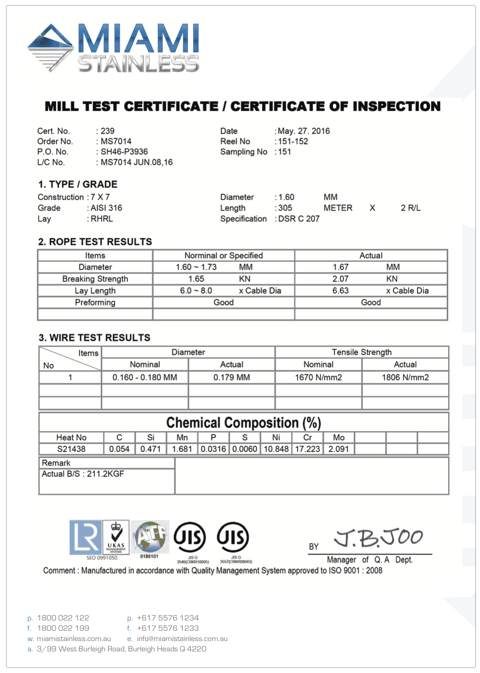
Understanding these fields sets the foundation for exploring the different EN 10204 certificate types and their levels of assurance.
### [EN 10204 - link no longer works]() Certificate Types Explained
The EN 10204 standard defines various inspection certificate types, each offering a different level of verification. The type of certificate determines the extent of testing and validation performed on the material.
- **Type 2.1**: This is the simplest form, where the manufacturer declares that the material complies with the order requirements. However, it does not include any specific test results or external verification.
- **Type 2.2**: This certificate includes test results for the material’s chemical composition and mechanical properties. While it offers more detail, the verification remains internal to the manufacturer.
- **Type 3.1**: A widely used certificate for critical applications, this involves validation by an authorised inspection representative who is independent of the production process.
- **Type 3.2**: The highest level of assurance, this certificate includes third-party validation in addition to the manufacturer’s testing. If a client requests a Type 3.2 certificate but the manufacturer can only provide a Type 3.1, a third-party quality inspection company must be engaged to certify the material [\[2\]](https://www.hqts.com/material-test-certificate)[\[4\]](https://www.h-lift.com/blog-detail/what-is-a-mill-test-certificate).
The certificate type required depends on the application and industry standards. For example, pressure vessels made under the [Pressure Equipment Directive - link no longer works]() (PED) typically require a Type 3.1 certificate, while aerospace or nuclear applications may demand the additional verification of Type 3.2.
Knowing the certificate type is key to verifying an MTC’s validity.
### How to Verify an MTC is Valid
Validating an MTC is essential to ensure compliance and maintain the integrity of the materials. Issues like inaccurate information, missing signatures, or unauthorised certificates can compromise the process [\[2\]](https://www.hqts.com/material-test-certificate).
Start by cross-referencing the certificate details with the physical material. Ensure the reference numbers on the MTC match the markings on the material and its packaging [\[1\]](https://www.rightonblackburns.co.uk/test-certificates). A mismatch in heat numbers is an immediate warning sign.
Next, confirm that the material meets the ordered specifications [\[1\]](https://www.rightonblackburns.co.uk/test-certificates). For instance, if Grade 304 stainless steel to BS EN 10088-2 was requested, the certificate’s chemical composition and mechanical properties must align with the defined ranges.
Check for proper authorisation by examining the certificate for stamps and signatures from the quality control department. As noted earlier, a certificate without these is invalid [\[2\]](https://www.hqts.com/material-test-certificate).
> "To verify a Mill Test Report, carefully review the document to ensure it includes all required information such as material composition, mechanical properties, and any relevant test results. Cross-reference the report with industry standards such as ASTM or ASME to confirm compliance and authenticity. If you have any doubts, consult with a qualified materials testing laboratory for further verification." – WH Labs [\[3\]](https://www.whlabs.com/verifying-mill-test-reports-in-manufacturing)
For critical applications, consider third-party verification. On-site sampling or laboratory tests provide an additional layer of assurance, ensuring the material properties match the certificate [\[2\]](https://www.hqts.com/material-test-certificate)[\[3\]](https://www.whlabs.com/verifying-mill-test-reports-in-manufacturing).
Another effective approach is contacting the manufacturer directly. Many reputable manufacturers have systems to verify certificate details using reference or heat numbers [\[3\]](https://www.whlabs.com/verifying-mill-test-reports-in-manufacturing).
When reviewing the certificate, look for inconsistencies, such as conflicting test results for tensile strength or chemical composition [\[3\]](https://www.whlabs.com/verifying-mill-test-reports-in-manufacturing). Ensure all required compliance certifications, like references to ASTM or British Standards, are present and valid [\[3\]](https://www.whlabs.com/verifying-mill-test-reports-in-manufacturing).
For organisations managing multiple MTCs, implementing an internal tracking system can streamline the process and ensure easy access during audits [\[3\]](https://www.whlabs.com/verifying-mill-test-reports-in-manufacturing).
## Common Problems with Mill Test Certificate Management
### Typical MTC Issues
Handling Mill Test Certificates (MTCs) can be tricky, with several recurring issues affecting material traceability and compliance with regulations.
One major concern is **inaccurate information**. MTCs might include incorrect details that don’t reflect the actual materials ordered [\[2\]](https://www.hqts.com/material-test-certificate)[\[6\]](https://blog.hb-steel.com/understanding-mill-test-certificates-for-seamless-pipes-and-flanges)[\[7\]](https://bullimporter.com/en/what-is-the-mtc-certificate-and-why-is-it-necessary-for-imports). Often, they lack key information like acceptance criteria, test results (such as heat treatment or impact tests), the manufacturer's name, or the testing methods used [\[5\]](https://steeltrace.co/5-common-errors-in-certificates)[\[2\]](https://www.hqts.com/material-test-certificate)[\[6\]](https://blog.hb-steel.com/understanding-mill-test-certificates-for-seamless-pipes-and-flanges)[\[7\]](https://bullimporter.com/en/what-is-the-mtc-certificate-and-why-is-it-necessary-for-imports). Without these details, the certificate falls short of verifying compliance or providing a dependable audit trail.
Another common problem is **counterfeit or incomplete certificates**. Some suppliers issue certificates without conducting the necessary tests, omitting critical quality control stamps or signatures in the process [\[2\]](https://www.hqts.com/material-test-certificate)[\[7\]](https://bullimporter.com/en/what-is-the-mtc-certificate-and-why-is-it-necessary-for-imports).
Then there’s the issue of **altered manufacturer details**. Trading companies may replace the original producer's information with their own, making it nearly impossible to trace materials back to their source [\[2\]](https://www.hqts.com/material-test-certificate)[\[7\]](https://bullimporter.com/en/what-is-the-mtc-certificate-and-why-is-it-necessary-for-imports).
Lastly, **dual certification issues** can crop up when certificates reference multiple international standards. Differences in standard editions or heat treatment requirements can create confusion over which standard actually applies.
These problems can significantly affect the reliability of operations.
### Consequences of Poor MTC Management
The issues outlined above don’t just complicate traceability - they can lead to serious operational risks. Errors in MTCs make it difficult to verify material quality, which can disrupt operations and make it harder to meet regulatory requirements. Without accurate and complete certifications, ensuring compliance becomes a daunting task, potentially leaving organisations vulnerable to costly setbacks.
## How to Improve MTC Management with Technology
### Best Practices for Managing MTCs
To build a strong foundation for managing Material Test Certificates (MTCs), start by clearly outlining the necessary certificate details. These typically include material grades, compositions, mechanical properties, heat treatment processes, and testing methods. Share these requirements with your suppliers upfront to avoid confusion or delays.
Centralising all MTCs in a single, easily accessible repository is another essential step. This ensures that anyone needing to verify material compliance can quickly locate the necessary documentation without wasting time searching through scattered systems.
Routine **verification procedures** are crucial. When materials arrive, check that material grades, batch numbers, and quantities align with the documentation. Catching discrepancies at this stage is far less costly than discovering them during production.
Adopting **standardised naming conventions** for digital files makes retrieval effortless. Include key details like the supplier’s name, material grade, and date in each filename. Conduct regular audits of your MTC repository to spot outdated certificates or missing documents that need attention.
### Using AI to Automate MTC Processing
Technology offers powerful tools to improve MTC management further, especially through automation.
Manual MTC processing is slow and prone to mistakes. [AI-driven platforms](https://www.gosmarter.ai/tags/artificial-intelligence) like [GoSmarter](https://www.gosmarter.ai/) can completely transform this process by automating the extraction, validation, and management of certificate data.
Automation typically involves two stages: first, digitising documents using Optical Character Recognition (OCR); second, extracting key details - such as material grades, compositions, and mechanical properties - through contextual analysis [\[8\]](https://cbs-consulting.com/us/steel-inspection-certificate-processing-with-ai)[\[10\]](https://datagrid.com/blog/ai-agents-material-test-report-validation).
These platforms use machine learning, natural language processing, and computer vision to validate certificates, a task that would otherwise consume hours of manual effort [\[10\]](https://datagrid.com/blog/ai-agents-material-test-report-validation). For example, AI can perform **rule-based comparisons** by checking extracted data against your technical specifications, flagging inconsistencies automatically. Its pattern recognition capabilities can also detect anomalies, such as counterfeit certificates or data entry errors.
AI systems continuously improve, adapting to the specific formats and details of the MTCs your organisation handles [\[9\]](https://starsoftware.co/mtr-automation). Over time, they become better at recognising various certificate layouts and extracting data with greater accuracy.
This automation addresses many of the errors and inefficiencies that often plague manual MTC management. By integrating AI platforms with existing systems like ERP software, CRM tools, and laboratory management systems, you can ensure seamless data transfer without the need for tedious manual input [\[10\]](https://datagrid.com/blog/ai-agents-material-test-report-validation)[\[11\]](https://docuexprt.com/auto-document-verification-manufacturing). Real-time monitoring and reporting features further enhance efficiency, enabling you to spot and resolve issues as they occur [\[11\]](https://docuexprt.com/auto-document-verification-manufacturing).
The benefits are clear: instead of spending hours manually transcribing certificate data and checking it against specifications, your team can focus on more strategic tasks. Automated reports provide instant summaries of compliance across your material inventory, saving time and reducing stress.
### Creating a Digital Audit Trail
A digital audit trail is another game-changer for MTC management, bolstering both compliance and traceability.
By centralising certificates and linking them to inventory and production records, a digital audit trail addresses past issues like mismanaged records and questionable certificate authenticity.
This system doesn’t just store certificates - it captures the entire chain of custody. It records when each MTC was received, who verified it, what materials it pertains to, and where those materials were used in production. This creates an unbroken link from raw material supplier to finished product.
The **searchability** of a digital audit trail is invaluable. Whether you’re responding to customer queries or undergoing a regulatory audit, you can instantly pull up all certificates related to a specific batch number, production order, or date range. This drastically cuts down the time needed to demonstrate compliance.
To maintain accuracy, use version control to archive updated certificates with timestamps and notes on any changes. Linking MTCs to production records also enables quick traceability during quality investigations, helping you identify root causes and implement targeted corrective actions faster.
Access controls are key to keeping sensitive certification data secure. Set permissions so that only authorised personnel - such as quality managers, production supervisors, or compliance officers - can access relevant documents. This ensures data integrity while maintaining accessibility.
Finally, regular backups of your digital repository safeguard against data loss. Cloud-based systems add another layer of convenience by allowing remote access, so team members can verify material compliance from anywhere, whether they’re on the factory floor, in the office, or working remotely.
## Conclusion
### Summary of MTC Management Questions
Managing Material Test Certificates (MTCs) effectively is crucial for maintaining quality and regulatory compliance in metals manufacturing. This article explored the key roles of MTCs, the critical information they contain, and the classifications outlined in EN 10204.
Issues like misplaced certificates, unreadable documents, and manual errors can lead to production delays, audit complications, and financial repercussions. To address these challenges, robust MTC management involves clear documentation, centralised storage, routine verification, and consistent naming practices. Combining these approaches with AI-driven automation and digital audit trails simplifies processes and improves overall efficiency.
### Benefits of Better MTC Management
Updating your approach to MTC management doesn't just cut down on paperwork - it delivers tangible operational improvements.
One of the most immediate benefits is saving time. Instead of spending hours manually inputting certificate data or cross-checking specifications, your team can focus on more strategic tasks that drive value. Automation allows certificates to be processed in minutes, freeing up resources for other priorities.
Improved accuracy is another advantage. By using AI-powered validation, errors from manual data entry are avoided, and discrepancies are flagged before they escalate into production issues. This ensures materials consistently meet specifications, reducing waste, minimising rework, and maintaining your reputation for quality.
Quick and easy access to certification records makes compliance less of a headache. During audits, certificates can be retrieved in seconds, providing full traceability from raw materials to finished products. This capability not only meets regulatory demands but also reassures customers who expect transparency about material origins.
A digital audit trail offers secure and organised record-keeping, making it easier to address quality concerns, respond to customer queries, or prepare for certification renewals. This streamlined access transforms these tasks into straightforward processes.
Finally, better MTC management supports business growth. It can handle increased workloads without adding administrative strain, ensuring your quality systems are ready to scale as your operations expand.
{{< youtube width="480" height="270" layout="responsive" id="uDX-QHqmuRE" >}}
## Frequently Asked Questions
{{< faq question="What is a mill test certificate?" >}}
A mill test certificate (MTC) is a document issued by the steel or metals manufacturer confirming that a batch of material meets the specified standard and the mechanical and chemical properties claimed. It records the heat number, grade, chemical composition, and mechanical test results. Mill test certificates are the primary means of proving material traceability in metals manufacturing and are required by standards like BS EN 1090 and EN 10204.
{{< /faq >}}
{{< faq question="What is the difference between an EN 10204 Type 3.1 and 3.2 mill cert?" >}}
Both are inspection certificates confirming material properties, but they differ in who signs them. A Type 3.1 certificate is signed by the manufacturer’s own authorised inspection representative. A Type 3.2 is signed by both the manufacturer’s representative and an independent third-party inspector. Type 3.1 is the standard requirement for most structural steel work. Type 3.2 is required on projects where the client specification demands independent verification — common in defence, aerospace, and high-consequence civil engineering.
{{< /faq >}}
{{< faq question="How long should I keep mill test certificates?" >}}
For structural steelwork covered by BS EN 1090, records should be kept for the working life of the structure. In practice, most fabricators retain mill certificates for a minimum of 10 years. For nuclear, defence, or infrastructure projects, permanent retention is standard. Digital storage solves the archiving problem entirely — scanned and indexed certificates take up no physical space and remain searchable indefinitely.
{{< /faq >}}
{{< faq question="How do I digitise mill test certificates?" >}}
Scan each certificate when it arrives with goods. Name the file using a consistent convention — heat number, grade, and supplier work well. Store certificates in a dedicated digital folder or, better, in a purpose-built system that can search and retrieve by heat number or job. Tools like GoSmarter’s MillCert Reader go further: they extract the key data from each certificate automatically, linking heat numbers and material properties directly to your inventory records without manual typing.
{{< /faq >}}
{{< faq question="What information must appear on a mill test certificate?" >}}
Under EN 10204, a mill test certificate must include: the product standard and grade, the heat number or batch number, the chemical composition, the mechanical test results (yield strength, tensile strength, elongation, and impact values where applicable), the certificate type and the name and signature of the authorised representative. For structural steel, the delivery condition and any applicable subgrades should also appear. Missing any of these fields means the certificate may not satisfy your compliance requirements.
{{< /faq >}}
## Go deeper
- [Mill Certificate Automation: The Complete Guide](https://www.gosmarter.ai/hubs/mill-cert-automation/) — everything about how GoSmarter reads, validates, and stores mill cert data automatically
- [Integrated Cert Traceability & Auditability](https://www.gosmarter.ai/hubs/integrated-cert-traceability/) — what a proper EN 10204 audit trail looks like and how to build one without manual effort
- [GoSmarter vs Generic OCR/IDP Tools for Mill Certificates](https://www.gosmarter.ai/blog/gosmarter-vs-generic-ocr-mill-cert/) — why domain-specific AI outperforms generic document processing tools
## 7 Ways to Reduce Paperwork in Metal Manufacturing
> Seven digital strategies—AI docs, MES, cloud inventory, ERP and e-signatures—to cut paperwork, speed production and improve compliance.
**Managing paperwork in metal manufacturing is a major challenge.** It slows production, increases costs, and makes compliance harder. But digital solutions can help. Here are seven ways to reduce paperwork and improve efficiency:
- [**AI-Powered Documentation**](https://www.gosmarter.ai/docs/): Digitise mill certificates, inspection reports, and logs using AI tools.
- **Automated Compliance Tracking**: Keep up with regulations effortlessly with real-time alerts and digital records.
- **Manufacturing Execution Systems (MES)**: Replace job cards and logs with real-time digital tracking.
- **Cloud-Based Inventory Management**: Track materials and stock digitally, reducing errors and manual input.
- **Digital Production Planning**: Simplify schedules and updates with centralised digital tools.
- **Electronic Signatures**: Speed up approvals and reduce delays with digital authorisations.
- **ERP Systems**: Centralise all business data for easier access and streamlined processes.
These methods save time, cut costs, and reduce errors. Start small by addressing your biggest pain points, and expand gradually. Digital tools also scale with your [production needs](https://www.gosmarter.ai/solutions/production/), making them practical for both small and large manufacturers. Whether it’s [automating compliance](https://www.gosmarter.ai/solutions/compliance/) or digitising inventory, these solutions help you stay competitive in today’s fast-paced industry.
{{< youtube width="480" height="270" layout="responsive" id="m0F3L1PsCck" >}}
## 1\. Digitise Documentation with AI-Powered Platforms
[AI-powered platforms](https://www.gosmarter.ai/tags/cognitive-services/) are transforming how metal manufacturers manage documentation by converting paper records into searchable digital formats. Using technologies like optical character recognition (OCR) and machine learning, these platforms extract data from mill certificates, inspection reports, material test certificates, and production logs. This eliminates the need for manual data entry while maintaining precision.
**Once digitised, the information becomes instantly accessible to authorised users across the facility**, cutting down the time spent digging through files to find certification documents for customers or evidence for quality audits.
### Reducing Manual Paperwork
Switching from paper to digital documentation significantly streamlines workflows. Instead of spending hours filing, retrieving, and copying certificate data, staff can focus on tasks that add real value. **AI-powered platforms automate repetitive processes, such as filling in fields across systems**, ensuring that once information is entered, it flows seamlessly through production planning, quality control, and shipping documentation.
For manufacturers processing hundreds of material certificates each month, the benefits are clear. Take a steel fabricator, for example: when raw materials arrive, the platform digitises mill certificates, extracts critical data, and links it to inventory batches. This creates a traceability chain without anyone having to manually input serial numbers or test results.
The advantages extend beyond certificates. Work instructions, safety data sheets, maintenance logs, and inspection forms can all shift to digital formats. **Teams access up-to-date documents on tablets or workstations, avoiding errors caused by outdated printed versions.** This transition not only reduces paperwork but also lays the groundwork for smoother integration into modern manufacturing systems.
### Integrating into Existing Workflows
AI platforms are designed to work with existing manufacturing systems, connecting via APIs and standard data formats. This means companies can keep their current processes intact while gradually introducing automation. **The platform takes care of tasks like document routing, data validation, and compliance checks in the background**, allowing staff to continue working as usual.
Many solutions offer flexible pricing models, aligning costs with actual usage. This makes advanced AI technology accessible without the need for hefty upfront investments, simplifying operations while also scaling to meet production demands.
### Adapting to Production Levels
AI-powered platforms are built to handle varying production volumes without requiring additional administrative staff. Whether processing 50 or 500 certificates a week, the system ensures there are no delays due to paperwork backlogs. **Even during peak production periods, the platform keeps operations running smoothly.** And when production slows, businesses aren’t left with surplus administrative capacity.
Flexible payment options, including Pay-As-You-Go plans, let companies pay only for what they use. Free plans are also available for businesses that want to test digital documentation before committing to a larger rollout.
### Cutting Costs for Metal Manufacturers
Digitising documentation doesn’t just save time - it also reduces costs. Administrative staff spend less time on manual tasks, allowing businesses to redeploy them to roles that directly support production or reduce headcount through natural attrition.
**Fewer errors mean fewer rejected batches, less rework, and fewer compliance penalties**, all of which save money. Storage costs drop as physical filing cabinets are replaced by cloud-based systems. Manufacturers no longer need dedicated archive rooms or off-site storage for legally required records. Digital backups also protect against risks like fire, flooding, or misfiling, which can be costly if historical certificates are needed years down the line.
The savings add up quickly. In most cases, businesses see a return on investment within months as time is saved and error-related costs shrink. Usage-based pricing models make this transition even more cost-effective, ensuring companies only pay for what they need, especially during quieter production periods.
## 2\. Automate Compliance Tracking
Metal manufacturers face an ongoing challenge in meeting a variety of compliance requirements, including health and safety regulations, environmental standards, and industry-specific certifications. Keeping up with these demands means managing a mountain of records - inspection logs, audit reports, training records, and regulatory submissions. Automated compliance tracking systems simplify this process by monitoring requirements in real time and generating the necessary documentation.
These systems track regulatory updates, schedule inspections, and alert you when certifications are nearing expiry. Instead of relying on spreadsheets to remember when equipment needs recertification or when staff training is due, the software takes care of it automatically. When it’s time for an audit, the system pulls together all the relevant records in one go, saving hours of searching through scattered paperwork. This approach drastically reduces the need for manual data collection.
### Effectiveness in Reducing Manual Paperwork
One of the biggest headaches for metal manufacturers is the sheer volume of paperwork required to stay compliant. Think about the typical compliance tasks in a metal fabrication facility - weekly safety inspections, monthly environmental checks, quarterly equipment calibrations, and annual training renewals. Each of these traditionally involves piles of forms and files.
Automation changes the game. Inspectors can now complete digital checklists on tablets or smartphones, with the data flowing directly into the system. The software cross-references the information with regulatory requirements, flagging any gaps right away. If a piece of equipment fails an inspection, the system automatically assigns corrective actions and tracks their progress until resolved.
Training records are also digitised. Instead of keeping paper files for each employee’s certifications and renewal dates, the system stores everything electronically and sends reminders when renewals are due. Need proof of up-to-date certifications for an audit? The system generates the report in seconds, not hours.
For environmental compliance, automation ensures greater accuracy by reducing errors tied to manual record-keeping. Whether data is entered manually or captured through digital measurement tools, the system organises it for easy review, seamlessly integrating into existing workflows.
### Ease of Integration into Existing Workflows
Modern tracking systems are designed to fit into existing manufacturing processes without causing major disruptions. They integrate with current software tools - such as production equipment systems, quality control platforms, and [inventory management tools](https://www.gosmarter.ai/docs/inventory/) - eliminating the need for duplicate data entry.
Staff can continue their usual routines, like conducting inspections or performing maintenance, but instead of filling out paper forms, they use familiar digital interfaces. The system works quietly in the background, organising information, checking compliance, and sending alerts when action is required.
Many platforms also include mobile apps that work offline, which is especially useful in workshop environments where connectivity can be an issue. Inspectors can complete their tasks without internet access, and the data syncs automatically once they’re back online. This flexibility makes the transition from paper to digital smoother for everyone involved.
### Scalability for Varying Production Levels
Whether your production lines are running at full capacity or at a slower pace, compliance requirements remain constant. Automated systems adapt effortlessly, handling everything from small-scale operations to large, multi-line facilities.
During busy periods, when more equipment is in use and additional staff are on shift, the system scales up to manage the increased workload. Inspections, training records, and compliance checks are captured and organised in real time, avoiding any paperwork bottlenecks.
As your business grows or takes on new contracts requiring additional certifications, these platforms can expand alongside you. For example, the same system managing ISO 9001 can also handle new standards as your needs evolve.
### Cost-Efficiency for Metal Manufacturers
The financial benefits of automated compliance tracking go beyond just saving on paper and storage costs. Administrative staff who used to spend hours each week on compliance paperwork can now focus on higher-value tasks. By minimising paperwork-related errors, these systems also reduce the risk of fines or failed audits, safeguarding both finances and reputation.
Audit preparation becomes far less time-consuming. Instead of spending days compiling documents, the system generates complete audit packages in minutes, allowing operations to continue with minimal disruption.
There’s even the potential for reduced insurance premiums. Many insurers view automated compliance systems as a way to lower risk, thanks to consistent monitoring and accurate record-keeping. And with flexible pricing models - such as usage-based options - these systems are accessible to businesses without requiring hefty upfront investments.
## 3\. Use Manufacturing Execution Systems (MES)
Manufacturing Execution Systems (MES) take the place of traditional paper-based records by automating digital data capture. This means no more job cards, production logs, quality checklists, or shift reports cluttering up the workspace. Instead, the system keeps a close eye on shop floor operations - tracking which machines are active, which jobs are underway, and whether quality standards are being upheld. Operators input data via touchscreens or scanners, eliminating the need for manual forms. As work progresses, the MES logs each step, recording timestamps, operator entries, and any issues that arise. This digital shift ensures production records are consistently accurate and easy to access.
### Effectiveness in Reducing Manual Paperwork
An MES transforms the production workflow by digitising almost every aspect, effectively removing the need for paper documentation. Work orders are displayed directly on screens at each workstation, and operators update their progress using touchscreens or barcode scanners. The system automatically logs start and finish times, so there’s no need for manual tracking.
Tasks like quality checks, material tracking, and shift handovers are also digitised. Operators use tablets or terminals to input measurements and inspection results, with some systems even connecting directly to measuring tools to automatically record dimensions. When raw material batches are scanned, the MES deducts them from inventory and links them to specific jobs, eliminating handwritten requisition forms and manual end-of-shift counts. Real-time tracking of material usage supports both inventory management and traceability, while structured digital shift handovers ensure all activities and production statuses are clearly documented and easily reviewed.
### Ease of Integration into Existing Workflows
Modern MES platforms are designed to integrate seamlessly with existing production setups. They connect directly to CNC machines, welding equipment, and other machinery using standard industrial protocols, automatically pulling data without disrupting operations. For equipment that isn’t digital, operators can manually input data through user-friendly interfaces. If someone knows how to use a smartphone, they can quickly adapt to an MES terminal - extensive training isn’t necessary.
Beyond the shop floor, MES systems sync with other business software, such as inventory management tools, quality control systems, and enterprise resource planning (ERP) platforms. This ensures that information flows smoothly across departments, further reducing the need for physical paperwork. When a new order is placed, it’s automatically transferred from the planning system to the MES, which schedules and tracks production without requiring manual intervention.
### Scalability for Varying Production Levels
In metal manufacturing, production demands can fluctuate significantly, and an MES is built to handle these changes effortlessly. Whether it’s a single prototype or a large-scale production run, the system manages the workload without adding administrative complexity. As production ramps up, the MES handles the increased activity - more operators can log in, additional machines can be monitored, and extra shifts can be tracked, all without generating extra paperwork.
For manufacturers with multiple facilities or production lines, MES platforms provide a centralised view while accommodating local differences. They’re also versatile enough to manage different types of production, whether it’s continuous manufacturing of standard parts or custom fabrication projects. By scaling with ease, MES systems eliminate paperwork bottlenecks, saving time and resources.
### Cost-Efficiency for Metal Manufacturers
The financial benefits of an MES come from time savings and increased productivity. Administrative staff spend less time processing paperwork, freeing them up for more valuable tasks. Operators focus on production rather than filling out forms.
Automatic data capture reduces errors, which means less rework and lower costs. Detailed production records improve traceability, making it easier to resolve customer queries and handle warranty claims. Accurate material tracking reduces waste, and the system helps operators address potential issues before they become costly problems.
Storage costs also drop significantly. Instead of maintaining filing cabinets stuffed with production records for regulatory compliance, all data is stored digitally and can be retrieved in seconds. Whether it’s an auditor or a customer requesting documentation, the information is ready at the click of a button. The return on investment often becomes evident within the first year, thanks to labour savings, reduced waste, and increased throughput.
## 4\. Use Cloud-Based Inventory Management
Switching to a cloud-based inventory system eliminates the hassle of paper records and manual stock management. For metal manufacturers, this means tracking raw materials, work-in-progress, and finished goods through a centralised digital platform that’s accessible from anywhere. When materials arrive, staff can scan barcodes or input details directly into the system using tablets or smartphones. Stock levels update instantly, giving everyone - from shop floor staff to the purchasing team - a clear, real-time view of inventory. This seamless coordination enhances supply chain efficiency and complements other automation tools, ensuring inventory management keeps pace with production tracking.
### Cutting Down on Manual Paperwork
[Cloud systems](https://www.gosmarter.ai/tags/cloud/) simplify operations by centralising data and reducing repetitive admin tasks. Stock requisition forms? Gone. Operators can now request materials digitally, with approvals managed within the system. Movement of items - from warehouse to production - is automatically tracked, eliminating the need for manual tallying. Handheld scanners or mobile devices verify quantities, flagging any discrepancies for immediate follow-up.
For customer requests like material certifications, the system offers instant access to batch numbers, supplier details, and mill certificates. This not only makes compliance easier but also ensures documentation is secure, searchable, and free from the risk of being lost or damaged.
Receiving materials also becomes smoother. Delivery notes can be photographed or scanned directly into the system, linked to purchase orders, and matched against actual deliveries. Any discrepancies trigger automatic alerts to the purchasing team, replacing outdated paper-based processes and manual follow-ups.
### Seamless Integration with Current Workflows
Modern cloud inventory platforms are designed to integrate effortlessly with existing business software. They can pull data from purchasing systems, update production planning tools, and sync with accounting platforms. For example, when a purchase order is raised, the expected delivery automatically appears in the inventory system. Similarly, when materials are allocated to a job, production planning software is updated without requiring manual input.
If barcode systems are already in use, cloud platforms work with existing scanners and labels. For businesses without barcodes, implementing them alongside a cloud system is straightforward - most suppliers already provide materials with identification codes. Generating internal stock labels is just as simple. Plus, staff familiar with smartphones will find the user-friendly interfaces easy to navigate, eliminating the need for extensive training.
Since these systems are cloud-based, there’s no need for costly on-site servers or complex IT setups. Updates roll out automatically, and the system can be accessed from any device with an internet connection. This is particularly valuable for manufacturers operating across multiple sites, as everyone works with the same up-to-date information regardless of location.
### Scaling with Production Demands
Cloud inventory systems are built to handle fluctuating stock levels and transaction volumes without adding administrative burden. During busy periods, the system processes increased activity seamlessly. If a manufacturer expands its product range or adds new materials, these can be incorporated into the system without requiring a complete overhaul.
For businesses with multiple locations, cloud platforms provide a unified view while allowing for site-specific requirements. For instance, a manufacturer with separate warehouses for different materials can track everything in one system, with access controls ensuring teams only see relevant information. As the business grows, adding users, locations, or stock-keeping units is straightforward and doesn’t increase administrative workload.
These systems also adapt to various inventory management practices, whether it’s first-in-first-out (FIFO) for perishable materials, batch tracking for traceability, or just-in-time principles to minimise stock holding. This flexibility ensures the software supports the business, rather than forcing the business to adapt to the software.
### Cost Benefits for Metal Manufacturers
The financial advantages of cloud inventory management go far beyond saving on paper. Administrative hours previously spent on stock counts, filing, and reconciling errors can now be redirected to more productive tasks.
Real-time updates improve accuracy, reducing costly mistakes. Purchasing decisions are based on up-to-date information, helping avoid stock-outs that disrupt production or over-ordering that ties up capital. Analysing material usage patterns becomes easier, allowing manufacturers to spot waste and refine job costing for more precise quotes.
Physical and administrative costs drop too. Filing cabinets can be repurposed, historical records are instantly accessible, and stocktakes become quicker and less disruptive. With subscription-based pricing, smaller manufacturers pay only for what they need, while larger businesses can scale up without hefty upfront investments.
Accurate digital records also simplify processes like insurance claims and warranty investigations. Disputes over deliveries become rare when transactions are documented and timestamped automatically, further reducing financial risks.
## 5\. Use Digital Production Planning Tools
Digital production planning software transforms how schedules, work orders, and shop floor management are handled in metal manufacturing. By moving away from paper-based systems, these tools cut down on administrative workload and boost efficiency. Instead of relying on outdated paper job sheets, manufacturers can use a centralised digital platform where production plans are created, updated, and shared electronically. Operators access up-to-date work orders on tablets or screens placed around the facility, while managers can track progress in real-time without chasing paperwork or making endless phone calls.
Switching to digital displays ensures everyone works with the same accurate information. If priorities change or a machine breaks down, updates are instantly reflected across all devices, maintaining a single, reliable schedule.
### Cutting Down on Manual Paperwork
These tools eliminate many time-consuming paper-based processes. There's no longer a need to print, distribute, or manually update work orders. Instead, operators receive digital instructions that include everything they need - drawings, material specs, and quality guidelines - all on one screen. As tasks are completed, the system is updated automatically, notifying the next department and adjusting the overall schedule in real-time.
The days of misplaced or damaged paper job travellers are over. Digital records track every step of the process, creating a searchable and secure audit trail. Material requisitions are simplified too. When a job is scheduled, the system generates pick lists for the warehouse team, who confirm material allocations digitally. No more handwritten notes for specific steel grades or batch numbers - everything is documented and tracked within the system.
Quality control also gets a digital upgrade. Inspectors can record measurements directly into tablets, linking the data to specific jobs or customer orders. Photos of completed work can be attached instantly, eliminating the need for separate filing systems. When customers request documentation, it’s all readily accessible, no rummaging through filing cabinets required.
### Easy Integration with Current Workflows
Modern planning software connects seamlessly with other business systems, ensuring a smooth flow of information. For example, sales orders can automatically generate production jobs with pre-filled details, integrating with inventory and accounting systems. Material requirements feed directly into inventory management, while completion data updates accounting platforms for invoicing. This interconnected setup reduces duplicate data entry and the errors that often come with it.
For those using specialised machinery, many planning tools can interface directly with machine controllers. This enables automatic collection of cycle times, downtime data, and production quantities. Operators can focus on running machines instead of filling out timesheets, and managers get accurate performance data without extra effort.
Transitioning to digital doesn’t mean you have to overhaul everything at once. Many systems allow for gradual implementation - starting with one production line or a specific product range. As staff become familiar with the platform, more processes can be moved over until paper becomes the rare exception. Plus, the intuitive interfaces make training straightforward, especially for shop floor staff already accustomed to smartphones or tablets.
### Adapting to Production Changes
Digital planning tools are built to handle fluctuations in workload without adding stress. During quieter periods, the system manages fewer jobs. When things ramp up, it scales effortlessly, handling hundreds of work orders without slowing down or requiring additional administrative staff.
As production expands - whether through new machinery, extra shifts, or even new facilities - the software adapts. Adding new workstations or production lines is simple, and multi-site manufacturers can coordinate activities across locations while accounting for site-specific constraints.
These tools also work with different manufacturing methods, whether it’s make-to-order, make-to-stock, or a mix of both. Job priorities can be adjusted on the fly based on factors like delivery dates, material availability, or customer urgency. Rush orders slot into schedules seamlessly, with the system recalculating downstream impacts and notifying affected departments.
For businesses dealing with seasonal demand, digital planning offers a clear view of capacity constraints weeks in advance. This helps managers make informed decisions about overtime, temporary staff, or outsourcing. Unlike paper systems, which require manual consolidation of information, digital tools provide an overarching view at a glance.
### Financial Benefits for Metal Manufacturers
The financial perks of digital planning go far beyond saving on paper and printer costs. Administrative time shifts from chasing information to improving processes. Supervisors spend less time searching for answers and more time addressing challenges and streamlining operations.
Improved visibility into production status reduces delays and bottlenecks. With real-time updates, issues are spotted and resolved quickly, keeping jobs on track and improving on-time delivery rates. Cutting down on paper also increases transparency, supporting broader [digital transformation](https://www.gosmarter.ai/tags/digital-transformation/) efforts within metal manufacturing.
Accurate time tracking enhances job costing and quoting. Manufacturers can see how long tasks take compared to estimates, helping refine pricing and pinpoint areas where efficiency can be improved. Over time, this leads to more competitive pricing and healthier profit margins.
Machine utilisation also benefits. The software identifies opportunities to group similar jobs, minimise changeovers, and keep equipment running efficiently. Downtime is tracked automatically, revealing patterns that might indicate maintenance needs or training gaps - insights that are hard to glean from paper records but are clear in digital systems.
For smaller manufacturers, subscription-based pricing makes these tools accessible without hefty upfront investments. Costs scale with usage, so businesses only pay for what they need. Larger operations gain access to enterprise-level features that handle complex scheduling and integrate with existing ERP systems, all while maintaining a single source of truth for production data.
## 6\. Use Electronic Signatures and Approvals
Electronic signatures have transformed the way businesses handle document approvals, removing the need for printing, scanning, and filing. In metal manufacturing, where authorisation is required for a variety of documents like purchase orders, quality inspection reports, engineering change notices, and health and safety forms, this shift can make a huge difference. Traditional paper-based processes often create delays as documents move between departments. By contrast, electronic signatures speed things up, allowing approvals to happen much faster.
With electronic signature systems, staff can sign documents from virtually anywhere - whether they’re using a computer, tablet, or smartphone. Managers, for example, can approve critical documents while on-site or working remotely. This flexibility ensures operations run smoothly, especially when dealing with urgent orders or compliance requirements. Plus, it integrates seamlessly with existing systems, making the transition straightforward.
### Cutting Down on Paperwork
Electronic signature systems automate the entire approval process. Instead of printing a purchase order, delivering it to a manager’s desk, waiting for a signature, and then filing it, everything happens digitally. The system sends an email notification to the relevant person, who can review and sign the document in seconds. Once signed, the document is automatically stored with a complete audit trail, showing who signed it and when.
This system is particularly useful for maintaining quality documentation. For instance, an inspector can sign off on an inspection report directly from a tablet, making it instantly accessible to production teams, dispatch departments, or even customers. This eliminates the risk of misplaced paperwork and avoids delays caused by waiting for approvals.
Engineering change notices also see improvements. When a customer requests a design or production modification, the change request can be sent electronically to all relevant teams - engineering, production, quality, and commercial. Each stakeholder reviews and signs the document digitally, with the system tracking progress and sending reminders if needed. This ensures faster turnaround times compared to traditional methods.
Health and safety documentation also becomes easier to manage. Risk assessments, method statements, and training records often require multiple signatures. Electronic systems ensure these documents are signed promptly and stored securely, making them readily available during audits or inspections. When HSE inspectors visit, you won’t need to dig through filing cabinets - everything is accessible at the click of a button.
### Easy Integration with Existing Systems
Modern electronic signature platforms are designed to work with the tools you already use. Documents created in accounting software, quality management systems, or other platforms can be sent for electronic signature directly from those applications. Once signed, the document is automatically saved back into your system, updating its status and notifying relevant staff.
Many platforms also support cloud storage, which means signed documents are automatically filed in the correct folders. For example, a signed customer contract could be saved directly to a project folder, while a signed quality report might go into the quality records directory. This automation reduces the time spent on administrative tasks like scanning and filing.
Importantly, manufacturers don’t need to overhaul their processes all at once. You can start small - perhaps with purchase orders or inspection reports - and expand gradually as your team becomes comfortable with the system. This step-by-step approach makes it easier to transition to a paperless workflow.
### Adapting to Changing Production Levels
Electronic signature systems are built to handle the ebb and flow of business operations. Whether you’re processing fewer documents during quieter periods or managing a higher volume during peak production, these platforms can adapt with ease.
As your business grows, adding new users - whether they’re internal staff, additional departments, or external partners like suppliers and customers - is usually straightforward. Multi-site manufacturers can implement the same system across all locations, ensuring consistent workflows. The software also accommodates varying approval needs; while some documents may only need one signature, others might require a sequence of approvals from multiple parties. The system manages these workflows automatically, ensuring documents move through the correct channels in the right order.
### Cost Savings for Metal Manufacturers
Switching to electronic signatures can significantly reduce costs associated with paper, printing, and storage. Administrative tasks shift from managing physical documents to more productive activities. Staff no longer need to spend time printing, distributing, chasing, and filing paperwork, freeing up time for other critical responsibilities.
Retrieving documents also becomes much faster. Whether a customer has a question about an order or an auditor needs proof of compliance, signed documents can be found instantly with a simple search. This not only saves time but also reduces the risk of penalties for missing documentation during audits.
Electronic storage is another major advantage. Filing cabinets take up valuable space that could be used for production equipment or inventory, and off-site storage for archived documents often incurs ongoing rental fees. In contrast, electronic storage requires minimal server space and involves only modest ongoing costs.
Most electronic signature platforms operate on a subscription basis, charging per user per month. This model is particularly budget-friendly for smaller manufacturers, while larger companies often benefit from volume discounts as they expand. By reducing administrative costs, saving physical space, and ensuring compliance with UK and EU regulations, electronic signatures are a practical and efficient solution for modern metal manufacturers.
## 7\. Use ERP Systems to Centralise Data
ERP systems bring all key business data - finance, production, inventory, quality, and sales - onto a single digital platform, replacing scattered paperwork with streamlined processes. By consolidating these functions, manufacturers can eliminate the inefficiencies of juggling separate systems. Instead of hunting through files or waiting on other departments for documents, staff can instantly access the information they need.
For metal manufacturers, this integration is a game-changer. When a customer places an order, the system automatically routes the details through sales, production planning, inventory, purchasing, and quality control. Each department works from the same real-time data, cutting out the need for printed order sheets, manual spreadsheet updates, or paper-based coordination.
Every transaction and activity is logged within the ERP, creating a comprehensive digital trail. Whether it’s checking the status of a job, reviewing material costs, or confirming when a batch was inspected, the information is just a few clicks away. This not only saves time but also reduces the administrative hassle of managing paper trails.
### Effectiveness in Reducing Manual Paperwork
ERP systems digitise workflows, replacing countless paper-based processes. For example, if there’s a material shortage, the system generates a digital requisition that purchasing can review and convert into a purchase order - no printing required.
On the shop floor, digital job cards and work instructions allow real-time updates. Successive departments are notified automatically, and inventory is updated as tasks progress. This eliminates the need for physical job cards, which are prone to damage, loss, or becoming outdated.
Financial processes also benefit. Invoices, delivery notes, and payment records are managed digitally, reducing the need for manual filing. When goods are dispatched, the ERP creates the delivery note and invoice, emails them to the customer, and updates accounts receivable - all without human intervention. This automation frees up accounts staff to focus on analysis rather than repetitive data entry.
### Ease of Integration into Existing Workflows
Modern ERP systems are designed to integrate smoothly with existing workflows. Manufacturers often worry that adopting an ERP means starting from scratch, but most systems can import data from spreadsheets, accounting software, and production databases. This ensures historical records are preserved while transitioning to digital processes.
A phased implementation works best. Start with order management and inventory, then expand to production planning and quality control. This step-by-step approach allows staff to adapt gradually, avoiding the overwhelm of too many changes at once.
For manufacturers using specialised tools like nesting software for sheet metal cutting or CAD systems for design, many ERPs offer integration options. For instance, designs from CAD software can flow directly into production planning, while nesting programmes update material requirements automatically. This connectivity eliminates manual data transfers and paperwork, ensuring a seamless flow of information.
### Scalability for Varying Production Levels
ERP systems are built to handle fluctuations in production, whether it’s a seasonal slowdown or a surge in demand. For metal manufacturers, this flexibility is invaluable when managing large projects or adjusting to market changes.
Adding new users is straightforward, making it easy to bring on temporary staff during busy periods or expand to new facilities. Multi-site manufacturers can unify operations, ensuring consistent processes and real-time visibility across all locations.
As production becomes more complex, the ERP scales to manage additional data. Whether it’s handling detailed bills of materials, routing steps, or quality checkpoints, the system grows alongside your business. Expanding product ranges or transitioning to complex assemblies doesn’t require extra paperwork or manual tracking.
Reporting capabilities also adapt. Smaller manufacturers may only need basic reports, while larger operations can build detailed dashboards tracking performance across departments and locations. The system evolves with your analytical needs, eliminating the hassle of manual data compilation.
### Cost-Efficiency for Metal Manufacturers
In recent years, ERP systems have become more accessible, thanks to [cloud-based solutions](https://www.gosmarter.ai/tags/azure/) and subscription pricing. Instead of investing heavily upfront, manufacturers can pay predictable monthly fees based on the number of users and required modules. This model makes ERP technology attainable for businesses of all sizes.
Once implemented, ERPs significantly cut administrative costs. Staff spend less time on data entry, filing, and retrieving information, allowing them to focus on more productive tasks. Savings on paper, printing, and storage add up, though the bigger impact comes from reduced labour costs.
Inventory management becomes more precise, leading to cost savings. Real-time stock visibility and automated reordering prevent overstocking and stockouts. Better material tracking reduces waste, while accurate job costing helps identify unprofitable products or processes.
Error reduction is another financial advantage. When data flows seamlessly between departments, transcription errors, miscommunication, and duplicate entries drop sharply. Fewer mistakes mean less rework, fewer customer complaints, and lower costs. For manufacturers working with tight tolerances, this level of accuracy is crucial.
Flexible pricing models make ERPs even more appealing. Smaller manufacturers can start with basic features and add modules as needed, while larger businesses often benefit from volume discounts. Some platforms, like [GoSmarter](https://www.gosmarter.ai/), offer pay-as-you-go options, aligning costs with usage. This ensures you only pay for what you need, with the flexibility to expand as your business grows or production demands change.
## Conclusion
Cutting down on paperwork in metal manufacturing isn’t just about saving paper - it’s about addressing inefficiencies that drain time, money, and productivity. The strategies outlined here offer practical ways to reshape how your business manages information, from the shop floor to the back office.
**AI-powered documentation platforms** can handle mill certificates and technical specs without manual input, while **automated compliance tracking** keeps you on top of regulations without the need for endless spreadsheets. **Manufacturing execution systems** provide real-time insights by connecting your production floor with the rest of your operations. **Cloud-based inventory management** ensures accurate stock tracking across locations, reducing costly mistakes. **Digital production planning tools** replace outdated whiteboards and printed schedules with streamlined scheduling solutions. **Electronic signatures and approvals** speed up decision-making, and **ERP systems** bring it all together, creating an interconnected digital workflow that eliminates silos.
By reducing paperwork, you not only cut costs but also free up your team to focus on tasks that truly add value. Below are some actionable steps to help you get started with these solutions.
For many manufacturers, the challenge isn’t identifying the problem - it’s figuring out where to begin. The good news? You don’t have to tackle everything at once. A phased approach allows your team to adapt gradually while gaining confidence in these digital processes.
Start by pinpointing your biggest bottlenecks. If missing mill certificates are a constant headache, prioritise digital documentation. If scheduling feels chaotic, digital planning tools should come first. Struggling with inventory management across multiple sites? Then cloud-based systems make sense. Focus on solutions that directly address your most pressing issues. Once those are under control, look for tools that can scale as your production needs grow.
Scalable solutions with flexible pricing, like the pay-as-you-go model offered by platforms such as GoSmarter, make it easier to start small. Prove the value of the system on a smaller scale, then expand as your business grows.
It’s also crucial to choose tools that integrate smoothly with your existing systems. For instance, connecting CAD software to production planning or linking nesting programmes to inventory management ensures data flows seamlessly, eliminating the manual transfers that often lead to paperwork. Involve your team - operators, supervisors, and admin staff - in the selection process. Their day-to-day insights will help identify tools that improve workflows without adding unnecessary complexity.
Manufacturers who reduce their dependence on paperwork gain a competitive edge. Faster turnaround times, improved accuracy, and lower operating costs allow you to respond to customer demands more quickly, track jobs more effectively, and make decisions based on up-to-date data rather than outdated reports.
Take the time to evaluate which of these seven methods align best with your operational goals and budget. Whether you start with a single solution or tackle multiple areas, transitioning from paper to digital processes will prepare your business to meet future challenges head-on.
## Frequently Asked Questions
{{< faq question="What paperwork can be automated in metal manufacturing?" >}}
The highest-volume paperwork tasks in metals manufacturing are mill certificate processing, purchase order management, delivery note generation, quality inspection records, and compliance documentation. Mill certificates are the most impactful to automate — AI tools like GoSmarter’s MillCert Reader extract all key data from PDFs in seconds, eliminating the manual typing that typically consumes 2–4 hours per week per person. Compliance tracking and audit trail generation can also be fully automated, removing the scramble that precedes most external audits.
{{< /faq >}}
{{< faq question="How do I go paperless in a metal fabrication business?" >}}
Start with the paper that causes the most problems: mill certificates. Digitise incoming certs at goods-in using a scanner and an AI extraction tool. Then move to digital job cards and work instructions on the shop floor, which eliminates paper damage and transcription errors. Digital delivery notes and invoices complete the loop on the commercial side. You don’t need to do everything at once — a phased approach by document type lets your team adapt without disruption.
{{< /faq >}}
{{< faq question="What are the biggest time-wasters in metals admin?" >}}
In order of time impact: manually typing data from mill certificates (2–4 hours per week), manually processing Request For Quote (RFQ) emails (10–15 minutes per quote), reconciling inventory records against actual stock (1–2 hours per week), and preparing compliance documentation for audits (1–2 days per audit). Most of these can be automated with purpose-built tools at a fraction of the cost of the labour they replace.
{{< /faq >}}
{{< faq question="What does digital transformation cost for a small metals business?" >}}
Entry-level digital tools for metals businesses start from around £275 per month for mill certificate processing. A full suite covering inventory, cutting plans, and document management runs to £1,000–1,500 per month. Compared to the cost of the manual work these tools replace — typically £14,000–40,000 per year in labour — the return on investment is usually positive within the first 3–6 months. Many tools also offer free tiers or trials so you can prove the value before committing.
{{< /faq >}}
{{< faq question="How do I reduce document errors in manufacturing compliance?" >}}
The most effective step is to stop manual data entry for compliance-critical documents. AI-powered extraction tools read mill certificates, test reports, and delivery notes automatically, eliminating transcription errors at source. Automated validation against your specifications catches discrepancies before material enters production. A digital audit trail with version control ensures you always know which version of a document was used and when. Together, these measures reduce compliance-related errors to near zero.
{{< /faq >}}
## Go deeper
- [No-Code Workflows for Metals SMEs](https://www.gosmarter.ai/hubs/no-code-workflows-metals-smes/) — three core GoSmarter workflows that eliminate paperwork without coding
- [Mill Certificate Automation: The Complete Guide](https://www.gosmarter.ai/hubs/mill-cert-automation/) — the biggest single source of manual admin in metals, solved
## Steel Mill Certificate Management Software: How to Automate in 5 Steps
> Automate mill cert handling in 5 steps with steel certificate management software. Reduce errors, close compliance gaps, and cut manual admin.
**Managing steel certificates manually can lead to errors, delays, and compliance risks. The right steel certificate management software automates this process, improves accuracy, saves time, and ensures smooth operations.** Here's how you can do it in five steps:
1. **Assess Current Processes**: Identify inefficiencies, manual touchpoints, and compliance gaps. Quantify time and cost impacts to build a case for automation.
2. **Choose Automation Technology**: Select a system that integrates with your existing tools like ERP and [manufacturing systems](https://www.gosmarter.ai/tags/manufacturing/). Ensure it supports features like data extraction and validation.
3. **Deploy and Integrate**: Implement the system in phases. Configure workflows, validation rules, and ensure seamless data flow across platforms.
4. **Set Up Compliance Checks**: Automate validation against industry standards. Configure alerts for discrepancies and maintain digital audit trails for traceability.
5. **Train Teams and Monitor**: Provide staff training and track KPIs like processing times and error rates. Use feedback to refine the system.
## Step 1: Review Your Current Mill Certificate Management Process
Take a close look at how you currently handle [mill certificate management](https://www.gosmarter.ai/newsroom/steel-millcert-reader-launched/). The goal is to spot inefficiencies, hidden costs, and areas where automation could make the biggest difference. Here’s how to break it down for a smoother transition.
### Identify Manual Touchpoints
Start by mapping out every stage where human intervention is involved - data entry, storage, retrieval, and verification. These steps are often where errors and delays creep in.
For example, manually entering data from mill test reports, such as PDFs or scans, can lead to mistakes like transposed digits in chemical compositions or mechanical properties. Storing certificates in different places - physical files, network drives, or email attachments - makes tracking a nightmare, especially when dealing with multiple suppliers. On top of that, manually locating and verifying certificates slows down audits and production validations, creating bottlenecks and increasing the risk of oversights.
### Check for Compliance and Traceability Gaps
After mapping manual touchpoints, shift your focus to compliance and traceability. Are you meeting standards like [ASTM](https://www.astm.org/), [ASME](https://www.asme.org/), and EN? Are there gaps in your system that could compromise traceability across the supply chain?
Manually reviewing mill test reports to verify chemical compositions, mechanical properties, and regulatory adherence is time-consuming and prone to inconsistencies. Different team members might interpret the same specifications differently, or they might miss important details during busy periods.
For international supply chains, there’s an added layer of complexity. Certificates need to confirm material origins to meet sanctions and quality control requirements.
> The CE marking process, which involves managing documentation like Mill Test Certificates, can be "extremely complicated and time consuming" [\[2\]](https://www.conformance.co.uk/our-services/ce-marking-self-assessment).
Non-compliance can lead to rejected shipments at customs, causing delays and extra costs. Ask yourself: Can you quickly identify which supplier provided material for a specific batch? Does a certificate meet [ASTM A36](https://en.wikipedia.org/wiki/A36_steel) specifications? Can you prove material origins for customs clearance? If answering these questions involves long searches or extensive cross-referencing, your system likely has significant traceability gaps.
### Calculate Time and Cost Impact
Now, quantify the time and money spent on manual processes. How many hours per week go into data entry, filing, retrieval, and responding to audits? Multiply this by your team’s hourly rates. Then, add the costs of compliance failures, such as rejected shipments, delays, or recalls. This calculation will help you build a solid case for automation.
Don’t forget to consider the opportunity cost - what could your team achieve if they weren’t bogged down by these tasks? Also, think about the broader costs of non-compliance. Failing to meet regulations can lead to product withdrawals, design changes, or even legal consequences, all of which can damage both finances and reputation.
Here’s an example: One automotive manufacturer automated 90% of its mill test report processing. They saved over 30 hours per week and cut their time-to-market by 15% [\[1\]](https://www.certivo.com/blog-details/certivo-simplifies-mill-test-report-analysis-with-ai-powered-compliance-tools).
Document these findings clearly for stakeholders. Show the weekly hours spent on manual tasks, annualise this figure, and apply labour costs. Then, add the estimated annual cost of compliance failures and delays. This total becomes your baseline and a benchmark to measure the return on investment when adopting automation technology.
## Step 2: Select the Right Automation Technology
Once you've mapped out your manual processes, the next step is choosing a technology that addresses the compliance and traceability gaps you've identified.
Look for an automation platform that works effortlessly with your existing manufacturing systems. A well-integrated solution ensures that critical certificate data moves seamlessly between your ERP, supply chain management, and production systems - avoiding data silos and keeping everything connected.
### Integration with Existing Systems
Opt for a platform with built-in APIs and connectors [\[3\]](https://identitymanagementinstitute.org/automated-certificate-lifecycle-management)[\[5\]](https://www.digicert.com/faq/certificate-management/how-do-you-automate-certificate-management)[\[4\]](https://docs.certifytheweb.com/blog/certificate-automation-intro) that can automatically transfer certificate data to your ERP, update inventory records, and provide direct links to your manufacturing execution systems.
For more specialised setups, consider tools that allow custom deployment options. Features like export functions, file transfers via UNC shares or SSH, and scripting through PowerShell or Bash can help maintain a smooth flow of data tailored to your environment.
Before rolling out the solution across your operations, conduct a pilot test. This will help you evaluate data synchronisation speeds, system performance during outages, and its ability to handle peak transaction loads effectively.
## Step 3: Deploy and Integrate the Automation System
Once your automation system has been thoroughly tested, it’s time to deploy it. This step involves embedding automation into your daily operations, ensuring that mill certificates are processed and managed effortlessly.
To minimise disruptions, set a clear deployment timeline. Many manufacturers find success with a phased approach - rolling out the system on one production line first before expanding it across the entire operation. This method allows you to identify and address integration issues early while maintaining business continuity. By building on earlier process reviews and technology choices, this phased rollout ensures a smoother transition.
### Configure Workflows and Automation Rules
Start by mapping out the journey of each certificate. Set up **automated document storage** that categorises certificates by key details like material grade, supplier, batch number, and the date received. This eliminates manual filing and ensures every certificate is stored in the correct digital location. Use AI-powered optical character recognition (OCR) to extract critical data points such as chemical composition, mechanical properties, and heat numbers.
Define **validation rules** tailored to your quality standards. For example, if you’re handling [EN 10204 - link no longer works]() 3.1 certificates for structural steel, configure the system to automatically verify that properties like carbon content, tensile strength, and yield strength meet specified tolerances. Certificates with values outside these ranges should be flagged for manual review immediately.
Set up **approval workflows** to streamline quality control. Certificates that meet all specifications can automatically move to an approved status, while those with discrepancies trigger alerts for senior metallurgists. You can also implement time-based rules - for instance, certificates awaiting approval for more than 48 hours can be escalated to management.
Establish **naming conventions** and metadata standards to make certificates easily searchable. A well-organised system allows your team to locate any certificate in seconds, whether by project codes, purchase order numbers, or specific material properties. These configurations form the foundation for seamless integration with other systems.
### Connect with Manufacturing Systems
After setting up workflows, the next step is to integrate the automation system with your manufacturing infrastructure. The ultimate goal is **real-time visibility** - when a certificate is validated, that information should instantly update key systems like inventory, production planning, and quality management.
Connect to your **ERP system** so that certificate data flows automatically. For instance, when a shipment of stainless steel arrives with its certificates, the inventory system should update stock levels and link certificate references to batch numbers - no manual input required.
Integrate with your **manufacturing execution system (MES)** to give production teams instant access to material specifications. Operators scanning a batch should be able to view the relevant mill certificate data immediately.
Link to your **quality management system** to ensure complete traceability. If a customer questions the material used in a part manufactured months ago, your team should be able to trace it back to the exact mill certificate in moments. This level of traceability is invaluable for audits and addressing quality concerns.
Establish connections with your **supply chain management tools** to ensure certificate requirements are communicated upstream to suppliers. For example, when you issue a purchase order for materials, the system should automatically inform suppliers of the required certifications, reducing the chances of receiving incomplete or incorrect documentation.
During deployment, rigorously test data synchronisation. Run parallel processes - keeping your manual systems active while operating the automated system alongside them. Compare outputs to ensure certificate data flows accurately between systems, and monitor performance during peak periods to check the system can handle high volumes without delays or errors.
Finally, configure **backup protocols** to safeguard your data. Ensure local copies of certificate data are available during any cloud downtime and that the system resynchronises automatically once the connection is restored. This redundancy ensures smooth operations, even in the face of network issues, while maintaining the compliance and traceability improvements achieved through automation.
## Step 4: Set Up Compliance and Validation Settings
Now that your integration is complete, it’s time to configure compliance and validation settings. This step ensures certificates are automatically checked against the relevant industry standards.
Tailor these settings to the specific standards your operation requires. Whether you're working with high-performance alloys or standard construction steels, your validation processes should align with the specifications and tolerances critical to your projects. This setup not only strengthens quality assurance but also reduces the risk of compliance issues, material recalls, and gaps in traceability.
Once configured, automate these checks to guarantee every certificate meets the required standards.
### Automate Compliance Checks
Set up your system to verify certificate data against recognised industry standards. It should automatically ensure certificates meet international or sector-specific requirements.
For instance, when a mill certificate for stainless steel arrives, the system should confirm its chemical composition and mechanical properties match the required standards. Any discrepancies should trigger a quality review.
Additionally, consider any unique supplier or project-specific requirements. These might include extra testing or additional documentation, which should also be part of the automated checks. Keep compliance criteria updated regularly to reflect any changes in standards or requirements.
### Configure Alert Systems
With [automated compliance](https://www.gosmarter.ai/solutions/compliance/) checks in place, the next step is to implement alert systems that flag issues as they arise.
Alerts serve as early warnings, notifying the right team members when something goes wrong. To avoid overwhelming your team, design these alerts to prioritise clarity and relevance.
- **Critical alerts**: Notify quality managers immediately of major issues, such as certificates failing validation for key material properties.
- **Low-priority alerts**: Summarise minor issues, like formatting errors or slight delays, in daily reports to avoid constant interruptions.
Assign role-specific notifications so alerts go directly to the right people. For example, if a certificate fails a mechanical property check, engineers should be notified. If a supplier repeatedly submits incomplete documents, the procurement team should receive the alert.
Set up escalation rules to ensure unresolved issues don’t linger. For example, if a flagged certificate isn’t addressed promptly, escalate the alert to higher management. You can also use pattern recognition to identify recurring problems, such as a supplier consistently submitting non-compliant certificates, and take corrective action.
For projects with specific traceability demands, consider adding customer-facing notifications. A dashboard with clear visual markers can help quality managers and stakeholders quickly spot and resolve issues.
### Create Digital Audit Trails
Once alerts are in place, focus on building robust digital audit trails to ensure complete traceability.
Audit trails are essential for regulatory inspections and customer audits. Every action taken on a mill certificate - uploading, validation, approval, or archiving - should be logged with timestamps and user details.
Set up your system to record a comprehensive history for each certificate, including validation results, flagged issues, and final status. Use immutable logging to prevent any retroactive changes, safeguarding the integrity of your records. Automate compliance reporting so you can quickly generate audit-ready documents, saving time during inspections.
Establish proper retention policies to meet regulatory and contractual obligations. Certificates should be archived securely and only deleted when appropriate. Additionally, track any changes to certificate data or validation rules, ensuring all modifications are logged with details on what changed, who made the change, and why.
Regularly reviewing audit trails can help identify trends and uncover areas for improvement. Make sure these trails integrate with your broader document management systems to provide a complete view of material traceability, linking related records like production batches or inspection reports for a more comprehensive perspective.
## Step 5: Train Teams and Monitor Performance
To make the most of your automated mill certificate management system, it’s crucial to ensure your team is well-prepared and that system performance is closely monitored.
### Conduct Staff Training
Train your team thoroughly so they understand how to use the system and recognise its impact on quality and compliance. As highlighted by [Metal Work Group](https://www.metalwork.co.uk/pneumatic-components/World-Sales-Network-0004395.html) Top Management:
> "The involvement of personnel in pursuing the Quality objectives through the development of personnel training and awareness-raising programmes at all company levels is a must for the Group." [\[6\]](https://www.metalwork.co.uk/pneumatic-components/Company-certificates-0005028.html)
Once training is complete, keep a close eye on the system’s performance to identify areas for improvement and ensure it meets your objectives.
### Define Key Performance Indicators (KPIs)
Set clear metrics to measure how effectively the system is operating. Focus on tracking:
- Processing times
- Error rates
- Compliance pass rates
- Audit response times
These indicators provide measurable insights into whether the automation is achieving the desired results. Additionally, monitor the volume of certificates processed and the accuracy of validations to spot any bottlenecks or recurring problems. Regularly review these metrics with your team to stay on track and ensure continuous improvement.
### Improve Based on Feedback
Encourage a culture of continuous improvement by gathering feedback and applying methods like Total Quality Management, Lean, and Kaizen to close performance gaps and hit quality targets. Metal Work Group Top Management underscores this approach:
> "Process-oriented management: Ensuring the achievement of the set goals by using organisational tools, such as Total Quality Management and the Lean and Kaizen business models." [\[6\]](https://www.metalwork.co.uk/pneumatic-components/Company-certificates-0005028.html)
Invite your team to report system issues, suggest workflow enhancements, and share observations from their day-to-day use of the system. Use this input to fine-tune validation rules, recalibrate alert thresholds, and optimise system integration with manufacturing processes. Regular reviews will ensure the system adapts to your evolving needs, keeping operations efficient and compliant.
## Benefits of Automating Mill Certificate Management
[Automating mill certificate management](https://www.gosmarter.ai/newsroom/case-study-millcert-reader-saves-10-hours-a-month-for-busy-production-teams/) reshapes how metals manufacturers handle compliance documentation, bringing noticeable improvements across their operations.
### Increased Accuracy and Efficiency
Handling large volumes of documents manually often leads to errors. Automation tackles this issue head-on by using AI to extract, validate, and organise certificate data. This not only reduces mistakes but also allows staff to focus on more strategic tasks, like quality analysis.
Automated systems capture certificate data exactly as it appears, avoiding transcription errors that could cause compliance problems or production delays. By validating specifications against project requirements automatically, non-conforming materials are flagged instantly, helping production stay on track.
These systems maintain consistent accuracy, whether dealing with regular workloads or scaling up during busy periods. This reliability boosts overall compliance and ensures smooth traceability throughout operations.
### Strengthened Compliance and Traceability
With automation, compliance processes become more streamlined and reliable. Meeting standards like [ISO 9001](https://asq.org/quality-resources/iso-9001?srsltid=AfmBOop1XpXkw22uRV1hy2jueHauQmOYF03cNfmXI46zr9Wx4-xTeNqv) and EN 10204 is much simpler when compliance checks are managed automatically. The system continuously reviews certificates against predefined requirements, ensuring materials meet specifications before advancing further.
Traceability is enhanced as materials are tracked in real-time throughout production. Certificates are directly linked to batches, orders, and projects, enabling immediate access to material histories when requested by auditors or customers.
Digital audit trails provide a detailed record of every certificate interaction, complete with timestamps. These logs are invaluable during audits or quality investigations, showcasing a solid commitment to quality and compliance.
When regulations change or new requirements arise, automated systems can be updated quickly to reflect these changes, eliminating the need for extensive retraining and ensuring workflows remain compliant.
### Cost Savings and Scalability
Reducing manual processes leads to direct cost savings. With less reliance on manual data entry, labour costs decrease, and the risk of costly compliance errors, rejected shipments, or production rework is minimised.
Administrative staff, freed from repetitive tasks, can shift their focus to higher-value activities. Additionally, moving from physical filing systems to [digital archives](https://www.gosmarter.ai/categories/archive/) reduces storage expenses. Document retrieval becomes almost instant, cutting costs further while also reducing paper usage - offering both economic and environmental benefits.
Automation also supports scalability. Whether increasing production, launching new product lines, or expanding facilities, automated systems handle larger workloads without requiring additional resources. For example, [GoSmarter](https://www.gosmarter.ai/)’s platform offers a flexible, pay-as-you-go pricing model, eliminating the need for significant upfront investments while providing access to advanced automation features.
Beyond immediate savings, automation generates valuable data insights. These insights can help [optimise procurement](https://www.gosmarter.ai/blog/procurement-best-practice-what-manufacturers-can-learn/), identify quality trends, and enhance supplier performance. Together, these benefits highlight how automation not only streamlines mill certificate management but also provides a strategic edge in a competitive market.
## Conclusion
Transitioning from manual to automated mill certificate management can be a smooth process when handled thoughtfully. By working through five key steps - assessing your current workflows, choosing the appropriate technology, deploying and integrating the system, configuring compliance and validation settings, and equipping your teams with the right training - you tackle the risks and inefficiencies associated with manual methods head-on.
This approach not only simplifies operations but also strengthens compliance and traceability. It ensures your shift to automation is secure, well-suited to your organisation’s requirements, and prepared to meet future demands with confidence.
## FAQs
{{< faq question="Which software can automatically read mill certificate data without manual data entry?" >}}
GoSmarter MillCert Reader extracts data from PDF mill certificates automatically — heat numbers, material grades, chemical compositions, and mechanical properties. There is no template to configure and no field mapping to maintain. Upload the certificate; the data is stored and linked to your stock record in seconds.
{{< /faq >}}
{{< faq question="How much time does automating mill certificate management actually save a quality team?" >}}
Manual data entry from a single mill certificate typically takes five to fifteen minutes — longer if the certificate is a scan or uses an unfamiliar format. Teams processing ten or more certificates daily can recover one to two hours per person per day. GoSmarter customers have reported saving over ten hours a month in certificate handling alone. Audit preparation — previously a half-day exercise — typically drops to a few minutes of search and export.
{{< /faq >}}
{{< faq question="What are the main advantages of automating mill certificate management over manual methods?" >}}
Automating mill certificate management significantly cuts down on human error, ensuring critical data is handled with far greater precision. Tasks like data validation and traceability become more streamlined, boosting efficiency across operations while keeping everything aligned with industry standards.
Automation also prevents unexpected disruptions by simplifying workflows and integrating smoothly with production systems. The result is time savings and a noticeable drop in operational costs.
{{< /faq >}}
{{< faq question="How can I ensure the automation technology integrates seamlessly with my current systems?" >}}
Assess how well the new solution aligns with your existing infrastructure — make sure it can handle the file formats, protocols, and software you already rely on. Partnering with a provider that offers flexible customisation and dependable support during implementation is equally crucial. Features like API integrations can be especially helpful in linking the automation tool to your workflows.
{{< /faq >}}
{{< faq question="What compliance and traceability standards should I follow when automating mill certificate management?" >}}
Follow recognised industry standards such as those set by the [British Standards Institution](https://www.bsigroup.com/en-GB/) (BSI) or the [International Organisation for Standardisation](https://www.iso.org/home.html) (ISO). These ensure your processes align with regulatory requirements while maintaining quality.
Traceability is equally important. Certificates should be traceable back to the original raw materials — essential for verifying material authenticity and fulfilling customer and legal obligations. EN 10204 (European Norm 10204) defines the types of inspection certificates for metallic materials and is the most commonly required standard.
{{< /faq >}}
## Go deeper
- [Mill Certificate Automation: The Complete Guide](https://www.gosmarter.ai/hubs/mill-cert-automation/) — how GoSmarter extracts data from any cert in seconds, handles multi-heat documents, and builds your audit trail automatically
- [Integrated Cert Traceability & Auditability](https://www.gosmarter.ai/hubs/integrated-cert-traceability/) — what a complete EN 10204 chain of custody looks like and how to build it without manual effort
## Compliance Management Checklist for Metals Manufacturers
> Compliance checklist for metals manufacturers: UK REACH, import/export rules, ISO standards, supplier qualification, traceability, emissions, and digital tools.
**Staying compliant in metals manufacturing is non-negotiable.** From UK REACH regulations to ISO certifications, the stakes are high - fines, project delays, and reputational damage are real risks. This guide outlines everything you need to know to keep your operations running smoothly.
Here’s what you’ll learn:
- Key regulations like UK REACH, emissions control, and material traceability.
- Import/export requirements, including customs documentation and conflict minerals compliance.
- How to meet quality standards with ISO certifications and proper documentation.
- Supplier qualification processes and maintaining supply chain compliance.
- Leveraging digital tools to simplify and automate compliance tasks.
**Compliance is complex, but with the right systems, it’s manageable.** Whether it’s tracking regulatory updates, ensuring material traceability, or preparing for audits, this checklist will help you stay ahead and avoid costly mistakes.
## Key Regulatory Requirements
Navigating the complex web of regulations is a daily reality for UK metals manufacturers. From managing chemical compliance to ensuring smooth cross-border trade, staying ahead requires constant vigilance and meticulous record-keeping. Two key areas demand particular attention: chemical regulations under UK REACH and the import/export compliance of both raw materials and finished goods. Both involve detailed documentation and regular updates to processes.
Failing to comply can lead to serious consequences, including notices from the [Health and Safety Executive](https://www.hse.gov.uk/) (HSE), hefty fines, or even prosecution. Beyond the legal risks, non-compliance can halt production, delay shipments, and harm customer trust. In an industry where contracts often hinge on solid compliance systems, safeguarding your reputation is non-negotiable.
Staying compliant means more than just ticking boxes - it requires actively monitoring regulatory changes, maintaining thorough records, and training staff regularly. A reactive approach can leave gaps, especially as regulations evolve. This is particularly critical for meeting the demands of UK REACH.
### UK REACH and EU REACH Alignment
UK REACH (Registration, Evaluation, Authorisation and Restriction of Chemicals) came into force in Great Britain after Brexit, replacing the EU REACH framework. Any facility handling more than one tonne of a substance annually must register it with the HSE. This applies to metals, alloys, and other chemical substances used in manufacturing, such as lubricants or surface treatments.
The registration process involves submitting detailed information about each substance, including its properties, hazards, safe handling measures, and risk management protocols. For substances registered under EU REACH before Brexit, transitional arrangements were put in place. Registration costs can vary widely depending on the quantity of the substance.
For manufacturers exporting to the EU, compliance becomes even more challenging. EU REACH still applies to products entering European markets, requiring separate registrations with the [European Chemicals Agency](https://echa.europa.eu/) (ECHA). This adds significant administrative work and expense, particularly for smaller businesses without dedicated compliance teams. To manage this, many manufacturers appoint an Only Representative based in the EU to handle their obligations, though this adds another layer of coordination.
The Candidate List of Substances of Very High Concern (SVHC) poses an ongoing challenge. If a substance exceeds 0.1% w/w in a product, notification is required. For metals manufacturers working with complex alloys or coatings, this means obtaining material declarations from every supplier in the supply chain.
Additional hurdles include authorisation and restriction requirements. If a substance appears in Annex XIV, you’ll need authorisation from the HSE to use it. Similarly, substances listed in Annex XVII face usage restrictions or outright bans. Exporters must ensure compliance with both UK and EU regulations, adding another layer of complexity to the process.
### Material Import and Export Compliance
Proper substance registration under UK REACH helps streamline international documentation and ensures smoother border compliance. Importing raw materials and exporting finished products involve multiple regulatory checkpoints. Accurate customs documentation is essential - this includes correct commodity codes, country of origin declarations, and proof of compliance. Mistakes can lead to shipments being held at borders, resulting in storage fees and delayed deliveries.
Even seemingly minor details, like the use of wooden pallets or crates, fall under scrutiny. The UK's Timber and Timber Products Regulations 2013 require manufacturers to ensure that any timber used in packaging hasn’t been illegally harvested. This means obtaining proper documentation from suppliers to verify the timber’s origin and legality. Overlooking this can lead to penalties and operational disruptions.
For imported materials, due diligence extends beyond customs paperwork. It’s crucial to confirm that suppliers comply with their local regulations and that materials meet UK standards. This is especially important for alloys or metals that could contain restricted substances. Many manufacturers request detailed questionnaires from suppliers covering environmental, labour, and chemical standards before approving them.
Exporting certain metals and alloys adds further challenges. Products with potential military or dual-use applications - such as titanium alloys, specific steel grades, or specialised aluminium products - may require export licences. These licences, managed by the [Export Control Joint Unit](https://www.gov.uk/government/organisations/export-control-joint-unit) (ECJU), can take weeks to process, so factoring this into production schedules is essential.
Conflict minerals regulations are another consideration. While primarily driven by the US [Dodd-Frank Act](https://en.wikipedia.org/wiki/Dodd%E2%80%93Frank_Wall_Street_Reform_and_Consumer_Protection_Act), these rules increasingly affect UK manufacturers through customer demands. Many buyers now require declarations confirming that materials like tin, tantalum, tungsten, and gold are not sourced from conflict-affected regions. Additionally, the EU Conflict Minerals Regulation, effective since January 2021, has added further supply chain expectations for UK manufacturers.
To avoid delays or rejections, ensure that all commercial invoices, certificates of origin, safety data sheets, and conformity declarations are complete and accurate.
Finally, trade agreements and tariffs continually reshape the economic landscape for imports and exports. The UK Global Tariff (UKGT) outlines duty rates for goods entering the UK, while free trade agreements offer preferential rates for qualifying products. Understanding these agreements and ensuring products meet rules of origin requirements can have a significant impact on costs and competitiveness.
## Meeting Quality Standards
Building quality control into your compliance framework isn’t just about ticking boxes - it’s about preventing costly mistakes and ensuring your processes meet industry expectations. Quality standards act as a safeguard, bolstering confidence among regulators, customers, and auditors. Without them, even small errors can spiral into major issues like non-compliance, product recalls, or lost contracts.
In the metals industry, quality control faces specific hurdles. Material properties can shift from batch to batch, processing conditions impact final outcomes, and strict traceability rules demand precise documentation. A single misstep - like an error in heat treatment or mixing up material grades - can ruin an entire production run, especially when safety is on the line.
Quality standards create systems that catch problems early. This requires clear procedures, comprehensive staff training, and detailed documentation that proves compliance every step of the way. For UK manufacturers aiming to compete internationally, recognised certifications are often the key to unlocking new markets and securing valuable contracts.
### ISO Standards and Certifications
[**ISO 9001**](https://www.iso.org/standard/62085.html) is the cornerstone of quality management systems across manufacturing industries. It lays out the framework for documenting processes, managing risks, and driving continual improvement. For metals manufacturers, earning ISO 9001 certification signals to customers that your operations are tightly controlled - from raw material intake to final inspection and delivery.
To achieve ISO 9001, you’ll need to map out every process that impacts product quality. This involves defining roles, creating work instructions, setting acceptance criteria, and establishing corrective action procedures. The standard also requires evidence of management’s involvement, regular internal audits, and documented reviews to assess system performance. Certification bodies conduct initial assessments and follow up with regular surveillance audits.
In some sectors, additional certifications build on ISO 9001. For example:
- [**AS9100**](https://www.sae.org/standards/as9100-quality-systems-aerospace-model-quality-assurance-design-development-production-installation-servicing) is tailored for aerospace, adding controls for configuration management, first article inspections, and counterfeit parts prevention. Aerospace customers often won’t work with suppliers who lack this certification, as it ensures adherence to stringent quality and traceability standards.\*\*
**- \*\*[IATF 16949](https://www.bsigroup.com/en-GB/products-and-services/standards/iatf-16949-automotive-quality-management-system/)** (formerly ISO/TS 16949) is designed for the automotive sector, focusing on defect prevention, reducing variation, and minimising waste. Automotive supply chains demand incredibly low defect rates, often measured in parts per million, making robust quality systems a must.\*\*
**- Specialised certifications like \*\*[ISO 13485](https://www.iso.org/standard/59752.html)** for medical devices, [**ISO 3834**](https://www.iso.org/standard/81650.html) for fusion welding, and [**ISO 19443**](https://www.iso.org/standard/64908.html) for nuclear applications address specific industry needs. These standards emphasise traceability, personnel qualifications, and strict documentation protocols.
Maintaining certifications requires ongoing effort. Regular internal audits, management reviews, and prompt resolution of non-conformances identified during external audits are essential. Training records also play a critical role, proving that staff are qualified for their tasks. For specialised processes like heat treatment or non-destructive testing, personnel often need certification under recognised schemes like PCN ([Personnel Certification in Non-Destructive Testing](https://www.bindt.org/Certification/general-information/Personnel-Certification/)).
Certification costs vary based on company size and complexity. Initial expenses include consultant fees for gap analysis and system development, along with certification body fees for assessments. Ongoing costs, such as annual surveillance audits, are typically offset by improved efficiency, reduced waste, and access to premium contracts.
While certifications create a strong foundation for quality, accurate product marking and thorough documentation ensure ongoing compliance.
### Product Marking and Documentation
Once certified, maintaining compliance hinges on precise product marking and detailed documentation. These measures prevent rejected shipments and ensure traceability throughout the supply chain.
**Material test certificates** (MTCs) are critical for proving material composition and properties. Each batch of metal must be accompanied by an MTC detailing chemical analysis, mechanical properties, heat treatment conditions, and traceability data. For critical applications, customers often specify the type of certificate required, such as [EN 10204](https://regbar.com/pt/wp-content/uploads/2019/09/EN10204.pdf) 3.1 certificates, which include independent inspection and testing verification.
MTCs must be clear, complete, and directly linked to the supplied material. Missing or mismatched information can lead to compliance failures. Digital systems can streamline MTC management, ensuring easy access and consistent quality control.
Physical product marking is essential for traceability. Methods like stamping, engraving, laser etching, or electro-chemical marking ensure information - such as material grade, heat number, and supplier details - remains legible through handling and processing. For smaller components or thin materials, tags, labels, or colour coding may be used, though these methods require additional safeguards to prevent misplacement or confusion.
**Certificates of conformity** confirm that products meet specified standards. These documents reference applicable standards, customer requirements, and any additional testing performed. They must be signed by authorised personnel and provide enough detail for customers to verify compliance. Generic templates won’t meet audit standards if they lack product-specific information.
Additional documentation, like dimensional inspection reports, non-destructive testing results, and surface finish measurements, provides objective proof of product compliance. These records must be retained for periods specified by contracts or regulations - often five to ten years, or longer for aerospace and nuclear sectors. Secure storage, whether physical or digital, is crucial to safeguard records from loss or tampering.
**Traceability systems** link raw materials through every stage of production, capturing data at each step: material receipt, cutting or forming, heat treatment, surface finishing, inspection, and dispatch. Technologies like barcoding, QR codes, or RFID tags can automate [data collection](https://www.gosmarter.ai/docs/what-is-data-collection/), reducing errors and speeding up retrieval. If issues arise, these systems allow for quick identification of affected products, minimising recalls and demonstrating accountability to regulators.
Document control is equally important. Work instructions, inspection procedures, and test methods must include version numbers, approval signatures, and effective dates. Obsolete documents should be removed from circulation to prevent accidental use, while distribution lists ensure updates reach the right people.
Electronic document management systems simplify version control, access management, and audit trails. These systems allow multiple users to access documents simultaneously, automate change notifications, and enable quick retrieval during audits or customer inquiries. Backup procedures and business continuity plans are vital to protect against data loss or system failures.
Calibration records for measuring and testing equipment are another key component. Instruments must be calibrated regularly using traceable standards, with records showing calibration dates, results, and any adjustments made. If equipment is found out of calibration, investigations must determine whether affected measurements or products require corrective action.
Finally, some industries impose additional documentation requirements. For example, aerospace customers may demand first article inspection reports (FAIRs) to demonstrate that new or modified processes consistently produce conforming parts. Automotive customers often require production part approval process (PPAP) submissions, including process flow diagrams, failure mode and effects analyses (FMEA), and control plans. Meeting these requirements upfront avoids costly delays and rejections later on.
## Managing Supply Chain Compliance
Your responsibility for compliance doesn't end at your factory doors. Ensuring supply chain compliance means extending your quality and regulatory standards to every supplier, subcontractor, and material source you work with. If any part of the chain fails to meet these standards, you risk production delays, regulatory fines, and even damage to your reputation.
For metals manufacturers, this challenge is particularly complex. Raw materials often pass through multiple stages - mining, smelting, trading, and distribution - before they arrive at your facility. Each step introduces potential risks: incorrect documentation, material substitutions, contamination, or even intentional fraud. Without a robust system in place, pinpointing the source of an issue becomes exponentially more difficult.
The stakes are high. Industries like aerospace and automotive regularly audit their suppliers, requiring proof that every step of the supply chain meets stringent standards. Regulatory bodies such as the Health and Safety Executive also scrutinise material origins, especially for hazardous substances. Post-Brexit, compliance requirements have become even more complicated, with differing rules for materials sourced from the EU compared to other regions. Failing to meet these standards can lead to lost contracts, production stoppages, and legal liabilities.
To manage supply chain compliance effectively, you need two key strategies: **rigorous supplier qualification** and **strong material traceability**. These are not one-time tasks but ongoing processes requiring constant attention and thorough documentation.
### Supplier Qualification Protocols
The quality of your suppliers can vary widely. Some operate with excellent systems, while others may cut corners or lack the capability to meet your requirements. Supplier qualification helps you identify reliable partners who can consistently provide compliant materials.
Start by assessing suppliers before awarding contracts. Request certifications such as ISO 9001, and for sector-specific needs, look for standards like AS9100 or IATF 16949. Ensure these certifications are current and relevant to the scope of work. Cross-check certification details using public registers to confirm their validity and ensure they haven’t been suspended or revoked.
Financial stability is another critical factor. A supplier facing financial difficulties might compromise on quality or even cease operations unexpectedly, leaving you scrambling for alternatives. Reviewing financial statements and conducting credit checks can provide early warning signs, especially for suppliers of critical or sole-source materials.
On-site audits are invaluable for verifying a supplier's operations. Look at their equipment, storage conditions, work instructions, calibration practices, and staff competence. A clean, organised facility often reflects disciplined operations. During audits, assess their documentation systems - can they quickly provide material test certificates, calibration records, or traceability data? Examine their processes for handling non-conformances and corrective actions. Transparent and cooperative suppliers are generally more reliable, while evasive answers can indicate potential issues.
For smaller suppliers or those providing lower-risk materials, desktop assessments may be sufficient. Ask them to complete questionnaires detailing their quality systems, certifications, and compliance procedures. Request sample documentation - such as material test certificates (MTCs) or inspection reports - to evaluate their quality and completeness. Customer references can also offer valuable insights into their reliability.
Maintain an **Approved Supplier List (ASL)** to formalise qualification outcomes. Only suppliers on this list should receive purchase orders. Include details like approved materials, restrictions, and qualification status. Regularly review this list - at least annually - to ensure suppliers continue to meet your standards, as certifications can expire, financial conditions may change, and quality can drift without oversight.
Monitor supplier performance through metrics like on-time delivery, conformance rates, and documentation accuracy. Some manufacturers use tiered systems to reward top-performing suppliers with more business, while placing underperformers on probation and increasing scrutiny.
If a supplier fails an audit or underperforms, issue a Corrective Action Request (CAR) to document deficiencies and required improvements. Set clear deadlines for corrective measures, often verified through follow-up audits or evidence submissions. Suppliers unwilling or unable to address issues should be removed from the ASL to avoid compliance risks.
For suppliers outsourcing critical processes, require them to meet your quality standards through approved flow-down clauses. Contracts should specify that subcontractors must also meet your criteria, with critical services requiring your approval.
For materials subject to conflict minerals regulations or sustainability mandates, demand documented proof of responsible sourcing. Third-party certifications, such as [Responsible Steel](https://www.responsiblesteel.org/certification), can provide additional assurance.
Documentation is the backbone of supplier qualification. Maintain comprehensive records for each supplier, including certifications, audit reports, performance data, and correspondence. These records serve as evidence of due diligence during customer audits or regulatory inspections. Digital systems can simplify this by enabling quick searches and automated reminders for expiring certifications or overdue reviews.
Once suppliers are qualified, the next step is ensuring robust traceability for materials throughout your production process.
### Material Traceability and Documentation
Strong traceability systems build on supplier qualification to ensure materials remain compliant from the moment they arrive to the final product. This process is essential for maintaining both quality and regulatory standards.
Start with incoming inspections. Check each delivery against purchase orders and accompanying documentation. Verify that MTCs match the materials supplied, including heat numbers, material grades, dimensions, and quantities. A physical inspection ensures there’s no damage, contamination, or deviation from specifications. Any discrepancies must be resolved before materials are accepted into inventory to prevent downstream issues.
Ensure MTCs from accredited sources include complete traceability details. Missing or questionable documentation should result in a rejection or hold until clarification is provided.
Unique identification is key to linking physical materials with their documentation. Once materials are accepted, assign internal lot numbers or use supplier heat numbers to track them through your facility. Clearly mark materials using appropriate methods - stamping for bars and plates, tagging for coils, or colour coding for smaller items. Segregate different grades or specifications to avoid accidental mixing, as even brief confusion can compromise traceability.
Storage arrangements play a critical role in maintaining traceability. Assign specific, clearly labelled storage locations for each material type, indicating their status (approved, quarantined, or rejected). First-in, first-out (FIFO) systems help ensure older stock is used first, reducing the risk of degradation or expired materials.
Document every step of the material’s journey, from lot numbers and processing parameters to inspection results and any deviations. This creates an unbroken chain of records from raw material to finished product. If a supplier later identifies an issue with a specific batch, you can quickly pinpoint all affected jobs and take appropriate action.
While traditional methods like manual logs are still useful, automated systems offer significant advantages. Barcode or QR code systems simplify data collection, reduce errors, and speed up information retrieval. Operators can scan materials at each step to automatically update records. For high-temperature processes, RFID tags provide a touchless tracking solution where other labels might fail.
Centralise traceability data using digital platforms. When customers request documentation years after delivery, these systems allow you to retrieve it in minutes rather than spending hours searching through paper files.
Outgoing documentation is the final link in the traceability chain. Certificates of conformity provided to customers should reference specific materials, including heat numbers, internal lot numbers, and relevant MTCs. Include inspection results, dimensional reports, and any customer-specific testing data. This ensures customers can trace the material back to its original source through your records.
Retain copies of all outgoing documentation alongside internal records. Retention periods vary by industry, but five years is common, with aerospace and nuclear sectors often requiring ten years or more. Secure storage - whether physical or digital - protects against loss due to fire, water damage, or misfiling.
When non-conformances occur, such as incorrect materials being shipped or documentation errors, traceability systems enable swift investigations. They help identify affected materials, uncover root causes, and implement corrective actions to prevent recurrence. In cases where recalls are necessary, precise traceability minimises the scope, reducing both costs and customer impact.
## Environmental and Emissions Compliance
In the UK, metals manufacturers running energy-intensive operations - like furnaces, boilers, or other high-emission equipment - must obtain environmental permits to operate legally [\[1\]](https://www.gov.uk/government/collections/technical-guidance-for-regulated-industry-sectors-environmental-permitting). These permits are not just a formality; they ensure your operations align with environmental standards and protect your licence to operate. Meeting these requirements is a critical part of your overall regulatory responsibilities.
### UK Emissions Regulations
Managing emissions is a key aspect of staying compliant. Start by determining whether your facility requires an environmental permit. If your processes include activities such as melting, casting, or heat treatment, a permit is mandatory. Issued by the [Environment Agency](https://www.gov.uk/government/organisations/environment-agency), this permit sets out the technical standards your operations must meet to keep emissions under control.
## Using Technology for Compliance
Relying on manual compliance processes can slow down operations and increase the likelihood of errors. Using spreadsheets, paper records, and disconnected systems makes it challenging to keep up with changing regulations, maintain accurate records, and respond efficiently to audits. For metals manufacturers managing a variety of regulatory demands - from permits to material traceability - technology provides a way to streamline repetitive tasks and keep everything organised in one centralised system.
The right digital tools can minimise administrative burdens and identify compliance gaps, allowing your team to focus more on production. Shifting to digital solutions also sets the stage for better documentation, regulatory tracking, and embedding compliance into daily workflows.
### Digital Compliance Tools
One of the most immediate benefits of technology is **automating documentation**. In metals manufacturing, mill certificates, material test reports, and compliance records can quickly pile up. By digitising these documents and linking them to specific batches or orders, retrieving any certificate becomes a matter of seconds instead of hours spent digging through filing cabinets or email chains.
For instance, [GoSmarter](https://www.gosmarter.ai/)’s platform automatically aligns mill certificates with inventory, eliminating the need for manual data entry. This ensures your records remain accurate and audit-ready. If you need to demonstrate compliance for a specific batch of steel or aluminium, the system can instantly pull up all the related documentation.
Another key advantage is **tracking regulatory changes**. Standards like UK REACH requirements, emissions guidelines, and quality certifications are constantly evolving. Digital tools can automatically flag new regulations and suggest necessary process adjustments. This proactive approach helps avoid compliance gaps that could lead to fines or disruptions in operations.
**Centralising compliance data** in one platform also improves visibility across your organisation. Teams across production, quality control, and compliance can access the same data without duplicating efforts. GoSmarter integrates seamlessly with ERP systems, [inventory management software](https://www.gosmarter.ai/docs/inventory/), and production planning tools, ensuring compliance information flows smoothly between departments. These automated processes make it easier to weave compliance into everyday operations.
### Building Compliance into Daily Operations
Using technology, compliance can become part of the daily rhythm of production rather than an added burden. By embedding regulatory checks into tasks people already perform, compliance becomes second nature instead of feeling like extra bureaucracy.
**Integrate compliance prompts** into production workflows. For example, when a team member logs a new batch of material into inventory, the system can automatically verify whether the accompanying mill certificate meets the required standards. If something is missing or incorrect, the system issues an immediate alert. This real-time feedback ensures non-compliant materials don’t enter your supply chain.
**Assign clear task ownership** within the system. Each compliance task - whether it’s verifying supplier certifications, updating environmental monitoring data, or conducting quality checks - should have a designated owner and deadline. Automated reminders help ensure nothing is overlooked, while dashboards provide an overview of compliance status, highlighting key metrics like upcoming permit renewals, pending supplier audits, or missing documentation. Effective training is critical for success, focusing on practical scenarios such as uploading mill certificates, resolving flagged issues, or generating audit reports.
By leveraging system data, workflows can be streamlined, and redundant steps eliminated.
GoSmarter’s platform is designed with user-friendliness in mind, reducing the learning curve. Its intuitive interface guides users through compliance tasks with clear instructions, whether they’re uploading documents, checking material traceability, or preparing for an audit. This simplicity encourages consistent use and minimises errors caused by confusion or workaround solutions.
## Non-Compliance Risks and Corrective Actions
Navigating the complexities of compliance in metals manufacturing is no small task. Failing to meet regulatory standards can lead to serious consequences, but having a clear plan to address issues can help protect your business from costly disruptions. The regulatory environment is intricate, and even unintentional violations can result in hefty penalties. A quick and structured response to any compliance gaps is essential.
### Penalties for Non-Compliance
Non-compliance in metals manufacturing doesn’t just hurt your wallet - it can ripple across your entire business. Regulatory fines vary based on the type and seriousness of the violation, whether it involves safety, quality, or environmental standards. Beyond fines, breaches can trigger enforced operational changes or legal action. And the impact doesn’t stop there. Repeated or major violations can tarnish your reputation, disqualify you from supplier programmes, and lead to higher insurance premiums and legal fees.
### Steps for Corrective Action
When a compliance issue arises, quick and decisive action is critical. Start by isolating any non-compliant materials and documenting your findings and actions. If the issue affects product safety or customer requirements, notify all relevant stakeholders and, when necessary, report to regulators.
Next, conduct a root cause analysis to uncover the reasons behind the compliance gap. Bring together your compliance, production, and quality teams to determine whether system failures, inadequate training, or process breakdowns contributed to the issue. The goal here isn’t to assign blame but to understand what went wrong and why.
From there, create a corrective action plan that tackles both the immediate problem and its root causes. This plan should include specific, measurable steps, clear deadlines, and assigned responsibilities. For example, if supplier vetting is the issue, you might update qualification criteria, audit current suppliers, and tighten incoming material inspections. Similarly, revising standard operating procedures or providing targeted training can help prevent future issues.
To reduce the risk of similar problems elsewhere, apply preventive measures across the organisation. This could mean introducing regular audits, automating compliance checks, or adding extra review stages before materials are used or products are shipped. Sharing what you’ve learned from the incident can foster a culture where compliance is a shared responsibility.
Finally, don’t stop at implementing changes - follow through to ensure they’re working. Monitor the effectiveness of your corrective actions and conduct follow-up audits to confirm compliance. Regularly revisit and update your corrective action plan to keep it relevant as your operations and regulatory requirements evolve.
## Conclusion
Staying compliant in metals manufacturing is crucial for maintaining smooth operations, protecting your reputation, and achieving business growth. Meeting requirements like UK REACH, ISO certifications, material traceability, and emissions standards ensures your business remains strong and prepared for challenges.
However, managing the increasing complexity of documentation and processes manually can quickly become overwhelming. Digital tools, such as GoSmarter's [AI-powered platform](https://www.gosmarter.ai/tags/artificial-intelligence/), simplify tasks like digitising certificates, managing supply chain documents, and staying audit-ready. These solutions not only minimise errors but also ensure processes run more consistently. By adopting such approaches, manufacturers can confidently navigate regulatory demands and strengthen their [operational resilience](https://www.gosmarter.ai/blog/building-operational-resilience-in-times-of-crisis/) in an ever-evolving landscape.
## FAQs
### What are the main differences between UK REACH and EU REACH, and what do they mean for metals manufacturers?
The main differences between **UK REACH** and **EU REACH** stem from their governance, scope, and data requirements. In the UK, REACH is overseen by the Health and Safety Executive (HSE) and applies to Great Britain. On the other hand, EU REACH is administered by the European Chemicals Agency (ECHA) and covers all EU member states.
For metals manufacturers operating across both regions, this often means submitting duplicate data to comply with both regulatory frameworks. Adding to the complexity, the UK's list of Substances of Very High Concern (SVHC) has remained unchanged since the Brexit transition period. Over time, this could result in differences in compliance requirements between the two systems.
Grasping these distinctions is crucial to ensuring your manufacturing operations align with the unique regulatory needs of each market.
### How can digital tools simplify compliance management for metals manufacturers, and which tasks can they automate?
Digital tools play a crucial role in simplifying compliance management for metals manufacturers. By automating labor-intensive tasks, these tools not only save time but also help ensure strict adherence to regulatory and quality standards. They minimise manual errors, boost efficiency, and maintain precise records - essential for audits.
Here are some of the key areas where automation makes a difference:
- **Document management**: Automatically organising and updating compliance documents like certifications and inspection reports, so nothing gets overlooked.\*\*
**- \*\*Monitoring and reporting**: Providing real-time tracking of production metrics and generating detailed compliance reports with minimal effort.\*\*
**- \*\*Audit preparation**: Streamlining audit readiness by consolidating data and keeping all required documentation up to date and easily accessible.
By weaving these digital tools into their processes, manufacturers can prioritise operational efficiency without compromising on compliance.
### What are the key steps metals manufacturers should take to ensure supply chain compliance in the UK, especially after Brexit?
Ensuring supply chain compliance in the UK after Brexit demands thorough preparation and a clear understanding of new regulations. Some key actions include securing a **GB EORI number**, familiarising yourself with updated rules for importing and exporting goods, and ensuring customs declarations are completed accurately. You'll also need to factor in **import VAT requirements** and carry out due diligence checks, like confirming that materials imported from the EU and EEA are legally sourced.
Keeping up-to-date with regulatory updates and embedding compliance checks into your processes can help reduce disruptions and keep your supply chain running smoothly.
## Go deeper
- [Integrated Cert Traceability & Auditability](https://www.gosmarter.ai/hubs/integrated-cert-traceability/) — an auditable chain of custody for metals manufacturers, built automatically from the moment material arrives
- [Mill Certificate Automation: The Complete Guide](https://www.gosmarter.ai/hubs/mill-cert-automation/) — automating the cert side of your compliance process from goods-in to customer despatch
## Wales Tech Week 2025: Connecting, Showcasing, and Inspiring Welsh Innovation
> Wales Tech Week 2025 highlights — GoSmarter at the Factory Floor to Digital Core panel, Welsh tech ecosystem connections, and the Best Greentech Award.
Created and powered by Technology Connected, Wales Tech Week is Wales’ largest international tech summit, bringing together the most forward thinking individuals and organisations across our ecosystem. For myself and my co-founder Ruth Kearney, this event was not just a gathering. It was an opportunity to learn, to connect with peers, and to deepen the collaborative spirit that drives Welsh technology forward.
The summit was full of tech leaders, founders, investors, researchers, and policymakers, all aligned in a shared mission to drive innovation from Wales outward into the world. Here are some of our highlights.
## **The “Factory Floor to Digital Core”**
A standout moment was taking to the stage for the “Factory Floor to Digital Core” panel. The discussion explored the real world challenges and breakthroughs that come with introducing digital processes into manufacturing. It brought together a strong mix of expertise, including Simon Pritchard of Philtronics Ltd, Zen G of British Rototherm Co, Andrew Silcox of the Advanced Manufacturing Research Centre, and Matthew Patching of WMG at the University of Warwick.

We especially valued the focus on a principle we deeply believe in at Nightingale HQ. Digitalisation should remove repetitive tasks, not remove people. It should free up time, create more meaningful work, and enable humans to do what they do best. Hearing examples of digital tools giving people their weekends back or re energising their workday affirmed why our mission matters. It is about enabling better work, not just faster work.
## **Embracing Failure: Lessons for Founders**
The “Embracing Failure” session, led by Eamon Tuhami along with Richard Theo, Dan Mines, Dan Awais Dean, and myself, was another highlight. As founders we often talk about growth and success, yet rarely about the difficult parts that shape us.

This conversation was real and honest. The stories of setbacks, pivots, disappointments, and resilience felt authentic and familiar. We firmly believe that failure is not a verdict. It is part of the journey. When we normalise failure, we normalise learning. We create a healthier tech culture, one where founders and teams feel able to adapt, iterate, improve, and grow. That openness will be vital if Wales is to continue developing as a thriving tech hub.
## **Manufacturing and Funding: A Strategic Focus**
At Nightingale HQ we are committed to supporting the manufacturing sector, and Wales Tech Week reinforced how crucial this is to the wider United Kingdom economy. The Fireside Chat with Jon Blackburn of High Value Manufacturing Catapult and Jacqui Murray in South Wales underscored manufacturing’s value as a strategic advantage.

The message was clear. Technology alone is not enough. Innovation must be driven by people, supported by collaboration, and communicated effectively through compelling stories.
## Investor speed networking
We were also pleased to see a strong investor presence at the event. I had the opportunity to meet directly with three investors through the matchmaking sessions, demonstrating that interest and confidence in Welsh technology is real and accelerating.
It was equally encouraging to see Innovate UK actively participating. Their role in unlocking funding, supporting research and development, and helping companies scale beyond borders is essential for the road ahead.
## Female founder afternoon tea
Thanks to [Avril Lewis, MBE](https://www.linkedin.com/in/avril-lewis-mbe-1bb39b17/) I was invited to a leadership event for the amazing group of women in the local ecosystem. It was fantastic to connect with so many resilient, inspiring entrepreneurs.
## **Celebrating Excellence: Wales Technology Awards**
The week concluded on an uplifting note with the tenth Annual Wales Technology Awards. This celebration of Welsh innovation never fails to inspire, and this year was no exception. The achievements recognised were impressive, and we want to congratulate every finalist and winner.

We were immensely proud that Nightingale HQ received the Best Greentech Award for our work with GoSmarter.ai in supporting metal manufacturers to reduce waste and carbon emissions. Recognition like this strengthens our resolve to build technology that makes tangible impact for industry and environment alike. Read more about [winning Best Greentech here](https://www.gosmarter.ai/newsroom/nightingale-hq-win-best-greentech-at-wales-tech-awards-2025/).
## **Looking Ahead**
Wales Tech Week 2025 once again proved that Wales is attracting global attention, global investment, and global talent. As co-founders of Nightingale HQ, we left feeling energised, optimistic, and more confident than ever in the trajectory of our ecosystem. By bringing people together, sharing knowledge, accelerating innovation, and celebrating progress, Wales Tech Week plays a crucial role in driving the Welsh tech sector forward.
Check out our gallery of Wales Tech Week talks and the Technology Awards. Photos courtesy of Technology Connected.
 ## **Further reading**
- [Nightingale HQ Wins Best Greentech at Wales Tech Awards 2025](https://www.gosmarter.ai/blog/nightingale-hq-win-best-greentech-at-wales-tech-awards-2025/)
- [Wales Tech Week](https://www.walestechweek.com/)
- [HVM Catapult Baglan](https://hvm.catapult.org.uk/hvm-catapult-baglan/)
## Nightingale HQ team attend UK Metals Expo
> GoSmarter at UK Metals Expo — meeting metals manufacturers at the NEC Birmingham to showcase AI tools that cut admin and boost production efficiency.
UK Metals Expo 2025 is a leading trade event that brings together the full metals industry from raw materials and machinery to digital and green technologies. We are particularly looking forward to hearing from steelmakers such as Tata Steel, ArcelorMittal, Premier Steel, Marcegaglia, British Steel, and Outokumpu, who will share valuable perspectives on the current state of the industry and future strategies.
Key topics throughout the conference include EAF steelmaking, CBAM readiness, circular economy models, and low-carbon sourcing. A highlight will be the keynote address by T. V. Narendran, CEO of Tata Steel and Chair of the World Steel Association, who will provide a global outlook on the steel industry and its transition toward a greener, more resilient future.
This is a great opportunity to connect with industry leaders and explore the tech and innovations shaping the future of steel manufacturing and construction.
[ukmetalsexpo.com/](https://www.ukmetalsexpo.com/)
## FAQs
{{< faq question="What was GoSmarter showcasing at UK Metals Expo 2025?" >}}
Our team attended UK Metals Expo 2025 with a clear focus: demonstrating how GoSmarter's tools are already helping metals manufacturers reduce scrap, speed up compliance documentation, and get more accurate visibility into their inventory — without requiring a long implementation project or a dedicated IT team.
The expo was an opportunity to have direct conversations with production managers, operations directors, and quality teams who are facing the same challenges our existing customers faced before they adopted GoSmarter: too much time spent on manual admin, compliance documentation that slows down deliveries, and cutting plans that leave more scrap than they should.
{{< /faq >}}
{{< faq question="What are the themes that mattered at UK Metals Expo 2025?" >}}
CBAM readiness — the Carbon Border Adjustment Mechanism that came into force for EU imports — was a major topic at this year's expo. For UK steel manufacturers exporting to Europe, CBAM means reporting on the embodied carbon of their products. GoSmarter's emissions tools and material tracking capabilities are directly relevant to this requirement: getting accurate carbon data is the first step in meeting CBAM compliance.
EAF (Electric Arc Furnace) steelmaking and circular economy models were also prominent themes. The shift toward lower-carbon steelmaking processes creates new data and tracking challenges — understanding material composition, scrap inputs, and energy consumption at greater granularity than traditional steelmaking required. GoSmarter's data infrastructure is built to support exactly this kind of operational visibility.
{{< /faq >}}
{{< faq question="What did we take away?" >}}
Conversations with steelmakers at UK Metals Expo confirmed what we see in our customer data: the metals industry knows it needs to change, understands the direction of travel on sustainability and digitalisation, and is actively looking for tools that can deliver value quickly without requiring a wholesale replacement of existing systems. That is exactly what GoSmarter provides.
We left with new connections, a clearer understanding of where the industry's immediate needs lie, and strong validation that the tools we are building are the right ones for this moment.
{{< /faq >}}
{{< faq question="How is CBAM affecting UK steel manufacturers' data needs?" >}}
The Carbon Border Adjustment Mechanism (CBAM) applies to certain goods imported into the EU, including steel products. From 2026, importers into the EU must report the embedded carbon content of products — and from 2034, they will need to pay for carbon certificates. For UK steel manufacturers exporting to Europe, this means they need accurate, auditable data on energy consumption per tonne, scrap inputs, and production route. That data has to come from somewhere. Manual records and spreadsheets cannot provide the granularity or audit trail that CBAM compliance demands. GoSmarter's material tracking and production data tools are built to provide exactly the level of traceability CBAM reporters need.
{{< /faq >}}
{{< faq question="What should metals businesses do before their next major trade event?" >}}
Trade events like UK Metals Expo are most useful when you arrive knowing what problems you're trying to solve. Before attending, review your current pain points: where are your biggest sources of admin, error, or delay? Are you spending hours chasing mill certificates? Is your inventory visibility poor enough that you're holding buffer stock you shouldn't need? Are your cutting plans generating more scrap than your competitors? Coming with specific operational questions means you can have direct, productive conversations — not just collect brochures. GoSmarter is always happy to talk through specific challenges before, during, or after industry events.
{{< /faq >}}
## Related reading
- [UK Negotiates EU Agreements to Counter Steel Tariffs and EV Regulations](https://www.gosmarter.ai/blog/uk-eu-agreements-counter-steel-tariffs-ev-regulations/) — trade policy context including CBAM and carbon compliance
- [AI-Powered Flow Optimisation: What Leading Metals Producers Know](https://www.gosmarter.ai/blog/ai-powered-flow-optimisation-leading-metals-producers-know/) — the production efficiency tools GoSmarter demonstrated at UK Metals Expo
- [How to Automate Mill Certificate Management in 5 Steps](https://www.gosmarter.ai/blog/how-to-automate-mill-certificate-management-in-5-steps/) — practical guide to the certificate workflows discussed at the expo
- [Midland Steel Case Study](https://www.gosmarter.ai/casestudies/midland-steel-mill-cert-automation/) — a real example of GoSmarter in production at a UK metals business
## CBAM Explained: The Financial Case for Cutting Scrap
> The steel industry faces increasing pressure to decarbonise, with the EU’s Carbon Border Adjustment Mechanism (CBAM) set to become a decisive factor by 2026. Scrap is no longer just a production inefficiency — it directly increases reported emissions and carbon costs. For Finance and Sustainability Managers, reducing scrap is now central to meeting carbon targets and protecting margins.
As the steel industry faces mounting pressure to decarbonise, the European Union’s Carbon Border Adjustment Mechanism (CBAM) is set to become a decisive financial factor. By 2026, imported steel will carry a carbon price aligned with EU standards turning scrap from a hidden inefficiency into a direct cost driver. For Finance Managers, the implications are clear:
- Every tonne of scrap hits twice - first as lost margin, then as added carbon liability.
- Scrap sold typically returns only ~40% of its purchase price, representing up to a 60% loss.
- Industry “best practice” targets a 2.5% scrap rate, but in reality, many manufacturers operate between 3% and 8%. At scale, this can mean millions of euros in lost gross margin annually.
The financial risks extend beyond internal P&L impact. Under CBAM, higher scrap inflates reported emissions, which in turn increases levy exposure. These costs will either erode profitability or be passed down the value chain, raising the cost of goods sold (COGS). For CFOs and Finance Managers, reducing scrap is no longer just about operational efficiency, it's central to margin protection, compliance, and shareholder value. With steel demand projected at 405 million tonnes by 2025, even a 1% reduction in scrap rates could translate into tens of millions in savings alongside measurable carbon reductions.
By treating scrap as a financial KPI, not just a production by-product, Finance leaders can position their organisations to safeguard margins, manage CBAM risk, and strengthen competitiveness in an increasingly regulated market.
**GoSmarter.ai: A Strategic Response to CBAM**
[GoSmarter.ai](https://gosmarter.ai/) is an AI-powered optimisation platform purpose-built for the rebar steel industry. Developed by Nightingale HQ, it integrates heuristic algorithms and artificial intelligence to reduce scrap, improve margins, and meet sustainability targets.
Key Features:
- Scrap Reduction: Achieves scrap rates of 2.5% or lower, aligning with industry gold standards
- Mill Cert Digitisation: Extracts carbon equivalence (CEQ) data from steel mill certificates to guide cutting decisions
- Rolling Gains Calculations: Optimises material use across rolling schedules
The Plug-and-Play Interface is also designed for non-technical users, with no coding or complex setup required. Initial results with a leading rebar manufacturer demonstrated a 2.5% scrap reduction, outperforming the industry benchmark.
**CBAM, Compliance and Competitive Advantage**
By reducing scrap, [GoSmarter.ai](https://gosmarter.ai/) enables manufacturers to lower CBAM tax liability as less waste means fewer emissions and reduced carbon costs. It also strengthens sustainability profiles, supporting compliance and tendering success. Most importantly, it boosts profitability as every percentage point reduction in scrap can potentially lift gross margins by 0.5 to 1.5pp.
Our mission is simple we want help rebar manufacturers maximise the net realised value of every tonne of steel they purchase through smarter, greener production. GoSmarter.ai offers a powerful, user-friendly solution that not only cuts waste but also strengthens compliance and competitiveness in a carbon-conscious market. Whether preparing for CBAM or seeking margin growth, GoSmarter.ai is the smart choice for rebar manufacturers who want to get more out of raw material while protecting profitability.
**References**
Image reference: Photo by [Anna Seeley](https://unsplash.com/@yeleannaes?utm_content=creditCopyText&utm_medium=referral&utm_source=unsplash) on [Unsplash](https://unsplash.com/photos/brown-metal-wire-with-white-string-bS1b9gUxj74?utm_content=creditCopyText&utm_medium=referral&utm_source=unsplash)\
\
**[Carbon Border Adjustment Mechanism - European Commission](https://taxation-customs.ec.europa.eu/carbon-border-adjustment-mechanism_en)**
**[Nightingale HQ delivers on scrap cutting trials with steel manufacturer](https://nightingalehq.ai/newsroom/nightingale-hq-unveils-ai-powered-tools-to-drive-sustainability-and-reduce-co-in-the-global-steel-sector/)**
**[How to win with CBAM | McKinsey & Company](https://www.mckinsey.com/capabilities/operations/our-insights/operations-blog/new-opportunities-capturing-value-from-cbam-regulation)**
## Go deeper
- [Scrap, Waste & Yield Optimisation](https://www.gosmarter.ai/hubs/scrap-waste-yield-optimisation/) — how GoSmarter's Cutting Plans reduces scrap rates by up to 50% for long products, with CBAM carbon data included
- [Mill Certificate Automation](https://www.gosmarter.ai/hubs/mill-cert-automation/) — extracting carbon equivalence (CEQ) data from every certificate automatically for CBAM reporting
## Smart Cuts, Less Scrap: A 1D Cutting Stock Problem
> Rebar scrap challenge and the benefit of optimisation - A 1D cutting stock problem
In the high-stakes world of rebar manufacturing, scrap is more than a technical nuisance, it’s a direct threat to both profitability and sustainability. Every percentage point of waste translates into lost revenue and wasted raw materials. For manufacturers operating in volatile markets, the need for leaner, more efficient production has never been greater.
One of the most effective ways to address this challenge is through the application of mathematical optimisation specifically, the 1D Cutting Stock Problem. This classic technique focuses on how to cut raw materials, typically long, uniform stock lengths, into smaller pieces to meet specific demands while minimising waste. Imagine you have a stock of 10-metre steel bars and a list of required lengths for a construction project. The goal is to figure out the most efficient way to cut those bars so that all required lengths are fulfilled and the amount of leftover material (scrap) is minimised.
\
**Why It Matters?**
\
In rebar production, manufacturers typically work with standard-length bars that must be cut to various sizes. Without intelligent planning, this process generates unnecessary waste, eroding profit margins and creating a significant environmental burden. With global demand for rebar forecast to reach 405 million tonnes this year at a market valued at $321 billion and cutting waste is not insignificant. It estimated that rebar wasting accounts for 3–5% of total production, which makes is a 20 million tonnes of wasted steel problem with up to 28.3 million tonnes of CO₂ emissions. Industry averages suggest scrap rates around 2.5%, but in some regions they are reported to be 8% and higher. This scale of inefficiency underlines the urgent need for smarter, data-driven solutions to dramatically reduce scrap and deliver measurable carbon savings.
At the core of our platform is the GoSmarter.ai Rebar Optimiser, purpose-built to solve the 1D Cutting Stock Problem. Using advanced mathematical optimisation, it determines the most efficient way to cut stock lengths into required sizes calculating which bars to use for which orders, and when. The result: reduced scrap, maximised usable offcuts, and a clear path to higher efficiency and lower emissions.
\
**Why Traditional Systems Falls Short**
\
Traditional Manufacturing Execution Systems (MES) often rely on static rules or manual inputs. For busy production managers, this can be time-consuming and inflexible. These systems typically lack the dynamic optimisation capabilities needed to adapt to real-time job specifications, account for fluctuating stock availability, and integrate sustainability metrics like carbon equivalence. Without intelligent automation, MES tools struggle to deliver the level of precision and responsiveness required to minimise scrap and maximise efficiency, especially in fast-paced, high-volume rebar manufacturing environments. Busy production managers need to be able to easily and quickly access data and derive improved results to act upon. This is also why our easy interface that has been designed with steel users and we offer a plug-and-play solution for production managers and requires no specialist IT skills. We make advanced optimisation accessible and actionable.
\
**Case Study: Midland Steel**
\
Getting the GoSmarter Optimisers into production with real data meant integrating directly with Midland Steel’s inventory and job schedules. This enabled the us to optimise its Cut & Bent processes over a two-week production trial. GoSmarter optimised 734 tonnes of steel across 193 jobs, delivering an initial reduction in scrap of 2.5%. Building on this success, we are now moving towards more advanced optimisation, incorporating additional production constraints. Tony Woods, Managing Director of Midland Steel, added that;
> “Smart technology can directly contribute to reducing carbon emissions in steel manufacturing. By integrating AI and digital tracking tools, we have significantly improved efficiency while aligning with our sustainability goals.”
The financial impact is also clear: by cutting scrap,GoSmarter.ai boosts revenue while advancing sustainability, proving the tangible value of optimisation. Midland Steel are also trailing waste and offcut management tools including Offcut Tracker App to improve material reusability by monitoring and reassigning offcuts and Scrap Weight Tracker App to provide visibility into waste management.
At GoSmarter.ai we are offering a user-friendly solution that empowers manufacturers to cut smarter and grow greener. For rebar producers like Midland Steel, the results speak for themselves: lower scrap rates, higher margins, and a stronger sustainability story. In an industry where every metre counts, GoSmarter.ai is helping manufacturers turn offcuts into opportunity.
## Frequently Asked Questions
{{< faq question="What is the 1D cutting stock problem?" >}}
The 1D cutting stock problem is a mathematical optimisation challenge: given a set of standard-length raw material bars, and a list of required shorter lengths, what is the most efficient set of cut patterns to fulfil all requirements while minimising leftover scrap? It’s a classic in operations research. In rebar manufacturing, it maps directly to daily production planning — every job is a demand for specific lengths, and every bar cut generates a pattern. Without optimisation, planners choose patterns based on experience. With optimisation, an algorithm evaluates millions of combinations and finds the mathematically best answer in seconds.
{{< /faq >}}
{{< faq question="How does the cutting stock problem apply to rebar?" >}}
Rebar manufacturers cut standard-length stock bars (typically 12m) into the specific lengths required by construction projects. Each project specifies quantities of lengths like 3.6m, 5.4m, and 7.2m. Without an optimiser, a planner might cut each length separately, generating significant offcut waste. An optimiser finds the cutting patterns that fulfil all demands simultaneously — for example, cutting two 5.4m pieces and one 1.2m remnant from a single 12m bar — so that waste across the whole production run is minimised.
{{< /faq >}}
{{< faq question="How much scrap can I save with cutting optimisation software?" >}}
Results vary by product mix and starting baseline. GoSmarter’s trial with Midland Steel delivered an initial 2.5% scrap reduction across 734 tonnes in a two-week period. Industry averages suggest scrap rates of 3–8% for unoptimised operations, with a target of around 2.5%. Closing even half of that gap on 200 tonnes per month at £700 per tonne rebar is worth over £2,100 per month. Most operations see payback within 1–3 months.
{{< /faq >}}
{{< faq question="Is cutting optimisation software worth the investment?" >}}
For any manufacturer cutting significant volumes of long products, yes. The break-even point is typically 1–3 months at GoSmarter’s pricing. Beyond direct scrap savings, optimisation also reduces the carbon footprint of your operation — important under Carbon Border Adjustment Mechanism (CBAM) reporting requirements. And unlike a general ERP project, cutting optimisation software can be running and producing results the same week you start. The question isn’t whether the investment is worth it — it’s how much scrap you can afford to keep generating while you wait.
{{< /faq >}}
## Go deeper
- [Scrap, Waste & Yield Optimisation](https://www.gosmarter.ai/hubs/scrap-waste-yield-optimisation/) — the complete guide to yield metrics, offcut tracking, and GoSmarter's cutting optimisation approach
- [GoSmarter Cutting Plans](https://www.gosmarter.ai/products/cutting-optimiser/) — the tool that powered the Midland Steel scrap reduction trials
## Northern Ireland Manufacturing & Supply Chain Conference highlights
> Highlights from the Northern Ireland Manufacturing & Supply Chain Conference — greener software, AI for supply chains, and lessons for UK manufacturers.
On the Sustainability stage, I had the opportunity to share how we’ve integrated Greener Software Principles into our designs and their impact on the steel industry. Our collaboration with leading rebar supplier Midland Steel aims to optimise production processes and drive a reduction in scrap and carbon emissions. My talk detailed how our tools aim to reduce emissions but we are also trying to optimise development practices to prevent inefficiencies. I also got to meet project collaborator Mark Elwell from KUKA Robotics Ireland partners on this project.
I contributed to a panel discussion tackled the critical topic of "Addressing the Skills Gap in Northern Ireland, which was moderated by [Brian Barry](https://www.linkedin.com/in/brian-barry-mc/) along with [Philip McNally](https://www.linkedin.com/in/philip-mcnally-269008143/), Senior Manager at [Deloitte](https://www.linkedin.com/company/deloitte/) Ireland. We talked about many solutions to the skills gaps, often return to key practical ones such as education and mentoring.
I shared how a programme like [Strada](https://stradawomen.eu/) Europe’s first dedicated leadership programme for emerging women in manufacturing could contribute addressing the manufacturing skills gap across Europe. The stats for female representation at middle management level are estimated to be 17% and female participation in junior roles is as low at 25%. Strada is a 3 month online programme that is EIT Manufacturing and Innovate UK funded, making it free to participants. A highlight for me was meeting [Lauren McGarry](https://www.linkedin.com/in/lauren-mcgarry/) Senior Engineer at AMIC who took Strada last year. She supported me on my talk and shared her first hand experience of the value that the programme gave her.
## **Further reading**
- [Nightingale HQ Wins Best Greentech at Wales Tech Awards 2025](https://www.gosmarter.ai/blog/nightingale-hq-win-best-greentech-at-wales-tech-awards-2025/)
- [Wales Tech Week](https://www.walestechweek.com/)
- [HVM Catapult Baglan](https://hvm.catapult.org.uk/hvm-catapult-baglan/)
## Nightingale HQ team attend UK Metals Expo
> GoSmarter at UK Metals Expo — meeting metals manufacturers at the NEC Birmingham to showcase AI tools that cut admin and boost production efficiency.
UK Metals Expo 2025 is a leading trade event that brings together the full metals industry from raw materials and machinery to digital and green technologies. We are particularly looking forward to hearing from steelmakers such as Tata Steel, ArcelorMittal, Premier Steel, Marcegaglia, British Steel, and Outokumpu, who will share valuable perspectives on the current state of the industry and future strategies.
Key topics throughout the conference include EAF steelmaking, CBAM readiness, circular economy models, and low-carbon sourcing. A highlight will be the keynote address by T. V. Narendran, CEO of Tata Steel and Chair of the World Steel Association, who will provide a global outlook on the steel industry and its transition toward a greener, more resilient future.
This is a great opportunity to connect with industry leaders and explore the tech and innovations shaping the future of steel manufacturing and construction.
[ukmetalsexpo.com/](https://www.ukmetalsexpo.com/)
## FAQs
{{< faq question="What was GoSmarter showcasing at UK Metals Expo 2025?" >}}
Our team attended UK Metals Expo 2025 with a clear focus: demonstrating how GoSmarter's tools are already helping metals manufacturers reduce scrap, speed up compliance documentation, and get more accurate visibility into their inventory — without requiring a long implementation project or a dedicated IT team.
The expo was an opportunity to have direct conversations with production managers, operations directors, and quality teams who are facing the same challenges our existing customers faced before they adopted GoSmarter: too much time spent on manual admin, compliance documentation that slows down deliveries, and cutting plans that leave more scrap than they should.
{{< /faq >}}
{{< faq question="What are the themes that mattered at UK Metals Expo 2025?" >}}
CBAM readiness — the Carbon Border Adjustment Mechanism that came into force for EU imports — was a major topic at this year's expo. For UK steel manufacturers exporting to Europe, CBAM means reporting on the embodied carbon of their products. GoSmarter's emissions tools and material tracking capabilities are directly relevant to this requirement: getting accurate carbon data is the first step in meeting CBAM compliance.
EAF (Electric Arc Furnace) steelmaking and circular economy models were also prominent themes. The shift toward lower-carbon steelmaking processes creates new data and tracking challenges — understanding material composition, scrap inputs, and energy consumption at greater granularity than traditional steelmaking required. GoSmarter's data infrastructure is built to support exactly this kind of operational visibility.
{{< /faq >}}
{{< faq question="What did we take away?" >}}
Conversations with steelmakers at UK Metals Expo confirmed what we see in our customer data: the metals industry knows it needs to change, understands the direction of travel on sustainability and digitalisation, and is actively looking for tools that can deliver value quickly without requiring a wholesale replacement of existing systems. That is exactly what GoSmarter provides.
We left with new connections, a clearer understanding of where the industry's immediate needs lie, and strong validation that the tools we are building are the right ones for this moment.
{{< /faq >}}
{{< faq question="How is CBAM affecting UK steel manufacturers' data needs?" >}}
The Carbon Border Adjustment Mechanism (CBAM) applies to certain goods imported into the EU, including steel products. From 2026, importers into the EU must report the embedded carbon content of products — and from 2034, they will need to pay for carbon certificates. For UK steel manufacturers exporting to Europe, this means they need accurate, auditable data on energy consumption per tonne, scrap inputs, and production route. That data has to come from somewhere. Manual records and spreadsheets cannot provide the granularity or audit trail that CBAM compliance demands. GoSmarter's material tracking and production data tools are built to provide exactly the level of traceability CBAM reporters need.
{{< /faq >}}
{{< faq question="What should metals businesses do before their next major trade event?" >}}
Trade events like UK Metals Expo are most useful when you arrive knowing what problems you're trying to solve. Before attending, review your current pain points: where are your biggest sources of admin, error, or delay? Are you spending hours chasing mill certificates? Is your inventory visibility poor enough that you're holding buffer stock you shouldn't need? Are your cutting plans generating more scrap than your competitors? Coming with specific operational questions means you can have direct, productive conversations — not just collect brochures. GoSmarter is always happy to talk through specific challenges before, during, or after industry events.
{{< /faq >}}
## Related reading
- [UK Negotiates EU Agreements to Counter Steel Tariffs and EV Regulations](https://www.gosmarter.ai/blog/uk-eu-agreements-counter-steel-tariffs-ev-regulations/) — trade policy context including CBAM and carbon compliance
- [AI-Powered Flow Optimisation: What Leading Metals Producers Know](https://www.gosmarter.ai/blog/ai-powered-flow-optimisation-leading-metals-producers-know/) — the production efficiency tools GoSmarter demonstrated at UK Metals Expo
- [How to Automate Mill Certificate Management in 5 Steps](https://www.gosmarter.ai/blog/how-to-automate-mill-certificate-management-in-5-steps/) — practical guide to the certificate workflows discussed at the expo
- [Midland Steel Case Study](https://www.gosmarter.ai/casestudies/midland-steel-mill-cert-automation/) — a real example of GoSmarter in production at a UK metals business
## CBAM Explained: The Financial Case for Cutting Scrap
> The steel industry faces increasing pressure to decarbonise, with the EU’s Carbon Border Adjustment Mechanism (CBAM) set to become a decisive factor by 2026. Scrap is no longer just a production inefficiency — it directly increases reported emissions and carbon costs. For Finance and Sustainability Managers, reducing scrap is now central to meeting carbon targets and protecting margins.
As the steel industry faces mounting pressure to decarbonise, the European Union’s Carbon Border Adjustment Mechanism (CBAM) is set to become a decisive financial factor. By 2026, imported steel will carry a carbon price aligned with EU standards turning scrap from a hidden inefficiency into a direct cost driver. For Finance Managers, the implications are clear:
- Every tonne of scrap hits twice - first as lost margin, then as added carbon liability.
- Scrap sold typically returns only ~40% of its purchase price, representing up to a 60% loss.
- Industry “best practice” targets a 2.5% scrap rate, but in reality, many manufacturers operate between 3% and 8%. At scale, this can mean millions of euros in lost gross margin annually.
The financial risks extend beyond internal P&L impact. Under CBAM, higher scrap inflates reported emissions, which in turn increases levy exposure. These costs will either erode profitability or be passed down the value chain, raising the cost of goods sold (COGS). For CFOs and Finance Managers, reducing scrap is no longer just about operational efficiency, it's central to margin protection, compliance, and shareholder value. With steel demand projected at 405 million tonnes by 2025, even a 1% reduction in scrap rates could translate into tens of millions in savings alongside measurable carbon reductions.
By treating scrap as a financial KPI, not just a production by-product, Finance leaders can position their organisations to safeguard margins, manage CBAM risk, and strengthen competitiveness in an increasingly regulated market.
**GoSmarter.ai: A Strategic Response to CBAM**
[GoSmarter.ai](https://gosmarter.ai/) is an AI-powered optimisation platform purpose-built for the rebar steel industry. Developed by Nightingale HQ, it integrates heuristic algorithms and artificial intelligence to reduce scrap, improve margins, and meet sustainability targets.
Key Features:
- Scrap Reduction: Achieves scrap rates of 2.5% or lower, aligning with industry gold standards
- Mill Cert Digitisation: Extracts carbon equivalence (CEQ) data from steel mill certificates to guide cutting decisions
- Rolling Gains Calculations: Optimises material use across rolling schedules
The Plug-and-Play Interface is also designed for non-technical users, with no coding or complex setup required. Initial results with a leading rebar manufacturer demonstrated a 2.5% scrap reduction, outperforming the industry benchmark.
**CBAM, Compliance and Competitive Advantage**
By reducing scrap, [GoSmarter.ai](https://gosmarter.ai/) enables manufacturers to lower CBAM tax liability as less waste means fewer emissions and reduced carbon costs. It also strengthens sustainability profiles, supporting compliance and tendering success. Most importantly, it boosts profitability as every percentage point reduction in scrap can potentially lift gross margins by 0.5 to 1.5pp.
Our mission is simple we want help rebar manufacturers maximise the net realised value of every tonne of steel they purchase through smarter, greener production. GoSmarter.ai offers a powerful, user-friendly solution that not only cuts waste but also strengthens compliance and competitiveness in a carbon-conscious market. Whether preparing for CBAM or seeking margin growth, GoSmarter.ai is the smart choice for rebar manufacturers who want to get more out of raw material while protecting profitability.
**References**
Image reference: Photo by [Anna Seeley](https://unsplash.com/@yeleannaes?utm_content=creditCopyText&utm_medium=referral&utm_source=unsplash) on [Unsplash](https://unsplash.com/photos/brown-metal-wire-with-white-string-bS1b9gUxj74?utm_content=creditCopyText&utm_medium=referral&utm_source=unsplash)\
\
**[Carbon Border Adjustment Mechanism - European Commission](https://taxation-customs.ec.europa.eu/carbon-border-adjustment-mechanism_en)**
**[Nightingale HQ delivers on scrap cutting trials with steel manufacturer](https://nightingalehq.ai/newsroom/nightingale-hq-unveils-ai-powered-tools-to-drive-sustainability-and-reduce-co-in-the-global-steel-sector/)**
**[How to win with CBAM | McKinsey & Company](https://www.mckinsey.com/capabilities/operations/our-insights/operations-blog/new-opportunities-capturing-value-from-cbam-regulation)**
## Go deeper
- [Scrap, Waste & Yield Optimisation](https://www.gosmarter.ai/hubs/scrap-waste-yield-optimisation/) — how GoSmarter's Cutting Plans reduces scrap rates by up to 50% for long products, with CBAM carbon data included
- [Mill Certificate Automation](https://www.gosmarter.ai/hubs/mill-cert-automation/) — extracting carbon equivalence (CEQ) data from every certificate automatically for CBAM reporting
## Smart Cuts, Less Scrap: A 1D Cutting Stock Problem
> Rebar scrap challenge and the benefit of optimisation - A 1D cutting stock problem
In the high-stakes world of rebar manufacturing, scrap is more than a technical nuisance, it’s a direct threat to both profitability and sustainability. Every percentage point of waste translates into lost revenue and wasted raw materials. For manufacturers operating in volatile markets, the need for leaner, more efficient production has never been greater.
One of the most effective ways to address this challenge is through the application of mathematical optimisation specifically, the 1D Cutting Stock Problem. This classic technique focuses on how to cut raw materials, typically long, uniform stock lengths, into smaller pieces to meet specific demands while minimising waste. Imagine you have a stock of 10-metre steel bars and a list of required lengths for a construction project. The goal is to figure out the most efficient way to cut those bars so that all required lengths are fulfilled and the amount of leftover material (scrap) is minimised.
\
**Why It Matters?**
\
In rebar production, manufacturers typically work with standard-length bars that must be cut to various sizes. Without intelligent planning, this process generates unnecessary waste, eroding profit margins and creating a significant environmental burden. With global demand for rebar forecast to reach 405 million tonnes this year at a market valued at $321 billion and cutting waste is not insignificant. It estimated that rebar wasting accounts for 3–5% of total production, which makes is a 20 million tonnes of wasted steel problem with up to 28.3 million tonnes of CO₂ emissions. Industry averages suggest scrap rates around 2.5%, but in some regions they are reported to be 8% and higher. This scale of inefficiency underlines the urgent need for smarter, data-driven solutions to dramatically reduce scrap and deliver measurable carbon savings.
At the core of our platform is the GoSmarter.ai Rebar Optimiser, purpose-built to solve the 1D Cutting Stock Problem. Using advanced mathematical optimisation, it determines the most efficient way to cut stock lengths into required sizes calculating which bars to use for which orders, and when. The result: reduced scrap, maximised usable offcuts, and a clear path to higher efficiency and lower emissions.
\
**Why Traditional Systems Falls Short**
\
Traditional Manufacturing Execution Systems (MES) often rely on static rules or manual inputs. For busy production managers, this can be time-consuming and inflexible. These systems typically lack the dynamic optimisation capabilities needed to adapt to real-time job specifications, account for fluctuating stock availability, and integrate sustainability metrics like carbon equivalence. Without intelligent automation, MES tools struggle to deliver the level of precision and responsiveness required to minimise scrap and maximise efficiency, especially in fast-paced, high-volume rebar manufacturing environments. Busy production managers need to be able to easily and quickly access data and derive improved results to act upon. This is also why our easy interface that has been designed with steel users and we offer a plug-and-play solution for production managers and requires no specialist IT skills. We make advanced optimisation accessible and actionable.
\
**Case Study: Midland Steel**
\
Getting the GoSmarter Optimisers into production with real data meant integrating directly with Midland Steel’s inventory and job schedules. This enabled the us to optimise its Cut & Bent processes over a two-week production trial. GoSmarter optimised 734 tonnes of steel across 193 jobs, delivering an initial reduction in scrap of 2.5%. Building on this success, we are now moving towards more advanced optimisation, incorporating additional production constraints. Tony Woods, Managing Director of Midland Steel, added that;
> “Smart technology can directly contribute to reducing carbon emissions in steel manufacturing. By integrating AI and digital tracking tools, we have significantly improved efficiency while aligning with our sustainability goals.”
The financial impact is also clear: by cutting scrap,GoSmarter.ai boosts revenue while advancing sustainability, proving the tangible value of optimisation. Midland Steel are also trailing waste and offcut management tools including Offcut Tracker App to improve material reusability by monitoring and reassigning offcuts and Scrap Weight Tracker App to provide visibility into waste management.
At GoSmarter.ai we are offering a user-friendly solution that empowers manufacturers to cut smarter and grow greener. For rebar producers like Midland Steel, the results speak for themselves: lower scrap rates, higher margins, and a stronger sustainability story. In an industry where every metre counts, GoSmarter.ai is helping manufacturers turn offcuts into opportunity.
## Frequently Asked Questions
{{< faq question="What is the 1D cutting stock problem?" >}}
The 1D cutting stock problem is a mathematical optimisation challenge: given a set of standard-length raw material bars, and a list of required shorter lengths, what is the most efficient set of cut patterns to fulfil all requirements while minimising leftover scrap? It’s a classic in operations research. In rebar manufacturing, it maps directly to daily production planning — every job is a demand for specific lengths, and every bar cut generates a pattern. Without optimisation, planners choose patterns based on experience. With optimisation, an algorithm evaluates millions of combinations and finds the mathematically best answer in seconds.
{{< /faq >}}
{{< faq question="How does the cutting stock problem apply to rebar?" >}}
Rebar manufacturers cut standard-length stock bars (typically 12m) into the specific lengths required by construction projects. Each project specifies quantities of lengths like 3.6m, 5.4m, and 7.2m. Without an optimiser, a planner might cut each length separately, generating significant offcut waste. An optimiser finds the cutting patterns that fulfil all demands simultaneously — for example, cutting two 5.4m pieces and one 1.2m remnant from a single 12m bar — so that waste across the whole production run is minimised.
{{< /faq >}}
{{< faq question="How much scrap can I save with cutting optimisation software?" >}}
Results vary by product mix and starting baseline. GoSmarter’s trial with Midland Steel delivered an initial 2.5% scrap reduction across 734 tonnes in a two-week period. Industry averages suggest scrap rates of 3–8% for unoptimised operations, with a target of around 2.5%. Closing even half of that gap on 200 tonnes per month at £700 per tonne rebar is worth over £2,100 per month. Most operations see payback within 1–3 months.
{{< /faq >}}
{{< faq question="Is cutting optimisation software worth the investment?" >}}
For any manufacturer cutting significant volumes of long products, yes. The break-even point is typically 1–3 months at GoSmarter’s pricing. Beyond direct scrap savings, optimisation also reduces the carbon footprint of your operation — important under Carbon Border Adjustment Mechanism (CBAM) reporting requirements. And unlike a general ERP project, cutting optimisation software can be running and producing results the same week you start. The question isn’t whether the investment is worth it — it’s how much scrap you can afford to keep generating while you wait.
{{< /faq >}}
## Go deeper
- [Scrap, Waste & Yield Optimisation](https://www.gosmarter.ai/hubs/scrap-waste-yield-optimisation/) — the complete guide to yield metrics, offcut tracking, and GoSmarter's cutting optimisation approach
- [GoSmarter Cutting Plans](https://www.gosmarter.ai/products/cutting-optimiser/) — the tool that powered the Midland Steel scrap reduction trials
## Northern Ireland Manufacturing & Supply Chain Conference highlights
> Highlights from the Northern Ireland Manufacturing & Supply Chain Conference — greener software, AI for supply chains, and lessons for UK manufacturers.
On the Sustainability stage, I had the opportunity to share how we’ve integrated Greener Software Principles into our designs and their impact on the steel industry. Our collaboration with leading rebar supplier Midland Steel aims to optimise production processes and drive a reduction in scrap and carbon emissions. My talk detailed how our tools aim to reduce emissions but we are also trying to optimise development practices to prevent inefficiencies. I also got to meet project collaborator Mark Elwell from KUKA Robotics Ireland partners on this project.
I contributed to a panel discussion tackled the critical topic of "Addressing the Skills Gap in Northern Ireland, which was moderated by [Brian Barry](https://www.linkedin.com/in/brian-barry-mc/) along with [Philip McNally](https://www.linkedin.com/in/philip-mcnally-269008143/), Senior Manager at [Deloitte](https://www.linkedin.com/company/deloitte/) Ireland. We talked about many solutions to the skills gaps, often return to key practical ones such as education and mentoring.
I shared how a programme like [Strada](https://stradawomen.eu/) Europe’s first dedicated leadership programme for emerging women in manufacturing could contribute addressing the manufacturing skills gap across Europe. The stats for female representation at middle management level are estimated to be 17% and female participation in junior roles is as low at 25%. Strada is a 3 month online programme that is EIT Manufacturing and Innovate UK funded, making it free to participants. A highlight for me was meeting [Lauren McGarry](https://www.linkedin.com/in/lauren-mcgarry/) Senior Engineer at AMIC who took Strada last year. She supported me on my talk and shared her first hand experience of the value that the programme gave her.
 There was an update on one of the biggest development in NI, the new [Advanced Manufacturing Innovation Centre (AMIC) - link no longer works]() and CEO Sam Turner shared his vision for how Northern Ireland can harness innovation to strengthen its manufacturing industry. The centre is led by [Queen's University Belfast](https://www.qub.ac.uk/) with a £100m investment, they are building a world-class, industry-led innovation centre, supported by top-tier engineering expertise and academic excellence.
There were lots of great exhibitors and I really enjoyed chatting about scrap with the folks from [McKenzies](https://www.linkedin.com/company/mckenzies-n-i-ltd/posts/?feedView=all) who are a leading metal recycler based in Belfast. Their new smelting furnace keeps keep around 40,000 tons of aluminium from being shipped outside of Northern Ireland.
## FAQs
{{< faq question="What is the Northern Ireland manufacturing landscape?" >}}
Northern Ireland has a significant and diverse manufacturing base — aerospace components, food processing, engineering, pharma, and automotive are all represented, alongside a growing technology sector that is beginning to penetrate manufacturing with digital tools. The Supply Chain Conference brings together manufacturers, tier one suppliers, and technology providers in a setting that reflects the interconnected nature of modern manufacturing: you cannot optimise your operation in isolation from the supply chain you depend on and the customers you serve.
GoSmarter's participation in the conference reflected both its growing presence in the Northern Ireland market and its broader mission to bring practical AI tools to manufacturers who are ready to adopt them.
{{< /faq >}}
{{< faq question="How is supply chain visibility a competitive advantage?" >}}
One of the consistent themes at supply chain conferences is the gap between what manufacturers would like to know about their supply chain and what they actually know in real time. Lead times, material availability, certificate status, and delivery reliability are all variables that affect production planning — and all variables that are frequently managed with outdated information.
GoSmarter's approach to supply chain visibility starts with the manufacturer's own data: knowing exactly what material is in stock, what it is committed to, when it needs replenishment, and what certificates accompany it. Getting this foundation right is the prerequisite for any broader supply chain optimisation.
{{< /faq >}}
{{< faq question="What are the key themes from the conference?" >}}
The Northern Ireland conference provided useful intelligence on where the sector's most pressing needs lie: talent shortages are driving interest in automation that can reduce dependency on scarce skills, sustainability requirements from large customers are creating demand for better carbon and traceability data, and the cost of manual administrative work is increasingly visible as manufacturers look hard at their cost base in a challenging environment.
Each of these themes connects directly to what GoSmarter offers: tools that automate manual work, track materials and their environmental characteristics, and reduce the administrative burden on production teams.
{{< /faq >}}
## NHQ attend Databricks's Data + AI World Tour
> Nightingale HQ attended Databricks Data + AI World Tour in London, learning about serverless compute and platform innovations
Here we heard about Databricks's plans for the future, were given a deeper insight into the most exciting new features of the platform, and were given a chance to share our experiences with other companies present.
The keynote from Databricks focused on their core vision for the future: "Democratising Data + AI". This sentiment was well illustrated, highlighting how fragmented a business's data estate typically is and how Databricks looks to provide a unifying solution. There was much discussion around the recent update which allows any compute needed for Databricks operations to be used in a serverless capacity. The "pay-as-you-use" model found within serverless architecture lends itself well to sustainable computing practices, as detailed in our [Whitepaper on Sustainable Serverless Computing for Manufacturers](https://nightingalehq.ai/newsroom/nightingale-hq-releases-greener-manufacturing-whitepaper/). There was also a focus on using natural language processing (NLP) to query Databricks-hosted data through [AI/BI Genie](https://www.databricks.com/product/ai-bi/genie), further reducing the technical requirements required for querying, and further democratising data access.
The keynote speech also involved customer testimonies and demonstrations from the likes of Rolls-Royce, SEGA, ASDA and Meta. Common themes across these testimonies included an increase of innovation velocity, ease of data access across the business, and a more developed understanding of their customer base's needs. Meta also provided an overview of Llama 3.1 and the benefits of open-source AI platforms, specifically for tuning models to a specific use context. Such tuning can lead to more efficient querying, which will lead to a reduction in power and compute usage, areas which are of great import when considering green software practices within the field of machine learning model training.
Alongside the keynote was an afternoon filled with training sessions and informative talks. Training included sessions such as "Get Started with Data Engineering with Databricks" and "Get Started with Generative AI with Databricks", while notable talks included "Transforming Retails with Data and AI", "Speeding Access to Data with the Data Transformation Copilot" and "Harnessing Data-Drive Insights in Quantamental Investing". This breadth of data-based topics truly demonstrates the flexibility and strength of the Databricks platform across myriad markets and disciplines.
We left the event confident in our choice of Databricks as a platform we can depend on for data handling. Through the diversity of use cases, clear vision of the company's own direction, and awareness of sustainable software practices, Nightingale HQ can clearly see how we can further work with Databricks to provide data-driven, AI-powered solutions to our customers.
## South West Manufacturing Digitalisation Series
> Manufacturing clusters, Steel production and Process mapping
In the heart of Kerry, the South West region of Ireland, there's a thriving community of manufacturing and technology companies surrounding the RDI Hub centre of excellence. The opportunity to meet, network, and learn from this ecosystem is something we at Nightingale HQ value and continually want to contribute to. The RDI Hub invited us to talk at their new series along with Midland Steel and Astellas Pharma.
## Tony Woods and the Midland Steel Group
The event kicked off with an address by Tony Woods, the CEO of the Midland Steel Group who are a partner of ours. The company was founded in 1998 and has grown to 250 employees across various locations, including Mountmellick, London, Bishop Auckland, Motherwell, and Norway. Their mission revolves around generating employment, promoting sustainability, and supporting the local economy. Over the years, Midland Steel has successfully tackled high-profile projects spanning diverse sectors, from commercial and residential to infrastructure, healthcare, pharmaceuticals, and marine. Tony gave insights into their groundbreaking FasterFix solution, a patented solution that has earned the title of the world's quickest steel fixing process. He also shared insights into our ongoing EIT Manufacturing project as a source of innovation and greener steel production in Europe.
## Joining forces with Astellas Pharma on Process Mapping
In March, I had a [site tour of Astellas Pharmaceutical](https://nightingalehq.ai/blog/manufacturing-excellence-with-astellas-ireland/), which left me in awe of their strides in sustainability, warehouse automation, and site management. [They shared insights into the significance of Process Mapping](https://nightingalehq.ai/blog/manufacturing-excellence-with-astellas-ireland/), an area that we had been working extensively on with an customers in the UK. For the Digitalisation Series we crafted a session to demonstrate through example the business value of Process Mapping as a critical component to digitalisation. The collaboration was with Martin Ready and Megan Coffey and their session highlighted success stories where diverse processes were meticulously mapped, offering the audience practical advice and best practices accumulated throughout their journey. It also covered the very important change management elements of mapping and how important it is to bring all key stakeholders on that journey.
Richard Jackson, led the session from the NHQ side, delved into the fundamentals of mapping and underscored the pivotal role process mapping plays in the digitalisation journey. It’s an essential first step to any digitalisation project and acts as a precursor to understanding data readiness and informs the selection of digital tools.
The South West Manufacturing Digitalisation Series is not only a valuable networking event but also an important space to exchange ideas for companies that want to collaborate and scale. \
\
[Photo gallery](https://flic.kr/s/aHBqjAZH4R) of the event \
\
**Further Reading**
- [RDI Hub](https://rdihub.com/)
- [Midland Steel](https://midlandsteelreinforcement.com/)
- [Astellas Pharma Ireland](https://www.astellas.com/ie/)
- [EIT Manufacturing](https://www.eitmanufacturing.eu/)
## SQLBits 2023
> Our takeaways from SQLBits 2023 — Europe's largest community-led SQL Server and Microsoft Data Platform conference and what it means for manufacturers.
This year’s data conference took place at the International Convention Centre (ICC) Wales, so Chris and I were delighted to be able to make a short trip down the M4 to attend. While we had the pleasure of a half hour drive, other attendees had flown over from across the world, from Albuquerque to India. This was clearly the place to be for anyone working in a data-driven enterprise.
Events such as SQLBits are invaluable opportunities to learn from tech specialists at the top of their game, and this year’s conference was no exception. We attended two, full-day training sessions which were filled with business-relevant technical solutions and perspectives relevant for our day-to-day operations – notebooks were filled with ideas to take back to our clients.
Sessions attended included:
- “Automate the rollout of a complete Azure based data warehouse solution in a day” with Andre Kamman
- “Boost Your Skills for an Azure Architect” with Heini Ilmarinen
- “Building an end-to-end and open solution to monitor and govern your entire data estate” with Dave Ruijter and friends
- “Improve your skills as a database developer” with Uwe Ricken
There was an update on one of the biggest development in NI, the new [Advanced Manufacturing Innovation Centre (AMIC) - link no longer works]() and CEO Sam Turner shared his vision for how Northern Ireland can harness innovation to strengthen its manufacturing industry. The centre is led by [Queen's University Belfast](https://www.qub.ac.uk/) with a £100m investment, they are building a world-class, industry-led innovation centre, supported by top-tier engineering expertise and academic excellence.
There were lots of great exhibitors and I really enjoyed chatting about scrap with the folks from [McKenzies](https://www.linkedin.com/company/mckenzies-n-i-ltd/posts/?feedView=all) who are a leading metal recycler based in Belfast. Their new smelting furnace keeps keep around 40,000 tons of aluminium from being shipped outside of Northern Ireland.
## FAQs
{{< faq question="What is the Northern Ireland manufacturing landscape?" >}}
Northern Ireland has a significant and diverse manufacturing base — aerospace components, food processing, engineering, pharma, and automotive are all represented, alongside a growing technology sector that is beginning to penetrate manufacturing with digital tools. The Supply Chain Conference brings together manufacturers, tier one suppliers, and technology providers in a setting that reflects the interconnected nature of modern manufacturing: you cannot optimise your operation in isolation from the supply chain you depend on and the customers you serve.
GoSmarter's participation in the conference reflected both its growing presence in the Northern Ireland market and its broader mission to bring practical AI tools to manufacturers who are ready to adopt them.
{{< /faq >}}
{{< faq question="How is supply chain visibility a competitive advantage?" >}}
One of the consistent themes at supply chain conferences is the gap between what manufacturers would like to know about their supply chain and what they actually know in real time. Lead times, material availability, certificate status, and delivery reliability are all variables that affect production planning — and all variables that are frequently managed with outdated information.
GoSmarter's approach to supply chain visibility starts with the manufacturer's own data: knowing exactly what material is in stock, what it is committed to, when it needs replenishment, and what certificates accompany it. Getting this foundation right is the prerequisite for any broader supply chain optimisation.
{{< /faq >}}
{{< faq question="What are the key themes from the conference?" >}}
The Northern Ireland conference provided useful intelligence on where the sector's most pressing needs lie: talent shortages are driving interest in automation that can reduce dependency on scarce skills, sustainability requirements from large customers are creating demand for better carbon and traceability data, and the cost of manual administrative work is increasingly visible as manufacturers look hard at their cost base in a challenging environment.
Each of these themes connects directly to what GoSmarter offers: tools that automate manual work, track materials and their environmental characteristics, and reduce the administrative burden on production teams.
{{< /faq >}}
## NHQ attend Databricks's Data + AI World Tour
> Nightingale HQ attended Databricks Data + AI World Tour in London, learning about serverless compute and platform innovations
Here we heard about Databricks's plans for the future, were given a deeper insight into the most exciting new features of the platform, and were given a chance to share our experiences with other companies present.
The keynote from Databricks focused on their core vision for the future: "Democratising Data + AI". This sentiment was well illustrated, highlighting how fragmented a business's data estate typically is and how Databricks looks to provide a unifying solution. There was much discussion around the recent update which allows any compute needed for Databricks operations to be used in a serverless capacity. The "pay-as-you-use" model found within serverless architecture lends itself well to sustainable computing practices, as detailed in our [Whitepaper on Sustainable Serverless Computing for Manufacturers](https://nightingalehq.ai/newsroom/nightingale-hq-releases-greener-manufacturing-whitepaper/). There was also a focus on using natural language processing (NLP) to query Databricks-hosted data through [AI/BI Genie](https://www.databricks.com/product/ai-bi/genie), further reducing the technical requirements required for querying, and further democratising data access.
The keynote speech also involved customer testimonies and demonstrations from the likes of Rolls-Royce, SEGA, ASDA and Meta. Common themes across these testimonies included an increase of innovation velocity, ease of data access across the business, and a more developed understanding of their customer base's needs. Meta also provided an overview of Llama 3.1 and the benefits of open-source AI platforms, specifically for tuning models to a specific use context. Such tuning can lead to more efficient querying, which will lead to a reduction in power and compute usage, areas which are of great import when considering green software practices within the field of machine learning model training.
Alongside the keynote was an afternoon filled with training sessions and informative talks. Training included sessions such as "Get Started with Data Engineering with Databricks" and "Get Started with Generative AI with Databricks", while notable talks included "Transforming Retails with Data and AI", "Speeding Access to Data with the Data Transformation Copilot" and "Harnessing Data-Drive Insights in Quantamental Investing". This breadth of data-based topics truly demonstrates the flexibility and strength of the Databricks platform across myriad markets and disciplines.
We left the event confident in our choice of Databricks as a platform we can depend on for data handling. Through the diversity of use cases, clear vision of the company's own direction, and awareness of sustainable software practices, Nightingale HQ can clearly see how we can further work with Databricks to provide data-driven, AI-powered solutions to our customers.
## South West Manufacturing Digitalisation Series
> Manufacturing clusters, Steel production and Process mapping
In the heart of Kerry, the South West region of Ireland, there's a thriving community of manufacturing and technology companies surrounding the RDI Hub centre of excellence. The opportunity to meet, network, and learn from this ecosystem is something we at Nightingale HQ value and continually want to contribute to. The RDI Hub invited us to talk at their new series along with Midland Steel and Astellas Pharma.
## Tony Woods and the Midland Steel Group
The event kicked off with an address by Tony Woods, the CEO of the Midland Steel Group who are a partner of ours. The company was founded in 1998 and has grown to 250 employees across various locations, including Mountmellick, London, Bishop Auckland, Motherwell, and Norway. Their mission revolves around generating employment, promoting sustainability, and supporting the local economy. Over the years, Midland Steel has successfully tackled high-profile projects spanning diverse sectors, from commercial and residential to infrastructure, healthcare, pharmaceuticals, and marine. Tony gave insights into their groundbreaking FasterFix solution, a patented solution that has earned the title of the world's quickest steel fixing process. He also shared insights into our ongoing EIT Manufacturing project as a source of innovation and greener steel production in Europe.
## Joining forces with Astellas Pharma on Process Mapping
In March, I had a [site tour of Astellas Pharmaceutical](https://nightingalehq.ai/blog/manufacturing-excellence-with-astellas-ireland/), which left me in awe of their strides in sustainability, warehouse automation, and site management. [They shared insights into the significance of Process Mapping](https://nightingalehq.ai/blog/manufacturing-excellence-with-astellas-ireland/), an area that we had been working extensively on with an customers in the UK. For the Digitalisation Series we crafted a session to demonstrate through example the business value of Process Mapping as a critical component to digitalisation. The collaboration was with Martin Ready and Megan Coffey and their session highlighted success stories where diverse processes were meticulously mapped, offering the audience practical advice and best practices accumulated throughout their journey. It also covered the very important change management elements of mapping and how important it is to bring all key stakeholders on that journey.
Richard Jackson, led the session from the NHQ side, delved into the fundamentals of mapping and underscored the pivotal role process mapping plays in the digitalisation journey. It’s an essential first step to any digitalisation project and acts as a precursor to understanding data readiness and informs the selection of digital tools.
The South West Manufacturing Digitalisation Series is not only a valuable networking event but also an important space to exchange ideas for companies that want to collaborate and scale. \
\
[Photo gallery](https://flic.kr/s/aHBqjAZH4R) of the event \
\
**Further Reading**
- [RDI Hub](https://rdihub.com/)
- [Midland Steel](https://midlandsteelreinforcement.com/)
- [Astellas Pharma Ireland](https://www.astellas.com/ie/)
- [EIT Manufacturing](https://www.eitmanufacturing.eu/)
## SQLBits 2023
> Our takeaways from SQLBits 2023 — Europe's largest community-led SQL Server and Microsoft Data Platform conference and what it means for manufacturers.
This year’s data conference took place at the International Convention Centre (ICC) Wales, so Chris and I were delighted to be able to make a short trip down the M4 to attend. While we had the pleasure of a half hour drive, other attendees had flown over from across the world, from Albuquerque to India. This was clearly the place to be for anyone working in a data-driven enterprise.
Events such as SQLBits are invaluable opportunities to learn from tech specialists at the top of their game, and this year’s conference was no exception. We attended two, full-day training sessions which were filled with business-relevant technical solutions and perspectives relevant for our day-to-day operations – notebooks were filled with ideas to take back to our clients.
Sessions attended included:
- “Automate the rollout of a complete Azure based data warehouse solution in a day” with Andre Kamman
- “Boost Your Skills for an Azure Architect” with Heini Ilmarinen
- “Building an end-to-end and open solution to monitor and govern your entire data estate” with Dave Ruijter and friends
- “Improve your skills as a database developer” with Uwe Ricken
 Alongside these core sessions were the opportunities for after-hours gaming, socialising, excellent foot and even a 5k run (!) in a “Dungeons and Dragons”-themed environment – what more could you ask for?
I then returned for the Saturday sessions to catch the most colourfully dressed keynote speech ever witnessed, before attending a session by Microsoft Sr CSA Manager and NHQ Chair Steph Locke on the use of Azure Functions within data pipelines.
This event was hugely beneficial for us as a company as the learning taken from these sessions will have immediate advantages for our clients and future projects. It was a joy to see such an important event be hosted in Wales and we hope that more, large conferences make their way across the border.[\
\
SQLBits 2023](https://sqlbits.com/)
## FAQs
{{< faq question="Why does data conferences matter for a manufacturing AI company?" >}}
SQLBits is one of the UK's largest data and analytics conferences, bringing together data professionals from across industries to share knowledge about data engineering, analytics, machine learning, and the Microsoft data platform. For GoSmarter, participation in SQLBits reflects the data engineering foundations that underpin everything the company does.
Manufacturing AI tools are, at their core, data tools. Mill certificate reading is a document intelligence problem. Cutting optimisation is a combinatorial optimisation problem. Inventory management is a data management problem. Compliance documentation is a data governance problem. The data engineering skills required to build these tools well are the same skills celebrated at conferences like SQLBits.
{{< /faq >}}
{{< faq question="What are the data engineering challenges in manufacturing?" >}}
Manufacturing data presents some distinctive engineering challenges. It is often unstructured (PDFs, scanned documents, handwritten records), variable in quality (scans of poor quality, non-standard formats, missing fields), high in volume (thousands of certificates, hundreds of orders), and operationally critical (the certificate that cannot be found is the delivery that cannot go out).
Building systems that handle this kind of data reliably — at the speed and accuracy that production teams need — requires genuine data engineering expertise. GoSmarter's presence at SQLBits reflects the company's investment in the data engineering discipline that makes its manufacturing tools work in real production environments.
{{< /faq >}}
{{< faq question="What is the value of open knowledge and the data community?" >}}
SQLBits operates on a principle of open knowledge sharing: practitioners present what they have learned, how they solved hard problems, and what did not work, for the benefit of the broader community. This is consistent with GoSmarter's approach to its work — sharing insights from the manufacturing AI space, contributing to the broader conversation about how data tools can make a difference in industrial settings, and building relationships with the data engineering community that supports the company's technical ambitions.
{{< /faq >}}
## Manufacturing excellence with Astellas Ireland
> Learning from manufacturing best practice with Astellas Ireland.
It was a real pleasure to get a site tour of Astellas, the Japanese pharmaceutical plant in Killorglin, Co.Kerry on the south west coast of Ireland. Established over thirty years ago, they employ 300 staff and manufacturer vital immunosuppressant medicines for transplant patients worldwide.
There were many advanced areas that Tim Moroney Building Services Engineer proudly shared with myself and Liam Cronin, CEO of the RDI Hub including a Just-In-Time inventory system, a wind turbine power generation station and a 1.6MW wood chip biomass boiler installed in 2012 that displaces 800,000+ litres of oil annually! Their inventory management systems is something that every manufacturers could learn from given the impact of inventory on profitability.
Alongside these core sessions were the opportunities for after-hours gaming, socialising, excellent foot and even a 5k run (!) in a “Dungeons and Dragons”-themed environment – what more could you ask for?
I then returned for the Saturday sessions to catch the most colourfully dressed keynote speech ever witnessed, before attending a session by Microsoft Sr CSA Manager and NHQ Chair Steph Locke on the use of Azure Functions within data pipelines.
This event was hugely beneficial for us as a company as the learning taken from these sessions will have immediate advantages for our clients and future projects. It was a joy to see such an important event be hosted in Wales and we hope that more, large conferences make their way across the border.[\
\
SQLBits 2023](https://sqlbits.com/)
## FAQs
{{< faq question="Why does data conferences matter for a manufacturing AI company?" >}}
SQLBits is one of the UK's largest data and analytics conferences, bringing together data professionals from across industries to share knowledge about data engineering, analytics, machine learning, and the Microsoft data platform. For GoSmarter, participation in SQLBits reflects the data engineering foundations that underpin everything the company does.
Manufacturing AI tools are, at their core, data tools. Mill certificate reading is a document intelligence problem. Cutting optimisation is a combinatorial optimisation problem. Inventory management is a data management problem. Compliance documentation is a data governance problem. The data engineering skills required to build these tools well are the same skills celebrated at conferences like SQLBits.
{{< /faq >}}
{{< faq question="What are the data engineering challenges in manufacturing?" >}}
Manufacturing data presents some distinctive engineering challenges. It is often unstructured (PDFs, scanned documents, handwritten records), variable in quality (scans of poor quality, non-standard formats, missing fields), high in volume (thousands of certificates, hundreds of orders), and operationally critical (the certificate that cannot be found is the delivery that cannot go out).
Building systems that handle this kind of data reliably — at the speed and accuracy that production teams need — requires genuine data engineering expertise. GoSmarter's presence at SQLBits reflects the company's investment in the data engineering discipline that makes its manufacturing tools work in real production environments.
{{< /faq >}}
{{< faq question="What is the value of open knowledge and the data community?" >}}
SQLBits operates on a principle of open knowledge sharing: practitioners present what they have learned, how they solved hard problems, and what did not work, for the benefit of the broader community. This is consistent with GoSmarter's approach to its work — sharing insights from the manufacturing AI space, contributing to the broader conversation about how data tools can make a difference in industrial settings, and building relationships with the data engineering community that supports the company's technical ambitions.
{{< /faq >}}
## Manufacturing excellence with Astellas Ireland
> Learning from manufacturing best practice with Astellas Ireland.
It was a real pleasure to get a site tour of Astellas, the Japanese pharmaceutical plant in Killorglin, Co.Kerry on the south west coast of Ireland. Established over thirty years ago, they employ 300 staff and manufacturer vital immunosuppressant medicines for transplant patients worldwide.
There were many advanced areas that Tim Moroney Building Services Engineer proudly shared with myself and Liam Cronin, CEO of the RDI Hub including a Just-In-Time inventory system, a wind turbine power generation station and a 1.6MW wood chip biomass boiler installed in 2012 that displaces 800,000+ litres of oil annually! Their inventory management systems is something that every manufacturers could learn from given the impact of inventory on profitability.
 Of course Astellas Ireland have made significant investments but the payback has been within a few years and the benefits enormous both in terms of a reduction in CO2 emissions and energy savings. This also fuels innovation and they have recently opened a new chemistry laboratory and production area where greater volumes and new products will be developed.
It was hugely impressive to see manufacturing best practices first hand and learn about how the folks in Kerry are driving operational excellence. Long may it continue.
## References
- [Astellas Ireland](https://www.astellas.com/ie)
- [RDI Hub](https://rdihub.com/) Technology and Research Hub
- [Astellas Ireland manufactures pharmaceutical products for the global market from its Killorglin facility in County Kerry](https://www.seai.ie/case-studies/astellas-ireland-five-yea/)
- [Astellas tells a story of rural innovation as part of ‘Innovate For Life’](https://www.ipha.ie/astellas-tells-a-story-of-rural-innovation-as-part-of-innovate-for-life/)
- [Coillte and Astellas Secure a Green Future with Biomass Energy](https://www.coillte.ie/media/2017/03/Astellas2017.pdf)
## FAQs
{{< faq question="What are the lessons from Astellas for manufacturers of all sizes?" >}}
The practices at Astellas — Just-In-Time inventory, biomass energy, rigorous operational standards — are not unique to pharmaceutical manufacturing. The principles translate directly to metals manufacturing, food manufacturing, and any process industry where materials, energy, and output quality are the key operational levers.
Just-In-Time inventory management is particularly relevant. In metals manufacturing, holding excess stock is expensive — raw material is valuable, storage space costs money, and tied-up capital is working capital that cannot be deployed elsewhere. Getting inventory management right requires visibility: knowing exactly what you have, where it is, what it is committed to, and when you need to order more. GoSmarter's inventory tools are built around exactly this challenge.
{{< /faq >}}
{{< faq question="Which energy and sustainability investments pay back?" >}}
The Astellas example of a 1.6MW wood chip biomass boiler that displaces 800,000+ litres of oil annually — with payback within a few years — illustrates an important truth about sustainability investments in manufacturing: the financial case is often stronger than sceptical finance directors expect. When carbon prices rise, when energy costs are volatile, and when customers increasingly require sustainability reporting from their suppliers, the ROI on reducing energy consumption and emissions becomes compelling.
GoSmarter's approach to sustainability is similar: start with accurate measurement (emissions calculators, scrap rate tracking), identify the biggest opportunities for improvement, and build the business case with numbers that the finance team can check. The Astellas visit reinforced the value of this approach — seeing best practices first hand provides the motivation and the reference points to make the case for investment back home.
{{< /faq >}}
{{< faq question="What is the broader value of factory tours?" >}}
Ruth Kearney's visit to Astellas reflects a broader principle in GoSmarter's approach: understanding manufacturing from the inside, not just from a software perspective. Building AI tools that work in production environments requires genuine knowledge of what those environments look like — how decisions are made, where the data lives, and what the real constraints on adoption are.
The connections made through visits like this — with the RDI Hub, with Irish manufacturers of all sizes, with the network of organisations supporting manufacturing excellence in Ireland — are part of how GoSmarter continues to build the domain expertise that makes its tools genuinely useful rather than generically capable.
{{< /faq >}}
## Nightingale HQ meets German manufacturers and tech founders
> UK and Welsh tech start-ups meet German manufacturers at Start-up BW conference in Baden-Württemberg — building cross-border AI and manufacturing partnerships.
The region is one of the most industrial in Europe and is especially known for its strong economy with various industries like car manufacturing, electrical engineering, mechanical engineering. The NHQ team were selected to pitch at the summit and got the opportunity to connect with some of the most prominent German manufacturers including Festo, Bosch, Boehringer Ingelheim and Trumpf to name but a few.
We got the opportunity to meet with Dr. Nicole Hoffmeister-Kraut, the Minister of Economic Affairs, Labour, and Tourism of Baden-Württemberg who is actively pushing to improve tax and R&D incentives for founders. There was a strong emphasis on crossing-national borders recognising that many founding teams are international and operating in a global marketplace. This is certainly the case with Nightingale HQ as we continue to grow the business across the UK, Ireland, and Germany.\
\
Of course Astellas Ireland have made significant investments but the payback has been within a few years and the benefits enormous both in terms of a reduction in CO2 emissions and energy savings. This also fuels innovation and they have recently opened a new chemistry laboratory and production area where greater volumes and new products will be developed.
It was hugely impressive to see manufacturing best practices first hand and learn about how the folks in Kerry are driving operational excellence. Long may it continue.
## References
- [Astellas Ireland](https://www.astellas.com/ie)
- [RDI Hub](https://rdihub.com/) Technology and Research Hub
- [Astellas Ireland manufactures pharmaceutical products for the global market from its Killorglin facility in County Kerry](https://www.seai.ie/case-studies/astellas-ireland-five-yea/)
- [Astellas tells a story of rural innovation as part of ‘Innovate For Life’](https://www.ipha.ie/astellas-tells-a-story-of-rural-innovation-as-part-of-innovate-for-life/)
- [Coillte and Astellas Secure a Green Future with Biomass Energy](https://www.coillte.ie/media/2017/03/Astellas2017.pdf)
## FAQs
{{< faq question="What are the lessons from Astellas for manufacturers of all sizes?" >}}
The practices at Astellas — Just-In-Time inventory, biomass energy, rigorous operational standards — are not unique to pharmaceutical manufacturing. The principles translate directly to metals manufacturing, food manufacturing, and any process industry where materials, energy, and output quality are the key operational levers.
Just-In-Time inventory management is particularly relevant. In metals manufacturing, holding excess stock is expensive — raw material is valuable, storage space costs money, and tied-up capital is working capital that cannot be deployed elsewhere. Getting inventory management right requires visibility: knowing exactly what you have, where it is, what it is committed to, and when you need to order more. GoSmarter's inventory tools are built around exactly this challenge.
{{< /faq >}}
{{< faq question="Which energy and sustainability investments pay back?" >}}
The Astellas example of a 1.6MW wood chip biomass boiler that displaces 800,000+ litres of oil annually — with payback within a few years — illustrates an important truth about sustainability investments in manufacturing: the financial case is often stronger than sceptical finance directors expect. When carbon prices rise, when energy costs are volatile, and when customers increasingly require sustainability reporting from their suppliers, the ROI on reducing energy consumption and emissions becomes compelling.
GoSmarter's approach to sustainability is similar: start with accurate measurement (emissions calculators, scrap rate tracking), identify the biggest opportunities for improvement, and build the business case with numbers that the finance team can check. The Astellas visit reinforced the value of this approach — seeing best practices first hand provides the motivation and the reference points to make the case for investment back home.
{{< /faq >}}
{{< faq question="What is the broader value of factory tours?" >}}
Ruth Kearney's visit to Astellas reflects a broader principle in GoSmarter's approach: understanding manufacturing from the inside, not just from a software perspective. Building AI tools that work in production environments requires genuine knowledge of what those environments look like — how decisions are made, where the data lives, and what the real constraints on adoption are.
The connections made through visits like this — with the RDI Hub, with Irish manufacturers of all sizes, with the network of organisations supporting manufacturing excellence in Ireland — are part of how GoSmarter continues to build the domain expertise that makes its tools genuinely useful rather than generically capable.
{{< /faq >}}
## Nightingale HQ meets German manufacturers and tech founders
> UK and Welsh tech start-ups meet German manufacturers at Start-up BW conference in Baden-Württemberg — building cross-border AI and manufacturing partnerships.
The region is one of the most industrial in Europe and is especially known for its strong economy with various industries like car manufacturing, electrical engineering, mechanical engineering. The NHQ team were selected to pitch at the summit and got the opportunity to connect with some of the most prominent German manufacturers including Festo, Bosch, Boehringer Ingelheim and Trumpf to name but a few.
We got the opportunity to meet with Dr. Nicole Hoffmeister-Kraut, the Minister of Economic Affairs, Labour, and Tourism of Baden-Württemberg who is actively pushing to improve tax and R&D incentives for founders. There was a strong emphasis on crossing-national borders recognising that many founding teams are international and operating in a global marketplace. This is certainly the case with Nightingale HQ as we continue to grow the business across the UK, Ireland, and Germany.\
\
 We were joined at the event with 48 founders from 10 Nations contributing to showcasing UK tech ecosystem. It was a great opportunity for us to meet with Welsh and UK government representatives working on the ground in Germany to develop links between both countries; Marc Shanker Senior Business Development Manager for the Welsh government and Frank Ambos Senior Trade Adviser at Department for International Trade (DIT) provide valuable insight and contacts in the market making business development easier. Nicola Pinder is another prominent contact for UK organisations interested in expanding their business or relationships into Germany.
Overall, a great event to accelerate our understanding of the German tech and manufacturing markets and to learn more about Batten-Württemberg, one of the most industrial regions in Europe.
## Further info
- [BW startup](https://www.startupbw.de/)
- [Land Baden-Württemberg](https://www.baden-wuerttemberg.de/de/service/presse/pressemitteilung/pid/gruenderszene-trifft-sich-auf-dem-start-up-bw-summit-1/)
- [CyberLab](https://www.cyberlab.co.uk/)
- [THE LÄND](https://www.linkedin.com/company/the-laend/) [\#UK](https://www.linkedin.com/feed/hashtag/?keywords=uk&highlightedUpdateUrns=urn%3Ali%3Aactivity%3A6981637435273179137) [Baden-Württemberg International (BW_i)](https://www.linkedin.com/company/bw-i/)
## FAQs
{{< faq question="Why Germany is central to GoSmarter's European strategy?" >}}
Germany is Europe's largest manufacturing economy and home to the Mittelstand — a network of mid-sized, often family-owned manufacturers who are among the most technically skilled in the world, but who often face the same challenges as UK and Irish manufacturers when it comes to digital adoption. Limited IT resource, pressure on margins, and the complexity of integrating digital tools with existing production processes are common across all three countries.
GoSmarter's meetings with German manufacturers were part of a deliberate effort to understand the specific context of the German market — what tools they are already using, where the gaps are, and what the regulatory and commercial environment means for the adoption of AI tools in manufacturing.
{{< /faq >}}
{{< faq question="What did the meetings reveal?" >}}
German manufacturers are often further ahead on certain aspects of digital adoption — particularly in areas like PLC integration, sensor data collection, and quality management systems. But they face similar challenges to UK manufacturers when it comes to using that data effectively: the data exists but is not being used to make better decisions because the tools to analyse it and act on it are not in place.
This creates an opportunity for GoSmarter's approach: tools that work with the data manufacturers already have, rather than requiring expensive new infrastructure, and that deliver results quickly enough to justify the investment.
{{< /faq >}}
{{< faq question="What are the universal operational challenges of manufacturing?" >}}
One of the consistent findings from GoSmarter's international engagements is that the operational fundamentals of manufacturing — the specific challenges of cutting waste, managing certificates, tracking material through production — are genuinely universal. The terminology may differ, the regulatory context may vary, but the fundamental operational problems that GoSmarter addresses are the same in Germany, Ireland, the UK, and Norway.
This universality is what makes international expansion viable. GoSmarter's tools are not culturally specific to the UK or Ireland — they address problems that exist wherever metals are manufactured.
{{< /faq >}}
## Inaugural AI conference a hit in UK universities
> Highlights from the first-ever AIMLAC UKRI AI conference — how UK universities are accelerating AI research and what it means for manufacturing innovators.
Nightingale HQ (NHQ) continues to ramp up attendance at tech and AI conferences across the UK and Ireland this summer with the first-ever AI conference by the [Centre for Doctoral Training in Artificial Intelligence, Machine Learning & Advanced Computing (AIMLAC UKRI)](http://cdt-aimlac.org/)
NHQ Cloud Software Engineer Richard Jackson was there to learn from AI use cases and the impact, application and future of emerging technologies. A highlight was the keynote from Roger Whitaker praising the virtues and progress of the Wales Data Nation Accelerator consortium. The session illustrated the nationally increasing adoption to new technologies across Wales and setting out a vision for how further technological integration can be achieved.
A wide range of papers were presented, covering topics such as conversational AI and the metaverse, AI as a cloud commodity service, Machine learning from Quantum Field Theory and Grammatical Neuroevolution. Papers were followed by talks on medical imaging, social media predictions and much more. A link to the abstracts is share on our further reading below.
The presentations were made by current participants in the UKRI Centre for Doctoral Training (CDT) program, which brings academics from Cardiff, Swansea, Aberystwyth, Bangor and Bristol universities together to collaborate. For their first conference, it was a strong demonstration of progressive research with diverse application. We look forward to many more.
## Further Reading
- Abstracts: [](http://cdt-aimlac.org/)
- Agenda:
- Details:
**AIMLAC** = UKRI Centre for Doctoral Training in Artificial Intelligence, Machine Learning & Advanced Computing:
**UKRI** = UK Research and Innovation:
**STFC** = Science and Technology Facilities Council:
**CDT** = Centres for Doctoral Training:
## Nightingale HQ supports Green Freight with FLS Logistics
> How digital tools are helping FLS Logistics cut CO2 emissions — practical sustainability strategies for freight and logistics manufacturers.
Many industries are becoming more aware of the impacts of their CO2 emissions and are looking for practical ways to reduce this. It’s an area that we have written about previously, where we explore digital tools that can help accelerate greater sustainability.
One such recent project we supported was with our customer Freight Logistics Solutions (FLS) who have developed a Green Mile Carbon Saver Calculator for their customers. Widespread practice for freight carriers to provide a vehicle that is just ‘available’ and not consider its proximity to the collection point, or if there is a load available to fill its return journey leading to a waste of energy resources.
FLS are changing this, their calculator lets customers know how much carbon the journey they are booking will produce and how much they will save over their planned journey. Their transport matching algorithms select the closest carrier vehicle to the freight collection point (rather than the closest haulier depot). The client receives the vehicle faster and there is a reduction in the level of emissions. It’s a win-win!
> # **"30% of all road freight mileage is currently driven empty, we are on a mission to reduce this.**
>
> explained Paul Cleverley, Marketing & Communications Director at FLS who added that partnering with Nightingale HQ together we have developed a data-driven approach to source and control vehicles more efficiently. We want our customers to benefit from getting the right size vehicle from the best location possible, and that vehicles to collection and return journey also gets considered, planned further reducing empty mileage, reducing costs and reducing carbon emissions”
This tool is a practical approach to support FLS' sustainability goals, reduce costs and help change commercial behaviours by using data to help customers understand their environmental footprint.\
\
Nightingale HQ CTO Chris Wilson added
> “By combining vehicle emission data with FLS’ experience of managing vehicle locations and routes we were able to indicate to the customer potential carbon savings. It’s a real case of the data delivering practical results to reduce supply chain Scope 3 emissions.”
## Leading the green way
FLS is always looking to add real value to its customer relationships and is keen on keeping customers in the loop with the most up-to-date information. Their Client Portal enables customers to track loads and access their carbon spend and save analysis so that they can see where they have managed clients' carbon emission responsibilities by filling empty journeys and supporting better planning in the future.
Digital tools can go a long way to support both manufacturers and logistics companies to become more sustainable. It helps the environment and makes good business sense.
## Further Reading
- [Green Freight | Freight Logistics Solutions - link no longer works]()
- [Logistics firm liberates staff with data automation (nightingalehq.ai)](https://nightingalehq.ai/casestudies/fls/)
- [Upskilling for the green revolution (nightingalehq.ai)](https://nightingalehq.ai/blog/upskilling-for-the-green-revolution/)
- [UK Government supports AI approaches to manufacturing sustainability](https://nightingalehq.ai/blog/uk-government-supports-ai-approaches-to-manufacturing-sustainability/)
## AI Meet and Match Luncheon Germany and Wales
> GoSmarter at the AI Meet & Match Luncheon, London Tech Week — connecting Welsh and German tech firms to share AI insights and build manufacturing partnerships.
Nightingale HQ were selected to attend a Meet & Match Luncheon with business from Baden Württemberg Germany and Wales as part of London Tech Week. It was an opportunity to network with technology companies and gain insights into the regional ecosystems of both regions.
The event was organised by Welsh Government and Baden-Württemberg International (BW_i) in order to continue to strengthen co-operation with a particular focus on AI. Both regions signed an MOU this year which focuses on creating closer ties and cooperation, with AI being one of the commercial sectors identified as a priority.
The objective was to enable companies like ours to have informative discussions over lunch to gain a greater understanding of each other’s examples of corporate innovation, ecosystems, barriers and challenges to implementing AI, and market trends.
> Rich Jackson, from NHQ who attended said "It’s always fascinating to hear about the current projects and companies working in other places, especially Baden-Württemberg, as one of Germany’s most industrial regions. There are lots of opportunities to collaborate and matching events like this accelerate that. I look forward to seeing where this goes”.
The attendees included
- [KI-P GmbH](https://eur01.safelinks.protection.outlook.com/?url=http%3A%2F%2Fwww.ki-p.de%2F&data=05%7C01%7Cchris.probert%40gov.wales%7C47caa04736e8469203be08da488bc9da%7Ca2cc36c592804ae78887d06dab89216b%7C0%7C0%7C637902062643441569%7CUnknown%7CTWFpbGZsb3d8eyJWIjoiMC4wLjAwMDAiLCJQIjoiV2luMzIiLCJBTiI6Ik1haWwiLCJXVCI6Mn0%3D%7C3000%7C%7C%7C&sdata=tQev2mA8XeNuHkDJU0mzRT7598ZQThD2H4Yh9%2FCUkrY%3D&reserved=0) à Smart City solutions
- [VAVisual Abstract GmbH](https://eur01.safelinks.protection.outlook.com/?url=http%3A%2F%2Fwww.visual-abstract.com%2F&data=05%7C01%7Cchris.probert%40gov.wales%7C47caa04736e8469203be08da488bc9da%7Ca2cc36c592804ae78887d06dab89216b%7C0%7C0%7C637902062643441569%7CUnknown%7CTWFpbGZsb3d8eyJWIjoiMC4wLjAwMDAiLCJQIjoiV2luMzIiLCJBTiI6Ik1haWwiLCJXVCI6Mn0%3D%7C3000%7C%7C%7C&sdata=BJxRPa9mVanoBgvEzWfUUk9rRxos%2BGFyh71Rqn1oAV4%3D&reserved=0) à visualisation of research publications
- [HighLine Technology GmbH](https://eur01.safelinks.protection.outlook.com/?url=http%3A%2F%2Fwww.highline-technology.com%2F&data=05%7C01%7Cchris.probert%40gov.wales%7C47caa04736e8469203be08da488bc9da%7Ca2cc36c592804ae78887d06dab89216b%7C0%7C0%7C637902062643441569%7CUnknown%7CTWFpbGZsb3d8eyJWIjoiMC4wLjAwMDAiLCJQIjoiV2luMzIiLCJBTiI6Ik1haWwiLCJXVCI6Mn0%3D%7C3000%7C%7C%7C&sdata=5awvJ%2BdofmDh02dmGnQe69oX066S9YSngp%2BBT3mkSng%3D&reserved=0) à Process optimisation / material consumption reduction for PV industry
- [Ventecon Technologies GmbH](https://eur01.safelinks.protection.outlook.com/?url=https%3A%2F%2Fventecon.com%2F&data=05%7C01%7Cchris.probert%40gov.wales%7C47caa04736e8469203be08da488bc9da%7Ca2cc36c592804ae78887d06dab89216b%7C0%7C0%7C637902062643441569%7CUnknown%7CTWFpbGZsb3d8eyJWIjoiMC4wLjAwMDAiLCJQIjoiV2luMzIiLCJBTiI6Ik1haWwiLCJXVCI6Mn0%3D%7C3000%7C%7C%7C&sdata=jpKA4z7wGqkb7ygTQVViXGZ1zED6K0LWa2%2B8PYq6cbw%3D&reserved=0) à using AI to optimise product manager journey
- [Codefy GmbH](https://eur01.safelinks.protection.outlook.com/?url=https%3A%2F%2Fcodefy.de%2Fen%2F&data=05%7C01%7Cchris.probert%40gov.wales%7C47caa04736e8469203be08da488bc9da%7Ca2cc36c592804ae78887d06dab89216b%7C0%7C0%7C637902062643441569%7CUnknown%7CTWFpbGZsb3d8eyJWIjoiMC4wLjAwMDAiLCJQIjoiV2luMzIiLCJBTiI6Ik1haWwiLCJXVCI6Mn0%3D%7C3000%7C%7C%7C&sdata=QVX1ECmaKYsdS1e%2B%2BdEASepKHIul8DUIOIy4mdtQbOQ%3D&reserved=0) à intelligent processing and management of digital documents
- [ValueWorks GmbH](https://eur01.safelinks.protection.outlook.com/?url=http%3A%2F%2Fwww.valueworks.ai%2F&data=05%7C01%7Cchris.probert%40gov.wales%7C47caa04736e8469203be08da488bc9da%7Ca2cc36c592804ae78887d06dab89216b%7C0%7C0%7C637902062643441569%7CUnknown%7CTWFpbGZsb3d8eyJWIjoiMC4wLjAwMDAiLCJQIjoiV2luMzIiLCJBTiI6Ik1haWwiLCJXVCI6Mn0%3D%7C3000%7C%7C%7C&sdata=exiFePfST%2BZ1mSLQ7zkGqsKgYbXGQU32B2Wqcnv6OiE%3D&reserved=0) à software solution for executives
- [www.apic.ai](https://eur01.safelinks.protection.outlook.com/?url=http%3A%2F%2Fwww.apic.ai%2F&data=05%7C01%7Cchris.probert%40gov.wales%7C47caa04736e8469203be08da488bc9da%7Ca2cc36c592804ae78887d06dab89216b%7C0%7C0%7C637902062643597799%7CUnknown%7CTWFpbGZsb3d8eyJWIjoiMC4wLjAwMDAiLCJQIjoiV2luMzIiLCJBTiI6Ik1haWwiLCJXVCI6Mn0%3D%7C3000%7C%7C%7C&sdata=jptaRILwaXyNjsbFC6udaeZHbO7D3n9eyhjgZj7EicM%3D&reserved=0) à automated pollinator monitoring
- [Paretos GmbH](https://eur01.safelinks.protection.outlook.com/?url=http%3A%2F%2Fwww.paretos.com%2F&data=05%7C01%7Cchris.probert%40gov.wales%7C47caa04736e8469203be08da488bc9da%7Ca2cc36c592804ae78887d06dab89216b%7C0%7C0%7C637902062643597799%7CUnknown%7CTWFpbGZsb3d8eyJWIjoiMC4wLjAwMDAiLCJQIjoiV2luMzIiLCJBTiI6Ik1haWwiLCJXVCI6Mn0%3D%7C3000%7C%7C%7C&sdata=c9t7mK2bt7fweDGprshhw4bf2KG2NqiSXZMjjxHeivY%3D&reserved=0) à decision Intelligence platform
- [istari.ai UG](https://eur01.safelinks.protection.outlook.com/?url=https%3A%2F%2Fistari.ai%2Fen%2F&data=05%7C01%7Cchris.probert%40gov.wales%7C47caa04736e8469203be08da488bc9da%7Ca2cc36c592804ae78887d06dab89216b%7C0%7C0%7C637902062643597799%7CUnknown%7CTWFpbGZsb3d8eyJWIjoiMC4wLjAwMDAiLCJQIjoiV2luMzIiLCJBTiI6Ik1haWwiLCJXVCI6Mn0%3D%7C3000%7C%7C%7C&sdata=dX%2BomSqdSyhXfh85hhbx8TBFeUe58SiOL4aHYWNcV34%3D&reserved=0) à decision Intelligence platform
This was a very informative and interesting event and we are very grateful that we were able to attend.
## Further Reading
[Market Entry To Germany - At A Glance (nightingalehq.ai)](https://nightingalehq.ai/newsroom/market-entry-to-germany-at-a-glance/)
## Baden-Württemberg International
Baden-Württemberg International is the central location marketing agency for business and science in Baden-Württemberg. BW is home not only to world-renowned companies, but also to highly innovative medium-sized enterprises with expertise in AI in areas such as manufacturing, mechanical engineering, and the automotive sector. [www.bw-i.de](http://www.bw-i.de/)
## FAQs
{{< faq question="What is the Wales-Germany connection in manufacturing AI?" >}}
Wales and Germany are an unlikely pair at first glance, but for a manufacturing AI company headquartered in Cardiff, the connection makes commercial sense. Germany's Mittelstand — the network of mid-sized, often family-owned industrial manufacturers — faces the same digital adoption challenges as Welsh manufacturers: strong engineering heritage, limited digital resource, and the need for AI tools that work in real production environments without requiring enterprise IT budgets.
The AI Meet & Match Luncheon event in Germany was part of GoSmarter's active exploration of the German market — building the relationships and understanding of the market context that any successful international expansion requires. Manufacturing is a relationship business, and that applies to the technology companies serving it as well as the manufacturers themselves.
{{< /faq >}}
{{< faq question="What do meet-and-match events achieve?" >}}
The meet-and-match format is well-suited to technology-manufacturing introductions. Structured one-to-one conversations between technology providers and manufacturers, facilitated by a host organisation, create more productive interactions than a trade stand or a general networking event. Both sides come prepared, with a clear understanding of what they are looking for and why they are meeting. The conversations are focused and productive.
GoSmarter's participation in these events reflects a consistent approach to international development: show up, be present in the conversations that matter, and let the quality of the tools and the team speak for themselves.
{{< /faq >}}
{{< faq question="What is the tech ecosystem connecting Wales and Germany?" >}}
Both Wales and Germany have active programmes to support technology-manufacturing collaboration: in Wales, the Welsh Government's international trade team and organisations like the Welsh ICE and Cardiff University's enterprise network; in Germany, the EIT Manufacturing community, the NRW Business Global international trade agency, and the Mittelstand Digital network. GoSmarter has engaged actively with these ecosystems in both countries, building the network that supports sustained commercial development rather than one-off introductions.
{{< /faq >}}
## Advancing Digital Transformation of SMEs in the Midlands
> Partnering on EI Digitalisation Vouchers with Irish manufacturers Midland Steel and Shabra Plastics to accelerate digital transformation for SMEs.
Our CEO Ruth Kearney presented at the Advanced Technologies in Manufacturing (ATIM) cluster workshop in the Irish Manufacturing Research Centre in Mullingar. Ruth was there to share details of working on two EI Digitalisation Vouchers with Irish manufacturers, namely Midland Steel and Shabra Plastics. She presented details of the value and benefits achieved through the reviews and how practical they are at jump-starting digital. Check out Ruth's presentation below
{{
We were joined at the event with 48 founders from 10 Nations contributing to showcasing UK tech ecosystem. It was a great opportunity for us to meet with Welsh and UK government representatives working on the ground in Germany to develop links between both countries; Marc Shanker Senior Business Development Manager for the Welsh government and Frank Ambos Senior Trade Adviser at Department for International Trade (DIT) provide valuable insight and contacts in the market making business development easier. Nicola Pinder is another prominent contact for UK organisations interested in expanding their business or relationships into Germany.
Overall, a great event to accelerate our understanding of the German tech and manufacturing markets and to learn more about Batten-Württemberg, one of the most industrial regions in Europe.
## Further info
- [BW startup](https://www.startupbw.de/)
- [Land Baden-Württemberg](https://www.baden-wuerttemberg.de/de/service/presse/pressemitteilung/pid/gruenderszene-trifft-sich-auf-dem-start-up-bw-summit-1/)
- [CyberLab](https://www.cyberlab.co.uk/)
- [THE LÄND](https://www.linkedin.com/company/the-laend/) [\#UK](https://www.linkedin.com/feed/hashtag/?keywords=uk&highlightedUpdateUrns=urn%3Ali%3Aactivity%3A6981637435273179137) [Baden-Württemberg International (BW_i)](https://www.linkedin.com/company/bw-i/)
## FAQs
{{< faq question="Why Germany is central to GoSmarter's European strategy?" >}}
Germany is Europe's largest manufacturing economy and home to the Mittelstand — a network of mid-sized, often family-owned manufacturers who are among the most technically skilled in the world, but who often face the same challenges as UK and Irish manufacturers when it comes to digital adoption. Limited IT resource, pressure on margins, and the complexity of integrating digital tools with existing production processes are common across all three countries.
GoSmarter's meetings with German manufacturers were part of a deliberate effort to understand the specific context of the German market — what tools they are already using, where the gaps are, and what the regulatory and commercial environment means for the adoption of AI tools in manufacturing.
{{< /faq >}}
{{< faq question="What did the meetings reveal?" >}}
German manufacturers are often further ahead on certain aspects of digital adoption — particularly in areas like PLC integration, sensor data collection, and quality management systems. But they face similar challenges to UK manufacturers when it comes to using that data effectively: the data exists but is not being used to make better decisions because the tools to analyse it and act on it are not in place.
This creates an opportunity for GoSmarter's approach: tools that work with the data manufacturers already have, rather than requiring expensive new infrastructure, and that deliver results quickly enough to justify the investment.
{{< /faq >}}
{{< faq question="What are the universal operational challenges of manufacturing?" >}}
One of the consistent findings from GoSmarter's international engagements is that the operational fundamentals of manufacturing — the specific challenges of cutting waste, managing certificates, tracking material through production — are genuinely universal. The terminology may differ, the regulatory context may vary, but the fundamental operational problems that GoSmarter addresses are the same in Germany, Ireland, the UK, and Norway.
This universality is what makes international expansion viable. GoSmarter's tools are not culturally specific to the UK or Ireland — they address problems that exist wherever metals are manufactured.
{{< /faq >}}
## Inaugural AI conference a hit in UK universities
> Highlights from the first-ever AIMLAC UKRI AI conference — how UK universities are accelerating AI research and what it means for manufacturing innovators.
Nightingale HQ (NHQ) continues to ramp up attendance at tech and AI conferences across the UK and Ireland this summer with the first-ever AI conference by the [Centre for Doctoral Training in Artificial Intelligence, Machine Learning & Advanced Computing (AIMLAC UKRI)](http://cdt-aimlac.org/)
NHQ Cloud Software Engineer Richard Jackson was there to learn from AI use cases and the impact, application and future of emerging technologies. A highlight was the keynote from Roger Whitaker praising the virtues and progress of the Wales Data Nation Accelerator consortium. The session illustrated the nationally increasing adoption to new technologies across Wales and setting out a vision for how further technological integration can be achieved.
A wide range of papers were presented, covering topics such as conversational AI and the metaverse, AI as a cloud commodity service, Machine learning from Quantum Field Theory and Grammatical Neuroevolution. Papers were followed by talks on medical imaging, social media predictions and much more. A link to the abstracts is share on our further reading below.
The presentations were made by current participants in the UKRI Centre for Doctoral Training (CDT) program, which brings academics from Cardiff, Swansea, Aberystwyth, Bangor and Bristol universities together to collaborate. For their first conference, it was a strong demonstration of progressive research with diverse application. We look forward to many more.
## Further Reading
- Abstracts: [](http://cdt-aimlac.org/)
- Agenda:
- Details:
**AIMLAC** = UKRI Centre for Doctoral Training in Artificial Intelligence, Machine Learning & Advanced Computing:
**UKRI** = UK Research and Innovation:
**STFC** = Science and Technology Facilities Council:
**CDT** = Centres for Doctoral Training:
## Nightingale HQ supports Green Freight with FLS Logistics
> How digital tools are helping FLS Logistics cut CO2 emissions — practical sustainability strategies for freight and logistics manufacturers.
Many industries are becoming more aware of the impacts of their CO2 emissions and are looking for practical ways to reduce this. It’s an area that we have written about previously, where we explore digital tools that can help accelerate greater sustainability.
One such recent project we supported was with our customer Freight Logistics Solutions (FLS) who have developed a Green Mile Carbon Saver Calculator for their customers. Widespread practice for freight carriers to provide a vehicle that is just ‘available’ and not consider its proximity to the collection point, or if there is a load available to fill its return journey leading to a waste of energy resources.
FLS are changing this, their calculator lets customers know how much carbon the journey they are booking will produce and how much they will save over their planned journey. Their transport matching algorithms select the closest carrier vehicle to the freight collection point (rather than the closest haulier depot). The client receives the vehicle faster and there is a reduction in the level of emissions. It’s a win-win!
> # **"30% of all road freight mileage is currently driven empty, we are on a mission to reduce this.**
>
> explained Paul Cleverley, Marketing & Communications Director at FLS who added that partnering with Nightingale HQ together we have developed a data-driven approach to source and control vehicles more efficiently. We want our customers to benefit from getting the right size vehicle from the best location possible, and that vehicles to collection and return journey also gets considered, planned further reducing empty mileage, reducing costs and reducing carbon emissions”
This tool is a practical approach to support FLS' sustainability goals, reduce costs and help change commercial behaviours by using data to help customers understand their environmental footprint.\
\
Nightingale HQ CTO Chris Wilson added
> “By combining vehicle emission data with FLS’ experience of managing vehicle locations and routes we were able to indicate to the customer potential carbon savings. It’s a real case of the data delivering practical results to reduce supply chain Scope 3 emissions.”
## Leading the green way
FLS is always looking to add real value to its customer relationships and is keen on keeping customers in the loop with the most up-to-date information. Their Client Portal enables customers to track loads and access their carbon spend and save analysis so that they can see where they have managed clients' carbon emission responsibilities by filling empty journeys and supporting better planning in the future.
Digital tools can go a long way to support both manufacturers and logistics companies to become more sustainable. It helps the environment and makes good business sense.
## Further Reading
- [Green Freight | Freight Logistics Solutions - link no longer works]()
- [Logistics firm liberates staff with data automation (nightingalehq.ai)](https://nightingalehq.ai/casestudies/fls/)
- [Upskilling for the green revolution (nightingalehq.ai)](https://nightingalehq.ai/blog/upskilling-for-the-green-revolution/)
- [UK Government supports AI approaches to manufacturing sustainability](https://nightingalehq.ai/blog/uk-government-supports-ai-approaches-to-manufacturing-sustainability/)
## AI Meet and Match Luncheon Germany and Wales
> GoSmarter at the AI Meet & Match Luncheon, London Tech Week — connecting Welsh and German tech firms to share AI insights and build manufacturing partnerships.
Nightingale HQ were selected to attend a Meet & Match Luncheon with business from Baden Württemberg Germany and Wales as part of London Tech Week. It was an opportunity to network with technology companies and gain insights into the regional ecosystems of both regions.
The event was organised by Welsh Government and Baden-Württemberg International (BW_i) in order to continue to strengthen co-operation with a particular focus on AI. Both regions signed an MOU this year which focuses on creating closer ties and cooperation, with AI being one of the commercial sectors identified as a priority.
The objective was to enable companies like ours to have informative discussions over lunch to gain a greater understanding of each other’s examples of corporate innovation, ecosystems, barriers and challenges to implementing AI, and market trends.
> Rich Jackson, from NHQ who attended said "It’s always fascinating to hear about the current projects and companies working in other places, especially Baden-Württemberg, as one of Germany’s most industrial regions. There are lots of opportunities to collaborate and matching events like this accelerate that. I look forward to seeing where this goes”.
The attendees included
- [KI-P GmbH](https://eur01.safelinks.protection.outlook.com/?url=http%3A%2F%2Fwww.ki-p.de%2F&data=05%7C01%7Cchris.probert%40gov.wales%7C47caa04736e8469203be08da488bc9da%7Ca2cc36c592804ae78887d06dab89216b%7C0%7C0%7C637902062643441569%7CUnknown%7CTWFpbGZsb3d8eyJWIjoiMC4wLjAwMDAiLCJQIjoiV2luMzIiLCJBTiI6Ik1haWwiLCJXVCI6Mn0%3D%7C3000%7C%7C%7C&sdata=tQev2mA8XeNuHkDJU0mzRT7598ZQThD2H4Yh9%2FCUkrY%3D&reserved=0) à Smart City solutions
- [VAVisual Abstract GmbH](https://eur01.safelinks.protection.outlook.com/?url=http%3A%2F%2Fwww.visual-abstract.com%2F&data=05%7C01%7Cchris.probert%40gov.wales%7C47caa04736e8469203be08da488bc9da%7Ca2cc36c592804ae78887d06dab89216b%7C0%7C0%7C637902062643441569%7CUnknown%7CTWFpbGZsb3d8eyJWIjoiMC4wLjAwMDAiLCJQIjoiV2luMzIiLCJBTiI6Ik1haWwiLCJXVCI6Mn0%3D%7C3000%7C%7C%7C&sdata=BJxRPa9mVanoBgvEzWfUUk9rRxos%2BGFyh71Rqn1oAV4%3D&reserved=0) à visualisation of research publications
- [HighLine Technology GmbH](https://eur01.safelinks.protection.outlook.com/?url=http%3A%2F%2Fwww.highline-technology.com%2F&data=05%7C01%7Cchris.probert%40gov.wales%7C47caa04736e8469203be08da488bc9da%7Ca2cc36c592804ae78887d06dab89216b%7C0%7C0%7C637902062643441569%7CUnknown%7CTWFpbGZsb3d8eyJWIjoiMC4wLjAwMDAiLCJQIjoiV2luMzIiLCJBTiI6Ik1haWwiLCJXVCI6Mn0%3D%7C3000%7C%7C%7C&sdata=5awvJ%2BdofmDh02dmGnQe69oX066S9YSngp%2BBT3mkSng%3D&reserved=0) à Process optimisation / material consumption reduction for PV industry
- [Ventecon Technologies GmbH](https://eur01.safelinks.protection.outlook.com/?url=https%3A%2F%2Fventecon.com%2F&data=05%7C01%7Cchris.probert%40gov.wales%7C47caa04736e8469203be08da488bc9da%7Ca2cc36c592804ae78887d06dab89216b%7C0%7C0%7C637902062643441569%7CUnknown%7CTWFpbGZsb3d8eyJWIjoiMC4wLjAwMDAiLCJQIjoiV2luMzIiLCJBTiI6Ik1haWwiLCJXVCI6Mn0%3D%7C3000%7C%7C%7C&sdata=jpKA4z7wGqkb7ygTQVViXGZ1zED6K0LWa2%2B8PYq6cbw%3D&reserved=0) à using AI to optimise product manager journey
- [Codefy GmbH](https://eur01.safelinks.protection.outlook.com/?url=https%3A%2F%2Fcodefy.de%2Fen%2F&data=05%7C01%7Cchris.probert%40gov.wales%7C47caa04736e8469203be08da488bc9da%7Ca2cc36c592804ae78887d06dab89216b%7C0%7C0%7C637902062643441569%7CUnknown%7CTWFpbGZsb3d8eyJWIjoiMC4wLjAwMDAiLCJQIjoiV2luMzIiLCJBTiI6Ik1haWwiLCJXVCI6Mn0%3D%7C3000%7C%7C%7C&sdata=QVX1ECmaKYsdS1e%2B%2BdEASepKHIul8DUIOIy4mdtQbOQ%3D&reserved=0) à intelligent processing and management of digital documents
- [ValueWorks GmbH](https://eur01.safelinks.protection.outlook.com/?url=http%3A%2F%2Fwww.valueworks.ai%2F&data=05%7C01%7Cchris.probert%40gov.wales%7C47caa04736e8469203be08da488bc9da%7Ca2cc36c592804ae78887d06dab89216b%7C0%7C0%7C637902062643441569%7CUnknown%7CTWFpbGZsb3d8eyJWIjoiMC4wLjAwMDAiLCJQIjoiV2luMzIiLCJBTiI6Ik1haWwiLCJXVCI6Mn0%3D%7C3000%7C%7C%7C&sdata=exiFePfST%2BZ1mSLQ7zkGqsKgYbXGQU32B2Wqcnv6OiE%3D&reserved=0) à software solution for executives
- [www.apic.ai](https://eur01.safelinks.protection.outlook.com/?url=http%3A%2F%2Fwww.apic.ai%2F&data=05%7C01%7Cchris.probert%40gov.wales%7C47caa04736e8469203be08da488bc9da%7Ca2cc36c592804ae78887d06dab89216b%7C0%7C0%7C637902062643597799%7CUnknown%7CTWFpbGZsb3d8eyJWIjoiMC4wLjAwMDAiLCJQIjoiV2luMzIiLCJBTiI6Ik1haWwiLCJXVCI6Mn0%3D%7C3000%7C%7C%7C&sdata=jptaRILwaXyNjsbFC6udaeZHbO7D3n9eyhjgZj7EicM%3D&reserved=0) à automated pollinator monitoring
- [Paretos GmbH](https://eur01.safelinks.protection.outlook.com/?url=http%3A%2F%2Fwww.paretos.com%2F&data=05%7C01%7Cchris.probert%40gov.wales%7C47caa04736e8469203be08da488bc9da%7Ca2cc36c592804ae78887d06dab89216b%7C0%7C0%7C637902062643597799%7CUnknown%7CTWFpbGZsb3d8eyJWIjoiMC4wLjAwMDAiLCJQIjoiV2luMzIiLCJBTiI6Ik1haWwiLCJXVCI6Mn0%3D%7C3000%7C%7C%7C&sdata=c9t7mK2bt7fweDGprshhw4bf2KG2NqiSXZMjjxHeivY%3D&reserved=0) à decision Intelligence platform
- [istari.ai UG](https://eur01.safelinks.protection.outlook.com/?url=https%3A%2F%2Fistari.ai%2Fen%2F&data=05%7C01%7Cchris.probert%40gov.wales%7C47caa04736e8469203be08da488bc9da%7Ca2cc36c592804ae78887d06dab89216b%7C0%7C0%7C637902062643597799%7CUnknown%7CTWFpbGZsb3d8eyJWIjoiMC4wLjAwMDAiLCJQIjoiV2luMzIiLCJBTiI6Ik1haWwiLCJXVCI6Mn0%3D%7C3000%7C%7C%7C&sdata=dX%2BomSqdSyhXfh85hhbx8TBFeUe58SiOL4aHYWNcV34%3D&reserved=0) à decision Intelligence platform
This was a very informative and interesting event and we are very grateful that we were able to attend.
## Further Reading
[Market Entry To Germany - At A Glance (nightingalehq.ai)](https://nightingalehq.ai/newsroom/market-entry-to-germany-at-a-glance/)
## Baden-Württemberg International
Baden-Württemberg International is the central location marketing agency for business and science in Baden-Württemberg. BW is home not only to world-renowned companies, but also to highly innovative medium-sized enterprises with expertise in AI in areas such as manufacturing, mechanical engineering, and the automotive sector. [www.bw-i.de](http://www.bw-i.de/)
## FAQs
{{< faq question="What is the Wales-Germany connection in manufacturing AI?" >}}
Wales and Germany are an unlikely pair at first glance, but for a manufacturing AI company headquartered in Cardiff, the connection makes commercial sense. Germany's Mittelstand — the network of mid-sized, often family-owned industrial manufacturers — faces the same digital adoption challenges as Welsh manufacturers: strong engineering heritage, limited digital resource, and the need for AI tools that work in real production environments without requiring enterprise IT budgets.
The AI Meet & Match Luncheon event in Germany was part of GoSmarter's active exploration of the German market — building the relationships and understanding of the market context that any successful international expansion requires. Manufacturing is a relationship business, and that applies to the technology companies serving it as well as the manufacturers themselves.
{{< /faq >}}
{{< faq question="What do meet-and-match events achieve?" >}}
The meet-and-match format is well-suited to technology-manufacturing introductions. Structured one-to-one conversations between technology providers and manufacturers, facilitated by a host organisation, create more productive interactions than a trade stand or a general networking event. Both sides come prepared, with a clear understanding of what they are looking for and why they are meeting. The conversations are focused and productive.
GoSmarter's participation in these events reflects a consistent approach to international development: show up, be present in the conversations that matter, and let the quality of the tools and the team speak for themselves.
{{< /faq >}}
{{< faq question="What is the tech ecosystem connecting Wales and Germany?" >}}
Both Wales and Germany have active programmes to support technology-manufacturing collaboration: in Wales, the Welsh Government's international trade team and organisations like the Welsh ICE and Cardiff University's enterprise network; in Germany, the EIT Manufacturing community, the NRW Business Global international trade agency, and the Mittelstand Digital network. GoSmarter has engaged actively with these ecosystems in both countries, building the network that supports sustained commercial development rather than one-off introductions.
{{< /faq >}}
## Advancing Digital Transformation of SMEs in the Midlands
> Partnering on EI Digitalisation Vouchers with Irish manufacturers Midland Steel and Shabra Plastics to accelerate digital transformation for SMEs.
Our CEO Ruth Kearney presented at the Advanced Technologies in Manufacturing (ATIM) cluster workshop in the Irish Manufacturing Research Centre in Mullingar. Ruth was there to share details of working on two EI Digitalisation Vouchers with Irish manufacturers, namely Midland Steel and Shabra Plastics. She presented details of the value and benefits achieved through the reviews and how practical they are at jump-starting digital. Check out Ruth's presentation below
{{