Your Scrap Rate Is Costing You Twice. Here's How to Calculate It.
- Ruth Kearney
- Blog , Learning
- March 16, 2026
- Updated:
Table of Contents
Scrap costs you money twice: once when you buy the raw material, and again when you have to do something with the waste. Getting a handle on your scrap rate is the first step to reducing it.
Here is the formula, how to use it, and what a good scrap rate actually looks like.
The Scrap Rate Formula
The scrap rate formula is straightforward:
Scrap Rate (%) = (Units Scrapped ÷ Total Units Produced) × 100
Or, when working by weight (which is typical in metals):
Scrap Rate (%) = (Weight of Scrap ÷ Total Weight Processed) × 100
Both versions give the same answer — it is simply a question of whether you are counting pieces or kilograms.
Worked Example: Calculating Scrap Rate by Piece Count
You are running a fabrication job. During one shift:
- Total pieces produced: 400
- Pieces rejected and scrapped: 18
Scrap Rate = (18 ÷ 400) × 100 = 4.5%
That 4.5% might sound small. Each piece weighs 15 kg. At £800 per tonne for steel, every scrapped piece costs you £12. Eighteen scrapped pieces in a single shift is over £200 of lost material, even before you factor in the labour that went into cutting them.
Worked Example: Calculating Scrap Rate by Weight
For long products like rebar, beam, or tube, weight is the more natural unit.
During a production run:
- Total stock weight processed: 4,200 kg
- Offcut and reject weight collected: 210 kg
Scrap Rate = (210 ÷ 4,200) × 100 = 5.0%
At £800 per tonne, 210 kg of scrap represents £168 of recoverable material that has gone into the skip and you may only recover 40p in the pound when you sell it for recycling. That is a real loss of around £100 from a single production run.
What Is a Good Scrap Rate?
In metals manufacturing, particularly for long products:
| Scrap Rate | Assessment |
|---|---|
| < 2.5% | Industry best practice |
| 2.5%–4% | Acceptable; there is room to improve |
| 4%–6% | Above average; process review recommended |
| > 6% | High; likely a systemic issue with cut planning or material handling |
Track quality-related scrap separately — it has its own benchmarks depending on your process.
Most rebar and sections operations can hit 2.5% or below with mathematical cut planning. Many plants on manual planning or spreadsheets run at 5%–8% without knowing the gap exists.
How to Calculate Scrap Rate for Different Production Types
Cutting scrap (long products)
Use the weight method. Weigh or estimate the offcut collected per shift or per job, divide by total stock weight processed.
If you do not weigh offcuts routinely, you can estimate: multiply the number of offcut pieces by their average length and the weight per metre for the bar size.
Quality scrap (defective product)
Use the piece-count method. Record the number of parts rejected at inspection versus total parts inspected. This is your quality scrap rate.
Some manufacturers track these separately and then report a combined total scrap rate. Both numbers are useful — cutting scrap points at your cut plan and planning process; quality scrap points at your process control and material handling.
Scrap by batch or job
If you want to track scrap at job level rather than daily or weekly, record the starting weight (or piece count) for each job and the scrap generated for that job. Calculate each job’s scrap rate individually. This lets you identify which types of orders, sizes, or grades generate the most waste.
Calculating Your Annual Scrap Cost
Once you know your scrap rate, you can put a pound figure on it:
Annual Scrap Cost = (Annual Material Spend × Scrap Rate) × (1 − Scrap Recovery Rate)
For example:
- Annual material spend: £2,500,000
- Scrap rate: 5%
- Scrap recovery rate (selling price as fraction of purchase price): 40%
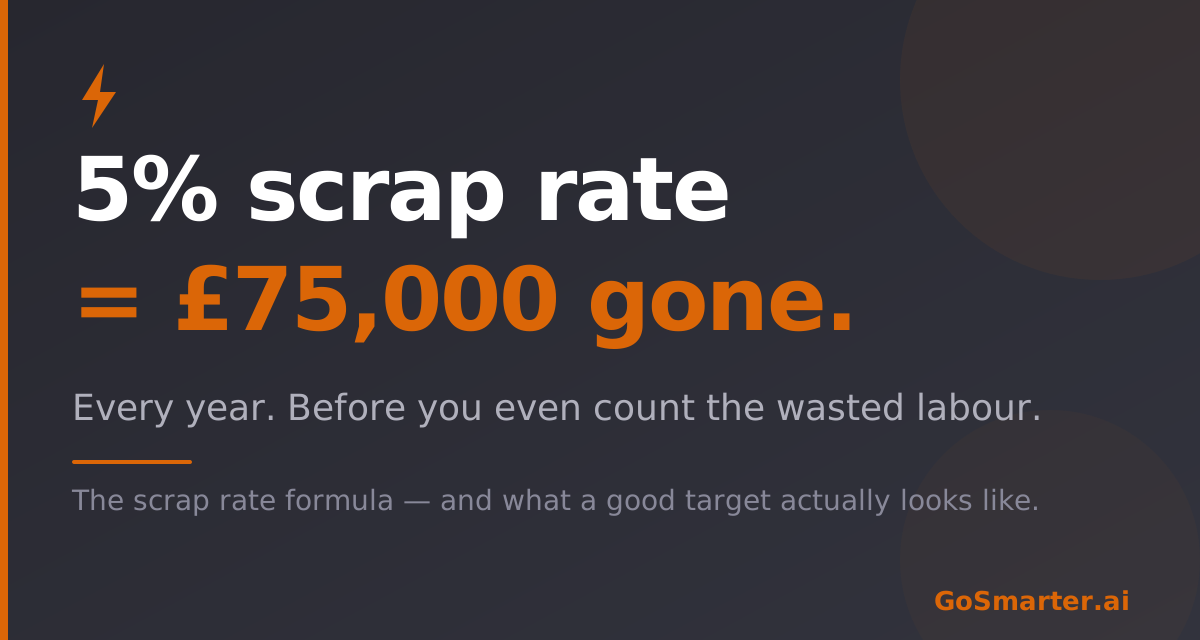
Material lost to scrap: £2,500,000 × 5% = £125,000 Net cost after recovery: £125,000 × (1 − 0.40) = £75,000 per year
That £75,000 is the floor and it doesn’t even include the labour wasted processing material that ends up in the skip, the time spent dealing with short deliveries, or the cost of emergency restocking when a job runs short.
Why Scrap Rate Changes Over Time
Scrap rates are not fixed. They move in response to:
Order mix — Short or varied order lengths generate more offcut than long, uniform orders. A week of complex bending schedules will show higher scrap than a week of straight-cut repeat orders.
Stock length availability — If your stock arrives in non-standard lengths (due to supplier variation or partial bundles), finding efficient cut combinations gets harder. More variation in incoming stock length usually means more waste.
Cut planning method — This is the biggest single lever. Manual planning using intuition and experience typically generates 5%–8% scrap. Algorithm-based planning routinely achieves 2.5%–3%. Same orders, same stock, different result.
Material handling — If you don’t track offcuts, you’ll write off material that could have fulfilled a future order. Poor bay organisation turns reusable stock into skip fodder.
Reducing Your Scrap Rate
Knowing your scrap rate is step one. Reducing it is step two.
The fastest route to lower scrap in long product manufacturing is better cut planning. The GoSmarter Cutting Plans uses mathematical optimisation to calculate the minimum-waste combination of cuts for your live orders against your live inventory. In a production trial at Midland Steel, it reduced the scrap rate from 5% to 2.5% — a 50% reduction.
Other levers worth reviewing:
- Track offcuts systematically. Offcuts that go back into stock and get reused are not scrap. You only count material that leaves the building as waste. If you are not tracking offcuts, you are probably overcounting your scrap — or losing reusable material.
- Analyse your scrap by job type. If certain order types consistently generate high offcut, you can reprice them, change your stock holding for those sizes, or plan them differently.
- Review your stock length strategy. Holding a mix of bar lengths, rather than only standard 12 m stock, gives the algorithm more options and reduces the minimum achievable scrap rate.
Scrap Rate vs Yield Rate
These two metrics are the inverse of each other:
Yield Rate (%) = 100 − Scrap Rate (%)
A scrap rate of 5% means a yield rate of 95%. Some manufacturers prefer to track yield because a higher number feels more positive, but the information is identical. Choose whichever is more intuitive for your team — just be consistent.
Some operations also track First Pass Yield (FPY), which measures the proportion of units that make it through the entire production process without any rework or rejection. FPY is more relevant for discrete manufacturing with quality inspection gates; for long product cutting, scrap rate by weight is usually the more useful measure.
FAQs
What is a scrap rate?
What is a good scrap rate for steel manufacturing?
Is scrap rate the same as defect rate?
How do I reduce my scrap rate?
How often should I calculate my scrap rate?
Go deeper
- Scrap, Waste & Yield Optimisation for Metals Manufacturers — the full hub on reducing scrap in long product manufacturing
- Smart Cuts, Less Scrap: A 1D Cutting Stock Problem — the maths behind optimised cut planning
- GoSmarter Cutting Plans — the tool that puts this into practice