How AI Simplifies Cross-Border Compliance in Metals
- BlogSmarter AI
- Edited by Steph Locke
- Blog
- May 2, 2026
- Updated:
Table of Contents Show Hide
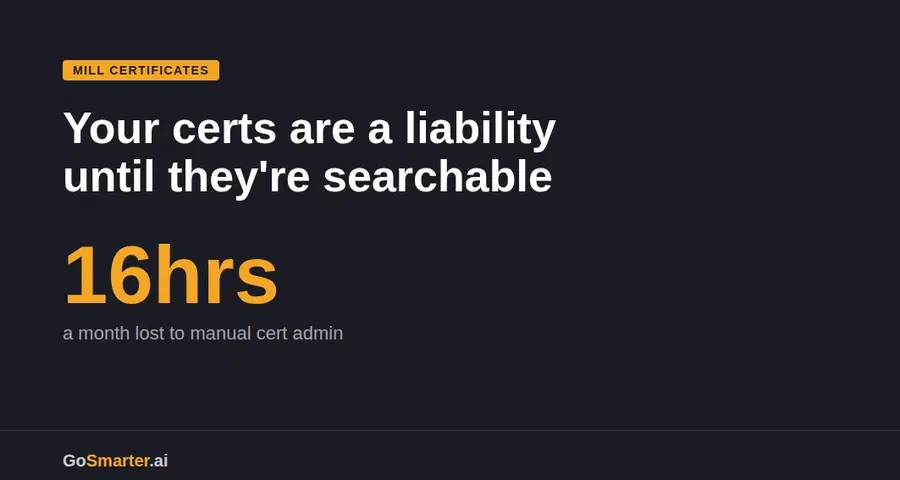
Retyping data from mill certificates costs metals teams hours every week. Mill certs arriving in French, German, or Spanish, customs declarations riddled with mismatches - the paperwork grind in international metals shipping is relentless. The cost: missed deadlines, overpaid tariffs, and hefty compliance fines.
GoSmarter - built by Nightingale HQ - offers AI tools that cut through the chaos. They turn clumsy PDFs into clean, structured data, validate it for compliance, and flag issues before they cost you time or money. Metals manufacturers, from steel stockholders to fabricators, are saving thousands of hours and slashing errors with tools like the MillCert Reader.
Here’s what you’ll get:
- Faster processing: 1-2 minutes per certificate instead of an hour.
- Fewer errors: Accuracy up to 99%, stopping fines in their tracks.
- Real-time updates: Stay ahead of changing global regulations.
- Audit-ready records: Proof of compliance at your fingertips.
Stop drowning in paperwork. Let’s fix this.
How AI Is Transforming Border Control and Trade Compliance
How AI Automates Compliance Workflows
AI takes the headache out of compliance by turning messy, unstructured data into clean, actionable records. For metals manufacturers, the compliance bottleneck often starts with mill certificates arriving as unstructured PDFs. Some are in French, German, or Spanish. One might list chemical compositions neatly in a table on page two; another hides the same details in a paragraph buried on page four. The result? Hours wasted hunting for heat numbers, carbon equivalence values, or tensile strength figures - only to re-type them into Enterprise Resource Planning (ERP) systems, where typos can trigger audit flags months down the line.
Converting PDF Certificates into Structured Data
AI tools, using Optical Character Recognition (OCR) to scan and interpret certificate layouts, tackle this chaos head-on. They scan certificates, pick out critical data like alloy composition and test results, and convert it into structured formats - CSV files, JSON, or even direct ERP feeds. What used to take 30-60 minutes per certificate can now be done in just 1-2 minutes, with accuracy jumping from 85-90% to an impressive 98-99%.
Take ArcelorMittal, for example. In early 2024, they rolled out IBM Watson’s AI OCR across 20 EU plants. This slashed manual data entry time from 4 hours per certificate to just 5 minutes, while boosting accuracy by 92%. By extracting 150 key data fields like chemical composition and heat numbers, they saved 1,200 man-hours every month, translating to annual savings of £180,000. Similarly, Thyssenkrupp automated over 500,000 supplier certificates between June and December 2023 using Rossum.ai. The result? Compliance audit prep time dropped by 85% (from 2 weeks to just 2 days), errors fell to a mere 0.8%, and they unlocked real-time shipment approvals worth €50 million.
GoSmarter’s MillCert Reader takes this a step further by focusing specifically on metals manufacturers. It extracts scrap rates and material specs to ensure compliance with standards like Registration, Evaluation, Authorisation and Restriction of Chemicals (REACH) and Restriction of Hazardous Substances (RoHS). But it doesn’t stop at faster data conversion - AI also validates the extracted data to ensure compliance, as detailed below.
Improving Accuracy with Automated Data Processing
Extracting data is only part of the story. AI then cross-checks this information against expected ranges for specific grades and standards - think EN 10204, EN 10025, or ASTM equivalents. Say a certificate claims to list S355 steel, but the carbon content falls outside the allowable range. AI flags the issue immediately at goods-in, instead of weeks later when it’s already on the shop floor. It also catches missing impact test results, swapped heat numbers, or non-conforming alloys before they cause customs delays or hefty penalties.
Siemens Energy saw this in action in 2023 when they implemented ABBYY FlexiCapture AI for their UK operations. Processing 10,000 documents a month at 98.5% accuracy, they cut regulatory non-compliance fines by £450,000 annually. Teams managing over 200 certificates a month typically reclaim 8-12 hours of admin time per week within the first month of using AI, with processing speeds now 60% faster than manual methods.
What’s the payoff? An audit-ready trail that links every certificate to its purchase order, inventory item, and customer despatch. No more scrambling through folders when customs officers demand proof of origin or carbon data. Instead, the system pulls the report in seconds, not days. This kind of automated validation isn’t just about saving time - it’s about enabling real-time monitoring and cutting compliance costs across the board.
Real-Time Compliance Monitoring with AI
Once your data is extracted and validated, the next hurdle is keeping up with regulatory changes across multiple regions. Imagine a UK metals manufacturer exporting to the EU, US, and Asia. Tracking all the updates manually - typically through legal teams and endless spreadsheets - becomes a slow, reactive process. By the time you’re notified of a regulation change, you’re already playing catch-up. This is where AI steps in, enabling continuous, real-time compliance monitoring.
What is AI compliance monitoring? It is the automated, continuous checking of your supply chain documents, regulatory updates, and shipment records against current trade rules - without a human reviewing every document.
Monitoring Regulatory Updates Automatically
AI platforms can now scan and process massive volumes of regulatory texts in real time. They monitor legislative updates, committee discussions, guidance papers, and even public consultations to flag changes before they become formal rules 1. These systems go a step further by cross-referencing your supply chain - factories, distribution centres, and transit routes - against global regulatory databases. This means you’ll know exactly which rules apply to your operations and where.
Regulatory Engines combine machine learning with frameworks built by experts, turning complex regulatory changes into clear, actionable steps. They highlight which product lines, factories, or shipments are impacted by new requirements 1.
As Inexto explains: “AI turns regulatory oversight from a reactive process into a proactive, intelligence‑driven capability” 1.
AI doesn’t just stop at identifying risks - it maps new regulations directly to your shipments or inventory. This approach reduces the need for manual updates and helps avoid non-compliance headaches. Real-time screening engines also check outbound shipments against denied party lists, export control rules, and sanctions. This prevents costly delays or holds at customs 2.
A great example is Maersk’s AI-driven customs platform, launched in June 2025. It centralises data, optimises tariff applications, and tackles common issues like tariff overpayments (5-6%) and shipment delays (20%). By applying product codes accurately and screening for compliance risks, Maersk has streamlined operations for its global customers 2. With technical regulations now affecting two-thirds of global trade and over 80 countries enforcing live reporting mandates, automation like this isn’t optional - it’s essential 2.
Creating Automated Audit Trails
While real-time monitoring keeps you ahead, automated audit trails ensure everything is traceable. AI compliance tools log every interaction with a document - who uploaded it, what data was extracted, which inventory records it linked to, and when 3. These logs are tamper-proof, meeting the strict documentation standards of ISO 9001 and EN 10204. Every mill certificate, heat number, and shipment is tagged with an auditable chain of custody, from goods arriving to final despatch.
GoSmarter’s Workshop tier, starting at £280/month billed annually, simplifies this process. It automatically links mill certificates to inventory and retrieves PDFs by heat code, ensuring compliance data stays with the material throughout production 3. The same structured records feed GoSmarter’s Metals Manager for inventory management and Cutting Optimiser for scrap reduction - one compliance record, every workflow. One UK steel stockholder using GoSmarter’s MillCert Reader saved over 120 hours a year - equivalent to three full work weeks - by automating certificate extraction and eliminating manual data entry 3.
As one UK steel stockholder shared: “Our AI tool saves hours every month by automatically pulling key data from mill certificates. It can rename documents in seconds, which is a task that is usually painfully manual” 3.
The Financial Benefits of AI Compliance Tools
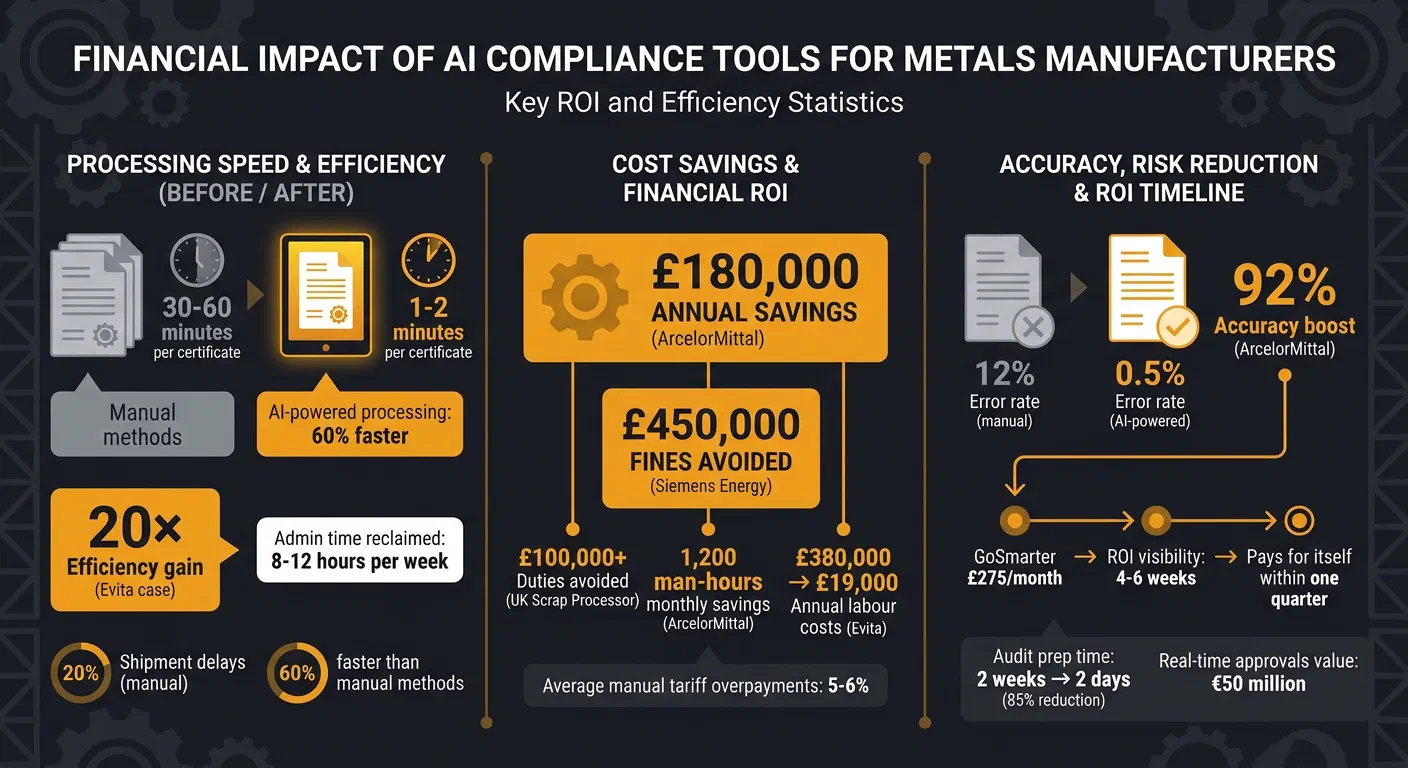
AI compliance tools slash labour costs, eliminate costly errors, and support sustainability measures that metals manufacturers can no longer afford to ignore - especially when exporting across borders.
Cutting Time and Costs
Manual compliance is a money pit. On average, manual processes lead to tariff overpayments of 5-6% and delay 20% of shipments due to poor customs preparation 2. For companies handling cross-border shipments, these numbers translate into significant financial losses. AI-powered certificate processing, on the other hand, is 60% faster than manual methods. Teams managing over 200 certificates a month can reclaim 8-12 hours of admin time per week in just the first month of using these tools 4.
The cost benefits don’t stop at speed. Take Evita, for instance. By integrating AI compliance workflows with OpenAI and Relevance AI, they reduced manual checks from hours to just 2 minutes. The result? Annual labour costs dropped from around £380,000 to £19,000 - a staggering 20× efficiency boost 5.
George Goognin, Founder of Evita, shared: “If we would try to process our current 1,000 checks/mo manually - we would spend approx $480,000/year on labor. While the AI set up keeps our costs at $24,000/year, an impressive x20 efficiency gain” 5.
Even GoSmarter’s entry-level paid tier, Workshop, priced at £280/month billed annually, typically pays for itself within a single quarter. The savings come from reduced scrap rejection and admin time - calculated against your actual incoming certificate volume 4.
AI also shields you from the hidden costs of non-compliance. Features like real-time sanctions screening and automated Harmonised System (HS) code classification prevent shipments from being held at customs, dodging hefty penalties and lost revenue. In fiscal 2025, U.S. Customs and Border Protection collected over $216 billion in duties, taxes, and fees 2. Every misstep - whether a misclassification or a delay - eats into your margins. And while these tools save money, they also pave the way for greener, more efficient operations.
Aligning with Sustainability Standards
Sustainability isn’t optional anymore. The EU’s Carbon Border Adjustment Mechanism (CBAM) requires detailed traceability and carbon data for imports. Manually extracting Carbon Equivalence (CEQ) values from mill certificates is slow, tedious, and prone to errors. AI automates this process, linking CEQ data directly to inventory records so that every piece of stock is tagged with its compliance and environmental footprint 3.
This level of traceability has knock-on benefits. By identifying non-conforming stock early, manufacturers can reduce waste, lower their carbon footprint, and keep production schedules intact 4. For those exporting to the EU, automated CEQ extraction turns CBAM reporting from a quarterly panic into a routine background operation. GoSmarter’s MillCert Reader, for example, pulls data directly from incoming certificates, keeping you audit-ready without the need for manual input 3.
AI compliance tools don’t just reduce costs - they transform regulatory challenges into actionable insights. By automating compliance, you’re not only saving money but also supporting greener, more efficient operations.
Implementing AI Compliance Solutions
Manufacturers can now adopt AI compliance tools without upending their existing workflows. These tools fit into current operations without disrupting them, delivering results in days rather than months.
Working with Legacy ERP Systems
Many metals manufacturers still rely on older ERP systems like SAP R/3, Epicor, or Sage - platforms that have been the backbone of their operations for years. The good news? Modern AI compliance tools don’t require a complete system overhaul or production downtime. For instance, GoSmarter uses integrated API connectors and CSV workflows to translate data from these older systems into updated formats, all without custom coding. GoSmarter customers have reported high data compatibility with legacy SAP R/3 systems, cutting integration time from months to weeks - without the cost of a full ERP upgrade.
Integration can be approached in two main ways:
- CSV files: Platforms like Infor, Microsoft Dynamics, and SAP Business One support this straightforward method.
- REST API: Enables real-time data synchronisation for a more dynamic connection.
Because GoSmarter operates through a browser, there’s no need for local installation or a complicated IT rollout. It sits on top of your existing ERP, Excel, or email - no rip-and-replace required. For deeper integration, GoSmarter connects via REST API with OAuth 2.0 and Microsoft Entra (SSO) authentication. Certificate data is hosted on UK Azure infrastructure, and GoSmarter never uses your data to train its models - your records remain your own. Teams can immediately start processing certificates, export the structured data as a CSV, and upload it directly into their ERP. Once integration is sorted, the next step is getting teams up to speed with the new tools.
Training Teams on AI Systems
AI compliance tools are designed to be simple to adopt, often requiring just one to two days for teams to become proficient. In Sheffield’s steel sector, role-specific sessions - short online demos combined with hands-on exercises - typically achieve strong adoption within the first month. Quick micro-training sessions of 15-30 minutes during shifts further minimise downtime, with return on investment often visible in as little as four to six weeks.
Training shifts the focus for staff from manual data entry to reviewing and validating AI-generated outputs. Teams learn to interpret automated reports, flag potential issues (like REACH non-compliance), and cross-check results against source PDFs. Focused training has helped metals manufacturers achieve dramatic reductions in compliance error rates, allowing them to handle more cross-border shipments each quarter without adding headcount.
With skilled teams in place, manufacturers can quickly take advantage of tools that deliver immediate results.
Starting with Quick-Win Solutions
The fastest way to showcase ROI is by deploying a quick-win tool like GoSmarter’s MillCert Reader. This tool automates the conversion of mill certificates from PDFs into usable data, generating compliance reports for tariffs and sustainability requirements in minutes. Cloud-based and easy to use, it saved one UK scrap processor 20 hours per week on data entry and helped avoid substantial customs duty exposure.
Manufacturers get a 7-day free trial to process real certificates from their current suppliers, often proving ROI in a single session. For operations processing more than 200 certificates a month, the time savings - 8 to 12 hours weekly - can justify the investment almost immediately. With an annual subscription priced at £280/month billed annually, most companies recover the cost through staff time savings within the first quarter. See how Midland Steel used GoSmarter to gain real-time traceability over their incoming mill cert data. These quick wins provide a smooth transition from manual processes to AI-powered efficiency, setting the stage for broader adoption.
FAQs
What documents can AI extract data from besides mill certificates?
How does AI spot non-compliant certificate data before goods-in approval?
What do we need to integrate AI outputs with our existing ERP?
Further Reading
1: The New Compass for Regulatory Navigation in Global Supply Chains - Powered by AI | Inexto
2: AI-Powered Customs Automation: How CXTMS Eliminates Cross-Border Compliance Delays | CXTMS
3: Mill Certificate Automation for Metals | GoSmarter
4: EN 10204 Compliance Software for Metals | GoSmarter
5: How to Apply AI to Streamline Cross-border Payments Compliance and Increase Productivity x20 | Financial IT
About the Author

Editor· Co-founder & Head of Product
Steph Locke is Co-founder and Head of Product at GoSmarter AI — former Microsoft Data & AI MVP building practical tools to cut paperwork and automate compliance for metals manufacturers.