Fire safety failings identified at Hinkley Point C by regulators
- BlogSmarter AI
- Edited by Steph Locke
- Blog
- February 23, 2026
- Updated:
Table of contents Show Hide
Regulators have identified significant fire safety failings at the Hinkley Point C nuclear power construction site, prompting formal enforcement action. The Office for Nuclear Regulation (ONR) has issued fire enforcement notices to five organisations involved in the project after uncovering serious deficiencies during a targeted inspection in December 2025.
Safety concerns at critical infrastructure
The inspection, which focused on the Unit 1 HF (electrical) building, revealed a lack of compliance with the Regulatory Reform (Fire Safety) Order 2005. Among the issues identified were the absence of a suitable and sufficient fire risk assessment for the site, inadequate emergency escape provisions, and the accumulation of combustible materials in a designated emergency exit staircase. These deficiencies posed a significant safety risk, particularly given the scale and complexity of the ongoing construction and the number of workers present.
Enforcement notices issued to contractors
The enforcement notices were served to five organisations involved with the Mechanical, Electrical, and Heating (MEH) alliance and Heating, Ventilation and Air Conditioning (HVAC) works at the Somerset site. The organisations include Altrad Babcock, Altrad Services, Balfour Beatty Kilpatrick, Cavendish Nuclear, and NG Bailey. The notices require these contractors to “make improvements to ensure adequate arrangements are developed and embedded to address the shortfalls in compliance and prevent reoccurrence”, according to the ONR.
Regulator underscores the importance of fire safety
Highlighting the severity of the findings, Mahtab Khan, ONR’s Head of Regulation – EPR, emphasised the need for rigorous fire safety measures on nuclear construction sites. “Fire safety is an important part of our regulatory activity and is not optional – it is a legal requirement that protects lives”, Khan stated. He also affirmed ONR’s commitment to holding dutyholders accountable, saying, “We will not hesitate to take enforcement action where safety standards fall short, and we expect all dutyholders to treat fire safety with the urgency it demands.”
Collaboration to address risks
The ONR confirmed that while the identified deficiencies did not result in any immediate danger to workers, the public, or the environment, the potential for harm was categorised as unacceptable. Collaborative efforts are underway to address the risks, with Khan noting that “working alongside the principal contractor and MEH alliance, we have made good progress in understanding the root causes of these shortfalls to ensure they are addressed.”
This regulatory action forms part of the ONR’s broader oversight of Hinkley Point C, one of the largest and most complex infrastructure projects in the UK, as it seeks to ensure that safety standards are upheld at every stage of construction.
FAQs
What is the fire safety and quality management — the data dimension?
The fire safety failings identified at Hinkley Point C are, at their core, a quality management failure. Materials and systems that do not meet specification have been installed in a safety-critical environment. The question of how this happens in a large, heavily regulated project — with multiple layers of inspection, certification, and quality assurance — is one that applies to any manufacturing supply chain where compliance matters.
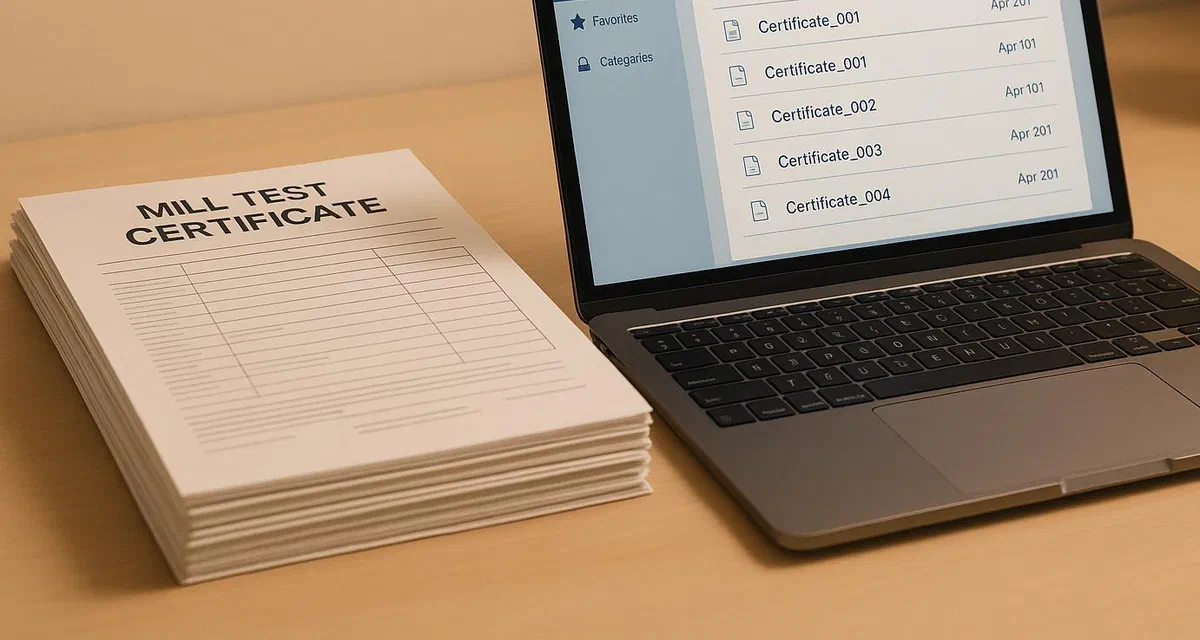
The answer often involves a combination of documentation failures, supply chain opacity, and the gap between what quality assurance processes are designed to catch and what they actually catch in practice. In metals manufacturing, this is not an abstract problem. The mill certificates and inspection records that accompany structural steel, reinforcing bar, and pressure vessel components are the paper trail that is supposed to prevent exactly these situations.
Why does documentation quality matter even when the steel is right?
The steel itself might be correct — the right grade, the right chemical composition, the right mechanical properties. But if the documentation does not match, or if it cannot be produced when a regulatory inspection or customer audit requires it, the consequences can be severe. Delays, rework requirements, and in safety-critical applications, the kind of regulatory intervention that Hinkley Point C experienced.
GoSmarter’s mill certificate management and material traceability tools address this documentation quality challenge directly. Automating the extraction and storage of certificate data ensures that the documentation that matters is captured accurately, stored reliably, and retrievable when it is needed — whether that is next week or in five years when an inspector asks for evidence that a particular batch of material met the required standard.
What is the broader lesson for the construction supply chain?
Hinkley Point C is an extreme case — the largest construction project in Europe, in a heavily regulated sector, with safety implications that are literally existential. But the quality management lessons apply across the construction supply chain, from major infrastructure projects to commercial buildings to residential developments. The steel that goes into a building needs to meet specification, and the documentation that proves it met specification needs to be complete and retrievable.
As Building Information Modelling (BIM) requirements and golden thread legislation (following Grenfell) make documentation requirements more stringent across construction, the ability to manage material certification data reliably is becoming a competitive requirement for steel distributors and fabricators supplying the construction market.
About the Author

Editor · Co-founder & Head of Product
Steph Locke is Co-founder and Head of Product at GoSmarter AI — former Microsoft Data & AI MVP building practical tools to cut paperwork and automate compliance for metals manufacturers.