Heat vs Lot vs Batch Number: What's the Difference?
- BlogSmarter AI
- Edited by Steph Locke
- Blog
- November 6, 2026
Table of Contents Show Hide
A heat number traces the melt. A lot number traces a stock group. A batch number traces a processing run. Confuse them and you risk holding the wrong material, or releasing it.
This post is for quality and stores teams at metals manufacturers. If you first need the paperwork basics, read the MTR vs MTC comparison. A PDF alone can’t link a heat to a lot and a furnace load. That job needs integrated certificate traceability from goods-in to dispatch.
You’ll learn how to:
- Follow 1 heat through 2 lots and 2 furnace loads.
- Match certificates, labels and work orders before release.
- Set quality holds around the fault, not just the number.
What Is a Heat Number on Steel?
A heat number is the identifier a mill gives to one melt, or furnace charge, of metal. It ties the material to its chemistry and test results on the mill certificate.
Want the practical side? Read our guide to tracing a heat number back to its mill certificate. For a plain-English definition, see what a heat number is. Prefer video? This short clip from Steel Supply L.P. explains what a heat number is on steel.
Compare Heat, Lot and Batch Numbers
Usage varies between companies and standards, so confirm each term with your supplier. This table shows the common pattern.
| Identifier | Often assigned by | What it covers | What it traces | Typical documents | Links to other identifiers |
|---|---|---|---|---|---|
| Heat number | Mill or primary metal producer | One melt or furnace charge | Chemical composition, cast origin and mill test results | Mill test certificate, material test report, mill tag, product marking | A producer may split one heat into several lots. Processors may use it across several batches |
| Lot number | Distributor, service centre, processor or purchaser | Defined stock, shipment or inspection group | Material grouped for inventory, sampling or acceptance | Delivery note, stock label, inspection report, certificate of conformity | May link to one heat, part of a heat or multiple heats if records document the links |
| Batch number | Processor or manufacturer | One production or processing run | Operations that share common conditions | Production record, furnace chart, traveller, batch record, heat-treatment certificate | One batch may contain material from several lots. Keep the heat reference for each input |
The metals manufacturing glossary defines each term. Always ask whether a group contains multiple heats and which certificates apply.
A shared heat number doesn’t prove identical mechanical properties after processing. Check the test scope and heat-treatment records before you apply results to the whole group.
Example: 1 Heat, 2 Lots and 2 Furnace Loads
This illustrative example uses invented numbers. It shows how one stainless-steel heat splits into two lots, then into separate furnace loads. The heat number stays the anchor across the certificate, labels and production records.
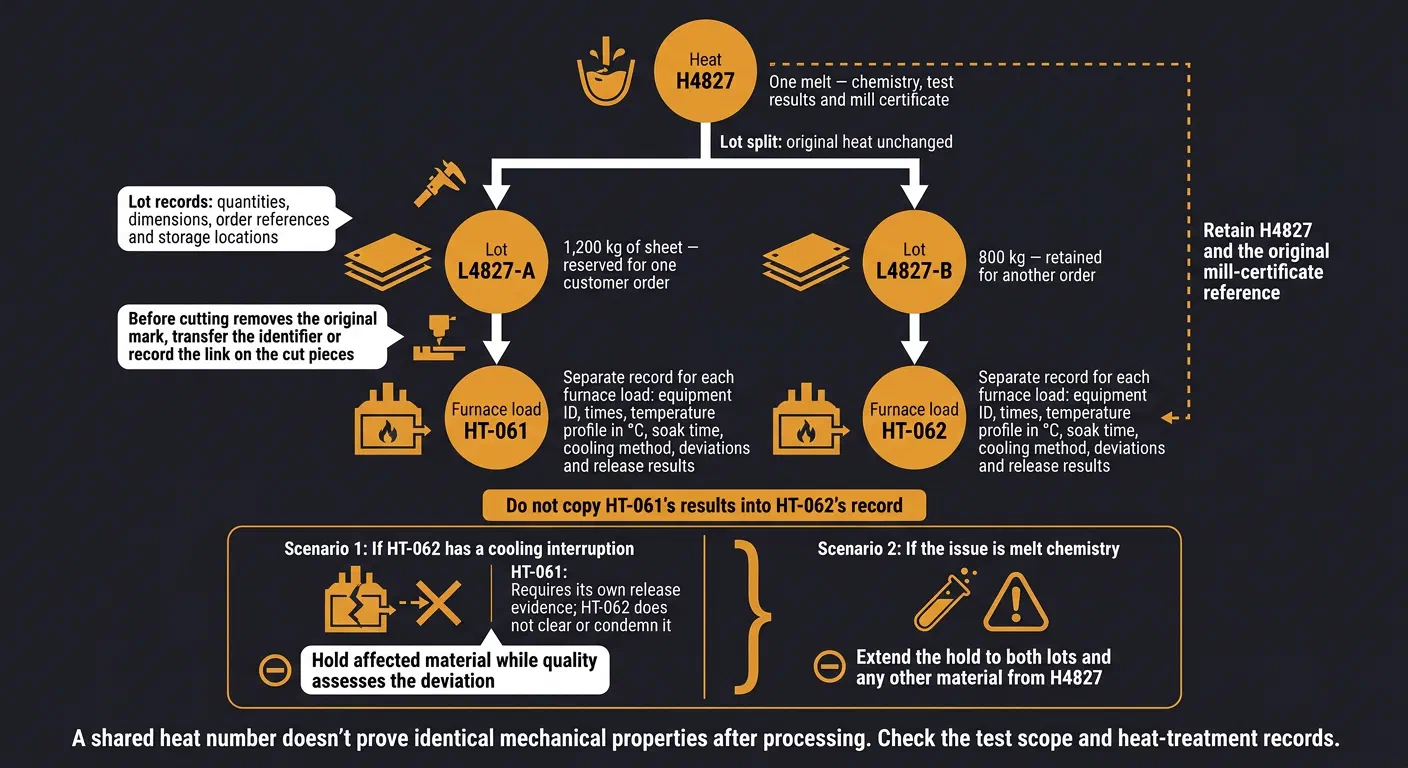
Divide Heat H4827 into Lots L4827-A and L4827-B
The mill assigns H4827 to the melt and records its chemistry, test results and mill certificate. A distributor then divides the heat. L4827-A is 1,200 kg of sheet reserved for one customer order. L4827-B is 800 kg kept for another order.
Both lot records keep H4827 and the original mill-certificate reference. They also hold quantities, dimensions, order references and storage locations. Cutting can remove the original mark. Before you cut, transfer the identifier or record the link on the cut pieces.
The lot split doesn’t change the original heat. The furnace loads create a separate process trail.
Track Furnace Loads HT-061 and HT-062 Separately
The processing paths are H4827 > L4827-A > HT-061 and H4827 > L4827-B > HT-062. Keep a separate record for each furnace load. Include:
- Equipment ID and times.
- Temperature profile in °C and soak time.
- Cooling method.
- Deviations and release results.
Don’t copy HT-061’s results into HT-062’s record.
Suppose HT-062 has a cooling interruption. Hold the affected material while quality assesses the deviation. HT-061 needs its own release evidence. HT-062 neither clears nor condemns it. If the issue is melt chemistry, extend the hold to both lots and any other material from H4827.
Verify Material Identity and Set Quality Holds
Once you know the heat, lot and batch trail, check the paperwork against the material before release.
Match the Certificate, Stock Label and Work Order
- Read the certificate before release. Record the original heat number, grade, product form, dimensions, quantity and specification. The field guide to reading a mill test certificate walks through each line.
- Match the physical material to the delivery record. Compare its heat marking and supplier lot or bundle reference against the certificate, delivery note and receiving record. Record the internal lot, quantity, storage location and inspection status. Add the checker’s name and the delivery date.
- Attach processing references to the work order. Keep heat, lot and batch references, procedure revision, process records and test results. Carry them through cutting, fabrication, testing and shipment. Never replace the original heat number with an internal code.
The goods-in procedure covers step 2 in more detail.
Use Quality Records to Decide What to Hold
Start with the defect, not the label. Chemistry issues start at heat level. Receiving mismatches start at lot level. Furnace deviations start at batch level. Check certificates, stock movements, load sheets and test evidence to see whether the uncertainty reaches further. Let the findings and the applicable specification set the final scope, not the identifier alone.
Block use while quality decides what happens next. Apply a hold tag and a system block. Record affected quantities, locations and work orders. Add the detection date and time, the breached requirement and the authorised approver. Release unaffected material only when records show it sits outside the affected scope. Keep the evidence behind each outcome: release, retest, rework, concession, return or rejection. ISO 9001 clause 8.7 on nonconforming outputs expects this kind of control.
Check a Heat Trail with GoSmarter
GoSmarter, built by Nightingale HQ, is a material traceability platform that sits on top of your existing ERP, spreadsheets and email. No rip-and-replace. MillCert Reader reads a mill certificate and extracts the heat number, grade, chemistry and mechanical results. You compare them against the original. Metals Manager holds the inventory the certificate links to. One heat number connects both.
Open the inventory item and enter or confirm its heat number. Certificates link to the inventory items they cover, and you can search by heat number. Open the linked certificate and check the original PDF sits beside the extracted data. If you split stock into bundles or pieces, check each new record still shows the correct heat number. The guide to digitising mill certificates explains the steps.
Then check the lot and batch records yourself. Stock and cut records should carry the lot reference. Production and heat-treatment records should carry the batch or furnace-load reference. GoSmarter anchors the certificate link to the heat number. That link doesn’t prove every lot-to-batch connection. Verify those references and flag any missing link for quality review before release.
For your IT team, every paid plan includes a REST API and CSV export. GoSmarter stores your data on Microsoft Azure in UK data centres. GoSmarter uses de-identified certificates to improve its own extraction models. It never shares them with other customers or third-party AI providers.
On the stated inputs, MillCert Reader recovers its upfront annual fee in about 11 months. Your own payback depends on volume and labour cost. You can start with a 7-day free trial. See the pricing page for plans.
FAQs
Are heat numbers unique across different mills?
No. A heat number identifies one melt at a specific mill. Each mill uses its own numbering system. Different producers can therefore use the same heat number.
For accurate traceability, check both the producer name and the heat number on certificates and inventory records.
What if my supplier uses lot and batch interchangeably?
Don’t assume lot and batch mean the same thing. They may identify processing groups, goods-in events or stock groupings. Ask your supplier for a written cross-reference so you keep a clear traceability record.
Prioritise the heat number for compliance. It identifies the original melt. Check that the linked mill certificate matches your material.
What is the difference between a heat number and a batch number?
What should I do if a heat marking is lost?
Quarantine the material immediately and treat it as non-conforming. Testing a piece shows its properties, not its original melt. It doesn’t restore the link to the heat.
Don’t release it to production without a verified link to the original mill certificate. Ask the supplier or mill for official documentation or a written cross-reference.
If you can’t reliably recover its original identity, reject the material or keep it on permanent hold.
Drill deeper
- How to Trace a Heat Number Back to Its Mill Certificate
Go here for the goods-in steps that match one marked heat number to its certificate.
12 min read
- Material Test Report (MTR) vs Mill Test Certificate (MTC): What's the Difference?
Go here if you first need to know whether a material test report and a mill test certificate are the same document.
8 min read
- Your ERP Calls It Traceability. It Isn't.
Go here if your enterprise resource planning (ERP) system tracks lots but not heats.
10 min read
About the Author

Editor· Co-founder & Head of Product
Steph Locke is Co-founder and Head of Product at GoSmarter AI — former Microsoft Data & AI MVP building practical tools to cut paperwork and automate compliance for metals manufacturers.