Your S&OP Meeting Is Built on the Wrong Numbers
- BlogSmarter AI
- Edited by Steph Locke
- Blog
- May 11, 2026
- Updated:
Table of Contents Show Hide
GoSmarter is an AI platform that gives metals manufacturers real-time, cert-linked inventory data, so that Sales and Operations Planning (S&OP) reviews run on live floor data rather than last night’s ERP batch. Most GoSmarter customers eliminate the ghost stock problem within the first week of go-live. That cuts emergency spot purchasing and the excess holding costs that follow from stale data.
Your S&OP meeting is the most important decision session in your month. In most metals businesses, it is running on data that is already three to four weeks out of date.
Enterprise Resource Planning (ERP) systems batch-update overnight at best. Stock committed to an order that shipped three days ago is still listed as “available.” A shortfall that will force an emergency spot purchase next week has not yet appeared in anyone’s numbers. So your commercial team arrives with one set of figures, operations arrives with another, and the meeting burns 45 minutes reconciling spreadsheets instead of making decisions.
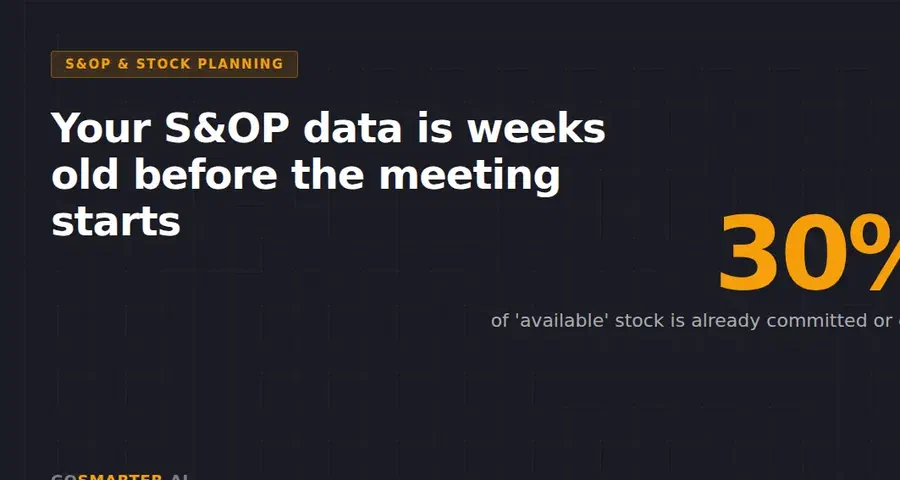
Ghost stock typically runs at 20 to 30 percent of recorded available inventory in a typical metals operation. That is not a rounding error. That is a quarter of your stock picture being materially wrong at the moment your S&OP team is trying to plan the next month.
GoSmarter fixes the data problem. Inventory updates in real time at the point of movement, not batched overnight. Mill certificates link to stock at goods-in. Committed versus available positions reflect what is actually on the floor right now. Your S&OP review becomes a decision meeting, not a reconciliation exercise. Whether your planning cycle is a formal monthly review or a Monday morning call about what’s short, the same data gap applies.
Here is what this post covers:
- Why S&OP reviews break down in metals and where the data gap comes from
- The ghost stock problem: what it costs and why ERP cannot solve it cleanly
- How emergency spot purchasing drains 8 to 15 percent above your contracted rates
- What real-time, cert-linked inventory data changes about your monthly planning cycle
- Quantified comparisons and the GoSmarter tools that fix each stage
Why S&OP Keeps Breaking Down in Metals
S&OP is supposed to reconcile demand and supply into a single agreed plan. Commercial brings the order book. Operations brings the material and capacity constraints. Together you agree on what to build, what to buy, and when.
In practice, both sides are working from different systems at different points in time. Commercial is looking at the order management view from this morning. Operations is looking at a stock position from last night’s ERP batch run. Finance is working from last month’s actuals. Nobody is looking at the same thing.
When the plan that emerges is built on mismatched data, every downstream commitment is suspect. Orders get promised against material that has already gone. Shortfalls go undetected until it is too late to solve them through normal procurement. The excess stock that nobody trusted enough to commit against sits in the yard, costing money and collecting dust.
The argument is not about commercial versus operations. It is about whose data snapshot is least wrong. That is a solvable problem.
The Ghost Stock Problem: 20–30% of Your Available Inventory Is Wrong
Here is the structural issue your ERP was never designed to solve cleanly.
When the commercial team raises a sales order and commits material, ERP flags that stock as allocated. When the order ships, gets cancelled, or changes specification mid-process, the allocation does not always clear correctly or immediately. The record persists. The stock remains listed as “available” in the view your S&OP planner is using to commit the next month’s production.
Ghost stock runs at 20 to 30 percent of recorded available inventory in a typical metals operation. One in four or five units your planner believes is free to commit is already spoken for, shipped, or simply wrong. The plan your S&OP team builds on top of that data inherits every one of those errors.
The practical consequence: your team commits to orders the material cannot support. The gap surfaces too late. Someone goes to the spot market.
What Emergency Spot Purchasing Costs You Each Month
When a shortfall surfaces two weeks before a delivery date, you do not have time to wait for a scheduled purchase order to work through the system. You go to the spot market and pay whatever it takes.
Spot purchasing for metals carries a premium of 8 to 15 percent above your contracted rates. On a single order of 50 tonnes of structural steel at £800 per tonne, that premium adds £3,200 to £6,000 to one transaction. For a business firing off five or six emergency purchases a month, the annual drain on margin is substantial. It never shows up clearly in any single cost line on the Profit and Loss (P&L). It accumulates invisibly across hundreds of small decisions made under time pressure.
The trigger is almost always the same: a shortfall discovered too late to solve through normal procurement. Fix the data timeliness, and you fix the timing. Fix the timing, and you eliminate most of the premium.
The Excess Holding Trap: 3–5% of Revenue Sitting in the Yard
Ghost stock creates the opposite problem simultaneously.
When planners do not trust inventory data, they over-order. The rational response to uncertainty is to keep material on-site rather than risk a shortfall and a missed delivery. That behaviour protects individual order dates in the short term. It is expensive at the year level.
The typical metals manufacturer running manual or batch-updated planning carries 3 to 5 percent of revenue in excess stock. Warehousing, insurance, and eventual obsolescence all compound. On a business turning over £10 million, that is £300,000 to £500,000 in cash sitting in the yard, not working. It appears on the balance sheet as inventory and quietly loses value.
Integrated planning and materials alignment closes this gap. But only when the inventory data underneath it is accurate enough to trust. A well-designed planning process built on stale data still produces a bad plan.
What the Right Data Changes About Your S&OP Review
A GoSmarter-backed S&OP review looks different from the start.
Commercial brings the order book. Operations brings a live view of committed versus available material, accurate to the current moment. Finance can see the margin implications of every material position: the cost of excess stock on one side, the premium exposure from potential shortfalls on the other. The team builds the agreed plan from a single shared picture, not three different snapshots taken at three different times.
That changes the function of the meeting. Instead of spending 45 minutes reconciling competing spreadsheets, the team makes actual decisions about procurement timing, production priorities, and order commitments. The conversation is about what to do, not about whose numbers are correct.
Real-Time Inventory: Updated at the Point of Movement, Not Overnight
The core problem with ERP inventory management is that updates are transactional and batched. A movement happens on the shop floor. Someone logs it in the system eventually. The system processes it overnight. By the time the data reaches your S&OP planner the next morning, it is already history.
GoSmarter’s real-time inventory visibility works differently. Every movement (goods-in, cut, transfer, despatch) updates the live stock position at the point it happens. There is no overnight batch. There is no manual log-in lag. There is no “as of last Tuesday” caveat attached to the data your planners are using.
When your S&OP team pulls the committed versus available position on a Wednesday morning, they are seeing Wednesday morning’s reality. That one change (live updates instead of batch updates) removes the structural cause of most S&OP data disputes.
Cert-Linked Stock: Not Just Quantity, but Whether It Is Compliant
Quantity is only half the S&OP question. In metals manufacturing, material compliance is the other half.
Your S&OP review might show 30 tonnes of 316L stainless plate available in the yard. But if 20 of those tonnes arrived without a valid mill certificate, or with certs not yet verified against the purchase order specification, they are not available for any order requiring full EN 1090 or National Structural Steelwork Specification (NSSS) traceability. Committing those tonnes to a certified-spec order and discovering the compliance gap at despatch is an expensive problem to fix under deadline.
GoSmarter’s Mill Certificate Reader links cert data to stock at goods-in using AI Optical Character Recognition (OCR). The moment material arrives, the cert is read, validated, and attached to the stock record. Your S&OP reviewers can see not just how many tonnes are on-site, but how many of those tonnes are certified to the specification required by pending orders.
That removes a second class of S&OP error entirely: committing certified-spec jobs to non-certified stock, then finding out at the wrong moment.
Better Cut Plans Mean Less Material to Buy Next Month
One of the underappreciated S&OP inputs in long-product metals operations is the cutting plan. The more efficiently you cut existing stock, the more orders you fulfil from what you already have. That directly reduces the volume of new material you need to commit in the next planning cycle. And it reduces the urgency that pushes buyers onto the spot market.
GoSmarter’s Cutting Optimiser generates AI-driven cut plans that minimise offcuts and maximise material yield across multiple orders simultaneously. In an S&OP context, better cut plan data shows you exactly how far current stock stretches before you need to buy more material. That shrinks both the frequency and the cost of new material purchases.
The Numbers: What Fixing S&OP Data Actually Saves
| S&OP Problem | With Manual or ERP Batch Data | With GoSmarter Live Data |
|---|---|---|
| Ghost stock in “available” inventory | 20–30% of recorded stock already committed or gone | Real-time committed vs available; stale allocations cleared at point of movement |
| Emergency spot purchase premium | 8–15% above contract rate on each emergency order | Shortfalls surface in time for scheduled procurement |
| Excess stock holding cost | 3–5% of revenue tied up in the yard | Right-sized procurement driven by accurate stock and demand signals |
| Cert compliance at despatch | Discovered at the point of shipping | Cert-linked at goods-in; visible in S&OP data from day one |
| Time lost in S&OP data disputes | 30–45 minutes reconciling competing snapshots | Single live view; meeting time redirected to decisions |
These are structural differences between batch-updated ERP data and real-time operational data. The savings are not theoretical. They are the direct result of closing the gap between what happened on the floor and what the planning team can see.
Midland Steel: What Accurate Production Data Delivers
The Midland Steel case study is the clearest available evidence of what happens when production data becomes reliable. In a two-week GoSmarter trial, the scrap rate dropped by 50 percent. That result came directly from having accurate, real-time data about what the team was cutting, how, and what material remained.
The S&OP principle is identical. When your production data is accurate, your S&OP inputs are accurate. When your S&OP inputs are accurate, your material commitments are accurate. And when commitments are accurate, the downstream costs of ghost stock, spot purchasing, and excess holding start to compress.
Data quality is not a back-office concern. It determines whether your planning review produces a plan you can act on. Or one you quietly revise the moment the meeting ends.
How to Quantify Your Own S&OP Data Gap
Every metals business carries a different combination of ghost stock exposure, spot purchasing frequency, and excess holding cost. The specific opportunity depends on your order volumes, material mix, and how far your current ERP data drifts from physical reality by the time your S&OP team uses it.
The Business Case Calculator lets you model this for your own operation before committing to anything. Enter your annual turnover, current scrap rate, and estimate of monthly emergency purchases, and it returns a quantified picture of what better data could recover. Want to see what GoSmarter costs before you run the numbers? Our pricing page gives you the full picture.
If your S&OP review is currently a data dispute rather than a planning session, that calculator is the right place to start.
Frequently Asked Questions
What is S&OP in a metals manufacturing context?
Why does ERP data cause problems for S&OP reviews in metals?
How does GoSmarter complement an existing ERP system?
Can GoSmarter show whether available stock is certified to the required specification?
What is the real cost of ghost stock in a metals operation?
How quickly can GoSmarter flag a potential material shortfall before it becomes a spot-purchase emergency?
What is a realistic timeline to see results after going live with GoSmarter?
Does this work for smaller operations without a formal S&OP process?
Go Deeper
- Real-Time Inventory Visibility — live committed vs available data, reorder alerts, and commitment management for metals operations
- Integrated Planning and Materials Alignment — connecting demand, material, and production into a single accurate plan
- Scrap, Waste & Yield Optimisation — how GoSmarter cuts scrap by up to 50% and feeds that back into S&OP material planning
- Cutting Optimiser — AI-driven cut plans that reduce new material demand at each planning cycle
- Midland Steel Case Study — real-world results from GoSmarter in a live production environment
- Finance Solution — material cost tracking and margin protection from the finance perspective
- Business Case Calculator — quantify your own S&OP data gap before committing to anything
About the Author

Editor· Co-founder & Head of Product
Steph Locke is Co-founder and Head of Product at GoSmarter AI — former Microsoft Data & AI MVP building practical tools to cut paperwork and automate compliance for metals manufacturers.