GoSmarter Now Covers Non-Ferrous Metals: Copper, Bronze, and Beyond
- Steph Locke
- Blog
- June 1, 2026
- Updated:
Table of Contents Show Hide
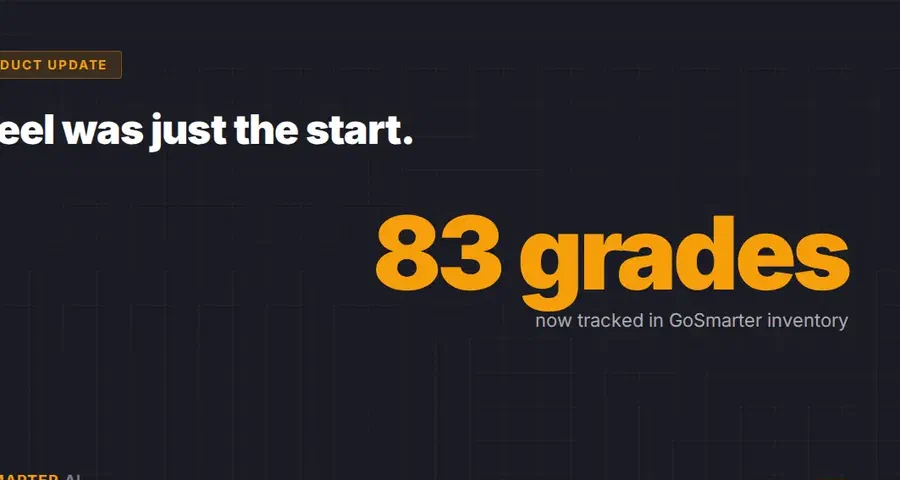
GoSmarter now ships with a built-in starter list of 83 grades and 18 product forms out of the box: copper-nickel alloys C70600 and C71500, eight bronze grades, three distinct copper grades, and marine aluminium alloys 5383 and 5456, with full mill certificate traceability for each grade. If the starter list works for you, there is nothing to configure. If the starter list doesn’t fit, you can create your own, including grades with ID numbers that map directly to your ERP. The metals emissions calculator now covers copper alloys alongside steel, with Carbon Border Adjustment Mechanism (CBAM)-ready regional factors for aluminium.
Steel got GoSmarter off the ground. But a lot of the businesses we talk to don’t only hold steel. They hold copper-nickel (Cu-Ni) pipe for marine and offshore work. They hold bronze flanges and fittings for valve assemblies. They hold aluminium-bronze (Al-Bronze) bar for wear-critical applications where strength and corrosion resistance both matter.
For too long, those materials lived in a separate spreadsheet, or a separate system, because the inventory tool only understood steel grades. Here is what has changed across the platform.
Inventory: 83 grades, 18 product forms, built in and ready to go
GoSmarter Metals Manager ships with a built-in starter list of 83 grades and 18 product forms (up from 63 grades and 11 forms before this update). If the starter list covers what you stock, there is nothing to configure: open an account and those grades are ready to use.
If it does not fit your business exactly, you can create your own reference data. Build your list line by line, import from a CSV using GoSmarter’s template, or start from the built-in list and edit from there. Your grades can use any naming convention or ID scheme you like, including codes that map directly to your ERP system. A business stocking 400 proprietary alloy designations can make GoSmarter feel entirely bespoke. A small team that only needs a handful of values can strip the list right back. Read more about reference data customisation →
Copper-nickel: a new category
Added C70600 (90/10 Cu-Ni) and C71500 (70/30 Cu-Ni), the two dominant alloys for marine heat exchangers, seawater piping systems, and offshore structural tube. Previously an entirely missing category in GoSmarter. If you’re supplying into naval, offshore, or desalination plant projects, these are the grades on the shelf.
A nominal-diameter (DN) 50 C70600 pipe and a DN 50 C71500 pipe look identical on the rack. They have different corrosion resistance, different suitability for brackish versus full seawater service, and different mechanical properties. GoSmarter now tracks them as the separate materials they are.
Bronze: eight grades, not a catch-all
Bronze was already partially supported in the weight calculator but had zero inventory database entries, making proper stock management impossible for bronze distributors. That’s fixed. Eight grades now covered:
- Naval Bronze
- Phosphor Bronze
- Aluminium Bronze (Al-Bronze)
- Silicon Bronze
- Manganese Bronze
- Bearing Bronzes (Leaded, Tin, and Sintered variants)
Bronze is not one material. A Phosphor Bronze bushing and an Aluminium Bronze propeller are different alloys with different mechanical properties and different traceability requirements.
Copper: three proper commercial grades, not one
GoSmarter previously had a single generic “Copper” entry. We replaced it with three distinct commercial grades:
- C10200: oxygen-free, high-conductivity (OFHC) copper; used in electronics and electrical applications where contamination cannot be tolerated
- C11000: electrolytic tough pitch (ETP) copper; the standard commercial grade for bus bars and electrical conductors
- C12200: phosphorus deoxidised (DHP) copper; the right choice for welded plumbing tube and heat exchangers because it doesn’t go brittle when welded
These three grades have different weldability and conductivity characteristics. A single “Copper” tag makes accurate inventory tagging impossible. Now you can record what you actually have.
Marine aluminium
Added alloys 5383 and 5456, high-strength marine aluminium alloys widely stocked by non-ferrous distributors for shipbuilding and offshore structural work. Previously absent from GoSmarter entirely.
Both alloys are stocked in temper designations (-H116 and -H321) that govern weld qualification for marine structural use under Det Norske Veritas (DNV) and Lloyd’s Register specifications. GoSmarter tracks plate, sheet, extrusion, and bar in both alloys, with the temper designation recorded as part of the grade attribute.
Stainless steel
Added 303, 304L, 316L, 317L, and 17-4 PH. That covers:
- 303: the free-machining stainless for turned parts; different composition from 304 and not interchangeable
- 304L: the low-carbon variant of 304, used for welded pressure assemblies where sensitisation is a concern
- 316L: low-carbon 316, the workhorse of marine and chemical processing environments; commonly stocked by non-ferrous distributors
- 317L: higher molybdenum content than 316L; used where chloride resistance needs to go further
- 17-4 PH: precipitation-hardened stainless for aerospace and oil & gas applications; different processing and mechanical properties from austenitic grades
These are not interchangeable materials. A coil of 304L and a coil of 316L have different cost, corrosion resistance, and suitability for different applications. GoSmarter now tracks them separately, because they are separate.
New product forms
Added Pipe, Fitting, Flange, Fastener, Angle, Channel, and I-beam.
Pipe in particular is a significant addition, because pipe is fundamentally different from tube as a stock category. Tube is ordered by actual outside diameter (OD) and wall thickness. Pipe is ordered by Nominal Pipe Size (NPS) and Schedule. A 2-inch NPS pipe has an OD of 2.375 inches. The wall thickness depends on whether it’s Schedule 40, Schedule 80, or XXS. You can’t treat it as “a tube with a 2-inch outside diameter” and get the right answer.
Fittings and Flanges are the natural companions for pipe distributors. Fasteners, Angle, Channel, and I-beam round out the structural and fabrication stock categories.
That means if you’re holding 3-inch Cu-Ni 90/10 pipe, Schedule 40, in grade C70600, you can track it by material, grade, product form, nominal size, and schedule in one system. Not a Cu-Ni spreadsheet and a steel spreadsheet.
Weight calculator: correct densities, Cu-Ni, Al-Bronze, and pipe lookup modes
The Metal Weight Calculator now covers 12 metal types, up from 10. GoSmarter added Cu-Ni and Al-Bronze.
Two density corrections in this update: GoSmarter corrected Copper from 8.96 to 8.94 g/cm³ (aligned with ASTM/ASM reference values) and split the single “Bronze” entry (previously 8.90 g/cm³) into two entries with accurate densities per alloy family. If you’ve used the Al-Bronze entry for haulage quotes or stock valuations before this update, re-run those calculations. The old value would have been 13% too heavy.
| Metal | Density (g/cm³) | Notes |
|---|---|---|
| Copper | 8.94 | Corrected from 8.96 |
| Copper-Nickel (Cu-Ni) | 8.90 | New |
| Bronze (Phosphor/Silicon) | 8.86 | Was a single 8.90 entry — now split |
| Aluminium-Bronze (Al-Bronze) | 7.78 | New; old single value would produce 13% error |
Pipe lookup modes
GoSmarter has overhauled round tube calculation. You no longer need to look up the OD and wall thickness of a pipe from a standards table before entering them. The calculator now supports three pipe lookup modes alongside the existing manual OD/wall entry:
- NPS + Schedule (ASME B36.10/B36.19): select a Nominal Pipe Size (NPS) and schedule (Sch 5S, Sch 10S, Sch 40, Sch 80, XXS, etc.); GoSmarter resolves the correct OD and wall thickness from the standard and shows them in the UI before the calculation runs
- DN + Standard (EN 10255 / ISO 4200): select DN size and European/international pipe standard for metric pipe
- Copper Pipe Type K/L/M/DWV (ASTM B88): select the drain, waste, and vent (DWV) tube type for plumbing and heating, ventilation, and air conditioning (HVAC) work; GoSmarter applies the correct wall thickness for each type and nominal size automatically
Calculated results include linear weight in kg/m and lb/ft alongside total mass in kg and lbs. For pipe distributors, linear weight is the primary commercial unit: price per metre, cut-length quotes, and supplier weight list checks all use it.
For a deeper look at the calculator and the pipe lookup modes, see Metal Weight Calculator: Stop Guessing Before the Job Starts.
Emissions calculator: copper alloys join the mix, aluminium gets regional factors
The Metals Emissions Calculator has been steel-only since launch. It now covers five material types:
- Steel: blast furnace–basic oxygen furnace (BF-BOF) and electric arc furnace (EAF) routes (unchanged)
- Aluminium: regional factors (see below)
- Copper: primary and secondary (recycled) routes
- Copper-nickel (Cu-Ni): based on copper production intensity
- Brass and bronze: blended factors for common alloy families
Why aluminium regional factors matter for CBAM compliance
Aluminium is the most carbon-variable material in the calculator. Emissions vary more than 3× depending on where the aluminium was smelted, because primary aluminium production is electricity-intensive and grid carbon intensity varies enormously by region. Figures are from International Aluminium Institute (IAI) 2022 data:
| Origin | Emissions factor (kg CO₂/kg) | Why |
|---|---|---|
| EU (primary) | 6–8 | Predominantly hydropower and low-carbon grid mix |
| North America | 7–10 | Mixed grid; varies significantly by smelter region |
| China (primary) | 14–20 | Coal-dominated grid — highest-impact source |
| Global average | 11–17 (IAI 2022) | Reference figure for unknown-origin material |
| Secondary / recycled | 0.5–1.0 | ~95% energy saving versus primary |
This matters directly for Carbon Border Adjustment Mechanism (CBAM) compliance. CBAM Phase 2, which took effect 1st January 2026, requires European importers to report the embedded emissions of imported aluminium at the installation level. An importer bringing in Chinese-smelted aluminium faces a carbon cost more than twice that of EU-smelted material at the same weight. GoSmarter’s regional breakdown gives you a working estimate for modelling your CBAM exposure and Scope 3 carbon accounting. It won’t replace installation-level supplier declarations, but it’s the right tool for pre-qualifying material origin risk before you request verified data from suppliers.
Beyond compliance, secondary/recycled aluminium at 0.5–1.0 kg CO₂/kg versus primary at 11–17 kg CO₂/kg is a compelling commercial conversation with customers who have Scope 3 targets. The calculator now helps you have it with numbers, not hand-waving.
For more on how verified emissions data replaces costly EU-default CBAM penalties, see Lifecycle Carbon Tools for CBAM Compliance.
Copper and copper-alloy emissions factors added:
| Material | Emissions factor (kg CO₂/kg) | Source |
|---|---|---|
| Copper — primary | 3–4 | International Copper Association (ICA) |
| Copper — secondary | 0.3–0.7 | ICA |
| Copper-nickel | 4–6 | Based on copper production intensity |
| Brass / Bronze | 2–4 | Blended factors for common alloy families |
Results show the full factor range alongside the midpoint figure used in calculations. GoSmarter cites sources in the Calculation Details panel and the collapsible Sources section. PDF and CSV exports include material type, factor range, and source citation.
Why this matters for non-ferrous distributors
Steel distributors have been GoSmarter’s home turf. Non-ferrous distributors face the same problems: stale spreadsheets, lost certificates, manual weight calculations, sustainability reporting with no good data. But the existing tools assumed steel.
A Cu-Ni stockholder doesn’t care how many S355 grades GoSmarter tracks. They care whether the system understands that C70600 and C71500 pipe are different items even in the same nominal size, that a fitting has a different product form from pipe, and that a certificate for ASTM B466 Cu-Ni pipe needs to link to the relevant stock item at goods-in. Now it does all of that.
The traceability requirements in non-ferrous are, if anything, more demanding than in steel. Marine and offshore specifications like ASTM B466 for Cu-Ni seamless pipe, or EN 12449 for cold-drawn copper tube, require the same heat number and chemical analysis traceability as EN 10204 in steel. Certificate-linked inventory matters just as much. For best practices on heat number tracking across mixed-metal stockholdings, see Digital Traceability for Metals: Best Practices.
These updates mean pipe and fittings distributors, copper alloy stockholders, marine alloy specialists, and non-ferrous service centres can all use GoSmarter now. Nothing changes in how the core application works. You can now add pipe stock to inventory using the right product form, calculate its weight using NPS/Schedule lookup, and report its emissions profile for CBAM or Scope 3. All in the same platform.
Get started
If you’re already using GoSmarter Metals Manager, the new grades and product forms are in your account today. No migration, no setup. Add stock in the new categories the same way you’ve been adding steel.
Steel-focused? Here’s what’s new for you too: The density corrections in the weight calculator apply to copper and aluminium-bronze. Re-run any copper quotes made before June 2026. Your steel grades, product forms, and account are completely unchanged. And if you occasionally quote on mixed-material jobs, you can now do those entirely inside GoSmarter.
If you’re not using GoSmarter yet and managing non-ferrous materials in spreadsheets, the free first-month offer is the place to start. Import your existing stock list in CSV: the import template maps to grade, product form, nominal size, and schedule. Most distributors are live within a day; complex multi-form catalogues typically take two to three days with our onboarding team.
Running another system? GoSmarter connects via REST API or CSV export. Run it alongside your existing setup or as a replacement. Talk to us about migration.
If you’re on the buying side, a fabricator or manufacturer taking delivery of Cu-Ni, bronze, or non-ferrous stainless, GoSmarter’s certificate reader now handles the certs that come with these materials. Incoming ASTM B466 Cu-Ni pipe cert? Read it, link it to the delivery, store it searchably. No more manual logging of heat numbers.
The Metal Weight Calculator and Metals Emissions Calculator are both free to use with no account required.
Frequently asked questions
Does GoSmarter support copper-nickel inventory management?
Can I calculate the weight of NPS pipe using GoSmarter's free tools?
Does GoSmarter's emissions calculator cover CBAM aluminium emissions?
What bronze grades does GoSmarter support for inventory management?
Can GoSmarter distinguish between pipe and tube in inventory?
Which metals distributors and stockholders does GoSmarter now support?
What tools help a metals distributor prevent shipping the wrong copper or stainless grade?
Does GoSmarter support traceability for ASTM B466 copper-nickel pipe and EN 12449 copper tube?
Are there tools that help quantify the environmental impact of recycled versus primary non-ferrous metals?
Why does using the wrong density for aluminium-bronze cause errors in weight calculations and quotes?
Go deeper
- Metals Manager: real-time inventory for steel and non-ferrous metals
- Free Tools: calculators with no account required
- Metal Weight Calculator: Stop Guessing Before the Job Starts: pipe lookup modes, copper tube types, and linear weight
- Lifecycle Carbon Tools for CBAM Compliance: replacing EU-default CBAM penalties with verified emissions data
- Digital Traceability for Metals: Best Practices: heat number tracking and certificate management across mixed-metal stockholdings
- Scrap, Waste & Yield Optimisation: reducing material waste across all metals
- Metals Manufacturing Glossary: definitions for heat numbers, grades, traceability, and more
About the Author

Co-founder & Head of Product
Steph Locke is Co-founder and Head of Product at GoSmarter AI — former Microsoft Data & AI MVP building practical tools to cut paperwork and automate compliance for metals manufacturers.