Florence Nightingale: Lighting the way in much more than healthcare
- Steph Organ
- Archive
- October 16, 2019
- Updated:
Table of Contents
Many may think of Florence Nightingale as the incredible woman who reformed healthcare in ways that still impact the industry today, but at GoSmarter AI we admire her for an additional reason.
Working around the clock throughout the Crimean War leading a team of 38 nurses, she became known as The Lady of the Lamp. In order to get there she rebelled against societal expectations for a woman of her class by training to be a nurse rather than marrying and having a family. She campaigned for improvements in healthcare, she triggered medical reform, she even founded her own nurse training school, but behind it all, she was an avid data journalist.
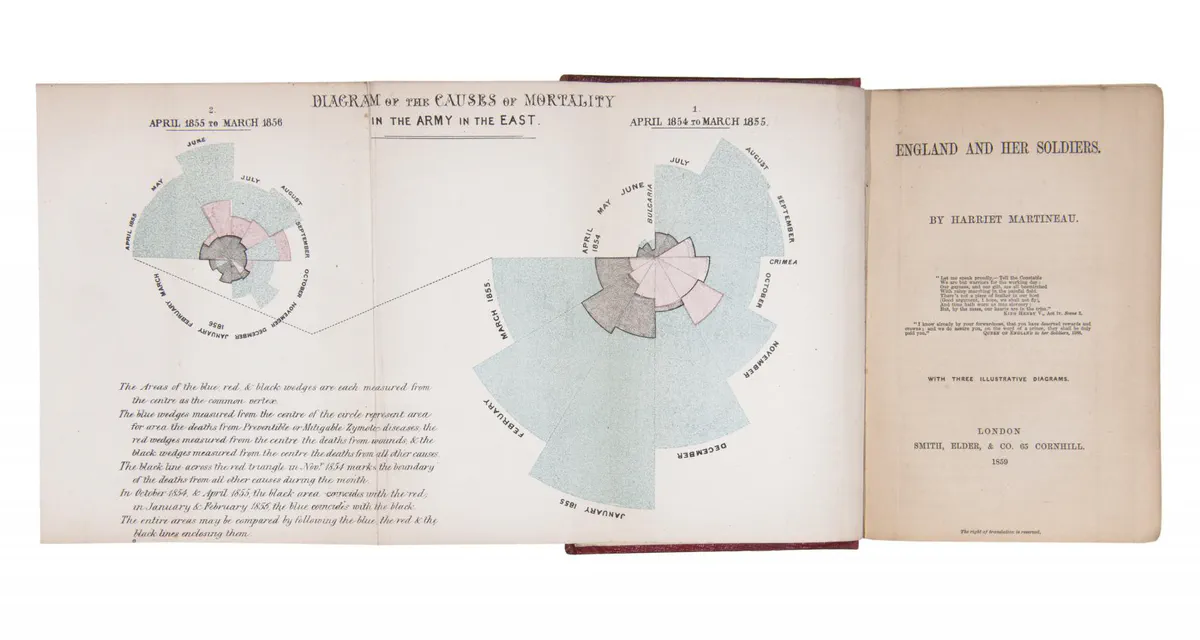
Nightingale conducted studies and collected data to assist her reports that would help transform patient care, but she realised that she had to find a way to present her data so that the insights were clear and easy to make sense of. She made use of pie charts and other graphic visualisations to illustrate her findings in a way that was easy to digest. Rather than publishing in science journals, she took her findings straight to parliament and military officials, provoking them to take immediate action.
We are inspired by the way Florence Nightingale conducted her research. Using tools such as the Coxcombs diagram, which she developed alongside William Farr, to demonstrate complex and real work findings in such a way that made it easy for people to understand and act on. She collected data in the same way that biologists of the time collected specimens leading the way as one of the first and most successful data scientists. Not only did her analytical methods inspire the development of statistics and permanently impact the world of healthcare and nursing, but these pioneering steps in effective use of data lead us to where we are today — almost 200 years after her birth — with Big Data and Artificial Intelligence.
While Nightingale is far from the first person in history to collect data, she did demonstrate the importance of data in gathering insight and generating change. Since then, the field of data has advanced to become the foundation of the hottest topic of today, AI, which incidentally has some great applications within healthcare.
So just as Florence lit the way to medical reform through elegant and powerful visualisations of her data, GoSmarter AI carries that same torch — using data and AI to drive progress where it’s needed most, from healthcare to heavy industry. If you’re a metals manufacturer who believes decisions should be driven by data, not gut feel, you’re in the right place.