ERP vs AI: Scaling Manufacturing Operations
- BlogSmarter AI
- Edited by Steph Locke
- Blog
- March 30, 2026
- Updated:
Table of Contents Show Hide
Running your factory on legacy ERP burns margin and slows growth.
If your Enterprise Resource Planning (ERP) system feels more like a glorified filing cabinet than a tool for growth, you’re not alone. Spreadsheet chaos, manual data entry, and missed deadlines are just the start. Here’s the kicker: 80% of ERP transformations fail to hit their targets. Why? Because these systems were built to record the past, not predict the future.
Artificial Intelligence (AI) flips the script. Instead of waiting for problems to derail your production, AI predicts and prevents them. It cuts manual data work by up to 80%, slashes downtime costs by 35%, and turns scattered data into actionable insights - all in real time.
The Old Way vs. The Smart Way
| The Old Way (ERP) | The Smart Way (AI) |
|---|---|
| Manual data entry slows you down. | AI automates tedious tasks. |
| Downtime costs £200,000/hour. | Predictive tools cut downtime by 35%. |
| Reports lag behind reality. | Real-time insights keep you ahead. |
It’s not about replacing your ERP - it’s about upgrading your operations. AI tools like GoSmarter can get you results in weeks, not years. Let’s fix the mess.
AI for Manufacturing: What ERP Systems Can’t See or Solve | Episode - 14 | Agentic Enterprise
Why Traditional ERP Systems Struggle with Manufacturing Scale
Legacy ERP systems were originally designed to track transactions - not to handle the demands of today’s fast-moving metals manufacturing. When operations scale - whether by adding production lines, boosting capacity, or responding to sudden demand surges - these older systems often buckle under the pressure. This is why modern solutions are becoming a necessity.
How Legacy Systems Hold Back Growth
One of the biggest issues with traditional ERP systems is their reliance on batch processing. Instead of updating data in real time, these systems perform updates through scheduled background jobs, often running overnight or at hourly intervals. For example, if you need to change a bill of materials or adjust quantities, production jobs can be left in limbo, waiting for the system to catch up 1.
Another challenge is that these systems are typically designed for general engineering rather than the specific needs of metals manufacturing. Tasks like managing heat treatment cycles, tracking mill certificates, or handling complex alloy specifications often require custom workarounds. These customisations create “technical debt” - a term SAP’s VP of Product Marketing, Chao Yi, uses to describe the fragmented data and reliance on spreadsheets that result from patching general-purpose systems 12. Over time, this technical debt makes upgrades harder and less effective.
Fundamentally, automation is outpacing the systems built to support it.
This disconnect between legacy ERPs and modern manufacturing needs leads to inefficiencies that slow growth and increase costs.
The Financial Toll of ERP Inefficiencies
The cost of sticking with outdated systems can be steep. Downtime expenses skyrocket when ERPs only react after a failure has occurred 3. Traditional systems typically log machine failures after they’ve already disrupted production, rather than providing early warnings based on real-time data. These older ERPs simply weren’t built to process millisecond-level telemetry from today’s automated machines 2.
Scaling with legacy systems also drives up infrastructure costs. On-premise ERPs often demand costly hardware upgrades, require constant IT maintenance, and involve drawn-out implementation timelines - ranging from 18 to 36 months for Tier-1 systems like SAP or Oracle 31. Adding to this, businesses often become increasingly dependent on external IT support, further inflating the total cost of ownership.
In short, the inefficiencies of traditional ERPs aren’t just a technical problem - they’re a financial one too.
How AI Solves Manufacturing Scalability Problems
AI-powered platforms do more than just track past performance - they predict what’s coming and help you act before problems arise. As Groovy Web explains:
Traditional ERP answers the question: what happened? AI-powered ERP answers: what will happen, and what should we do about it before it does?
This shift from reacting to anticipating is critical for scaling metals manufacturing operations 3.
Organising Chaos into Actionable Data
Metals manufacturing is often buried under a mountain of disorganised data. Mill certificates show up as unstructured PDFs, scrap rates are scattered across spreadsheets, and heat numbers are scribbled on paper. AI tools step in to automatically read, extract, and organise this data as it’s received. For instance, AI-driven computer vision can spot defects with 12–18% greater accuracy than human inspectors, cutting defect escape rates by up to 89% 3. This allows skilled workers to focus on driving innovation rather than getting bogged down with tedious inspections.
Before scaling AI, it’s essential to unify fragmented data. Consolidating information from PLCs, sensors, and spreadsheets into a single, cohesive model is the first step 4. With this clean and integrated data, AI-driven forecasting models can outperform traditional ERP systems, improving accuracy by 15–30% and slashing inventory costs by 28% 3.
Once the data foundation is set, AI can take operations to the next level with real-time responsiveness.
Proactive Maintenance and Dynamic Adjustments
Traditional ERPs only react after a failure, but AI flips the script by predicting issues before they occur. Predictive maintenance, often the easiest entry point for AI, uses IoT data to reduce downtime significantly - often delivering returns in under 90 days 3. On top of that, AI doesn’t rely on static rules for inventory management. Instead, it uses probabilistic demand curves to make dynamic adjustments 3.
Imagine a scenario where a rush order comes in or a key machine breaks down. AI evaluates machine capacity, material availability, and workforce constraints to instantly optimise production plans 45. This kind of flexibility is becoming increasingly vital, with 92% of manufacturers identifying smart manufacturing as a key driver of competitiveness over the next three years 4.
AI doesn’t just help scale operations - it transforms them into smarter, faster, and more adaptable systems that can handle disruptions with ease.
ERP vs AI: Comparing Core Manufacturing Functions
Key Comparison Metrics
Choosing between sticking with your legacy ERP or upgrading to an AI-driven system comes down to understanding the metrics that truly matter in scaling metals manufacturing. Metrics like implementation time reflect how quickly the system can be deployed, while flexibility reveals its ability to handle unexpected situations like rush orders or equipment failures without manual intervention. Scrap reduction measures whether the system actively prevents waste instead of just reporting it, and integration capability determines how easily the system connects with existing equipment without requiring a complete overhaul.
These metrics highlight the differences in operational performance. As Nathan Rowan from Business-Software.com puts it:
Organisations implementing traditional ERP today risk technological obsolescence within 3–5 years as AI capabilities become standard market expectations.
The table below lays out the key distinctions between traditional ERP systems and AI-driven platforms, offering a clear view of how AI can reshape operations 6.
Comparison Table: ERP vs AI
| Metric | Traditional ERP Systems | AI-Powered Platforms |
|---|---|---|
| Implementation Time | 6–18 months (up to 36 for Tier-1) 36 | 3–9 months (augmentation in 12–20 weeks) 3 |
| Flexibility | Rigid; relies on predefined rules/workflows 76 | Highly adaptive; learns from data patterns 46 |
| Maintenance | Reactive; occurs after failure or on schedule 4 | Predictive; reduces downtime by 35% 3 |
| Quality Control | Manual/Sample-based; 5–10% coverage 3 | Computer Vision; 100% inspection coverage 3 |
| Data Analysis | Manual reports and scheduled queries 6 | Real-time insights and conversational analytics 6 |
| Integration | Predefined APIs; struggles with legacy silos 68 | Intelligent IoT/Sensor connectivity 46 |
| Scalability | Limited; performance degrades with big data 78 | High; scales easily across plants/geographies 47 |
AI-powered platforms stand out by slashing implementation time by nearly half, providing full inspection coverage rather than limited sample-based checks, and cutting unplanned downtime by over 35% 3. Traditional ERP systems, on the other hand, often focus on reporting issues after they’ve already occurred. In contrast, AI systems anticipate potential problems, enabling proactive measures that protect your profits before issues arise.
GoSmarter: AI Built for Metals Manufacturing
Designed for the Realities of Heavy Industry
GoSmarter isn’t your average software - it’s built specifically for metals manufacturing. It tackles the everyday challenges of factories drowning in PDFs, faxes, and endless spreadsheets. Take the MillCert Reader, for instance: it uses advanced AI-powered OCR to digitise scanned documents, pulling out heat numbers and linking material data directly to inventory systems. This alone can save 120 hours a year 9. Then there’s Cutting Plans, which uses deep learning to predict scrap generation and refine cutting plans for long products, slashing material loss by up to 50% 11, while automating complex scheduling by syncing inventory and orders. The result? Planning time is cut by over half, and delivery times improve dramatically 11.
Unlike traditional ERPs that demand endless customisation, GoSmarter is ready to roll in just 1–2 days. All it takes is a simple API or CSV connection 9.
Tony Woods, CEO of Midland Steel, says it best: “The integration of AI and digital tracking has significantly improved our operational efficiency and sustainability performance.” 9
This isn’t generic software awkwardly adapted for the shop floor. It’s purpose-built for heavy industry, turning tedious processes into workflows that eliminate spreadsheet firefighting.
Turning Chaos into Order
As your operation grows, the need for smarter systems becomes unavoidable. GoSmarter steps in where outdated ERPs fall short, tackling the critical tasks that legacy systems just can’t handle. Its Metals Manager offers real-time data analytics for stock visibility, complete with certificate-linked inventory. This ensures full traceability and compliance with standards like BS EN 1090 1110. No more digging through emails or file cabinets for test reports - everything is just a search away, instantly connected to heat codes.
Tadhg Hurley, Managing Director at MAAS Precision Engineering, highlights the impact: “We’re constantly seeking ways to improve our systems and processes with technology, and this has been a great opportunity to accelerate our adoption of smarter tools.” 9
GoSmarter doesn’t aim to replace your legacy ERP - it enhances it. Start small with the MillCert Reader for £280/month billed annually or the Cutting Plans for £760/month billed annually. Once you see the return on investment, scaling up is easy. Not sure where to begin? Use the free Business Case Calculator to estimate your savings in scrap reduction and admin hours before committing. It’s time to modernise your operations and leave inefficiency behind.
Implementation and ROI: ERP vs AI in Practice
Deployment Timelines and Costs
When it comes to rolling out new systems, the difference in timelines and costs between traditional ERP systems and AI-driven platforms is striking.
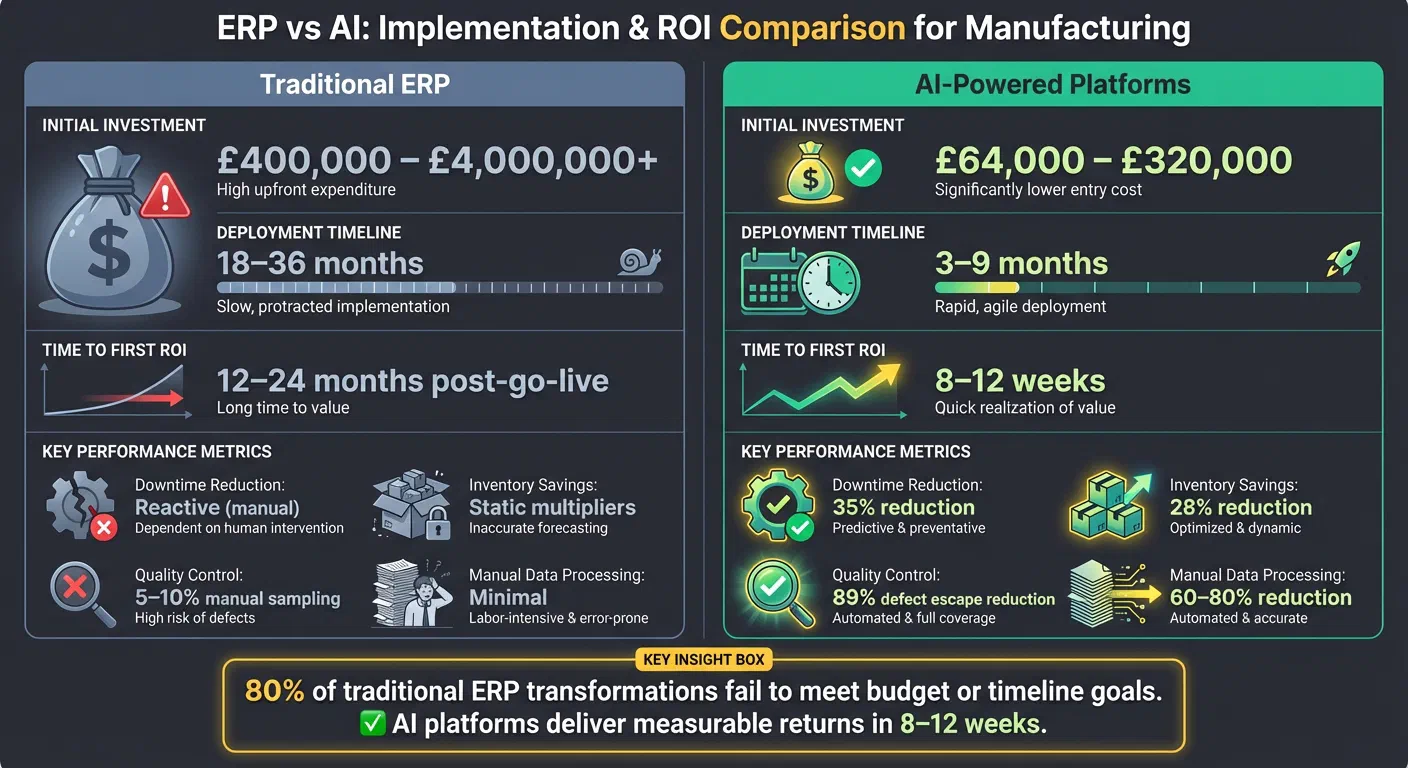
For large-scale manufacturing, traditional ERP systems take anywhere from 18 to 36 months to fully implement. Costs are steep, with initial fees ranging between £395,000 and £3,950,000 3. Add software licensing and ongoing expenses, and the three-year total ownership cost balloons to £1.2 million to £6.3 million 11. While cloud-based ERPs promise faster returns (12–18 months) compared to on-premises systems (24–36 months), it’s still a long wait before you see any payoff.
AI platforms, on the other hand, are designed for speed and efficiency. They can be operational in just 3–9 months, with implementation costs ranging from £64,000 to £320,000 3. Some AI features, like predictive maintenance, can go live in as little as 6–12 weeks 3. Take GoSmarter, for example: it’s tailored for metals manufacturing and ready to work straight out of the box. You can start small with tools like the MillCert Reader for just £280/month billed annually and expand as savings roll in.
ROI Comparison Table: ERP vs AI
| Metric | Traditional Tier-1 ERP (e.g., SAP/Oracle) | AI-First Platform / Custom AI Build |
|---|---|---|
| Initial Investment | £400,000 – £4,000,000+ 3 | £64,000 – £320,000 3 |
| Deployment Timeline | 18–36 months 3 | 3–9 months 3 |
| Time to First ROI | 12–24 months post-go-live 3 | 8–12 weeks 312 |
| Downtime Reduction | Reactive (manual scheduling) | 35% reduction (predictive) 3 |
| Inventory Savings | Static safety stock multipliers | 28% reduction (probabilistic) 3 |
| Quality/Scrap Reduction | 5–10% manual sampling | 89% defect escape reduction 3 |
| Manual Data Processing | Minimal (rule-based) | 60–80% reduction 11 |
The data makes the contrast crystal clear. AI-driven solutions deliver results far quicker and with significantly less investment. Predictive maintenance powered by AI slashes unplanned downtime by 35% and boosts inventory accuracy by nearly 30%, all while delivering ROI in a matter of weeks 3. Computer vision technology further enhances quality control, reducing defect escape rates by 89% and enabling 100% inspection coverage - far beyond the 5–10% achieved through manual sampling 3.
This rapid deployment and near-instant ROI give manufacturers an edge, improving operational flexibility and cutting costs. These aren’t just numbers; they’re game-changers for companies looking to scale efficiently.
Michael B., Managing Director, puts it succinctly: “The ROI was positive after 8 weeks - few tools achieve that for us.” 12
The bottom line? While an ERP might take years to pay off, AI-driven platforms deliver results in weeks, transforming how manufacturers operate.
Conclusion: Stop Running Your Factory Like It’s 1985
The days of relying on traditional ERP systems are over - they belong to a past that can no longer keep up. The evidence is clear: 80% of traditional ERP transformations fail to meet budget or timeline goals 13, while AI-powered platforms deliver measurable returns in just 8–12 weeks 3. The difference is staggering.
Consider this: implementing a tier‑1 ERP system takes 18–36 months and costs anywhere from £400,000 to over £4,000,000 3. In contrast, AI-first platforms deploy in just 3–9 months at a fraction of the cost, while delivering real results. They reduce unplanned downtime by 35%, slash inventory waste by 28%, and cut defect escapes by 89% 3. Manufacturers leading the way today aren’t clinging to outdated systems - they’re embracing automation to eliminate inefficiencies and focus on what they do best.
By 2029, 78% of IT leaders expect AI to replace or significantly enhance core ERP functionality 13. Platforms like GoSmarter are designed specifically for industries like metals manufacturing, transforming chaotic production data into clear, actionable insights. You can start small - tools like the MillCert Reader cost just £280/month billed annually, deliver ROI within weeks, and scale effortlessly from there. This isn’t just about efficiency; it’s about staying ahead in a fast-changing market.
Companies still investing in traditional ERP risk falling behind as AI becomes the new standard within the next 3–5 years 6. Why pour resources into systems that can’t keep up? The future of manufacturing isn’t about patching up outdated technology - it’s about adopting intelligent tools that actually deliver.
FAQs
Will AI replace my ERP?
AI isn’t here to kick your ERP system out the door - it’s here to make it better. In fact, 78% of IT leaders predict that AI will enhance certain ERP functions within the next three years.
What does this mean for you? AI is stepping in to handle repetitive tasks, refine decision-making, and improve operational resilience. It’s like upgrading your toolbox with smarter tools, not throwing out the whole shed.
That said, fully integrating AI into ERP systems isn’t without its hurdles. Many organisations are still tackling challenges around AI readiness, so a complete overhaul isn’t on the cards just yet. For now, AI serves as a powerful sidekick, helping ERP systems do more and do it better.
What data do we need before using AI?
To make AI work effectively in manufacturing, you need reliable, precise data about your production processes, equipment, and day-to-day operations. The most important types of data include:
- Real-time sensor readings: These provide up-to-the-minute insights into equipment performance and environmental conditions.
- Quality and production records: Essential for tracking output and identifying areas for improvement.
- Maintenance logs: A detailed history of equipment upkeep helps predict and prevent failures.
This information allows AI to spot trends, foresee problems like machinery breakdowns, and fine-tune operations for greater automation and efficiency. To get the most out of AI, your data must be consistent, well-organised, and connected across systems.
How soon can we see ROI from AI?
Further Reading
1: Why Traditional ERPs Fail in Modern Manufacturing — Yeti Forge Technologies
2: AI-Enabled ERP Is Closing the Automation Gap for Mid-Sized Manufacturers | Automation World
3: ERP with AI in Manufacturing: 2026 Guide
4: AI in ERP: Benefits, Use Cases, and Manufacturing Impact
5: How AI in combination with ERP software is Redefining Manufacturing | Robosol Software
6: AI ERP vs Traditional ERP: The Complete 2025 Comparison Guide
8: AI vs ERP Systems: Better Decision Making in Manufacturing?
9: GoSmarter AI | AI Tools for Metals Manufacturing
10: GoSmarter Blog | AI & Manufacturing Insights
11: AI ERP vs Traditional ERP: The Complete 2025 Comparison Guide
12: https://qualimero.com/en/blog/when-is-erp-worth-it-cost-benefits-ai-readiness
13: Is Agentic AI the Inflection Point for Scaling ERP Transformations? | Bain & Company
Tags:
About the Author

Editor· Co-founder & Head of Product
Steph Locke is Co-founder and Head of Product at GoSmarter AI — former Microsoft Data & AI MVP building practical tools to cut paperwork and automate compliance for metals manufacturers.