ERP for JIT in Metals Manufacturing
- BlogSmarter AI
- Edited by Ruth Kearney
- Blog
- April 23, 2026
- Updated:
Table of Contents Show Hide
Enterprise Resource Planning (ERP) systems built specifically for metals manufacturing are what make profitable Just-in-Time (JIT) delivery possible. Generic systems cannot track remnants, handle catch-weight inventory, or link mill certificates to live stock records. Metals-specific ERPs and specialist AI tools do all three. The difference shows up directly in your On-Time In Full (OTIF) rate and your margins.
Most metals manufacturers juggle complex inventories, unpredictable schedules, and compliance paperwork with systems that were never built for the job. The result? Wasted materials, delayed orders, and hours lost to manual fixes. GoSmarter (built by Nightingale HQ) works on top of your existing ERP or spreadsheets. No rip-and-replace project required.
What you get:
- Live remnant tracking: Use every scrap of material, no more over-ordering.
- Automated compliance: Digitise and link mill certs to inventory, no manual data entry.
- Smart scheduling: Match material availability to job priorities in real time.
- Scrap reduction: AI tools optimise cuts and spot defects before they cost you.
1. Metals Manufacturing
Material Tracking
In metals manufacturing, the inventory isn’t just about part numbers - it’s all about the details. Thickness, width, length, temper, and chemical composition define the materials, making standard ERP systems a poor fit. Christina Morrison sums it up well:
Standard manufacturing ERP systems are fundamentally incompatible with how the metals industry operates. It’s an architecture problem 1.
Take steel coils, for example. They’re sold by weight but used by dimension, so you need a system that can handle catch-weight tracking. This means accounting for the difference between theoretical and actual weights 1. Then there’s remnant management: when a 6-metre plate is cut down to 4 metres, that leftover 2-metre piece isn’t waste. It’s valuable stock, searchable and usable - especially crucial in just-in-time (JIT) setups where there’s no room for extra inventory 21.
Modern ERPs also make heat number traceability a breeze. They automate tracking from the moment materials arrive to when they leave, ensuring chemical compositions and heat numbers are always accounted for. Add barcode and Radio Frequency Identification (RFID) tech into the mix, and you’ve got a system that avoids manual errors - keeping JIT processes running smoothly 2.
These tools lay the groundwork for more efficient production scheduling.
Production Scheduling
Metals manufacturing doesn’t run on predictable, steady workflows like an automotive assembly line. Instead, it’s a juggling act of shared equipment, complex routing, and shifting priorities. This is where a good ERP system steps in, balancing order priorities, material availability, lead times, setup times, and changeover costs.
Controlled-push scheduling stops the work-in-progress pile-up before it starts. It delays material release until the perfect moment, cutting down on work-in-progress inventory at bottleneck points. Supervisors get dashboards with colour-coded capacity views, making it easy to spot and address constraints before they cause delays. Plus, these systems tie scheduling and inventory tracking together, so before triggering a new purchase order, they check for available remnants or drops. Automated procurement only kicks in when absolutely necessary 2.
By streamlining scheduling, manufacturers can focus on reducing waste, especially scrap.
Scrap Management
Scrap can be a real profit killer, especially when errors in the Bill of Materials (BOM) mean 40% of items are wrong 2. Linking Computer-Aided Design/Computer-Aided Manufacturing (CAD/CAM) systems directly to the ERP solves this by uploading design components straight into the BOM, cutting out manual mistakes. Nesting software integration takes it further, managing remnants and tracking scrap in real time.
AI-driven tools analyse past orders to recommend efficient slit planning strategies, while predictive quality control uses computer vision to spot surface defects faster than any manual inspection ever could. This keeps defective material out of the production line and maximises yield 1.
Compliance and Certification Management
Meeting standards like ISO 9001, 14001, and 45001 isn’t optional - it’s mandatory. Metals manufacturers need to track chemical and physical properties, from chemistry to mechanical test results, to stay compliant 2. For JIT operations, this has to happen without slowing the line. ERPs automate Material Test Report (MTR) retrieval and distribution, ensuring shipments meet metallurgical specs without holding up the process 1.
On top of that, modern systems are starting to track Scope 3 emissions data by heat number and lot, helping manufacturers meet sustainability goals while maintaining material quality.
GoSmarter simplifies this with its Mill Certificate Reader. It digitises those messy PDF mill certificates and links inventory to heat codes automatically. No more manual data entry, no more wasted hours. Engineers can finally focus on production instead of drowning in compliance paperwork.
Complete ERP Solution for Steel Manufacturing
2. Automotive Manufacturing
Metals manufacturing might focus on material properties, but in automotive manufacturing, it’s all about serialised tracking to keep up with the precision demands of Just-In-Time (JIT) operations.
Material Tracking
In the automotive world, every part needs a digital paper trail. From the moment a component is received to when it’s delivered, its cost and origin are meticulously tracked through serialisation 2. This isn’t just a preference - it’s a necessity to meet strict safety audits and liability demands.
But tracking doesn’t stop there. Managing stock in a JIT environment means you need more than just a count of what’s “on-hand.” ERPs must differentiate between inventory tied to active orders and what’s genuinely available. This distinction can slash emergency procurement costs by 30–40% 3. On top of that, automated mill certificate integration ensures that heat numbers, grades, and mechanical properties are directly linked to each stock item 3. It’s a system built for precision, setting the foundation for synchronised production schedules.
Production Scheduling
Automotive JIT thrives on precision timing, and that’s where Electronic Data Interchange (EDI) and structured release management come into play. These tools coordinate multi-tier supply chains to hit tight OEM delivery windows. ERPs like SAP S/4HANA use aggregated order tracking and real-time machine data to stay ahead. With advanced analytics, these systems can forecast production up to 50 times faster 4. That means Tier 1–3 suppliers can anticipate risks and fine-tune schedules across multiple sites, keeping everything running smoothly.
Compliance and Certification Management
Scheduling precision is only part of the equation - compliance is equally critical. Automotive manufacturing operates under the rigorous standards of International Automotive Task Force (IATF) 16949 and OEM-specific requirements like the Production Part Approval Process (PPAP). These go far beyond the ISO standards often seen in metals manufacturing 4.
ERPs simplify this complexity by automating Materials Management Operations Guideline/Logistics Evaluation (MMOG/LE) assessments and IATF 16949 workflows, cutting down the admin workload tied to maintaining certifications. Quality control tools like Statistical Process Control (SPC) and Statistical Quality Control (SQC) monitor real-time variations, ensuring non-compliant parts don’t leave the factory floor 2. Worker certifications are also tracked to guarantee that only qualified staff handle safety-critical tasks. And with tamper-proof archiving of batch numbers and production data, manufacturers are always prepared for any product liability challenges that might come their way 2.
3. Electronics Manufacturing
Electronics manufacturing operates in a world of discrete components and rapid turnover. It’s a completely different beast compared to the detailed material tracking in metals manufacturing or the precision-heavy processes of automotive production.
Material Tracking
In electronics, there’s no need to worry about offcuts or leftover materials. Every single resistor, capacitor, and microchip arrives as a standalone item. The ERP system’s job here is straightforward but crucial: it provides real-time visibility into these components, ensuring they align perfectly with demand signals 5. Unlike metals manufacturing, where tracking raw material transformations is key, electronics ERP zeroes in on component traceability to keep production on schedule.
To stay efficient, electronics operations lean on integrated supplier portals that lock in Just-in-Time (JIT) deliveries. This approach keeps production moving without overloading inventory. AI-powered demand forecasting, often based on sales history, ensures production stays closely tied to what’s actually needed 5.
Production Scheduling
JIT in electronics lives or dies by accurate demand forecasting. Unlike industries where shared equipment bottlenecks dominate scheduling concerns, electronics manufacturing focuses on synchronising multi-tier supply chains. The aim? To make sure materials show up exactly when they’re needed, no sooner, no later.
Nandan Goda, an ERP Designer, explains it well:
JIT works best when powered by ERP. The combination of real-time visibility, demand forecasting, and supplier collaboration transforms JIT from a cost-cutting tactic into a competitive advantage 5.
This approach ensures smooth production flow, with complete visibility into every inventory stage preventing any surprises.
Compliance and Certification Management
In electronics, compliance is less about tracking detailed material properties and more about ensuring component traceability and supplier reliability. ERP systems centralise compliance documentation, automating audit trails to confirm that every component meets the required quality standards before it even hits the production line 5.
Personnel certifications also play a role. For instance, the system might track qualifications for specialised tasks like soldering, much like it would for welding in metals manufacturing 2. And when it comes to liability protection, tamper-proof data archiving ensures manufacturers can quickly pull up historical records during audits or recalls, offering a safety net against potential product issues.
These ERP strategies highlight the unique challenges electronics manufacturers face - and how tailored solutions keep production efficient and compliant.
Benefits and Drawbacks by Sector
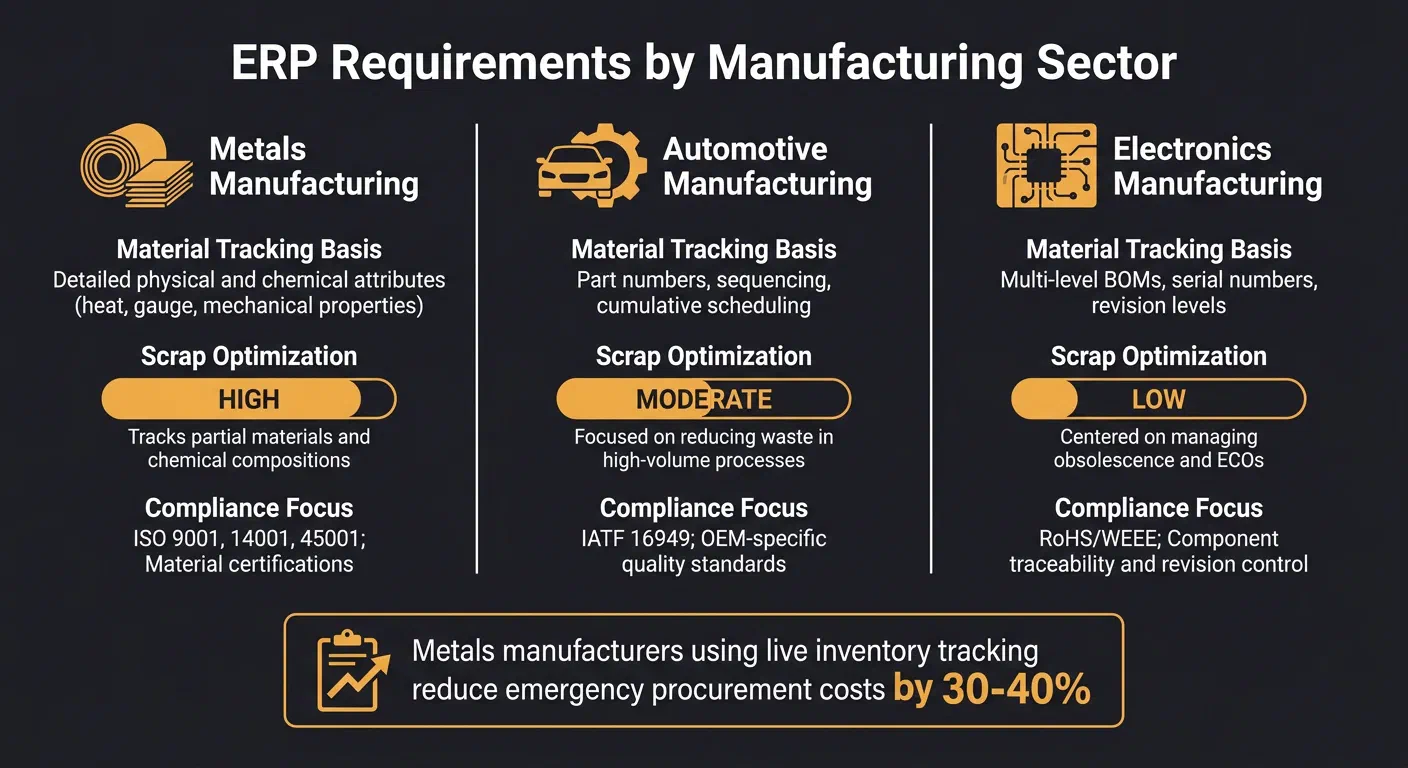
ERP systems aren’t one-size-fits-all - they need to be customised to match the specific demands of each sector. What works perfectly for metals manufacturing might fall short in automotive or electronics. The differences stem from how each industry handles materials, manages waste, and meets compliance standards. Here’s a closer look at how ERP systems tackle these challenges across metals, automotive, and electronics sectors.
Metals manufacturing thrives on attribute-based tracking. Unlike generic part numbers, ERPs in this sector monitor physical dimensions and chemical properties such as heat, gauge, and mechanical test results. This level of detail is a must for precise JIT operations, particularly when dealing with remnants from previous jobs. As MIE Solutions explains:
ERP systems designed for metal fabrication handle industry-specific challenges like tracking partial materials, managing remnants, and recording chemical compositions - capabilities that generic inventory systems simply cannot provide 2.
GoSmarter takes this further by automating tasks like mill certificate digitisation and offcut tracking, which are critical for metals manufacturers. The trade-off? Metals ERPs require more detailed data entry and tighter integration with mill certificates, which can slow down the initial setup. But for manufacturers, this granularity is worth it.
Automotive manufacturing is all about high-volume, repetitive production. ERPs in this sector rely on tools like Electronic Data Interchange (EDI), Advanced Shipping Notices (ASN), and Kanban sequencing to stay in sync with OEM schedules. These systems prioritise speed, enabling dock-to-stock programmes with pre-certified materials. However, rigid compliance standards like PPAP and IATF 16949 can make it challenging to adapt to custom or low-volume projects 6.
Electronics manufacturing presents a different challenge: managing multi-level Bills of Materials (BOMs) while staying ahead of rapid component obsolescence. ERPs track individual components - resistors, capacitors, microchips - using serial numbers and revision levels. Engineering Change Order (ECO) workflows ensure production stays aligned with design updates. While traceability is a major advantage, scrap optimisation takes a back seat. Unlike metals, where offcuts can be reused, electronics components are either fully used or discarded.
| Feature | Metals Manufacturing | Automotive Manufacturing | Electronics Manufacturing |
|---|---|---|---|
| Material Tracking Basis | Detailed physical and chemical attributes 27 | Part numbers, sequencing, cumulative scheduling 8 | Multi-level BOMs, serial numbers, revision levels 8 |
| Scrap Optimisation | High; tracks partial materials and chemical compositions 2 | Moderate; focused on reducing waste in high-volume processes 8 | Low; centred on managing obsolescence and ECOs 8 |
| Compliance Focus | ISO 9001, 14001, 45001; material certifications 2 | IATF 16949; OEM-specific quality standards 8 | RoHS/WEEE; component traceability and revision control 8 |
For metals manufacturers, the ability to track remnants in real-time and link them to mill certificates can significantly reduce emergency procurement costs. In fact, companies using live inventory tracking often cut these costs by 30–40% 3. These sector-specific insights highlight one thing: an ERP system that truly understands your industry’s challenges is far more effective than one packed with generic features.
What to Look for in a JIT-Ready Metals ERP
Metals manufacturing demands a different approach from automotive or electronics. The standout feature of a true metals ERP is attribute-based tracking - letting you search inventory by chemical composition, heat numbers, or mechanical properties instead of just part numbers. This level of detail is what makes Just-In-Time (JIT) production practical. It allows remnants from previous jobs to be reused, cuts emergency procurement costs by up to 30–40% 3, and minimises the financial fallout from BOM errors 2. Better remnant visibility also drives up On-Time In Full (OTIF) performance. When you know exactly what metal is available and what’s already committed to a job, you stop shipping late because someone ordered the same bar twice.
While automotive and electronics manufacturers thrive in high-volume, standardised environments where speed and sequencing dominate, metals manufacturers deal with a different beast. They face high-mix, low-volume production, shared equipment, and constantly shifting bottlenecks. Generic ERPs simply don’t cut it here. They can’t track offcuts alongside new stock or automatically link mill certificates to inventory - essential features for JIT in metals 2. This reinforces the point: JIT success hinges on an ERP system built for the job.
When choosing an ERP, look for remnant tracking and real-time commitment monitoring. The system must differentiate between total stock on hand and what’s actually available for live orders 3.
For manufacturers needing deeper shop-floor insights than a standard ERP can offer, GoSmarter steps in as a specialist AI layer on top of your existing setup. The Mill Certificate Reader digitises mill certs and links them to live stock automatically — at £350/month (Workshop tier), teams spending hours each week on manual cert entry typically recover that cost inside the first quarter. The Cutting Optimiser improves cut plans to reduce scrap by up to 50% 9. Both tools share the same heat-number data spine, so one certificate upload feeds your inventory view and your cut plan in a single step. GoSmarter connects to existing ERPs via Application Programming Interface (API) or CSV file, using OAuth-based authentication. Data is hosted on UK Azure infrastructure. GoSmarter does not train its AI on your data. Most teams are live within a day.
As GoSmarter bluntly puts it:
If you don’t know what metal you have, you’re losing money. It’s that simple 3.
FAQs
What is just-in-time (JIT) delivery in metals manufacturing?
What makes a metals ERP 'JIT-ready'?
How does remnant tracking reduce emergency buying?
How are mill certs linked to stock automatically?
How does GoSmarter work alongside an existing ERP?
Further Reading
1: Why These Are the Top ERP Systems for Metals and Steel Fabricators
2: The Essential ERP Features for Metal Fabricators and Manufacturers - MIE Solutions
3: Metals Inventory Management Software | GoSmarter
4: https://godlan.com/best-erp-for-automotive-industry
5: Using ERP for Just-in-Time (JIT) Inventory in Manufacturing | Differ
6: Automotive ERP in 2025: IATF 16949 Compliance, JIT/JIS Manufacturing & OEM Supplier Integration | FlowSense
7: The Top ERP Systems for: Metal and Steel Fabrication, $1 to 10 Million
8: Best Manufacturing ERP Software 2026 | Top Systems Compared | ERP Research
Tags:
About the Author

Editor· Co-Founder & CEO
Ruth Kearney is Co-Founder and CEO of GoSmarter AI — driving commercial growth and strategic partnerships to help metals manufacturers adopt AI and digital tools that actually deliver on the shop floor.