You Didn’t Become an Engineer to Read PDFs All Day
- Ruth Kearney
- Blog
- February 19, 2026
- Updated:
Table of Contents
You didn’t spend years learning thermodynamics and materials science just to waste your time renaming files and retyping data from PDFs. But if you’re in metals manufacturing, chances are you’re stuck doing exactly that. Every week, hours are lost slogging through mill certificates, splitting bulk PDFs, and manually entering data that should already be usable.
Here’s the harsh truth: manual PDF processing is killing your productivity. It’s not just boring - it’s a hidden drain on time, money, and accuracy. Errors creep in, quality suffers, and engineers spend more time fixing admin mistakes than solving real problems.
The good news? You don’t have to live like this. AI tools like GoSmarter’s MillCert Reader take the headache out of PDF drudgery by automatically extracting key data - chemical compositions, mechanical properties, product codes - in seconds. No IT overhaul. No drama. Just clean, actionable data ready to go.
The Old Way vs. The Smart Way
| The Old Way | The Smart Way |
|---|---|
| Hours wasted renaming and splitting PDFs | Data extracted and sorted in seconds |
| Manual entry prone to errors | Automated accuracy, fewer mistakes |
| Engineers stuck in admin work | Engineers focus on production and problem-solving |
Let’s face it: you didn’t sign up for this. It’s time to ditch the grunt work and get back to what you do best - engineering.
Manual PDF Processing Destroys Productivity
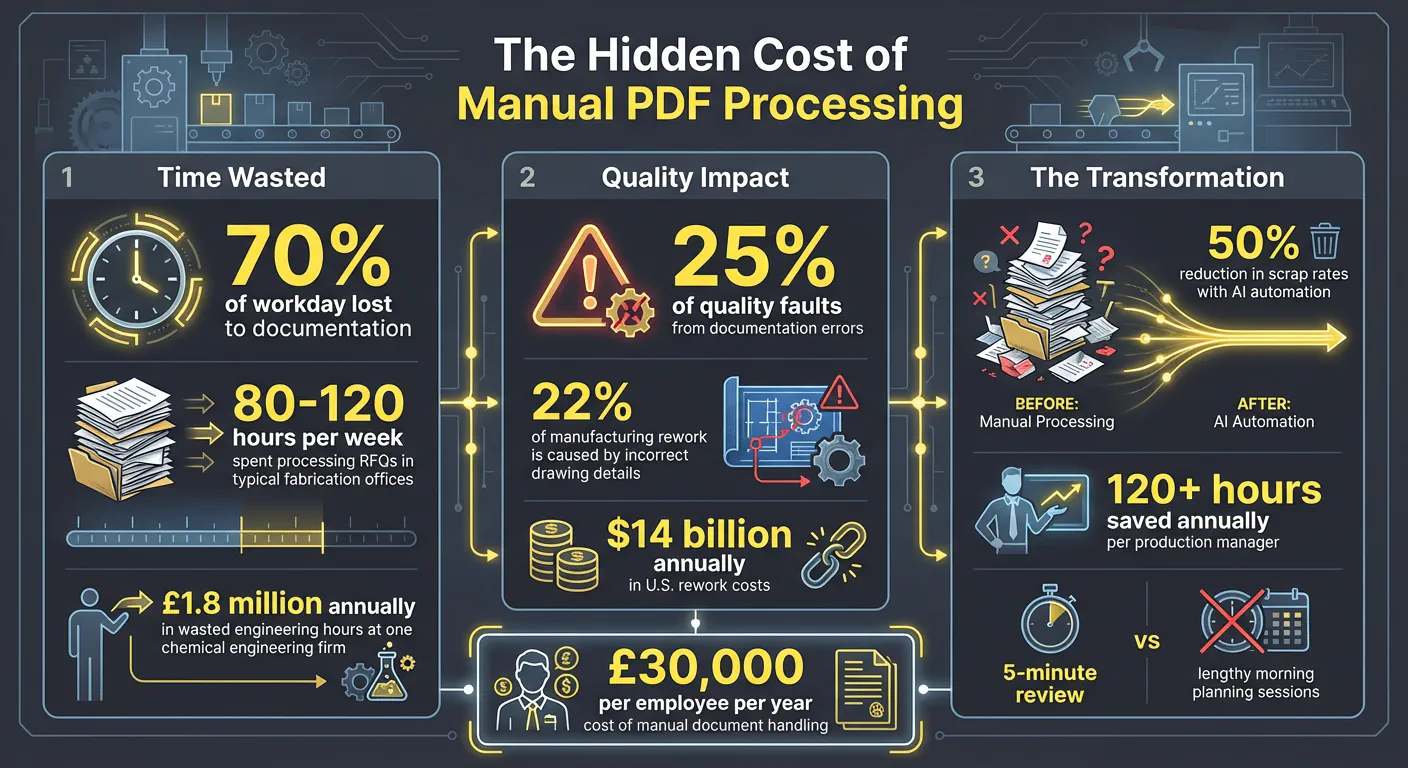
Every hour spent on manual PDF processing is an hour that could have driven real engineering progress. Shockingly, manufacturing engineers can lose up to 70% of their workday on documentation tasks instead of focusing on production improvements or product development [6]. That’s seven out of ten hours tied up in paperwork rather than solving engineering challenges.
Time Wasted: The Hidden Drain on Productivity
The numbers paint a stark picture. In a typical fabrication front office, 80 to 120 hours per week are spent processing RFQs and re-entering data [7]. That’s the workload of two or three full-time employees dedicated solely to inputting information that already exists in digital form. One chemical engineering firm estimated that administrative tasks cost them £1.8 million annually in engineering hours - time that could have been invested in innovation and development [6].
But the problem doesn’t stop at wasted time. Manual processes also increase the likelihood of errors, which can ripple through operations, causing even more inefficiencies.
Human Error: The Cost of Mistakes in Critical Data
Manual data entry isn’t just slow - it’s also prone to errors. Mistakes in documentation contribute to 25% of quality faults in technical manufacturing environments [6]. In fact, 22% of manufacturing rework stems from overlooked or incorrect drawing details, costing over $14 billion annually in the U.S. alone [4].
These errors don’t just hurt the bottom line; they also trap engineers in a cycle of fixing mistakes instead of advancing production processes.
Opportunity Cost: Engineers Stuck in Admin Work
Engineers are trained to innovate, optimise, and problem-solve. Yet, they’re often bogged down with administrative tasks like renaming PDFs or splitting bulk certificates. These low-value activities steal time from high-impact engineering work.
“We spend 70% of our estimating effort on jobs we never win. The other 30% is where we actually make money,”
shared one operations director at a £28 million sheet metal fabricator [7].
Midland Steel offers a compelling example of what’s possible when engineers are freed from these burdens. After implementing GoSmarter’s AI-powered tools in 2025, the company slashed its scrap rates by 50%. This shift allowed engineers to focus on improving operational efficiency instead of being tied to manual data entry [2][3].
“Smart technology choices can have a direct, measurable impact on reducing carbon emissions in steel manufacturing. The integration of AI and digital tracking has significantly improved our operational efficiency,”
said Tony Woods, CEO of Midland Steel [2].
The message is clear: reclaiming engineering time through AI-driven solutions isn’t just about productivity - it’s about unlocking the full potential of your team and operations.
AI-Powered Tools That Eliminate PDF Work
This solution takes the hassle out of tedious tasks by using AI tools specifically designed for metals manufacturing. These tools can read mill certificates, capture essential data, and seamlessly integrate it into your current systems - no lengthy setup required.
GoSmarter MillCert Reader: Automated PDF Data Extraction
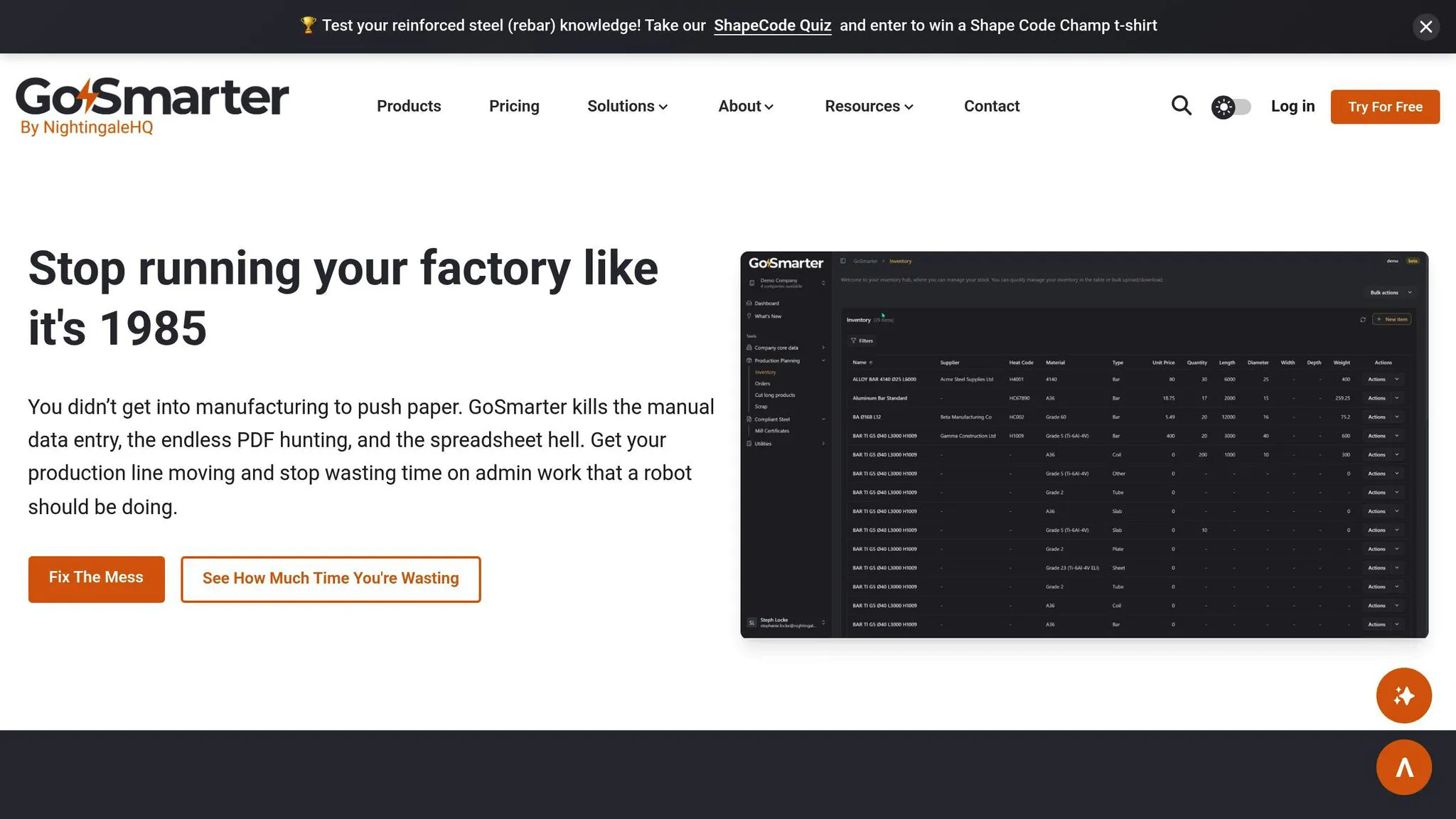
The MillCert Reader uses advanced OCR technology to digitise mill certificates, pulling out key details like chemical composition, mechanical properties, and heat codes. Say goodbye to manual typing, blurry scans, and endless file renaming.
In late 2025, Midland Steel’s production team adopted this tool to manage Cut & Bend rebar and mesh documentation. Their Production Manager shared how they were “up and running in minutes”, saving 10 hours each month on tasks that previously demanded significant manual effort [1]. Another manager reported saving over 120 hours annually by using the tool to split bulk certificates into neatly organised, single-page PDFs by heat code [8].
“I logged in for the first time and was up and running in minutes. MillCert Reader now pulls all the key info - chemical composition, mechanical properties - automatically. What used to take hours every week is done in seconds.”
- Production Manager, Midland Steel [1]
The system also handles bulk processing and renaming in seconds, transforming stacks of certificates into tidy, single-page PDFs sorted by heat and product codes [1][8]. No need for custom model training or outside consultants - results are immediate.
Once the data is extracted, it’s ready to be integrated into your operational systems.
Automated Integration: From PDFs to Usable Data
The extracted data flows directly into your existing systems. GoSmarter connects seamlessly with inventory tracking and order management tools, improving traceability without the need for a full ERP replacement. Production managers can upload inventory and order spreadsheets in Excel or CSV formats to test planning tools [3]. This integration also supports resource tracking and aids in analysing environmental impacts, helping with compliance and sustainability reporting [5][2].
“The integration of AI and digital tracking has significantly improved our operational efficiency and sustainability performance.”
- Tony Woods, CEO, Midland Steel [2]
Quick Setup: No Complex Implementation Required
Beyond its smart data extraction and integration capabilities, GoSmarter stands out for its ease of implementation. It’s designed to deliver results quickly, without requiring complex IT upgrades or costly consultants. The trial model allows you to start small with tools for scrap management and basic calculations, letting you test its value before committing - no enterprise contract needed.
Reclaim your team’s time and streamline your workflow with these proven tools today.
The Results: Engineers Innovate, Factories Run Better
Time Saved and Fewer Errors
When you eliminate repetitive tasks, the impact is immediate - better efficiency and fewer mistakes. GoSmarter’s MillCert Reader is a prime example of this transformation. Production managers have reclaimed over 120 hours annually by automating tasks like splitting bulk certificates into single-page PDFs sorted by heat codes. That’s time they can now spend on more meaningful work [1].
But it’s not just about speed. Accuracy improves too. By digitising mill certificates and directly linking them to inventory records, manufacturers ensure the right materials end up in the right jobs. This drastically reduces documentation errors [6], which are often the root cause of costly rework, failed welds, and unhappy customers. Guesswork? Gone. “Close enough”? No longer good enough.
Less Waste, Lower Emissions
Using AI to optimise production doesn’t just save time - it reduces waste and cuts emissions. Smarter cutting plans mean less scrap, and that translates into a smaller carbon footprint per tonne of steel produced. Tony Woods, CEO of Midland Steel, highlighted this shift:
“Smart technology choices can have a direct, measurable impact on reducing carbon emissions in steel manufacturing. The integration of AI and digital tracking has significantly improved our operational efficiency and sustainability performance” [2].
Tools like GoSmarter’s Steel Emissions Calculator make it easy to quantify these benefits. By estimating the carbon footprint of specific orders based on material weight and processes [3], manufacturers can turn vague ESG goals into concrete, trackable results. Less waste, lower energy use, and cleaner reporting - all achieved while improving efficiency.
Engineers Doing What They Do Best
The biggest win? Engineers get to focus on engineering. With automated data extraction, filing, and AI-generated cut lists, the gruelling morning planning session shrinks to a five-minute review [3]. This means your most skilled people can spend their time solving technical challenges, refining processes, and driving innovation on the factory floor.
As one Production Manager put it:
“It’s not just about speed - it’s helping us work smarter” [1].
When engineers aren’t buried in admin, they can focus on what really matters: improving yields, enhancing quality, and keeping your operation competitive. Shifting their workload from repetitive tasks to strategic problem-solving is what drives long-term success.
Conclusion: Stop Running Your Factory Like It’s 2005
The numbers don’t lie - automating processes leads to real savings and smoother operations.
Engineers spend years mastering their craft, yet outdated systems turn them into glorified typists. Did you know manual document handling costs around £30,000 per employee every year [9]? And that’s not even counting the errors, rework, or missed opportunities that come with it.
The factories thriving today aren’t necessarily the ones with the flashiest equipment. They’re the ones that have cut out the grunt work, reducing scrap rates by up to 50% and giving their engineers the freedom to solve meaningful challenges [3]. As Tadhg Hurley from MAAS Precision Engineering put it:
“Choosing the right digital tools… has been a great opportunity to accelerate our adoption of smarter tools that open up new opportunities” [2].
GoSmarter makes this transformation simple. With a start-for-free model and no hidden enterprise contracts, you can begin automating key processes - like mill certificate handling, production planning, and scrap tracking - without ripping out your current ERP or suffering through drawn-out implementation timelines [2]. The best part? GoSmarter delivers immediate results, providing “Day 1” payback [2].
So, what’s it going to be? Stick with costly, outdated methods, or free your team to focus on what they do best? Automating repetitive tasks isn’t just a nice-to-have - it’s a game-changer. Don’t let yesterday’s practices hold your factory back.
FAQs
Will it work with our mill certificates?
How accurate is the extracted data?
How do we plug it into our current systems?
To get started with AI-powered PDF processing, begin by figuring out exactly what kind of data you need to extract. Are you dealing with engineering drawings, product specifications, or something else? Knowing this will help you tailor the solution to your needs.
Next, set up automated workflows that can handle PDFs from wherever they’re stored - whether that’s a local server or a cloud-based system. From there, configure your AI models to pull out structured data like part numbers, dimensions, or other critical details. Make sure to validate the extracted information to ensure accuracy.
Finally, connect the processed data to your existing systems using APIs or data import tools. This will help you simplify your operations and cut down on tedious manual tasks.