Why End-to-End Traceability Is an Operations Advantage, Not a Quality Box-Tick
- BlogSmarter AI
- Edited by Ruth Kearney
- Blog
- June 18, 2026
- Updated:
Table of Contents Show Hide
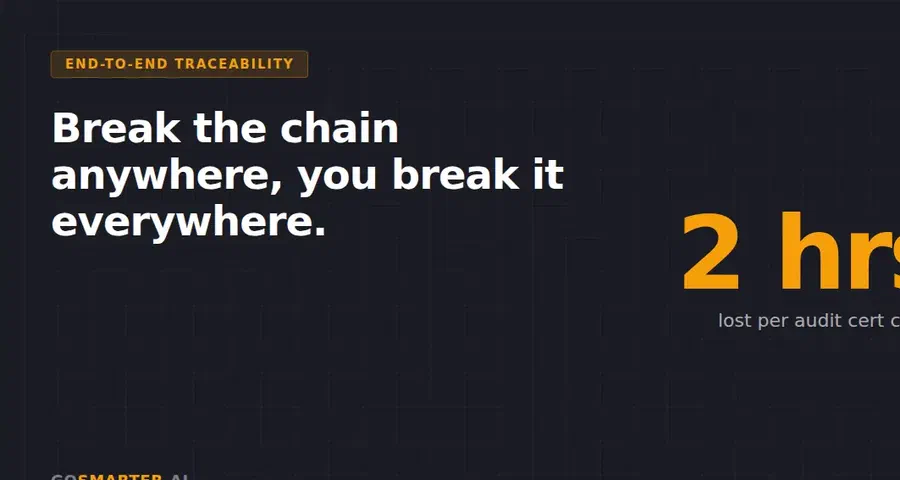
End-to-end traceability is an operations advantage, not a quality box-tick. When the heat number and certificate status travel with the material through every step, you release stock faster, ship the right grade every time, and pull any record in seconds. Break the chain anywhere and you break it everywhere.
You feel it on the shop floor. A bar is sitting in the yard, ready to cut, but nobody can confirm the cert is approved. So it waits. A job slips. The material is fine. The traceability is not. That gap costs you throughput, and it never shows up in a single, neat line on a report.
Most factories treat traceability as a quality job. The Quality team owns the certs, files the Material Test Reports (MTRs, also called Material Test Certificates or MTCs), and dusts them off at audit time. That framing is the problem. Traceability is a production data flow. When it works, your day runs smoother. When it breaks, you lose hours you will never get back.
Here is what end-to-end traceability gives you as an Operations Manager:
- Faster material release, because cert status is visible at the point of use
- Fewer wrong-material incidents, because heat numbers stay linked to jobs
- No audit drills, because the record is already built
- Faster recall isolation, because you can trace one heat in minutes
- Protected margins, because none of the above eats your team’s time
Let’s walk the chain, step by step.
The Chain Is Only as Strong as Its Weakest Handoff
Traceability is not a single record. It is a thread that runs from the mill to your customer. The thread passes through goods-in, stock, job reservation, cutting, despatch, and the customer cert pack. Each handoff is a place where the thread can snap.
Material arrives with a perfect cert. By the time it reaches the saw, nobody knows which heat it belongs to. The chain broke at stocking, and everything downstream is now guesswork.
This is the core point. Perfect traceability at goods-in is worthless if it dies at the next step. A cert filed in a folder while the steel goes into a rack, unlabelled, gives you nothing. Not when a job needs it. You have proof the material is good. You cannot prove which material is which.
Heat number traceability only works when the heat number stays attached at every stage. That is what “end to end” actually means. Not a cert in a drawer. A live link from steel to certificate to job to despatch note.
Goods-In: Where the Thread Starts (or Snaps)
Goods-in is the first handoff, and it is where most chains start with a knot. A delivery arrives. The cert is a PDF, a scan, or a creased sheet. Sometimes from a supplier who has never met a scanner. Someone re-keys the heat number, the grade, and the chemical results into a spreadsheet. Or they do not, and the cert goes in a pile.
Every manual keystroke here is a chance to get it wrong. A transposed heat number means the wrong material is linked to the wrong cert from minute one. That error then travels the whole chain, undetected, until an auditor or a customer finds it for you.
The fix is to verify the cert against the EN 10204 type at goods-in and link it to the physical material straight away. Capture the data once, accurately, and attach it to the stock. The thread is now tied to the steel, not to a folder.
Stock and Reservation: Keep the Heat Number on the Steel
Once material is booked in, it sits in stock until a job needs it. This is where traceability quietly dies in most yards. The certificate lives in your Enterprise Resource Planning (ERP) system or a shared drive. The steel lives in a rack. Nothing connects the two except someone’s memory.
Real traceability links stock to cert by heat number, and keeps that link when material is reserved against a job. When a job is allocated 2 tonnes of a specific grade, the system reserves stock with a known heat and a known, approved cert. The picker does not guess. The cutter does not check three folders. The right material is the easy choice, not the lucky one.
| The Manual Way | The Linked Way |
|---|---|
| Cert in a folder, steel in a rack, no link | Heat number ties cert to physical stock |
| Reserve material, then hunt for its cert | Reserve material with cert already attached |
| Confirm cert status by walking to QA | Cert status visible at the point of picking |
| Wrong heat reaches the saw, caught late | Wrong heat blocked before it is cut |
Cutting and Production: One Wrong Heat Costs a Job
The saw does not care about your paperwork. It cuts what it is given. If the wrong heat reaches the cutting list, you do not find out until the part fails inspection, or worse, until it is welded into a customer’s structure.
A wrong-material incident is not a quality statistic to an Operations Manager. It is a scrapped batch, a remade job, an angry customer, and a hole in the schedule. The cost is throughput and rework, not a line in a compliance log.
End-to-end traceability stops this at the cut. The heat number stays attached through production, so every offcut and finished part still carries its origin. If a question comes up later, you trace the part back to the heat, the cert, and the delivery. No detective work.
Despatch and the Customer Cert Pack: Close the Loop
The last handoff is despatch. The order ships, and the customer wants the cert pack. If your chain held all the way through, the pack assembles from records you already have built. If it broke anywhere, someone now reconstructs the trail by hand, before the lorry leaves.
A clean despatch links each item on the order to its heat number and approved cert, then produces the On-Time In Full (OTIF) shipment with its documentation in one go. The customer gets a branded cert pack. You get the despatch out the door. Nobody spends the afternoon collating PDFs.
This is also where recall isolation lives. If a heat is later found out of spec, you trace every order it touched in minutes. Not days. You isolate the affected jobs and contain the problem. A broken chain turns the same recall into a frantic sweep through folders and memory.
Audit Day: Built, Not Crammed
An audit is not a project when traceability runs end to end. The auditor asks for the cert behind a heat number, and you pull it up. They ask who approved it and when, and the log answers. The audit trail built itself while you worked.
Compare that to the usual scramble. Someone spends two hours chasing one cert, then another two on the next request. At £30 an hour, a single audit fire drill burns a day of skilled time on filing. Not steel. Run that against every customer audit and quality review in a year and the cost is real money.
The best audit is the one you do not notice. The record was always there, because every step wrote to it as it happened.
Traceability Is an Operations Metric
Stop treating traceability as a QA cost centre. It belongs on your operations dashboard, next to throughput and on-time delivery. Faster material release is a throughput gain. Fewer wrong-material incidents is a scrap and rework gain. No audit panic is a recovered-time gain. These are your numbers, not the Quality team’s.
The companies that get this build the chain once and run it forever. We saw exactly that pattern in our work with Midland Steel. Joining up processes across the business removed the manual handoffs that slow rebar supply. The principle holds for any stockholder or fabricator. For the full workflow view, our guide to end-to-end mill cert traceability walks every stage from upload to customer pack.
Frequently Asked Questions
What does end-to-end traceability actually mean in a metals business?
Why is traceability an operations issue and not just a quality one?
How does end-to-end traceability speed up an audit?
What is the link between heat numbers and recall isolation?
Build the Chain Automatically as You Work
The fastest way to make traceability an operations advantage is to stop building it by hand. GoSmarter MillCert Reader builds the EN 10204 audit trail automatically as you work. The AI extracts the cert, your team reviews and approves it, and the system links it to stock by heat number. From there it reserves against jobs and travels through to the despatched order with a branded cert pack.
That is the exact end-to-end chain this post argues for, working without an IT project, a consultant, or a migration. Get a 7-day free trial and run it on your next delivery of certs. See the heat number travel from goods-in to despatch on a real job.
For the bigger picture, the integrated cert traceability hub covers how the whole chain joins up, and the mill cert automation hub explains how the extraction works. Then put it on your next batch and watch material release speed up.
About the Author

Editor· Co-Founder & CEO
Ruth Kearney is Co-Founder and CEO of GoSmarter AI — driving commercial growth and strategic partnerships to help metals manufacturers adopt AI and digital tools that actually deliver on the shop floor.