EN 10204 3.1 vs 3.2 Certificates for Fabricators
- BlogSmarter AI
- Edited by Steph Locke
- Blog
- October 28, 2026
- Updated:
Table of Contents Show Hide
We don’t judge a mill certificate or material test report by passing results alone. EN 10204 3.1 requires manufacturer validation independent of production. Type 3.2 also requires the purchaser’s authorised representative or an inspector appointed under official regulations.
Order the wrong type, and you risk rejected stock before fabrication starts. Another PDF won’t fix missing validation.
GoSmarter is built by Nightingale HQ. It sits on top of your existing ERP, spreadsheets and email, with no rip-and-replace. It links mill certs to stock. It handles the document trail, not the inspector’s approval.
We’ll cover how you can:
- Specify the certificate type and validator before ordering.
- Check results, heat numbers and validation at goods-in.
- Keep certificates linked through cutting and offcut records.
Sort the requirement before you buy. Here’s what to check.
What is the Difference Between 3.1 and 3.2 MTC (Material Test Report) as per EN10204?
EN 10204 3.1 vs 3.2: Results and Validation
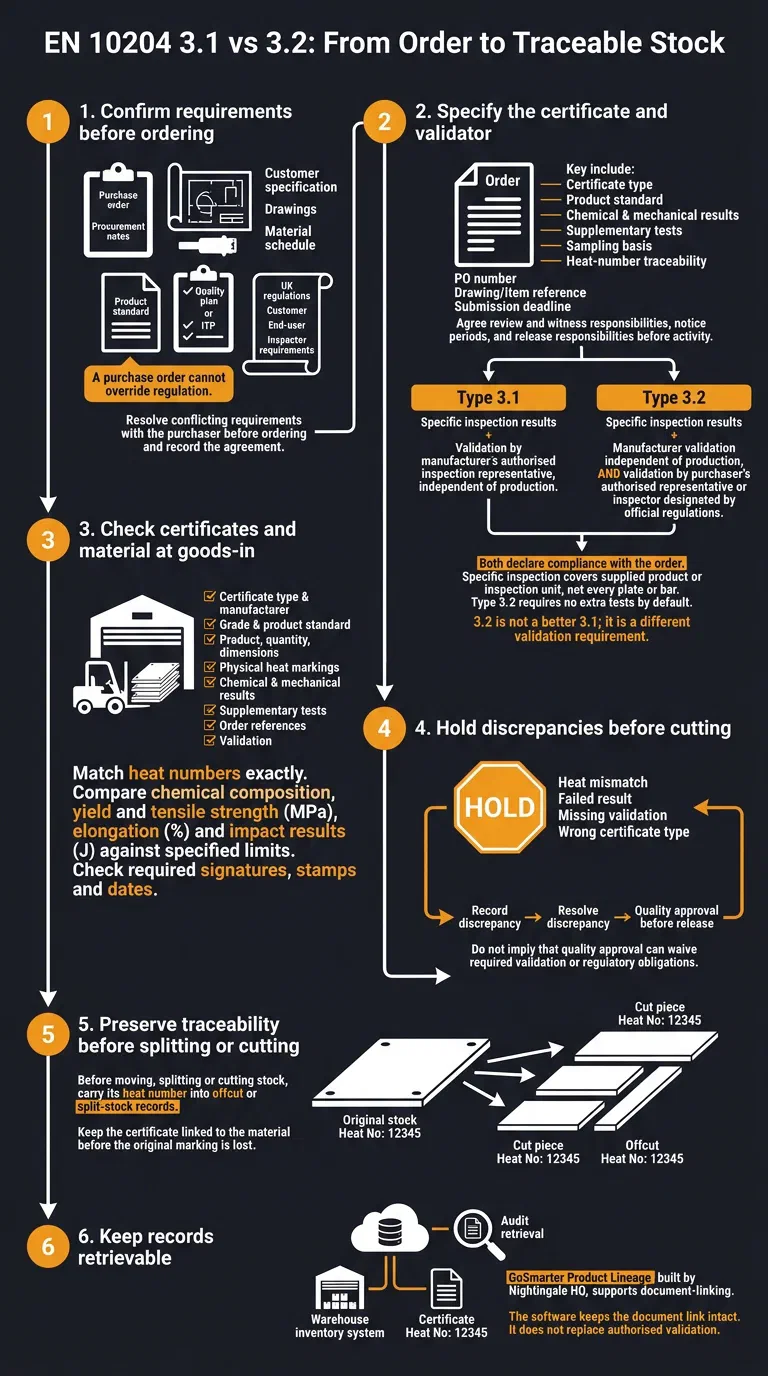
Under BS EN 10204:2004, both certificate types declare compliance with the order and report specific inspection results. Specific inspection covers the supplied product or its inspection unit, not every plate or bar. The product standard, order and applicable regulations set the required tests.[5]
The difference lies in who validates the results, not the results themselves. The table separates the shared test record from the extra validation.
| Aspect | Type 3.1 | Type 3.2 |
|---|---|---|
| Results | Required specific inspection results. | Required specific inspection results; no extra tests by default. |
| Manufacturer validation | The manufacturer’s authorised inspection representative, independent of production, validates the certificate. | The manufacturer’s inspection representative, independent of production, also validates the certificate. |
| Additional validation | The type 3.1 definition requires none. | The purchaser’s authorised representative or an inspector designated by official regulations also validates the certificate. |
What a Type 3.1 Certificate Requires
Type 3.1 states that the supplied products comply with the order and includes specific inspection results. The manufacturer’s authorised inspection representative validates it. That representative must work independently of production.[5]
Check the grade, product description, dimensions, standard, heat or inspection-unit identification, test results and validation. All must link to the supplied material. A generic test report isn’t enough without that link and the required validation.[5]
What a Type 3.2 Certificate Requires
Type 3.2 includes the manufacturer’s specific inspection results and validation. It also requires validation from the purchaser’s authorised representative or an inspector designated by official regulations.[5]
In practice, the additional validator may check traceability and witness required tests. For a 3.2 order, 3.1-style results alone don’t meet the requirement. You need the extra validation.[3]
Why Passing Test Results Are Not Enough
Passing test results don’t make a 3.1 acceptable when the order requires 3.2.[3] 3.2 is not a better 3.1; it is a different validation requirement.
Hold material with missing validation. Don’t release it for cutting. The order, project specification and regulations decide the certificate type, not the product category.[5] Write the required certificate type into the order before you buy material.
Confirm Certificate Requirements Before Ordering
Get purchasing and quality to agree one set of requirements before you release the order. Check these together:
- Purchase order and procurement notes: confirm certificate type, grade, product form, quantity, tests and heat-number traceability.
- Customer specification: check contract quality clauses and additional validation requirements.
- Drawings and material schedule: match item references, dimensions, grades and service requirements.
- Product standard: identify required tests and acceptance criteria.
- Quality plan or inspection and test plan (ITP): identify document reviews, witness points and hold points.
- Applicable UK regulations: confirm material documentation and conformity-assessment requirements, including any certificate type that pressure-equipment rules require.[6][8]
- Customer, end-user or inspector requirements: agree the authorised representative, notice period, inspection location and release responsibilities with your supplier.
Resolve conflicting wording with the purchaser before ordering. Record the agreement in an approved procurement note or technical-query response. Send it to the supplier.
If documents specify different validation requirements, don’t leave purchasing to pick one. A purchase order cannot override regulation. Check pressure-equipment requirements against the applicable conformity-assessment route.[6][7]
Then state the agreed requirement clearly in the purchase order.
State the Certificate Type in the Order
Specify the certificate type, product standard, chemical and mechanical results, supplementary tests, sampling basis and heat-number traceability. Record the manufacturer’s validation responsibility. For 3.2, also specify the purchaser’s authorised representative or an inspector designated by official regulations.[3]
Include the purchase-order number, drawing or item reference and document submission deadline.
Carry relevant ITP obligations into the order. State who reviews or witnesses each activity, their notice period, and whether work can proceed without attendance. Arrange witness points before the activity, not when the certificate lands in your inbox.
Why Late Certification Requests Can Cost More
A late 3.2 request can mean more than another signature. Depending on the validator, you may need original-record review, material identification, extra sampling or witnessed testing.
Cutting, mixing or coating material can break traceability or remove the chance to witness testing. That can make retrospective validation impossible.
Agree the validation route at enquiry stage to avoid replacement stock and production delays. Don’t pay for 3.2 when the confirmed requirements accept 3.1.
Check Certificates and Material at Goods-In
Check the certificate against the order and the stock before release. If any field fails, hold the material before cutting or fabrication. Work through these goods-in checks:
- Certificate type and manufacturer: check 3.1 or 3.2 against the order, plus mill name, address and works order number.
- Grade and product standard: match the full grade designation and product standard to the order.
- Product, quantity and dimensions: match product form, quantity and dimensions in millimetres (mm) to the order. The glossary defines unfamiliar terms.
- Physical heat markings: match stamped or tagged heat numbers exactly to the certificate. Check each heat separately where applicable.
- Chemical and mechanical results: compare chemical composition, yield and tensile strength (MPa), elongation (%) and impact results (J) against specified limits.
- Supplementary tests: confirm the certificate covers all ordered additional tests and heat-treatment requirements.
- Order references: check the purchase-order number and any internal references.
- Validation: check all required signatures, stamps and dates.[1]
Hold Material with Traceability or Validation Gaps
Hold material with a heat mismatch, failed result, missing validation or wrong certificate type. Record the discrepancy. Release the material only after quality approval.
Before moving, splitting or cutting stock, carry its heat number into offcut or split-stock records. Do this before you lose the original marking, and keep the certificate linked to the material.[1][2]
Link Stock to Certificates with GoSmarter
MillCert Reader reads supplier certificates and extracts heat numbers, grades and test results. Your team checks each field before approval. Product Lineage then links inventory to heat codes, so you can pull the certificate by heat code during an audit.[4]
The software keeps the document link intact. It does not validate the certificate type or replace the authorised validator. You still compare the certificate against the order yourself.
The same heat-number record feeds Metals Manager and Cutting Plans, so one record follows the material.
For IT teams: every paid plan includes a REST API, and customer data sits on UK/EU Azure-hosted infrastructure. See the trust centre. On the stated inputs, MillCert Reader recovers its upfront annual fee in about 11 months. You can start with a 7-day free trial.
Review Your Next Order with Purchasing and Quality
Have purchasing and quality confirm the requirement. Record the required EN 10204 type, ASTM, or ASME standards and validator on the purchase order before release.[1]
If the supplier cannot meet the required type, stop the order before production starts. Delivering 3.1 against a 3.2 requirement may breach the order and lead to rejection.[3]
Use GoSmarter to keep the certificate linked to stock. That link runs from goods-in through cutting and offcut records.[4][9] Purchasing, quality and goods-in then work from the same certificate requirement.
FAQs
Can I obtain 3.2 validation after material has been delivered?
It may be possible if the manufacturer has provided only a 3.1 certificate. To meet the 3.2 requirement, you need additional verification and validation. This must involve the purchaser’s authorised representative or an inspector designated by official regulations.
The process can be complicated and costly. Confirm certification requirements before ordering, in your purchase order or project specifications, to avoid delays or material rejection.
How do I verify a certificate validator's authority?
Check that the certificate’s signature and stamp identify the authorised representative in the correct role.
- 3.1: The manufacturer’s authorised inspection representative must validate the certificate. They must work independently of production.
- 3.2: The purchaser’s authorised representative or an inspector designated by official regulations must also validate the certificate.
Check that the certificate’s heat number matches the material markings.
How do I preserve heat-number traceability on small offcuts?
Keep a documented tracking system from material receipt through to the final fabricated element. Whenever you cut material, carry its traceability markings forward. Each offcut must stay linked to its heat number and corresponding certificate.
Link certificate data to stock records, then update those records as you use material. Clear offcut markings and up-to-date inventory records keep that chain intact. They also give you evidence for audits and project requirements.
Sources
- What is EN 10204? Types explained, GoSmarter
- What is a mill test certificate? GoSmarter
- BS EN 10204 test certificates for stainless steel products, British Stainless Steel Association
- Integrated certificate traceability, GoSmarter
- EN 10204 inspection documents, Van Leeuwen
- Pressure Equipment (Safety) Regulations 2016, legislation.gov.uk
- Pressure Equipment (Safety) Regulations, HSE
- Pressure Equipment (Safety) Regulations 2016, version at 10 September 2019
- What is metals inventory management? GoSmarter
Drill deeper
- EN 10204 vs ASTM and ASME: How the Standards Fit Together
Go here for how the certificate type sits beside material and design standards, not who validates it.
7 min read
- How to Read a Mill Test Certificate: A Field Guide for Quality Managers
Go here for a line-by-line check of chemistry and mechanical results once you know the type.
10 min read
- How to Trace a Heat Number Back to Its Mill Certificate
Go here for the goods-in steps that match a marked heat to its certificate.
12 min read
About the Author

Editor· Co-founder & Head of Product
Steph Locke is Co-founder and Head of Product at GoSmarter AI — former Microsoft Data & AI MVP building practical tools to cut paperwork and automate compliance for metals manufacturers.