Data-Driven Lean Manufacturing: Benefits and Tools
- BlogSmarter AI
- Blog
- March 21, 2026
- Updated:
Table of contents Show Hide
Stop running your factory like it’s 1985. Clipboard checklists and manual Gemba walks might have worked back when production was simpler, but today’s factories churn out terabytes of data — and ignoring it is like throwing money down the drain.
Here’s the hard truth: 323 hours lost annually to unplanned downtime. That’s the average. And with 72% of factory tasks still being done manually, inefficiencies are hiding everywhere.
The fix? Lean 4.0. By combining lean principles with modern tools like AI and IoT, you can stop reacting to problems and start preventing them. AI systems now pinpoint inefficiencies with up to 95% accuracy, slash downtime by 20%, and cut maintenance costs by 10%.
The Old Way vs. The Smart Way
| The Old Way | The Smart Way |
|---|---|
| Relying on gut instincts and outdated reports. | Live data dashboards and predictive analytics. |
| Manual Gemba walks that miss hidden issues. | Digital Gemba with IoT sensors spotting problems instantly. |
| Weeks spent finding root causes. | AI cuts root cause analysis time by up to 70%. |
Instead of drowning in spreadsheets or playing catch-up, modern tools let your factory run smoother, faster, and with fewer surprises. Let’s break down how these tools work and why they’re changing manufacturing forever.
The Future of Lean: AI-Driven Process Optimisation
1. Traditional Lean Manufacturing Methods
Lean manufacturing, as it was originally conceived, thrived in a world of clipboards and stopwatches. Back then, production processes were straightforward, and tracking them was manageable. The “Visual Factory” method was at the heart of these systems, relying on tangible signals like Andon lights, which flashed red to indicate problems, or Kanban cards, which kept inventory flowing. Managers would conduct Gemba walks, physically observing the shop floor to identify inefficiencies rather than relying on second-hand reports [9][1]. The entire philosophy revolved around exposing and eliminating waste wherever it hid.
Visibility
In traditional lean systems, visibility meant making everything on the shop floor obvious and easy to monitor. Andon systems, for instance, used lights or boards to alert teams to problems, empowering operators to stop production immediately when something went wrong [9]. Kanban cards were another visual tool, triggering inventory replenishment without the need for complex systems [9][1]. The 5S methodology ensured workspaces were organised and defects were impossible to ignore [1]:
- Sort — remove anything that doesn’t belong
- Straighten — a place for everything, everything in its place
- Shine — keep it clean enough that problems are visible
- Standardise — document the right way so everyone does it the same
- Sustain — don’t let it slip
As Lean Production explains:
“Visual Factory makes the state and condition of manufacturing processes easily accessible and very clear - to everyone” [9].
However, these methods had a major shortcoming: they only provided a snapshot of what was happening at a given moment. Problems that emerged between observations often went unnoticed [11]. While the visual tools were effective, they couldn’t capture everything, leaving gaps in waste detection.
Waste Detection
Traditional lean relied heavily on manual methods to identify waste. The eight wastes — summarised by the acronym DOWNTIME — were the framework [1][11]:
- Defects
- Overproduction
- Waiting
- Non-utilised talent
- Transportation
- Inventory
- Motion
- Excess Processing
Tools like Value Stream Mapping helped map inefficiencies. Poka-Yoke devices prevented errors at the source [9][1]. Despite these efforts, manual inspections often missed subtle issues [4].
As Rish Gupta, CEO of Spot AI, explains:
“The limitation isn’t just finding waste - it’s capturing evidence of inefficiencies that occur between Gemba walks, across multiple shifts, and in areas where manual observation simply can’t scale” [11].
This dependence on human observation meant that by the time anyone spotted the problem, it had already cost real money.
Decision-Making Speed
Traditional lean systems often left managers playing catch-up. Decisions were typically based on past reports rather than live data. By the time an issue was identified, it had already caused significant disruption [2][12]. For example, at Precision Components Inc., a Midwest automotive supplier, managers struggled to locate specific orders on their sprawling 7,000-square-metre factory floor. Until mid-2024, they relied on paper-based systems, which failed to catch issues like tool wear until entire batches were ruined. This resulted in an 18% scrap and rework rate and a bloated 28-day lead time [13].
Without real-time data, decision-making often relied on the intuition of experienced operators — what some call “tribal knowledge” [2][13]. Root cause analysis could stretch out for weeks or even months, further delaying corrective actions [11]. That slow response time exposes the real limits of traditional lean.
Scalability
Scaling traditional lean practices was another major hurdle. While Standardised Work documented best practices, ensuring consistent application across multiple shifts was a constant challenge [9][10][11]. Stopwatch-based time and motion studies, though helpful, were laborious, prone to errors, and impractical for analysing thousands of cycles across different operators [4][11]. Manual processes and frequent downtime made it difficult for operations to grow efficiently. These scalability issues have driven many manufacturers to adopt modern, data-driven solutions that can handle complexity more effectively.
2. Data-Driven Lean Manufacturing Tools
Modern lean manufacturing has evolved beyond traditional manual methods, introducing data-driven tools that reshape how factories operate. These tools act like a “digital nervous system”, monitoring machines, operators, and processes in real time. The goal isn’t to replace lean principles but to automate the tedious tasks, allowing teams to tackle waste before it spirals into costly problems.
Visibility
Instead of relying on periodic observations, data-driven tools provide live, continuous monitoring. With the help of Industrial IoT sensors and AI dashboards, factories now have a “Digital Gemba” — a virtual version of shop floor observation. This technology lets managers track metrics like Overall Equipment Effectiveness (OEE), cycle times, and throughput in real time, even remotely.
For instance, in 2024, Versatech, an automotive supplier, adopted a real-time production monitoring system from Mingo Smart Factory, boosting its OEE by 30% [6]. Since 72% of factory tasks are still manual [1], modern platforms extend visibility to manual workstations through digital job routing and scheduling. This breaks down silos between production, maintenance, and quality teams, ensuring everyone works with the same accurate data.
Waste Detection
AI has turned waste detection into a continuous process rather than a periodic audit. AI-based anomaly detection can identify inefficiencies with an accuracy rate of 92–95% [4]. At Toyota’s Kentucky plant, AI inspection systems reduced defect rates by 91% by spotting subtle issues invisible to the human eye [4]. These systems process huge amounts of data, alerting operators to problems and pinpointing their root causes before they escalate.
A great example comes from H&T Waterbury, a metal stamping company that integrated its monitoring system with Fiix in 2024. This let them implement condition-based maintenance, slashing unplanned downtime by 71% [6]. Sadia Waseem from Retrocausal explains this shift perfectly:
“AI creates an eighth dimension beyond Lean’s traditional seven wastes, which is unused information” [4].
Decision-Making Speed
Traditional methods often react to problems after they’ve occurred. Data-driven lean catches issues before they blow up. AI-powered demand forecasting systems, for example, can reduce forecasting errors by 20–50% [4], helping manufacturers avoid material shortages or excess inventory. Similarly, AI-assisted Root Cause Analysis (RCA) can cut the time engineers spend on data preparation by 50–70% [14], allowing faster resolution of issues.
Real-time alerts let teams intervene before defects occur or equipment fails. Syed Ajmal, Senior Solutions Engineer at MathCo, explains:
“The factories that will win the next decade are not the ones with the most automation, they are the ones that learn the fastest. Lean AI makes that possible” [7].
Scalability
Data-driven tools also make scaling operations easier by converting “tribal knowledge” into digital work instructions that update automatically based on performance data [4]. Cloud-edge hybrid systems — combining cloud computing with local processing — allow AI models to scale across multiple facilities while maintaining the speed needed for production lines [15].
For example, a medical device manufacturer reduced its scrap rate by 60% by deploying an AI-driven “assembly copilot” across four workstations [4]. Similarly, platforms like GoSmarter simplify complex tasks for metals manufacturers, such as reading mill certificates, calculating scrap rates, and scheduling production runs. GoSmarter connects directly to your existing ERP, shared drives, and email — it sits on top of what you already use, rather than replacing it. These Lean 4.0 platforms can cut unplanned downtime by up to 70% and maintenance costs by 25% [3], proving that scaling up doesn’t have to come at the expense of efficiency or profitability.
Strengths and Weaknesses
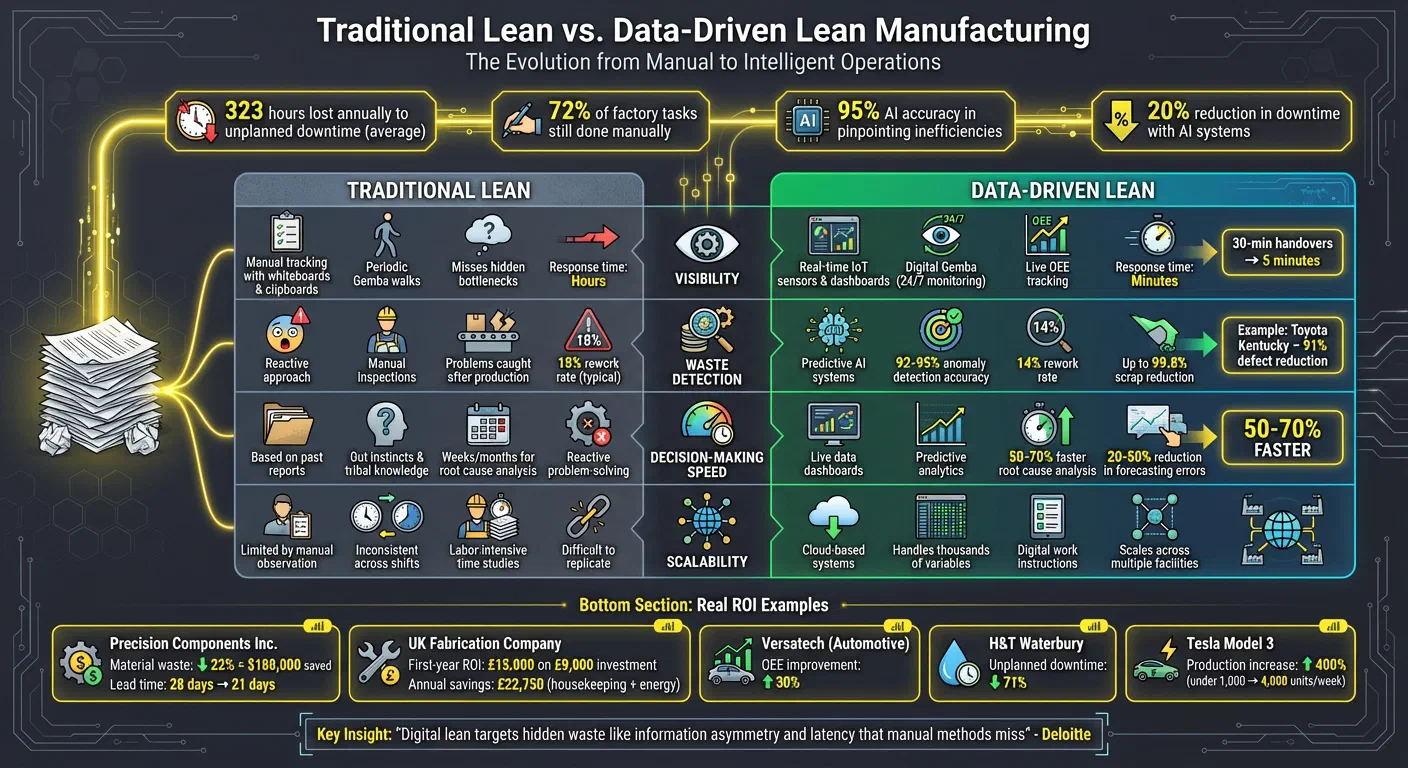
Traditional lean manufacturing methods and modern data-driven approaches are increasingly moving in different directions. The old-school methods — relying on whiteboards, clipboards, and manual observation — can work well for simple production lines. But as operations grow more complex, “invisible bottlenecks” start to appear, and managers can spend hours trying to track down stuck orders on the shop floor [13]. In contrast, data-driven tools use real-time dashboards and IoT sensors to cut response times drastically — from hours to just minutes. For example, shift handovers that once took 30 minutes now take five [13]. The table below highlights how these approaches differ.
| Criterion | Traditional Lean Manufacturing | Data-Driven Lean Tools |
|---|---|---|
| Visibility | Relies on manual tracking with whiteboards and clipboards, often missing hidden bottlenecks [13]. | Real-time dashboards and IoT sensors provide live tracking, with response times measured in minutes [13]. |
| Waste Detection | Reactive approach: defects are often caught after production, leading to an 18% rework rate [13]. | Predictive systems: AI detects anomalies early, cutting rework to 14% and reducing scrap rates by up to 99.8% [13][6]. |
| Decision-Making Speed | Slower due to reliance on historical averages and lengthy 30-minute shift handovers [13]. | Faster decisions with five-minute handovers and AI-powered scenario simulations [13][5]. |
| Scalability | Limited by manual observation and the need for skilled personnel [4]. | Cloud-based systems handle thousands of variables at once, making them highly scalable [5][2]. |
These operational upgrades lead to measurable financial benefits. For instance, Precision Components Inc., a manufacturer with 150 employees, reduced material waste by 22%, saving $180,000 annually. They also cut lead times from 28 days to 21 days after adopting IoT vibration sensors and a manufacturing execution system between 2024 and 2026 [13]. Similarly, a medium-sized UK fabrication company achieved a first-year ROI of £15,000 on a £9,000 software investment. They also saved £16,250 annually by adjusting housekeeping schedules and cut energy costs by an extra £6,500 each year [8].
The difference in scalability is especially striking. Traditional lean methods struggle when production variables multiply — human observers simply can’t keep up with every detail across multiple shifts. Data-driven platforms like GoSmarter step in to handle these challenges. They automate tedious tasks like reading mill certificates, calculating scrap rates, and scheduling production, freeing engineers to focus on innovation instead of repetitive data entry. H&T Waterbury is a direct example from within metals: the metal stamping company integrated condition-based monitoring into their maintenance workflow and cut unplanned downtime by 71% [6] — proof that data-driven lean in metals doesn’t require a billion-pound R&D budget, just the right tool pointed at the right problem. Deloitte sums it up perfectly:
“Digital lean provides an opportunity to target hidden components of waste, such as information asymmetry and latency, that often go unnoticed” [2].
That’s why more manufacturers are ditching the guesswork and letting AI do the heavy lifting.
The Numbers Make the Case
The case for a digital overhaul in manufacturing is clear. Traditional lean methods are no longer enough to keep pace. Data-driven tools speed up operations. They close the gap between what ERP systems plan and what actually happens on the shop floor. With so many processes still handled manually [16], the opportunity to cut waste, boost uptime, and avoid errors is enormous.
The results speak volumes. Carolina Precision Manufacturing, for instance, saved £1.5 million in just one year by using an IoT platform to improve operator accountability [16]. These aren’t minor tweaks — ditching manual record-keeping for real-time, data-powered systems is what made those results possible [16].
One medium-sized UK fabrication company put £9,000 into a digital lean software platform and saw £15,000 back in year one — plus £16,250 in ongoing annual savings and £6,500 cut from energy costs [8]. That’s not a pilot. That’s a business case. Ready to run the same maths on your shop floor? See GoSmarter pricing.
For metals manufacturers stuck in the rut of endless spreadsheets, GoSmarter is built specifically for heavy industry. The fastest entry point is mill certificate reading: GoSmarter reads a PDF mill cert in under 30 seconds — a task that can eat 20 minutes or more of an engineer’s time when done by hand. Most customers are live in under a day, with no IT project required and no changes to existing systems. GoSmarter sits alongside your ERP and spreadsheets, adding intelligence to the processes you already run. As Tony Woods, CEO of Midland Steel, explains:
“Smart technology choices can have a direct, measurable impact on reducing carbon emissions in steel manufacturing. The integration of AI and digital tracking has significantly improved our operational efficiency and sustainability performance.”
Start small — pilot digital upgrades on a few machines, measure the ROI, and scale from there [8]. Focus on the biggest bottleneck first, whether it’s a machine or a process, and target improvements there [9]. Shifting from reactive to predictive maintenance isn’t just about saving time. In this industry, every penny counts — and waste is expensive.
The future of manufacturing belongs to those who stop guessing and start measuring. Turn your data into your edge.
The fastest way in? Start with mill certificates. GoSmarter reads PDF mill certs in seconds — try the Mill Certificate Reader free.
FAQs
What is Lean 4.0?
Lean 4.0 merges the time-tested principles of lean manufacturing with Industry 4.0 technologies — AI, IoT, and automation. Real-time data and digital tools help manufacturers make faster, better decisions and fix problems before they get expensive.
This isn’t just a modernisation project; it’s lean’s core mission — eliminating waste and maximising value — with a proper engine behind it. Think of it as lean manufacturing, but instead of a stopwatch and a clipboard, you’ve got sensors, AI, and a live-view of everything going wrong before it gets worse.
Where should I start with data-driven lean in my factory?
Most factories start by adding monitoring to their single biggest bottleneck — the machine or process that causes the most disruption when it goes wrong. Get visibility there first, then expand.
In metals, the quickest wins are usually the most manual admin tasks: reading mill certificates, logging scrap by hand, or shift handovers done on paper. Pick the one that costs your team the most time. Measure how long it takes right now. Then run GoSmarter for 30 days and measure again. The gap between those two numbers is your business case — no consultants or six-month project plan required.
How do I prove ROI from IoT and AI on the shop floor?
To prove ROI, you need numbers — not vibes. Focus on three things:
- Uptime gained: predictive maintenance pays for itself fast when you stop firefighting breakdowns
- Scrap and rework rate: measure before and after, then show the difference
- Overall Equipment Effectiveness (OEE): the single number that wraps efficiency, quality, and availability into one
DMAIC (Define, Measure, Analyse, Improve, Control) gives you a structured way to track improvements step by step. Pair it with real-time data tools and your team can turn those numbers into a board-ready business case — not a vague concept.