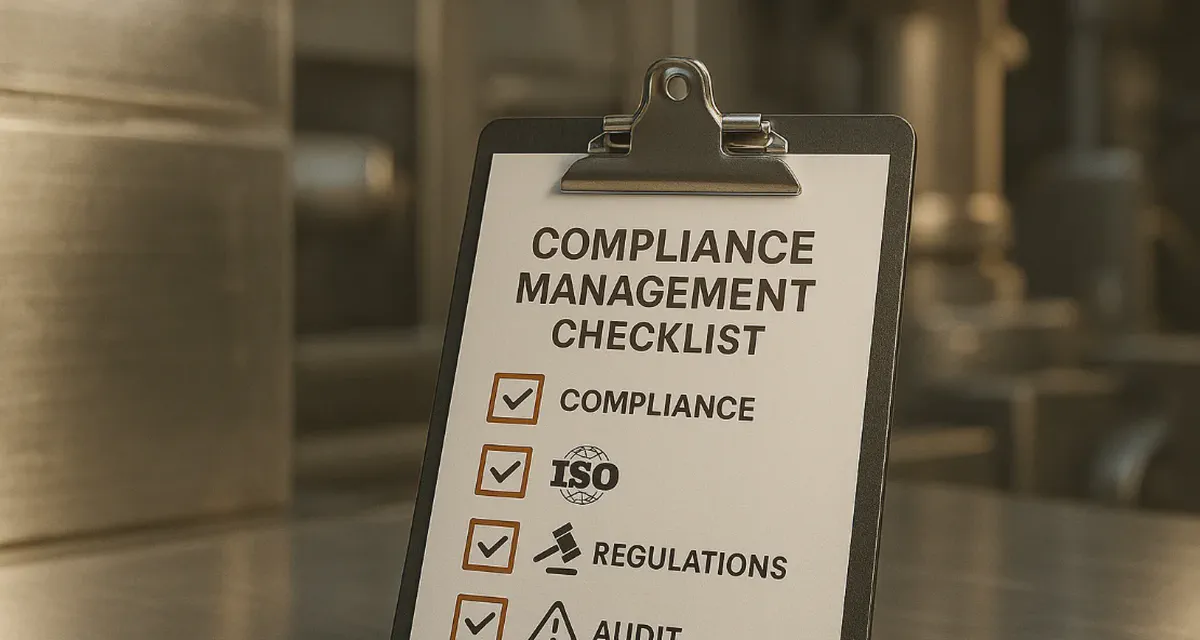
Compliance Management Checklist for Metals Manufacturers
- Steph Locke
- Blog , Learning
- December 4, 2025
- Updated:
Table of Contents
Staying compliant in metals manufacturing is non-negotiable. From UK REACH regulations to ISO certifications, the stakes are high - fines, project delays, and reputational damage are real risks. This guide outlines everything you need to know to keep your operations running smoothly.
Here’s what you’ll learn:
- Key regulations like UK REACH, emissions control, and material traceability.
- Import/export requirements, including customs documentation and conflict minerals compliance.
- How to meet quality standards with ISO certifications and proper documentation.
- Supplier qualification processes and maintaining supply chain compliance.
- Leveraging digital tools to simplify and automate compliance tasks.
Compliance is complex, but with the right systems, it’s manageable. Whether it’s tracking regulatory updates, ensuring material traceability, or preparing for audits, this checklist will help you stay ahead and avoid costly mistakes.
Key Regulatory Requirements
Navigating the complex web of regulations is a daily reality for UK metals manufacturers. From managing chemical compliance to ensuring smooth cross-border trade, staying ahead requires constant vigilance and meticulous record-keeping. Two key areas demand particular attention: chemical regulations under UK REACH and the import/export compliance of both raw materials and finished goods. Both involve detailed documentation and regular updates to processes.
Failing to comply can lead to serious consequences, including notices from the Health and Safety Executive (HSE), hefty fines, or even prosecution. Beyond the legal risks, non-compliance can halt production, delay shipments, and harm customer trust. In an industry where contracts often hinge on solid compliance systems, safeguarding your reputation is non-negotiable.
Staying compliant means more than just ticking boxes - it requires actively monitoring regulatory changes, maintaining thorough records, and training staff regularly. A reactive approach can leave gaps, especially as regulations evolve. This is particularly critical for meeting the demands of UK REACH.
UK REACH and EU REACH Alignment
UK REACH (Registration, Evaluation, Authorisation and Restriction of Chemicals) came into force in Great Britain after Brexit, replacing the EU REACH framework. Any facility handling more than one tonne of a substance annually must register it with the HSE. This applies to metals, alloys, and other chemical substances used in manufacturing, such as lubricants or surface treatments.
The registration process involves submitting detailed information about each substance, including its properties, hazards, safe handling measures, and risk management protocols. For substances registered under EU REACH before Brexit, transitional arrangements were put in place. Registration costs can vary widely depending on the quantity of the substance.
For manufacturers exporting to the EU, compliance becomes even more challenging. EU REACH still applies to products entering European markets, requiring separate registrations with the European Chemicals Agency (ECHA). This adds significant administrative work and expense, particularly for smaller businesses without dedicated compliance teams. To manage this, many manufacturers appoint an Only Representative based in the EU to handle their obligations, though this adds another layer of coordination.
The Candidate List of Substances of Very High Concern (SVHC) poses an ongoing challenge. If a substance exceeds 0.1% w/w in a product, notification is required. For metals manufacturers working with complex alloys or coatings, this means obtaining material declarations from every supplier in the supply chain.
Additional hurdles include authorisation and restriction requirements. If a substance appears in Annex XIV, you’ll need authorisation from the HSE to use it. Similarly, substances listed in Annex XVII face usage restrictions or outright bans. Exporters must ensure compliance with both UK and EU regulations, adding another layer of complexity to the process.
Material Import and Export Compliance
Proper substance registration under UK REACH helps streamline international documentation and ensures smoother border compliance. Importing raw materials and exporting finished products involve multiple regulatory checkpoints. Accurate customs documentation is essential - this includes correct commodity codes, country of origin declarations, and proof of compliance. Mistakes can lead to shipments being held at borders, resulting in storage fees and delayed deliveries.
Even seemingly minor details, like the use of wooden pallets or crates, fall under scrutiny. The UK’s Timber and Timber Products Regulations 2013 require manufacturers to ensure that any timber used in packaging hasn’t been illegally harvested. This means obtaining proper documentation from suppliers to verify the timber’s origin and legality. Overlooking this can lead to penalties and operational disruptions.
For imported materials, due diligence extends beyond customs paperwork. It’s crucial to confirm that suppliers comply with their local regulations and that materials meet UK standards. This is especially important for alloys or metals that could contain restricted substances. Many manufacturers request detailed questionnaires from suppliers covering environmental, labour, and chemical standards before approving them.
Exporting certain metals and alloys adds further challenges. Products with potential military or dual-use applications - such as titanium alloys, specific steel grades, or specialised aluminium products - may require export licences. These licences, managed by the Export Control Joint Unit (ECJU), can take weeks to process, so factoring this into production schedules is essential.
Conflict minerals regulations are another consideration. While primarily driven by the US Dodd-Frank Act, these rules increasingly affect UK manufacturers through customer demands. Many buyers now require declarations confirming that materials like tin, tantalum, tungsten, and gold are not sourced from conflict-affected regions. Additionally, the EU Conflict Minerals Regulation, effective since January 2021, has added further supply chain expectations for UK manufacturers.
To avoid delays or rejections, ensure that all commercial invoices, certificates of origin, safety data sheets, and conformity declarations are complete and accurate.
Finally, trade agreements and tariffs continually reshape the economic landscape for imports and exports. The UK Global Tariff (UKGT) outlines duty rates for goods entering the UK, while free trade agreements offer preferential rates for qualifying products. Understanding these agreements and ensuring products meet rules of origin requirements can have a significant impact on costs and competitiveness.
Meeting Quality Standards
Building quality control into your compliance framework isn’t just about ticking boxes - it’s about preventing costly mistakes and ensuring your processes meet industry expectations. Quality standards act as a safeguard, bolstering confidence among regulators, customers, and auditors. Without them, even small errors can spiral into major issues like non-compliance, product recalls, or lost contracts.
In the metals industry, quality control faces specific hurdles. Material properties can shift from batch to batch, processing conditions impact final outcomes, and strict traceability rules demand precise documentation. A single misstep - like an error in heat treatment or mixing up material grades - can ruin an entire production run, especially when safety is on the line.
Quality standards create systems that catch problems early. This requires clear procedures, comprehensive staff training, and detailed documentation that proves compliance every step of the way. For UK manufacturers aiming to compete internationally, recognised certifications are often the key to unlocking new markets and securing valuable contracts.
ISO Standards and Certifications
ISO 9001 is the cornerstone of quality management systems across manufacturing industries. It lays out the framework for documenting processes, managing risks, and driving continual improvement. For metals manufacturers, earning ISO 9001 certification signals to customers that your operations are tightly controlled - from raw material intake to final inspection and delivery.
To achieve ISO 9001, you’ll need to map out every process that impacts product quality. This involves defining roles, creating work instructions, setting acceptance criteria, and establishing corrective action procedures. The standard also requires evidence of management’s involvement, regular internal audits, and documented reviews to assess system performance. Certification bodies conduct initial assessments and follow up with regular surveillance audits.
In some sectors, additional certifications build on ISO 9001. For example:
- AS9100 is tailored for aerospace, adding controls for configuration management, first article inspections, and counterfeit parts prevention. Aerospace customers often won’t work with suppliers who lack this certification, as it ensures adherence to stringent quality and traceability standards.** - **IATF 16949 (formerly ISO/TS 16949) is designed for the automotive sector, focusing on defect prevention, reducing variation, and minimising waste. Automotive supply chains demand incredibly low defect rates, often measured in parts per million, making robust quality systems a must.** - Specialised certifications like **ISO 13485 for medical devices, ISO 3834 for fusion welding, and ISO 19443 for nuclear applications address specific industry needs. These standards emphasise traceability, personnel qualifications, and strict documentation protocols.
Maintaining certifications requires ongoing effort. Regular internal audits, management reviews, and prompt resolution of non-conformances identified during external audits are essential. Training records also play a critical role, proving that staff are qualified for their tasks. For specialised processes like heat treatment or non-destructive testing, personnel often need certification under recognised schemes like PCN (Personnel Certification in Non-Destructive Testing).
Certification costs vary based on company size and complexity. Initial expenses include consultant fees for gap analysis and system development, along with certification body fees for assessments. Ongoing costs, such as annual surveillance audits, are typically offset by improved efficiency, reduced waste, and access to premium contracts.
While certifications create a strong foundation for quality, accurate product marking and thorough documentation ensure ongoing compliance.
Product Marking and Documentation
Once certified, maintaining compliance hinges on precise product marking and detailed documentation. These measures prevent rejected shipments and ensure traceability throughout the supply chain.
Material test certificates (MTCs) are critical for proving material composition and properties. Each batch of metal must be accompanied by an MTC detailing chemical analysis, mechanical properties, heat treatment conditions, and traceability data. For critical applications, customers often specify the type of certificate required, such as EN 10204 3.1 certificates, which include independent inspection and testing verification.
MTCs must be clear, complete, and directly linked to the supplied material. Missing or mismatched information can lead to compliance failures. Digital systems can streamline MTC management, ensuring easy access and consistent quality control.
Physical product marking is essential for traceability. Methods like stamping, engraving, laser etching, or electro-chemical marking ensure information - such as material grade, heat number, and supplier details - remains legible through handling and processing. For smaller components or thin materials, tags, labels, or colour coding may be used, though these methods require additional safeguards to prevent misplacement or confusion.
Certificates of conformity confirm that products meet specified standards. These documents reference applicable standards, customer requirements, and any additional testing performed. They must be signed by authorised personnel and provide enough detail for customers to verify compliance. Generic templates won’t meet audit standards if they lack product-specific information.
Additional documentation, like dimensional inspection reports, non-destructive testing results, and surface finish measurements, provides objective proof of product compliance. These records must be retained for periods specified by contracts or regulations - often five to ten years, or longer for aerospace and nuclear sectors. Secure storage, whether physical or digital, is crucial to safeguard records from loss or tampering.
Traceability systems link raw materials through every stage of production, capturing data at each step: material receipt, cutting or forming, heat treatment, surface finishing, inspection, and dispatch. Technologies like barcoding, QR codes, or RFID tags can automate data collection, reducing errors and speeding up retrieval. If issues arise, these systems allow for quick identification of affected products, minimising recalls and demonstrating accountability to regulators.
Document control is equally important. Work instructions, inspection procedures, and test methods must include version numbers, approval signatures, and effective dates. Obsolete documents should be removed from circulation to prevent accidental use, while distribution lists ensure updates reach the right people.
Electronic document management systems simplify version control, access management, and audit trails. These systems allow multiple users to access documents simultaneously, automate change notifications, and enable quick retrieval during audits or customer inquiries. Backup procedures and business continuity plans are vital to protect against data loss or system failures.
Calibration records for measuring and testing equipment are another key component. Instruments must be calibrated regularly using traceable standards, with records showing calibration dates, results, and any adjustments made. If equipment is found out of calibration, investigations must determine whether affected measurements or products require corrective action.
Finally, some industries impose additional documentation requirements. For example, aerospace customers may demand first article inspection reports (FAIRs) to demonstrate that new or modified processes consistently produce conforming parts. Automotive customers often require production part approval process (PPAP) submissions, including process flow diagrams, failure mode and effects analyses (FMEA), and control plans. Meeting these requirements upfront avoids costly delays and rejections later on.
Managing Supply Chain Compliance
Your responsibility for compliance doesn’t end at your factory doors. Ensuring supply chain compliance means extending your quality and regulatory standards to every supplier, subcontractor, and material source you work with. If any part of the chain fails to meet these standards, you risk production delays, regulatory fines, and even damage to your reputation.
For metals manufacturers, this challenge is particularly complex. Raw materials often pass through multiple stages - mining, smelting, trading, and distribution - before they arrive at your facility. Each step introduces potential risks: incorrect documentation, material substitutions, contamination, or even intentional fraud. Without a robust system in place, pinpointing the source of an issue becomes exponentially more difficult.
The stakes are high. Industries like aerospace and automotive regularly audit their suppliers, requiring proof that every step of the supply chain meets stringent standards. Regulatory bodies such as the Health and Safety Executive also scrutinise material origins, especially for hazardous substances. Post-Brexit, compliance requirements have become even more complicated, with differing rules for materials sourced from the EU compared to other regions. Failing to meet these standards can lead to lost contracts, production stoppages, and legal liabilities.
To manage supply chain compliance effectively, you need two key strategies: rigorous supplier qualification and strong material traceability. These are not one-time tasks but ongoing processes requiring constant attention and thorough documentation.
Supplier Qualification Protocols
The quality of your suppliers can vary widely. Some operate with excellent systems, while others may cut corners or lack the capability to meet your requirements. Supplier qualification helps you identify reliable partners who can consistently provide compliant materials.
Start by assessing suppliers before awarding contracts. Request certifications such as ISO 9001, and for sector-specific needs, look for standards like AS9100 or IATF 16949. Ensure these certifications are current and relevant to the scope of work. Cross-check certification details using public registers to confirm their validity and ensure they haven’t been suspended or revoked.
Financial stability is another critical factor. A supplier facing financial difficulties might compromise on quality or even cease operations unexpectedly, leaving you scrambling for alternatives. Reviewing financial statements and conducting credit checks can provide early warning signs, especially for suppliers of critical or sole-source materials.
On-site audits are invaluable for verifying a supplier’s operations. Look at their equipment, storage conditions, work instructions, calibration practices, and staff competence. A clean, organised facility often reflects disciplined operations. During audits, assess their documentation systems - can they quickly provide material test certificates, calibration records, or traceability data? Examine their processes for handling non-conformances and corrective actions. Transparent and cooperative suppliers are generally more reliable, while evasive answers can indicate potential issues.
For smaller suppliers or those providing lower-risk materials, desktop assessments may be sufficient. Ask them to complete questionnaires detailing their quality systems, certifications, and compliance procedures. Request sample documentation - such as material test certificates (MTCs) or inspection reports - to evaluate their quality and completeness. Customer references can also offer valuable insights into their reliability.
Maintain an Approved Supplier List (ASL) to formalise qualification outcomes. Only suppliers on this list should receive purchase orders. Include details like approved materials, restrictions, and qualification status. Regularly review this list - at least annually - to ensure suppliers continue to meet your standards, as certifications can expire, financial conditions may change, and quality can drift without oversight.
Monitor supplier performance through metrics like on-time delivery, conformance rates, and documentation accuracy. Some manufacturers use tiered systems to reward top-performing suppliers with more business, while placing underperformers on probation and increasing scrutiny.
If a supplier fails an audit or underperforms, issue a Corrective Action Request (CAR) to document deficiencies and required improvements. Set clear deadlines for corrective measures, often verified through follow-up audits or evidence submissions. Suppliers unwilling or unable to address issues should be removed from the ASL to avoid compliance risks.
For suppliers outsourcing critical processes, require them to meet your quality standards through approved flow-down clauses. Contracts should specify that subcontractors must also meet your criteria, with critical services requiring your approval.
For materials subject to conflict minerals regulations or sustainability mandates, demand documented proof of responsible sourcing. Third-party certifications, such as Responsible Steel, can provide additional assurance.
Documentation is the backbone of supplier qualification. Maintain comprehensive records for each supplier, including certifications, audit reports, performance data, and correspondence. These records serve as evidence of due diligence during customer audits or regulatory inspections. Digital systems can simplify this by enabling quick searches and automated reminders for expiring certifications or overdue reviews.
Once suppliers are qualified, the next step is ensuring robust traceability for materials throughout your production process.
Material Traceability and Documentation
Strong traceability systems build on supplier qualification to ensure materials remain compliant from the moment they arrive to the final product. This process is essential for maintaining both quality and regulatory standards.
Start with incoming inspections. Check each delivery against purchase orders and accompanying documentation. Verify that MTCs match the materials supplied, including heat numbers, material grades, dimensions, and quantities. A physical inspection ensures there’s no damage, contamination, or deviation from specifications. Any discrepancies must be resolved before materials are accepted into inventory to prevent downstream issues.
Ensure MTCs from accredited sources include complete traceability details. Missing or questionable documentation should result in a rejection or hold until clarification is provided.
Unique identification is key to linking physical materials with their documentation. Once materials are accepted, assign internal lot numbers or use supplier heat numbers to track them through your facility. Clearly mark materials using appropriate methods - stamping for bars and plates, tagging for coils, or colour coding for smaller items. Segregate different grades or specifications to avoid accidental mixing, as even brief confusion can compromise traceability.
Storage arrangements play a critical role in maintaining traceability. Assign specific, clearly labelled storage locations for each material type, indicating their status (approved, quarantined, or rejected). First-in, first-out (FIFO) systems help ensure older stock is used first, reducing the risk of degradation or expired materials.
Document every step of the material’s journey, from lot numbers and processing parameters to inspection results and any deviations. This creates an unbroken chain of records from raw material to finished product. If a supplier later identifies an issue with a specific batch, you can quickly pinpoint all affected jobs and take appropriate action.
While traditional methods like manual logs are still useful, automated systems offer significant advantages. Barcode or QR code systems simplify data collection, reduce errors, and speed up information retrieval. Operators can scan materials at each step to automatically update records. For high-temperature processes, RFID tags provide a touchless tracking solution where other labels might fail.
Centralise traceability data using digital platforms. When customers request documentation years after delivery, these systems allow you to retrieve it in minutes rather than spending hours searching through paper files.
Outgoing documentation is the final link in the traceability chain. Certificates of conformity provided to customers should reference specific materials, including heat numbers, internal lot numbers, and relevant MTCs. Include inspection results, dimensional reports, and any customer-specific testing data. This ensures customers can trace the material back to its original source through your records.
Retain copies of all outgoing documentation alongside internal records. Retention periods vary by industry, but five years is common, with aerospace and nuclear sectors often requiring ten years or more. Secure storage - whether physical or digital - protects against loss due to fire, water damage, or misfiling.
When non-conformances occur, such as incorrect materials being shipped or documentation errors, traceability systems enable swift investigations. They help identify affected materials, uncover root causes, and implement corrective actions to prevent recurrence. In cases where recalls are necessary, precise traceability minimises the scope, reducing both costs and customer impact.
Environmental and Emissions Compliance
In the UK, metals manufacturers running energy-intensive operations - like furnaces, boilers, or other high-emission equipment - must obtain environmental permits to operate legally [1]. These permits are not just a formality; they ensure your operations align with environmental standards and protect your licence to operate. Meeting these requirements is a critical part of your overall regulatory responsibilities.
UK Emissions Regulations
Managing emissions is a key aspect of staying compliant. Start by determining whether your facility requires an environmental permit. If your processes include activities such as melting, casting, or heat treatment, a permit is mandatory. Issued by the Environment Agency, this permit sets out the technical standards your operations must meet to keep emissions under control.
Using Technology for Compliance
Relying on manual compliance processes can slow down operations and increase the likelihood of errors. Using spreadsheets, paper records, and disconnected systems makes it challenging to keep up with changing regulations, maintain accurate records, and respond efficiently to audits. For metals manufacturers managing a variety of regulatory demands - from permits to material traceability - technology provides a way to streamline repetitive tasks and keep everything organised in one centralised system.
The right digital tools can minimise administrative burdens and identify compliance gaps, allowing your team to focus more on production. Shifting to digital solutions also sets the stage for better documentation, regulatory tracking, and embedding compliance into daily workflows.
Digital Compliance Tools
One of the most immediate benefits of technology is automating documentation. In metals manufacturing, mill certificates, material test reports, and compliance records can quickly pile up. By digitising these documents and linking them to specific batches or orders, retrieving any certificate becomes a matter of seconds instead of hours spent digging through filing cabinets or email chains.
For instance, GoSmarter’s platform automatically aligns mill certificates with inventory, eliminating the need for manual data entry. This ensures your records remain accurate and audit-ready. If you need to demonstrate compliance for a specific batch of steel or aluminium, the system can instantly pull up all the related documentation.
Another key advantage is tracking regulatory changes. Standards like UK REACH requirements, emissions guidelines, and quality certifications are constantly evolving. Digital tools can automatically flag new regulations and suggest necessary process adjustments. This proactive approach helps avoid compliance gaps that could lead to fines or disruptions in operations.
Centralising compliance data in one platform also improves visibility across your organisation. Teams across production, quality control, and compliance can access the same data without duplicating efforts. GoSmarter integrates seamlessly with ERP systems, inventory management software, and production planning tools, ensuring compliance information flows smoothly between departments. These automated processes make it easier to weave compliance into everyday operations.
Building Compliance into Daily Operations
Using technology, compliance can become part of the daily rhythm of production rather than an added burden. By embedding regulatory checks into tasks people already perform, compliance becomes second nature instead of feeling like extra bureaucracy.
Integrate compliance prompts into production workflows. For example, when a team member logs a new batch of material into inventory, the system can automatically verify whether the accompanying mill certificate meets the required standards. If something is missing or incorrect, the system issues an immediate alert. This real-time feedback ensures non-compliant materials don’t enter your supply chain.
Assign clear task ownership within the system. Each compliance task - whether it’s verifying supplier certifications, updating environmental monitoring data, or conducting quality checks - should have a designated owner and deadline. Automated reminders help ensure nothing is overlooked, while dashboards provide an overview of compliance status, highlighting key metrics like upcoming permit renewals, pending supplier audits, or missing documentation. Effective training is critical for success, focusing on practical scenarios such as uploading mill certificates, resolving flagged issues, or generating audit reports.
By leveraging system data, workflows can be streamlined, and redundant steps eliminated.
GoSmarter’s platform is designed with user-friendliness in mind, reducing the learning curve. Its intuitive interface guides users through compliance tasks with clear instructions, whether they’re uploading documents, checking material traceability, or preparing for an audit. This simplicity encourages consistent use and minimises errors caused by confusion or workaround solutions.
Non-Compliance Risks and Corrective Actions
Navigating the complexities of compliance in metals manufacturing is no small task. Failing to meet regulatory standards can lead to serious consequences, but having a clear plan to address issues can help protect your business from costly disruptions. The regulatory environment is intricate, and even unintentional violations can result in hefty penalties. A quick and structured response to any compliance gaps is essential.
Penalties for Non-Compliance
Non-compliance in metals manufacturing doesn’t just hurt your wallet - it can ripple across your entire business. Regulatory fines vary based on the type and seriousness of the violation, whether it involves safety, quality, or environmental standards. Beyond fines, breaches can trigger enforced operational changes or legal action. And the impact doesn’t stop there. Repeated or major violations can tarnish your reputation, disqualify you from supplier programmes, and lead to higher insurance premiums and legal fees.
Steps for Corrective Action
When a compliance issue arises, quick and decisive action is critical. Start by isolating any non-compliant materials and documenting your findings and actions. If the issue affects product safety or customer requirements, notify all relevant stakeholders and, when necessary, report to regulators.
Next, conduct a root cause analysis to uncover the reasons behind the compliance gap. Bring together your compliance, production, and quality teams to determine whether system failures, inadequate training, or process breakdowns contributed to the issue. The goal here isn’t to assign blame but to understand what went wrong and why.
From there, create a corrective action plan that tackles both the immediate problem and its root causes. This plan should include specific, measurable steps, clear deadlines, and assigned responsibilities. For example, if supplier vetting is the issue, you might update qualification criteria, audit current suppliers, and tighten incoming material inspections. Similarly, revising standard operating procedures or providing targeted training can help prevent future issues.
To reduce the risk of similar problems elsewhere, apply preventive measures across the organisation. This could mean introducing regular audits, automating compliance checks, or adding extra review stages before materials are used or products are shipped. Sharing what you’ve learned from the incident can foster a culture where compliance is a shared responsibility.
Finally, don’t stop at implementing changes - follow through to ensure they’re working. Monitor the effectiveness of your corrective actions and conduct follow-up audits to confirm compliance. Regularly revisit and update your corrective action plan to keep it relevant as your operations and regulatory requirements evolve.
Conclusion
Staying compliant in metals manufacturing is crucial for maintaining smooth operations, protecting your reputation, and achieving business growth. Meeting requirements like UK REACH, ISO certifications, material traceability, and emissions standards ensures your business remains strong and prepared for challenges.
However, managing the increasing complexity of documentation and processes manually can quickly become overwhelming. Digital tools, such as GoSmarter’s AI-powered platform, simplify tasks like digitising certificates, managing supply chain documents, and staying audit-ready. These solutions not only minimise errors but also ensure processes run more consistently. By adopting such approaches, manufacturers can confidently navigate regulatory demands and strengthen their operational resilience in an ever-evolving landscape.
FAQs
What are the main differences between UK REACH and EU REACH, and what do they mean for metals manufacturers?
The main differences between UK REACH and EU REACH stem from their governance, scope, and data requirements. In the UK, REACH is overseen by the Health and Safety Executive (HSE) and applies to Great Britain. On the other hand, EU REACH is administered by the European Chemicals Agency (ECHA) and covers all EU member states.
For metals manufacturers operating across both regions, this often means submitting duplicate data to comply with both regulatory frameworks. Adding to the complexity, the UK’s list of Substances of Very High Concern (SVHC) has remained unchanged since the Brexit transition period. Over time, this could result in differences in compliance requirements between the two systems.
Grasping these distinctions is crucial to ensuring your manufacturing operations align with the unique regulatory needs of each market.
How can digital tools simplify compliance management for metals manufacturers, and which tasks can they automate?
Digital tools play a crucial role in simplifying compliance management for metals manufacturers. By automating labor-intensive tasks, these tools not only save time but also help ensure strict adherence to regulatory and quality standards. They minimise manual errors, boost efficiency, and maintain precise records - essential for audits.
Here are some of the key areas where automation makes a difference:
- Document management: Automatically organising and updating compliance documents like certifications and inspection reports, so nothing gets overlooked.** - **Monitoring and reporting: Providing real-time tracking of production metrics and generating detailed compliance reports with minimal effort.** - **Audit preparation: Streamlining audit readiness by consolidating data and keeping all required documentation up to date and easily accessible.
By weaving these digital tools into their processes, manufacturers can prioritise operational efficiency without compromising on compliance.
What are the key steps metals manufacturers should take to ensure supply chain compliance in the UK, especially after Brexit?
Ensuring supply chain compliance in the UK after Brexit demands thorough preparation and a clear understanding of new regulations. Some key actions include securing a GB EORI number, familiarising yourself with updated rules for importing and exporting goods, and ensuring customs declarations are completed accurately. You’ll also need to factor in import VAT requirements and carry out due diligence checks, like confirming that materials imported from the EU and EEA are legally sourced.
Keeping up-to-date with regulatory updates and embedding compliance checks into your processes can help reduce disruptions and keep your supply chain running smoothly.
Go deeper
- Integrated Cert Traceability & Auditability — an auditable chain of custody for metals manufacturers, built automatically from the moment material arrives
- Mill Certificate Automation: The Complete Guide — automating the cert side of your compliance process from goods-in to customer despatch