Compliance Doesn’t Have to Suck: Turning 2027’s Paperwork Nightmare into a Cash Machine
- BlogSmarter AI
- Edited by Steph Locke
- Blog
- June 5, 2026
- Updated:
Table of Contents Show Hide
How much time are you wasting on paperwork that could be spent fixing real problems?
If you’re in metals manufacturing, 2027 is coming for your weekends. The EU’s Carbon Border Adjustment Mechanism (CBAM) is about to make compliance tougher than ever. Mess up your emissions data? That’s €100 per tonne in fines. Keep relying on spreadsheets and manual processes, and you’ll be drowning in audits, errors, and penalties.
But here’s the good news: compliance doesn’t have to be a drain. With AI tools like GoSmarter’s MillCert Reader, you can turn this headache into an opportunity. Automate the grind, cut scrap, and save hours every week.
Here’s what you get:
- 120+ hours saved annually on admin tasks like mill cert processing.
- Full traceability in seconds, not hours.
Let’s sort this out.
Why 2027 Compliance Will Hit Metals Manufacturers Hard
By September 2027, metals manufacturers must fully account for, document, and verify their emissions data. The stakes? Fines of €100 per undeclared tonne of CO₂ [5]. With EU Emissions Trading System (EU ETS) carbon prices hovering between €65 and €80 per tonne in early 2026, the financial risks pile up quickly [5].
Adding to the pressure, 2027 introduces weekly CBAM pricing, replacing the less volatile quarterly averages used in 2026 [1]. If you’re not tracking smart data in manufacturing in near real time, managing these fluctuations will feel like a losing battle. And don’t think you can cut corners: all reported emissions data must be verified by an accredited third-party verifier self-reported numbers won’t fly [1][4].
The Compliance Bottlenecks in Metals Manufacturing
Relying on manual processes isn’t just slow but it’s a liability for both your compliance and your bottom line.
Metals manufacturing generates mountains of paperwork. Every coil, billet, or rebar delivery comes with a Mill Test Certificate (MTC), which contains heat codes, chemical compositions, and mechanical properties. Each MTC needs to be tied to its job, stored correctly, and easily accessible for audits. When this is done manually, it leads to data entry mistakes, misplaced certificates, and broken traceability chains issues that often only come to light when a regulator or customer is already breathing down your neck.
These manual errors don’t just waste time during audits. They risk failing the third-party verification required by CBAM [2]. If your data is incomplete or unverifiable, expect penalties to follow.
Why Legacy Systems Can’t Keep Up
Most UK ERP systems were built for yesterday’s compliance needs. Sure, they can track stock and manage orders, but they’re not equipped to capture embedded emissions data, link it to verified supplier documentation, or generate the structured reports CBAM now demands. Trying to patch these systems with manual workarounds only adds more headaches without solving the core issues.
And the challenge doesn’t stop there. The EU plans to expand CBAM to cover 180 additional steel-heavy downstream products, such as structural steel and vehicle parts, by 2028 [5]. If you’re barely managing the current scope, legacy systems won’t give you the breathing room to handle this expansion. In fact, they’ll leave you scrambling as compliance requirements continue to grow. It’s clear these outdated systems aren’t up to the task, making way for AI-driven toolkits for smart manufacturing to step in and sort out the mess.
Where AI Cuts Out the Paperwork
Drowning in paperwork? Legacy systems make it inevitable. AI tools, however, cut through the mess by automating repetitive, rule-based tasks that eat up your quality team’s time. No extra software. Just smarter processes.
AI Tools That Simplify Metals Compliance
AI’s real value lies in solving the pain points you already know too well.
Take OCR (Optical Character Recognition), for example. Modern AI OCR engines can handle even the messiest mill certificates - think low-quality PDFs, stamped documents, or certificates from overseas suppliers. It converts these into structured, machine-readable data. From there, NLP (Natural Language Processing) takes the reins, identifying and tagging key fields like heat number, material grade (e.g. S355J2+N), standard (e.g. EN 10025-2), chemical composition, and mechanical properties. Even inconsistent layouts don’t throw it off.
The next step? Validation. AI cross-checks the extracted data against purchase orders and relevant standards, flagging mismatches before the material hits the shop floor.
GoSmarter’s MillCert Reader is a prime example. It reads mill certificates, extracts the critical information, and links it straight to inventory and production records. This builds a connected digital trail from goods-in to final despatch [2][6]. As one QC Manager at a UK steel stockholder puts it:
“Our tool saves hours every month by automatically pulling key data from mill certificates. Renaming documents in seconds used to be painfully manual - now it just happens.” [6]
AI doesn’t stop there. It also powers automated audit reporting, pulling together certificates, test results, process parameters, and non-conformance logs for a given heat or job in minutes. That’s a far cry from the two days it used to take a quality engineer to sift through PDFs and spreadsheets [2].
These tools don’t just make compliance easier. They deliver measurable improvements.
The Operational Gains of AI-Driven Compliance
Automating mill certificate processing slashes manual data entry time by 80–90% per certificate compared to typing it into ERP or QMS systems. Plus, error rates drop by up to 90% when AI handles extraction and validation. Preparing for an ISO 9001 audit? What used to take two or three days now takes about 30 minutes [2].
Traceability also sees a massive boost. Automatically linking heat numbers, test results, and process parameters across ERP, Manufacturing Execution System (MES), and document systems means you can trace any batch in seconds instead of hours. For UK manufacturers in industries like construction, aerospace, or oil and gas where traceability can stretch back a decade or more and this isn’t optional. It’s a must.
| Compliance Task | The Manual Way | The Automated Way |
|---|---|---|
| Mill certificate processing | 3–5 minutes per certificate, manual entry | 30–60 seconds; AI extracts and validates fields |
| Audit preparation | 2–3 days collating PDFs and spreadsheets | ~30 minutes; system retrieves records by heat or job |
| Traceability retrieval | Hours searching paper files or shared drives | Seconds; searchable by heat number, batch, or spec |
| Non-conformance detection | Found after material has moved | Flagged automatically at goods-in, before production |
How Compliance Data Can Drive Profit
Compliance data isn’t just about ticking boxes for audits. It’s a treasure trove of performance insights waiting to be tapped. While most production managers see compliance as a necessary evil - forms, standards, and endless check, the truth is, those records can do more than just keep regulators happy. They can tell the story of your plant’s performance. Heat numbers, process parameters, test results, and non-conformance logs, when organised properly, can help slash costs and boost profits. It’s about shifting from passive record-keeping to actively using that data to make better decisions.
Turning Compliance Records into Operational Insights
Compliance data collected for standards like EN 10204, ISO 9001, or UK Emissions Trading Scheme (UK ETS) doesn’t vanish after the audit. It piles up, forming a rich database. The trick is to make it searchable and usable. When you can query that data, patterns emerge that can directly impact your bottom line.
Take long-product operations, for example. Material test data such as tensile strength and carbon equivalence can feed into cutting algorithms. This has already proven to cut scrap rates significantly. Industry norms for scrap hover around 5–8% under manual planning, but with AI-driven insights, you can bring that down to 2.5% or less. Every tonne saved adds up fast [3].
AI can also spot dodgy materials early. By cross-checking mill certificate data against purchase orders, it flags substandard materials before they hit the production line. That means less wasted machine time, fewer reworks, and fewer customer complaints. Over time, AI can track supplier performance, showing which vendors deliver consistent quality and which don’t. This allows purchasing teams to adjust inspection levels or find better suppliers all based on data you already have for audits. According to McKinsey, using compliance data for process control can cut defects by 10–20% and trim inspection costs by another 10–15% [McKinsey].
Using AI-Structured Data to Make Better Decisions
When compliance data is structured and linked to systems like inventory and production planning, it stops being just a record and starts driving smarter decisions.
For starters, energy management gets a boost. Compliance with UK ETS and Streamlined Energy and Carbon Reporting (SECR) already requires energy data by production line. AI can take that data and help schedulers group energy-intensive operations into off-peak tariff windows or sequence runs to minimise reheats. The European Commission estimates that better use of energy data can cut industrial energy use by up to 10% [European Commission]. Considering energy costs make up 20–30% of operating expenses in metals manufacturing, that’s a big deal [UK Government].
Inventory management also benefits. Instead of just looking at stock by grade or size, AI can layer in compliance details like chemistry bands, mechanical properties, and certification status. This lets sales and planning teams match stock to orders more precisely - avoiding the costly mistake of over-specifying and shipping higher-grade material than needed.
According to Boston Consulting Group, manufacturers using advanced data analytics see productivity gains of 3–5% and inventory reductions of 15–30% [BCG].
Here’s the kicker: up to 70–80% of manufacturing data goes unanalysed. In metals plants, a lot of this so-called dark data such as furnace logs and inspection results is already collected, time-stamped, and audited. The cost of turning this data into insights is minimal compared to the cost of letting it gather dust.
What a Well-Run AI Compliance Workflow Looks Like
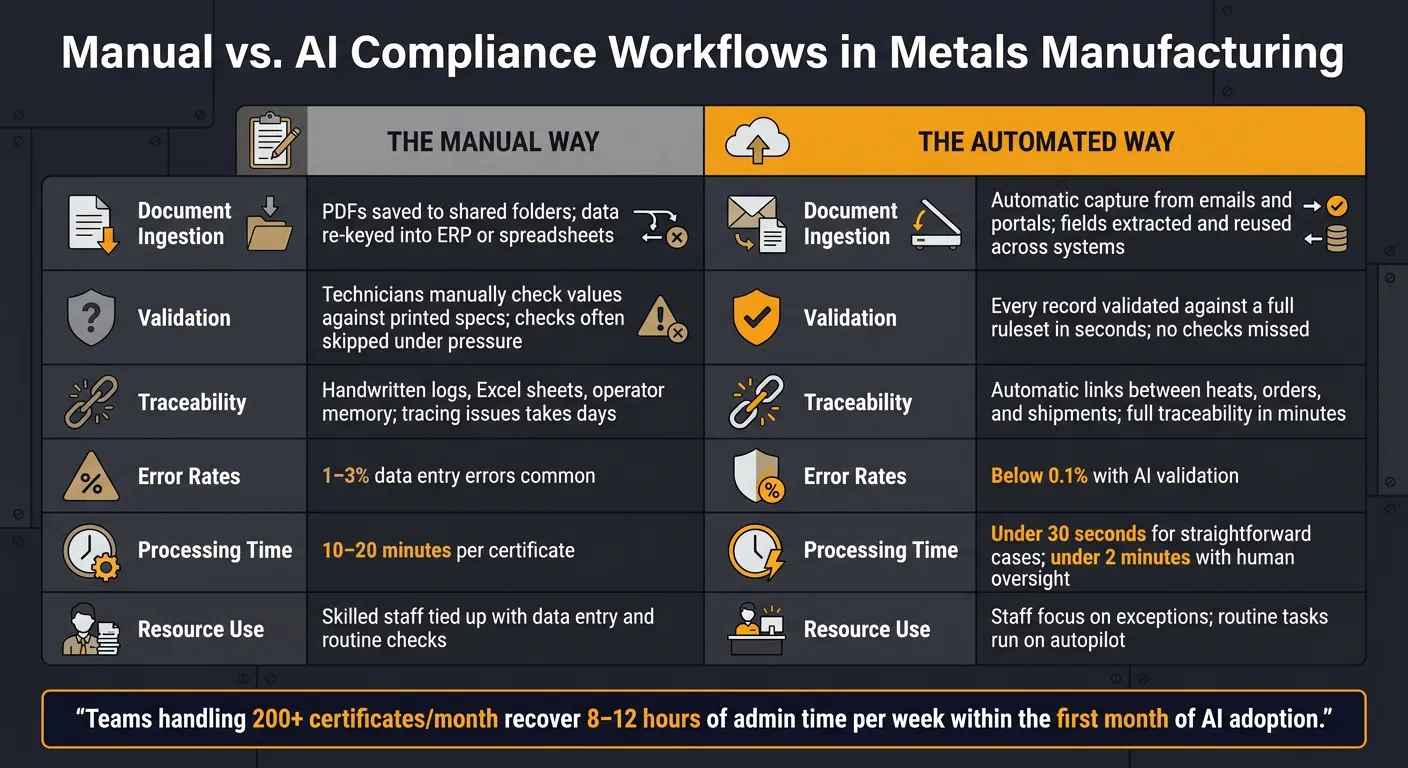
Most metals plants already have the building blocks for compliance they process is in place for mill test certificates, heat numbers, inspection logs, and process parameters. The problem? How these are handled: printed out, re-keyed, and filed away, only to be dug up during an audit. A well-run AI compliance workflow doesn’t change what you’re doing; it just eliminates the manual grind that makes the process a headache. Here’s how AI transforms those outdated steps into something far more efficient.
The End-to-End AI-Driven Compliance Workflow
Everything kicks off as soon as a document arrives. AI-powered ingestion tools take over, pulling in MTCs, certificates of conformity, and safety datasheets straight from emails, supplier portals, or ERP exports. Using OCR and intelligent document processing, the system extracts key details automatically - heat number, grade, chemical composition, mechanical properties, and standards like BS EN 10025. This eliminates the main source of errors: manual data entry.
Next, the system gets everything in order. It converts units, standardises dates (dd/mm/yyyy), and aligns supplier labels with internal codes. This ensures that certificates from multiple suppliers can be compared without confusion. Automated validation rules then step in, checking every value against grade specs, customer demands, and regulatory requirements. If a manganese percentage is borderline or a tensile strength result doesn’t meet S355JR standards, the system flags it immediately and at goods-in, not days later when the material’s already in use.
Here’s the clever bit: only the exceptions (around 20–40% of documents, depending on supplier consistency) go to a quality engineer for review. The rest pass through automatically. Once validated, the system links compliance data to works orders, machine IDs, and dispatch records, creating a connected digital trail from raw material to finished product. This doesn’t just save time - it also surfaces insights that can help you protect your margins.
GoSmarter’s MillCert Reader takes care of this entire process. During a production trial at Midland Steel Manufacturing in early 2026, the tool linked certificates to inventory across 193 jobs and 734 tonnes of material. It showed the workflow handling real production volumes without added headcount [3].
Manual vs. AI Workflows: A Direct Comparison
The difference between manual and AI-driven compliance isn’t small. Manual processes rely on people remembering to check specs, filing documents properly, and finding them again in a pinch. AI workflows, on the other hand, encode those checks once and apply them consistently, every single time.
| Aspect | The Manual Way | The Automated Way |
|---|---|---|
| Document ingestion | PDFs saved to shared folders; data re-keyed into ERP or spreadsheets | Automatic capture from emails and portals; fields extracted and reused across systems |
| Validation | Technicians manually check values against printed specs or spreadsheets; checks often skipped under pressure | Every record validated against a full ruleset in seconds; no checks missed |
| Traceability | Handwritten logs, Excel sheets, and operator memory; tracing issues takes days | Automatic links between heats, orders, and shipments; full traceability in minutes |
| Error rates | Manual data entry errors of 1–3% are common | AI with validation reduces errors to below 0.1% |
| Processing time | 10–20 minutes per certificate | Under 2 minutes with human oversight; under 30 seconds for straightforward cases |
| Resource use | Skilled staff tied up with data entry and routine checks | Staff focus on exceptions and improving processes; routine tasks run on autopilot |
“Teams handling 200+ certificates a month typically recover 8–12 hours of admin time per week within the first month of AI adoption.” [2]
This isn’t just about speed but rather consistency. Manual processes depend on whoever is doing the work that day. AI workflows apply the same rules to every document, every time. That’s the kind of reliability regulators and customers are demanding as 2027 approaches.
How to Roll Out AI Compliance Tools Without Disrupting Production
When introducing an AI production assistant on the shop floor, production managers often worry less about whether it works and more about whether it will throw everything into chaos. AI compliance tools, when rolled out properly, don’t need to cause disruption. In fact, the right approach can make the transition so smooth that production barely notices it happening.
A Phased Approach to Rolling Out AI Compliance Tools
The key to a smooth rollout is starting small and working your way up. Begin with tasks that don’t touch production lines like those admin-heavy jobs that chew through time but don’t directly affect machine settings. Think of tasks like processing mill test certificates, assembling audit evidence, or creating certificates of conformity. These are perfect starting points because they can be automated without risking production hiccups.
Here’s how a phased rollout might look for a metals manufacturer in the UK:
Phase 1 (Weeks 1–2): Start with automating the capture of mill test certificates. Use an AI tool like GoSmarter’s MillCert Reader to digitise incoming certificates. Run it in a test environment alongside your current process to make sure everything’s working properly. This “shadow mode” approach ensures no disruptions while you fine-tune the system. The MillCert Reader can be operational in just one day and integrate with your existing systems within another [2].
Phase 2 (Weeks 3–4): Once the certificate capture is running smoothly, link the data to traceability workflows. Automate connections between heats, batches, and stock records, and set up alerts for missing or out-of-spec data.
Phase 3 (Weeks 5–8): Expand into automated reporting. This includes generating audit reports and, if needed, handling carbon and CBAM reporting. From here, you can extend the system to cover more product lines or sites. Early trials have shown this approach can save a significant amount of admin time in the first month alone [3].
What to Get Right Before You Start
To avoid headaches later, make sure these essentials are sorted before you begin:
Data Quality: Standardise how grades, standards, and material codes are named across your systems. If your ERP treats “S355JR”, “S355 JR”, and “S355-JR” as separate entries, the AI will struggle to match records. A quick audit of your master data (materials, customer codes, and test plans) can save a lot of hassle.
System Integration: Don’t try to connect every system at once. Start small, linking one or two critical systems. For example, connect the AI certificate reader to your quality management system (QMS) or link reporting tools to your document management system. Older systems can often work with simple file-based exchanges like CSV or XML, which keeps things manageable for your IT team.
Process Ownership: Assign clear responsibility for each workflow you’re automating. For instance, the Quality Manager might oversee incoming certifications, while the Technical Manager handles customer-facing certificates of conformity. Clear ownership ensures exceptions are dealt with quickly and nothing falls through the cracks.
Implementation Priorities by Function
Not every compliance workflow is created equal. Some are easier to automate and deliver more immediate benefits. The table below shows where to focus first, based on the effort required versus the impact delivered:
| Function | Complexity | Value / Impact | Priority Level |
|---|---|---|---|
| Mill cert capture (goods-in) | Low – live within 1 day [2] | Very high – saves 120+ hrs/yr [3] | 1 – Start here |
| Audit reporting | Low – instant export capability | High – reduces audit prep from days to 30 minutes [2] | 2 – Early rollout |
| Heat number traceability | Medium – requires ERP export | High – eliminates recall risk | 3 – Mid-rollout |
| Cutting optimisation | Medium – 2-week trial for initial results [3] | Very high – up to 50% scrap reduction [3] | 4 – Strategic expansion |
| CBAM / carbon reporting | Medium – requires data mapping | High – avoids regulatory penalties | 5 – Regulatory phase |
Mill cert capture is the logical starting point. It acts as the control centre for everything downstream. Once that’s running smoothly, the rest of the rollout becomes much easier. For teams handling over 200 certificates a month, automating this process can recover 8–12 hours of admin time per week within the first month [2]. Reinvest that time into more critical tasks. It builds confidence in the system and makes each future phase easier to land. With these priorities in place, the next challenge is ensuring the system stays integrated and continues to improve over time.
Make Compliance Work for Your Business
By 2027, stricter environmental regulations, CBAM reporting, UK REACH obligations, and rising demands for traceability will turn outdated compliance processes into a serious liability. But as we’ve seen, compliance doesn’t have to be a burden. When done right, it can cut costs, improve quality, and free up your skilled staff to focus on what really matters.
Take digitisation as an example. Starting at the point of receipt, digitising mill certificates into a structured, searchable format simplifies everything that follows. Automatic traceability built into workflows means no more re-keying data, while audit reports, carbon summaries, and customer documentation can be generated in minutes. In one trial, this approach cut scrap by 2.5% and saved over 120 hours of admin time each year all without disrupting production [3].
The financial upside is hard to ignore. Companies adopting AI-driven automation report saving 30–50% of the time spent on compliance tasks, alongside better risk detection. McKinsey’s research on digital transformations in heavy industries shows that advanced analytics and AI can improve earnings before interest, tax, depreciation, and amortisation (EBITDA) by 3–5%, thanks to better yield, energy efficiency, maintenance, and quality.
If you’re ready to change how compliance works for you, GoSmarter’s MillCert Reader and Metals Manager tools are designed specifically for metals manufacturers. They can be up and running in a day, integrating smoothly with your current systems with no long-winded implementation projects required [2]. And if you’re looking for a no-strings starting point, GoSmarter Insights offers free tools for estimating scrap weight, cost, and carbon impact. The idea isn’t to overhaul everything at once. Start small, prove the value in one area, and expand from there. With this approach, compliance stops being a drain and starts driving efficiency and profit and all while meeting the challenges of 2027 head-on.
FAQs
What data will I need to provide for CBAM by September 2027?
To meet the requirements of the Carbon Border Adjustment Mechanism by 30 September 2027, you’ll need to submit verified data for goods imported during 2026. Here’s what you’ll need:
- Carbon emissions per product: Measured in tonnes of CO2 equivalent per tonne of goods.
- Production site details: This includes the name, address, and geographical coordinates of the site.
All emissions data must go through third-party verification, which includes an on-site inspection. Failing to provide this data means default values will be applied, with an additional 10% penalty added.
How can we plug AI certificate capture into our current ERP/QMS without disruption?
To connect AI certificate capture to your ERP or QMS without any headaches, GoSmarter offers two options: a lightweight software agent or a RESTful API. The setup is straightforward - thanks to a guided wizard, you can link it to your ERP data fields in under 30 minutes. No need to scrap your existing systems.
For flexibility, you can also export data as a CSV or integrate it through ODBC/JDBC connections. If you’re cautious about diving straight into automation, no problem. You can run the tool alongside your manual processes during the transition to ensure everything works smoothly.
How do we validate and audit AI-extracted mill cert data for third-party verification?
GoSmarter takes the guesswork out of validating mill certificate data. It automatically cross-checks AI-extracted details - like chemical compositions and mechanical properties - against the expected ranges for the specified grade and standard. If something’s off, such as mismatched heat numbers or missing impact test results, the system flags it straight away.
Every certificate is digitally tied to your inventory, purchase orders, and dispatch records, creating a searchable chain of custody that’s always ready for audits. No more scrambling through files or second-guessing your data.
Tags:
About the Author

Editor· Co-founder & Head of Product
Steph Locke is Co-founder and Head of Product at GoSmarter AI — former Microsoft Data & AI MVP building practical tools to cut paperwork and automate compliance for metals manufacturers.