Common Resource Allocation Problems and AI Solutions
- BlogSmarter AI
- Edited by Ruth Kearney
- Blog
- April 25, 2026
- Updated:
Table of Contents Show Hide
Resource allocation problems in metals manufacturing cost UK plants millions every year in avoidable scrap, missed deliveries, and excess stock. The culprits are the same on every shop floor: scrap waste, production delays, overworked teams, and disorganised supply chains. Spreadsheets and paper logs cannot keep up. They never could.
AI changes that. Tools like GoSmarter automate the hard parts — cutting plans, scheduling, and inventory tracking — so you can stop burning cash and start hitting targets.
What AI Can Do for You
- Cut scrap waste by up to 50%: Smarter cutting plans mean less material in the bin.
- Reduce delays by 40%: Real-time scheduling keeps production on track.
- Balance workloads: No more overworked shifts or idle machines.
- Fix supply chain chaos: Live inventory tracking stops over-ordering and stockouts.
Here’s how each of those problems actually gets solved.
AI Scheduling for Metals Manufacturing: Stop Reacting, Start Optimising
Material Waste: How Poor Planning Drives Up Costs
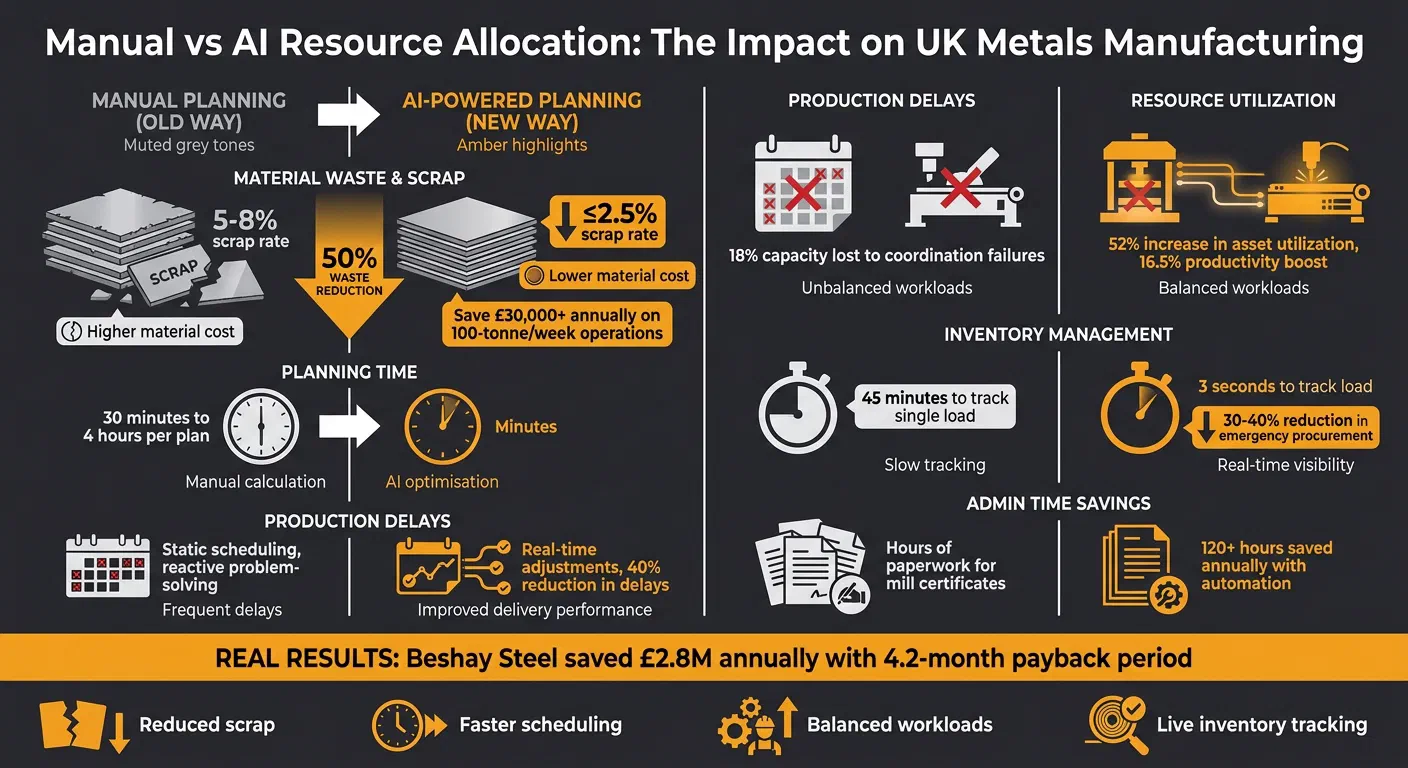
Material waste is a silent profit killer in metals manufacturing. For operations processing 100 tonnes a week, manual planning methods typically result in 5–8% waste. That’s tens of thousands of pounds lost each year. With mild steel priced between £400 and £600 per tonne and scrap fetching only 40p per pound, every wasted tonne eats directly into your margins 1.
Why does this happen? The answer lies in the limitations of manual planning. Spreadsheets churn out millions of cutting permutations, but no human can realistically evaluate them all. Ruth Kearney, CEO of GoSmarter AI, puts it bluntly:
“At 80 orders, the number of possible combinations of orders and bars is larger than any person can work through in a morning - that is not a skills gap, it is just arithmetic.” 1
The result? Inefficient cutting patterns that either leave behind waste or force operators to crack open new stock when offcuts could have done the job. Add last-minute orders into the mix, and things spiral further. Plans become outdated, offcuts go untracked, and operators end up “walking the floor” to figure out what’s actually in stock 1.
It’s not just money being wasted. In some industries, waste accounts for over 20% of total production costs 2. These inefficiencies highlight why AI is making waves in cutting and resource management.
How AI Optimisers Reduce Scrap by 50%
AI-powered cutting optimisers are rewriting the rules. Instead of relying on gut instinct or guesswork, AI analyses every possible combination to create cutting patterns that minimise waste. GoSmarter’s Cutting Optimiser, for instance, connects directly to real-time data analytics for live inventory tracking. When a rush job comes in mid-shift, its “Replan” function updates only the remaining cuts, keeping the work already done intact while ensuring efficiency 13.
The numbers speak for themselves. In April 2026, GoSmarter tested its optimiser during a two-week trial with Midland Steel — read the full case study, covering 734 tonnes of material. The results? Scrap rates were slashed by half - from 5% to 2.5% - adding tens of thousands of pounds to annual gross margins. Ruth Kearney sums it up:
“Manual planning typically wastes 5–8% of material; optimised planning targets ≤2.5%. That gap is worth tens of thousands of pounds a year on a 100‐tonne‐per‐week operation.” 1
AI doesn’t just cut waste; it also manages offcuts systematically. By tracking these leftovers digitally, AI ensures that they’re reused in future orders instead of being discarded. As GoSmarter explains:
“When your cutting plans use existing stock intelligently, you stop ordering steel you already have in the rack.” 4
With mild steel priced at £600 per tonne, saving just one tonne of scrap per week translates to over £30,000 in annual savings. There’s an environmental upside too: one tonne of steel avoided is roughly 1.85 tonnes of CO₂e that never gets emitted 4.
Here’s how manual planning stacks up against AI-optimised planning:
| Feature | Manual Planning (Spreadsheets) | AI Optimised Planning (GoSmarter) |
|---|---|---|
| Scrap Rate | 5–8% 1 | ≤2.5% 1 |
| Planning Time | 30 minutes to 4 hours 1 | Minutes 1 |
| Adaptability | Requires manual rework for every change | Instant “Replan” for remaining cuts 1 |
| Offcut Management | Often lost or unrecorded | Tracked and allocated for reuse 1 |
| Accuracy | Prone to human arithmetic errors | Mathematically provable optimum 1 |
Switching from spreadsheets to AI isn’t just about saving time - it’s about reclaiming your margins. By integrating mill certificate data with stock records and automating cut planning, manufacturers can turn hours of manual work into seconds of precise optimisation. The result? Scrap and offcut waste reduced by 20–50%, engineers freed from paperwork, and a major step towards solving the cost and efficiency challenges that have long plagued UK metals manufacturing 3.
Production Delays: The Real Cost of Poor Scheduling
Scheduling inefficiencies are like a slow leak in your operation - they silently drain profits while throwing your processes into chaos. Production delays don’t just mess up timelines; they burn through cash. When scheduling is done manually, every machine breakdown, urgent order, or unexpected absence sends planners scrambling. Hours are wasted reworking outdated schedules, and the fallout is predictable: missed deadlines, inflated overtime costs, and machines either sitting idle or running flat out.
At the heart of this chaos is static planning. Manual scheduling depends on outdated snapshots - inventory counts from yesterday, machine statuses from last week, and pure guesswork about when materials will arrive. When a machine fails or a rush order lands, there’s no quick fix. Planners either stick to the original (and now useless) schedule or toss it out and start over. Meanwhile, operators on the shop floor are left to guess which job should run next, relying on memory instead of accurate, real-time data.
Workforce imbalances make things worse. Without live updates on staff availability and skills, managers overload experienced workers while others are underused. This creates bottlenecks at critical workstations, pushing delivery dates further out. As Thiago Maia, Executive Vice President Automation, Digital and Service Solutions at SMS group, explains:
“AI is not just another tool – it’s a transformative force that redefines how we approach industrial automation… it enables us to shift from reactive operations to proactive decision-making” 5.
Inefficient schedules also come with an opportunity cost. Valuable capacity is wasted, leaving fewer resources available to take on new orders. AI changes this reactive cycle into a system of ongoing, real-time adjustments.
Where manual systems struggle, AI steps in and adapts.
How AI Schedulers Prevent Production Bottlenecks
AI-powered schedulers don’t just tweak the process - they overhaul it. Forget static spreadsheets. These systems use live data from Industrial Internet of Things (IIoT) sensors, ERP platforms, and shop floor terminals to create a digital twin of your operation. When a machine goes down or a rush order comes in, the AI recalculates instantly. It doesn’t throw out the entire schedule - it adjusts what’s already in place. What used to take hours now takes minutes, and your delivery dates are based on actual progress, not outdated estimates.
AI doesn’t just react - it predicts. Using “what-if” scenario analysis, it spots potential bottlenecks before they happen. Want to prioritise an urgent customer order? The AI shows exactly how it will affect current jobs, which machines need reassigning, and whether deadlines are still achievable - all before you commit to the change. For example, GoSmarter’s Cutting Plans integrates directly with inventory and order data, generating cutting plans that account for live stock levels and machine availability 4.
Workforce planning also gets a much-needed upgrade. AI assigns tasks based on skills and availability, balancing workloads to avoid burnout on one shift and downtime on another. It even catches material mismatches - like the wrong grade - before they disrupt production 4. The result? Smoother operations, tighter delivery timelines, and managers who can focus on strategy instead of firefighting.
| Feature | Manual Scheduling Problems | AI Scheduling Solutions |
|---|---|---|
| Update Frequency | Manual, periodic, error-prone | Real-time, automatic adjustments |
| Resource Allocation | Memory-based or static lists | Skill- and availability-based optimisation |
| Bottleneck Handling | Reactive problem-solving | Proactive identification and testing |
| Data Source | Outdated spreadsheets or paper | Live feeds from IIoT, ERP, and shop floor |
AI doesn’t mean scrapping your current systems. It works alongside your existing ERP — whether that’s Infor, Epicor, Dynamics, or Sage — without the hassle and expense of starting from scratch. Instead, it adds a layer of real-time insights and dynamic scheduling to what you already have. This shift - from hours of manual adjustments to minutes of automated planning - completely changes the game for metals manufacturers, giving them an edge in delivery performance, cost management, and resource efficiency.
Resource Imbalance: Fixing Idle Machines and Overworked Teams
When resources are spread unevenly, production suffers. Some shifts push workers to the brink with overtime, while others leave machines sitting idle. Skilled operators are overloaded, while less experienced staff end up waiting for tasks. Equipment that could be running often sits unused simply because no one knows it’s available. Why? Because data is stuck in silos. Teams waste hours chasing updates, and without live production data, planners are left guessing. This guesswork leads to coordination failures, which eat into capacity and slow everything down 6.
Take this example from an integrated steel plant. AI analysis uncovered that 18% of their effective capacity was being lost to coordination problems. The VP of Operations explained:
“We were convinced we needed a new caster to meet demand. AI analysis revealed we were losing 18% of effective capacity to coordination failures… Fixing the scheduling problem delivered the capacity we needed at a fraction of the capital cost.” - VP of Operations, Integrated Steel Plant
Demand spikes make things worse. When a rush order comes in, planners scramble to reshuffle work without a clear picture of machine and worker availability. Outdated tools only add to the chaos, creating bottlenecks in one area while leaving other machines idle. The result? Overtime costs soar, deliveries are delayed, and morale takes a hit.
How AI Distributes Resources Across Your Factory
AI steps in where traditional planning falls short, often using toolkits for smart manufacturing to bridge the gap. By pulling real-time data from sensors, Programmable Logic Controllers (PLCs), and even spreadsheets, it gives you a clear, up-to-the-minute view of your factory. This means when priorities shift, resources can be reassigned with a single click.
Advanced Production Scheduling (APS) tools use methods like Drum-Buffer-Rope (DBR) scheduling to pinpoint bottlenecks and maximise capacity. If a machine breaks down or a rush order lands, automated workflows kick in to alert maintenance teams or reshuffle tasks. AI tools also match workers to jobs based on their skills and availability, balancing workloads across the board. For instance, GoSmarter’s Cutting Plans links live inventory and order data, ensuring resource allocation adjusts in real time.
The numbers speak for themselves. In 2025, Beshay Steel in Egypt switched from reactive maintenance to an AI-driven predictive model. The results? A 47% drop in unplanned downtime, a 62% boost in Mean Time Between Failures (MTBF), and annual savings of £2.8 million - all with a payback period of just 4.2 months. Meanwhile, MachineMetrics users saw asset utilisation rise by 52% and productivity climb by 16.5%. APS tools alone can improve Overall Equipment Effectiveness (OEE) by 3%, recovering about 30 minutes of lost production time each day.
AI also transforms capacity planning. What once took hours is done in seconds. These systems manage and adjust thousands of production tasks in real time, turning wasted capacity into a competitive edge.
Supply Chain Problems: Inventory and Lead Time Issues
When materials don’t show up on time - or when you’re unknowingly sitting on stock you already have - everything starts to fall apart. Production schedules get thrown off, quality takes a hit, and costs spiral out of control. The main culprit? No real-time visibility of your stock. Without it, planners are left guessing what’s actually available versus what’s already tied up in other jobs. This blind spot leads to panic buying - paying inflated prices for materials that might already be sitting in your yard, buried in offcuts or lost in outdated records. These last-minute fixes not only blow up your budget but also disrupt production further.
Here’s the kicker: live inventory tracking can cut emergency procurement by 30–40% 7. That’s real money saved. And it’s not just about cost - manual processes for tracking inventory waste an incredible amount of time. Before digitisation, JSW Steel took 45 minutes just to track a single load. After implementing AI-driven automation? It now takes 3 seconds.
But shortages aren’t the only headache. Excess stock is just as bad - it eats up working capital and clutters your yard. Offcuts often go untracked because no one knows they’re there, so planners over-order “just in case.” This piles on waste and drives costs even higher. Add unpredictable lead times into the mix, and you’re stuck with rushed deliveries or ordering too much, just to avoid running out.
How AI Forecasting Prevents Stockouts and Overstocking
AI doesn’t just fix material waste and scheduling headaches - it completely changes how supply chains are managed. With real-time inventory control, AI eliminates the guesswork, so you’re not stuck with too much or too little stock.
AI-driven systems give you a clear, live view of every piece of material - whether it’s coil, plate, bar, or tube. Forget manual stock counts. GoSmarter tracks what’s allocated to live orders and what’s actually available, so you’re never caught off guard. Need to reorder? Automated alerts kick in when stock dips below a set threshold, stopping production delays before they even start 7.
It gets better. Tools like MillCert Reader digitise mill certificates in seconds, pulling heat numbers, grades, and mechanical properties straight into your inventory records 8. No more digging through outdated files during audits or despatch. This automation can save over 120 hours of admin work every year 38. And those offcuts you thought were scrap? AI tracks them as live stock, so planners can use what’s already there instead of ordering more. That means less waste, better yield, and fewer headaches 7.
Make the Numbers Work: AI That Pays for Itself
Metals manufacturing is hard enough without fighting your own software. AI removes the guesswork from operations: scrap waste, scheduling chaos, idle machines, and supply chain blind spots. By automating the drudge work — reading mill certs, tracking offcuts, balancing loads — your engineers get back to the work that actually matters. No more spreadsheets. No more gut decisions.
Purpose-built solutions like GoSmarter are designed to slot into your existing ERP systems, giving you real-time insights into inventory, orders, and production schedules. On-Time In Full (OTIF) delivery rates improve because planners are working from live data, not yesterday’s guesswork. Most teams are up and running in just a few hours. Many manufacturers see the subscription pay for itself within the first quarter through reduced scrap and admin costs 910. It’s as simple as logging in, uploading your inventory and orders, and getting started. If your team can handle a smartphone, they can handle GoSmarter 9.
Want to see the numbers? The Business Case Calculator lets you estimate savings in scrap, staff hours, and emergency procurement 9. It’s a no-nonsense way to give your finance team a clear picture of the return on investment before you even begin. Plus, with GoSmarter acting as a single source of truth for production, quality, compliance, and sales, everyone has access to the same up-to-date information. No more chasing updates. No more guessing delivery dates. Just one reliable system for everyone.
Cut out the manual grind and move towards faster, cleaner, and more predictable operations. Visit GoSmarter to see how AI can reshape your factory floor.
FAQs
What data does AI need to optimise cutting and reduce scrap?
How quickly can AI reschedule when a machine fails or a rush order arrives?
Will GoSmarter work with my existing ERP and spreadsheets?
What are the most common resource allocation problems in metals manufacturing?
How long does it take to see results from AI-powered resource allocation?
Further Reading
1: Shop Floor Planning Software for Metals Manufacturers | GoSmarter
2: Waste Reduction in Manufacturing: AI for Predictive Sustainability - Bronson.AI
3: GoSmarter AI | AI Tools for Metals Manufacturing
4: Shop Floor Planning Software for Metals | GoSmarter
5: How AI is transforming the steel, aluminum, and copper industry - SMS group GmbH
6: Operations Management for Metals Manufacturers | GoSmarter
7: Metals Inventory Management Software | GoSmarter
8: Mill Certificate Automation for Metals | GoSmarter
9: Operations Management for Metals Manufacturers | GoSmarter
About the Author

Editor· Co-Founder & CEO
Ruth Kearney is Co-Founder and CEO of GoSmarter AI — driving commercial growth and strategic partnerships to help metals manufacturers adopt AI and digital tools that actually deliver on the shop floor.