AI Augmentation for Metals: Fix What Generic ERP Can’t
- BlogSmarter AI
- Edited by Ruth Kearney
- Blog
- April 2, 2026
- Updated:
Table of Contents Show Hide
Metals manufacturers waste hours every week digging through spreadsheets and chasing missing mill certs. Generic Enterprise Resource Planning (ERP) systems handle back-office admin, not the chaos of metals production.
The problem? Generic systems can’t handle the nitty-gritty: heat code traceability, mill certs, or scrap rate calculations. The result? Endless workarounds, costly customisations, and wasted hours that could’ve been spent on production.
The fix? A metals-focused Artificial Intelligence (AI) operations layer that sits on top of your ERP. GoSmarter automates mill cert processing, improves traceability, and optimises scrap planning without forcing a rip-and-replace project.
What you get:
- Save hours with automated mill cert processing and linked inventory records.
- Cut waste with AI-driven cutting plans and scrap tracking.
- Stay compliant with built-in heat code traceability and audit-ready documentation.
Here’s how to sort the mess and get your factory back on track.
Metals ERP Capability: Native vs Add-On Tools
The video below shows what this looks like in practice for a metals workflow.
What Makes Metals Manufacturing Different?
Metals manufacturing isn’t your average production process. It needs tight material traceability, strict regulatory compliance, and near real-time shop-floor visibility. Every batch, from raw material to finished product, must be tracked. Quality records need to stay intact for years, ready for audits long after the product ships. Try doing all that with a generic ERP system. It’s like using accounting software to track chemical compositions — the tool was never built for it.
The complexity goes far beyond inventory management. Metals manufacturers deal with multiple production lines, complex batch tracking, and rigorous quality standards. These aren’t optional extras; they’re non-negotiable. When a customer queries a steel beam’s origin five years after installation, you need instant access to heat codes, mill certificates, and production records. A generic ERP isn’t built for that.
Common Challenges in Metals Operations
Daily operations in metals manufacturing are no walk in the park. Every coil, billet, or casting must be tracked with pinpoint accuracy. This means linking raw materials to work-in-progress and finished goods in real time. Without this, you’re flying blind.
Real-time monitoring isn’t just nice to have - it’s essential. Metals manufacturers rely on Internet of Things (IoT) devices and sensors to monitor machine performance in real time. Most generic ERPs don’t integrate with them. Delayed bottleneck detection means wasted time and lost money.
Quality control and compliance add another layer of pressure. Metals manufacturers must meet ISO 9001 and sector-specific standards. That means built-in tools to track defects, inspections, and certifications. Generic platforms treat quality as an afterthought. Teams end up bolting on third-party tools or paying for custom modules. Clear cost tracking also exposes savings: better raw-material tracking can cut inventory carrying costs by 14% 1. Meanwhile, production-focused systems have helped smaller factories recover their investment in as little as 18 months 1.
Why Generic ERP Systems Fall Short
Generic ERP systems are designed for back-office tasks: finance, HR, basic logistics. They’re not built for mill certificate tracking, scrap rate calculations, or heat code traceability. Getting them to do any of that requires heavy customisation. And as Deltek puts it, this process is “cumbersome”, “costly”, and “time-intensive” 2.
Even after deployment, the headaches don’t stop. Maintaining the custom code needed for metals-specific tracking often demands a dedicated IT team and ongoing investment 2. Industry-specific cloud solutions are live in weeks. Traditional generic ERP implementations, loaded with customisation, can take over a year and rack up millions in consulting fees 2. Deltek sums it up:
Implementing a traditional ERP system can be a cumbersome undertaking that requires significant upfront capital. It typically involves oversight from an organisation’s IT staff and often requires a dedicated team of specialists for ongoing maintenance and upgrades 2.
Generic systems also struggle with supply chain visibility and production complexity unless they’re heavily modified. This is a dealbreaker for metals manufacturers operating in highly regulated environments, where enhanced safety measures and specific security requirements are the norm 2.
The bottom line? Generic ERP platforms cover the basics. They force metals manufacturers into a tough choice: settle for inadequate tools or sink money into endless customisation. Specialised cloud ERP comes with metals-specific features out of the box. Faster to deploy. Easier to maintain. No expensive workarounds. For most manufacturers, that’s a straightforward call.
Cloud ERP for Metals vs Generic ERP: Scalability Differences
In metals manufacturing, scalability is survival. Production demand shifts constantly: customer orders, seasonal trends, global supply chain disruptions. When demand surges, your ERP needs to adapt instantly. No massive IT bill, no waiting weeks for new servers. That’s where cloud ERP built for metals wins.
Scaling for Fluctuating Production Volumes
Generic on-premise ERP systems treat scaling as an expensive headache. Need to ramp up production for a big contract? That often means buying extra servers, hiring IT staff, and waiting for everything to be set up. It’s a slow, costly process that doesn’t match the fast-paced reality of modern manufacturing.
Cloud ERP systems, on the other hand, handle this automatically. As Deltek explains:
As ERP usage fluctuates throughout a quarter or year… a cloud provider manages the ups and downs in capacity. The customer’s IT team doesn’t need to worry about allocating additional server or storage resources 2.
When production peaks, the cloud system quietly boosts computing power and storage in the background. When demand eases off, it scales back down. Costs adjust in real-time through licence-based scaling - add users during a busy season, remove them when things settle. This flexibility ensures you’re only paying for what you need, when you need it.
By cutting down on IT overheads, cloud ERP systems free up resources, allowing manufacturers to unlock new savings across operations and respond quickly to market changes. Cloud ERP implementations run in weeks or months, not years 2. Your competitors will still be in planning meetings while you’re live. That agility matters whether you’re running one site or ten. Implementing toolkits for smart manufacturing can further streamline these processes.
Global Supply Chain Integration
Scaling isn’t just about production - it’s also about keeping global operations in sync. Using a generic ERP to manage a global supply chain is like trying to direct an orchestra when half the musicians can’t hear you. Data gets trapped in silos across different sites, leaving you guessing about inventory levels in one location while another struggles with shortages.
Cloud ERP systems designed for metals manufacturing solve this by centralising everything. Whether you’re running facilities in the UK, the US, or Asia, everyone works from the same real-time data. This ensures accurate inventory management and smooth coordination across your entire network. As Brian Hildebrand, CIO at ECI Solutions, explains:
Cloud ERP solutions scale quickly to match evolving business needs, from adding new users to expanding into new markets or service lines 3.
Generic systems often fall short here because they weren’t built for 24/7 global access. Cloud ERPs let your team access production data securely from any device. Whether that’s on the shop floor in Sheffield or checking orders while on the road. And when regulations change, cloud systems update automatically, helping you stay aligned with audit and quality requirements without manual patches and IT fire drills 3.
Industry-Specific Features GoSmarter Delivers as an AI Layer
Generic ERPs handle basic inventory. They can’t handle the demands of metals manufacturing: chemical compositions, heat codes, compliance documentation. That’s where they fall short. GoSmarter’s AI augmentation layer is built for exactly these challenges.
Mill Certificate Management
Every metal shipment comes with a mill certificate - a PDF detailing the material’s chemical composition, mechanical properties, and heat code. In a generic ERP, managing these certificates often turns into a chaotic mess. Quality teams end up typing data from scanned PDFs into spreadsheets by hand. They attach files to random folders. Then they pray they can find the right document when an auditor calls months later.
An AI augmentation layer like GoSmarter eliminates this headache without replacing your ERP. MillCert Reader uses AI to pull heat numbers, grades, and material properties straight from PDF certificates, including scanned ones. Each record links automatically to the corresponding inventory entry. As MIE Solutions puts it:
Manufacturing ERP systems allow metal fabricators to define and track inventory with unlimited physical, dimensional, and chemical attributes 4.
Every bar, plate, or coil ends up with its certificate linked directly to its inventory entry. Compliance documentation is ready for audits at a moment’s notice. One production manager using GoSmarter’s MillCert Reader reported saving dozens of hours a year that were previously spent on manual data entry. And with this process streamlined, manufacturers can focus on improving material efficiency, including cutting down on scrap waste.
Scrap Rate Optimisation
In a generic ERP, scrap is just another inventory write-off - a vague total that doesn’t tell you much. For metals manufacturers working with long products like rebar or structural sections, scrap is a direct hit to profits. Especially when planning relies on guesswork.
An AI layer on top of your ERP tackles this problem head-on with cutting optimisation. It generates precise cutting plans in minutes, helping planners maximise material use and minimise offcuts. Take Midland Steel, for example: in production trials with GoSmarter Cutting Plans, the team cut scrap rates by 50%. That’s not just a small tweak - it’s a major shift in how materials are used and costs are controlled. Plus, the added traceability ensures that every scrap of material, from raw stock to remnants, is accounted for.
Heat Code Traceability
For metals manufacturers, traceability isn’t optional - it’s a regulatory must. Standards like ISO 9001 and other sector-specific quality standards require detailed records tracking every step, from raw materials to finished products. Generic ERPs might offer basic lot or serial tracking, but that’s nowhere near enough for audit compliance in this industry.
GoSmarter’s AI layer adds full heat code traceability to your current ERP setup. Each inventory item is tagged with its heat code, which is automatically linked to the original mill certificate, production job, and customer order. As MIE Solutions explains:
Specialised ERP features allow viewing remnants (drops) alongside stock material in the same inquiry, providing complete visibility into available resources 4.
If a quality issue arises, you trace it back to the source material in seconds. You pull up the right certificate. You prove compliance without digging through folders or spreadsheets. For manufacturers working under strict quality systems, this feature is often the difference between passing an audit smoothly or facing costly penalties.
Cost and Implementation Comparison
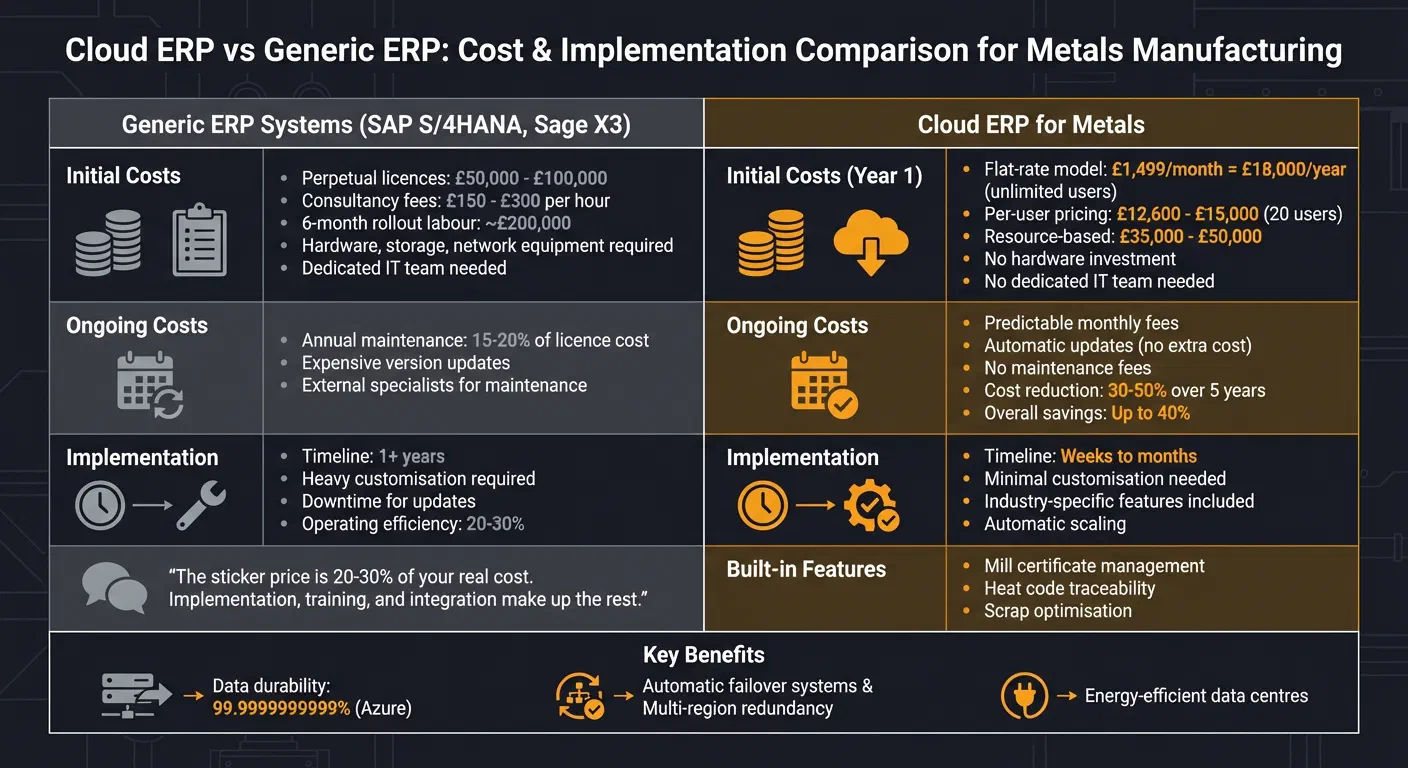
When it comes to cloud ERP versus generic systems, the differences in cost and speed of implementation are hard to ignore. Let’s break it down.
Total Cost of Ownership
Generic ERP systems like SAP S/4HANA or Sage X3 come with hefty price tags. Perpetual licences alone can set you back between £50,000 and £100,000, with consultancy fees ranging from £150 to £300 per hour. A typical six-month rollout? Expect to shell out around £200,000 in labour. As one expert bluntly put it:
The sticker price is 20–30% of your real cost. Implementation, training, and integration make up the rest 5.
Cloud ERP systems tailored for metals manufacturing offer a much more predictable - and often lower - pricing structure. Flat-rate models typically cost around £1,499 per month, including implementation, bringing the first-year total to roughly £18,000 for unlimited users. Other options, like per-user pricing, range between £12,600 and £15,000 for 20 users, while resource-based plans land somewhere between £35,000 and £50,000 for the first year. These solutions come with industry-specific features like mill certificate management, heat code traceability, and scrap optimisation baked in, keeping ongoing costs consistent 5.
After year one, the gap widens. Generic systems tack on annual maintenance fees of 15–20% of the original licence cost and often require pricey updates whenever the vendor releases a new version. In contrast, cloud ERP systems roll out updates automatically - no downtime, no surprise bills. Flat-rate pricing also means you can scale without worrying about costs spiralling out of control, unlike per-user models, which can become painfully expensive as your team grows.
The savings don’t stop there. Faster deployments mean you start reaping the benefits sooner.
Deployment Speed and Complexity
Generic systems often come with a laundry list of upfront requirements - hardware, storage, network equipment, and a dedicated IT team. Even after all that, you’ll likely need external specialists for ongoing maintenance 2.
Cloud ERP systems built for metals manufacturing? They’re up and running in weeks or months, not years. Thanks to their purpose-built design, they require minimal customisation. Features like mill certificate management, heat code traceability, and scrap optimisation are ready to go out of the box, especially in specialised tools like MillCert Reader and Cutting Plans.
The software-as-a-service model eliminates the need for hardware investment or an in-house IT team, so you see results faster.
Why an AI Augmentation Layer Is the Better Choice
An AI augmentation layer on top of your current ERP gives you the upside of modern cloud tooling without a rip-and-replace project. With GoSmarter, you scale faster, cut admin drag, and tighten traceability from day one.
You still get cloud-level benefits without replacing your ERP. Costs drop when you automate cert handling, cut admin time, and optimise scrap with better planning. Security and uptime stay strong because GoSmarter runs on modern cloud infrastructure with built-in redundancy 6. Your team gets better data and faster decisions, without a full migration project.
You Don’t Need to Replace Your ERP
GoSmarter is not a replacement cloud ERP. It works as an AI augmentation layer alongside your existing systems, whether that’s Sage, Infor, Epicor, or plain old spreadsheets. Start with mill cert automation. Add cutting optimisation when you’re ready. The whole thing runs in your browser. No server installation, no IT project, no six-month wait.
If a full Manufacturing Execution System is still on your radar rather than an augmentation layer, our Cloud MES comparison breaks down real total cost of ownership against on-premise.
The business case adds up fast. When inventory data is accurate, over-ordering drops. When mill certs link to stock records automatically, your On-Time In Full (OTIF) delivery performance stops being a fire drill. When engineers stop chasing paperwork, they spend more time on production.
The manufacturers who pull ahead won’t be the ones who bought the most expensive ERP. They’ll be the ones who stopped drowning in admin first.
Get Started with GoSmarter
GoSmarter is a vertical AI software-as-a-service platform for metals manufacturers. It augments your existing ERP and workflow tools instead of replacing them. You can start with one tool and expand as you need. Most teams are live within a day.
- MillCert Reader: Reads and extracts data from mill certificate PDFs, including scanned ones, and links them directly to your inventory records.
- Cutting Plans: Generates precise cutting plans in minutes. Midland Steel cut scrap rates by 50% in production trials.
- Metals Manager: Keeps your inventory, jobs, and commitments in one place. Teams save over 10 hours a month on admin.
All three tools integrate directly with your existing ERP. No rip-and-replace required. Ready to see what this looks like for your team? See pricing or book a demo.
FAQs
Can a metals cloud ERP replace spreadsheets for traceability?
How does cloud ERP handle heat codes and mill certs end-to-end?
What’s the quickest way to cut scrap rates using ERP data?
Do I need to replace my existing ERP to benefit from an AI augmentation layer for metals?
Further Reading
1: Generic ERP vs Manufacturing ERP: What’s the Real Difference? | ABC Info Soft
2: Cloud ERP vs. Traditional ERP: Which is Best for Your Business?
3: Cloud ERP vs On-Premises ERP: Business Comparison Guide
4: The Essential ERP Features for Metal Fabricators and Manufacturers - MIE Solutions
5: Manufacturing ERP Pricing: What to Expect in 2026 | WorkCell
6: Cloud ERP vs On-Premise ERP: Which Saves More Money? - MIE Solutions
About the Author

Editor· Co-Founder & CEO
Ruth Kearney is Co-Founder and CEO of GoSmarter AI — driving commercial growth and strategic partnerships to help metals manufacturers adopt AI and digital tools that actually deliver on the shop floor.