BS EN 1090 and NSSS Compliance: Stop Drowning in Structural Steel Paperwork
- Steph Locke
- Blog , Learning
- March 19, 2026
- Updated:
Table of Contents Show Hide
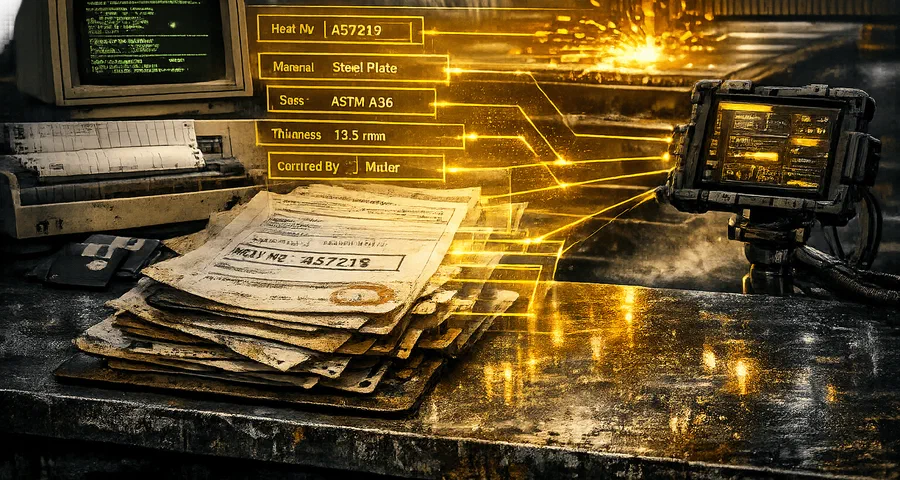
BS EN 1090 and the National Structural Steelwork Specification (NSSS) require traceable, auditable mill certificate records from every structural steel fabricator working on UK building projects. The standards dictate what you build, how you document it, and what happens when an auditor shows up. What they all have in common — and what nobody talks about enough — is the mountain of mill certificate paperwork they generate. Traceability from mill to site. EN 10204 test reports matched to every element. Audit records that have to survive for years.
GoSmarter’s MillCert Reader was built for exactly this situation. Here is what the standards actually require, where the manual process breaks down, and how automation fixes it.
What BS EN 1090 Actually Demands From You
BS EN 1090 is the European standard governing the execution of structural steel and aluminium structures. It has two parts that matter for fabricators.
BS EN 1090-1: CE Marking and Factory Production Control
BS EN 1090-1 covers conformity assessment and is the CE marking regime for structural components. To CE-mark a structural steel component, you need to show your FPC system can trace material from incoming steel to finished product.
That means your documentation system must show:
- Which mill produced the source steel
- What EN 10204 certificate covers it
- Which heat number applies to which finished element
- That the declared material properties were verified before fabrication
If you cannot produce that chain of evidence, you do not have a CE mark that means anything. And without a CE mark, you cannot legally place structural components on the UK market.
BS EN 1090-2: Technical Requirements and Execution Classes
BS EN 1090-2 specifies the technical requirements for steel structure execution, including material requirements by execution class. The classes run from EXC1 (simple structures, low consequence of failure) through to EXC4 (structures with extreme consequences of failure such as major bridges, nuclear facilities).
For execution classes EXC2, EXC3, and EXC4 which cover the vast majority of commercial and public building projects the standard requires:
- EN 10204 Type 3.1 certificates for all structural steel (and Type 3.2 for EXC4 or where the contract specifies)
- A documented system for identifying and tracing material from receipt through to the final structure
- Records of incoming inspection, including verification that received material matches the stated certificate
- Traceability marking maintained on steel elements throughout fabrication
The 3.1 and 3.2 distinction matters. A Type 2.2 test report — the kind that comes with commodity steel without any mill reference to a specific order is not sufficient for EXC2 and above. You need a 3.1 certificate which is issued by the mill’s own testing representative, referencing the specific heat number of the material you received.
Getting that documentation is one problem. Proving you have it and that the values on it are what they say they are is another.
NSSS Piles On — Here Is What Else You Need
The National Structural Steelwork Specification (NSSS) is published jointly by the BCSA and the Steel Construction Institute. It shows up in almost every structural steelwork contract in the UK.
The NSSS does not replace BS EN 1090-2 it works alongside it, adding UK-specific requirements for building projects. It requires:
- Mill test certificates (to EN 10204) for all structural steel, submitted to the client or their representative before or alongside delivery
- Traceability of material from the mill certificate to the fabricated element, maintained through marking, records, or both
- Records retained for the duration of the project and a period after practical completion. This is often ten years minimum under construction contract terms.
That last point is the one that bites fabricators. You are not just managing certificates for the duration of a job. You are maintaining a document library that needs to remain searchable, auditable, and provably complete for a decade. Folders of PDFs with no metadata are not going to cut it when a building owner asks for the traceability records on an element in ten years’ time.
Here Is Where the Manual Process Falls Apart
Here is what happens in most fabrication shops today.
Steel arrives with a certificate. Someone files it in a folder named by job or heat number. The element gets marked with a heat number or piece mark. When the time comes to compile documentation for the client, someone manually matches the element marks to the certificates. They scan the PDFs. They email them across. If the client queries a yield strength value, someone pulls the certificate and checks it manually against the spec. Every time. For every query.
This works, after a fashion. It worked in 2005. It barely works now. Until the folder structure breaks down. Until someone files the cert under the wrong job. Until the certificate for heat A321 gets confused with the certificate for A231. Until a client asks for every cert for elements from a specific mill. And there is no way to answer that without opening every single file.
Frequently Asked Questions
Does GoSmarter produce documentation that satisfies BS EN 1090-2 directly?
What certificate types does GoSmarter support?
Does it work with handwritten or scanned certificates?
We use multiple steel grades across our projects. Can GoSmarter handle that?
How long does it take to set up?
What does BS EN 1090 require for mill certificates?
What is the difference between EN 10204 Type 3.1 and 3.2?
How long do I need to keep mill certificate records under NSSS?
What happens if I cannot produce a mill certificate during an audit?
How do I automate BS EN 1090 traceability?
Stop Guessing, Start Knowing
BS EN 1090 and NSSS do not ask for a best-effort filing system. They ask for demonstrable traceability and a verifiable audit trail. The manual approach gets close enough until it does not which is usually at the worst possible moment, when a project is complete and someone is questioning the documentation.
GoSmarter turns mill certificate management from a compliance risk into a compliance asset. The data is there. The audit trail is there. The validation records are there. When the question comes, you have the answer.
Start Your Free Trial →Or see what GoSmarter does with your actual certificates — bring one along to the call.
Go Deeper
- Mill Certificate Automation for Metals Manufacturers — the complete guide to what GoSmarter does with mill certs
- GoSmarter MillCert Reader product page — features, pricing, and first-month offer
- GoSmarter vs Generic OCR/IDP Tools for Mill Certificates — why metals-specific AI wins
- Mill Test Certificate Management: Common Questions Answered — EN 10204 explained
GoSmarter is made by Nightingale HQ, a UK-based AI company building practical tools for metals manufacturers since 2018.
About the Author

Co-founder & Head of Product
Steph Locke is Co-founder and Head of Product at GoSmarter AI — former Microsoft Data & AI MVP building practical tools to cut paperwork and automate compliance for metals manufacturers.