Norwegian Green Steel Group In the Running to Buy Collapsed UK Producer
- BlogSmarter AI
- Edited by Ruth Kearney
- Blog
- February 20, 2026
- Updated:
Table of contents Show Hide
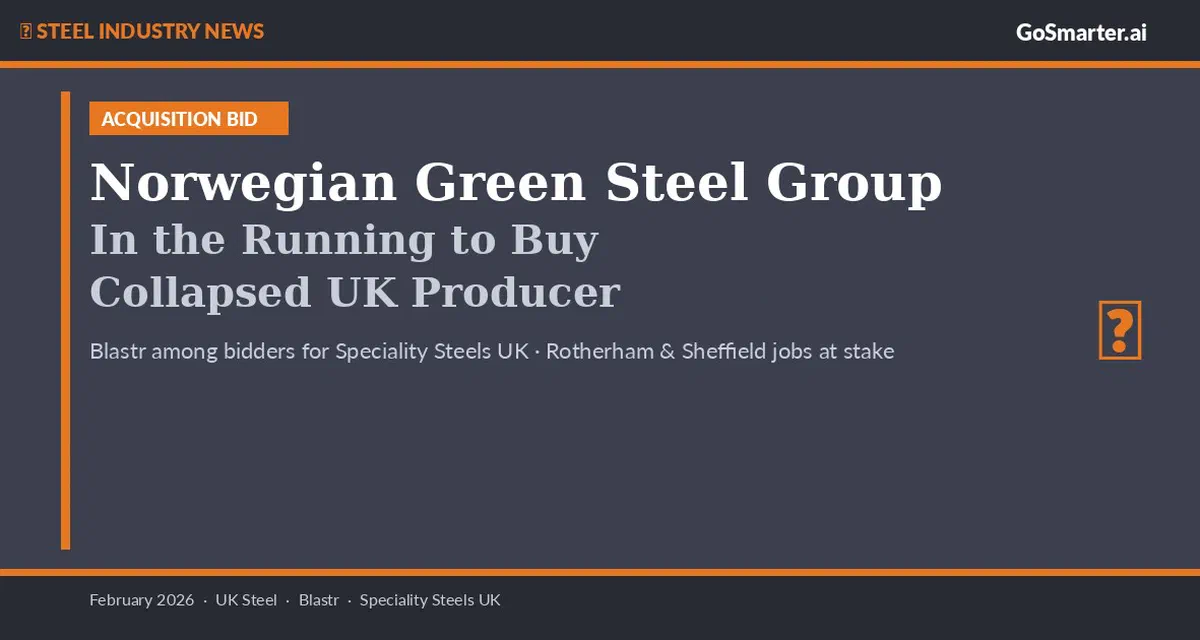
Over 1,000 steel workers in Rotherham and Sheffield are watching the clock. Speciality Steels UK (SSUK) — Britain’s third-largest steel producer — went into compulsory liquidation six months ago after a judge called it “hopelessly insolvent.” Now a Norwegian green steel outfit called Blastr fancies its chances of picking up the pieces.
Who’s Blastr?
Blastr is led by Mark Bula, who’s spent his career dismantling the old blast furnace playbook. He cut his teeth at Nucor and Big River Steel — two companies that showed the industry electric arc furnaces weren’t just a nice idea, they were the future. Blastr’s pitch is a low-cost, low-emission steel chain in the UK and Europe. Ambitious? Yes. Doable? They seem to think so.
There’s also a rumour they’re thinking about moving their holding company from Norway to the UK. Whether that’s contingent on landing SSUK or not, nobody’s saying. What we do know is they’ve brought in Evercore to advise on the bid — the same investment bank the UK government hired to figure out what to do with the wider steel mess.
The Competition
Blastr isn’t the only one circling. Two other bidders have thrown their hats in:
- Arabian Gulf Steel Industries (AGSI) from Abu Dhabi — reportedly sniffing around the National Wealth Fund for financial backing.
- 7 Steel UK — backed by Czech energy tycoon Pavel Tykac, who already owns the Allied Steel and Wire site in Cardiff.
Whitehall insiders reckon a preferred bidder could be named in the next few weeks. But there’s still a real chance none of them can get the financing sorted, so don’t hold your breath.
The Bigger Picture
SSUK’s fate is playing out against a grim backdrop for the British steel industry. The government has been firefighting on multiple fronts:
- It took control of Scunthorpe-based British Steel in April to stop the furnaces going cold — a bailout that’s already cost taxpayers millions with no clear end in sight.
- It funded £500 million in grants Tata Steel to get an electric arc furnace running at Port Talbot — a project that won’t be done until 2027 and will need to re-recruit for when it comes online.
The industry is going through a generational shift whether it likes it or not. The question is who comes out the other side.
What They’re Saying
The Insolvency Service told us earlier this month: “We can confirm that the Official Receiver continues to progress bids for the sale of Speciality Steel UK. This process is ongoing, with the aim to complete a sale at the earliest opportunity.”
Blastr? No comment.
Source: Sky News
FAQs
Why does steel sector consolidation matter for the wider industry?
Steel manufacturing is a capital-intensive, cyclical industry where scale matters enormously for competitiveness. Fixed costs — blast furnaces, rolling mills, energy infrastructure — are substantial and largely unavoidable. Variable costs, particularly raw materials and energy, respond to global markets. The ability to compete in this environment requires either very high volume, very high specialisation, or both.
Consolidation in the steel sector — acquisitions, mergers, and strategic relocations — is a response to these economics. When a producer like Blastr acquires a UK steel manufacturer, or when a manufacturer considers strategic relocation, the decisions are driven by the search for the right combination of cost structure, market access, and production capability to compete in a market that rewards those who get these decisions right.
What are the technology implications of consolidation?
For manufacturers considering or undergoing acquisition or strategic relocation, the technology and data implications are significant and often underestimated. What data systems will the combined operation need? How will the acquired business’s data be integrated into the acquirer’s systems? What compliance and traceability requirements apply to the new corporate structure?
GoSmarter’s tools — and particularly the digital review and roadmap process — are relevant to manufacturers navigating these transitions. Having a clear picture of the current technology landscape, the data assets the business holds, and the integration requirements of a combined operation is valuable intelligence in an M&A context.
What is the UK steel sector's strategic position?
The UK steel sector is at a critical juncture. With major production facilities under pressure from global competition and the energy costs associated with the UK’s energy market, strategic decisions about which production capabilities to retain, where to invest, and how to position UK steel production for a decarbonising market are actively being made.
GoSmarter’s focus on sustainability reporting, carbon tracking, and material efficiency is directly relevant to this strategic context. Manufacturers and acquirers who can demonstrate their carbon position and their efficiency relative to benchmarks are better positioned in a market where sustainability performance is increasingly a commercial requirement.
About the Author

Editor · Co-Founder & CEO
Ruth Kearney is Co-Founder and CEO of GoSmarter AI — driving commercial growth and strategic partnerships to help metals manufacturers adopt AI and digital tools that actually deliver on the shop floor.